HM Procurator General and Treasury Solicitor: Annual Report and Accounts - 2025-26
Published 18 June 2026

© Crown copyright 2026
This publication is licensed under the terms of the Open Government Licence v3.0 except where otherwise stated. To view this licence, visit nationalarchives.gov.uk/doc/open-government-licence/version/3 or write to the Information Policy Team, The National Archives, Kew, London TW9 4DU, or email: psi@nationalarchives.gov.uk.
Where we have identified any third party copyright information you will need to obtain permission from the copyright holders concerned.
This publication is available at https://www.gov.uk/government/publications/hm-procurator-general-treasury-solicitor-annual-report-and-accounts-2025-26/hm-procurator-general-and-treasury-solicitor-annual-report-and-accounts-2025-26
For the year ended 31 March 2026
Accounts presented to the House of Commons pursuant to section 6(4) of the Government Resources and Accounts Act 2000
Annual Report presented to the House of Commons by Command of His Majesty
This is part of a series of departmental publications which, along with the Main and Supplementary Estimates 2026-27 and the document Public Expenditure: Statistical Analyses 2025, present the government’s outturn for 2025-26 and planned expenditure for 2026-27
© Crown copyright 2026
This publication is licensed under the terms of the Open Government Licence v3.0 except where otherwise stated. To view this licence, visit: www.nationalarchives.gov.uk/doc/open-government-licence/version/3
Where we have identified any third party copyright information you will need to obtain permission from the copyright holders concerned
This publication is available at: www.gov.uk/official-documents
Any enquiries regarding this publication should be sent to us at:
Government Legal Department,
102 Petty France,
London
SW1H 9GL
ISBN 978-1-5286-6501-8
E03605785
06/26
Performance Report
The Performance Report includes a summary of the department's purpose and activities (the Overview) followed by a review of progress against performance measures and an overview of significant events that have taken place during the financial year (the Performance Analysis). A summary of risks and mitigating actions is set out in the Governance Statement on page 30.
Overview
Introduction
The Office of the Solicitor for the affairs of His Majesty’s Treasury (the Treasury Solicitor) was incorporated as a corporation sole by the Treasury Solicitor Act 1876. Since then the nature of the work of the Government Legal Department has expanded greatly and today it provides a comprehensive legal service to other government departments in England and Wales and is one of the largest legal organisations in the country. The Treasury Solicitor is also Head of the Government Legal Profession.
The Government Legal Department (GLD) is a non-ministerial government department and executive agency. In addition to being responsible for all financial activity within GLD, the Treasury Solicitor is also responsible for financial matters at the Attorney General’s Office (AGO) and His Majesty’s Crown Prosecution Service Inspectorate (HMCPSI).
The financial statements on pages 69 to 85 cover all these bodies and have been prepared under an accounts direction issued in December 2025 by HM Treasury (HMT), in accordance with section 5(2) of the Government Resources and Accounts Act 2000. The Accounts demonstrate the resources that have been consumed in delivering the department’s objectives. They have been prepared in accordance with the guidance set out in the Government Financial Reporting Manual (FReM).
Entities within the Accounts
These Accounts present the consolidated results for 2025-26 of the:
-
Government Legal Department (GLD)
-
Attorney General’s Office (AGO)
-
HM Crown Prosecution Service Inspectorate (HMCPSI)
The governance structure of the entities presented in the Accounts is set out in the Governance Statement on page 21.
Government Legal Department
GLD’s purpose is to help the government to govern well, within the rule of law.
GLD’s vision is to be:
-
An outstanding legal organisation, committed to the highest standards of service and professionalism.
-
A brilliant place to work, where we can all thrive and fulfil our potential.
The principal activities of GLD are as follows:
-
Advisory - GLD has expert advisory teams specialising in the work of their client department, providing risk-based and solution-focused legal advice. GLD lawyers are crucial throughout the lifecycle of government policy. They advise on and draft legislation and work to take it through Parliament; advising departments and ministers on the legal implications of government policy, and ensuring it stands up to Parliamentary scrutiny.
-
Litigation - GLD’s litigation group is comprised of four divisions: Defence and Security, Home Office and Immigration, Justice and Development and the Covid Inquiry Team. Litigation lawyers handle high profile public and private law litigation for central government departments, security agencies, and other public bodies; including UK military and security bodies. The divisions also undertake inquest, inquiry and injunctive work for GLD’s clients. GLD litigation teams are currently handling approximately 27,000 pieces of litigation.
-
Employment - As one of the largest employment law practices in the country, GLD’s Employment Group advise on complex and fast-moving legal areas including: claims for unfair dismissal and relating to discrimination; pay issues; contractual issues and terms and conditions; and whistleblowing claims. The TUPE (Transfer of Undertakings Protection of Employment) and Transactional Hub provides specialist advice on employment and pensions issues to help manage employment-related risks, while the Industrial Hub advises on trade union matters and industrial action. The National Security Hub manages advice work and litigation claims requiring a knowledge of security vetting or the management of protected material.
-
Commercial - The Commercial Law Group (CLGp) provides expert advice on transactional, litigation, property and advisory commercial legal matters. Transactional and advisory teams advise government departments on their commercial work, ensuring value for money in the purchase of goods and services for the public sector. The litigation and dispute resolution team supports the government in high profile legal claims, and saves taxpayer money by pursuing alternative forums (mediation, adjudication). The GLD Property Hub provides strategic commercial property advice, and supports government departments and agencies via training on property issues.
-
The Statutory Instrument (SI) Hub is the GLD’s specialist statutory instrument drafting service and Centre of Excellence for secondary legislation, with 30 lawyers drafting secondary legislation for all of GLD’s client departments. The SI Hub Centre of Excellence makes a major contribution to helping lawyers across GLD improve the quality of their drafting, through its structured SI training programme, the annual SI conference and drafting guidance.
-
GLD also has 17 Centres of Excellence; formal networks of lawyers who have recognised expertise in an area of law or legal practice that has relevance across a number of GLD divisions and teams.
-
The Chief Operating Officer (COO) Group is responsible for developing the department’s strategy and plans and leading and coordinating programmes of activity across the department to deliver cost effective legal and support services that address the needs of our clients and staff. The Finance, Operations and Digital Directorate covers finance, procurement, facilities management, security, digital, data and cyber, business continuity and resilience and records management services. The Strategy, People and Culture Directorate covers human resources (HR), governance and strategy, planning and performance, business management, communications and engagement, and project delivery. The Legal Operations Directorate leads on developing the department's integrated Legal Knowledge, Capability and Innovation Strategy and on building a future-fit legal environment through legal process improvement, introduction of legal project managers, effective use of Panel Counsel and the Legal Panel for Government, automation, and innovative technologies, including AI. The directorate also includes the Bona Vacantia Division, which on behalf of the Crown’s Nominee, administers the estates of people who die intestate and without relatives entitled to inherit and collects the assets of dissolved companies and failed trusts in England, Wales and Northern Ireland, except in the Duchies of Cornwall and Lancaster. The costs of the division are recovered from the estates and assets it administers. The proceeds of bona vacantia are accounted for in the Crown’s Nominee Accounts and separately notified to Parliament as prescribed in the Treasury Solicitor (Crown’s Nominee) Rules 1997 (SI.1997/2870).
Attorney General’s Office
The Attorney General’s Office (the AGO) is a ministerial department serving the Attorney General and the Solicitor General (the Law Officers for England and Wales).
The Law Officers are the government’s chief legal advisers, helping the government to deliver policy in the context of upholding and promoting the rule of law, and perform a visible and effective role as leaders in the domestic and international legal community.
The Law Officers also have sponsorship responsibilities in relation to the Government Legal Department (GLD), Crown Prosecution Service (CPS), the Serious Fraud Office (SFO), and His Majesty's Crown Prosecution Service Inspectorate (HMCPSI). They take a close interest in any matters of criminal justice policy and practice bearing on the role of the prosecutors. In addition, they perform a range of civil and criminal law litigation functions exercisable in the public interest, including referring sentences which may be unduly lenient to the Court of Appeal, bringing proceedings for contempt of court, and authorising applications for fresh inquests. The Attorney General is chief legal adviser to the government and is accountable to Parliament for all the Law Officers’ Departments. The Attorney General is also head of the Bar of England and Wales and exercises a leadership role in relation to the wider legal professions. The Attorney holds, ex officio, the separate office of Advocate General for Northern Ireland.
The AGO’s Business Plan set out its priorities for 2025-26 and is published on gov.uk. The plan is reviewed to ensure it is based on ministerial priorities, and business requirements. The AGO’s objectives focused on:
-
Helping deliver government policy in the context of the Law Officers’ constitutional role in relation to the Rule of Law.
-
Defining and delivering the Law Officers’ public interest functions in the interests of the administration of justice.
-
Sponsoring the Law Officers’ Departments and connecting the work of the prosecutors with wider criminal justice policy.
-
Ensuring a high performing and efficient Attorney General’s Office which meets its legal and performance obligations.
HM Crown Prosecution Service Inspectorate
The Crown Prosecution Service Inspectorate Act 2000 created the role of HM Chief Inspector of the Crown Prosecution Service. The Chief Inspector is appointed by, and reports, to the Attorney General. The Chief Inspector also fulfils the function of Chief Executive of HM Crown Prosecution Service Inspectorate. Since it was established, the Inspectorate’s statutory remit has been broadened to include the Serious Fraud Office (ASBCP Act 2014 – section 149 commencement).
The purpose of the Inspectorate’s work is to inspect the operation of the Crown Prosecution Service (CPS) and Serious Fraud Office (SFO) and to provide independently assessed evidence to allow others to hold those agencies to account thereby encouraging improvement. HMCPSI can undertake inspection by invitation.
HMCPSI’s vision
We are part of the solution to improving the Criminal Justice System through high quality inspection.
-
We hold the CPS and SFO to account for what they deliver (we make recommendations that drive improvement)
-
Victims will be at the heart of inspection (where we can, we will use victim experience in our inspection)
-
Using our 25 years of experience we will help public prosecutors improve (their legal casework)
-
Inspection will identify and spread best practice
Performance Analysis
Performance Measures
The following performance measures were agreed with HMT. These all relate to GLD.
| Performance Measure | Outturn 2025-26 | Outturn 2024-25 |
|---|---|---|
| To improve client satisfaction rating: | ||
| Percentage Good or Excellent | 93% | 95% |
| Average score (Excellent: 10, Good: 5, Acceptable: 0, Poor: -5, Unacceptable: -10) | 6.85 | 7.99 |
| To recover from clients the full operating costs of chargeable services | Achieved | Achieved |
| To retain Lexcel accreditation | Achieved | Achieved |
Client Satisfaction
Our aim is to achieve a 95% or above rating in our annual survey of client satisfaction, and while 93% of our clients rated our services as Good or Excellent this was a 2% reduction on last year. Using the performance score developed in previous years, we scored 6.85 a 1.14 point reduction on last year. This year we have reviewed elements of our client feedback system, including this survey which is one element. This year’s survey highlights areas for us to continue to focus on in terms of our client service and our systems for gathering feedback.
Lexcel
To maintain Lexcel accreditation. Lexcel is the Law Society's legal practice quality mark for practice management, compliance and client care, and GLD’s contentious teams have been Lexcel accredited since November 2006. Following an interim audit conducted in early December 2025 by a new independent Lexcel auditor, GLD’s Litigation, Employment and Commercial Law Directorates were successful in meeting the requirements of the Lexcel Standard, leading to reaccreditation by The Law Society. The auditor noted several areas of practice in which GLD exceeded the standard.
Full cost recovery
GLD is primarily funded from the fees charged to clients for legal services. Fee rates are set in accordance with the HMT publication - Managing Public Money - and are designed to recover the costs incurred by the department. Financial performance is monitored throughout the year, and on a quarterly basis, GLD undertakes a formal exercise to forecast the financial outturn for the year. GLD's commitment to its clients is to ensure that they benefit from better than budgeted financial performance and if the forecasting exercise at the end of quarter 2 predicts a significant surplus, GLD evaluates the underlying reasons, consider the financial risks for the remainder of the year and assess whether a fee reduction should be made in-year.
Full cost recovery was achieved in 2025-26 and, after a cost of capital adjustment, a surplus of £10m (2024-25: £15m) was generated after rebates of £6m (2024-25: £12m). In setting fees and budgets for the year, key factors include the level of litigation demand, the level of staff turnover, the level of investment required to deliver our objectives and the use of third parties to support legal work. In determining these and other financial factors, GLD takes account of the factors underlying the previous year's financial performance and the likelihood of them recurring. GLD also continually review and refine fee setting and forecasting processes to minimise the level of surplus that may arise.
Significant events during the financial year
Government Legal Department
In the GLD Business Plan 2025-26, the GLD Board set out the key legal and strategic priorities GLD would focus on to help the government deliver for citizens, including examples of how the department's work contributes towards the government's 5 Missions.
By way of case studies and commentary, the GLD Annual Report and Accounts 2025-26 provides substantial details of significant events and achievements. It is available at: www.gov.uk/gld.
Attorney General’s Office
AGO’s Rule of Law team focusses on the Attorney General’s priority to build a rule of law culture across society and support its future resilience, championing its tangible benefits in our day to day lives. This year, the team have led communication and engagement initiatives across Whitehall and beyond, notably on youth engagement and public legal education. Highlights include new teaching resources on law and rights co-designed with young people, the launch of the Youth Ambassadors Programme and high-profile events with international stakeholders.
In light of the Government’s Plan for Change, the Prime Ministers ambition for a Productive and Agile State, and the undertaking to make efficiency savings following the Spending Review, the Attorney General has decided to revitalise the approach taken across the Law Officers’ Departments on communications, policy and strategy work. With the aim of improving ministerial accountability and organisational coherence in service of the public, the Law Officers’ Departments will share resources and work far more closely together in these areas. With these changes being implemented with no additional cost to the taxpayer, the goal remains ultimately to increase the effectiveness and efficiency of all of the Law Officers’ Departments.
The AGO have conducted its annual Board Effectiveness Evaluation and reviewed the Board Operating Framework. Recommendations have been accepted and implemented.
Government Internal Audit Agency have completed an audit of the department’s financial controls of its Public Interest work. Recommendations cut across AGO and GLD, analysis and implementation of suggested changes will begin in Q4 of 2025-26.
Key Performance Indicators
The Law Officers continue to provide legal advice to government directly and, indirectly, ensure the delivery of quality legal services via the Government Legal Department. Due to the Law Officers’ Convention, which prohibits the disclosure outside of government of the fact or content of Law Officer involvement, it is not possible to provide public metrics of this aspect of the Law Officers’ work. GLD performance is covered in its return.
Our public interest work continues to grow, and we have seen referrals to AGO of unduly lenient sentence cases for consideration by the Law Officers increase, as illustrated by the following table:
| 2025 | 2024 | |
|---|---|---|
| Referrals | 1,506 | 1,223 |
| In scope | 784 | 831 |
Our consents to prosecute and contempt of court referrals have continued to grow, reaching 236 in 2025 for consents, an increase of 45 from 2024 (191). In addition, there have been 966 requests for consent to prosecute (submitted to AGO in 36 groups) for offences under the Terrorism Act 2000 flowing from the Home Secretary’s decision to proscribe Palestine Action as a terrorist organisation. Contempt of Court referrals were 39 in 2024 rising 114% in 2025 to 83 referrals.
During 2025 the AGO has run 33 recruitment campaigns and successfully onboarded 38 new people into the AGO including legal trainees and short term secondees. Each new starter has received an induction pack, participated in an induction event which are held monthly, and had introductory conversations with the Director General and Director.
HM Crown Prosecution Service Inspectorate
Anthony Rogers was appointed as fifth Chief Inspector in February 2025, and this year also saw HMCPSI celebrating 25 years since its inception.
HMCPSI delivered a full programme of inspection and published twelve reports.
-
An inspection of early advice and pre-charge decision making in adult rape cases. Published July 2025
-
A follow-up inspection of the recommendations made in the 2023 Report: CPS Handling of Complaints. Published July 2025
-
CPS Direct – An inspection of the quality and timeliness of charging decisions made by the CPS out-of-hours service. Published September 2025
-
Area Inspection Programme Phase 3 – CPS Yorkshire & Humberside. Published September 2025
-
A follow-up inspection of the inspection recommendations made in the 2020 joint inspection, evidence-led domestic abuse prosecution. Published October 2025
-
Area Inspection Programme Phase 3 – CPS Cymru-Wales. Published in January 2026
-
An inspection of the CPS’s approach to prosecuting crimes against older people. Published March 2026.
-
Composite Report of the phase three inspections of CPS Yorkshire and Humberside and CPS Cymru/Wales. Published March 2026.
-
An inspection of the CPS’s approach to handling knife crime. Published March 2026.
In partnership with the HMICFRS, HMCPSI jointly published one report.
- Joint case building by the police and CPS. Published July 2025
HMCPSI are permitted to carry out inspections outside of its statutory remit by invitation. We carried out two inspection by invitation in this year:
-
An inspection of the legal casework in the Health & Safety Executive. Published November 2025
-
A follow-up inspection for the quality of casework in the Service Prosecuting Authority. Published December 2025
Risk
GLD risks are aligned with the risk categories in HM Treasury’s risk management guidance – “The Orange Book" and have been agreed by the GLD Board.
The AGO has adopted the Orange Book approach to risk management, which has been developed alongside partners in Government Legal Department. Strategic risks and mitigating actions are discussed at each Executive Board, together with quarterly deep dives to ensure risk is managed effectively.
The HMCPSI principal risks are managed by its Management Board.
Details of principal risks, and plans and mitigations in respect of these risks are set out in the Governance Statement on page 30.
Future Development
Government Legal Department
Delivery of the GLD Business Plan in 2026-27 will see GLD progress its strategic ambitions in the third year of its strategy (2024-27). GLD will build on its previous success expanding national offices, strengthening deployment of collaborative tools and technologies, and enhancing both leadership capabilities and the offer to GLD people.
Further details about these plans will be set out in GLD's 2026-27 Business Plan on gov.uk.
Attorney General’s Office
In response to the Cabinet Office Correspondence review the AGO will procure an e-case system to manage correspondence across the department, working closely with Law Officer Departments and the Cabinet Office.
The department will continue work across the Law Officers’ Departments to improve effectiveness and efficiency, and follow through and, if necessary, deepen the plans to improve work on policy, strategy and communication functions.
AGO has rolled out AI usage to all staff during the year and are encouraging its day-to-day usage in a range of approved tasks and exploring where further testing or expansion can be set in motion.
The 2026-27 Annual Report and Business plan will be produced for the start of the new fiscal year and will be published on gov.uk.
HM Crown Prosecution Service Inspectorate
HMCPSI will continue to provide evidence for others to hold the CPS and SFO to account in order to encourage improvement in the performance of the prosecution services. It will work with the inspected agencies to identify and promote good practice and continue to undertake a robust follow-up process.
HMCPSI will also continue to help other jurisdictions with advice, assistance and the sharing of best practice when invited to do so and when resources allow. During this period, we have engaged with teams from Albania, Kenya and Ireland.
This year we used our “by invitation” powers to inspect the Health & Safety Executive, the Service Prosecuting Authority and have started an inspection of the Criminal Cases Review Commission which will report in the next financial year.
Further details are shown in HMCPSI’s 2025-26 Business Plan, available at: hmcpsi.justiceinspectorates.gov.uk/report/hmcpsi-business-plan-2025-26/
Sustainability Performance
All departments are required to participate actively in developing action plans to achieve and report their performance against the ‘Greening Government Commitments’ (GGC) and to report on Task Force on Climate-related Financial Disclosures (TCFD).
A summary of the department’s performance and action taken in 2025-26 to improve sustainability is provided in the Sustainability Report at Annex A (page 86).
Complaints to the Parliamentary Ombudsman
There were no complaints upheld in respect of GLD, the AGO or HMCPSI.
Performance in responding to correspondence from the public
GLD does not normally receive correspondence from members of the public since it conducts the majority of its business with other government departments. When it does receive such correspondence, it normally relates to the way cases have been handled or people feeling they were treated unfairly. GLD received 232 Freedom of Information (FOI) requests, responding to 90% within the statutory deadline (2024-25: 188 FOI received, responding to 91% within the statutory deadline).
The AGO has seen a significant increase in correspondence from members of parliament, in 2025 the AGO responded to 245 MP letters (2024 - 139), answering 71.9% (172) within the deadline (2024 - 73%). The AGO received 396 FOI requests in 2025-26; 93.84% were responded to within the statutory deadline. This equates to a 54.89% increase in requests, and a 6.84% increase in timeliness. (2024-25: 235 FOI received, responding to 87% within the statutory deadline).
HMCPSI does not normally receive correspondence from members of the public as its business relates entirely to the inspection of the CPS and SFO. Any letters received tend to be complaints about interaction with the Criminal Justice System and are rarely matters where HMCPSI can intervene or assist. HMCPSI received 12 FOI requests, and they were all dealt with within the statutory deadline (2024-25: 12, all responded to within the statutory deadline).
Financial Results
In delivering its wide range of legal services to its clients, legal and strategic policy advice and support to the Law Officers, and inspection and assessment of prosecution services, the department spent £439.8m (2024-25: £386.8m). After taking into account income of £439.2m (2024-25: £393.0m), the net resource requirement for 2025-26 was net expenditure of £0.6m (2024-25: £6.2m net income), £12.8m less than the sum approved by Parliament in the 2025-26 Supplementary Estimate for HM Procurator General and Treasury Solicitor (2024-25: £14.5m less than the sum approved by Parliament).
Total operating income was £439.2m (2024-25: £393.0m). GLD's income from legal fees and charges to clients increased this year to reflect demand for legal services - £360.2m (2024-25: £330.7m). Other income streams were: £69.6m from the recovery of disbursements incurred in providing legal services to clients (2024-25: £54.2m); £5.0m was recovered from the Crown’s Nominee (2024-25: £4.9m) and other income of £4.3m including subscription services was received (2024-25: £3.2m).
GLD is primarily funded from the fees charged to clients for its legal services whereas AGO and HMCPSI are funded by the Parliamentary vote. Full cost recovery was achieved by GLD. A surplus of £10m was generated (2024-25: £15m). The surplus has primarily been driven by more efficient delivery of legal services and short term delays in investment in GLD legal operations and development of a new legal practice management system.
Taxpayers' Equity is £30.9m at 31 March 2026 (£21.6m at 31 March 2025) comprising total assets of £108.4m (non-current assets of £31.0m, trade and other receivables of £69.2m, and cash of £8.3m); and current and non-current liabilities of £77.5m (trade and other payables, lease liabilities and provisions). Further details are in the Notes to the Accounts.
PES (2021) 03 requires departments to include an annex disaggregating the financial results and staff numbers by entities within the consolidation boundary. These requirements have been met through the Staff report (page 46) and Note 2 to the financial statements.
Comparison of Estimate and Outturn
GLD underspent by £13m against its voted funding, generating an overall surplus against full cost recovery. The surplus has primarily been driven by more efficient delivery of legal services and short term delays in investment in GLD legal operations and development of a new legal practice management system.
The AGO overspent against budget by £0.7m, mainly relating to an increase in staffing levels to implement the Law Officer Departments Review recommendations. This overspend has been covered through a virement from GLD.
HMCPSI underspent their budget marginally by £23k.
The department underspent its net cash requirement by £8.3m, due to movements in working capital.
The capital budget was underspent by £8.5m mainly due to lower capitalisation of leases and lower expenditure on information technology.
Reconciliation of Resource Expenditure between Estimates, Accounts and Budgets
| £m | 2025-26 | 2024-25 |
|---|---|---|
| Net Resource Outturn - Estimates | 0.6 | (6.2) |
| Net Operating Expenditure / (Income) - Accounts | 0.6 | (6.2) |
| Resource Budget Outturn - Budget | 0.6 | (6.2) |
| Of which | ||
| Departmental Expenditure Limits | 1.2 | (6.3) |
| Annually Managed Expenditure | (0.6) | (0.1) |
Douglas Wilson KC (Hon) OBE
Accounting Officer
3 June 2026
Accountability Report
The Accountability Report includes a corporate governance report, a remuneration and staff report and a parliamentary accountability and audit report. These sections reflect financial reporting and parliamentary accountability reporting requirements.
Corporate Governance Report
Directors’ Report
Directors
The Governance Statement on page 19 includes the ministerial titles and names of ministers who had responsibility for the department for the year, the name of the permanent head of the department and the composition of the GLD Board. Management matters in the AGO are the responsibility of the Director General and HMCPSI is led by the Chief Inspector, who also fulfils the function of Chief Executive.
Register of interests
No directorships or other significant interests, which may have caused a conflict with their management responsibilities, were held by any Board Members. Note 16 to the Accounts includes related party interests identified.
Personal data related incidents
All government departments are required to publish information about any personal data related incidents, which have to be reported to the Information Commissioner. There was one personal data incident requiring GLD notification to the Information Commissioners Office in 2025-26.
Audit
The Accounts are audited by the National Audit Office (NAO) on behalf of the Comptroller and Auditor General. The NAO also audit the Crown’s Nominee Accounts administered by the department’s Bona Vacantia Division. The auditors provide no further assurance or other advisory services. We did not pay any remuneration to the NAO for non-audit work. The notional audit fee for the audit was £187k (2024-25: £106k).
Statement of Accounting Officer’s Responsibilities
Under the Government Resources and Accounts Act 2000, HMT has directed HM Procurator General and Treasury Solicitor to prepare, for each financial year, Resource Accounts detailing the resources acquired, held or disposed of during the year and the use of resources by the department during the year. The Accounts are prepared on an accruals basis and must give a true and fair view of the state of affairs of the department and of its income and expenditure, Statement of Financial Position and cash flows for the financial year.
In preparing the Accounts, the Principal Accounting Officer is required to comply with the requirements of the Government Financial Reporting Manual and in particular to:
-
observe the Accounts Direction issued by HMT, including the relevant accounting and disclosure requirements and apply suitable accounting policies on a consistent basis;
-
make judgments and estimates on a reasonable basis;
-
state whether applicable accounting standards as set out in the Government Financial Reporting Manual have been followed and disclose and explain any material departures in the Accounts;
-
prepare the Accounts on a going concern basis; and
-
confirm that the Annual Report and Accounts as a whole is fair, balanced and understandable and take personal responsibility for the Annual Report and Accounts and the judgments required for determining that it is fair, balanced and understandable.
HMT has appointed the permanent head of the department as Principal Accounting Officer of the department.
In addition, the Principal Accounting Officer has appointed HM Chief Inspector, Anthony Rogers, as Accounting Officer for HMCPSI, to be accountable for that part of the department’s Accounts relating to HMCPSI and Douglas Wilson KC (Hon) OBE, Director General of the AGO, as Accounting Officer for AGO, to be accountable for that part of the department's Accounts relating to AGO. These appointments do not detract from the head of department’s overall responsibility as Accounting Officer for the department’s accounts.
The responsibilities of an Accounting Officer, including responsibility for the propriety and regularity of the public finances for which the Accounting Officer is answerable, for keeping proper records and for safeguarding the department’s assets, are set out in Managing Public Money, published by HMT.
As Accounting Officer, I have taken all the steps that I ought to have taken to make myself aware of any relevant audit information and to establish that the department’s auditors are aware of that information. So far as I am aware, there is no relevant audit information of which the auditors are unaware.
Governance Statement
The Office of the Solicitor for the affairs of His Majesty’s Treasury (the Treasury Solicitor) was incorporated as a corporation sole by the Treasury Solicitor Act 1876.
The Government Legal Department (GLD) is a non-ministerial department and was established as an Executive Agency on 01 April 1996. Ministerial oversight and accountability to Parliament lies with the Attorney General. The HM Procurator General and Treasury Solicitor leads the Department, in the roles of Permanent Secretary and Chief Executive.
The Treasury Solicitor is accountable to the Attorney General for the running of GLD; and as Chief Legal Adviser to government, the Attorney has a close interest in the legal advice and legal services being provided to government by GLD and the wider Government Legal Profession (GLP). An interim Framework Agreement governs the relationship between GLD and the Law Officers and the Attorney General’s Office.
Ministers
The ministers who had responsibility for the department during the year were:
-
The Rt Hon Lord Richard Hermer KC, Attorney General
-
Lucy Rigby KC MP, Solicitor General to 6 September 2025
-
The Rt Hon Ellie Reeves KC MP, Solicitor General from 6 September 2025
Accounting Officer System Statement
As Principal Accounting Officer of HM Procurator General and Treasury Solicitor, I am personally responsible for safeguarding the public funds for which I have been given charge under the name of the HM Procurator General and Treasury Solicitor Estimate. This includes responsibility for GLD, AGO and HMCPSI. To help me ensure I am fulfilling my responsibilities as an Accounting Officer, this Governance Statement also describes the accountability system in place, and the relationship between GLD, the AGO and HMCPSI.
To support me in discharging my responsibilities, there is a framework of delegated authority in place. The GLD Board also supports me. Management matters in the AGO are the responsibility of the Director General and HMCPSI is led by the Chief Inspector, who also fulfils the function of Chief Executive. Both the Chief Inspector HMCPSI and the Director General AGO have been appointed as Accounting Officers for HMCPSI and AGO respectively. In accordance with Managing Public Money, this relationship is set out in writing. The Director General, AGO and the Chief Inspector HMCPSI meet the Principal Accounting Officer regularly and each provides an annual assurance report. The AGO Director General and AGO officials meet the Law Officers regularly to provide high quality legal and strategic policy advice and support. The HMCPSI Chief Inspector meets regularly with the Law Officers to provide assurance on the practices of the CPS and SFO.
The department enters into contracts with third party suppliers in the normal course of business. There are no significant contracts. GLD administers the Attorney General’s Panel Counsel. The Attorney General maintains four panels of junior counsel to undertake civil and EU work for all government departments. There is also a Public International Law Panel to undertake such work on behalf of government. These are in addition to any standing counsel, the Senior Treasury Counsel Group, and the First Treasury Counsel, Sir James Eadie KC. There are three London Panels (an A Panel for senior juniors, a B Panel for middle juniors, a C Panel for junior juniors) and a regional panel. The size of each panel is determined by need. All government departments and agencies of government departments must use the Panels. Working with the Crown Commercial Service, GLD has also reviewed how external legal services are purchased from private sector law firms and has put in a place a Legal Panel for Government.
AGO has an Executive Board made up of the Director General, Director and Deputy Head of Office, and Deputy Directors. The board sits monthly and provides governance, oversight and strategic leadership to the AGO, and is collectively responsible for delivering the AGO Strategic Objectives. The board is underpinned by a Board Operating Framework and Terms of Reference.
The Chief Inspector is appointed by the Attorney General and is a public appointee appointed for a fixed term. The Chief Inspector acts independently of the Attorney General and of the Government. The operational relationship between the Attorney General and the Chief Inspector is set out in a protocol agreed between the Law Officers (the Attorney General and Solicitor General) and the Chief Inspector. In line with the protocol, the Chief Inspector has established and chairs a Management Board made up of the Chief Inspector, the Deputy Chief Inspectors and senior leaders in the organisation (all direct-reports to the Deputy Chief Inspectors). The Board function is advisory and supervisory. The Board meets every two months.
GLD Board and sub-committees
The GLD Governance structure at the reporting period date is set out below:
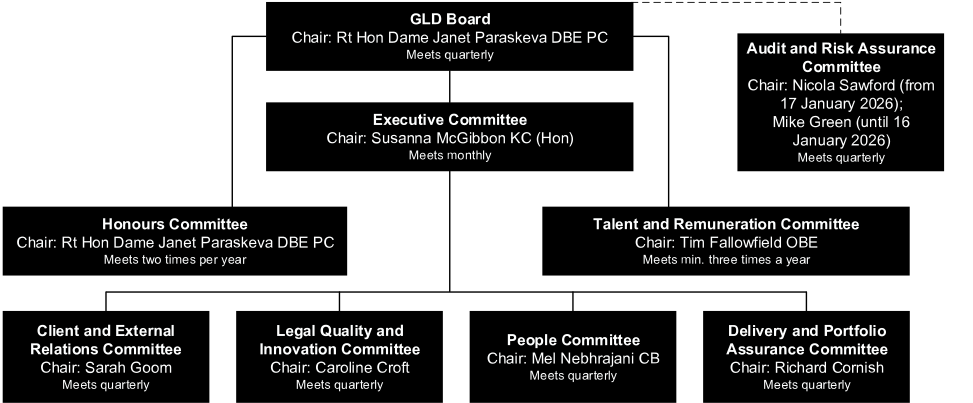
GLD Board
Chair: The Rt Hon Dame Janet Paraskeva DBE PC, Lead Non-Executive Board Member
The GLD Board provides collective strategic leadership to the Department, setting the overall vision and strategic direction for the organisation and to ensure the delivery of GLD’s strategic aims and objectives through long-term business and financial planning, and through the 2024-27 GLD Strategy.
The Board advises the Treasury Solicitor in providing leadership, as Chief Executive and Permanent Secretary of GLD, as Accounting Officer, and in their accountability to the Attorney General. It is supported by the Executive Committee and its sub-committees. The Audit and Risk Assurance Committee, the Honours Committee, and the Talent and Remuneration Committee are sub-committees of the Board and provide assurance. The Board operates collectively, holding the Executive to account for the leadership and outcomes of the Department.
The Board is supported by the Board’s sub-committees which comprise of the Executive Committee, the Audit and Risk Assurance Committee, the Honours Committee, and the Talent and Remuneration Committee.
The Board meets quarterly and met four times in 2025-26.
Changes made during the reporting period
In January 2026, the Board established a new composition (via the recruitment of a new Non-Executive Board Member and ARAC Chair replacing Mike Green whose tenure ended on 16 January 2026).
Committee Membership
Current committee membership is drawn from GLD’s Executive (relevant to expertise), and Non-Executive members. The Lead Non-Executive Board Member is independent Chair of the Board.
Board Members
Membership of the GLD Board from 01 April 2024 to 31 March 2025 was as follows:
Executive members:
Susanna McGibbon KC (Hon), Permanent Secretary, Treasury Solicitor and Chief Executive
Richard Cornish, Director General Chief Operating Officer
Carmel Thornton, Finance, Operations and Digital Director
Ex-officio member:
Douglas Wilson KC (Hon) OBE Director General, Attorney General's Office
Non-Executive Board Members:
The Rt Hon Dame Janet Paraskeva DBE PC
Mike Green (until 16 January 2026)
Tim Fallowfield OBE
Nicola Sawford (from 17 January 2026)
Non-Executive Board Members
The Rt Hon Dame Janet Paraskeva DBE PC, Lead Non-Executive Board Member
Dame Janet was Chief Executive of the Law Society from 2000 to 2006, preparing it for the advent of the Legal Services Act 2007 by establishing separate regulatory functions for the Solicitors Regulation Authority (SRA) and the Office for Legal Complaints (OLC).
She has since served as First Civil Service Commissioner, been an independent member of the Consumer Council for Water, a Non-Executive Director of the Serious and Organised Crime Agency, Chair of the Child Maintenance and Enforcement Commission, and Chair of the Appointments Commission for the States of Jersey. She also serves as a trustee of the charity Contemporary Applied Arts, as Vice Chair of the Games Rating Authority, Chair of Primary Eye Care Services, and is Chair of Council for Licenced Conveyancers, the Construction Skills Certification Scheme, and the Southern Co-op.
Dame Janet was made a Privy Councillor to assist in her role as a member of the Detainee Inquiry established by the Prime Minister in 2010.
Mike Green, Non-Executive Board Member
(until 16 January 2026)
A Fellow of the Institute of Chartered Accountants in England and Wales and a graduate of the London School of Economics, Mike qualified as a chartered accountant with what is now KPMG and spent 11 years with the audit practice before a 20-year career in Commercial Television. He has held senior finance roles at TVS Television Limited and Carlton Communications plc and was involved in the Carlton/Granada merger which formed ITV plc. Following the merger, Mike moved to ITV and ultimately held the role of Deputy Group Finance Director. He also represented ITV on a number of joint venture boards in the UK and internationally.
Currently Mike is a Director, Audit Committee Chair and a member of the Service Quality Committee at Anchor Hanover, a housing association specialising in older people’s housing and operating over 100 care homes. Mike is also a Trustee of the Royal Television Society, a charity advancing public education in the practice, technology, art, and science of television. He was also a Non-Executive on the Board and committees of an NHS Foundation Trust for 10 years.
Tim Fallowfield OBE, Non-Executive Board Member
Tim retired from Sainsbury’s in 2024 having joined as Company Secretary and General Counsel in 2001 and being appointed to the Operating Board in September 2004. Tim was responsible for governance and risk management, leading the Corporate Services Division comprising Legal and Regulatory, Information Security and Cyber, Safety, Shareholder Services, Insurance and Central Security. He chaired the Group Safety Committee and the Data Governance Committee. Tim joined Sainsbury’s from Exel plc, the global logistics company, where he was Company Secretary and Head of Legal Services. He began his career at the international law firm Clifford Chance and is a qualified solicitor.
Tim is a Trustee of Save the Children UK and Chair of the Sainsbury Archive. He chaired the Disability Confident Business Leaders Group between 2016-23 which works with government in shaping the disability employment agenda and in raising awareness of the benefits of employing disabled people. He was awarded an OBE for services to Disability Awareness in the 2020 New Year’s Honours list.
Nicola Sawford, Non-Executive Board Member
(from 05 January in the Department and 17 January 2026 on the Board)
Nicola is a chartered accountant and experienced board leader with a distinguished career spanning professional services, financial services, technology, property, housing and the charity sector.
Currently serving as Chair of the Law Society Audit Committee and Chair of Milton Keynes Development Partnership, and previously, Chair of Chelmer Housing Partnership, she brings extensive expertise in governance, strategy, risk and audit to multiple organisations.
Her executive career culminated as Chief Executive of Serle Court, a leading barristers' organisation, where she delivered significant growth and led the digital transformation of the business. Prior roles included Finance Director positions up to plc level.
Nicola was a finalist at the NED Director Awards in 2023 and featured in the 2018 Cranfield 100 Women to Watch, Female FTSE Board Report. She also contributes to the Managing Partners Forum and Fifth Day advisory boards and has previously served as a trustee for charities including the Access to Justice Foundation and Changing Faces UK.
Board attendance
The Board met 4 times 2025-26 with attendance as follows:
| Executive members | Eligible to attend | Attended (to end March) |
|---|---|---|
| Susanna McGibbon KC (Hon) | 4 | 4 |
| Carmel Thornton | 4 | 2 |
| Richard Cornish | 4 | 4 |
| Ex-officio member - Douglas Wilson KC (Hon) OBE | 4 | 2 |
| Non-executive members | Eligible to attend | Attended (to end March) |
|---|---|---|
| The Rt Hon Dame Janet Paraskeva DBE PC | 4 | 4 |
| Mike Green (until 16 January 2026) | 3 | 3 |
| Tim Fallowfield OBE | 4 | 4 |
| Nicola Sawford (from 17 January 2026) | 1 | 1 |
The Board's work covers the 5 main areas expected by the 2017 Corporate Governance in Central Government Departments: Code of Good Practice:
-
Strategy – steering the department so that decision-making and strategic objectives are in line with the 2024-27 Strategy and that these are scrutinised, most especially by the external expertise and perspectives of the Non-Executive Board Members.
-
Commercial focus – scrutinising the allocation of resources to achieve plans; ensuring controls are in place to manage Risk (receiving adequate assurance from the Audit and Risk Assurance Committee that effective controls are in place).
-
Talented people – GLD has a People Strategy to help ensure that GLD has the capability to deliver and to meet current and future needs. This is supported by the Talent and Remuneration Committee.
-
Results focus/performance – the Board endorses the annual Business Plan and monitors and manages departmental performance against it.
-
Management information – the Board receives quarterly performance and risk reporting, containing clear, consistent and comparable performance information.
Honours Committee
Chair: The Rt Hon Dame Janet Paraskeva DBE PC, GLD Lead Non-Executive Board Member
The Honours Committee is a sub-committee of the GLD Board and is responsible for reviewing nominations for national honours for merit, exceptional achievement, or service. It oversees the nominations process for GLD employees for the King’s Birthday and New Year Honours. Additionally, it informs the formal submission and pipeline of GLD nominations to the Cabinet Office through moderation of nominations.
The Honours Committee is additionally responsible for determining potential candidates for Royal Garden Party invites once a year. The Committee may be also called upon to moderate Honorary King’s Counsel nominations as these arise. Lastly, the Committee is notified of any additional honours awarded throughout the year which do not require moderation (for example, Imperial Service Medals). This is to promote these in line with GLD Strategy and celebrating the great achievements of those at GLD.
The Honours Committee meets twice yearly and met two times in 2025-26.
Changes made during the reporting period
From June 2025, the Director General of the Attorney General’s Office joined the Committee as a permanent ex-officio member.
Honours Committee members
Membership of the Honours Committee from 01 April 2025 to 31 March 2026 and is as follows:
Executive members
Susanna McGibbon KC (Hon), Permanent Secretary, Treasury Solicitor and Chief Executive
Caroline Croft, Director General, Employment with Social Policy
Mel Nebhrajani CB, Director General, Litigation with Justice and Security
Sarah Goom, Director General, Commercial with Trade and International
Richard Cornish, Director General, Chief Operating Officer
Damian Paterson, Director of Strategy, People and Culture
Ex-officio member
Douglas Wilson KC (Hon) OBE, Director General, Attorney General's Office
Non-Executive members
The Rt Hon Dame Janet Paraskeva DBE PC
Honours Committee Attendance
The Honours Committee met two times between 01 April 2025 – 31 March 2026, with attendance as follows:
| Executive members | Eligible to attend | Attended (to end March) |
|---|---|---|
| Susanna McGibbon KC (Hon) | 2 | 2 |
| Caroline Croft | 2 | 1 |
| Mel Nebhrajani CB | 2 | 1 |
| Sarah Goom | 2 | 2 |
| Richard Cornish | 2 | 2 |
| Damian Paterson | 2 | 2 |
| Ex-officio Member - Douglas Wilson KC (Hon) OBE | 2 | 2 |
| Non-executive members | Eligible to attend | Attended (to end March) |
|---|---|---|
| The Rt Hon Dame Janet Paraskeva DBE PC | 2 | 2 |
Talent and Remuneration Committee
Chair: Tim Fallowfield OBE, Non-Executive Board Member
The Talent and Remuneration Committee (TRC) is a sub-committee of the GLD Board and is responsible for providing assurance relating to the support, investment, and recognition of GLD’s Senior Civil Servants (SCS). It receives assurance relating to talent management and succession planning for our most senior cohort and business critical roles and nominations for high potential development interventions and programmes.
TRC is also responsible for approving and directing SCS pay for those whose pay is administered by GLD and setting reward strategies that meet GLD’s business needs (in accordance with the SCS Practitioner Guidance). This includes monitoring the results to ensure compliance with diversity legislation, taking any appropriate action as necessary. This includes seeking assurance that due process has been undertaken relating to SCS performance to enable pay recommendations to be made to the Committee.
Over the year, the Talent & Remuneration Committee strengthened GLD’s senior talent, performance and pay governance through consistent oversight of SCS processes, including refined minimum standards, improved moderation and enhanced succession planning frameworks. The Committee reviewed and endorsed updates to the SCS pay remit, adjusted bonus structures in line with central expectations, and monitored the application of in-year awards to ensure fairness and consistency. TRC also oversaw improvements to talent data quality, refreshed development tools and guidance, and considered nominations for high-impact leadership programmes, ensuring alignment with organizational priorities.
TRC Committee meets 3 times per year and met 3 times in 2025-26.
Changes made during the reporting period
No changes reported
Audit and Risk Assurance Committee
Chair: Mike Green, Non-Executive Board Member (until 16 January 2026)
Chair: Nicola Sawford (from 17 January 2026)
The Audit and Risk Assurance Committee (ARAC) is a sub-committee of the GLD Board. It supports the Principal Accounting Officer by monitoring and reviewing the department's risk, control, and governance processes, as well as the associated assurance processes, including external and internal audit.
The Committee meets quarterly and met 4 times during the year. A private meeting with the internal and external auditors, without GLD colleagues present was held before each meeting. The Committee consists of Non-Executive members and an independent member and is attended by executive and external and internal auditors.
The Committee oversaw the audit process and advised the Principal Accounting Officer on the financial integrity of three sets of accounts: Agency accounts, departmental accounts, and the Crown’s Nominee accounts for 2025-26 whilst maintaining oversight of key audit risks. At its final meeting of 2025–26, the Committee reviewed the proposed internal audit plan for 2026-27, reviewed the Crowns Nominee & HMPGTS/GLD External Audit reports, the Annual Report and Accounts timetable and considered information security and cyber risk. It continued its programme of deep dives, scrutinising Strategic Workforce, cyber security risk and reviewing delivery confidence and key dependencies for the Legal Practice Management (LPM) programme.
The Committee continued to monitor the completion of the 2024–25 audit plan alongside receiving assurance on the 2025-26 Internal audit plan which includes 13 audits this year, and that recommendations from previous audits were being addressed. The overall internal audit opinion for 2025–26 was “Moderate", and the Committee continued to monitor progress on the completion of management actions and the strengthening of assurance processes across the organisation.
Throughout the year, the Committee reviewed GLD’s Principal Risks and Risk Framework, including developments in digital transformation, risk capability activity and preparations for the forthcoming review of GLD’s risk appetite. It also maintained oversight of information security, cyber activity and business continuity arrangements, drawing on lessons from recent resilience exercises.
No new Raising a Concern: Whistleblowing incidents were reported throughout the year. The annual Business Appointment Rules report recorded nil cases across GLD, AGO and HMCPSI.
As part of governance changes implemented during the year, Health and Safety reporting was transferred from ARAC to the Executive Committee (ExCo) and no longer forms part of the Committee’s regular business. In line with the HM Treasury ARAC Handbook, the Committee reviewed the effectiveness of the internal and external audit functions.
The Committee also undertook an effectiveness review, which will be followed up next year, when results and associated actions will be considered.
Changes made during the reporting period
Mike Green (Non-Executive Board Member and Chair of the Audit and Risk Assurance Committee) left the Committee, after his tenure came to an end on 16 January. Nicola Sawford joined as the new Non-Executive Board Member and the Audit and Risk Assurance Committee Chair and commenced her role with ARAC on 17 January 2026 (replacing Mike Green). Asif Bhatti (Independent Member of the Audit and Risk Assurance Committee) left the Committee after his tenure ended on 30 November 2025. Rachel Sexton joined as the new Independent Member of the Audit and Risk Assurance Committee and commenced her role with ARAC on 17 January 2026 (replacing Asif Bhatti). From September 2025, His Majesty’s Chief Inspector (HMCPSI) joined the Committee as a permanent attendee.
The Committee was quorate at each meeting. A breakdown of members’ attendance is shown below:
Audit and Risk Assurance Committee attendance
ARAC met 4 times between April 2025 and March 2026, with attendance as follows:
| Non-executive members | Eligible to attend | Attended (to end March) |
|---|---|---|
| Mike Green (until 16 January 2026) | 3 | 3 |
| Tim Fallowfield OBE | 4 | 4 |
| Asif Bhatti (independent member) (until 30 November 2025) | 3 | 3 |
| Nicola Sawford (from 17 January 2026) | 1 | 1 |
| Rachel Sexton (Independent Member) (from 17 January 2026) | 1 | 1 |
Executive Committee
Chair: Susanna McGibbon KC (Hon), Permanent Secretary and Treasury Solicitor
The Executive Committee (ExCo) is responsible for the day-to-day operational management, performance and delivery of the Department’s work programme. It sets and monitors performance and delivery against GLD objectives, strategic goals and reviews. It manages departmental risk and other critical business issues. It supports development, and maintains oversight of, the Department’s strategies and items of strategic and / or ministerial importance from across the department. It ensures the strategic direction of the Department is based on a collective understanding of policy issues and ensures that cross-cutting policy issues are considered by ExCo. ExCo sets the direction of the assurance sub-committees that report to it.
ExCo has a governance responsibility for decisions relating to:
-
Finance
-
Risk
-
Annual Report and Accounts
-
GLD Annual Business Plan and GLD strategy
It oversees Health and Safety, Security; Fraud; Business Continuity; Pay and Performance management and Policy and Corporate Objectives (including business and workforce planning).
ExCo consists of GLD’s Executive colleagues and meets once a month, with additional exceptional meetings if required.
The Committee met 12 times in 2025-26. An annual business planning and budget process, overseen by ExCo, sets the department’s priorities and resourcing for the year ahead. Over the past year some of the topics that ExCo have considered include Performance and Risk monitoring including meeting the department efficiencies targets and review of the Principal Risk Register; Delivering GLDs strategy 24-27; Counsel Diversity; Financial Forecasts; National GLD targets; Accommodation; Legal Operations Design; Annual Report and Accounts; Spending Review; GIAA audit plan; implementation of a Productive and Agile State; GLD 2030; Pay; Departmental Leadership Group and AI strategy.
ExCo is supported by 4 sub-committees: the Legal Quality and Innovation Committee (LQIC), Delivery and Project Assurance Committee (DPAC); Client and External Relations Committee (CERC) and People Committee (PC).
Changes made during the reporting period
A review and updates to the ExCo Terms of Reference was undertaken during the year, ensuring clear delineation between ExCo and its sub-committees.
Client and External Relations Committee
Chair: Sarah Goom, Legal Director General, Commercial with Trade and International
The Client and External Relations Committee (CERC) reports directly to the Executive Committee (ExCo) and provides strategic direction, oversight, and assurance for: (i) the conduct and effectiveness of GLD’s client relationships; (ii) the procurement, quality, value, and efficiency of external legal services; (iii) cohesion and engagement across the Government Legal Profession; and (iv) wider engagement with legal professional and regulatory bodies in support of GLD’s Business Plan.
The Committee meets quarterly and met 3 times in 2025-26. Over the past year CERC has overseen several key initiatives across client care, external supplier management, and external relations. In relation to client care, CERC reviewed quarterly performance metrics including insights on client satisfaction trends and provided direction on the refreshed Client Feedback System, including Deep Dive pilots and Legal Project Reviews. The Committee also oversaw preparations for the redesigned Client Feedback Survey, agreeing improvements to survey structure, language, data collection, and governance.
In relation to external legal services, the Committee oversaw procurement of the new Legal Panel for Government, reviewing governance agreements, supplier onboarding, pricing considerations, and associated risks, ensuring an effective and value for money framework for external legal support.
The committee also provided oversight in relation to the Government Legal Profession (GLP) and wider external engagement, including progress on the External Relations Strategy, stakeholder engagement priorities, and alignment with the GLP Strategy 2024-27. Additionally, the Committee considered work to strengthen GLD’s pro bono framework, reviewing updated guidance for GLD lawyers and progress on pro bono related activities as part of its wider oversight of professional standards.
In line with the GLD Board’s ongoing commitment to increasing diversity in the GLD’s decision making bodies, SCS and delegated grade Diversity and Inclusion members have remained a staple of the committee’s membership. The current D&I members were put in place in April 2024 and have had their tenure extended until Q1 2026-27.
Changes made during the reporting period
During the reporting period, the Committee implemented changes arising from the ExCo sub-committee governance reviews. These included an updated Terms of Reference clarifying the Committee’s decision making and assurance role, alignment with a standardised membership framework, and active management of membership changes linked to role succession and Director General group representation.
Legal Quality and Innovation Committee
Chair: Caroline Croft, Legal Director General, Employment with Social Policy
The Legal Quality and Innovation Committee (LQIC) is a sub-committee of GLD’s Executive Committee (ExCo). It provides strategic direction, oversight and assurance on the quality and effectiveness of GLD’s legal work and the innovation that supports delivery of GLD’s legal services.
LQIC’s remit spans legal quality and effectiveness; legal knowledge resources and systems; legal capability, induction and training; and innovation (including AI) as an enabler of delivery. The Committee also oversees GLD’s quality accreditation and recognition processes, including Lexcel, and the legal quality and innovation priorities within GLD’s Business Plans.
LQIC meets quarterly and met four times in 2025–26. Meetings are structured around themed areas of the Committee’s remit, supported by use of the Committee’s data report to test the reliability, accessibility and decision-usefulness of management information and to underpin governance-level assurance.
Across the year, the Committee sustained a strong focus on legal quality and effectiveness, including undertaking a review of the Quality Assurance process for GLD’s advisory directorates and deciding on measures for further improvement, following the committee’s approval of the process during the last reporting year. LQIC examined the work of GLD’s Centres of Excellence, reaffirmed their importance and agreed actions to strengthen central support and improve communication about their activities across the Government Legal Profession.
The Committee also undertook substantial scrutiny of legal knowledge resources and knowledge systems. LQIC endorsed steps to support organisational grip on knowledge systems maintenance including work to ensure granular insight and enable targeted continued improvement.
LQIC addressed GLD’s legal capability, induction and training, providing oversight by monitoring training for staff members, fostering the continued development of the Introductory Course for Lawyers (ICFL) and the Introductory Course for Senior Lawyers (ICSL) and agreeing practical levers to support delivery.
Innovation and AI featured prominently as governance priorities linked to delivery and assurance. The Committee oversaw the work being undertaken by GLD’s AI Centre of Excellence (AICoE) and AI Programme (including Copilot, legal research tool trials and guidance updates), with active monitoring of impact. The Committee made a recommendation to GLD’s ExCo for a wider rollout of Copilot across the department, underpinned by training and support.
The Committee provided assurance on quality accreditation and resilience preparedness. LQIC considered GLD’s successful Lexcel audit and reaffirmed the wider organisational importance of Lexcel as a quality assurance mark for litigation work. The Committee also reviewed the draft Project Pegasus Exercise Playbook, as part of its consideration of the development of a legal-focused pandemic playbook and agreed on actions to ensure effective outputs.
Looking ahead, LQIC will continue to oversee the implementation and effectiveness of priority initiatives, supporting strong delivery and sustained improvement across GLD’s legal quality and innovation agenda.
Changes made during the reporting period
Following a review of ExCo sub-committees, LQIC approved and agreed updated Terms of Reference which included changes intended to clarify and align the Committee’s remit and ways of working with wider sub committee practice.
People Committee
Chair: Mel Nebhrajani CB, Legal Director General, Litigation with Justice and Security.
People Committee (PC) reports directly to the Executive Committee (ExCo) and oversees the organisation’s People Strategy and related policies. PC reviews key workforce metrics, risks, and actions, particularly in terms of strategic workforce planning, and capability. It also monitors the effectiveness and wellbeing of employees and supports leadership initiatives across legal and corporate services. PC decisions are based on a range of data that includes responses to the People Survey.
PC meets quarterly, (with additional meetings as required), and met 6 times in 2025-26. Over the past year, PC continued to provide strategic oversight of the organisation’s People Strategy, focusing on workforce capability, resourcing, inclusion, wellbeing, and overall organisational health. PC reviewed progress against the Strategy’s delivery plans, including career pathways, line management capability, and strategic workforce planning. It oversaw major programmes of work such as improvements to recruitment and workforce planning, updates to the Legal Capability Framework, and ongoing efforts to strengthen leadership, culture, and employee experience. PC continues to use insights from a range of sources to help shape priorities for the year ahead and provide assurance to ExCo on risks within its remit.
In line with the GLD Board’s ongoing commitment to increasing diversity in the GLD’s decision making bodies, SCS and delegated grade Diversity and Inclusion (D&I) members have remained a staple of PC’s membership. The current D&I members were appointed in April 2025 and have a two-year tenure.
Changes made during the reporting period
During the reporting period, PC implemented changes arising from the ExCo sub-committee governance reviews. These included an updated Terms of Reference clarifying PC’s decision making and assurance role, alignment with a standardised membership framework, and active management of membership changes linked to role succession and Director General group representation.
Delivery and Portfolio Assurance Committee
Chair: Richard Cornish, Director General Chief Operating Officer
The Delivery and Portfolio Assurance Committee (DPAC) is a sub-committee of GLD’s Executive Committee (ExCo) and plays a key role in supporting oversight of delivery of GLD’s priorities as reflected in the GLD Business Plan and the GLD Strategy 2024–2027. DPAC provides assurance and challenge on delivery, resourcing and risk, and supports the department’s focus on maintaining strong governance of transformation activity and performance reporting.
DPAC meets quarterly and had 4 meetings in 2025-2026 during which it sustained its focus on a transformational agenda for GLD’s corporate services and legal operations functions and progressed its mission to drive forward key departmental projects and initiatives. DPAC continued to provide effective assurance, bringing together progress review and forward planning to support a clear and coherent delivery narrative, with GLD 2030 running in parallel to help bridge related strands of work.
During the reporting period, DPAC continued to use its quarterly Business Plan Delivery Report (BPDR) as the primary mechanism for monitoring delivery of Business Plan priorities, to maintain a consistent, disciplined view of delivery, enabling focused discussion on areas requiring additional attention and strengthening delivery confidence across the portfolio. The Committee supported constructive challenge on scope and resourcing clarity, and reinforced the importance of robust milestones and sequencing, helping to improve delivery discipline through the year.
DPAC complemented monitoring through the BPDR with deep dive sessions to provide assurance on the approach and delivery of priority initiatives, such as Strategic Resourcing.
Where delivery depended on external factors, DPAC provided a forum to surface and manage those dependencies early and transparently, maintaining oversight and using its governance role to ensure these risks were visible and addressed through the right channels.
DPAC also supported more agile governance of delivery by using a Change Assessment Gateway process to consider significant in year amendments, strengthening prioritisation and ensuring that changes to Business Plan activity were assessed in the round. This included agreeing changes intended to reinforce delivery oversight and performance reporting.
In addition, DPAC considered significant enabling themes aligned to departmental priorities, including work connected to Productive and Agile State (PAS) planning and delivery enablers such as Interoperability. Where practical delivery barriers were identified, DPAC ensured these issues were handled as part of a broader, joined up view of deliverability and risk.
DPAC also demonstrated active governance through escalation where appropriate, ensuring that important risks and assurance concerns were progressed beyond committee where needed.
Looking forward, DPAC will sustain its assurance role by tracking Business Plan delivery, shaping GLD 2030 and business planning for the year ahead, considering in year changes, and using deep dives to provide structured assurance on the approach and delivery of priority initiatives.
Changes made during the reporting period
No changes.
Professionalisation of GLD’s governance
The Department continues to align and enhance its governance, delivery and accountability arrangements, in line with the 2024-27 Strategy, current Business Plan, and other relevant strategic priorities/strategies.
The Governance Team undertook light touch reviews of three of the Executive Committee sub-committees (Client and External Relations Committee, Legal Quality and Assurance Committee and People Committee), which aimed to ensure that the sub-committees were functioning effectively, in line with best practice and are aligned by formal and professional processes. The outcomes included:
-
more strategic and aligned forward planning;
-
improved paper quality;
-
wider circulation of ExCo sub-committee papers with senior colleagues across the organisation to feed in their comments;
-
defined committee membership categories; and
-
effective use of committee time with an increased used of Out of Committee papers for non-decision items.
The Review of the Delivery and Portfolio Assurance Committee is in progress and is due to report in 2026-27. A review of the Audit and Risk Assurance Committee Terms of Reference and committee effectiveness will be undertaken by the new chair in 2026-27.
As part of wider transparency, the governance team continues to oversee the committee observer scheme and promote staff engagement sessions with Board members (at all GLD National locations, on a rotating basis) and ensures D&I representation on ExCo sub-Committees to support diverse decision making.
The contribution of Non-Executives’ external public and private sector expertise is an integral part of amplifying the impact of the strategic changes made to-date, and their ongoing contributions should provide better engagement, quality, outcomes, ultimately benefitting the delivery of our legal services.
The GLD Board’s performance
GLD adheres to centrally set standards of good governance practice for government departmental boards and follows the Board Effectiveness Evaluation process, where possible, recommended in guidance produced by the Cabinet Office. This financial year, the process was delayed in the anticipation of the arrival of a new Non-Executive Board Member and Independent Member of the Audit and Risk Assurance Committee (which would also have an impact on the evaluation of the ARAC itself, as well as the governance arrangement to the Board). It is anticipated that the next Board Effectiveness Evaluation will take place with GLD’s new Permanent Secretary in post, and focus on:
-
Board Members’ personal evaluation
-
Governance arrangements
-
The work of the Board
-
Composition and culture
-
Support and organisation
-
Progress and impact
The recommendations will be discussed and implemented. Progress on the recommendations from the previous evaluation was reviewed during the reporting year and implementations made by 31 March 2026.
Compliance with the Corporate Governance in Central Government Departments: Code of Good Practice
Corporate Governance in Central Government Departments: Code of Good Practice applies primarily to ministerial departments. This means that the key provisions relating to the composition of Boards do not apply to GLD; specifically, the involvement of ministers and the requirement to have roughly equal numbers of ministers, senior civil servants, and Non-Executives.
Management of interests and Business Appointments
GLD has a policy, published in our Staff Handbook, on outside activities and employment. The general principles are that official time must not be spent on any outside activity without the approval of the Head of Division. Individuals must not engage in any outside activity, which would in any way tend to impair their effectiveness in their official duties or be inconsistent with their position as civil servants, or as members of GLD.
No member of staff may carry out private legal work except, and subject to permission of the Treasury Solicitor, in relation to non-contentious family matters, or pro bono work.
Individuals must seek permission from the Head of HR, via a senior manager in their business area, to ensure there is no risk in respect of conflict of interest with, or potential damage to the credibility of, GLD before:
-
taking any job or position, which might affect their official work directly or indirectly; or
-
undertaking any outside work involving official information; or
-
undertaking any work involving payment by another government department or agency on their own account.
Where permission is granted the relevant documentation is filed in the individual’s personnel folder.
There are strict rules in place for those responsible for procurement or management of contracts and on an annual basis all directors are asked to complete a Declaration of Related Party Interests.
We have a policy on business interests and shareholdings, also published in our Staff Handbook. This states that there is no objection to civil servants investing in shareholdings unless the nature of their work is such as to require constraints on this. Individuals must not be involved in any work, which could affect the value of their private investments, or the value of those on which they give advice to others; nor must staff use information acquired in the course of their work to advance their private financial interests or those of others.
Individuals must declare to the Finance, Operations and Digital Director any business interests or shareholdings (including directorships) which they or members of their immediate family (spouse/partner and children) hold - to the extent to which they are aware of them - which they would be able to further as a result of their official position. They must comply with any subsequent instructions from the Finance, Operations and Digital Director regarding the retention, disposal or management of such holdings.
In line with Cabinet Office guidance, GLD will ensure that:
-
All senior civil servants are required to routinely declare any relevant interests to the Permanent Secretary. This will include providing a ‘nil return’ should they have no relevant outside interests.
-
Senior civil servants continue to declare any outside interests on appointment, or if their circumstances change, in real time.
-
These returns are scrutinised within GLD by the Audit and Risk Assurance Committee, with assurance of this process set out in the Annual Report and Accounts, and a return is provided to the Cabinet Office, providing assurance that all outside interests are being managed appropriately.
-
As part of or alongside our Annual Report and Accounts we will publish a register of relevant interests for all members of the Departmental Board, including senior civil servants.
-
When a civil servant is appointed, as part of the recruitment process the hiring manager is satisfied they can comply with the requirements of the Civil Service Code. The individual must ensure that any interests they do have are compliant with their obligations as a civil servant. If their employer considers there is any real or perceived conflict from their outside interests, the individual must resolve that conflict - for example, by giving up any outside employment.
-
After a civil servant is appointed, they declare relevant private interests in real time to their line manager and, if necessary, senior management. They will be required to comply with any instructions from GLD relating to those interests. They will also be required to seek permission before taking up any outside engagement which might affect their work
Special Advisers
In line with the current Declaration of Interests policy for special advisers, the special advisers to the Attorney General are asked to declare any relevant interests or confirm they do not consider they have any relevant interests. The Director General of the Attorney General’s Office considers returns provided and will publish any relevant interests.
Business Appointments
The Audit and Risk Assurance Committee monitor compliance with the Business Appointment rules, receiving an Annual Report from Human Resources. In compliance with Business Appointment rules, the department is transparent in the advice given to individual applications for senior staff, including special advisers. A summary of advice given is published at: https://www.gov.uk/government/publications/ago-gld-and-hmcpsi-business-appointment-rules.
In 2025-26 there were 11 exits from the Senior Civil Service (SCS). No BAR applications were submitted to the department from SCS or from staff members at delegated grades. There were no breaches of rules in the preceding year.
Risk Management in GLD
Risk management practices comply with the requirements of the Orange Book’s (HM Treasury risk management guidance) Main Principles. Our principal risks are also aligned to the risk categories in the Orange Book.
The ARAC provides a challenge function to the department’s risk management arrangements, including deep dive reviews, internal audit reviews and the assurance of processes.
Risk management is embedded at every level in the department by encouraging empowerment and delegation so that risks can be managed proactively by those with the local knowledge and experience, and who are held accountable for the effective management of those risks. The process is to identify and evaluate a risk, determine an appropriate response, and actively manage the response to ensure that GLD’s exposure is limited to an acceptable level.
Principal risks are agreed by the GLD Board and monitored by the ARAC, and each key strategic risk is owned by an Executive Committee member. The risks and actions to mitigate them are reported quarterly to the Executive Committee and the Board. The principal risks and the actions to mitigate them are detailed in the GLD business plan.
Risk Profile
GLD’s key principal risks and mitigating actions which are:
| Orange Book Risk Category | Risk Description | Rating | Plans and Mitigations |
|---|---|---|---|
| Property | GLD does not deliver on its Health and Safety obligations caused by poor management leading to unsafe and unsuitable buildings or unsuitable equipment for staff. | 4 - Green | A robust management plan is in place, which includes regular health and safety liaison with our public sector landlords, to ensure that GLD’s legal responsibilities are met through risk assessment and safety awareness management. Competent persons are in place to deliver these and GLD has set up a Health and Wellbeing Group to oversee health, safety, and wellbeing within GLD. GLD engages with landlords through building house and safety committees. |
| Business Continuity | We do not prepare for significant external events which impact the delivery of legal services or cost recovery. | 4 - Green | GLD has a robust command and control structure to manage disruption to the delivery of GLD services; which is overseen by the GLD Incident Management Team; this takes into consideration the disparate locations of staff and the specific requirements of business areas; these plans are reviewed annually and tested to ensure that they are effective and would minimise the impact of disruption on GLD business operations. |
| Security | We do not keep pace with emerging threats or a failure of compliance as a result of inappropriate awareness, culture and practice across personnel, physical and cyber security domains. Resulting in harm, or sanctions, or has an adverse impact on our ability to deliver legal services to our clients. | 15 - Red | GLD is delivering a digital security transformation programme focused on improving resilience, strengthening monitoring and detection, addressing control weaknesses, maturing governance, and building sustainable in-house cyber capability. We comply with the requirements of our Information Security Management System (this is an ISO27001 mechanism, owned by Digital and Data, It hosts our risk-based framework with Controls, Policies, Standards and Procedures to manage and protect our data. This scope of our ISO27001 currently covers Digital and Data and HR). We also comply with the GovS007 Functional Standard and Minimum-Security Standards across all security functions (Physical, Personnel, Cyber and Technical). We ensure all staff are appropriately security cleared and communicate securely with counsel and other third parties. All staff are required to complete the mandatory annual ‘Security and Data Protection’ training. Assurance is obtained through maintaining various cyber related certifications and accreditations, such as the ISO27001, Cyber Assessment Framework (CAF) and Government Cryptographic standards (IS4). This allows us to provide and support secure IT equipment and services to the National Security team, amongst others. |
| Technology | We fail to provide IT tools on a consistent basis, impacting efficiency and productivity. Inadequate IT could impact Core Purpose and strategic vision delivery; staff morale and productivity; service delivery. | 6 - Amber | Our newly established digital security transformation programme will enhance our cyber posture via service improvements, upgrades (such as backup and antivirus) and increased vigilance of our Official data security assets. We are moving users from legacy, on-premise solutions and storage to cloud enabled services including replacing our case management system with a more contemporary digital product. We are reducing the risks around physical resilience by removing the need for data centres and increasing availability, via diverse communication and power links. |
| Operations | GLD could lose money due to fraud and error as a result of fraudulent staff, fraudulent suppliers or external fraudsters making fraudulent payments, changes to bank details, authorising fake invoices leading to inappropriate use of GLD assets, loss of assets, selling GLD data, inappropriate use of GLD travel contracts. | 4 - Green | We design our systems and processes to minimise the risk of fraud wherever possible. Our fraud policy and associated response plan was updated last year has and has been uploaded on to the intranet providing clear guidance on how to respond to fraud. Where fraud has occurred or been attempted, we review our associated systems and ensure where appropriate controls are strengthened. We also undertake an annual review of areas of potential fraud to consider whether further measures are required. |
| Financial | We do not generate sufficient income or efficiencies to achieve full cost recovery and/or we breach one of our HM Treasury Control Totals and / or fail to meet our SR commitments. | 6 - Amber | Each year we undertake a comprehensive planning and budgeting process to determine the fee rates we need to charge to clients. The income, expenditure and activity trends are monitored throughout the year, and this enables prompt action to be taken to bring spending in line with HM Treasury Control Totals. |
| People | We are unable to attract and retain sufficient legal and other professionals necessary to deliver against the demand for GLD’s services. | 9 - Amber | We attract and retain staff by offering an excellent overall package that includes legal and other career pathways, use of available pay frameworks and capability based pay for lawyers. This is also supported by a People Strategy which aims to enhance the working environment. We are increasing specialist recruitment to complement our broader recruitment campaigns and raising the profile of GLD in the legal marketplace. We use agency staff and contractors to meet resource pressures or where we need specialist skills. |
| Client and External Relations | GLD fails to meet the demand for high quality, trusted and integrated legal services (utilising a combination of internal and external legal provision) at an acceptable cost to clients, leading to loss of confidence in GLD and undermining our role as the default provider of legal services to government. | 9 - Amber | We proactively recruit, develop and support lawyers to provide best value legal services to government. We are rolling out a strategic resourcing approach that will maximise the value for money obtained and quality in delivering legal services including appropriate use of external legal services. A Legal Panel for Government is in place with robust oversight and governance through the Legal Services Oversight Group. We conduct an annual client survey, and through analysis of the results, we develop a programme of work to improve delivery of our legal service. |
| Legal Practice Management | GLD’s project to implement a Legal Practice Management system is unsuccessful, does not deliver its anticipated benefits in full or significantly slips and not completed before the existing unsupported core operational CMS fails (critical issue for GLD), adversely impacting legal service delivery and compliance, resulting in financial penalties, reduced productivity and reputational damage. | 9 - Amber | The programme is overseen by a Legal Practice Management Board chaired by a member of the GLD Executive Committee. The programme is being led by an experienced project director. The Strategic Outline Business Case has been approved by HMT and we are following government best practice for digital programmes. Funding has been factored into GLD’s budget for 2026-27. |
| Innovation | The absence of a clear innovation strategy, well-defined innovation processes, and strong innovation capabilities - combined with the rapid development and wider availability of generative artificial (Gen AI) could obstruct future efforts to foster innovation and build an innovation-driven culture and result in missed opportunities for improved efficiencies. | 6 - Amber | We have set out and communicated an Innovation Strategy with relevant key performance indicators. We are stimulating staff engagement with AI supported by GLD guidance, and are delivering training to build knowledge, and encouraging exposure to authorized AI-based tools. We will continue to monitor the use of AI in the private sector and wider government, to identify practices that may highlight further risks that need to be managed. |
| Strategic Workforce Planning | GLD’s annual workforce planning process limits our understanding of medium to long term capability and capacity requirements for legal services across government, constraining medium-long term organisational (GLD) design and development. This could result in skills and capability gaps, a less effective workforce and inefficient deployment of GLD’s capacity. | 12 - Red | We are establishing a strategic workforce planning framework aligned to the CIPD six-step model. This will see GLD implement process changes required to enable and support a much-improved workforce planning system. The strategic workforce plan will align to other business process cycles, for example budget and recruitment processes, and the framework will define roles and responsibilities and embed routine, cross-functional governance to improve collaboration, transparency, and organisation-wide ownership. An internal audit has been undertaken, and its recommendations are being taken forward. |
Risk ratings are based on a combined assessment of likelihood and impact, resulting in a combined risk scoring of 1 to 25 with 1 being the lowest risk and 25 the highest risk. The numerical scores are grouped into 4 colours: Green for risks with a combined score of 1-4, Amber 5-10, Red 12-15, Brown 16-25.
The table below summarises our risk appetite for our principal risks, serving as a benchmark for managing and mitigating risks:
| Principal Risks | Risk appetite ratings | ||||
|---|---|---|---|---|---|
| Averse Seek to avoid risk and uncertainty, virtually no inherent risk. | Minimalist Preference for very safe delivery options, low level of inherent risk. | Cautious Preference for safer delivery options but will accept some risk, High inherent risk but controlled to a low level of residual risk. | Open Consider all options. Choice is the most likely to be successful. Balance between high likelihood of success and high level of residual risk. | Eager Innovate and maximise opportunities. High potential benefits. High level of residual risk. | |
| Property | ✓ | ||||
| Business Continuity | ✓ | ||||
| Security | ✓ | ||||
| Technology | ✓ | ||||
| Operations | ✓ | ||||
| Financial | ✓ | ||||
| People | Varied | ||||
| Client and External Relations | ✓ | ||||
| Legal Practice Management | ✓ | ||||
| Innovation | ✓ | ||||
| Strategic Workforce Planning | ✓ | ||||
The HMCPSI principal risks were as follows:
-
Resilience and resources - HMCPSI unable to achieve right balance in terms of numbers and level of experience of staff.
-
Financial Management - Lack of appropriate financial budget control results in ineffective use of resources and/or fraud and error causing financial and reputational damage.
-
Information Management - Information security breach is caused by loss of experience and/or absence of knowledge, impacting on key processes and resulting in non-compliance with legislation.
These risks were effectively managed and not considered to have crystallised.
The AGO principal risks were as follows:
| Risk Area | Strategic Risk |
|---|---|
| Governance | • Board behaviours are immature, and roles/responsibilities not understood • Key decisions, impacting on the whole department, are made without Board scrutiny and challenge • Ministers are not engaged/informed about issues impacting on the efficiency and effectiveness of the AGO |
| Financial | • Insufficient processes in place to manage financial responsibilities effectively • Extravagant and wasteful spend is not challenged • Poor business planning and new work pressures not anticipated impacting on financial forecasting • Ability to cover inflation increases over the next 3 years could impact on the viability of the organisation |
| Security | • Disregard to security polices and guidance to protect the AGOs assets • Increase in unauthorised disclosures that impacts on ability to advise government effectively • Insufficient protection against Cyber attacks |
| Technology | • IT service provision insufficient for the AGOs needs • CPS do not support IT innovation projects to update legacy systems, preventing the AGO to implement productivity targets • Under utilisation of AI capabilities across the AGO |
| People | • Inability to manage unexpected loss of staff could mean the AGO will not meet business plan objectives due to high vacancy rate and resulting in reduced capacity and capability within the AGO, and loss of trust of Law Officers • Failure to manage timely recruitment processes and provide accurate and timely paperwork OGDs/LODs • Inadequate response to the People Survey results leading to sudden exits and reputational damage |
| Communications | • Ineffective communications impact on performance within the Organisation • External communications are inaccurate and impact on the reputation of the AGO |
| Operational | • Ineffective and inefficient processes to deal with our Sponsorship arrangements, people or external events, impact on the AGOs ability to deliver its core services to ministers, courts and public • Statutory targets are not met and causes reputational damage to the AGO • Advice provided does not comply with statutory guidelines and frustrates process |
| Property | • AGO accommodation is insufficient and does not meet the business needs of staff and ministers • Poor service provision from GPA and FM teams impacting on the AGO ability to progress issues • Financial forecasting impacted on by GPA unable to provide accurate information |
These risks were effectively managed and not considered to have crystallised.
Security, information governance and business continuity
The effective management and protection of Information is, in particular, confidentiality and integrity remain key tenets of GLD’s approach to information risk management. GLD maintains an information governance framework of relevant policies and procedures designed to support the protection and security of information used in GLD’s operations. The framework is assured on a quarterly basis by Senior Information Risk Owner (SIRO) reporting, focusing on the current state of Data Protection, Information and Cyber Security and Risk management activities across GLD. All staff are provided mandatory ‘Security and Data Protection’ and training, to ensure they are fully aware of their responsibility to process personal information lawfully and securely.
In 2025-26, GLD reimagined its Security Working Group (SWG) with a change in focus and scope, becoming the Security Oversight Working Group (SOWG) to manage security risk and delivery of key services in Security, Data Protection and Cyber Security.
In year, GLD also maintained its ISO27001 standard and remains assured against Cyber Essential Plus Certifications and the Government Functional Security Standard (GovS 007: Security). As part of this work, GLD drove continuous improvement in its cyber security maturity by consolidating and improving its Security, Information and Event Management (SIEM) systems and undertook extensive penetration testing to assure its Cyber resilience and vulnerability management processes.
In order to ensure the continued delivery of GLD business, the organisation has a robust business continuity framework, based on the Gold, Silver, Bronze Command Structure. The Chief Operating Officer is the lead for the strategic management of business continuity across GLD and is the Gold Commander, overseeing incident management and communications and liaising directly with GLD’s executive team. Management of an incident, impact assessments and plans for recovery is delegated to the GLD’s Incident Control Manager who is supported by the GLD’s Incident Management Team which assures the continued delivery of legal services to clients in the event of disruption. Under a delegated model, all GLD teams are required to have local business continuity plans which identify their specific requirements and can be activated in the event of disruption. The Gold/Silver/Bronze structure was successfully tested in a GLD-wide exercise in October 2025 and ARAC were provided with assurance that the structure was effective. During 2026, there will be business continuity exercises taking place with Heads of Place and site leads at the GLD’s hub locations. These will provide the Heads of Place with the opportunity to engage with the business continuity aspect of their role and reinforce collaboration and engagement with the site leads.
AGO have their own business continuity and security policies, developed in partnership with their service providers. AGO have submitted the Departmental Security Health check which was chosen for the quality assurance process by Cabinet Office.
HMCPSI has a clear security policy which is in part driven by shared service arrangements for ICT and accommodation. All HMCPSI colleagues receive a security briefing as part of their induction, and these are followed in line management conversations and confirmed as part of the assurance reporting process.
Whistleblowing
To be updated Since 2014, departments have been implementing recommendations from the PAC inquiry into whistleblowing to develop a culture “to encourage whistleblowers to come forward”. Departments were asked to do more to give employees the confidence to raise concerns without fear they will suffer detriment. In GLD, the Board reviews progress annually and ARAC bi-annually, based on reports from the Strategy, People & Culture Director, who is responsible for ensuring that whistleblowing is considered and remains high on the Board’s agenda.
There have not been any official cases of ‘whistleblowing’ during 2025-26, however, the four nominated officers continue to help address colleagues concerns and make sure they are managed via the most appropriate channels.
In terms of wider organisational insight, the 2025 People Survey results provide an insight into staff awareness of the Civil Service Code, along with their confidence when raising concerns, speaking up and challenging inappropriate behaviours:
-
The survey results showed GLD has a high level of awareness of the Civil Service Code and what it means for their conduct, with 93% of staff providing a positive response. This is 1% lower than our 2024 score and is equivalent to the Civil Service benchmark score.
-
A large proportion of people (77%) are confident that if they raised a concern under the Civil Service Code in GLD it would be investigated properly, a slight increase from last year’s score of 76% and this year’s Civil Service Benchmark of 76%.
-
A slightly lower amount of people (66%) are aware of how to raise a concern under the Civil Service Code, is below the Civil Service Benchmark of 72%.
-
78% feel encouraged to speak up when they identify a serious policy or delivery risk and 72% feel able to challenge inappropriate behaviour in the workplace.
The results show that GLD are either above or roughly in line with the Civil Service benchmark scores in these areas.
AGO and HMCPSI also follow the GLD Whistleblowing policy.
Effectiveness of the risk management and governance framework
Assurance is obtained from a range of sources, including the work of the Internal Auditors. In their Annual Assurance Report, which offers an opinion on the adequacy and effectiveness of risk management, control and governance, the Head of Internal Audit gave a moderate level of assurance. In his opinion, some improvements are required to enhance the adequacy and effectiveness of the framework of governance, risk management and control. Assurance on information handling is provided by the Senior Information Risk Owner, supported by the Security Team.
GLD Directors, the Director General of AGO, and the Chief Inspector, HMCPSI, provide an annual end of year Assurance Report highlighting any risks that crystallised during the year. These assurances have been reviewed by the ARAC.
At the end of each quarter, GLD conducts a formal forecasting exercise. GLD Directors, the Director General of AGO, and the Chief Inspector, HMCPSI, are asked to review their resourcing priorities and relevant income and expenditure against budget, and to forecast their year-end position. This information enables the Executive Committee and the Board to identify areas of concern and, if necessary, to review and consider the allocation of resources in meeting GLD objectives. From quarter two, it also enables consideration of potential in-year fee reductions and rebates/refunds, where a surplus is forecast, or increases if a deficit is forecast.
External assurance of GLD’s litigation activities is provided by the Law Society against the Lexcel Standard, and GLD’s information systems are assured against the Lloyd's Register Quality Assurance Ltd standard ISO27001.
In addition we have considered and implemented Government Functional Standards where appropriate.
These processes highlighted no issues of significance to the corporate health or operations of the AGO or HMCPSI in 2025-26.
Remuneration and Staff Report
Remuneration Report
Service Contracts
The Constitutional Reform and Governance Act 2010 requires Civil Service appointments to be made on merit on the basis of fair and open competition. The Recruitment Principles published by the Civil Service Commission specify the circumstances when appointments may be made otherwise.
Unless otherwise stated below, the officials covered by this report hold appointments, which are open-ended. Early termination, other than for misconduct, would result in the individual receiving compensation as set out in the Civil Service Compensation Scheme.
Further information about the work of the Civil Service Commission can be found at: www.civilservicecommission.org.uk
Remuneration Policy
The Prime Minister, following independent advice from the Senior Salaries Review Body, sets the remuneration of senior civil servants. The Review Body also advises the Prime Minister, from time to time, on the pay and pensions of Members of Parliament and their allowances; on Peers’ allowances; and on the pay, pensions and allowances of ministers and others whose pay is determined by the Ministerial and Other Salaries Act 1975.
In reaching its recommendations, the Review Body has regard to the following considerations:
-
The need to recruit, retain and motivate suitably able and qualified people to exercise their different responsibilities;
-
Regional/local variations in labour markets and their effects on the recruitment and retention of staff;
-
Government policies for improving the public services including the requirement on departments to meet the output targets for the delivery of departmental services;
-
The funds available to departments as set out in the government’s departmental expenditure limits; and
-
The government’s inflation target.
The Review Body takes account of the evidence it receives about wider economic considerations and the affordability of its recommendations.
Further information about the work of the Review Body can be found at: https://www.gov.uk/government/organisations/office-of-manpower-economics.
Permanent Secretaries are paid within the Permanent Secretaries pay range. The exact position on the pay range is set individually for each Permanent Secretary by the government on the recommendation of the Permanent Secretaries Remuneration Committee (which the government normally expects to accept). The Committee comprises members of the Senior Salaries Review Body (SSRB), the Head of the Home Civil Service and the Permanent Secretary of HMT.
Consolidated awards (salary increase)
In 2025-26 the department was bound by SCS Cabinet Office Practitioner Guidance to implement the new pay range minima and give all eligible members of the SCS a consolidated pay award of 3.25% of their base pay, inclusive of any increase necessary to uplift members to the revised pay band minimum.
Non-consolidated performance related pay awards
An end-of-year non-consolidated amount was available for jobholders who were assessed as “Exceeding" or "High Performing" in the 2024-25 performance year.
In-year non-consolidated awards for performance during 2025-26 were made using the overall budget for non-consolidated SCS payments. The criteria used to award these were:
| Level 1 and/or Team Award (within division) | Level 2 (across multiple divisions/government) Can also be awarded for achievement in division where the task was significantly complex |
|---|---|
| Has developed and led the implementation of an idea and/or (corporate) initiative that has demonstrably achieved a strategic aim(s), across their wider division. | Has developed and led the implementation of an idea and/or (corporate) initiative that has demonstrably achieved a strategic aim(s), across the multiple divisions/government. |
| Has developed collaboratively across the division and led the implementation of an idea and/or (corporate) initiative that has demonstrably achieved a strategic aim(s), across the wider division. | Has developed collaboratively across multiple divisions and led the implementation of an idea and/or (corporate) initiative that has demonstrably achieved a strategic aim(s), across the multiple divisions/ government. |
| Has demonstrably contributed to the improvement of capability, resilience, wellbeing and performance in their work area. | Has demonstrably contributed to the improvement of capability, resilience, wellbeing and performance across multiple divisions/ government. |
| Has demonstrably improved diversity, including social mobility, in their work area/division. | Has demonstrably improved diversity, including social mobility, across multiple divisions/ government. |
| Has led a piece of work that has demonstrably secured significant savings or efficiency gains in their work area/division. | Has led a piece of work that has demonstrably secured significant savings or efficiency gains across multiple divisions/ government. |
| Leading as a subject expert, demonstrably building capability within their division. | Leading as a subject expert, demonstrably building capability with an impact across multiple divisions/ government. |
Note: SCS jobholders who were awarded both an in-year payment for performance in 2024-25 and end-of-year payment had their total non-consolidated payments for the year capped at the amount for the annual performance award.
Remuneration (including salary) and pension entitlements
The following sections, which have been subject to audit, provide details of the remuneration and pension interests of the ministers and most senior management (i.e. Board members) of the department.
Remuneration (salary, benefits-in-kind and pensions)
| Ministers | Salary (£) | Pension Benefits (to nearest £1,000)(1) |
Total (to nearest £1,000) |
|||
|---|---|---|---|---|---|---|
| 2025-26 | 2024-25 | 2025-26 | 2024-25 | 2025-26 | 2024-25 | |
|
The Rt Hon Lord Hermer KC Attorney General from 5 July 2024 |
109,174 | 80,707 | 28,000 | 20,000 | 137,000 | 101,000 |
|
The Rt Hon Ellie Reeves KC MP Solicitor General from 6 September 2025 |
33,006 | - | 9,000 | - | 42,000 | - |
|
Lucy Rigby KC MP Solicitor General from 2 December 2024 to 6 September 2025 |
28,981 | 19,009 | 6,000 | 5,000 | 35,000 | 24,000 |
|
Sarah Sackman KC MP Solicitor General from 9 July 2024 until 2 December 2024 |
- | 23,060 | - | 6,000 | - | 29,000 |
|
The Rt Hon Victoria Prentis KC, MP, Attorney General from 25 October 2022 until 5 July 2024 |
- | 48,494* | - | 6,000 | - | 54,000 |
|
Robert Courts KC, MP, Solicitor General from 7 December 2023 until 5 July 2024 |
- | 29,760* | - | 3,000 | - | 33,000 |
| 1) The value of pension benefits accrued during the year is calculated as (the real increase in pension multiplied by 20) less (the contributions made by the individual). The real increase excludes increases due to inflation or any increase or decrease due to transfer of pension rights. |
2025-26 notes
Ellie Reeves MP - the full year equivalent was £57,962
Lucy Rigby KC MP - the full year equivalent was £57,962
2024-25 notes
The Rt Hon Lord Hermer KC - the full year equivalent was £109,174
Sarah Sackman KC MP - the full year equivalent was £57,962
Lucy Rigby KC MP - the full year equivalent was £57,962
The Rt Hon Victoria Prentis KC MP - the full year equivalent was £94,450, salary amount includes severance payment of £23,612
Robert Courts KC MP - the full year equivalent was £57,962, salary amount includes severance payment of £14,490
There were no benefits in kind.
This information has been subject to audit.
Ministerial Severance
In the 2024-25 financial year severance was received by the following ministers for the following amounts:
-
The Rt Hon Victoria Prentis KC MP £23,612
-
The Robert Courts KC MP £14,490
This information has been subject to audit.
Single total figure of remuneration
| Officials | Salary (£000) |
Bonus Payments (£000) |
Pension Benefits (to nearest £1,000)(1) |
Total (£000) |
||||
|---|---|---|---|---|---|---|---|---|
| 2025-26 | 2024-25 | 2025-26 | 2024-25 | 2025-26 | 2024-25 | 2025-26 | 2024-25 | |
|
Susanna McGibbon KC (Hon) Permanent Secretary |
185-190 | 180-185 | - | - | 64,000 | 120,000 | 255-260 | 300-305 |
|
Mel Nebhrajani CB Legal Director General |
150-155 | 145-150 | - | 5-10 | 52,000 | 102,000 | 205-210 | 255-260 |
|
Caroline Croft Legal Director General |
120-125 | 115-120 | 5-10 | - | 83,000 | 138,000 | 210-215 | 250-255 |
|
Sarah Goom Legal Director General |
140-145 | 130-135 | 5-10 | - | 87,000 | 237,000 | 235-240 | 370-375 |
|
Richard Cornish Director General, Chief Operating Officer |
140-145 | 130-135 | - | - | 73,000 | 177,000 | 215-220 | 310-315 |
|
Damian Paterson Director of Strategy, People and Culture |
110-115 | 110-115 | - | 0-5 | 41,000 | 65,000 | 155-160 | 175-180 |
|
Carmel Thornton Director of Finance, Operations and Digital |
110-115 | 100-105 | 5-10 | 0-5 | 107,000 | 148,000 | 225-230 | 250-255 |
|
Anthony Rogers HM Chief Inspector of the Crown Prosecution Service Inspectorate |
125-130 | 115-120 | - | 5-10 | 117,000 | 185,000 | 240-245 | 305-310 |
|
Douglas Wilson KC (Hon) OBE Director General of Attorney General’s Office |
160-165 | 155-160 | 5-10 | 5-10 | 46,000 | 110,000 | 225-230 | 275-280 |
| 1) The value of pension benefits accrued during the year is calculated as (the real increase in pension multiplied by 20) plus (the real increase in any lump sum) less (the contributions made by the individual). The real increase excludes increases due to inflation or any increase or decrease due to transfer of pension rights. Where prior year figures have changed this is due to a retrospective update to salary data. Changes in pension benefit can be negative as well as positive |
Accrued pension benefits included in this table for any individual affected by the Public Service Pensions Remedy have been calculated based on their inclusion in the legacy scheme for the period between 1 April 2015 and 31 March 2022, following the McCloud judgment. The Public Service Pensions Remedy applies to individuals that were members, or eligible to be members, of a public service pension scheme on 31 March 2012 and were members of a public service pension scheme between 1 April 2015 and 31 March 2022. The basis for the calculation reflects the legal position that impacted members have been rolled back into the relevant legacy scheme for the remedy period and that this will apply unless the member actively exercises their entitlement on retirement to decide instead to receive benefits calculated under the terms of the Alpha scheme for the period from 1 April 2015 to 31 March 2022
There were no benefits in kind.
Notes 2025-26
-
Susanna McGibbon will receive a voluntary exit compensation payment of £262,185 under the terms of the Civil Service Compensation Scheme (CSCS) which is not included in the 2025-26 total salary figure. Susanna also received a business appointment rules waiting period payment of £47,394.
-
Caroline Croft - full year equivalent salary was £140k-145k
Notes 2024-25
-
Caroline Croft - full year equivalent salary was £130k-£135k
-
Richard Cornish - the pension benefits figure for 2024-25 has been restated
This information has been subject to audit.
The Non-Executive Directors were paid salaries in the following bands:
| Officials | Contract end | Salary (£000) |
Benefits-in-kind (to nearest £100) |
Total (£000) |
|||
|---|---|---|---|---|---|---|---|
| 2025-26 | 2024-25 | 2025-26 | 2024-25 | 2025-26 | 2024-25 | ||
| The Rt Hon Dame Janet Paraskeva DBE PC | January 2027 | 20-25 | 20-25 | - | - | 20-25 | 20-25 |
| Mike Green | January 2026 | 10-15 | 15-20 | - | - | 10-15 | 15-20 |
| Tim Fallowfield OBE | January 2027 | 15-20 | 15-20 | 200 | - | 15-20 | 15-20 |
| Nicola Sawford | January 2029 | 0-5 | - | - | - | 0-5 | - |
Full year equivalents for Nicola Sawford and Mike Green are £15k-£20k for 2025-26 salary.
This information has been subject to audit.
Salary
‘Salary’ includes gross salary; overtime; reserved rights to London weighting or London allowances; recruitment and retention allowances; private office allowances and any other allowance to the extent that it is subject to UK taxation. This report is based on payments made by the department and thus recorded in these Accounts. In respect of ministers in the House of Commons, departments bear only the cost of the additional ministerial remuneration; the salary for their services as an MP (£93,904 from 1 April 2025) and various allowances to which they are entitled are borne centrally. However, the arrangement for Ministers in the House of Lords is different in that they do not receive a salary but rather an additional remuneration, which cannot be quantified separately from their Ministerial salaries. This total remuneration, as well as the allowances to which they are entitled, is paid by the department, and is therefore shown in full in the figures above.
Benefits in kind
The monetary value of benefits in kind covers any benefits provided by the department and treated by HM Revenue and Customs as a taxable emolument.
Bonus payments
Performance related pay awards (non-consolidated) are based on an individual’s performance and are moderated as part of the SCS appraisal process. Bonuses disclosed may relate to performance in the previous financial year.
Pay Multiples
Reporting bodies are required to disclose the relationship between the remuneration of the highest-paid director in their organisation and the median remuneration of the organisation’s workforce.
| 2025-26 | 2024-25 | Percentage change % | |
|---|---|---|---|
| Remuneration of the highest-paid director | £187,500 | £182,500 | 3% |
| 25th percentile of pay and benefits | £51,541 | £49,919 | 3% |
| Highest-paid director's remuneration as a multiple of the 25th percentile | 3.6 | 3.7 | -3% |
| Median remuneration of the workforce | £65,822 | £61,200 | 8% |
| Highest-paid director's remuneration as a multiple of the median remuneration | 2.8 | 3.0 | -7% |
| 75th percentile of pay and benefits | £79,973 | £74,000 | 8% |
| Highest-paid director's remuneration as a multiple of the 75th percentile | 2.3 | 2.5 | -8% |
| Average percentage change in pay relative to the previous financial year for the organisation as a whole | 5% | 6% |
Total remuneration includes salary, non-consolidated performance-related pay and benefits in kind. It does not include severance payments, employer pension contributions and the cash equivalent transfer value (CETV) of pensions. The median, 25th and 75th percentiles are salary only, there were no bonuses or benefits.
The pay ratios for the 25th, median and 75th percentiles have reduced by 1%, 4% and 3% respectively. The decrease in the pay ratios is attributable to the 25th, median and 75th percentile remuneration increasing by more in percentage terms than that for the highest paid director.
The median pay ratio is consistent with the pay, reward and progression policies for the department.
In 2025-26 no (2024-25: no) employees received remuneration in excess of the highest-paid director. Remuneration ranged from £24k-£183k (2024-25: £24k-£183k).
Salary Component only
| 2025-26 | 2024-25 | Percentage change % | |
|---|---|---|---|
| Remuneration of the highest-paid director | £187,500 | £182,500 | 3% |
| 25th percentile of pay | £51,541 | £49,919 | 3% |
| Highest-paid director's remuneration as a multiple of the 25th percentile | 3.6 | 3.7 | -3% |
| Median remuneration of the workforce | £65,822 | £61,200 | 8% |
| Highest-paid director's remuneration as a multiple of the median remuneration | 2.8 | 3.0 | -7% |
| 75th percentile of pay | £78,284 | £74,000 | 6% |
| Highest-paid director's remuneration as a multiple of the 75th percentile | 2.4 | 2.5 | -4% |
| Average percentage change in pay relative to the previous financial year for the organisation as a whole | 5% | 6% |
This information has been subject to audit.
Pension Benefits
| Ministers | Accrued pension at age 65 as at 31/3/26 | Real increase in pension at age 65 | CETV at 31/3/26(2) | CETV at 31/3/25(1) | Real increase in CETV funded by taxpayer |
|---|---|---|---|---|---|
| £000 | £000 | £000 | £000 | £000 | |
|
The Rt Hon Lord Hermer KC Attorney General from 5 July 2024 |
4 | 2 | 60 | 24 | 22 |
|
The Rt Hon Ellie Reeves KC MP Solicitor General from 6 September 2025 |
1 | 1 | 8 | - | 5 |
|
Lucy Rigby KC MP Solicitor General from 2 December 2024 to 6 September 2025 |
1 | - | 10 | 4 | 3 |
|
Sarah Sackman KC MP Solicitor General from 9 July 2024 until 2 December 2024 |
- | - | - | 5 | - |
|
The Rt Hon Victoria Prentis KC, MP, Attorney General from 25 October 2022 to 5 July 2024 |
- | - | - | 71 | - |
|
Robert Courts KC, MP, Solicitor General from 7 December 2023 to 5 July 2024 |
- | - | - | 22 | - |
| 1) Start date is 31 March 2025 unless the minister was appointed to the department during the year. |
| 2) End date is 31 March 2026 unless the minister left the department during the year. |
This information has been subject to audit.
Ministerial pensions
Pension benefits for ministers are provided by the Parliamentary Contributory Pension Fund (PCPF). The scheme is made under statute and the rules are set out in the Ministers’ etc Pension Scheme 2015, available at: https://mypcpfpension.co.uk
Those ministers who are Members of Parliament may also accrue an MP’s pension under the PCPF (details of which are not included in this report).
Benefits for ministers are payable from State Pension age under the 2015 scheme. Pensions are re-valued annually in line with Pensions Increase legislation both before and after retirement. The contribution rate from May 2015 is 11.1% and the accrual rate is 1.775% of pensionable earnings.
The figure shown for pension value includes the total pension payable to the member under both the pre and post-2015 ministerial pension schemes.
The Cash Equivalent Transfer Value (CETV)
This is the actuarially assessed capitalised value of the pension scheme benefits accrued by a member at a particular point in time. The benefits valued are the member’s accrued benefits and any contingent spouse’s pension payable from the scheme. A CETV is a payment made by a pension scheme or arrangement to secure pension benefits in another pension scheme or arrangement when the member leaves a scheme and chooses to transfer the pension benefits, they have accrued in their former scheme. The pension figures shown relate to the benefits that the individual has accrued as a consequence of their total Ministerial service, not just their current appointment as a Minister. CETVs are calculated in accordance with The Occupational Pension Schemes (Transfer Values) (Amendment) Regulations 2008 and do not take account of any actual or potential reduction to benefits resulting from Lifetime Allowance Tax which may be due when pension benefits are taken.
The real increase in the value of the CETV
This is the element of the increase in accrued pension funded by the Exchequer. It excludes increases due to inflation and contributions paid by the minister. It is worked out using common market valuation factors for the start and end of the period.
Officials pensions
| Officials | Accrued pension at pension age as at 31/3/26 and related lump sum | Real increase in pension and related lump sum at pension age | CETV at 31/3/26 | CETV at 31/3/25(1) | Real increase in CETV | Employer contribution to partnership pension accounts |
|---|---|---|---|---|---|---|
| £000 | £000 | £000 | £000 | £000 | Nearest £100 | |
|
Susanna McGibbon KC (Hon) Permanent Secretary |
85-90 plus a lump sum of 200-205 | 2.5-5 plus a lump sum of 0 | 2,001 | 1,841 | 45 | - |
|
Mel Nebhrajani CB Legal Director General |
70-75 | 2.5-5 | 1,459 | 1,340 | 35 | - |
|
Caroline Croft Legal Director General |
60-65 plus a lump sum of 155-160 | 2.5-5 plus a lump sum of 2.5-5 | 1,508 | 1,353 | 75 | - |
|
Sarah Goom Legal Director General |
85-90 | 2.5-5 | 1,780 | 1,609 | 74 | - |
|
Richard Cornish Director General, Chief Operating Officer |
45-50 plus a lump sum of 105-110 | 2.5-5 plus a lump sum of 0-2.5 | 876 | 780 | 46 | - |
|
Damian Paterson Director of Strategy, People and Culture |
45-50 | 0-2.5 | 764 | 699 | 21 | - |
|
Carmel Thornton Director of Finance, Operations and Digital |
50-55 plus a lump sum of 135-140 | 5-7.5 plus a lump sum of 7.5-10 | 1,272 | 1,104 | 100 | - |
|
Anthony Rogers HM Chief Inspector of the Crown Prosecution Service Inspectorate |
60-65 plus a lump sum of 150-155 | 5-7.5 plus a lump sum of 7.5-10 | 1,426 | 1,241 | 109 | - |
|
Douglas Wilson KC (Hon) OBE Director General of Attorney General’s Office |
55-60 | 2.5-5 | 1,019 | 937 | 22 | - |
| 1) Where prior year figures have changes this is due to a retrospective update to data. |
Accrued pension benefits included in this table for any individual affected by the Public Service Pensions Remedy have been calculated based on their inclusion in the legacy scheme for the period between 1 April 2015 and 31 March 2022, following the McCloud judgment. The Public Service Pensions Remedy applies to individuals that were members, or eligible to be members, of a public service pension scheme on 31 March 2012 and were members of a public service pension scheme between 1 April 2015 and 31 March 2022. The basis for the calculation reflects the legal position that impacted members have been rolled back into the relevant legacy scheme for the remedy period and that this will apply unless the member actively exercises their entitlement on retirement to decide instead to receive benefits calculated under the terms of the Alpha scheme for the period from 1 April 2015 to 31 March 2022.
This information has been subject to audit.
Civil Service Pensions
Pension benefits are provided through the Civil Service pension arrangements. Before 1 April 2015, the only scheme was the Principal Civil Service Pension Scheme (PCSPS), which is divided into a few different sections – classic, premium, and classic plus provide benefits on a final salary basis, whilst nuvos provides benefits on a career average basis. From 1 April 2015 a new pension scheme for civil servants was introduced – the Civil Servants and Others Pension Scheme or alpha, which provides benefits on a career average basis. All newly appointed civil servants, and the majority of those already in service, are in alpha.
The PCSPS and alpha are unfunded statutory schemes. Employees and employers make contributions (employee contributions range between 4.6% and 8.05%, depending on salary). The balance of the cost of benefits in payment is met by monies voted by Parliament each year. Pensions in payment are increased annually in line with the Pensions Increase legislation. Instead of the defined benefit arrangements, employees may opt for a defined contribution pension with an employer contribution, the partnership pension account.
In alpha, pension builds up at a rate of 2.32% of pensionable earnings each year, and the total amount accrued is adjusted annually in line with a rate set by HM Treasury. Members may opt to give up (commute) pension for a lump sum up to the limits set by the Finance Act 2004. All members who switched to alpha from the PCSPS had their PCSPS benefits ‘banked’, with those with earlier benefits in one of the final salary sections of the PCSPS having those benefits based on their final salary when they leave alpha.
The accrued pensions shown in this report are the pension the member is entitled to receive when they reach normal pension age, or immediately on ceasing to be an active member of the scheme if they are already at or over normal pension age. Normal pension age is 60 for members of classic, premium, and classic plus, 65 for members of nuvos, and the higher of 65 or State Pension Age for members of alpha. The pension figures in this report show pension earned in PCSPS or alpha – as appropriate. Where a member has benefits in both the PCSPS and alpha, the figures show the combined value of their benefits in the two schemes but note that the constituent parts of that pension may be payable from different ages.
When the Government introduced new public service pension schemes in 2015, there were transitional arrangements which treated existing scheme members differently based on their age. Older members of the PCSPS remained in that scheme, rather than moving to alpha. In 2018, the Court of Appeal found that the transitional arrangements in the public service pension schemes unlawfully discriminated against younger members.
As a result, steps are being taken to remedy those 2015 reforms, making the pension scheme provisions fair to all members. The public service pensions remedy is made up of two parts. The first part closed the PCSPS on 31 March 2022, with all active members becoming members of alpha from 1 April 2022. The second part removes the age discrimination for the remedy period, between 1 April 2015 and 31 March 2022, by moving the membership of eligible members during this period back into the PCSPS on 1 October 2023. This is known as "rollback".
For members who are in scope of the public service pension remedy, the calculation of their benefits for the purpose of calculating their Cash Equivalent Transfer Value and their single total figure of remuneration, as of 31 March 2025 and 31 March 2026, reflects the fact that membership between 1 April 2015 and 31 March 2022 has been rolled back into the PCSPS. Although members will in due course get an option to decide whether that period should count towards PCSPS or alpha benefits, the figures show the rolled back position i.e., PCSPS benefits for that period.
The partnership pension account is an occupational defined contribution pension arrangement which is part of the Legal and General Mastertrust. The employer makes a basic contribution of between 8% and 14.75% (depending on the age of the member). The employee does not have to contribute but, where they do make contributions, the employer will match these up to a limit of 3% of pensionable salary (in addition to the employer’s basic contribution). Employers also contribute a further 0.5% of pensionable salary to cover the cost of centrally provided risk benefit cover (death in service and ill health retirement).
Further details about the Civil Service pension arrangements can be found at the website www.civilservicepensionscheme.org.uk
Cash Equivalent Transfer Values
A Cash Equivalent Transfer Value (CETV) is the actuarially assessed capitalised value of the pension scheme benefits accrued by a member at a particular point in time. The benefits valued are the member’s accrued benefits and any contingent spouse’s pension payable from the scheme. A CETV is a payment made by a pension scheme or arrangement to secure pension benefits in another pension scheme or arrangement when the member leaves a scheme and chooses to transfer the benefits accrued in their former scheme. The pension figures shown relate to the benefits that the individual has accrued as a consequence of their total membership of the pension scheme, not just their service in a senior capacity to which disclosure applies.
The figures include the value of any pension benefit in another scheme or arrangement which the member has transferred to the Civil Service pension arrangements. They also include any additional pension benefit accrued to the member as a result of their buying additional pension benefits at their own cost.
CETVs are worked out in accordance with The Occupational Pension Schemes (Transfer Values) (Amendment) Regulations 2008 and do not take account of any actual or potential reduction to benefits resulting from Lifetime Allowance Tax which may be due when pension benefits are taken.
Real increase in CETV
This reflects the increase in CETV that is funded by the employer. It does not include the increase in accrued pension due to inflation, contributions paid by the employee (including the value of any benefits transferred from another pension scheme or arrangement) and uses common market valuation factors for the start and end of the period.
Staff Report
Staff costs
| 2025-26 | 2024-25 | ||||
|---|---|---|---|---|---|
| Permanently employed staff | Others | Ministers | Total | Total | |
| Staff costs comprise: | £000 | £000 | £000 | £000 | £000 |
| Wages and salaries | 207,402 | - | 171 | 207,573 | 186,206 |
| Social security costs | 28,288 | - | 24 | 28,312 | 21,349 |
| Other pension costs | 58,101 | - | - | 58.101 | 52,194 |
| Sub Total | 293,791 | - | 195 | 293,986 | 259,749 |
| Agency and contracted staff | - | 27,504 | - | 27,504 | 26,773 |
| Inward secondments | - | 758 | - | 758 | 898 |
| Total | 293,791 | 28,262 | 195 | 322,248 | 287,420 |
| Less recoveries in respect of outward secondments | (708) | - | - | (708) | (382) |
| Total Net Costs | 293,083 | 28,262 | 195 | 321,540 | 287,038 |
No staff costs have been charged to capital.
The Principal Civil Service Pension Scheme (PCSPS) and the Civil Servant and Other Pension Scheme (CSOPS) - known as ‘alpha’ are unfunded multi-employer defined benefit schemes but the GLD is unable to identify its share of the underlying assets and liabilities. The scheme actuary valued the scheme as at 31 March 2020. Details can be found in the resource accounts of the Cabinet Office: Civil Superannuation: www.civilservicepensionscheme.org.uk.
For 2025-26, employers’ contributions of £57,675k were payable to the PCSPS (2024-25: £51,603k) at the rate of 28.97% of pensionable pay, based on salary bands. The Scheme Actuary reviews employer contributions usually every four years following a full scheme valuation.
The contribution rates are set to meet the cost of the benefits accruing during 2025-26 to be paid when the member retires and not the benefits paid during this period to existing pensioners.
Employees can opt to open a partnership pension account, a stakeholder pension with an employer contribution. Employers’ contributions of £446k (2024-25: £418k) were paid to the appointed stakeholder pension provider. Employer contributions are age-related and range from 8 to 14.75% of pensionable pay. Employers also match employee contributions of up to 3% of pensionable pay. In addition, employer contributions of £17k (2024-25: £17k), 0.5% of pensionable pay, were payable to the PCSPS to cover the cost of the future provision of lump sum benefits on death in service and ill health retirement of these employees. Contributions due to the partnership pension providers at the reporting date were £nil. Contributions prepaid at that date were £nil.
One member of staff retired early on ill health grounds (2024-25: 2); the total additional accrued pension liabilities in the year amounted to £nil (2024-25: £nil).
This information has been subject to audit.
Average number of persons employed
The average number of whole-time equivalent persons employed during the year was as follows.
| 2025-26 | 2024-25 | |||||
|---|---|---|---|---|---|---|
| Number | Number | |||||
| Permanent Staff | Others | Ministers | Special Advisers | Total | Total | |
| GLD | 2,980 | 512 | - | - | 3,492 | 3,312 |
| AGO | 45 | 17 | 2 | 2 | 66 | 56 |
| HMCPSI | 26 | 1 | - | - | 27 | 20 |
| Total | 3,051 | 530 | 2 | 2 | 3,585 | 3,388 |
"Others" relates to agency staff and staff employed on a fixed term basis.
This information has been subject to audit.
Special Advisers
Special advisers are temporary civil servants. In order to improve efficiency, the administration of staff costs for all special advisers across government is managed by the Cabinet Office, with corresponding budget cover transfers. Therefore all special adviser costs are reported in the Cabinet Office Annual Report and Accounts. Special advisers remain employed by the respective department of their appointing Minister.
In line with the Constitutional Reform and Governance Act 2010 and the Model Contract for Special Advisers, a special adviser's appointment automatically ends when their appointing Minister leaves office. Special advisers are not entitled to a notice period but receive contractual termination benefits to compensate for this. Termination benefits are based on length of service and capped at six months’ salary. If a special adviser returns to work for HM Government following the receipt of a severance payment, the payment is required to be repaid, less a deduction in lieu of wages for the period until their return. Termination costs for special advisers are reported in the Cabinet Office Annual Report and Accounts.
The Special Adviser staff numbers reported are a snapshot as at 31 March 2026.
Reporting of Civil Service and other compensation schemes – exit packages
| 2025-26 | 2024-25 | |||||
|---|---|---|---|---|---|---|
| Exit package cost band | Number of compulsory redundancies | Number of other departures agreed | Total number of exit packages by cost band | Number of compulsory redundancies | Number of other departures agreed | Total number of exit packages by cost band |
| <£10,000 | - | - | - | - | 1 | 1 |
| £10,000 - £25,000 | - | - | - | - | - | - |
| £25,000 - £50,000 | - | 1 | 1 | - | 1 | 1 |
| £50,000 - £100,000 | - | - | - | - | 3 | 3 |
| £100,000- £150,000 | - | - | - | - | - | - |
| £150,000- £200,000 | - | - | - | - | - | - |
| >£200,000 | - | 1 | 1 | - | - | - |
| Total number of exit packages by type | - | 2 | 2 | - | 5 | 5 |
| Total resource cost/£ | - | 357,344 | 357,344 | - | 312,670 | 312,670 |
Redundancy and other departure costs have been paid in accordance with the provisions of the Civil Service Compensation Scheme, a statutory scheme made under the Superannuation Act 1972. Exit costs are accounted for in full in the year of departure. Where the department has agreed early retirements, the additional costs are met by the department and not by the Civil Service pension scheme. Ill-health retirement costs are met by the pension scheme and are not included in the table.
This information has been subject to audit.
Staff turnover
The staff turnover percentage for 2025-26 for the department (including GLD, the AGO and HMCPSI) was 8.6% (2024-25: 9.6%). This has been calculated as the number of leavers between 1st April 2025 and 31st March 2026 divided by the average staff in post over the same period (FTE).
SCS by Payband
The number of SCS staff by pay band as at 31 March was as follows:
| 31 March 2026 | 31 March 2025 | |||||
|---|---|---|---|---|---|---|
| GLD | AGO | HMCPSI | GLD | AGO | HMCPSI | |
| SCS 4 | 1 | - | - | 1 | - | - |
| SCS 3 | 4 | 1 | - | 4 | 1 | - |
| SCS 2 | 26 | 1 | - | 24 | - | - |
| SCS 1 and 1A | 214 | 6 | 2 | 209 | 4 | 2 |
| Total | 245 | 8 | 2 | 238 | 5 | 2 |
The Chief Inspector, HMCPSI is a public appointment rather than SCS so is not included in this table.
Staff composition
The department, including the AGO and HMCPSI, continues to promote diversity and inclusion for all and, in particular, continues to maintain a strong gender profile and work to improve the representation of ethnic minority and disabled staff at SCS level and in feeder grades to the SCS.
The gender breakdown of the department's headcount as at 31 March was as follows:
| 31 March 2026 | 31 March 2025 | |||
|---|---|---|---|---|
| Male | Female | Male | Female | |
| Officials as disclosed in the Remuneration Report | 4 | 5 | 4 | 5 |
| Non-executive directors | 1 | 2 | 2 | 1 |
| SCS (excluding officials disclosed in the Remuneration Report) | 80 | 167 | 78 | 159 |
| Employees | 1,045 | 2,183 | 1,008 | 2,009 |
| Total | 1,130 | 2,357 | 1,092 | 2,174 |
Note: includes GLD Board members, Director General of the AGO and the Chief Inspector, HMCPSI, but excludes ministers.
The proportion of ethnic minority staff (based on those who have self-declared) at SCS is 13.3% (2024-25: 13.8%). The proportion of all staff is 21.3% (2024-25: 22.3%). Levels of staff with disabilities (based on those who have self-declared) are 11.3% in the SCS (2024-25: 10.2%) and 9.1% for all staff (2024-25: 8.8%). Individuals are supported by efficient arrangements for assessments and the implementation of workplace adjustments for those who require them.
Sickness absence
Overall sickness absence (including the AGO and HMCPSI) was an average of 4.7 working days lost per staff year for the year ended 31 March 2026 (year ended 31 March 2025: 4.7 days). This compares favourably with the Civil Service average of 8.2 days lost per staff year for the year ended 31 March 2025 (most recent available figures). 63% of staff had no sickness absences in the year ended 31 March 2026 (year ended 31 March 2026: 60%).
Managers are encouraged to actively manage sickness absence in their area, ensuring that people are supported during any illness, and that any underlying causes are identified and addressed, where possible, through workplace adjustments.
Expenditure on consultancy and temporary staff
Expenditure on consultants in 2025-26 has been £23k (2024-25: £50k). The spend mainly relates to advice on pay policy.
Expenditure on temporary staff was £27.5m (2024-25: £26.8m). GLD continues to employ agency and contract staff where there is a need for specialist skills, and where for business reasons the Executive Committee has agreed there should be a mixed economy of permanent and contract staff to provide some flexibility to cope with changes in demand. GLD also employs agency staff to support resourcing where we do not have the permanent staff required to deliver the department's work.
High paid off-payroll appointments
Following the Review of Tax Arrangements of Public Sector Appointees published by the Chief Secretary to the Treasury on 23 May 2013, departments must publish information on their high paid and/or senior off-payroll engagements.
For GLD, these engagements are principally made up of two categories of individual:
-
In the Digital and Data area, the GLD Executive Committee has agreed that there should be a mixed economy of permanent and temporary staff for practical business reasons. During 2025-26, GLD continued to manage a number of temporary agency Digital staff to undertake specific IT tasks, in addition to some who have been there for longer periods.
-
Temporary agency lawyers, via the Contingent Labour contract, who are filling business critical posts and help manage the fluctuation in demand for legal services.
Details are as follows:
Table 1: For all off-payroll engagements at GLD as of 31 March 2026, for more than £245 per day
| 31 March 2026 | 31 March 2025 | |
|---|---|---|
| No. of existing engagements as at 31 March | 66 | 94 |
| Of which | ||
| No. that have existed for less than one year at time of reporting | 19 | 20 |
| No. that have existed for between one and two years at time of reporting | 7 | 23 |
| No. that have existed for between two and three years at time of reporting | 21 | 24 |
| No. that have existed for between three and four years at time of reporting | 6 | 8 |
| No. that have existed for four or more years at time of reporting | 13 | 19 |
There were no off payroll engagements at AGO or HMCPSI for more than £245 per day
Table 2: For all off-payroll appointments engaged at any point between 1 April 2025 and 31 March 2026 for more than £245 per day
| 2025-26 | 2024-25 | |
|---|---|---|
| No. of temporary off payroll appointments engaged between 1 April 2025 and 31 March 2026 | 65 | 124 |
| Of which | ||
| Not subject to off payroll legislation | 58 | 10 |
| Subject to off-payroll legislation and determined as in-scope of IR35 | 7 | 112 |
| Subject to off-payroll legislation and determined as out-of-scope of IR35 | - | 2 |
| No. of engagements reassessed for compliance or assurance purposes during the year | - | - |
| Of which: No. of engagements that saw a change to IR35 status following review | - | - |
There were no off payroll engagements at AGO or HMCPSI for more than £245 per day
Table 3: For any off-payroll engagements of board members, and/or senior officials with significant financial responsibility, between 1 April 2025 and 31 March 2026
| 2025-26 | GLD | AGO | HMCPSI |
|---|---|---|---|
| No of off payroll engagements of Board members and/or senior officials with significant financial responsibility during the financial year | - | - | - |
| Total No of officials on payroll and off payroll that have been deemed 'Board members and/or senior officials with significant financial responsibility' during the financial year | 7 | 1 | 1 |
| 2024-25 | GLD | AGO | HMCPSI |
|---|---|---|---|
| No of off payroll engagements of Board members and/or senior officials with significant financial responsibility during the financial year | - | - | - |
| Total No of officials on payroll and off payroll that have been deemed 'Board members and/or senior officials with significant financial responsibility' during the financial year | 7 | 1 | 1 |
Staff policies relating to disability
GLD has been validated as a Level 3: Disability Confident Leader by the businessdisabilityforum.org.uk. GLD provides guaranteed interviews for those who declare as having a disability and who meet the minimum criteria. We provide reasonable adjustments (where required) and ensure diverse interview panels, including an independent panel member.
GLD provides support to any colleagues who suffer illness or who become disabled whilst employed by us. This takes the form of a comprehensive attendance management policy, the use of occupational health referrals (where required), independent employee assistance advice, provision for reasonable adjustments and disability leave. HR business partners allocated to each business area provide advice and support to managers and individuals. Access to training, career development and promotion is available to all staff. Where relevant, this will take into account any reasonable workplace adjustments. GLD regularly reviews data related to protected characteristics, including disability.
Consultation with employees
2025 People Survey
Government Legal Department
The People Survey is a key measure of the department's success in delivering GLD’s vision to be the ‘best employer for our people’. In the 2025 Survey, GLD achieved an Engagement Index of 65% (with a response rate of 70%), this represented a 1-point rise on 2024 and is level with the Civil Service average. The engagement index has risen by six points since 2022.
Of the 9 main engagement areas, 5 have risen compared to 2024 (Organisational Objectives and Purpose, My Team, Learning and Development, Inclusion and Fair Treatment and Leadership and Managing Change) 4 (My Work, My Manager, Resources and Workload and Pay and Benefits) have stayed the same. None of the engagement areas have dropped.
Colleagues reporting experience of discrimination stayed the same as 2023 and 2024. Colleagues reporting that they have experienced Bullying and Harassment dropped by 1%.
This year, the staff survey will not have a stand-alone action plan, the actions have been absorbed in the new People Strategy.
Attorney General’s Office
AGO has multiple channels for engagement, exchange and empowering all members of staff. In response to the 2025 people survey, the Wellbeing and Staff Engagement Group (WASE), in partnership with the Learning and Development, and Diversity and Inclusion Leaders Groups have analysed the results and held drop-in sessions with AGO colleagues to generate ideas for improvement in an inclusive forum. The Leaders’ Groups drafted key recommendations to Executive Board, which have been approved. WASE are co-ordinating progress against the recommendations and will routinely report progress to the Board and evaluate the success.
The Leaders groups responsibilities are:
-
WASE - Ensuring that views from all parts of AGO are heard and that action is taken in response, and that everyone is involved in and able to influence decision making in the AGO.
-
Learning and Development - Deliver useful, exciting, and relevant seasonal programmes of learning and development for the office, tailored to key skills objectives, and oversee AGO’s online Leadership Academy.
-
Diversity and Inclusion - Ensure that AGO puts its commitment to diversity at the heart of everything that it does.
HM Crown Prosecution Service Inspectorate
HMCPSI achieved an Engagement Index of 83% with a response rate of 84%. This was an 8% increase on the score from 2024 and the majority of the “theme” scores showed improvement from last year. Following the survey, the Management Board commissioned a report to examine those aspects with a higher than average neutral score, Management Board continue to hold regular “Town Hall” meetings with all staff where details of Board meetings are cascaded, and staff views gathered which can then be fed into decision making, as well as regular one to ones between the Chief Inspector and all staff and twice annually counter-signing conversations.
Partnership
GLD has continued to maintain a positive working relationship with the Trade Unions (First Division Association and Public and Commercial Services). Human Resources regularly meet the unions on an informal basis to discuss a range of issues that have an impact on union members, and there are also regular formal Partnership meetings, which include representatives from across GLD, and departmental and national union representatives. Business managers are also encouraged to meet trade union colleagues at an early stage where resourcing levels or workloads may be changing. GLD also manages the working relationship with the Trade Unions on behalf of the AGO and HMCPSI.
Health and Safety
Government Legal Department
GLD has a “Buddy” scheme which aims to provide informal and confidential support to employees who have received or are in the process of applying for workplace adjustments; in particular those who are operationally embedded in client-based buildings. Following consultation with the Chair of the Disability and Wellness Network and the Workplace Adjustments Team, The Human Resources Team created a profile for the role and advertised for volunteers to act as buddies. In February 2026, 13 new buddies were appointed and inducted into the role. The Civil Service Workplace Adjustments Service (CSWAS) expressed interest in this initiative and attended the induction process; they are very keen to see GLD’s buddy scheme implemented in other Departments.
The Civil Service Workplace Adjustments Service (CSWAS) provides support to GLD in an advisory capacity and as a review route when required. The Workplace Adjustment Passport System continues to be used by GLD and is key to ensuring that workplace adjustments are transferred seamlessly when a member of staff moves to another team or location. The Passport template is available to staff on the intranet alongside example templates for staff to follow for specific areas of disability and long-term conditions, including neuro diversity. Managers and staff can adjust the templates to suit individual circumstances or needs. GLD Workplace Adjustments eLearning was developed and made available for all staff to access on the Learning Management System (LMS). The Workplace Adjustments Team, with HR and the Chair of DAWN ran a series of Workplace Adjustments Passports awareness raising sessions for staff.
GLD recorded 4.6 Average Working Days Lost (AWDL) per staff for the year ending 30 September 2025. This remains significantly below the wider Civil Service which was 8.4 AWDL and an improvement from 4.8 for the previous year. GLD also continues to have a higher percentage of employees with no sickness absence (61%, compared with 50% Civil Service-wide). Mental ill Health was the largest overall cause of sickness absence recorded in GLD, contributing 1.41 AWDL, which represents around 30% of all sickness absence. This remains substantially lower than the wider Civil Service level of 3.0 AWDL. Short term sickness (1-20 days) accounted for 2.63 AWDL in GLD. The leading cause was respiratory system illnesses, representing 19% of all short-term absence. Mental ill health contributed 0.43 AWDL, accounting for 17% of short-term absence. Long term sickness (21+ days) accounted for 2.00 AWDL in GLD. Mental Ill Health remained the dominant cause, contributing 0.97 AWDL, equating to 49% of all long-term absence. This is consistent with the wider Civil Service, where Mental Ill Health accounted for 2.4 AWDL.
GLD has strengthened its commitment to mental health by embedding health and wellbeing into the GLD’s People Strategy 2025–28 which includes the Diversity and Inclusion and Wellbeing People Ambition. This was underpinned by actions in the People Strategy Year 1 Delivery Plan, launched in April 2025. Six-monthly GLD Mental Health and Wellbeing Reports were produced and the data and insights, along with wellbeing scores from the GLD People Survey results in 2024 and 2025 have been used to inform delivery of the People Strategy. GLD first introduced Mental Health First Aiders (MHFAs) in 2016 and currently has 51 trained MHFAs drawn from across the organisation, from a range of grades, locations and backgrounds. The MHFA network is due to undergo Mental Health First Aider Refresher training in March 2026.
Health and wellbeing and mental health awareness continue to be included in the Personal Effective Programme and on the Learning Management System (LMS). GLD health and wellbeing e-learning ‘Harnessing Healthy Habits’ was launched in 2024, and GLD Mental Health First Aiders have been providing mental health training for line managers, facilitated since April 2025. The Health and Wellbeing pages on Eagle, which are in the process of being refreshed this year, continue to provide wellbeing and mental health guidance.
Attorney General’s Office
No issues have been identified in the reporting year. The AGO has qualified fire marshals, first aid providers (including mental health first aiders) and display screen equipment assessors to support the health and wellbeing of staff.
HM Crown Prosecution Service Inspectorate
HMCPSI has always supported flexible working with many staff working from home when not on site for inspection purposes. HMCPSI continues to support staff to work from home, from our offices or on site. With these working arrangements it is important that HMCPSI staff remain connected. HMPCSI achieves this through on-site inspection work where teams come together. There are also mandatory “office” days monthly and also regular all staff days where staff come together.
Parliamentary accountability and audit report
Statement of Outturn against Parliamentary Supply
In addition to the primary statements prepared under IFRS, the Government Financial Reporting Manual (FReM) requires the department to prepare a Statement of Outturn against Parliamentary Supply (SOPS) and supporting notes. The SOPS and related notes are subject to audit, as detailed in the Certificate and Report of the Comptroller and Auditor General to the House of Commons.
The SOPS is a key accountability statement that shows, in detail, how an entity has spent against their Supply Estimate. Supply is the monetary provision (for resource and capital purposes) and cash (drawn primarily from the Consolidated fund), that Parliament gives statutory authority for entities to utilise. The Estimate details supply and is voted on by Parliament at the start of the financial year. Should an entity exceed the limits set by their Supply Estimate, called control limits, their accounts will receive a qualified opinion.
The format of the SOPS mirrors the Supply Estimates, published on gov.uk, to enable comparability between what Parliament approves and the final outturn. The SOPS contain a summary table, detailing performance against the control limits that Parliament have voted on, cash spent (budgets are compiled on an accruals basis and so outturn will not exactly tie to cash spent) and administration. The supporting notes detail the following: Outturn by Estimate line, providing a more detailed breakdown (note SOPS 1); a reconciliation of outturn to net operating expenditure in the Statement of Comprehensive Net Income, to tie the SOPS to the financial statements (note SOPS 2); and a reconciliation of outturn to net cash requirement (note SOPS 3).
Summary of Resource and Capital Outturn 2025-26
|
Note |
2025-26 | 2025-26 | 2024-25 | ||||||
|---|---|---|---|---|---|---|---|---|---|
| Outturn | Estimate | Voted Outturn | Outturn | ||||||
| Voted | Non -Voted | Total | Voted | Non -Voted | Total | compared with Estimate saving/ (excess) | Total | ||
| £000 | £000 | £000 | £000 | £000 | £000 | £000 | £000 | ||
| Departmental Expenditure Limit (DEL) | |||||||||
| Resource | SOPS 1.1 | 1,198 | - | 1,198 | 12,459 | - | 12,459 | 11,261 | (6,313) |
| Capital | SOPS 1.2 | 10,993 | - | 10,993 | 18,000 | - | 18,000 | 7,007 | 12,302 |
| Total | 12,191 | 12,191 | 30,459 | - | 30,459 | 18,268 | 5,989 | ||
| Annually Managed Expenditure (AME) | |||||||||
| Resource | SOPS 1.1 | (555) | - | (555) | 1,000 | - | 1,000 | 1,555 | 72 |
| Capital | SOPS 1.2 | 480 | - | 480 | 2,000 | - | 2,000 | 1,520 | - |
| Total | (75) | - | (75) | 3,000 | - | 3,000 | 3,075 | 72 | |
| Total Budget | |||||||||
| Resource | SOPS 1.1 | 643 | - | 643 | 13,459 | 13,459 | 12,816 | (6,241) | |
| Capital | SOPS 1.2 | 11,473 | - | 11,473 | 20,000 | - | 20,000 | 8,527 | 12,302 |
| Total Budget Expenditure | 12,116 | - | 12,116 | 33,459 | - | 33,459 | 21,343 | 6,061 | |
| Non Budget Expenditure | - | - | - | - | - | - | - | - | |
| Total Budget and Non Budget | 12,116 | - | 12,116 | 33,459 | - | 33,459 | 21,343 | 6,061 | |
Net cash requirement 2025-26
|
Note |
2025-26 | 2025-26 | 2024-25 | ||
|---|---|---|---|---|---|
| Outturn | Estimate | Outturn compared with Estimate saving/ (excess) | Outturn | ||
| £000 | £000 | £000 | £000 | ||
| Net cash requirement | SOPS 3. | 9,781 | 18,055 | 8,274 | (9,283) |
Administration costs 2025-26
|
Note |
2025-26 | 2025-26 | 2024-25 | ||
|---|---|---|---|---|---|
| Outturn | Estimate | Outturn compared with Estimate saving/ (excess) | Outturn | ||
| £000 | £000 | £000 | £000 | ||
| Net cash requirement | SOPS 1.1 | 1,198 | 12,459 | 11,261 | (6,313) |
Figures in the areas outlined in bold are voted totals subject to Parliamentary control. In addition, although not a separate voted limit, any breach of the Administration Budget will result in an excess vote.
The SOPS and Estimates are compiled against the budgeting framework, which is similar to, but different to, IFRS. In the case of the department for financial year 2024-25 there are no differences to reconcile between the budgeting framework and IFRS. Further information on the Public Spending Framework and the reasons why budgeting rules are different to IFRS can also be found in chapter 1 of the Consolidated Budgeting Guidance, available on gov.uk.
The SOPS provides a detailed view of financial performance, in a form that is voted on and recognised by Parliament. The Financial Results section, in the Performance Report, provides a summarised discussion of outturn against estimate and functions as an introduction to the SOPS disclosures.
Notes to the Departmental Resource Accounts (Statement of Outturn against Parliamentary Supply)
SOPS 1. Net outturn
SOPS 1.1 Analysis of net resource outturn by Estimate line
| 2025-26 | 2024-25 | |||||||||||
|---|---|---|---|---|---|---|---|---|---|---|---|---|
| Outturn | Estimate | |||||||||||
| Administration | Programme | Total | Net total | Virements | Total including virements | Outturn vs Estimate saving / (excess) | Prior- year outturn | |||||
| Gross | Income | Net | Gross | Income | Net | |||||||
| £000 | £000 | £000 | £000 | £000 | £000 | £000 | £000 | £000 | £000 | £000 | £000 | |
| Spending in Departmental Expenditure Limit | ||||||||||||
| Voted | ||||||||||||
| A: GLD | 429,886 | (439,601) | (9,715) | - | - | - | (9,715) | 2,227 | (704) | 1,523 | 11,238 | (15,517) |
| B: AGO | 8,197 | (394) | 7,803 | - | - | - | 7,803 | 7,099 | 704 | 7,803 | - | 6,578 |
| C: HMCPSI | 3,110 | - | 3,110 | - | - | - | 3,110 | 3,133 | - | 3,133 | 23 | 2,626 |
| Total Voted | 441,193 | (439,995) | 1,198 | - | - | - | 1,198 | 12,459 | - | 12,459 | 11,261 | (6,313) |
| Non-Voted | - | - | - | - | - | - | - | - | - | - | - | - |
| Spending in Annually Managed Expenditure | ||||||||||||
| Voted | ||||||||||||
| D: Provisions | - | - | - | (555) | - | (555) | (555) | 1,000 | - | 1,000 | 1,555 | 72 |
| Non-Voted | - | - | - | - | - | - | - | - | - | - | - | - |
| Total | 441,193 | (439,995) | 1,198 | (555) | - | (555) | 643 | 13,459 | - | 13,459 | 12,816 | (6,241) |
The variance between Estimate and Outturn is due to:
GLD underspent by £13m against its voted funding, generating an overall surplus against full cost recovery. The surplus has primarily been driven by more efficient delivery of legal services and short term delays in investment in GLD legal operations and development of a new legal practice management system.
The AGO overspent against budget by £0.7m, mainly relating to an increase in staffing levels to implement the Law Officer Departments Review recommendations. This overspend has been covered through a virement from GLD.
HMCPSI underspent their budget marginally by £23k.
SOPS 1.2 Analysis of net capital outturn by Estimate line
| 2025-26 | 2025-26 | 2024-25 | ||||||
|---|---|---|---|---|---|---|---|---|
| Outturn | Estimate | |||||||
| Gross | Income | Net | Total | Virements | Total including virements | Outturn vs Estimate saving / (excess) | Prior- year outturn | |
| £000 | £000 | £000 | £000 | £000 | £000 | £000 | £000 | |
| Spending in Departmental Expenditure Limit | ||||||||
| Voted | ||||||||
| A: GLD | 10,807 | - | 10,807 | 18,000 | (186) | 17,814 | 7,007 | 11,727 |
| B: AGO | 186 | - | 186 | - | 186 | 186 | - | 575 |
| C: HMCPSI | - | - | - | - | - | - | - | - |
| Non-Voted | - | - | - | - | - | - | - | - |
| Annually Managed Expenditure | ||||||||
| Voted | ||||||||
| D: Provisions | 480 | - | 480 | 2,000 | - | 2,000 | 1,520 | - |
| Non-Voted | - | - | - | - | - | - | - | - |
| Total | 11,473 | - | 11,473 | 20,000 | - | 20,000 | 8,527 | 12,302 |
The capital budget was underspent by £8.5m mainly due to lower expenditure on information technology and lower capitalisation of leases.
The total Estimate columns include virements. Virements are the reallocation of provision in the Estimates that do not require parliamentary authority (because Parliament does not vote to that level of detail and delegates to HM Treasury). Further information on virements is provided in the Supply Estimates Manual, available on gov.uk.
The outturn vs estimate column is based on the total including virements. The estimate total before virements have been made is included so that users can tie the estimate back to the Estimates laid before Parliament.
SOPS 2. Reconciliation of Net Resource Outturn to Net Operating Income
| Note | 2025-26 £000 |
2024-25 £000 |
||
|---|---|---|---|---|
| Total resource outturn in Statement of Parliamentary Supply | Budget | SOPS 1.1 | 643 | (6,241) |
| Non-Budget | - | - | ||
| Net operating expenditure in Statement of Comprehensive Net Income | 643 | (6,241) |
As noted in the introduction to the SOPS above, outturn and the Estimates are compiled against the budgeting framework, which is similar to, but different from, IFRS. Therefore, this reconciliation bridges the resource outturn to net operating expenditure, linking the SOPS to the financial statements.
SOPS 3. Reconciliation of Net Resource Outturn to Net Cash Requirement
| 2025-26 | ||||
|---|---|---|---|---|
| Note | Outturn £000 |
Estimate £000 |
Net total outturn compared with estimate saving/ (excess) £000 |
|
| Resource Outturn | SOPS 1.1 | 643 | 13,459 | 12,816 |
| Capital Outturn | SOPS 1.2 | 11,473 | 20,000 | 8,527 |
| Accruals to cash adjustments: | ||||
| Adjustments to remove non-cash items: | ||||
| Depreciation and amortisation | 4 | (11,874) | (12,027) | (153) |
| Movement on provisions | 4 | 291 | (3,000) | (3,291) |
| Capitalised provision | (480) | - | 480 | |
| Auditor's remuneration | 4 | (187) | - | 187 |
| Adjustments to reflect movements in working capital balances: | ||||
| Increase in receivables | 10 | 15,586 | - | (15,586) |
| Decrease/(Increase) in payables | 12 | 12,230 | (377) | (12,607) |
| Less movement in supply creditor | 12 | (17,036) | - | 17,036 |
| Less movement in staff loans capitalised | (28) | - | 28 | |
| Movement in lease liabilities | 13 | (1,101) | - | 1,101 |
| Use of provisions | 14 | 264 | - | (264) |
| Net Cash Requirement | 9,781 | 18,055 | 8,274 | |
As noted in the introduction to the SOPS above, outturn and the Estimates are compiled against the budgeting framework, not on a cash basis. Therefore, this reconciliation bridges the resource and capital outturn to the net cash requirement.
Losses and special payments
HMT’s publication, - Managing Public Money - requires a statement showing losses and special payments by value and by type to be disclosed where the total of losses or the total of special payments exceed £300k. Individual losses or special payments of more than £300k are noted separately.
Losses are transactions of a type which Parliament could not have foreseen when Supply funding for the department was voted. The term loss includes loss of cash and stores, fruitless payments, losses arising from overpayments and claims waived. There were no significant losses that needed to be reported, the total being below £300k (2024-25: none).
Special payments are transactions that Parliament could not have anticipated when passing legislation or approving Supply Estimates for the department. Examples include: extra contractual or ex-gratia payments or extra statutory and extra regulatory payments. Total special payments were £475k (3 compensation payments and one severance payment) mainly consisting of one special payment relating to a case handling error that resulted in a compensation payment of £396k. In 2024-25 there were no special payments that needed to be reported.
This is subject to audit.
Fees and Charges
An analysis of the Government Legal Department’s income and associated costs is shown below. The income and expenditure disclosed relates solely to the Government Legal Department and excludes the Attorney General’s Office and HM Crown Prosecution Service Inspectorate whose income is non-business in nature and immaterial. Charges for the provision of legal services and administration services to Bona Vacantia Division are set to recover full costs in accordance with HMT’s guidance on fees and charges set out in Managing Public Money. This analysis is not for International Financial Reporting Standards (IFRS) 8 purposes.
| 2025-26 | 2024-25 | |||||||
|---|---|---|---|---|---|---|---|---|
| Administration income: | Income £000 | Vote funding £000 | Full Cost £000 | Surplus/ (deficit) £000 | Income £000 | Vote funding £000 | Full Cost £000 | Surplus/ (deficit) £000 |
| Legal fees and charges to clients | 430,410 | - | 420,685 | 9,725 | 385,463 | - | 370,431 | 15,032 |
| Recovery of costs from Bona Vacantia | 5,022 | - | 5,022 | - | 4,861 | - | 4,861 | - |
| Other income | 4,169 | - | 4,169 | - | 3,248 | - | 3,248 | - |
| Non-chargeable work | - | 387 | 387 | - | - | 416 | 416 | - |
| Total (GLD) | 439,601 | 387 | 430,263 | 9,725 | 393,572 | 416 | 378,956 | 15,032 |
'Bona Vacantia' relates to income charged for administering bona vacantia (ownerless assets in respect of dissolved companies and intestate estates). 'Other income' is primarily related to recoveries for subscription costs and ICT services provided to other government departments. Vote funding relates to Public Interest legal work. In accordance with HMT’s guidance a notional cost of capital charge £932k (2024-25: £829k) is included for setting fees and charges and is also reflected in full cost figures for this analysis. The notional cost of capital is not recognised in the financial statements. The cost of capital charge is calculated at the real rate set by HMT (currently 3.5%) on the average carrying amount of all assets less liabilities, except for cash balances held with the Government Banking Service.
This is subject to audit.
Remote contingent liabilities
The department has no contingent liabilities that need to be disclosed under Parliamentary reporting requirements. This is subject to audit.
Expenditure Tables
This information is not subject to audit.
These tables present actual expenditure for the years 2020-21 to 2025-26 and planned expenditure for 2026-27. Outturn data is consistent with previous years’ published Accounts and plan years’ information is consistent with the Spending Review settlement, adjusted for growth.
The format of the tables is determined by HMT. Table 1 is a summary of the department’s net public spending. Table 2 is a summary of the department’s Administration expenditure.
Approval for the spending plans for 2025-26 are set out in the HM Procurator General and Treasury Solicitor Supplementary Estimate 2025-26. The document is available at the HMT website at: www.gov.uk/government/organisations/hm-treasury.
Table 1: Public Spending
| £000 | 2020-21 Outturn |
2021-22 Outturn |
2022-23 Outturn |
2023-24 Outturn |
2024-25 Outturn |
2025-26 Outturn |
2026-27 Plan |
|---|---|---|---|---|---|---|---|
| A: GLD (Net) | (3,989) | (12,015) | (11,127) | (7,984) | (15,517) | (9,715) | (9,195) |
| B: AGO (Net) | 5,712 | 6,492 | 6,066 | 6,427 | 6,578 | 7,803 | 6,741 |
| C: HMCPSI (Net) | 2,673 | 2,754 | 2,768 | 2,850 | 2,626 | 3,110 | 3,233 |
| D: Annually Managed Expenditure (Net) | - | (437) | 334 | (305) | 72 | (555) | 12,750 |
| Total Resources | 4,396 | (3,206) | (1,959) | 988 | (6,241) | 643 | 13,529 |
| Total DEL | 4,396 | (2,769) | (2,293) | 1,293 | (6,313) | 1,198 | 779 |
| Total AME* | - | (437) | 334 | (305) | 72 | (555) | 12,750 |
| A: GLD (Net) | 799 | 1,588 | 2,985 | 4,523 | 11,716 | 10,807 | 7,500 |
| B: AGO (Net) | 297 | 222 | - | - | 586 | 186 | - |
| C: HMCPSI (Net) | - | - | - | - | - | - | - |
| Total Capital DEL | 1,096 | 1,810 | 2,985 | 4,523 | 12,302 | 10,993 | 7,500 |
| Total Capital AME | - | - | - | - | - | 480 | - |
Table 2: Administration Budgets
| £000 | 2020-21 Outturn |
2021-22 Outturn |
2022-23 Outturn |
2023-24 Outturn |
2024-25 Outturn |
2025-26 Outturn |
2026-27 Plan |
|---|---|---|---|---|---|---|---|
| A: GLD (Net) | (3,989) | (12,015) | (11,127) | (7,984) | (15,517) | (9,715) | (9,195) |
| B: AGO (Net) | 5,460 | 6,140 | 5,769 | 5,958 | 6,578 | 7,803 | 6,741 |
| C: HMCPSI (Net) | 2,673 | 2,754 | 2,768 | 2,850 | 2,626 | 3,110 | 3,233 |
| Total Administration Budget | 4,144 | (3,121) | (2,590) | 824 | (6,313) | 1,198 | 779 |
| Of which | |||||||
| Staff Costs | 203,113 | 209,497 | 222,469 | 254,634 | 287,538 | 322,248 | 350,787 |
| Other Expenditure | 69,871 | 78,740 | 83,803 | 96,067 | 99,884 | 118,945 | 111,312 |
| Income | (268,840) | (291,358) | (308,862) | (349,877) | (393,735) | (439,995) | (461,320) |
*Annually managed expenditure (AME) is higher in 2026-27 as depreciation is treated as AME in Estimates and Budgets from 2026-27
Long term expenditure trends
Planned net expenditure as agreed with HMT is set out in the Expenditure Tables. The Departmental Expenditure Limit (DEL) Resource funding is to cover the costs of public interest casework (time and disbursements) and the costs of the AGO and HMCPSI. The balance of GLD’s operating costs are recovered from its clients. In setting GLD fixed fees and hourly rates, HMT’s guidance on fees and charges contained within their publication, Managing Public Money is applied.
The DEL Capital funding allows GLD to invest in improving and developing systems to support its business and meet its accommodation needs.
Douglas Wilson KC (Hon) OBE
Accounting Officer
3 June 2026
The Certificate and Report of the Comptroller and Auditor General to the House of Commons
Opinion on financial statements
I certify that I have audited the financial statements of His Majesty's Procurator General and Treasury Solicitor for the year ended 31 March 2026 under the Government Resources and Accounts Act 2000. The Group comprises the Government Legal Department, the Attorney General’s Office and His Majesty's Crown Prosecution Service Inspectorate.
The financial statements comprise the Group’s:
-
Statement of Financial Position as at 31 March 2026;
-
Statement of Comprehensive Net Expenditure, Statement of Cash Flows and Statement of Changes in Taxpayers’ Equity for the year then ended; and
-
the related notes including the significant accounting policies.
The financial reporting framework that has been applied in the preparation of the Group financial statements is applicable law and UK adopted international accounting standards.
In my opinion, the financial statements:
-
give a true and fair view of the state of the Group’s affairs as at 31 March 2026 and its net operating expenditure for the year then ended; and
-
have been properly prepared in accordance with the Government Resources and Accounts Act 2000 and HM Treasury directions issued thereunder.
Opinion on regularity
In my opinion, in all material respects:
-
the Statement of Outturn against Parliamentary Supply properly presents the outturn against voted Parliamentary control totals for the year ended 31 March 2026 and shows that those totals have not been exceeded; and
-
the income and expenditure recorded in the financial statements have been applied to the purposes intended by Parliament and the financial transactions recorded in the financial statements conform to the authorities which govern them.
Basis for opinions
I conducted my audit in accordance with International Standards on Auditing (UK) (ISAs UK), applicable law and Practice Note 10 Audit of Financial Statements and Regularity of Public Sector Bodies in the United Kingdom (2024). My responsibilities under those standards are further described in the Auditor’s responsibilities for the audit of the financial statements section of my certificate.
Those standards require me and my staff to comply with the Financial Reporting Council’s Revised Ethical Standard 2024. I am independent of the Group in accordance with the ethical requirements that are relevant to my audit of the financial statements in the UK. My staff and I have fulfilled our other ethical responsibilities in accordance with these requirements.
I believe that the audit evidence I have obtained is sufficient and appropriate to provide a basis for my opinion.
Conclusions relating to going concern
In auditing the financial statements, I have concluded that the Group’s use of the going concern basis of accounting in the preparation of the financial statements is appropriate.
Based on the work I have performed, I have not identified any material uncertainties relating to events or conditions that, individually or collectively, may cast significant doubt on the Group's ability to continue as a going concern for a period of at least twelve months from when the financial statements are authorised for issue.
My responsibilities and the responsibilities of the Accounting Officer with respect to going concern are described in the relevant sections of this certificate.
The going concern basis of accounting for the Group is adopted in consideration of the requirements set out in HM Treasury’s Government Financial Reporting Manual, which requires entities to adopt the going concern basis of accounting in the preparation of the financial statements where it is anticipated that the services which they provide will continue into the future.
Other information
The other information comprises information included in the Annual Report, but does not include the financial statements and my auditor’s certificate and report thereon. The Accounting Officer is responsible for the other information.
My opinion on the financial statements does not cover the other information and, except to the extent otherwise explicitly stated in my certificate, I do not express any form of assurance conclusion thereon.
My responsibility is to read the other information and, in doing so, consider whether the other information is materially inconsistent with the financial statements or my knowledge obtained in the audit, or otherwise appears to be materially misstated.
If I identify such material inconsistencies or apparent material misstatements, I am required to determine whether this gives rise to a material misstatement in the financial statements themselves. If, based on the work I have performed, I conclude that there is a material misstatement of this other information, I am required to report that fact.
I have nothing to report in this regard.
Opinion on other matters
In my opinion the part of the Remuneration and Staff Report to be audited has been properly prepared in accordance with HM Treasury directions issued under the Government Resources and Accounts Act 2000.
In my opinion, based on the work undertaken in the course of the audit:
-
the parts of the Accountability Report subject to audit have been properly prepared in accordance with HM Treasury directions issued under the Government Resources and Accounts Act 2000;
-
the information given in the Performance and Accountability Reports for the financial year for which the financial statements are prepared is consistent with the financial statements and is in accordance with the applicable legal requirements.
Matters on which I report by exception
In the light of the knowledge and understanding of the Group and its environment obtained in the course of the audit, I have not identified material misstatements in the Performance and Accountability Report.
I have nothing to report in respect of the following matters which I report to you if, in my opinion:
-
adequate accounting records have not been kept by the Group or returns adequate for my audit have not been received from branches not visited by my staff; or
-
I have not received all of the information and explanations I require for my audit; or
-
the financial statements and the parts of the Accountability Report subject to audit are not in agreement with the accounting records and returns; or
-
certain disclosures of remuneration specified by HM Treasury’s Government Financial Reporting Manual have not been made or parts of the Remuneration and Staff Report to be audited is not in agreement with the accounting records and returns; or
-
the Governance Statement does not reflect compliance with HM Treasury’s guidance.
Responsibilities of the Accounting Officer for the financial statements
As explained more fully in the Statement of Accounting Officer’s Responsibilities, the Accounting Officer is responsible for:
-
maintaining proper accounting records;
-
providing the C&AG with access to all information of which management is aware that is relevant to the preparation of the financial statements such as records, documentation and other matters;
-
providing the C&AG with additional information and explanations needed for his audit;
-
providing the C&AG with unrestricted access to persons within the Group from whom the auditor determines it necessary to obtain audit evidence;
-
ensuring such internal controls are in place as deemed necessary to enable the preparation of financial statements to be free from material misstatement, whether due to fraud or error;
-
preparing financial statements which give a true and fair view, in accordance with HM Treasury directions issued under the Government Resources and Accounts Act 2000;
-
preparing the annual report, which includes the Remuneration and Staff Report, in accordance with HM Treasury directions issued under the Government Resources and Accounts Act 2000; and
-
assessing the Group’s ability to continue as a going concern, disclosing, as applicable, matters related to going concern and using the going concern basis of accounting unless the Accounting Officer anticipates that the services provided by the Group will not continue to be provided in the future.
Auditor’s responsibilities for the audit of the financial statements
My responsibility is to audit, certify and report on the financial statements in accordance with the Government Resources and Accounts Act 2000.
My objectives are to obtain reasonable assurance about whether the financial statements as a whole are free from material misstatement, whether due to fraud or error, and to issue a certificate that includes my opinion. Reasonable assurance is a high level of assurance but is not a guarantee that an audit conducted in accordance with ISAs (UK) will always detect a material misstatement when it exists. Misstatements can arise from fraud or error and are considered material if, individually or in the aggregate, they could reasonably be expected to influence the economic decisions of users taken on the basis of these financial statements.
Extent to which the audit was considered capable of detecting non-compliance with laws and regulations, including fraud
I design procedures in line with my responsibilities, outlined above, to detect material misstatements in respect of non-compliance with laws and regulations, including fraud. The extent to which my procedures are capable of detecting non-compliance with laws and regulations, including fraud is detailed below.
Identifying and assessing potential risks related to non-compliance with laws and regulations, including fraud
In identifying and assessing risks of material misstatement in respect of non-compliance with laws and regulations, including fraud, I:
-
considered the nature of the sector, control environment and operational performance including the design of the Group’s accounting policies and key performance indicators.
-
inquired of management, the Group’s head of internal audit and those charged with governance, including obtaining and reviewing supporting documentation relating to the Group’s policies and procedures on:
-
identifying, evaluating and complying with laws and regulations;
-
detecting and responding to the risks of fraud; and
-
the internal controls established to mitigate risks related to fraud or non-compliance with laws and regulations including the Group’s controls relating to the Group’s compliance with the Government Resources and Accounts Act 2000, and Managing Public Money
-
-
inquired of management, the Group’s head of internal audit and those charged with governance whether:
-
they were aware of any instances of non-compliance with laws and regulations;
-
they had knowledge of any actual, suspected, or alleged fraud,
-
-
discussed with the engagement team and the, regarding how and where fraud might occur in the financial statements and any potential indicators of fraud.
As a result of these procedures, I considered the opportunities and incentives that may exist within the Group for fraud and identified the greatest potential for fraud in the following areas: revenue recognition, posting of unusual journals, complex transactions, and bias in estimating accrued income. In common with all audits under ISAs (UK), I am required to perform specific procedures to respond to the risk of management override.
I obtained an understanding of the Group’s framework of authority and other legal and regulatory frameworks in which the Group operates. I focused on those laws and regulations that had a direct effect on material amounts and disclosures in the financial statements or that had a fundamental effect on the operations of the Group. The key laws and regulations I considered in this context included Government Resources and Accounts Act 2000, Managing Public Money, Supply and Appropriation (Main Estimates) Act 2025, employment law, pensions legislation and tax legislation.
Audit response to identified risk
To respond to the identified risks resulting from the above procedures:
-
I reviewed the financial statement disclosures and testing to supporting documentation to assess compliance with provisions of relevant laws and regulations described above as having direct effect on the financial statements;
-
I enquired of management and the Audit and Risk Assurance Committee concerning actual and potential litigation and claims;
-
I reviewed minutes of meetings of those charged with governance and the Board; and internal audit reports;
-
I addressed the risk of fraud through management override of controls by testing the appropriateness of journal entries and other adjustments; assessing whether the judgements on estimates are indicative of a potential bias; and evaluating the business rationale of any significant transactions that are unusual or outside the normal course of business; and
-
I addressed the risk of fraud through revenue recognition, which was pinpointed to the Government Legal Department, by assessing the controls over the preparation of accruals for unbilled time, testing the accuracy and cut-off of unbilled time including tracing to post year end invoices and subsequent cash receipts where appropriate; and undertaking procedures to test the recoverability of the unbilled elements.
I communicated relevant identified laws and regulations and potential risks of fraud to all engagement team members and remained alert to any indications of fraud or non-compliance with laws and regulations throughout the audit.
A further description of my responsibilities for the audit of the financial statements is located on the Financial Reporting Council’s website at: www.frc.org.uk/auditorsresponsibilities. This description forms part of my certificate.
Other auditor’s responsibilities
I am required to obtain appropriate evidence sufficient to give reasonable assurance that the Statement of Outturn against Parliamentary Supply properly presents the outturn against voted Parliamentary control totals and that those totals have not been exceeded. The voted Parliamentary control totals are Departmental Expenditure Limits (Resource and Capital), Annually Managed Expenditure (Resource and Capital), Non-Budget (Resource) and Net Cash Requirement.
I am required to obtain sufficient appropriate audit evidence to give reasonable assurance that the expenditure and income recorded in the financial statements have been applied to the purposes intended by Parliament and the financial transactions recorded in the financial statements conform to the authorities which govern them.
I communicate with those charged with governance regarding, among other matters, the planned scope and timing of the audit and significant audit findings, including any significant deficiencies in internal control I identify during my audit.
Report
I have no observations to make on these financial statements.
Gareth Davies
Comptroller and Auditor General
Date: 16 June 2026
National Audit Office
157-197 Buckingham Palace Road
Victoria
London
SW1W 9SP
Financial Statements
Statement of Comprehensive Net Income for the year ended 31 March 2026
| 2025-26 | 2024-25 | ||
|---|---|---|---|
| Note | £000 | £000 | |
| Income from sale of services | 5 | (432,055) | (387,190) |
| Other operating income | 5 | (7,132) | (5,824) |
| Total operating income | 5 | (439,187) | (393,014) |
| Staff costs | 3 | 322,248 | 287,420 |
| Purchase of goods and services and other operating expenditure | 4 | 30,311 | 29,313 |
| Rentals under operating leases | 4 | 120 | 65 |
| Non-cash items | 4 | 12,986 | 12,606 |
| Disbursements | 4 | 74,165 | 57,369 |
| Total operating expenditure | 439,830 | 386,773 | |
| Net operating expenditure / (income) | 643 | (6,241) | |
| Total Comprehensive expenditure / (Income) for the year | 643 | (6,241) | |
All income and expenditure is derived from continuing operations.
The notes on pages 71 to 83 form part of these Accounts.
Statement of Financial Position as at 31 March 2026
| 31 March 2026 | 31 March 2025 | ||||
|---|---|---|---|---|---|
| Note | £000 | £000 | £000 | £000 | |
| Non-current assets | |||||
| Property, plant and equipment | 6 | 7,092 | 8,077 | ||
| Intangible assets | 7 | 3 | 5 | ||
| Right of use assets | 8 | 23,862 | 23,304 | ||
| Total non-current assets | 30,957 | 31,386 | |||
| Current assets | |||||
| Trade and other receivables | 10 | 69,164 | 53,578 | ||
| Cash and cash equivalents | 11 | 8,274 | 25,310 | ||
| Total current assets | 77,438 | 78,888 | |||
| Total assets | 108,395 | 110,274 | |||
| Current liabilities | |||||
| Trade and other payables | 12 | (54,285) | (66,515) | ||
| Lease liabilities | 13 | (7,353) | (7,661) | ||
| Provisions | 14 | (108) | (552) | ||
| Total current liabilities | (61,746) | (74,728) | |||
| Total assets less current liabilities | 46,649 | 35,546 | |||
| Non-current liabilities | |||||
| Lease liabilities | 13 | (15,376) | (13,967) | ||
| Provisions | 14 | (369) | - | ||
| Total non-current liabilities | (15,745) | (13,967) | |||
| Total assets less liabilities | 30,904 | 21,579 | |||
| Taxpayers’ equity and other reserves | |||||
| General fund | 30,904 | 21,579 | |||
| Total equity | 30,904 | 21,579 | |||
The notes on pages 71 to 83 form part of these Accounts.
Douglas Wilson KC (Hon) OBE
Accounting Officer
3 June 2026
Statement of Cash Flows for the year ended 31 March 2026
| Note | 2025-26 £000 | 2024-25 £000 | |
|---|---|---|---|
| Cash flows from operating activities | |||
| Net operating (expenditure) / income | 2 | (643) | 6,241 |
| Adjustments for non-cash transactions arising in the year | 4 | 12,986 | 12,606 |
| (Increase) / decrease in trade and other receivables | (15,586) | 4,032 | |
| Increase in trade and other payables* | 6,055 | 349 | |
| IFRS 16: Interest | (1,249) | (2,195) | |
| Use of provisions | (264) | (118) | |
| Net cash inflow from operating activities | 1,299 | 20,915 | |
| Cash flows from investing activities | |||
| Purchase of property, plant and equipment | 6 | (2,767) | (5,176) |
| Purchase of intangibles | 7 | - | (5) |
| Net cash outflow from investing activities | (2,767) | (5,181) | |
| Cash flows from financing activities | |||
| Net from the Consolidated Fund (Supply) – current year | 18,055 | 6,885 | |
| IFRS 16: payment of lease liabilities for the principal | (8,313) | (6,451) | |
| Contingencies Fund advance (to support working capital) | 30,000 | 30,000 | |
| Repayment of Contingencies Fund advance | (30,000) | (30,000) | |
| Net Financing | 9,742 | 434 | |
| Net increase in cash and cash equivalents in the period | 11 | 8,274 | 16,168 |
| Payment of amounts due to the Consolidated Fund | (25,310) | (2,127) | |
| Cash and cash equivalents at the beginning of the period | 11 | 25,310 | 11,269 |
| Cash and cash equivalents at the end of the period | 11 | 8,274 | 25,310 |
*The movement on payables excludes movements in payables relating to items not passing through the Statement of Comprehensive Net Income such as departmental balances with the Consolidated Fund or lease liabilities.
The notes on pages 71 to 83 form part of these Accounts.
Statement of Changes in Taxpayers’ Equity for the year ended 31 March 2026
| Note | General Fund £000 |
Total Reserves £000 |
|
|---|---|---|---|
| Balance at 1st April 2024 | 24,515 | 24,515 | |
| Changes in taxpayer's equity for 2024-25 | |||
| Net parliamentary funding – drawn down | 6,885 | 6,885 | |
| Net parliamentary funding – deemed | 11,269 | 11,269 | |
| Payment to the Consolidated Fund | 11 | (2,127) | (2,127) |
| Supply payable adjustment | 12 | (25,310) | (25,310) |
| Comprehensive net income for the year | 2 | 6,241 | 6,241 |
| Non-cash adjustments: | |||
| Auditors’ remuneration | 4 | 106 | 106 |
| Total changes in taxpayers' equity for 2024-25 | (2,936) | (2,936) | |
| Balance at 31 March 2025 | 21,579 | 21,579 | |
| Changes in taxpayer’s equity for 2025-26 | |||
| Parliamentary funding – drawn down | 18,055 | 18,055 | |
| Excess cash surrenderable to the Consolidated Fund | 25,310 | 25,310 | |
| Payment to Consolidated Fund | 11 | (25,310) | (25,310) |
| Supply payable adjustment | 12 | (8,274) | (8,274) |
| Comprehensive net expenditure for the year | 2 | (643) | (643) |
| Non-cash adjustments: | |||
| Auditors’ remuneration | 4 | 187 | 187 |
| Total changes in taxpayers' equity for 2025-26 | 9,325 | 9,325 | |
| Balance at 31 March 2026 | 30,904 | 30,904 | |
The General Fund represents the total assets less liabilities of each of the entities within the accounting boundary, to the extent that the total is not represented by other reserves and financing items.
The notes on pages 71 to 83 form part of these Accounts.
Notes to the Accounts
1. Statement of accounting policies
The financial statements have been prepared in accordance with the 2025-26 Government Financial Reporting Manual (FReM) issued by HMT. The accounting policies contained in the FReM apply International Financial Reporting Standards (IFRS) as adapted or interpreted for the public sector context. Where the FReM permits a choice of accounting policy, the accounting policy which is judged to be most appropriate to the particular circumstances of the department for the purpose of giving a true and fair view has been selected. The particular policies adopted by the department are described below. They have been applied consistently in dealing with items considered material in relation to the Accounts.
In common with other government departments, the future financing of the department’s liabilities is to be met by future grants of Supply and the application of future income, both to be approved annually by Parliament. After making enquiries, the Accounting Officer has a reasonable expectation that the department has adequate resources to continue in operational existence for a period of at least 12 months from the date the financial statements are authorised for issue.
The going concern basis of accounting for the department is adopted in consideration of the requirements set out in HM Treasury’s Government Reporting Manual, which requires entities to adopt the going concern basis of accounting in the preparation of the financial statements where it is anticipated that the services which they provide will continue into the future. For the above reasons it has been considered appropriate to adopt a going concern basis for the preparation of these financial statements.
1.1 Accounting convention
These Accounts have been prepared under the historical cost convention and where material modified to account for the revaluation of property, plant and equipment and intangible assets at their value to the business by reference to their current costs.
1.2 Basis of consolidation
The Accounts comprise a consolidation of those entities that fall within the departmental boundary as defined by the FReM. Transactions between entities included in the consolidation are eliminated. A list of all entities within the departmental boundary is given at Note 18. There is no 'parent' department and separate financial statements are prepared for the Government Legal Department (GLD). The Attorney General’s Office (AGO) and HM Crown Prosecution Service Inspectorate (HMCPSI) are not required to produce financial statements; therefore only a group SOCNE and SOFP are produced.
1.3 Material accounting judgments and estimates
The judgments applied to non-current asset balances with regard to asset lives and impairment reviews are set out in the separate accounting policies on these assets. Judgments relating to leases are set out in the leases accounting policy.
Most of the larger accruals included in the accounts within the working capital balances are routine and are based on system data rather than being the result of estimates or judgments applied by management. The main exception to this is the accrual included for legal disbursement costs yet to be invoiced to the department. As most of these costs are recharged to the department's clients both an expenditure and income accrual are included in the financial statements (£7.5m and £7.4m respectively), so the overall impact on net operating income is largely neutral. The accrual is based on an estimate of the level of outstanding disbursements costs at the financial year-end using historical transaction data. Actual results may differ from these estimates.
Provision balances are also subject to management estimates on the level of leasehold dilapidations. These balances are not currently significant. The value of untaken annual leave is also estimated on the basis of HR records and staff cost averages.
1.4 Income
Income relates directly to the operating activities of the department. It principally comprises fees and charges for legal services provided during the year by GLD to the other central government departments, agencies and arm's length bodies and recovery of disbursements incurred on their behalf. Fees and charges are set in accordance with HMT’s guidance set out in Managing Public Money.
In addition, it includes other income such as charges for the administration costs of the Bona Vacantia Division, rental income and service charge relating to tenants of GLD and the AGO, recovery of costs for recruitment and training services provided to other government departments.
This income has been recognised as follows in line with IFRS 15 principles:
-
Fees for legal services which are charged as a fixed annual fee for the service provided in that year have been recognised in full for that financial year on the basis that when the year comes to an end the service has been fully provided.
-
Fees for legal services which are charged on an hourly basis for provision of advice/casework have been recognised in line with the hours recorded by staff on chargeable work.
-
Fees charged to recover costs incurred by GLD where it has been agreed that these will be passed straight onto customers are recognised in line with when those costs have been recognised by GLD.
Work in progress is recognised as operating income as incurred. This represents unbilled time charges which are valued at the appropriate rate, for the financial year in which the work was undertaken and the accrued cost of legal disbursements incurred to be recharged to clients.
1.5 Property, plant and equipment
Assets are carried at current value in existing use using depreciated historic cost as a proxy. The need for impairment is considered on an annual basis. Expenditure on plant, property and equipment over £5,000 is capitalised on an individual or group basis. On initial recognition they are measured at cost including any costs (such as installation) directly attributable to bringing them into working condition.
The policy on right of use assets is disclosed in Note 1.11.
1.6 Depreciation
Plant, property and equipment are depreciated at rates calculated to write them down on a straight-line basis over their estimated useful lives. Leasehold improvements are depreciated over the term of the lease.
Asset lives are normally within the following ranges:
-
Leasehold improvements - limited to period remaining on lease (up to five years)
-
Right of use leasehold buildings - limited to period remaining on lease (up to five years)
-
Furniture and fittings - three, five or ten years
-
ICT network - three to five years
1.7 Intangible Assets
Purchased and internally developed software, purchased software licences and website costs are capitalised as intangible assets and are valued at depreciated historic cost as a proxy for fair value. The need for impairment is considered on an annual basis. Expenditure on intangibles over £5,000 is capitalised on an individual or group basis.
Intangible assets under construction are not amortised until they are in use. Once they are in use, they are amortised on a straight line basis over the life of the associated project or their expected useful economic life. Asset lives are normally within the following ranges:
-
Software development - three to five years
-
Software licences - three to five years
-
Website costs - five years
1.8 Debt recovery
All aged debt is regularly reviewed to ascertain the continuing prospect of recovery and that it remains economical to continue to pursue recovery. Where recovery is considered doubtful or uneconomic, the department will provide for or write-off the debt by reducing the value of debtors within the statement of financial position.
1.9 Pensions
Past and present employees are covered by the provisions of the Principal Civil Service Pension Scheme (PCSPS). The defined benefit schemes are unfunded and are non-contributory except in respect of dependants’ benefits. This is a multi-employer scheme and it is not possible to separate the assets and liabilities, and is therefore accounted for in the same manner as defined contribution schemes. The department recognises the expected cost of providing pensions on a systematic and rational basis over the period during which it benefits from employees’ services by payment to the PCSPS of amounts calculated on an accruing basis. Liability for payment of future benefits is a charge on the PCSPS.
In respect of the defined contribution schemes, the department recognises the contributions payable for the year. Employer contributions for the financial year to 31 March 2027 are expected to be around £0.5m.
1.10 Contingent Liabilities
Contingent liabilities are disclosed, where applicable, in the notes to the Accounts in accordance with IAS 37. Remote contingent liabilities that are not required to be disclosed by IAS 37 but are required to be reported to Parliament, where applicable, are included in the Accountability Report.
1.11 Leases
IFRS 16 “Leases” introduces a single lessee accounting model, removing the distinction between operating and finance leases and requiring a lessee to recognise 'right of use' assets and liabilities for all leases (apart from the exemptions included below). For government bodies reporting under the FReM, IFRS 16 was implemented on 1 April 2022 and replaces IAS 17 (Leases).
The department's leasing activities relate to being a lessee in respect of buildings occupied for operational purposes.
Assumptions
The definition of a contract is expanded to include intra-UK government agreements where non-performance may not be enforceable by law. This includes, for example, Memorandum of Terms of Occupation (MOTO) agreements.
The department has elected not to recognise right of use assets and lease liabilities for the following leases:
-
non-lease components of contracts where applicable;
-
low value assets (these are determined to be in line with capitalisation thresholds on Property, Plant and Equipment); and
-
leases with a lease term of 12 months or less.
At inception of a contract, the department assesses whether a contract is, or contains, a lease. A contract is, or contains a lease if the contract conveys the right to control the use of an identified asset for a period of time in exchange for consideration, including whether:
-
The contract involves the use of an identified asset;
-
The department has the right to obtain substantially all of the economic benefit from the use of the asset throughout the period of use; and
-
The department has the right to direct the use of the asset.
The department assesses whether it is reasonably certain to exercise break or extension options at the lease commencement date. The department reassesses this if there are significant events or changes in circumstances that were not anticipated.
As a lessee
Right of use assets
The department recognises a right of use asset and lease liability at the commencement date. The right of use asset is initially measured at cost, which comprises the initial amount of the lease liability. The right of use assets are subsequently measured at current value in existing use in line with property, plant and equipment assets, using cost as a proxy for fair value as significant market fluctuations are not anticipated. The right of use asset is depreciated using the straight line method from the commencement date to the end of the lease term. The department applies IAS 36 Impairment of Assets to determine whether the right of use asset is impaired and to account for any impairment loss identified.
Lease liabilities
The lease liability is initially measured at the present value of the lease payments that are not paid at the commencement date, discounted using the interest rate implicit in the lease, or if that cannot be readily determined, the rate provided by HM Treasury (HMT). All leases in the department account have been discounted using the HMT discount rate. Leases in the department’s accounts that commenced and were adopted into IFRS 16 before 1st January 2023 are discounted using the HMT discount rate of 0.95%. Leases entered into after 1 January 2023 are discounted using the HMT discount rate of 3.51%. Leases entered into during 2024 are discounted using the HMT discount rate of 4.72%.
The lease payment is measured at amortised cost using the effective interest method. It is re-measured when there is a change in future lease payments or if the department changes its assessment of whether it will exercise an extension or break option.
1.12 Taxation
Where VAT is recoverable by the department, amounts are included net of VAT. Irrecoverable VAT is included in operating costs and capital additions. The amount due to or from HM Revenue and Customs in respect of VAT is included within debtors or creditors as appropriate. Operating income is stated net of VAT.
1.13 Third Party Assets
The department holds various funds on behalf of its clients. These relate to ongoing legal processes. These balances are not recognised in the Statement of Financial Position but are disclosed in Note 17 to these Accounts.
1.14 IFRS issued but not yet effective
IFRS 18 will replace IAS 1 Presentation of Financial Statements and is effective for annual reporting periods beginning on or after the 1 January 2027 in the private sector. The impact of IFRS 18 on the Public Sector is still being assessed, and a decision has not yet been taken on an implementation date.
IFRS 19 allows eligible subsidiaries to apply IFRS Accounting Standards with reduced disclosure requirements and is effective for annual reporting periods beginning on or after the 1 January 2027 in the private sector. The impact of IFRS 19 on the Public Sector is still being assessed, and a decision has not yet been taken on an implementation date.
2. Statement of operating costs by operating segment
The department’s reportable segments are as follows:
-
Government Legal Department (GLD)
-
Attorney General’s Office (AGO)
-
HM Crown Prosecution Service Inspectorate (HMCPSI)
Management monitors the operating results of the three entities separately for the purpose of making decisions about resources to be allocated and of assessing performance. Each entity’s performance is evaluated against the Voted Funds. GLD’s services are described in the Annual Report.
| 2025-26 | GLD | AGO | HMCPSI | Eliminations | Consolidated |
|---|---|---|---|---|---|
| £000 | £000 | £000 | £000 | £000 | |
| Income and Expenditure | |||||
| Revenues | |||||
| Third Party | (438,883) | (304) | - | - | (439,187) |
| Inter-segment | (718) | (90) | - | 808 | - |
| Total Revenues | (439,601) | (394) | - | 808 | (439,187) |
| Gross Expenditure | 429,301 | 7,606 | 2,923 | - | 439,830 |
| Inter-segment | 30 | 591 | 187 | (808) | - |
| Net Operating (Income)/Cost | (10,270) | 7,803 | 3,110 | - | 643 |
Income primarily relates to fees and charges for legal services provided during the year to clients from central government departments, agencies and ALBs. Government is treated as a single customer and therefore no further disclosure has been included.
| 2024-25 | GLD | AGO | HMCPSI | Eliminations | Consolidated |
|---|---|---|---|---|---|
| £000 | £000 | £000 | £000 | £000 | |
| Income and Expenditure | |||||
| Revenues | |||||
| Third Party | (392,941) | (73) | - | - | (393,014) |
| Inter-segment | (631) | (90) | - | 721 | - |
| Total Revenues | (393,572) | (163) | - | 721 | (393,014) |
| Gross Expenditure | 378,097 | 6,237 | 2,439 | - | 386,773 |
| Inter-segment | 30 | 504 | 187 | (721) | - |
| Net Operating (Income)/Cost | (15,445) | 6,578 | 2,626 | - | (6,241) |
3. Staff Costs
Staff costs comprise:
| 2025-26 | 2024-25 | ||||
|---|---|---|---|---|---|
| Permanently employed staff | Others | Ministers | Total | Total | |
| £000 | £000 | £000 | £000 | £000 | |
| Wages and salaries | 207,402 | - | 171 | 207,573 | 186,206 |
| Social security costs | 28,288 | - | 24 | 28,312 | 21,349 |
| Other pension costs | 58,101 | - | - | 58,101 | 52,194 |
| Sub Total | 293,791 | - | 195 | 293,986 | 259,749 |
| Agency and contracted staff | - | 27,504 | - | 27,504 | 26,773 |
| Inward secondments | - | 758 | - | 758 | 898 |
| Total | 293,791 | 28,262 | 195 | 322,248 | 287,420 |
No staff costs have been charged to capital. Detailed disclosures on staff costs are set out in the Staff Report.
4. Other Expenditure
| 2025-26 | 2024-25 | |
|---|---|---|
| Total Other Expenditure | £000 | £000 |
| Disbursements | 74,165 | 57,369 |
| Rentals under operating leases | 120 | 65 |
| Purchase of goods and services and other operating expenditure: | ||
| IT and communications costs | 8,192 | 7,135 |
| Accommodation | 6,180 | 7,206 |
| Library information services | 4,391 | 4,317 |
| Training | 2,428 | 2,264 |
| Recruitment | 2,043 | 1,801 |
| Other | 7,077 | 6,590 |
| Non-cash items: | ||
| Depreciation | 11,872 | 10,064 |
| Amortisation | 2 | 6 |
| IFRS 16: Interest expense | 1,249 | 2,195 |
| Provisions not required written back | (291) | - |
| Increase in provisions | - | 190 |
| IFRS 16: revaluation | (33) | 45 |
| External auditors’ remuneration* | 187 | 106 |
| Total Other Expenditure | 117,582 | 99,353 |
* External auditors’ remuneration represents the notional audit fees of £187k (2024-25 £106k) for the Departmental Resource Account, and Government Legal Department Account. No non-audit services were provided during the financial year.
5. Income
Analysis of income by classification and activity
| 2025-26 £000 |
2024-25 £000 |
|
|---|---|---|
| Income from sales of goods and services: | ||
| Legal fees and charges to clients | 360,197 | 330,717 |
| Disbursements | 69,622 | 54,244 |
| LION subscription | 2,236 | 2,229 |
| 432,055 | 387,190 | |
| Other operating income: | ||
| Recovery of costs from Bona Vacantia | 5,022 | 4,861 |
| Recovery of secondments out | 708 | 382 |
| Other income | 1,402 | 581 |
| 7,132 | 5,824 | |
| Total income | 439,187 | 393,014 |
Income is shown net of inter-group transactions between GLD, AGO and HMCPSI.
6. Property, plant and equipment
| Leasehold improvements £000 |
ICT Network £000 |
Furniture and Fittings £000 |
2025-26 Total £000 |
|
|---|---|---|---|---|
| Cost or Valuation | ||||
| At 1 April 2025 | 4,597 | 16,004 | 2,452 | 23,053 |
| Additions | - | 2,767 | - | 2,767 |
| Capitalised provision | 480 | - | - | 480 |
| Disposals | (388) | (3,511) | - | (3,899) |
| At 31 March 2026 | 4,689 | 15,260 | 2,452 | 22,401 |
| Depreciation | ||||
| At 1 April 2025 | 3,278 | 10,061 | 1,637 | 14,976 |
| Charge in year | 717 | 3,274 | 241 | 4,232 |
| Disposals | (388) | (3,511) | - | (3,899) |
| At 31 March 2026 | 3,607 | 9,824 | 1,878 | 15,309 |
| Carrying amount at 31 March 2026 | 1,082 | 5,436 | 574 | 7,092 |
| Asset Financing | ||||
| Owned | 1,082 | 5,436 | 574 | 7,092 |
| Leased | - | - | - | - |
| At 31 March 2026 | 1,082 | 5,436 | 574 | 7,092 |
| Leasehold improvements £000 |
ICT Network £000 |
Furniture and Fittings £000 |
2024-25 Total £000 |
|
|---|---|---|---|---|
| Cost or Valuation | ||||
| At 1 April 2024 | 4,597 | 11,032 | 2,439 | 18,068 |
| Additions | - | 4,972 | 13 | 4,985 |
| At 31 March 2025 | 4,597 | 16,004 | 2,452 | 23,053 |
| Depreciation | ||||
| At 1 April 2024 | 2,970 | 7,358 | 1,465 | 11,793 |
| Charge in year | 308 | 2,703 | 172 | 3,183 |
| At 31 March 2025 | 3,278 | 10,061 | 1,637 | 14,976 |
| Carrying amount at 31 March 2025 | 1,319 | 5,943 | 815 | 8,077 |
| Asset Financing | ||||
| Owned | 1,319 | 5,943 | 815 | 8,077 |
| Leased | - | - | - | - |
| At 31 March 2025 | 1,319 | 5,943 | 815 | 8,077 |
| Cash flow analysis for property, plant and equipment | 2025-26 £000 |
2024-25 £000 |
|---|---|---|
| Property, plant and equipment additions excluding right of use asset | 2,767 | 4,985 |
| Movement in accruals for property, plant and equipment | - | 191 |
| Cash flows for property, plant and equipment | 2,767 | 5,176 |
7. Intangible assets
| Software licences £000 |
2025-26 Total £000 |
|
|---|---|---|
| Cost or Valuation | ||
| At 1 April 2025 | 776 | 776 |
| Disposals | (771) | (771) |
| At 31 March 2026 | 5 | 5 |
| Amortisation | ||
| At 1 April 2025 | 771 | 771 |
| Charge in year | 2 | 2 |
| Disposals | (771) | (771) |
| At 31 March 2026 | 2 | 2 |
| Carrying amount at 31 March 2026 | 3 | 3 |
| Software licences £000 |
2024-25 Total £000 |
|
|---|---|---|
| Costs or Valuation | ||
| At 1 April 2024 | 771 | 771 |
| Additions | 5 | 5 |
| At 31 March 2025 | 776 | 776 |
| Amortisation | ||
| At 1 April 2024 | 765 | 765 |
| Charge in year | 6 | 6 |
| At 31 March 2025 | 771 | 771 |
| Carrying amount at 31 March 2025 | 5 | 5 |
8. Right of use assets
| Right of use buildings £000 |
2025-26 Total £000 |
|
|---|---|---|
| Cost or Valuation | ||
| At 1 April 2025 | 46,604 | 46,604 |
| Additions | 8,198 | 8,198 |
| At 31 March 2026 | 54,802 | 54,802 |
| Depreciation | ||
| At 1 April 2025 | 23,300 | 23,300 |
| Charge in year | 7,640 | 7,640 |
| At 31 March 2026 | 30,940 | 30,940 |
| Carrying amount at 31 March 2026 | 23,862 | 23,862 |
| Right of use buildings £000 |
2024-25 Total £000 |
|
|---|---|---|
| Cost or Valuation | ||
| At 1 April 2024 | 39,292 | 39,292 |
| Additions | 7,312 | 7,312 |
| At 31 March 2025 | 46,604 | 46,604 |
| Depreciation | ||
| At 1 April 2024 | 16,419 | 16,419 |
| Charge in year | 6,881 | 6,881 |
| At 31 March 2025 | 23,300 | 23,300 |
| Carrying amount at 31 March 2025 | 23,304 | 23,304 |
9. Financial Instruments
As the cash requirements of the department are primarily met from income from clients (other government departments) and a limited amount through the Estimates process, financial instruments play a more limited role in creating risk than would apply to a non-public sector body of a similar size. The majority of financial instruments relate to contracts to buy in non-financial items in line with the department’s expected purchase and usage requirements and the department is therefore exposed to little credit, liquidity or market risk.
10. Trade receivables and other current assets
Analysis by type
| 31 March 2026 £000 |
31 March 2025 £000 |
|
|---|---|---|
| Amounts falling due within one year: | ||
| Unbilled time | 11,711 | 10,216 |
| Unbilled disbursements | 15,369 | 12,904 |
| Trade receivables | 35,887 | 26,030 |
| Deposits and advances | 220 | 277 |
| Other receivables | 28 | - |
| Prepayments and accrued income | 5,949 | 4,151 |
| 69,164 | 53,578 | |
11. Cash and cash equivalents
| 2025-26 £000 |
2024-25 £000 |
|
|---|---|---|
| Balance at 1 April | 25,310 | 11,269 |
| Payments of amounts due to Consolidated Fund | (25,310) | (2,127) |
| Net change in cash and cash equivalents | 8,274 | 16,168 |
| Balance at 31 March | 8,274 | 25,310 |
All balances were held with the Government Banking Service as cash. There were no cash equivalents.
12. Trade payables and other current liabilities
Analysis by type
| 31 March 2026 £000 |
31 March 2025 £000 |
|
|---|---|---|
| Amounts falling due within one year: | ||
| VAT | 14,688 | 11,107 |
| Other taxation and social security costs | 6,864 | 5,659 |
| Trade and other payables | 80 | 622 |
| Accruals and deferred income | 24,379 | 23,817 |
| Sub total | 46,011 | 41,205 |
| Excess cash surrenderable to the Consolidated Fund | - | 25,310 |
| Amounts issued from the Consolidated Fund for supply but not spent at year end | 8,274 | - |
| Total current payables and other current liabilities | 54,285 | 66,515 |
13. IFRS 16 Lease Liability
| 2025-26 £000 |
2024-25 £000 |
|
|---|---|---|
| Balance at 1 April | 21,628 | 20,722 |
| Lease additions | 8,198 | 7,312 |
| Lease revaluation | (33) | 45 |
| Lease payments made | (8,313) | (8,646) |
| Interest expense | 1,249 | 2,195 |
| Balance at 31 March | 22,729 | 21,628 |
| Obligations for the following periods comprise: | ||
| Not later than one year | 7,353 | 7,661 |
| Later than one year and not later than 5 years | 14,141 | 13,967 |
| Later than 5 years | 1,235 | - |
| Current | 7,353 | 7,661 |
| Non-current | 15,376 | 13,967 |
14. Provisions for liabilities and charges
| Other | Dilapidations | 2025-26 Total |
2024-25 Total |
|
|---|---|---|---|---|
| £000 | £000 | |||
| Balance at 1 April | 190 | 362 | 552 | 480 |
| Provided in year (capitalised provision) | - | 480 | 480 | 190 |
| Not required written back | - | (291) | (291) | - |
| Utilisation | (190) | (74) | (264) | (118) |
| Balance at 31 March | - | 477 | 477 | 552 |
| Analysis of expected timing of cash flows | 2025-26 | 2024-25 |
|---|---|---|
| Total £000 |
Total £000 |
|
| Not later than one year | 108 | 552 |
| Later than one year and not later than five years | 369 | - |
| Later than five years and not later than ten years | - | - |
| 477 | 552 |
15. Contingent liabilities
There were no contingent liabilities as at 31 March 2026 (31 March 2025: £nil).
16. Related party transactions
The department has had a significant number of material transactions with other government departments and public agencies since the nature of the department’s business is to provide legal services to central government. Most of these transactions have been with: Home Office, Ministry of Justice, Ministry of Defence, Department for Business and Trade, Department of Health and Social Care, Cabinet Office, Department for Work and Pensions, Foreign, Commonwealth and Development Office, Department for Transport, Department for Education, HM Revenue and Customs, Department for Environment, Food and Rural Affairs, Ministry of Housing, Communities and Local Government, HM Treasury, Department for Energy Security and Net Zero, Department for Science, Innovation and Technology and Department for Culture, Media and Sport. The Treasury Solicitor, by virtue of the Treasury Solicitor Act 1876, is also the Crown’s Nominee (see Annual Report).
Richard Cornish, GLD Chief Operating Officer, has a related party connection to Insight Direct (UK) who are a supplier to GLD in respect of technology hardware and software. Expenditure with Insight for 2025-26 was £2.7m (2024-25: £3.8m). Whilst this connection is not expected to result in a conflict of interest, to ensure that there is no conflict of interest, Richard Cornish will have no direct involvement in the procurement of services that Insight might bid for or management of existing contracts with this supplier.
Nicola Sawford, Non-executive Board member and Chair of the GLD Audit and Risk Assurance Committee, is also chair of the Law Society Audit Committee. During 2025-26 GLD has had paid subscriptions relating to the Law Society of £4k and reimbursed staff for Law Society related fees to a total of £36k.
No other Board members, or key managerial staff , or their related parties, has undertaken any material transactions with the department during the year. Board members’ remuneration is disclosed in the Remuneration Report.
17. Third party assets: client monies
Funds are required in advance from clients to enable settlement of awards for damages and contributions toward the cost of court proceedings. The department places these funds on deposit until the final costs of a case have been calculated and settled. These are not departmental assets, these are accounted for as funds held on behalf of third parties and as a consequence do not appear in these Accounts. As at 31 March 2025, these amounted in total to £36,548k (31 March 2025: £36,548k). An analysis of the movements on these funds is shown in the table below:
| 2025-26 | 2024-25 | |
|---|---|---|
| £000 | £000 | |
| Opening balance at 1 April | 36,548 | 48,319 |
| Gross inflows | 120,014 | 135,994 |
| Gross outflows | (129,838) | (147,765) |
| Closing balance at 31 March | 26,724 | 36,548 |
These balances are held with the Government Banking Service.
18. Entities within the departmental boundary
The entities within the boundary during 2025-26 were as follows:
Supply-financed agencies:
Government Legal Department (GLD)
Non-Executive Non-Departmental Public Bodies:
None
Other entities:
Attorney General’s Office (AGO)
HM Crown Prosecution Service Inspectorate (HMCPSI)
The Annual Report and Accounts of the Government Legal Department are published separately.
19. Events after the reporting period
In accordance with the requirements of IAS 10, events after the reporting period are considered up to the date on which the Accounts are authorised for issue by the Accounting Officer. This is interpreted as the date of the Certificate and Report of the Comptroller and Auditor General.
The Permanent Secretary and Accounting Officer, Susanna McGibbon left GLD and Douglas Wilson became Permanent Secretary and Accounting Officer in April 2026. There is nothing further to report.
Annex A: Sustainability Report for the year ended 31 March 2026
Task Force on Climate- related Financial Disclosure (TCFD) Compliance Statement
Compliance Statement
GLD has reported on climate-related financial disclosures consistent with HM Treasury’s TCFD-aligned disclosure application guidance, which interprets and adapts the framework for government departments, public sector agencies and arm’s length bodies (ALBs). GLD considers climate change to present a principal risk and has complied with the following TCFD recommended disclosures:
-
Governance: (a) board oversight and (b) management’s role
-
Risk Management: (a) identification, (b) management and (c) integration
-
Metrics and Targets: (a) metrics, (b) emissions and (c) targets
On Strategy [Phase 3]: (b) impact of climate-related risks on operations, strategy and financial planning, and (c) resilience of the organisation’s strategy, GLD is a minor tenant of office spaces and the department’s ability to pro-actively monitor, influence and reduce emissions is limited.
These factors are in the process of being addressed with a view to progress towards further alignment with the strategy pillar of TCFD requirements. Over the course of the financial year 2025 to 2026, a series of remedial steps and preparatory works were undertaken:
-
Review of risk management practices and processes to align with HM Treasury’s Orange Book: updating risk registers, introducing analytical techniques, and mitigation controls of climate-related risks.
-
Setting up the GLD Sustainability Steering Group to deliver on current strategy, monitoring risks and performance against metric targets.
-
Introducing climate-related issues and risk in existing reporting channels to Senior Information Risk Officers (SIROs), GLD’s Audit and Risk Assurance Committee (ARAC) and the ExCo (Executive Committee) with a view to inform the development of a strategic approach to assessing and managing aggregate climate risks.
-
Working with stakeholders to undertake a scenario analysis across the business as to further resilience and obtain quantitative data such as financial exposure.
Governance
In the financial year 2025 to 2026, the department’s climate governance saw further enhancements designed to further visibility and the fluidity of climate-related data – namely issues and risks -to decision-makers and oversight committees. Such changes include:
-
The inclusion of sustainability data – including climate-related risks - in the Senior Information Risk Owner (SIRO) reporting, produced quarterly for the Audit and Risk Assurance Committee (ARAC) and the Delivery Portfolio and Assurance Committee (DPAC).
-
Upholding clear lines of management accountability, with principal risk ownership remaining with the Executive Director for Finance, Operations and Digital.
-
Establishing a new Sustainability Steering Group (SSG) to support the strengthening of our governance. The SSG’s overall goals are to:
-
i. reduce carbon emissions across GLD
-
ii. monitoring GLD’s progress towards more sustainable practices across respective areas including buildings, hardware and software, people, procurement and organisational commitments
-
iii. ensuring that GLD adheres with its Greening Government Commitments (GGC) and meets its net zero targets in accordance to legal requirements emanating from the 2019 amendment of the Climate Change Act 2008.
-
Board Oversight of Climate Issues
The Departmental Board does not regularly receive a climate change and sustainability transitional risk report. Instead, the current structure comprises of GLD’s “Sustainability Champion” being a member of the Departmental Board and being updated on climate-related issues and risks on a monthly basis. Subject to the risk appetite, these are escalated to the attention of the Board.
The Audit and Risk Assurance Committee (ARAC) receive quarterly updates and is informed by the Senior Information Risk Owner (SIRO) report document. Risks that are rated as being beyond the GLD tolerance threshold, along with exceptional issues that have an imminent or unreasonable impact, are escalated to ARAC for it to agree upon the appropriate mitigation measures.
Management’s Role
The handling and responsibility over matters relating to Sustainability within GLD - encompassing climate and TCFD reporting - have been delegated to the Operations division. This includes presiding and co-ordinating the recently established Sustainability Steering Group (SSG).
The Steering Group comprises of stakeholder leads from all functions that constitute the business: Digital, Finance, Litigation, Property and members of the “Greener GLD” network. Its core functions are to provide oversight on the degree of implementation of GLD’s Sustainability strategy, as well as reviewing climate-related risks and opportunities, along with monitoring performance metrics such as emissions. The SSG meets on a quarterly basis and informs its findings to the Audit and Risk Assurance Committee (ARAC).
Risk Management
Climate change presents both physical risks, such as flooding and extreme weather events, and transition risks such as regulatory changes and market adjustments, which stem from the shift towards a low-carbon economy.
Throughout the financial year, considerable steps were undertaken to ensure that GLD’s risk management practices align with the principles set out in HM Treasury’s Orange Book, with a view to ensure compliance, efficiency and interoperability with partners across government departments and the public sector.
Risk identification
Climate risks are identified at the operational level of GLD through monthly reviews which include analyses of risk scores and mapping against the organisation’s risk threshold. These are subsequently reported, and where necessary, escalated through the Senior Information Risk Officer (SIRO) report channel. The SIROs at GLD are at Director and Deputy-Director level, concurrent with the “Sustainability Champion” who is responsible for escalating and reporting climate-related risks and issues to the respective committees (ARAC and DPAC) and the Departmental Board.
In line with the TCFD recommendations and by extension, the Ministry of Justice’s Good Practice guidance document, GLD is working towards establishing a business-wide risk management forum led by the Operations division – the Management of Risk Operations Committee (MoROCO) – regrouping stakeholders across the department, along with external observers from other government departments, with the task of identifying, analysing and designing mitigation controls surrounding climate-related risks that will impact GLD. MoROCO will be operation in the new financial year (2026-2027) and will meet on a quarterly basis.
Risk Monitoring
Climate-related risks at Operational level are routinely monitored with a monthly SIRO report mapping current threats and mitigation controls for the attention of the Director of Operations. A quarterly report is produced for the attention of ARAC, who is the nominated committee tasked with risk auditing, and DPAC, who are tasked with oversight of performance delivery across GLD. Both committees are subsequently briefed by the Director of Finance, Operations and Digital.
The identification and monitoring of climate-related risks specifically, are recent additions within the GLD risk management landscape. It was in response to the TCFD Phase 2 reporting requirements that the Sustainability Steering Group was established. The SSG undertakes the role of monitoring climate-related risks. This is expected to be superseded by MoROCO, which upon achieving operational status, will see the inclusion of observers and subject matter experts from across government in order to allow for greater technical expertise and guidance.
Integration
The monthly SIRO reports, combined with the working group, constitute the principal channels that inform GLD’s Senior Leadership on climate-related risks and issues. All escalated risks are brought forward to the Audit and Risk Assurance Committee (ARAC) which meet on a quarterly basis, with the aim of informing decision making at strategic level and where required, initiating policy shifts and changes at operational level.
Risk Management next steps
The creation of the Sustainability Steering Group (SSG) and onset of the Management of Risks Operations Committee (MoROCO) are designed to further the visibility and embed climate related matters in decision making and policy across the functions that constitute GLD (from Finance, Digital to Litigation and Procurement), programmes and projects (Plan for London and Places for Growth) to business continuity planning.
Strategy
Risks, opportunities and time horizons
Empirical evidence shows that the global annual average temperatures for the last 40 years has moved well outside the envelope of historical observations covering the last 300 years. Rising greenhouse gas emissions have impacted on climate with noticeable changes including: (1) warmer and wetter winters, (2) hotter and drier summers, and (3) more frequent and intense weather extremes.
During this financial year, a preliminary and limited scenario analysis was undertaken in line with the Climate scenario analysis guidance document produced by the Government Actuary’s Department, with the aim of adhering to TCFD reporting requirements. The time horizons used for identifying climate-related risks and opportunities in the short, medium and long term were:
-
Short-term 2025 to 2040 (near-term)
-
Medium-term 2041 to 2060 (mid-century
-
Long-term 2051 to 2100 (end of century)
A comprehensive exercise is planned for the first quarter of FY 2026-27 which will coincide with the release of GLD data for the period covering FY 2025-26 relating to energy usage, emissions, waste and financial costs. The exercise will include all key stakeholder leads from across the business. The focus will be on identifying risks and opportunities across two scenarios:
-
Paris Agreement transition an annual average temperature increase capped at 1.5°C.
-
Failed transition an annual average temperature increases above 2°C.
Tables 1 and 2 summarise the key risks and opportunities impacting GLD by time horizon.
Table 1A: Transitional Risks
| Area | Description | Time Horizon | GLD Mitigation |
|---|---|---|---|
| Legal and policy | Non-compliance with new policy and legislation. Exposure to litigation or additional FOI requests. | Short to medium | Sustainability strategy 2024-2027 and further works scheduled to be undertaken for Climate Adaptation Plan. Regular climate-related risk reporting (MoROCO and SSG) to monitor compliance. |
| Finance | Increased costs and expenditure owing to; insurance premiums for property impacted by extreme weather, energy costs. Lack of investment in transition: greener technologies, energy efficient hardware. | Short to long | Considerations for climate-related risks and opportunities to become a requirement as part of Strategic Review 2027. Investment decisions to take into account climate-related risks and benefits. |
| Governance | Ineffective strategy. Lack of adequate planning and accountability. | Medium to long | Greater accountability at board and executive levels surrounding climate-related matters. Improving the quality of information and data being reported regarding impact of climate on GLD. Furthering awareness and training for Senior Leadership. |
| Delivery | Increased energy consumption owing to Whitehall relocation into non-BREEAM (Building Research Establishment Environmental Assessment Method) buildings (part of Plan for London). Increased share of fossil-fuels in GLD supply. Potential GLD expansion outside of London beyond 2030 (part of Places for Growth). | Short to medium | Introduce “Sustainability and Climate” requirements as part of GLD’s new Accommodation and Location strategy. Work with Government Property Agency to guarantee future relocation to BREEAM rated offices. |
| Technology | Growing use of Artificial Intelligence and roll out as part of modernisation will generate greater environmental impact and negative footprint. Transitioning to new technologies/low emission alternatives may be subject to financial, operational and security constraints. | Short to long | Climate-related considerations to be embedded in pilot projects and future AI deployments. Overhaul of procurement strategy across Digital & Data to prioritise technological alternatives or incentivise the reduction of carbon footprints. |
Table 1B: Physical Risks
| Area | Description | Time Horizon | GLD Mitigation |
|---|---|---|---|
| People | Extreme weather such as heatwaves will impact on general health of staff, especially vulnerable. Additional service interruptions and sick days (respiratory illness, exhaustion or increased rates of heart defects). | Medium to long | Adapting HR policies; reasonable adjustments, flexible working, workplace health checks. Monitoring weather patterns and using AI for predictive impact on service and infrastructure emanating from extreme weather. |
| Operations | Changes in mean temperatures, precipitation and sea levels will impact the operational resilience of property. Adapting property and/or services will incur additional operating costs. | Short to long | Adapting Business Continuity plans to consider climate-related disruptions. Conducting regular scenario analysis exercises for GLD and its national estate to guide budget forecasts, cost projections and strategic decisions. |
Table 2: Opportunities
| Area | Description | Potential Benefits |
|---|---|---|
| Energy security | Decreasing reliance on fossil fuels and deployment of lower emission energy sources. Use of new technologies. | Reducing operating costs from cheaper forms of renewable or low-emission energy. Less exposed to geopolitical instability and reducing exposure to volatile markets. |
| Operational resilience | Investment in climate adaptation and preventive measures. | Increased resilience, futureproofing and increasing potential for long-term value for money. |
| Resource efficiency | Energy-efficient hardware, systems, buildings and transport. | Use of more energy-efficient assets reduces operating costs and increases value of fixed assets. Sustainable procurement policy to index value-for-money on low emission, shelf life and performance. Opportunity to renew equipment and modernise infrastructure across the business. |
| Service | Green skills pathway for GLD staff | Green skills, qualifications and development within GLD can foster new career pathways or attract talent from across the Civil Service and private sector. |
Climate strategy next steps
In the financial year 2026 to 2027 we will:
-
Conduct a comprehensive scenario analysis exercise with GLD stakeholder leads.
-
Using the Met Office Climate Projections (UKCP18) Representative Concentration Pathways, that relate to the varying global temperature increase scenarios (optimistic pathway 1.5°C, and a worst possible scenario of above 2°C).
-
Quantify financial exposure to transitional and physical risks.
-
Consider reporting on geographic climate risk exposure.
-
Explore transition risk analysis aligned to low and high transition risk scenarios.
-
Report quantitative data emanating from scenario analysis in our next TCFD report (Financial year 2026-27).
Metrics and Targets
Overview
GLD’s Strategy 2024-2027 (published in spring 2024), under the headline “An Environment Fit for the Future”, states that “we will meet enhanced sustainability targets, achieving our commitment to reduce emissions by 2030 and achieve net zero by 2050”.
The department has been able to take some work forward, most notably through the Sustainability Steering Group (SSG) whose aim is to oversee the delivery of the sustainability programme. The principal aims of the SSG include:
-
The reduction of carbon emissions across GLD.
-
Ensuring that GLD’s move towards more sustainable practices covers a wide range of areas including buildings, hardware and software, people, procurement, organisational commitments.
-
Monitoring GLD’s progress with regards to its net zero sustainability goal in accordance with its legal obligations.
Scope of reporting
Performance is reported in line with the minimum reporting requirements for Greening Government Commitments, as outlined in Sustainability Reporting Guidance: 2025-26.
The 2025-26 financial year is the baseline year for the 2026-30 Greening Government Commitments, so data relating to the previous baseline year (2017-18) is not included in this report. However, in order to have some comparative data, we have included that for 2024-25.
GLD is a tenant in all buildings occupied and therefore not the key decision maker regarding most areas covered by GGC. However, as in previous years, in addition to the minimum reporting requirements, the department has reported for its share of occupied buildings where that data is available.
Most data included is only available at a building level given the absence of separate meterage in place for sub-tenants. Consequently, the data has been apportioned based on GLD’s occupation percentage. The only data included which is based on departmental actuals rather than an apportionment, is in respect of Scope 3 Emissions, expenditure on business travel.
The utilities data reported covers occupancy at the GLD central London office at 102 Petty France and the Bristol Office at 2 Rivergate. This data is supplied to GLD by the Government Property Agency (GPA), who is the building manager for these respective sites.
There is no available data for the GLD office spaces in Croydon, Leeds and Manchester. GLD is a minor tenant in these buildings, with responsibility over data reporting falling to the major occupier and leaseholder instead.
The following reporting areas set out in the minimum reporting requirements are not applicable to the department:
-
Travel Car Fleet – GLD does not own, hire or lease car fleets
-
Carbon Offsets – GLD does not purchase carbon credits
| Greenhouse gas emissions – Scope 1 (energy direct), Scope 2 (energy indirect) and Scope 3 (value chain) | 2024-25 | 2025-26 (baseline) |
|
|---|---|---|---|
| Non-Financial Indicators (tCO2e) | Gross Emissions Scope 1 - energy direct | 199 (est) | 182 |
| Gross Emissions Scope 2 - energy indirect | 394 (est) | 374 | |
| Gross Emisssions Scope 3 - business travel | 105 | 183 | |
| Total Greenhouse Gas Emissions | 698 | 739 | |
| Related Energy Consumption (KWh) | Electricity | 2,065,379 | 2,155,313 |
| Gas | 701,314 | 589,874 | |
| Total KWh | 2,766,693 | 2,745,187 | |
| Financial Indicators (£) | Expenditure on energy | 639,100 | Not Available |
| Expenditure on business travel | 998,567 | 1,213,291 | |
| Waste organisation and management | 2024-25 | 2025-26 (baseline) |
|
|---|---|---|---|
| Non-Financial Indicators (tonnes) | Total waste | 37 | 37 |
| Total waste recycled | 26 | 26 | |
| Total ICT waste recycled, reused and recovered | None | None | |
| Total waste composted/food waste | None | None | |
| Total waste incinerated with energy recovery | 11 | 11 | |
| Total waste incinerated without energy recovery | None | None | |
| Total waste to landfill | None | None | |
| Finite resource consumption | Water (m3) | 5,727 | 6,175 |
| Financial Indicators (£) | Waste disposal | 7,519 | Not Available |
| Water supply and disposal | 2,232 | Not Available | |
Metrics & targets - next steps
In an ongoing effort to improve the quality of TCFD metric reporting, the department will be investigating the concept of “circular computing” by looking to engage with other government departments and industry actors on the feasibility of:
-
Re-manufacturing laptops with high recycled component thresholds.
-
Deploying carbon-neutral IT infrastructure (data centres) and supply chains.
-
Exploring approved sustainable alternatives for equipment and hardware.
Additionally, GLD will explore avenues and methods to improve the sustainability of business travel. We will analyse our domestic travel, including hotel use, to further reduce the department’s carbon footprint.