Developing place-based business cases
Published 28 October 2026

© Crown copyright 2026
This publication is licensed under the terms of the Open Government Licence v3.0 except where otherwise stated. To view this licence, visit nationalarchives.gov.uk/doc/open-government-licence/version/3 or write to the Information Policy Team, The National Archives, Kew, London TW9 4DU, or email: psi@nationalarchives.gov.uk.
Where we have identified any third party copyright information you will need to obtain permission from the copyright holders concerned.
This publication is available at https://www.gov.uk/government/publications/guidance-on-developing-place-based-business-cases/developing-place-based-business-cases
1. Introduction
1.1 What is a place-based business case (PBBC)?
A place-based business case (PBBC) is a tool for stakeholders in local, regional, devolved and central government to develop and agree:
- A shared, evidence-based understanding of a place, including its challenges and opportunities
- A coherent set of objectives for that place
- A package of interventions most likely to achieve those objectives
1.2 What does a PBBC do?
A PBBC provides a strategic framework for coordinating investment in a place. In doing so, it can reduce duplication and accelerate subsequent business case processes.
Achieving the objectives of a place will often require more than a single project or programme. Projects and programmes within a place can also interact in ways that materially affect whether those objectives are achieved.
A core purpose of a PBBC is therefore to identify a ‘package’ of interventions that work together to achieve the objectives of a place. A package can include public and private investment, alongside regulatory changes or other measures.
1.3 Why use a PBBC?
The authority, funding and capability needed to develop and deliver a package of interventions are often spread across different levels of government. Without effective coordination, organisations risk making decisions in isolation, missing opportunities to align investment and failing to take account of different priorities for a place.
A PBBC supports better, more joined-up decision making to achieve the objectives of a place. A PBBC may be particularly useful where there is a need to:
- Coordinate new and existing investment where no effective mechanism already exists
- Identify the optimal mix of interventions needed to achieve the objectives of a place, especially where these are transformational
- Respond collectively to significant economic, social or environmental challenges that require a coordinated place-based response
A PBBC is unlikely to add value where a single project or programme can achieve the objectives, or where there is limited opportunity for interventions to interact or contribute to shared place-based outcomes. In these circumstances, conventional project or programme business cases will usually be more appropriate.
A PBBC does not guarantee funding. Nor does it change the responsibilities of public bodies for making investment decisions within their respective remits.
1.4 Who is this guidance for?
Any public sector organisation can use this guidance to develop a PBBC. This guidance is also for public, private and third sector organisations invited to collaborate on a PBBC.
Developing a PBBC is voluntary. This guidance does not oblige any organisation to initiate, develop or collaborate on a PBBC.
1.5 How is this guidance structured?
This guidance sets out the process for developing a PBBC. In summary:
- Chapters 1 and 2 set out the purpose and structure of a PBBC and how it fits within existing processes, including how it supports decision making and how it can help progress individual project and programme business cases
- Chapters 3 to 7 set out how to develop a PBBC
- Annex A sets out how social cost-benefit analysis can be incorporated into PBBCs
This guidance uses the following terms throughout:
- Place: The area to which the objectives of the PBBC relate
- Partners: The local, regional, devolved and central government bodies, other public sector organisations, and private and third sector organisations involved in developing a PBBC
- Practitioners: A generic term referring to the individuals involved in developing a PBBC
2. Developing and approving a PBBC
2.1 Introduction
Like any business case, a PBBC brings together the evidence needed to support good decisions. This chapter explains how a PBBC fits with existing business case and spending processes, and then how to structure a PBBC.
2.2 Who should initiate a PBBC and when?
Any public sector organisation can use this guidance to initiate a PBBC. Local authorities and strategic authorities are most likely to initiate a PBBC given their role in identifying and pursuing objectives for their place. There is no prescribed point at which to initiate one, although Chapter 1 sets out circumstances where a PBBC may be particularly useful. Figure 1 shows the steps from identifying a place-based opportunity or challenge to deciding to develop a PBBC.
Figure 1. Deciding when to develop a PBBC
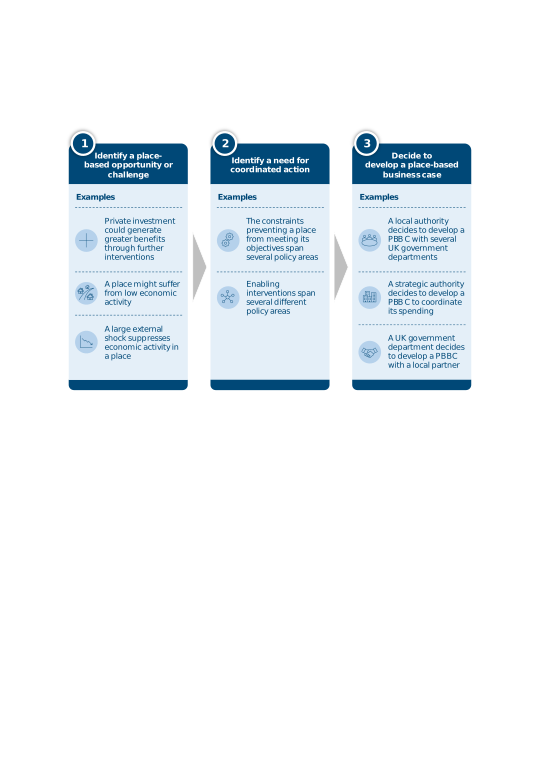
This guidance refers to the partner that chooses to develop a PBBC as the ‘initiating partner’. Where a UK government department is the initiating partner, it must always invite the support and involvement of the relevant local, regional and devolved governments.
2.3 How should partners work together?
The initiating partner is responsible for bringing partners together to agree roles, responsibilities, governance arrangements and ways of working at the outset.
The initiating partner should identify and engage organisations that may need to:
- Explore and assess interventions that might make up the package
- Fund interventions within the package
- Approve interventions within the package
- Support the delivery of interventions within the package
Early engagement helps partners develop a shared understanding of the place and its priorities, identify dependencies and build agreement around the emerging package.
Partners should develop the PBBC together. One organisation should not develop a PBBC independently and present it to others as a completed proposal. The PBBC should reflect a shared assessment of the place’s challenges, opportunities and priorities. This ongoing collaboration will be particularly important when partners seek approval for the PBBC.
Partners developing a PBBC in Scotland, Wales or Northern Ireland should engage the relevant devolved government on any potential interventions in devolved policy areas.
Partners involved in a PBBC may change as the PBBC develops and the emerging package becomes clearer. Practitioners should bring in additional partners where proposals require their expertise, support, funding or approval.
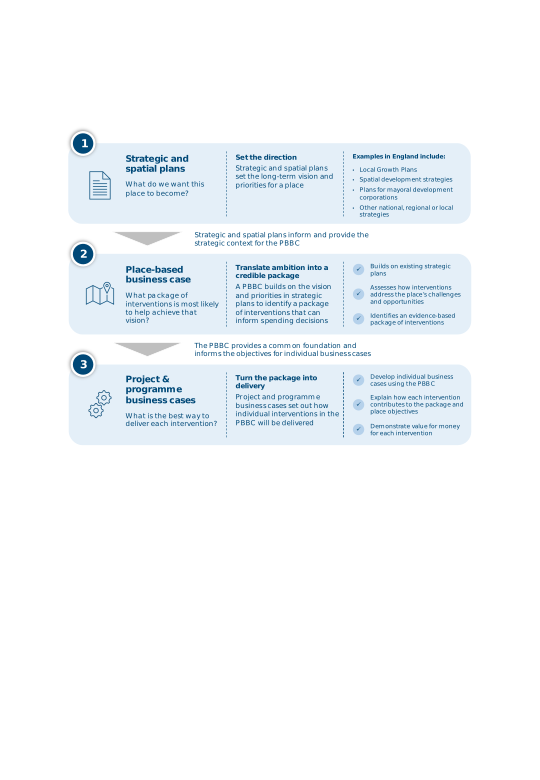
2.4 How does a PBBC relate to existing strategic plans?
PBBCs should align with and build on existing strategic and spatial plans, rather than duplicate them. In England, relevant plans may include:
- Local Growth Plans
- Spatial development strategies
- Plans for mayoral development corporations
- Other relevant national, regional or local strategies
Scotland, Wales and Northern Ireland have their own spatial, planning and development frameworks and strategic plans at the national, regional and local levels, reflecting devolved responsibilities in these areas.
These various strategic plans and PBBCs have distinct but complementary roles:
- Strategic and spatial plans set the long-term vision and strategic priorities for a place
- A PBBC builds on this vision by identifying a coherent, evidence-based package of interventions to inform decision making
2.5 How does a PBBC relate to project and programme business cases?
A PBBC does not replace the project and programme business cases for individual interventions within a package. Instead, it provides a common foundation for these underlying interventions by agreeing objectives, priorities and shared analysis upfront. Individual project and programme business cases should then draw on this work, reducing duplication and helping to accelerate their development.
A PBBC can also incorporate relevant projects and programmes that are already in development or under way. Developing a PBBC should not unnecessarily delay or disrupt their progress.
Figure 2 shows how PBBCs fit with strategic and spatial plans and individual project and programme business cases. As per Chapter 1, developing a PBBC is voluntary and is not a prerequisite for developing project or programme business cases.
Figure 2. How PBBCs connect strategy to projects and programmes
2.6 Who approves a PBBC and how?
A PBBC does not replace or bypass existing spending controls, approval processes or delegated authorities. The partners responsible for funding or delivering interventions within the package should therefore agree and approve the PBBC, while each partner remains responsible for approving expenditure within their own remit.
Partners should agree how they will approve the PBBC at the outset of the process and, where possible, use existing decision-making arrangements. Depending on the partners involved, these arrangements could include formal governance forums, established cross-organisational approval processes, or written agreements.
Partners responsible for funding, approving or delivering interventions should be involved throughout the development of the PBBC. This will help ensure that:
- The PBBC reflects the priorities and constraints of the organisations responsible for taking interventions forward
- Funding assumptions are realistic
- The package is deliverable
Without this engagement, partners are less likely to reach collective agreement on the PBBC or secure the approvals needed to progress individual interventions.
2.7 What happens after a PBBC is approved?
By approving a PBBC, partners agree to develop and consider the individual interventions through the relevant project, programme and funding approval processes.
When developing project and programme business cases, practitioners should build on the evidence and analysis set out in the PBBC rather than repeat it. Those business cases should explain how the individual interventions represent value for money, complement other interventions in the package, and contribute to the objectives set out in the PBBC.
A PBBC can accelerate the development and approval of underlying project and programme business cases. An approved PBBC should act as the initial programme business case for individual programmes in the package. It should also act as the Strategic Outline Case (SOC) for individual projects within the package, allowing those projects to move directly to Outline Business Case (OBC) stage.
In exceptional circumstances, partners may still require an individual SOC for a project or an initial programme business case for a programme. This might be suitable for interventions that are particularly high-risk, nationally significant, or involve significant expenditure. The need for any additional business case should become apparent as the PBBC develops. Partners should only require one where the additional work is proportionate to the risks involved.
Not every intervention within an approved PBBC will necessarily secure subsequent approval. Where the removal or material change of an intervention significantly affects the overall package, partners should review the PBBC and consider whether the package remains appropriate.
2.8 How should partners develop a PBBC?
A PBBC follows the Five Case Model, comprising the strategic, economic, commercial, financial and management cases. Partners should develop these in three broad stages:
- Develop the strategic case (Chapter 3) to establish the strategic context, agree the objectives for the place, and develop a theory of change that underpins the rest of the PBBC
- Develop the economic case (Chapter 4) to identify the binding constraints holding a place back, assess potential interventions and determine the package of interventions most likely to achieve the objectives
- Develop the commercial, financial and management cases (Chapters 5 to 7) concurrently to assess the deliverability of the package and establish appropriate arrangements for funding, implementation, governance, risk management, assurance and evaluation
Practitioners must develop a PBBC in accordance with the relevant statutory duties, as set out in more detail in the Green Book and guidance on developing business cases. This guidance uses terms and concepts defined in those documents, which practitioners should refer to where helpful.
Developing a PBBC involves 18 actions across the five cases, as summarised in the table below.
Table 1. The actions involved in developing a place-based business case
| Case | Actions |
|---|---|
| Chapter 3: The strategic case | Action 1 – Outline context and geographic scope |
| Action 2 – Determine business as usual (BAU) | |
| Action 3 – Determine the case for change | |
| Action 4 – Determine objectives | |
| Action 5 – Determine a theory of change | |
| Chapter 4: The economic case | Action 6 – Establish the binding constraints for the place |
| Action 7 – Identify appropriate comparators and estimate the economic potential of the place | |
| Action 8 – Identify a longlist of individual interventions | |
| Action 9 – Use the longlist to build a shortlist of packages | |
| Action 10 – Identify a preferred package | |
| Chapter 5: The commercial case | Action 11 – Assess labour, land and capital capacity |
| Action 12 – Assess procurement feasibility and key commercial risks | |
| Chapter 6: The financial case | Action 13 – Estimate whole life costs |
| Action 14 – Identify funding sources | |
| Chapter 7: The management case | Action 15 – Determine governance and accountability |
| Action 16 – Develop an integrated portfolio delivery plan | |
| Action 17 – Develop a place-level operating model | |
| Action 18 – Develop a benefits realisation and evaluation plan |
This guidance uses examples throughout to illustrate how the approach can be applied in practice. These examples are illustrative and should not be treated as prescriptive or as indicating the level of analysis or information required in individual cases.
2.9 How long should a PBBC be?
Practitioners should use this guidance proportionately. A PBBC should contain sufficient detail to support robust decision making, but it should not take up more time and resources than necessary. The effort involved in developing a PBBC should reflect its scale, cost, complexity, risk and role in future approvals. Practitioners should refer to HM Treasury’s guidance on producing proportionate business cases for further support.
Practitioners should include information and analysis at the level where it is most useful for decision making. That might be within the PBBC or in the underlying business case for a specific programme or project.
3. The strategic case
3.1 Introduction
The first dimension of a PBBC is the strategic case. It should establish the case for change by setting out the context for the place, the challenges and opportunities it faces, and the objectives partners want to achieve.
The strategic cases for the underlying project and programme business cases should build on this shared strategic foundation and explain how individual interventions contribute to the objectives and wider package set out in the PBBC.
Table 2. Strategic case actions
| Action | Strategic case |
|---|---|
| Action 1 | Outline context and geographic scope |
| Action 2 | Determine business as usual (BAU) |
| Action 3 | Determine the case for change |
| Action 4 | Determine objectives |
| Action 5 | Determine a theory of change |
3.2 Action 1: Outline context and geographic scope
Practitioners should set out the strategic context for the PBBC, including the organisations involved, their roles in developing the business case and any agreed governance arrangements. They should also provide a high-level overview of the place’s economic, social and environmental circumstances and explain why these make a PBBC appropriate.
Practitioners should define the geographic scope of the PBBC. This is commonly referred to as the ‘place’, but when conducting analysis practitioners should distinguish between the:
- Intervention area: The geographic area in which practitioners expect organisations to deliver interventions
- Outcome area: The geographic area expected to experience the main benefits, costs and outcomes from those interventions
Practitioners should define the intervention area and outcome area at the start of the PBBC process. They may refine them as the PBBC develops. These areas should provide a consistent basis for the analysis, objectives and assessment of options throughout the PBBC. Practitioners can draw on relevant geographies when defining the intervention and outcome areas, such as travel-to-work areas, local authority areas or city wards.
Interventions should be sufficiently close together for the package to deliver measurable change in the outcome area. Where interventions are widely dispersed, practitioners should consider whether they would be better assessed separately or as part of a wider initiative.
The PBBC should focus primarily on outcomes within its defined geographic scope. However, it is important that practitioners also identify material positive or negative effects on other areas.
Example: Action 1
Middlemarch is a large, relatively isolated town surrounded by rural communities.
- The local authority and partners defined the town’s built-up area, including its main offices and commercial centre, as the intervention area.
- They defined the wider Middlemarch travel-to-work area as the outcome area, as residents and businesses across this wider area are expected to experience the main effects on employment, earnings, productivity and access to services.
3.3 Action 2: Determine business as usual (BAU)
Practitioners should establish a business as usual (BAU) baseline to understand how the place is expected to develop without the additional interventions in the PBBC. This provides a counterfactual against which practitioners can assess alternative intervention packages. It helps to identify the gap between the expected trajectory of the place and its objectives.
Practitioners should start by establishing a robust evidence base on the current economic, social and environmental conditions in the outcome area. This could draw on relevant local and national data, evidence from partner organisations and previous studies.
Practitioners should then consider how these conditions are expected to change over time under the BAU. This should take account of existing policies, committed investments, wider economic and demographic trends including local growth rates, and the expected behaviour of residents, businesses and public sector organisations.
The time and resources spent developing the BAU baseline should be proportionate to the scale, cost, complexity and risk of the PBBC. A reasonable, evidence-based forecast will often be more useful than complex analysis that depends on uncertain assumptions. Where the future is particularly uncertain, practitioners may consider alternative scenarios alongside the central BAU forecast.
Example: Action 2
Practitioners established a baseline using local economic, social and environmental data. Where possible, they used data covering the outcome area.
Evidence from the last 5 to 10 years shows that Middlemarch has:
- Below-average productivity
- Relatively few people with higher-level qualifications
- Constrained housing supply
- Limited transport options with heavy reliance on cars
- Slightly below-average health outcomes
Under the BAU scenario, practitioners expect these conditions to improve only gradually. Existing skills programmes should modestly increase qualification levels, while committed transport investments should support productivity. However, these improvements will not close the gap between Middlemarch and national and regional averages. Demographic change and limited housing supply will reduce labour market participation, while productivity will remain low.
Practitioners based this assessment on local plans, committed public investments, demographic projections and wider economic forecasts.
3.4 Action 3: Determine the case for change
Practitioners should set out the case for change by identifying the main challenges and opportunities facing the place and what is preventing progress towards its objectives. This should build on the evidence about the place and the BAU baseline.
Practitioners should explain why these barriers are unlikely to be addressed without public sector action and what role government needs to play. This could include addressing market failures, coordinating activity, unlocking private investment, or providing public goods and services.
3.5 Action 4: Determine objectives
Practitioners should work with partners to agree a small number of shared objectives for the place. These should build on the BAU and case for change and, where relevant, existing Local Growth Plans, spatial strategies and other strategic plans.
Objectives should:
- Be limited in number and focus on the most important outcomes for the outcome area
- Reflect the evidence and analysis of the outcome area’s economic, social and environmental conditions and the challenges and opportunities identified in the case for change
- Be SMART (specific, measurable, achievable, realistic and time-limited) and expressed in terms of outcomes rather than outputs
The objectives should guide the options developed and assessed in the economic case. For example, if a PBBC aims to reduce the number of low-income households, practitioners should only take forward options with a reasonable prospect of contributing to that objective.
Practitioners should set objectives before identifying the preferred interventions. A good business case considers different ways of achieving its objectives, so practitioners should not select objectives to justify a predetermined package.
Example: Action 4
Practitioners and partners agreed two core objectives for the Middlemarch PBBC. These are high-level and demand a coordinated package of interventions that cut across several policy areas. These objectives are:
- By 2035, close at least half of the projected gap in real gross value-added (GVA) per worker between Middlemarch and the regional average
- By 2035, close at least half of the projected gap in the employment rate between Middlemarch and the regional average
3.6 Action 5: Determine a theory of change
Practitioners should develop a theory of change that explains how interventions could achieve the objectives for the outcome area. It should show the logical chain from the challenges and opportunities identified in the case for change, through potential interventions, to the outcomes they are expected to achieve.
The theory of change should be grounded in evidence. Practitioners should identify the key assumptions about how and why interventions are expected to lead to particular outcomes, drawing on relevant evidence such as evaluations of previous interventions, research and evidence from partners.
Practitioners should also consider how different interventions could work together. Where relevant, the theory of change should explain how interventions in different policy areas could reinforce one another and why a coordinated package could achieve more than individual interventions in isolation.
4. The economic case
4.1 Introduction
The second dimension of a PBBC is the economic case. It should assess alternative packages of interventions to identify the package most likely to achieve the objectives set out in the strategic case, including where achieving those objectives requires transformational change. It should provide relevant evidence to support this choice.
The economic cases for the underlying project and programme business cases should build on the preferred package. They should assess the options for delivering individual interventions within the package using social cost-benefit analysis where appropriate.
4.2 Analytical techniques
There are two analytical approaches for assessing packages of interventions:
- Economic potential analysis (EPA): The primary analytical technique for assessing packages of interventions in a PBBC is EPA. EPA assesses how far each shortlisted package could address the place’s binding constraints, unlock economic potential and achieve the objectives set out in the strategic case, including through synergies between interventions. Actions 6 to 10 explain how to apply EPA.
- Social cost-benefit analysis (CBA): Practitioners may conduct CBA where monetising a package’s costs and benefits would provide useful evidence for selecting a preferred package or for subsequent project, programme or funding decisions. Annex A explains how to apply CBA in a PBBC.
Table 3. Economic case actions using economic potential analysis
| Action | Economic case |
|---|---|
| Action 6 | Establish the binding constraints for the place |
| Action 7 | Identify appropriate comparators and estimate the economic potential of the place |
| Action 8 | Identify a longlist of individual interventions |
| Action 9 | Use the longlist to build a shortlist of packages |
| Action 10 | Identify a preferred package |
4.3 Action 6: Establish the binding constraints for the place
Constraints are the forces at work within a place that prevent it from achieving its objectives. These will often act as barriers to economic growth, and places are likely to face several interconnected constraints at the same time. Practitioners should identify which constraints are materially limiting economic performance. However, they should not simply list where a place is performing poorly.
Practitioners should assess how the local economy functions and what might prevent it from functioning more effectively. They should also use the evidence developed in the strategic case, including the BAU baseline and theory of change, to identify and assess potential constraints. This can help identify where the links between inputs, activities, outputs and outcomes are breaking down.
Practitioners should draw on a range of evidence, including trends over time, variation within the place, sectoral and labour market evidence, quantitative and qualitative evidence from businesses and residents, and relevant wider empirical evidence.
Practitioners should distinguish between:
- Binding constraints: These are constraints that are demonstrably holding back economic growth or progress towards a place’s objectives
- Secondary constraints: These are constraints that may also limit progress, but addressing them is unlikely to have a material impact until the binding constraints have been addressed
The distinction between binding and secondary constraints should be based on the weight of evidence rather than any single indicator or predetermined threshold. A binding constraint would normally be supported by several observable symptoms, consistent with how the constraint is expected to affect economic performance.
Practitioners should therefore test each potential constraint against multiple sources and types of evidence and consider evidence both for and against it. Where these symptoms are weak, absent or better explained by another factor, this may indicate that the constraint is secondary rather than binding. Practitioners should prioritise constraints where:
- There is consistent evidence from several indicators: Practitioners should consider whether the same underlying problem appears across different datasets, groups or time periods. Comparator analysis can identify where performance is unusual. However, underperformance relative to a comparator should be treated as a signal for further investigation rather than evidence that the factor is binding in itself.
- An important input is scarce relative to demand: Practitioners should look beyond whether an input is simply low and ask whether it appears scarce relative to demand. High prices, wages, rents, congestion, queues, vacancies or other indicators can provide strong evidence of a constraint.
- Individuals or businesses are willing to pay a premium to overcome the constraint: A binding constraint should create incentives for businesses, workers or households to find ways around it. Practitioners should therefore look for evidence that these groups incur additional costs, change their behaviour, substitute other inputs or develop workarounds. These responses may be visible in quantitative data, but qualitative evidence may also be important.
- There is a credible link between weaker inputs and poorer economic outcomes: Practitioners should consider whether changes in the severity of the constraint, either over time or across otherwise comparable parts of the place, are associated with changes in the outcome it is expected to affect. If a potential constraint is important, a more severe constraint should generally be associated with a poorer outcome, and vice versa. Practitioners should also consider alternative explanations, including whether poorer economic outcomes could themselves be contributing to the apparent constraint.
Example: Action 6
Practitioners distinguished between binding and secondary constraints in Middlemarch.
| Constraint | Type | Description |
|---|---|---|
| Low technical skills | Binding | Vacancy data and employer evidence consistently indicate a shortage of technical skills relative to employer demand. Evidence shows a relationship between access to these skills and firms’ ability to improve productivity, particularly in advanced manufacturing and digital sectors. |
| Limited housing supply | Binding | Housing supply has not kept pace with demand, while affordability and availability indicators suggest difficulties accommodating additional workers. A shortage of housing constrains the labour supply and makes it harder to attract new residents and businesses. |
| Poor rail connectivity | Secondary | Journey times and service frequencies indicate relatively weak access to employment opportunities and surrounding labour markets. However, current evidence suggests that skills and housing constraints are more immediate limits on firms’ ability to recruit and expand, so improved rail connectivity is unlikely to have a material impact until those binding constraints are addressed. |
| Poor health outcomes | Secondary | Employment data indicates that ill health is preventing some residents from accessing employment. However, the number affected is small relative to the overall population, so addressing this would not meaningfully alter overall productivity. |
| Energy network capacity | Secondary | There are limits to energy capacity for large businesses, but current evidence does not indicate that this is materially constraining existing or expected economic activity. |
4.4 Action 7: Identify appropriate comparators and estimate the economic potential of the place
Economic potential is the gap between:
- The expected performance of the place under the BAU
- The performance the place could realistically achieve if the binding constraints were eased
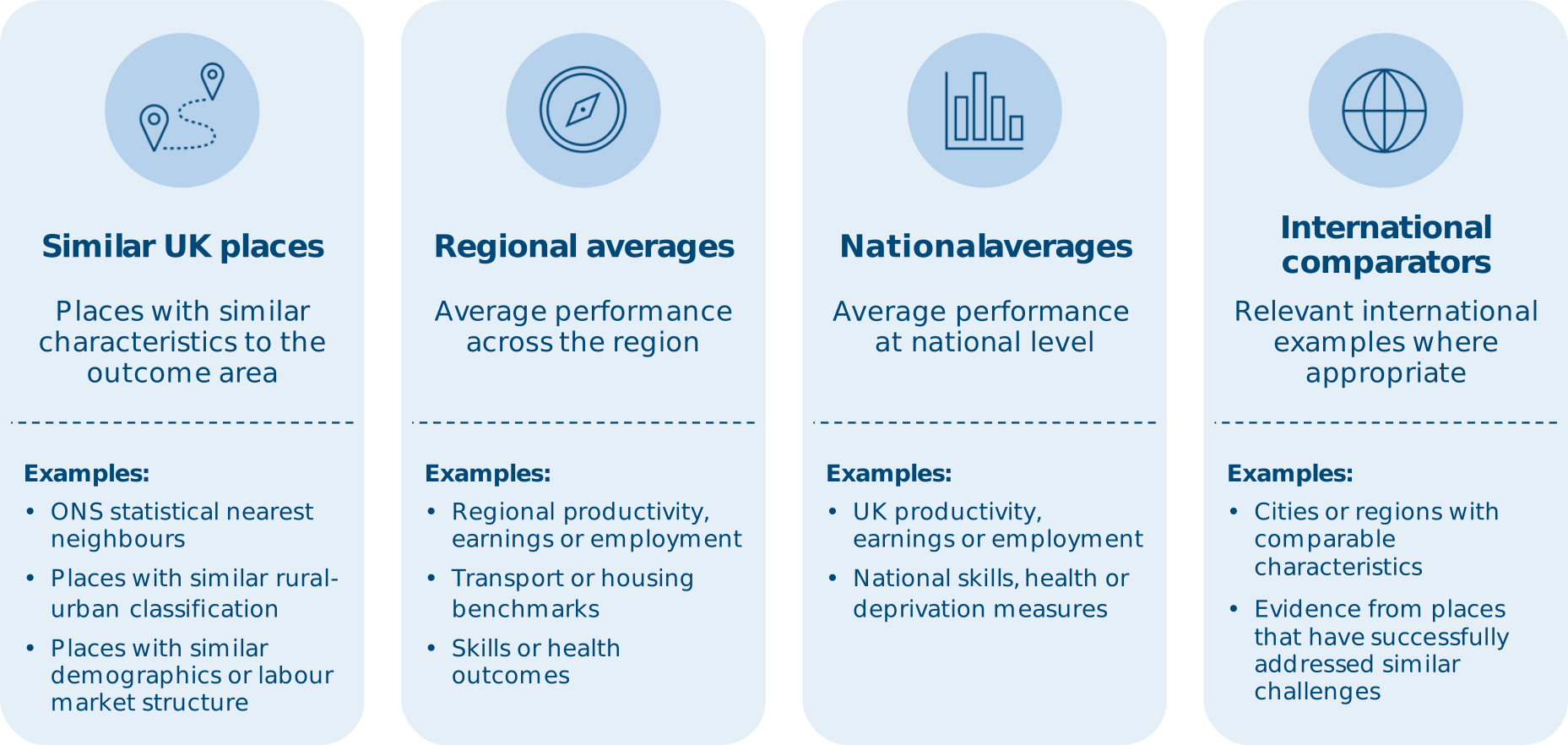
Practitioners should use ‘comparators’ to identify the scale of this potential. These are benchmarks used to help practitioners understand what the place could achieve, to inform the choice of preferred package.
Figure 3 sets out the different types of comparator. Practitioners must use a range of comparators, including national and regional averages, as well as two or three similar UK places. Practitioners may also use international comparators where this is justifiable and useful.
Figure 3. Types of comparator
Practitioners should select comparators:
- Consistently and transparently: They should provide a clear rationale and avoid selective benchmarking simply to justify a predetermined package or intervention
- Using statistical analysis and judgement: They should identify places that have sufficiently similar economic, demographic and geographic characteristics to provide meaningful comparison
Practitioners should use relevant indicators that may include rural-urban classification, levels of deprivation, labour market conditions, industrial structure, population profile and wider economic context.
Where possible, practitioners should use comparators that have achieved stronger outcomes from a sufficiently similar starting point. This will provide stretching but plausible benchmarks for improvement.
Example: Action 7 (identifying appropriate comparators)
The comparator selection process for Middlemarch focused on places that had experienced similar economic transitions and had successfully improved technical skills and housing over time.
Practitioners used the Office for National Statistics (ONS) statistical nearest neighbour methodology to help identify some suitable comparators in the UK. They also identified an international comparator, and regional and national averages.
| Comparator | Type | Rationale |
|---|---|---|
| Northport | UK place | A former agricultural and manufacturing town with a similar population size and industrial structure to Middlemarch. |
| Westford | UK place | A town that successfully improved productivity by investing in technical skills provision and apprenticeships. Previously had similar issues to Middlemarch. |
| Riverton | UK place | A town with a similar demographic and industrial structure to Middlemarch that experienced significant growth following housing and road upgrades. |
| Bellacosta | International comparator | A medium-sized European town that transitioned from an agricultural economy towards advanced manufacturing and logistics following major housing investment. |
| Regional GVA and employment | Regional average | High-level benchmark against broader economic performance. |
| National GVA and employment | National average | High-level benchmark against broader economic performance at the national level. |
Practitioners should set out how each comparator performs relative to the place in terms of the metrics they used when establishing the binding constraints. For example, when comparing Middlemarch with Westford, practitioners might provide a breakdown of population by qualification level for each place.
Practitioners should draw on the evidence to assess and describe economic potential. They should present this as a series of credible scenarios. These should describe the change to the place if its economic potential were realised, including the scale of change that could reasonably be considered transformational. Practitioners should consider low, medium and high scenarios for realising economic potential. They should also indicate high-level timelines for realising each scenario, using data from the comparators where available.
To describe a scenario, practitioners should focus on changes that relate directly to the objectives and binding constraints. They could show changes in productivity, earnings, employment, skills, health, economic inactivity or deprivation. For example, a scenario could show Middlemarch closing the technical skills gap with Westford.
Example: Action 7 (assessing economic potential)
Practitioners compared Middlemarch with the comparator group across several variables. One of the variables was GVA per worker, a measure of productivity. The latest data showed that GVA per worker in Middlemarch was approximately £50,000, around £6,000 below the comparator average and £11,000 below the highest-performing comparator, Westford. Average earnings in Middlemarch were also lower than both benchmarks.
Using these benchmarks, practitioners developed a series of scenarios:
- Comparator average scenario (low): If Middlemarch were to close the productivity gap to the comparator average, this would imply an increase in GVA of approximately £250 million per year.
- Aspirational comparator scenario (medium): If Middlemarch were able to achieve productivity levels similar to Westford’s, a more ambitious comparison, GVA could increase by approximately £450 million per year.
- Historical transformation scenario (high): Following its economic transition, Bellacosta experienced stronger economic performance alongside improvements in workforce skills and housing provision. Over the long term, productivity rose by around 25% and employment by around 5%. If Middlemarch experienced a similar scale of change, GVA could increase by approximately £650 million per year, reflecting both higher output per worker and a larger workforce.
Practitioners should not assume that the outcomes experienced in comparators can be replicated directly. Even statistical neighbours may differ materially in their opportunities, constraints, assets, institutions and wider economic conditions. Practitioners should assess the relevance and transferability of each comparator and, where there is a clear evidence-based case, adjust the scenario to reflect place-specific circumstances. They should clearly explain any adjustments and assumptions.
Comparator-based scenarios should be treated as illustrations of potential rather than forecasts or targets. Practitioners may quantify or monetise the gap between the BAU and selected benchmarks where useful but should not present this as a causal estimate of the benefits of a package.
4.5 Action 8: Identify a longlist of individual interventions
Practitioners should identify a wide range of potential interventions that could address the constraints identified in Action 6 and contribute to the objectives for the place. Practitioners should also use any existing data from the comparators on interventions that have successfully addressed similar issues.
Practitioners should work with local, regional and national partners to identify interventions that may:
- Span a range of reserved and devolved policy areas, which could include housing, transport, infrastructure, innovation and health
- Operate over different timescales
- Address different constraints
- Include interventions already in delivery, proposals under development, new proposals, and private sector investments that have significant interdependencies with public sector activity
Practitioners should assess the high-level benefits, costs and risks of each intervention, including how it could contribute to the objectives and address the identified constraints. One intervention may address several constraints or objectives, while several interventions may need to work together to address a single constraint or objective.
Example: Action 8
The table below provides an illustrative sample from the longlist of interventions for Middlemarch.
| Project or programme | Indicative costs | Delivery timeline | Indicative benefits | Risks |
|---|---|---|---|---|
| Employer apprenticeship scheme | Low–medium | 2–5 years | Higher skills, employment and earnings | Low employer take-up |
| Technical skills academy | Medium–high | 3–7 years | Technical qualifications and labour productivity | Recruitment and operating cost pressures |
| Rail connectivity improvements (enabling works only) | Medium | 2–5 years | Prepares for later rail improvements and reduces delivery risk | Benefits depend on the full programme proceeding |
| Rail connectivity improvements (full programme) | High | 5–10 years | Greater labour mobility and market access | Cost escalation and delivery delay |
| Housing development | High | 5–10 years | More homes and a larger available labour force | Planning, land and infrastructure constraints |
| Freight hub and industrial estate | High | 5–10 years | New commercial space, jobs and logistics capacity | Demand uncertainty and infrastructure dependencies |
| Small and medium-sized enterprise (SME) investment fund | Medium | 2–6 years | Business investment, innovation and productivity | Low take-up and additionality risks |
| Town centre regeneration programme | Medium | 3–6 years | Lower vacancies and improved place attractiveness | Displacement and weak private investment |
4.6 Action 9: Use the longlist to build a shortlist of packages
Practitioners should combine interventions from the longlist into a shortlist of credible packages. Figure 4 sets out this process.
Figure 4. From a longlist of interventions to a shortlist of packages
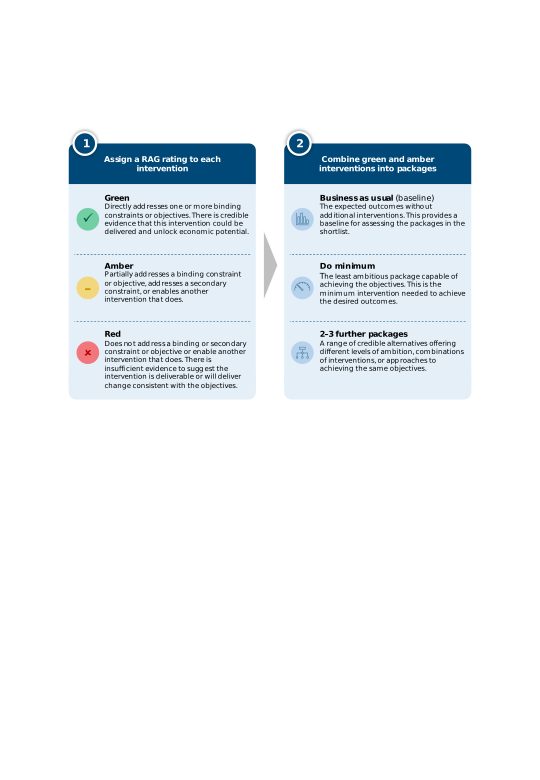
Practitioners should work through the longlist and RAG rate each intervention according to Figure 4. They should assess:
- The extent to which an intervention addresses the binding or secondary constraints, which can be a quantitative or qualitative judgement
- Whether an intervention aligns with or enables other interventions
Practitioners should disregard interventions that neither directly address a binding or secondary constraint nor enable other interventions that do. Practitioners should take green-rated and amber-rated interventions forward to build a shortlist of packages.
Each shortlisted package should:
- Contain complementary interventions: Practitioners should combine interventions that can work together to achieve outcomes and deliver greater benefits than if they were delivered separately
- Address the objectives: Practitioners should discount packages that are unlikely to make a material contribution to achieving the objectives or addressing the place’s binding constraints
- Be deliverable: Packages should reflect realistic assumptions about funding, delivery capacity and stakeholder support
- Represent meaningful alternatives: Packages should test different combinations of interventions and levels of ambition to provide decision makers with a genuine choice between approaches
The shortlist does not need to include every possible permutation of interventions, but it should capture the most credible and relevant packages.
Example: Action 9
Practitioners built several packages of varying ambition that take different approaches to achieving the objectives.
Using the scenarios they developed in Action 7, they built a skills-focused package that closely replicates previous interventions in Westford, with fewer interventions that directly boost housing supply. They also developed a housing-focused package with greater upfront capital costs but which indicators suggest may unlock significant private sector investment.
| Intervention | Business as usual | Package 1 (Do minimum) | Package 2 (Skills focus) | Package 3 (Housing focus) | Package 4 (Do maximum) |
|---|---|---|---|---|---|
| Existing programmes only | Yes | ||||
| Employer apprenticeship scheme | Yes | Yes | Yes | Yes | |
| Rail connectivity improvements (enabling works only) | Yes | ||||
| Rail connectivity improvements (full programme) | Yes | Yes | |||
| Tec# hnical skills academy | Yes | Yes | |||
| Housing development | Yes | Yes | |||
| Freight hub and industrial estate | Yes | ||||
| SME investment fund | Yes | Yes | |||
| Town centre regeneration programme | Yes | Yes | Yes | Yes |
4.7 Action 10: Identify a preferred package
Practitioners should use the results of the analysis undertaken in Actions 6 to 9 to identify the preferred package. This should be the package that provides the most credible route to unlocking economic potential and achieving the objectives set out in the strategic case.
Practitioners should assess each shortlisted package using quantitative and qualitative evidence gathered during the economic case process to make a judgement on the optimal package. This should consider:
- Objectives: To what extent does the package directly address the objectives set out in the strategic case?
- Binding constraints: To what extent does the package directly address the binding and secondary constraints?
- Economic potential: Is there credible local, national or international evidence gathered through comparators that similar combinations of interventions could improve the outcomes sought? Does the package address the performance gaps identified through comparison with similar places and relevant averages? To what extent does the package transform the place to align with one or more of the scenarios described in Action 7?
- Complementarities: To what extent does delivering all the interventions in the package generate mutually reinforcing benefits?
- Funding feasibility: How likely is funding to be secured for the package? Are the constituent interventions likely to obtain the necessary approvals?
- Deliverability: How feasible is the delivery of the package? Over what timeframe will it be delivered? Are there any significant delivery risks or barriers to implementation?
Practitioners should engage all partners involved in the development, delivery and funding of the shortlisted packages when assessing them against these criteria.
Practitioners should weigh the evidence for each package against these criteria. In doing so, they should clearly document any assumptions, uncertainties and the rationale for key judgements.
The results of this assessment can be summarised in a table for decision makers that presents each shortlisted package and its performance against the assessment criteria.
Example: Action 10
The partners selected package 2 (skills focus). All packages meet the objectives, but package 2 offers the most credible route to doing so by 2035. Its strong complementarities, credible funding sources and similarity to effective interventions in Westford made a compelling case. Package 3’s housing interventions had less certain funding and a weaker case for delivery, while package 1 would meet the objectives only narrowly. Partners agreed to keep housing pressures under review.
| Assessment criterion | Business as usual | Package 1 (Do minimum) | Package 2 (Skills focus) | Package 3 (Housing focus) | Package 4 (Do maximum) |
|---|---|---|---|---|---|
| Objectives | Not met Objectives will not be met | Met Meets GVA and employment objectives | Met Significant increase to GVA per worker and employment | Met Significant increase to GVA per worker and employment | Met Significant increase to GVA per worker and employment |
| Binding constraints | Low Constraints remain | Medium Partly eases skills constraint | Medium Tackles skills but continued lack of housing prevents population growth | High Tackles housing and generates private investment that should boost skills | High Tackles all constraints |
| Economic potential | Low Gaps persist | Low–medium Limited scale | Medium-high Closes the skills gap with potential for transform-ation similar to Westford | High Unlocks gains similar to Bellacosta | High Greatest potential |
| Complementarities | Low No new interactions | Low Limited interaction between the two interventions | High Good interactions between interventions | Medium Some interaction between interventions | High Extensive interactions between interventions |
| Funding feasibility | High Already funded | High Modest cost | Medium–high Credible sources | Medium Funding uncertain | Low Major funding gap |
| Deliverability | High Already in place | High Simple delivery | Medium–high Manageable planning, land and delivery risks | Medium Complex sequencing | Low Very complex delivery |
5. The commercial case
5.1 Introduction
The third dimension of a PBBC is the commercial case. It should assess whether there is sufficient market capacity and capability to deliver the preferred package of interventions and identify any significant constraints.
The commercial cases for the underlying project and programme business cases should build on this high-level assessment and set out the commercial and procurement approach for individual interventions.
Table 4. Commercial case actions
| Action | Commercial case |
|---|---|
| Action 11 | Assess labour, land and capital capacity |
| Action 12 | Assess procurement feasibility and key commercial risks |
5.2 Action 11: Assess labour, land and capital capacity
Practitioners should assess whether there is sufficient labour, land and physical capital to deliver the preferred package, taking account of capacity within the place and its wider economic area. They should identify any material constraints, and how these could be addressed, across:
- Labour: Practitioners should consider the availability of workers with the skills needed to deliver the package, including within a reasonable commuting distance, and the potential to recruit, contract or train additional workers. Where the package includes skills interventions, practitioners should consider whether these could help address identified labour constraints.
- Land and physical capital: Practitioners should consider relevant constraints such as land availability and ownership, planning and environmental requirements, and the capacity of supply chains to provide the necessary materials, equipment and other inputs. Where material constraints exist, practitioners should identify how alternative sites, suppliers or delivery approaches could address them.
5.3 Action 12: Assess procurement feasibility and key commercial risks
Practitioners should assess whether the preferred package can be procured through the relevant markets and within the expected timescales. This should be proportionate and does not require detailed procurement strategies for individual interventions. Practitioners should consider whether any interventions require specialist procurement or contracting approaches.
Practitioners should identify the key commercial risks to delivering the package. These could include limited supplier capacity or appetite, price volatility, supply chain disruption, or other constraints that could affect procurement. Practitioners should consider whether delivering the interventions as a package could create overarching commercial constraints or opportunities that would not arise when considering each intervention individually. Detailed commercial risks for individual interventions should be addressed through subsequent project and programme business cases.
Practitioners should identify proportionate mitigations for material commercial risks and carry these risks and mitigations into the management case.
6. The financial case
6.1 Introduction
The fourth dimension of a PBBC is the financial case. It should demonstrate the overall affordability of the preferred package and set out its financial implications across the partners involved.
The financial cases for the underlying project and programme business cases should build on this high-level assessment and set out the detailed costs, funding and affordability of individual interventions.
Table 5. Financial case actions
| Action | Financial case |
|---|---|
| Action 13 | Estimate whole life costs |
| Action 14 | Identify funding sources |
6.2 Action 13: Estimate whole life costs
Practitioners should estimate the whole life costs of each intervention in the preferred package. Whole life costs are defined in the guidance on developing business cases. Where costs are uncertain, practitioners can present reasonable ranges.
Practitioners should use tables to show:
- The costs of each intervention, profiled over time and split by resource spending and capital spending where possible
- The total cost of the preferred package, profiled over time and split by resource spending and capital spending where possible
Practitioners should clearly set out the key assumptions and material uncertainties underpinning these estimates, including relevant inflation assumptions and unit‑cost benchmarks.
Practitioners should also estimate any material financial returns to the public sector arising from the package. These could include revenues from fees or charges, or additional tax revenues.
6.3 Action 14: Identify funding sources
Practitioners should identify the funding sources for each intervention in the preferred package. These could include funding from UK government departments, devolved governments, local government, other public bodies or the private sector.
Practitioners should distinguish between funding that is secured and funding that remains subject to future decisions, bids or approvals. They should identify any funding gaps and set out realistic options for addressing them.
The financial case should therefore show:
- The estimated costs of each intervention and the overall package
- The source and status of funding for each intervention
- Any funding gaps or uncertainties
- The implications for the overall affordability and deliverability of the package
7. The management case
7.1 Introduction
The fifth dimension of a PBBC is the management case. It should set out how partners will deliver the preferred package, including the sequencing of interventions, responsibilities for delivery, and arrangements for governance, assurance and evaluation.
The management cases for the underlying project and programme business cases should build on these package-level arrangements and set out how individual interventions will be delivered, managed and governed.
Table 6. Management case actions
| Action | Management case |
|---|---|
| # Action 15 | Determine governance and accountability |
| Action 16 | Develop an integrated portfolio delivery plan |
| Action 17 | Develop a place-level operating model |
| Action 18 | Develop a benefits realisation and evaluation plan |
7.2 Action 15: Determine governance and accountability
Practitioners should assign a responsible owner for each intervention and clearly define their responsibilities and accountabilities. Responsible owners could include local or regional government, UK government departments, devolved governments, other public bodies or private sector partners.
Practitioners should also establish governance arrangements for the package as a whole. These should set out who owns the integrated portfolio delivery plan, how partners will make decisions, and how they will escalate risks and delivery issues.
Responsible owners should set out how they will take individual interventions forward, including through the relevant project and programme business cases and approval processes. Practitioners should also explain how the governance of the overall package will interact with these existing processes and how partners will provide assurance and maintain accountability throughout delivery.
7.3 Action 16: Develop an integrated portfolio delivery plan
Practitioners should develop and maintain an integrated portfolio delivery plan for the preferred package. This should provide a single view of each intervention’s development and approval status, responsible owner, key milestones, dependencies, sequencing and expected delivery timetable.
The plan should show the maturity and likelihood of delivery of each intervention, distinguishing between:
- Confirmed interventions: These are interventions that have secured the necessary funding and approvals and are expected to proceed
- Probable interventions: These are interventions that form part of the preferred package but remain subject to funding, approval or further business case development
Practitioners should bring together the material risks, assumptions, issues and dependencies affecting delivery of the preferred package. They should explain how these could affect the timing, costs, benefits or deliverability of individual interventions or the package as a whole and identify appropriate mitigations.
The plan should set out the sequencing, key milestones and critical path for the package. Practitioners should take account of dependencies, deliverability, market capacity, funding availability and the timing of benefits when determining the sequence.
Where funding, approvals or dependencies are uncertain, practitioners should set out contingency arrangements and the implications for the rest of the package.
Practitioners should keep the plan under review and update it as individual interventions develop, so that partners retain a current view of delivery across the package.
7.4 Action 17: Develop a place-level operating model
Practitioners should develop a place-level operating model that sets out how partners will work together to deliver the preferred package. This should explain how partners will govern and coordinate delivery, maintain the integrated portfolio delivery plan, manage risks and dependencies, and provide assurance.
Practitioners should assess whether partners have the capability and capacity needed to coordinate and deliver the package. They should consider, where relevant, capability in commercial and procurement activity, planning and consents, land assembly, data and digital, technical assurance, and benefits realisation and evaluation.
Practitioners should identify any capability or capacity gaps and how partners will address them. This could include developing in-house capability, sharing capability across partners, procuring external support or drawing on expertise elsewhere.
The operating model should also set out how partners will manage risks, assumptions, issues and dependencies across the package, including who will own and monitor them and how partners will escalate and resolve issues.
Where an intervention does not progress as planned or a material assumption or dependency changes, the operating model should set out how partners will agree mitigations or contingencies and assess the implications for the wider package and its objectives.
7.5 Action 18: Develop a benefits realisation and evaluation plan
Practitioners should develop a high-level benefits realisation and evaluation plan for the preferred package. This should explain how partners will track and manage the intended place-based outcomes during delivery and how interventions detailed in the PBBC will be evaluated. This should draw directly on the objectives and theory of change in the strategic case.
Practitioners should evaluate individual projects and programmes in line with the Magenta Book. Practitioners should also plan how they will evaluate the overall results of the package of interventions in the PBBC. This is important to ensure that lessons can be learned about how different interventions work together in practice, and what results they do, or do not, achieve collectively.
Planning for evaluation should begin at the outset, to ensure that appropriate plans can be put in place early to capture relevant data, design suitable methods and engage with stakeholders.
The overall place-based evaluation should assess whether the package achieved the objectives set out in the strategic case, whether it alleviated the binding constraints set out in the economic case, and whether the expected benefits were realised.
Practitioners can seek further guidance on benefits realisation and evaluation from resources including the:
- Magenta Book, which contains guidance on evaluation approaches
- Guidance on developing business cases, which contains guidance on how to plan monitoring and evaluation within standard business cases
- Teal Book (Chapters 2 and 19), which provides more information about planning for evaluation alongside benefits management activities
8. Annex A: Social cost-benefit analysis in a PBBC
EPA will normally provide sufficient evidence to assess the potential of shortlisted packages. A PBBC does not therefore always need package-level CBA.
Practitioners may use CBA to supplement EPA, or as the primary basis for selecting a preferred package following Action 9, where partners agree that this would materially support decisions or subsequent programme, project or funding approvals.
The steps below show how practitioners can apply CBA to shortlisted packages following Action 9.
8.1 Step 1: Assess costs and benefits of individual interventions
Practitioners should assess the monetisable costs and benefits of each intervention contained within the shortlisted packages in line with the Green Book. This step should focus on impacts within the outcome area defined in the strategic case.
Practitioners should first assess each intervention on a standalone basis, assuming that the other interventions in the package are not delivered. This provides a baseline for assessing the additional effects of interventions working together in subsequent steps.
Where appropriate, practitioners should calculate the relevant summary metrics for each intervention, including the net present social value (NPSV) and the benefit-cost ratio (BCR). They should also identify and describe material costs and benefits that cannot be monetised.
8.2 Step 2: Assess costs and benefits of intervention packages
Practitioners should assess the monetisable costs and benefits of each shortlisted package within the outcome area. This assessment should assume that all interventions within the package are delivered.
Practitioners should assess whether delivering interventions together changes their costs and benefits. This should capture any additional benefits or costs that arise from interactions between interventions.
When an intervention is already under way, practitioners should exclude costs and benefits that would arise anyway, while including any additional effects that result from delivering it alongside other interventions in the package.
Where the evidence allows, practitioners should estimate the additional monetisable value created by interactions between interventions. This can be assessed by comparing the NPSV of the complete package with the sum of the standalone NPSVs calculated in Step 1:
Package synergy = NPSV of package − sum of standalone intervention NPSVs
Where interactions cannot be robustly monetised, practitioners should quantify them in non-monetary terms where possible or describe their expected effects.
Practitioners should calculate the relevant summary metrics for each shortlisted package.
8.3 Step 3: Assess costs and benefits at the UK level
Practitioners should assess the costs and benefits of each shortlisted package from a UK-wide perspective. This should establish the net social value of each package to the UK as a whole.
Practitioners should adjust the analysis from Step 2 to account for displacement, substitution, leakage and other relevant effects. This should distinguish between benefits experienced within the outcome area and benefits that are additional to the UK as a whole.
When assessing employment impacts at the UK level, practitioners should generally assume that proposals do not bring about an increase in national labour supply. This is known as the principle of full displacement of jobs. There may, however, be exceptional circumstances where the assumption of full displacement of jobs does not hold in a local economy, and practitioners may credibly assume that their proposal will increase labour supply. If practitioners assume that their proposal will increase labour supply, this must be accompanied by transparent reasoning and compelling evidence. Decision makers should be alert to this assumption. Practitioners should make sure this social benefit is carefully monitored and evaluated to inform future decision making.
Practitioners should calculate the relevant summary metrics for each shortlisted package based on UK-wide costs and benefits. They should also identify any material costs and benefits that cannot be monetised.
8.4 Step 4: Test complementarities and package composition
Practitioners should test how far the performance of each shortlisted package depends on interactions between its interventions and the assumptions underpinning them.
Practitioners should vary the most important assumptions and, where useful, remove or change interventions within a package and recalculate its costs and benefits. They should focus on the variations most relevant to the decision rather than testing every possible combination.
The analysis should test:
- Which interventions make the greatest contribution to the package
- Which costs or benefits depend on interventions being delivered together
- Whether any interventions duplicate, displace or constrain the effects of others
- Whether the timing or sequencing of interventions affects their expected impacts
- Whether the preferred package remains preferred if the benefits from interventions working together are smaller than expected or do not materialise
Practitioners should present the results in a way that allows decision makers to compare the standalone value of individual interventions and the value of complete packages. This should make clear how far the case for coordinated intervention depends on the additional benefits of interventions being delivered together.