Group A streptococcal infections: fourth and final update report on seasonal activity in England, 2025 to 2026
Updated 24 September 2026
Applies to England

© Crown copyright 2026
This publication is licensed under the terms of the Open Government Licence v3.0 except where otherwise stated. To view this licence, visit nationalarchives.gov.uk/doc/open-government-licence/version/3 or write to the Information Policy Team, The National Archives, Kew, London TW9 4DU, or email: psi@nationalarchives.gov.uk.
Where we have identified any third party copyright information you will need to obtain permission from the copyright holders concerned.
This publication is available at https://www.gov.uk/government/publications/group-a-streptococcal-infections-seasonal-activity-in-england-2025-to-2026/group-a-streptococcal-infections-fourth-and-final-update-report-on-seasonal-activity-in-england-2025-to-2026
Main points
Scarlet fever in-hours GP consultations for the 2025/26 group A streptococcal (GAS) season have been declining since week 27 this year (week commencing 29 June). Notifications remain in line with normal seasonal levels.
Laboratory notifications of invasive group A streptococcal (iGAS) infection are similarly within expected levels, though levels have remained relatively consistent with no distinct seasonal peaks.
Given the potential for severe presentations, scarlet fever cases should be treated promptly with antibiotics to limit further spread and reduce risk of potential complications in cases and their close contacts. Clinicians should continue to be alert to the severe complications of GAS infections and maintain a high degree of clinical suspicion when assessing patients, particularly those with preceding viral infection (including chickenpox) or their close contacts. Tetracycline resistance is being more frequently identified in iGAS isolates at this point in the season; clinicians should continue to consider the full antibiogram when treating patients with reported penicillin allergy.
Updated UK public health guidance on the management of close contacts of iGAS cases in community settings was published on 15 December 2022, with public health action extended to include patients with probable invasive GAS infection and additional close contact groups recommended for antibiotic prophylaxis. The evidence base underpinning the change in risk groups has been published.
National guidance on the management of scarlet fever outbreaks highlights essential tools to limit spread:
- prompt notification of scarlet fever cases and outbreaks to UK Health Security Agency (UKHSA) health protection teams (HPTs)
- collection of throat swabs (prior to commencing antibiotics) when there is uncertainty about the diagnosis
- exclusion of cases from school and work until 24 hours of antibiotic treatment has been received
Numbers presented in this seasonal activity update are based on data available as of 16 September 2026 for diagnoses up to and including 6 September 2026 (end of week 36). Numbers presented may change as updated data becomes available.
The information presented in this report is presented on the UKHSA data dashboard, where aggregate numbers can also be downloaded.
Key definitions are available at the end of the report.
Scarlet fever
Scarlet fever activity followed expected patterns during the 2025/26 season (week 37 2025 to week 36 2026), with the most recent continuing a decline from week 27 (week commencing 29 June 2026) (Figure 1). The highest weekly rate of in-hours GP consultations this season was observed in week 12 at 1.34 per 100,000 registered population. For the latest week, the rate (0.18 per 100,000 registered population, week 37 2026) falls within the range (0.03 to 0.25) observed for the same week in the last 6 seasons (2019/2020 season to 2024/2025 season, excluding the 2022/2023 upsurge season).
Figure 1. Weekly scarlet fever notifications in England, 2019 to 2020 onwards
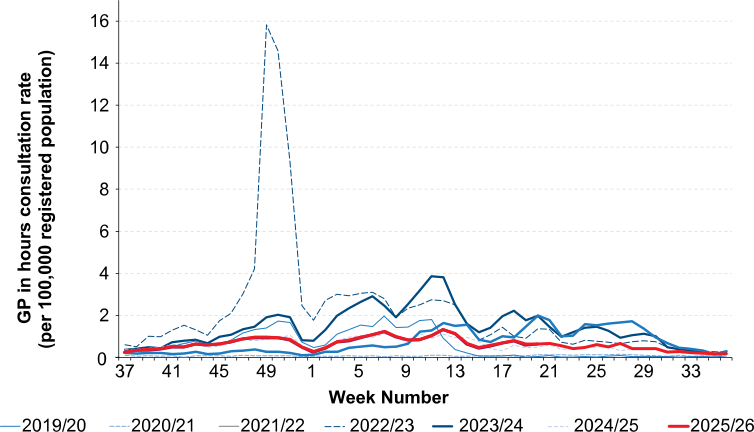
Note: data shown for the current season goes up to week 36 (6 September 2026).
Invasive group A streptococcal infection
Laboratory notifications of iGAS infection in the 2025/26 season (week 37, 2025 up to week 36, 2026) displayed a relatively persistent trend, with no discernible peaks (Figure 2). Numbers remained within the range expected at this time of year. A total of 2,535 notifications of iGAS disease for this season have been received to date, with the highest weekly total reported in week 8 with 62 notifications (week commencing 16 February 2026). The season total of iGAS infections is slightly higher than the average (2,260) but still falls within the range (810 to 2,967) for the same period in the prior five seasons (2019/20 to 2024/25 seasons, excluding the 2022/23 upsurge season).
Overall this season (up to week 37), the highest notification rates were observed Yorkshire and The Humber (6.0 per 100,000 population), followed by the North East (5.9 per 100,000). The lowest rates were seen in London (both 3.3 per 100,000).
Figure 2. Weekly laboratory notifications of invasive GAS, England, 2019 to 2020 season onwards
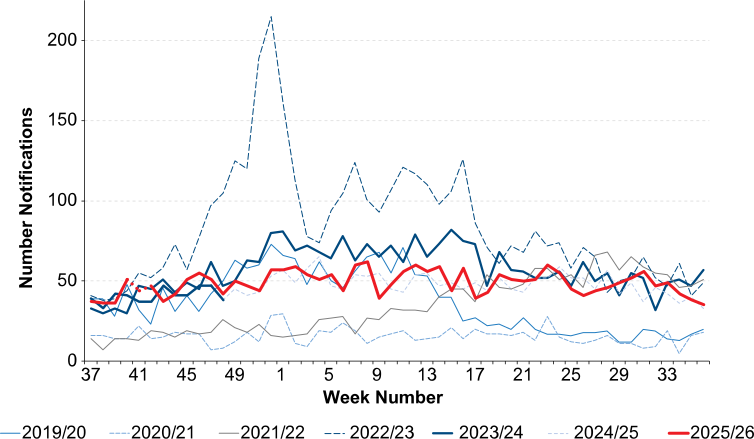
Note: Numbers of notifications in the latest weeks of the 2025/26 season are expected to increase due to a lag in laboratory reporting. The decline in notifications in recent weeks should be interpreted with caution; delayed processing and reporting timeframes mean that the values shown for weeks 34 and 36 of 2026 may need to be revised.
Rates of iGAS infection in the 2025/26 season were highest in those aged 75 years and over (15.7 per 100,000), with the second highest rate in those individuals aged under 1 year (7.1 per 100,000). The lowest notification rate (0.5 per 100,000) was observed in cases aged 10 to 14 years.
The median age of notified cases of iGAS infection this season is 62 years (range of 0 to 106 years). This is slightly higher than the range of median age reported for this point in the preceding five seasons (51 to 61 years).
Antimicrobial susceptibility results from routine laboratory surveillance for iGAS infection (week 37 2025 to week 37 2026) continue to show elevated levels of tetracycline and erythromycin resistance, higher than the range seen in the previous six seasons, with co-resistance to both tetracycline and erythromycin identified in 14% of sterile site isolates. Co-trimoxazole resistance has been reported in 4.3% of iGAS cases in the 2025/26 season (3.3% of iGAS cases in the 2024/25 season). Changes in the resistance rates are likely to reflect dominant emm types currently circulating this season. Specifically:
- 24.5% were resistant to erythromycin (20.8% in 2024/25; range 5.4% to 20.8% in the last six seasons)
- 46.1% were resistant to tetracycline (41.9% in 2024/25; range 14.3% to 41.96% in the last 6 seasons)
- 10.9% were resistant to clindamycin (9.3% in 2024/25; range 4.4% to 11.1% in the last six seasons)
Analysis of reference laboratory sterile-site iGAS isolate submissions indicated a diverse range of emm gene sequence types identified this season (week 37 2025 to week 37 2026); emm 49.8 was the most common type (21.7% of all referrals), followed by emm 89.0 (8.0%) and emm 8.0 (7.5%). At the end of the prior 2024/25 season, these emm types held the same positions, though emm 49.8 was more dominant this season (15.6% in 2024/25). Since the previous report (third update), emm 89.0 (7.1% in the previous report) has overtaken emm 8.0 (6.2%) as the second most common emm type.
Discussion
Following the 2022/23 season, which saw a period of considerable elevation in scarlet fever notifications (1,2) and unusual seasonal patterns, the 2023/24 season saw a return to more usual GAS activity. GP-in hours rates for scarlet fever for the 2025/26 season were within expected levels.
Invasive GAS infection cases this season have not displayed any distinct peaks and remain at a persistent level, though within the usual range for the time of year, with a slight decline in recent weeks. This is similar to the previous few seasons. Incidence by age group follows the expected pattern with highest rates in the elderly.
Of note this season, antimicrobial resistance to second line therapeutic agents (like tetracyclines and macrolides) remains elevated. This is likely a result of emm 49.8 being the dominant emm type this season, as more than 95% of emm 49.8 isolates are resistant to both tetracycline and erythromycin, but predominantly susceptible to co-trimoxazole and clindamycin. GAS remains universally susceptible to penicillin which remains the drug of choice.
Prompt treatment of scarlet fever with antibiotics is recommended to reduce risk of possible complications and limit onward transmission. GPs and other frontline clinical staff are also reminded of the increased risk of invasive disease among household contacts of scarlet fever cases (3,4). Clinicians should continue to maintain a high index of suspicion in relevant patients for invasive disease as early recognition facilitates prompt initiation of specific and supportive therapy for patients with iGAS infection.
Relevant guidelines and FAQs are available on GOV.UK as follows:
- Guidelines for the public health management of scarlet fever outbreaks in schools, nurseries and other childcare settings
- Scarlet fever: symptoms, diagnosis and treatment
- Guidelines for the management of close community contacts of invasive GAS cases
- Prevention and control of group A streptococcal infection in acute healthcare and maternity settings
- Report a Notifiable Disease (eNOIDS)
All invasive disease isolates – and also non-invasive isolates – from suspected clusters or outbreaks should be submitted for typing to:
Staphylococcus and Streptococcus Reference Section
Antimicrobial Resistance and Healthcare Associated Infections (AMRHAI)
UK Health Security Agency
61 Colindale Avenue
London
NW9 5HT
Further information on health equity groups is published annually within the annual streptococcal bacteraemia report, describing trends by ethnic group and deprivation for GAS bacteraemia.
Data from this report, and from the routine weekly syndromic surveillance scarlet fever GP-in hours rates, are available on the UKHSA Dashboard.
Data sources and methods
Scarlet fever data is presented as GP in-hours consultation rates per 100,000 registered population. This information is collected from UKHSA’s GP in-hours syndromic surveillance system. This system is sentinel, which means that not all GP practices in England are included, and coverage varies by UKHSA region, so comparison between geographic regions is not recommended. The system currently includes approximately 19 million registered patients across England. The data included is from two sources: technology provider TPP and ORCHID (Oxford and Royal College of General Practitioners Clinical Informatics Digital Hub). The indicator for scarlet fever syndromic is based on diagnoses recorded during GP in-hours patient consultations, and diagnoses are based on signs/symptoms and may not be laboratory confirmed. The weekly rates presented differ from the daily rates reported as standard elsewhere (5).
Invasive GAS laboratory notification data was extracted from the UKHSA Second Generation Surveillance System (SGSS) and combined with specimen referrals to the Staphylococcus and Streptococcus Reference Section to produce a total number of episodes for England. Data was extracted on 16 September 2026.
Antimicrobial resistance data is based on phenotypic test results for tetracycline, erythromycin, or clindamycin reported by laboratories to SGSS and are reported as susceptible or resistant. Co-resistance data is based on data where both tetracycline and erythromycin results have been reported for the iGAS episode.
Population rates are calculated per 100,000 using the relevant year’s ONS mid-year population estimate.
The M protein gene (emm) encodes the cell surface M virulence protein. Information for the emm gene was extracted from UKHSA’s reference laboratory and this report contains data covering the period 8 September 2025 to 6 September 2026.
Prior to the COVID-19 pandemic, there were a number of seasons when elevated incidence of scarlet fever and iGAS was seen, in particular the 2017/18 season. During the pandemic, there was an unprecedented reduction in the number of scarlet fever and iGAS notifications, affecting the 2019/20 season and the 2021/22 season.
References
1. UKHSA (2023). ‘Group A streptococcal infections: 15th update on seasonal activity in England, 2022/23’. Health Protection Report volume 17, number 7
2. Guy R, Henderson KL, Coelho J, Hughes H, Mason EL, Gerver SM and others (2023). ‘Increase in invasive group A streptococcal infection notifications, England, 2022’. Eurosurveillance: volume 28, number 1
3. Lamagni T, Guy R, Chand M, Henderson KL, Chalker V, Lewis J, and others (2018). ‘Resurgence of scarlet fever in England, 2014 to 2016: a population-based surveillance study’. The Lancet Infectious Diseases: volume 18, number 2, pages 180 to 187
4. Watts V, Balasegaram S, Brown CS, Mathew S, Mearkle R, Ready D, and others (2019) . ‘Increased risk for invasive group A streptococcus disease for household contacts of scarlet fever cases, England, 2011 to 2016’. Emerging Infectious Diseases: volume 25, number 3, pages 529 to 537
5. UKHSA (2024). ‘Syndromic Surveillance Systems and Analyses’
Acknowledgements
These reports would not be possible without the weekly contributions from microbiology colleagues in laboratories across England, without whom there would be no surveillance data.
Feedback and specific queries about this report are welcome via hcai.amrdepartment@ukhsa.gov.uk