Grant support for spruce management (accessible version)
Published 11 February 2026
Applies to England

© Crown copyright 2026
This publication is licensed under the terms of the Open Government Licence v3.0 except where otherwise stated. To view this licence, visit nationalarchives.gov.uk/doc/open-government-licence/version/3 or write to the Information Policy Team, The National Archives, Kew, London TW9 4DU, or email: psi@nationalarchives.gov.uk.
Where we have identified any third party copyright information you will need to obtain permission from the copyright holders concerned.
This publication is available at https://www.gov.uk/government/publications/grant-support-for-spruce-management-in-the-ips-typographus-proactive-spruce-removal-area/grant-support-for-spruce-management-accessible-version
If you own woodland with spruce in the proactive spruce removal area, Forestry Commission grants can help you plan ahead, manage risk from lps typographus, and invest confidently in the future of your woodland.
1. Woodland protection from spruce bark beetle
The eight-toothed spruce bark beetle (lps typographus) is a serious pest of spruce trees recently found in parts of England. It mainly attacks weakened spruce but can spread to healthy trees, causing significant damage to woodlands and forestry.
The beetle, particularly in association with blue stain fungus, can weaken trees and reduces timber quality. In continental Europe, it has devastated spruce forests, and UK monitoring shows it can arrive on winds from the continent and could establish where conditions allow. Early detection and management are essential to prevent outbreaks.
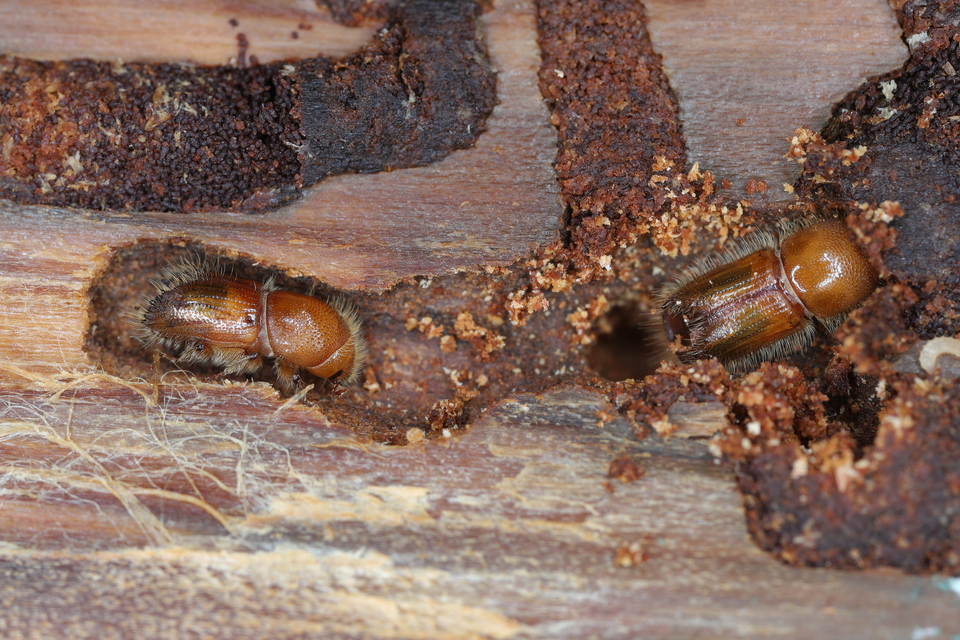
Infested spruce tree with Ips typographus beetles.
Proactive spruce management can:
- reduce the risk of future infestations
- protect tree health and woodland value
- maximise timber use and potential income
- give you greater flexibility and time to plan
Applications can be made individually or as a group, for woodland and non-woodland sites.
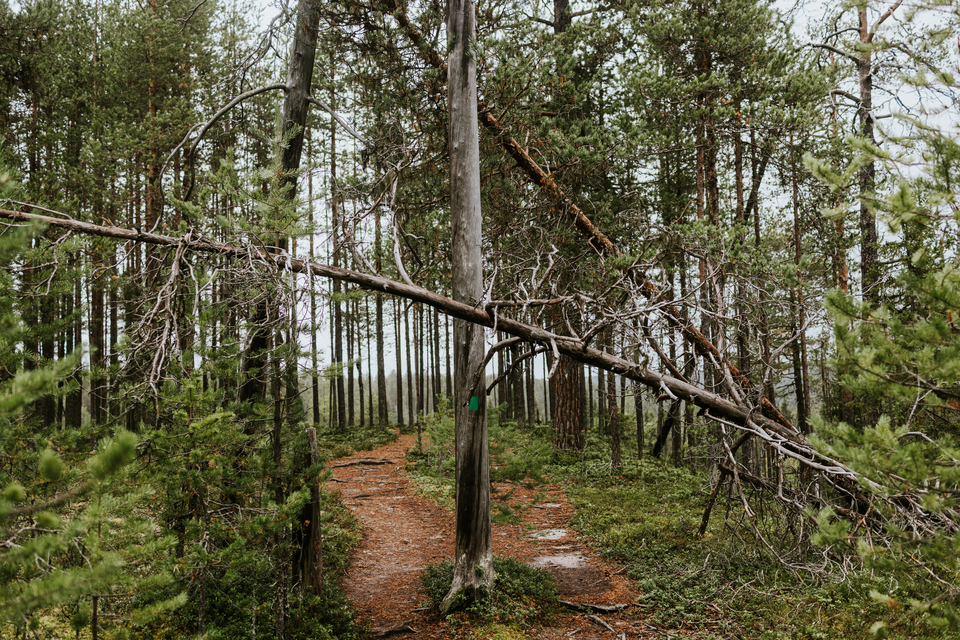
Spruce woodland with dying spruce tree at risk of Ips typographus infestation.
2. Spruce Site Assessment (SSA)
The Spruce Site Assessment offers a fixed payment of £2000 to help you understand the amount and condition of spruce on your land, assess potential risks and plan for felling and restocking.
Completing an SSA does not commit you to felling, but the information collected can also support future funding applications.
An SSA will help you to:
- assess your spruce and identify susceptible material
- plan ahead for felling, extraction and restocking
- ensure plans meet Ips typographus demarcated area requirements
- understand likely costs and funding options
- contribute information to the national Ips typographus response
3. Tree health pilot: proactive spruce removal
If you are in the proactive spruce removal area and do not have Ips typographus, you may be eligible for funding to fell and restock before infestation occurs, in line with your felling licence.
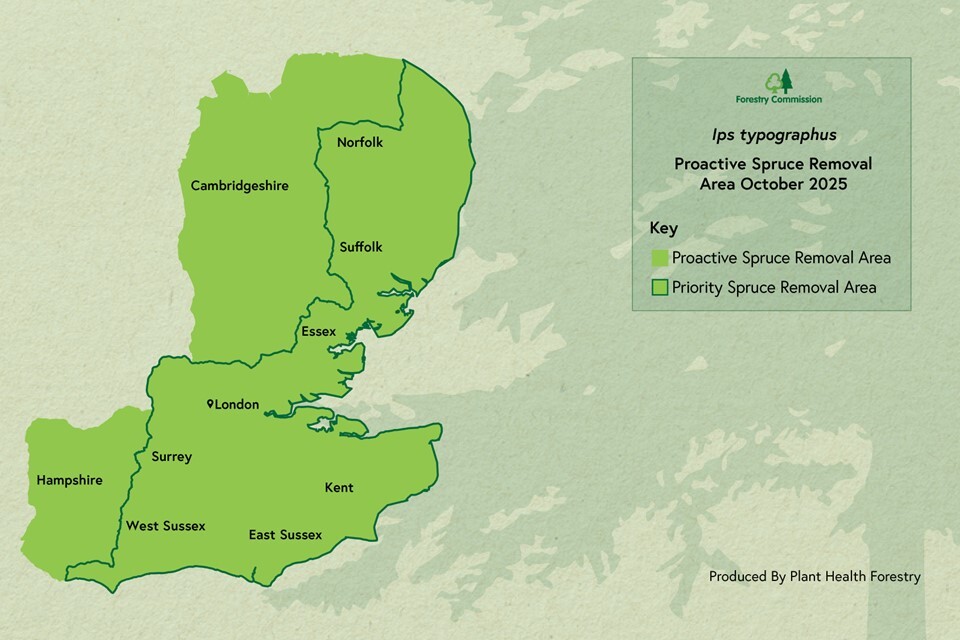
Ips typopgraphus proactive spruce removal area as of October 2025.
3.1 Funding available through the tree health pilot
Felling and temporary infrastructure
- priority spruce removal area: 80% of actual costs
- proactive area (outside priority area):
- 40% of actual costs, or
- 80% of actual costs where an SSA confirms susceptible spruce and is verified by the Forestry Commission
- timber income is not deducted
Biosecurity
- funding available through the biosecurity capital items grant
Grants for felling, infrastructure and biosecurity are capped at £100,000 per application (excluding restocking and maintenance).
Permanent infrastructure
- up to 100% of actual costs for approved roads, tracks and loading areas
- must be proportionate to spruce removed and agreed with a Forestry Commission Woodland Officer
Facilitation (group applications only)
- £27 per hour (basic rate)
- £47.47 per hour for environmental expertise
- up to £4,725 per month
4. Restocking and maintenance
Funding is available to restock woodland sites and maintain new trees, using standard costs, capped per hectare by species and woodland type.
| Ancient woodland | Other woodland | |
|---|---|---|
| Native species (over 80% native) | £6,000 per hectare | £4,720 per hectare |
| Non-native species | £3,000 per hectare | £3,850 per hectare |
Maintenance payments are available for up to 5 years. Trees planted outside woodland are funded at standard rates and maintenance payments are available for up to 3 years.
5. Find out more
Read full scheme details on the tree health pilot.
To start the process, submit a tree health pilot: proactive spruce removal expression of interest form to thpenquiries@forestrycommission.gov.uk.
For Spruce Site Assessment enquiries, email SSAenquiries@forestrycommission.gov.uk.