Small Business Regulatory Taskforce report
Published 23 October 2026

© Crown copyright 2026
This publication is licensed under the terms of the Open Government Licence v3.0 except where otherwise stated. To view this licence, visit nationalarchives.gov.uk/doc/open-government-licence/version/3 or write to the Information Policy Team, The National Archives, Kew, London TW9 4DU, or email: psi@nationalarchives.gov.uk.
Where we have identified any third party copyright information you will need to obtain permission from the copyright holders concerned.
This publication is available at https://www.gov.uk/government/publications/government-response-to-small-business-regulatory-taskforce-report/small-business-regulatory-taskforce-report
This report is from the Small Business Regulatory Taskforce, a group made up of representatives from government and industry. It was drafted for the government by the Federation of Small Business (FSB) and taskforce members.
Foreword
Small businesses are present in every part of the UK, providing jobs, supporting their communities and growing wealth. The government says that getting growth in every postcode is an overriding priority, and providing the best possible environment for small businesses to thrive must be the guiding principle behind this strategy. Improving how regulation works for small businesses is a vital part of the overall growth picture.
I am passionate about freeing up small business owners’ time and money to do what they do best. Too often small business owners spend time wondering how to comply with a new rule, or end up spending money on administration or regulatory fees that could be invested in their growth.
It is welcome that the government:
- recognises the scale of the challenge that regulation can pose
- has committed to reducing the administrative burden of regulation on business by 25%
- has set out its ambition for regulation to support – rather than hinder – employment, entrepreneurship, and growth
The Small Business Regulatory Taskforce was commissioned with the purpose of identifying practical reforms that can address these challenges and reduce unnecessary regulatory and administrative burdens on smaller firms.
Over the course of the taskforce’s work, members heard directly from businesses across a wide range of sectors, and the consistent message received was not that businesses object to regulation itself.
Business owners recognise that well-designed regulation supports a safe trading environment, for consumers and businesses alike. When regulation works as intended, it helps small firms to compete on a fair footing with larger and more established businesses.
However, the regulatory landscape as it currently exists could do with a lot of improvement to get it working on everyone’s behalf, rather than costing small firms vast amounts of time and money, and being a major source of stress.
Business owners want to spend less time filling in forms, navigating complex guidance, and providing the same information multiple times, and more time investing, employing people, serving customers, and growing their businesses. They want regulation that is proportionate, guidance and support which is tailored to their size and level of resource, and regulators that understand their needs and ability to comply.
A number of common themes emerged from the workstreams established as part of the taskforce, and these have been reflected in the recommendations set out in this report. These include the principle that, where the government already holds information, businesses should not be required to provide it repeatedly. In addition, where compliance is required, expectations should be communicated clearly. Finally, regulatory processes should be designed with small businesses in mind.
This report reflects a collaborative effort between business organisations, businesses themselves, professional bodies, and the government. We are grateful to all those who contributed evidence, insights, and expertise throughout the process. We hope that the recommendations contained within this report will help support a regulatory system that is more accessible, proportionate, and effective for small and medium-sized businesses.
Tina McKenzie MBE
National Chair, Federation of Small Businesses
Membership and aims of the taskforce
Aims
The Small Business Regulatory Taskforce was established to identify practical reforms that can reduce unnecessary regulatory and administrative burdens on small and medium-sized enterprises (SMEs). The taskforce was commissioned to support the government’s ambition to reduce administrative burdens on business while maintaining protections for workers, consumers, the environment and the wider public interest.
The taskforce’s work has focused on identifying opportunities to:
- simplify interactions between SMEs and regulators
- improve the accessibility and usability of regulatory guidance
- support greater productivity, innovation and growth across the SME economy
The taskforce divided the work into a number of workstreams:
- modernising regulatory submissions
- embedding SME-friendly approaches to regulatory guidance
- exploring regulatory passporting initiatives
- supporting SMEs to build capability, resource and technological capacity to meet regulatory and compliance requirements more effectively
- reviewing the impact of regulatory enforcement across regulators and local authorities
The recommendations within this report focus on reducing administrative and compliance costs that are demonstrated to be unnecessary, duplicative or poorly designed, and that disproportionately affect SMEs.
Membership
The taskforce was co-chaired by the Minister for Small Business, and Tina McKenzie MBE, National Chair at the FSB.
Membership comprised representatives from business organisations, professional bodies, SMEs and government, bringing together a broad range of expertise and practical experience from across the SME economy.
Members included:
- Lord Leong CBE, Minister for Small Business and Enterprise (Co-chair)
- Tina McKenzie MBE, National Chair, Federation of Small Businesses (Co-chair)
- Michelle Ovens CBE, Founder, Small Business Britain
- Polly Dhaliwal, Chief Operating Officer (COO), Enterprise Nation
- Neil Davy, Chief Executive Officer (CEO), Family Business UK
- Jon Foster, Vice President, Goldman Sachs, 10,000 Small Businesses UK
- Dr Roni Savage OBE, CEO and Founder, Jomas Associates; Non-Executive Director, Department for Business, Innovation, Science and Trade (BIST)
- Joshua Toovey, Head of Policy and Research, Association of Independent Professionals and the Self-Employed (IPSE)
- Kate Shoesmith, Director of Policy and Insight, British Chambers of Commerce
- Iain Wright, Chief Policy and Communications Officer, Institute of Chartered Accountants in England and Wales (ICAEW)
- Ed Woodall, CEO, Association of Convenience Stores (ACS)
- James Carroll, Special Adviser, No. 10 Downing Street
- Emma Jones CBE, Small Business Commissioner
Survey of SMEs
The taskforce considered new survey evidence from a survey conducted by YouGov for the FSB in June 2026.
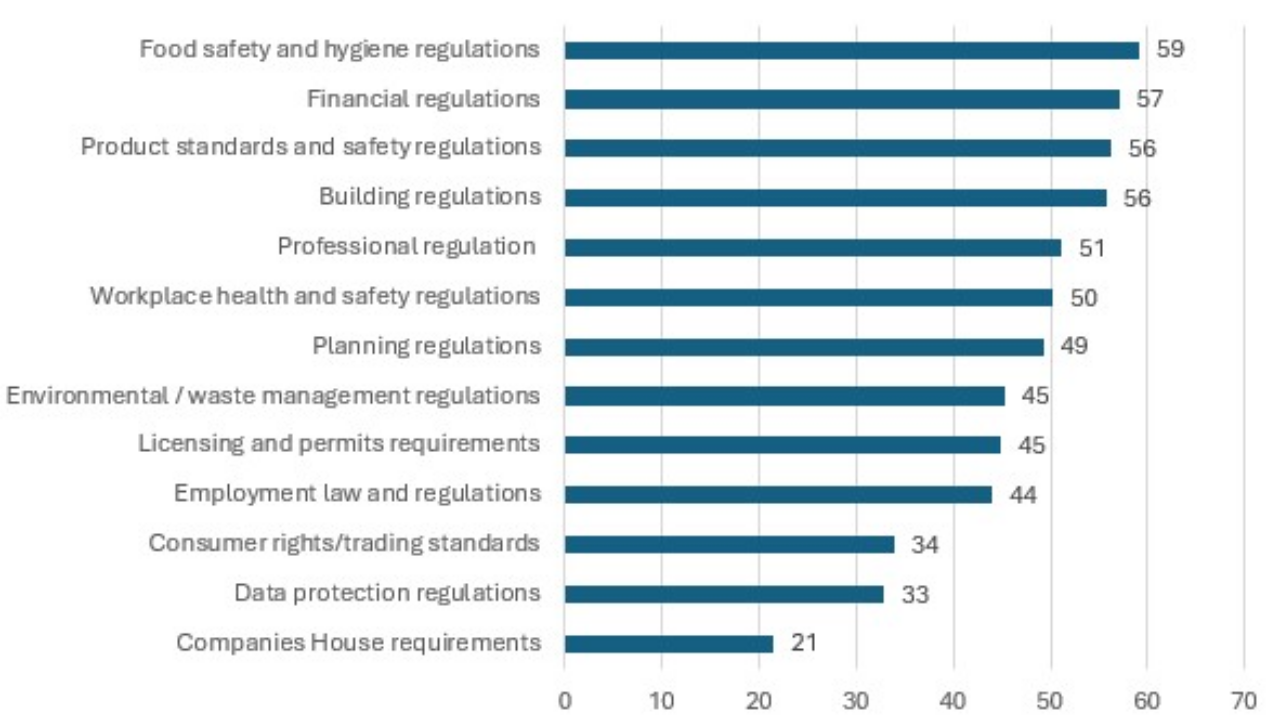
The survey asked respondents to estimate the time that they spent on regulatory areas that they felt had a significant impact on their business.[footnote 1]
Figure 1: average hours spent on compliance per regulatory area per year
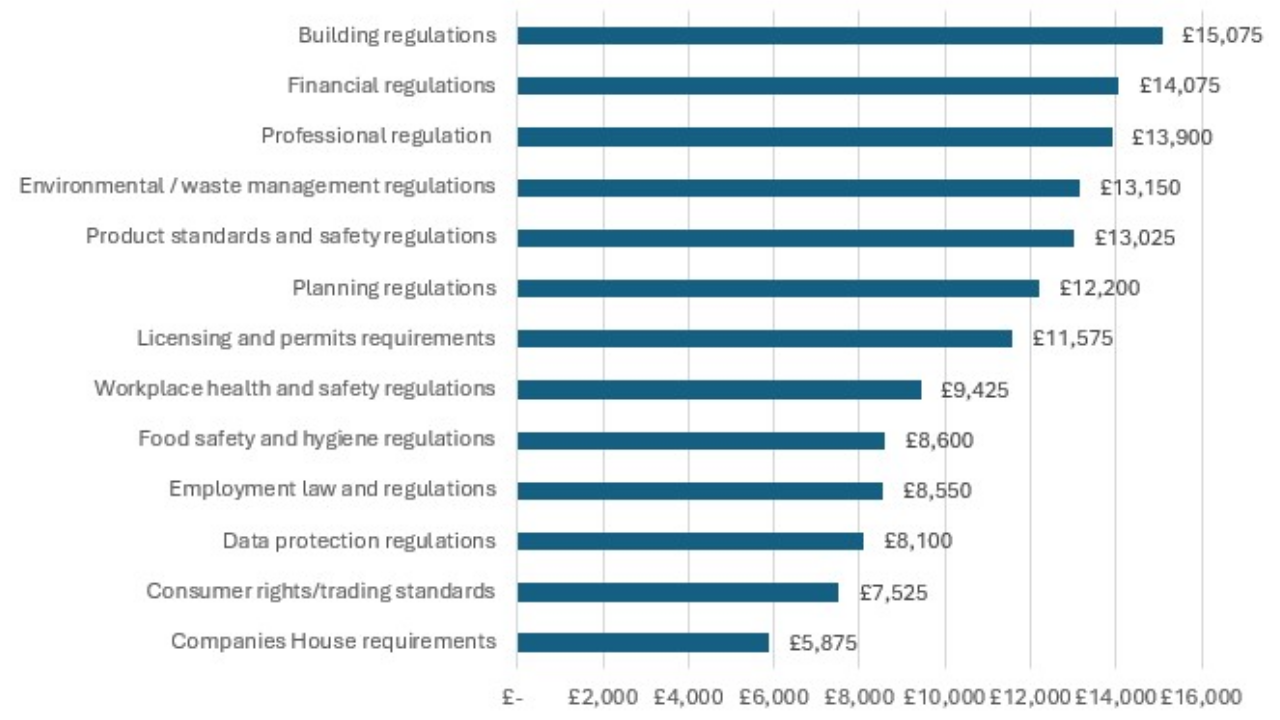
Similarly, where a small business had identified a regulatory area as having a significant impact on its business, they were asked to estimate the average cost they spent each year on compliance.
Figure 2: average financial cost per regulatory area per year
The respondents were also asked which regulatory areas create the greatest burden on businesses and to indicate whether there was scope to reduce the burden. The research found that majority of respondents identified the following regulatory areas as having the greatest scope to reduce the burden on SMEs:
- financial regulations (66%)
- environmental and waste management regulations (58%)
- Companies House requirements (56%)
- licensing and permit requirements (56%)
- planning regulations (56%)
- professional regulation (52%)
- employment law and regulations (51%)
What drives regulatory burden
The survey asked what the biggest drivers of regulatory burden are in respect of each regulatory area. Two factors consistently appeared towards the top of the list of drivers of burden. One is ‘working out what my business needs to do to be compliant’. Across the 13 areas of regulation that were mentioned in the survey, this was cited as the highest driver of burden for 5 areas, and the second highest driver of burden for 6 areas.
This indicates that improved clarity and certainty would substantially reduce regulatory burden for small businesses. Regulators should aim to clearly communicate to a small business the steps that they must take to comply, and distinguish this from the steps that they could choose to take to comply, with illustrative examples where possible.
This desire for clarity highlights a tension between small businesses’ need for clarity, and a tendency for government and regulators to impose principles-based regulation or reasonableness tests.
The second factor that consistently appeared as one of the top drivers of burden was ‘record-keeping’. It was cited as the top driver for 6 regulatory areas, and the second-top driver for 5 areas.
The survey revealed some notable variations between different areas of regulation. For example, ‘insurance premiums’ was generally low down the list of drivers of regulatory burden, but this trend was bucked by 3 areas:
- professional regulation (where insurance was cited by 36% of respondents)
- health and safety (34%)
- product standards and safety (28%)
This suggests it would be worthwhile for professional regulators, and the Health and Safety Executive (HSE), to closely examine whether they are gold-plating their mandatory insurance requirements and see if costs can be reduced.
When asked what would help to lower the burden of regulation, one of the most popular answers selected by respondents was ‘more flexibility over how I can comply’. On the face of it, this might seem inconsistent with the earlier finding that small businesses want clarity over what they need to do, but it isn’t.
It is perfectly possible for a regulator to allow flexibility over how a small business might choose to comply, while at the same time giving clear illustrations of what compliance can look like to reassure those small business owners who desire certainty and who have no interest in pushing regulatory boundaries.
Many respondents felt that a regulator having better digital systems would help to lower their regulatory burden. For Companies House, better digital systems were seen by survey respondents as the single most significant improvement that could be made to reduce regulatory burden in this area.
This may relate to practical difficulties that many directors experienced with digital systems when trying to verify their identity in the past year, or the significant data breach that Companies House experienced, or the proposal that small businesses will need to submit profit and loss accounts to Companies House even though HM Revenue and Customs (HMRC) already receives this information.
Another common theme was that small business owners said that making it easier to speak to someone at the regulator (either on the phone or through webchat) would help alleviate the burden of regulation.
For 5 regulatory areas, this was cited as the top improvement that could be made, and it was in second place for 5 other regulatory areas, and third place for 3 more. This speaks to the fact that business owners want reassurance that their circumstances have been understood, and that their business is compliant.
Modernising regulatory submissions
A survey of Institute of Chartered Accountants in England and Wales (ICAEW) estimated that SMEs spend approximately 37 hours per month on administrative tasks, with the burden falling disproportionately on micro-sized firms.
Not all of this is based on government direction or regulation of course, but it does indicate that for a week in every month a small business is pulled away from focusing on growth or servicing its customers.
Underpinning all of the recommendations in this section is the principle of small businesses submitting information once, with the onus on authorities sharing data with consent rather than mandating or asking small businesses for the information several times.
Recommendation 1: ‘tell government once’
A business may have to submit information to several government organisations, such as Companies House, HMRC, the Office for National Statistics (ONS), local authorities, the Information Commissioner’s Office (ICO), the Pensions Regulator (TPR) and other regulators and sector-specific bodies.
Much of this information overlaps, with the data having to be reformatted for different government bodies. The onus is currently on the business to reformat on behalf of the government.
Surveys conducted by Family Business UK and Small Business Britain also identified that duplicative reporting requirements were a major source of burden and highlighted the opportunity if these requests could be reduced.
Government should ensure that a small business must only give the same information once. The onus must be on organisations like HMRC and Companies House to extract the information required for their specific purpose for example, by integrating their systems, rather than different parts of the government or public sector asking for the same information from a business multiple times. The government should provide a clear timetable for when such a change would commence for small business.
1a. Profit and loss statements
Government should reverse the decision to remove the small company exemption from filing full accounts and introduction of the requirement for businesses to file full profit and loss accounts to Companies House.
As businesses already file this information to HMRC, this new requirement goes against the ‘tell government once’ principle, and therefore it should be reversed so that small businesses do not need to familiarise themselves, and comply with, unnecessary and duplicative requirements.
Amending information sharing powers between HMRC and Companies House could also be explored, so that small businesses are not required to provide the same information more than once.
Recommendation 2: reducing the impact of the annual confirmation statement
Under section 853A of the Companies Act 2006, all companies, including dormant and non-trading companies, are required to file a confirmation statement to Companies House confirming the information held about the company is up to date. This confirmation statement must be submitted at least once every 12 months. The cost of filing a confirmation statement is £50 online, or £110 via paper and by post.
Government should amend the relevant section of the Companies Act 2006 to ensure that small companies classed as dormant and non-trading, where no statutory information has changed since the last confirmation statement, are not required to file a new confirmation statement or pay the associated fee.
Recommendation 3: ONS data commissions
A consistent theme from an ICAEW members’ survey was being asked by the ONS, in addition to other agencies, for identical or similar information multiple times. Collection of data on turnover was cited as a good example: the Monthly Business Survey collects turnover and new orders.
The Annual Business Survey separately collects turnover, wages and salaries. However, turnover is also collected from VAT returns. A small company which has registered for VAT will provide the same figure on turnover to government at least 3 different times.
A business said that in one month, ONS sent them 5 requests for information. The business stated that these requests alone added up to 12 hours of administrative time. Current legislation, notably the Statistics of Trade Act 1947, the Statistics and Registration Service Act 2007 and the Digital Economy Act 2017 give the ONS permissive and mandatory powers to obtain data from most UK companies.
Government should ask the ONS to work with representatives of small businesses to develop a roadmap for reducing the burden on SMEs of responding to business surveys.
In support of the existing statutory duty ONS has to minimise burdens on businesses,[footnote 2] the roadmap should:
- identify opportunities to make greater use of data held elsewhere in government
- improve engagement with small business respondents
- simplify survey collection where possible
- set out areas where further government action may be required to reduce repeated requests for information
Recommendation 4: standardise construction procurement
The Common Assessment Standard, developed by Build UK, is the industry-recognised standard for the pre-qualification of suppliers in the construction sector. It comprises a question set which includes all the questions from the standard selection questionnaire. However, small businesses are still required to provide the same information via lengthy documents.
One small business highlighted that businesses repeatedly provide the same information to different government and local authority clients through pre-qualification questionnaires, supplier approval processes, accreditation schemes and policy evidence requests. Contracts frequently require hundreds of pages of supporting documentation even where information has already been provided elsewhere.
4a. Promote mutual recognition of existing standards and certifications
Government should work with public sector procuring authorities and the construction industry to establish a more consistent approach to the recognition of existing, widely accepted standards and certifications when pre-qualifying construction and engineering suppliers.
In particular, authorities should recognise relevant and up-to-date certifications such as ISO 9001, ISO 14001 and ISO 45001, where they provide the assurance sought. This is rather than requiring SMEs to submit the same information through separate or duplicated pre-qualification processes.
4b. Encourage consistent use of the Common Assessment Standard
Government should encourage public sector procuring authorities to use the Build UK Common Assessment Standard, or a recognised equivalent, as the basis for construction and engineering-related supplier assessment.
Authorities should avoid requiring suppliers to provide information that has already been satisfactorily demonstrated through the Common Assessment Standard, a recognised equivalent or an appropriate existing certification.
The objective should be to establish a proportionate, interoperable approach to supplier assessment across the public sector, reducing the need for SMEs to repeatedly provide the same information to different authorities.
4c. Develop a proportionate, light-touch approach for SMEs
Government should work with the construction industry and public sector procuring authorities to develop a proportionate approach to pre-qualification for SMEs. This is with the presumption that information already held through recognised standards, certifications or assessment schemes should not need to be resubmitted unless there is a clear and specific procurement-related reason to do so.
Any approach should be designed to reduce duplication and administrative burden rather than create additional compliance or reporting requirements for procuring authorities.
Regulatory guidance
The regulatory guidance workstream examined how regulatory requirements are communicated to SMEs and identified opportunities to make compliance simpler, clearer and more proportionate. While the underlying objectives of most regulations are widely supported, businesses reported that compliance is often made more difficult by complex guidance, uncertainty regarding expectations and a lack of accessible support.
Recommendation 5: support for SMEs in complying with Natasha’s Law
Any business that produces prepacked for direct sale food is required to label it with the name of the food and a full ingredients list, with allergenic ingredients emphasised within the list. This is known as Natasha’s Law.
While the consumer protection objectives of Natasha’s Law are strongly supported, small food businesses can face disproportionately high compliance costs compared with larger operators.
Micro and small businesses often lack access to specialist software, legal support or dedicated compliance staff. As a result, meeting allergen and ingredient labelling requirements can be administratively burdensome as they face the same labelling requirements as large supermarkets, despite the relatively limited scale of their operations.
Government should convene a time-limited sprint working group – meeting over 2 to 3 months – comprising:
- BIST
- the Food Standards Agency (FSA)
- the Department for Environment Food and Rural Affairs (Defra)
- Enterprise Nation
- the FSB
- other relevant business representative groups
The group’s mandate should be to agree practical solutions that make it easier for small food and drink businesses to comply with Natasha’s Law, including the feasibility of a free, customisable FSA labelling template.
Recommendation 6: establishing a cross-government programme to create a better business journey for SMEs interacting with GOV.UK
Businesses reported that identifying and interpreting regulatory requirements can be difficult, particularly where guidance is fragmented, outdated or written for specialist audiences. Similarly, the quality and accessibility of guidance is becoming increasingly important as businesses make greater use of digital tools and artificial intelligence (AI)-powered services that rely on GOV.UK content.
Government should expand BIST’s efforts on improving and maintaining SME-facing regulatory guidance on GOV.UK across all government departments. Government should also establish a fully funded and fully resourced cross-departmental programme led by the Government Digital Service (GDS) Business Unit to drive progress on making GOV.UK more accessible for small businesses.
All government departments should be required to implement common content-management standards, including regular review dates, ownership arrangements, notification of regulatory changes and task-based signposting for businesses.
The programme should prioritise identifying and removing outdated content, improve the quality of information consumed through AI tools and provide a more consistent and navigable experience for businesses interacting with government.
Recommendation 7: installing SME priorities into a new strengthened growth duty and departmental growth goals
All government departments should ensure that regulators in scope of the new strengthened growth duty consider SME growth priorities when setting strategic growth steers. The strengthened growth duty will give Secretaries of State a new power to set direction on growth priorities for regulators through statutory strategic growth steers.
To ensure that regulators consider SME growth as part of their role, government departments should require that specific SME growth priorities are incorporated into these steers where relevant. In addition, ahead of legislative readiness, SME growth priorities should also be factored in non-statutory growth goals programme, starting with the 2027 to 2028 goals which are expected in Spring 2027.
If these priorities are applied effectively by regulators, they could translate to regulators being more attuned to the needs of SMEs and lead to regulators producing more SME-friendly outputs.
This will help SMEs comply with regulatory requirements through clear guidance, while at the same time providing services like sandboxes to businesses wishing to bring innovative products and services to market. This would also make clear to regulators supporting small businesses to comply with regulation is a core part of their role, not a nice-to-have.
Regulatory passporting
The regulatory passporting workstream examined opportunities to reduce duplication in business onboarding, procurement, compliance and regulatory interactions.
Recommendation 8: single business identifier
The workstream considered the need for a single business identifier, as that would enable businesses to move seamlessly across different services and reduce the administrative burden of having to provide the same information more than once.
The co-chairs of the taskforce should bring government and industry together with the aim of agreeing a business-to-business Single Business ID roadmap and timeline, giving certainty to the market on the shape and timing of such a critical passporting scheme.
Recommendation 9: establish a dedicated home for small businesses seeking to report burdensome regulations
Businesses and representative organisations highlighted the difficulty of identifying where to raise concerns about regulations that create unnecessary administrative burdens or unintended consequences.
The workstream reviewed international examples, including the United States Office of Advocacy, which provides businesses with a clear route to raise regulatory concerns and contribute evidence on the impact of regulation.
Government should establish a single business-facing entry point on Business.gov.uk through which small businesses can report specific regulations which are burdensome, disproportionate, outdated or challenging for SMEs to comply with.
This should be complemented by existing support from the Business Growth Service (BGS) which can route businesses to the appropriate support mechanism and provide bespoke advice on how to achieve regulatory compliance.
Evidence gathered through this mechanism should be systematically reviewed to identify recurring administrative burdens, duplicative requirements and disproportionate impacts on SMEs, helping to shape cross-government burden-reduction programmes and drive departmental accountability.
Where possible, the government should also explore integrating existing initiatives to ensure it is not duplicating efforts for example, from the Regulatory Innovation Office (RIO) Business Front Door.
Supporting SMEs in building capability, resource and technology
The workstream focused on practical ways to help SMEs build the capability, resource and confidence needed to comply with regulatory requirements. Small businesses generally understand the objectives of regulation but can struggle to navigate multiple sources of advice, understand which obligations apply to them, and access specialist support at the point it is needed.
Recommendation 10: work with local government to maximise the impact of local expert regulatory advice delivered by growth hubs as part of a national network
Government and local government should consider how expanded local regulatory advice can best be provided to businesses on compliance and enforcement queries, including outreach to new businesses in higher-risk sectors.
This could also include businesses highlighting regulatory barriers to innovation to inform support offers, such as the planned BIST regulatory sandbox programme, as well as existing wider RIO support.
Where local business support is devolved, this is a decision for local leaders on how they best deliver outcome focused deliverables, which should support the design of a simplified local and national business support system.
Recommendation 11: government should introduce solutions which support directors’ understanding of their core responsibilities and improves compliance
Government should work across departmental boundaries – including BIST, HMRC, Companies House and Insolvency Service – to develop its evidence base and test hypotheses on how it could support directors’ understanding of their core responsibilities.
This should include exploring options for improved guidance, information and support (including GOV.UK content), the targeting of higher risk business segments, and better timing of communications according to the business lifecycle including at the point of registration and at early signs of financial distress.
This work should adopt a co-design approach which identifies quick wins, longer term actions and explores the roles which business intermediaries can play. This should aspire for greater personalisation (including a personalised compliance checklist) as increasingly sophisticated digital capabilities are delivered through existing Companies House and wider government digital transformation.
This would help to address the issue that many businesses only discover their obligations once problems arise. Better communications and a more personalised approach would benefit all new businesses by improving awareness of regulatory requirements from the outset and by signposting reliable government guidance at the point when businesses are most likely to need it. Delivery would require cross-government digital integration and data-sharing between the relevant registration and guidance services.
Recommendation 12: HMRC should commit to cutting the administrative burden on small businesses associated with the implementation of the information duty under the Non-Domestic Rating Act 2023
Information requests can place a significant burden on small businesses, particularly where the information being requested is unnecessary or duplicates information already held by a public body. Therefore, as part of the valuation process, the Valuation Office (VO) should, by default, provide pre-populated forms containing all information currently held for a given property. This would prevent small businesses from having to unnecessarily provide information which is already known to the VO.
When updating these forms, small businesses should be able to check the information that is held and only be required to amend the information if there have been any changes to the property. If no changes have occurred, then the business should only be required to confirm that the information that is held is correct. This approach would save considerable time by removing the need to resubmit information that is already held by the VO.
Recommendation 13: strengthening transparency of the administrative burden reduction target for SMEs
The government should clearly set out how savings implemented as part of the 25% administrative burden reduction target cut the administrative burden of regulation for SMEs of different size to increase transparency about how the target is being achieved where possible, as part of any future progress updates.
Providing a genuine assessment through future programme reports of how measures reduce administrative burden on SMEs, together with the associated cost savings where possible, would enable small businesses to recognise the savings made and feel the difference in their day-to-day operations.
It would also help foster transparency and help reassure SMEs that the government has considered the needs of firms of all sizes as part of its 25% administrative burden reduction target.
Government should also be more proactive in communicating how significant new regulatory requirements affecting SMEs have been considered and mitigated. Given that the government is introducing measures that are likely to have a significant impact on SMEs, including through the Employment Rights Act, this would also provide an opportunity to demonstrate how reductions in administrative burdens are being balanced against the impact of new regulatory requirements coming into force.
In addition, clearly setting out a net regulatory administrative burden reduction assessment would help demonstrate that the government’s objective is genuinely to reduce the overall administrative burden on businesses, rather than reducing it in one area while increasing it in another.
Regulatory enforcement
Evidence gathered through focus groups and 2 separate surveys covering over 500 SMEs informed the recommendations coming out of this workstream. The recommendations do not purely focus on making changes to enforcement, they also touch on the design of regulations, as better up-front design of regulations can help improve regulatory enforcement.
Recommendation 14: build regulation with smaller businesses in mind, with impacts on SMEs assessed prior to making new laws or regulations
Small businesses reported that regulatory systems are frequently designed around the resources and structures of larger organisations. Unlike larger firms, SMEs rarely have dedicated compliance, legal or administrative teams, meaning regulatory activity falls directly on business owners and senior staff.
This means that the impact of new requirements on SMEs is not always fully understood before implementation and that obligations which appear proportionate for larger organisations can have significantly greater consequences for smaller firms.
Before any new regulation, reporting requirement or digital process is introduced or amended, government should assess its cost and administrative impact on businesses of different sizes, including SMEs. Assessments should be tested with real businesses and published alongside proposals. Where burdens fall disproportionately on SMEs, proportionate and tiered requirements should follow.
Recommendation 15: digitalisation and standardisation of licence applications
Differences between local authorities were identified as a significant source of complexity and administrative burden. A survey of Small Business Britain members and Family Business UK members showed a significant number of small businesses identifying differing requirements and interpretations of requirements across local authorities as a major challenge.
Businesses face significant friction in complying with regulatory licencing requirements – often having to submit the same information, in a different format (sometimes still in paper format), to a different local authority, so that they can operate in a different area. As one small business owner put it, “It’s not the licensing itself that’s the problem, it’s that 300-plus authorities each run their own versions, different fees, forms, response times, all uncoordinated”.
Government should work towards standardising licence applications for alcohol, entertainment, temporary events notices, late night refreshment and taxis administered by local authorities in England. This is so that businesses only need to provide information once, and introduce guaranteed decision timelines where feasible.
This should be supported by the digitalisation of licence applications and, where feasible, a national digital register of licence holders, enabling businesses to receive and present licences digitally.
Methodology
The survey was administered by YouGov and was in the field from 16 to 23 June 2026. The survey was carried out online and received 1,041 responses from SME decision makers. The data has been weighted by business size and region to be representative of the full distribution of UK SMEs.
The figures presented have been analysed independently by the FSB. The views expressed here do not represent the views of YouGov.
-
Because the averages were only calculated for businesses who felt the regulatory area had a significant impact on their business, it is not appropriate to sum these figures to create overall estimates of regulatory burden. ↩