Government Actuary's Department Annual Report and Accounts 2024-25 (HTML version)
Updated 9 December 2025

© Crown copyright 2025
This publication is licensed under the terms of the Open Government Licence v3.0 except where otherwise stated. To view this licence, visit nationalarchives.gov.uk/doc/open-government-licence/version/3 or write to the Information Policy Team, The National Archives, Kew, London TW9 4DU, or email: psi@nationalarchives.gov.uk.
Where we have identified any third party copyright information you will need to obtain permission from the copyright holders concerned.
This publication is available at https://www.gov.uk/government/publications/government-actuarys-department-annual-report-and-accounts-2024-to-2025/government-actuarys-department-annual-report-and-accounts-2024-25-html-version
Key highlights
- £26.1 million fee income in 2024-25
- We advised NHS Resolution on £60 billion provision for clinical negligence claims
- We provided analysis and advice to enable the £2.26 billion loan to Ukraine
- We supported the Pensions Investment Review impacting assets of £400 billion for the Local Government Pension Scheme and £200 billion for the defined contribution pension market
- We achieved a 4.8 star rating (out of 5) in our client survey
- GAD employee engagement was 68% in the Civil Service People Survey
- We hosted over 700 attendees at GAD events, and staff contributed to over 50 industry events sharing knowledge and raising awareness of our impact
- We recorded over 17,000 learning hours, over 11 days per employee
- 31 GAD staff members participated in secondments, supporting 8 clients across government departments and 6 across the wider public sector and other organisations
The Performance Report
Overview
This section contains a summary from the Government Actuary providing her perspective on the performance of the organisation over the period. It also provides details of the purpose, vision and values of the Government Actuary’s Department (GAD), GAD’s strategy and principal activities, a list of key risks that could affect GAD in delivering its objectives, GAD’s going concern assessment, and a performance summary.
Foreword by the Government Actuary
This has been my first full year at GAD, and I continue to be inspired by the breadth and depth of our work and the tangible impact it has across the public sector. From public service pensions and policy development to government risk pools, investment advice, disaster risk financing, climate analysis and assurance on complex government modelling – our people bring expertise to some of the greatest challenges facing government today.
This report reflects on the final year of our previous strategy, and I am proud of what we have accomplished in 2024 to 2025. We anticipated a shift in the nature of our work this year, with a growing emphasis on supporting policy development and a relative reduction in our focus on public service pensions, due to the nature of the cycle of regular activity. In response, we have proactively engaged early with clients to shape outcomes and provide insight on issues of national importance. We have also invested in our commercial capabilities and enhanced our operational efficiency through new tools and techniques – freeing up capacity to tackle emerging challenges for the future. Today, we work with more departments and public bodies than ever before, and we are tackling a broader range of issues.
While this report reviews the past year, we are firmly focused on the future in our activity. Our aspiration is to be the ‘go‑to’ partner across the public sector – brought in early to help shape problems and deliver solutions when faced with complex and uncertain financial challenges. We have developed a new strategy that aligns with government priorities. Our 2030 Strategy sets out an ambitious vision: to be bold and trusted partners in risk and finance, enhancing decision‑making for lasting benefits to society.
This strategy has been rigorously tested and shaped with input from our Board. It builds on our strengths as problem solvers and strategic thinkers, and it positions us to unlock even greater value from our core work while expanding our impact across government policy. As we enter the first year of this new strategy, we have already laid the groundwork for success – with refreshed leadership structures, clear goals and high ambition. We recognise that the cyclical nature of our statutory work means the next 2 years will be particularly demanding.
I am excited by the opportunities ahead to support our clients in addressing some of the most pressing issues facing society. This report highlights just some of the ways our actuaries, analysts and business professionals are making a difference across government. I look forward to working with our teams and the Board to deliver on our shared vision.
Fiona Dunsire
Government Actuary
Vision and values of GAD
The prior 5‑year strategy for GAD was launched in April 2020 and ran through to the end of the 2024 to 2025 financial year. That strategy was built around GAD’s mission to improve the stewardship of public sector finances by supporting effective decision‑making and robust financial reporting through actuarial analysis, modelling and advice. During the year we developed a new 5‑year strategy which launched in March 2025, which sets our strategic vision and goals for the years ahead.
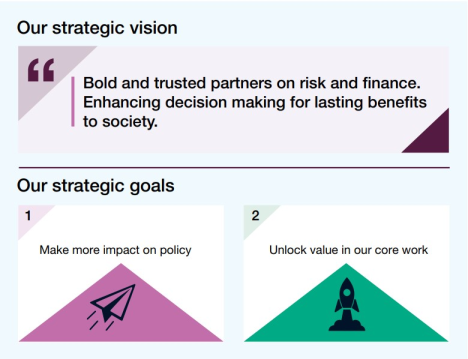
Our strategic vision
Bold and trusted partners on risk and finance. Enhancing decision making for lasting benefits to society.
Our strategic goals
- Make more impact on policy
- Unlock value in our core work
GAD is a non-ministerial government department, and part of the Analysis Function in Government. We provide impartial actuarial advice, analysis and professional support to the government and public sector, helping our clients to understand and analyse complex and uncertain financial challenges. We apply the actuarial profession’s technical skills, consultancy discipline, high standards of professionalism and industry sector knowledge to help solve these financial challenges.
Our values are the beliefs and behaviours which define us as an organisation. We are:
- expert - We provide high quality, professional advice
- collaborative - We partner effectively with our clients to understand and address their business needs
- inclusive - We value and develop all our people
- innovative - We are forward looking, continually developing and improving to meet evolving client needs
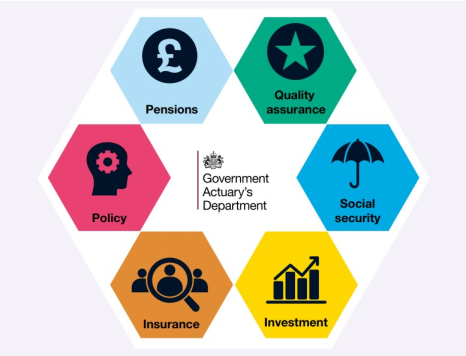
Our areas of expertise include:
- Pensions
- Quality assurance
- Social security
- Investment
- Insurance
- Policy
What we do
GAD’s team structure
During 2024 to 2025, GAD’s client services were organised across 3 client‑facing teams: insurance and investment, public service pension schemes and specialist actuarial. The teams were further supported and enabled by the cross‑cutting analytical solutions team, research and technical team and corporate areas. As of 1 April 2025, GAD’s structure has been aligned with the 2030 Strategy to enable implementation of the strategy.
GAD’s principal activities are divided into the following areas:
Climate change and disaster risk finance
We help organisations understand and assess the physical risks that climate change poses to them as well as the risks of the transition to a low‑carbon economy. We provide help to departments and organisations implementing policies to meet emissions targets or to adapt to changing physical risks. We advise on arrangements to finance the response to disasters such as flood and drought, including assessing the use of different financial instruments to support the response costs.
Credit risk
We provide advice on financial risks to UK government from credit support schemes and other credit‑related contingent liabilities. This includes analysis supporting disclosure of expected credit losses and assurance of work done by others.
Data science
We have continued to develop our data analytics capability within the department and use modern programming tools to apply a range of advanced analytical techniques, such as machine learning algorithms and spatial and time‑series analysis, to provide richer insights for clients. Alongside this we are adopting visualisations and interactive dashboards. Our expertise in this area has enabled us to identify trends and communicate insights to inform strategic decision‑making.
Reproducible analytical pipelines
We have applied the concept of reproducible analytical pipelines to some of our regular work, such as data processing and analysis for the public service pensions valuations. Using the reproducible analytical pipelines framework enables us to ensure that the work we are producing is reproducible, auditable, efficient and high quality.
Insurance and contingent liabilities
We provide actuarial advice to government departments, public bodies, local authorities and international development organisations on life, general and health insurance‑related matters. We also provide advice to government departments on contingent liabilities, mostly in areas of market failure and government intervention. Examples of insurance and contingent liabilities clients include: NHS Resolution, Department for Education (risk protection arrangement) and our support for the Financial Instruments and Transactions Advisory Group in UK Government Investments. We advise on the expected costs and underlying risks of future potential financial liabilities which might arise from self‑insurance, risk transfer schemes, or government backing. Our analysis and advice apply to a wide range of challenges, including estimating costs of specific redress initiatives, quantifying government support on new energy projects and assisting our clients in their adoption of IFRS 17 accounting standards.
Investment and financing
We help organisations to fund their long‑term financial obligations. We model uncertainty in future expenditure and explore funding strategies to mitigate risk. For example, we advise the Department for Energy Security and Net Zero on the funding arrangements for meeting decommissioning costs for new nuclear power stations. We advise on investments including strategic investment strategy and operational aspects, with a particular focus on investments backing pension and insurance arrangements.
Modelling and quality assurance
We provide financial modelling, demographic modelling and other bespoke modelling services. This includes assistance on a model that a client wishes to develop internally and providing a full modelling service from initial design through to testing and adoption. We also perform quality assurance reviews of models in order to give model users confidence in outputs which underpin decisions. Our quality assurance reviews include:
-
verifying that model calculations are working correctly and that models are robust
-
validating that data, assumptions and the modelling approach are fit for purpose
-
reviewing model documentation to reduce the risk of errors arising at future use or updates
-
assessing whether a model has been subject to appropriate scrutiny and challenge
-
checking whether limitations and uncertainties are communicated adequately
Pensions
Funded pension schemes
We provide a full range of actuarial services to occupational pension schemes which have a pool of assets backing the liabilities. Our advice is focused on arrangements in the wider public sector. Our services include:
-
consultancy services for trustees - expert guidance to trustees on managing their pension schemes, ensuring compliance with regulatory requirements and developing funding strategies
-
advice to employers - we support employers in understanding their pension scheme financial obligations, managing risks and working with trustees to agree suitable strategies
-
governance reviews - we carry out reviews of benefit structures, as well as funding and investment strategies, to inform client decision‑making
Pensions policy, regulation and supervision
Drawing on our actuarial knowledge, wide‑ranging experience and understanding of pensions issues, we offer technical and analytical advice which recognises the broader policy context. This includes the provision of actuarial analysis for government departments and public bodies requiring actuarial input to policy development. While the main focus is on the provision of actuarial support to officials in HM Treasury and the Department for Work and Pensions, we also support a number of autonomous bodies such as the Pension Protection Fund and the Pensions Regulator.
Public service pension schemes
We provide actuarial advice to all of the main UK public service pension schemes such as those for the Civil Service, armed forces, police, fire service, teachers, local government and NHS. Our advice impacts a significant proportion of the population, covering around 16 million members in total. We advise and assist UK government departments on strategic pension scheme policy and implementation, including the implications of legal cases affecting public service pension schemes such as the McCloud case. We support the effective administration and ongoing management of the schemes by measuring scheme costs and employer contributions, providing financial information for government accounts, and producing and maintaining schemes’ actuarial factors.
Staff transfers
We advise public sector bodies where staff are set to have their pension arrangements changed. Our key services include broad comparability assessments and advice on bulk transfers including early assessment of potential shortfall costs. We help with staff communications and liaise with pension administrators and lawyers. We often work alongside clients in managing the whole transfer process.
Social security
We provide regular reports to Parliament on the financial position of the UK National Insurance Fund (‘the Fund’) as required by legislation. These include an annual report concerning the impact on the Fund of the proposed up‑rating of benefits or changes in contributions, and a report every 5 years which summarises projections of the estimated balance in the fund over the longer term. The Government Actuary has a statutory role in reporting on the review of the State Pension age, which legislation requires must take place at least once every 6 years. We also provide advice to social security organisations in other countries.
More information about GAD’s services is available on the GAD website.
How we are funded
GAD is a non‑ministerial department whose funding is budgeted to be met entirely from the fees charged to its clients.
Key organisational risks
There are risks to not meeting the objectives set out in our 5‑year strategy and annual business plans. The key strategic risks identified by the Board are set out below.
Clients: Risk that GAD’s reputation for providing high‑quality advice to clients effectively and efficiently is damaged or that GAD’s services do not match the evolving needs of its clients.
People and inclusion: Risk that GAD is unable to provide future advice effectively due to a lack of access to appropriate talent.
Processes: Risk that GAD’s advice is not efficiently produced or that quality is not maintained owing to poor processes in place.
Finance: Risk that GAD does not provide good value for money, meet financial targets or has weaknesses in its financial control framework.
Further details about how these could affect GAD in delivering its objectives can be found in the governance statement within the accountability report.
Going concern assessment
In common with other government departments, the future financing of the department’s liabilities is to be met by the supply estimate process and the application of future income generated from clients. These are stated in the department’s annual supply estimate which is approved by Parliament. As the department will continue its operations for the foreseeable future, these financial statements have been prepared on a going concern basis.
Performance summary
The 2024 to 2025 financial year was another year of strong client demand, with our revenue exceeding expectations. We continued to diversify our work and client base, enhancing our reputation as a key partner to our clients on pension scheme administration and providing quality assurance of an increasing range of government modelling.
Performance analysis
Performance and operating review
The 2024 to 2025 financial year has successfully demonstrated our ability to have a greater impact in supporting policy development across government, in a year where there has been a reduced focus on public service pensions valuation work. This was the result of a deliberate strategy to diversify our client activity and be proactive in engaging early to support policy development. It has also required development of broader skills across the department, to meet client needs in emerging areas of work.
Despite being a year in which our public service pension scheme clients were not involved in valuation work, we continued to deliver near record levels of client support. This was delivered against a background of innovation and system development to enable future efficiencies.
The performance of the department is measured through the Balanced Scorecard Key Performance Indicators (KPIs). The KPIs are produced quarterly and are presented at Board meetings for review, discussion and action.
The key highlights of performance have been split between clients, people and inclusion, processes and finance.
Clients
Over the past year, our commitment to client delivery and operational excellence generated more than £26.1 million in revenue. Our teams worked closely with client stakeholders throughout the year, ensuring alignment with their evolving needs and strategic goals. This included 31 secondees working across 14 client organisations, providing hands‑on expertise and fostering strong, trusted partnerships.
In preparation for upcoming public service pensions valuations, we placed a strong emphasis on developing new tools and refining processes to enhance both accuracy and efficiency. Our analytical solutions team played a pivotal role in this transformation, contributing to 39% of total revenue by embedding advanced analytics across our service lines. Their work led to measurable improvements in the effectiveness of our delivery and the scalability of our solutions.
GAD continued to deliver high‑impact, trusted advice on complex and high‑profile policy issues, as demonstrated in the four case studies (see pages 20 and 22). During the year we also worked closely with colleagues in the Department for Work and Pensions, the Ministry of Housing, Communities and Local Government, and HM Treasury providing critical input to assess the pensions landscape and develop proposals for the Pensions Investment Review and the subsequent Pension Schemes Bill.
These efforts were reflected in our client survey results, where we achieved an outstanding 4.8 out of 5 stars for overall satisfaction. Notably, we saw an 8% increase in our innovation score, underscoring our clients’ recognition of the value we bring through continuous improvement and forward‑thinking solutions.
People and inclusion
Our people are at the heart of our success. This year, we have invested in continuous professional development, with structured learning activities. Our learning programme covered technical and consulting skills, leadership, and inclusion, supporting both individual growth and organisational capability.
We have further expanded our presence in Edinburgh, recruiting new actuaries, specialist consultants and analysts to deliver services to both devolved administrations and UK‑wide clients. The Edinburgh office has become a vibrant hub for collaboration and innovation.
Our onsite working and secondment opportunities enable our staff to work directly with client departments. These placements have deepened client relationships and provided valuable professional development for our people.
Over the year, we continued to progress our people strategy, developing our staff and ensuring that GAD remains fit for the future. This included the following areas.
Engagement: We achieved a staff engagement score of 68% which was 4% higher than the overall Civil Service staff engagement score. For 5 of the 9 themes, we achieved scores of over 80%.
Human Resources: The function played an integral role in supporting the business in shaping and launching GAD’s 5‑year 2030 Strategy. A new HR Director was appointed to further bolster strategic leadership to the organisation and the function.
Learning and development: Over the course of the year, to support the identification of core development needs, talent management conversations using the 9‑box grid were piloted.
Recruitment: We continued to strengthen our recruitment practices throughout the year, building on the foundations laid in recent years. We worked closely with our graduate recruitment provider to further develop and improve the inclusivity and reach of our graduate campaign. This led to a more diverse pool of candidates than ever before. We recruited 7 graduates in this period and our approach achieved a good gender and ethnicity split. The recruitment of graduates continues to provide an important and sustainable pipeline of talent to support key business activities. We also maintained our focus on attracting experienced actuaries and specialist consultants into government, ensuring our processes support fair and transparent hiring at all levels.
Diversity and inclusion: This year, we continued to deliver against our diversity and inclusion strategy, further integrating it with our broader people strategy to support our goal of becoming a more inclusive and representative organisation.
Processes
We improved our infrastructure to support our work, expanding our use of modern coding languages and starting to test the potential of artificial intelligence to deliver advice more efficiently. Significant developments include:
Greater productivity: We have started to utilise AI for some pieces of work to provide richer insights to clients and greater value for money. For example, we have used AI to summarise various consultation responses which has enabled us to provide clients with a quick and comprehensive summary of responses. We have also begun trialling Copilot to understand how we can use embedded AI to improve our productivity. All our uses of AI are in line with the principles set out in the Government’s AI playbook.
Modernisation of tools: We have used our increased capabilities in modern analytical tools and techniques to update some of our models and processes. These updates provide increased functionality, better presentation of outputs, lower risk and improved value for our clients. We completed the migration of our Factor Guidance notes onto a digital platform which makes them easier to maintain, access and use. We also completed the migration of our data processes onto R and began to use this to process valuation data for the 2024 PSPS Valuations.
Risk management: Our risk management approach runs throughout the organisation and highlights any areas of concern, as well as ensuring sufficient mitigation actions are being taken. Throughout the year we enhanced the summary reporting of our risks to better enable senior staff to prioritise areas that required attention. During the year there were particular improvements to our residual risks on IT systems and our infrastructure arising from the changes in our support providers.
Professional accreditation: We continue to be accredited under the Institute and Faculty of Actuaries Quality Assurance Scheme. The scheme provides external scrutiny to our processes and our professional approach to delivering a quality service.
Data management: We moved our digital filing system to HMT’s Info Store system which has improved the way that we manage, access, protect, store and document our digital information and makes it easier to meet our regulatory obligations.
Customer relations: We have introduced Salesforce in the department to provide better management of our upcoming work pipeline and more insight into our customer relationships. We envisage that the use of Salesforce will help to improve our productivity by providing enhanced knowledge of future work and will improve the value we provide to clients.
Functional standards: GAD’s processes comply with the government’s functional standards.
Finances
Client income for the year exceeded expectations, though slightly lower than the previous year. Even so, we have increased our breadth and reach across the wider public sector as well as identifying new areas where we can add value.
We continue to review our forecasting and resource planning processes through quarterly business reviews, to ensure all risks and opportunities are recognised and managed in a timely manner.
Public sector budgeting framework
In line with the public sector budgeting framework, GAD’s net spending is broken down into 4 spending totals, for which Parliament’s approval is sought. These are as follows:
-
resource departmental expenditure limit (resource DEL) - net limit comprising day‑to‑day running costs less income from actuarial services provided
-
capital departmental expenditure limit (capital DEL) - right of use assets on GAD’s leases
-
resource annually managed expenditure limit (resource AME) - a provision for a historic injury benefit
-
capital annually managed expenditure limit (capital AME) - a limit for capital dilapidation provisions arising on our property leases since the implementation of IFRS 16
The table below provides a summary of GAD’s outturn in 2024‑25 compared to the approved estimates.
Table 1: GAD’s outturn in 2024 to 2025 compared to the approved estimates
| Category | Reconciles to SOPS note | Outturn £000 | Estimate £000 | Variance £000 | Commentary |
|---|---|---|---|---|---|
| Resource DEL | 1.1 | (690) | 1 | 691 | The favourable variance is as a result of higher than budgeted income due to strong client demand for GAD’s services and better management of expenditure. |
| Capital DEL | 1.2 | 312 | 450 | 138 | This variance is due to the savings from the purchase of the right of use asset for the lease in our Edinburgh office, where fewer desks were required than budgeted. |
| Resource AME | 1.1 | (3) | 50 | 53 | The favourable variance is due to the unwinding of the injury benefit provision which was lower than budgeted. |
| Capital AME | 1.2 | (22) | 100 | 122 | The favourable variance relates to the derecognition of the QEH dilapidations provision for GAD leases. |
The above table reconciles with the Statement of Outturn against Parliamentary Supply (SOPS). The SOPS has in turn been reconciled with the Statement of Comprehensive Income in SOPS 2.
GAD’s income arises from the fees charged to clients. Due to GAD being self‑funded, GAD’s net outturn (resource DEL) is often negative (income is higher than spend), as can be seen in the trend analysis below. Any excess cash held as at 31 March as a result of this is paid over to HM Treasury.
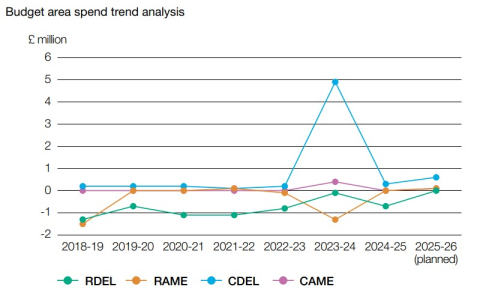
The increase in the CDEL expenditure for 2023-24 was as a result of GAD entering into its new office lease.
Examples of GAD’s work during 2024 to 2025
During the 2024 to 2025 financial year, we completed a wide range of work and highlight a small number of case studies here, to demonstrate the breadth of work GAD supports and its impact. These range from the review of Personal Injury Discount Rates in the UK to financial analysis supporting Ukraine’s defence; from analysis for the National Insurance Fund to work around climate scenarios.
Supporting evidence-based policy: GAD’s role in the Personal Injury Discount Rate Reviews
Read the story here: Personal Injury Discount Rate - England and Wales
The Lord Chancellor announced changes to the Personal Injury Discount Rate (PIDR) in England and Wales. The PIDR is used to determine lump sum damages awards to people who suffer serious and long-term personal injury due to the actions or negligence of another party. The lump sum payments are intended to provide people with full and fair financial compensation for all expected losses and costs caused by their injuries.
Where a lump sum is provided, it is calculated allowing for the period over which losses and costs are expected to be met and the assumed investment return that a claimant expects to earn on the lump sum award. The assumed investment return is referred to as the PIDR.
Legislation requires the Lord Chancellor to review the PIDR every 5 years and an independent expert panel, chaired by the Government Actuary, must be consulted for each review. GAD played a central role in the latest review, providing detailed analysis to the expert panel.
Our team modelled a range of investment scenarios, analysed factors affecting claimant outcomes, and evaluated economic trends. This analysis informed the expert panel’s advice to the Lord Chancellor. The framework for setting the PIDR in Scotland and Northern Ireland is different, with the Government Actuary having a formal role in setting the rate, however GAD provided similar analysis for both reviews.
Supporting Ukraine’s Defence: GAD’s Role in UK-Ukraine Bilateral loan
Read the story here: GAD’s interest rate advice for the Ukraine loan
We advised HM Treasury on the options around setting an interest rate on UK’s loan to Ukraine. Representatives from the UK and Ukraine signed the UK-Ukraine Bilateral agreement in March 2025, at a ceremony in Downing Street.
GAD assessed financial considerations for setting an interest rate on the loan of more than £2 billion to Ukraine. This was the UK’s contribution to the G7 Extraordinary Revenue Acceleration Loans to Ukraine scheme, through which G7 countries will collectively provide $50 billion to support Ukraine.
The loan has a novel repayment structure in that repayments will come from income derived from the profits on sanctioned Russian sovereign assets held in the EU. This means careful consideration of the potential income stream of these assets had to be taken into account in our calculations. Our analysis and supporting assumptions formed the basis of our advice to HM Treasury around the level and structure of the interest rate on the loan.
The international agreement represents a significant achievement in international financial diplomacy. The successful implementation of our recommendations showcases GAD’s vital role in enabling innovative financial solutions that advance both the UK’s strategic interests and international security priorities.
Supporting robust financial analysis: National Insurance Fund projections
Read the story here: Up-rating Report 2025 - report on the National Insurance Fund
In January 2025, GAD’s Up-rating Report 2025 was laid in Parliament and published online. It is GAD’s annual review of the National Insurance Fund of Great Britain, containing income and expenditure projections for the Fund. The National Insurance Fund is used to make State Pension payments, as well as some working age benefits. The report projects forthcoming contribution income and benefit expenditure through to 2030 and is a source of information for ministers and Parliament.
The report looked at how benefit payments and pension increases would affect the Fund, how the National Insurance changes announced in the 2024 Spring Statement and Budget would shape future contributions, and whether additional financing may be required.
The report showed that contribution income is projected to exceed benefit expenditure in every year of the projection period. This results in an increasing Fund balance over the projection period and no requirement for additional financing.
Climate scenario decision tool for Scottish public sector
Read the story here: Future climate scenarios
We supplied advice and recommendations to the Scottish Government, to help develop a climate scenario decision tool. This will help public sector organisations across Scotland plan for the impact of climate change under different scenarios.
Our report, “Using future climate scenarios to support today’s decision-making” is the basis for Scottish public sector guidance on climate scenario analysis. Our work was commissioned on behalf of the Scottish Government by ClimateXChange, Scotland’s centre of expertise on climate change.
GAD’s team of climate risk experts set out recommendations on the climate change emissions pathways or temperature scenarios, time frames and climate hazards. We reviewed existing policy, guidance, and stakeholder practice on the use of future climate scenarios and hazard data.
We developed options for setting national-level guidance to support the consideration of future climate change and help drive a consistent approach to adaptation planning across the public sector in Scotland.
GAD recommended that organisations should consider both chronic and acute physical climate hazards, at least 2 global warming scenarios (2°C and 4°C), and update their scenario analysis every few years.
Task Force on Climate‑related Financial Disclosures
Introduction
The Task Force on Climate‑Related Financial Disclosures (TCFD) aims to promote the effective management of climate‑related risks and opportunities across economies through high‑quality disclosure. The framework is structured around 4 pillars.
| Governance | Strategy | Risk management | Metrics and targets |
|---|---|---|---|
| The organisation’s governance around climate‑related risks and opportunities. | The actual and potential impacts of climate‑related risks and opportunities on the organisation’s businesses, strategy and financial planning where such information is material. | How the organisation identifies, assesses and manages climate‑related risks. | The metrics and targets used to assess and manage relevant climate‑related risks and opportunities where such information is material |
The UK government formally endorsed the TCFD framework and, as well as mandating disclosure from large private sector organisations, committed central government departments to a phased implementation of TCFD‑aligned disclosure up to 2025 to 2026.
This is GAD’s second TCFD‑aligned disclosure, consistent with phase 2 of HM Treasury’s TCFD‑aligned application guidance, and also includes some additional material where possible.
Structure and governance
Climate‑related matters are considered at all levels within GAD and are integrated into business processes as far as possible. The Board is ultimately responsible for climate risk management and strategy at GAD, but day‑to‑day management is the responsibility of the Executive Committee. Given the nature of GAD’s role, climate‑related matters are most material in the advice we provide for clients, rather than through our operating activities.
Over 2024 to 2025, the Board discussed issues relating to climate change risk management and potential opportunities for the department to have more impact in the area as part of the development of GAD’s 2030 Strategy.
The Audit and Risk Assurance Committee (ARAC) has oversight of risk management processes and frameworks. Any climate change‑related risks are highlighted and discussed at the ARAC as and when required. During 2024 to 2025, the ARAC reviewed the key climate risks and opportunities and the climate scenario analysis.
The Actuarial Director for Quality, Compliance and Risk sat on both the Board and attended ARAC, and had responsibility for ensuring a comprehensive consideration and proportionate response to climate risks and opportunities facing the organisation.
The internal Climate and Nature Group has played a pivotal role in the development of climate‑related opportunities with our clients since its inception. Several members of the group also contribute to broader sustainability‑related initiatives. This includes 2 group members volunteering for the Institute and Faculty of Actuaries, working to incorporate sustainability into actuarial education and developing guidance on new practices for actuaries working in this area. One member of the group has also been on the committee of the Civil Service Climate and Environment Network helping to inspire other civil servants, building climate and environmental knowledge and capability across government.
Strategy
The department is committed to progress towards the UK’s target of net zero by 2050. Since 2009 we have been accredited with the international standard (ISO 14001) for our environmental management system, and we continue to integrate sustainability across our operations.
As a relatively small department, with minimal operating footprint (directly contributing less than 0.1% of government’s greenhouse gas emissions), we have a much broader impact and exposure through our client work and advice.
Climate is not currently a principal risk for GAD, nor is it a significant component of other principal risks for our organisation. Climate is not considered a principal risk because GAD has limited direct exposure, reducing the likelihood of risks materialising, and has mitigations in place to reduce the severity of risks, as detailed below. GAD’s operational delivery is resilient to the impacts of climate change in the short to medium term. However, GAD will continue to monitor the risk climate change poses to its operations and strategy.
The following sections set out the most material risks and opportunities to GAD as a result of climate change.
Climate risks and opportunities
Climate risks are generally categorised as either physical or transition.
Physical risks arise from exposure to climate‑related changes including changes in temperature and extreme weather events. Physical risks can be classified as acute, meaning they are specific events such as floods or storms, or chronic, meaning they gradually evolve over time, such as sea level rise.
Transition risks arise from moving to a greener, low‑carbon economy. These risks are primarily due to policy and financial market changes.
Our key climate risks and opportunities:
Table 2: Most material climate‑related risks and opportunities
| Material risk or opportunity | Time horizon (S/M/L) | Business impact | Strategic response and mitigations |
|---|---|---|---|
| Physical risks | |||
| Extreme heavy rainfall events lead to pluvial and fluvial flooding, disrupting staff travel and impacting the ability to work from home. | S | Loss of revenue and potential reputation damage if unable to attend client meetings. Travel expenses and associated emissions may increase. | All staff are suitably equipped to work flexibly, including remotely or in office locations, as necessary. |
| Extreme heavy rainfall events lead to flooding in office locations, preventing access and causing damage. | S | GAD does not own the office spaces staff work in. However, there is the potential for revenue loss and rent increases as a result of more frequent flood damage and increased building insurance premiums. | In addition to equipping staff to work remotely initial analysis by the Government Property Agency (GPA) suggests GAD’s offices are unlikely to face significant impacts from flooding. |
| High temperature events impact staff ability to work from home and impact cost of office spaces. | L | Extreme high temperatures lead to reduced productivity and increased heat‑related health issues among staff. Increased expenditure on health and safety measures including rent increases due to increased reliance on air conditioning. | Staff are equipped to work flexibly and GPA’s initial analysis also suggests GAD’s offices are unlikely to face significant impacts from overheating. |
| High temperature events may affect staff ability to travel to the office or to clients. | S | Loss of revenue and potential reputation damage. Transport for London ‘do not travel’ warnings may lead to particular disruptions in London. | All staff are suitably equipped to work flexibly, including remotely, as necessary. |
| More frequent and/or severe storms lead to increased risk of IT downtime and may impact ability to travel to the office or to clients. | L | Loss of revenue and potential impacts on staff productivity. IT downtime could have a significant impact if all employees are affected. Staff may be unable to work from home due to power outages and other incidents. | GAD’s IT service level agreement requires that systems are operational within 4 hours. |
| Transition risks | |||
| Reputational and regulatory risks from actual or perceived failure to adequately consider climate risk in our advice or contribute actively towards broader sustainability. | M | Actuaries have a professional obligation to consider, where material, climate risks. Increasingly, projects are also subject to specific sustainability‑related regulations. Failure to comply with these regulations could lead to financial and reputational impacts. | The Climate and Nature Group keeps colleagues up to date on regulatory and professional requirements. Annually, the group meets with the Technical Committee to ensure the professional and technical risks associated with climate are adequately considered. |
| Risk of increased charges from third parties (including office and IT costs) as a result of their transition and exposure to physical climate risks. | L | Increased expenditure may lead to funding concerns and a need to substantially change GAD’s operational set‑up. | GAD continues to work with third parties to ensure they are able to transition as effectively as possible to net zero, while also improving the quality of our scope 3 emissions data. |
| Risk of increased revenue volatility and uncertainty as a result of changing departmental and client priorities through the climate transition. | L | GAD may face reduced business demand and revenue for some services, depending on the nature of the climate transition and government priorities. | GAD will continue to respond dynamically to changing government priorities and offer new services where there is demand from the public sector to do so. |
| Opportunities | |||
| While it is already mandatory to consider climate in our work, more consideration may be required in the future. | M | This could mean additional work is required, increasing GAD’s value across the public sector. | GAD will continue to ensure climate risk is considered proportionately in all projects. |
| Increased government focus on climate change may lead to new projects for GAD, including actuarial analysis to support climate‑related policies. | L | New projects bring with them the opportunity for GAD to add value and contribute to public sector activities. | The Climate and Nature Group will continue to liaise with stakeholders across the public sector to understand their needs. |
| GAD may experience growth in demand for particular services, for example disaster risk financing support work. | L | Growth of demand for particular services may enable GAD to recruit more staff in this area and hence better support government. | GAD will continue to invest in people to ensure we have the skills and expertise needed to best support the sector over the transition period, offering innovative solutions to problems. |
As we explore the opportunities in table 2 and venture into new areas of work, we
recognise the potential risk to our reputation for providing high‑quality advice to clients
effectively and efficiently, if we do not have sufficient talent in the necessary areas.
We have recently published our 2030 Strategy. Climate change, and its potential impacts on our department, has been considered throughout the development of this strategy. Given the opportunity for GAD to support the UK’s transition to net zero and adaptation plans, we have created a new climate and disaster risk team. This team will help ensure GAD builds expertise and capacity to support on a range of climate‑related matters across the public sector.
Scenario analysis
Although under HM Treasury guidance GAD is not required to conduct scenario analysis, we have produced proportionate physical risk analysis under two scenarios. In line with HM Treasury guidance, transition risks were not considered at this time.
Table 3: Summary of scenarios considered for scenario analysis
| Scenario | Lower physical risk | Higher physical risk |
|---|---|---|
| Warming by end of century | 2°C | 4°C |
| Brief description | Global action on climate, including the UK meeting its 2050 net zero target, limits global warming to 2°C by the end of the century. | Despite the UK transitioning to net zero by 2050, a less successful global transition leads to 4°C global warming by the end of the century. |
| Representative concentration pathways (Note 1) | 2.6 and 4.5 | 8.5 |
Note 1: Representative concentration pathways are climate change scenario paths that correspond to different levels of total atmospheric radiative forcing by 2100. They have been adopted by the Intergovernmental Panel on Climate Change.
Under both scenarios, but particularly the lower physical risk scenario, the speed and
nature of the transition will have an effect on the timing of impacts.
Scenario analysis is well placed to consider risks and opportunities in the longer term. Therefore, as well as the 2030s and 2050s, a very long time horizon of the 2080s was also considered. This is important given the time it takes for some physical risks to materialise.
The graphic below summarises the results of scenario analysis for the 2080s time horizon for two of the potentially most significant physical risks to GAD’s operations.
Risk 1: High temperature events impact staff ability to work from home.
Risk 2: More frequent and/or severe storms lead to increased risk of IT downtime and may impact ability to travel to the office or to clients.
The pathway from the current risk profile to that in the 2080s will depend on a number of factors, including how orderly the transition to net zero is.

Graphic showing the current risk position (in blue) as well as equivalent 2080 risk positions under a lower physical risk scenario (green) and higher physical risk scenario (red) of 2 climate‑related risks.
The above analysis was supported by data and information from the UK Climate Projections, launched in 2018.
The results of the scenario analysis suggest that our operational and strategic resilience
to physical climate‑related risks is strong. Therefore, no action has been taken as a direct result of the scenario analysis. The analysis will be updated in no more than 5 years, in line with the HM Treasury application guidance.
Climate risk management
We are experienced in handling complex risks in our advice to clients. Our risk
management principles are broadly applicable and embedded into everyday
processes. GAD’s overall risk management processes are covered in more detail in the
risk management section of the corporate governance report.
Climate change risk is considered in all projects. When projects are established, risk
registers are completed as standard with risk register documentation specifically to remind colleagues of the importance of considering the impact of climate change on projects. This is in line with guidance and standards set by the Financial Reporting Council, who set technical standards for actuarial work in the UK.
All material risks, including those relating to climate change, are assessed in a consistent manner using red, amber and green ratings based on qualitative assessments of the relative likelihood and severity of each risk. The management of these risks is then considered on a project‑specific basis to ensure an effective yet proportional response.
Risks are then considered at a team level and escalated to the Executive Committee if that is deemed appropriate. Risks can then be further escalated to the Board.
Separately, GAD also has a long‑term strategic risk register. Currently, climate change is not considered a principal risk (or significant part of a principal risk) to GAD and there are no specifically climate‑related risks at the highest level, which reflects the nature of GAD’s work and operations at present. This will continue to be monitored annually, given the pace of regulatory and policy developments in this area.
Metrics and targets
2024 to 2025 marked the final year in the current round of Greening Government
Commitments (GGCs) in which GAD has agreed to a number of targets, including:
- reducing direct (scope 1) greenhouse gas emissions from estate and operations by 25% from a 2017 to 2018 baseline
- reducing the emissions from domestic business flights by at least 30% from a 2017 to
2018 baseline - reducing the overall amount of waste generated by 15% from a 2017 to 2018 baseline
- reducing overall water consumption by at least 8% from a 2017 to 2018 baseline
In addition, GAD had targets over 2024 to 2025 to:
- reduce total scope 1 and 2 emissions per employee by 25% from a 2017 to 2018 baseline
- improve the quality of environmental data, particularly scope 3
- engage with the supply chain to reduce emissions
- enhance the range of metrics used to assess climate risks and opportunities
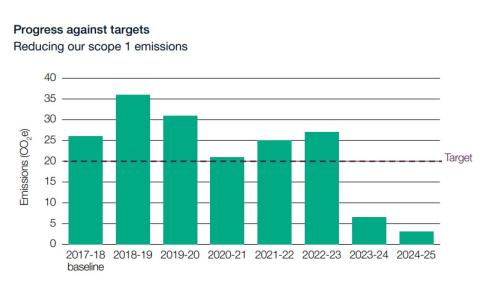
GAD has made good progress with reducing total scope 1 emissions since 2017 to 2018,
largely due to our London office move to 10 South Colonnade, a more energy‑efficient
building. 10 South Colonnade also had heat pumps installed over 2024 to 2025, removing the requirement for natural gas in the building.
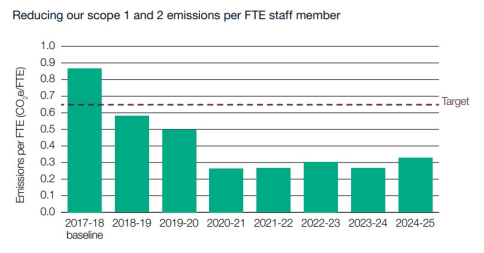
Total Scope 1 and 2 emissions per full‑time equivalent (FTE) staff member have reduced by over 50% since 2017 to 2018, significantly exceeding the GGC target.
A zero‑carbon electricity plan is used in both 10 South Colonnade and Queen Elizabeth
House. GPA has conducted planning, design and scoping work for solar power installation within 10 South Colonnade.
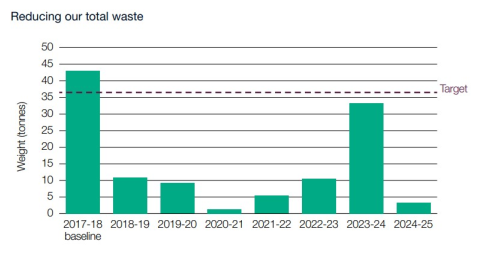
GAD has made good progress reducing total waste. Our London office move in 2023 to
2024 led to a peak in waste. However, no waste went to landfill and 90% of waste was
reused, recycled or composted. This financial year, waste levels have reduced significantly, as expected.

GAD has met the GGC water usage reduction target. Water usage has risen since the
COVID‑19 pandemic as staff have returned to the office. As GAD is based in office hubs,
we have little control over the building’s water usage.
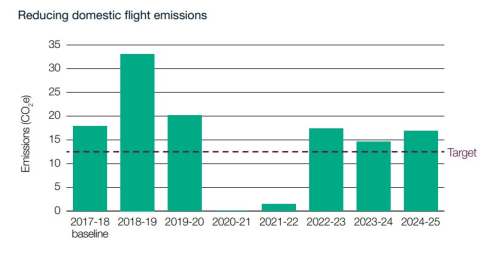
GAD’s domestic flight emissions have reduced but by less than the government target.
Staff travel has increased between GAD’s London and Edinburgh offices as a result of
continued growth of GAD’s Edinburgh office. However, travel emissions per person in
Scotland has decreased.
GAD has a travel policy in place that encourages rail travel over air, and our travel booking system has flags in place to prioritise rail travel over air.
Total greenhouse gas emissions
In 2023 to 2024, work was done to better understand and quantify scope 3 emissions
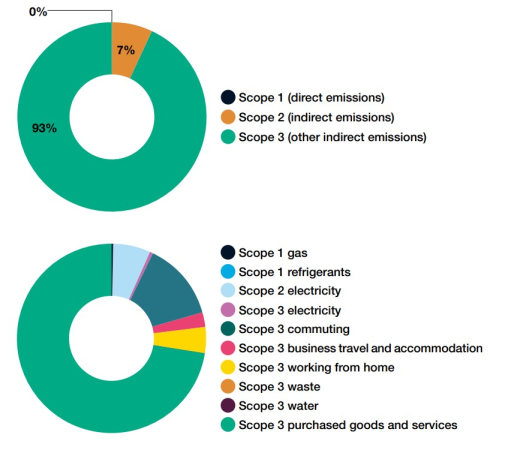
beyond business travel which, in line with the GGCs, has been reported in previous years. Scope 3 emissions are emissions that occur as a consequence of GAD’s activity, but that are not owned directly by GAD. These include emissions from business travel, staff commuting and staff working from home. Initial analysis, due to be continually refined, indicates that as much as 93% of GAD’s emissions are scope 3. This is comparable to other professional service organisations and emphasises the need to engage with the supply chain to cut emissions and meet net zero.
The first pie chart below highlights the large slice of scope 3 emissions. The second pie
chart breaks down the scopes into further detail, highlighting the high emitters being staff commuting, and purchased goods and services.
Data quality
We have been consistently improving the quality of our environmental management system and environmental data for a number of years. Moving to 10 South Colonnade has meant that we have less direct control over the data relating to building energy and water use. However, we have been working with GPA to ensure we have high‑quality environmental data and will continue efforts in this space over 2025 to 2026.
GAD’s reported business travel emissions, now include ad hoc travel and subsistence
claims as of 2024 to 2025 (including car and taxi use, as well as all bus and tube travel). As mentioned above we are going to be specifically focusing on improving the quality of our scope 3 emissions data over 2025 to 2026, while continuing to liaise with the supply chain on their emissions.
Supply chain engagement
Our IT service provider TrIS have their own environmental targets, and surplus IT equipment is regularly reused or sent to a responsible partner for recycling or disposal. The TrIS IT kit purchase plan is done with a view to purchasing environmentally friendly equipment.
GAD does not purchase significant office consumables. However, we have agreements
with suppliers to purchase recycled products where possible. Our main office stationery
supplier identifies particular products that meet sustainability standards, which helps us identify more environmentally friendly options.
GAD makes minimal use of the postal system, as the majority of reports are sent digitally. Couriers are also rarely used.
Metric development
We have delayed finalising our metric development work in anticipation of the publication of the next round of GGCs, expected imminently.
Methodology and assumptions
Estimating some of our scope 3 emissions has required a number of assumptions,
detailed below.
All emissions have been calculated using the standard Department for Environment, Food and Rural Affairs factors.
Purchased goods and services are an exception and use the spend based method (PDF, 608KB.
The purchased goods and services factors are sourced from carbon saver.org. They are estimated based on spend on different items. We are looking to engage with our main suppliers to understand if they are able to calculate more specifically the emissions from their interactions with GAD.
Staff office commutes are estimated based on all staff working in the office 60% of the
working week and the average distance staff are based from the office (based on the 2023 office move survey).
Working from home is estimated based on all staff working at home 40% of the working
week in an average home, using the standard Department for Environment, Food and Rural Affairs factors for home working.
Fiona Dunsire
Government Actuary Accounting Officer 28 October 2025
The Accountability Report
Overview
The accountability report includes the:
-
corporate governance report comprising the Executive’s report, the statement of
Accounting Officer’s responsibilities and the governance statement - remuneration and staff report comprising information on the pay and benefits received by Board members and provides details on staff costs and numbers
- parliamentary accountability and audit report comprising the Statement of Outturn against Parliamentary Supply, the parliamentary accountability disclosures and the certificate and report of the Comptroller and Auditor General
Corporate governance report
Executive’s report
Details of the Chair and the composition of the Board can be found in the governance
statement. Board members’ interests are disclosed in the remuneration report.
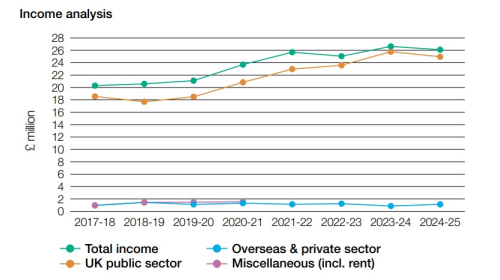
During the year we generated an operating surplus of £0.853 million. Income for the
year was £26.093 million. Fee income (income from actuarial services) decreased by 2% (£0.541 million) from £26.634 million in 2023 to 2024, to £26.093 million in 2024 to 2025 as a result of completion of the public service pension valuations in 2023 to 2024. Our fee rate increase for 2024 to 2025 was 2%.
Income generated from within the UK was £25.965 million (2023 to 2024: £26.355 million).
Overseas income was £128,000 (2023 to 2024: £279,000).
GAD no longer has any rent and miscellaneous income as the subletting arrangement at
Finlaison House finished when GAD moved to its new office in Canary Wharf.
Administration and finance costs in 2024 to 2025 amounted to £25.400 million, a
£0.198 million increase from £25.202 million in 2023 to 2024. Staff costs of £20.680 million are the main component of administration costs. Staff costs in 2024 to 2025 increased by 5.5% (£1.082 million), mainly due to the Civil Service pay award. Other administration expenditure in 2024 to 2025 amounted to £4.720 million, a decrease of £0.884 million from £5.604 million in 2023 to 2024 as there were no dilapidation costs for the move to our new premises, compared to previous year.
GAD’s capital spend in 2024 to 2025 was £0.312 million which is a £4.628 million reduction due to the full capital recognition of 10 South Colonnade being accounted for in 2023 to 2024 under IFRS 16. GAD entered into a new office lease in Canary Wharf in the financial year 2023 to 2024.
Our running and capital costs were met through income from fees.
The Statement of Financial Position shows total assets of £11.839 million (2023 to 2024 £11.655 million), non-current and current assets less current liabilities of £8.228 million (2023 to 2024: £8.163 million), and non-current liabilities of £4.906 million (2023 to 2024: £5.197 million).
Payment of suppliers
Our aim, in accordance with government policy, is to pay 90% of undisputed invoices
within 5 working days of the receipt of goods or services or the presentation of a valid
invoice, whichever is the later. During 2024 to 2025, 97.3% of invoices by value (96.3% by number) were paid within 5 working days. The equivalent figures for 2023 to 2024 were 98.4% of invoices by value (96.4% by number). No interest payments were made under the late Payment of Commercial Debts (Interest) Act 1998.
Expenditure on internal audit, professional services, legal, consultancy, temporary staff, publicity and advertising
During 2024 to 2025, we spent £208,000 (2023 to 2024: £365,000) on internal audit, professional services and legal costs. Consultancy spend in 2024 to 2025 was £62,000 (2023 to 2024: £20,000) mainly in relation to strategic development and finance system readiness work. We incurred costs of £nil (2023 to 2024: £41,000) on the employment of temporary staff.
In 2024 to 2025, £27,000 was incurred on publicity and advertising costs, all of which was for recruitment (2023 to 2024: £24,000).
Financial risk
We have only very limited exposure to financial instruments, which plays a more limited role in creating and managing risk than would apply to a non-public sector body of a similar size. More detail is given in note 9.
Political and charitable donations
GAD made no political or charitable donations in 2024 to 2025 (2023 to 2024: £nil).
Recruitment and turnover
GAD’s staff turnover this year was 8.5% to the end of March 2025 (13.0% in 2023 to 2024). This figure was calculated against all leavers from the organisation.
The market continues to be highly competitive and this year’s recruitment activity ensured that staffing levels were maintained to support business activity. A highlight was the graduate recruitment campaign which involved significant planning and co-ordination with a selected provider to attract a diverse pool of top talent and ensure a strong pipeline of future leaders for our growing organisation. GAD is officially recognised as a Disability Confident employer, and disabled candidates who meet the essential criteria for the advertised role are offered an interview. GAD’s appointment letter makes reference to the collective agreements with the recognised trade union, Prospect. These terms, along with any agreements at a later date, continue to form part of the employees’ terms of employment.
| Turnover 2024‑25 | Turnover 2023‑24 |
|---|---|
| 8.5% | 13.0% |
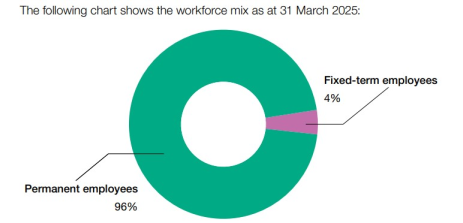
Staff in post as at 31 March 2025
| Staff in post 31/03/2025 | Male | Female | Staff in post 31/03/2024 | Male | Female | |
|---|---|---|---|---|---|---|
| Actuaries | 113 | 62 | 51 | 114 | 63 | 51 |
| Trainee actuaries | 26 | 14 | 12 | 27 | 17 | 10 |
| Analysts | 39 | 27 | 12 | 39 | 29 | 10 |
| Support staff | 49 | 18 | 31 | 41 | 17 | 24 |
| Agency/non‑payroll | 0 | 0 | 0 | 0 | 0 | 0 |
| Total | 227 | 121 | 106 | 221 | 126 | 95 |
| Of which senior leadership (members of GAD’s Executive Committee) | 12 | 7 | 5 | 12 | 8 | 4 |
Staff engagement survey
The annual Civil Service People Survey for 2024 took place from September to October 2024 and was completed by 170 members of staff, representing 82% of the workforce at the time of issue. This response rate was 21% higher than that of the overall Civil Service which was 61%.
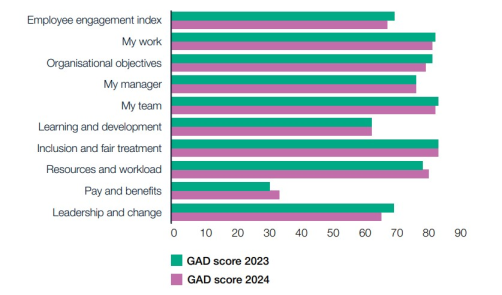
Overall, the results of the survey are generally more favourable compared to the figures for the entire Civil Service. Our overall engagement score, which is an aggregated statistic based on survey results, was 68%. While this is a decrease of 2% since the 2023 survey, it is 4% higher than the overall Civil Service engagement score of 64%.
Across the 9 themed areas, scores of 80% or above were achieved in 5 areas:
my team, organisational objectives and purpose, my work, inclusion and fair treatment, and resources and workload.
76% see GAD as a great place to work and 69% are proud to tell others that they
work at GAD.
A number of activities have been prioritised from feedback provided to continue to
improve engagement. Examples of recent actions include the introduction of regular
quarterly pulse surveys and the introduction of mandatory leadership objectives to
cultivate a values-led culture where leaders champion and empower inclusivity.
| GAD score 2023 | GAD score 2024 | Change from 2023 | |
|---|---|---|---|
| Employee engagement index | 70% | 68% | -2 |
| My work | 83% | 82% | -1 |
| Organisational objectives | 82% | 80% | -2 |
| My manager | 77% | 77% | 0 |
| My team | 84% | 83% | -1 |
| Learning and development | 63% | 63% | 0 |
| Inclusion and fair treatment | 84% | 84% | 0 |
| Resources and workload | 79% | 81% | +2 |
| Pay and benefits | 31% | 34% | +3 |
| Leadership and change | 70% | 66% | -4 |
Diversity, inclusion and wellbeing
We continue to embed diversity, inclusion and wellbeing into our people‑related activities, building on progress to date to ensure GAD continues to be a diverse and inclusive organisation where everyone can thrive.
The diversity, inclusion and wellbeing intranet page is updated regularly with blogs to celebrate key events in the diversity and inclusion calendar, for example Black History Month and Mental Health Awareness Week.
To help the team get to know new joiners and to promote inclusion, we also publish a
‘Chips or Mash’ blog for all new joiners.
A toolkit with a range of resources was published to raise awareness about Dyslexia,
Dyspraxia, Dysgraphia and Dyscalculia and we continue to promote diversity through
a range of organised events and activities – for example, a Pride Picnic, a staff supper
for Eid‑al‑Fitr, and a programme of activities during Mental Health Awareness Week.
In March 2025 we delivered a training session for the Executive Committee and senior
leaders on neurodiversity for managers. The session covered the value of neurodiversity
at organisational level, looking at strategies to encourage openness and discussing case studies and management strategies. We also participated in the Institute and Faculty of Actuaries’ work experience programme and Civil Service Catapult mentoring programme to support social inclusion.
Gender pay gap
GAD currently has fewer than 250 employees, so the reporting of gender pay gap
information is not compulsory. We calculate our mean gender pay gap in hourly pay
as at 31 March 2025 to be 5.7% in favour of men and the median pay gap to be 0%.
Comparative figures for 31 March 2024 for the mean gender pay gap in hourly pay stood
at 1.7% in favour of men and the median pay gap at 0%. Pay comparability within grades is kept under review and, if appropriate, adjustments are made.
Learning and Development (L&D)
At GAD we continue to champion a culture of continuous learning. Over the past year we have made notable progress in raising awareness of the many ways employees can learn, from on‑the‑job experience and peer learning to formal training, coaching, mentoring and self‑directed learning. We also emphasised the importance of recording learning activity, supported through regular communications including the L&D newsletter, emails, team messages, training sessions and team meetings. The impact of this focus is reflected in our monthly KPIs for L&D. By the end of the financial year, staff recorded an average of 11.1 days of L&D per person – demonstrating a strong commitment not only to engaging in development, but also to consistently capturing activity in MyHR.
Key L&D activities delivered include:
-
strengthening trainee support, introducing a structured transition period between trainee rotations to help staff manage exam preparation and workload more effectively
-
developing and rolling out an L&D training plan aligned to strategic priorities – the plan delivered 27 sessions covering business development, communication skills, project management and personal impact
-
introducing a dedicated line manager training programme to support effective team
leadership and people management -
promoting mentoring as a key tool for personal and professional development, which
included showcasing GAD’s range of internal mentoring options, and the Moving Ahead Mentoring Programme for actuaries -
launching a career development initiative for junior non‑actuarial staff, including the
Beyond Boundaries Programme and opportunities like the Unlocking HEO and SEO
Talent event
Raising a concern procedures
GAD is committed to the highest standards of openness, integrity and accountability.
It is important that all our people can raise concerns about the standards of service we
provide or the behaviour of our people in delivering the service. Our Raising a Concern
(including whistleblowing) Policy is available to our people on our intranet and sets out
the steps to take to raise concerns about behaviours and practices at GAD. The policy is
supported by detailed guidance on the procedures to follow when raising these concerns. In addition, a whistleblowing system is a professional requirement for qualified actuaries and is explained in the Institute and Faculty of Actuaries’ code of conduct.
As of 2024 to 2025, there were no whistleblowing cases reported (2023 to 2024: one). The ARAC is informed of any cases of whistleblowing at GAD.
Personal data
GAD has a wide range of policies relating to the protection, storage and retention of
personal data, and we actively monitor compliance with these policies. We provide
support to staff around any matters relating to personal data and take appropriate action as required.
We are required to report any data‑related incidents that were formally reported to the
Information Commissioner’s Office. There were no such incidents in 2024 to 2025 and
none in 2023 to 2024.
GAD’s compliance with its data protection responsibilities is audited by the Government Internal Audit Agency.
The General Data Protection Regulation (GDPR)
As a data controller of personal data, GAD takes its responsibilities seriously.
We currently comply with GDPR by:
- regularly reviewing and updating internal policies and processes relating to data
protection and storage - handling personal data in line with our retention policy
- publishing our up‑to‑date privacy notice on GOV.UK
- storing, processing and transmitting personal data securely
- replying to data subject access requests in a timely manner
- ensuring that all staff take information security awareness training
- taking an active role in relevant cross‑government groups
- holding regular meetings with relevant staff, which includes executive representation, to discuss security matters at both an operational and strategic level
Health and safety reporting
We continue to engender a conducive working environment in which health and safety,
and overall wellbeing are an integral part. At GAD, we recognise that health and safety is a shared responsibility, and a cornerstone of our culture, and maintaining a workforce where everyone feels safe, respected and empowered to thrive is key. Below are some examples:
- ensuring that we continue to comply with all relevant health and safety legislation
- providing appropriate training, resources, and support to managers and individuals to
ensure the physical and psychosocial wellbeing of all individuals - conducting occupational health assessments and risk assessments for employees who have been absent owing to illness, as well as expectant mothers and for new mothers returning to work to ensure that the appropriate support is in place
Statement of Accounting Officer’s responsibilities
Under the Government Resources and Accounts Act 2000 Section 5(2), HM Treasury has directed GAD to prepare for each financial year resource accounts detailing the resources acquired, held or disposed of during the year and the use of resources by the department during the year.
The accounts are prepared on an accruals basis and must give a true and fair view of the
state of affairs of GAD and of its income and expenditure, Statement of Financial Position and cash flows for the financial year.
In preparing the accounts, the Accounting Officer is required to comply with the
requirements of the Government Financial Reporting Manual and in particular to:
- observe the Accounts Direction issued by HM Treasury including the relevant
accounting and disclosure requirements, and apply suitable accounting policies on a
consistent basis - make judgements and estimates on a reasonable basis
- state whether applicable accounting standards, as set out in the Government Financial Reporting Manual, have been followed and disclose and explain any material departures in the accounts
- prepare the accounts on a going concern basis
HM Treasury has appointed the permanent head of the department, the Government
Actuary, as Accounting Officer of GAD. The responsibilities of the Accounting Officer,
including responsibility for the propriety and regularity of the public finances for which the Accounting Officer is answerable, for keeping proper records, and for safeguarding GAD’s assets, are set out in Managing Public Money published by HM Treasury.
As the Accounting Officer, I have taken all the steps that I ought to have taken to make
myself aware of any relevant audit information and to establish that GAD’s auditors are
aware of that information. So far as I am aware, there is no relevant audit information of
which the auditors are unaware.
I confirm that this annual report and accounts as a whole is fair, balanced and
understandable. I take personal responsibility for the annual report and accounts and the judgements required for determining that it is fair, balanced and understandable.
Auditor
The Comptroller and Auditor General is the statutorily appointed auditor for the
department’s accounts. The notional cost of audit services in 2024 to 2025 was £80,000 (2023 to 2024: £77,000). No fees, either actual or notional, were incurred for non‑audit work (2023 to 2024: £nil).
Governance Statement
Governance framework
GAD was established in 1919. It is a non‑ministerial department responsible for providing actuarial services and advice to public sector clients (UK and overseas) and private sector clients, where this is consistent with government policy and does not impair our ability to serve the UK government. Ministerial responsibility, and accountability to Parliament lies with the Exchequer Secretary to the Treasury since 9 July 2024. Prior to this it sat with the Financial Secretary to the Treasury.
A framework document dated March 2023 has been agreed between HM Treasury
and GAD which sets out the broad governance framework within which the GAD and
HM Treasury operate.
The Government Actuary is accountable to Sam Beckett, Chief Economic Adviser, Head of the Government Economic Service and Second Permanent Secretary to HM Treasury for the running of GAD. Additionally, the Government Actuary has a number of statutory duties in connection with public service pensions, social security and personal injury discount rates. Fiona Dunsire has been the Government Actuary since November 2023.
Governance committees
GAD Board
GAD’s Board is the principal advisory body and supports the Government Actuary in
providing leadership to GAD, setting the overall strategy for GAD and exercising oversight over the performance of the department including its identification and management of risks. At 31 March 2025, the Board comprised 6 executive members including the Government Actuary, 3 non‑executive members, and the Board secretary. The Board structure has been updated from 1 April 2025 to reflect roles and responsibilities aligned with GAD’s 2030 Strategy. As of January 2025, GAD welcomed Enrico Romano as part of the Boardroom Apprentice Programme, an initiative that provides hands-on experience, training, and mentorship to individuals aspiring to become board members within the public and third sectors.
At regular intervals, the Board conducts reviews of its effectiveness in terms of how it
operates and the quality of data available to, and used by, the Board. The most recent
review was conducted by an independent external reviewer in spring (March to April) 2024. An action plan was developed and agreed by the Board to strengthen governance and ensure the Board continues to support GAD to achieve its objectives effectively. This focused on actions to continue to elevate the strategic impact of the Board and manage the succession and replacement of Board members to ensure the right mix and diversity of input for the future. The Board confirmed in the January 2025 meeting that all actions agreed were implemented.
Membership of the Board from 1 April 2024 to 31 March 2025 was:
| Indrani Banerjee‑Jones | Director of Finance and Operations |
| Grace Berkkan | Board Secretary |
| Fiona Dunsire | Government Actuary |
| Matt Gurden | Deputy Government Actuary |
| Stephen Humphrey | Actuarial director, Quality, Compliance, and Risk |
| Dave Johnston | Actuarial director, People and Capability |
| Bal Kaur | Director of Human Resources from March 2025 |
| Bev Messinger | Non‑Executive Director until November 2024 |
| Les Philpott | Non‑Executive Director from September 2021 and chair from November 2021 on a 3‑year appointment (re‑appointed effective from September 2024 on a 3‑year appointment) |
| Graeme Taylor | Director of Human Resources on an interim basis from 14 August 2023 to 1 March 2025 |
| Liz Thornhill | Non‑Executive Director from December 2024 on a 2‑year appointment |
| Ian Wilson | Non‑Executive Director from September 2019 on a 3‑year appointment – his contract has been extended for another 3 years, ending August 2025 |
Non‑executive board members
GAD’s Board and ARAC include 3 non‑executive members, who are appointed
following open competition for terms of 2 or 3 years, which may be renewed once.
| Bev Messinger | Bev joined the GAD Board in November 2021. She is an experienced former public/charity sector senior executive who now undertakes consultancy assignments alongside her non‑executive portfolio. A Fellow of the Chartered Institute of Personnel and Development, her professional background is in HR and organisational development. But in the last decade she has focused on leadership and organisational transformation, most recently as Chief Executive Officer of the Institution of Occupational Safety and Health, and continues this as a coach and management consultant. Bev has a diverse non‑executive background in a range of public, charity and voluntary organisations, as well as the NHS. She currently sits on the Board of Your Housing Group as their vice chair, and is chair of the People Committee. |
| Les Philpott | Les Philpott was appointed non‑executive chair of the Board at GAD in September 2021. His non‑executive experience also includes chair and non‑executive director roles in wider central government, the NHS, and the education and private healthcare sectors. Les formerly held the position of Chief Executive at the Office for Nuclear Regulation. Prior to that he held senior roles in the Health and Safety Executive. |
| Liz Thornhill | A practising barrister, Liz has a background in public law, regulation, governance and risk. She is general counsel, Head of Risk and Legal Adviser to the Board at the Office of Rail and Road, leading a team advising on safety and economic regulation. Liz also sits as a member of the Standards Committee at the Royal Institute of British Architects and previously worked at the Office of Safety and Standards and the Department for Transport. |
| Ian Wilson | Ian is a Fellow of the Institute of Chartered Accountants in England and Wales, and an accredited professional Pension Trustee. He has over 25 years’ experience working with global blue‑chip companies including various finance director roles, as well as leading large multi‑functional business services organisations for internal customers in both private and public sectors. He now focuses on non‑executive director and Pension Trustee roles. He is currently Non‑Executive Director at the Department for Work and Pensions. He chairs the Trustee Board of a top 50 UK pension fund and chairs the Finance Committee at Royal Holloway, University of London. He is also a Trustee with the Church of England Pension Fund and a lay Trustee of the Royal College of General Practitioners. He has previous experience as a non‑executive director with the Ministry of Defence, UK Research and Innovation and the NHS. He holds an MA in Natural Sciences from the University of Cambridge and is an alumnus of London Business School. Ian has been the chair of GAD’s ARAC since July 2021. |
Between 1 April 2024 and 31 March 2025, the Board met 8 times, with attendance as follows:
| Indrani Banerjee‑Jones | 6/8 |
| Grace Berkkan | 8/8 |
| Fiona Dunsire | 8/8 |
| Graeme Taylor | 6/8 |
| Matt Gurden | 8/8 |
| Stephen Humphrey | 7/8 |
| Dave Johnston | 7/8 |
| Bal Kaur | 1/1 |
| Bev Messinger | 5/5 |
| Les Philpott | 8/8 |
| Liz Thornhill | 3/3 |
| Ian Wilson | 8/8 |
Audit and Risk Assurance Committee
GAD’s ARAC comprises the 3 non‑executive members of the Board, one of whom
serves as the chair. The ARAC provides assurance to the Accounting Officer and the Board on the comprehensiveness and reliability of assurances on governance, risk management, internal controls, and the integrity of financial statements and the annual report and accounts.
ARAC meetings are attended by the 3 non‑executive members of the committee,
the Accounting Officer, the Finance Director, the Actuarial Director responsible for quality, compliance and risk, the Committee Secretary and representatives of the internal and external auditors. The ARAC may ask any other staff members of GAD or an independent member to attend to assist it with discussions on any particular matter. The ARAC may ask any or all of those who normally attend but who are not members to withdraw to facilitate discussion of particular items or for the committee to assemble its advice to the Board.
Between 1 April 2024 and 31 March 2025, the ARAC met 4 times with attendance as follows:
| Indrani Banerjee‑Jones | 3/4 |
| Grace Berkkan | 4/4 |
| Fiona Dunsire | 4/4 |
| Stephen Humphrey | 4/4 |
| Bev Messinger | 2/2 |
| Les Philpott | 4/4 |
| Liz Thornhill | 2/2 |
| Ian Wilson | 4/4 |
| Internal audit | 4/4 |
| External audit | 4/4 |
The committee’s terms of reference cover not only matters that the department is obliged to consider but also any other matters that both the Board and the committee consider to be areas of concern from an internal control, assurance and governance perspective.
The committee met 4 times during 2024 to 2025 and considered a range of issues, including:
- internal and external audit - reviewing the planned activity and results of internal and external audit, including the adequacy of the management response to issues identified
-
risk management - considering the scope of the risks and the effectiveness of
management controls and mitigations - control environment - considering the improvements required as identified through the corporate and actuarial assurance exercises and the progress made to resolve any gaps
The committee also assessed the governance statement and supported the signing of the annual report and accounts, through providing assurance to the Accounting Officer and the Board that the governance statement was meaningful, underpinned by robust evidence and a good range of assurances.
Members’ interests
Fiona Dunsire holds share options and shares in Marsh McLennan (MCC). A protocol and process for pre‑approval of any trading in these shares was agreed with HM Treasury as part of Fiona’s appointment as the Government Actuary.
No other directorships or significant interests that may have caused a conflict with their
management responsibilities were held by the Board members. The opportunity to disclose conflicts with items on the agenda is provided at every meeting.
Other committees
Executive Committee
Over the year, the Executive Committee comprised the executive members of the Board, the Board and Committee Secretary and other actuarial team leads. It met weekly to consider strategic, operational and management issues. Membership was updated from 1 April 2025 to reflect roles and responsibilities aligned with GAD’s 2030 Strategy.
Technical Committee
Professional and technical matters are overseen by the Head of Technical and Professional. In performing this role, he is assisted by the Technical Committee (and sub‑committees covering different technical areas) whose purpose is to develop and maintain appropriate technical and professional practices across GAD, and to monitor and mitigate relevant areas of technical and professional risk. The Technical Committee consists of the Head of Technical and Professional, actuarial members drawn from across teams, and the chairs of the 8 technical sub‑committees. It is chaired by the Head of Technical and Professional and reports of the Committee’s work are periodically made to the ARAC.
The purpose of the Technical Committee is to develop and maintain appropriate technical and professional practices across GAD. In particular, this includes promoting consistency, quality and professional standards in the provision of client advice.
The department maintains standing and ad‑hoc committees to oversee programmes and initiatives as appropriate.
Corporate Governance Code
Government policy on departmental governance is outlined in ‘Corporate Governance
in Central Departments: Code of Good Practice’ (Cabinet Office, April 2017). This code
operates on a ‘comply or explain’ basis, whereby departments are asked to disclose any
element of the code with which they are not fully compliant, explaining their rationale and any alternative measures which have been put in place to meet the objectives of the code.
The code applies primarily to ministerial departments. This means that some of the
provisions are not applicable to GAD, for example the involvement of ministers on the
departmental Board. GAD’s Board has assessed GAD’s corporate governance against the code and agreed which measures in the code are relevant to a department of GAD’s size and can be implemented in a cost‑effective way.
Management of interests
All appointment and contract of employment letters refer to the Civil Service code of conduct. The letters contain a policy on the declaration of secondary employment which sets out the principles and the process to be followed. GAD’s policy on this is also published on the intranet.
Business appointment rules
GAD applies the business appointment rules (BARs) in line with the guidance published on GOV.UK. In compliance with BARs, GAD is transparent in the advice given to individual applications for senior staff, including non‑executive directors.
| GAD | |
|---|---|
| Number of exits from the Senior Civil Service (SCS) | 0 |
| Number of BARs applications assessed by the department over the year (by grade: SCS2, SCS1 and delegated grades) | N/A |
| Number of BARs applications where conditions were set (by grade: SCS2, SCS1 and delegated grades) | N/A |
| Number of applications that were found to be unsuitable for the applicant to take up by the department over the year (by grade: SCS2, SCS1 and delegated grades) | N/A |
| Number of breaches of the BARs in the preceding year | N/A |
Risk management
GAD is a relatively small organisation, but the advice we provide impacts on decisions
which can have significant national financial consequences and be relatively high risk given their political profile. Risk management is therefore integrated as far as possible into the normal process of managing the business and the advice that we provide, with clear lines of responsibility.
The strategic risks of the department are considered as part of an enterprise risk management framework that is closely aligned to our 5‑year strategy, annual business plans and risk appetite statement. The risk appetite and resulting risks are aligned to our strategic themes and they represent a longer‑term view than our operational risk planning. The Board reviews a summary of these risks at regular meetings during the year.
Our risk management processes operate at 3 organisational levels: Board, Executive Committee and operational. Operational risks are managed within the relevant business areas, with corresponding operational risk registers being used as management tools. Highly rated risks and significant individual risks are escalated to the Executive Committee where, alongside any other risks identified by the Executive Committee, they are grouped into the relevant quadrant of the balanced scorecard (finance, people and inclusion, clients and processes). A member of the Executive has oversight responsibility for the risk management processes for each quadrant, in addition to the 4 strategic themes.
The most significant of these risks are further escalated to the Board. There are also reviews of longer‑term strategic risks, to focus attention on long‑term issues that may not be picked up by day‑to‑day management of the business and the operational risk registers, and reviews of the risk appetite statement to ensure it remains aligned with the objectives set out in the 5‑year strategy and the latest annual business plan.
This process for risk management has enabled significant risks to be identified and
mitigations to be discussed and implemented as appropriate.
The ARAC reviews the operation of the risk management processes, so it can provide assurance to the Accounting Officer that they are working effectively. During the year the committee reviewed a selection of risk registers in detail. The ARAC also explores in more detail, individual risks where necessary. Internal and external audit reports are all received and reviewed by the ARAC.
Risk appetite, strategic risks and mitigations
GAD has set out an overall risk appetite statement and seeks to take on the appropriate level of risk to maximise benefits within the department, to our clients and to other
stakeholders alongside the wider public interest. There are a number of strategic risks to
us meeting our objectives, which are being mitigated to ensure we remain within our risk
appetite. These are largely unchanged over the year and are explained below.
Clients
There is a risk that GAD’s reputation for providing high‑quality advice to clients effectively and efficiently is damaged such that future advice is not requested or acted upon, that GAD’s services do not match the evolving needs of its clients, or that there is limited awareness of GAD or the support it can provide across the public sector. The specific risks associated with these arise from failure to raise our profile, understand client needs and deliver timely, high‑quality advice, innovations and solutions to budget.
Our mission is to make an impact on policy through supporting effective decision‑making and robust reporting within government. Therefore, we have an appetite to accept risks associated with providing services which will enable us to continue to add value to government decision‑making. However, our reputation is paramount to being a trusted provider in government, such that we are averse to risks that are likely to undermine that status.
To mitigate risks, we continue to invest in project management processes and tools, as well as maintaining professional standards, policies and our professional quality accreditation. We maintain client plans for all key clients to help us manage the relationships and provide a consistently high‑quality service while investing in our staff to improve understanding of client needs. We also seek client feedback to inform our client plans and improve the quality of our work. For the most high‑profile projects we apply additional senior oversight to ensure the appropriate level of governance, planning and focus.
Financial
There is a risk that GAD’s income is not sufficient to meet our costs on a long‑term and sustainable basis. This may arise due to insufficient demand from clients or if our cost base is higher than expected and income is insufficient to cover it.
We have a responsibility to provide value for money within government and stay within our HM Treasury financial control totals. Therefore, we have an appetite to accept risks associated with projects intended to increase our output to costs ratio or improve the quality of our financial control, management information or reporting. However, we are averse to major financial surprises or financial risks that are likely to undermine our ability to meet our control totals or our sustainability as a service provider.
To mitigate risks, within the annual strategic and business planning cycle, we have regular forecasting and monthly financial and performance reporting. HM Treasury are updated throughout the year on our current and projected financial position, so any potential concerns may be discussed at an early stage.
People and inclusion
There is a risk that GAD lacks resource capacity or skills, or that is it not matched to our clients’ demand. This may arise if there is a lack of development of skills and experience or that staff are not enabled or encouraged to work to their best ability.
The ability to recruit, retain and motivate quality people is critical to our long‑term success. Therefore, we have an appetite to accept risk associated with investing in our staff to ensure they can meet current and future client needs. However, we are averse to risks that are likely to prevent us recruiting and retaining the quality of people we need.
To mitigate risks, within the annual strategic and business planning cycle, we have regular forecasting of resources against revenue. We monitor inclusivity through the diversity of staff at all levels and engaging with staff on these issues alongside ensuring we are in line with best practice. We have a people strategy aiming to align recruitment, learning and development, talent management, secondments and rotations of staff, to ensure they are aimed at delivering GAD’s future needs.
Processes
There is a risk of system or process failure or that GAD fails to utilise modern techniques to analyse data, perform calculations and provide insights for clients. This may prevent GAD from delivering effectively and running inappropriate risks, and could cause loss of assets or sensitive data.
Having effective processes is essential to providing value for money and ensuring we provide a high‑quality service meeting our contractual, professional and statutory requirements. Therefore, we have an appetite to accept risk associated with developing processes to enhance our consistency or efficiency or expand our range of services. However, we are averse to risks to delivering our statutory obligations or meeting our professional requirements.
To mitigate risks, we have implemented risk management processes and clear responsibilities, a central analytical services team to support innovation and analysis, implemented project management tools on all business‑critical projects, and invested in our IT strategy and data science and AI training.
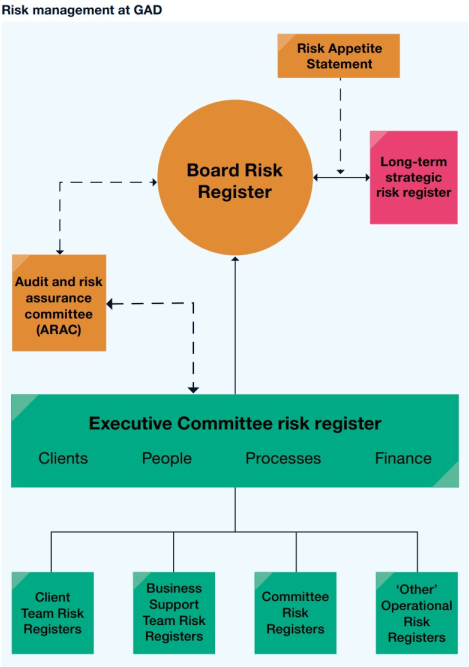
| Principles | Process |
|---|---|
| Risk appetite statement provides a framework to assess the risks against the objectives. | Risk appetite statement is updated by balanced scorecard quadrant owners and reviewed annually at ExCo and the Board. |
| Long-term strategic risks functions top-down to identify risks that threaten the department’s ability to deliver its responsibilities at a strategic level, which may differ from those identified through a bottom-up approach. | Long-term strategic risk register is updated by balanced scorecard quadrant owners and reviewed quarterly at ExCo and the Board. |
| Risks escalated to the Board are risks that ExCo deem to require attention or action by the Board. | The Board risk register is updated by risk owners and reviewed regularly by ExCo and the Board. |
| Risks escalated to ExCo comprises key risks identified by operational risk registers, grouped by balanced scorecard quadrant. | ExCo reviews the updated ExCo risk register (ExCoRR) and: |
| Escalates risks where necessary or appropriate for attention or action by the Board/ARAC. | - agrees whether risks escalated from operational level should be included in the ExCoRR |
| ARAC conducts deep dive reviews on the risk registers for one balanced scorecard quadrant or operational level risk register at each quarterly meeting. | - includes new risks identified at ExCo level |
| - where necessary or appropriate escalates ExCoRR risks for attention or action by the Board/ARAC. | |
| ARAC selects one balanced scorecard quadrant or operational risk register item to review through a deep dive at each quarterly meeting. | |
| Operational level groups (programmes or activities), responsible for identifying risks to operational delivery, and actions to mitigate their impact | Administration team request risk register owners and named risk owners to update risks status on a regular basis on any change in the risk rating (RAG), progress in completing mitigating actions, and any risks to be removed or escalated. |
| Where necessary, these groups identify and escalate risks that are considered to need attention or action at a higher level, i.e. by ExCo. | Administration team updates centrally held operational risk registers and ensures that escalated risks are added to the ExCo risk register. |
Overall assurance
The assurance from internal audit is supplemented by a formal system of assurance
statements produced by Executive Committee members. These statements, supported by other internal controls, require senior managers to give evidence to support their assurance that they and their teams comply with departmental policies and procedures and, where appropriate, professional standards. The assurance statements cover governance arrangements, delivery and performance management, financial, people, information and project management. No significant issues were identified, and Executive Committee members and GAD’s wider leadership team have provided adequate assurance to the Accounting Officer to support the GAD‑wide statement.
Overall assurance is further supported by two assurance maps for the organisation: one
for actuarial activities and another for corporate activities. The maps identify the critical
functions in key areas and the sources of assurance for internal control processes across the department, following HM Treasury’s Three Lines of Defence model:
- management control and reporting as the first line
- functional control as the second line
- independent review/assurance/regulatory controls as the third line
Both maps are updated and reviewed by the ARAC every 6 months.
An overview of risk performance was reported to regular Board meetings.
Quality Assurance Scheme
Since October 2016, GAD has been accredited under the Institute and Faculty of Actuaries’ Quality Assurance Scheme (QAS).
QAS is a voluntary global accreditation scheme which recognises the importance of
the working environment in enabling actuaries to fulfil their professional responsibilities. The scheme aims to promote quality assurance at an organisational level and confidence in the work of actuaries. To gain accreditation, organisations must demonstrate their commitment to the quality of actuarial work and comply with the standard APS QA1 Quality Assurance Scheme for Organisations.
The accreditation process included an independent assessment of GAD’s approach to quality assurance, conflicts of interest, training and development, speaking up and our relationship with the users of actuarial information. Based on this assessment, suitability was then determined by the QAS sub‑committee. Each year GAD submits an annual return, providing evidence of continued commitment to the QAS themes.
Internal audit assurance
The internal audit team has delivered a comprehensive programme of work during the
year, aligned with the audit strategy approved by the Audit and Risk Assurance Committee (ARAC). Where audits identified control weaknesses, GAD has accepted the internal audit team’s recommendations and committed to implementing the necessary actions.
The internal audit programme was completed in full and all reports were issued
before the end of the financial year. The Head of Internal Audit provided an overall
moderate assurance for the year ended 31 March 2025, as reflected in the annual
assurance statement.
Finance Key Controls – Finance System (Moderate opinion): This audit assessed
the effectiveness of GAD’s current finance system and explored alternative systems for
potential future procurement. The review included benchmarking against systems used by comparable departments and outlined what a modern finance system could offer.
HR System (Moderate opinion): The audit evaluated the adequacy and effectiveness
of GAD’s outsourced HR and payroll system, focusing on whether the service meets
expectations and delivers value for money. It also identified considerations for the potential procurement of a new payroll system in 2 years.
Actuarial Operations (Moderate opinion): This audit provided assurance over the
effectiveness of actuarial operations, particularly the transition of work from the Analytical Solutions Team (AST) to other client-facing areas.
Business Continuity (Limited opinion): The review assessed GAD’s Business Continuity Management in light of recent changes to Estates and IT service provision.
Artificial Intelligence (Advisory Review): This advisory review supported GAD’s strategic and governance approach to AI adoption. It drew on insights from similar reviews across government and highlighted the potential risks of unmanaged AI implementation.
Remuneration and staff report
Remuneration report
Service contracts
The Constitutional Reform and Governance Act 2010 requires Civil Service appointments to be made on merit on the basis of fair and open competition. The Recruitment Principles published by the Civil Service Commission specify the circumstances when appointments may be made otherwise.
Unless otherwise stated, the officials covered by this report hold appointments which are open‑ended. Early termination, other than for misconduct, would result in the individual receiving compensation as set out in the Civil Service Compensation Scheme.
Further information can be found on the Civil Service Commission’s website.
Remuneration policy
The pay of the Government Actuary is determined on an annual basis, under agreed
arrangements with the Second Permanent Secretary of HM Treasury. The determination
of the pay of the remaining senior staff has been formally delegated to the
Government Actuary.
Remuneration (including salary) and pension entitlements
The following sections provide details of the remuneration and pension interests of the
Board members of the department. These details are shown in accordance with the
2024 to 2025 Government Financial Reporting Manual (FReM) issued by HM Treasury.
Remuneration (salary, bonus payments, benefits in kind and pensions) (audited)
Included in the table is the remuneration of the non‑executive Board members GAD
has appointed to the Board and the ARAC. The non‑executive Board members receive
no emoluments except for fees of £540 to £600 per 7 hours of service plus their
travelling expenses.
Remuneration (special payments)
As at 31 March 2025, GAD had no losses or special payments to report (2023 to 2024: £nil). The reporting threshold for losses and special payments is £300,000.
| Salary (£000) 2024/25 | Salary (£000) 2023/24 | Bonus payments (£000) 2024/25 | Bonus payments (£000) 2023/24 | Benefits in kind (to nearest £100) 2024/25 | Benefits in kind (to nearest £100) 2023/24 | Pension benefits (to nearest £1,000) 2024/25 (Note 1) | Pension benefits (to nearest £1,000) 2023/24 (Note 1) | Total (£000) 2024-25 | Total (£000) 2023-24 | ||
|---|---|---|---|---|---|---|---|---|---|---|---|
| Fiona Dunsire, Government Actuary (from November 2023) (Note 2) | 215-220 | 85-90 (215-220 full year equivalent) | 20-25 | – | – | – | 82 | 35 | 315-320 | 120-125 | |
| Matt Gurden, Deputy Government Actuary | 175-180 | 165-170 | 0-5 | 0-5 | - | - | 68 | 65 | 245-250 | 235-240 | |
| Stephen Humphrey, Actuarial Director – Quality, Compliance and Risk | 170-175 | 160-165 | 0-5 | 0-5 | - | - | 99 | 44 | 275-280 | 210-215 | |
| Dave Johnston, Actuarial Director – People and Capability | 155-160 | 145-150 | 0-5 | 0-5 | - | - | 62 | 56 | 210-215 | 205-210 | |
| Indrani Banerjee-Jones, Director of Finance and Operations | 90-95 | 85-90 | 10-15 | 5-10 | – | – | 35 | 34 | 130-135 | 125-130 | |
| Graeme Taylor, Director of Human Resources (on interim basis until 31 March 2025) | 85-90 | 50-55 (80-85 full year equivalent) | 0-5 | 0-5 | – | – | 24 | 44 | 105-110 | 95-100 | |
| Bal Kaur, Director of HR (from March 2025) (Note 3) | 5-10 (85-90 full year equivalent) | – | – | – | – | – | 1 | – | 5-10 | – | |
| Ian Wilson, Non-Executive Board Member | 10-15 | 5-10 | – | – | – | – | – | – | 10-15 | 5-10 | |
| Les Philpott, Non-Executive Board Member | 15-20 | 10-15 | – | – | – | – | – | – | 15-20 | 10-15 | |
| Bev Messinger, Non-Executive Board Member (until November 2024) | 5-10 | 5-10 | – | – | – | – | – | – | 5-10 | 5-10 | |
| Elizabeth Thornhill, Non-Executive Board Member (from February 2025) (Note 4) | 0-5 | – | – | – | – | – | – | – | 0-5 | – |
Note 1: The value of pension benefits accrued during the year is calculated as (the real increase in pension multiplied by 20) plus (the real increase in any lump sum) less (the contributions made by the individual). The real increase excludes increases due to inflation or any increase or decreases due to a transfer of pension rights.
Note 2: Bonus payments include a one-off, non-consolidated, non-pensionable lump sum payment per Senior Civil Service Pay Award 2024 to 2025 guidance.
Note 3: Where there is a difference between the full-year equivalent salary and the actual amount paid, this is because the actual figure shows the payment for time worked.
Note 4: Up-rating Report 2025 - report on the National Insurance Fund
Salary
‘Salary’ includes gross salary, overtime, reserved rights to London weighting or London
allowances, recruitment and retention allowances, private office allowances, and any other allowance to the extent that it is subject to UK taxation. This report is based on accrued payments made by the department and therefore recorded in these accounts.
Benefits in kind
The monetary value of benefits in kind covers any benefits provided by the department and treated by HM Revenue and Customs as a taxable emolument.
Bonuses
Bonuses are based on performance levels which are assessed as part of the appraisal
process. Bonuses relate to the performance in the year in which they become payable to
the individual.
The bonus reported for the Government Actuary in 2024 to 2025 relates to performance in 2023 to 2024.
Fair pay multiples (audited)
Reporting bodies are required to disclose the relationship between the remuneration of the highest paid director in their organisation and the lower quartile, median and upper quartile remuneration of the organisation’s workforce.
The banded remuneration of the highest paid director at GAD in the financial year 2024 to 2025 was £235,000 to £240,000 (2023 to 2024: £215,000 to £220,000). This was 3.1 times (2023 to 2024: 3.0 times) the median remuneration of the workforce, which was £75,436 (2023 to 2024: £71,982). The median pay ratio is consistent with the pay, reward and progression policies for the department. Remuneration ranged from £25,000 to £30,000, to £235,000 to £240,000.
No employees received (annualised) remuneration in excess of the Government Actuary.
There was a change to the total remuneration of the highest paid director compared to
2023 to 2024. Remuneration ranged from £25,000 to £30,000, to £235,000 to £240,000 (2023 to 2024: £25,000 to £30,000, to £215,000 to £220,000).
| Percentage change from previous financial year | Percentage change |
|---|---|
| Highest paid director – total remuneration | 9.2% |
| Highest paid director – salary and allowances only | 0% |
| Highest paid director – bonus only (Note 1) | 100% |
| Average employee – total remuneration | 5.0% |
| Average employee – salary and allowances only | 5.0% |
| Average employee – bonus only | 8.8% |
Note 1: The bonus includes a one-off, non-consolidated, non-pensionable lump sum payment per Senior Civil Service Pay Award 2024 to 2025 guidance.
Total remuneration includes salary, non‑consolidated performance‑related pay (bonus) and benefits in kind. It does not include severance payments, employer pension contributions and the cash equivalent transfer value of pensions.
The following table shows the median earnings of the department’s workforce and the ratio between this and the earning of the highest paid director.
| 2024-25 | 2023-24 | |
|---|---|---|
| Band of highest paid director’s total remuneration (£000) | 235-240 | 215-220 |
| 25th percentile total pay and benefits (£) | 47,975 | 42,295 |
| 25th percentile total pay and benefits ratio | 5.0 | 5.1 |
| 25th percentile salary component (£) | 47,010 | 41,106 |
| 25th percentile salary ratio | 4.6 | 5.3 |
| Median total pay and benefits (£) | 75,436 | 71,982 |
| Median total pay and benefits ratio | 3.1 | 3.0 |
| Median salary component (£) | 74,432 | 70,888 |
| Median salary ratio | 2.9 | 3.1 |
| 75th percentile total pay and benefits (£) | 95,314 | 95,251 |
| 75th percentile total pay and benefits ratio | 2.5 | 2.3 |
| 75th percentile salary component (£) | 94,116 | 94,357 |
| 75th percentile salary ratio | 2.3 | 2.3 |
Pension benefits (audited)
| Accrued pension at pension age as at 31 March 2025 and related lump sum £000 | Real increase in pension and related lump sum at pension age (£000) | CETV at 31 March 2025 (£000) | CETV at 31 March 2024 (£000) | Real increase in CETV (£000) | Employer contribution to partnership pension account (Nearest £100) | |
|---|---|---|---|---|---|---|
| Fiona Dunsire, Government Actuary | 5-10 | 2.5-5 | 99 | 28 | 51 | 0 |
| Matt Gurden, Deputy Government Actuary | 50-55 | 2.5-5 | 687 | 598 | 24 | 0 |
| Stephen Humphrey, Actuarial Director – Quality, Compliance, and Risk | 85-90 plus a lump sum of 130-135 | 5-7.5 plus a lump sum of 2.5-5 | 1694 | 1518 | 78 | 0 |
| Dave Johnston, Actuarial Director – People and Capability | 40-45 | 2.5-5 | 442 | 388 | 10 | 0 |
| Indrani Banerjee-Jones, Director of Finance and Operations | 15-20 | 0-2.5 | 180 | 146 | 16 | 0 |
| Graeme Taylor, Director of Human Resources | 5-10 | 0-2.5 | 44 | 29 | 6 | 0 |
Note 1: Bal Kaur’s CETV is immaterial as she only joined in March 2025.
Some Board members may incur annual allowance tax charges as a result of pension
accrual during the accounting period. No allowance has been made for consequential
benefit reduction that may arise if these members elect to meet this tax liability, or similar ones from previous years, through a reduction to their pension benefits.
The figures above, including the opening and closing cash equivalent transfer values
(CETVs) reflect these members’ periods of Board membership.
Civil Service pensions
Pension benefits are provided through the Civil Service pension arrangements. Before
1 April 2015, the only scheme was the Principal Civil Service Pension Scheme (PCSPS),
which is divided into different sections – Classic, Premium and Classic Plus provide
benefits on a final salary basis, while Nuvos provides benefits on a career average
basis. From 1 April 2015 a new pension scheme for civil servants was introduced –
the Civil Servants and Others Pension Scheme, or Alpha – which provides benefits on a
career average basis. All newly appointed civil servants service joined the new scheme
from this date.
The PCSPS and Alpha are unfunded statutory schemes. Employees and employers
make contributions (employee contributions range between 4.6% and 8.05%, depending on salary). The balance of the cost of benefits in payment is met by monies voted by Parliament each year. Pensions in payment are increased annually in line with the pensions increase legislation. Instead of the defined benefit arrangements, employees may opt for a defined contribution pension with an employer contribution, the partnership pension account.
In Alpha, pension builds up at a rate of 2.32% of pensionable earnings each year, and the total amount accrued is adjusted annually in line with a rate set by HM Treasury. Members may opt to give up (commute) pension for a lump sum up to the limits set by the Finance Act 2004. All members who switched to alpha from the PCSPS had their PCSPS benefits ‘banked’, with those with earlier benefits in one of the final salary sections of the PCSPS having those benefits based on their final salary when they leave Alpha.
The accrued pensions shown in this report are the pension the member is entitled to receive when they reach normal pension age, or immediately on ceasing to be an active member of the scheme if they are already at or over normal pension age. Normal pension age is 60 for members of Classic, Premium, and Classic Plus, 65 for members of Nuvos, and the higher of 65 or State Pension age for members of Alpha. The pension figures in this report show pension earned in PCSPS or Alpha – as appropriate. Where a member has benefits in both the PCSPS and Alpha, the figures show the combined value of their benefits in the two schemes but note that the constituent parts of that pension may be payable from different ages.
When the government introduced new public service pension schemes in 2015, there were transitional arrangements which treated existing scheme members differently based on their age. Older members of the PCSPS remained in that scheme, rather than moving to Alpha. In 2018, the Court of Appeal found that the transitional arrangements in the public service pension schemes unlawfully discriminated against younger members.
As a result, steps are being taken to remedy those 2015 reforms, making the pension scheme provisions fair to all members. The public service pensions remedy is made up of two parts. The first part closed the PCSPS on 31 March 2022, with all active members becoming members of alpha from 1 April 2022. The second part removes the age discrimination for the remedy period, between 1 April 2015 and 31 March 2022, by moving the membership of eligible members during this period back into the PCSPS from 1 October 2023. This is known as ‘rollback’.
For members who are in scope of the public service pension remedy, the calculation of their benefits for the purpose of calculating their cash equivalent transfer value and their single total figure of remuneration, as of 31 March 2024 and 31 March 2025, reflects the fact that membership between 1 April 2015 and 31 March 2022 has been rolled back into the PCSPS. Although members will in due course get an option to decide whether that period should count towards PCSPS or Alpha benefits, the figures show the rolled back position (PCSPS benefits) for that period.
The partnership pension account is an occupational defined contribution pension
arrangement which is part of the Legal and General Mastertrust. The employer makes
a basic contribution of between 8% and 14.75% (depending on the age of the member).
The employee does not have to contribute but, where they do make contributions, the
employer will match these up to a limit of 3% of pensionable salary (in addition to the
employer’s basic contribution). Employers also contribute a further 0.5% of pensionable salary to cover the cost of centrally provided risk benefit cover (death in service and ill health retirement).
Further details about the Civil Service pension arrangements can be found on the
Civil Service pension scheme website.
Cash Equivalent Transfer Values
A cash equivalent transfer value (CETV) is the actuarially assessed capitalised value of the pension scheme benefits accrued by a member at a particular point in time. The benefits valued are the member’s accrued benefits and any contingent spouse’s pension payable from the scheme. A CETV is a payment made by a pension scheme or arrangement to secure pension benefits in another pension scheme or arrangement when the member leaves a scheme and chooses to transfer the benefits accrued in their former scheme. The pension figures shown relate to the benefits that the individual has accrued as a consequence of their total membership of the pension scheme, not just their service in a senior capacity to which disclosure applies. The figures include the value of any pension benefit in another scheme or arrangement which the member has transferred to the Civil Service pension arrangements. They also include any additional pension benefit accrued to the member as a result of their buying additional pension benefits at their own cost. CETVs are worked out in accordance with The Occupational Pension Schemes (Transfer Values) (Amendment) Regulations 2008 and do not take account of any actual or potential reduction to benefits resulting from Lifetime Allowance Tax which may be due when pension benefits are taken.
Real increase in CETV
This reflects the increase in CETV that is funded by the employer. It does not include the
increase in accrued pension due to inflation, contributions paid by the employee (including the value of any benefits transferred from another pension scheme or arrangement) and uses common market valuation factors for the start and end of the period.
Compensation on early retirement or loss of office (audited)
No compensation on early retirement or loss of office was made in 2024 to 2025 (£nil in 2023 to 2024).
Payments to past directors (audited)
No payments to past directors were made in 2024 to 2025 (£17,500 was paid to
Martin Clarke in 2023 to 2024 relating to performance in the year ending March 2023
which was authorised by the Second Permanent Secretary for HM Treasury).
Off‑payroll engagements
Following the Review of Tax Arrangements of Public Sector Appointees published by
the Chief Secretary to the Treasury on 23 May 2012, departments and their arm’s length
bodies must publish information on their highly paid and/or senior off‑payroll engagements.
Highly paid off‑payroll engagements as at 31 March 2025, earning £245 per day or greater
| GAD | |
|---|---|
| Number of existing engagements as of 31 March 2025 | 0 |
| of which: | |
| Number that have existed for less than 1 year | – |
| Number that have existed for between 1 and 2 years | – |
| Number that have existed for between 2 and 3 years | – |
| Number that have existed for between 3 and 4 years | – |
| Number that have existed for 4 or more years | – |
All highly paid off‑payroll workers engaged at any point during the year ended 31 March 2025, earning £245 per day or greater
| GAD | |
|---|---|
| Number of temporary off‑payroll workers engaged during the year ended 31 March 2025 | 0 |
| of which: | |
| Not subject to off‑payroll legislation | – |
| Subject to off‑payroll legislation and determined as in‑scope of IR35 | – |
| Subject to off‑payroll legislation and determined as out‑of‑scope of IR35 | – |
| Number of engagements reassessed for compliance or assurance purposes during the year | – |
| of which: | |
| Number of engagements that saw a change to IR35 status following review | – |
Engagements of Board members and/or senior officials with significant financial responsibility between 1 April 2024 and 31 March 2025
| GAD | |
|---|---|
| Number of off-payroll engagements of Board members and/or senior officials with significant financial responsibility during the financial year | – |
| Total number of individuals on payroll and off‑payroll that have been deemed ‘Board members and/or senior officials with significant financial responsibility’ during the financial year – this figure should include both on payroll and off‑payroll engagements | 7 |
Staff report
Staff costs (audited)
| 2024-25 | 2023-24 | |||
|---|---|---|---|---|
| Permanently employed staff £000 | Others £000 (Note 1) | Total £000 | Total £000 | |
| Wages and salaries | 15,485 | 68 | 15,553 | 14,789 |
| Social security costs | 1,925 | 4 | 1,929 | 1,826 |
| Other pension costs | 4,294 | – | 4,294 | 4,036 |
| Total costs | 21,704 | 72 | 21,776 | 20,651 |
| Less recoveries in respect of outward secondments | (1,096) | – | (1,096) | (1,053) |
| Total costs | 20,608 | 72 | 20,680 | 19,598 |
Note 1: Includes non-executive Board members and and other payments where applicable
The PCSPS and the Civil Servants and Others Pension Scheme, known as alpha, are
unfunded multi-employer-defined benefit schemes and generally government departments are unable to identify their share of the underlying assets and liabilities. Due to its role as Scheme Actuary, GAD would be able to identify its share but has not done so in line with normal practice. The schemes were valued as at 31 March 2020. Details of scheme valuations can be found on the Civil Service Pensions website.
For 2024 to 2025, employers’ contributions of £4,279,000 were payable to the PCSPS
(2023 to 2024: £4,025,000) at one of 4 rates in the range 26.6% to 30.3% (rates
unchanged from 2023 to 2024) of pensionable pay, based on salary bands. The Scheme Actuary reviews employer contributions every 4 years following a full scheme valuation. The contribution rates reflect benefits as they are accrued, not when the costs are actually incurred, and reflect past experience of the scheme.
Employees can opt to open a partnership pension account, a stakeholder pension with an employer contribution. Employers’ contributions of £14,000 (2023 to 2024: £10,000) were paid to appointed stakeholder pension providers. Employer contributions are age related and range from 8% to 14.75% (rates unchanged from 2023 to 2024) of pensionable pay.
Employers also match employee contributions up to 3% of pensionable pay.
Employers’ contributions due to the partnership pension providers at the reporting date
were £nil. Contributions prepaid at that date were £nil.
Average number of persons employed (audited)
The average number of persons employed during the year was as follows:
| Permanently employed staff | Others | 2024-25 Total | 2023-24 Total | |
|---|---|---|---|---|
| Total | 218 | 6 | 224 | 216 |
SCS salaries (full time equivalent) as at 31 March 2025
| Salary bands | Total 31 March 2025 | Male 31 March 2025 | Female 31 March 2025 |
|---|---|---|---|
| £215,000-£220,000 | 1 | – | 1 |
| Total | 1 | – | 1 |
Reporting of Civil Service and other compensation schemes – exit packages (audited)
As at 31 March 2025, GAD had no special payments to report (2023 to 2024: £nil). The reporting threshold for losses and special payments is £300,000.
Sickness absence
The Board monitored sickness absence on a monthly basis and in 2024 to 2025 GAD lost an average of 6.7 working days per employee due to sickness absence in comparison to an average of 4.0 working days in 2023 to 2024. The 6.7 days for 2024 to 2025 includes members of staff on long-term sick leave. The average number of sick days excluding those on long-term sick leave stood at an average of 2.3 working days per employee.
Staff secondments
During 2024 to 2025, 31 GAD staff members went on 32 separate secondments, 18 to
government departments and 14 to other organisations. The average duration of these
secondments was 11.5 months. The 32 separate secondments are summarised in the
table below.
| Type of organisation | Short-term | Long-term | Total |
|---|---|---|---|
| Government department | 7 | 11 | 18 |
| Other organisation | 7 | 7 | 14 |
| Total | 14 | 18 | 32 |
Short term is defined as up to 6 months. Both part-time and full-time arrangements
are included.
The table below shows the secondments by grade and length of secondment. The average duration of these secondments was 10.6 months.
| Grade | Short-term | Long-term | Total |
|---|---|---|---|
| Actuary | 2 | 5 | 7 |
| Trainee actuary | 0 | 3 | 3 |
| Analyst | 3 | 0 | 3 |
| Other | 2 | 3 | 5 |
| Total | 7 | 11 | 18 |
All secondments are classified as an administration expense for budgeting purposes.
Trade union facility time
Relevant union officials
| GAD | |
|---|---|
| Number of employees who were relevant union officials during 2024-25 | 6 |
| Full-time equivalent employee number | 4.9 |
Percentage of time spent on facility time
| Number of Employees | |
|---|---|
| 0-1% | 5 |
| 1-50% | 1 |
Percentage of pay bill spent on facility time
| £000 | |
|---|---|
| Total cost of facility time | 1.5 |
| Total pay bill | 20,592 |
| Percentage of total pay bill spent on facility time | 0.01% |
Paid trade union activities
| % | |
|---|---|
| Hours spent by employees who were relevant trade union officials during 2024-25 as a percentage of total paid facility time hours | 0 |
| Time spent on paid trade union activities as a percentage of total paid facility hours | 0 |
Parliamentary Accountability and Audit Report
Statement of Outturn against Parliamentary Supply (audited)
In addition to the primary statements prepared under IFRS, the Government Financial Reporting Manual (FReM) requires GAD to prepare a Statement of Outturn against Parliamentary Supply (SOPS) and supporting notes.
The SOPS and related notes are subject to audit, as detailed in the certificate and report of the Comptroller and Auditor General to the House of Commons.
The SOPS is a key accountability statement that shows, in detail, how an entity has spent against their supply estimate. Supply is the monetary provision (for resource and capital purposes) and cash (drawn primarily from the Consolidated Fund), that Parliament gives statutory authority for entities to utilise. The estimate details supply and is voted on by Parliament at the start of the financial year.
Should an entity exceed the limits set by their supply estimate, called control limits,
their accounts will receive a qualified opinion.
The format of the SOPS mirrors the supply estimates, published on GOV.UK, to enable
comparability between what Parliament approves and the final outturn.
The SOPS contain a summary table, detailing performance against the control limits that Parliament has voted on, cash spent (budgets are compiled on an accruals basis and so outturn won’t exactly tie to cash spent) and administration.
The supporting notes detail the following:
- outturn by estimate line, providing a more detailed breakdown (note 1)
- a reconciliation of outturn to net operating expenditure in the SOCI to tie the SOPS to the financial statements (note 2)
- a reconciliation of outturn to net cash requirement (note 3)
- an analysis of income payable to the Consolidated Fund (note 4)
The SOPS and estimates are compiled against the budgeting framework, which is similar to, but different from, IFRS. An understanding of the budgeting framework and an explanation of key terms is provided on page 18, in the financial review section of the performance report. Further information on the public spending framework and the reasons why budgeting rules are different to IFRS can also be found in chapter 1 of the Consolidated Budgeting Guidance, available on GOV.UK.
The SOPS provides a detailed view of financial performance, in a form that is voted on and recognised by Parliament. The financial review, in the performance report, provides a summarised discussion of outturn against estimate and functions as an introduction to the SOPS disclosures.
Summary tables – mirrors part 1 of the estimates
Summary table, 2024 to 2025, all figures presented in £000s
| Outturn | Estimate | Outturn vs Estimate, saving/ (excess) | Prior Year Outturn Total | |||||||
|---|---|---|---|---|---|---|---|---|---|---|
| Type of Spend | SOPS Note | Voted | Non-Voted | Total | Voted | Non-Voted | Total | Voted | Total | 2023-24 |
| DEL | ||||||||||
| Resource | 1.1 | (690) | – | (690) | 1 | – | 1 | 691 | 691 | (127) |
| Capital | 1.2 | 312 | – | 312 | 450 | – | 450 | 138 | 138 | 4,940 |
| Total | (378) | – | (378) | 451 | – | 451 | 829 | 829 | 4,813 | |
| AME | ||||||||||
| Resource | 1.1 | (3) | – | (3) | 50 | – | 50 | 53 | 53 | (1,305) |
| Capital | 1.2 | (22) | – | (22) | 100 | – | 100 | 122 | 122 | 369 |
| Total | (25) | – | (25) | 150 | – | 150 | 175 | 175 | (936) | |
| Total | (403) | – | (403) | 601 | – | 601 | 1,004 | 1,004 | 3,877 | |
| Total Budget | ||||||||||
| Resource | 1.1 | (693) | – | (693) | 51 | – | 51 | 744 | 744 | (1,432) |
| Capital | 1.2 | 290 | – | 290 | 550 | – | 550 | 260 | 260 | 5,309 |
| Total Budget Expenditure | (403) | – | (403) | 601 | – | 601 | 1,004 | 1,004 | 3,877 | |
| Non-Budget Expenditure | 1.1 | – | – | – | – | – | – | – | – | – |
| Total Budget and Non budget | (403) | – | (403) | 601 | – | 601 | 1,004 | 1,004 | 3,877 |
Figures in the areas outlined in thick line cover the voted control limits voted by Parliament. Refer to the Supply Estimates Manual, available on GOV.UK, for detail on the control limits voted by Parliament.
Net cash requirement 2024 to 2025, all figures presented in £000s
| Item | SOPS note | Outturn | Estimate | Outturn vs estimate, saving/(excess) | Prior year outturn total, 2023-24 |
|---|---|---|---|---|---|
| Net cash requirement | 3 | (417) | 1,074 | 1,491 | (1,188) |
Administration costs 2024 to 2025, all figures presented in £000s
| Type of spend | SOPS note | Outturn | Estimate | Outturn vs estimate, saving/(excess) | Prior year outturn total, 2023-24 |
|---|---|---|---|---|---|
| Administration costs | 1.1 | (690) | 1 | 691 | (127) |
Although not a separate voted limit, any breach of the administration budget will also result in an excess vote.
Notes to the Statement of Outturn against Parliamentary Supply, 2024 to 2025 (£000s)
SOPS1. Outturn detail, by estimate line
SOPS1.1. Analysis of net resource outturn by estimate line
| Resource outturn | Estimate | |||||||||||
|---|---|---|---|---|---|---|---|---|---|---|---|---|
| Administration | Programme | |||||||||||
| Type of spend (Resource) | Gross | Income | Net | Gross | Income | Net | Total | Total | Virements | Total including virements | Outturn vs estimate, saving/(excess) | Prior year outturn total, 2023-24 |
| Spending in Departmental Expenditure Limit (DEL) | ||||||||||||
| Voted expenditure | ||||||||||||
| Administration | 25,382 | (26,093) | (711) | – | – | – | (711) | (19) | – | (19) | 692 | (1,447) |
| Use of provision | 21 | – | 21 | – | – | – | 21 | 20 | – | 20 | (1) | 1,320 |
| Total voted DEL | 25,403 | (26,093) | (690) | – | – | – | (690) | 1 | – | 1 | 691 | (127) |
| Non-voted expenditure | – | – | – | – | – | – | – | – | – | – | – | – |
| Total non-voted DEL | – | – | – | – | – | – | – | – | – | – | – | – |
| Total spending in DEL | 25,403 | (26,093) | (690) | – | – | – | (690) | 1 | – | 1 | 691 | (127) |
| Spending in Annually Managed Expenditure (AME) | ||||||||||||
| Voted expenditure | ||||||||||||
| Voted Provisions (AME) | – | – | – | (3) | – | (3) | (3) | 50 | – | 50 | 53 | (1,305) |
| Total voted AME | – | – | – | (3) | – | (3) | (3) | 50 | – | 50 | 53 | (1,305) |
| Non-voted expenditure | – | – | – | – | – | – | – | – | – | – | – | – |
| Total non-voted AME | – | – | – | – | – | – | – | – | – | – | – | – |
| Total spending in AME | – | – | – | (3) | – | (3) | (3) | 50 | – | 50 | 53 | (1,305) |
| Total resource | 25,403 | (26,093) | (690) | (3) | – | (3) | (693) | 51 | – | 51 | 744 | (1,432) |
SOPS1.2 Analysis of capital outturn by estimate line
| Outturn | Estimate | |||||||||||
|---|---|---|---|---|---|---|---|---|---|---|---|---|
| Type of spend (Capital) | Gross | Income | Net total | Total | Virements | Total including virements | Outturn vs estimate, saving/(excess) | Prior year outturn total, 2023-24 | ||||
| Spending in Departmental Expenditure Limit (DEL) | ||||||||||||
| Voted expenditure | ||||||||||||
| Purchase of capital items | 312 | – | 312 | 450 | – | 450 | 138 | 4,940 | ||||
| Total voted DEL | 312 | – | 312 | 450 | – | 450 | 138 | 4,940 | ||||
| Non-voted expenditure | – | – | – | – | – | – | – | – | ||||
| Total non-voted DEL | – | – | – | – | – | – | – | – | ||||
| Total spending in DEL | 312 | – | 312 | 450 | – | 450 | 138 | 4,940 | ||||
| Spending in Annually Managed Expenditure (AME) | ||||||||||||
| Total voted AME | (22) | – | (22) | 100 | – | 100 | 122 | 369 | ||||
| Total non-voted AME | – | – | – | – | – | – | – | – | ||||
| Total spending in AME | (22) | – | (22) | 100 | – | 100 | 122 | 369 | ||||
| Total capital | 290 | – | 290 | 550 | – | 550 | 260 | 5,309 |
The total estimate columns include virements. Virements are the reallocation of provision in the estimates that do not require parliamentary authority (because Parliament does not vote to that level of detail and delegates to HM Treasury). Further information on virements is provided in the Supply Estimates Manual, available on GOV.UK.
The outturn vs estimate column is based on the total including virements. The estimate total before virements have been made is included so that users can tie the estimate back to the estimates laid before Parliament.
An explanation of variances between the estimates and outturn is given on page 20.
SOPS2. Reconciliation of outturn to net operating expenditure
| Item | Reference | Outturn total | Prior year outturn total, 2023-24 |
|---|---|---|---|
| Net resource outturn | SOPS 1.1 | (693) | (1,432) |
| Net income for year in Statement of Comprehensive Income | SOCI | (693) | (1,432) |
As noted in the introduction to the SOPS above, outturn and the estimates are compiled against the budgeting framework, which is similar to, but different from, IFRS. Therefore, this reconciliation bridges the resource outturn to net operating expenditure, linking the SOPS to the financial statements.
There was no difference between the net resource outturn per Statement of Outturn against Parliamentary Supply and the net income in 2024 to 2025 or 2023 to 2024.
SOPS3. Reconciliation of net resource outturn to net cash requirement
| Item | Reference | Outturn total | Estimate | Outturn vs estimate, saving/(excess) |
|---|---|---|---|---|
| Total resource outturn | SOPS 1.1 | (693) | 51 | 744 |
| Total capital outturn | SOPS 1.2 | 290 | 550 | 260 |
| Adjustments to remove non-cash items: | ||||
| Depreciation | (659) | (700) | (41) | |
| New provisions and adjustments to previous provisions | 4 | (170) | (174) | |
| Departmental unallocated provision | – | – | – | |
| Supported capital expenditure (revenue) | – | – | – | |
| Prior period adjustments | – | – | – | |
| Other non-cash items | (80) | (77) | 3 | |
| Adjustments to reflect movements in working balances: | ||||
| Increase/(decrease) in work in progress | (521) | – | 521 | |
| Increase/(decrease) in receivables | 302 | 1,400 | 1,098 | |
| (Increase)/decrease in payables | (259) | – | 259 | |
| (Increase)/decrease in lease liabilities | 221 | – | (221) | |
| Use of provisions | 22 | 20 | (2) | |
| Net cash requirement | (417) | 1,074 | 1,491 |
As noted in the introduction to the SOPS above, outturn and the estimates are compiled against the budgeting framework, not on a cash basis. Therefore, this reconciliation bridges the resource and capital outturn to the net cash requirement.
SOPS4. Amounts of income to the consolidated fund
SOPS4.1 Analysis of income payable to the consolidated fund
| Item | Outturn total | Outturn total | Prior year, 2023-24 | Prior year, 2023-24 |
|---|---|---|---|---|
| Accruals | Cash basis | Accruals | Cash basis | |
| Income outside the ambit of the Estimate | – | – | – | – |
| Excess cash surrenderable to the Consolidated Fund | 917 | 917 | 1,188 | 1,188 |
| Total amount payable to the Consolidated Fund | 917 | 917 | 1,188 | 1,188 |
The closing balance of £0.917 million will be surrendered to the Consolidated Fund by
31 March 2026.
Parliamentary accountability disclosures
The following Parliamentary accountability disclosures are made in accordance with relevant guidance issued by HM Treasury.
Regularity of expenditure (audited)
All expenditure was applied to the purpose intended by Parliament.
Losses and special payments (audited)
As at 31 March 2025, GAD had no special payments to report (2023 to 2024: £nil). The reporting threshold for losses and special payments is £300,000.
Gifts (audited)
As at 31 March 2025, GAD had no gifts to report (2023 to 2024: £nil).
Fees and charges (audited)
GAD generates income (shown net of value added tax) through the provision of actuarial services. Our fees are set in accordance with Managing Public Money to recover the full costs of the service provision.
| Income (£000) | Full cost of service (£000) | Surplus/(Deficit) (£000) | |
|---|---|---|---|
| Fees and charges | |||
| 2024-25 Actuarial services work | 26,093 | 25,400 | 693 |
| 2023-24 Actuarial services work | 26,634 | 25,202 | 1,432 |
| 2022-23 Actuarial services work | 24,819 | 23,953 | 866 |
Remote contingent liabilities (audited)
As at 31 March 2025, GAD did not have any remote contingent liabilities, or liabilities for which the likelihood of a transfer of economic benefit in settlement is remote, that are required to be disclosed under parliamentary reporting requirements (2023 to 2024 £nil).
Long-term expenditure trends
In summary, the department is expected to recover its costs, generating a small surplus. The capital budget requirements for future years will be kept under review.
GAD has agreed indicative baseline funding until 2025 to 2026. Further detail is provided within the core departmental tables (see Appendix B).
Fiona Dunsire
Government Actuary
Accounting Officer
28 October 2025
Certificate and report of the Comptroller and Auditor General to the House of Commons
Opinion on financial statements
I certify that I have audited the financial statements of the Government Actuary’s Department for the year ended 31 March 2025 under the Government Resources and Accounts Act 2000.
The financial statements comprise the department’s:
- Statement of Financial Position as at 31 March 2025
- Statement of Comprehensive Income, Statement of Cash Flows and Statement of Changes in Taxpayers’ Equity for the year then ended
- the related notes including the significant accounting policies
The financial reporting framework that has been applied in the preparation of the financial statements is applicable law and UK adopted international accounting standards.
In my opinion, the financial statements:
-
give a true and fair view of the state of the department’s affairs as at 31 March 2025 and its net income for the year then ended
-
have been properly prepared in accordance with the Government Resources and Accounts Act 2000 and HM Treasury directions issued thereunder
Opinion on regularity
In my opinion, in all material respects:
-
the Statement of Outturn against Parliamentary Supply properly presents the outturn against voted parliamentary control totals for the year ended 31 March 2025 and shows that those totals have not been exceeded
-
the income and expenditure recorded in the financial statements have been applied
to the purposes intended by Parliament and the financial transactions recorded in the
financial statements conform to the authorities which govern them
Basis for opinions
I conducted my audit in accordance with International Standards on Auditing (UK)(ISAs UK), applicable law and Practice Note 10 ‘Audit of Financial Statements and Regularity of Public Sector Bodies in the United Kingdom (2024)’. My responsibilities under those standards are further described in the ‘Auditor’s responsibilities for the audit of the financial statements’ section of my certificate.
Those standards require me and my staff to comply with the Financial Reporting Council’s Revised Ethical Standard 2024. I am independent of the department in accordance with the ethical requirements that are relevant to my audit of the financial statements in the UK. My staff and I have fulfilled our other ethical responsibilities in accordance with these requirements.
I believe that the audit evidence I have obtained is sufficient and appropriate to provide a basis for my opinion.
Conclusions relating to going concern
In auditing the financial statements, I have concluded that the department’s use of the going concern basis of accounting in the preparation of the financial statements is appropriate.
Based on the work I have performed, I have not identified any material uncertainties relating to events or conditions that, individually or collectively, may cast significant doubt on the department’s ability to continue as a going concern for a period of at least 12 months from when the financial statements are authorised for issue.
My responsibilities and the responsibilities of the Accounting Officer with respect to going concern are described in the relevant sections of this certificate.
The going concern basis of accounting for the department is adopted in consideration of the requirements set out in HM Treasury’s Government Financial Reporting Manual, which requires entities to adopt the going concern basis of accounting in the preparation of the financial statements where it is anticipated that the services which they provide will continue into the future.
Other information
The other information comprises information included in the annual report, but does not include the financial statements and my auditor’s certificate and report thereon. The Accounting Officer is responsible for the other information.
My opinion on the financial statements does not cover the other information and, except to the extent otherwise explicitly stated in my certificate, I do not express any form of assurance conclusion thereon.
My responsibility is to read the other information and, in doing so, consider whether the other information is materially inconsistent with the financial statements or my knowledge obtained in the audit, or otherwise appears to be materially misstated.
If I identify such material inconsistencies or apparent material misstatements, I am required to determine whether this gives rise to a material misstatement in the financial statements themselves. If, based on the work I have performed, I conclude that there is a material misstatement of this other information, I am required to report that fact.
I have nothing to report in this regard.
Opinion on other matters
In my opinion the part of the remuneration and staff report to be audited has been properly prepared in accordance with HM Treasury directions issued under the Government Resources and Accounts Act 2000.
In my opinion, based on the work undertaken in the course of the audit:
-
the parts of the accountability report subject to audit have been properly prepared in accordance with HM Treasury directions issued under the Government Resources and Accounts Act 2000
-
the information given in the performance and accountability reports for the financial year for which the financial statements are prepared is consistent with the financial statements and is in accordance with the applicable legal requirements
Matters on which I report by exception
In the light of the knowledge and understanding of the department and its environment obtained in the course of the audit, I have not identified material misstatements in the performance and accountability reports.
I have nothing to report in respect of the following matters which I report to you if, in my opinion:
-
adequate accounting records have not been kept by the department or returns adequate for my audit have not been received from branches not visited by my staff or
-
I have not received all of the information and explanations I require for my audit or
-
the financial statements and the parts of the accountability report subject to audit are not in agreement with the accounting records and returns or
-
certain disclosures of remuneration specified by HM Treasury’s Government Financial Reporting Manual have not been made or parts of the remuneration and staff report to be audited are not in agreement with the accounting records and returns or
-
the governance statement does not reflect compliance with HM Treasury’s guidance
Responsibilities of the Accounting Officer for the financial statements
As explained more fully in the statement of Accounting Officer’s responsibilities, the Accounting Officer is responsible for:
- maintaining proper accounting records
- providing the C&AG with access to all information of which management is aware that is relevant to the preparation of the financial statements such as records, documentation and other matters
- providing the C&AG with additional information and explanations needed for his audit
- providing the C&AG with unrestricted access to persons within the department from whom the auditor determines it necessary to obtain audit evidence
- ensuring such internal controls are in place as deemed necessary to enable the preparation of financial statements to be free from material misstatement, whether due to fraud or error
- preparing financial statements which give a true and fair view, in accordance with HM Treasury directions issued under the Government Resources and Accounts Act 2000
- preparing the annual report, which includes the remuneration and staff report, in accordance with HM Treasury directions issued under the Government Resources and Accounts Act 2000
- assessing the department’s ability to continue as a going concern, disclosing, as applicable, matters related to going concern and using the going concern basis of accounting unless the Accounting Officer anticipates that the services provided by the department will not continue to be provided in the future
Auditor’s responsibilities for the audit of the financial statements
My responsibility is to audit, certify and report on the financial statements in accordance with the Government Resources and Accounts Act 2000.
My objectives are to obtain reasonable assurance about whether the financial statements as a whole are free from material misstatement, whether due to fraud or error, and to issue a certificate that includes my opinion. Reasonable assurance is a high level of assurance but is not a guarantee that an audit conducted in accordance with ISAs (UK) will always detect a material misstatement when it exists. Misstatements can arise from fraud or error and are considered material if, individually or in the aggregate, they could reasonably be expected to influence the economic decisions of users taken on the basis of these financial statements.
Extent to which the audit was considered capable of detecting non-compliance with laws and regulations, including fraud
I design procedures in line with my responsibilities, outlined above, to detect material misstatements in respect of non-compliance with laws and regulations, including fraud. The extent to which my procedures are capable of detecting non-compliance with laws and regulations, including fraud is detailed below.
Identifying and assessing potential risks related to non-compliance with laws and regulations, including fraud
In identifying and assessing risks of material misstatement in respect of non-compliance with laws and regulations, including fraud, I:
- considered the nature of the sector, control environment and operational performance including the design of the department’s accounting policies, and performance incentives
inquired of management, the department’s head of internal audit and those charged with governance, including obtaining and reviewing supporting documentation relating to the department’s policies and procedures on:
- identifying, evaluating and complying with laws and regulations
- detecting and responding to the risks of fraud
- the internal controls established to mitigate risks related to fraud or non-compliance with laws and regulations including the department’s controls relating to the department’s compliance with the Government Resources and Accounts Act 2000 and Managing Public Money
inquired of management, the department’s head of internal audit and those charged with governance whether:
- they were aware of any instances of non-compliance with laws and regulations
-
they had knowledge of any actual, suspected, or alleged fraud
- discussed with the engagement team regarding how and where fraud might occur in the financial statements and any potential indicators of fraud
As a result of these procedures, I considered the opportunities and incentives that may exist within the department for fraud and identified the greatest potential for fraud in the following areas: revenue recognition, posting of unusual journals, complex transactions and bias in management estimates. In common with all audits under ISAs (UK), I am required to perform specific procedures to respond to the risk of management override.
I obtained an understanding of the department’s framework of authority and other legal and regulatory frameworks in which the department operates. I focused on those laws and regulations that had a direct effect on material amounts and disclosures in the financial statements or that had a fundamental effect on the operations of the department. The key laws and regulations I considered in this context included the Government Resources and Accounts Act 2000, Managing Public Money, the Supply and Appropriation (Main Estimates) Act 2024, the Supply and Appropriation (Anticipation and Adjustments) Act 2025, employment law and tax legislation.
Audit response to identified risk
To respond to the identified risks resulting from the above procedures:
- I reviewed the financial statement disclosures and testing to supporting documentation to assess compliance with provisions of relevant laws and regulations described above as having direct effect on the financial statements
- I enquired of management and the Audit and Risk Assurance Committee concerning actual and potential litigation and claims
- I reviewed minutes of meetings of those charged with governance and the Board, and internal audit reports
- I addressed the risk of fraud through management override of controls by testing the appropriateness of journal entries and other adjustments, assessing whether the judgements on estimates are indicative of a potential bias, and evaluating the business rationale of any significant transactions that are unusual or outside the normal course of business
I communicated relevant identified laws and regulations and potential risks of fraud to all engagement team members and remained alert to any indications of fraud or non‑compliance with laws and regulations throughout the audit.
A further description of my responsibilities for the audit of the financial statements is located on the Financial Reporting Council’s website. This description forms part of my certificate.
Other auditor’s responsibilities
I am required to obtain appropriate evidence sufficient to give reasonable assurance that the Statement of Outturn against Parliamentary Supply properly presents the outturn against voted parliamentary control totals and that those totals have not been exceeded. The voted parliamentary control totals are departmental expenditure limits (resource and capital), annually managed expenditure (resource and capital), non-budget (resource) and net cash requirement.
I am required to obtain sufficient appropriate audit evidence to give reasonable assurance that the expenditure and income recorded in the financial statements have been applied to the purposes intended by Parliament and the financial transactions recorded in the financial statements conform to the authorities which govern them.
I communicate with those charged with governance regarding, among other matters,
the planned scope and timing of the audit and significant audit findings, including any
significant deficiencies in internal control I identify during my audit.
Report
I have no observations to make on these financial statements.
Gareth Davies
Comptroller and Auditor General
31 October 2025
National Audit Office 157‑197 Buckingham Palace Road, Victoria, London, SW1W 9SP.
The Financial statements
Statement of Comprehensive Income
For the year ended 31 March 2024
This account summarises the expenditure and income generated and consumed on an accruals basis. It also includes other comprehensive income and expenditure, which include changes to the values of non-current assets and other financial instruments that cannot yet be recognised as income or expenditure.
| 2024-25 (£000) | 2023-24 (£000) | ||
|---|---|---|---|
| Note | |||
| Income from sale of goods and services | 4 | (26,093) | (26,634) |
| Total operating income | (26,093) | (26,634) | |
| Staff costs | 2 | 20,680 | 19,598 |
| Purchase of goods and services | 3 | 3,690 | 4,286 |
| Depreciation and impairment charges | 3 | 659 | 829 |
| Provision expense | 3 | 14 | 12 |
| Other operating expenditure | 3 | 197 | 329 |
| Total operating expenditure | 25,240 | 25,054 | |
| Net operating income | (853) | (1,580) | |
| Finance costs | 3 | 160 | 148 |
| Net income for the year | (693) | (1,432) | |
| Items which will not be reclassified to net operating costs: | |||
| - Net (gain)/loss on revaluation of property, plant and equipment | 5 | - | - |
| Total comprehensive net income for the year | (693) | (1,432) |
The notes to the accounts on pages 98 to 114 form an integral part of these accounts.
Statement of Financial Position
This statement presents the financial position of the department. It comprises three main components: assets owned or controlled, liabilities owed to other bodies, and equity, the remaining value of the entity.
| As at 31 March 2025 (£000) | As at 31 March 2024 (£000) | ||
|---|---|---|---|
| Note | |||
| Non-current assets | |||
| Property, plant & equipment | 5 | 1 | 23 |
| Right of use assets | 6 | 5,111 | 5,457 |
| Total non-current assets | 5,112 | 5,480 | |
| Current assets | |||
| Work in progress | 10 | 2,851 | 2,330 |
| Trade and other receivables | 12 | 2,959 | 2,657 |
| Cash and cash equivalents | 11 | 917 | 1,188 |
| Total current assets | 6,727 | 6,175 | |
| Total assets | 11,839 | 11,655 | |
| Current liabilities | |||
| Trade and other payables | 13 | (3,018) | (2,944) |
| Provisions | 15 | (21) | (20) |
| Lease liabilities | 14 | (572) | (528) |
| Total current liabilities | (3,611) | (3,492) | |
| Total assets less current liabilities | 8,228 | 8,163 | |
| Non-current liabilities | |||
| Provisions | 15 | (522) | (548) |
| Lease liabilities | 14 | (4,384) | (4,649) |
| Total non-current liabilities | (4,906) | (5,197) | |
| Total assets less total liabilities | 3,322 | 2,966 | |
| Taxpayers’ equity and other reserves | |||
| General Fund | 3,322 | 2,966 | |
| Total equity | 3,322 | 2,966 |
The notes to the accounts on pages 98 to 114 form an integral part of these accounts.
Fiona Dunsire
Government Actuary
Accounting Officer
28 October 2025
Statement of Cash Flows
For the year ended 31 March 2025
The Statement of Cash Flows shows the changes in cash and cash equivalents of the department during the reporting period. The statement shows how the department generates and uses cash and cash equivalents by classifying cash flows as operating, investing and financing activities. The amount of net cash flows arising from operating activities is a key indicator of service costs and the extent to which these operations are funded by way of income from the recipients of services provided by the department. Investing activities represent the extent to which cash inflows and outflows have been made for resources which are intended to contribute to the department’s future public service delivery.
| 2024-25 (£000) | 2023-24 (£000) | ||
|---|---|---|---|
| Note | |||
| Cash flows from operating activities | |||
| Comprehensive net income | 693 | 1,432 | |
| Adjustments for non‑cash transactions | 3 | 913 | 1,217 |
| Decrease/(Increase) in trade and other receivables | 12 | (302) | (13) |
| Decrease/(Increase) in work in progress | 10 | (521) | 370 |
| Increase/(decrease) in trade and other payables | 13 | 345 | 82 |
| Use of provisions | 15 | (22) | (1,320) |
| Net cash inflow from operating activities | 1,106 | 1,768 | |
| Cash flows from financing activities | |||
| From the Consolidated Fund (supply) – current year | 500 | ‑ | |
| Payment of lease liabilities – principal | (533) | (435) | |
| Payment of lease liabilities – finance cost | (156) | (145) | |
| Net cash outflow from financing activities | (189) | (580) | |
| Net increase/(decrease) in cash and cash equivalents in the period before adjustment for payments to the Consolidated Fund | 917 | 1,188 | |
| Payments of prior year balance to the Consolidated Fund | (1,188) | (1,754) | |
| Net increase/(decrease) in cash and cash equivalents in the period after adjustment for receipts and payments to the Consolidated Fund | (271) | (566) | |
| Cash and cash equivalents at the beginning of the year | 11 | 1,188 | 1,754 |
| Cash and cash equivalents at the end of the period | 11 | 917 | 1,188 |
The notes to the accounts on pages 98 to 114 form an integral part of these accounts.
Statement of Changes in Taxpayers’ Equity
For the year ended 31 March 2025
This statement shows the movement in the year on the different reserves held by GAD, analysed into ‘general fund reserves’ (i.e. those reserves that reflect a contribution from the Consolidated Fund). The Revaluation Reserve reflects the change in asset values that has not been recognised as income or expenditure. The General Fund represents the total assets less liabilities of a department, to the extent that the total is not represented by other reserves and financing items.
| General Fund (£000) | Revaluation Reserve (£000) | Taxpayers’ Equity (£000) | ||
|---|---|---|---|---|
| Note | ||||
| Balance at 1 April 2024 | 2,966 | – | 2,966 | |
| Net Parliamentary Funding – Excess cash to be surrendered to the Consolidated Fund | 13 | (917) | – | (917) |
| Net Parliamentary Funding ‑ drawn down | 500 | – | 500 | |
| Comprehensive net income for the year | SOCI | 693 | – | 693 |
| Notional charges | ||||
| Auditor’s Remuneration | 3 | 80 | – | 80 |
| Other reserve movements including transfers | – | – | – | |
| Balance at 31 March 2025 | 3,322 | – | 3,322 | |
| Balance at 1 April 2023 | 2,152 | 493 | 2,645 | |
| Net Parliamentary Funding | 13 | (1,188) | ‑ | (1,188) |
| Comprehensive net income for the year | SOCI | 1,432 | ‑ | 1,432 |
| Notional charges | ||||
| Auditor’s Remuneration | 3 | 77 | ‑ | 77 |
| Other reserve movements including transfers | 493 | (493) | ‑ | |
| Balance at 31 March 2024 | 2,966 | - | 2,966 |
The notes to the accounts on pages 98 to 114 form an integral part of these accounts.
Notes to the accounts
1. Statement of accounting policies
These financial statements have been produced under the accounts direction given by HM Treasury in accordance with section 5(2) of the Government Resources and Accounts Act 2000.
These financial statements have been prepared in accordance with the 2024 to 2025 Government FReM issued by HM Treasury. The accounting policies contained in the FReM apply International Financial Reporting Standards (IFRS) as adapted or interpreted for the public sector. Where the FReM permits a choice of accounting policy, the accounting policy which is judged to be most appropriate to the particular circumstances of the GAD for the purpose of giving a true and fair view has been selected. The particular policies adopted by GAD are described below. They have been applied consistently in dealing with items that are considered material to the accounts.
In addition to the primary statements prepared under the FReM, the department is also required to prepare an additional statement. The Statement of Outturn against Parliamentary Supply and supporting notes show Outturn against Estimate in terms of
the net resource requirement and the net cash requirement. These can be found in the
Parliamentary Accountability and Audit Report section within the Accountability Report.
1.1 Accounting convention
These accounts have been prepared on a going concern basis under the historical cost convention modified to include the revaluation of property and plant and equipment assets. The accounts are prepared in £ Sterling to the nearest thousand.
1.2 Basis of preparation
A description of the accounting policies for all material items is as follows:
1.2.1 Pensions
Most past or present employees are covered by the provisions of the Principal Civil Service Pension Scheme (PCSPS) and alpha (a new pension scheme introduced on 1 April 2015) which are defined benefit schemes. The department recognises the expected cost of providing pensions on a systematic and rational basis over the period during which it benefits from employees’ services by payment to the relevant government pension provider of amounts calculated on an accruing basis. Employees have the choice to instead opt for a defined contribution scheme. In respect of these schemes, the department recognises the contributions payable for the year.
1.2.2 Property, plant and equipment
Assets with a cost of £5,000 or more are capitalised and are depreciated according to 1.2.3 below. Property, plant and equipment are carried at current value in existing use.
1.2.3 Depreciation
Depreciation for property, plant and equipment is accounted for on a straight-line basis and the useful economic lives are as follows:
| Leasehold improvements | The shorter of useful economic life of improvements or to the end of lease |
| Information Technology | 3 to 4 years |
| Furniture and Fittings | The shorter of useful economic life or 10 years |
1.2.4 Revaluation and impairment
Revaluations applied are based on published indices. However, revaluation is only applied where there is a material effect on the Statement of Financial Position (SOFP). Any impairments incurred in-year are expensed in the Statement of Comprehensive
Income (SOCI).
1.2.5 Foreign currency transactions
Transactions in foreign currencies are recorded at the rate of exchange applicable at the time of the transaction. All currency gains or losses are taken into the SOCI. The department’s functional currency and presentation currency is Sterling.
1.2.6 Leases
GAD’s lease portfolio consists of two property leases (10 South Colonnade and Queen
Elizabeth House). In May 2023 GAD moved from Finlaison House to 10 South Colonnade (Canary Wharf government hub) managed by the Government Property Agency (GPA).
IFRS 16
Under IFRS 16 (Leases) all material leases with a term of more than 12 months are on balance sheet hereby eliminating the ‘off-balance sheet’ treatment of operating leases under IAS 17.
GAD recognises right-of-use assets and lease liabilities for all leases with a term of more than 12 months, unless the underlying asset is of low value or meets one of the exemption criteria set out below.
GAD has elected not to recognise right of use assets and lease liabilities for the following types of leases:
- intangible assets
- non-lease components of contracts
- low value assets
- leases with a lease term of 12 months or less
For consistency with our fixed asset capitalisation policy, we consider all leases where the underlying asset has a value under £5,000 to be low value assets.
Lessee accounting – lease liabilities
At the start of a lease, GAD measures the lease liability at the present value of future
lease payments, discounted using the HM Treasury discount rate published in the Public Expenditure System (PES) papers.
Lease liabilities will be measured at amortised cost and a finance cost will be charged to
the SOCI each year over the life of the lease.
Lease liabilities are subsequently adjusted for the interest accrual, lease repayments, and any reassessments or lease modifications.
Lessee accounting – right of use assets
Right of use assets are measured at the same value as the lease liability, adjusted for prepayments, lease incentives (such as an accrual for a rent-free period) and an estimate of dismantling (dilapidation) costs.
Right of use assets are depreciated straight line over the life of the lease in line with our
depreciation policy.
Right of use assets are subsequently measured at either fair value or current value in use, in line with IAS 16. GAD considers cost to be a reasonable proxy for fair value for all leases except property leases without regular rent reviews. GAD does not currently have any property leases without regular rent reviews.
1.2.7 Work in Progress
Work in progress is fee income related to unbilled time charges that are valued at the
recoverable value. Work is billed monthly in arrears.
1.2.8 Income
GAD provides a range of actuarial, technical and analytical advice to public sector organisations, local authorities, pension scheme trustees, financial institutions and governments in the UK and around the world. This includes risk analysis, modelling and quality assurance across a wide variety of public sector financial liabilities.
GAD’s revenue arises from its actuarial services as described above and is accounted for in line with the FReM and IFRS 15’s 5 step model.
Identification of a contract: GAD has a small number of statutory engagements, but the majority are engagements by agreement. The FReM adaptation expands the definition of a contract to include legislation and regulations and, as a result, GAD’s statutory work is also in scope of IFRS 15. GAD’s contracts with its clients are in the form of a Letter of Engagement, a Memorandum of Understanding or a call off contract.
Identification of performance obligations: GAD has identified the performance obligation of each contract to be the objective of the assignment as set out in the Letter of Engagement, Memorandum of Understanding or call off contract. The main outputs of GAD’s assignments are typically formal reports and/or models.
Determination of when performance obligations are satisfied: Revenues are recognised progressively as the performance obligations associated with these engagements are satisfied over time. GAD has determined that the performance obligations are satisfied over time, rather than at a point in time, because GAD’s performance of the engagement does not create an asset with an alternative use to GAD. GAD also has an enforceable right to payment for work completed to date.
Allocation of transaction price to performance obligations: The majority of GAD’s contracts are charged on a time cost recovery basis. Revenue is recognised based on the number of hours worked on an assignment charged at GAD’s standard charge-out rates. GAD’s standard invoicing procedure is monthly in arrears, therefore billing all time recorded in the previous month. Any unrecoverable amounts are written off prior to the invoice being raised.
GAD also has a small number of fixed fee contracts. Revenue is recognised based on the number of hours worked at GAD’s standard charge-out rates, adjusted for any difference with the fixed fee amount due for the portion of hours of the assignment completed to date compared to the total expected number of hours to complete the assignment.
Both revenue recognition treatments outlined above provide a faithful depiction of the transfer of services because the nature of work is that the costs of staff time incurred represent progress towards satisfaction of the performance obligation. There is a direct relationship between these inputs and the transfer of services to the client.
Revenue is recorded net of VAT.
1.2.9 Provisions
Provisions for liabilities and charges have been established under the criteria of IAS 37 –Provisions, Contingent Liabilities and Contingent Assets, and are based on reliable estimates of the expenditure required to settle legal or constructive obligations that exist at the reporting period date. On initial recognition, provisions are charged to the SOCI unless the expenditure will provide access to current or future economic benefits. Provisions are discounted at rates advised by HM Treasury (where material). The discount is unwound over the remaining life of the provision and is shown within finance expense in the SOCI.
1.2.10 Value Added Tax
Irrecoverable VAT is charged to the relevant expenditure category.
1.2.11 Employee benefits for annual leave carried forward
Annual leave that has been earned by employees but not taken at the year-end is recognised in the financial statements within current liabilities.
1.2.12 Segmental reporting
Under the definitions of IFRS 8 – Operating Segments, GAD is an entity with a single reportable segment. GAD’s financial planning and internal reporting is based on GAD being one single entity. Accordingly, GAD complies with the entity-wide reporting requirements of IFRS 8, because it has a single operating segment.
1.2.13 Cash and cash equivalents
Cash in the Statement of Financial Position comprises cash at bank. For the purpose of the cash flow statement, cash and cash equivalents consist of cash only.
1.2.14 Financial instruments
As the cash requirements of GAD are met through the estimates process, financial instruments play a limited role in GAD. The financial instruments held arise from GAD’s day‑to-day operations and include trade and other receivables and trade and other payables. GAD is therefore exposed to limited credit, liquidity or market risk.
1.2.15 Impending application of newly issued accounting standards not yet effective
IFRS 17 Insurance contracts is due to be effective from 1 April 2025 for financial statements prepared in accordance with the FReM. However, we do not expect this to have a material impact on GAD.
IFRS 18 Presentation and Disclosure of Financial Statements is due to be effective from
1 January 2027. IFRS 18 sets out requirements for the presentation and disclosure of information in the financial statements. Once effective, it will replace IAS 1 Presentation of Financial Statements. The impact of adopting this standard is still being assessed. GAD does not intend to early adopt IFRS 18.
IFRS 19 Subsidiaries without Public Accountability: Disclosures is due to be effective from 1 January 2027. IFRS 19 permits eligible subsidiaries to apply reduced disclosure requirements in its financial statements. As GAD is not a subsidiary, and also does not have any subsidiaries, this standard is not expected to impact GAD’s financial statements.
There are no other IFRS standards that are not yet effective that would be expected to
have a material impact on GAD.
1.3 Accounting estimates and judgments
The preparation of financial statements requires management to make judgments, estimates and assumptions about the reported amounts of assets, liabilities, income and expenditure that are not readily apparent from other sources. The estimates and associated assumptions are based on historical experience and other factors that are considered to be relevant. Actual results may differ from these estimates. The estimates and underlying assumptions are reviewed on an ongoing basis. Revisions to accounting estimates are recognised in the period in which the estimate is revised and in any future periods affected.
This note sets out areas involving a higher degree of judgment, complexity, assumptions and estimation techniques as below:
Depreciation (1.2.3)
The determination of asset lives for depreciation purposes is reviewed on a regular basis. Assessing the useful economic life of an asset is based on management judgment, taking into account historic experience, wear and tear and the impact of technological change. Consequently, this represents a source of estimation.
Revaluation and impairment (1.2.4)
Revaluations applied are based on published indices. The following indices are used:
- IT assets: ONS (Computer, Electronic and Optical products index)
- Furniture: ONS (Furniture index)
- Buildings: UK House Price Index (London region index)
However, the revaluations are only applied where there is a material effect on the Statement of Financial Position (SOFP).
1.3.1 Significant accounting estimates
Provisions (1.2.9)
In line with accounting policy 1.2.9, GAD has recognised a provision for dilapidation costs associated with the lease for 10 South Colonnade and Queen Elizabeth House.
Management reviews the dilapidation cost provision and the assumptions on which it is based on a yearly basis.
2. Staff costs
| 2024-25 | 2023-24 | |||
|---|---|---|---|---|
| Permanently employed staff £000 | Others £000 (Note 1) | Total £000 | Total £000 | |
| Wages and salaries | 15,485 | 68 | 15,553 | 14,789 |
| Social security costs | 1,925 | 4 | 1,929 | 1,826 |
| Other pension costs | 4,294 | ‑ | 4,294 | 4,036 |
| Total costs | 21,704 | 72 | 21,776 | 20,651 |
| Less recoveries in respect of outward secondments | (1,096) | ‑ | (1,096) | (1,053) |
| Total costs | 20,608 | 72 | 20,680 | 19,598 |
Note 1: Includes non-executive board members and other payments where applicable.
For a detailed breakdown of the above staff costs and staff numbers, please refer to the Remuneration Report and Staff Report.
3. Expenditure
| 2024-25 | 2023-24 | ||
|---|---|---|---|
| Note | Total £000 | Total £000 | |
| Purchase of goods and services | |||
| Facilities management | 578 | 899 | |
| Agency and other temporary staff | ‑ | 41 | |
| Information Technology | 1,867 | 2,003 | |
| Training | 305 | 349 | |
| Recruitment | 184 | 248 | |
| Subscriptions | 260 | 194 | |
| Travel, subsistence and hospitality | 135 | 87 | |
| Internal audit, professional services and legal | 208 | 365 | |
| Consultancy | 62 | 20 | |
| Photocopying, stationery and publications | 91 | 80 | |
| Other operating expenditure | |||
| Expenses relating to leases of low value assets | ‑ | 8 | |
| Non-cash items | |||
| Depreciation | 5, 6 | 659 | 829 |
| Provision movements | 15 | 14 | 12 |
| Finance cost on unwinding of discounts on provisions | 15 | 4 | 3 |
| Finance cost on lease liabilities | 14 | 156 | 145 |
| Loss on disposal of assets | ‑ | 150 | |
| Auditor’s remuneration – external audit | 80 | 77 | |
| Other expenditure | 117 | 94 | |
| Total | 4,720 | 5,604 |
4. Income
| 2024-25 | 2023-24 | |
|---|---|---|
| Total £000 | Total £000 | |
| Government departments | 21,815 | 22,874 |
| Of which receipts from: | ||
| National Insurance Fund | 532 | 589 |
| Wider public sector, private sector and overseas | 4,278 | 3,760 |
| Total | 26,093 | 26,634 |
| Income by geographical locations | ||
| UK | 25,965 | 26,355 |
| Overseas | 128 | 279 |
| Total | 26,093 | 26,634 |
| Income by types of work carried out | ||
| UK policy advice | 5,203 | 6,657 |
| Staff transfers | 644 | 695 |
| UK public service pensions | 15,956 | 15,223 |
| Other actuarial work | 4,290 | 4,059 |
| Total | 26,093 | 26,634 |
In 2024 to 2025 income from the largest client was £1,965k (7.5% of total income (2023 to 2024: £1,809k, 6.8%).
5. Property, plant and equipment
| 2024-25 | ||||
|---|---|---|---|---|
| Leasehold Improvements £000 | Information Technology £000 | Furniture & Fittings £000 | Total £000 | |
| Cost or valuation | ||||
| At 1 April 2024 | – | 66 | – | 66 |
| Additions | – | – | – | – |
| Disposals | – | – | – | – |
| Balance at 31 March 2025 | – | 66 | – | 66 |
| Depreciation | ||||
| At 1 April 2024 | – | (43) | – | (43) |
| Charged in year | – | (22) | – | (22) |
| Disposals | – | – | – | – |
| Balance at 31 March 2025 | – | (65) | – | (65) |
| Carrying amount at 31 March 2024 | – | 23 | – | 23 |
| Carrying amount at 31 March 2025 | – | 1 | – | 1 |
| 2023-24 | ||||
|---|---|---|---|---|
| Leasehold Improvements £000 | Information Technology £000 | Furniture & Fittings £000 | Total £000 | |
| Cost or valuation | ||||
| At 1 April 2023 | 2,298 | 1141 | 184 | 3,623 |
| Additions | – | – | – | – |
| Disposals | (2,298) | (1075) | (184) | (3557) |
| Balance at 31 March 2024 | – | 66 | – | 66 |
| Depreciation | ||||
| At 1 April 2023 | (2,278) | (926) | (175) | (3,379) |
| Charged in year | (20) | (42) | (9) | (71) |
| Disposals | 2,298 | 925 | 184 | 3,407 |
| Balance at 31 March 2024 | – | (43) | – | (43) |
| Carrying amount at 31 March 2023 | 20 | 215 | 9 | 244 |
| Carrying amount at 31 March 2024 | – | 23 | – | 23 |
Assets are almost fully depreciated, with a small balance for IT on the net book value as at the end of the reporting period. All assets will be fully depreciated by the end of June 2025.
6. Right of use assets
| 2024-25 | |
|---|---|
| Buildings £000 | |
| Cost or valuation | |
| At 1 April 2024 | 6,016 |
| Remeasurement | 312 |
| Adjustments to capital dismantling provisions | (21) |
| Disposals | – |
| Balance at 31 March 2025 | 6,307 |
| Depreciations | |
| At 1 April 2024 | (559) |
| Charged in year | (637) |
| Disposals | – |
| Balance at 31 March 2025 | (1,196) |
| Carrying amount at 31 March 2024 | 5,457 |
| Carrying amount at 31 March 2025 | 5,111 |
| 2023-24 | |
|---|---|
| Buildings £000 | |
| Cost or valuation | |
| At 1 April 2023 | 1,767 |
| Additions | 5,090 |
| Adjustments to capital dismantling provisions | 369 |
| Disposals | (1,210) |
| Balance at 31 March 2024 | 6,016 |
| Depreciations | |
| At 1 April 2022 | (1,010) |
| Charged in year | (758) |
| Disposals | 1,209 |
| Balance at 31 March 2024 | (559) |
| Carrying amount at 31 March 2023 | 757 |
| Carrying amount at 31 March 2024 | 5,457 |
7. Impairments
GAD did not incur any impairment costs during 2024-25 (2023-24: £nil).
8. Capital and other commitments
8.1 Commitments under operating leases
GAD implemented IFRS 16 from 1 April 2022 and as such, most of GAD’s leases have been brought on balance sheet and are no longer accounted for as operating leases.
8.2 Capital commitments
At 31 March 2025 GAD had no capital commitments (31 March 2024: £nil).
8.3 Other financial commitments
GAD had no other financial commitments at 31 March 2025 (31 March 2024: £nil).
9. Financial instruments
GAD has limited exposure to financial instruments because of the nature of its customers and the fact that billing is predominantly in Sterling.
All the financial assets and liabilities of GAD are held at fair value.
9.1 Credit Risk
The maximum credit risk the department was exposed to at 31 March 2025 was £2.492m. GAD has received payment promises for the aged receivables and these are all with inter government clients. Therefore, GAD has deemed that no expected credit loss needs to be recognised for the aged receivables.
The aged receivable analysis as at 31 March 2025 is as follows:
| 31 March 2025 | |
|---|---|
| £000 | |
| Up to 30 days | 2,027 |
| 31-90 days | 448 |
| 91-180 days | 17 |
| Over 365 days | – |
9.2 Liquidity Risk
GAD funds its payments with cash receipts from invoices issued.
GAD is required to surrender cash in its bank account at the end of each financial year to the Consolidated Fund. The department has access to the Contingencies Fund to meet any cash shortfalls during a financial year; however, this amount would need to be returned by the end of the financial year.
The department manages its liquidity risk by continuously monitoring its cash flow and the management of outstanding working capital.
Total amount owing analysed by when it falls due:
| 31 March 2025 | |
|---|---|
| £000 | |
| Up to 1 year | 2,648 |
| 1 to 5 years | – |
| Over 5 years | – |
The £2.648m excludes the annual leave accrual under staff payables (£370k) as this is a non-cash item. The maturity analysis of our lease liabilities is also not included here, but is instead presented in note 14.1.
9.3 Market Risk
GAD did not have any foreign currency income in 2024 to 2025 and therefore was not exposed to foreign currency risk from overseas customers. The overseas income during the year 2024 to 2025 was £128k (2023 to 2024: £279k).
10. Work in progress
| 2024-25 | 2023-24 | |
|---|---|---|
| £000 | £000 | |
| Value of time worked but not billed | 2,851 | 2,330 |
| Balance at 31 March | 2,851 | 2,330 |
11. Cash and cash equivalents
| 2024-25 | 2023-24 | |
|---|---|---|
| £000 | £000 | |
| Balance at 1 April | 1,188 | 1,754 |
| Net change in cash and cash equivalent balances | (271) | (566) |
| Balance at 31 March | 917 | 1,188 |
| The following balances at 31 March were held at: | ||
| Government Banking | 917 | 1,188 |
| Balance at 31 March | 917 | 1,188 |
12. Trade receivables, financial and other assets
| 2024-25 | 2023-24 | |
|---|---|---|
| £000 | £000 | |
| Amounts falling due within one year: | ||
| Trade receivables | 2,492 | 2,160 |
| Deposits and advances | 1 | 2 |
| Prepayments | 384 | 398 |
| Accrued income | 82 | 97 |
| Balance at 31 March | 2,959 | 2,657 |
13. Trade payables and other current liabilities
| 2024-25 | 2023-24 | |
|---|---|---|
| £000 | £000 | |
| Amounts falling due within one year: | ||
| VAT | 780 | 797 |
| Trade payables | 436 | 144 |
| Staff payables | 370 | 343 |
| Other payables | – | 2 |
| Accruals | 515 | 470 |
| Consolidated Fund creditor for cash unspent – year end | 917 | 1,188 |
| Balance at 31 March | 3,018 | 2,944 |
14. Lease liabilities
14.1 Maturity analysis
| 2024-25 | 2023-24 | |
|---|---|---|
| £000 | £000 | |
| Buildings | ||
| Not later than one year | 572 | 528 |
| Later than one year and not later than 5 years | 2,487 | 2,296 |
| Later than 5 years | 1,897 | 2,353 |
| Balance at 31 March | 4,956 | 5,177 |
14.2 Amount recognised in the SOCI
| 2024-25 | 2023-24 | ||
|---|---|---|---|
| Note | Total £000 | Total £000 | |
| Finance cost – Interest on lease liabilities | 3 | 156 | 145 |
| Expenses related to leases of low value assets | 3 | – | 8 |
| Total | 156 | 153 |
See note 1.2.6 for details of GAD’s lease portfolio.
15. Provisions for liabilities and charges
| 2024-25 | 2023-24 | |||
|---|---|---|---|---|
| Dilapidations £000 | Others £000 | Total £000 | Total £000 | |
| Balance at 1 April | 376 | 192 | 568 | 1,504 |
| Provided in the year | – | – | – | 369 |
| Provisions not required written back | (22) | – | (22) | – |
| Provisions utilised in the year | – | (21) | (21) | (1,320) |
| Changes in discount rates | – | 14 | 14 | 12 |
| Borrowing costs (unwinding of discounts) | – | 4 | 4 | 3 |
| Balance at 31 March | 354 | 189 | 543 | 568 |
15.1 Analysis of expected timing of discounted flows 2024-25
| 2024-25 | 2023-24 | |||
|---|---|---|---|---|
| Dilapidations £000 | Others £000 | Total £000 | Total £000 | |
| Not later than one year | ‑ | 21 | 21 | 20 |
| Later than one year and not later than five years | ‑ | 98 | 98 | 91 |
| Later than five years | 354 | 70 | 424 | 457 |
| Balance at 31 March | 354 | 189 | 543 | 568 |
Dilapidation provision
GAD moved into a new office at 10 South Colonnade in Canary Wharf in May 2023 and recognised a dilapidations provision in that year for its share of the dismantling costs of this office.
Other provisions
A former GAD employee was awarded an injury benefit allowance during 2009-10 under the Civil Service Injury Benefits Scheme. As a result, GAD is responsible for making injury benefit payments. GAD discounts this provision using the discount rates published by HMT. Without discounting, the injury benefit provision liability figure would be £215k.
16. Contingent liabilities
As at 31 March 2025 GAD held no contingent liabilities (31 March 2024: £nil).
17. Related-party transactions
During the year, GAD has had various material transactions with other government departments and central government bodies, primarily for the provision of actuarial services, technical and analytical advice. Most of these transactions have been with the Department for Work and Pensions; the Cabinet Office; the Ministry of Housing, Communities and Local Government; the Home Office; HM Revenue and Customs; HM Treasury; the Department of Health and Social Care; the Department for Business and Trade; the Department for Education; the Ministry of Defence; the Foreign, Commonwealth and Development Office; Department for Transport; Department for Energy Security & Net Zero; and the Ministry of Justice.
The above entities are not related parties per the IAS 24 definition; however, we have chosen to disclose the transactions with these entities as they are part of the wider Whole of Government Accounts group.
No board member, key manager or other related parties has undertaken any material transactions with GAD during the year. Board members’ remuneration is disclosed in the Remuneration report.
18. Third-party assets
During 2024 to 2025 the department did not hold any third-party assets (2023 to
2024: £nil).
19. Entities within the departmental boundary
No entities, other than GAD itself, fall within the departmental boundary.
20. Events after the reporting period date
There were no events recorded after the Statement of Financial Position date which affected the true and fair view of the accounts.
21. Date of Authorisation of Accounts
The accounts have been authorised for issue by the Accounting Officer on the same date as the C&AG’s Audit Certificate.
Appendices
Appendix A – Greening Government Commitments
Our objectives and targets are based on the Greening Government Commitments (GGCs) 2021 to 2025. These targets concentrate on:
- mitigating climate change and working towards net zero by 2050
- minimising waste and promoting resource efficiency
- reducing water use, procuring sustainable products and services
- adapting to climate change
- reducing environmental impacts from ICT
Further detail on the GGC targets can be found on the gov.uk website.
GAD moved its main office location to 10 South Colonnade in May 2023. As a Government Hub with numerous tenants, the utilities consumption data is shared by proportion of building area, The utility and waste data is now provided quarterly by the GPA. GPA are conducting a review of the sub metering on each floor to see if this can be improved.
HMRC report on the entirety of their estate, so there is no need for GAD to report on their Edinburgh presence – Queen Elizabeth House (QEH).
Commitment A: Mitigating climate change – working towards net zero by 2050
GAD is committed to Net Zero and has collated its carbon footprint since 2023 to 2024. The footprint data will continually improve as we develop suitable systems to gather more accurate information at a granular level.
Historical CO2 emissions figures are taken from the Cabinet Office electronic Property Information Mapping Service (ePIMS) database. From 2021 to 2022, CO2 emissions figures have been calculated using the DEFRA conversion factors.
The requirement to meet the ultra-low emission vehicles Government Fleet Commitment is not applicable to GAD, as GAD does not own, hire or lease car fleets.
Scope 1 direct emissions
| Baseline 2017-18 | 2019-20 | 2020-21 | 2021-22 | 2022-23 | 2023-24 (Restated) | 2024-25 | Percentage change 2024-25 from baseline | |
|---|---|---|---|---|---|---|---|---|
| Non‑financial indicators (CO2e) | ||||||||
| Scope 1 emissions | 26 | 31 | 21 | 25 | 27 | 6.5 | 0.6 | ‑98% |
| Fugitive Refrigerant emissions | ‑ | ‑ | ‑ | ‑ | 33 | ‑ | ‑ | 0% |
| Related Energy Consumption (KWh) | ||||||||
| Gas consumption | 140,418 | 170,588 | 116,191 | 139,257 | 150,590 | Restated to 35,712 from 76,232 (Note 1) | 3,027 | ‑98% |
| Financial indicators (£) | ||||||||
| Expenditure on gas | 6,807 | 4,818 | 4,050 | 5,214 | 12,242 | 2,749 | 375 | ‑94% |
Note 1: The prior year figures in the above table have been restated due to a calculation error.
As a result of the move to 10 South Colonnade, GAD’s direct scope 1 emissions have decreased significantly. In 2024 to 2025 GPA installed an air source heat pump, replacing the gas supply used to heat the building. QEH data is reported on by HMRC on their whole estate, therefore this data has now been excluded from this report.
Scope 2 and 3 energy indirect emissions
| Baseline 2017-18 | 2019-20 | 2020-21 | 2021-22 | 2022-23 | 2023-24 | 2024-25 | Percentage change 2024-25 from baseline | |
|---|---|---|---|---|---|---|---|---|
| Non‑financial indicators (CO2e) | ||||||||
| Scope 2 emissions | 115 | 63 | 34 | 35 | 40 | 51 | 64 | -44% |
| Scope 3 emissions (Transmission & distribution losses) | 10 | 5 | 3 | 3 | 3 | 4 | 5.7 | -43% |
| Related Energy Consumption (KWh) | ||||||||
| Electricity consumption | 317,791 | 247,623 | 143,792 | 162,651 | 200,332 | 246,968 | 308,791 | -3% |
| Financial indicators (£) | ||||||||
| Expenditure on electricity | 39,305 | 35,997 | 22,350 | 25,202 | 37,419 | 69,748 | 77,957 | +98% |
A zero carbon electricity plan is used in 10 South Colonnade and Queen Elizabeth House. GPA have conducted planning, design and scoping work for solar power installation within 10 South Colonnade. QEH data is reported on by HMRC on their whole estate, therefore this data has now been excluded from this report.
Scope 3 official business travel emissions
| Baseline 2017-18 | 2019-20 | 2020-21 | 2021-22 | 2022-23 | 2023-24 | 2024-25 | Percentage change 2024-25 from baseline | |
|---|---|---|---|---|---|---|---|---|
| Non‑financial indicators (CO2e) | ||||||||
| Scope 3 emissions (Indirect – official business travel) | 25.3 | 22.9 | 0.1 | 2.3 | 20.5 | 22.2 | 25.6 | +1% |
| Scope 3 emissions (Domestic air travel) | 17.9 | 20.2 | 0.1 | 1.5 | 17.4 | 14.6 | 16.8 | ‑6% |
| Number of domestic flights | 132 | 151 | 1 | 11 | 133 | 101 | 129 | ‑2% |
| Other Non‑financial Indicators | ||||||||
| Distance travelled on domestic economy flights (kilometres) (Note 1 & Note 2) | – | – | – | – | – | 53,470 | 61,793 | N/A |
| Distance travelled on short haul economy flights (kilometres) | 20,205 | 2,128 | – | – | – | 897 | 6,598 | ‑67% |
| Distance travelled on long haul business flights (kilometres) (Note 1) | – | – | – | – | – | 17,838 | – | N/A |
| Financial Indicators (£) | ||||||||
| Expenditure on official business travel | 40,975 | 33,686 | 529 | 10,965 | 48,636 | 50,210 | 65,130 | +59% |
Note 1: Baseline data for distance travelled domestic economy and long haul business flights are new metrics and not currently available.
Note 2: New reporting requirement for 2024-25.
Our business presence in Edinburgh has increased significantly since 2021, prompting increased travel and in-person collaboration between offices. Conversely, travel emissions per person in Scotland have in fact decreased.
Commitment B: Minimising waste and promoting resource efficiency
| Baseline 2017-18 | 2019-20 | 2020-21 | 2021-22 | 2022-23 | 2023-24 | 2024-25 | Percentage change 2024-25 from baseline | |
|---|---|---|---|---|---|---|---|---|
| Non‑financial indicators (tonnes) | ||||||||
| Total waste to landfill | – | – | – | – | – | – | – | 0% |
| Total reused | 15.7 | 0.5 | – | 1.0 | 0.4 | 11.2 | – | ‑100% |
| Total recycled | 22.7 | 4.5 | 0.7 | 3.1 | 4.6 | 17.0 | 1.4 | ‑94% |
| Total ICT waste recycled (Note 1 & Note 2) | – | – | – | – | 2.9 | 1.3 | – | N/A |
| Total ICT waste reused (Note 1 & Note 2) | – | – | – | – | – | 0.2 | – | N/A |
| Total waste composted (food waste) | 2.5 | 2.3 | 0.1 | 0.2 | 0.8 | 1.2 | 0.3 | ‑90% |
| Incinerated with energy recovery | 2.1 | 1.9 | 0.5 | 1.1 | 1.8 | 2.3 | 1.4 | ‑33% |
| Total waste | 43.0 | 9.2 | 1.3 | 5.4 | 10.5 | 33.2 | 3.1 | ‑93% |
| Financial indicators (£) | ||||||||
| Total disposal cost | 6,941 | 5,276 | 4,599 | 6,417 | 12,951 | 4,741 | 1,535 | ‑78% |
Note 1: Our standard policy is to recycle all redundant IT equipment that cannot be re used through our IT Service Provider, TrIS (HM Treasury). All other surplus IT equipment is also sent to TrIS for reuse. Therefore, GAD will not have any recycling data. No baseline data currently available.
Note 2: New reporting requirement for 2024-25.
100% of GAD’s waste is diverted away from landfill as it is all either composted (through anaerobic digestion), reused, recycled or incinerated for energy recovery. Staff are encouraged to limit how much waste they produce. The waste systems in 10 South Colonnade and Queen Elizabeth House are based on multiple bin streams to encourage waste segregation.
It is currently not possible for GAD to split the disposal costs between the different waste streams. GAD will work with the GPA (who manage the facilities management contracts) with the aim of improving this analysis for future years.
Waste disposal costs have reduced as these are significantly lower at 10 South Colonnade compared with Finlaison House.
With the help of FM providers and suppliers, GAD have attempted to remove Single Use Plastic (SUP) in 2025. This is mainly through the introduction of reusable cleaning products, using plastic free tea bags, and removing plastic wrapping from packaging.
GAD does not offer a food service. However, in both office spaces there is a shared food service facility available to staff.
GAD is on target to meet the 15% reduction in waste generated from the 2017 to 2018 baseline required by the GGCs.
Paper
| Baseline 2017-18 | 2019-20 | 2020-21 | 2021-22 | 2022-23 | 2023-24 | 2024-25 | Percentage change 2024‑25 from baseline | |
|---|---|---|---|---|---|---|---|---|
| Non-financial indicators (A4 reams) | 785 | 395 | – | 40 | 134 | 60 | 55 | -93% |
55 reams of paper were purchased in 2023-24. This is an 92% reduction from the 2017-18 baseline, a reduction significantly larger than the 50% target set by the GGCs. The majority of GAD’s systems are now paperless.
Commitment C: Reducing our water use
| Baseline 2017-18 | 2019-20 | 2020-21 | 2021-22 | 2022-23 | 2023-24 | 2024-25 | Percentage change 2024‑25 from baseline | ||
|---|---|---|---|---|---|---|---|---|---|
| Non-financial indicators (m3) | |||||||||
| Water consumption | 842 | 770 | 347 | 474 | 545 | 596 | 613 | -27% | |
| m3 per FTE | 5.2 | 4.4 | 1.7 | 2.2 | 2.6 | 2.9 | 2.9 | -46% | |
| Financial indicators (£) | |||||||||
| Water supply and disposal costs | 2,340 | 2,103 | 886 | 1,271 | 1,574 | 1,945 | 1,191 | -49% |
GAD is on target to achieve the 8% reduction in water consumption from the 2017 to 2018 baseline required by the GGCs. Currently, GAD has seen a 46% reduction in water use compared to the baseline.
Commitment D: Procuring sustainable products and services
Our procurement policy follows UK Government recommendations for sustainable
procurement. We promote sustainability in procurement by:
- building sustainable practices into contract provisions and services levels with suppliers wherever possible, by including relevant environmental conditions or criteria in tender specifications, and evaluating supplier offers accordingly
- considering a product or service’s potential for environmental impact before buying
- complying with environmental legislation and regulatory requirements throughout a product’s lifecycle
- raising awareness of environmental issues within GAD, and among suppliers and contractors
Commitment E: Nature recovery – making space for thriving plants and wildlife
GAD does not hold natural capital or landholdings.
10 South Colonnade has a live roof, to encourage nature. Canary Wharf management are also redeveloping the local area to help encourage nature to thrive.
Commitment F: Adapting to climate change
We are committed to limiting the extent to which we contribute to climate change. GAD report in line with the recommendations of the Task Force on Climate Related Financial Disclosures (TCFD). Within this there are details of GADs approach to climate change and information relating to the processes of identifying, assessing and mitigating climate-related risks.
Commitment G: Reducing environmental impacts from Information Communication Technology (ICT) and digital
GAD’s ICT is continually reused. Redundant ICT is recycled through our IT service provided by HM Treasury. GAD works with HMT to define an IT strategy that includes consideration of its environmental impact.
Appendix B – Core Tables
The Core tables are required to be included by HM Treasury and are based on the outline guidance issued by HM Treasury. Outturn data is consistent with previous years’ published core tables and plan years’ information is consistent with the Spending Review settlement.
Table 1 is a summary of the public spending by the department, and this is supplemented by Table 2 which shows the administrative cost budgets. The variances between the 2024 to 2025 net resource outturn and budget are explained in the comparison of Estimate and Outturn within the Statement of Outturn against Parliamentary Supply.
Approval for our spending plans for 2024 to 2025 is set out in the GAD Main Estimate 2024 to 2025 and Supplementary Estimate 2024 to 2025. The document is available at the HM Treasury website.
Table 1: Public spending
| £000 | 2020-21 Outturn | 2021-22 Outturn | 2022-23 Outturn | 2023-24 Outturn | 2024-25 Outturn | 2025-26 Plans |
|---|---|---|---|---|---|---|
| Resource DEL | ||||||
| Administration | (1,103) | (1,111) | (810) | (1,447) | (711) | (21) |
| Use of Provisions (DEL) | 18 | 18 | 18 | 1,320 | 21 | 22 |
| Total Resource DEL | (1,085) | (1,093) | (792) | (127) | (690) | 1 |
| Of which: | ||||||
| Staff costs | 16,691 | 17,877 | 18,569 | 19,599 | 20,681 | 21,935 |
| Purchase of goods and services | 5,362 | 6,282 | 4,259 | 5,857 | 3,828 | 5,061 |
| Income from sales of goods and services | (23,690) | (25,691) | (25,052) | (26,634) | (26,094) | (27,764) |
| Depreciation | 489 | 375 | 1,344 | 829 | 659 | 689 |
| Other resource | 63 | 64 | 88 | 222 | 236 | 80 |
| Resource AME | ||||||
| Provisions (AME) | (31) | 71 | (74) | (1,305) | (3) | 50 |
| Non Budget cover | – | – | – | – | – | – |
| Total Resource AME | (31) | 71 | (74) | (1,305) | (3) | 50 |
| Of which: | ||||||
| Take up of provisions | (13) | 89 | (56) | 15 | 18 | 72 |
| Release of provision | (18) | (18) | (18) | (1,320) | (21) | (22) |
| Total Resource Budget | (1,116) | (1,022) | (866) | (1,432) | (693) | 51 |
| Of which: | ||||||
| Depreciation & Losses on revaluation | 489 | 375 | 1,344 | 829 | 659 | 689 |
| Capital DEL | ||||||
| Administration | 150 | 77 | 167 | 4,940 | 312 | 600 |
| Total Capital DEL | 150 | 77 | 167 | 4,940 | 312 | 600 |
| Of which: | ||||||
| Purchase of assets | 150 | 77 | 174 | 5,090 | 312 | 600 |
| Net book value on disposal | – | – | (7) | (150) | – | – |
| Capital AME | – | – | 7 | 369 | (22) | – |
| Total Capital Budget | 150 | 77 | 174 | 5,309 | 290 | 600 |
| Total DEL | (935) | (1,016) | (625) | 4,813 | (378) | 601 |
| Total AME | (31) | 71 | (67) | (936) | (25) | 50 |
Table 2: Administration budget
| £000 | 2020-21 Outturn | 2021-22 Outturn | 2022-23 Outturn | 2023-24 Outturn | 2024-25 Outturn | 2025-26 Plans |
|---|---|---|---|---|---|---|
| Resource DEL | ||||||
| Administration | (1,103) | (1,111) | (810) | (1,447) | (711) | (21) |
| Use of Provisions (DEL) | 18 | 18 | 18 | 1,320 | 21 | 22 |
| Total Resource DEL | (1,085) | (1,093) | (792) | (127) | (690) | 1 |
| Of which: | ||||||
| Staff costs | 16,691 | 17,877 | 18,569 | 19,599 | 20,681 | 21,935 |
| Purchase of goods and services | 5,362 | 6,282 | 4,259 | 5,857 | 3,828 | 5,061 |
| Income from sales of goods and services | (23,690) | (25,691) | (25,052) | (26,634) | (26,094) | (27,764) |
| Depreciation | 489 | 375 | 1,344 | 829 | 659 | 689 |
| Other resource | 63 | 64 | 88 | 222 | 236 | 80 |