Giardia data 2016 to 2025
Updated 26 August 2026

© Crown copyright 2026
This publication is licensed under the terms of the Open Government Licence v3.0 except where otherwise stated. To view this licence, visit nationalarchives.gov.uk/doc/open-government-licence/version/3 or write to the Information Policy Team, The National Archives, Kew, London TW9 4DU, or email: psi@nationalarchives.gov.uk.
Where we have identified any third party copyright information you will need to obtain permission from the copyright holders concerned.
This publication is available at https://www.gov.uk/government/publications/giardia-national-laboratory-data/giardia-data-2016-to-2025
Main points for 2025
The 2025 report shows that:
- the number of Giardia laboratory reports in England rose from 5,450 cases in 2024 to 6,069 cases in 2025, an increase of 619 cases (11.4%); the number of laboratory reports in 2025 is the highest since 2016 and is above pre-pandemic levels
- the highest rates of laboratory reports were in London (17.3 per 100,000 population)
- the highest number of laboratory reports were in adults aged 30 to 39 years (20.0% of total reports), with the majority of cases aged 30 to 39 years occurring in males; overall, 64.2% of Giardia laboratory reports in England were male
- it is likely that changes to testing – particularly the introduction of multiplex gastrointestinal infection (GI) polymerase chain reaction (PCR) testing – are contributing to recent increases in giardia, but other potential factors are being investigated including travel, climate and other environmental changes
- one outbreak of giardiasis was reported in 2025 in a nursery setting
Background
Giardiasis is an infection caused by the protozoan parasite Giardia duodenalis (also known as Giardia intestinalis or Giardia lamblia) (1). The most common symptom is diarrhoea, which may be acute or prolonged, and is often accompanied by abdominal cramps, bloating, belching, flatulence and weight loss (2, 3). While infection is frequently self-limiting, persistent infection may occur and can result in malabsorption and prolonged gastrointestinal symptoms, particularly in young children and immunocompromised individuals (1, 3). Effective antimicrobial treatments are available (3). Asymptomatic infection is estimated to occur in up to 25% of cases (4, 5).
Giardia duodenalis is a zoonotic pathogen detected in a range of animal hosts including ruminants and domestic animals, although transmission in higher-income countries is often human-to-human (1, 6, 7). Infection occurs via the faecal-oral route following ingestion of infectious cysts (1, 2, 7). Common routes include contaminated drinking water, recreational water exposure, foodborne transmission and direct person-to-person spread including sexual transmission (2, 7, 8, 9).
In the UK giardiasis is often associated with international travel, however domestically acquired infections also occur (2, 7, 10). Risk factors for giardiasis include exposure to contaminated environmental water sources and drinking water, swimming in pools and contact with infected people, particularly young children and household members (5, 7, 10). Outbreak investigations in England have also demonstrated the role of recreational water exposure, including open-water swimming events, in transmission (8). Increased risk has also been identified among gay, bisexual and other men who have sex with men (GBMSM), consistent with transmission within sexual networks (9, 11).
Seasonal patterns are less defined than for some other gastrointestinal pathogens, with cases reported throughout the year, although increases in incidence have been observed during summer and autumn, potentially reflecting increased travel and recreational exposures (7, 12).
Traditionally, diagnosis has been performed by microscopy or antigen detection assays (1, 13). However, more sensitive molecular techniques, such as polymerase chain reaction (PCR), are increasingly used in England and may influence reported detections (7, 13).
This report summarises the trends in reporting of Giardia cases in England in 2025 with a comparison to reporting in previous years.
COVID-19 pandemic
During 2020 and 2021 it is likely that the emergence of the novel severe acute respiratory syndrome coronavirus 2 (SARS-CoV-2), the causative agent of coronavirus disease (COVID-19), and subsequent non-pharmaceutical interventions (NPIs) implemented to control COVID-19 transmission affected notifications of Giardia infections to national surveillance in a number of ways. These include, but are not limited to, changes which may have impacted ascertainment (for example, healthcare seeking behaviour, access to health care, availability or capacity of testing) as well as changes which likely impacted incidence (for example, limited international travel, closure of hospitality and attractions, such as petting farms, or behavioural changes around food consumption) which will have also varied over time. A large reduction of cases due to the COVID-19 pandemic and subsequent NPIs was observed (15, 16). Therefore, trends presented in this report should be interpreted with caution, and 2020 and 2021 data is excluded from the calculation of 5-year medians. This approach is consistent with annual reports of other gastrointestinal pathogens.
The magnitude and duration of the impacts on reporting differed by gastrointestinal pathogen due to differences in severity, transmission routes and risk factors (15, 16). Therefore, the number of years impacted and consequentially excluded from the calculation of 5-year medians also differs by pathogen, for example 2020 and 2021 for Giardia but only 2020 for Campylobacter.
Methods
This report covers all Giardia notifications in England. National surveillance of Giardiasis in England is coordinated by the Gastrointestinal Infections, Food Safety and One Health Division (GIFSOH) at the UK Health Security Agency (UKHSA). As a live laboratory reporting system was used for extraction, the data is subject to change and historical totals may differ from those previously published (see Data sources section for more information). Laboratory report date was used for all data analyses in this report. All data presented in this report is correct as of 16 February 2026.
Population data were sourced from the Office for National Statistics (ONS) for England. The latest mid-year population estimates were used to provide denominators for the calculation of rates in 2025 (at the time of production, the latest mid-year population estimates available were mid-2024). All rates are calculated as per 100,000 population.
Regional classification was based on ONS regional boundaries using patient residence postcode where available. Where patient residence postcode was not available or invalid, GP postcode or referring laboratory postcode was used as a proxy. Previous reports used Nomenclature of Territorial Units for regional boundaries, level (NUTS1) codes, therefore historical regional totals in previous publications may differ slightly. Updated regional totals were calculated for 2024 for accurate comparison with 2025 data. This change was made to ensure the same regional assignment methodology is used across all Giardia surveillance outputs.
The deprivation level of an area (Index of Multiple Deprivation decile) was mapped to each case using patient home postcode and 2025 IMD version.
When calculating the median of the previous 5 years, 2020 and 2021 were excluded due to the impacts of the COVID-19 pandemic, therefore the 5-year median was calculated from the same period in 2018 to 2019 and 2022 to 2024.
Giardia laboratory data 2016 to 2025
Annual data 2016 to 2025
Figure 1 and Table 1 show the trend of Giardia laboratory reports in England from 2016 to 2025. The rate of Giardia laboratory reports per 100,000 population increased by 11.8% from 9.3 in 2024 to 10.4 in 2025. The rate in 2025 is the highest observed since 2016, continuing the increasing trend observed since 2022.
Figure 1. Annual laboratory reports of Giardia in England from 2016 to 2025
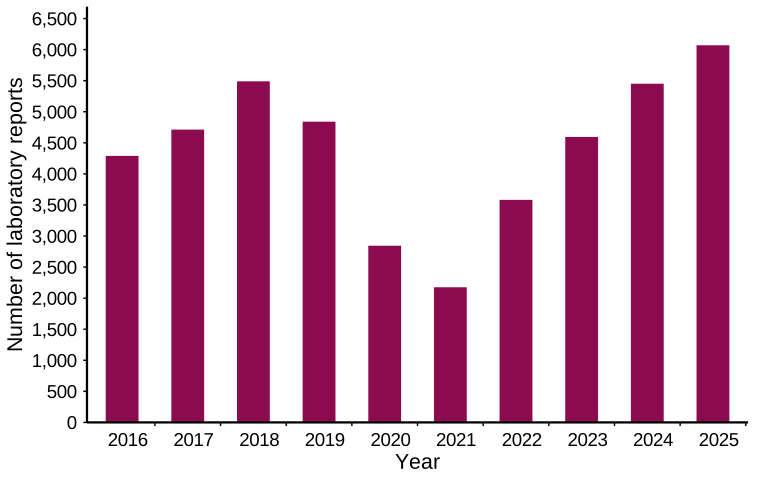
Table 1. Annual laboratory reports of Giardia in England from 2016 to 2025
| Year | Number of laboratory reports | Laboratory reports per 100,000 population |
|---|---|---|
| 2016 | 4,290 | 7.8 |
| 2017 | 4,712 | 8.5 |
| 2018 | 5,489 | 9.8 |
| 2019 | 4,840 | 8.6 |
| 2020 | 2,843 | 5.0 |
| 2021 | 2,175 | 3.8 |
| 2022 | 3,581 | 6.3 |
| 2023 | 4,594 | 7.9 |
| 2024 | 5,450 | 9.3 |
| 2025 | 6,069 | 10.4 |
Regional data in 2025
Table 2 displays the number of Giardia laboratory reports and the rate per 100,000 population per region in 2025.
Rates increased between 2024 and 2025 in all regions, except the South East which decreased by 4.7%. London had the highest rate of laboratory reports (17.3 per 100,000 population) in 2025 and had the largest increase in rate of any region, with laboratory reports per 100,000 population increasing by 29.1% from 13.4 reports per 100,000 population in 2024. The lowest rate was in the East of England (4.0 laboratory reports per 100,000 population).
Table 2. Regional distribution of laboratory reports of Giardia in England in 2025 (n=6,069)
| Region | Laboratory reports | Laboratory reports per 100,000 population |
|---|---|---|
| East Midlands | 312 | 6.2 |
| East of England | 261 | 4.0 |
| London | 1,568 | 17.3 |
| North East | 217 | 7.9 |
| North West | 1,029 | 13.3 |
| South East | 977 | 10.1 |
| South West | 844 | 14.3 |
| West Midlands | 557 | 9.0 |
| Yorkshire and the Humber | 304 | 5.4 |
Age and sex distribution in 2025
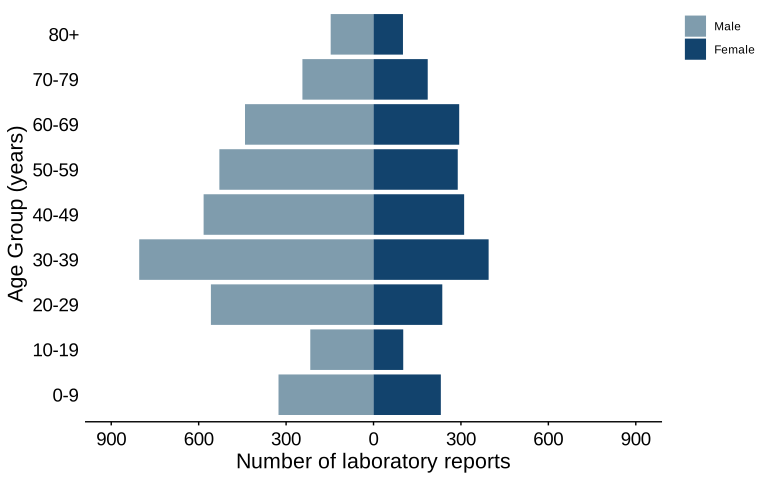
Figure 2 shows the age and sex distribution of Giardia laboratory reports in England during 2025. Laboratory reports were excluded where age or sex was unknown (n=75). Cases were more likely to be male (n=3,849, 64.2%) in all age groups, but the difference was less pronounced in young children (0 to 9 years) and older adults (70 to 79 and 80 years and over).
Adults aged 30 to 39 years were most affected accounting for 1,199 cases (20.0% of total laboratory reports); males accounted for 67.1% of the 30 to 39 year age group.
Figure 2. Age and sex distribution of laboratory reports of Giardia in England in 2025 (n=5,994)
Index of Multiple Deprivation (IMD) in 2025
Table 3 displays the number of Giardia cases resident in postcodes of each Index of Multiple Deprivation (IMD) decile. IMD decile could not be established for 190 cases without a valid postcode. The median IMD decile of Giardia cases was 5 (interquartile range: 3 to 8).
Table 3. Number of Giardia cases per Index of Multiple Deprivation (IMD) decile in England 2025 (n=5,879)
| IMD deciles | Total number of cases (%) |
|---|---|
| 1 (Most deprived) | 604 (10.3) |
| 2 | 630 (10.7) |
| 3 | 633 (10.8) |
| 4 | 672 (11.4) |
| 5 | 649 (11.0) |
| 6 | 584 (9.9) |
| 7 | 571 (9.7) |
| 8 | 509 (8.7) |
| 9 | 526 (8.9) |
| 10 (Least deprived) | 501 (8.5) |
Seasonal variation in 2025
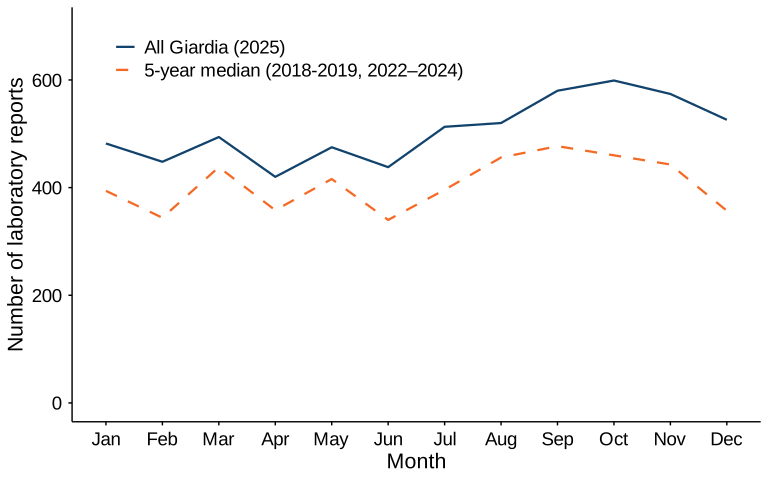
Figure 3 shows the seasonal trend of laboratory reporting for Giardia in England during 2025 by month. In 2025, the number of laboratory reports per month was higher than the 5-year median (2018 to 2024, excluding 2020 and 2021) for all months. The number of laboratory reports peaked in autumn, with the highest number of reports observed in October (n=599), followed by September (n=580) and November (n=574). This trend is consistent with that observed in previous years, with an observed increase starting in the summer months, peaking in autumn and decreasing during the winter months.
Figure 3. Seasonality of laboratory reports of Giardia in England by month in 2025 with median number of reports by month in 2018 to 2024 (excluding 2020 and 2021) (n=6,069)
Outbreak data in 2025
In 2025, there was one Giardia outbreak reported to national surveillance (Table 4). Overall, the total number of people affected was 7 with 3 laboratory-confirmed cases, of which there were no reported hospitalisations or deaths (hospital admission and death data is not collected routinely or systematically). However, there is likely to be under ascertainment in the number of cases reported.
The outbreak reported in 2025 was associated with person-to-person transmission within a closed setting.
Table 4. Outbreaks of Giardia reported in England in 2025 [note 1]
| Agent | Total affected | Laboratory-confirmed | Hospital admissions [note 2] | Deaths [note 2] | Setting | Month |
|---|---|---|---|---|---|---|
| Giardia | 7 | 3 | 0 | 0 | Nursery | December |
Note 1: number of cases affected, and number laboratory-confirmed for cases resident in England.
Note 2: clinical outcome is not known for all cases and the data reported represents cases who have hospital admissions or deaths reported to national surveillance.
Conclusions
In 2025, the rate of Giardia laboratory reports in England increased from 9.3 in 2024 to 10.4 per 100,000 population, with the highest rates reported in London (17.3), however, the true burden is likely underestimated, with community studies suggesting substantially higher incidence than reported cases (5, 16). During the COVID-19 pandemic years (2020 and 2021) and in 2022, a lower number of laboratory reports was observed.
The number of laboratory reports per year returned to pre-pandemic levels in 2023 and has increased annually. The reason for this increase in reporting is likely multifaceted and investigations are ongoing. However, it is likely that the introduction of multiplex GI PCR and changes to testing have played a role. Other factors such as changes in international and domestic travel post-pandemic, and climate and other environmental changes in the UK could also be influencing the trends observed and are being kept under review. There was one outbreak of Giardia reported to national surveillance in 2025, with 7 cases of which 3 were laboratory confirmed.
The number of reports peaked in autumn for Giardia with the highest number of reports in October (n=599), similar to the normal seasonality observed in previous years. There is limited information on current risks associated with Giardia infection. While travel is likely a risk factor, there is no clear temporal signal that risk of Giardia infection can be attributable to travel given cases are distributed throughout the year. Data on travel is also not routinely collected on laboratory forms and there is no standardised enhanced surveillance questionnaire in place for Giardia cases.
The age and sex distribution of cases remained comparable to historic years; the 30 to 39 year age group was the most affected and there was a higher number of male cases reported, particularly in adults aged 20 to 69 years. Using gender distribution data as a proxy measure for exposure data (11), there is a higher ratio of male to female laboratory reports (1.82:1.00), indicating GBMSM as a potential driver of male cases, this is supported by the accompanying age distribution of predominantly adult males.
Giardiasis is treated with nitroimidazoles and combinations of antiparasitics if the infection does not respond to standard treatment (3, 17). Infections which persist despite standard treatment (refractory infections) are increasingly common in the UK in both asymptomatic and symptomatic individuals, particularly among children seeking asylum and travellers returning from India. Multiple factors, including protozoal drug resistance and host-related factors such as re-infection within families or close contacts are thought to be contributing to drug resistance (17). Further research is needed to understand the mechanisms underlying treatment failure.
Data sources
This report was produced using data derived from 5 data sources:
- the UK Health Security Agency (UKHSA), formerly Public Health England (PHE), Second Generation Surveillance System (SGSS). This is a live laboratory reporting system therefore numbers are subject to change. In 2015, PHE upgraded the laboratory reporting system so direct comparisons between data reported from the previous system (LabBase2) and the new system (SGSS) requires cautious interpretation
- the Gastrointestinal Infections, Food Safety and One Health (GIFSOH) Division’s eFOSS (electronic foodborne and non-foodborne outbreak surveillance system) is also a live laboratory reporting system and therefore numbers are subject to change
- the population data used for England were sourced from the Office for National Statistics, mid-year 2024 estimates
- the regional classification of cases was identified through postcode matching with lookup tables sourced from Office of National Statistics via the Census 2021 geographies
- the Index of Multiple Deprivation (IMD) deciles were sourced from the Ministry of Housing, Communities and Local Government, English Indices of Deprivation 2025
Data caveats
This report was produced using laboratory data for England only, therefore the number of Giardia laboratory reports published in previous reports which include data from other UK countries may differ to those included in this report.
Acknowledgements
We are grateful to:
- the NHS and private sector diagnostic laboratories, microbiologists and local authorities, health protection and environmental health specialists who have contributed data and reports to national surveillance systems, including those who have investigated and reported outbreaks to the electronic foodborne and non-foodborne gastrointestinal outbreak surveillance system (eFOSS)
- the epidemiologists and information officers who have worked on the national surveillance of intestinal infectious diseases
- UKHSA (formerly PHE) Information Management Department for maintenance and quality assurance of UKHSA national surveillance databases used for Gastrointestinal Infections (GI) pathogen surveillance at the national level
- UKHSA (formerly PHE) Local Public Health Laboratories and Food Water and Environmental Microbiology Services for providing a surveillance function for GI pathogens and testing of food and environmental samples routinely and during outbreak investigations
Prepared by Gastrointestinal Infections, Food Safety and One Health Division, UKHSA.
For queries relating to this document, contact: EEDD@ukhsa.gov.uk
References
1. Adam RD. ‘Giardia duodenalis: Biology and Pathogenesis’ Clinical Microbiology Reviews 2021: volume 34, issue 4, e00024 to e00019
2. UKHSA (2014). ‘Giardia: guidance and data’ (updated 2026)
3. NHS (2023). ‘Giardiasis’
4. Hawker J, Begg N, Blair I, Reintjes R, Weinberg J. ‘Communicable Disease Control Handbook’ Blackwell 2005
5. Waldram A, Vivancos R, Hartley C, Lamden K. ‘Prevalence of Giardia infection in households of Giardia cases and risk factors for household transmission’ BMC Infectious Diseases 2017: volume 17, issue 1
6. Minetti C, Lamden K, Durband C, Cheesbrough J, Fox A, Wastling JM. ‘Determination of Giardia duodenalis assemblages and multi-locus genotypes in patients with sporadic giardiasis from England’ Parasites and Vectors 2015: volume 8, page 444
7. Horton B, Bridle H, Alexander CL, Katzer F. ‘Giardia duodenalis in the UK: current knowledge of risk factors and public health implications’ Parasitology 2019: volume 146, issue 4, pages 413 to 424
8. Hall V, Taye A, Walsh B, Maguire H, Dave J, Wright A, Anderson C, Crook P. ‘A large outbreak of gastrointestinal illness at an open-water swimming event in the River Thames, London’ Epidemiology and Infection 2017: volume 145, issue 6, pages 1,246 to 1,255
9. Richardson D, Pakianathan M, Ewens M, Mitchell H, Mohammed H, Wiseman E, Tweed M, Nichols K, Rawdah W, Cooper R, Macrowan R, Irish M, Evans A, Godbole G. ‘British Association of Sexual Health and HIV (BASHH) United Kingdom national guideline for the management of sexually transmitted enteric infections 2023’ International Journal of Sexually Transmitted Diseases and Acquired Immunodeficiency Syndrome 2023: volume 34, issue 9, pages 1 to 15
10. Minetti C, Lamden K, Durband C, Cheesbrough J, Platt K, Charlett A, O’Brien SJ, Fox A, Wastling JM. ‘Case-control study of risk factors for sporadic giardiasis and parasite assemblages in North West England’ Journal of Clinical Microbiology 2015: volume 53, issue 10, pages 3,133 to 3,140
11. Mook P, Gardiner D, Kanagarajah S, Kerac M, Hughes G, Field N, McCarthy N, Rawlings C, Simms I, Lane C, Crook PD. ‘Use of gender distribution in routine surveillance data to detect potential transmission of gastrointestinal infections among men who have sex with men in England’ Epidemiology and Infection 2018: volume 146, issue 11, pages 1,468 to 1,477
12. Cherrie MPC, Nichols G, Iacono GL, Sarran C, Hajat S, Fleming LE. ‘Pathogen seasonality and links with weather in England and Wales: a big data time series analysis’ BMC Public Health 2018: volume 18, page 1,067
13. Amar CFL, Dear PH, Pedraza-Díaz S, Looker N, Linnane E, McLauchlin J. ‘Detection and genotyping by real-time PCR/RFLP analyses of Giardia duodenalis from human faeces’ Journal of Medical Microbiology 2002: volume 51, issue 11, pages 998 to 1,005
14. Yoder JS, Harral C, Beach MJ. ‘Giardiasis Surveillance — United States, 2006–2008’ Morbidity and Mortality Weekly Report Surveillance Summaries 2010: volume 59, issue 6, pages 15 to 25
15. Adamson JP, Chalmers RM, Thomas DR, Elwin K, Robinson G, Barrasa A. ‘Impact of the COVID-19 restrictions on the epidemiology of Cryptosporidium spp. in England and Wales, 2015–2021: a time series analysis’ Journal of Medical Microbiology 2023: article number 001693
16. Love NK, Elliot AJ, Chalmers RM, Douglas A, Gharbia S, McCormick J, Hughes H, Morbey R, Oliver I, Vivancos R, Smith G. ‘Impact of the COVID-19 pandemic on gastrointestinal infection trends in England, February to July 2020’ British Medical Journal Open 2022: volume 12, issue 3, article e050469
17. Boté-Casamitjana A, Bodhani R, Chiodini PL, Longley N, Godbole G, Eisen S, Nabarro LE. ‘Epidemiology and management of nitroimidazole-refractory giardiasis’ Journal of Travel Medicine: volume 33, issue 2, taag002