Stakeholder Forum Papers: Television - Competitiveness and sustainability of PSB ecosystem
Published 23 June 2026

© Crown copyright 2026
This publication is licensed under the terms of the Open Government Licence v3.0 except where otherwise stated. To view this licence, visit nationalarchives.gov.uk/doc/open-government-licence/version/3 or write to the Information Policy Team, The National Archives, Kew, London TW9 4DU, or email: psi@nationalarchives.gov.uk.
Where we have identified any third party copyright information you will need to obtain permission from the copyright holders concerned.
This publication is available at https://www.gov.uk/government/publications/future-of-tv-distribution-stakeholder-forum-papers/stakeholder-forum-papers-television-competitiveness-and-sustainability-of-psb-ecosystem--2
A paper independently produced by the TV Sector Working Group ahead of the Future of TV Distribution Stakeholder Forum.
The creative industries are one of the eight growth-driving sectors the government has selected for targeted support as part of its industrial strategy. The government’s consultation noted that the creative industries sector “plays an important role in driving growth across regions and nations, through creative clusters and corridors across the country that spread opportunity and prosperity in communities, as well as driving growth by enhancing access to skills, spillovers, and knowledge sharing.”[footnote 1] Within the broader creative industries, the UK screen sector (film, TV, radio and photography) delivers £21bn of GVA each year[footnote 2] and the TV sector is a significant contributor to this.
The TV sector Working Group is concerned with assessing Ofcom’s options for the future of TV distribution against the two core decision factors:
-
Promoting a competitive TV industry - any decision should encourage a competitive TV sector for PSBs and commercial channels
-
A sustainable PSB ecosystem - any solution should seek to maintain and support the concept of public service broadcasting and ensure that public service content continues to be available to audiences
This paper sets out the critical factors for achieving success in core decision factors ‘Promoting a competitive TV industry’ and ‘Maintaining a sustainable PSB ecosystem’ in the 2030s. While we recognise that there are challenges within the current TV sector and PSB ecosystem, and that the recently passed Media Act is in the process of being implemented by Ofcom, this paper looks further ahead to anticipate the challenges the sector will face beyond the next few years, along with potential solutions. We note that this paper is not supported by Coba.
Broadcast distribution has historically underpinned the success of the UK TV sector and the PSB ecosystem
Broadcast distribution - analogue and then digital terrestrial television (DTT) and digital satellite television (DSat) - has played a crucial role in the UK TV sector for both PSB and non-PSB commercial channels by providing wide and unmediated reach for broadcasters, free access for audiences and prominence for PSB . Satellite and cable TV platforms also carry the PSB channels ensuring they are accessible on all broadcast platforms. The regulated terms as set out in the 2003 Communications Act have ensured there is a level playing field between PSBs and platforms that carry PSB content.
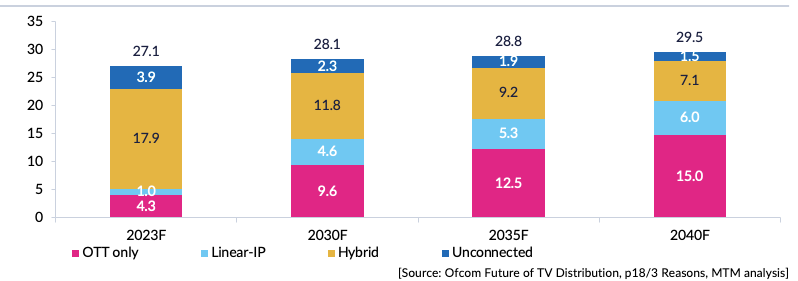
More recently, however, broadcast has been complemented by IP distribution resulting in an abundance of choice of platforms, services and channels for audiences. On TV, viewers can watch broadcasters’ content and FAST services supplied by professional producers alongside user-generated content on video sharing platforms which adheres to different quality standards. In substance many of the features of an IP TV world are visible today, with 23.2m households (85% of TV households) having access to IPTV in 2023 (see figure 1).
Figure 1: UK TV homes by primary TV UI type
It should also be noted that the traditional definition of ‘TV viewing’ is changing. 96% of UK adults now have a smartphone. And while 85% of children watch TV programmes or films via a TV set, 80% watch via other devices (e.g. tablet or mobile phone).[footnote 3] However this paper will focus on viewing on TVs, which is the focus of the DCMS’s stakeholder forum on the future of TV distribution. Research shows that the overwhelming majority of total in-home video viewing (84%)[footnote 4] still takes place this way.
The hypothesis for this paper is that all-IP distribution (Ofcom option 3) is the best way to ensure that the UK’s TV sector remains competitive and supports a sustainable PSB ecosystem.
In order to test this hypothesis, this paper will outline:
1. The critical success factors that need to be met in the 2030s for a competitive TV industry and a sustainable PSB ecosystem;
2. Whether IP distribution can fulfil these success factors and the policy and/or industry solutions that would be needed to ensure it can; and
3. Assuming these solutions are in place, whether all-IP distribution or an alternative hybrid DTT/IP solution would best support the success factors.
1. The critical success factors for the 2030s
The table below sets out the critical success factors that would need to be fulfilled in order to realise a competitive TV industry.
| A competitive TV industry | ||
|---|---|---|
| 1 | Mixed ecology | A range of business models (pay TV, advertising, licence fee) are supported. |
| 2 | Fair and competitive access | Reasonable opportunities to make content available on a prominent basis and widely across multiple platforms for all players. No player is able to exert disproportionate market power over other industry participants. |
| 3 | Low barriers to entry | There should not be higher barriers to entry for broadcasters in the UK than currently exist. |
| 4 | Strong export potential | The UK TV sector can achieve a fair international return on its intellectual property for reinvestment in the UK industry. UK content delivers soft power benefit to the UK when it is exported/provided around the world. |
| 5 | Strong domestic production | There is a range of large and small companies commissioning and producing high quality, diverse, UK-originated content across a range of genres much of which speaks to lives in and of the UK and attracts UK audiences and creates jobs and investment across the entire country. Producers benefit from a range of copyright business models (e.g. from Terms of Trade to cost plus), which is far superior to that in many other markets. |
| 6 | Inward investment | The sector attracts investment via jobs, content and infrastructure, helping build critical mass and create opportunities for domestic producers, crews, talent and other workers.. |
| 7 | Quality standards | There are quality standards in place for all content viewable on the TV, overseen by an independent regulator. |
| 8 | Content discoverability | Viewers can easily find and access UK focussed TV content services. |
| 9 | Innovation | The UK TV industry needs to be confident that creative energies and resources can be forward-looking and focused on meeting market demand. Regulation must be proportionate and not overly burdensome to ensure innovation and growth. |
The table below sets out the PSBs’ views on the critical success factors for a sustainable PSB ecosystem into the 2030s:
| A sustainable PSB ecosystem | ||
|---|---|---|
| 1 | Universality | The full range of PSM content and services is available to all audiences and easily discoverable on all significant TV platforms. |
| 2 | Effective PSM compact | The benefits PSBs receive are proportionate to the obligations they must deliver to ensure that PSB status is attractive and commercially sustainable. |
| 3 | Sustainable funding | Sustainable funding models for the BBC and commercial PSBs. |
| 4 | Collaboration | There are opportunities for collaboration between broadcasters, streamers, producers and platforms (consistent with a dynamic approach to competition law). |
It should be noted that some non-PSB members of the working group, while being supportive of the principle of maintaining a sustainable public service broadcasting ecosystem, believe that the PSB ecosystem should not fundamentally impact the commercial viability of other UK broadcasters nor UK TV platforms.
2. IP distribution has the potential to support a competitive TV industry and a sustainable PSB ecosystem in the 2030s, but may require intervention
While IP distribution has the potential to deliver the same benefits as broadcast distribution has and potentially more in some though not all areas, it also changes the dynamics of the industry and results in a number of challenges.
Using the success factors identified in section 1, the tables below set out how IP distribution in the UK can meet each success factor, what the challenges are and some examples of how these could be overcome. The solutions outlined in the two tables below are not an exhaustive list, and we note that exploring these and other potential options is outside the scope of this paper and would be a future matter for the DCMS and Ofcom.
We also note that the Media Act—which covers a range of areas including the PSB compact, PSB prominence and VOD regulations—is currently being implemented by Ofcom, and may help resolve some of the challenges in the move to IP distribution. However, the effects are as yet unclear and will need to be monitored by Ofcom.
2a. Supporting a competitive TV sector
| Success factor | How IP can meet success factor | Challenges of IP | Examples of policy and industry solutions[footnote 5] | |
|---|---|---|---|---|
| 1 | Mixed ecology | IP distribution can support the full range of business models, enabling all audiences to access all the services that they want, need and (where applicable) pay for. It can provide new ways to reach audiences and monetise content. | In a marketplace with more ways to exploit content and generate revenues, it is important that UK focussed content is surfaced and viewed with sufficient revenue/value in return to support a variety of business models and enable reinvestment. | The mixed ecology in the sector (inc. direct public funding, advertising and subscription revenue streams) supported by tax incentives for production ensures choice and flexibility. Ofcom should continue to monitor the viability of each of these revenue models in the medium-long term. The new provisions in the Media Act to ensure appropriate prominence fo3r PSB content should be implemented and kept under review during the transition from DTT to IPTV distribution. Regulation on processing data to facilitate targeted TV advertising should be monitored to ensure it does not impact the viability of the ad financed streaming model. |
| 2 | Fair and competitive access | There is some level of competition at all stages of the IP distribution chain. | While there is competition at all stages, IP distribution has also resulted in new intermediaries across the distribution value chain. | Regulation may be necessary to curb the powers of intermediaries in the IPTV distribution chain where there is not effective competition. |
| 3 | Low barriers to entry | IP distribution presents low barriers to entry for new channels and services given the availability of distribution capacity. | The proliferation of IP platforms means there are multiple entry points for channels/services. These platforms may be able to exert market power to increase barriers to entry | Industry standards may be necessary to keep barriers to entry low. If these cannot be reached, regulation may be necessary. |
| 4 | Strong export potential | IP distribution can support export potential to the same degree that broadcast distribution has | IP distribution enables global business models that focus on content with global appeal. This may devalue distinctly UK content, but could also bring greater variety and choice to audiences | Ensure that the UK has the talent, facilities and IP protections in place to ensure that programmes made in the UK are made to the highest quality and standards, to maximise export potential. International co-productions can bring additional revenues to the UK TV sector. Government to ensure that the creative industries are represented in trade visits and that the UK TV sector’s position of strength is not compromised in any future trade deals and that UK made content retains its status as European works in EU markets. Government to promote a strong regulatory approved list of services internationally, both individual and collective bouquets – essentially providing a UK quality kite-mark to international audiences. |
| 5 | Strong domestic production | IP distribution can support domestic production to the same degree that broadcast distribution has | Changes in distribution in the UK are not directly likely to impact the domestic production sector, but it is important the UK production sector is able to continue to compete effectively | The UK needs to have a sufficiently flexible regulatory environment to enable British businesses to collaborate and deliver growth whilst ensuring effective competition. Update of tax credit system to ensure that it remains internationally competitive and supports and incentivises production in the UK. |
| 6 | Inward investment | IP distribution can equally support inward investment | As above | Enhanced tax credits to incentivise investment in UK content production as part of a globally competitive regulatory, legislative and fiscal regime. Targeted interventions must be kept under review to ensure that the UK remains internationally competitive. |
| 7 | Quality standards | Content distributed over IP can be equally held to quality standards | Quality standards do not apply to all the ways in which content delivered via IP is available on TVs. Viewers could find it difficult to understand the differences between regulated and unregulated content that is distributed on the same screen. | Update quality standards for any content that can be viewed via TV, including user-generated content. Ensure that the rules are overseen by Ofcom. |
| 8 | Content discoverability | Content distributed over IP can be highly discoverable by all audiences with innovative discovery methods (e.g. voice control) | IP significantly increases the amount of content available to viewers, but new IP prominence paradigms and tools can make discovery for viewers and commercial returns for content providers more challenging. | Industry standards for metadata and other discoverability factors may be required to ensure relevant content is discoverable by all audiences. If these cannot be reached, regulation may be necessary. |
| 9 | Innovation | IP distribution offers new ways for viewers to interact with TV content and greater personalisation. IPTV can also offer enhanced protections and security (e.g. firewall blocking) | Consumers may not always appreciate greater personalisation, or see it as an enhancement and would expect to be able to continue to watch their TV anonymously. | The regulatory environment needs to be sufficiently flexible and proportionate to allow companies to innovate across the whole ecosystem and value chain, whilst ensuring that viewers are appropriately protected from harm. |
2b. Maintaining a sustainable public service broadcasting ecosystem into the 2030s
There are diverging views within the TV sector working group as to the level of regulatory and industry support that the public service broadcasters require in order to maintain a sustainable public service broadcasting ecosystem into the 2030s. As a result the table below sets out how IP distribution can meet each identified success factor and the challenges IP distribution may bring. The column containing examples of potential regulatory and industry solutions therefore contains: general examples; specific views of the PSBs; and also highlights when non-PSB members of the group are either opposed to the PSB proposal, or believe it should be tempered.
| Success factor | How IP can meet success factor | Challenges of IP | Examples of policy and industry solutions | |
|---|---|---|---|---|
| 1 | Universality | IPTV has the ability to be universal. DSIT is running or supervising a number of programmes and superfast broadband is expected to be available to 99.65% of homes by 2030.[footnote 6] | As identified by the Audiences Working Group there are challenges around availability and take-up of IPTV. | Solutions against this success factor are being considered in the Audiences Working Group. Industry and Government have a role to play in ensuring that the barriers to digital inclusion – including media literacy and data and device poverty – are addressed as quickly as possible to ensure that no one is left behind in a digital world. |
| 2 | Effective PSM compact | A PSM compact based on IP can better reflect the reality of the new digital media environment. | Key aspects of value in the current compact are attached to broadcast distribution technologies. The 2024 Media Act is the first step in updating this for the IP age but further updates to the compact may be necessary as audiences continue to migrate to IP. | PSB views: As well as implementing the Media Act, Ofcom should continue to assess whether the PSM compact remains appropriate to ensure the sustainability of PSM provision in the medium-long term, and if not how it should be updated Updated PSB benefits for the digital age ensuring broader discoverability of PSB content on other platforms, protection from value extraction by aggregators/platforms and an IP equivalent for gifted spectrum could be considered. Other group members views: Coba: The Media Act will update the PSB compact, including prominence for an IPTV world. Ofcom’s public service media review and the BBC Charter Review will further address PSB concerns. Coba does not support the PSBs’ views that further media legislation will be required. Sky: New media legislation may be required in the future and changes in distribution technology should be considered as part of any legislative process |
| 3 | Sustainable funding | IP distribution does not necessitate a change to the funding model of the BBC or commercial PSBs. | The additional choice enabled by the internet has resulted in PSBs facing fierce competition for audiences (and advertising for the commercial PSBs) in the online world as well as value extraction by online platforms and aggregators. As a result, declining Licence Fee and advertising revenue have meant that PSBs have seen significant real terms decline in their revenues in the last 10 years.[footnote 7] | PSB views: Tax credits should incentivise PS objectives e.g. encouraging production out of London, the production of nations and regions news, the preservation of IP within the UK, and co-production with PSBs. Significant and sustainable public funding for the BBC as part of a mixed ecology of TV funding. Reduced costs of public service broadcasting. Other group members views: Coba: The Media Act will update the PSB compact, including prominence for an IPTV world. Ofcom’s public service media review and the BBC Charter Review will further address PSB concerns. Coba does not support the PSBs’ views that further media legislation will be required. Sky: Ofcom should continue to monitor the viability of all revenue models (e.g. direct public funding, advertising and subscription) in the medium-long term |
| 4 | Collaboration | IP offers new opportunities for collaboration between PSBs, producers and platforms. | PSBs no longer have the market power that they once had and must now compete with many different players, many of which have global reach. The downside of low barriers to growth and the rise of global players (both features of the IPTV world) is that PSBs face competition from scale players and low or no cost players simultaneously. | The UK needs to have a sufficiently flexible regulatory environment (with a dynamic forward-looking approach to competition law) to enable British businesses to collaborate, grow scale and efficiency and deliver growth whilst ensuring effective competition. Additional PSB views: The PSBs should have greater flexibility to work together (and with other non-PSBs) as well as the right to jointly or individually promote joint services |
3. If the challenges are addressed, the benefits of all IP to the TV sector and PSB will outweigh a hybrid model
For the purposes of testing the hypothesis we assume policy and industry solutions to address the challenges outlined in section 2 are implemented by the 2030s. We can then assess how either maintaining a hybrid distribution approach (Ofcom option 1 & 2) or transitioning to all-IP distribution (Ofcom option 3) impacts on each of the identified success factors.
Conclusions and next steps
| A competitive TV industry | Hybrid (Ofcom option 1 & 2) | All IP (Ofcom option 3) | |||
|---|---|---|---|---|---|
| 1 | Mixed ecology | The financial implications of maintaining hybrid distribution will put increasing pressure on business models | Business models do not need to support hybrid distribution. Larger addressable market for IP-based businesses models due to previously DTT-only viewers being connected | ||
| 2 | Fair and competitive access | No material change | There will be effective competition at all stages of the distribution chain with no monopolies | ||
| 3 | Low barriers to entry | No material change | No channels/services will be required to compete for restricted distribution capacity | ||
| 4 | Strong export potential | No material impact | No material impact | ||
| 5 | Strong domestic production | No material impact | Potential for increased investment in content as a result of business models not needing to support hybrid distribution | ||
| 6 | Inward investment | No material impact | No material impact | ||
| 7 | Quality standards | No material impact | No material impact | ||
| 8 | Content discoverability | No material change | Content will be highly discoverable by all audiences, including previously DTT-only viewers | ||
| 9 | Innovation | Running a hybrid model could hamper the speed of innovation in the UK TV sector | Ensures that viewers get the best experience and that the UK remains competitive | ||
| A sustainable PSB ecosystem | |||||
| 1 | Universality | No material impact | All audiences (including previously DTT-only viewers) will have access to the full range of PSB content and services | ||
| 2 | Effective PSM compact | DTT becomes a cost to be funded and not a benefit funding other PSB obligations | No material impact | ||
| 3 | Sustainable funding | The financial implications of maintaining hybrid distribution will put increasing pressure on PSBs as IP distribution costs rise | PSBs will no longer need to maintain hybrid distribution | ||
| 4 | Collaboration | No material impact | No material impact |
From the analysis in this paper it follows that a transition to all IP distribution in the 2030s is the option that will best promote a competitive TV industry and support a sustainable PSB ecosystem, providing policy solutions to the challenges set out in section 2 are assessed and that appropriate and proportionate changes are implemented well ahead of any changes introduced in the 2030s.
Without proper consideration of these challenges by policy-makers, the success factors may not be met under any of the potential distribution scenarios. Maintaining DTT is not protective of the successful system the UK has had, as the economic costs and benefits of continuing with this distribution technology will continue to evolve in line with changing viewer habits. Any option for the future of distribution requires policy maker action, and we welcome the DCMS’ consideration of this issue, advised by industry via the working groups.
Given the potential benefit to the industry, we recommend that the challenges and example policy solutions set out in this paper are explored further by Ofcom and DCMS as part of this process.
It should be noted that techUK’s Consumer Electronics Strategy & Technology (CE S\&T) group has been participating in the working group as representative of TV device manufacturers, and that this group of stakeholders do not agree with the conclusion that Ofcom’s Option 3 (all-IP distribution) is the best way to promote a competitive TV industry and support a sustainable PSB ecosystem in the 2030s. techUK’s CE S\&T will welcome further engagement with DCMS and Ofcom on these issues.
Coba believes that a competitive TV industry in the 2030s requires: a) fair competition in the UK market in terms of access to audiences; b) global competitiveness; c) flexibility in IP (copyright) areas when commissioning; and d) certainty in regulatory/legislative areas.
-
https://lordslibrary.parliament.uk/creative-industries-growth-jobs-and-productivity/ ↩
-
ibid ↩
-
Ofcom, Children and Parents Media Use and Attitudes 2023 ↩
-
Ofcom, Media Nations 2024 ↩
-
Note that policy and industry solutions included in both tables are indicative to provide some tangible areas that could be explored further ↩
-
https://assets.publishing.service.gov.uk/media/672cafe262831268b0b1a2f4/Future_of_TV_Distribution_FINAL__7_Nov_2024_-accessible.pdf ↩
-
Ofcom, Review of Public Service Media (2019-2023) ↩