Stakeholder Forum Papers: Infrastructure - Innovations in future of TV
Published 23 June 2026

© Crown copyright 2026
This publication is licensed under the terms of the Open Government Licence v3.0 except where otherwise stated. To view this licence, visit nationalarchives.gov.uk/doc/open-government-licence/version/3 or write to the Information Policy Team, The National Archives, Kew, London TW9 4DU, or email: psi@nationalarchives.gov.uk.
Where we have identified any third party copyright information you will need to obtain permission from the copyright holders concerned.
This publication is available at https://www.gov.uk/government/publications/future-of-tv-distribution-stakeholder-forum-papers/stakeholder-forum-papers-infrastructure-innovations-in-future-of-tv
A paper independently produced by the Infrastructure Working Group ahead of the Future of TV Distribution Stakeholder Forum
This paper sets out, at high level, a range of potential innovations that the infrastructure working group believes might play a significant role in the way the TV distribution landscape evolves in coming years. The paper explains the extent to which these innovations are relevant to each of the future scenarios for TV distribution, and to what extent they might address any potential concerns or questions.
Attached to this paper are a series of annexes, setting out a wider range of innovations in more detail. Unlike this summary paper, they have been drafted by individual members of the distribution working group (as noted in each annex) and so represent the views of the authors rather than the consensus view of the working group as a whole.
The innovations covered range from products and services that are already developed and available in the UK market to those that are more conceptual and longer-term, perhaps requiring some combination of technical development, investment (whether via commercial agreement or public funding) or policy reform.
Executive summary
The UK’s television ecosystem is undergoing an historic shift from broadcast (largely DTT) to most homes streaming IP television alongside broadcast. This paper presents the findings of the Future of UK Television Infrastructure Working Group, which identified and evaluated innovations that could play a critical role in the viable future of television distribution while safeguarding public value, inclusivity, and commercial sustainability.
Each innovation was scored against three weighted criteria: Problem-Solution Relevance (40%), Transformative Impact by 2034 (25%), and New or Enhanced Service Potential (15%). The highest-ranked innovations span accessibility, usability, IP network resilience, hybrid delivery models, and smart device ecosystems. Together, although by no means exhaustive, they form a roadmap for ensuring universal service, regulatory compliance, and continued UK leadership in media technology.
This paper also offers actionable takeaways rather than a play-by-play for policymakers and industry stakeholders to support this innovation landscape through infrastructure investment, policy support, and collaborative innovation frameworks.
Introduction
Television remains the UK’s most widely consumed media format, with millions relying on it for news, entertainment, education, and cultural representation. However, the underlying distribution infrastructure is in transition. Audiences are increasingly shifting from linear broadcast to on-demand and linear streamed services. At the same time, new device ecosystems, connectivity options, and content formats are reshaping how television is experienced.
The Future of UK Television Infrastructure Working Group examined how innovations across the delivery chain can support a smooth, inclusive transition. The twelve categories examined include accessibility, usability, fixed and mobile networks, satellite, smart TVs, cloud-based delivery, in-home connectivity, data, and international standards. Each innovation was assessed through a weighted methodology designed to evaluate both audience and public service benefit and business impact. This approximation was designed to shine a light on innovations that have potential and is not a cost benefit assessment, or a recommendation that a specific innovation is financially viable.
Accessibility and usability as foundational drivers IP delivery introduces unprecedented opportunities to enhance accessibility. Freed from broadcast constraints, platforms can deliver multiple content versions to suit diverse needs. Key innovations include AI-generated sign language interpretation, dynamic subtitles, customisable UI settings, and content versions tailored to neurodivergent audiences.
User experience is equally vital. The transition to IP must not disenfranchise those with low digital confidence. Usability innovations such as simplified remotes, voice-enabled search, AI-powered personalisation, and “simple mode” toggles are critical. These are already possible on platforms like Freely, Sky Glass and VMO2 Stream.
Research shows these features increase satisfaction and reduce churn - particularly among older adults and digitally-excluded audiences. By 2034, accessibility and usability should be baseline design principles, supported by regulatory frameworks and embedded in industry standards.
Innovation and hybrid delivery
While IP is the long-term future, DTT remains popular. It delivers universal, reliable, and energy-efficient service, particularly for live content. Innovations such as DVB-T2 and High Efficiency Video Coding (HEVC) might offer improved compression, better picture quality, and next-generation audio formats in future. These improve user experience while reducing transmission costs and carbon emissions (Arqiva estimates c.40% reduction in energy and carbon possible on a like-for-like basis through new transmitters).
The current phase involves hybridisation. HbbTV allows integration of IP-delivered content with broadcast streams, creating seamless experiences. Hybrid models also support targeted advertising and additional revenue models for commercial broadcasters.
Fixed IP networks and scalable content delivery
Fixed IP networks form the backbone of the UK’s streaming future. Although at an early stage of live trials, technologies like MAUD (Multicast-Assisted Unicast Delivery) have been shown to significantly reduce peak demand pressure, a key cost and reliability challenge for IP delivery today for example live sporting events. BT’s trials with BBC content demonstrated a more than 60% reduction in traffic - boosting resilience and sustainability.
The concept of TV-only broadband could provide low-cost, prioritised connectivity for households using broadband solely for TV - a potential offering for digitally excluded or cost-sensitive users.
Another example of innovation is Synamedia’s Multi-CDN architecture, which supports lastic, energy-efficient delivery with up to 35% off-peak energy savings. These platforms also support content sovereignty and targeted services. By 2034, fixed IP must provide low-latency, resilient service at scale, backed by transparent governance and regulatory support.
Mobile, FWA and satellite: Extending reach and resilience
Mobile networks play a supplementary yet essential role. In rural or underserved areas, Fixed Wireless Access (FWA) and 4G/5G can offer reliable fallback or primary access. They are also invaluable in disaster recovery and temporary deployment scenarios.
The emergence of 5G broadcast adds new potential. Using multicast, it can deliver live video with high efficiency, relieving network strain during large events. While not yet widely deployed, it offers promise for the future of scalable mobile viewing. However, there is the significant barrier of whether mobile handset manufacturers will include the necessary technology in their devices. They may do if there were demonstrable and sufficient consumer demand, though it is not clear whether there would be given viewer preferences to be able to watch on-demand much of the time.
GSO satellite continues to serve millions via Sky and Freesat. International innovations like DVB-NIP could deliver IP-native services through existing dishes. Satellite also potentially provides a viable nightlight service for DSAT homes post-2034.
Low Earth Orbit (LEO) constellations, such as Starlink and OneWeb, offer direct broadband in hard-to-reach areas and have demonstrated 4K streaming viability. Though currently more expensive than standard fixed broadband for households, scale and competition could lower costs.
These technologies will not replace fixed IP, but they are essential complements, ensuring no UK viewer is left behind.
In-home connectivity: Enabling seamless transition
The in-home environment can be a make-or-break factor for IPTV success. Innovations in mesh networks, next-gen Wi-Fi hubs, and Wi-Fi 7 are delivering near-universal coverage. BT Broadband’s Complete Wi-Fi Guarantee and Virgin Media O2’s minimum 30Mbps promise are industry-leading examples.
In-home resilience is also improving through mobile back-up routers and “unbreakable broadband” offers. These reduce downtime and give consumers confidence in switching to IPTV.
Smart TV products and cloud-based platforms
Smart TV innovation is accelerating the IP transition. Platforms from international consumer electronics manufacturers and UK platforms such as BT TV, Sky Glass, Freely, and VMO2 Stream are delivering rich, accessible experiences with no aerial or satellite requirement. A more radical innovation is Synamedia Senza’s low-cost, thin-client, cloud-based HDMI which enables cloud-rendered UIs and application instances that update continuously. Such an approach also enables remote use assistance.
Key features that warrant further exploration include single sign-on (SSO), voice navigation, personalisation, and smart notifications. Addressable advertising and simplified onboarding further enhance the business case. These innovations reduce friction, expand access, and create new monetisation models. Freely’s backwards EPG and Never Miss feature are live examples of design for accessibility and retention.
These devices also support PSB prominence and regulatory compliance - vital as content ecosystems fragment.
Data and international standards: The enablers of innovation
Data underpins the next generation of television. While some audience members, especially those with lower digital skills find aspects of this, such as sign in, a barrier, or in principle off-putting. Whether to require UK TV services to provide viewing without this is a complex policy question with rights (does someone have a right to access without some data being collected?), commercial (what commercial impacts would there be on services required to offer this, and are they worth it?) and user impacts (viewers declining to share data may get a worse viewing experience or be unable to use beneficial features that rely on it) to consider. It is also not an isolated issue and we suggest governance of data collection and use in TV should be in line with, and a subset of, wider UK data policy, such as the Data Use and Access Bill currently before Parliament.
From content personalisation to network management, collection and use of some relevant data enables tailored services and efficient operations.
Next generation international television technology standards (e.g. DVB) ensure seamless service discovery and device compatibility. The main international standards organisation for the internet (W3C) has a group exploring supporting decentralised identity and user control. The Coalition for Content Provenance and Authenticity (C2PA) addresses the prevalence of misleading information online through the development of technical standards for certifying the source and history (or provenance) of media content - an essential tool in combating misinformation and AI-generated content.
Open data models foster innovation, reduce duplication, and enhance interoperability. They also support regulatory aims around trust, competition, and audience protection. Toolboxes of technical standards remain the bedrock of product innovations and interoperability. UK leadership in international standards organisations (interSDOs) positions it well to shape these global standards and embed PSB values.
Key takeaways
-
Innovation lifecycles are different between products, regional standards and global standards i.e. Products:Mths-Yrs, Regional (e.g. DVB):5 Yrs, Global (e.g. ITU):10 Yrs.
-
Prepare homes with hybrid IP linear service delivery technology ready for future distribution scenarios (as done with digital broadcast switchover), through research, funding, trials and testbeds, and regulatory clarity.
-
Explore options for long-term broadcast i.e. extension of DTT with refreshed platform enabling adoption of DVB-T2 and a replacement GSO DSAT for satellite audiences.
-
Mandate accessibility and usability features as standard requirements across platforms, apps, and hardware, supported by inclusion funding.
-
Consider TV-only broadband to support digitally-excluded households, including policy reform around traffic prioritisation.
-
Expand public access to in-home connectivity innovation, including mesh networks and mobile backup solutions.
-
Enable targeted adoption of GSO and LEO satellite as supplementary delivery mechanisms.
-
Assess the viability of 5G broadcast especially whether global handset manufacturers will explore whether to add the necessary technology to their devices.
-
Support open standards and interoperable frameworks to prevent platform lock-in, keep international TV manufacturers engaged and ensure service longevity and protect PSB prominence.
-
Foster innovation partnerships across broadcast, telco, tech, and creative sectors - using government convening power to unlock shared value.
By advancing these priorities, the UK can maintain universal access, support competition and innovation, and build an infrastructure that reflects its values - public service, inclusion, and resilience - in a streaming-first future.
Definition[footnote 1]: Innovation is the “process of taking ideas from inception to impact
Innovation is not just about the initial creation of an idea but also about the journey it takes to make a significant impact. This approach to innovation involves three key and connected concepts: ecosystems, capacities, and stakeholders.
Innovation can be seen as a spectrum, with two distinct types of activities:
-
Formal “Innovation” (with a capital “I”) involves taking novel scientific and technological research and development outputs or transformational innovations from inception through to impact. Innovation is more of a continuum in IP when compared to that of broadcast and so this includes continuous innovation and innovations currently being scaled that have a high impact. These types of innovation often lead to significant changes and are described as being in the ‘10x’ transformation category.
-
A more modest form of innovation involves the innovative adoption or adaptation of existing technologies and practices. This type of innovation is more widely applicable and falls into the ‘10%’ category, signifying incremental improvements.
and satisfy the DCMS Core Decision Factors and criteria below:
Innovation
Any solution should encourage the TV sector to continue to innovate - this includes innovation in distribution technologies, content creation and service design. Solution should avoid ‘locking in’ an unsustainable technology.
Reliability
Any chosen distribution method should be reliable. This includes being able to provide a consistent level of service, including at times of peak and exceptional demand.
Annex 1: Accessibility (inc. AI)
Overview and strategic relevance
The flexibility of IPTV facilitates innovations that benefit viewers, and audiences experience this already from watching programmes on-demand in 4K to changing the size of subtitles.
Looking forward, there is scope for improved and more personalised accessibility features. IPTV is not limited to transmitting the same version of content or standardised access services as is the case with broadcast platforms, therefore it is possible to envision a future where video content is not only ‘accessible’ but also ‘inclusive’ as the versions available could be limitless.
The pace at which AI is being advanced has a role to play in both the creation of these accessible and inclusive versions, as well as understanding the individual audience needs and making selections and modifications based on these.
Additionally, as most IP devices and platforms are software-based this also enables these innovations to be rolled out faster. However, there is the risk that these features aren’t deployed consistently across different services and platforms leading to a sense of frustration and exclusion for those audiences who depend on them
For clarity this Annex will not focus on ‘usability’ which will be covered in Annex 2.
Innovation description
This flexibility that IPTV allows, paired with the exponential advancement of AI technologies means, there are endless opportunities for innovation relating to accessibility and inclusion. Including but not limited to:
Innovations that could improve existing TV accessibility services
- Subtitles. More user choice over how subtitles appear (e.g. colour, contrast, positioning)
- Sign-interpreted versions. Simultaneous transmission of sign-interpreted versions (currently not available on broadcast), with more user choice of how the interpreter appears in the video. Also potential to use GenAI to create these versions, so they are more readily available.
- Audio Description. Greater flexibility of audio description playback via IPTV, by allowing ‘client-side’ mixing so audiences can adjust the audio levels. A text version of audio descriptions could potentially be made available for use by assistive technologies such as Braille displays, so that deaf-blind audiences can also experience TV content.
Innovations that could enhance TV viewing for those experiencing barriers to access
- Dialogue Enhancement. For those who are hard of hearing, having more control over the audio mix of a programme will be beneficial. There is also a role for AI and machine-learning to identify dialogue and non-dialogue elements
- For viewers with photosensitive epilepsy. Technology could be implemented to allow users to watch live TV and/or existing programmes that have flashing images.
- For neurodivergent audiences. Again, technology and AI can play a role in providing versions of content that meet specific needs, such as reducing sensory overload or providing summaries of complex storylines.
Existing developments and examples
Many of these innovations are already in development or are available on select devices and platforms:
Accessible TV Guide (Freeview Play & Freely)
- The Accessible TV Guide (ATVG) is available via channel 555 on internet-enabled Freeview Play and Freely devices. The navigation is high contrast and further customisable based on user needs (i.e. text-to-speech or magnification) and enables users to filter programmes via accessibility needs, such as subtitles, audio descriptions or sign-interpretation.
Personalised accessibility mixes
- Mixmups Ultra Access Episodes are currently available via web browser. Mixmups is an animated series starring disabled characters aimed at young children, these episodes are customisable based on access needs, including dialogue enhancement or Makaton-interpretation.
Dialogue enhancements
- BBC Taster: Casualty A&E - a 2019 trial that allowed users to control their own audio mix in a simple manner.
- DTS Clear Dialogue - launched in 2024 to improve dialogue intelligibility on TVs
AI developments
- AI4ME, a partnership between the University of Surrey, Lancaster University and the BBC, is pivoting to further explore deep personalisation, bringing together the original ideas of object-based media, with the new capabilities of generative AI. This includes, for example, exploring ways in which content creators and producers can build in accessibility features at the start of the workflow, rather than added as an afterthought. This brings down the cost and greatly increases the options for enhancing media.
Scoring rationale
Currently broadcast (e.g. DTT) is broadly accessible with many programmes offering subtitles and audio description. However, there are limitations. For example, sign-interpreted versions cannot be broadcast at the same time on the same linear channel.
IPTV enables different versions to be delivered simultaneously, paired with technological advancements available to content creation and editing, TV has great potential to become more accessible and inclusive over the coming years.
Barriers and enablers
Barriers
- Inconsistent standards
IPTV relies less on shared standards than broadcast, which means that audience experience can vary greatly from platform to platform. Also, users must select their access needs and settings in each individual service or platform, which can be another source of frustration.
- Content provider and platform strategy
Innovations will be prioritised and implemented based on individual content provider and platforms’ product roadmaps.
Enablers
-
Greater audience uptake of IPTV
By 2035, forecasters predict that 62% of TV households will only receive IP-delivered TV and a further 32% will be hybrid TV households. This means that an overwhelming majority of TV households will be able to benefit from any IPTV innovations in this time.
-
Technological advancement of AI
The evolution of AI will enable content producers and providers to create and distribute more accessible and inclusive versions at pace.
- Standardisation and sharing of IPTV accessibility user-profile settings
Efforts to standardise and share user-profile settings have already been initiated (i.e.. ANSI/CTA-2115) and will enable a more consistent user experience where possible and preferable.
F. Projected outcomes by 2034
Around 94% of TV households will have IPTV on their primary set by 2034. There are infinite possibilities to make online TV and video content more accessible in this time, but it will require coordination among industry to define and meet standards so that audiences have a consistent and coherent viewing experience that meets their needs.
Annex 2: Usability (inc. AI)
Lead: DTG Sources and contributors: DTG.
Overview and strategic relevance
Innovation in the usability of television services delivers clear audience, public and commercial value. It ensures that all viewers - regardless of age, ability, or digital confidence - can continue to enjoy familiar content while gradually exploring new experiences. In doing so, it enhances everyday life, strengthens social inclusion, and upholds the UK’s proud tradition of universal access to television. As television continues to evolve, ensuring that interfaces are intuitive and inclusive will be central to maintaining high standards of excellence, trust, and accessibility in the UK’s television ecosystem.
Artificial intelligence (AI) is front and centre in redefining how users navigate television interfaces and discover content. A wave of innovations from global manufacturers revealed how AI is now being embedded more deeply into the operating systems of smart TVs, with a focus on simplifying access, personalising experiences, and enhancing accessibility. For example, Samsung’s new Vision AI platform introduced features such as Click to Search, which enables viewers to access contextual information about what they’re watching with a single click - and Live Translate, which provides real-time subtitle translations for international content. These were coupled with AI-driven upscaling and adaptive sound, aimed at automatically optimising the picture and audio experience for each viewer (Samsung Vision AI).
Meanwhile, Google announced a significant update to its Google TV platform by integrating its Gemini AI technology. This advancement allows users to issue voice commands without the need for trigger phrases like “Hey Google” and introduces proximity-aware widgets that appear as a user approaches the TV, making interaction more seamless and context-aware (The Verge on Google TV and Gemini AI). LG and Samsung also showcased collaboration with Microsoft’s Copilot AI, bringing conversational assistance directly to television interfaces to help users search for and organise information more efficiently. These developments signal a broader shift towards user-centric design, where AI plays a central role in making television not only more intelligent, but more usable and inclusive for all.
The transition to IP-delivered television brings significant opportunities for increased functionality, interactivity, and personalisation. However, it also presents substantial usability challenges, particularly for older audiences and individuals with lower levels of digital literacy. Recent user testing by the DTG and i2 Media Research for Ofcom highlights that many smart TV interfaces are not currently designed to support the full spectrum of user abilities - especially when it comes to intuitive navigation, accessibility, and user confidence.
The study identified numerous barriers, including unclear navigation structures, inconsistent on-screen feedback, confusing remote-control layouts, visually cluttered home screens, and complex sign-in and search processes. For example, while 100% of participants successfully used traditional logical channel numbers (LCN), success rates dropped to just over 55% when using the electronic programme guide (EPG) and fell further to only 21% for unaided use of broadcast video-on-demand (BVoD) services. Interestingly, voice search - though unfamiliar to most - was completed successfully by 60% of users with little or no prompting, indicating the potential for well-designed features to bridge usability gaps.
These challenges are not limited to IP services. They are common across all modern television user interfaces - often referred to as “home pages” - to a greater or lesser degree, irrespective of whether the content is delivered via broadcast, hybrid, or IP networks. This indicates that usability is a cross-platform issue that affects the entire television experience, and not just internet-based services. As such, innovations that improve usability - such as an option for simplified navigation, clearer interface feedback, and adaptive design - will benefit all viewers.
Strategic relevance
Usability is not merely a matter of interface aesthetics; it is a core enabler of innovation and public value in the future television distribution ecosystem. Its strategic relevance cuts across multiple priorities:
- Digital inclusion and equality: The design of television services must accommodate the needs of older adults, those with cognitive or motor impairments, and individuals with limited confidence in using digital technologies. Poor usability risks reinforcing digital exclusion precisely at the point television becomes more internet-dependent.
-
Regulatory preparedness for the UK and other markets: The requirements of the Media Act and international players addressing the forthcoming EU Accessibility Act (2028) requirements for a “Simple Mode” for digital devices and services could also result in UK market improvements. Anticipating and addressing these requirements now will ensure legal compliance and avoid costly retrofits later.
Recommendation for further investigation is made into the impact of: EU Directives, AVMS EMFA, RED CRA (Cyber), ESPR (Eco), DSA DMA, EAA, Data Act, e-Commerce, Data Protection ePrivacy, AI Act, Media Freedom Act: Customisation of remote controls
- Support burden and operational rfficiency: Inadequate usability increases the burden on informal support networks (typically family members) and formal service providers. Designing intuitive systems reduces reliance on others and lowers support costs across the value chain.
- Public service value and trust: Television remains a vital source of news, entertainment, and social connection for many. Ensuring that all audiences can navigate and access content confidently is essential for maintaining television’s role as a trusted and inclusive public service.
- Scalable innovation: If new features - such as personalised recommendations or interactive content - are only usable by digitally-fluent individuals, their reach and impact will be limited. Human-centred design is essential to ensure that innovations are broadly adopted and deliver public benefit.
In summary, usability is a cornerstone of a successful and equitable transition to IP-delivered television. By embedding user-centred design principles - rooted in real-world evidence - into future infrastructure planning, the UK can deliver an inclusive, accessible, and sustainable television ecosystem for all. It is anticipated that with the right guidance many, if not all of the innovations identified, have or will have been integrated into television products in the market
Innovation description
30 key usability innovations in television (with cross-references)
This document outlines 30 usability innovations designed to enhance the user experience of internet-delivered television services. The innovations are categorised into four themes: ‘Familiar TV Experiences’, ‘Simplification’, ‘Assisted Help’, and ‘AI and Personalisation’. Each entry includes cross-references to key findings from the Ofcom-funded DTG-i2 usability research and relevant international studies.
Familiar TV experiences
- PSB number buttons that function consistently across interfaces - Referenced in DTG-i2 Phase 2 Demonstrator and SMILE MORE framework.
- Standardised menu structures across platforms - Supported by TetraLogical (2023) and DTG-i2 Phase 1 findings on interface inconsistency.
- ‘Continue watching’ resumption panels - Aligned with BOOPRO Tech 2024 UX recommendations and Nielsen Norman Group suggestions.
- Channel history recall for quick re-tuning - Common in global UX designs; matches user preferences found in DTG-i2 Phase 1.
- Live TV shortcut tiles on home screens - Echoed in usability tests (DTG-i2 Phase 1) showing preference for shortcut-based navigation.
- Retention of coloured button functions (red, green, yellow, blue) - Highlights feedback from older users in DTG-i2 focus groups.
- Logical channel numbering embedded within app interfaces - Reinforces legacy mental models per DTG-i2 and Samsung UX research.
- Simplified catch-up access via integrated EPG options - Validated in DTG-i2 trials as improving confidence and task success.
Simplification
- ‘Simple mode’ or basic user interface toggle - Backed by EU Accessibility Act (Directive 2019/882); echoed in Miroboard 2025 mapping with TechUK TV Manufacturers.
- Simplified remote control layouts - Strongly supported in DTG-i2 Phase 1 testing and international ergonomics research (Chen et al., 2022).
- Unified search across live and on-demand content - Advocated by Nielsen Norman Group (2023); tested in DTG-i2 demonstrator.
- Fewer layers within apps and menus - Recommended by BOOPRO Tech (2024); shown to reduce frustration in DTG-i2 usability sessions.
- Clearer visual hierarchies in interface design - Supported by Ouyang & Zhou (2019) in screen design studies.
- Reduced confirmation steps for common actions - Identified as a barrier in DTG-i2 Phase 1; improves flow and reduces drop-off.
- One-touch launch for frequently used applications - Found in Samsung’s Smart Hub and validated by user preference data (DTG-i2).
- Quick-access subtitle and audio toggle buttons within settings - Improves perceived control; highlighted in SamÄÂÂović (2022).
Assisted help
- Interactive onboarding tutorials for new users - Tested in DTG-i2 Phase 2; increased user confidence and learning speed.
- Context-sensitive on-screen prompts - Featured in DTG-i2 demonstrator; aligns with international UX trends for just-in-time guidance.
- Step-by-step guidance for signing in to services - Found to reduce sign-in abandonment in DTG-i2 user testing.
- Exit and recovery prompts for users who become lost - Addressed common cognitive load issues in DTG-i2 Phase 1.
- ‘What’s new’ guidance cards within the interface - Inspired by mobile onboarding techniques; useful for updating features gradually.
- Real-time feedback for incorrect remote input or navigation errors - Supported by BOOPRO and industry UX benchmarking.
- Visual highlighting of current selection or focus area - A key recommendation from both DTG-i2 research and TetraLogical.
- Dedicated help mode accessible via remote shortcut - Found effective in DTG-i2 prototyping to support digital confidence.
AI and personalisation
- Voice search activated with a single press - Improved usability in DTG-i2 Phase 1; consistent with Samsung Relumino and Google TV UX.
- Predictive content suggestions based on time and usage - Advocated by international HCI research; used in Netflix, Google TV.
- Machine-learned reordering of the home screen based on preferences - Tested by Apple TV and supported in DTG-i2 user feedback.
- Smart recommendations that adapt to household viewing habits - Personalisation praised in Nielsen Norman usability analysis.
- Flexible voice activation options including ambient listening - Samsung and Google Home integrations referenced; enhances ease of access.
- Automatic input recognition and switching between sources - Seen in international product reviews; reduces setup friction.
- User profiles with continuity of content across devices - Recommended in BOOPRO (2024) for reducing fragmentation.
- Reduction of repetitive prompts based on past interactions - A form of adaptive design supported in AI usability research.
- Content alerts tailored to user-defined interests - Successfully implemented in BBC iPlayer notifications; well received in trials.
- Dynamic user interface adaptation based on usage patterns - Supported by adaptive interface studies (Khan et al., 2022; Coelho et al., 2013).
References supporting TV usability innovations
DTG-i2 Ofcom Interim Report Phase 1 and 2 (available July 2025)
TetraLogical - TV Accessibility Considerations: https://tetralogical.com/blog/2023/08/09/tv-accessibility-considerations/
Nielsen Norman Group - Smart TV Usability: https://www.nngroup.com/articles/smart-tv-usability/
BOOPRO Tech - Enhancing Smart TV UX: https://boopro.tech/post/the-art-of-enhancing-user-experience-in-smart-tv-applications
EU Accessibility Act (Directive 2019/882): https://ec.europa.eu/social/main.jsp?catId=1202
Chen et al., 2022 - Remote Usability for Older Adults: https://www.sciencedirect.com/science/article/abs/pii/S1877050922001053
Ouyang & Zhou, 2019 - TV Input Methods for Older Users: https://doi.org/10.1016/j.chb.2019.02.013
Samcovic, 2022 - Subtitles and Accessibility in TV: https://www.sciencedirect.com/science/article/pii/S1877050922007150 Khan et al., 2022 - Personalisation and Cognitive Load in Smart TVs: https://doi.org/10.1016/j.ijhcs.2022.102844
Coelho et al., 2013 - Multimodal TV Interfaces: https://doi.org/10.1016/j.chb.2013.03.006 Samsung Relumino Accessibility Tech: https://news.samsung.com/us/samsung-advancing-equity-entertainment-creating-inclusive-tv-experience-relumino-mode-interview
BBC iPlayer Notifications and Content Alerts: https://www.bbc.co.uk/iplayer/help/latest-news/personalised-recommendations
Google TV Setup Experience: https://www.androidcentral.com/streaming-tv/google-tv-new-setup-experience-details
Evidence of impact
Evidence of impact: usability improvements in television
Recent academic and peer-reviewed studies, alongside commissioned field research such as the in-progress Ofcom-funded DTG-i2 usability research, provide strong evidence that improvements in usability significantly enhance viewer satisfaction, confidence, and digital inclusion - particularly among older adults and individuals with lower digital literacy. The project is still in progress and it is likely that further testing on nationally representative samples at scale would be beneficial along with a programme to drive industry’s adoption of the findings.
User confidence and task success
The DTG-i2 Phase 1 research (2025) demonstrated a stark decline in usability success when users moved from familiar channel-based navigation (100% success) to more complex tasks such as BVoD access (25% success). However, Phase 2 demonstrator testing revealed that simplified interfaces, clearer menu labels, and onboarding prompts increased successful task completion and reduced anxiety. These findings support usability principles outlined in Nielsen Norman Group (2023), which advocate for minimal cognitive load and consistent menu structures.
Cognitive load and interface complexity
International research confirms that cognitive overload is a key barrier to effective TV use. Chen et al. (2022) found that remote controls with unclear labelling and numerous buttons significantly impeded use by older adults. Similarly, Khan et al. (2022) established that interfaces not tailored to user familiarity or digital literacy led to dissatisfaction among 91% of surveyed participants. Coelho et al. (2013) recommended multimodal, simplified interfaces with clear labels and consistent design patterns to support ageing populations and neurodiverse users.
Personalisation and adaptive interfaces
Voice control and AI-based personalisation are also proving beneficial. DTG-i2 Phase 1 participants, many of whom had never used voice search, were able to complete tasks successfully with minimal prompting once the feature was demonstrated. Studies by Ouyang & Zhou (2019) and Dou et al. (2019) further show that voice input significantly reduces task completion time and user frustration. Adaptive features - such as home screen reordering or predictive content tiles - improve satisfaction and discovery, as evidenced by usability studies on Google TV and Netflix platforms.
Social value and digital inclusion
Usability innovations have a direct impact on social outcomes. According to the UK Office for National Statistics (ONS), 79% of those excluded from digital participation are aged 65 and above. Age UK and i2 Media Research emphasise that intuitive design can reduce isolation, increase independent access to information, and improve quality of life. The DTG-i2 work shows that even small interface improvements can make television - a vital medium for companionship, information, and entertainment - more inclusive and empowering.
Scoring rationale
Scored Usability Innovations in Television
This table summarises the scoring of 30 usability innovations in internet-delivered television, based on the evaluation framework defined by the DCMS Future of TV Distribution Infrastructure Working Group. Each innovation is assessed on three weighted criteria: Critical Problem Solution (40%), Transformative Impact by 2034 (25%), and New/Enhanced Service Potential (15%).
| Innovation | Problem Solution (40%) | Impact by 2034 (25%) | New Service Impact (15%) | Weighted Score |
|---|---|---|---|---|
| ‘Simple mode’ or basic user interface toggle | 5 | 5 | 4 | 3.85 |
| Simplified catch-up access via integrated EPG options | 5 | 4 | 4 | 3.60 |
| Simplified remote control layouts | 5 | 4 | 4 | 3.60 |
| PSB number buttons that function consistently across interfaces | 5 | 4 | 3 | 3.45 |
| Voice search activated with a single press | 4 | 5 | 4 | 3.45 |
| Standardised menu structures across platforms | 5 | 4 | 3 | 3.45 |
| Logical channel numbering embedded within app interfaces | 5 | 4 | 3 | 3.45 |
| Fewer layers within apps and menus | 4 | 4 | 4 | 3.20 |
| Predictive content suggestions based on time and usage | 3 | 5 | 5 | 3.20 |
| One-touch launch for frequently used applications | 4 | 4 | 4 | 3.20 |
| Dynamic user interface adaptation based on usage patterns | 3 | 5 | 5 | 3.20 |
| Unified search across live and on-demand content | 4 | 4 | 4 | 3.20 |
| ‘Continue watching’ resumption panels | 4 | 4 | 4 | 3.20 |
| User profiles with continuity of content across devices | 3 | 5 | 4 | 3.05 |
| Smart recommendations that adapt to household viewing habits | 3 | 5 | 4 | 3.05 |
| Machine-learned reordering of the home screen based on preferences | 3 | 5 | 4 | 3.05 |
| Reduced confirmation steps for common actions | 4 | 4 | 3 | 3.05 |
| Live TV shortcut tiles on home screens | 4 | 4 | 3 | 3.05 |
| Clearer visual hierarchies in interface design | 4 | 4 | 3 | 3.05 |
| Content alerts tailored to user-defined interests | 3 | 4 | 4 | 2.80 |
| Reduction of repetitive prompts based on past interactions | 3 | 4 | 4 | 2.80 |
| Automatic input recognition and switching between sources | 3 | 4 | 4 | 2.80 |
| Flexible voice activation options including ambient listening | 3 | 4 | 4 | 2.80 |
| Channel history recall for quick re-tuning | 4 | 3 | 3 | 2.80 |
| Context-sensitive on-screen prompts | 4 | 3 | 3 | 2.80 |
| Dedicated help mode accessible via remote shortcut | 4 | 3 | 3 | 2.80 |
| Exit and recovery prompts for users who become lost | 4 | 3 | 3 | 2.80 |
| Step-by-step guidance for signing in to services | 4 | 3 | 3 | 2.80 |
| Interactive onboarding tutorials for new users | 4 | 3 | 3 | 2.80 |
| Quick-access subtitle and audio toggle buttons within settings | 4 | 3 | 3 | 2.80 |
| Retention of coloured button functions (red, green, yellow, blue) | 4 | 3 | 3 | 2.80 |
| Real-time feedback for incorrect remote input or navigation errors | 3 | 3 | 3 | 2.40 |
| ‘What’s new’ guidance cards within the interface | 3 | 3 | 3 | 2.40 |
| Visual highlighting of current selection or focus area | 3 | 3 | 3 | 2.40 |
Barriers and enablers
The market for television products and platforms is currently undergoing a significant transition as viewing shifts toward internet-delivered services. This transition presents both structural challenges and compelling opportunities for innovation. Usability innovation - once treated as an afterthought - is now becoming central to competitive advantage, audience retention, and inclusive access. However, progress is not without tension.
Barriers
1. Designing for diverse user needs
One of the most persistent challenges is designing for all users, including older adults, people with low digital confidence, and those unfamiliar with app-based ecosystems. The sheer variability in cognitive, sensory, and physical needs makes “universal design” a complex, sometimes commercially-unattractive, goal unless supported by standards or mandates.
2. Fragmentation across the ecosystem
There remains a lack of consistency in how usability principles are applied across different manufacturers, operating systems, and content providers. This undermines user learning and contributes to confusion and abandonment, particularly among non-digital-native audiences.
3. Commercial pressures and innovation risk
Many market actors prioritise feature-led differentiation and rapid innovation cycles over coherence or simplicity. As Philipp Zuerberg aptly noted, “People developed planes first and then took care of flight safety. If people were focused on safety first, no one would ever have built a plane.” The same holds true for usability: many product innovations begin with bold, disruptive ideas rather than safe, standardised solutions.
4. Limited cross-sector coordination
Without stronger cooperation between platform operators, manufacturers, regulators, and broadcasters, there is a risk that usability improvements will remain piecemeal rather than systemic.
Enablers
1. Industry guidelines and standards
Good practice guidelines and technical standardisation have a demonstrable track record of delivering consistency and usability.
2. Growing recognition of digital inclusion
There is now broad industry and policy consensus that usability is a key determinant of access, inclusion, and public value.
3. Commercial opportunity in human-centred design
With intense platform competition, usability is becoming a competitive differentiator. Products that “just work” - quickly, clearly, and confidently - are increasingly rewarded with loyalty and engagement.
4. Regulatory and policy momentum
Regulators and public broadcasters are playing a critical role in convening standards, promoting inclusive design, and ensuring no one is left behind in the shift to IP-based TV services.
5. Audience-focused market innovation
Across the ecosystem, signs of audience-focused innovation are growing. From simplified remotes to predictive interfaces and voice-first control, the market is now investing in features that reduce cognitive load and improve discoverability – particularly for underserved groups.
6. Testbeds, labs, and open collaborationNone
Industry collaboration platforms, accessibility testbeds, and usability co-design workshops are providing real-world feedback loops that accelerate innovation while maintaining user relevance.
Projected outcomes by 2034
If current momentum continues - driven by engaged audiences, active policy frameworks, and sustained industry collaboration - usability innovation in television services will yield transformative outcomes by 2034:
Television services will be intuitive by default
Navigating internet-delivered TV services will feel as natural and immediate as traditional linear television once did. Whether through remote control, voice, or adaptive UI agents, users will be able to find, watch, and resume content effortlessly, regardless of platform or technical confidence.
No one left behind
Inclusive design will no longer be seen as a regulatory burden or niche requirement. It will be embedded in mainstream product and service development, supported by simple modes, onboarding, and user guidance systems that adapt dynamically to individual needs. Industry-led innovations, reinforced by policy initiatives like the Media Bill and EU Accessibility Act, will ensure that older adults, people with cognitive or sensory differences, and users with lower digital literacy remain confident and connected.
Personalisation will be meaningful, not overwhelming
AI and voice assistants will offer personalised content discovery, accessible navigation, and smarter interfaces, without overwhelming users or violating trust. Instead of replacing human control, technology will enhance user confidence and autonomy through context-aware support and simplification.
Regulation will reflect real-world experience
Policy and regulation will be informed by practical, collaborative, and user-tested insights. By 2034, we can expect common standards for usability and discoverability across devices and platforms, enabling consistent expectations and lowering barriers to engagement.
A resilient, human-centred innovation ecosystem
The UK will have established itself as a global exemplar in audience-centred TV innovation. A vibrant ecosystem of broadcasters, platforms, manufacturers, and accessibility experts will continue to co-create solutions, responding rapidly to evolving behaviours and needs.
Summary
By 2034, usability will be seen not as an add-on but as a foundational design principle, crucial to equitable access, competitive advantage, and public trust. Provided that industry, policy makers and users continue to engage, we will move beyond simply “solving for usability” toward creating a future of television where confidence, clarity, and control are universal.
Annex 3: DTT
Author: Arqiva
1. Introduction
DTT is part of a hybrid viewing platform offering access to broadcast linear content alongside broadband delivered services. This hybrid DTT network continues to evolve with broad scope for ongoing innovation over time as technologies and market preferences develop.
The DTT platform continues to be the most utilised means for TV reception and has benefited from many innovations over its lifetime which has been underpinned by a very strong adherence to standards such as the D-Book and utilisation by various industry platform specifications (e.g. Freeview Play, Freely, Youview). These have created a platform which is easy to use by the viewer and is operated upon a highly reliable transmission network supported by the Multiplex Operators and Everyone TV. This co-ordination between the broadcasters, the platform and transmission operator has created a highly trusted and reliable TV service successfully delivering for viewers and broadcasters.
In this Annex we discuss and evaluate a number of potential innovations which are being considered and are possible around the DTT platform over time, drawing on ideas from the UK, markets across Europe and globally.
2. Innovations relating to the potential development of the DTT platform
Broadcasters, technology vendors and DTT operators across Europe[footnote 2] and globally [footnote 3]are considering a range of innovations which can enhance the hybrid DTT service in their respective markets and offer benefits to viewers, broadcasters and society. These can be categorised across a number of themes, including:
- Enhancing the user experience on DTT via a move to DVB-T2;
- Improving the energy and carbon sustainability of the DTT network with a move to DVB-T2;
- Enabling seamless access to linear and on-demand content and supporting targeted advertising within hybrid DTT;
- Evolving to offer a mobile broadcast capability and experience;
- Innovating along the DTT delivery chain;
Enhancing the user experience on DTT via a move to DVB-T2
If it continues past 2034 the UK DTT platform will naturally evolve to be able to operate in the next generation of operating model - DVB-T2. The existing transmitters required to operate the network will have reached the end of their life and not be supported anymore - these will be replaced by newer versions which will be DVB-T2 standard transmitters.
This move to DVB-T2 will support a range of innovations on the platform improving the user experience by increasing the quality of video, in terms of both sharper and better picture definition along with improved audio. All this while enhancing compression of video and thus making more efficient use of the spectrum.
More image definition (to support HD, UHD and eventually UHD2) - the next generation of DTT equipment will provide potential for sharper and more detailed images, as the amount of data encoded can be higher. DVB-T2 will support widespread use of HD with scope for UHD if there is demand within the market and within the installed base of TVs. The use of DTT capacity for the delivery of high capacity video services would form a very efficient means of delivering this type of content.
An example of a market which is embracing improvements in the capabilities of DTT is Spain. It has recently announced[footnote 4] a new national technical plan for DTT incorporating ambitions to evolve to UHD broadcasting once the uptake of DVB-T2 receivers and 4K televisions reaches a certain level.
Enhanced compression (moving fully to MPEG4 and then HEVC) - As TV sets are replaced over time this offers scope to move to more advanced compression formats to be adopted. This would enable better image definition or a greater number of channels over time. Potential improvements include moving from MPEG2 or MPEG4 compression and eventually to High Efficiency Video Coding (HEVC), after a move to DVB-T2, which would offer around 50% additional data compression for the same perceptual quality. HEVC was originally published as an ITU standard in 2013 and is integrated within many TV sets although it is not expected to be in a sufficient number of TV sets until well after 2034.
These more advanced systems are being introduced and tested across Europe e.g. in 2022, Spanish public broadcaster RTVE broadcast 20 FIFA World Cup matched in UHD and HDR quality, free-to-air over DTT to 60% of the Spanish population. Polish public broadcaster TVP also offered all the World Cup matches in UHD and HDR free-to-air to 95% of the Polish population. France introduced for the Olympics a UHD DTT multiplex which will stay on air until the main network transitions to UHD at which point this UHD multiplex is envisaged as becoming a 5G Broadcast multiplex.
Better picture definition (through the adoption of HDR, HFR, WCG) - As TV sets are replaced and as the capacity of the DTT network expands through an evolution to DVB-T2 it will be possible to explore technical possibilities on DTT such as: High Dynamic Range (HDR) which improves the contrast between very dark and very light colours on a TV screen making images more vivid and realistic. High Frame Rate (HFR) to support video shot at more than 24 frames per second the traditional rate used by cinema, enabling a smoother viewing experience and valuable in live sports viewing.
Better sound quality (adopting Next Generation Audio - NGA) - there is scope to improve the audio quality available via a hybrid DTT / IP system. This can come about as the consumers replace their TVs and the transmission evolves with DVB-T2 providing additional capacity to support the services. This includes through immersion - offering an immersive audio experience at home without the need of any adaptation of the programme created by the content producer - personalisation - automated or controlled by the user, the audio stream improves intelligibility and allows for selection of sources, as well as greater accessibility for people with hearing loss, providing a more enjoyable experience.
Improving the energy and carbon sustainability of the DTT network via a move to DVB-T2The newest generation of transmitter offers the opportunity to significantly improve the efficiency of the DTT network with energy and carbon efficiency of around 40-44% now possible on a like for like basis. The switch to DVB-T2 will allow consideration of a reduction in the number of multiplexes and transmitters as fewer would be needed to carry the same number of services. These innovations would permit a significant reduction in the electricity consumption and carbon emmisions for the DTT network.
Enabling seamless access to linear and on-demand content and supporting targeted advertising within hybrid DTT
A key innovation we will continue to see across the hybrid DTT and internet delivered platform landscape is the ability to seamlessly switch between DTT broadcast delivered content and that delivered via broadband. This will enhance the viewer experience and support commercial models for broadcasters.Innovations in hybrid delivery will be supported by the migration to the Hybrid Broadcast Broadband Television (HbbTV) standard of consumer equipment. HbbTV brings broadcast and broadband services together to the same device, notably connected TVs but also set-top boxes and multiscreen devices. It enables interactive services over broadcast and broadband networks. HbbTV is widely available in most EU countries and the standard is supported and developed by a community of varied industry players, including public broadcasters, commercial broadcasters, broadcast network operators, chipset manufacturers and consumer electronics’ companies.An important innovation we expect in the market in the next year is advertising insertion into DTT via a broadband stream. This will be enabled by HbbTV. Arqiva is currently testing proof of concept and expect to launch summer 2025. This service will integrate with advertising sales houses and enable a targeted advertising experience on a hybrid DTT set, similar to that offered on the Sky platform through Sky AdSmart. This will enhance the value of being on DTT for commercial broadcasters.Evolving to offer a mobile broadcast capability and experience
Over the long-term the DTT network has potential to support a wide range of mobile applications through an evolution to a 5G broadcast standard. As the DTT network evolves to replace transmitters with DVB-T2 these transmitters will offer the potential to operate as both DTT but also to transmit in a 5G broadcast mode (subject to relatively small modifications). This opens up the possibility for innovation over time to replace a DVB-T2 DTT multiplex with a 5G broadcast service or integrating both within a multiplex. Alternatively, a 5G broadcast multiplex could be built from scratch.
5G broadcast combines the building blocks of 5G with the DTT High Power High Tower infrastructure and would permit broadcasters to target all types of mobile devices, including in-car systems. There is a growing community focused on 5G broadcast. Qualcomm has already shown its commitment by including 5G broadcast in its chipsets which go into mobile phones. Many European markets have undertaken 5G broadcast trials including in Germany, France, Italy, Spain and Austria to name a few, and variants around this are being considered in global markets such as China, USA, India and Brazil. It is not clear whether the necessary receiver technology will be incorporated into mobile handsets at scale by the device major manufacturers, and this is a key contingency on the viability of 5G broadcast.
Through this technology there is a long-term potential to offer downlink-only services for video and audio content and non-media services, including to vehicles, across the Internet of Things (IoT) or offloading to support mobile networks.
Innovating along the DTT delivery chain
In order to deliver a hybrid DTT service to viewers, there are a number of steps within the delivery chain. These include acquiring the content, preparing it, distributing it to a processing point from where it can be delivered via both a broadcast and broadband network. An overview of this is highlighted in the chart overleaf.
Arqiva, along with other service providers, are innovating and investing across the DTT delivery chain with the aim of providing a modular, scalable, secure and cost-effective system for broadcasters within a managed service offering.
Media delivery chain to support hybrid DTT/IP
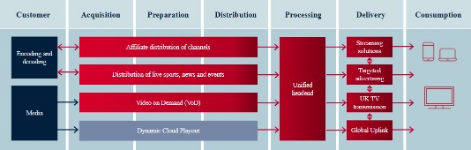
Source: Arqiva
Innovations in the media delivery chain include the migration to operation in the cloud as an option rather than using on-premise equipment, delivering seamless services and integration between broadcast and broadband delivered content and increased automation. This can support improvements such as greater bandwidth and the ability to expand or decrease requirements quickly, a reduction in costs, faster speed to market for new services, enhanced disaster recovery and resilience, and also energy efficiency gains.
3. Evaluation scoring of DTT innovations
These innovation areas can be scored based on the innovation evaluation framework. This suggests that the move to DVB-T2 unlocks key innovations for the DTT platform to improve its energy/carbon use and enhance services. The platform will also benefit from being able to support targeted advertising and innovate along the value chain. Longer-term, there is scope to evolve to support mobile broadcasts.
DTT innovation scoring
| Innovation area | Critical Problem Solution | Impact | New/enhanced service impact | Total weighted score | Rank |
|---|---|---|---|---|---|
| Enhancing the user experience on DTT via a move to DVB-T2 | 4 | 4 | 4 | 3.2 | 2 |
| Improving the energy and carbon sustainability of the DTT network via a move to DVB-T2 | 5 | 5 | 4 | 3.9 | 1 |
| Enabling seamless access to linear and on-demand content and supporting targeted advertising within hybrid DTT | 4 | 3 | 4 | 3.0 | 3 |
| Evolving to offer a mobile broadcast capability and experience | 2 | 2 | 3 | 1.8 | 5 |
| Innovating along the DTT delivery chain | 2 | 3 | 3 | 2.0 | 4 |
Note: weighting applied - critical problem solution 40%, Impact 25%, enhanced service impact 15%.
Annex 4: Synamedia’s multi-cdn approach
Lead: Synamedia
Overview and strategic relevance
The transition from terrestrial to IP-based TV distribution raises fundamental questions about reach, adaptability, and scalability in content delivery. While Public Service Broadcasters (PSBs) are central to this transition, platforms such as Freeview and Freesat illustrate that public-interest television encompasses a wider ecosystem, including smaller and specialist broadcasters.
To safeguard the future of TV broadcasting in the UK, development of streaming-first architecture should be considered. This needs to be a robust, highly distributed, highly scalable content delivery network built and run for the national interests. Much in the way DTT is critical infrastructure for the UK so should a UK content delivery network be. Currently all the CDNs that deliver traffic in the UK are owned and operated by Multinational Companies. The UK is at the mercy of their strategic decisions and market forces. Furthermore these networks are not optimised for video delivery and subject to demands from 100’s of thousands of applications. The streaming future of the UK should have national interests at its heart and put the UK in control of its own destiny. To deliver low-latency streaming at scale, Synamedia’s vision is a framework for multi-CDN traffic steering and elastic edge caching, to enable a shared national CDN infrastructure for all public-interest broadcast services. This architecture aims to operate over various ISP networks and leverage open standards for traffic steering and session-based security. The model is designed not only for technical scalability, but also for partnership with ISPs and CDNs. This vision emphasises:
- Fully dedicated, robust and secure streaming infrastructure for UK Broadcasting
- Revenue-sharing frameworks to ensure viability of all stakeholders.
- Routing decisions based on real-time QoE, business logic, and network-aware inputs.
- Compatibility with emerging content formats/forms (e.g., short-form videos, mobile-centric 9:16 streaming, and AI-curated editorial experiences).
- Support for both traditional (e.g. live sports) and new media distribution patterns.
- Respect of regulations and obligations such as universal reach and accessibility features.
Innovation description
Our vision is currently supported by two innovative products.
Multi-cdn steering (Quortex switch)
Synamedia’s steering system supports real-time traffic balancing across multiple CDN providers. Unlike traditional static routing, the mechanism complies with the HLS and MPEG-DASH content steering extension, which does not require client-specific integration. Sessions can seamlessly be transferred between CDNs with no impact on the end user. Quortex Switch features:
- Standards-compliant orchestration (HLS/DASH).
- Routing based on QoE, business agreements, and regional balancing policies.
- Security via token-based session authorization (e.g., CAT standard).
- Inclusion of inputs from all actors (QoE, ISPs, CDNs, PSBs) for optimal orchestration.
The system, which supports mid-stream failover, is designed to scale globally via public cloud infrastructure. Its neutrality with respect to CDN providers allows each operator to remain independent, while enabling traffic distribution based on external policy or performance signals. To ensure editorial control, PSBs can implement their own traffic policies and gain access to analytics dashboards for service verification and compliance monitoring.
Elastic CDN cache (fluid edge)
CDNs must evolve to support enormous peaks of demand punctuating periods of lower delivery rates. Synamedia’s Elastic Edge model proposes a hybrid server infrastructure combining:
- Static deployments at ISP edge facilities (e.g. on-premises at BT, Sky, or other UK networks),
- Transient cloud resources provisioned dynamically during peak periods.
The system incorporates machine learning models to forecast traffic levels over short timescales (e.g. 10 minutes), allowing dynamic infrastructure scaling. This optimisation is designed to reduce energy consumption during off-peak hours. Granularity is addressed through horizontal infrastructure sizing. Synamedia has observed that some hardware configurations (e.g., 150 Gbps per server) provide an optimal balance between peak efficiency and elasticity.
Evidence of impact
Low-latency HLS and DASH standards have proven to be the right technological support for scalable delivery with broadcast-like end-to-end latency.
Large-scale IP-native streaming providers have been deploying centralised multi-CDN orchestrators for the past five years, yet without the support from ISP and regulators. Synamedia’s vision is that the next generation multi-CDN will be based on open standards, supported by players and delivery actors. The community has designed HLS/DASH steering to this end.
Synamedia’s architecture supports integration with standardised content protection (CAT) and analytics (CMCD). The need for security and monitoring is a must-have feature in streaming.
Simulated elastic CDN environments have demonstrated up to 35% reduction in energy usage during off-peak periods. Sustainability is a core driver of the architecture for 2034’s TV business.
Scoring rationale
This solution addresses the lack of unified delivery governance in the post-DTT era. Its standards-based, unicast architecture allows PSBs to operate across networks and CDNs with high control, while enabling personalisation and session-specific security policies. It is distinct from multicast-based architectures, which lack support for personalisation and privacy enforcement, and are less adaptable to new, irregular content formats.
- Critical Problem Solution: 5
- Transformative Impact by 2034: 4
- New/Enhanced Service Potential: 4
Barriers and enablers
Barriers
- Coordination complexity among CDN providers, ISPs, and PSBs.
- Perception that multicast and static edge deployments alone can replace DTT.
- Lack of national-level framework to govern traffic orchestration and hosting obligations.
Enablers
- Revenue-sharing mechanisms embedded in Quortex Switch. ISPs can benefit from hosting and QoS roles. Elastic Cache provides a path to monetise local scaling.
- Routing logic that incorporates QoE and network signals to run cross-layer steering.
- Frameworks for partnerships. PSBs, CDNs and ISPs retain autonomy over infrastructure choices.
- Use of open standards (HLS/DASH steering, CMCD, CAT) ensures interoperability and vendor neutrality.
Projected outcomes by 2034
By 2034, PSB content will be delivered via unicast-first architectures hosted in national ISP networks. The architecture will serve not only live events (e.g. sports), but also increasingly asynchronous, personalised and AI-curated experiences.
Synamedia’s vision is a model offering
- Support for both major PSBs and niche broadcasters.
- Energy-efficient delivery, responsive to real-time load and sustainability goals.
- Collaborative governance, with ISP and CDN partners contributing to delivery decisions.
This infrastructure is designed to accommodate:
- High variability in format (e.g. AI-based summaries, short-form highlights),
- Asynchronous access patterns and versatile traffic
- Session-specific personalisation (e.g. targeted advertising, dynamic overlays),
- Security and privacy guarantees.
The proposed architecture offers a practical migration path from linear to IP delivery, avoiding the limitations of multicast while remaining agnostic to CDN vendor implementations.
Annex 4: Fixed IP networks
Lead: Emma Whitmore(Amagi), Clive Carter(BT), Andrew Wileman (VMO2)
Contributors: BT, Openreach, Sky, VMO2, CDNs, AWS, Google, Microsoft.
Overview and strategic relevance
We expect peak traffic on core fixed networks to grow significantly by 2030. This is brought into sharper focus as IP networks become the principal delivery mechanism for linear TV content, including (PSB) content that is subject to regulatory obligations. Fixed network resources must be used efficiently to maintain network resilience and deliver the highest possible user experience to customers.
Both the quantity and quality of content is growing. Online gaming, virtual worlds and the growth of streaming, coupled with ever more sophisticated tech that delivers these experiences in greater quality, are driving up data usage. Of particular issue is ‘content clash,’ when simultaneous data heavy events occur on the network. At present, ISPs generally build their networks to accommodate these extraordinarily high - but only occasional and often very short duration - peaks to avoid a poor customer experience. As more viewing transitions from DTT to IP, ISPs expect the challenge of managing ‘peak’ events to become greater.
In this Annex, we discuss various innovations that could be used to partially mitigate the challenges above. Some of these require collaboration, including:
- Multicast innovations such as Multicast-Assisted Unicast Delivery (MAUD)
- TV-only broadband
- Security and resilience efficiency improvements
- 5G broadcast, which we discuss in more detail in Annex 5
There are also other innovations which are more commercial in nature, including:
We also note that some policy/legislative developments could also be necessary or could contribute to the mitigation of the challenges set out in this paper. These include, for example, consideration of the responsibility for PSB delivery and availability obligations should DTT no longer be an option, potential reform of net neutrality rules and the establishment of sustainable/equitable traffic delivery frameworks. While these are not innovations in and of themselves, we note them here as ‘developments’ that will need to be considered as a part of the programme. We anticipate that a separate paper will be produced discussing these matters in greater detail.
Innovation description
Collaboration-based innovations:
- Multicast technologies such as MAUD can help improve network efficiency during mass-viewing live events, such as popular football matches. MAUD increases content delivery efficiency for broadcasters and Content Delivery Networks (CDNs)[footnote 5] and also improves energy efficiency, supporting ESG goals.[footnote 6]
- TV-only broadband could provide a cost-effective way of offering broadband to those without a regular broadband subscription. These could be either ‘Over The Top’ or offered via an ISP’s TV platform. In the case of the former, ISPs will need a means to accurately identify TV content by content providers tagging content. Additionally, net neutrality legislation would need to be updated so that ISPs can legally restrict broadband services to TV only.
- Security and resilience efficiency improvements would enable ISPs to continue to protect their networks as much as they do today, without incurring huge costs as traffic volumes grow, which would otherwise need to be passed on to customers. This would be achieved by both limiting ‘content clash’ and driving take-up of more efficient content delivery technologies.
- 5G broadcast could deliver the efficiency benefits of MAUD or other evolving content delivery technologies to mobile networks too. We discuss 5G broadcast in more detail in Annex 5.
Evidence of impact
Collaboration-based innovations:
- BT conducted a MAUD trial using BBC Two content on EE’s set-top box TV platform in the live network - taking the technology from proof of concept to the real-world. The trial showed that during peak times on the network, MAUD converted over 60 percent of traffic from unicast delivery to multicast delivery. In other words, the trial showed MAUD’s ability to flatten peaks of network traffic. (Note: Sky commented that this is an example of CDN / multicast evolution and efficiency - it is not the only way, and comes with downsides (including reducing content provider flexibility.)
- The security and resilience of ISP networks is already very high. For example, BT’s core network delivers better than 99.99% availability to exchange level, which is better than 53 minutes of outage per year. This is achieved through a combination of (i) multiple interconnected locations, (ii) duplicated equipment, (iii) vendor diversity and (iv) diverse and physically separate connection routes.
- As TV-only broadband and 5G broadcast haven’t been launched, there is limited evidence of their impact.
Scoring rationale
Collaboration-based innovations:
- Multicast technologies such as MAUD reduce required network capex, creating cost savings which could be passed on to customers, and/or can also offer a greater reliability for the same level of network capex. More information on the benefits of MAUD is available here: BT Group announces live TV technology breakthrough to meet growing customer demand
- TV-only broadband could provide a cost-effective way of offering IPTV to those without a regular broadband subscription, but in its ‘TV platform independent’ guise, it relies on tagging, which may be difficult to achieve for the UK market alone.
- Security and resilience efficiency improvements could enable ISPs to avoid spiralling security and resilience costs as traffic volumes rise, creating cost savings which could be passed on to customers.
- 5G broadcast could deliver the efficiency benefits of MAUD to mobile networks too, but it has not been possible to commercially launch such a service to date.
Barriers and enablers
Barriers
- Dynamic Ad Insertion (DAI): Some advertising supported content producers have expressed doubts about multicast as, for them, being able to deliver personalised advertising is a key part of their business models. New innovations mean emerging multicast technologies could support personalisation through techniques like Dynamic Ad Insertion (DAI), in which the mainstream is encapsulated in multicast but there is the potential to ‘stitch in’ ad content locally. Ads are delivered in parallel with main content (lower bitrate as slower delivery) and in advance of the ad break; and are then played out from local storage during a break. Since the ads are pre-loaded, they are always high quality. BT TV already pre-loads ads in a similar way, as do other well-established industry solutions.
- Loss of content provider optionality, content providers’ own extensive global CDN deployment.
- Content tagging: As explained above, for TV platform independent TV-only broadband to become viable, ISPs would need to accurately identify TV content. This could be achieved by content providers tagging content.
Enablers
- Partnerships between CAPs, CDNs and ISPs: Partnering with CAPs and CDNs to use efficient technologies and maximize efficient distribution could help manage the impact of increased TV traffic being delivered over UK networks.
Projected outcomes by 2034
IPTV viewing will continue to grow: Forecasts also suggest that households which solely rely on IP connections (without a DTT or other TV service) are growing. In 2023, 3 Reasons estimated that 5.3m households only connected their main TV sets via a broadband connection, and that this would grow to 17.8m households by 2035.[footnote 7]
By 2035, most TV viewing will happen over the internet rather than via DTT.
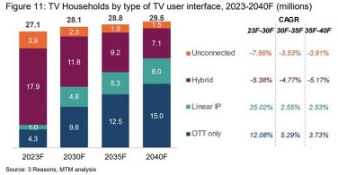
In addition, we expect broadband coverage and speeds to grow. Today, 98% of residential premises can access download speeds of 30 Mbps or more and 83% can access speeds of 1 Gbps or more.[footnote 8] However, from 2030, we expect 99% of premises will be able to access download speeds of 1 Gbps or more, due to a combination of private sector investment and the Government’s Project Gigabit scheme.[footnote 9]
Annex 5: Mobile/FWA
Lead: Mobile UK
Contributors: GSMA, DSIT Future Networks Team, Vendors, VMO2, BT
Overview and strategic relevance
Mobile networks currently carry about 2% of all data traffic consumed in the UK[footnote 10], and, as such, are very unlikely to have enough capacity to support the vast majority of TV viewers’ usage, except perhaps in edge cases (for example, in very rural areas where Project Gigabit won’t reach but mobile coverage is available). However, in these edge cases, it could provide a pivotal solution in enabling homes without fixed broadband to watch IPTV. In addition, in the event of an access network fault affecting a single or small number of premises, mobile networks could potentially provide a back-up Internet connection to enable all homes to continue to watch IPTV. It is also worth noting that 5G is likely to expand the overall streaming TV market, as the capability and capacity of 5G will make it a more user-friendly and practical experience for consumers on the move to watch both on demand and live-streamed content, such as major sporting events.
Innovation description
- 5G delivers more capacity for mobile connectivity than previous mobile technologies.
- 5G broadcast (multicast technology) can reduce the load on mobile networks during large live events, such as sports events.
Evidence of impact
- 5G has been extensively rolled out and Ofcom has confirmed that it can offer faster speeds than previous technology generations.[footnote 11]
- As 5G broadcast hasn’t been launched, and mobile phone handsets being sold today do not contain the necessary technology, there is limited evidence of its impact.
Scoring rationale
Mobile networks wouldn’t be able to support the vast majority of TV viewers’ usage, except perhaps in special edge cases (for example, in very rural areas where Project Gigabit won’t reach but mobile coverage is available).
Barriers and enablers
- Enabler: 5G SA will enable 5G slicing and more personalised, tailored TV viewing on mobile devices.
- Barrier: As highlighted in the overview section, capacity for mobile and FWA is limited. As such, mobile cannot be used for mass TV viewing.
Projected outcomes by 2034
Mobile networks will continue to have insufficient capacity to support large-scale TV viewing over FWA.
Annex 6: GSO satellite
Lead: Toby Higho (Sky)
Contributors: Sky, Freesat (ETV), BBC, SES, Eutelsat, Arqiva.
Overview and strategic relevance
- Geostationary orbit (GSO) satellites deliver digital satellite TV (DSAT) services (e.g., Sky and Freesat) in the UK. Broadcasters typically lease (transponder) capacity from GSO satellite operators (e.g., SES) or resellers (e.g., Arqiva).
- These DSAT services offer multichannel live TV via EPGs (including PSB channels). DSAT signal availability to UK premises is high.
- DSAT end users require satellite receiving dishes attached to their premises (as opposed to DTT aerials). Dishes are positioned to point to a fixed spot in the sky (as GSO satellites appear at a fixed location, keeping exact pace with the rotation of the Earth) and are set at the angle corresponding to the satellite from which they are receiving their signals (e.g., 28.2° East, 23.5° East, 19.2° East, 5°East, 1°West).
-
DSAT services deliver traditional, linear TV services. Conversely, satellite broadband can be delivered over GSO satellites as well as low earth orbit (LEO) satellites.
- GSO satellite delivery of TV services face similar challenges to DTT as TV distribution transitions to IP. Fixed broadband is by far the primary connectivity medium for IP-delivered TV in the UK currently but can also be delivered over fixed wireless access (FWA), mobile broadband (MBB) and via satellite broadband connectivity from ever expanding LEO satellite constellations (e.g., from SpaceX and Starlink).
- IPTV services such as Freely, Sky Glass and Sky Stream are taking up increasing shares of end user TV services at the expense of Freesat and Sky DSAT services. There are high fixed costs from launching and operating satellites and operating DSAT services. As volumes of DSAT end users decline, the economic viability of these platforms is likely to deteriorate as unit costs increase from a reduction in scale economies.
- The current fleet of GSO satellites at 28.2°East has a limited lifespan to 2029 and these satellites would need to be replaced towards 2030.
As DSAT services are similar to DTT services in that they carry multichannel TV including PSB channels, DCMS is exploring whether DSAT could be the basis for a ‘nightlight’ TV solution serving those end users who have not transitioned to IP from 2034.
- New industry standards like DVB-NIP (Digital Video Broadcasting-Native-IP) could allow IP-based TV content to be transmitted to households with a satellite reception dish. Such content can be consumed on any IP device in home, including Smart TVs, connected to the local WLAN.
- DSAT can be an efficient low energy means of content distribution where there are a large number of receivers densely deployed across a territory.
Innovation description
- DSAT is an alternative TV distribution method to DTT, cable and IP-delivered TV.
-
New GSO satellites will be needed to replace the current fleet at 28.2°East to continue DSAT services from 2029. If they are launched to the same GSO location as the current fleet, current end user receiving satellite dishes would not need to be repositioned.
- If DSAT were adopted as a nightlight option to provide TV services to end users remaining on DTT (not just on DSAT), then these end users would require satellite dishes and DSAT customer in-home equipment (e.g. set-top boxes) to be installed.
- With the adoption of the DVB-NIP standard on top of DVB-S/S2, satellite broadcasting could potentially provide IP-based content to households.
Evidence of impact
-
DSAT services are widely available in the UK.
-
As TV distribution moves to IP, numbers of DSAT households are expected to reduce.
Scoring rationale
- Consideration of whether DSAT is a viable ‘nightlight’ option beyond 2034.
Barriers and enablers
-
The current fleet of GSO satellites which expires in 2029 would need to be replaced.
- Assumption - no change: as TV distribution moves to IP, DSAT end user volumes fall and the economic viability of GSO satellites and DSAT services reduces.
-
Assumption - change of DSAT to NIP: a potential alternative for content distribution and monetisation, allowing consumption of IPTV content over DSAT connections.
-
A large proportion of end users who will not have adopted IPTV by 2034 would require satellite dishes and DSAT in-home customer equipment to be installed and connected if DSAT were to be used as the nightlight solution (with a further end user migration to IP technology a few years later).
-
Some UK households cannot have satellite dishes installed at their premises - for instance due to planning restrictions or landlord prohibitions.
- If a new fleet of GSO satellites launched to a different geostationary location, existing satellite receiving dishes would need to be repositioned by engineers at end users’ premises.
Projected outcomes by 2034
By 2034, we expect the overwhelming majority of households will watch IPTV with the volume of DSAT end users declining.
Annex 7: LEO satellite
Lead: BT, BBC R&D.
Contributors: OneWeb, Starlink, Amazon/Kuiper, GTC/Telesat, Satellite Applications Catapult - Mike Short (reviewed by DSIT)
Overview and strategic relevance
LEO satellite constellations are increasingly providing broadband type access to growing numbers of consumers. LEO satellite broadband will never meet the techno-economics of full fibre but it can be a useful augmentation for certain geographical areas.
Innovation description
LEO satellite services can offer direct consumer broadband Internet access or may in some cases, offer opportunities for direct integration with a communication provider’s network infrastructure. In the case of an integrated solution, it may be possible to operate TV services using an overlay multi-cast mechanism.
Evidence of impact
Starlink claims that its “users typically experience download speeds between 25 and 220 Mbps, with a majority of users experiencing speeds over 100 Mbps”.[footnote 12] Amazon’s Project Kuiper Protoflight mission reportedly included successfully conducting demonstrations of 4K video streaming and two-way video calls over its network.[footnote 13] Although the price of LEO satellite services is higher than that of fixed broadband[footnote 14], which might potentially exclude some groups, it is possible that prices will reduce in future as a result of competition.
Scoring rationale
LEO satellite could potentially enable people without a fixed broadband connection to watch IPTV in future; however, its applicability depends on the capacity and performance that LEO satellite will offer in future, which is highly uncertain.
Barriers and enablers
Geographical coverage and LEO constellation capacity are key considerations. In addition, the inherent variability in LEO conditions can lead to an increase in bitrate switches and rebuffers, although this could potentially be mitigated by video streaming and congestion control algorithms.[footnote 15]
Projected outcomes by 2034
In the coming years, geographical coverage and LEO constellation capacity are likely to improve, but it is too early to say what performance and coverage could be like by 2034.
Annex 8: In-home
Lead: BT, VMO2, Confederation of Aerial Industries (CAI)
Contributors: CAI, Sky, VMO2, BT, DTG.
Overview and strategic relevance
For TV viewers to migrate from DTT to IPTV, they will need Internet access in the parts of their homes where they locate client devices for watching TV, including existing TVs. In some cases, this Internet connection will be provided by Ethernet or power-line connectivity; however, for many viewers, Wi-Fi will be a more attractive option to avoid internal re-wiring, for portable devices and to serve new locations in the home. For Wi-Fi to provide a better in-home experience than DTT, Wi-Fi needs to offer a more consistent performance than DTT and Wi-Fi coverage needs to be in at least the parts of homes where viewers locate TVs.
Innovation description
There are at least three types of innovations relevant to Wi-Fi connectivity:
1. Wi-Fi coverage innovations: these include better Wi-Fi hubs, Wi-Fi extenders and mesh networks
2. Wi-Fi performance innovations - these include Wi-Fi 7 technology (including MLO and spectrum puncturing), more spectrum for Wi-Fi (including 5 GHz and lower 6 GHz) and other Wi-Fi hub enhancements
3. Underlying broadband connection innovations: these include mobile back-up connectivity for broadband routers
Evidence of impact
1. On Wi-Fi coverage innovations, many ISPs offer a complete Wi-Fi guarantee, guaranteeing Wi-Fi coverage in every room of the home or money back, enabled by mesh networks or Wi-Fi extenders. These commitments are widespread. See, for example, here, here, here and here.
2. On Wi-Fi performance innovations, Wi-Fi 7 technology gives a faster connection, to more devices at the same time, more consistently throughout the home[footnote 16] - and we expect that, by 2034, the majority of smart TVs will be Wi-Fi 7 enabled. Moreover, even without Wi-Fi 7, overall Wi-Fi technology has improved in recent years to become more reliable than DTT. For example, BT analysis from 2024 found that:
- Less than 1% of our customers’ Wi-Fi performance hits a threshold that could be considered a failure.
- Content watched over broadband has an error rate 2 times lower than content over DTT.
- 3% of BT’s broadband customers are impacted by content delivery errors, compared to 5% over DTT.
In addition, EE sees no significant difference in the propensity to fault between its wired and Wi-Fi connected TV set-top boxes. This demonstrates the reliability of live TV delivered at scale over Wi-Fi in a wide range of housing types.
3. On underlying broadband connection innovations, some ISPs offer ‘unbreakable broadband’ which includes mobile back-up connectivity for their broadband routers, ensuring customers have service even if their fixed broadband connection goes down. See, for example, here and here.
Scoring rationale
These technologies are critical for enabling all viewers to migrate from DTT to IPTV; DTT switch-off would not be possible without them. This makes them fundamental to the future of TV distribution.
Barriers and enablers
New build and refurbishment building regulations can make Wi-Fi distribution potentially challenging, particularly through external walls and windows. However, Wi-Fi innovations such as Wi-Fi extenders, mesh networks and Wi-Fi 7 can overcome these problems, though when desired structured cabling can provide an alternative solution.
Although the technology exists to offer a reliable Wi-Fi connection throughout viewers’ homes, some users may need support to adopt this technology. This is particularly the case for digitally excluded viewers who do not currently have a broadband connection, often because they lack the digital skills, confidence, motivation or in some cases finances to get online.[footnote 17] A targeted, publicly-funded program to support digitally excluded viewers to become online could enable them to use this technology and reap the benefits of being part of a digital society.
This would in turn generate wider economic benefits: Deloitte and the Digital Poverty Alliance estimate that interventions in digital poverty can unlock billions each year for individuals, government, and businesses. Their research estimates that improved digital skills could be worth a collective £17 billion in additional earnings for individuals (though this could be partially offset by lower benefit income and depends on employer demand), while reducing social exclusion could create £2 billion in additional welfare benefits to individuals.[footnote 18]
Projected outcomes by 2034
By 2034, we expect the overwhelming majority of homes will have a consistent Wi-Fi connection throughout the home using technologies such as those described in this section. Furthermore, with a targeted, publicly-funded program to support digitally excluded viewers to become online, we believe that this could rise to 100%.
Annex 9a: BT TV products
Overview and strategic relevance
The overwhelming majority of TV viewers are expected to naturally migrate to watching TV online over the coming decade. Assumption 2 from DCMS’ and DSIT’s “Key Policy Assumptions” paper includes a prediction that “by 2035, 26.9m households will have IPTV (whether linear or on-demand), with 1.9m households being unconnected; and that by 2040 there will be 28m households with IPTV, with 1.5m unconnected.”
BT has offered live IPTV since 2011 on its network in the UK, and was the first operator in Europe to introduce live UHD services with BT Sport in 2016. It is also the only UK operator to offer recording of multicast IPTV channels. There are a number of innovative services and technologies of relevance to the options being considered by DCMS for the future of TV distribution such as:
- Silent sign-on and provisioning of linear and on-demand service;
- Multicast Assisted Unicast Delivery (helping scalability);
- An IBC Accelerator project on low latency delivery; and
- Dynamic Ad Insertion (DAI).
Each of these innovations is covered in turn below.
Innovation description
- BT’s EE TV service offers silent sign-on and provisioning of linear and on-demand services. Research has shown that initial set-up of services through user name and passwords, use of apps and QR codes is a significant barrier to some viewer demographics. When a customer first connects their EE TV STB, a look-up is done on the broadband line used, and the rights for the STB identified and automatically provisioned. This means IPTV channels, including the PSBs, and key VOD players like Netflix “just work” without further end user intervention. The DTG has written a paper on “The Future of Sign-In Services” which examines other ways of easing this set-up problem space.
- Live TV viewing is characterised by periodic highly watched events, particularly popular sporting events. Broadcast technology supports distribution of this with ease, but IP delivery over unicast drives network demand spikes far above typical usage. This either drives significant cost in provisioning networks for peak, or risks a reduced quality of viewing experience. BT’s research function developed MAUD (Multicast Assisted Unicast Delivery) which addresses this by delivering the most popular live content over a single multicast stream per channel. This is done seamlessly to the content provider’s egress to CDN and the player application. This is currently in technical trial, and has shown to deliver >60% bandwidth saving compared to unicast delivery.
-
Live TV viewing over broadcast also has a low end-to-end latency of a few seconds, whereas unicast IP delivery has delays of tens of seconds or more. This is important to viewers for some content classes such as live sports and for companion app use such as social media commentary or online betting. BT is a member of the IBC Accelerator Scaleable Ultra-Low Latency Streaming project, which aims to deliver such content at scale with a latency comparable to conventional broadcast using innovation throughout the broadcast chain.
- Advertising revenues are very important to some broadcast providers, but they typically attract lower CPM (“Cost Per Mille”) than internet placed ads, since broadcast services have historically only been addressable on a regional basis (everyone in the same region sees the same ad). DAI (Dynamic Ad Insertion) permits substitution of ads in each avail, with targeting determinable on anything from an individual user upwards yielding an improved CPM. Typically the targeting is postcode based at the moment, but more specific targeting would be possible, with appropriate privacy safeguards and end user agreement.
Evidence of impact
BT’s EE TV service offers silent sign-on and provisioning of linear and on-demand service. This means IPTV channels, including the PSBs, and key VOD players like Netflix can “just work” without further end user intervention.
BT conducted a MAUD trial using BBC Two content on EE’s set-top box TV platform in the live network - taking the technology from proof of concept to the real-world. The trial showed that during peak times on the network, MAUD converted over 60 percent of traffic from unicast delivery to multicast delivery. In other words, the trial showed MAUD’s ability to flatten peaks of network traffic.
As the other innovations listed above haven’t been launched or trialled, there is limited evidence of their impact.
Scoring rationale
Research has shown that initial set-up of services through user name and passwords, use of apps and QR codes is a significant barrier to some viewer demographics. This can be mitigated by BT’s EE TV service which offers silent sign-on and provisioning of linear and on-demand service.
Multicast technologies such as MAUD reduce required network capex, creating cost savings which could be passed on to customers and/or can offer greater reliability for the same level of network capex. More information on the benefits of MAUD is available here: BT Group announces live TV technology breakthrough to meet growing customer demand.
Low latency is important to viewers for some content classes such as live sports and for companion app use such as social media commentary or online betting.
DAI enables individual personalisation of advertising, which is of key interest to content providers as part of the migration to IPTV, whilst at the same time avoiding the levels of ISP network capex which would otherwise be required to deliver personalised advertising. This, in turn, creates cost savings which could be passed on to customers and/or can offer greater reliability for the same level of network capex.
Barriers and enablers
Barriers
- Some content providers are reluctant to support MAUD and DAI, even alongside unicast, because they perceive it as added complexity with limited upside. However, this overlooks the greater reliability that MAUD offers.
- More generally, content providers and CDNs (excluding content providers such as Sky) are generally not incentivised to account for the impact of high traffic volumes for their content on other users of the Internet, as the prices they pay for distributing their content do not take this externality into account. This further reduces the take-up of innovations such as MAUD and DAI.
Enablers
- Partnering with CAPs and CDNs to use efficient technologies and maximize efficient distribution could help manage the impact of increased TV traffic being delivered over UK networks.
Projected outcomes by 2034
As the innovations listed above are generally at an early stage of development or adoption, it is too early to say what their likely use will be by 2034.
Annex 9b: Freely
Author: Everyone TV
Freely, from Everyone TV
Overview & strategic relevance
A joint venture between BBC, ITV, Channel 4 and 5, Everyone TV (previously Digital UK) owns and operates the largest free-to-air TV platforms in the UK, including Freesat, Freeview and the recently launched IPTV platform Freely.
Freely, launched in April 2024, is a free IPTV service built into new smart TVs offering seamless access to live and on demand content, for free, without the need for a DTT or satellite connection. Freely provides access to public service broadcaster (PSB) content and other free-to-air (FTA) content providers, with no costs reducing the barriers to IP delivered television and securing free TV for the streaming age.
Innovation description
Freely ensures that PSB and FTA content remains easily accessible for all as more audiences choose to connect via IP, providing a free platform where UK audiences can stream live TV channels alongside on demand content via their smart TVs. Prior to Freely, IP-only homes could not easily access live PSB content via their smart TVs for free.
The user interface includes new features which bring the free TV experience into the streaming age. For the first time for free, viewers will be able to switch seamlessly between live and on demand TV from the leading UK broadcasters, taking advantage of features such as pause, restart and access to more episodes, without having to pay for the service. Freely TVs can also be placed anywhere in the home where there is a Wi-Fi connection.
Key Freely features revealed today include
- MiniGuide - A new feature for the free TV experience, this pop-up interface appears each time users switch channels, creating a seamless browsing experience and enabling viewers to easily discover related live or on demand content. Audiences can also take advantage of features such as restart, pause and access to more episodes from live TV.
- Browse - Viewers will be able to press the Freely button on their remote to explore recommended live and on demand programming from Britain’s leading broadcasters and free-to-air channels, all in one place.
- TV Guide - Bringing simplicity and familiarity, this 7-day guide provides relevant information and is easily recognisable thanks to its consistency across all Freely TVs and one-touch access via the ‘Guide’ button on the remote. Audiences can also discover more episodes and on demand content linked to the live TV shows they are enjoying, all via the TV Guide.
Freely ensures all audiences continue to have easy access to an aggregated free TV experience, however they choose to connect.
To maximise compatibility with globally manufactured TV receivers Freely was developed using the open-standards, HbbTV Core and Operator Application specifications. Using this technology has also ensured open access to critical functionality which will benefit other HbbTV applications hoping to provide access to IP streaming services in other markets.
It is worth noting, Freely TVs can be connected via IP-only, or a hybrid IP/DTT connection allowing the viewer to ‘top-up’ their IP-only channels with Freeview’s DTT line-up. Freely required a broadband speed of 10 Mbps.
Evidence of impact
In its first year, Freely has
- Increased its reach
- Since launch, Freely has announced deals with multiple TV manufacturers and TV OS providers to bring the service to their smart TVs.
- Increased its content offering
- Launching with content from BBC, ITV, Channel 4 and 5, Freely has since added content from UKTV, AMC, PBS and other FTA broadcasters. This demonstrates that content providers are keen to showcase content on Freely.
- Freely offers more on demand content than any streaming service in the UK and is home to 97% of the nation’s favourite shows (BARB Sept 2024 - Jan 2025).
- Freely has also announced 16 new streamed channels from ITV, Channel 4 and 5, not available on any other TV Guide outside of Freely. These include new channel brands such as 4Life, 4Reality and 4Homes. IP gives broadcasters and audiences more options and a wider range of choice as we continue to work to not only emulate but enhance the Freeview line-up.
- Continually added new updates and features.
- Thanks to the technology on which Freely is built (an owned operator application), Everyone TV has been able to add new features to Freely which audiences are requesting, for example My List feature allows viewers to save up to 50 of their favourite programmes across all the free-to-air broadcasters for the first time on a free TV platform.
- IPTV also allows for enhanced accessibility features which are currently being developed to complement channel 555 which is already available on Freely.
Scoring rationale
These innovations are important for enabling the transition from DTT and DSAT to IPTV, as we see increasing numbers of audiences transition to become IP-only households.
The efforts of Freely are crucial to ensure accessibility and prominence of PSB and FTA content remain easily accessible and front-and-centre of the TV experience in the streaming age.
Freely ensures live TV remains at the centre of the viewing experience and is familiar to viewers, with a streaming experience that looks and feels the way TV always has.
Barriers and enablers
Adoption and availability - ensuring smart TV partners adopt the service. We have partnered with half the UK TV market in our first year.
Widespread availability of broadband services - A nationwide reliable internet service is needed to support Freely’s minimum required speed at 10 Mbps. Ensuring no audiences are left behind, for those without a reliable internet connection we continue to support Freeview and Freesat services.
Projected outcomes by 2034
By 2034, we expect around three quarters of UK households to be IP-only (3 reasons) and as such as would expect the majority of free-to-air viewers to be watching via a Freely TV or device, transitioning from Freeview and Freesat.
Annex 9b: Sky IPTV products
Lead: Toby Higho (Sky)
Overview and strategic relevance
Launched in 2021 and 2022 respectively, Sky Glass and Sky Stream are Sky’s Internet Protocol TV (IPTV) products delivering a comprehensive range of multichannel live TV, Catch up, apps and Video On Demand services, including PSB and global streamer content, to end users exclusively over their broadband connections. These services are not connected to DTT or DSAT.
- Sky Glass is a Sky branded TV set with Sky’s OS and Electronic Programme Guide (EPG) embedded.
- Sky Stream is a ‘puck’ that can be plugged into any TV set via an HDMI cable to give viewers access to the same Sky OS, EPG and other functionality as available on Sky Glass.
These products are at the forefront of driving the transition to full IPTV delivery and, as such, also contribute to:
- Digital inclusion: by supporting greater levels in broadband adoption by UK households.
- Enhanced accessibility and personalisation: with hands-free voice control, audio description, subtitles and simplified, aggregated curation of content.
- Efficient spectrum use: supporting the eventual switch off of DTT and the subsequent reallocation of spectrum for more productive uses.
Innovation description
- Sky Glass and Sky Stream offer significantly better accessibility, discoverability and personalisation of content than traditional TV services because all content, irrespective of provider, is aggregated, curated and presented in a simple user interface.
- Both Glass and Stream feature a full live TV EPG akin to EPGs available on traditional TV. The Sky EPG is modelled on the linear TV guide available on Sky+/Q (Sky’s DSAT / Hybrid DSAT-IPTV services), including the first five EPG slots given over to the five main PSB channels.
- Viewers can ‘watch from start’, pause, rewind and, with the ‘continue watching’ functionality, pick up viewing content from where they left off.
- Available apps include BBC iPlayer; ITVX, Channel 4, 5, STV, Netflix, Prime Video, Disney+, Paramount+, Apple TV+, discovery+, Hayu, Crunchyroll, U and Xumo Play as well as music and radio provider, sports and fitness apps.
- Viewers can save their favourite shows to a Playlist, bringing together any programmes added from the TV guide, on demand and apps in one place. Once a show is added to the Playlist, every episode, past, present, and future will appear there.
- Accessibility features include hands-free voice control, voice control via the remote, audio description, subtitles and voice guidance.
- While Glass and Stream can operate at slower speeds, Sky recommends a minimum broadband download speed to support Glass / Stream of 25Mbps for HD, and 30Mbps for 4k. This is well within reach of the vast majority of UK households as superfast broadband (30Mbps to 300Mbps) is available to 98% of UK households and the average download speed in the UK of 223Mbps.[footnote 19]
- Sky Glass and Sky Stream customers can take their broadband service from any provider, i.e., they are not hard bundled with Sky Broadband.
Evidence of impact
Sky Glass and Sky Stream are now Sky’s main TV products for new customers joining Sky.
- 90% of new Sky TV customers take Sky’s IPTV streaming products.
- Sky Glass Medium (55”) was the best-selling TV in the UK in 2023.
Scoring rationale
These innovations are important for enabling the transition from DTT and DSAT to IPTV and to support DTT switch-off.
Barriers and enablers
- Widespread availability and adoption of broadband services meeting Sky’s recommended minimum download speed requirements.
- Utilisation of WiFi, powerline or ethernet connections to Sky Glass sets or Sky Stream devices.
- User ease of use through a simple, familiar user interface, including live TV EPG and PSB content.
- A well-functioning IPTV ecosystem between content providers (including PSBs), Content Distribution Network operators and broadband providers.
Projected outcomes by 2034
By 2034, we expect the overwhelming majority of households will watch IPTV services such as Sky Glass and Sky Stream. Sky Glass and Sky Stream (and any successor IPTV products) will constitute a large proportion of Sky’s TV customer base.
Annex 9c: Synamedia Senza IPTV streaming product
Lead: Margaret Davies & Nick Thexton (Synamedia)
Overview and strategic relevance
Synamedia Senza, launched in 2024 following a three-year research and development cycle, is a new IPTV delivery platform that aims to support a broad transition to internet-based TV distribution. Designed to deliver live television, catch-up services, video-on-demand, and on-screen web applications, Senza is compatible with any television display.
The platform is intended to support public service and commercial broadcasters alike in adapting to new viewing behaviours while addressing several practical and strategic challenges in the broadcast and streaming sectors. These include the cost and complexity of viewer adoption, the commercial terms imposed by consumer electronics platforms, fragmentation of device support, and the environmental impacts of frequent hardware upgrades.
Senza’s approach shifts the rendering of the user interface from the consumer device to the cloud. This change reduces the technical demands placed on in-home equipment and allows for a more rapid pace of service innovation. It is particularly relevant in the context of future digital terrestrial television (DTT) switch-off and reallocation of spectrum, as well as broader efforts to extend access to television content in underserved areas.
Senza seeks to address:
-
Viewer acquisition and adoption cost - It is expensive for consumers and distributors to transition viewers to new consumption models as they often require expensive replacement consumer equipment.
-
Consumer Electronics platform business models - Today’s popular streaming aggregation platforms (e.g. Smart TVs) control the availability and prominence of content services and charge fees in the form of advertising/subscription revenue splits.
-
TV application development - Developing for today’s streaming aggregation platforms requires specialist development resources.
-
User experiences and innovation are constrained by device hardware - Every on-screen experience in UK homes today is limited by the hardware capabilities of the in-home device. Adoption of future technologies, such as AI, are severely hampered by the current model that relies on the in-home hardware for processing and graphics display.
-
E-waste - Adoption of new consumption models (e.g. transition from broadcast to streaming) often involves the disposal of devices and TVs that are sometime as young as 5 years old and still perfectly functional.
-
DTT ‘left behind’ and DTT spectrum use - The so-called ‘DTT left behind’ cohort need access to broadcast content and the eventual switch off of DTT, and subsequent reallocation of spectrum, requires innovative, low cost, accessible technologies.
-
Device proliferation and fragmentation - Content Owners often have to support 10+ different device platforms to achieve sufficient viewer reach with their streaming service.
Senza’s approach enables businesses to overcome the limitations of the in-home device and their inevitable obsolescence. By leveraging cloud computing and web technologies, Senza enables rapid innovation and deployment, enabling Content Distributors to innovate quickly and adapt to consumer expectations. The on-screen experience can be updated instantly like a website. This approach helps the industry transition towards a pure IPTV future by enabling services to cost-effectively reach new audiences at scale with new business models that foster growth.
Innovation description
At the core of Senza’s design is a clear separation between content rendering and content playback. Traditional TV platforms rely on consumer hardware to render the user interface and manage applications. In contrast, Senza uses a cloud-first architecture where the user interface is rendered in a data centre and streamed to a minimal hardware endpoint–resembling the model used in cloud gaming.
The system comprises two main components:
-
The Senza Cloud Connector, https://www.synamedia.com/senza-cloud-connector - a small, low-cost, hardware device connected to the TV via HDMI and powered through a standard USB port, receives a video stream of the user interface from the Senza platform and accesses the broadcaster’s content via a standard CDN. The device is designed for discreet placement and minimal energy use. Synamedia plans to license its manufacture and distribution, rather than manage these activities directly.
-
The Senza Platform, a cloud-based service, hosts the interface rendering infrastructure, authenticates users, manages access controls, and ensures content security through standard DRM mechanisms. WebRTC is used to stream the interface to the end user in real time. The cloud platform can also integrate other consumer devices, so the experience on TV can integrate multiple phone applications and video streams.
Applications for the platform can be developed using HTML5 and related web technologies, making them accessible to a broad developer base. The Cloud Connector uses embedded keys stored in the cloud for secure service access, which can be revoked remotely to protect against unauthorised use.
Senza has been through controlled consumer trials over its development period, with one customer already live and two more preparing for commercial deployment.
Evidence of impact
- beIN Media Group - a Qatari-based broadcaster - are using Senza to distribute their beIN STREAM service to multiple countries. beIN STREAM is a low-cost streaming proposition whose price point is only possible because of the low-cost economic model of Senza. Senza increases beIN’s reach to every home with an internet connection.
-
Tribal Ready and SuperCloud International are US-based Internet Service Providers. Both are readying their Senza-enabled TV services for launch in 2025. Senza will enable both companies to deliver TV services to viewers on or off their broadband network.
-
The Cloud Connector device is built with a Bill Of Materials (BOM) cost of $6 USD, increasing the availability and accessibility of IPTV services and opening up new business models for Content Distributors.
-
Synamedia research has demonstrated how the on-boarding cost for launching an app on Senza can be reduced by up to 90% compared to legacy devices.
- Ben Keen, a highly respected UK-based industry analyst, provided the following commentary when Senza launched: “For many years a debate has raged about whether the set-top box has a future. Now Synamedia has redrawn the terms of that debate by radically rethinking the role of the in-home device using a cloud-first design that promises to fundamentally change the economics of TV delivery.”
Scoring rationale
Specific critical problem solution
Senza scores highly in this area because it directly addresses several major pain points for the TV industry (see Section a): high costs and technical complexity of supporting diverse array of devices, the limitations of in-home device hardware, and the ability to cost-effectively reach viewers. By moving the user experience to the cloud and using a low-cost connector, Senza offers a fundamentally different economic model to Content Distributors and simplifies many operational aspects of service operation.
Impact by 2034
Senza can cost-efficiently deliver video to all homes with an internet connection. The 10+ year life span of the Cloud Connector will see Senza’s value and impact extend far beyond today’s consumer devices. In addition, the user experience delivered by Senza will improve up to and beyond 2034 as cloud technology and capabilities advance, providing a true platform for innovation. Senza has the ability to extend the life of millions of disconnected or never connected TVs, saving them from landfill and reducing e-waste. The low power requirements will also contribute to reduced energy demand, contributing to the UK’s energy and carbon reduction targets.
New/Enhanced service impact
Senza is the only content distribution platform that enables the user experience to improve over time and embrace future technologies. All future Web technologies - such as connected home (IoT) devices and AI technologies - can be integrated into the TV experience because there is no dependency on the in-home device.
Barriers and enablers
Senza requires a broadband internet connection (above 10Mbps) over Wi-Fi, an HDMI-enabled display, and a 0.5W USB power source (typically provided by the TV’s USB port). The remote control uses Bluetooth. Content providers develop applications using standard HTML5 Web technologies (the same used by everyday websites). Content is delivered to the device using standard HTTP streaming protocols (e.g. MPEG-DASH) and existing CDNs. The user interface is delivered using the Low Latency WebRTC streaming protocol.
The Cloud Connector requires partnerships with OEMs for manufacturing and distribution. Both the device and packaging are CE-certified for distribution in the UK.
Projected outcomes by 2034
By 2034, Senza’s success will have helped establish a vibrant, competitive distribution ecosystem benefiting viewers with faster, richer, and more accessible TV experiences. Public Service Broadcasters and Pay TV providers will reach more households at reduced cost and greater agility, delivering trusted, personalised content without hardware constraints. Cloud virtualisation will be standard, reshaping the economics of the TV industry and driving continuous innovation in how content is discovered and enjoyed.
Widespread adoption of virtualised user experiences will reduce the reliance on traditional hardware, driving down operation and acquisition costs and extending reach into underserved markets, democratising access to video content. For Content distributors, onboarding and maintenance will be faster and cheaper. Consumers will benefit from lower energy use, longer shelf life of their TVs, smoother experiences, and continuous improvements in the user experience.
Senza will also help accelerate the UK’s transition to an all-IPTV future and support the phase out of DTT and release of DTT spectrum.
Annex 9d: Virgin Media O2 IPTV products
Andrew Wileman (VMO2)
Overview and strategic relevance
-
IP by default: Virgin Media O2 has transitioned its front book TV propositions fully to IP. Accordingly, new customers are offered exclusively IP-based TV packages. Via these packages, customers can access all of the same content that can be accessed via the Virgin TV 360 box (the older broadcast/IP hybrid Personal Video Recorder, or PVR) - and more - solely via IP.
-
Stream: The transition to IP is enabled by Virgin Media O2’s Stream box, an IP-only ‘puck’ device that connects to the internet over WiFi or ethernet cable and can be used, via an HDMI connection, to effectively turn any TV into a smart TV. The stream box aggregates a range of SVOD and BVOD services, IP linear channels, catch-up and on demand content and numerous apps. It also offers multiple personal user profiles, voice search and control, and remote operation/management via an app.
-
Propositions: The Stream service requires a Virgin Media O2 broadband subscription and is available either in ‘Flex’ guise (offering a 30 day rolling contract), or via a number of bundled package options, which offer a choice of various entertainment channels, third party subscription services and premium content, such as sport and movies.
-
Multiroom via Stream: Virgin Media O2 has also changed the way in which ‘multiroom’ services are offered to existing customers (most of whom use a Virgin TV 360 PVR box). These customers are now offered ‘multiroom’ services via one or more of Virgin Media O2’s Stream boxes (up to five in any one premises). This allows customers to connect additional Stream boxes (and thus TVs) over WiFi, removing the need for additional cabling throughout the premises. The Stream boxes also support synchronisation, so that customers can, for example, start watching a content asset in one room and pick up where they left off at a later time in another room.
-
Rationale: The transition to IP is a key enabler of the retirement of (DVB-C) broadcast TV delivery, which will allow the re-purposing of spectrum within the network. It also reduces the overall cost of network expansion and customer acquisition.
Innovation description
-
My Watchlists: Reflecting the evolution in customer viewing and content consumption habits, the Virgin Media O2 Stream box does not contain a hard disc drive (for recording). Instead, it includes a ‘My Watchlist’ feature, which allows users easily and simply to add linear, on demand, and app content to their own, personalised list of content to watch at their time of choosing. The ability to pause and rewind live TV has been maintained.
-
Apps: The Stream box integrates seamlessly the major content apps necessary to offer a compelling premium content experience in the UK today, including BVOD/PSB apps alongside Netflix, Amazon Prime Video, Disney+, Apple TV+, Paramount+, U and many more.
-
Voice: The Stream box offers voice search and control.
-
Accessibility: The Stream box offers audio description, subtitles, text-to-speech, high contrast mode, and a dedicated accessible content discovery area within the EPG.
-
FAST Channels: The stream service includes a range of Free Ad-Supported TV channels that are easily accessible from the EPG, and can be used to offer a variety of thematic, special interest and content branded channels and packages.
-
WiFi Guarantee: While not strictly a TV product innovation, Virgin Media O2 considers its WiFi guarantee to be a necessary quality commitment, to provide and support the quality of viewing experience expected by customers. Eligible customers are given a minimum 30Mbps speed guarantee in every room of their premises, and are provided with up to three WiFi pods to facilitate this.
Evidence of impact
- Virgin Media O2’s Stream box is now the exclusive TV proposition for front book customers. It is expected to become the principal TV delivery mechanism in the next few years, with legacy DVB-C/hybrid IP boxes gradually becoming the minority.
Scoring rationale
- These innovations are important for enabling the transition from traditional (DVB-C) broadcast to IP based delivery.
Barriers and enablers
Projected outcomes by 2034
Annex 10: BT broadband products
Contributors: BT
Overview and strategic relevance
Assuming 30+ Mbps services are required for viewing live TV, BT broadband services can deliver this now, and into the future. We also have products to improve the reliability of broadband and Wi-Fi, including our hybrid back-up and Complete Wi-Fi Guarantee.
Innovation description
BT supports at least three types of innovations relevant to broadband and Wi-Fi:
1. Wi-Fi coverage innovations: these include market-leading Wi-Fi hubs, Wi-Fi extenders and mesh networks.
2. Wi-Fi performance innovations - these include Wi-Fi 7 technology (including MLO and spectrum puncturing), more spectrum for Wi-Fi (including 5 GHz and lower 6 GHz) and other Wi-Fi hub enhancements.
3. Underlying broadband connection innovations: these include broadband resilience features (such as a back-up connection for every part of BT’s core network) and mobile back-up connectivity for broadband customers taking out BT’s Halo products.
Evidence of impact
1. On Wi-Fi coverage, BT offers a complete Wi-Fi guarantee, guaranteeing Wi-Fi coverage in every room of the home or money back. This commitment is enabled by mesh networks.
2. On Wi-Fi performance innovations, Wi-Fi 7 technology gives a faster connection, to more devices at the same time, more consistently throughout the home[footnote 20] - and we expect that, by 2034, the majority of smart TVs will be Wi-Fi 7 enabled. Moreover, even without Wi-Fi 7, overall Wi-Fi technology has improved in recent years to become more reliable than DTT. For example, BT analysis from 2024 found that:
- Less than 1% of our customers’ Wi-Fi performance hits a threshold a that could be considered a failure.
- Content watched over broadband has an error rate 2 times lower than content over DTT.
- 3% of BT’s broadband customers are impacted by content delivery errors, compared to 5% over DTT.
3. On underlying broadband connection innovations, BT’s core network delivers better than 99.99% availability to exchange level, which is better than 53 minutes of outage per year. This is achieved through a combination of (i) multiple interconnected locations, (ii) duplicated equipment, (iii) vendor diversity and (iv) diverse and physically separate connection routes. And BT also offers ‘unbreakable broadband’ which includes mobile back-up connectivity for BT’s Halo products, ensuring customers have service even if their fixed broadband connection goes down.
Scoring rationale
These technologies are critical for enabling all viewers to migrate from DTT to IPTV; DTT switch-off would not be possible without them. This makes them fundamental to the future of TV distribution.
Barriers and enablers
Although the technology exists to offer a reliable IPTV service to viewers, some users may need support to adopt this technology. This is particularly the case for digitally excluded viewers who do not currently have a broadband connection, often because they lack the digital skills, confidence, motivation or in some cases finances to get online.[footnote 21] A targeted, publicly-funded program to support digitally excluded viewers to become online could enable them to use this technology and reap the benefits of being part of a digital society.
This would in turn generate wider economic benefits: Deloitte and the Digital Poverty Alliance estimate that interventions in digital poverty can unlock billions each year for individuals, government, and businesses. Their research estimates that improved digital skills could be worth a collective £17 billion in additional earnings for individuals (though this could be partially offset by lower benefit income and depends on employer demand), while reducing social exclusion could create £2 billion in additional welfare benefits to individuals.[footnote 22]
Projected outcomes by 2034
By 2034, we expect the overwhelming majority of homes will have broadband and Wi-Fi throughout the home using innovations such as those described in this section. Furthermore, with a targeted, publicly-funded program to support digitally excluded viewers to become online, we believe that this could rise to 100%.
Annex 11a: Data
Lead: DTG
Overview and strategic relevance
Data underpins every dimension of modern digital television - from delivery and discovery to personalisation and monetisation. As the UK transitions toward an increasingly IP-centric TV infrastructure, the strategic value of data - spanning personal identifiers, content metadata, business intelligence, and real-time diagnostics - has never been more critical. Data enables content to be found, trusted, understood, and tailored. It powers personalisation engines, informs programme guides, protects rights and revenue, and supports regulatory obligations.
Just as vital is data security. In an era of growing cyber threats, secure handling of data - particularly personal and behavioural data - is essential for maintaining viewer trust, safeguarding users (especially children and vulnerable audiences), and upholding the integrity of public and commercial media services. Without robust data governance and protection measures, the television experience risks being compromised - both technically and reputationally.
A coordinated approach to data standards, interoperability, and cyber resilience is therefore essential for ensuring a vibrant, trusted, and inclusive media ecosystem.
Innovation description
This innovation concerns the structured and interoperable use of diverse data types across the television value chain:
- Personal Data: Preferences, viewing behaviour, accessibility needs, and consent frameworks for personalisation and inclusion.
- Business Intelligence Data: Usage analytics, audience measurement, advertising engagement metrics, and diagnostics.
- Content Metadata: Descriptive data (genre, title, actors), contextual metadata (themes, sensitivity, parental ratings), and structural metadata (timing, chapters, technical specs).
-
Network and Device Data: Quality of service, energy consumption, usage patterns, and device capabilities.
Recent advancements in metadata standardisation (e.g., EIDR, Media ID, DVB-I), secure data exchange frameworks (e.g., privacy-preserving analytics, zero-party data models), and real-time AI-driven tagging and recognition (e.g., from edge or cloud inference engines) allow data to be more usable, portable, and dynamic.
### Evidence of impact - Audience Experience: Personalised UIs and content recommendations have become central to mainstream TV platforms. For example, accessibility metadata enables dynamic adaptation for users with visual or hearing impairments.
- Business Value: Data-driven addressable advertising and programmatic trading have boosted broadcaster revenues, particularly in hybrid or FAST environments.
- Operational Efficiency: Automated content recognition and enriched metadata streamline rights tracking, content discovery, and compliance (e.g. Ofcom and PEGI guidelines).
-
Regulatory Compliance: Data frameworks allow broadcasters and platforms to meet obligations on prominence, discoverability, age ratings, and harmful content warnings.
### Scoring rationale - Problem-Solution Relevance (40%): High. Solves multiple systemic challenges in discoverability, inclusion, monetisation, and compliance.
- Transformative Impact by 2034 (25%): High. A coherent data framework will underpin almost all innovations in user experience and business models over the next decade.
- New/Enhanced Service Potential (15%): Medium-High. Unlocks value-added features such as cross-platform continuity, universal search, and adaptive interfaces.
Barriers and enablers
Barriers
- Lack of standardisation or competing metadata schemas.
- Privacy concerns and regulatory fragmentation (GDPR, ePrivacy, etc.).
- Platform silos inhibiting data portability and third-party innovation.
Enablers: - Growing industry consensus on metadata standards (e.g. DVB-I, EIDR, W3C).
- Advances in AI and cloud/edge data processing.
- UK leadership in public service media creating a testbed for ethical and inclusive data practices.
### Projected outcomes by 2034
By 2034, interoperable data frameworks will allow seamless content discovery across devices, consistent accessibility features, and dynamic, secure personalisation. Viewers will be able to navigate vast content libraries with ease - regardless of service provider - –while retaining control over their preferences and privacy. For industry stakeholders, data will enable hyper-targeted services, efficient distribution, and real-time compliance. The UK will remain at the forefront of audience-focused innovation, combining ethical use of data with trusted public and commercial content delivery.
Appendix 11b: Video metadata
Lead: Xperi
Overview and strategic relevance
Video Metadata is information that is provided with a video asset (herein used to refer to a TV show, a movie, a programme, a sports match, an event, etc.). Examples include title, unique identifier(s), description, actors/actresses, directors, release year, sequencing (season numbering, episode numbering) and so on. The video metadata (or simply ‘metadata’) are used in a variety of ways by companies involved in the video market (including OTT apps), as well as viewers who naturally read the data in order to make informed content watching decisions via what they may see on a screen.
Though video metadata’s most common use is for visualization on a screen, the data is also used by algorithms for content discovery purposes. For example, a video asset’s metadata can be used to input into an algorithm, for that algorithm to find similar content based on the similarity to other pieces of video content. Video metadata are also used in text and voice-based search, whereby viewers search for video content with a specific title, or a specific actress, etc. Metadata is also used for the purposes of supporting both traditional, and CTV (Connected TV advertising). Metadata is used by ad buyers to associate their brands, and to reach audiences that they believe are interested in their products.
Video metadata is broadly categorized into factual metadata (the title, the description, release year, etc.), imagery (poster artwork, series level images, episodic level images), and advanced metadata (moods, tones, themes, time periods, time-based metadata and algorithmically-based trends). In many cases, video metadata fields number in the several dozens and can exceed hundreds of fields for any given video asset. The more video metadata there exists for a given video asset, the more discoverable that asset can be for viewers hoping to find it amongst the sea of content available to them on a given video platform.
Video metadata is absolutely critical to every video discovery experience. Without it, video platforms would not be able to provide an easy to use, interactive, personalised, and simple discovery experience. And without video metadata, ad buyers would not be able to reach appropriate audiences.
Note: it should be acknowledged that video metadata have a number of additional uses, though not all considered here for brevity. These can include video content licensing decisions, royalty payments, and other business uses.
Innovation description
The challenges facing companies that create, aggregate, employ, deliver, and visualize video metadata in today’s current environment of OTT apps, are numerous. The following table identifies just some of those challenges, and provides ways in which the industry is looking to innovate.
| # | Challenge | Additional Detail(s) |
|---|---|---|
| 1 | Standardization: How the data is constructed, what fields are included, are there any standardized IDs being mapped to the content. | Various OTT apps have defined their own standard, and use metadata for their own B2C (Business to Customer) apps. This results in a wild west of unique identifiers, formats, fields supported. Aggregation, is required for platforms that aim to present content across multiple OTT apps. |
| 2 | Rights: Who has the right to share the data? Is the data available in a certain region or does the platform know the user’s entitlements to show the content? | Content producers and providers are sensitive about who has access to their metadata and how it is displayed in relation to other providers and content. |
| 3 | Technology: Are there different applications for different platforms? Does the application/service support deep linking? Does the application require specific parameters to identify the platform? Is there DRM or security key required? Geo location checks? Does the platform’s remote control support all functions in the applications. | |
| 4 | Platform leverage: certain platforms have the leverage to demand the metadata feeds be in their format, with their desired structure and content. | This creates scalability issues for OTT’s to deliver these essentially custom feeds. |
| 5 | Unique timing for the industry: we are in a unique time right now in terms of the shift of linear content being historically on broadcast channels, now shifting to be on streaming technology: ie: FAST (Free Ad-Supported Streaming Television) channels, live sports on streaming services, etc. | This is forcing OTT’s, some who may never have considered the concept of ‘scheduling metadata’ now deal with that added dimension. This is ultimately resulting in OTTs struggling to come up with a uniform way to provide these data. |
| 6 | OTT’s seeking to exert UI control over platforms: it’s not just the metadata feeds that are needing some structure; some PSB’s (Netflix was the first; others are following) are now producing APIs to deliver carousels directly onto the platform’s UIs. And those APIs come with varying degrees of complexity and control. |
Annex 12: Standards-based innovations in video, audio and interactive TV distribution
Lead: Various
Sources: BBC R&D, Broadpeak, Fraunhofer IIS, V-Nova, DASH Industry Forum, W3C Solid CG, SVTA, HbbTV Association
Overview and strategic relevance
Recent advances in global standardisation efforts and open technology frameworks are reshaping how video, audio, and interactive services are delivered and experienced across IP networks. These developments support greater interoperability, improved compression efficiency, provenance of content, enhanced user control of data, and more dynamic, responsive services across devices. Innovations from the W3C Solid Community Group, Streaming Video Technology Alliance (SVTA), DVB, HbbTV, and audio/video codec standards bodies (e.g. MPEG, ETSI) are playing a pivotal role in enabling a more open, scalable and personalised future for media distribution.
In the context of UK infrastructure planning, these innovations are essential for sustaining universality, improving service delivery efficiency, and fostering innovation across platforms. They are particularly relevant to the delivery of public service content, advertising, accessibility tools, and immersive media.
Innovation description
1. W3C Solid and Decentralised Identity Frameworks
- Supports user-controlled personal data pods for privacy-respecting interactivity and service personalisation.
2. SVTA Open Caching, Streaming Architectures and Sandbox * Defines open standards for caching, telemetry, and AI-enabled test environments to reduce latency and improve QoE.
3. IP-delivered linear TV, DVB-I and DVB Native IP, and Targeted Advertising (DVB-TA)
- Enables IP-delivered linear services, service discovery, and server and device-side advertising with service list integrity.
4. HbbTV Enhancements and Application Discovery
-
Adds support for deep-linking, prominence, and broadcast-independent service initiation 5. Codec and Energy Efficiency Standards
- MPEG-H, VVC, AVS3, and ST 2144 advance efficient delivery and visual quality measurement aligned with energy metrics.
- C2PA- open standard for embedding content credentials - cryptographically verifiable metadata-into digital media.
- UHDTV and HDR - BBC widely distributes programming in UHDTV via iPlayer, Sky shows UHDTV content for major sporting events, streamers show content in UHDTV and with Dolby Atmos on movies and drama
6. QUIC is a next-generation transport protocol that improves video streaming by reducing latency, supporting seamless connection migration, and enhancing reliability - even on congested or variable networks. Its built-in encryption and efficient delivery mechanisms make it ideal for powering future IP-based TV services, enabling faster start times, smoother playback, and more resilient content delivery.
Evidence of impact
- DVB-I pilots in Germany, Spain, and Ireland support hybrid platforms and national service discovery.
- SVTA open caching and content security efforts have improved CDN efficiency and are supporting new streaming formats.
- SMPTE ST 2144 (Visible Difference Predictors) brings perceptual metrics to quality evaluation.
- CTA’s WAVE test suites and HbbTV integration confirm device compliance and streaming robustness.
- W3C Solid pilots, such as with the BBC, demonstrate potential for interoperable, decentralised user experiences. https://www.bbc.co.uk/rd/blog/2021-09-personal-data-store-research
- C2PA - Pilots by Deutsche Welle and others, built-in to tools from Adobe and Amazon AWS
-
UHDTV/Immersive audio - Improved quality of content vision and sound as demonstrated on a wide selection of affordable TV sets on the market
### Scoring rationaleMaturity: Video and audio standards are already deployed; Solid and VVC are advancing rapidly.
Impact: High in terms of efficiency, discoverability, and user trust, but requires ecosystem alignment.
Risk: Requires cross-industry coordination and standard compliance to avoid fragmentation.
Barriers and enablers
Enablers
- Regulatory backing for privacy and accessibility.
- Broad stakeholder adoption of SVTA and DVB test suites and protocols.
- Growth of IP-first devices and services.
Barriers: - Complexity of codec licensing (e.g. HEVC, VVC, AVS3).
- Transition incentives, management and legacy migration.
- Platform resistance to decentralised identity (Solid).
-
Risk of divergence without formal interoperability mandates.
### Projected outcomes by 2034 -
IP-delivered linear TV (e.g. Freely, Sky Stream/Glass, VMO2 Stream, Manufacturer-specific channel systems and DVB-I (various EU member states)) will underpin universal IPTV offerings.
-
Standards-based streaming workflows will reduce reliance on proprietary ecosystems.
-
Codec and perceptual quality standards will support energy-efficient and high-fidelity content delivery.
-
Service discovery, prominence, and accessibility will be safeguarded by interoperable standards.
- Viewers will benefit from trusted, consistent experiences with greater choice and control.
MIRO board from workshop with techUK CE manufacturers
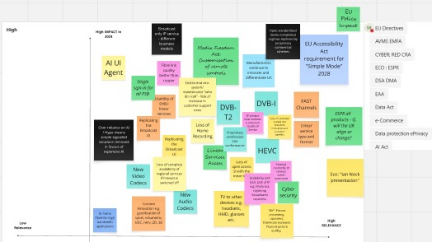
MIRO board from workshop with InfraWG
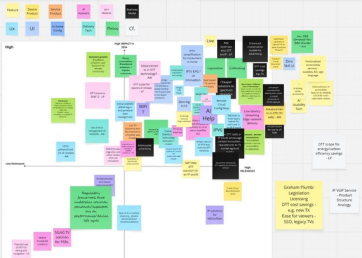
-
Modified MIT approach ↩
-
See Broadcast Networks Europe, https://broadcast-networks.eu/european-cultural-band-an-innovation-roadmap-for-the-lower-uhf-band/ ↩
-
For example, see Brazil adopts TV 3.0 with many component technologies described in the Ultra HD Forum’s Guidelines - Ultra HD Forum. Sinmilar examples in Japan with Advanced ISDB-T and the US with ATSC 3 ↩
-
https://www.broadbandtvnews.com/2025/04/04/uhd-spain-welcomes-approval-of-new-dtt-plan ↩
-
BT delivers first successful trial of new live streaming technology ↩
-
Networks and Applied Research (2020) Energy consumption in the UK 2020, KWH-to- CO2 (rensmart.com).l ↩
-
Ofcom (2024), Communications Market Report 2024, page 3. ↩
-
Ofcom (2024), Mobile Matters 2024, page 4. ↩
-
Starlink (2025), ‘Starlink Specifications’ for ‘GB - United Kingdom’ ↩
-
Amazon (2023), ‘All systems go: Amazon confirms 100% success rate for Project Kuiper Protoflight mission’ ↩
-
Starlink (2025), Starlink homepage ↩
-
Izhikevich, L; Enghardt, R; Huang, T and Teixeira, R (2024), ‘A Global Perspective on the Past, Present, and Future of Video Streaming over Starlink’ ↩
-
See, for example, https://ee.co.uk/broadband/wifi-7 ↩
-
BT (2023), ‘Digital inclusion: new insights and finding a sustainable way forward’ ↩
-
Digital Poverty Alliance (2023), ‘Up to 19 million face digital poverty, Deloitte & Digital Poverty Alliance report reveals’ ↩
-
See, for example, https://ee.co.uk/broadband/wifi-7 ↩
-
BT (2023), ‘Digital inclusion: new insights and finding a sustainable way forward’ ↩
-
Digital Poverty Alliance (2023), ‘Up to 19 million face digital poverty, Deloitte & Digital Poverty Alliance report reveals’ ↩