Stakeholder Forum Papers: Audience - Universality in future of TV distribution
Published 23 June 2026

© Crown copyright 2026
This publication is licensed under the terms of the Open Government Licence v3.0 except where otherwise stated. To view this licence, visit nationalarchives.gov.uk/doc/open-government-licence/version/3 or write to the Information Policy Team, The National Archives, Kew, London TW9 4DU, or email: psi@nationalarchives.gov.uk.
Where we have identified any third party copyright information you will need to obtain permission from the copyright holders concerned.
This publication is available at https://www.gov.uk/government/publications/future-of-tv-distribution-stakeholder-forum-papers/stakeholder-forum-papers-audience-universality-in-future-of-tv-distribution
A paper independently produced by the Audiences Working Group of the Future of TV Distribution Stakeholder Forum.
Introduction
Universality has been a central tenet of UK broadcasting policy for the past century, ensuring that all members of the population who want to can access high quality media that serves their civic needs.[footnote 1] As a principle, universality underpins and is underpinned by public service media (PSM),[footnote 2] charged with providing content and services that serve the needs of all audiences. Universality remains essential to enable all members of the UK population, should they wish, to access media that is designed to meet their needs as citizens, not just consumers, providing benefits to democracy, culture, identity, learning, participation and engagement.
However, any definition of universality needs to address the changing media market. Projecting from current trends and assuming no intervention, research for the DCMS (Vernon et al., 2024: 8) estimates that compared to 2023, by 2040 internet-TV only homes will increase from 18% to 71% of homes, while the percentage of hybrid TV homes (using digital terrestrial TV [DTT] and internet protocol television [IPTV]) will reduce from 65% to 24% and DTT-only homes will decline from 17% to 5%. These projections need to be treated with caution, however, because they assume that by 2040 all fixed broadband connections will deliver VoD-capable speeds, current trends in adoption continue, digital skills remain over the course of a lifetime and IPTV users do not revert back to DTT. As the research set out below demonstrates, there is strong evidence that these assumptions may not hold true, raising uncertainty about the rate of change.
Regardless of the speed of transition to IPTV, existing definitions of universality need to be strengthened to account for the new ways in which television is delivered and accessed. Some argue that any definition of IPTV universality should be consistent with the current definition of DTT universality (98.5% availability of public service broadcaster services) and that questions of affordability, usability and motivation are distinct factors. However, existing research suggests that affordability, usability and motivation are persistent barriers that are likely to continue to prevent some households from taking up IPTV even if the infrastructure is available to do so (see Table 2). These factors are not currently significant barriers to DTT use. There is a risk that without intervention to address these additional barriers, the universality of IPTV will not match that of DTT, and households, particularly vulnerable ones, will lose access to the vitally important democratic and cultural contribution that PSM makes to British life.
In this paper, therefore, we argue that universality should be defined as the principle that *all members of the UK population are able to access public service and a range of other TV content on devices that they are comfortable using and in a way that is affordable and reliable. In this paper, we set out four components of this definition: availability; affordability; usability; public good.[footnote 3] We also identify evidence gaps and the potential factors that need to be considered for implementation of full IPTV transition, DTT upgrade and DTT/DSAT nightlight by 2034. We refrain here from setting out solutions as this will be the focus of next paper.
1. Availability
The fundamental principle of ‘universal availability’ is that all audiences that want to are able to access the infrastructure required to watch public service and a range of other television. Currently 98.5% of the UK have access to DTT and 94% of households have a television set.
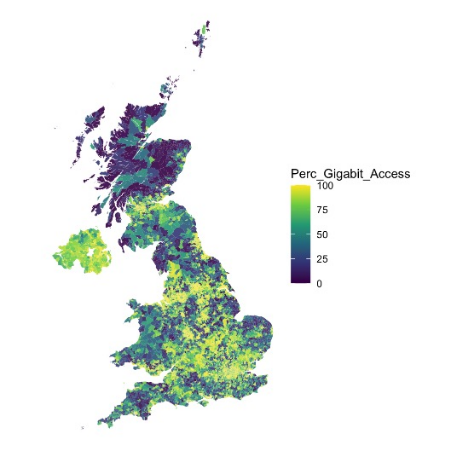
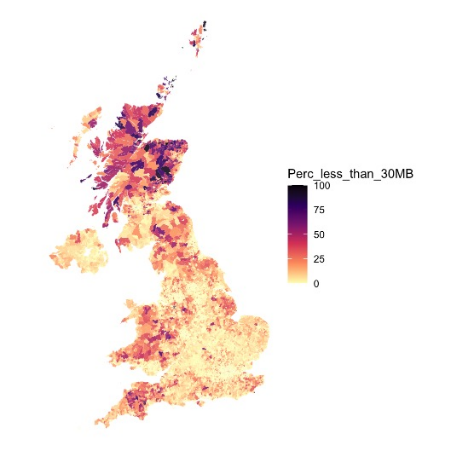
Universal availability in an IP world should match that of DTT, with at least 98.5% of UK households having easy, reliable and affordable access to the infrastructure needed to watch television. This requires access to a reliable internet service of sufficient speeds. Currently, 97.3% of residential households in the UK have access to super-fast broadband (Table 3). However, there are regional variations in household access to high-speed broadband (see Figures 1 and 2). Project Gigabit aims to make gigabit broadband available nationwide by 2030 and Ofcom claims that if all network deployments are realised as planned, gigabit-capable coverage could be in excess of 97% by 2027 (Ofcom, 2024a).
Identifying minimum speed requirements to ensure universal availability of IPTV requires examining the impact of peak traffic on network operators. Research for the DCMS modelled the impact of IPTV growth on peak traffic levels in the UK, assuming all households watch all TV via the internet by 2040 and that viewing will be split over more screens within the home as IPTV uptake increases. It claims that the projected annual peak IPTV traffic growth rate of 13% from 2023 to 2040 should be well within the capacity of network operators in the UK (Vernon et al., 2024: 108).
However, IPTV use only accounts for a percentage of peak traffic. In IPTV, there can also be challenges of network congestion, such as when large gaming downloads and popular sports matches, or other major societal events, happen at the same time. Research to develop minimum digital living standards (MDLS) found from repeated public consultation that citizens believe that minimum requirements to ensure households do not become digitally excluded include access to home broadband of sufficient reliability and speed to support all family members to access the internet at the same time, including to watch TV (Yates et al., 2024a). Any assessment of the minimum speeds required to enable universal availability of television must take into account the likelihood of increased simultaneous use of the internet for other activities beyond TV viewing, as well as potential innovations in the delivery of internet content which may make additional demands on network capacity by 2034.
To match the universal availability of DTT, internet services also need to provide audiences with a sufficiently reliable service. Arqiva has contractual obligations for the availability and reliability of DTT, including thresholds for what counts as loss of service and required response times in case of failure. In most cases, there is no contractual relationship between the ISP and the provider of IPTV services and there are no mandated quality of service guarantees (Vernon et al., 2024: 101). The UK has a strict regulatory regime for DTT, with legal obligations to fix problems within a reasonable timeframe, that is not currently replicated for IPTV.
In-home networks have also been identified as a potential technological challenge, including problems with the quality/availability of WiFi signals across all rooms within the home and with WiFi performance in densely populated areas, which can limit performance and be difficult for users to troubleshoot (Vernon et al., 2024: 102). More quantitative data is needed to assess how significant a problem this is and its effects on IPTV viewing.
The final technological infrastructure required to ensure universal availability is access to a smart TV or connected device. In 2023 87% of UK households had an internet-enabled primary TV set and 100% of sets sold will be internet-capable by 2025 (Vernon et al., 2024: 8). Given the lifetime of TV sets, we can expect that by 2034 there may be a small number of TV sets that are not internet-enabled, although second sets may be a more significant issue (Ibid.: 117). DTT upgrade is likely to require some audiences to upgrade their television sets, although most TV sets sold over the past 15 years are compatible (Ibid.: 9). A DTT nightlight option based on existing DTT infrastructure may have the benefit of not requiring audiences to invest in new technology, however, it is unclear how long existing DTT infrastructure could continue without upgrade. A DTT nightlight option based on satellite infrastructure would require many people to invest in new technology to be able to continue to receive what is likely to be a reduced service. Given that this option is designed as a stepping stone to IP transition, this is unlikely to be in the interests of audiences.
2. Affordability
The fundamental principle of ‘universal affordability’ is that all members of the UK population can access television in a form that is affordable. DTT is free at the point of use and requires one-off costs to install an aerial, plus the costs of a TV set. IPTV is not free at the point of use, given that it requires a monthly broadband subscription, in addition to devices to connect to the internet and sometimes an installation fee. DTT Upgrade and DTT Nightlight options raise fewer concerns related to affordability for audiences, particularly a nightlight option not dependent on satellite, as these would likely only require a small number of households to upgrade their TV sets. Full IPTV transition represents a more fundamental change to the universal affordability of TV, which we set out below.
Multiple studies have identified affordability as an issue for households in accessing broadband (EY, 2024; Citizens Advice, 2023; Deloitte, 2023; Good Things Foundation et al., 2024; Silver Voices, 2023; Vernon et al., 2024). Research by Deloitte identifies income poverty as perhaps the most important determinant of digital exclusion, with one in two individuals living in DE households experiencing digital poverty (Deloitte, 2023: 12). Research conducted for Citizens Advice (2023) suggests that 6% of people receiving Universal Credit had stopped spending on broadband compared to 1% of non-claimants. Ofcom (2024c) data suggests that in October 2024, 25% of individuals reported difficulty in affording any communications service (including pay TV and subscription video-on-demand [SVoD]), an increase from 15% in April 2021, indicating that affordability is a growing (not diminishing) factor in access to communications services, including broadband. Households taking SVoD and/or pay-TV were most likely to say that they struggled to afford these services (13% and 10% respectively), indicating the importance of free broadcaster video-on-demand services (BVoD) (Ibid.).
Social tariffs have been introduced to address affordability of the internet. However, currently uptake of social tariffs is very low (approx. 5% of those eligible, or 250,000 of over 4.3m). There are likely multiple reasons for this. As of October 2024, a third of decision makers who are eligible were unaware of social tariffs, a figure that has remained consistent since October 2023 (Ofcom 2024c). Affordability of social tariffs is also an issue. Survey work with social housing tenants in Greater Manchester Combined Authority (Tyrell et al., 2024) found that the optimum affordability ‘point’ for tenants was £11-15 – considerably below current social tariff offers, which range from £15-£23 pcm.[footnote 4] However, it is unclear whether reducing price as a standalone intervention would significantly increase uptake. Social tariffs also do not address the challenges for households with income so low that they cannot afford any connectivity (Frontier Economics, 2023 for BT). Research by Enders (2023) also raised concerns that full adoption of social tariffs would lead to price increases for other broadband consumers of up to 19%.
3. Usability
The fundamental principle of ‘universal usability’ is that all members of the UK population can access television on technologies that they are comfortable and confident using.
Digital skills are a barrier for both internet and IPTV take-up. Analysis of Ofcom tracker and Media Literacy surveys found that 7.9% of UK citizens remain non-users of digital media and services, with a further 32.7% using a narrow set of digital services. Limited users are more likely than active users to be struggling financially, be over 65+ and amongst lower socioeconomic groups.[footnote 5] The Lloyds Consumer Digital Index finds that 23% of the UK has a very low digital capability, a group much more likely to suffer from online harms when using the internet (Lloyds, 2024).
Age is a factor here. Research by the Older People’s Commissioner for Wales (2024) found that only 41% of people over 75 had recently been able to complete the 5 Basic Digital Skills (handling information and content, communicating, transacting, problem solving and being safe and legal online), compared to 91% of 16–24-year-olds. They also found that older people experience anxiety about online security, mistrust the internet, and feel safer offline due to scams, phishing and managing passwords. While these are broader points of concern about internet use, given that IPTV will require internet access, these anxieties may play a role in people’s willingness, or not, to transition from IPTV to DTT.
However, digital literacy is not just an issue for older people. Digital Poverty Alliance (2024) Tech4Families research found young device recipients often struggled with basic skills. Even after six months of owning a device, 48% couldn’t change passwords, and 27% couldn’t connect to Wi-Fi without training. EY research for Broadcast2040+ (2024) shows 10% of adults worry their skills won’t keep up with technological changes, rising to 16% for disabled viewers, 19% for ‘light-touch’ internet users and 21% for viewers aged 76+. Furthermore in 2019, 56% of adult non-internet users were disabled (ONS, 2019). It remains the case that having a long-term health condition that impacts daily life is a statistically significant predictor of being a non-user or limited user of the internet (Table 2),[footnote 6] highlighting the need for accessible digital design and affordable assistive technologies. Poorly designed and inaccessible digital content and services create significant barriers for individuals with sensory loss, cognitive impairments and health conditions such as arthritis, Parkinson’s and Alzheimer’s, which can make accessing online services particularly challenging and contribute to feelings of dependence and loss of autonomy (Older People’s Commissioner for Wales, 2024).
Research also suggests that digital skills are flat lining. In 2024, 53% of UK adults were able to complete all 26 essential digital skills for life, compared to 52% in 2023 and 47% in 2022. Out of the adults on the cusp of being able to do all life tasks, the number has remained static at 29% over the last two years (Lloyds, 2024). The number of adults who can use the internet to stream or download entertainment content has also remained fairly static at 88% in 2023 and 89% in 2024, following a significant uplift from 64% in 2022 (Lloyds, 2022, 2023, 2024). For older audiences, the challenges are more acute. 7% of people aged 75+ are ‘lapsed users’, having stopped internet use for over three months, risking skill atrophy. This has been reported as a growing issue where older people become less digitally confident (Older People’s Commissioner for Wales, 2024). The Lloyds Consumer Digital Index (2024) indicates a drop off in digital capability from about the age of 60, with a linear drop of 10 points per decade after this. Although overall scores have increased marginally year on year, this linear decline with age remains, indicating that this is likely an age, rather than a cohort effect.
IPTV use raises additional challenges for some people. The unfamiliar or complex interfaces of smart TVs and connected devices can compromise the viewing experience for some audiences (Sliver Voices, 2023). Research from a nationally representative survey in Australia found that 33% of people don’t know how to customise the order of apps and 51% don’t know how to adjust privacy settings on their smart TVs with the less active tending to be older and female (Lobato et al., 2023). This aligns with qualitative research in the UK where older female audiences were more likely to struggle to use the smart TV (Johnson et al., 2024).
4. Public Good
The fundamental principle of ‘universal public good’ is that all members of the UK population are easily able to access a range of TV content, including content that serves their civic needs.
There has been consensus since the 1920s that broadcasting in Britain should be regulated to benefit society as a whole, rather than being purely driven by consumer forces. Consumer interests are based on individual benefit, whereas citizen interests are based on societal benefit. Citizen interest broadcasting is not just provided to people who can afford it; it goes beyond the choices of private individuals, to provide broader benefits to democracy, culture, identity, learning, participation and engagement; and it benefits those who do not even make direct use of it, in much the same way as schools help create an educated society. Access to such content should be universally available to all citizens, not dependent on individual tastes, but providing something for everyone, serving mass and minority interests. Public service broadcasting regulation has underpinned this consensus by requiring certain broadcasters to produce content that specifically meets the needs of citizens and to deliver it to audiences in such a way that encourages consumption of programmes that educate and inform as well as entertain (such as through requiring prominence in the electronic programme guide or news programmes to be scheduled in primetime).
It has been argued that there is so much choice available to audiences today that we no longer need universal PSM provision (see, for example, DCMS, 2015).[footnote 7] However, there is little evidence to suggest that new services, such as SVoDs and video-sharing platforms (VSPs), are serving the civic needs of audiences. Those that are free, such as VSPs, are largely unregulated and operate via business models based on the exploitation of user data, which can lead to poor outcomes for consumers, including the circulation of harmful content. Others, such as SVoDs, sit behind paywalls, only available to those able to pay. The most-used of these tend to focus on drama, entertainment and high-end documentary programming, with a relatively limited amount of culturally-specific UK content compared to the UK’s public service broadcasters (Bruun et al., 2025; Ofcom, 2024b: 63-4); they do not, for example, provide children’s content which is relevant to their lives growing up in the UK or trusted news and analysis focused on the UK.
Furthermore, linear heavy audiences and those without IPTV are more likely to have positive perceptions of the quality, diversity and value for money of free linear TV and are more likely to value television as a source of information and education (Vernon et al., 2024: 45-6; Johnson et al., 2023). Given that BVoDs (such as iPlayer) and SVoDs in the UK provide less prominent and easy access to news, current affairs and cultural/lifestyle programmes than DTT, it is likely that satisfaction with the current DTT offer and experience in comparison to VoD is a reason not to switch to IPTV (EY, 2024; Bruun et al., 2025; Ofcom, 2024b: 65).
While there is a clear case for the continued need for PSM to be universally available each of the options raises potential risks for UK audiences.
- IPTV Transition: If it were possible to transition all audiences to IPTV, it remains unclear whether prominence legislation enacted in the Media Act 2024 will be effective in ensuring that citizen interests are met. There is evidence to suggest that PSM provision on VoD tends to prioritise content that mimics what is found on SVoDs, with news, current affairs and serious factual content less visible in the user interface (Bruun et al. 2025; Ofcom, 2024b: 65). Ofcom’s recently launched consultation on implementing the prominence requirements in the 2024 Media Act will be relevant in this regard. However, the prominence legislation in the Media Act only covers the most-used connected TV devices. To engage younger audiences, PSM providers are likely to distribute more content on social media platforms (a strategy Channel 4 are already adopting), leaving their content strategies highly susceptible to the determinants of the social media/VSPs’ algorithms. More needs to be done to ensure that the benefits of PSM can continue to be easily available to those using IPTV.
- DTT Upgrade: This option would have the benefit of maintaining the broadcast system and not requiring households to subscribe to broadband in order to access PSM. However, given the costs of having to support two distribution systems and the potential for DTT distribution costs to increase for PSMs, there is the risk that less money is invested in content, diminishing the service provided to all users by PSMs. Clear requirements and sufficient funding to ensure that PSM remits are met in both IPTV and DTT would be needed.
- DTT/DSAT Nightlight: This option would have the benefit of maintaining the linear broadcast system for those audiences unable to access IPTV. However, there is an even greater risk of reduced provision on DTT than DTT Upgrade.
Research gaps and next steps
We end with a brief summary of the areas where more data or research is needed to address universality in the context of changing audience behaviours, and which need to be addressed by the Stakeholder Forum Working Groups moving forward.
- An assessment of the minimum required speeds for reliable, quality IPTV delivery by 2034, taking into account anticipated increases in network demand, changes in the delivery of IPTV that may make more demands on network capacity, and simultaneous multiple use of the internet within households.
- An assessment of the potential challenges of in-home networks to the delivery of reliable IPTV.
- Proposals to ensure the reliability of IPTV matches that of DTT.
- Proposals and evaluation of potential interventions to address affordability.
- Proposals and evaluation of potential digital skills schemes to address both internet access and IPTV use, including an evaluation of existing digital skills in unconnected and linear heavy hybrid homes.
- Proposals and evaluation of minimum design standards for broadband and IPTV to bring down the skills needed to engage digitally, based on research into actual rather than reported behaviour.
- Proposals to ensure the continued availability, accessibility and prominence of PSM, including linear channels, regardless of the transition option adopted.
- Predictions of likely channel offerings for the DTT Upgrade and DTT/DSAT Nightlight options.
- Data on the number of households likely to require equipment upgrades for the DTT Upgrade and DTT/DSAT Nightlight options.
References:
DCMS (2016) Broadcasting: Copy of Royal Charter for the continuance of the British Broadcasting Corporation. (Cm 9365) London: The Stationary Office, https://downloads.bbc.co.uk/bbctrust/assets/files/pdf/about/how_we_govern/2016/charter.pdf
EY (2024) The costs and risks of switching to internet distribution for all broadcast TV, London, https://www.broadcast2040plus.org/_files/ugd/4e1def_c2059dcf53cb4909bbcd7a20356f5dca.pdf
Bruun, H et al. (2025) Streaming public service television in the age of platforms, University of Aarhus: Denmark, https://psm-ap.com/policy-brief-streaming-public-service-television-in-the-age-of-platforms/
Citizens Advice (2023) One million lose broadband access as cost-of-living crisis bites, https://www.citizensadvice.org.uk/about-us/media-centre/press-releases/one-million-lose-broadband-access-as-cost-of-living-crisis-bites/
DCMS (2015) BBC Charter Review: Public consultation, London, https://assets.publishing.service.gov.uk/government/uploads/system/uploads/attachment_data/file/445704/BBC_Charter_Review_Consultation_WEB.pdf
Deloitte (2023) Digital poverty in the UK: A socio-economic assessment of the implications of digital poverty in the UK, London, https://digitalpovertyalliance.org/wp-content/uploads/2023/09/Deloitte-Digital-Poverty_FinalReport_29092023.pdf
Digital Poverty Alliance (2024. Tech4Families evaluation report, London, https://digitalpovertyalliance.org/wp-content/uploads/2024/08/T4F-Final-Report_August-2024.pdf
Enders Analysis (2023) Social tariffs: On the edge of reason, London, https://www.endersanalysis.com/reports/social-tariffs-edge-reason
Frontier Economics (2023) Low income households and affording connectivity, London, https://www.frontier-economics.com/media/ttbkmqxw/frontier-affording-connectivity-final.pdf
Good Things Foundation, Trussell and WPI Economics (2024) Exploring the relationship between deep poverty and digital exclusion, https://www.goodthingsfoundation.org/policy-and-research/research-and-evidence/research-2024/deep-poverty-and-digital-exclusion
Lloyds (2024) 2024 Consumer Digital Index Report, London, https://www.lloydsbank.com/consumer-digital-index.html
Lobato, R et al. (2023) Smart TVs and local content prominence. Submission to the Prominence Framework for Connected TV Devices Proposals Paper, RMIT University/ADM+S, https://www.infrastructure.gov.au/sites/default/files/documents/pfpp–associate-professor-ramon-lobato-alexa-scarlata-bruno-schivinski-rmit-university.pdf
Johnson, C et al. (2024) An audience studies’ contribution to the discoverability and prominence debate: seeking UK TV audiences’ ‘routes to content’. Convergence: The international journal of research into new media technologies. 30(5). p.1636-1638, https://journals.sagepub.com/doi/full/10.1177/13548565231222605
Johnson, C et al. (2023) Ways of Watching: categorising television viewing in an age of streaming, University of Leeds, UK, available at: https://ahc.leeds.ac.uk/dir-record/research-projects/1840/routes-to-content
Martin, D and Johnson, C (2023), Universality: A battleground for UK public service media in the platform age, Political Quarterly, 2023, 95(1): 25-34, https://onlinelibrary.wiley.com/doi/10.1111/1467-923X.13342
Ofcom (2024a) Connected Nations – Planned Network Deployments 2024, London, https://www.ofcom.org.uk/phones-and-broadband/coverage-and-speeds/connected-nations-planned-network-deployment/connected-nations-2024/
Ofcom (2024b) Review of Public Service Media (2019-23): Challenges and opportunities for Public Service Media, London, https://www.ofcom.org.uk/siteassets/resources/documents/tv-radio-and-on-demand/broadcast-guidance/psb/2024/review-of-public-service-media-2019-2023.pdf?v=389567
Ofcom (2024c) Communications Affordability Tracker, London, https://www.ofcom.org.uk/phones-and-broadband/saving-money/affordability-tracker/
Older People’s Commissioner for Wales (2024) Access denied: Older people’s experiences of digital exclusion in Wales, Cardiff, https://olderpeople.wales/wp-content/uploads/2024/01/Access-Denied-Older-peoples-experiences-of-of-digital-exclusion-in-Wales.pdf
ONS (2019) Exploring the UK’s digital divide, https://www.ons.gov.uk/peoplepopulationandcommunity/householdcharacteristics/homeinternetandsocialmediausage/articles/exploringtheuksdigitaldivide/2019-03-04
Silver Voices (2023) Safeguarding universality: The future of broadcast TV and radio. https://www.broadcast2040plus.org/_files/ugd/c12aae_83d7fdff74154813975b19b96be22671.pdf
Tyrell, B et al. (2024) GMCA digital inclusion pilot: Research report, University of Liverpool, https://livrepository.liverpool.ac.uk/3179999/
Vernon, J et al. (2024) Future of TV Distribution, London: DCMS, https://assets.publishing.service.gov.uk/media/672cafe262831268b0b1a2f4/Future_of_TV_Distribution_FINAL__7_Nov_2024_-accessible.pdf
Yates, S et al. (2024) A minimum digital living standard for households with children: Overall findings report, University of Liverpool, https://mdls.org.uk/wp-content/uploads/2024/03/MDLS-final-report-v1.11-1.pdf
Yates, S J et al. (2020), Who are the limited users of digital systems and media? An examination of UK evidence, First Monday, 25(7), https://shura.shu.ac.uk/26626/
Yates, S J and Lockley, E (2018) “Social media and social class”, American Behavioural Scientist, 62(9), pp.1291-1316, https://shura.shu.ac.uk/18741/
Yates, S J, Kirby, J and Lockley, E (2015) Digital media use: differences and inequalities in relation to class and age, Sociological Research Online, 20(4), https://www.researchgate.net/publication/285384908_Digital_Media_Use_Differences_and_Inequalities_in_Relation_to_Class_and_Age
Appendices:
Table 1: Summary of core potential barriers to universality
| Full IP Transition | DTT Upgrade | DTT/DSAT Nightlight | |
|---|---|---|---|
| Availability | Speeds, including peak traffic, multiple internet use and potential innovations that may increase network demand by 2034. In-home networking and Wi-Fi performance. Reliability. | Requirement to upgrade TV sets. | Requirements to purchase and install satellites (DSAT). Lifespan on existing DTT technology which will impact likelihood of households requiring equipment upgrades. |
| Affordability | Affordability a growing factor in access to communications services, particularly given the cost-of-living crisis. Social tariffs have not adequately addressed affordability issues. | One-off costs of upgrading TV set for a small number of users. | One-off costs for switching to DSAT, likely to affect more households than DTT nightlight. |
| Useability | Digital skills a barrier for internet and IPTV use and take-up. Specific challenges for older and disabled people, but not restricted to those groups. | Useability not a concern. | Useability not a concern. |
| Public Good | Need to ensure the benefits of PSM can continue to be easily available in IPTV environments. | Need to ensure the benefits of PSM can continue to be easily available on DTT and IPTV. Risk that current DTT channel offer is reduced. | Need to ensure the benefits of PSM can continue to be easily available on DTT/DSAT and IPTV. Greater risk of reduced DTT provision on linear. |
Table 2: Factors predicting non-use of the internet
| Factor. | Effect measure | Statistically significant (bold) | Effect on non-use |
|---|---|---|---|
| (Intercept) | -4.16 | 0.00 | |
| Financially getting by | 0.09 | 0.68 | |
| Financially struggling | 0.56 | 0.03 | Increases |
| Health factor affecting everyday activity | 0.42 | 0.01 | Increases |
| House owner | -1.09 | 0.00 | Decreases |
| House rented | -0.52 | 0.07 | Decreases |
| Children in household | -1.01 | 0.00 | Decreases |
| Urban living | -0.31 | 0.10 | Decreases |
| BAME household | -0.01 | 0.98 | |
| 25-34 | -0.37 | 0.52 | |
| 35-44 | 0.57 | 0.21 | |
| 45-54 | -0.49 | 0.40 | |
| 55-64 | 0.87 | 0.04 | Increases |
| 65+ | 1.94 | 0.00 | Increases |
| NRS C1 | 0.79 | 0.03 | Increases |
| NRS C2 | 1.50 | 0.00 | Increases |
| NRS DE | 1.73 | 0.00 | Increases |
| Working | -1.45 | 0.00 | |
| Retired | 0.31 | 0.29 | |
| On benefits | 0.33 | 0.05 | Increases |
Source: Analysis of Ofcom 2024 Technology Tracker by Yates, following method of Yates et al. (2020)
Table 3: Broadband access
| Percentage of residential households meeting requirement | |||||
|---|---|---|---|---|---|
| Super-Fast Broadband availability | Ultra-Fast Broadband (100Mbit/s) availability | Ultra-Fast Broadband | Full Fibre availability | Gigabit availability | Unable to receive 2Mbit/s |
| 97.3 | 82.1 | 81.4 | 66.6 | 80.9 | 0.2 |
| Unable to receive 5Mbit/s | Unable to receive 10Mbit/s | Unable to receive 30Mbit/s | Below the USO | ||
| 0.5 | 0.9 | 2.5 | 0.2 |
Source: Ofcom autumn 2024 fixed broadband coverage (https://www.ofcom.org.uk/about-ofcom/our-research/statistical-release-calendar-2024-/)
Figure 1: Percent of households able to access gigabit speeds by Medium Super Output area (England, Wale) or Data Zone (Scotland and Northern Ireland)
Source: Ofcom broadband speed data 2024: https://www.ofcom.org.uk/about-ofcom/our-research/statistical-release-calendar-2024-/
Figure 2: Percent of households without access to 30MB by Medium Super Output area (England, Wale) or Data Zone (Scotland and Northern Ireland)
Source: Ofcom broadband speed data 2024: https://www.ofcom.org.uk/about-ofcom/our-research/statistical-release-calendar-2024-/
-
Universality also underpins the BBC’s Royal Charter, which states that ‘The Mission of the BBC is to act in the public interest, serving all audiences through the provision of impartial, high-quality and distinctive output and services which inform, educate and entertain.’ (DCMS, 2016) ↩
-
We use public service media here, rather than public service broadcasting, in recognition of the fact that UK public service broadcasters now deliver their content beyond radio and television, and to refer both to the principles set out in UK public service legislation and the broadcasters to which those principles apply: BBC, ITV, Channel 4, Channel 5. ↩
-
This paper focuses on television, but it should be noted that the principles of universality extend to radio also. ↩
-
Based on the current list provided by Ofcom and including only those services available across all of the UK that provide speeds of at least 30Mbps (https://www.ofcom.org.uk/phones-and-broadband/saving-money/social-tariffs/). ↩
-
2023 analysis of Ofcom Technology Tracker data by Yates et al., following methods of Yates et al. (2020), Yates and Lockley (2018) and Yates et al. (2015). ↩
-
2023 analysis of Ofcom Technology Tracker data by Yates et al., following methods of Yates et al. (2020), Yates and Lockley (2018) and Yates et al. (2015). ↩
-
See Martin and Johnson (2023: 25-34) for an analysis of how these arguments have played out in recent policy debates. ↩