Stakeholder Forum Papers: Audience - Solutions in future of TV distribution
Published 23 June 2026

© Crown copyright 2026
This publication is licensed under the terms of the Open Government Licence v3.0 except where otherwise stated. To view this licence, visit nationalarchives.gov.uk/doc/open-government-licence/version/3 or write to the Information Policy Team, The National Archives, Kew, London TW9 4DU, or email: psi@nationalarchives.gov.uk.
Where we have identified any third party copyright information you will need to obtain permission from the copyright holders concerned.
This publication is available at https://www.gov.uk/government/publications/future-of-tv-distribution-stakeholder-forum-papers/stakeholder-forum-papers-audience-solutions-in-future-of-tv-distribution
A paper independently produced by the Audiences Working Group ahead of the Future of TV Distribution Stakeholder Forum.
Introduction
An IPTV transition is expected to deliver both benefits to audiences (e.g. through access to a greater range of IP-delivered content and services) and also challenges – particularly for older and vulnerable audiences. This paper – produced following discussion amongst the Audiences Working Group – sets out ideas on the solutions which could be deployed to address the identified challenges. For the avoidance of doubt, whilst this paper focuses on a potential IPTV transition, we do not preclude the other options under consideration (e.g. upgrading DTT and a potential Nightlight).[footnote 1]
Before we expand on the potential solutions, at the outset of this paper we highlight a number of important areas of consensus – which we hope will inform DCMS’s policy thinking accordingly:
-
In the event of an IPTV transition, support needs to be focused on the those who need it most. The design of such a support scheme should take into account a number of considerations:
-
There should be a robust process to identify those groups with specific needs for getting IPTV, map the stages of their user journeys, understand their biggest barriers, and then explore solutions.
-
As part of this process, there is a need for clear costing and funding that takes into account the challenges of digital poverty – so as to ensure that costs are not passed on to households and individuals who cannot afford it.
-
It is also important to note that some individuals and groups in hybrid homes (i.e. those with access to both IPTV and DTT) may require assistance.
-
Further, there will be a need for iteration and refinement – to test the effectiveness of proposed solutions.
-
-
Whilst this paper identifies areas where solutions would be required in relation to availability and reliability, these are highlighted as questions for the Infrastructure Working Group to review and address, given that many of these areas relate to technical considerations which are within the remit of the Infrastructure Group.
-
The focus of this paper – and of this specific DCMS policy process – should be on those skills required for the use of IPTV, rather than digital skills more broadly.
-
Any transition needs to have a clear timeline with staging-post targets – so as to enable clear planning and delivery.
-
There should be a national campaign and budget to support any future IPTV transition – in order to raise awareness and support affected groups properly.
-
In the meantime, the policy process should draw on DCMS research about the known barriers and (where possible) the most tested solutions (from other contexts). We should seek to identify areas where we have done well and where we haven’t done well and why (in both cases); and ensure we build in scalability and focus on the hardest to reach.
The rest of this paper builds on the above areas of consensus, setting out the Working Group’s thinking on:
1. What an IPTV transition would look like in a best-case scenario: this enables us to identify the conditions and circumstances where the best-case criteria may not apply – and where policy solutions may therefore be needed.
2. What would a transition programme look like to address the challenges of availability, affordability and usability of IPTV?
3. How to ensure continued delivery** of the public good in an IPTV world – particularly through the provision of high-quality content to audiences.
1. What would an IPTV transition look like in a best-case scenario
We pose this question in order to understand what audiences might potentially gain and lose in the transition process, and to what extent any such losses can be mitigated.
We take as our starting point three essential principles that have underpinned terrestrial TV in the UK for the best part of 70 years: first, a universally available service that is easy to use and free at the point of use; second, a public service framework that guarantees a wide range of easily accessible high quality content, with an emphasis on UK originated material in the public interest; and third, a particular focus on easily accessible, impartial and high quality news and information, essential for a well-informed electorate in a properly functioning democracy.
Even in an era dominated by streaming platforms and social media tech companies, the traditional Reithian trilogy of inform, educate and entertain through free and easy audience access to content has been the cornerstone of British cultural and public life, primarily via the BBC and the commercial and nation/region-specific PSBs.
Our vision of what serves the audience is therefore not just a consumerist definition of what and how audiences access content (vital as this is) but a broader societal definition of active citizens. Our starting point is the principle laid down in the 2003 Communications Act as Ofcom’s duty to further the interests of citizens and consumers. IPTV should, in similar fashion, be serving those interests without diminishing the public service principles laid out above.
What would this mean in practice for the IPTV world? Access would need to be easy, with interfaces that mirror or improve on existing television menus at least for the free-to-air channels; be cost-free beyond any capital installation costs; be technically straightforward to operate with a single remote (or voice) control; and be reliable with any reception issues minimal and easily resolved without technical knowledge. In an ideal world, IPTV would also bring increased accessibility functions to make TV even more accessible for all.
While content creation is not an integral element of the distribution process, we expect there to be similar public service obligations both on the BBC and the commercial PSBs as now to provide an equivalent range of high-quality UK-oriented content. To mimic the linear world, that content should not only be easy to find but be prioritised within the relevant distribution interfaces. Ideally, PSM providers would be supplemented by a variety of freely available commercial services offering a wide range of choice for audiences free at the point of access. This will be particularly important for news and information, given that a cornerstone of the PSM philosophy is its commitment to impartial and reliable news.
2. What would a transition programme look like to address the challenges of availability, affordability and usability of IPTV?
Availability
The following solutions for the Infrastructure Working Group to review and assess, are designed to address the needs of audiences:
- To ensure that broadband is of sufficient speed to access IPTV, policymakers should design a process to establish minimum speed requirements for universal availability of IPTV, minimum digital living standards (MDLS[footnote 2]), assuming simultaneous use of the internet for various activities (e.g. viewing video, gaming, video conferencing, etc.), and considering potential increases in traffic growth, innovations in the delivery of internet content, and related network demand. This may require periodic review, including a review of MDLS standards. All fixed-line internet service providers should be required to meet these minimum standards in their offers. We believe that any review of Broadband Universal Service Obligations should take IPTV needs into account.
- To ensure a service of similar reliability to DTT, contractual obligations for availability and reliability for ISPs should match those currently in place for DTT, including legal obligations to fix problems within a reasonable timeframe and clarity for households about who to contact when things go wrong.
- To reduce reliance on WiFi, there should be a recommendation to use CAT-5 wiring wherever possible. Where that’s not possible, powerline products and technologies to carry network signals over home aerial wiring may also be suitable alternatives to WiFi.[footnote 3] Policymakers need to consider where responsibility should lie for in-home networking issues and whether existing aerial installers may have (or through training could develop) skillsets that could support the transition.
Separate from these issues of speed and reliability, there is a strong argument that by the early 2030s, broadband infrastructure will reach a similar (or greater) proportion of UK households as the current free-to-air TV service.[footnote 4] Based on current rollout projects, DSIT preliminary estimate is that a maximum of 130,000 premises will not have access to the infrastructure to receive superfast broadband by 2034. Affordability will likely remain as a significant challenge for more households.[footnote 5] This does not mean we should disregard the 2-5% who may be unable to access broadband that meets the needs of an IPTV transition; however, the major obstacles to take-up will probably be affordability and usability, which we address below.
Affordability
Using the current Minimum Income Standard (MIS)[footnote 6] definition as a baseline, the cost of accessing free-to-air TV in a UK household is £195 per year (TV licence plus the depreciation of a basic 32-inch Smart TV over five years).[footnote 7] Adding a basic broadband package increases this amount to £462 per year.[footnote 8] Consequently, current free IPTV content costs 237% of the current free-to-air costs. However, a broadband connection offers a wide range of services beyond IPTV.
As noted in the previous Universality paper, affordability is a growing (not diminishing) concern. Therefore, affordability could represent a significant barrier to accessing IPTV. Unlike availability, affordability may vary significantly yearly in response to national and personal economic circumstances and market fluctuations.
IPTV solutions must be affordable to all current TV service users to maintain current levels of access to free-to-air and PSM TV. Potential solutions must cover both access to broadband and access to appropriate devices that can receive TV content.
Broadband costs
Access to affordable broadband has been a concern for government and third-sector organisations aiming to enhance digital inclusion for over two decades. Currently, there are two primary solutions for low-income households: social tariffs and data banks. However, data banks do not provide a sustainable long-term solution for access to TV. Social tariffs could be a solution; however, as detailed in our Universality paper, they have a low take-up and do not address the challenges for households with incomes so low that they cannot afford any connectivity.[footnote 9] Setting social tariffs within or just below the affordability range identified in recent research – say £10 per month – would reduce IPTV access costs to £315 per year (an increase of 161%). However, such a price point for social tariffs would not be sustainable by ISPs and might have implications for the broader telecoms market. It would need some form of further subsidy.
The solutions below reflect national, regional, and local initiatives on digital inclusion. However, they currently lack coordination across the UK; almost all rely on temporary and inconsistent funding. A long-term affordability solution will require improved coordination. Providing affordable IPTV is thus almost identical to supporting affordable Internet access for all households. Therefore, it must align with the government’s Digital Inclusion Action Plan.[footnote 10] As such, there is a strong case for a switchover programme that ties into and utilises the Government’s digital inclusion strategy, needing close collaboration between DSIT and DCMS, and the use of existing national, regional, and local digital inclusion support hubs (e.g National Digital Inclusion Network[footnote 11]).
Other affordability solutions include:
- Going further than social tariffs and exploring free access to IPTV and adequate broadband for those on the lowest incomes. This would likely require a more robust eligibility check by the government than the current social tariff mechanisms.
- Zero-rating PSB TV output for 5G data would allow TV access on mobile devices and over 5G-enabled dongles/Wi-Fi devices. However, such solutions would be limited to areas with very good and reliable 5G coverage.
- A mix of solutions depending on place – from local mesh networks in social housing to more complex forms of social tariffs that take into account household composition (e.g. higher speeds for larger households).
- ‘IPTV switchover’ product(s). This could include a router than only supports IPTV services offered much cheaper or subsidised, which could be combined with an IPTV dongle offering a switchover experience that is ‘plug and play’ and could be installed in a single visit. This might include products that do not require ongoing subscriptions and could be subsidised for the relatively small number of people that need them.
- A more radical solution would be to provide free baseline broadband to all households that supports access to PSB IPTV. This would be a considerable cost to the government and have market implications for the ISPs.
Costs of devices
The MIS includes at 32 inch Smart TV as the base item for households to access TV, at a current cost of £169. This is also reflected in the Minimum Digital Living Standard[footnote 12], including a ‘large screen device’ such as a basic laptop or tablet. However, some devices, such as Amazon Fire TV Stick and Roku, are available for around £25 and can be used to access IPTV on a ‘dumb’ TV set. To address access to a basic device that can provide access to PSM on IPTV, several options are available:
- Inclusion of Smart TVs or dongles (to make current TVs ‘smart’) maybe through device banks (e.g. National Device Bank[footnote 13]).
- Options for low-income households to purchase smart TVs or dongles at a minimum cost.
- Trade-in programs to exchange old devices for significantly discounted or refurbished smart TV sets, potentially coordinated through device banks.
Again, it is important to note that such interventions align with the government’s Digital Inclusion Action Plan, especially around the device recycling target. This would also reduce the e-waste that could arise as part of this transition.
Usability
Successful IPTV use requires a range of digital skills, including connecting a device to Wi-Fi, creating and managing passwords, downloading apps, updating software, navigating interfaces, and ensuring online safety. Our Universality paper identified skills as an issue, particularly for older and disabled users, in accessing IPTV. Solutions to address these challenges could include:
- Smart TV manufacturers and retailers to provide free, personalised setup support with each purchase for those most in need. This includes in-home assistance for connecting the TV to the internet, password management, TV content access, and using accessibility features such as voice control or subtitles. These touchpoints are crucial for users who may be unfamiliar or anxious about navigating digital interfaces.
- IPTV systems need to be more intuitive and tested by those with low digital skills in real-world settings with reduced support. Remote controls should be redesigned with accessibility in mind, including clearer labels, larger fonts and/or specific buttons for accessibility features (such as subtitles). Voice control should be integrated as standard. On-screen layouts should minimise clutter to reduce confusion and mimic the simplicity of DTT systems. Freely and Sky Stream are moving in this direction.
- Equally important is the availability of ongoing troubleshoot support, which must be easy to access. A 24/7 helpline staffed by trained support personnel can ensure that users are not left stranded when facing difficulties. Staff should be equipped to handle basic and advanced IPTV queries with empathy and clarity, particularly when assisting users who may struggle with digital terminology.
Government and private sector should support and fund targeted local, face-to-face digital skills training tailored specifically to the demands of IPTV use, which could be combined with the training outlined above to address basic digital skills, building on existing provision but not relying on people to book courses or visit locations they do not usually access. Media literacy and online safety training must also be included. To ensure take up, these training must be accessible across every postcode in high footfall locations (such as supermarkets, Post Offices, and schools) and scheduled flexibly to suit people with part-time jobs or caring responsibilities. For housebound individuals, especially older and disabled people, at-home training and support must be prioritised. Evidence from AbilityNet shows that tailored support is one of the most effective ways to improve confidence and digital skills among older adults.[footnote 14]
Usability issues would be minimised if all TV sets providing PSB services — regardless of the platform selected—offer a service identical to the current experience of being able to watch live, linear TV without the need for sign-in or troubleshooting, with the ability to move through linear TV channels by selecting one channel on a remote or using buttons on the set. Sign-in, data-tracking, or any issues requiring digital skills, such as running updates or creating passwords, are likely to create usability issues for certain audiences, and therefore require careful consideration. If industry cannot provide a seamless experience that replicates the usability of DTT and government phases out traditional broadcast methods, people who lack the specific digital skills required for IPTV will face exclusion from accessing television.
3. How to ensure continued delivery of the public good in an IPTV world – particularly through the provision of high-quality content to audiences
Our Universality paper identified ‘universal public good’ as its final fundamental principle: “all members of the UK population are easily able to access a range of TV content, including content that serves their civic needs”. It is important to ensure that the quality of content in an IPTV environment is equivalent to that of DTT and to address concerns that an impaired user experience/content discovery experience will not reduce benefits to democracy, culture, identity, learning, participation, and engagement. The following section sets out how these elements of public good should be retained in the event of an IPTV transition.
In this context, it is important to note that migrating to IPTV does not mean exclusively consuming VoD-only content. Nor does it mean departing from linear EPG environments and/or channel portfolios which are familiar to users of DTT. As mentioned above both Freely and Sky Stream employ linear EPGs, which will be familiar to longtime users of DTT, and are both delivered over IP. Therefore, just as these platforms deliver linear PSB channels today, it is important to ensure that new IPTV platforms in the future do the same.
Figure 1: Freely linear EPG
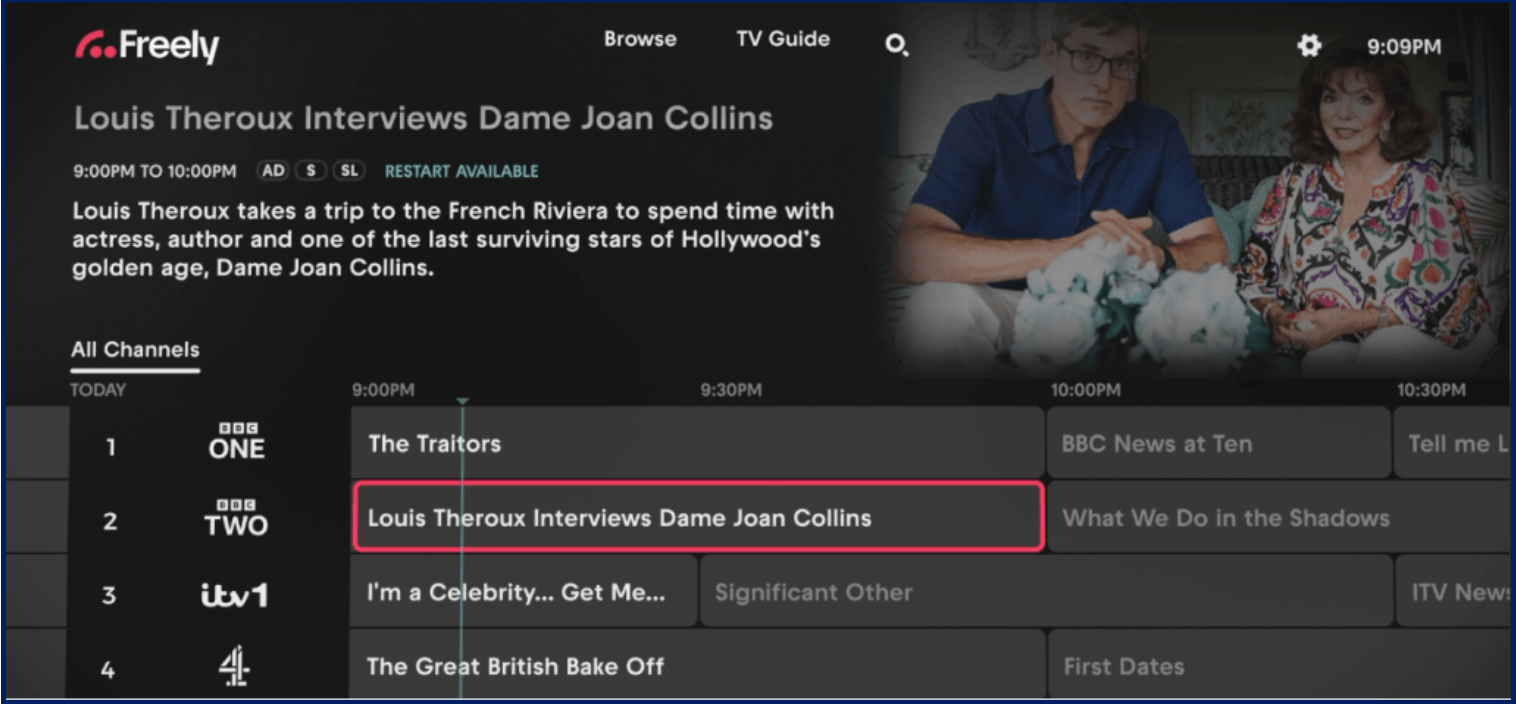
Connected to the above are concerns from some members of the Working Group that channel propositions may be different in an IPTV environment; the Working Group’s first Paper identified that “there is little evidence to suggest that new services, such as SVoDs and video-sharing platforms (VSPs), are serving the civic needs of audiences…”, and while some of the PSBs are being more proactive in curating their presence on YouTube, the Paper’s finding means that the replication of existing PSB lineups in an IPTV environment (simultaneously delivering PSM content / public good) will be crucial.
Were it to take place, given than an IPTV transition would take place over the course of the 2030s, it is difficult to assess precisely what channel propositions will look like at time of switchover. At the time of writing, all of the PSBs’ portfolio channels are available over IP, including platforms and services where the PSBs are stakeholders (i.e., Freely) and other commercial propositions (e.g., Sky Glass / Sky Stream). It is important to maintain this output, to allay concerns of PSB propositions being different in an IPTV environment.
Indeed, while far from certain, as the cost of reaching DTT viewers continues to increase in,[footnote 15] it is likely that there will be further rationalisation of broadcast linear channel portfolios in future.[footnote 16] IPTV will increasingly be the way to guarantee access to a full suite of channels – akin to DTT of the past – in the future. The high barrier to access to being on DTT (i.e., paying for access to spectrum) is likely to be removed in an IPTV world, and although there are associated costs with delivery, a managed switch to IPTV could increase the likelihood of non-PSB portfolio channels remaining available free to air.
In an IPTV-led world, ensuring easy access to a range of TV content will continue to be essential. As referenced above, this will mean replicating modes of access familiar to DTT and improving them where relevant and made available by technology. On the Freely UI, for instance, viewers are able to land on an Accessible TV guide (or ‘Accessible EPG’) which has been designed to be easier to read and has functionality which allows it to be modified for extra clarity.[footnote 17] Services should be proactive in reviewing accessibility requirements over time, and update services accordingly.
Finally, it is also important to replicate linear broadcast PSB prominence in IP environments; as discussed, IPTV-content environments are already seeking to deliver DTT-comparable outcomes from a content, accessibility, and functionality perspective, but they are undeniably different platforms and services in a regulatory sense. Whilst the regime and eventual implementation of the Media Act is still developing, there are already known gaps in terms of the devices that are not currently covered by it (e.g. games consoles, tablets, TV remote controls, YouTube, voice activation) and how device compliance with the regime will eventually be measured. This Working Group therefore urges Ofcom and the Government to work to address these gaps in the regime – to make sure that PSBs and PSM content remains easily accessible and continues to serve viewers’ civic needs in both broadcast and IPTV environments.
-
In the event options other than IPTV transition are pursued, some of these challenges (and therefore the solutions) may not apply. ↩
-
Yates, S et al (2024) A Minimum Digital Living Standard for Households with Children: Overall Findings Report ↩
-
DTG (2021) In-Home Connectivity Guide: Vol. 2 ↩
-
Vernon, J et al. (2024) Future of TV Distribution, London: DCMS. ↩
-
Ofcom (2025) Digital Adoption and Digital Disadvantage Today: what has changed, and what barriers remain? ↩
-
Loughborough University (2024) MIS: Household Budgets ↩
-
As the means of funding the BBC through the licence fee is currently being debated, this figure is likely to change by 2034 but is indicative of the increased costs that IPTV adds to households not currently paying for broadband. ↩
-
Calculated based on the MIS assessment as of 2024, which puts the cost of a broadband package offering 132Mb download speeds at an average of £22.34pcm. This was the cheapest contract on offer when setting the MIS to meet minimum household needs for broadband services. ↩
-
Frontier Economics (2023) Low Income Households and Affording Connectivity. ↩
-
DSIT (2025) Digital Inclusion Action Plan: First Steps ↩
-
Good Things Foundation (2025) Digital Inclusion Network ↩
-
MDLS (2025) Developing a Minimum Digital Living Standard ↩
-
Good Things Foundation (2025) What is the National Device Bank? ↩
-
AbilityNet (2024) Senior Digital Skills Support: Phase 1 Impact Report ↩
-
Costs associated with DTT are broadly fixed, but as the number of viewers regularly using DTT to access PSB services / technology declines over time, the cost of reaching each DTT viewer will increase exponentially. ↩
-
Ofcom, Future of TV Distribution, 2024, p24: “However, as more audience time is spent online, the economics of running multiple distribution networks in addition to supporting reliable high-quality streaming over the internet becomes ever more challenging for those who pay the running costs of broadcast networks.” ↩
-
There are also options to “Show only programmes with audio description…”, “Show only programmes with subtitles…”, “Show only programmes with sign language…” – to proactively remove some of the challenge of finding accessibility appropriate content for viewers. ↩