Stakeholder Forum Papers: Audience - Internet access and speeds
Published 23 June 2026

© Crown copyright 2026
This publication is licensed under the terms of the Open Government Licence v3.0 except where otherwise stated. To view this licence, visit nationalarchives.gov.uk/doc/open-government-licence/version/3 or write to the Information Policy Team, The National Archives, Kew, London TW9 4DU, or email: psi@nationalarchives.gov.uk.
Where we have identified any third party copyright information you will need to obtain permission from the copyright holders concerned.
This publication is available at https://www.gov.uk/government/publications/future-of-tv-distribution-stakeholder-forum-papers/stakeholder-forum-papers-audience-internet-access-and-speeds
A paper independently produced by the Audience Working Group ahead of the Future of TV Distribution Stakeholder Forum
Introduction
In this paper we examine how questions of internet access and speeds are likely to affect audience access to television in the future. Ensuring adequate internet access and speeds is essential if the government decides to opt for full IPTV transition by 2034. However, given the fact that 85% of TV households had access to IPTV in 2023[footnote 1] and that it is widely agreed that this figure will increase over the coming decade, questions of internet access and speeds are pertinent for all three options being considered by the UK government.
Scenarios
A. DTT is upgraded and remains in use alongside streaming services
In this scenario, IPTV would not be required to watch television. Upgrading DTT will preserve choice for those individuals in hybrid homes (17.9m households in 2023).[footnote 2] However, individuals who are digitally excluded cannot benefit from streaming and web services provided by PSBs and other broadcasters and used by growing numbers of viewers.[footnote 3] The Media Act 2024 allows PSBs to fulfil their remits on audiovisual services beyond their linear broadcast channels. A PSB may therefore choose to fulfil its public service remit through a combination of its main broadcast channel(s), portfolio TV channels and other online services. This could impact digitally excluded individuals, who may experience more limited access to public service media if they are unable to access on-demand services. Additionally, accessibility and usability improvements in connected devices and smart TVs are focused on IPTV (see Infrastructure Working Group ‘Innovations’ Paper). And any future shift towards the production of tuner-less television sets that are not capable of accessing DTT would further exacerbate potential inequalities between those that can and cannot access the internet. This highlights the need for digital inclusion, skills support, and interventions for key groups, even if DTT is upgraded.
B. Nightlight
This scenario extends the timeframe for transitioning audiences to IPTV, potentially delaying the transition to online access and maintaining choice for viewers. As above, many PSM and other TV services may have online-only elements not available to those without internet access. Nightlight is also envisaged as a temporary solution which simply extends the period for full IPTV transition. The need to deliver planned high-speed internet and digital capabilities for all vulnerable communities will remain. We also note that this scenario might trap some audience members in a context of reduced PSM access (Nightlight only) and limited digital access, potentially worse than either A or C.
C. IPTV only
For this scenario to be adopted, full “safe and confident” digital access is needed to match the existing 98.5% availability of DTT broadcast. Achieving this includes the combination of:
- Physical infrastructure – cable to home and good in-home connection
- Skills to use devices
- Affordability of services
Importantly, under all three scenarios, audiences are likely to require access to digital systems and media in addition to those accessible via a TV set.[footnote 4] Selecting Scenario A does not eliminate the need to support digital access and inclusion for full access to TV and PSM services, as well as broader government services.
A critical change
If planned and executed with digital inclusion at its core, some group members feel a transition to IPTV can act as a critical moment for change, whilst others feel it presents a clear risk to further exclude those on the wrong side of the digital divide. With significant investment into the millions of vulnerable people across the UK experiencing digital exclusion to access the affordable data, devices, and support they need to develop and sustain skills, literacies, and confidence to get online and stay online - a successful transition could result in helping fix the UK’s digital divide and raising awareness of this urgent issue.[footnote 5] In addition, increased digital inclusion could unlock more online activities for individuals, such as access to digital government and NHS services.
However, shifting distribution (e.g., from hybrid DTT/IPTV to solely IPTV) does not inherently promote digital inclusion. This has been repeatedly observed where there is a forced shift to digital for other services (e.g., ‘digital-by-default’ social services and healthcare).[footnote 6]
Key issues
To access TV and PSM in an IPTV environment, households will need suitable infrastructure, affordable access, and the necessary skills and confidence to use the systems. In 2023, 87% of households had an internet-enabled primary TV set with 18% using the internet exclusively to watch TV and 17% relying solely on DTT.[footnote 7] This figure is projected to rise by 2034, although there is disagreement about the rate of change. In this section, we set out the key issues that need to be addressed to ensure adequate internet access sufficient for IPTV use.
Changing audiences
Audience behaviours, preferences, and technology use will evolve over the next decade, with an ever-greater integration of digital services and media into citizens’ lives, particularly for those with internet access. It is also possible that the range of non-PSB remit channels offered on DTT will diminish if audiences continue to transition from broadcast to on-demand viewing.[footnote 8]
- Challenge 1: Planning for dynamic and changing audience and TV consumption habits.
- Premise 1: All audiences will benefit from some form of digital access alongside TV, in terms of the range and type of TV services available on IPTV as both full PSM access and other services will require digital access.
Connectivity uptake and reliability
Ofcom’s 2025 Technology Tracker survey estimates that 5% of those aged 16+ in the UK live in a household where there is no internet access. Aside from questions of affordability and skills that are addressed separately below, the primary barriers are lack of infrastructure to the cabinet/home and a lack of interest in accessing the internet. In 2025, 48,000 UK premises do not have access to decent broadband (at least 10 Mbps download and 1 Mbps upload).[footnote 9] Currently 26% of people who are offline state they are not interested in being online, although it is unclear whether this will hold in 2034 or what role a shift to IPTV might play in altering this perception.[footnote 10]
In addition, people’s ability to connect can be affected by poor in-home performance and reliability. At present, we do not have reliable data that sets out the scale of this problem and the extent to which it is a consequence of in-home networking problems or due to a lack of digital skills.
- Challenge 2: Addressing infrastructure access and in-home reliability
- Premise 2: Access to the infrastructure necessary to get online should match existing 98.5% availability of DTT broadcast and ensure equivalent levels of reliability by 2034.
Affordability
The affordability of PSM access will be higher via IPTV than it is for DTT, which is currently limited to one-off installation of an aerial (the additional cost of an annual licence fee, or whatever replaces it, will remain constant regardless of distribution system).
Issues of affordability are likely to persist. Of the 2.8m UK adults aged 16+ living in a house with no internet access, 27% indicated cost as a reason for not accessing the internet.[footnote 11] Projections suggest that by 2040 0.4m homes will not access broadband, primarily due to affordability or a lack of uptake, rather than inadequate infrastructure.[footnote 12] However, this figure assumes real term reductions in broadband prices, further uptake of social tariffs and no decline in skills as people age. It is also important to note that households may move in and out of digital poverty, meaning that those currently able to afford broadband and accessing IPTV may find themselves unable to afford to do so in the future.
- Challenge 3: Addressing affordability.
- Premise 3: While broadband access offers additional benefits for users and for society, any policy change regarding the distribution of TV needs to address the additional costs audiences face when accessing TV via IPTV.
Mobile only
Ofcom’s 2025 Technology Tracker survey estimates that 3% of those aged 16+ live in a household where the internet is accessed in the home only via mobile phone data. Mobile coverage is insufficient for streaming IPTV content in all UK areas. While not required to stream video, rollout of 5G Standalone could improve access and speeds, enabling better connectivity in rural and remote areas.[footnote 13] Although the Minimum Digital Living Standard (MDLS) considers both broadband and mobile access as core needs for households, in the MDLS deliberative groups, younger households without children indicated that a good mobile service with unlimited data was adequate. However, a considerable number of people live in circumstances where their ability to access to either fixed broadband or a TV set is limited (those in temporary accommodation, families facing homelessness, young adults in HE/FE or rented accommodation). Mobile-only internet access represents both an affordable and reliable access solution for people in such circumstances.
- Challenge 4: Addressing those unable to access fixed broadband.
- Premise 4: Those unable to access fixed broadband should have the ability to access IPTV over mobile.
Speeds
The broadband Universal Service Obligation (USO) provides every household/business in the UK with the right to request a ‘decent’ affordable connection, defined by legislation as a download speed of at least 10 Mbps. This connection speed can be sufficient for SD and a single stream of HD viewing but can be put under strain by multiple users in the home.[footnote 14] In practice, TV use must be considered in conjunction with all other digital systems and media usage within a household, particularly when considering that internet access is increasingly required for a wide range of tasks and services. The deliberative process in the MDLS by UK households sets the ‘minimum reasonable level of internet’ to be sufficient speed for all household members to undertake the tasks they need to at the same time. Therefore, actual household speed requirements are likely to be higher than this baseline for IPTV. Ensuring that speed is sufficient only for television access, without considering simultaneous use with other devices, would limit both TV access and access to digital services. We note that Annex 4 of the Infrastructure WG ‘Innovations’ paper predicted that from 2030 99% of premises will be able to access download speeds of 1 Gbps or more due to a combination of private sector investment and the government’s Project Gigabit scheme. It will be important to set and monitor targets to ensure audiences have adequate access to broadband speeds sufficient to use IPTV services alongside other uses of the internet.
- Challenge 5: Addressing internet download speeds
- Premise 5: Basic internet packages offer adequate download speeds for accessing IPTV, including simultaneous internet use within a household.
Skills
The core skills for IPTV rollout are centred on setting up, maintaining, and using the internet at home, as well as setting up and using a ‘smart TV’ or other large-screen device capable of TV delivery.
Key barriers have been identified in the context of the switch off the Public Switched Telephone Network and are worth noting. An estimated 1 million customers who are currently “voice only”[footnote 15] are expected to have a landline but remain “voice only” after the digital landline switchover. Challenges such as cost, the desire to stay offline, and a lack of skills and understanding persist. The skills challenges for these customers include having the knowledge and ability to set up wireless routers and broadband hubs, as well as manage them if they need resetting or when faults are identified. Digital confidence is also a related issue, so that all customers feel empowered and trust in their connectivity and kit. Similarly, current devices are not straightforward, and support services requiring knowledge of technical terms, including phrases such as broadband, upload speeds, and gigabits, can limit use. For those with long-term health conditions for example (including people with disabilities, the elderly, or those with access to telecare), home visits by engineers are being funded to ensure that every individual is set up and has access to their phone line and telecare. However, excepting telecare users, vulnerable customers have been left to self-identify before being offered support, leaving many at risk of having their landline cut off without adequate support to transition to IP delivery. All of these issues are likely to be pertinent to any decision to switch to full IPTV delivery in 2034.
Digital skill levels vary among different groups of people (see Audiences Working Group Solutions paper). However, it tends to be the most vulnerable who have the lowest level of skills (for example, elderly people, disabled people, those who are not fluent in English, and other underrepresented population groups).[footnote 16] These issues are intersectional, making some people higher risk. For example, those households currently without access to IPTV are disproportionately older, from lower socio-economic groups, and disabled (see Table 1).
Skill stagnation needs to be considered, as at-risk groups may not be able to improve their skills as technology advances without targeted support. There is also evidence that a drop-off in home broadband access with age is an apparent life stage effect, not a cohort effect, due to changes in living circumstances: as people age, cognitive decline can lead to a reduction in digital skills.[footnote 17]
The core skills needed for IPTV include some of the more complex functional and critical skills identified in the MDLS for all household types.
- Challenge 6: Ensuring skills, confidence and ease of use.
- Premise 6: The skills required for IPTV use should not be significantly more onerous than those needed for current DTT delivery. Any shift to IPTV will require improvements in usability, upskilling of a considerable number of UK citizens and easily accessible support with clear lines of responsibility.
Audience segments
In order to address the above issues, it is important to assess who is most likely to be affected by each challenge. In 2023, use of TV according to different distribution technologies could be segmented as follows:
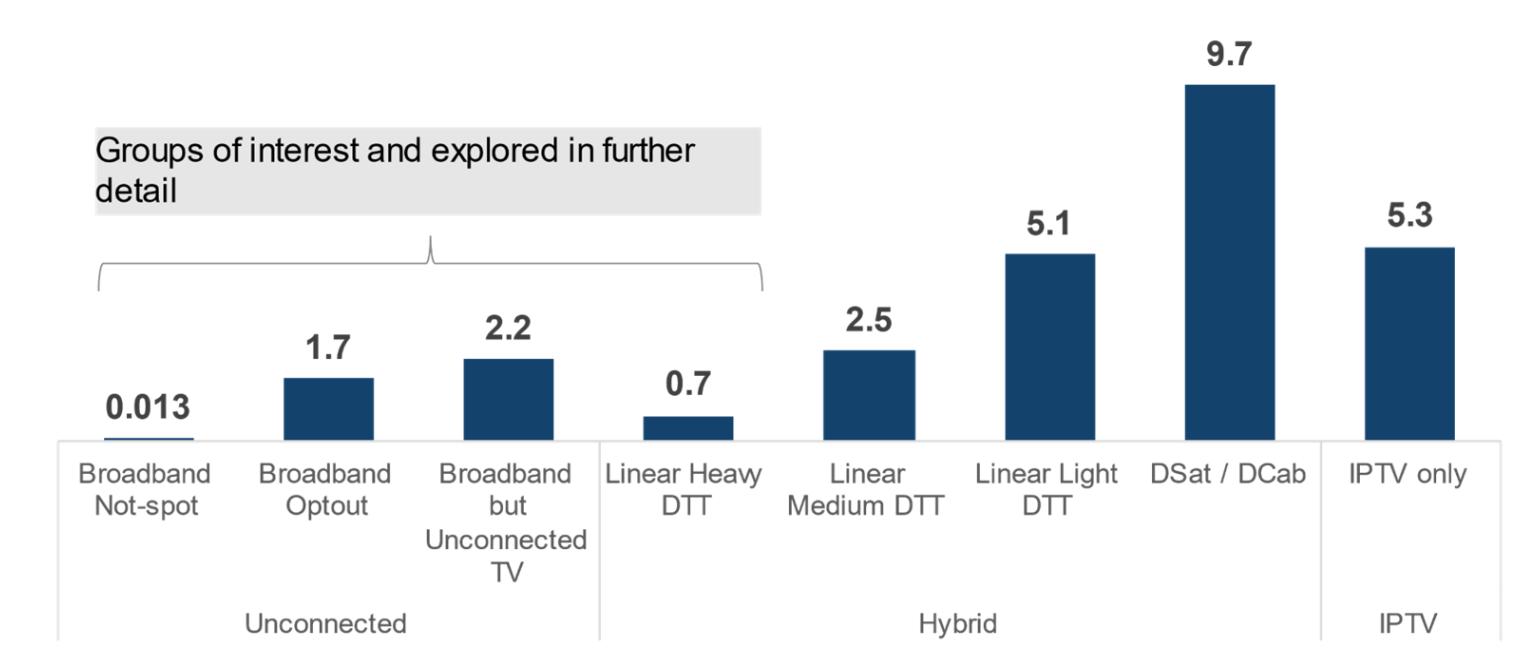
Figure 1: Size of unconnected TV and DTT hybrid groups vs. other segments, 2023 (source: Vernon et al, p.34).
By 2034, it is anticipated that the number of DTT-only and hybrid homes will have reduced and the number of IPTV-only homes increased.[footnote 18] However, the rate of change is disputed. In addition, any decision for an accelerated transition to IPTV would require interventions well in advance of 2034. As such, while we expect the numbers in each segment to change over time, this provides an indication of the scale of each challenge.
Table 1 sets out the core demographic characteristics of each segment. In Table 2, we map the key issues related to internet access and speeds that audiences face against the 6 audience segments in Table 1 to set out who is most affected by these challenges, potential solutions and risks. It is worth noting that several of the issues set out above affect all households, not just unconnected homes (segments 1-3). For example, it is important for all households to have access to reliable internet of sufficient speeds to be able to access IPTV. Furthermore, households currently accessing IPTV may face issues of affordability in the future.
| Segment | 1 | 2 | 3 | 4 | 5 | 6 |
|---|---|---|---|---|---|---|
| Description | Broadband Not-Spot | Broadband Optout | Broadband but Unconnected | Hybrid - DTT | Hybrid – DSat / DCab | IPTV only |
| DTT* homes in areas without any fixed-line broadband coverage or with broadband lines of <2 Mbps | DTT* homes without broadband access for reasons of affordability or choice | DTT* homes that have broadband access, but where the primary TV set is unconnected to the internet | Individuals in DTT homes with connected TV | Individuals in DTT homes with cable or satellite | IPTV only homes | |
| Households | 13k | 1.7m (1.4m DTT, 0.3m DSat) | 2.2m (1.8m DTT, 0.4m DSat) | 8.3m | 9.7m | 5.3m |
| Age | 93% 55+ | 92% 55+ | 55% 55+ | 34% 55+ | 33% 55+ | 9% 55+ |
| Gender | 54% female | 55% female | 53% female | 54% female | 54% female | 51% female |
| NRS | 82% C2DE | 79% C2DE | 55% C2DE | 41% C2DE | 44% C2DE | 46% C2DE |
| Household size | 1.2 | 1.2 | 1.8 | 2.3 | 2.6 | 2.6 |
| Disability | 43% | 41% | 14% | 15% | 15% | 8% |
Table 1: Key characteristics of audience segments, 2023 (source: Vernon et al, p.35-41)
| Issue | Cause | Segments affected | Scenarios affected | Context | Solutions | Size of issue in 2034[footnote 19] | Risks on way to 2034 |
|---|---|---|---|---|---|---|---|
| No/poor broadband. | Lack of infrastructure to cabinet/home. | 1 | ALL | By 2034 the majority of households in the UK will have access to adequate broadband for TV at cabinet or via 5G broadband. | The broadband USO provides every household/business in the UK with the right to request a ‘decent’ affordable connection, defined as a download speed of at least 10 Mbps. Those lacking available adequate broadband will need access via other technologies (e.g. Satellite). | Government goal is for Gigabit to reach all of UK in 2032[footnote 20]. | Rollout of adequate broadband is stalled, leaving larger groups without access. |
| No/poor broadband. | Poor ‘in home’ performance and reliability. | 4, 5, 6 | ALL | Repeated anecdotal evidence of poor in home performance of Wi-Fi – multiple causes. Potentially also affected by lack of household digital skills. | Consistent ‘in-home’ performance guarantees from suppliers. Clarity on responsibilities for addressing in home connection and reliability issues. | Data on this is currently limited. Additional data will be needed for planning on the number of homes that are experiencing poor performance because of technical issues. | Issues remain unresolved for some households. |
| No/poor broadband | Due to affordability | 2 NB members of other segments may face future affordability challenges due to changes in household income. | ALL | 26% of UK households declared struggling with telecoms costs in May 2025. This proportion has been relatively consistent since 2022, reaching its peak in 2024.[footnote 21] Current social tariffs do not meet needs.[footnote 22] | Low/no cost broadband for the most in need sufficient to support TV access. Other payment methods such as pay-as-you- go solutions. Solutions to low cost, or improved social tariff broadband options will likely need intervention beyond ISPs. | It will likely remain he case that around 20% of UK households (496,000) will still likely face telecoms affordability issues in 2034. | No viable solutions to lowering broadband costs. |
| No/poor broadband | Smartphone only access | All NB this is likely to be a more complex ‘digital cohort’ cutting across DTT and IPTV segments. | ALL | While 3% of those aged 16+ live in a household where the internet is accessed in the home only via mobile phone data[footnote 23], in 2023 17% of UK adults only went online using a smartphone.[footnote 24] This proportion has remained relatively stable over the last 5 years. This group also overlap with demographic segments from digital society studies such as social media focused users.[footnote 25] | Support for social context relevant access to broadband (maybe 5G broadband), consistent TV access solutions for smart devices, TV access in shared accommodation or other more complex circumstances. | ‘Smartphone only’ use is a complex mix of life stage and affordability. Given the growth in reliance on smartphones and similar devices we expect the proportion of UK population to be smartphone only to remain constant – 15% seems a reasonable estimate (7,965,000 adults).[footnote 26] | Lack of solutions for complex socio-economic and life stage circumstances. |
| No Smart TV | Older TV, or lack of appropriate device (e.g., Firestick, Apple TV). | 1 ,2, 3 | B, C | 70% of households, currently have a Smart TV.[footnote 27] However, by 2034 all sold TVs will be ‘smart’ and the majority of current TV sets will have gone through a replacement cycle. | Provision of basic ‘dongles’ (e.g., akin to the Firestick) | Current projections place smart TV ownership to reach 96% of households (99,200) by 2032.[footnote 28] | No solutions provided by government or industry. |
| Limited useability | Poor digital skills in home across: TV set up; TV use; broadband/Wi-Fi set up; Wi-Fi maintenance. | 1, 2, 3, 4, 5 Potentially additional groups depending on technology solutions. | B, C | In 2024, 52% of UK adults are unable to complete all of the essential digital skills (EDS) for work.[footnote 29] In 2023, 17.3% of adults lack confidence in the Minimum Digital Living Standard ‘functional skills’.[footnote 30] 7% of UK population lack EDS for life.[footnote 31] However, this means having less than 1 skill in each of the five Life Skill groups (less than 4 from 29 in total). 8% of UK adults cannot set up Wi-FI independently on a device (not router), this rises to 11% for NRS-grades C2DE, and 32% for over 65s.[footnote 32] Setting up a router is not on the EDS list. | Strong linkage to the DSIT Digital Inclusion Action Plan and following interventions. Regional and local support for digital skills. | It is likely that a proportion of UK population will remain limited users and have lower functional digital skills. 15% might be a reasonable estimate therefore (372,000 households). We may also need data on the number of homes experiencing poor performance because of limited in home skills. | A percentage of homes remain unable to use fully or in part IPTV services due to skills. |
| Limited useability | Poor/complex interface on IPTV devices. | All IPTV users | B, C | Current evidence indicates that at present, IPTV device interfaces are considerably more complex than DTT.[footnote 33] | Requirement for consistent interface design on IPTV solutions/smart TVs. Requirement for all to IPTV/smart TV solutions to have ‘simple’ mode. | Data on useability and likely numbers of households who will struggle with current designs is missing. Further data may be needed. | Complexity of IPTV interfaces will prevent full access for some groups (e.g., older adults with cognitive or physical decline; people with disabilities) |
Table 2: Key issues related to internet access and speeds required to access IPTV
Solutions
Addressing these challenges needs to take into account the broader digital context for UK citizens. Solutions must meet the audience “where they are.”
Connectivity uptake, reliability and speeds
Via Project Gigabit, the UK government expects that high-speed internet will be available to 99% of UK premises by 2032.[footnote 34] However, this does not imply that all households will have adequate access, as some may still be mobile only or outside of broadband and mobile signal.
Solutions
Current investments such as Project Gigabit and R100 in Scotland will likely deliver the levels of broadband speed and access needed for all three scenarios. However, this will need to be monitored. If installation programmes are falling behind schedule, or service is not being provided as required, further intervention in the infrastructure may be necessary. Consideration needs to be taken of mobile-only users and the potential to deliver IPTV via ‘unlimited’ data contracts and further spread of 5G or better mobile infrastructure.
Basic guarantees on speeds and reliability sufficient for IPTV to match DTT, available for all consumers, not just those on premium packages. Clear lines of responsibility, so consumers know who to contact when facing connectivity issues, with service and response time guarantees.
Affordability
The affordability of TV services and broadband is likely to remain an issue for many UK residents. This affects people across all age groups and life stages. The move to IPTV in full or part is likely to add to these overall costs.
Solutions
The current solutions for broadband affordability are ‘data banks’ and social tariffs. Data banks are inadequate for PSM and TV access needs as they are limited to data over mobile provision. Social tariff uptake is currently low at only 9.6% of all eligible households.[footnote 35] Of all (UK-wide) social tariff offers, only seven include speeds of at least 30Mbps, which we view as a minimum for IPTV access. Moreover, only one of these offers is currently priced below £20 a month and this offer is available only to recipients of Universal Credit with zero income.[footnote 36] Therefore, the cost for each consumer to access adequate broadband at present could start at £240 per year for sufficient speed at today’s costs. Previous work suggests that affordability for such services is £11-15 per month (see Audiences Working Group Paper 1: ‘Universality in the Future of TV Distribution’). If we assume that 1.5 million households are in the most profound need and cannot afford this (although the Digital Poverty Alliance estimated this number to be between 2-4 million households in 2023[footnote 37]), the cost/value gap could exceed £144 million per year at today’s rates. How this might be addressed by government or industry remains unclear. This would still leave the costs of accessing IPTV significantly higher than current DTT. However, as we noted above, all scenarios involve the necessity for some form of digital access.
This issue of cost is presently a concern for digital access, distinct from television use. There is a question regarding where the value for moving citizens online resides. Citizens utilising digital services and media may enable reductions in delivery costs across everything from health and social services to TV delivery. There is a policy question as to how this value is shared between organisations and citizens, especially for the most vulnerable. Good Things Foundation’s Data Poverty Lab report contains recommendations to address these issues.[footnote 38]
Skills/usability
The issue of skills is a challenge across digital inclusion interventions and the rollout of digital solutions for both domestic and work use. On a practical level, the rollout of IPTV and other new technologies in all three scenarios presents a challenge to technology acceptance. Technology acceptance models (TAM)[footnote 39] highlight two key factors that support user engagement:
- Perceived usefulness – the extent to which a person believes that using a technology would enhance the task they are engaged in.
- Perceived ease-of-use—the extent to which a person believes that using a technology would be free from substantive effort.
Ventakesh and Davis have identified four further factors that affect people’s acceptance of new technologies:[footnote 40]
- Performance expectancy, parallel to perceived usefulness, is the degree to which an individual believes that using the system will help them improve their performance of a particular task.
- Effort expectancy, parallel to perceived ease of use, is the degree of effort associated with using the system.
- Social influence is the degree to which an individual perceives that significant others believe they should use the new system.
- Facilitating conditions are the degree to which an individual believes that an organisational and technical infrastructure exists to support the use of the system.
Such work indicates, therefore, that skills training alone will not address the challenges of usability set out above. Solutions need to combine usable technology design and support structures with skills training.
-
Homes that have a smart TV or connected device that is connected to the internet, based on 3 Reasons data provided in Vernon et al (2024) Future of TV Distribution, p.8, 34. ↩
-
Vernon et al (2024) Future of TV Distribution, p.33. ↩
-
In 2023, viewing of live broadcast TV made up 40% of all in-home viewing across all devices, while on-demand viewing (to video-sharing platforms [VSPs], SVoD/AVoD/BVoD) made up 39%. However, live TV viewing declined by 9% from 2022, while viewing of BVoD increased by 29%, of VSPs increased by 12% and of SVoD/AVoD increased 6%. See Ofcom (2024) Media Nations, UK 2024, p.6-7. ↩
-
We are reflecting here the shift of media services (such as video, newspapers, podcasting) and other vital public and civic services (such as healthcare and banking) to online and digital provision. ↩
-
In 2023, 13-19m people aged 16+ were estimated to be in digital poverty in the UK, see Deloitte (2023) Digital Poverty in the UK: A socio-economic assessment of the implications of digital poverty in the UK, p.5. In 2024, 7.9m people aged 18+ lacked basic digital skills, see Lloyds (2024) UK Consumer Digital Index, p.32. ↩
-
Research by Blue Marble for Ofcom indicates that those who find it challenging to complete important activities online feel concerned about not being able to keep up with an increasingly digital society and describe feeling forgotten. Some disabled people have described going online as having a negative impact on their health. There is a risk, therefore, that a forced transition to IPTV might simply reinforce digital disadvantage typically experienced by people already disadvantaged due to disability, insecure housing, class/ethnicity and/or low incomes. See Blue Marble/Ofcom (2025) Exploring Digital Disadvantage, p.3-7. ↩
-
Vernon et al (2024) Future of TV Distribution, p.8. ↩
-
Disney dropped its linear channels in the UK in 2020 to focus on its streaming service, Disney+. In Sweden, Boxer TV, a multi-channel pay-TV service, switched delivery of its line-up of over 50 channels from DTT to streaming-only in 2025. ↩
-
Ofcom (2025) Connected Nations update: Spring 2025. ↩
-
Lloyds (2024) UK Consumer Digital Index, p.13. ↩
-
Ofcom (2025) A demographic deep dive into internet adoption: Analysis using Ofcom’s Technology Tracker 2024, March. ↩
-
Vernon et al (2024) Future of TV Distribution, p.71. Figures from EY/Broadcast 2040, projected that 5.5m premises (18%) in the UK are likely to be without highspeed broadband by 2040. However, this figure does not take into account full fibre rollout and includes non-residential buildings. See, EY/Broadcast 2040 (2024) TV Distribution in 2040, p.7. ↩
-
Ofcom (2023) Connected Nations: UK Report 2023, p.36. ↩
-
Ofcom (2024) Future of TV Distribution: Early market report to government, p.32-33. ↩
-
Fletcher, Y (2025) ‘Digital Voice and the landline phone swtich-off: what it means for you’, Which, 10 June. https://www.which.co.uk/reviews/broadband/article/digital-voice-and-the-landline-phone-switch-off-what-it-means-for-you-aPSOH8k1i6Vv ↩
-
Blue Marble/Ofcom (2025) Exploring Digital Disadvantage, p.3. ↩
-
Lloyds (2024) UK Consumer Digital Index; Audiences Working Group Paper 1: Universality in the Future of TV Distribution. ↩
-
Vernon et al (2024) Future of TV Distribution, p.70-71. ↩
-
Population estimates from ONS (2025) National Population Projects: 2022-based. ↩
-
Clark, A (2024) Gigabit Broadband in the UK: Government targets, policy, and funding, CBP 8392, House of Commons Library. ↩
-
Ofcom (2025) Affordability of Communication Services, Q1 2025. ↩
-
Tyrell, B et al (2023) GMCA Digital Inclusion Pilot: Research Report, University of Liverpool/GMCA. ↩
-
Ofcom (2025) Technology Tracker. ↩
-
Ofcom (2024) Adults’ Media Use and Attitudes Report, p.6, 37. ↩
-
Yates, S et al (2020) ‘Who are the limited users of digital systems and media? An examination of UK evidence’, First Monday, June. ↩
-
82% of UK adults used a smartphone to go online in 2023, up from 70% in 2017 (Ofcom (2024) Adults’ Media Use and Attitudes Report, p.41). However, it is worth noting that segments 1 and 2 (those that currently do not have broadband in the home) are also far less likely to own a smart phone than the other segments, with 16% and 17% respectively owning a smartphone in 2023 (Vernon et al (2024) Future of TV Distribution, p.42). As such, it is important not to assume that those without broadband will be able to access IPTV via a smartphone. ↩
-
Ofcom (2025) Technology Tracker. ↩
-
Ofcom (2024) Future of TV Distribution: Early market report to government, p.15. ↩
-
Lloyds (2024) UK Consumer Digital Index, p.50. ↩
-
Yates, S et al (2024) A Minimum Digital Living Standard for Households with Children: Survey findings report, University of Liverpool, March, p.16. ↩
-
Lloyds (2024) UK Consumer Digital Index, p.39. ↩
-
Setting up a Wi-Fi connection on a device remains the hardest of the essential digital skills for life to achieve. See Lloyds (2024) UK Consumer Digital Index, p.35. ↩
-
Research suggests that vulnerable audiences (defined in terms of demographic, physical/cognitive impairments and literacy) currently experience connected TV sets as having ‘busier navigational interfaces’ that lack consistency of design across services/devices. See, If (2024) TV Interfaces and Vulnerable Users: A summary report for Ofcom, p.11. Research also suggests that older female audiences, in particular, struggle with smart TV interfaces. However, this may be a consequence of long-standing negotiated gender dynamics within the home, rather than solely the consequence of skills deficits. See Johnson, C et al (2025) ‘Default Viewing: Reconceptualising choice and habit in television audience research’, Media, Culture & Society, 47(5), p.905 and Johnson, C et al (2024) ‘An Audience Studies’ Contribution to the Discoverability and Prominence Debate: Seeking UK TV audiences’ “routes to content”’, Convergence, 30(5), p.1636-7. ↩
-
Project Gigabit: https://www.gov.uk/guidance/project-gigabit-uk-gigabit-programme ↩
-
Ofcom (2024) Pricing Trends for Communications Service in the UK, p.58. ↩
-
Ofcom (2025) Social tariffs: Cheaper broadband and phone packages: https://www.ofcom.org.uk/phones-and-broadband/saving-money/social-tariffs. ↩
-
Deloitte (2023) Digital Poverty in the UK, p.22. ↩
-
Knowles, S and Stone E (2025) Tackling data poverty: Innovation and collaboration – The Data Poverty Lab 2025 Report, Good Things Foundation/Nominet. ↩
-
Davis, FD (1989) ‘Perceived Usefulness, Perceived Ease of Use, and User Acceptance of Information Technology’, MIS Quarterly, 13(3); Ventakesh et al (2003) ‘User Acceptance of Information Technology: Toward a unified view’, MIS Quarterly, 27(3). ↩
-
Ventakesh, V and Davis FD (2000) ‘A Theoretical Extension of the Technology Acceptance Model: Four longitudinal field studies’, Management Science, 46(2). ↩