Stakeholder Forum Papers: Audience - Audience impacts in future of TV distribution
Published 23 June 2026

© Crown copyright 2026
This publication is licensed under the terms of the Open Government Licence v3.0 except where otherwise stated. To view this licence, visit nationalarchives.gov.uk/doc/open-government-licence/version/3 or write to the Information Policy Team, The National Archives, Kew, London TW9 4DU, or email: psi@nationalarchives.gov.uk.
Where we have identified any third party copyright information you will need to obtain permission from the copyright holders concerned.
This publication is available at https://www.gov.uk/government/publications/future-of-tv-distribution-stakeholder-forum-papers/stakeholder-forum-papers-audience-audience-impacts-in-future-of-tv-distribution
A paper independently produced by the Audiences Working Group ahead of the ## Future of TV Distribution Stakeholder Forum.
1. Introduction
The aim of this paper is to assess the positive and negative impacts for audiences of the three different options for the future of TV distribution: DTT upgrade, IPTV transition, and DTT nightlight.
The main body of the paper represents the Audiences Working Group’s collective assessment of the positive and negative impacts of each option, recognising that how each option is implemented will play a major role on these impacts. The paper does not represent an endorsement of these positions by any single Audience Working Group member. We also include a series of Annexes where members of the Audiences Working Group set out their position on key aspects of the future of TV distribution. These are not endorsed by, and do not represent the position of, all members of the Audiences Working Group. They are included to provide space for important points of difference between Audience Working Group members and/or for more detailed exploration of key issues.
2. Likely scenarios in 2034
Current direction of travel:
As we set out below, audiences are gradually transitioning from DTT to IPTV. From 2018 to 2023, the number of IPTV-only households increased from 1.3 million to 4.3 million while the number of DTT-only households decreased from 7 million to 3.9 million. Most households are in hybrid homes, and this number is declining less quickly (from 18.7m to 17.9 million from 2018-2023).[footnote 1] Despite a small decrease from 2023 to 2024, the TV set remains central to viewing – in 2024, 84% of in-home viewing was through the TV set.[footnote 2]
It is hard to ascertain how much time audiences in hybrid homes are spending on DTT vs IPTV. The University of Exeter ‘Future of TV Distribution report’ indicates that those in hybrid homes spend most of the time watching linear television (via broadcast or IP), but that this figure has declined from 162mins per person per day (73% of overall viewing) in 2018, to 120 mins per person per day (57%) in 2023. Over the same period, the viewing of BVoD and SVoD per person per day in hybrid homes increased from 33 mins (15%) to 60 mins (29%).[footnote 3] The increased viewing of BVoD and SVoD by hybrid audiences over this time suggests a gradual movement away from DTT and away from watching linear broadcasting.
In 2024, broadcaster content (consumed via broadcast or BVoD) made up the majority of Barb-measured in-home video viewing (56% in 2024, down just one percentage point since 2023), while viewing of SVoD/AVoD services accounts for just 15% of all in-home viewing.[footnote 4] While it is difficult to ascertain exactly how much of the viewing of broadcaster content is via DTT, this data suggests the despite increases in viewing of SVoD/AVoD services, broadcaster services (whether viewed via DTT or IPTV) remain central to UK audiences. However, a generational difference remains in viewing behaviour, as can be seen in this chart from Ofcom’s 2025 ‘Media Nations’ report.[footnote 5]
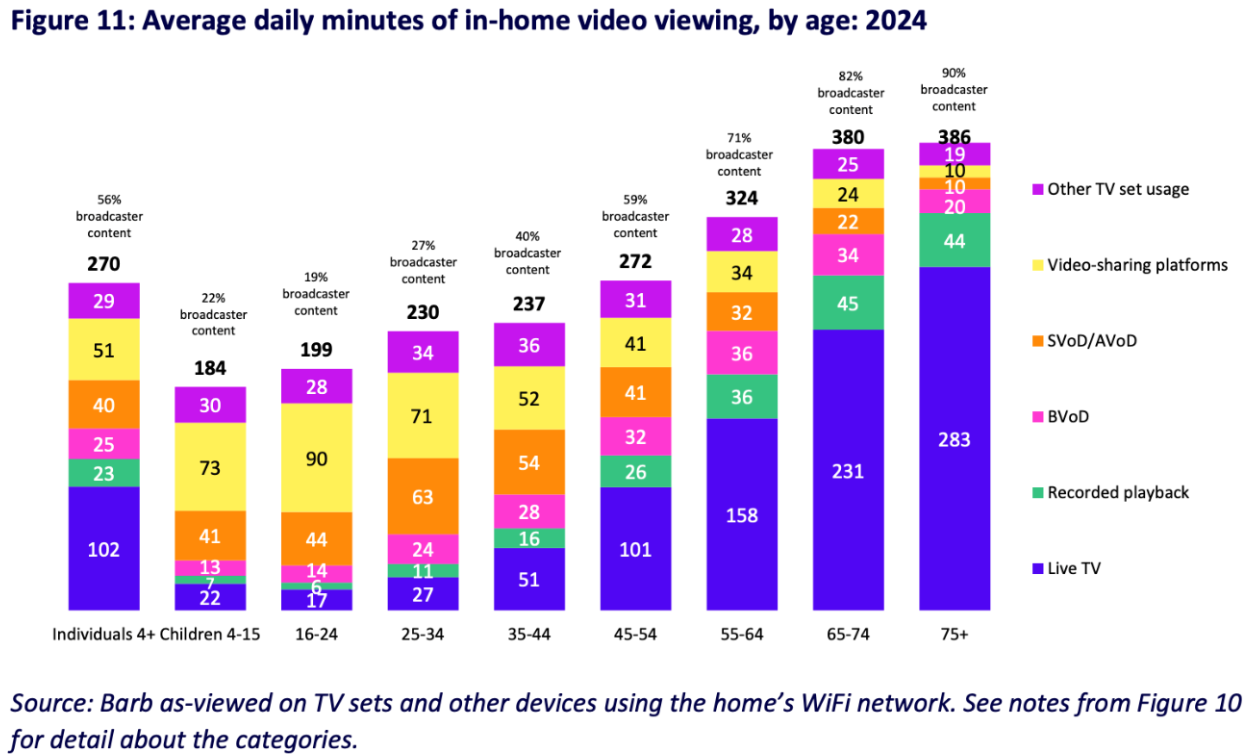
This data indicates that older audiences spend more time watching broadcaster content and live TV (on DTT and IPTV) than younger audiences, while younger audiences spend more time watching video-sharing platforms and SVoD/AVoD services.
University of Exeter ‘Future of TV Distribution’ report predictions for 2035:
Research for the DCMS predicts that by 2035, IPTV-only households will have increased to 17.8 million with DTT-only households decreasing to 1.9 million and hybrid homes to 9.2 million.[footnote 6]
These forecasts are based on several assumptions:
1. The broadband rollout will continue and that by 2040 92.6% of homes will have at least superfast fixed-line broadband of 30Mbps or above, and only 1.4% of homes will be without broadband.
2. That 100% of all TV sets sold by 2025 will be internet-connected and that 94% of homes will have an IP-connectable television set as their primary set by 2030, rising to 99% by 2040.
3. That PSBs will continue to increase the availability of linear content and channels over IPTV and that linear-IP content via conventional EPGs will grow (e.g. via the likes of Sky Stream/Glass and Freely).
4. That there is no material change to DTT distribution or the Freeview content offer.
5. That no material changes result from the implementation of the Media Act (which had not been passed when the report was written).[footnote 7]
As with all forecasts, these predictions do not necessarily reflect what will happen. As indicated by the DCMS, the report does not account for the fact that late adopters are likely to have greater challenges in adoption, doesn’t adequately consider the fact that digital skills do not remain over the course of a lifetime, and assumes that if a household already has broadband and uses IPTV they will not revert back to DTT.[footnote 8] For these reasons, the report may over-estimate the speed of transition from DTT to IPTV.
Currently, DTT-only and linear heavy DTT households are more likely to have one or more of the following characteristics:
- over 55 years old
- C2DE socio-economic groups/lower incomes
- live in smaller households
- female
- have a disability.
This is particularly the case for those households that are currently without access to broadband (because of access, affordability and/or choice).[footnote 9] There are, therefore, intersectional inequalities at work for those most dependent on DTT and these are unlikely to change by 2034 without intervention.
3. Summary of key positives and negatives for audiences
Table 1. Summary of audience impacts by option
| TV transition option | Positives | Negatives |
|---|---|---|
| DTT upgrade | 1. Continuity: DTT upgrade presents the smallest possible disruption for audiences. Neither DTT only, hybrid, nor IPTV only homes would need to change their established ways of accessing TV. | 1. Diminished service offering: If broadcasters rationalise their DTT offering in favour of IP-only delivery, DTT-only households might, without adequate policy intervention, experience diminished offering of channels and content. |
| DTT upgrade | 2. Affordability and Accessibility: 2.a Costs: DTT only households unconnected to the internet would not face additional recurring broadband costs. 2.b Skills: People with little to no digital skills would not have to learn additional skills (e.g., setting up broadband, connecting TV set to broadband, setting up accounts, navigating smart TV interfaces) 2.c Safety net: If costs or skills required to access IPTV became too high for households, DTT would remain as a means of accessing TV. | 2. Less PSB investment in content/services: PSBs would have to support two TV delivery infrastructures. Without additional intervention, spend on PSB content/services would suffer. |
| DTT upgrade | 3. Reliability: Clear service obligations on providers. Maintenance responsibilities borne by users are over their TV sets/aerials only. | 3. Costs to households: A small number of households will be required to upgrade their TV sets to be able to receive DVB-T2. |
| DTT upgrade | 4. Ensures choice and universal access for all: DTT upgrade preserves choice for audiences and maintains near universal reach for the most vulnerable in society not able to afford broadband. Particularly important for national emergencies (e.g. COVID-19). | 4. Reduce support for digital inclusion: Continuity may draw attention away from addressing and investing in the barriers to adoption of IPTV and addressing digital inequality. DTT upgrade requires capital expenditure which might otherwise be spent on broadcast affordability and accessibility. |
| IPTV transition | 1. Full access to PSB and free commercial services: All households would have access to the same offering of PSB and commercial broadcasters’ content, as there would not be a 2-tier system with some households accessing diminished DTT offering while others access full IPTV offering. | 1. Affordability and Accessibility: 1.a Costs: Of the 2.8m UK adults aged 16+ living in a house with no internet access, 27% (0.76 million) indicated cost as a reason for not accessing the internet.[footnote 10] DTT households unconnected to the internet could risk losing TV access due to recurring broadband costs and/or one-off equipment upgrade costs (e.g. updating TV set), unless this was fully funded. 1.b Skills: Viewers in households unconnected to the internet, in households with older TV sets, and in households where TV sets are not connected to broadband (even if possible) due to lack of skills would need to learn new skills. |
| IPTV transition | 2. More PSB investment in content/services: Financial savings for broadcasters who would not have to support two TV delivery infrastructures, which may be passed on to audiences via investment in content/services. | 2. Upskilling costs and take-up 2.a. Costs: The cost of providing digital skills training and assistance for the government/PSBs/ISPs. 2.b. Take-up: The challenges of getting people to take-up training. |
| IPTV transition | 3. Digital inclusion: If digital inclusion is placed at the heart of an IPTV transition, there could be significant benefits in terms of digital upskilling and wider gains from extending digital access. | 3. Broadband access and uptake: Uptake lags behind broadband availability because of skills, costs and interest particularly in already vulnerable audiences. Without an intervention targeting broadband uptake (rather than solely coverage), older, less able and more economically deprived audiences face a risk of further disadvantage. |
| IPTV transition | 4. Advanced accessibility functionality: Enables customisation for different sensory needs (e.g. accessible EPG, high-contrast picture settings, voice guidance, sign language). With intervention, all TVs could have a ‘simple mode’ accessible for all, and DTT-like interfaces could be replicated to preserve traditional navigation. | 4. Service standards: Increased demand from streaming could create a worse internet experience for users more broadly without intervention. The slower speed of many broadband social tariffs might result in worse experience for lower income households that does not meet Minimum Digital Living Standards.[footnote 11] This would particularly affect the ability of households to undertake multiple tasks simultaneously (watching TV, working from home etc.). |
| IPTV transition | 5. Avoids a double transition: One moment of transition means that those households without DVB-T2 equipment would not have to acquire it. However, this is expected to be a small number of households. (Estimated to be c.1 million in 2030 – of a similar scale to those who would be impacted by IPTV transition) Ofcom, Future of TV Distribution: Early market report to government, May 2024 | 5. Reliability: IPTV is not subjected to the same uptime technological standards as DTT is currently. As TV is relied on in emergency events, specific reliability requirements for service uptime and hardware performance would be needed. |
| DTT/DSAT Nightlight | 1. More PSB investment in content/services than DTT Upgrade: Nightlight might be initially cheaper than DTT Upgrade, which may be passed on to audiences via investment in content/services. | 1. Less PSB investment in content/services than IPTV Transition: As with DT Upgrade PSBs would have to support two TV delivery infrastructures. Without additional intervention, spend on PSB content/services would suffer. |
| DTT/DSAT Nightlight | 2. Access: It might be easier to ensure access to essential television services for vulnerable and unconnected populations, particularly in the nations and regions, as Nightlight would require small to no training and assistance compared to full IPTV transition. | 2. Double transition: Nightlight postpones full IPTV transition by 2 to 8 years. DSAT Nightlight would require two potentially costly transitions for households (i.e. to satellite first and 2-8 years later to IPTV). |
| DTT/DSAT Nightlight | 3. Resilience: Nightlight could provide a resilient ‘back-up’ solution for national communication strategy and for internet outage situations. | 3. Diminished service offering: Nightlight services will likely be constrained to core PSB offering. |
| DTT/DSAT Nightlight | 4. Continuity: Maintains continuity, reliability, ease of use and low cost for audiences and access to DTT on secondary sets. | 4. Reduced support for digital inclusion: Continuity may draw attention away from addressing and investing in the barriers to adoption of IPTV and wider digital inequality. |
Looking across these positives and negatives, we note the following key points:
All options:
- Those audiences most impacted by changes in TV distribution are older households, households with people with disabilities, and lower income households. This needs to be at the forefront of any decision-making.
DTT Upgrade and DTT Nightlight:
- DTT Upgrade and DTT Nightlight offer greater continuity and choice for all audiences.
- DTT Upgrade and DTT Nightlight maintain universal access to TV without increasing costs for audiences or requiring upskilling. However, the DTT Upgrade and Nightlight are likely to require a small number of households to upgrade their TV receiving equipment. These options also do not require investment in skills and broadband accessibility by government and/or industry.
- DTT Upgrade and DTT Nightlight require broadcasters to continue to invest in two sets of distribution costs. Without policy intervention, this may reduce the amount of money available for PSB content and for the improvement of PSB services (e.g. increased functionality), without additional funding for PSB, although this may be less in the Nightlight option.
- DTT Upgrade and DTT Nightlight are likely to provide a more limited range of channels compared to IPTV.
- DTT Upgrade and DTT Nightlight could reduce the incentives for industry and government to invest in support for digital inclusion and increasing access and usability of IPTV.
- DTT is underpinned by reliability standards which are not currently in place for IPTV. Lines of responsibility are more straight forward for DTT, making it easy for audiences to know who to go to when things go wrong.
- DTT Nightlight would provide a ‘back up’ service offering greater resilience in our national communication infrastructure.
DSAT Nightlight
- DSAT Nightlight would be less accessible than DTT Nightlight due to the costs associated with the temporary purchase and installation of satellite equipment, but would offer full coverage.
IPTV transition:
- IPTV has the potential to offer greater accessibility features and, with intervention, could make TV more accessible and replicate familiar DTT viewing experiences.
- Full IPTV transition would reduce distribution costs for PSBs which could provide them with more funds to spend on content and improved services for audiences if funding/revenues remain stable.
- Full IPTV transition avoids a double transition, which would be required in the case of DTT Nightlight which is a temporary solution.
- Full IPTV transition poses exacerbated risks of disadvantaging already vulnerable audiences, who are less able to afford and operate broadband or connected TV equipment.
Principles for any decision on the future of TV distribution:
The full impact of each option on audiences depends on how that option is designed. To ensure that audience needs are met, any decision should be based on the following principles:
1. Maintain universal access to PSM:
a. Ensure that all audiences, regardless of whether they use DTT or IPTV, have access to the full range of TV content and services required to meet PSM remits.
b. Ensure that PSM is available, affordable and accessible, recognising that this would require dedicated and ongoing financial and skills support in the case of IPTV transition, and that this support would need to extend beyond the transition period given that a household’s ability to afford and use broadband and IPTV can change over time.
2. Ensure PSM content and services are prominent and easy to access.
3. Not pass additional costs incurred by government and/or industry (e.g. capital investment, upskilling etc.) onto audiences and minimise other costs ensuring that vulnerable audiences and those on lower incomes do not have the shoulder the costs of transition.
4. Provide a reliable service, with clear contractual responsibilities and simple processes, guarantees and technical support for audiences when things go wrong.
5. Be underpinned by common usability standards, providing a simple experience for those who choose it designed to meet the needs of the most vulnerable.
6. Be based on ongoing engagement with audiences with audience interests at its heart.
Below we assess the positive and negative impacts of each option in more detail (Sections IV to VI) before ending with an assessment of the range of channels audiences need for the distribution mechanism to be worthwhile (Section VII), the costs of each option (Section VIII) and a glossary (Section IX).
4. DTT upgrade
This option reflects an evolution of the current hybrid option, allowing households to choose between DTT, IPTV, or a combination of the two (potentially by different generations).
A. Positive impacts
1. Continuity
DTT upgrade presents the smallest possible disruption for audiences. DTT remains a vital platform, with 49.6% of UK households relying on it for primary or secondary television access as of 2024 and 4.6 million relying on DTT for all or most of their TV viewing in 2023 and 11.1m expected to be in hybrid or DTT-only homes in 2035.[footnote 12] Neither those households that rely on DTT for all or a significant amount of their viewing, nor those in IPTV-only households, will need to change their established ways of accessing TV.
Currently DTT prioritises easy access to live linear TV, while most smart TVs and connected devices prioritise access to on-demand television, which older audiences, in particular, find harder to use.[footnote 13] As set out above, live linear TV viewing (on DTT and IPTV) accounts for the vast majority of viewing for those over 65 and this figure is relatively unchanged since 2019.[footnote 14] Given the importance of live linear TV, particularly to older audiences, unless there were changes to the way in which IPTV delivers television to viewers (e.g. simple interface design that provides easy access to linear TV on smarts TVs and connected devices), the DTT Upgrade option would ensure that these audiences are able to continue to access the television that they often depend on TV for news, information and companionship.[footnote 15]
2. Affordability and accessibility
a. Costs:
DTT-only households unconnected to the internet would not face recurring broadband costs. Upgrading DTT would prevent the need to ‘force’ people to move to online services to access TV. Evidence from other sectors suggests such nudging techniques regularly failing to support the most disadvantaged with sizeable majorities being either disadvantaged or disenfranchised, with examples including banking,[footnote 16] healthcare,[footnote 17] education,[footnote 18] and other services.
b. Skills:
DTT upgrade will not require upskilling for people to continue to access TV and PSB. Older people, those with disabilities, and those who for whatever reason lack digital confidence, have a lifetime of knowledge in using key functionality of DTT technology. Research demonstrates that logical channel numbering and traditional navigation via a DTT interface has most success compared to other navigation routes for those over 65.[footnote 19] These functions are not currently available as standard on all smart TVs and connected devices.
DTT upgrade removes the need for additional skills to access TV, such as setting up accounts, understanding the use of personal data and/or security concerns, or managing broadband. The recent digital telephone switchover has shown that for those who are digitally non-confident, setting up broadband routers is challenging, and the DSIT Telecare Action Plan was created to support the most at risk. This is not limited to older people, as 17% of parents lack basic skills such as setting up an email address. [footnote 20]
c. Safety net:
DTT upgrade would provide a valuable ‘safety net’ if the costs or skills required to access IPTV become too high for households. For example, in Northern Ireland the proportion of households relying solely on DTT without cable/satellite or an IPTV service increased to 49% in Q1 2025, up from 42% in Q1 2024.[footnote 21] This rise is linked to a decline in uptake of traditional paid-for TV services such as Sky or Virgin Media. Although there are free IPTV services (such as BBC iPlayer and ITVX), the fact that these households relied solely on DTT after cancelling their pay-TV services, underlines the continued importance of DTT as a safety net - even for those who may have previously used IPTV services. Cost-of-living pressures or significant life changes, such as the onset of disability or ageing, are important factors to consider when ensuring people have access to TV services in the future
3. Reliability
DTT upgrade ensures near universal access to a reliable TV service because Arqiva is held to required levels of service that IPTV is not presently required to meet. It is currently unclear whether IP technology can guarantee an equivalent level of services to DTT and, if it were, if the costs of doing so would be prohibitive, given that higher service standards in broadband are generally associated with higher minimum retail process. A communication network that is not reliant on broadband also provides a level of resilience through an alternative network in the event of internet outages, especially with most other communications now reliant on broadband, including landline phone calls.
In addition, DTT technology lacks the complexity of IPTV, making it easy for audiences to know who to go to when things go wrong.
4. Ensures choice and universal access for all
DTT technology has already achieved near universal reach. DTT upgrade would preserve choice for audiences, allowing for continued ease of access to PSB channels for all audiences, while those able to access IPTV can still access specific features such as on-demand video streaming. For the most vulnerable in society unable to afford and/or confidently use broadband and online services, DTT upgrades preserves access to vital TV services, particularly important at times of national crisis (e.g. COVID-19).
B. Negative impacts
1. Diminished service offering
As more households migrate to IPTV, the cost of upgrading and maintaining DTT infrastructure could become less financially viable for broadcasters. This could lead to a reduced offering if commercial broadcasters withdraw channels from DTT. Disney, for example, dropped its linear channels in the UK in 2020 to focus on Disney+. This, alongside the move of children’s services by ITV to its BVoD ITVX, has diminished children’s services on DTT which has specific negative impacts for disabled children and children from lower socio-economic backgrounds who are more likely to rely on DTT and DSAT.
As the Media Act 2024 allows PSBs to meet their remit through a mix of broadcast channels and online services, digitally excluded audiences might be at risk of diminished offering not only from commercial broadcasters, but also PSBs.[footnote 22]
Because most new usability and accessibility improvements in smart TVs and connected devices are being developed for IPTV, continuing to maintain DTT as a parallel system would likely result in a two-tier experience, where, without intervention, IPTV audiences benefit from a wider range of channels, a wider range of both public service and commercial broadcaster content, and enhanced accessibility features while DTT viewers are left with an overall limited experience.
2. Less investment in PSBs content/services
The DTT upgrade option would require PSBs to continue to cover the costs of funding two parallel TV distribution infrastructures. Without intervention, this would negatively impact their budgets and reduce the money available for PSBs to spend on content and services.
3. Costs to households
An upgrade to DVB-T2 would require retuning of TV sets. This would be a fairly simple procedure for audiences, but it would need to be communicated clearly ahead of an upgrade. In addition, a small number of households may have to replace their TV if they do not have a DVB-T2 tuner.
4. Reduced support for digital inclusion
Upgrading the DTT system may reduce the incentive for the government and industry to invest in supporting digital inclusion.
5. Full IPTV transition
This section reviews the potential positive and negative impacts on audiences of a full transition to IPTV. It is important to stress that the identification of vulnerable audiences and the quality of any national campaign to support them in a future IPTV transition will necessarily impact the positives and negatives on audiences. The review below therefore represents the full range of potential impacts, positive and negative, and notes that their likelihood is predicated on the success of a substantial and comprehensive switchover campaign.
A. Positive impacts:
1. Full access to PSB and free commercial services
IP transition would guarantee access to the full range of services provided by PSBs [footnote 23] and commercial broadcasters alike (i.e. linear channels delivered over IP, linear channels accessed via an EPG, and all streaming services – both PSB and commercial) and would avert a scenario where audiences receive different content propositions based on their distribution technology.
As the paper references above (see: IV, B. 1.), broadcasters are already beginning to rationalise their channel portfolios,[footnote 24] and this is likely to continue in the period to 2034. In the event of a full IPTV transition, a ‘two-tier’ system would be avoided.
2. More investment in PSB content/services
An IP transition could also support ongoing content/service investment by the PSBs by freeing up funds that would otherwise be spent on distribution costs. Those costs can be split into two categories.
1. Money saved from financial investment in a platform reaching a declining number of homes and/or used to contribute to a ‘nightlight’ (i.e., investment into DTT to upgrade it to DVB-T2; investment in DSAT to contribute to any platform re-build costs);
2. Money saved by the broadcasters from no longer having to support multiple methods of TV distribution;
The impact on audiences – of the second bullet in particular – would be more money for the PSBs to spend on delivery of their public purposes versus a counterfactual where the PSBs commit to maintaining multiple distribution technologies and are therefore more cost constrained than they otherwise would be.[footnote 25]
As Ofcom’s recent PSM Review noted: ‘PSB revenues from licence fee and linear TV advertising have declined by more than a quarter in real terms in 2016, with growth in BVoD revenues failing to compensate.’[footnote 26] Stable and adequate funding will be required to sustain a broad range of PSM content in future, and, although the future of TV distribution is distinct from PSB funding itself, reducing the cost base of the PSBs would be a factor in enabling them to continue supporting the key genres which are essential for PSM delivery.
3. Digital Inclusion
While it is clearly not the TV sector’s role to lead a UK-wide transition (given the broader economic and social benefits of getting more households online),[footnote 27] a transition to IPTV could be one component of a more coordinated approach to improve digital inclusion and skills, and to increase broadband uptake across the country.[footnote 28] However, it is important to note that many digital skills initiatives have failed (both locally and nationally). Two thirds of the population have stated they would improve their digital skills if there was free support – despite such free support being widely available.[footnote 29] Any package of support would therefore need to be designed in a new way, and for the most vulnerable would need to be in-home support tailored to the needs of using IPTV, including the TV itself, and associated accounts and internet use.
4. Advanced accessibility functionality
As this Working Group has already noted, IPTV is also more capable than DTT in terms of accessibility and functionality. On the Freely UI, for instance, viewers are able to select an Accessible TV Guide (or ‘Accessible EPG’) which has been designed to be easier to read and which has functionality which allows it to be modified for extra clarity – DTT is not capable of these kinds of changes. Likewise, accessibility settings on Sky Stream are also highly capable, and allow audiences to permanently turn on audio descriptions or subtitles, turn on high contrast picture settings, turn on voice guidance, and to highlight programmes in the TV guide which have subtitles, audio description and/or sign language available.[footnote 30] Making this type of functionality available to all audiences, as quickly as possible, would be a significant benefit of a full transition. It must be noted that these features need to be made easy to use and access for viewers and that some viewers would need to be trained in how to access and use these features.
5. Avoids a double transition period
IPTV Transition would avoid a double transition period. The risks of DTT upgrade and nightlight (DTT or DSAT) in this context are clear: homes that do not currently have DVB-T2 / satellite equipment would have to acquire it, undergo an initial transition period themselves, and then ultimately transition to IPTV at a later date, although we anticipate that the number of homes would be small (see below). While it is difficult to quantify how many households would be subjected to this (i.e. households still not able to consume TV over IP, even after a term of DVB-T2 / a ‘nightlight’), reducing the burden on them from a cost, logistical and organisational perspective would be a positive outcome.[footnote 31]
B. Negative impacts:
1. Affordability and accessibility
a. Costs:
One of the major differences between DTT and IPTV is affordability and the cost profile by household – a broadband subscription is an ongoing cost, whereas the installation of a TV aerial is a one-off cost (and the aerial itself rarely needs to be replaced). Therefore, TV households that do not have internet access at the time of transition – whether because of cost, digital skills, or vulnerability – and that want to continue to access TV services post-transition, may be subjected to costs that they were not before. Similarly, households that do not have access to IP-enabled equipment at the time of transition would also likely incur costs to upgrade their TV equipment (whether this is represented by a smart TV, or an IP-enabled ‘dongle’ to make a TV smart). However, current forecasts indicate that these numbers are likely to be small.[footnote 32]
b. Skills:
An additional negative impact on audiences of a full IP transition could be usability, and the exclusion of audiences who do not have the required digital skills to set up broadband, IPTV, and use and take advantage of IPTV. Research shows that older audiences can lack the ability to conduct simple tasks in IPTV environments, such as going to BBC1 live TV in the iPlayer app, signing into apps or finding and opening apps on a smart TV.[footnote 33] Without intervention, it is likely that the interfaces of smart TVs and IP-enabled TV propositions will continue to differ significantly from those that are familiar to audiences from DTT, and older audiences, those with disabilities and/or low digital skills struggle to use IPTV and be less able to exploit the functionality/accessibility benefits associated with the technology. Further regulation may be required to ensure that PSB content and services continue to be accessible, findable and discoverable in IPTV environments.
2. Upskilling costs and take-up
Addressing 1.b. will require investment in skills training and ongoing assistance for those audiences who lack the digital skills to get online and use IPTV. As discussed above, these are some of the most vulnerable audiences who often rely heavily on DTT (see IV, A. 2.b.). 7.3 million adults in the UK lack the essential digital skills for work, despite a range of existing free training opportunities, so ensuring take-up of skills training will be an additional challenge.[footnote 34]
It is important that the costs of providing appropriate and effective training (including in-home) should not be passed onto audiences, given that those affected are likely to be on low incomes. If PSBs were asked to share the burden of these costs, this could remove the financial benefits of IPTV transition (see V, A. 2.).
3. Service standards and offer
Increased demand from streaming and consuming TV content over IP could lead to a worsened internet experience for users more broadly. Without intervention and/or progress made by the ISPs, there is a chance that, during periods of mass usage / mass events, increased demand could outstrip ISPs’ network capability.[footnote 35]
If the social tariff offer for broadband remains unchanged then the slower speeds associated with many social tariffs, particularly those under £20pcm, might result in worse experience for lower income households that does not meet minimum digital living standards.[footnote 36] This may particularly affect the ability of households to undertake multiple tasks simultaneously (watching TV, working from home etc.) and limit the benefits of widening internet access.
As discussed in the Audience Working Group paper on internet access and speeds, the broadband Universal Service Obligation (USO) is unlikely to provide sufficient guarantees for audiences in the case of an IPTV transition. The current definition of a ‘decent’ affordable connection is defined by legislation as a download speed of at least 10 Mbps,[footnote 37] below the threshold used by the government for multiple reliable HD streams, currently set at 30 Mbps. As of Jan 2025, 48 000 homes do not have a ‘decent’ connection.[footnote 38]
Additional legislation may be required to ensure that PSB content, including about the UK Nations and regions, remains easy to find and accessible in IPTV environments, including supporting use of minority languages in voice search.[footnote 39]
4. Broadband access and uptake
Full IPTV transition will require significant, and potentially ongoing, investment in broadband uptake. This would cover not only ensuring universal availability of broadband (as in Project Gigabit), but also targeted investment to address skills, costs and interest, which are current barriers to IPTV uptake. Costs and skills are likely to be ongoing challenges requiring ongoing support beyond the switching off of DTT. As with point 2. above, if PSBs were asked to share the burden of these costs, this could remove the financial benefits of IPTV transition.
5. Reliability
Another difference between DTT and IPTV is reliability and the relative standards of uptime that the technologies are required to meet; Arqiva’s required level of service uptime is primarily because TV is relied upon in the event of crises and/or emergency communications, and IPTV is not presently held to the same standards.
In the event of a transition, and without intervention, there is a chance that IP distribution is not held to the same standards as DTT is currently (see IV, A. 3.). Targeted intervention will likely need to applied not only to service uptime (or equivalent), but also to hardware performance.[footnote 40]
IPTV technology is more complex than DTT, making it harder for audiences to identify the cause of faults when TV services are disrupted (e.g. is the cause failure in receiving equipment, broadband or other) and know who to contact. Clear lines of responsibility and easy access to fast and efficient customer service from manufacturers and ISPs would be required so that audiences know who to contact when facing issues with IPTV, with service and response time guarantees.
6. DTT/DSAT nightlight
‘Nightlight’ refers to a limited, residual broadcast service maintained beyond the primary transition period to IPTV. It is to ensure continuity of access to essential TV services, primarily PSB, for vulnerable unconnected populations. Projections indicate that by 2040 95% of homes will have IPTV, therefore the scale and necessity of a Nightlight service will diminish over time, but it does have the benefit of providing audiences with continuity and a ‘back-up’ communications system in the case of internet outages.[footnote 41]
There is a lack of consensus about what a Nightlight option might consist of, including what levels of capital expenditure it might require (if any) and what might be the channel offer and costs for audiences. There may also be high costs of operating IP and Nightlight temporarily, which means a need to balance public interest and fiscal responsibility (Infrastructure WG Nightlight Paper). The Infrastructure Working Group’s Nightlight paper set out four options for between two and eight years, which would make Nightlight a transitional option. It is likely that any Nightlight beyond eight years would require upgrading the DTT infrastructure.
Table 2 summarises the audience impacts of the different Nightlight options set out in the Infrastructure Working Group Nightlight paper.[footnote 42] Green, orange and red text indicate varying levels of impact, from more positive (green) to negative (red). We then go on to summarise the positive and negative impacts of the Nightlight option overall for audiences, addressing, where relevant, the different versions of DTT Nightlight.
Table 2: Summary of audience impacts of different Nightlight options.
| Option: | Financial costs for audiences | Scale of access | Channel offer | Length of provision |
|---|---|---|---|---|
| 1. Basic Public Model (DVB-T) | No need for audiences to upgrade receivers. | 98.5% (as for current DTT). | BBC and main commercial PSB channels only. | 2 years |
| 2.a. Standard Market Model (DVB-T2) | Approx 1 million households in 2025 and 200,000 in 2030 would need to upgrade receivers.[footnote 43] | 98.5% (as for current DTT). | Greater capacity for more channels but might not be commercially viable as audiences move away from DTT. | 6 years |
| 2.b. Reduced Coverage Market Model (DVB-T2) | Households would need to upgrade receivers, but figure likely to be smaller than 2.a. due to reduced coverage. | 90% coverage, risking core groups lose access to DTT, most likely in rural areas. | Lower carriage costs than 2.a. might encourage lead to a better channel offer. | 6 years |
| 3. DSAT-Only (DVB-S2) | DTT households without access to satellite would require a satellite dish. Only 18% of unconnected households in 2023 used DSAT.[footnote 44] Cost implications, particularly for those in shared housing and/or with building restrictions | ≈100% coverage. | Unclear. | 8 years |
A. Positive impacts for audiences:
1. More PSB investment in content/services than DTT Upgrade
A reduced DTT service could decrease the costs for broadcasters which could potentially be passed on to audiences via investment in content and services.
2. Access
Provides continuity of access to TV for those for whom the barriers to IPTV prove too difficult to overcome, but this continuity may only be temporary. Offers continued free access to key live sporting and cultural events, without the need for ongoing broadband costs, which remain important to audiences and is also significant for continued inclusion of marginalised groups.[footnote 45]
Currently, DTT-reliant are more likely to be located in Scotland and the North of England.[footnote 46] DTT is also currently an important platform to distribute content for and about the Nations which is a key tenet of PSB.[footnote 47] Options 1, 2.a. and 3 have better coverage for rural areas.
DTT Nightlight also provides more time to transition audiences to IPTV (2-8 years depending on the model chosen).
3. Resilience
If retained, DTT Nightlight potentially offers a ‘back-up’ solution for a national communication strategy. It offers audiences security when experiencing internet problems, connectivity issues or affordability and access issues. Broadband reliability can be an issue and we know that IP delivery is subject to network congestion.[footnote 48]
4. Continuity
Provides many of the benefits of DTT upgrade, with near universal coverage – especially options 1, 2.a. and 3. Nightlight maintains continuity, choice, reliability, ease of use, and low costs for audiences who are the most reluctant or unable to transition to IPTV. Most DTT users are satisfied with their set-up and have little reason to change it.[footnote 49] In the case of options 1 and 2, audiences will retain the ability to access DTT services on secondary sets which is estimated to be 4.4 million in 2040.[footnote 50]
B. Negative impacts for audiences:
1. Lower PSB investment in content/services than full IPTV transition
As with DTT Upgrade, simultaneous running costs for DTT and IPTV could reduce the money available for PSBs to spend on content and services.
2. Double transition
Depending upon the Nightlight option chosen, some audiences may need to transition twice to DVB-T2 compatible devices (options 2.a. and 2.b.) or to DSAT (option 3), before then transitioning to IPTV. This will incur related cost for a new TV set or purchase and installation of a satellite dish. Only option 1 avoids this problem, but its limited lifespan merely delays the transition to IPTV by 2 years. In general, the limited timeframes of DTT Nightlight (2 to 8 years) mean that audiences will need to transition to IPTV anyway, so would still need the same support as set out above to transition to IPTV. This also means two moments of significant change and the risk of increased costs for audiences within a relatively a short period of time.
3. Diminished service offering
There is likely to be a significantly diminished channel offer for audiences which is a greater risk than DTT upgrade. A reduction in service is also likely to mean a reduction in enhanced services like high definition for audiences (especially for Option 1). The DSAT nightlight option will leave audiences with only PSB channels. Those that remain on DTT/DSAT are likely to be older and less affluent and therefore attract less advertising revenue which may impact the offer to audiences. Diminished offer may expedite a ‘push’ for audiences to move to IPTV which might exert financial pressure on those with lower incomes as compared to a full DTT upgrade.
While Options 1, 2.a. and 3, suggest near universal reach, Option 2, the Reduced Coverage Market Model, presents issues for rural areas without transmitters. This will affect service to the regions and nations. Meanwhile, Option 3, DSAT, can have universal reach but there are problems and costs incurred for those in shared accommodation, those in temporary accommodation, and those with building restrictions. The first two of those groups may overlap with those on lower incomes.
4. Reduced support for digital inclusion
The offer of continuity may disincentivise transition to IPTV and delay full transition especially since DTT users are satisfied with their current service. Although we recognise that digital inclusion is a related issue which should not be conflated, continuity may draw attention away from addressing and investing in the barriers to adoption of IPTV and addressing digital inequality, especially if Option 3 (an 8-year Nightlight) is chosen.
5. Costs
Depending on the infrastructure investment required in either DTT or DSAT this is likely to have high costs which may be passed onto audiences. DSAT Nightlight in particular would place additional financial demands on households (e.g. purchase and installation of additional satellite equipment) greater than DTT Upgrade or other DTT Nightlight options.
7. What range of channels do audiences need for the distribution mechanism to be worthwhile
A key question in evaluating the positive and negative impacts of the DTT Nightlight and DTT Upgrade options is understanding what range of channels would be sufficient for audiences to deem DTT worthwhile. We lack good quality data because Barb/Ofcom do not routinely distinguish between live viewing on DTT and on IPTV, making it hard to assess the viewing habits of those in DTT-only, hybrid and IPTV-only homes.
There is evidence to suggest that those in DTT-only homes watch almost exclusively linear broadcast TV. MTM ScreenThink research from 2022/23 examined the ‘top 3 channels that viewers could not live without’. For DTT-heavy viewers, 36% put ITV linear channels and 30% BBC linear channels, 18% listed BBC iPlayer. Those in unconnected and linear-heavy homes spend more time watching PSB linear channels (particularly BBC and ITV), value PSB more and value the informational and educational function of TV.[footnote 51]
However, qualitative research indicates that some DTT viewers value a range of channels beyond the PSBs.[footnote 52] A representative online survey of UK adults conducted in 2021 revealed that audiences report using 10 different audiovisual services (TV channels or VoD services).[footnote 53] This suggests that the BBC channels and the main commercial PSB channels alone would not be deemed a sufficient TV offer for many.
8. Costs to audiences
Regardless of the option selected by government, there is no ‘staying still’ option. Audiences will continue to transition to IPTV, even if DTT remains a means by which a significant number of viewers continue to access television. All of the options require some level of potential cost for audiences – whether the costs of internet access and/or smart TVs/dongles in the case of IPTV transition, or of upgrades to TV sets or other forms of DTT distribution equipment in the case of DTT upgrade or DTT/DSAT nightlight. All options would also require a public information campaign to inform audiences of the transition.
The central position of the Audience Working Group is that these costs should not be passed onto audiences, particularly given that those audiences most dependent on DTT are also those on lowest incomes. Below we set out the costs for audiences of each option.
DTT Upgrade:
- Some households will need to make a one-off payment to upgrade receiving equipment to DVB-T2. Research estimates that in 2025, 1 million DTT households have a DVB-T only receiver as their TV receiver and that this is likely to reduce to 200,000 by 2030 and around 50,000 by 2034. Upgrades to DVB-T2 could be addressed by a subsidy programme for set-top-boxes (STBs) likely to cost no more than £50 per household, including for an awareness programme. Providing STBs that can support hybrid IPTV and DTT would maximise opportunities for a subsequent transition to IPTV.[footnote 54]
IPTV Transition:
- Broadband affordability and skills are significant barriers that would need support from government and/or industry. However, these are a wider issue, not specific to IPTV. I.e. the costs of getting online are important not just for IPTV, but also for banking, healthcare, government etc. Therefore, while it is essential that these costs are addressed ahead of an IPTV transition, the burden for managing these costs should not be placed on the TV sector or on DCMS alone.
- Where possible, skills related to the use/set-up of broadband should be addressed by usability design rather than by training. However, design alone will not address all usability issues, particularly in relation to setting up, using and managing broadband at home. Lack of skills is a core barrier and provision of ongoing training would need to be core IPTV transition.
- The costs specific to IPTV:
- Skills – good quality usability design with the most vulnerable at heart, plus clear written guidance for people, will minimise the need for skills training, but some ongoing training will be needed for the most vulnerable (combination of in-home and hub, ideally tied into wider digital support beyond IPTV).
- Affordability – a small number of households will require an internet-connected TV set or device (see Audiences WG Internet Access and Speeds paper for estimate). This is likely to require a small amount of support for the most vulnerable (e.g. a dongle to make a dumb TV smart). In addition, measures should be introduced to address the recycling of devices. The National Device Bank has been addressing this area.[footnote 55] Expanding this to cover television receiving equipment and incentivising more large-scale organisations to sign the IT Reuse for Good Charter and donate their old and disused devices would support affordability and sustainability.[footnote 56]
DTT Nightlight:
- Options 2.a. is likely to incur the same costs for upgrading receivers as for DTT Upgrade. Option 2.b. is likely to slightly reduce these costs because of the reduced scale of access.
- In the case of a DSAT nightlight, some households will need to purchase and install satellite equipment. We have been unable to identify reliable estimates for the number of households likely to be affected by 2034. Currently only 18% of unconnected households in 2023 used DSAT. Adopting the predicted figures from the University of Exeter ‘Future of TV Distribution’ report and assuming the same proportion of unconnected homes would be without satellite, indicates that approximately 1.5m households would need to purchase satellite receiving equipment if the DSAT Nightlight option was adopted in 2034.[footnote 57] If this were a transitional option, these costs are unlikely to be value for money for audiences.
9 Glossary
AVoD: Advertising Video on Demand – on-demand service that requires consumers to watch adverts BVoD: Broadcaster Video on Demand – on-demand service provided by broadcasters and also offering linear channels DSAT: Digital Satellite – television delivered via a communications satellite to an outdoor satellite dish on the home DTT: Digital Terrestrial Television – television delivered over radio spectrum to an aerial DVB-S2: Digital Video Broadcasting Satellite – second generation standard for DSAT DVB-T: Digital Video Broadcasting Terrestrial – original standard for DTT DVB-T2: Digital Video Broadcasting Terrestrial – second generation standard for DTT EPG: Electronic Programme Guide IPTV: Internet Protocol Television ISP: Internet Service Provider PSB: Public Service Broadcaster PSM: Public Service Media SVoD: Subscription Video on Demand – on-demand service that requires consumers to pay a subscription
Annex A: The impact of a transition to internet-only TV on older people
Silver Voices
1. Introduction: about Silver Voices
Silver Voices is the only independent, individual membership organisation for senior citizens in the UK. We represent people aged 60 and over, a growing group which today makes up a quarter of the UK population and will by 2034 account for approaching a third of the UK population.[footnote 58] We have been campaigning to secure the long-term future of terrestrial TV beyond the current 2034 commitment for several years because the universal, free-to-air nature of terrestrial TV brings important benefits to the growing number of older people which cannot be replicated by IPTV.
Our landmark study Safeguarding Universality, explored the benefits of terrestrial TV and its continuing importance.[footnote 59] Research through large-scale polling, focus groups and in-depth interviews drew out five key findings:
1. On average, people believe broadcast TV and radio should be protected until well beyond the 2040s, with a range from 2051 to 2079.
2. Three-quarters (74%) said that partial or total removal of broadcast services in the future risks leaving behind significant portions of the population.
3. The cost of online subscriptions (53%) and struggling to afford broadband bills (46%) in the next 15 years were cited as the top barriers to moving to online-only TV and radio services.
4. 2 in 3 (67%) worry that large sections of the population would be left behind if broadcast TV and radio were not protected, citing older generations, disabled people and those living in rural areas as most vulnerable to future changes.
5. 81% say that universal access to public service content should be protected by law.
2. The value of the hybrid model – terrestrial and IPTV give the best of both worlds
Losing terrestrial TV in the mid 2030s would deal a major blow to older people in the UK, still reeling from the loss of other once-universal social assets like the Winter Fuel Payment, the free License Fee and the increasing difficulty of accessing services which rely heavily on online access, smartphones and apps.
As a universal, free-to-air public service, terrestrial TV is an irreplaceable guarantee of social and cultural connection. It reaches over 98.5% of households, connecting them to a wide variety of quality channels, from mainstream public service television to more niche content, without the need for a costly, fixed high-speed broadband connection or monthly subscriptions. Its simple, well-understood interface poses few barriers to access for those who may lack up to date digital skills, manual dexterity and clear sight to navigate the complex and changing interfaces of IPTV.
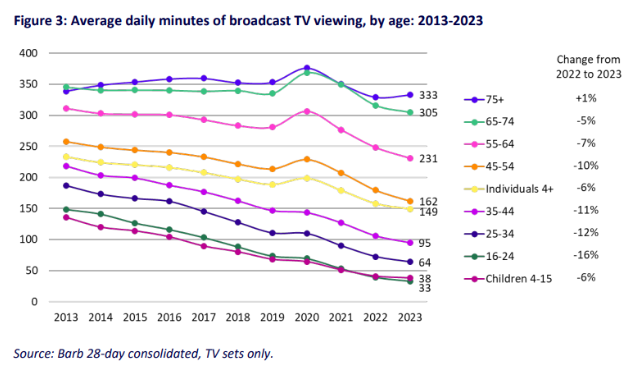
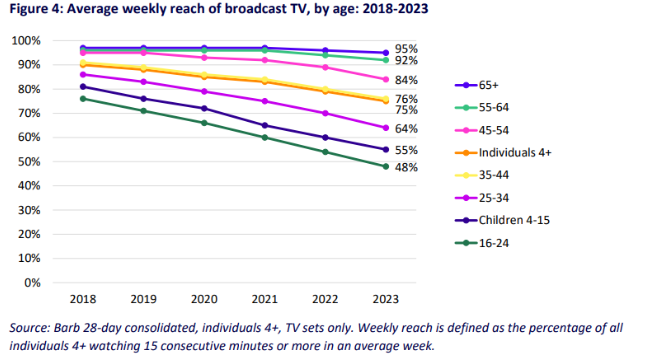
Too often the media debate is hijacked by concerns about the changing viewing habits of younger viewers. However, Ofcom data also shows that older people still watch linear TV heavily, are not switching away rapidly (if at all) and clearly still value it – a fact frequently ignored by policy-makers. The most recent Media Nations report showed minimal decline in broadcast TV viewing amongst the 65 to 74 and 75+ age groups. Indeed the latter group registered an increase in average daily minutes of broadcast TV viewing in 2023.[footnote 60] This reality must be factored in to any future decision making.
For people at risk of loneliness, disconnection, or social isolation, terrestrial TV provides a vital connection to the world and their local community. These individuals are more likely to be in digital exclusion and to lack the essential skills, devices and confidence to stream online. They are also more likely to be on a lower income, older, or living with a disability.
Even for those fortunate enough to enjoy the financial means, digital skills and a social support network enabling them to afford and access streaming, terrestrial TV nevertheless remains a valued and reassuring backup service. Older people benefit from the UK’s hybrid model of TV distribution, with reliable, simple and free terrestrial TV and online streaming together providing viewers with the best of both worlds. It is this socially resilient model which we stand to lose by moving to an online-only future for television.
3. The impacts of moving to an online-only model of TV distribution
Any move away from this best of both worlds, hybrid model to online-only TV would have serious negative implications for the growing number of older people in the UK.
Digital skills
Unlike the simple and well-understood interface of terrestrial TV, online streaming platforms present complex, inflexible and changing interfaces which demand a high level of digital literacy to access. Basic digital skills are expected to become ‘the UK’s largest skills gap by 2030,’ with older people predicted to be the most seriously affected.[footnote 61] Almost 4 million people over 65 (31% of the age group) do not use the internet at home, compared with just 320,000 (4%) for those aged 35 to 44. More than 3.8 million internet users over 65 are categorised as ‘narrow users’.[footnote 62] Of the 2.4 million adults with zero basic digital skills, more than half are over 75.[footnote 63]
Research from Age UK suggests that almost half (46%) of over-65s in the UK are unable to complete all eight of the most fundamental tasks required to use the internet safely and successfully. Almost one-in-four (23%) are unable to turn on the device and enter any account login information as required, with one-in-four (25%) unable to keep login information and passwords for a device and any accounts secure (e.g. not shared with anyone or written down or left prominently near a device).[footnote 64]
Even at its simplest, internet streaming of TV content makes demands in all of these areas. Should people be unable to complete any of these steps or should they be locked out of their settings, older people risk being cut off. Those who have friends or relatives to help may find this easier to manage, but those who experience loneliness or social isolation and lack a tech-savvy support network would be at acute risk of marginalisation. There is evidence that digital skills can decline as we get older and technology changes, highlighting the value of a simple, well-understood interface like terrestrial TV and the risk of transitioning to online-only TV in the context of an ageing society.[footnote 65]
Key point: An online-only TV future risks excluding millions of older people who struggle with digital skills.
Affordability
The image sometimes presented of older people living an economically privileged life is far from the reality for millions across the country. Older people living on fixed incomes face economic hardships which younger, more economically active people do not. They also have fewer options to boost their income by taking on additional work. Research from Independent Age shows that over 2 million pensioners are living below the poverty line, with many more living precariously just above it.[footnote 66] Further research suggests that by 2040, almost one in four, or 3.9 million, older people could be in poverty.[footnote 67]
While universal, free-to-air terrestrial TV provides access to a range of quality TV content at no additional cost to viewers, IPTV requires a highspeed broadband connection and high-tech devices to ensure the television set can receive streaming. Silver Voices research revealed that the cost of online subscriptions (53%) and struggling to afford broadband bills (46%) in the next 15 years were cited as the top barriers to older people moving to online-only TV and radio services.[footnote 68] While 31% of consumers say they cannot afford to pay more than they currently do to access broadband and TV services, this figure increases to 53% for retired people.[footnote 69] Citizens Advice found that a million households cancelled their broadband subscription to make ends meet during the cost-of-living crisis between 2022 and 2023.[footnote 70] Without terrestrial TV, cancelling your broadband connection will mean ending your ability to watch TV. The British people agree that coercing vulnerable elderly people into taking out an expensive high speed broadband subscription which they may neither want nor need simply to carry on watching TV would be wrong - over 2 in 3 (67%) agreed that it would be unfair to make people rely on the internet to watch TV.[footnote 71]
Key point: An online-only TV future would mean new cost burdens for millions of older people, risking their exclusion from accessing TV content.
Quality of life
Having guaranteed access to a variety of quality TV content at no additional cost underpins the quality of life of millions of older people across the UK, providing a social and cultural connection that eases loneliness and boosts mental wellbeing.
Three-quarters (75%) of citizens as a whole say that the availability of free-to-air terrestrial TV helps reduce loneliness or isolation. This figure rises to 87% of those aged 65+.[footnote 72] Research from the charity Independent Age reveals that the public believes the two biggest challenges currently facing older people in the UK are ‘the cost of living’ and ‘loneliness and isolation’. Terrestrial TV helps alleviate both challenges through universal, free-to-air access to entertainment and connection.[footnote 73]
With 1 in 3 (31%) over 60s – equivalent to 5.1 million – saying life is harder compared to five years ago because more of the services they rely on are online,[footnote 74] a switch to internet-only TV would risk compounding social isolation amongst those who cannot afford the cost of a high speed fixed broadband connection or who lack the digital skills and confidence to operate the technology.
Key point: *An online-only TV future would hurt the quality of life for millions of older people, risking an increase in social isolation and harming their emotional wellbeing.
Security and reliability
Older people have different priorities and motivations for the role of technology in their lives than younger cohorts, often prizing security and reliability more highly. A 2023 review found that older people placed a greater emphasis on environmental security (feelings of safety in their home) and data security/privacy (fear of misuse or data leakage) in their attitudes to smart technology.[footnote 75]
Terrestrial TV is a highly reliable service which does not depend on a broadband connection. Almost half (45.1%) of broadband customers experienced an outage lasting over 48 hours in the past year.[footnote 76] Uswitch data estimates that 22 million people endured outages of three hours or more in 2023. Citizens’ Advice helps one consumer every three-and-a-half minutes with a telecoms-related issue and telecoms issues were the most complained about essential service (16%) in 2024.[footnote 77] 1 in 4 (23%) broadband customers had a reason to complain in 2024, an increase compared to 2022 (20%) with the most common complaint being a service issue such as slow connection speeds or an intermittent or total loss of service (63%).[footnote 78] Older people who lack digital confidence and may have hearing difficulties can find making complaints and resolving technical problems harder. Making access to TV content wholly contingent on a functioning high speed broadband connection is therefore unwise for the country and unhelpful for older people specifically.
As well as the need to manage passwords and account information (both for broadband and for streaming accounts), IPTV generates personal data about users (e.g. viewing history, device usage, location, account details etc) raising issues of privacy and data security. In contrast, terrestrial broadcast TV offers a secure one-way method of accessing content that does not require user accounts, passwords, or generate any personal data, making it an inherently more private and low-friction option, especially for those concerned about digital safety – as many older people are.
The COVID pandemic demonstrated the value of universal television as a means of reaching a mass audience with critical health information.[footnote 79] This is of crucial importance to older people, who may lack other reliable and accessible means of accessing trusted live information during a national emergency.
Key point: An online-only TV future would be inherently less secure and resilient than the current hybrid model, forcing viewers to rely on often-unreliable broadband signals and to enter into data-sharing relationships with broadcasters.
4. Conclusion: a precious public good
It would be foolhardy for the United Kingdom to rush into an online-only future for TV distribution and older people stand to lose the most from any such unwise decision. There is no way to deliver TV online without a highspeed fixed broadband connection – something many millions of older people neither need nor want. The digital skills gap, which can widen as we get older, means a move to online only TV risks cutting off older people. Without government intervention to fund a universal broadband connection, cost-of-living pressures would also risk disconnecting the growing number of older people in the UK.
For many, the challenge is not age alone but the compounding barriers of isolation, disability, limited mobility or insecure housing – factors that affect people of all ages, but fall most heavily on those already marginalised. Ending the UK’s trusted, valued and popular hybrid model of TV distribution would be throwing away a precious public good. We must not do it.
Annex B: The positive impacts of digital transition on TV audiences
Channel 4
Channel 4’s thinking on the future of TV distribution has been primarily shaped by one guiding principle: the outcome should be of benefit to, and in service of, the UK’s TV audiences. It remains our view that a managed IP transition, as part of a broader, coordinated national digital inclusion and transition plan, would provide significant benefits to them.
This is primarily because the positive characteristics of the current system would not need to be diminished, and would only be improved, [footnote 80] in the event of a digital transition the principle of universality would be maintained, and linear TV would remain widely and freely accessible. Linear TV – and the linear behaviours still exhibited by a significant proportion of the population – would not be lost with the loss of broadcast TV, and the two things should not be conflated.[footnote 81]
Indeed, as the paper refers to above, as broadcasters continue to rationalise their channel portfolios, a digital transition may actually be the only route to true universality (i.e., all audiences with access to all linear channels, as opposed to a minority DTT audience with access to only a limited cohort of PSB channels).
A digital transition would also deliver a significantly improved viewer experience in the context of accessibility and functionality. The paper above rightly highlights the challenges that some audiences face with regard to hearing, sight and access difficulties, and delivery of television over the internet has characteristics that can significantly reduce these.
Freely – the free, IPTV service developed by Everyone TV and the UK PSBs – is a good example of this in practice. The service is capable of providing an Accessible TV Guide (or ‘Accessible EPG’) which has been specifically designed to be easier to read, navigate and use than the default setting. Adjustable settings are easily findable and can be accessed in the same way that audiences would when using DTT – via the settings menu, and by toggling ‘On’ and ‘Off’ where appropriate.[footnote 82] These same principles (i.e. flexibility of user-interface) are true of commercial IPTV propositions too – the underlying technology is what enables service providers to make changes to suit the needs of viewers, and is not possible on DTT.
Accessing these features does not require specialist equipment either, only a device with access to the internet – indeed, most TVs are already capable of this themselves. Ofcom reports that 76% of TV households already have a smart TV,[footnote 83] and GfK reports in its data that c.99% of TVs sold in 2024 were smart,[footnote 84] which can be reasonably translated to: ‘almost every TV that is sold today is capable of watching IPTV, and the majority of TVs in households are smart / IP-enabled already.’
Again, in the case of Freely, audiences will maintain straightforward, easy access to linear TV – even as the distribution technology is changed. Almost all Freely TVs have a ‘Guide’ button on the television remote which directly mirrors the channel selection experience on DTT.[footnote 85]
As the PSBs have argued on several occasions, the economics of DTT are also increasingly challenged given that the number of viewers does not warrant the cost of DTT distribution; [REDACTED][footnote 86] This position will only become more acute and will eventually lead to poorer outcomes for viewers as it will likely reduce investment in PSB content (e.g. original content production – including content made outside of London and from independent producers – and news). A managed digital transition offers an opportunity to maximise PSB investment in original programming and to continue to deliver for audiences.
The full extent of these positive impacts will only be realised with a national campaign to support a future IPTV transition. The identification of vulnerable audiences – and of the processes and resources required to best help them – will be a critical part of any plan, and sufficient care should be given to make sure it is robust as possible. Affordability of broadband and digital skills (i.e. use of passwords and set up of viewing accounts) will remain challenges but are not insurmountable with the right support.
The success of digital switchover continues to be an example of best practice.[footnote 87] The transition to IPTV – as a strand of a broader UK-wide digital inclusion and transition movement – is a huge opportunity for the UK and its TV audiences.[footnote 88] Much can be accomplished in a short period of time if sufficient resource is dedicated to it.
Annex C: A critical change moment for digital inclusion
Good Things Foundation
Embracing a managed IPTV transition can catalyse digital inclusion across the UK - an issue of which there is shared national urgency.[footnote 89] Seizing IPTV as a critical change moment creates a more inclusive society and increases value for the public; potentially generating £26.6 to £31.3 billion in non-market wellbeing benefits - like improved life satisfaction and access to services - and £21.1 to £30.8 billion in annual Gross Value Added through increased productivity and employment.[footnote 90]
Digital inclusion is integral for modern life and work. It enables employment, education, health and finance, as well as shopping, sports, and leisure. Historically experiences of digital exclusion have been associated with generational divides, and people of retirement-age remain more susceptible to experiencing digital exclusion in the UK.[footnote 91] However socio-economic factors have become equally significant - with affordability, connectivity, and digital skills and confidence now central to participation.
Those living on no or low income, rural and/or remote communities, people with disabilities, and individuals with low levels of English literacy are some of the key populations facing compounded barriers to digital inclusion.[footnote 92] By supporting a managed transition to IPTV, these divides can be narrowed and both digital connectivity and television services will be available, accessible, and usable for all. Guaranteeing easy to use, reliable, and future-proofed access to television for audiences who choose this - whilst also bringing the potential that a broader use of the internet offers.
Beyond unlocking measurable economic growth, the future of television can catalyse inclusion through coordination across policies targeting digitally excluded groups. This includes tackling data poverty - fundamental for achieving digital inclusion. We recommend:
- A *Connected Homes Discount’ scheme, whereby a voucher or payment is available for eligible households to use with their chosen Internet Service Provider;
- Embedding the National Databank in organisations supporting citizens in crisis and/or have a requirement for customers to use their services online;
- Mandating a basic (broadband) connectivity package for all customers, improving customer protection and preventing disconnection.[footnote 93]
Furthermore UK epistemic security is increasingly under threat. As highlighted in the recent House of Lords’ inquiry, ‘media literacy protects you from harm, while public service broadcasting enhances the good.’[footnote 94] A managed IPTV transition will be ‘good’ if delivered with digital inclusion foregrounded, and could therefore strengthen the country’s information resilience by maintaining fair access to accurate, high-quality content as well as supporting those delivering digital and media literacy support through platforms like Learn My Way.
Through cross-sectoral collaboration, in all nations, a managed IPTV transition can ensure digital participation is a reality for everyone - a critical change moment for digital inclusion, across the UK.
-
Vernon et al (2024) Future of TV Distribution, p.21. ↩
-
Ofcom (2025) Media Nations, p. 3, 18. ↩
-
Vernon et al (2024) Future of TV Distribution, p.23. ↩
-
Ofcom (2025) Media Nations, p.17, 18. ↩
-
The figure for live TV excludes live broadcast content watched via BVoD, which is included in the figure for BVoD. See Ofcom (2025) Media Nations, p.19. ↩
-
3 Reasons data provided in Vernon J et al (2024) Future of TV Distribution, p. 25: ↩
-
Vernon et al (2024) Future of TV Distribution, p. 23 to 24 ↩
-
Infrastructure Working Group Paper: Key Policy Assumptions, DCMS, p.5. Revealing Reality, DCMS: Future of TV Distribution. ↩
-
Vernon et al (2024) Future of TV Distribution, p. 35. ↩
-
See Ofcom (2025) A demographic deep dive into internet adoption – Analysis using Ofcom’s Technology Tracker 2024 ↩
-
See Annex. ↩
-
UK Spectrum Policy Forum report in Clover J (2025) Reduction in DTT multiplexes more probable than outright switch-off, Broadband TV News, 19 May: Vernon et al (2024) Future of TV Distribution, p.25, 34. ↩
-
DTG, i2 Media, Ofcom (2025) Identifying challenges and solutions for improving inclusivity and usability in the consumption of internet delivered television, p.9. ↩
-
Ofcom (2025) Media Nations, p.19 to 20. ↩
-
Revealing Reality (2025) Future of TV Distribution. ↩
-
Age UK (2023) “You can’t bank on it anymore” The impact of the rise of online banking on older people ↩
-
The King’s Fund (2025) The 10 Year Health Plan: what do we know about public perceptions of the three shifts? ↩
-
DPA/University of Sussex (2024) Tech4Families Evaluation Report ↩
-
DTG, i2 Media, Ofcom (2025) Identifying challenges and solutions, p.9. ↩
-
Good Things Foundation (2024) The Minimum Digital Living Standard: March 2024 ↩
-
Ofcom (2025) Media Nations: Northern Ireland 2025, p.6. ↩
-
Audience WG paper 3: Internet access and speeds. ↩
-
Regulation will continue to be required to ensure PSB services remain not only accessible, but findable and discoverable too – the Media Act will likely contribute significantly to delivering these outcomes, but additional legislation may be required. ↩
-
Channel 4 (2024) Channel 4 shares plans to become digital-first public service streamer by 2030 ↩
-
N.B. this does not imply that PSB distribution costs would be erased entirely. ↩
-
Ofcom (2025) Transmission Critical The Future of Public Service Media, p.5. ↩
-
PwC for the BBC (2025) The Socioeconomic Impact of Digital Transition; Capita and Good Things Foundation (2022) The Economic Impact of Digital Inclusion. ↩
-
We note the cross-department nature of the Digital Inclusion Action Plan, which demonstrates how multiple departments can contribute to ensuring every UK community is connected. IPTV transition would benefit from DCMS working together with other departments towards wider digital inclusion. ↩
-
Lloyds Bank (2024) 2024 UK Consumer Digital Index and Essential Digital Skills Report. ↩
-
Sky (2025) Accessibility Settings on Sky Stream. ↩
-
While it is certainly the view of the Working Group that the cost burden on audiences should minimised in any scenario, it is impossible to rule out that a proportion of costs associated with transition are eventually assigned to them. Were that to happen, subjecting them to only one transition period would be a means to ensuring the impact on them was minimal, even if we assume that the number of homes without T2 equipment will be small at this stage, and likely far smaller than the number of households affected in an IP transition. ↩
-
94% of homes are projected to have a smart TV as a primary set by 2030, rising to 99% by 2040 (Vernon et al (2024) Future of TV Distribution, p.66). ↩
-
DTG, i2 Media, Ofcom (2025) Identifying challenges and solutions, p.9 to 13. ↩
-
Lloyds Bank (2024) 2024 UK Consumer Digital Index and Essential Digital Skills Report, p.7. ↩
-
As this Group has already noted, it is for the Infrastructure Working Group to interrogate whether this is a valid concern or not – the Audiences Working Group has noted it (legitimately) as a concern but does not have the expertise to validate whether it is a concern that should be upheld. ↩
-
Ofcom (2024) Social Tariffs: Cheaper Broadband and Phone Packages. On MDLS, see Annex. ↩
-
Audience WG paper 3: Internet access and speeds. ↩
-
Ofcom (2025) Connected Nations Update: Spring 2025 ↩
-
Research by the DTG for Ofcom demonstrated that voice search offers significant accessibility benefits for older audiences in particular, but currently minority languages such as Welsh and Gaelic are not supported, and investment would be required to enable this. (DTG, i2 Media, Ofcom (2025) Identifying challenges and solutions: p.63 to 64). In Northern Ireland, the Good Friday Agreement enables Irish broadcasters’ services to be widely available via DTT and broadcasts of RTÉ and TG4 may need to be protected in the case of switch off (Ofcom (2024) Future of TV Distribution, p.63 to 64). ↩
-
None of the recently tested ISP routers cored 5/5 for coverage in Pears (2025) Best Wi-Fi Routers: Upgrade Your Wi-Fi with Top Rated Models ↩
-
Ofcom (2024) Future of TV Distribution. ↩
-
Please refer to Infrastructure Working Group Paper 1 for technical details of each Nightlight option. ↩
-
Coleago for the UK Spectrum Policy Forum (2025) Future of the UHF band after 2034: An analysis of options in the UK ↩
-
Ofcom (2024) Future of TV Distribution. ↩
-
For example, the Euros and Olympics were key to BBC increase in viewing according to Enders (2024) Viewing Trends ↩
-
Vernon et al (2024) Future of TV Distribution, p.39. ↩
-
Ofcom (2024) Future of TV Distribution, p.17 ↩
-
Infrastructures WG UK IP Ecosystem Readiness for Universal IPTV Only Adoption, p.3. ↩
-
Revealing Reality (2025) DCMS Future of TV Distribution: Research Report. ↩
-
Vernon et al., (2024) Future of TV Distribution, p.14. ↩
-
Vernon et al (2024) Future of TV Distribution, p.42 to 46 ↩
-
Revealing Reality (2025) DCMS Future of TV Distribution: Research Report. ↩
-
Johnson et al (2022) The Impact of Video-On-Demand on TV Viewing in the UK: Routes to Content After Covid-19 - Interim Report, p.3. ↩
-
Coleago (2025) Future of the UHF band after 2034: An analysis of options in the UK, p.33 to 34. ↩
-
Good Things Foundation What is the National Device Bank? ↩
-
DSIT (2025) The IT Reuse for Good charter ↩
-
Vernon et al., (2024) Future of TV Distribution, p.71. ↩
-
The number of people aged over 60 in the UK is projected to rise from c.16,810,000 in 2022 to c.19,833,000 in 2032.In mid-2022 there were 1.7 million people aged 85 years and over (2.5% of the population). By mid-2047, this is projected to have nearly doubled to 3.3 million (4.3% of the total UK population) (source: ONS link). ↩
-
Silver Voices (2023) Safeguarding Universality: The Future of Broadcast TV and Radio. ↩
-
Ofcom (2024) Media Nations, p.9 to 10. ↩
-
House of Lords Communications and Digital Committee (2023) Digital exclusion. ↩
-
Ofcom (2023) Adults’ Media Use and Attitudes in House of Lords Communications and Digital Committee (2023) Digital exclusion. ↩
-
Lloyds Bank (2022) Consumer Digital Index in House of Lords Communications and Digital Committee (2023) Digital exclusion. ↩
-
Age UK (2023) Age UK Launches Offline and Overlooked Digital Campaign. ↩
-
Kobayashi, et al., (2014) Internet Use, Social Engagement and Health Literacy Decline during Ageing in a Longitudinal Cohort of Older English Adults. ↩
-
Vine (2023) The hidden two million: The reality of financial hardship in later life. ↩
-
Independent Age (2024) Pensioner poverty could almost double in next 15 years: new research predicting a surge in financial hardship in later life. ↩
-
Silver Voices (2023) Safeguarding Universality: The Future of Broadcast TV and Radio. ↩
-
EY (2024) The costs and risks of switching to internet distribution for all broadcast TV ↩
-
BBC News (2023) One Million Cancel Broadband as Living Costs Rise, 17 May 2023. ↩
-
Silver Voices (2023) Safeguarding Universality: The Future of Broadcast TV and Radio. ↩
-
Digital Poverty Alliance (2025) Safeguarding Britain’s Social Resilience: The Critical Role of Terrestrial Television. ↩
-
Independent Age (2025) Together against poverty in later life: The state of public opinion. ↩
-
Age UK (2025) One in Three (31%) over 60s Say Life Is Harder than Five Years Ago Because More Services Are Now Online. ↩
-
Zhang (2023) Older people’s attitudes towards emerging technologies: A systematic literature review. ↩
-
Ofcom (2025) Comparing customer service: Mobile, home broadband and landline. ↩
-
Citizens Advice (2025) Citizens Advice reveals top five mobile and broadband issues faced by consumers ↩
-
Ofcom (2025) Comparing customer service: Mobile, home broadband and landline. ↩
-
Barb Insight (2020) What People Watch: News Channel Reach ↩
-
As referenced in the Paper above, this assumes that the switchover help scheme – akin to the one deployed for the duration of DSO – is comprehensive and well-resourced to adequately meet the needs of UK viewers who are unable to get online themselves, and who do not possess the digital behaviours sufficient to comfortably use IPTV at point of transition. ↩
-
YouGov research, commissioned by the BBC, found that only 37% of people were able to correctly identify the definition of ‘broadcast TV’ from a list of six options, while a further 36% identified ‘linear TV’. All respondents confirmed that they were able to distinguish between ‘broadcast’ and ‘linear’ TV before answering the survey questions. YouGov Digital Transition Survey in BBC (2025) BBC Annual Plan 2025/26. ↩
-
Freely (2025) Does Freely Offer Accessibility Features?. ↩
-
Ofcom (2024) Communications Market Report 2024: Interactive Data. ↩
-
GfK, TV Unit Sales: smart TV vs no smart TV, January – December 2024. ↩
-
Because Freely is an operating system which differs slightly depending on what CE manufacturer it has partnered with, remote control configurations can be different. ↩
-
MTM (2024) MTM x Ofcom: Broadcast Distribution Costs. ↩
-
In 2006, before switchover, Freeview coverage was c. 75% of homes (less penetration than broadband presently), 10 to 15% of survey respondents said that they would never convert to digital TV, and only 80 transmitters were converted. At the end of switchover, in 2012, Freeview coverage was c.98.5% coverage of homes, all TV homes converted to digital, and 1,154 transmitters had been converted. ↩
-
PwC found strong evidence that increased technology usage and digital upskilling can enhance productivity (e.g. via unemployed people transitioning to employment through digital inclusion; people with disabilities in employment through remote work) and have positive impacts on wellbeing for individuals who have become / are becoming digitally excluded. source: PwC (2025) The Socioeconomic Impact of Digital Transition, p.3. ↩
-
DSIT Digital Inclusion Action Plan, First Steps, 2025. ↩
-
PwC with Everyone TV and the BBC, Socioeconomic Impact of Digital Transition, 2025. ↩
-
Good Things Foundation, Digital Nation, 2025. ↩
-
DSIT Digital Inclusion Action Plan, Summary of Responses, 2025. ↩
-
See Good Things Foundation’s What Works? Co-Lab, 2025. ↩
-
House of Lords’ Communications and Digital Committee, Media Literacy, 2025. ↩