Stakeholder Forum Papers: Annex A - International context in future of TV distribution
Published 23 June 2026

© Crown copyright 2026
This publication is licensed under the terms of the Open Government Licence v3.0 except where otherwise stated. To view this licence, visit nationalarchives.gov.uk/doc/open-government-licence/version/3 or write to the Information Policy Team, The National Archives, Kew, London TW9 4DU, or email: psi@nationalarchives.gov.uk.
Where we have identified any third party copyright information you will need to obtain permission from the copyright holders concerned.
This publication is available at https://www.gov.uk/government/publications/future-of-tv-distribution-stakeholder-forum-papers/stakeholder-forum-papers-annex-a-international-context-in-future-of-tv-distribution
1. Purpose and scope
This annex provides an overview of how digital terrestrial television (DTT) and IP delivery are evolving internationally. It is intended to support the final two papers of the DCMS Future of TV Distribution Forum by:
- setting out the current role of DTT in Europe and selected non-European markets;
- summarising the direction of travel towards IP and hybrid models; and
- highlighting lessons that may be relevant to long-term UK strategy.
Note that work commissioned by DCMS on the Future of TV Distribution found that while there are some useful comparisons to be made with other countries, there are no directly comparable territories to the UK given unique political contexts, regulatory frameworks, technological infrastructure and audience behaviour.
The transition to IPTV is happening at different rates across Europe and is enabled by the level and use of fixed broadband access in each country.
2. DTT summary
DTT continues to play a role across European countries and globally. DTT reaches 80–90 million EU households (~35–40%) (Broadcast Networks Europe, 2024 briefing to EU institutions). Some nations in which use DTT is the primary distribution method have already completed or are actively pursuing a managed evolution of their broadcast infrastructure to the latest DTT technologies. While the specific configuration of networks varies, the consistent themes are universality, resilience, and technical modernisation through DVB-T2 and hybrid broadcast–broadband delivery. In general, the larger EU countries have chosen either to focus initially on the upgrade of their DTT networks to support HD and UHD (France and Spain) or on seamlessly integrating broadcasting and IPTV services through the adoption of DVB-I (Germany and Italy).
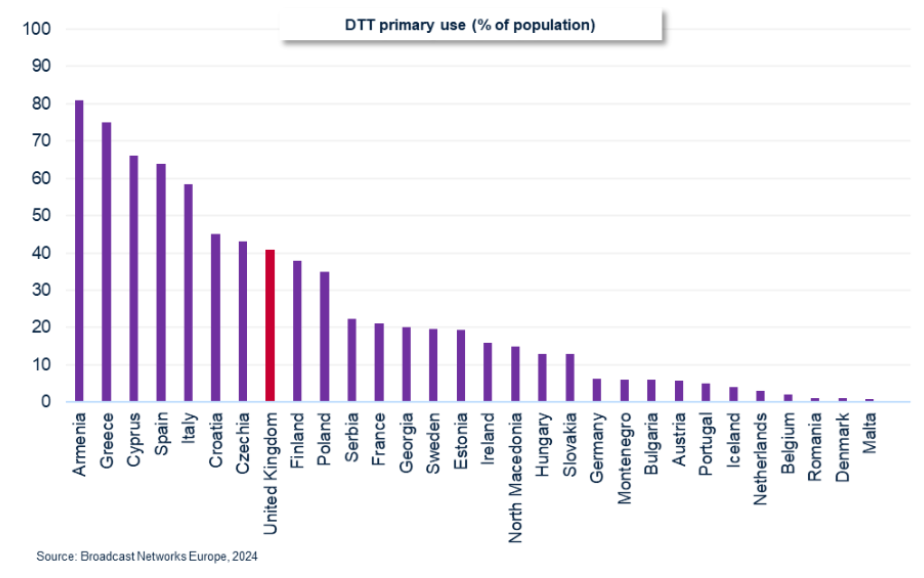
At the same time, some countries are reducing or withdrawing terrestrial services where usage has declined and alternatives (cable, satellite, IP) are widespread, while seeking to preserve resilience and alerting functions by other means.
3. IP transition summary
Across Europe, as in the UK, the number of IPTV households is increasing. The strategic direction in many territories is towards greater use of IP, enabled by broadband roll-out, changing viewing habits and pressure to reallocate UHF spectrum to mobile and other uses.[footnote 1]
Figure 79 MTM Exeter report Figure 79: Number of IPTV households in Europe from 2013 to 2028 (published Aug 2023). shows a rapid increase in IPTV usage in the EU within the last ten years.
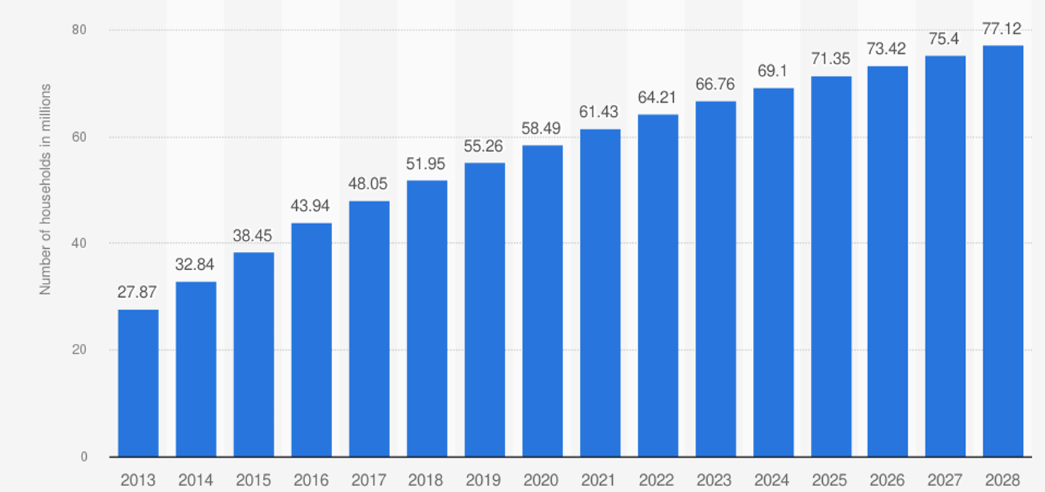
Number of IPTV households in Europe from 2013 – 2028 (published Aug 2023).
Key drivers include:
Audience behaviour – across Europe audiences are moving to IPTV and will continue to do so over the coming years [source Fig 79 Exeter report] driven by the wider range of content and services available via the internet.
- Economics of DTT carriage – in markets such as Sweden and France, broadcasters report rising transmission costs, falling linear audiences and stronger IP propositions. Commercial channels without regulatory obligations are reassessing their participation in DTT and, in some cases, exiting entirely.
- Spectrum demand – countries including Finland plan to reduce DTT spectrum and release capacity for 5G and future 6G, often by cutting the number of nationwide multiplexes and tightening the DTT line-up.
- Innovation – Many valued features – on-demand catalogues, personalisation and addressable services – are delivered most effectively over IP.
- Governance, affordability and resilience – Even where DTT has been withdrawn, governments and broadcasters have retained alternative arrangements for continuity, resilience and emergency alerting.
Outside Europe, similar pressures are visible but are playing out through different regulatory and market choices, for example in Australia and the United States.
The transition to IPTV is enabled by the rollout of fixed broadband which is part of a wider digital transition taking place in the UK as well as across Europe. Experiences from other countries in managing the rollout of fixed broadband show that this transition is most effective when combined with clear national strategies and cross-sector collaboration. For example, Estonia’s whole-of-government digital agenda and citizen-centric design, Australia’s Digital Economy Strategy with targeted inclusion funds, and Sweden’s accessibility mandates illustrate how coordinated governance can mitigate exclusion risks during major transitions.
4. Country-by-country summary (alphabetical)
Australia
Commercial TV advertising revenues fell by around 10% in 2024. Network Ten closed one DTT service, initially leaving about 70,000 viewers without access to Ten channels. A proposed wider withdrawal from much of regional Western Australia was averted by a A$32m government support package. There is concern that the public service broadcaster ABC could ultimately be left as the only major DTT tenant, which is seen as financially unsustainable and a poor outcome for audiences and society.
Belgium
Terrestrial usage is low with most households accessing television via cable. The Flemish public service broadcaster has already shut down DTT in Flanders. The Walloon public broadcaster has signalled an intention to switch off both DTT and FM radio by the end of the decade, moving audiences to cable, satellite, DAB and IP. In [footnote 2]Wallonia (French speaking region) and Brussels, a DTT multiplex is provided with the RTBF (Wallonian PSB) channels. This was upgraded in 2023 to use DVB-T2 and HEVC to provide high quality 1080p video, and can be received with an indoor antenna (in Brussels, at least).
See Quels sont les différents modes de réception TV? (in French, TNT = DTT)
List of terrestrial channels in Belgium
Finland
Finland, digital terrestrial television (DTT) still accounts for around 40% of viewing, but there has been a long-running debate about the eventual closure of terrestrial services and the government has launched a review. Strong mobile-sector demand for UHF spectrum has prompted draft regulation to reduce the number of nationwide DTT multiplexes from five to three from January 2027, ahead of expected 5G and 6G spectrum auctions in 2028–2029. Finland is also managing a transition to DVB-T2, and the main DTT operator, Digita, has closed its pay-TV services on DTT, leaving the platform as a free-to-air proposition only.
France
The majority of homes in France have access to IPTV and the share of people watching TV via the internet every day or almost every day was just below the EU average in 2023. France is managing a transition to DVB-T2, primarily to support new UHD services. The DTT network covers about 97% of the population. For the 2024 Paris Olympic Games a new DVB-T2/HEVC UHD multiplex was launched from 22 sites, including the Eiffel Tower, initially covering around 16m people and now reaching roughly 70% of the population with around 2.7 times the spectral efficiency of the previous DVB-T configuration. All but one minor regional service are in HD, covering 97% of the population. The roadmap anticipates further UHD expansion, with household coverage expected to approach 95%. France has announced plans to develop DVB-I pilots.
A government report on the future of DTT is pending. Canal+ has withdrawn its DTT services and the regulator Arcom has postponed the tender for the vacant capacity. Broadcasters[footnote 3] warn that transmission fees could rise sharply from 2026 as multi-year contracts renew, intensifying interest in IP alternatives.
Germany
Germany operates a strongly hybrid environment, although DTT use is low because of heavy investment in cable over the past 50 years. Around 87% of viewers use IPTV, while 86% access linear content via cable or satellite (many households use more than one platform). After DVB-T switch-off in 2019, DVB-T2 usage rests at about 2m homes (~4.5%). Germany has sought to modernise its DTT platform by integrating DTT and IPTV services into a harmonised user experience based on DVB-I. Adopting DVB-I means viewers can seamlessly find and watch television content, whether delivered over DTT, DSAT or any kind of IP network, including fibre, 5G and beyond. There is renewed interest in mobile and in-car viewing and ongoing trials of 5G broadcast over terrestrial infrastructure.
Italy
Broadband take-up and IPTV use is lower than the UK. IPTV households have declined since 2013 and DTT primary use remains high[footnote 4]. Italy has completed its DVB-T2 migration. Using HEVC, the platform delivers improved spectrum efficiency and supports HD and UHD services. Like Germany, Italy is developing DVB-I.
Spain
Despite a gradual rise in IPTV, 80% of TV consumption is on DTT and 6% of primary TV viewing is via DTT. In February 2024, Spain switched off all SD channels on its DTT network and under the National Technical Plan approved in March 2025, Spain is moving to full DVB-T2 deployment. The migration is phased, beginning with UHD services on nationwide channels and then extending to all multiplexes. An information and education programme has supported this transition. In October 2025, the Spanish government launched a public tender for the allocation of a new nationwide free-to-air DTT channel with a 15-year licence, renewable for an additional 15 year, indicating Spain’s commitment to DTT. Policy makers concluded that DTT is the only platform capable of enabling RTVE – the national broadcaster – to meet its legal obligation to reach the widest possible audience. Spain has announced plans to develop DVB-I pilots.
Sweden
All commercial broadcasters without DTT obligations have left or announced plans to leave the terrestrial platform, citing falling linear viewing, stronger IP offers and rising DTT costs. The DTT network now carries only five PSB channels, with around 40 services closed. The PSB, bound to DTT until 2034 under its Charter, now faces the full cost of the network and has asked government to meet the additional expense. Government has launched a consultation on DTT economics and signalled a wider review of the respective roles of DTT and IP, including how to harden IP delivery for universal service. The BBC has pointed to developments in Sweden, where TV4 has announced it will leave DTT by 12 January 2026, as a potential warning case for the UK if commercial channels continue to exit the platform.
Switzerland
DTT has never exceeded 5% penetration, and, like Belgium, long-standing investment has been in cable and satellite delivery. Switzerland switched off DTT in 2019 when usage had fallen to about 1.9% of households and cost savings were a priority, moving its channels to cable or satellite. Public broadcaster SRG retained distribution arrangements to ensure continuity and emergency alerting. At the end of 2024, FM radio was also turned off, completing a transition to DAB and IP for radio.