Foreign Influence Registration Scheme: step-by-step guide to registering (accessible)
Published 31 July 2026

© Crown copyright 2026
This publication is licensed under the terms of the Open Government Licence v3.0 except where otherwise stated. To view this licence, visit nationalarchives.gov.uk/doc/open-government-licence/version/3 or write to the Information Policy Team, The National Archives, Kew, London TW9 4DU, or email: psi@nationalarchives.gov.uk.
Where we have identified any third party copyright information you will need to obtain permission from the copyright holders concerned.
This publication is available at https://www.gov.uk/government/publications/foreign-influence-registration-scheme-step-by-step-guide-to-registering/foreign-influence-registration-scheme-step-by-step-guide-to-registering-accessible
© Crown copyright 2026
This publication is licensed under the terms of the Open Government Licence v3.0 except where otherwise stated. To view this licence, visit nationalarchives.gov.uk/doc/open-government-licence/version/3 or write to the Information Policy Team, The National Archives, Kew, London TW9 4DU, or email: psi@nationalarchives.gov.uk.
Where we have identified any third party copyright information you will need to obtain permission from the copyright holders concerned.
This publication is available at https://www.gov.uk/government/collections/foreign-influence-registration-scheme.
Any enquiries regarding this publication should be sent to us at FIRS@homeoffice.gov.uk
About this Guidance
The Foreign Influence Registration Scheme (FIRS) is a two-tier scheme which ensures transparency of foreign influence in UK politics and provides greater assurance around the activities of certain foreign powers or foreign-power controlled entities that may pose a risk to the UK’s safety and interests. It is contained within Part 4 of the National Security Act 2023.
This guide sets out a step-by-step process for those registering with FIRS. It provides information on how to register with FIRS, what happens after registration and how to ensure ongoing compliance with the scheme throughout the course of an arrangement.
Further information about how to use the online registration service is available at: Foreign Influence Registration Scheme: how to register online - GOV.UK.
Feedback on this guidance can be provided at the following link: Your details: Give feedback on the Foreign Influence Registration Scheme guidance.
Step 1: Determine if you need to register
1. You need to register if:
-
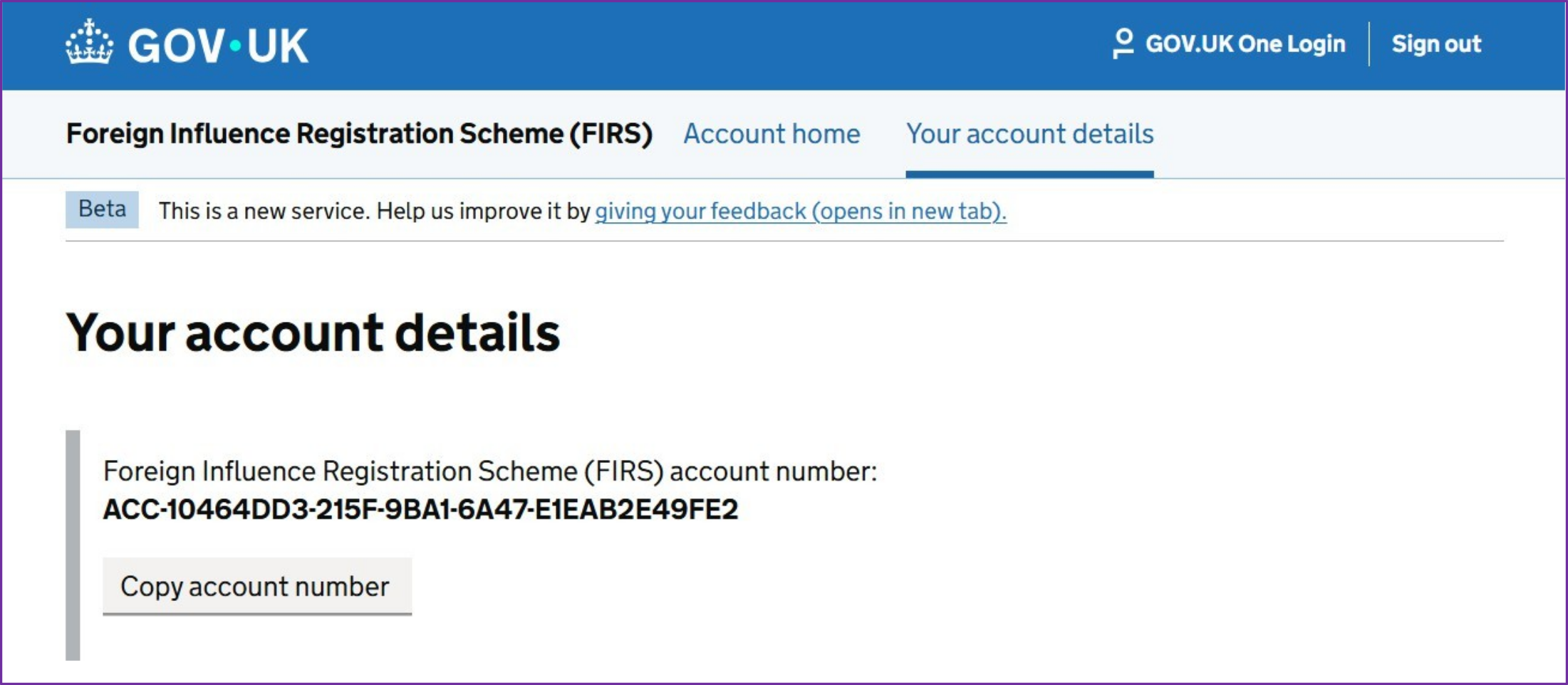
You are carrying out or arranging political influence activities at the direction of any foreign power (see guidance on the political influence tier); or
-
You are carrying out or arranging any activities at the direction of the Russian or Iranian states (see guidance on the enhanced tier); or
-
You are a specified Russian or Iranian foreign power-controlled entity and are carrying out activities in the UK (see guidance on the enhanced tier).
2. A range of further guidance is available on gov.uk to help determine if you need to register: Foreign Influence Registration Scheme - GOV.UK
3. You can also use the registration checker tool to see if you need to register: Check if you need to register with the Foreign Influence Registration Scheme - FIRS - GOV.UK
Step 2: Create your account and set up your registrant
4. A “registrant” is the individual or organisation who is obliged to register with FIRS. They must be the individual or organisation who is directly in the arrangement with the foreign power. Others who are involved in activities, but are not directly in the arrangement with the foreign power, should go to step 7.
5. There is no requirement to create an account if you do not have an arrangement or activity to register. You only need an account when you need to register an arrangement or activity.
Individuals – For those registering for themselves as an individual
6. You first need to create an account on the FIRS service: Register and view arrangements with foreign powers in the UK - FIRS - GOV.UK
7. When you have created your account, you then need to set up a “registrant” – this is you. You will be directed to verify your identity by using Gov.UK One Login. You will then be directed to provide a number of personal details and upload a copy of an ID document.
Organisations – For those registering for their organisation
8. Anyone within an organisation who needs to complete a new registration or manage an existing registration for their organisation will need to create their own personal account on the FIRS service: Register and view arrangements with foreign powers in the UK - FIRS - GOV.UK
9. A “Senior Responsible Officer” (SRO) will also need to create a personal account on the service. The SRO should be a director, member of the committee of management, chief executive, manager, secretary or other similar officer of the body. For UK body corporates, it is recommended that they are one of the directors listed on Companies House.
10. The process for setting up an organisation as a FIRS registrant is simplest if it is done by the SRO themselves, however it can be done by other individuals in the organisation.
SRO sets up organisation as a FIRS registrant themselves
11. You will first be directed to provide a number of details about your organisation, such as the organisation name, Companies House number (if relevant) and address.
12. Having provided these details, you will then be asked if you yourself are the SRO. Having selected “yes”, you will then be directed to verify your ID via Gov.UK One Login and provide a number of details about yourself.
13. Having completed this process, if required, you can then share access to your organisation’s registration page with other individuals within your organisation, to enable them to complete a registration. See the section “sharing access with other individuals in the organisation”.
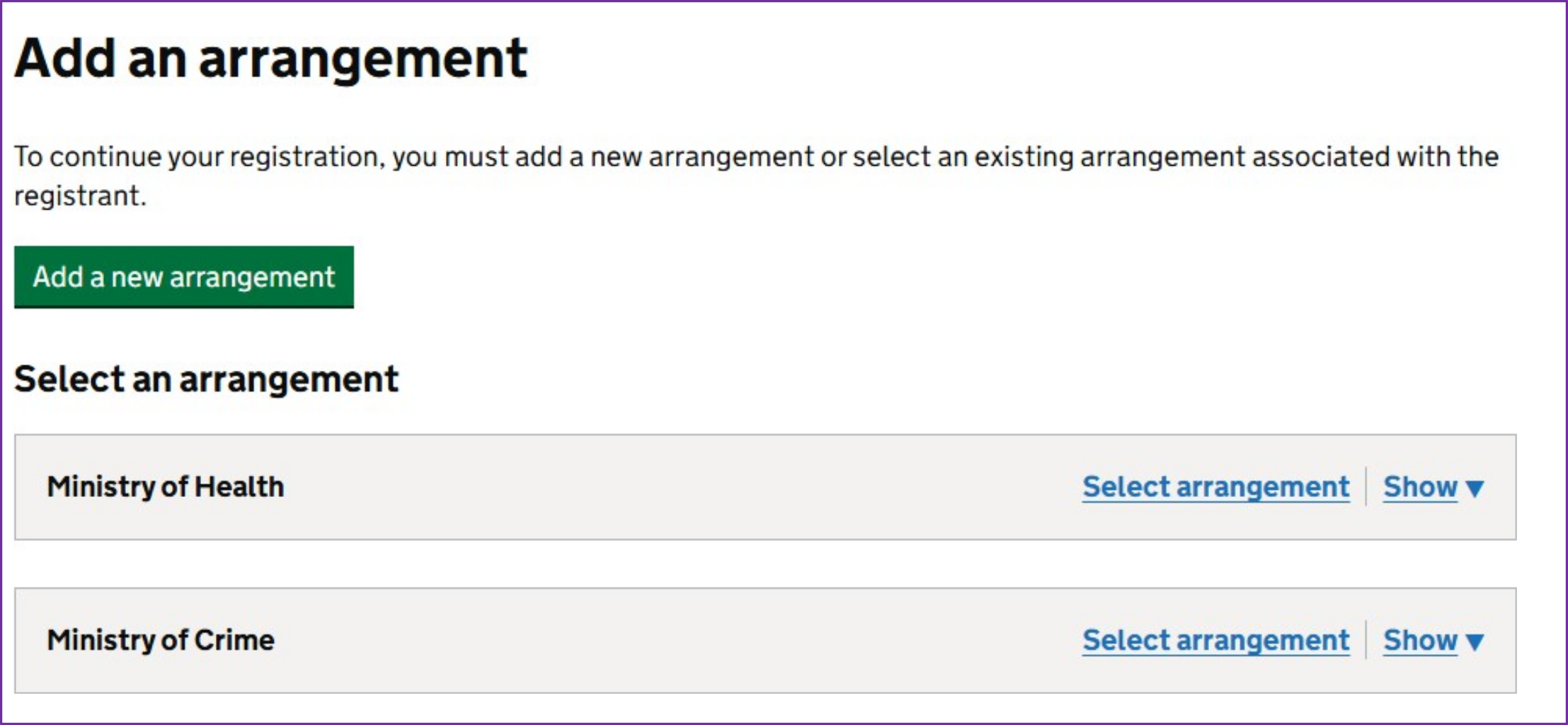
Another individual (who is not the SRO) sets up the organisation as a FIRS registrant
14. You will be first be directed to provide a number of details about your organisation, such as the organisation name, Companies House number (if relevant) and address.
15. You will then be required to assign an SRO to the organisation. This SRO must have their own personal account already and can be assigned via their account number (available via the “your account details” tab).
16. The SRO will then be required to log into their own account to accept the invitation to become an SRO. They will then be required to verify their ID and provide a number of personal details about themselves. The organisation will not be able to submit a registration until they have done this.
Sharing access with other individuals in the organisation
17. It is good practice for an organisation to grant access to more than one staff member of the organisation, so that another staff member can manage a registration in the event of leave or absence or if the staff member who submitted the registration leaves the organisation. However, only those who need to be involved in submitting or managing registrations need to have an account. Where an organisation registers with FIRS, there is also no need for each staff member to register individually as well.
18. Anyone within an organisation who needs to submit a registration, or view and update an existing registration, will need their own personal account on the FIRS service first: Register and view arrangements with foreign powers in the UK - FIRS - GOV.UK
19. They will then need to identify their account number via the “your account details” tab.
Image 1: Finding your FIRS account number
20. The SRO or the person who set up the organisation will then be able to add them as a user to the organisation via the “users” tab.
Image 2: Access can be shared with other members of the organisation via the “users” tab

Image 3: Users with existing access can be viewed and new users added

21. After a new user has been added, they will need to accept the invitation via their account homepage.
Image 4: New users must accept the invitation to become a user for an organisation

Third parties – For those registering for someone else
22. An individual or organisation registrant can ask a third party (for example, a lawyer) to submit and manage their registrations for them. The third party must set up their own individual account in order to do this: Register and view arrangements with foreign powers in the UK - FIRS - GOV.UK.
23. The individual or organisation who is required to register must first set up themselves as a registrant (see the sections above). Once this stage is completed the registrant can then grant access to the third party to allow them to manage their registrations.
24. Once granted access, the third party will be required to provide a limited set of details about themselves or their organisation, including their contact details.
25. While a third party can submit and manage registrations, the legal responsibility for registering remains with the registrant.
Step 3: Complete your registration
26. Each registration typically consists of three parts:
-
A registrant (created in step 2)
-
An arrangement
-
An activity
27. After submitting a registration, where relevant, there is also a further stage (“public register privacy”) where details of an exception to publication can be provided.
28. The registration form will direct you to provide the appropriate information based on your own circumstances. Please read the supporting text next to questions to understand how to respond.
Image 5: The online registration form will guide you through each part of the registration

Arrangements
29. You will be asked to provide a description of your arrangement. When doing so, you should focus solely on the type of arrangement that you are in (for example, a contract, or an informal quid pro-quo arrangement). Answers should convey enough detail to understand whether the arrangement is formal or informal and whether it sets a particular obligation or incentive to comply. Do not provide information about your activities at this stage – this can be provided later.
30. You will also be asked to provide details of the foreign power that your arrangement is with. In addition to the country or territory, this should include the specific ministry, government department, local authority, government agency or authority that the arrangement is with.
Activities
31. The information you need to provide about your activities will vary depending on the type of activity you are undertaking, however you will be always asked about the following:
-
What the activity seeks to achieve (its aim)
-
What the activity is
-
Who is doing the activity
-
When the activity is taking place (over what time period).
32. Registrants should provide enough detail at registration to ensure that the Government has a clear picture of the activities that they have been directed to carry out or arrange, and the means through which they will do this. Vague statements such as “I communicate with the Government to influence policy” or “I sell goods and services” will not be sufficient. However, it is possible to provide information about the nature and purpose of the activities, without detailing the “who, what, when, where, why and how” for every aspect of the activities. For example, detail of each email sent as part of political influencing activity, or each individual sale made or meeting held under a project, will not be necessary.
Political Influence Activities
33. Those registering arrangements with any countries that are not specified on the enhanced tier should only provide details of political influence activities. For example, when providing information about who is involved in the activities, there is no need to provide information about anyone doing other activities that may be part of the same arrangement, but are not political influence activities.
34. When asked about what the activity is seeking to achieve, those registering political influence activities should set out the types of policies, decisions or personnel that they are seeking to influence. You should avoid statements such as “to promote the interests of Country A” which do not set out the types of influence sought; nevertheless statements about the broad outcome sought such as “to influence the FCDO’s position on X issue within Country A” are acceptable.
35. If registering private communication activities, you will be asked to provide details of the individuals to whom you are communicating. You should only provide details of individuals who are a type of senior public official and politician listed in Schedule 14 of the National Security Act 2023 and at Annex A of the Guidance on the Political Influence Tier: Foreign Influence Registration Scheme: political influence tier - GOV.UK
Exceptions to publication (Requests to keep information private)
36. If you have registered political influence activities, you will be asked to set out if you believe that the publication of your registration would give rise to one of the following risks:
-
Exception to publication 1: A risk that publication would prejudice the safety or interests of the UK.
-
Exception to publication 2: A risk that publication would prejudice the prevention or detection of crime, a criminal investigation or criminal proceedings.
-
Exception to publication 3: A significant risk that publication would put any individual’s safety seriously at risk.
-
Exception to publication 4: A risk that publication would involve the disclosure of commercially sensitive information.
37. If you have selected that one of the above risks applies, you will then have 5 working days after submitting your registration to submit evidence or an explanation of why the exception applies and what information it relates to. Your registration will not be published within those 5 working days, if your evidence is still pending.
38. Further information about exceptions to publication can be found in chapter 7 of the guidance: Foreign Influence Registration Scheme: registration and public register - GOV.UK. See also step 5 for information about the process for applying exceptions to publication.
Further registrations
39. Having submitted one registration, the same registrant can be selected to create a second registration, if required. This would be required if the same registrant forms a new arrangement with the same, or a different, foreign power.
40. Similarly, the same arrangement details from the first registration may also be added to a second registration, if required. This would be required if the arrangement evolves to involve a new type of activity, which needs to be added to the arrangement.
Image 6: Existing arrangements can be selected for further registrations
Enhanced tier arrangements involving both political influence activities and other activities
41. In a circumstance where a registrant is in an arrangement with a specified foreign power or foreign power-controlled entity and that arrangement involves both political influence activities and other activities, they are required to submit two separate registrations but with a common arrangement.
42. In practice, they should first create the arrangement and then add one set of activities (either political influence activities or other activities).
43. They should then start a second registration, select the arrangement from the first registration and then add the other activities.
Step 4: Processing your registration
44. FIRS requires a minimum standard of information to be provided and a registration will not be considered compliant until this standard has been met. Following the guidance in step 3 and the hint text displayed alongside the questions on the registration form will help you comply with this minimum standard.
45. The Home Office FIRS Case Management Team (CMT) will consider the information provided in your registration and inform you if any information is missing or if further clarification is required. You must comply with instructions given to you by the Case Management Team about any additional information required.
46. They will also assess if they believe that your registration may be out-of-scope and will inform you if so, or request further information to clarify if it is in scope.
47. The CMT will inform you when they have finished processing your registration. However, there is no need to wait for your registration to be processed before commencing your activities.
Step 5: Publication of your registration
48. Registrations which involve political influence activities are, by default, published to the FIRS public register. Other registrations made under the enhanced tier are not published – those who have not registered political influence activities should skip to step 6.
Process for publishing a registration
49. After submitting your registration, it will be reviewed by a FIRS caseworker before it is published; your registration will not appear on the public register automatically after submission.
50. Even where a registration is published, not all data provided in the registration is published. For example, individuals’ full date of birth and telephone number are not published. Refer to the guidance for more details: Foreign Influence Registration Scheme: registration and public register - GOV.UK
51. If your information contains details of an identifiable “target of influence”, the Case Management Team will inform that target of influence at least 5 working days prior to publication. Further information is available here: Foreign Influence Registration Scheme: targets of influence - GOV.UK
52. The CMT may make edits to the information in your registration prior to its publication (for example, correction of spelling mistakes). Where this is the case, they will inform you of the changes made prior to publication.
Exceptions to publication
53. If you have selected in your registration that an exception to publication applies, the FIRS Case Management Team will then review your evidence and inform you of the outcome. If your evidence does not meet the bar for an exception to publication to apply, they will inform you of the further information required and the date that this is required. If information is not provided by this date, or if it is insufficient, your registration may be published.
54. Exceptions to publication can be applied to a registration in full (meaning the registration is not published at all) or to only some of the information in a registration (meaning the registration is published, but with that information redacted).
Step 6: Updating your registration
55. You must ensure that your registration remains up-to-date when any information within it materially changes. You can update your registration via the online registration service.
56. When registering, it is recommended that you take into account how activities may evolve over time when describing them, to ensure that the information does not easily become outdated.
57. When updating your registration, you will be asked for the reason why you are updating the registration. You should make clear whether you are updating the registration to correct a previous error, or because your arrangement or activity has evolved.
58. Where the underlying registration is publishable, you will also be asked if the updated information should be subject to an exception to publication. There is also the opportunity to submit evidence that information which is already published should be removed from the public register due to an exception to publication applying.
59. Anyone with access to an individual’s or organisation’s registrations on the service can update a registration for that individual or organisation, not just the person that submitted it.
60. Employees of an organisation who have submitted a registration for that organisation should ensure that they grant access to another employee before they leave the organisation or move roles. This ensures that someone else can continue managing the registration over the long-term, if the information about the arrangement or activities change.
61. After an update (“material change”) has been submitted, it will be reviewed by a FIRS caseworker in a similar way to new registrations (see step 4). Where the registration update is publishable, this is a manual process done by a FIRS caseworker; the update will not be published automatically. Any evidence of an exception to publication submitted alongside a registration update will also be reviewed by a caseworker in the same way as a registration.
62. Where a registration has been published, updates to the registration are generally published alongside the original information; the original information is not over-written on the public register, but rather displayed within a “previous information” drop-down.
Image 7: Previous information from before the change is included on the public register

Step 7: Compliance by “subcontractors”
63. Only the individual that is directly in the arrangement with the foreign power is required to register; however others involved in the activities (for example, subcontractors) may still commit an offence if they engage in activities which have not been registered.
64. For this reason, anyone involved in carrying out activities which they know, or reasonably ought to know, are being carried out under a registerable arrangement should check that it has been registered.
65. The person who registered is able to download a PDF copy of the registration from the online registration service. Subcontractors should request this PDF copy from the person who registered, and they should then send it to FIRS-General-Enquiries@homeoffice.gov.uk for a caseworker to check it is genuine.
66. If a “subcontractor” believes that a registration has not been submitted, or it has been submitted with false, inaccurate or misleading information, they should not commence their activities until it has been rectified by the registrant.
Image 8: There is an option to download a PDF of a registration, which can be shared with subcontractors

Help and guidance
Guidance
A range of guidance products are available at: Foreign Influence Registration Scheme - GOV.UK. This includes a range of sector-specific guidance for academia, business, charities and civil society, defence and security and media sectors.
Information on the political influence tier, including its scope, requirements and exemptions, is at: Foreign Influence Registration Scheme: political influence tier - GOV.UK
Information on the enhanced tier, including its scope, requirements and exemptions, is at: Foreign Influence Registration Scheme: enhanced tier - GOV.UK
Information on how to use the online registration service is at: Foreign Influence Registration Scheme: how to register online - GOV.UK
Details about the information required at registration and the public register is at: Foreign Influence Registration Scheme: registration and public register - GOV.UK
Support from the Case Management Team
The FIRS Case Management Team can be contacted on FIRS-General-Enquiries@homeoffice.gov.uk
The Case Management Team cannot provide definitive advice as to whether an arrangement is registerable under FIRS, however they may refer registrants to relevant guidance. They can, however, answer queries about how to comply with the requirements. It remains the responsibility of registrants themselves to familiarise themselves with the scheme and determine if they are affected by the requirements.