Female participation in inventorship
Published 5 March 2026

© Crown copyright 2026
This publication is licensed under the terms of the Open Government Licence v3.0 except where otherwise stated. To view this licence, visit nationalarchives.gov.uk/doc/open-government-licence/version/3 or write to the Information Policy Team, The National Archives, Kew, London TW9 4DU, or email: psi@nationalarchives.gov.uk.
Where we have identified any third party copyright information you will need to obtain permission from the copyright holders concerned.
This publication is available at https://www.gov.uk/government/publications/female-participation-in-inventorship/female-participation-in-inventorship--2
Executive summary
Despite progress in education and STEM participation, there is global evidence that female inventors are underrepresented in patenting worldwide. In 2023, the World Intellectual Property Organization (WIPO) reported 13% of inventors listed on global patent applications over the past 20 years were women. This report provides updated estimates from previous research by the UK Intellectual Property Office (UK IPO) on female representation in inventorship. It uses a revised methodology utilising WIPO’s World Gender Name Dictionary (WGND) 2.0, and infers the sex of inventors based on given name(s). While earlier UK IPO reports refer to gender in name-matching methods, this report aligns with the latest government guidance on sex and gender.
In the UK, female inventorship has increased at a gradual pace. Analysis of published patent applications filed to the UK IPO and via the Patent Cooperation Treaty (PCT) indicate that in 1997, between 3.9% and 4.8% of inventors were female. This rose to between 7.8% and 10.9% in 2024. The proportion of female inventors based outside of the UK shows a slightly higher average annual growth rate compared to UK-based inventors.
Of all published patent applications from female inventors, 21.4% come from private applicants. These are those inventors who apply for a patent without the use of a registered patent agent or attorney. This shows that this is a more common route for female inventors compared with other team types. It also contrasts with overall patent application trends, where female inventors remain underrepresented.
Analysis suggests that while the proportion of named female inventors is increasing, progress remains slow and uneven across technology sectors. For example, female inventors are more likely to be named as inventors in fields including “Other consumer goods”, “Furniture, games” and “Medical technology”. The “Other consumer goods” field includes a wide range of everyday consumer products, from clothing, personal-care equipment and household accessories, to printed materials, artistic tools, textiles, refrigeration devices and musical instruments. The largest disparity is observed for patents in the technology field “Civil engineering”. Across the time period and in recent years, this presents a notably lower proportion from individual female inventors, all-female teams and mixed teams, compared to male inventor teams.
Patent applications with individual female inventors, all-female inventor teams and individual male inventors are more likely to be withdrawn by the applicant or fail to meet a statutory time limit (terminated before grant). This is in comparison to all-male inventor teams and mixed teams.
For a comparable time period, at 2.9% the proportion of published patent applications with individual female inventors or all-female inventor teams is slightly higher than the proportion of granted patent applications (2.2%). This suggests that while a higher proportion file patent applications, a lower proportion proceed to grant. A likely influence of this is a lower proportion of patent applications granted with individual inventors, as a similar trend is shown for individual male inventors.
The main reason patents are deemed not in force following grant occurs when a renewal fee is not paid within the specified time, allowing the patent to lapse. This is most frequent in granted patent applications with individual inventors who cannot be inferred as male or female, and lowest for mixed and all-female inventor teams.
Current trends indicate that parity among sexes in inventorship is a long way off. Forecasts on UK patent data suggest that reaching a 50% female inventor rate could take decades, or even longer, depending on the assumptions applied. Although representation has increased, growth is gradual. Linear projections suggest that female inventorship may still be well below parity by 2061. These estimates are based on historical data points and do not account for systemic or external factors that could influence future progress.
This work forms a broader research programme on participation in IP, aimed at understanding how society engages with IP and identifying what barriers may exist. The UK IPO is keen to continue building partnerships with industry and academia to maximise the potential of our data, methodological approach and research. Feedback is welcome at research@ipo.gov.uk.
Introduction
Background
Globally, female inventors remain underrepresented in patent applications. The World Intellectual Property Organization (WIPO) reported 13% of all inventors listed on patent applications between 1999 and 2020 were women. The United Nations estimates 49.7% of the global population are female. According to Office for National Statistics mid-2024 population estimates, 51.0% of the United Kingdom (UK) population are female. However, a much lower proportion are represented in science, technology, engineering and mathematics (STEM) fields.
In 2021, the All-Party Parliamentary Group on Diversity and Inclusion in STEM reported that women account for 27% of the UK STEM workforce, compared to 52% of the total UK workforce. However, there has been a steady increase in students enrolling in core STEM subjects (physical sciences, mathematical sciences, engineering and technology, and computing) across higher education. Analysis of Higher Education Statistics Agency (HESA) data shows representation of female students in these subjects increased from 22.8% in academic year 2014-15, to 27.8% in 2023-24. When looking at postgraduate students in isolation, representation of female students has also increased across core subjects in the STEM field. The overall proportion rose from 27.2% in academic year 2014-15 to 33.0% in 2023-24, according to HESA data. However, research has shown representation drops at different stages in women’s careers, referred to as “the leaky pipeline”. Although WISE recently reported increased representation in the UK, evidence persists that women remain underrepresented in STEM fields. A study by Sarabi and Smith found that over 70% of projects funded by the Engineering and Physical Sciences Research Council had no female representation, and fewer than 15% were led by women.
The purpose of this report is to explore current trends in inventorship and examine differences by sex across inventor teams. It aims to provide insight into representation and highlight areas of opportunity. Intellectual property (IP) is a powerful enabler of innovation and creativity across the UK economy, drawing on talent from all parts of society. Encouraging more women and girls to study and build careers in STEM fields helps to support this effort. Work in STEM fields often leads to inventions, which are protected through patent applications.
While patent counts are not a direct measure of innovation, they can provide insight into inventive activity. As a patent provides legal protection for an invention and grant exclusive rights to the owner(s), this can encourage innovation. However, not all inventions are patented, and patents that are granted are not always commercialised or used.
Approach and rationale
One challenge in understanding inventorship trends is that many intellectual property (IP) offices, including the UK Intellectual Property Office (UK IPO), do not collect demographic information, such as the sex of inventors. WIPO discuss that direct collection of this data would be the simplest and most accurate approach. They note disadvantages include that it can be resource intensive, cannot be applied retroactively and is often bound by privacy and legal regulations. However, it is important to understand the current landscape and monitor changes over time to better understand representation. This helps identify where progress is being made and where there are opportunities for growth.
The UK IPO has previously published inferential analysis of worldwide patent data to understand the representation of women and men in patent applications and team composition. This report uses an updated methodology and therefore the results in this report cannot be directly compared to previous reports. The analysis uses data for patent applications filed directly at the UK IPO and via the Patent Cooperation Treaty (PCT). It includes published patent applications from April 1995 onwards, with first publication dates between 1997 and 2024, and at least one listed inventor.
This report provides estimates of an inventor’s sex using the WIPO World Gender Name Dictionary (WGND) 2.0. It applies a matching methodology that produces results where all given name(s) match the dictionary at a greater than or equal to (≥) a 95% confidence level. These are referred to as ‘95% confidence’ matches. Matches at 95% confidence account for 48.7% (N = 201,018) of inventors across published patent applications (Table 4 Technical Annex). Matches at all levels, including where partial given name(s) match, are referred to as ‘all matches’ (91.8%, N = 376,344). Name matching could not be inferred in 8.2% (N = 36,670) of inventors included in this report and are referred to as ‘no match’ or ‘unknown’. Further details on this methodology are provided in the Technical annex.
This approach has limitations, as it is not fully representative of inventors and cannot provide a definitive determination of an individual’s sex. There is also the potential for inaccuracies due to inventor mobility and the absence of nationality data, which can affect the reliability of name-based inference.
Methodology
Within this report, the likelihood of an inventor being male or female is inferred through name matching analysis of given name(s) using the WGND 2.0. This methodological approach relies on dictionaries developed through academic research and previous studies. As the UK IPO does not collect sex or other demographic data from patent applicants or inventors, this method provides estimates and should be interpreted with this in consideration. Further information on the method used can be found in the Technical annex.
Previous reports by the UK IPO and other IP offices often refer to gender when using this name matching approach. This report follows the latest government guidance in place at the time of writing on the reporting of sex. Further details are provided in Definitions.
The data analysed is based on published patent applications filed directly at the UK IPO and PCT applications from April 1995 onwards, with a first publication date between 1997 and 2024 (N = 325,991). This time period is used due to data availability and to show trends over time. Only applications that include an individual listed as an ‘inventor’ in the role description field are included. The analysis is restricted to applications with an “A” publication date due to being the most complete dataset available. More details can be found in the Technical annex.
The country code associated with an inventor, when available, follows the ISO 3166-1 alpha-2 list and is based on the correspondence address provided for the inventor on the physical address section of the forms. This is likely to reflect the country of residence at the time of application, although this cannot be guaranteed. An inventor’s address is collected for identification purposes and may not be up to date. There is no known indicator for nationality or country of birth, which limits the accuracy of name-based inference given the mobility of inventors. As the UK IPO does not collect nationality information, this approach provides the only feasible method for producing estimates. Where the country code associated with an inventor is missing, suppressed, or not included in the ISO 3166-1 alpha-2 list, name matching is applied using the inventor’s name only, which results in lower confidence.
Main findings
Overview
Female inventorship has increased steadily. Recent estimates indicate they represent between 7.8% and 10.9% of patent applications filed at the UK IPO and through the PCT. This is based on applications published in 2024.
For patent applications published in 1997, 3.9% (N = 397) of inventors whose names matched with at least 95% confidence are inferred to be female. This is based on inventor occurrences, counting each time an inventor is listed on a patent application. When considering all matched inventors regardless of confidence level, 4.8% (N = 1,045) are inferred to be female. This has increased to 7.8% (N = 1,089) at 95% confidence and 10.9% (N = 3,385) for all matches based on patent applications published in 2024 (Figure 1). Although the overall proportion has risen gradually across the time period, the year-on-year changes have been very small, with some minor fluctuations as shown in the following chart (Figure 1). In the last decade, pace has picked up slightly, apart from a dip between 2018 and 2019. Recent increases based on all inferred matches should be interpreted with caution, as the proportion of female inventors matched at 95% confidence has not risen at the same pace.
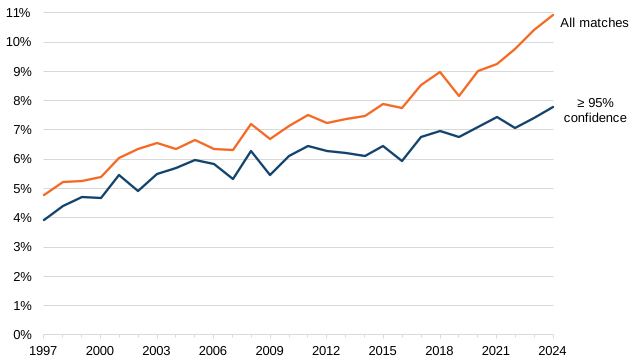
Figure 1. Proportion of inventor occurrences identified as female, based on patent applications to the UK IPO, by confidence level and publication year, 1997-2024
Download the data for figure 1 in worksheets 1a-1c (ODS, 99.3KB)
UK ecosystem
This section looks at female inventors with a correspondence address in the UK, referred to in this report as UK-based inventors. The proportion of UK-based inventors compared to overall inventor occurrences has increased slightly over time.
In 1997, 4.3% (N = 136) of UK-based inventors matched at 95% confidence have a name inferred as likely to be female. This is the same proportion (4.3%) for all female matches (N = 362), including those with lower certainty. For patent applications published in 2024, the proportion of UK-based female inventors has increased to 7.7% (N = 631) at 95% confidence and 9.3% (N = 1,274) for all matches (Figure 2).
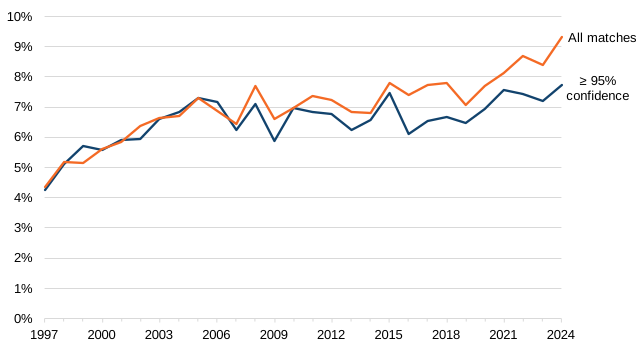
Figure 2. Proportion of UK-based female inventor occurrences, based on patent applications to the UK IPO, by confidence level and publication year, 1997-2024
Download the data for figure 2 in worksheets 1a-1c and UK-based inventor occurrences (ODS, 22.6KB)
For the number of patent applications published between 1997 and 2024 with only UK-based inventors, individual female inventors and all-female inventor teams account for 3.7% (N = 6,103). This proportion is higher for those matched with 95% confidence, at 4.4% (N = 3,172). The overall proportion for all matches has fluctuated across the years, with a rise in mixed inventor teams. These account for 3.3% (N = 181) of published patent applications with UK-based inventors in 1997, rising steadily to a high of 13.4% (N = 764) in 2024.
Download the data for patent applications from UK-based inventor teams (ODS, 46KB)
International inventors and collaboration
Inventors with a correspondence address outside of the UK are referred to as internationally based inventors in this report. They show a slightly higher average annual increase in the share of female inventors, based on published patent applications. This is when compared to UK-based inventors.
For internationally based inventors, in 1997 3.8% (N = 261) of these inventor occurrences are inferred as female inventors, when matched at 95% confidence. For all internationally based matches, 5.1% (N = 683) are inferred as female inventors. Looking at internationally based inventors in the most recent publication year in this report, 2024, presents a female inventor proportion of 7.9% (N = 458) at 95% confidence and 12.2% (N = 2,111) for all matches (see Figure 3).
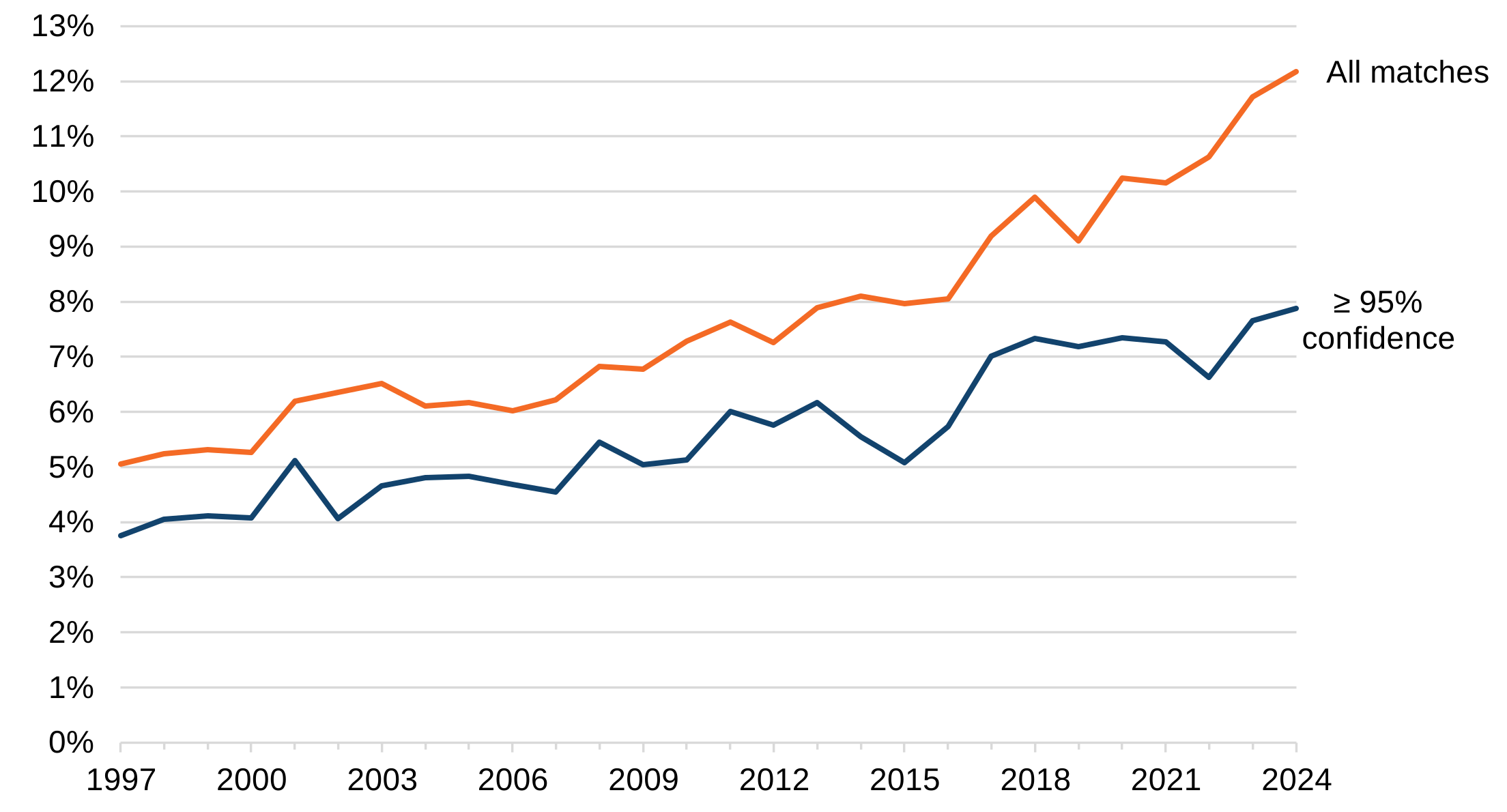
Figure 3. Proportion of internationally based female inventor occurrences, based on patent applications to the UK IPO, by confidence level and publication year, 1997-2024
When looking at published patent applications by inventor team type, the proportion of individual female inventors and all-female inventor teams is lower for internationally based teams. This is when compared to teams where all inventors are UK-based. All-female inventor teams and individual female inventors account for 2.1% (N = 3,199) of published patent applications (1997 to 2024), where all inventors are internationally based. It is lower for those matching with 95% confidence, at 1.8% (N = 803). This has seen marginal fluctuations across the time period. Mixed teams account for 12.5% (N = 18,607) of published patent applications with internationally based inventor teams. This has risen steadily from 6.6% (N = 414) in 1997, to 24.2% (N = 1,200) in 2024. These proportions are lower when inferring sex at 95% confidence, ranging between 3.5% and 8.6%.
Though worth noting the total numbers are low, a high proportion of teams with both UK-based and internationally based inventors are all-male inventor teams. These account for 67.7% (N = 6,903) of these patent applications published between 1997 and 2024. This has fallen from 76.6% (N = 167) in publication year 1997 to 58.0% (N = 238) in 2024, coinciding with a slight rise in teams with both female inventors and male inventors.
Download the data for patent applications from internationally based inventor teams (ODS, 46KB)
Inventor teams
This section looks at team compositions for each published patent application. The following chart (Figure 4) presents the proportion of inventor team compositions where all given name(s) across inventors match at 95% confidence (N = 117,893). The composition of inventor teams by level of confidence (Table 5) within the Technical annex. This shows 3.3% (N = 3,925) of all published patent applications from 1997 to 2024, where inventor sex is inferred with at least 95% confidence, consist of individual female inventors and all-female inventor teams. This proportion has fluctuated over the years, with the highest proportion of individual female inventors and all-female inventor teams in 2008, accounting for 4.5% (N = 185). This is closely followed by 4.4% (N = 186) in 2006 and 4.3% (N = 175) in 2012 (based on total inventors/inventor teams matched to female or male at 95% confidence only). 4.8% (N = 5,645) of published patent applications are from mixed inventor teams. Mixed teams have risen steadily over the years, from 2.8% (N = 116) in 1997 and peaking at 7.5% (N = 320) in 2022 (at 95% confidence). To show the change over time and demonstrate the overall make up of inventor teams matched at 95% confidence, Figure 5 presents the percentages for snapshot years and in total.
The size of mixed inventor teams, where sex is inferred at 95% confidence, has shown only slight fluctuations across the years. They average 3.2 individuals per team in publication year 1997, to 3.3 in 2024. Looking at the 28-year period (1997 to 2024), the composition of mixed teams (at 95% confidence) has remained consistent, with male ratios steadily higher than female ratios. For mixed inventor teams, 36.2% of team members tend to be female inventors, seeing a marginal dip to between 35.0% and 35.6% from 2022 to 2024.
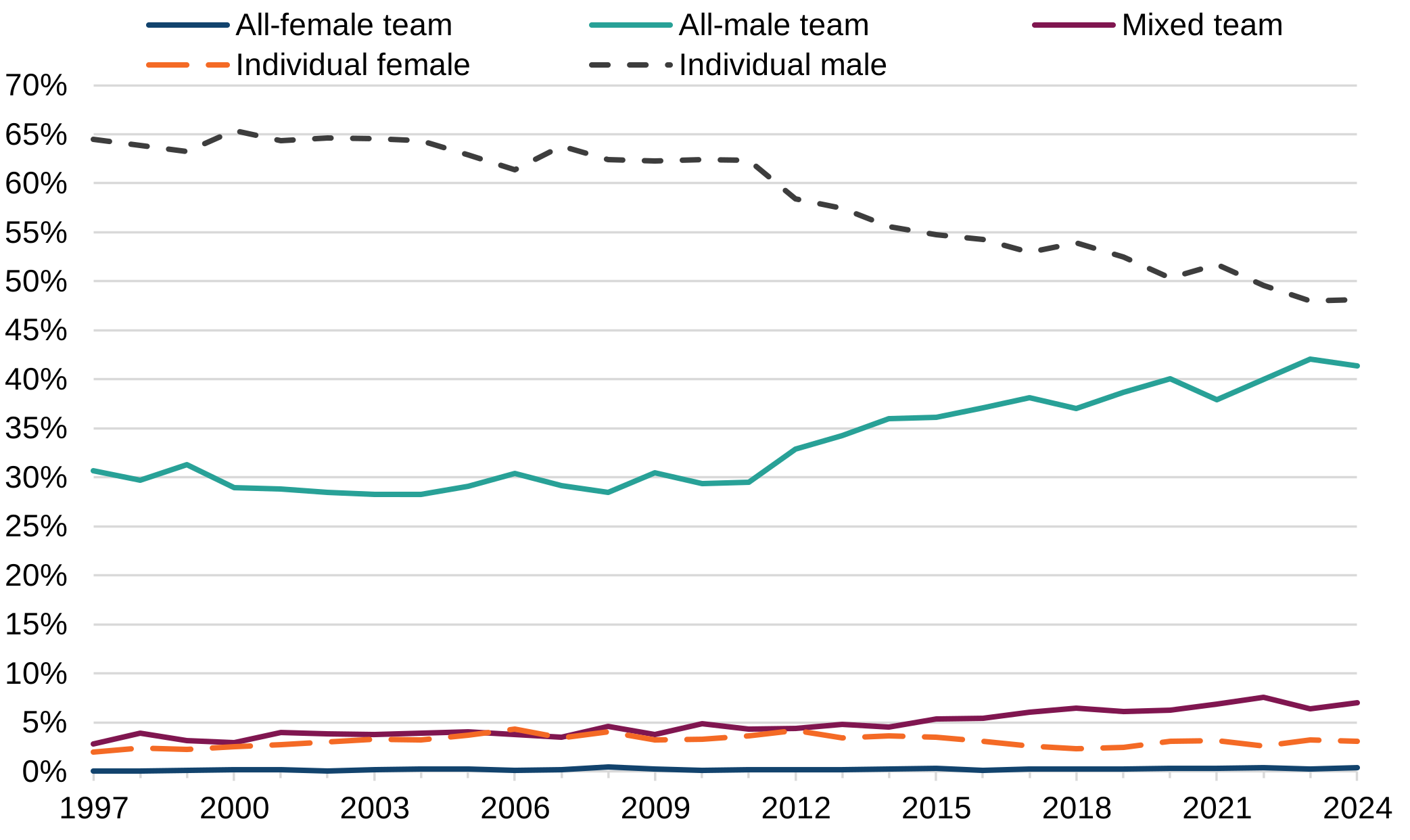
Figure 4. Inventor team composition (95% confidence) by publication year of patent applications, 1997-2024
Download the data for figure 4 in worksheets 3b-3c (ODS, 99.3KB)
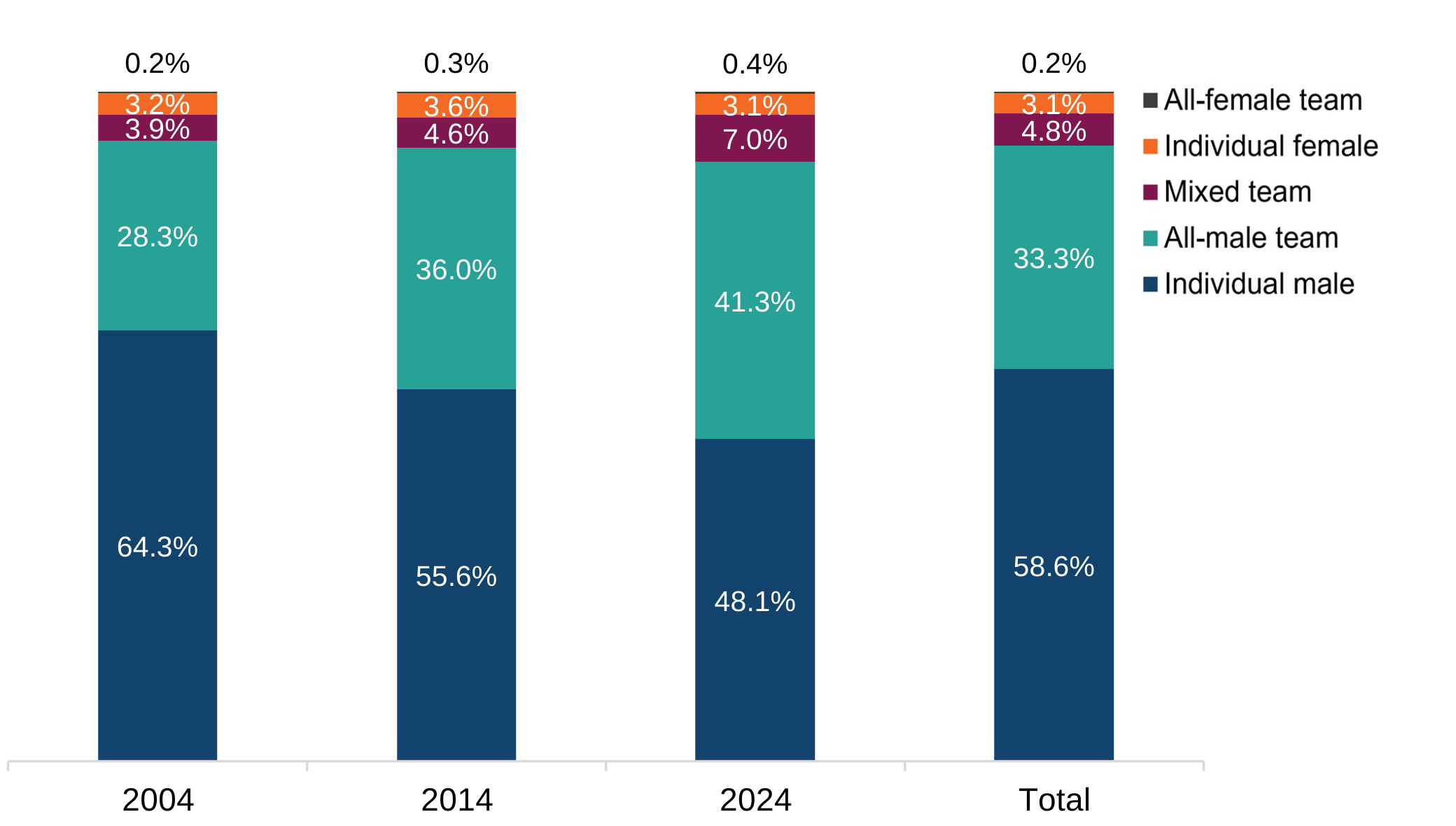
Figure 5. Proportion of team composition, snapshot years and combined total for 1997-2024 (95% confidence)
Download the data for figure 5 in worksheets 3b-3c (ODS, 99.3KB)
Only 2.9% (N = 9,323) of patent applications published between 1997 and 2024 are from individual female inventors and all-female inventor teams, based on all inferred matches (N = 325,991). This gradually increased from 2.1% (N = 249) in 1997, peaking at 3.8% in 2008 at 3.8% and has since fluctuated (Figure 6). In 2024, 2.9% (N = 316) of published patent applications had individual female inventors and all-female inventor teams. Patent applications with mixed inventor teams accounted for 5.2% (N = 619) of patent applications published in 1997. This rose at an average annual pace of 0.2% until 2007, where the annual average change increased to 0.5% between 2007 and 2017. This further increased to an annual average increase of 0.9% up until 2024, where the proportion of patent applications with mixed inventor teams peaked at 18.6% (N = 2,062). These rises have coincided with a declining number of individual male inventors, although it should be noted that all-male inventor teams have risen during the same period. Figure 7 shows the percentages in snapshot years and in total across inventor teams.
The average size of mixed inventor teams has grown steadily from publication year 1997 to 2024. This increased from an average of 3.7 people per mixed team, to 4.8 (based on all matches). Looking at the 28-year period (1997 to 2024), the composition of mixed inventor teams has remained constant, with the ratio of male inventors consistently higher than the ratio of female inventors. For mixed inventor teams, around 30.0% of team members tend to be female inventors, declining slightly in more recent years (based on all matches). The proportion of male inventors has also seen a decline. Across the time period, 61.3% of inventors in mixed teams are inferred as male. This reduced to 55.8% in 2023 and 56.1% in 2024. These declines have coincided with a rise of inventors within mixed teams where their sex cannot be inferred. These shifts may reflect an increase in unisex names. There has also been an increase in the average size of mixed inventor teams.
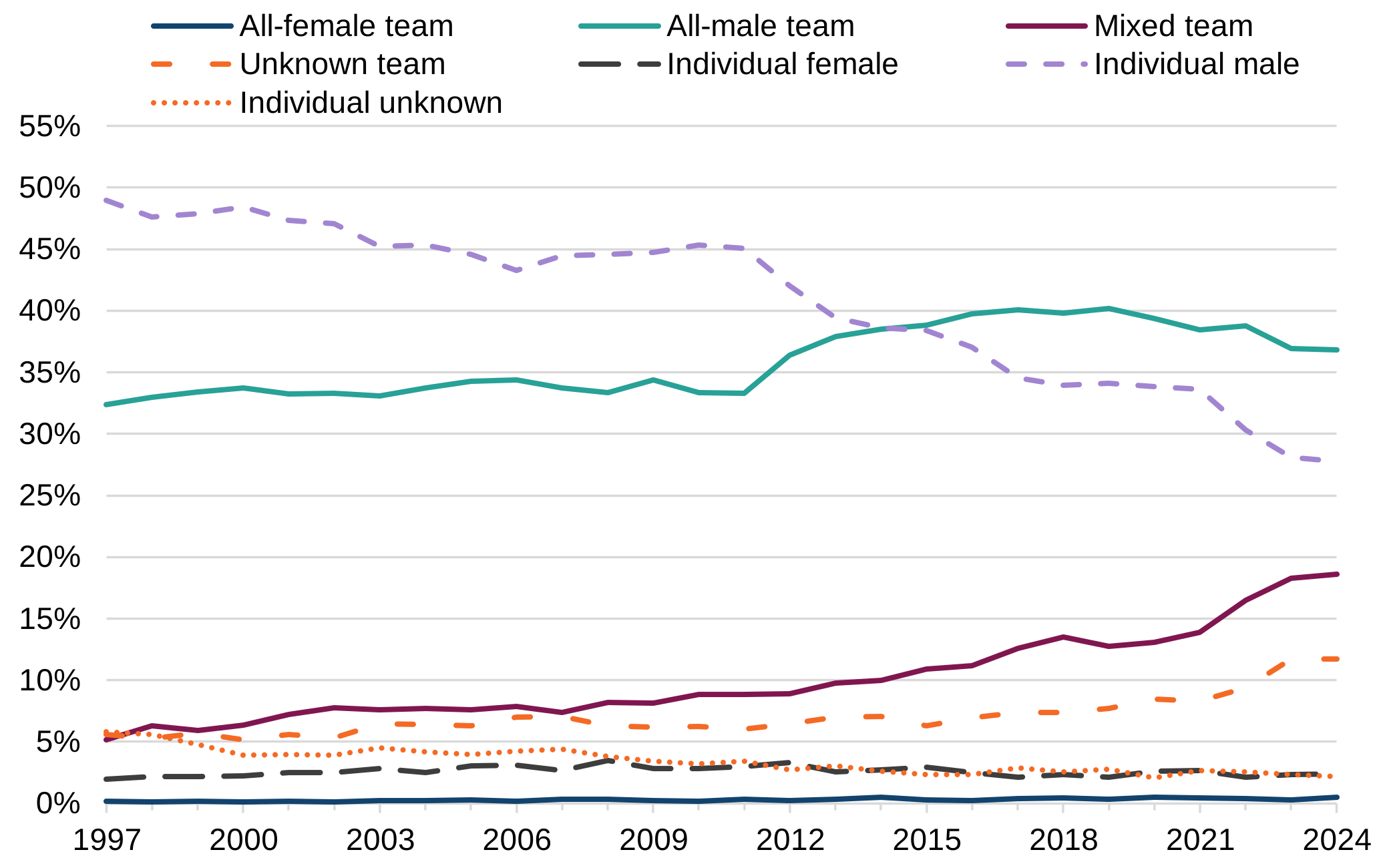
Figure 6. Inventor team composition (all patent applications) by publication year, 1997-2024
Download the data for figure 6 in worksheets 3d-3e (ODS, 99.3KB)
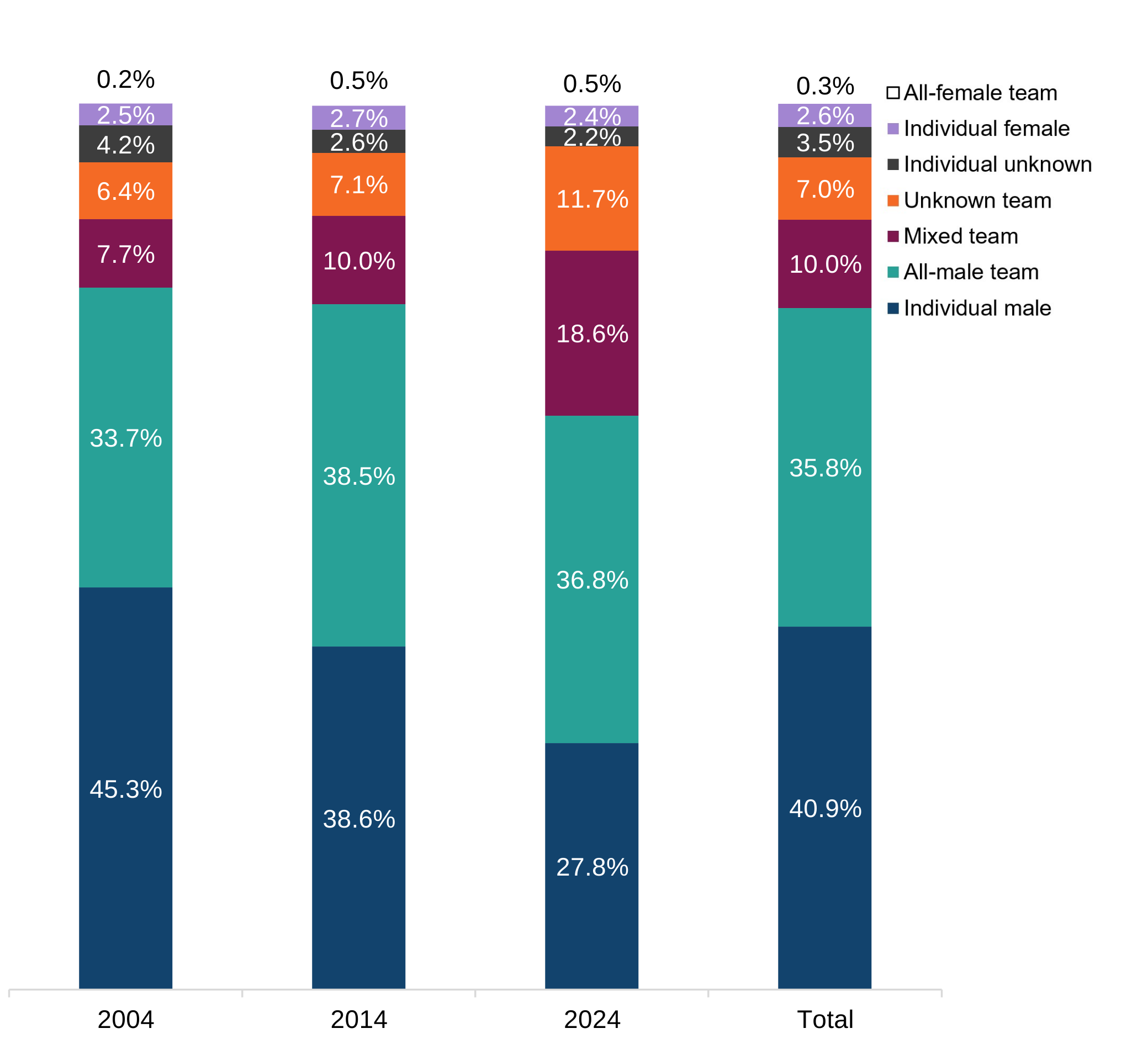
Figure 7. Proportion of team composition, snapshot years and combined total for 1997-2024 (all matches)
Download the data for figure 7 in worksheets 3d-3e (ODS, 99.3KB)
Types of applicants
Patent applications include an applicant or owner name, which is used in analysis to identify patent filings originating from different owner types. These include individual persons, registered entities and educational establishments. Some patent applications list multiple owners or applicants. This does not always mean the inventor is affiliated with listed entities. In some cases, the inventor may also be listed as the individual owner.
Industry applicants
A high proportion (79.1%, N = 257,852) of published patent applications come from those with an applicant or owner type identified as a registered entity such as companies, partnerships and corporations. Of these, 1.8% (N = 4,652) are from female inventor teams or individual female inventors (based on all inferred matches). This is the same proportion (1.8%) as with those from educational establishments, and as such is marginally lower than the proportion against all published patent applications (2.9%). Mixed inventor teams are higher, at 10.9% (N = 28,017). This is consistent with the proportion of mixed inventor teams for overall published patent applications (10.0%). Figure 8 shows the change over time. This is based on the share of applications from registered entities to overall published patent applications in each team type.
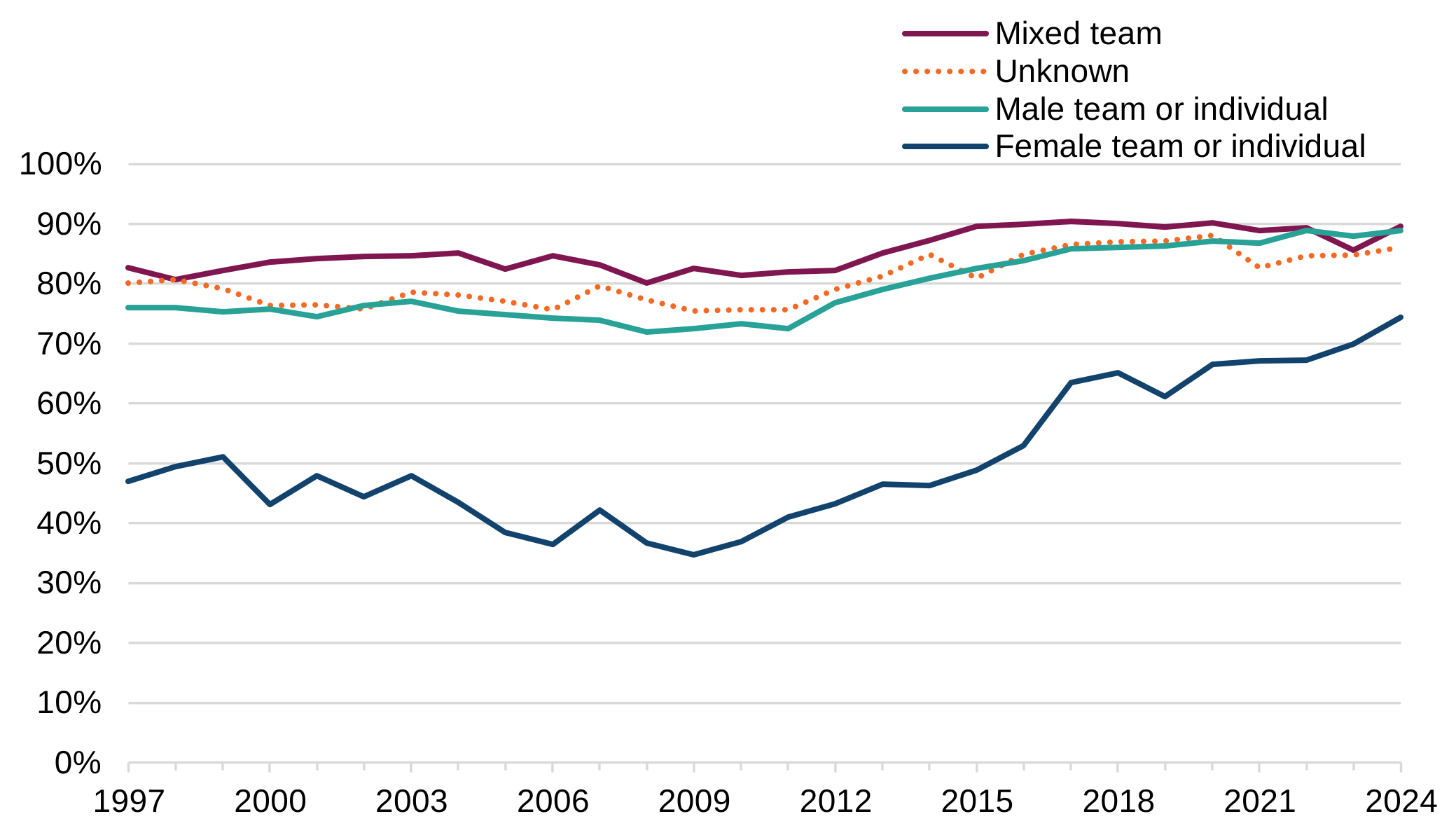
Figure 8. Registered entity share of total patent applications to the UK IPO, by inventor team composition and publication year, 1997-2024
(Note: the percentages are based on the share of applications from registered entities to overall published patent applications in each team type. Therefore, these do not total to 100%)
Download the data for figure 8 in worksheets 1a-1c (ODS, 33.9KB)
Academic applicants
Between 1997 and 2024, 1.7% (N = 5,659) of published patent applications originated from an educational establishment. This category includes both further education and higher education institutions, such as universities and colleges. As Technology Transfer Offices typically operate within universities, they are also captured within this category. Of these, 1.8% (N = 104) are from female inventor teams or individual female inventors (based on all inferred matches). This is marginally lower than the proportion against all published patent applications (2.9%), in Figure 9. However, mixed inventor teams are considerably higher, making up 31.3% (N = 1,774) of patent applications from educational establishments. This is unsurprising given the collaborative nature of research in higher education. For overall published patent applications, this proportion is substantially lower, at 10.0%.
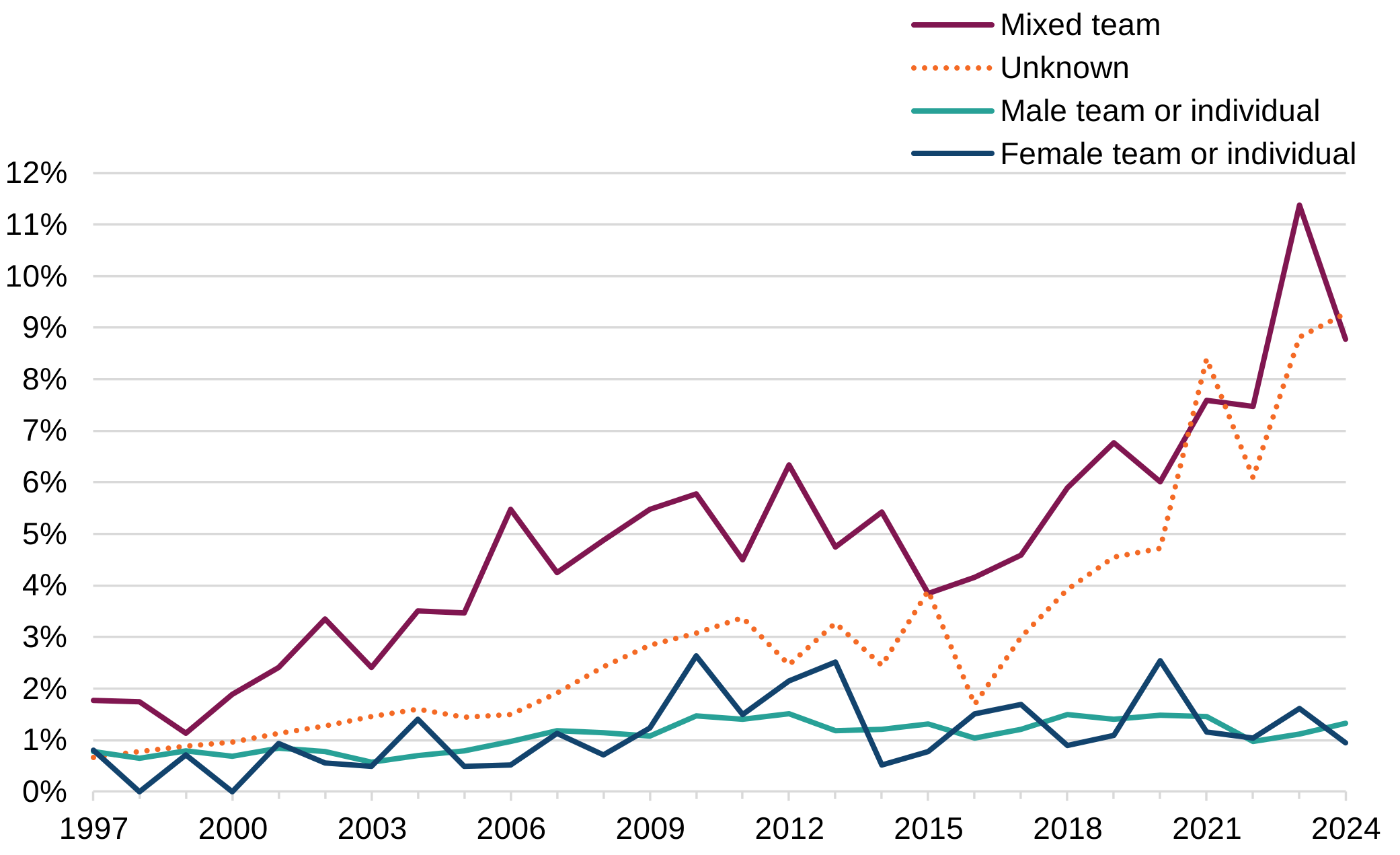
Figure 9. Educational establishment share of total patent applications to the UK IPO, by inventor team composition and publication year, 1997-2024
(Note: the percentages are based on the share of applications from education establishments to overall published patent applications in each team type. Therefore, these do not total to 100%)
Download the data for figure 9 in worksheets 2a-2c (ODS, 33.9KB)
Private applicants
Private applicants are those inventors who apply for a patent without the use of a registered patent agent or attorney. As outlined in the Technical annex, this analysis relies on a private applicant flag. Since applicants can choose to hire or discontinue an agent at any time, the results should be considered indicative.
Between 1997 and 2024, 8.2% (N = 26,573) of published patent applications are from private applicants. Of patent applications filed by private applicants, 7.5% (N = 1,992) have an all-female inventor team or individual female inventor. This is notably higher than the proportion of female inventor teams to all patent applications (2.9%). These are based on all matches regardless of confidence level, and a similar trend is observed for those matched at 95% confidence.
Perhaps more noteworthy, 21.4% of total patent applications with individual female inventors and all-female inventor teams (N = 9,323) are identified as being from private applicants. This is notably lower when observing patent applications with individual male inventors and all-male inventor teams, with 9.0% (N = 22,428) being identified as private applicants. For mixed inventor teams, this is 3.4% (N = 1,106). For those inventor teams or individual inventors where the sex has not been inferred (unknown), 3.1% (N = 1,047) of applications are private applicants.
These proportions have fluctuated across the years, as presented in the following chart (Figure 10). This chart shows the share of published patent applications from private applicants for each team type, calculated as a percentage of that team type’s total published patent applications for each year of publication. The highest proportion from private applicants compared to overall patent applications with individual female inventors or all-female inventor teams were published in 2005 and 2009, at 36.9% (N = 148) and 36.3% (N = 118), respectively. 2008 had the highest volume of published patent applications from private applicants in total (N = 1,540) and 8.5% (N = 131) were from all-female inventor teams or individual female inventors. The volume of published applications from private applicants has continued on a downward trajectory since 2008, to 255 in 2024. Although subsequent observations indicate an increase in applications through the private applicant route, this falls outside the scope of this report, as no analysis has been carried out for the period beyond publication year 2024.
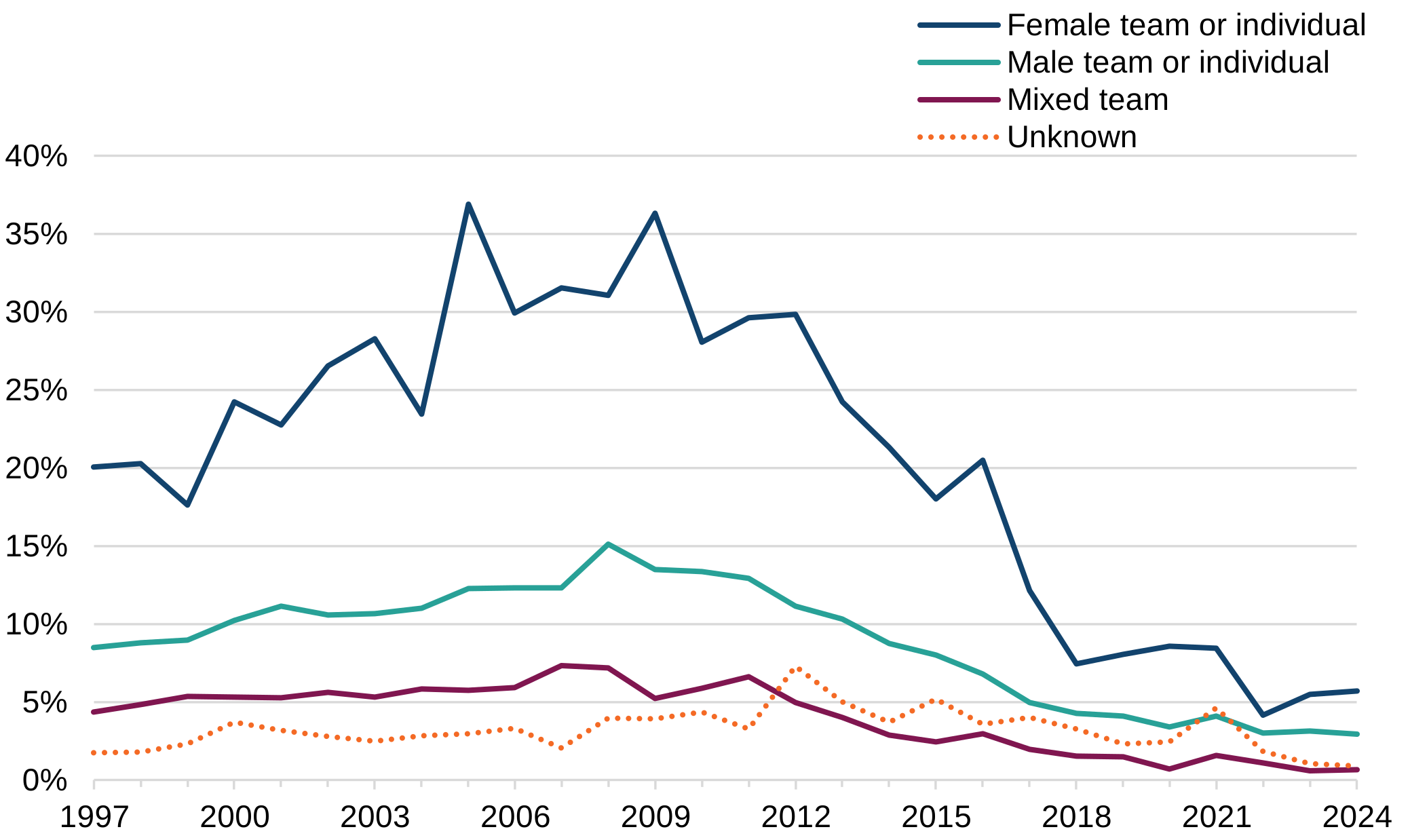
Figure 10. Private applicant share of total patent applications to the UK IPO for each team composition and by publication year, 1997-2024
(Note: the percentages are based on the share of applications from private applicants to overall published patent applications in each team type. Therefore, these do not total to 100%)
Download the data for figure 10 in worksheets 5a-5c (ODS, 99.3KB)
Areas of technology
A patent application can represent many different technology subclasses and is classified based on the International Patent Classification (IPC) scheme. The WIPO technology concordance table classify these to 35 fields of technology, which are presented in the following analysis. The technology sector and field assigned in this report are based on the first classification for each application. While this may not fully capture the breadth of each invention, it provides the closest available proxy to a ‘primary’ classification.
For patent applications published between 1997 and 2024, the highest volumes across all technology fields are for “Civil engineering” (9.8%, N = 31,792), “Computer technology” (8.6%, N = 27,881) and “Transport” (7.1%, N = 23,041). It’s important to note that absolute patent counts are not a direct measure of innovation, as outlined in the Patent Guide. As different technology fields naturally demonstrate different propensities to patent, higher volumes in one should not be interpreted as better performance.
For individual female inventors and all-female inventor teams at 95% confidence, shown in Figure 11, the highest volume comes from “Other consumer goods” (19.0% of published patent applications with individual female inventors and all-female inventor teams, N = 744). This is the same for individual female inventors and all-female inventor teams across all levels of name matching (16.2%, N = 1,509), presented in Figure 12. This technology field includes a wide range of everyday consumer products, from clothing, personal-care equipment and household accessories, to printed materials, artistic tools, textiles, refrigeration devices and musical instruments. More on technology fields and the type of IPC subclasses associated with each are available in WIPO’s IPC Publication.
Looking at the highest volumes with female inventors (across all matches), “Other consumer goods” is followed by “Furniture, games” (12.4%, N = 1,152) and “Medical technology” (8.4%, N = 779). Of all published patent applications classified as “Other consumer goods”, 12.8% were invented solely by female inventors.
For mixed inventor teams across all matches, the highest volume of patent applications is in the technology field “Computer technology” (11.3%, N = 3,662). This is followed by “Medical technology” (6.4%, N = 2,075) and “Measurement” (6.1%, N = 1,991). Of published patent applications in the “Biotechnology” field, 40.1% (N = 1,204) have mixed inventor teams.
The technology field with the lowest amount of published patent applications is “Micro-structural and nano-technology” (N = 171). This is the lowest across all types of inventor teams and account for 0.02% (N = 2) of published patent applications with individual female inventors. There are no identified published patent applications in this technology field from all-female inventor teams. They make up 0.08% (N = 27) of applications with mixed inventor teams (based on all matches), and 0.05% (N = 119) of applications with individual male inventors and all-male inventor teams.
When comparing female and male inventor teams (including individual inventors), the largest disparity in the volume of published patent applications across technology fields occurs in the “Civil engineering” technology field. Based on all inferred matches, 4.4% (N = 408) of applications with individual female inventors and all-female inventor teams are for “Civil engineering”. This is compared to 11.0% (N = 27,494) with individual male inventors and all-male inventor teams. 5.2% (N = 1,677) of patent applications with mixed inventor teams are in the “Civil engineering” technology field, and reviewing recent years suggests this remains a male-dominated area of technology.
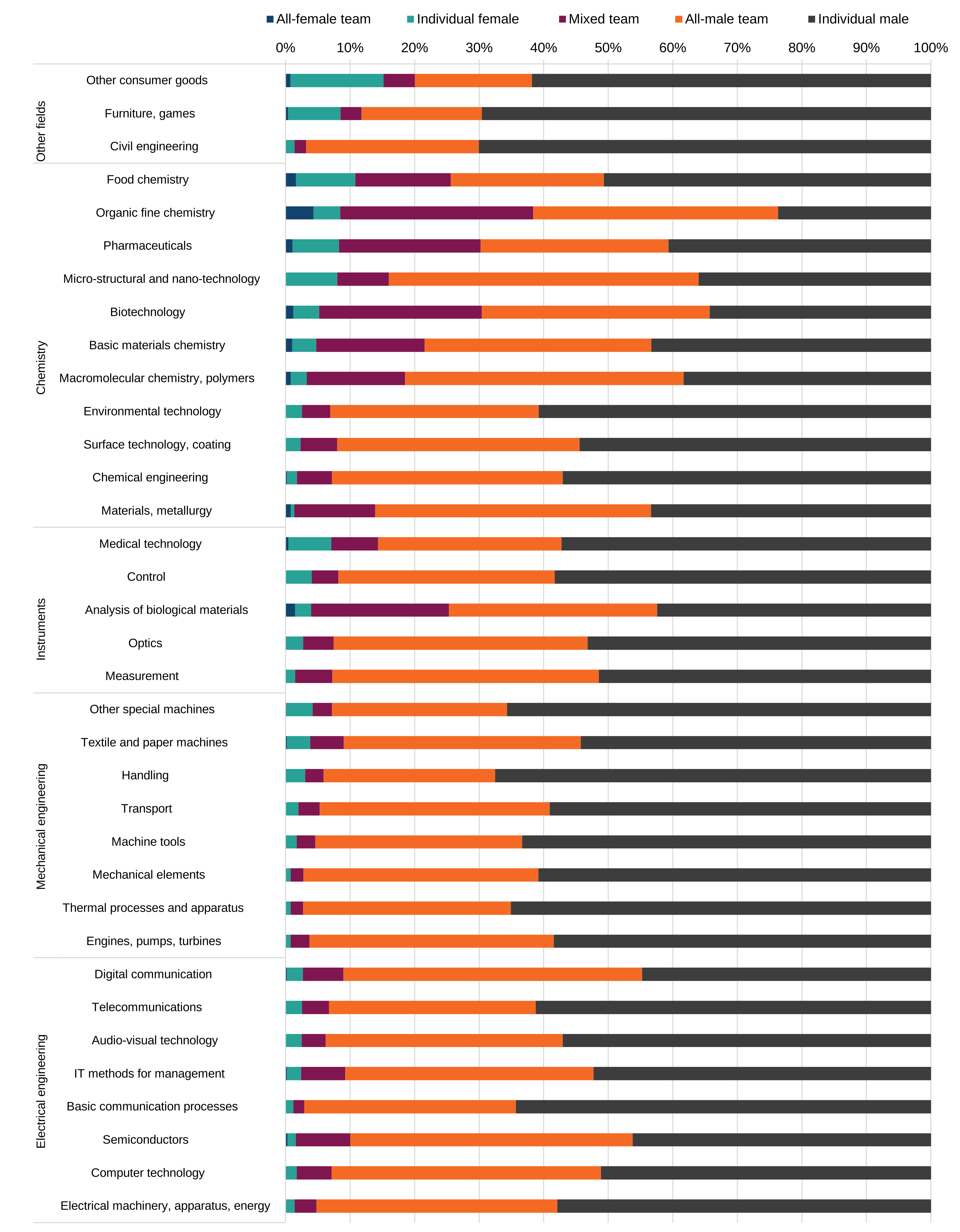
Figure 11. Percentage of inventor team composition by technology sector and field, ranked by female representation (95% confidence) in each sector, for published patent applications to the UK IPO, publication years 1997-2024
Download the data for figure 11 in worksheet 7a (ODS, 99.3KB)
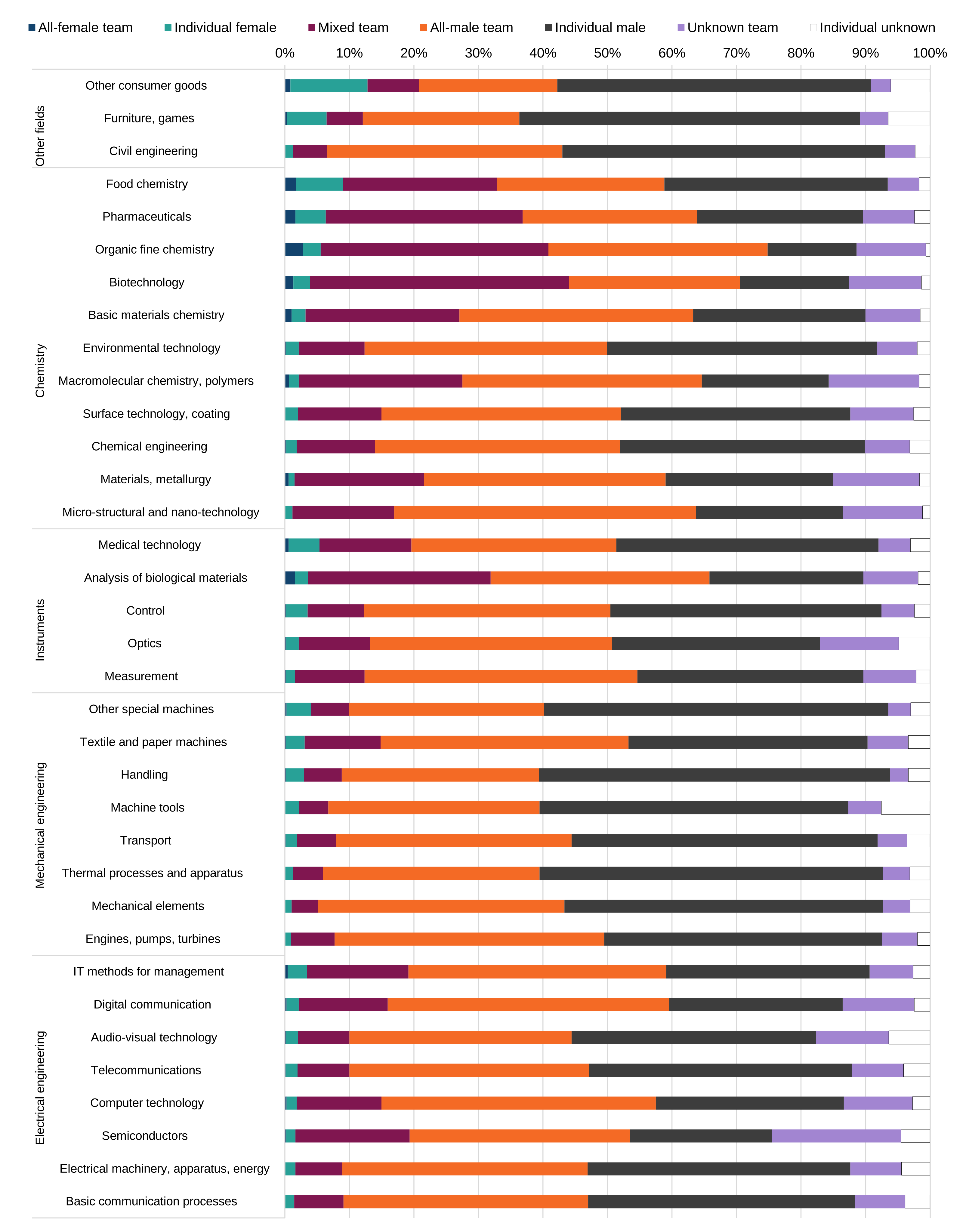
Figure 12. Percentage of inventor team composition by technology sector and field, ranked by female representation in each sector (all matches), for published patent applications to the UK IPO, publication years 1997-2024
Download the data for figure 12 in worksheet 7b (ODS, 99.3KB)
Table (1) shows the distribution of patent applications across technology fields by inventor team composition: female inventors/inventor teams, mixed inventor teams and male inventors/inventor teams. The fields are ranked from highest to lowest based on the share of applications with female inventors or all-female inventor teams.
Table 1. Percentage of inventor teams (grouped by sex) and technology field, publication years 1997-2024 (95% confidence), ordered highest to lowest for female inventors and all-female inventor teams
| Technology field | Female (95% confidence) | Mixed (95% confidence) | Male (95% confidence) |
|---|---|---|---|
| Other consumer goods | 15.2% | 4.9% | 80.0% |
| Food chemistry | 10.8% | 14.8% | 74.4% |
| Furniture, games | 8.5% | 3.2% | 88.3% |
| Organic fine chemistry | 8.4% | 29.9% | 61.7% |
| Pharmaceuticals | 8.3% | 21.9% | 69.8% |
| Micro-structural and nano-technology | 8.0% | 8.0% | 84.0% |
| Medical technology | 7.1% | 7.3% | 85.7% |
| Biotechnology | 5.2% | 25.2% | 69.6% |
| Basic materials chemistry | 4.8% | 16.8% | 78.5% |
| Other special machines | 4.2% | 3.0% | 92.8% |
| Control | 4.1% | 4.1% | 91.8% |
| Analysis of biological materials | 4.0% | 21.3% | 74.7% |
| Textile and paper machines | 3.8% | 5.2% | 91.0% |
| Macromolecular chemistry, polymers | 3.3% | 15.2% | 81.5% |
| Handling | 3.0% | 2.9% | 94.1% |
| Digital communication | 2.7% | 6.3% | 91.1% |
| Optics | 2.7% | 4.7% | 92.5% |
| Environmental technology | 2.5% | 4.4% | 93.1% |
| Audio-visual technology | 2.5% | 3.7% | 93.8% |
| Telecommunications | 2.5% | 4.2% | 93.3% |
| IT methods for management | 2.4% | 6.8% | 90.8% |
| Surface technology, coating | 2.3% | 5.7% | 92.0% |
| Transport | 2.0% | 3.3% | 94.7% |
| Chemical engineering | 1.8% | 5.4% | 92.8% |
| Computer technology | 1.7% | 5.4% | 92.9% |
| Machine tools | 1.7% | 2.9% | 95.4% |
| Semiconductors | 1.6% | 8.5% | 90.0% |
| Measurement | 1.5% | 5.7% | 92.8% |
| Materials, metallurgy | 1.4% | 12.5% | 86.1% |
| Electrical machinery, apparatus, energy | 1.4% | 3.4% | 95.2% |
| Civil engineering | 1.4% | 1.8% | 96.8% |
| Basic communication processes | 1.2% | 1.7% | 97.1% |
| Engines, pumps, turbines | 0.8% | 2.9% | 96.3% |
| Mechanical elements | 0.8% | 2.0% | 97.2% |
| Thermal processes and apparatus | 0.8% | 2.0% | 97.3% |
| Overall | 3.3% | 4.8% | 91.9% |
(Note: the percentages have been rounded to one decimal place and therefore may not total to 100%)
Stages of application
Different stages of the patent application process provide indicators of progress. Applicants, who in some instances are also the inventor(s), initially file their application and at this stage it is a pending patent. Before a patent can be granted, the UK IPO must carry out a search (requested through a Form 9A) to confirm the invention is new and inventive, and then the patent will be published. Only published patent applications are included in this analysis. A substantive examination of the patent application (requested through a Form 10) will then take place. Once a patent has been examined and meets requirements, the patent will be granted. As with other sections in this report, this analysis only looks at inventors rather than applicants.
Substantive examinations
11.4% (N = 37,084) of published patent applications between 1997 and 2024 do not have a Form 10 (a substantive examination). In a large majority of instances (99.4%), this is due to the patent being terminated before grant (N = 36,865). For all patent applications without a Form 10, those with individual female inventors and individual male inventors demonstrate a higher proportion than overall patent applications. This is shown in table (2). Patent applications with individual inventors are also more likely than those with a team of inventors to be terminated before grant.
Table 2. Percentage of published patent applications without a substantive examination request compared to all published patent applications, by inventor team composition
| Team composition | Percentage (%) of published patent applications with no Form 10, by inventor team type | Percentage (%) of published patent applications, by inventor team type |
|---|---|---|
| All-female team | 0.3% | 0.3% |
| All-male team | 29.2% | 35.8% |
| Mixed team | 8.1% | 10.0% |
| Unknown team | 3.7% | 7.0% |
| Individual female | 3.8% | 2.6% |
| Individual male | 52.4% | 40.9% |
| Individual unknown | 2.6% | 3.5% |
(Note: the percentages have been rounded to one decimal place and therefore will not total 100%)
Download the data for table 2 in worksheet 8 (ODS, 99.3KB)
Terminated before grant
When a patent application has been terminated before grant, the patent application has either been withdrawn by the applicant or the applicant has failed to meet a statutory time limit. These account for 34.5% (N = 112,418) of published patent applications across 1997 to 2024 included in this report.
Based on all matches, 42.1% (N = 381) of patent applications published between 1997 and 2024 with all-female inventor teams were terminated before grant. The proportion is higher for applications with individual female inventors, accounting for 48.3% (N = 4,070) of these patent applications. This is also high for patent applications with individual male inventors, at 40.5% (N = 53,962). The proportion of patent applications terminated before grant, relative to the total number of patent applications by inventor team, is lower for those with all-male inventor teams and mixed teams, at 29.7% (N = 34,743) and 30.4% (N = 9,855), respectively.
Granted patents
For those patent applications published between 1997 and 2024, 61.3% (N = 199,869) have been granted. This is based on all matches regardless of confidence level and data correct as of June 2025.
Of all granted patents, 2.2% (N = 4,470) come from individual female inventors or all-female inventor teams. Across publication years 1997 to 2024, the proportion of published patent applications invented by individual female inventors or all-female inventor teams is 2.9%, higher than the equivalent proportion of granted patents (2.2%). This suggests that while a higher proportion file patent applications, a lower proportion proceed to grant. It is likely influenced by a lower proportion of patent applications granted for individual inventors, as a similar trend is shown for individual male inventors. 10.0% (N = 20,042) of granted patents are from mixed inventor teams, and in 11.4% (N = 22,791), the inventor or inventor’s team sex cannot be inferred.
For granted patents where the sex of inventors and inventor teams is inferred at 95% confidence, the majority come from individual male inventors and all-male inventor teams. The proportion from individual female inventors or all-female inventor teams is 2.6% (N = 1,793). This is again lower than the equivalent proportion of patent applications invented by individual female inventors or all-female inventor teams, based on those matched at 95% confidence (3.3%). 4.8% (N = 3,305) of granted patents are from mixed inventor teams.
Across all levels of matching, patent applications in the technology field “Civil engineering” have the highest volume of grants, accounting for 11.0% (N = 21,963) of patents granted. This is also the technology field with the highest volume of published patent applications. Findings from WISE show that women make up 10.6% of the engineering workforce in the UK in 2024. They note variances across the engineering sector, showing that a higher proportion are represented as project managers and project engineers (18%) and as aerospace engineers (16%). However, women only represent 3% of electrical engineers.
For patent applications with only female inventors (individual female inventors and all-female inventor teams), the highest volume of published patent applications is for “Other consumer goods”. This technology field also sees the highest volume of granted patents for these groups, making up 13.4% (N = 599) of granted patents with individual female inventors or all-female inventor teams. This pattern is followed when looking at the next highest technology fields for published patent applications with female inventors, as “Furniture, games” also represents the second highest percentage of patents granted for these groups, at 11.5% (N = 513). “Medical technology” places third, accounting for 7.9% (N = 355) of granted patents from individual female inventors or all-female inventor teams.
The highest percentage of granted patents with mixed inventor teams are in the “Computer technology” field, accounting for 10.1% (N = 20,035). This is also the field with the highest volume of published patent applications with mixed inventor teams. Relative to grants per technology field, 41.3% (N = 644) of patents granted in the “Biotechnology” field were invented by mixed inventor teams. This aligns with the large proportion of published patent applications in this field from the mixed inventor cohort (40.1%).
Proportionally, the technology field with the highest disparity in patents granted when compared to published patent applications is “IT methods for management”. This is observed not only for female inventors, but across all inventor teams. Across all inventor teams, this technology field has a total of 305 granted patents and 3,478 patent applications, accounting for 8.8%.
Download the data for granted patents in worksheets 9a-9e (ODS, 99.3KB)
Reasons not in force
When a patent becomes ‘not in force’, it means the legal rights granted by a patent are no longer active. Of granted patent applications, the most prevalent reason for them not being in force is ceased. These make up 53.9% (N = 107,711) of granted patents and occur if a renewal fee is not paid within the time allowed, meaning the patent has been allowed to lapse.
The proportion of patents ceased is highest for granted patent applications with individual inventors where sex cannot be inferred, accounting for 70.2% (N = 4,809) of granted patents from this inventor cohort. Ceased is the reason patents are not in force in 61.0% (N = 2,439) of granted patents invented by individual female inventors, 60.5% (N = 45,559) of granted patents invented by individual male inventors, 49.6% (N = 38,293) of granted patents invented by all-male inventor teams and 49.4% of granted patents where the sex across teams of inventors cannot be inferred (N = 7,866). The proportion is lower for all-female inventor teams and mixed teams, at 44.9% (N = 211) and 42.6% (N = 8,534), respectively.
Other reasons why a patent is not in force include revoked (when a patent is deemed invalid), surrendered (when the patent owner voluntarily gives up a granted patent) and expired (when the patent has reached the end of its life span and cannot be renewed). Table 3 provides further context by showing the time between grant and a patent becoming not in force, broken down by reason.
Table 3. Average length in years from grant date to not in force date, by reason not in force and team type
| Team composition | Revoked (average decimal years) | Surrendered (average decimal years) | Expired (average decimal years) | Ceased (average decimal years) |
|---|---|---|---|---|
| All-female team | 6.2 [low] | [no data] | 16.5 [low] | 6.0 |
| All-male team | 3.9 | 3.2 | 17.0 | 6.8 |
| Mixed team | 3.9 | 4.3 [low] | 16.9 | 6.5 |
| Unknown team | 4.7 | [no data] | 17.2 | 6.9 |
| Individual female | 4.4 | [no data] | 17.0 | 6.1 |
| Individual male | 3.9 | 3.2 | 16.9 | 6.2 |
| Individual unknown | 3.9 [low] | 1.2 [low] | 17.3 | 6.0 |
(Note: average decimal years are shown to one decimal place. Some averages are based on a single or low number of patents (20 or less) and are marked in Table 3 as [low]. The actual number of patents these relate to the linked data tables. Those listed as [no data] are because there are no published patent applications with the reason not in force for that team type)
Download the data for table 3 in worksheet 6 (ODS, 32.2KB)
Outliers are identified for each grant year by comparing the average time between a patent grant and the date it becomes not in force, based on the team type and reason. Statistical significance was assessed using two-sided p-values, which tests how the observed average duration differs meaningfully from the typical duration.
This threshold is set as α = 0.05 and p-values are shown as ‘p = ’.In this instance, we test the hypothesis that the average duration in each group is the same as or less than the average for that year. The p-value denotes the probability that this hypothesis is correct. Any p-values less than or equal to (≤) 0.05 suggest the average duration is longer than the average for that year.
Those demonstrating statistical significance (p = 0.012) include patent applications granted in 2008 from individual female inventors. Three patents from individual female inventors were revoked, with the average duration between the grant date to not in force date of 8.9 years. This average was influenced by one patent with a duration of 13.3 years. Across all years included in this report, the average duration (time between grant and revocation) for patents invented by individual female inventors is 4.4 years, although this is based on only 36 patent applications. The average duration is higher for teams where the sex of inventors cannot be inferred, at 4.7 years. One application granted in 2010 presented a statistically significant (p = 0.001) duration following grant, being revoked after 13.8 years. Table 3, the average is lower for all-male inventor teams, mixed teams and individual male inventors, each presenting an average of 3.9 years. Only one published patent inferred as having an all-female inventor team has been revoked across the time period.
The surrender of patents happens infrequently and therefore these findings are based on low numbers. The reason a patent may be surrendered can include to avoid revocation proceedings, or infringement action, and therefore the time following grant will always vary. For patents with individual male inventors, the average duration from being granted to surrendered across the whole time period is 3.2 years. Statistical significance (p = 0.013) was observed for patents granted in 2011 with individual male inventors, influenced by one patent that was surrendered 11.5 years after grant. For all-male inventor teams, this is slightly higher at 3.2 years. One patent granted in 2006 with an all-male inventor team was surrendered 7.5 years after grant, showing statistical significance (p = 0.050). There have been 12 surrendered patents identified as being invented by mixed teams. These occur on average 4.3 years after grant, with one being surrendered over 10 years after being granted (10.6 years) and showing statistical significance (p = 0.006). Across the time period, no granted patents have been identified as surrendered where the inventors are inferred as individual female inventors or all-female inventor teams.
As patent renewal fees are payable annually from the fifth year onwards, if the patent owner does not pay this the patent will cease. In line with this, the average duration from grant to patent cessation across inventor cohorts ranges from 6.0 years for all-female inventor teams and individual inventors where sex cannot be inferred, to 6.9 years for inventor teams where sex cannot be inferred (Table 3).
Download the data for reasons not in force in worksheets 2-6 (ODS, 32.2KB)
Discussion
The future
Existing research and findings from WIPO suggest parity among sexes, defined in literature as a female inventor rate of 50%, may be possible around the year 2061 in worldwide inventorship. Many of these forecasts assume that the rate of growth will continue at similar rates seen between 2015 and 2020.
Using WIPO’s forecasting method of applying a Compound Annual Growth Rate (CAGR), parity among UK patent applications could be observed in 2051 as presented in Figure 13. However this is based on a five-year period (2019-2024) and the proportion of female inventors across all matches. As shown (Figure 13), parity is much further away than 2061 when expanding the period of CAGR to 10 years (2014-2024), as well as looking at the proportion of female inventors in 95% confidence name-sex matching of inventors (between 2091 and 2102).
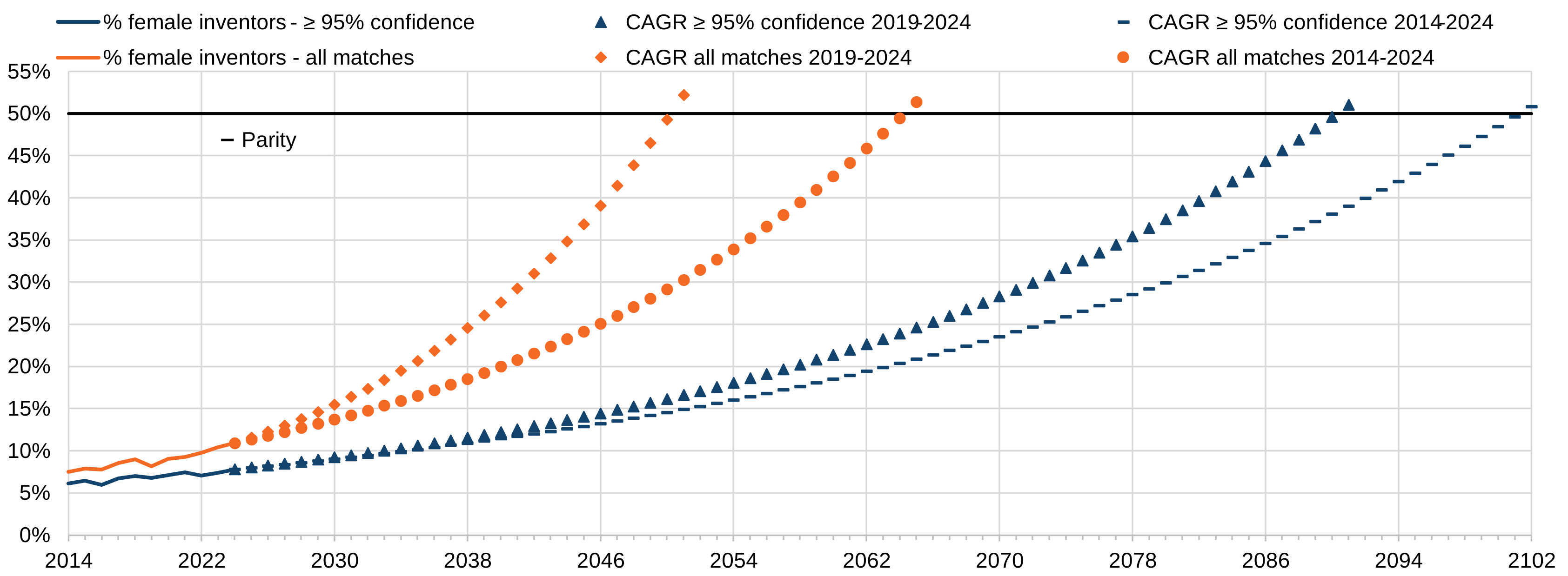
Figure 13. Proportion of female inventor occurrences and forecast using CAGR, based on previous five-year and 10-year periods (years shown at eight-year intervals)
Download the data for figure 13 in worksheet 1 (ODS, 16.7KB)
The following chart (Figure 14) shows the proportion of inventors inferred as female, and a linear trendline up to the year 2061. If the trend observed over the previous 28-year period continues, the proportion of female inventors is estimated to reach between 11.6% and 16.6% by 2061.
These variances in estimates highlight the limitations of predictions on data without any additional context or influence of contributing factors. This is discussed in the Technical annex, recommending that external factors such as female participation in STEM fields, should also be considered.
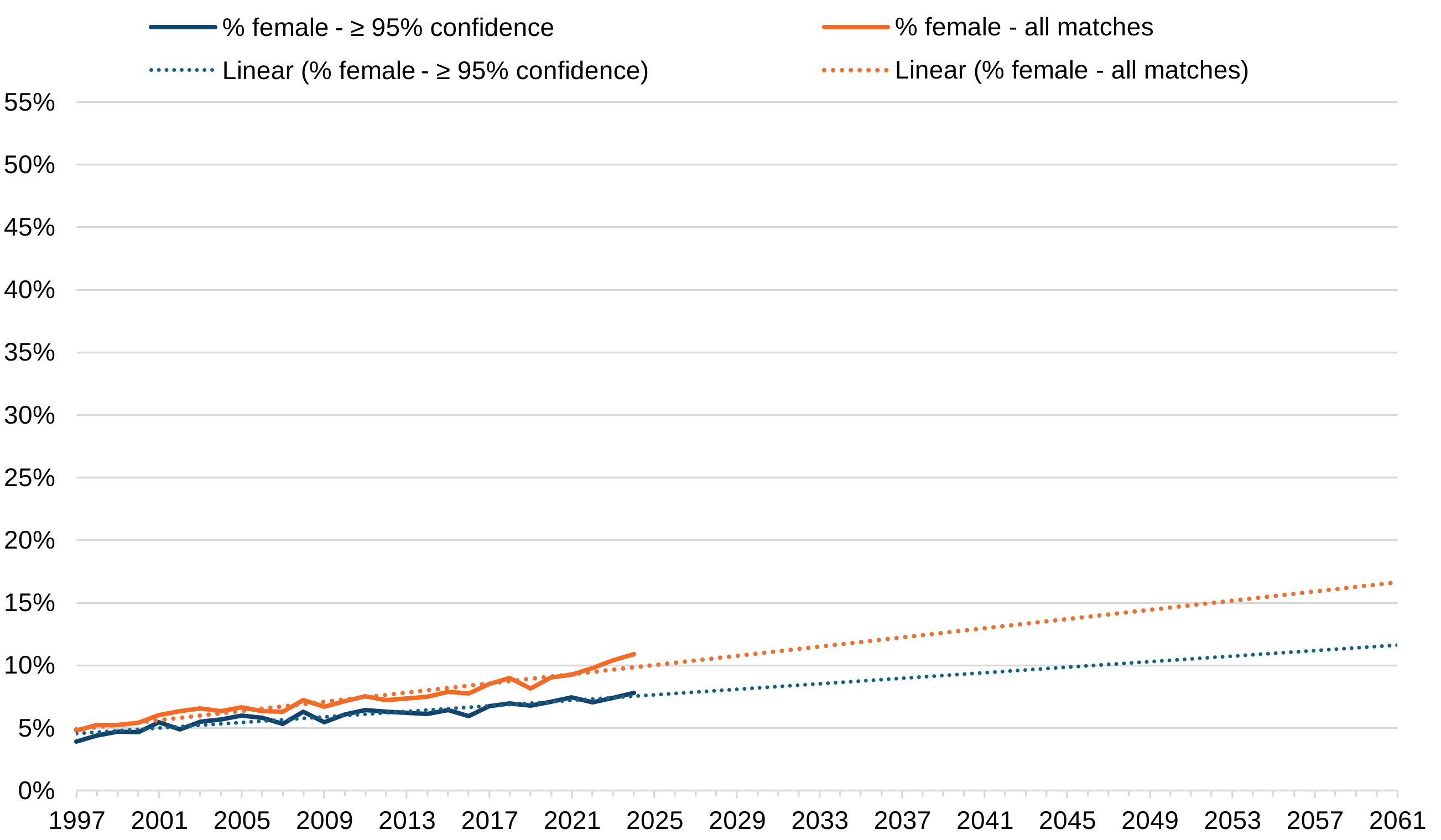
Figure 14. Proportion of inventor occurrences identified as female inventors and linear trendline forecast (years shown at four-year intervals)
Download the data for figure 14 in worksheet 2 (ODS, 16.7KB)
Recommendations for future research
The following recommendations outline potential areas for future research. However, feasibility has not been assessed, and they are provided for consideration only.
- compare international trends and evaluate the effect of policies. Compare female inventorship trends across countries, including identifying those with successful policies or programmes to evaluate impact
- evaluate the economic impact and growth potential of female inventorship. Assess how women inventors contribute to innovation, commercialisation and economic growth
- understand representation in critical technologies. Identify and understand the differences in female representation across critical technologies
- link inventorship data to the STEM pipeline. Link to other data such as STEM education and workforce participation to understand the influence over time
- understand intersectionality. Research how factors like ethnicity and socioeconomic background intersect with female participation in inventorship
- track changes over time. Consider monitoring progress in participation over time and evaluate the effectiveness of interventions or policy changes
- develop forecasting models. Use other sources, such as understanding external influences, policy trends and global innovation patterns, to develop a model on when and if parity in inventorship might realistically be achieved
This work forms a broader research programme on participation in IP, aimed at understanding how society engages with IP and identifying what barriers may exist. The UK IPO is keen to continue building partnerships with industry and academia to maximise the potential of our data, methodological approach and research. Feedback is welcome at research@ipo.gov.uk.
Technical annex
Data source and analysis tools
The analysis presented is from internal administrative data, correct as of June 2025. The data consists of patent applications filed directly at the UK IPO and PCT applications, with a first publication “A” date between January 1997 and December 2024. This only includes those with at least one inventor listed on the patent application.
The most complete dataset is available for patent applications with a publication “A” (i.e. the first publication). Data analysis has been conducted using inventor data for patent applications with a filing date from April 1995 onwards and publication year 1997 to 2024. As most publications take around 18 months to be published, data included is from 1997 onwards as this is the first most complete calendar year of data. This can present variance, and therefore all analysis is based on the date of extraction.
The WIPO WGND 2.0 has been used to infer whether an inventor is likely to be female or male. The dictionaries use over 26 million records linking given names to sex. These records are compiled from over 50 different sources, including national statistics, and span 195 countries and territories.
For this analysis, the dictionaries used include a weighted dictionary (name, country code, sex and confidence interval), language-expanded dictionary (name, country code and sex) and name-only dictionary (name and sex). These dictionaries have been obtained from the Harvard Dataverse.
The large-scale internal data and dictionaries have been ingested, cleaned and transformed using Apache Spark via PySpark. Data has been analysed with further insights generated through Microsoft Azure Synapse Analytics, Microsoft Excel and Microsoft Power BI.
An example of how the name matching to country codes works in practice can be found in Annex 2 – Methodological example.
Data cleaning
To improve data quality and prepare patent application data for analysis and name matching, the following data cleaning methods were used:
- removal of family names/surnames – these are excluded to match the WIPO dictionaries (WGND 2.0), which is based on given name(s) only
- separation of inventor and company names – separated inventor names from company names to isolate given name(s) for name matching. After these are separated, any names where only a company name is present are removed using keywords to filter out, as only natural persons can be inventors
- suppressed data – any rows with details including the automated data processing (ADP) number or country marked as ‘suppressed’ are removed
- standardisation of name formatting – cleaned given name(s) are standardised to lowercase and double or trailing spaces are removed to ensure consistency
- country code harmonisation – country codes were standardised in accordance with the ISO 3166-1 alpha-2 list to support name matching with WGND 2.0
Name matching and inferencing
The name matching logic applied in Table 4 and provides the volume of matches likely to infer female or male sex at each level. Each inventor is counted once in the matching table. Once the names are cleaned and separated from any family names or surnames, matching is attempted on all given name(s), including middle names.
To provide the highest accuracy, the main data reported on at inventor level is based on a complete match to the weighted dictionary. This includes matches to given name(s) and country code, at a minimum confidence level of 95%. Within the report, these are referred to as matches at ’95% confidence’. Matching across all levels has also been completed to provide further insight, which will have a lower level of confidence, referred to within the report as all matches. To note, as some countries are not included in the WIPO WGND 2.0 weighted dictionary, inventors based in these regions will only be possible through lower confidence matching. This includes the language-expanded dictionary and name-only dictionary.
If there is no match to an inventor’s given name(s) in the weighted dictionary at 95% confidence, this is then attempted at 80% confidence. If there is still no match, the name(s) and country code are matched against the language-expanded dictionary. If there is yet still no match, the name(s) are matched against the name-only dictionary.
If there are no matches at this point, given name(s) are split into individual parts to attempt matching to each dictionary using the same methods, but this time will infer the individual as female or male if at least 66.6% of names match one sex.
As a final matching attempt, the first given name is matched against the name-only dictionary. Otherwise, no match is given and accounts for names that are more likely to be unisex.
The levels of matching and volume of inventors at each stage (Table 4).
Table 4. Levels of matching by confidence interval
| Tier | Matching rule | Indicative confidence level | Unique inventors |
|---|---|---|---|
| High | 1. All given name(s) and country code match weighted dictionary at 95% | 95% | 201,018 (48.7%) |
| Moderate to high | 2. All given name(s) and country code match weighted dictionary at 80% | 80% | 4,411 (1.1%) |
| Moderate | 3. All given name(s) and country code match language-expanded dictionary 4. All given name(s) match in name-only dictionary 5. Given name(s) and country code meet or exceed 66.6% of one sex in weighted dictionary at 95% |
70% | 115,430 (27.9%) |
| Low | 6. Given name(s) and country code meet or exceed 66.6% of one sex in weighted dictionary at 80% 7. Given name(s) and country code meet or exceed 66.6% of one sex in language-expanded dictionary 8. Given name(s) meet or exceed 66.6% of one sex in name-only dictionary |
60% | 34,905 (8.5%) |
| Very low | 9. First given name match in name-only dictionary | 50-60% | 20,580 (5.0%) |
| Unknown | No match | Not inferred | 36,670 (8.9%) |
| Total inventors | 413,014 |
(Note: the percentages in the unique inventor column have been rounded to one decimal place and therefore may not total to 100%)
Team composition
Inventors listed on each patent application are identified using an ADP number. This allows analysis to determine how many inventors are listed on the patent, including if it is a single inventor or a group of inventors (a team). From the name matching and inference analysis, the ‘team composition’ can be understood.
The team composition is classified as:
- individuals. An individual female is a single inventor identified as a female inventor and an individual male is a single inventor identified as a male inventor. An individual unknown is a single inventor whose sex is not inferred
- teams. An all-female team consists of two or more inventors all identified as female, and an all-male team consists of two or more inventors all identified as male. A mixed team includes at least one female and one male inventor. An unknown team includes two or more inventors, with at least one whose sex is not inferred (unknown)
The indicative confidence level for each team is determined by the lowest confidence of an individual’s sex inferred among all inventors associated with the patent application. For individual inventors, the indicative confidence levels reflect the confidence in inferring the individual’s sex only. Table 5 shows the breakdown among the 325,991 patent applications included across this analysis.
Table 5. Inventor team composition by confidence level
| Team composition | High | Moderate-High | Moderate | Low | Very Low | Unknown |
|---|---|---|---|---|---|---|
| All-female team | 258 | 0 | 422 | 86 | 139 | 0 |
| All-male team | 39,250 | 2,171 | 45,027 | 17,029 | 13,365 | 0 |
| Mixed team | 5,645 | 229 | 11,608 | 3,329 | 5,398 | 6,259 |
| Individual female | 3,667 | 1 | 3,317 | 510 | 923 | 0 |
| Individual male | 69,073 | 1,209 | 48,140 | 9,369 | 5,501 | 0 |
| Unknown team | 0 | 0 | 0 | 0 | 0 | 22,778 |
| Unknown individual | 0 | 0 | 0 | 0 | 0 | 11,288 |
| Total | 117,893 | 3,610 | 108,514 | 30,323 | 25,326 | 40,325 |
Granted patents
Granted patents are shown based on the year of grant. Due to the availability of the most accurate data, these are only included for patent applications published between 1997 and 2024. Volumes for the earlier grant years (mainly 1997 to 1999) will appear lower than actual historical levels because patent applications published before 1997 are excluded from this report. As a patent can take years to be granted, it is likely more recent applications included in this report have not yet proceeded to grant. Guidance on patent grant timelines has more information on this. Grant year 2025 only includes data for the first six months of the year due to time of data extraction. Data is correct as of June 2025.
Owner or applicant type
There is no definitive method for identifying whether applications originated from a registered entity (such as companies, partnerships and corporations) or educational institutions. For analytical purposes, associated owner or applicant types are identified based on the owner or applicant name through a keyword matching approach. Matching these to local dictionaries which group educational establishment identifiers and company identifiers provide approximations on the patent application origin but are not definitive. This will also capture Technology Transfer Offices which typically operate within universities.
Some patent applications list multiple owners or applicants. This does not always mean the inventor is affiliated with listed entities. In some cases, the inventor may also be listed as the individual owner.
Forecast
To determine when parity may be expected, WIPO applied a compound annual growth rate (CAGR) forecasting method in their 2023 publication. The Global Gender Gap in Innovation and Creativity: An International Comparison of the Gender Gap in Global Patenting over Two Decades.
For this report, the CAGR has been calculated using the formulae:
Five-year CAGR for female inventors % (95% confidence) = (0.078/0.068)^(0.2) - 1
10-year CAGR for female inventors % (95% confidence) = (0.078/0.061)^(0.1) - 1
Five-year CAGR for female inventors % (all matches) = (0.109/0.082)^(0.2) - 1
10-year CAGR for female inventors % (all matches) = (0.109/0.075)^(0.1) - 1
This is then applied to future years to predict possible changes over time. There are limitations to this method, as each calculation is based on only two data points.
To show an alternative forecasting approach, a linear trendline has been applied to the previous 28-year historical data. This method projects future proportions by extending the long-term linear relationship observed in the data, presenting a different perspective to the CAGR method.
Both approaches are based solely on data points and do not take into account other contributing factors, such as participants in STEM fields of study, or external factors, such as COVID-19. These limitations should be considered when interpreting the forecasts.
Limitations and caveats
While the WGND offers extensive global coverage and high accuracy in inference, a margin of error remains due to several factors. This includes ambiguity of unisex names, which in most cases are classified as unknown to avoid misclassification. Although the analysis distinguishes between all matches and those with 95% or higher confidence, even high-confidence classifications cannot be considered definitive. Name-based inference is not the same as self-reported data, meaning that matches to names will not always accurately reflect an inventor’s sex.
The name matching analysis introduces some uncertainty as sex is inferred using the inventor’s country of residence/correspondence address rather than nationality. This is because the UK IPO does not collect this information from applicants. Incomplete or missing name data in source records could also contribute to misclassification.
Definitions
Automated Data Processing (ADP) number. Identifies each party associated with an IP right.
Gender and sex. An independent review of data, statistics and research on sex and gender was published by the Department for Science, Innovation and Technology (DSIT) in March 2025. This recommends using the term ‘sex’ instead of gender, unless referring to gender identity. As the UK IPO does not collect sex and other demographic data in patent applications, the name matching methodology is used to infer whether each inventor is more likely to be male or female. This has limitations as it is not fully representative of inventors and cannot provide an individual’s definite sex. It provides an indication based on an expansive range of data sources as discussed by WIPO. In previous research at the UK IPO and through research conducted by other IP offices, this is often referred to as gender name matching. For this report, the terms used align to the recommendations as part of the independent review published by DSIT.
Given name(s). Names are referred to as given name(s) and therefore do not consider family names/surnames. In several cultures, the family name is traditionally written before the given name. The UK IPO’s Form 7 (Statement of inventorship and of right to grant of a patent) requires applicants to underline their family name/surname. This instruction provides a consistent way to identify the surname regardless of cultural naming order. For the purposes of analysis, the underlined element can therefore be treated as the investor’s family name, even where it appears in the first position.
Inventor. For the purposes of this report, inventors are referred to as per the definition within The Patents Act 1977, meaning the actual deviser of the invention. A patent for an invention can be granted primarily to the inventor, or joint inventors, which make up the teams referred to in this report. This is not to be confused with applicants.
Not in force. Patent applications ‘not in force’ can be in the following states: terminated before grant, refused, ceased, expired, revoked and surrendered.
Private applicant. Analysis in this report refers to private applicants, which are those applicants who apply for a patent without using a registered patent attorney or agent. The analysis is conducted using a private applicant marker, which is applied to the current or last status for a given patent application. As applicants may hire, change or choose not to use agents at any time, and because the data is captured at a specific point, this figure is an estimate correct at the time of data extraction. Further information on private applicants can be found in the Formalities Manual.
Published patent application. Within this report and data tables, patent applications are referred to as published. To ensure the most accurate inventor data is used, for the purposes of this report only applications with a first publication, the “A” publication, have been included. When a patent is published at the “A” publication stage, the applicant and/or inventor does not have patent protection. More information can be found in the Patent Factsheet.
Search and examination requests. Patent applications undergo a search (Form 9A) and a substantive examination (Form 10) to confirm an invention is novel and inventive. More details on patent forms and fees can be found in the Patent forms and fees guidance.
Annex 1 – Data tables
-
UK-and-international-inventor-occurrences-data-tables (ODS, 22.6KB)
-
Owner-types-of-patent-applications-data-tables (ODS, 33.9KB)
-
Reason-not-in-force-by-inventor-teams-data-tables (ODS, 32.2KB)
Annex 2 – Methodological example
This example provides a hypothetical demonstration of how the name matching method works. For this, the example ‘Jean’ is used in instances where this is the only given name of inventors (i.e. no other names apart from surname, Figure 1).
Annex 2 Figure 1. Example of name matching methodology for given name ‘Jean’
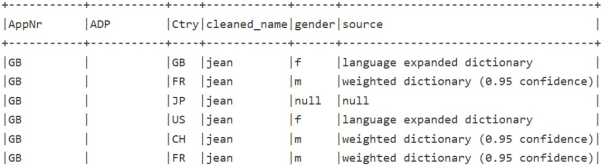
Table showing name-matching results for the given name 'Jean' across multiple country codes. Rows include GB, FR, JP, US and CH, with columns for cleaned name, inferred gender and source. Results show female or male matches where available and 95% confidence where weighted dictionaries apply. This returns a null result for Japan, indicating no inferred sex.
In the UK (code GB) based population, the distribution for the name ‘Jean’ has a weighting of 52.3% female and 47.7% male (Figure 2). There is only a narrow margin, and therefore this would not present a match against the weighted dictionary.
Annex 2 Figure 2. Example of name matching weighted dictionary for UK-based population, based on WIPO World Gender Name Dictionaries 2.0

Table displaying gender weighting from the WIPO WGND for the name 'Jean' in the UK (code GB). One row shows female with a weight of approximately 52.3% and one row shows male with approximately 47.7%, illustrating a narrow distribution for this name.
As the name ‘Jean’ in the UK is more likely to be female, this is included as such in the language-expanded dictionary (Figure 3).
Annex 2 Figure 3. Example of name matching language-expanded dictionary for UK-based population, based on WIPO World Gender Name Dictionaries 2.0

Single-row table showing the name 'Jean' in the UK (code GB) classified as female. The table shows a match in the WIPO WGND language-expanded dictionary without a confidence weighting.
This differs to France (code FR), where the weighting is 100% for male and therefore is included as having 95% confidence (Figure 4).
Annex 2 Figure 4. Example of name matching weighted dictionary for France-based population, based on WIPO World Gender Name Dictionaries 2.0

Single-row table showing the name 'Jean' in France (code FR) classified as male with a weighting of 1.0, indicating a match to the WIPO WGND 95% confidence weighted dictionary.
For the null shown in the example Annex 2 Figure 1, there is no sex inferred for an inventor based in Japan (code JP) called Jean. This is because in the WIPO dictionaries, Jean is not listed as a name commonly used in Japan. When searching for Jean without a country code, no match can be determined because the name’s sex association varies across countries, and no consistent match can be made. Jean is not listed as a single name in the WIPO name-only dictionary.