Farming Sector Environmental Objectives: tree canopy and woodland cover
Published 22 October 2026
Applies to England

© Crown copyright 2026
This publication is licensed under the terms of the Open Government Licence v3.0 except where otherwise stated. To view this licence, visit nationalarchives.gov.uk/doc/open-government-licence/version/3 or write to the Information Policy Team, The National Archives, Kew, London TW9 4DU, or email: psi@nationalarchives.gov.uk.
Where we have identified any third party copyright information you will need to obtain permission from the copyright holders concerned.
This publication is available at https://www.gov.uk/government/publications/farming-sector-environmental-objectives/farming-sector-environmental-objectives-tree-canopy-and-woodland-cover
1. Objective title
The farming sector and delivery partners will increase England’s tree canopy and woodland cover by 15,683 hectares by 2030.
2. Objective overview
The presence of woodland and tree canopy cover delivers a wide range of environmental and societal benefits. Expanding woodland contributes to carbon sequestration, enhances biodiversity, and improves air quality.
When integrated appropriately within agricultural systems, tree planting can also help reduce the runoff of pollutants and support more resilient land management practices.
As agricultural land comprises the majority of land in England, it provides a critical opportunity to support the delivery of statutory woodland creation and net zero targets.
This objective aims to increase the coverage of tree canopies and woodland on agricultural land through agri-environment schemes.
3. Relevant targets and commitments
30by30
Under the Global Biodiversity Framework, the UK government has agreed to:
- effectively conserve and manage 30% of our land and sea for nature by 2030
The framework does not set specific pathways to meet the target, which are devolved to the individual nations. Defra has produced the 30by30 on land: Delivery plan which focusses on the creation, restoration and long-term management of wildlife-rich habitat to meet the target. Woodland created under this objective will contribute to 30by30 target due to its wildlife-rich status.
Carbon Budget 6
The Climate Change Committee issues a series of reports advising the UK Government on key milestones for achieving Net Zero. These Carbon Budgets setting legally binding, five‑year caps on greenhouse gas emissions through to 2050.
Carbon Budget 6, covering the period 2033 to 2037, sets the following target:
- by 2037, we will reduce annual net emissions through agriculture, forestry and other land uses (AFOLU) by 4.9Mt CO2e per annum, in line with the Sixth Carbon Budget.
Environment Act 2021
The Environment Act 2021 (EA21) sets a statutory target focussed on tree canopy and woodland cover, stating:
- increase tree canopy and woodland cover to at least 16.5% of total land area by 2050.
This target is shared across Defra, with contributions from the farming sector delivered alongside those of other bodies, including the Forestry Commission and Natural England.
Environmental Improvement Plan
In order to meet the statutory targets set under the Environment Act 2021, the Environmental Improvement Plan 2025 (EIP25) sets an interim target for tree canopy and woodland cover:
- increase England’s tree canopy and woodland cover by 0.33% of land area by December 2030 from the 2022 baseline of 14.9% (equivalent to a net increase of 43,000 hectares).
In line with the EA21 statutory target, this interim target will be delivered collectively across Defra, with contributions from the farming sector and other delivery partners.
Interactions with other environmental objectives
Actions that create or restore woodland habitat to a ‘wildlife rich’ state of ‘biodiverse woodland’ will qualify as the creation of wildlife-rich habitats required under the statutory and interim targets. This contribution is measured within the Wildlife-Rich Habitat – Creation and Restoration.
Silvo-arable agroforestry systems (excluding dwarf fruit and nut trees) planted as part of the silvo-arable agroforestry objective contribute to this objective as “trees outside of woodland”. However, the extent of contribution has not yet been quantified due to density requirements. These actions will be included in measurement of this objective when this has been established.
4. Delivery approach
4.1 Methodology
Actions within agri‑environment schemes that incentivise new tree planting or support the growth of existing trees have been identified through an internal review of available environmental land management (ELM) scheme options.
Progress towards this objective is measured as total uptake of new or increased contributing key ELM actions between 2022 and 2030. Where an increase uptake occurs, only the additional amount of coverage is counted. All key actions are measured in hectares.
Supporting actions make a direct or indirect contribution that is not measurable with current methodologies, and therefore not included in achieved uptake. Inclusion may change as further evidence and information becomes available.
4.2 Baselines and assumptions
In line with the National Forest Inventory, ‘woodland’ is defined as an area of 0.5 hectares or greater with a minimum of 20% canopy cover. This must also cover a width of at least 20 metres and have the potential to grow to a height of 5 metres or more.
To be considered a tree, a plant must have at least one woody stem and be expected to achieve a height of at least 5 metres.
‘Trees outside woodland’ (ToW) are defined by meeting one of the following criteria:
-
areas of trees covering 0.1 hectare or more which are neither woodland or hedgerows.
-
single trees, or groups of trees, covering less than 0.5 hectare and more than 2 metres in height.
-
hedgerow trees that are more than 3 metres in height.
The ToW definition also excludes trees that are part of an energy forestry system, where trees are grown to provide biomass for renewable energy sources.
‘Tree canopy and woodland cover’ refers to both woodland and ToW, including shelter belts and wood pasture. Only ToW on agricultural land or in rural areas will be in scope of this objective.
In March 2022, canopy cover represented 14.9% of total land area in England (1.94 million hectares), as published within The Forestry Statistics 2023. From this, it has been calculated that the farming sector will need to contribute 15,683 hectares of uptake towards the target of 16.5% canopy cover across England, however further delivery may be required subject to review.
Progress towards this environmental objective is measured from the established 14.9% baseline.
4.3 Key and supporting actions
‘Category’ indicates whether individual actions contribute to the Woodland or ToW components, with some actions contributing to both. The specific contributions of some actions are under internal review, which are noted as ‘Unconfirmed’.
Table 1: Environmental land management actions contributing to Tree Canopy and Woodland Cover
| Action Code | Action Name | Scheme | Type | Category |
|---|---|---|---|---|
| WD6 | Creation of wood pasture | Countryside Stewardship | Key | ToW |
| WD12 | Creation of upland wood pasture | Countryside Stewardship | Key | ToW |
| CAGF1 | Manage high density in-field agroforestry | CS Higher Tier | Supporting | Woodland |
| CAGF2 | Manage low density in-field agroforestry on more sensitive land | CS Higher Tier | Supporting | ToW |
| CAGF3 | Manage medium density in-field agroforestry | CS Higher Tier | Supporting | ToW |
| CAGF4 | Manage very low density in-field agroforestry on more sensitive land | CS Higher Tier | Supporting | ToW |
| CBE5 | Create traditional orchards | CS Higher Tier | Supporting | ToW |
| CWD20 | Create wood pasture | CS Higher Tier | Supporting | ToW |
| CWS1 | Deer control and management | CS Higher Tier | Supporting | Either |
| CWS3 | Grey squirrel control and management | CS Higher Tier | Supporting | Either |
| AGF1 | Maintain very low density in-field agroforestry on less sensitive land | SFI Expanded Offer | Supporting | ToW |
| AGF2 | Maintain low density in-field agroforestry on less sensitive land | SFI Expanded Offer | Supporting | ToW |
| BE5 | Creation of traditional orchards | Countryside Stewardship | Supporting | ToW |
| WS1 | Deer control and management | Countryside Stewardship | Supporting | Either |
| WS3 | Squirrel control and management | Countryside Stewardship | Supporting | Either |
| AF1 | Plant an agroforestry woodland tree | Capital Grants | Supporting | ToW |
| AF2 | Plant an agroforestry fruit tree | Capital Grants | Supporting | ToW |
| AF3 | Supplement: Species diversity bonus | Capital Grants | Supporting | ToW |
| BC4 | Tree Guard Post and wire | Capital Grants | Supporting | ToW |
| FG1 | Fencing | Capital Grants | Supporting | Unconfirmed |
| FG3 | Permanent electric fencing | Capital Grants | Supporting | Unconfirmed |
| PA4 | Agroforestry plan | Capital Grants | Supporting | Unconfirmed |
| TE1 | Planting Standard Hedgerow Tree | Capital Grants | Supporting | ToW |
| TE2 | Planting Standard Parkland Tree | Capital Grants | Supporting | ToW |
| TE3 | Planting fruit trees | Capital Grants | Supporting | ToW |
| TE4 | Supply and plant tree | Capital Grants | Supporting | ToW |
| TE5 | Supplement for use of individual tree-shelters | Capital Grants | Supporting | Either |
| TE6 | Tree guard (tube and mesh) | Capital Grants | Supporting | Either |
| TE7 | Tree guard (wood post and rail) | Capital Grants | Supporting | Either |
| TE8 | Tree guard (wood post and wire) | Capital Grants | Supporting | Either |
| TE9 | Parkland tree guard | Capital Grants | Supporting | Unconfirmed |
| TE10 | Coppicing bankside trees | Capital Grants | Supporting | Unconfirmed |
| TE11 | Tree surgery | Capital Grants | Supporting | Unconfirmed |
| TE16 | Use tree surgery to hinge a tree or limb into a watercourse | Capital Grants | Supporting | Unconfirmed |
| TE18 | Supplement: Pruning to restore fruit trees | Capital Grants | Supporting | Unconfirmed |
| WN11 | Install temporary water storage features | Capital Grants | Supporting | Unconfirmed |
4.4 Required trajectory
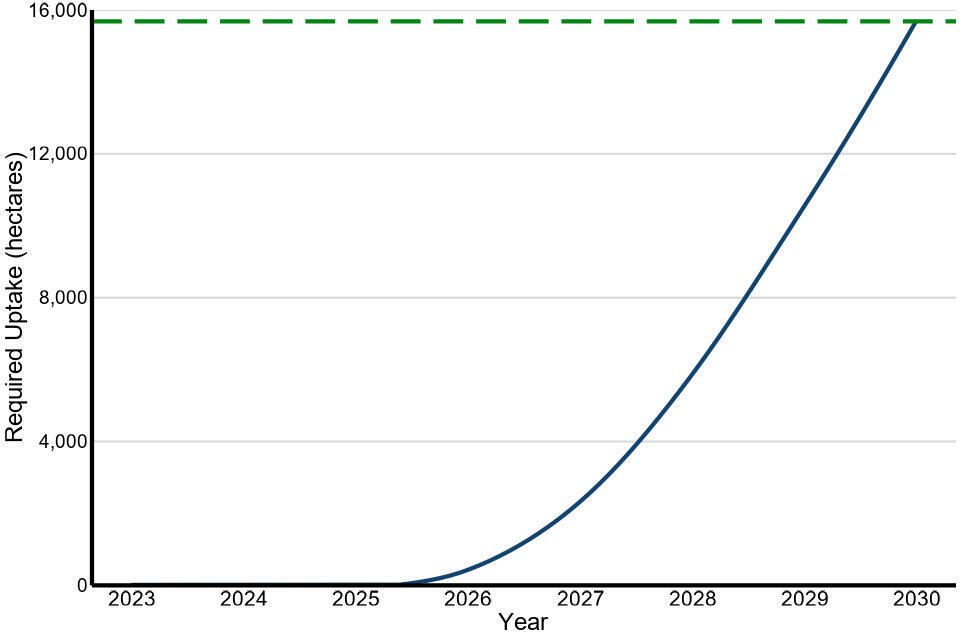
The required area of contributing actions has been calculated through to 2030.
This trajectory is based on analysis of historic uptake and illustrates the annual uptake that would be required to contribute to the environmental objective by the end of the assessment period. Its shape is informed by assumptions about economic and behavioural factors and delivery constraints.
As information on future schemes is not currently available, the trajectory should not be interpreted as a forecast of uptake or as an indication of future scheme availability.
Figure 2: Required uptake of actions contributing to Tree Canopy and Woodland Cover to 2030, hectares
Source: Department for Environment, Food and Rural Affairs
5. Metadata
| Objective | Tree Canopy and Woodland Cover |
|---|---|
| Related commitments | Statutory carbon emission reduction, woodland cover and wildlife-rich habitat creation targets |
| Reporting status | Interim |
| Contributing schemes | CS, CSHT |
| Aggregation method | Agreements live since 2022 |
| Geographical scope | England |
| First reported | October 2026 |
| Last updated | October 2026 |