Farming Sector Environmental Objectives: silvoarable agroforestry
Published 22 October 2026
Applies to England

© Crown copyright 2026
This publication is licensed under the terms of the Open Government Licence v3.0 except where otherwise stated. To view this licence, visit nationalarchives.gov.uk/doc/open-government-licence/version/3 or write to the Information Policy Team, The National Archives, Kew, London TW9 4DU, or email: psi@nationalarchives.gov.uk.
Where we have identified any third party copyright information you will need to obtain permission from the copyright holders concerned.
This publication is available at https://www.gov.uk/government/publications/farming-sector-environmental-objectives/farming-sector-environmental-objectives-silvoarable-agroforestry
1. Objective title
The farming sector and delivery partners will deliver 358,902ha of agroforestry on arable land in England by 2050.
2. Objective overview
With lower tree densities than woodlands, agroforestry systems can be combined with other agricultural production, including arable (silvoarable) and livestock (silvopasture) farming, within the same area.
This objective focuses on supporting the creation, through agri-environment schemes, of silvoarable agroforestry systems, which integrate trees into arable farming. This is a form of land‑sharing with multiple environmental and productive benefits, including protecting watercourses, sequestering carbon, and enhancing the overall resilience of food production systems.
3. Relevant targets and commitments
Environment Act 2021
The Environment Act 2021 (EA21) sets a statutory target focussed on tree canopy and woodland cover, stating:
- increase tree canopy and woodland cover to at least 16.5% of total land area by 2050.
Environmental Improvement Plan
In order to meet the statutory targets set under the Environment Act 2021, the Environmental Improvement Plan 2025 (EIP25) sets an interim target for tree canopy and woodland cover:
- increase England’s tree canopy and woodland cover by 0.33% of land area by December 2030 from the 2022 baseline of 14.9%. (Equivalent to a net increase of 43,000 hectares.)
Further to this, EIP25 sets a key commitment of:
- increase the number of trees on farms, with a focus on silvoarable (trees with crops) and silvopastoral (trees with livestock) agroforestry systems
Carbon Budget 6
The Climate Change Committee issues a series of reports advising the UK Government on key milestones for achieving Net Zero. These Carbon Budgets setting legally binding, five‑year caps on greenhouse gas emissions through to 2050.
Carbon Budget 6, covering the period 2033 to 2037, set the following target:
- by 2037, we will reduce annual emissions through agriculture, forestry and other land uses (AFOLU) by 4.9Mt CO2e per annum, in line with the Sixth Carbon Budget.
Interactions with other environmental objectives
Silvo-arable agroforestry systems do not have the required tree density to qualify as woodland, and therefore uptake does not currently contribute to Tree Canopy and Woodland Cover. These systems will contribute to the ‘trees outside of woodland’ component when it has been established.
4. Delivery approach
4.1 Methodology
Specific actions under existing environmental land management (ELM) schemes incentivise the integration of tree planting and food production, which currently form the main delivery pathway for this objective.
This objective focusses solely on agroforestry on arable land, estimating 358,902 hectares to represent 10% of arable land in 2050. Contribution of silvo-pastoral agroforestry to Defra targets is monitored separately.
Progress towards achieving this objective is measured as total uptake of new contributing key ELM actions between 2022 and 2050. Where an increase in actions occurs, only the additional amount is counted. All key actions are measured in hectares.
Supporting actions make a direct or indirect contribution that is not measurable with current methodologies, and therefore not included in achieved uptake. Inclusion may change as further evidence and information becomes available.
4.2 Baselines and Assumptions
For this objective, the term “Agroforestry” covers silvo-arable systems, where trees are planted in arable fields at a density of at least 30 stems per hectare. Appropriate species include woodland broadleaves, plus semi-vigorous and vigorous rootstock fruit and nut trees.
There is currently no available data on the extent of agroforestry systems in England, meaning a baseline cannot be established. As agroforestry was not supported by agri‑environment schemes prior to 2024, 1st January 2024 will be used as the baseline date, with contributing uptake assumed to be zero at this point. However, this does not indicate the absence of related activity prior to this date outside of agri-environment schemes.
4.3 Key and Supporting Actions
Table 1: Environmental land management actions contributing to Silvo-arable Agroforestry
| Action Code | Action Name | Scheme | Type |
|---|---|---|---|
| CAGF2 | Manage low density in-field agroforestry on more sensitive land | CS Higher Tier | Key |
| CAGF3 | Manage medium density in-field agroforestry | CS Higher Tier | Key |
| CAGF4 | Manage very low density in-field agroforestry on more sensitive land | CS Higher Tier | Key |
| AGF1 | Maintain very low density in-field agroforestry on less sensitive land | SFI Expanded Offer | Key |
| AGF2 | Maintain low density in-field agroforestry on less sensitive land | SFI Expanded Offer | Key |
| AF1 | Plant an agroforestry woodland tree | Capital Grants | Supporting |
| AF2 | Plant an agroforestry fruit tree | Capital Grants | Supporting |
| AF3 | Supplement: Species diversity bonus | Capital Grants | Supporting |
| BC4 | Tree Guard Post and wire | Capital Grants | Supporting |
| CWS1 | Deer control and management | CS Higher Tier | Supporting |
| CWS3 | Grey squirrel control and management | CS Higher Tier | Supporting |
| FG1 | Fencing | Capital Grants | Supporting |
| FG3 | Permanent electric fencing | Capital Grants | Supporting |
| PA4 | Agroforestry plan | Capital Grants | Supporting |
| TE5 | Supplement for use of individual tree-shelters | Capital Grants | Supporting |
| TE6 | Tree guard (tube and mesh) | Capital Grants | Supporting |
| TE7 | Tree guard (wood post and rail) | Capital Grants | Supporting |
| TE8 | Tree guard (wood post and wire) | Capital Grants | Supporting |
| WS1 | Deer control and management | Countryside Stewardship | Supporting |
| WS3 | Squirrel control and management | Countryside Stewardship | Supporting |
| WN11 | Install temporary water storage features | Capital Grants | Supporting |
4.4 Required trajectory
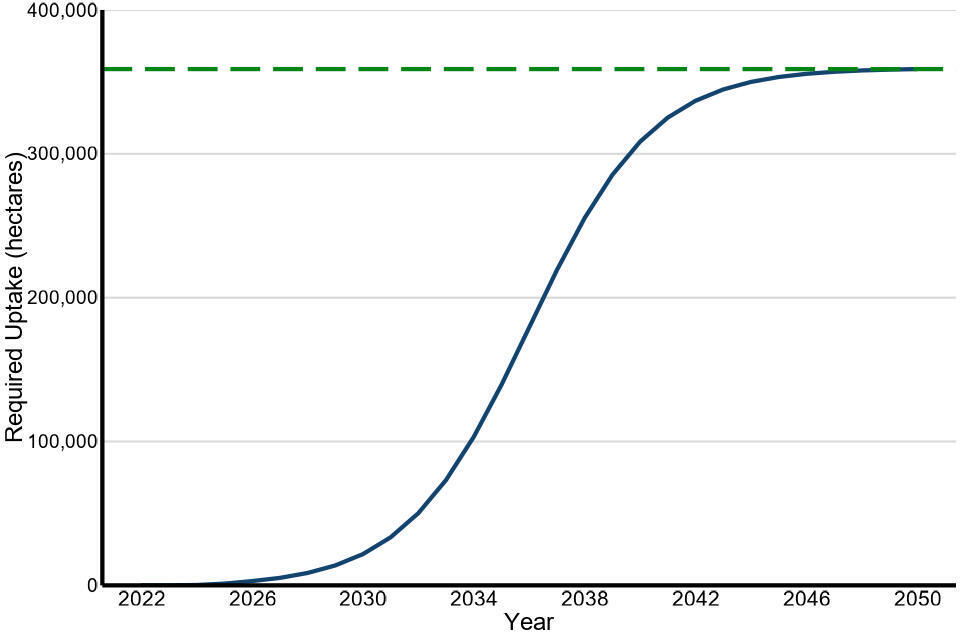
The required area of contributing actions has been calculated through to 2050. This trajectory is based on analysis of historic uptake and illustrates the annual uptake that would be required to contribute to the environmental objective by the end of the assessment period. Its shape is informed by assumptions about economic and behavioural factors and delivery constraints.
As information on future schemes is not currently available, the trajectory should not be interpreted as a forecast of uptake or as an indication of future scheme availability.
Figure 2: Required uptake of actions contributing to Silvo-arable Agroforestry to 2050, hectares
Source: Department for Environment, Food and Rural Affairs
5. Metadata
| Objective | Silvo-arable Agroforestry |
|---|---|
| Related commitments | Statutory woodland cover and emission reduction targets |
| Reporting status | Interim |
| Contributing schemes | CS, CSHT |
| Aggregation method | Agreements live since January 2022 |
| Geographical scope | England |
| First reported | October 2026 |
| Last updated | October 2026 |