Farming Sector Environmental Objectives: peatland restoration and management
Published 22 October 2026
Applies to England

© Crown copyright 2026
This publication is licensed under the terms of the Open Government Licence v3.0 except where otherwise stated. To view this licence, visit nationalarchives.gov.uk/doc/open-government-licence/version/3 or write to the Information Policy Team, The National Archives, Kew, London TW9 4DU, or email: psi@nationalarchives.gov.uk.
Where we have identified any third party copyright information you will need to obtain permission from the copyright holders concerned.
This publication is available at https://www.gov.uk/government/publications/farming-sector-environmental-objectives/farming-sector-environmental-objectives-peatland-restoration-and-management
1. Objective title
The farming sector and delivery partners will restore and maintain 240,000 hectares of peatland by 2050, whilst, from 2026, additionally managing circa 100,000 hectares of previously restored peatland.
2. Objective overview
Peatlands play a critical role in water regulation, biodiversity, and land‑based carbon storage, yet most peatlands in England have been degraded by pollution, forestry, and other human pressures.
Healthy peatlands are wetlands characterised by high, stable water tables close to the surface. These conditions support key wetland vegetation, which accumulates organic soil, protects stored carbon, regulates water flow, and supports wetland biodiversity.
With this objective, the farming sector will aim to restore degraded peatlands in England to a naturally functioning state through agri-environment schemes and subsequently keep them managed in a favourable state.
3. Relevant targets and commitments
30by30
Under the Global Biodiversity Framework, the UK government has agreed to:
- effectively conserve and manage 30% of our land and sea for nature by 2030
The framework does not set specific pathways to meet the target, which are devolved to the individual nations. Defra has produced the 30by30 on land: Delivery plan which focusses on the creation, restoration and long-term management of wildlife-rich habitat to meet the target. Peatland created, restored and managed under this objective could contribute to 30by30 where restored to wildlife-rich status, a subsequently meets management criteria.
Environment Act
The Environment Act 2021 sets a statutory target focussed on wildlife-rich habitats, stating:
- restore or create in excess of 500,000 hectares of a range of wildlife-rich habitats outside protected sites by 2042
Some delivery from this objective will contribute to the statutory habitat target, where action is taken outside of protected sites. The farming sector is not responsible for the entire statutory peatland objectives, as delivery through the Nature for Climate (NCF) Peatland Grant Scheme has reduced the required uptake from agri-environment schemes. This competitive scheme, delivered by Natural England, provided funding to restore peatlands within England between 2021 and 2025.
Environmental Improvement Plan
In order to meet the statutory targets set under the Environment Act 2021, the Environmental Improvement Plan 2025 (EIP25) sets an interim target for wildlife-rich habitats:
- restore or create a total of 250,000 hectares of a range of wildlife-rich habitats
Multiple key commitments and actions under EIP25 set goals to create and restore large areas of peatland within England, and support projects working towards these goals.
Carbon Budget 6
The Climate Change Committee issues a series of reports advising the UK Government on key milestones for achieving Net Zero. These Carbon Budgets set legally binding, five‑year caps on greenhouse gas emissions through to 2050.
Carbon Budget 6, covering the period 2033 to 2037, sets the following target:
- by 2037, we will reduce annual emissions through agriculture, forestry and other land uses (AFOLU) by 4.9Mt CO2e per annum, in line with the Sixth Carbon Budget.
Interactions with other environmental objectives
Areas of peatland, or wetlands on shallow peat, that are restored or maintained can also be features within protected areas. Therefore, it is possible that actions contributing towards this objective can also contribute towards the Sites of Special Scientific Interest objective if the criteria are met.
This objective also relates to the Wildlife-Rich Habitat – Creation and Restoration, Tree Canopy and Woodland Cover and other objectives contributing to statutory habitat creation targets under EIP25 and 30by30.
This objective also overlaps with Wildlife-Rich Habitat – Creation and Restoration as both have contributing actions that create or restore peatland. Actions cannot contribute to both objectives simultaneously, as this objective requires actions to be undertaken on deep peaty soil, whereas those on shallow peaty soils or soils with pockets of deep peat contribute to Wildlife-Rich Habitat – Creation and Restoration instead.
4. Delivery approach
4.1 Methodology
This objective is separated into ‘restoration’ and ‘management’ components.
The ‘restoration’ component of this objective refers to activities aimed at achieving the following:
-
creation of peatland habitats by reinstating peat-forming vegetation where land use change has replaced it entirely.
-
restoration of peatland habitats through the reinstatement of peat‑forming vegetation where it is present but degraded. This includes vegetation affected by human disturbance that retains a species composition and functional characteristics close to its natural state.
For this objective, eligible actions must be undertaken on deep peaty soil, defined as being rich in organic carbon to a depth exceeding 40cm. This definition aligns with wider peatland initiatives such as the International Union for Conservation of Nature (IUCN) UK Peatland Strategy and the England Peat Map, which informs this objective. Wider Defra guidance and legislation may use different thresholds for deep peat, such as the The Heather and Grass etc. Burning (England) Regulations 2021, which consider deep peat to be at a depth of 30cm or greater.
Actions that create or restore peatland habitat undertaken on soils with shallow peat, or pockets of deep peat, contribute to Wildlife Rich Habitats – Creation and Restoration instead.
This objective also excludes areas that have received funding from Nature for Climate (NCF) Peatland Grant Scheme to prevent actions being double-counted in contributions to the statutory target from the farming sector and NCF.
Actions contributing to restoration of peatland habitats (Table 1) focus on raising water levels or blocking drainage within upland, lowland raised bog, fen and reedbed habitats. These aim to create conditions for the proliferation of peat-forming plants.
Some environmental land management (ELM) actions must be done in combination on the same area to contribute to peatland habitat restoration. These currently include:
-
actions that manage lowland raised bog (WT10/CWT10) must be undertaken with actions that block grips or drainage channels (WN1).
-
actions that carry out customised capital works to manage specific sites or species (FM2) must be undertaken with a supplement for either moorland re-wetting (UP5) or a raised water level (SP2).
-
actions that block grips or drainage channels (WN1) must be undertaken with a supplement for either moorland re-wetting (UP5) or a raised water level (SP2/CSP2). In this instance, actions that manage lowland raised bog (WT10/CWT10) are not required, however may still be present.
The ‘management’ component focusses on the preservation and sustainable management of restored peatland habitat, maintaining the conditions required to support existing peat-forming plants already in existence. This can also include restoration activities that continue longer than ten years.
Some ELM actions must be done in combination on the same area to contribute to peatland management. These currently include:
- moorland management actions (UP3/CUP3) must be undertaken with a supplement for either moorland re-wetting (UP5) or a raised water level (SP2/CSP2)
The restoration and management components of this environmental objective are measured and reported separately due to difference in aims and methodologies.
Progress towards restoration is measured as total uptake of new or increased key ELM actions between 2020 and 2050. Where an increase in actions occurs, only the additional amount is counted. All key actions are measured in hectares.
However, progress towards management is measured by total uptake of contributing key ELM actions in live agreements at the capture date. All key actions are measured in hectares. This is not currently measured by Defra, with contributing uptake expected in late 2026.
Supporting actions make a direct or indirect contribution that is not measurable with current methodologies, and therefore not included in achieved uptake. Inclusion may change as further evidence and information becomes available.
4.2 Assumptions and Baselines
This objective uses the 1st January 2020 as the start of uptake for peatland restoration, counting this date as having 0 hectares of contributing actions. However, this does not indicate the absence of related activity prior to this date.
4.3 Key and supporting actions
Table 1: Environmental land management actions contributing to peatland habitat creation and restoration
| Action Code | Action Name | Scheme | Type |
|---|---|---|---|
| CSP2 | Rewetting supplement | CS Higher Tier | Key (c) |
| CUP5 | Moorland re-wetting supplement | CS Higher Tier | Key (c) |
| CWT14 | Create fen, reedbed or wetland mosaics | CS Higher Tier | Key |
| CWT10 | Manage lowland raised bog | CS Higher Tier | Key (c) |
| UP5 | Moorland re-wetting supplement | Countryside Stewardship | Key (c) |
| SP2 | Raised water level supplement | Countryside Stewardship | Key (c) |
| WT9 | Creation of fen | Countryside Stewardship | Key |
| WT7 | Creation of reedbed | Countryside Stewardship | Key |
| WT10 | Management of lowland raised bog | Countryside Stewardship | Key (c) |
| FM2 | Major preparatory work for Priority Habitats (creation and restoration) and Priority Species | Capital Grants | Key (c) |
| WN1 | Blocking Grips or Drainage Channels | Capital Grants | Key (c) |
| CSP13 | Invasive plant species control and management (lower rate) | CS Higher Tier | Supporting |
| CSP14 | Invasive plant species control and management (intermediate rate) | CS Higher Tier | Supporting |
| CSP15 | Invasive plant species control and management (upper rate) | CS Higher Tier | Supporting |
| CUP14 | Shepherding livestock on moorland (remove stock for a minimum of 8 months) | CS Higher Tier | Supporting |
| CUP3 | General moorland management | CS Higher Tier | Supporting |
| CWT12 | Wetland grazing supplement | CS Higher Tier | Supporting |
| CMOR1 | Assess moorland and produce a written record | SFI Expanded Offer | Supporting |
| UPL10 | Shepherding livestock on moorland (remove stock for at least 8 months) | SFI Expanded Offer | Supporting |
| UP6 | Livestock exclusion supplement | Countryside Stewardship | Supporting |
| UP3 | Management of moorland | Countryside Stewardship | Supporting |
| UP4 | Management of moorland vegetation supplement | Countryside Stewardship | Supporting |
| SP5 | Shepherding | Countryside Stewardship | Supporting |
| WT11 | Wetland cutting supplement | Countryside Stewardship | Supporting |
| WT12 | Wetland grazing supplement | Countryside Stewardship | Supporting |
| PA1 | Implementation plan | Capital Grants | Supporting |
| PA2 | Feasibility study | Capital Grants | Supporting |
| PA5 | Moorland mapping | Capital Grants | Supporting |
| WN3 | Ditch, dyke and rhine restoration | Capital Grants | Supporting |
| WN4 | Ditch, dyke and rhine creation | Capital Grants | Supporting |
| WN8 | Timber sluice | Capital Grants | Supporting |
| WN9 | Brick, Stone or Concrete Sluice | Capital Grants | Supporting |
| WN10 | Construction of water penning structures | Capital Grants | Supporting |
| WN13 | Supplement: Manage wetland cutting | Capital Grants | Supporting |
Note: (c) indicates where an action combination is required as detailed in objective methodology
Table 2: Agri-environment scheme actions contributing to peatland habitat management
| Action Code | Action Name | Scheme | Type |
|---|---|---|---|
| CWT13 | Manage and restore fen, reedbed and wetland mosaics | CS Higher Tier | Key |
| SP2 | Raised water level supplement | Countryside Stewardship | Key (c) |
| UP3 | Management of moorland | Countryside Stewardship | Key (c) |
| UP5 | Moorland re-wetting supplement | Countryside Stewardship | Key (c) |
| WT6 | Management of reedbed | Countryside Stewardship | Key |
| WT8 | Management of fen | Countryside Stewardship | Key |
| WT10 | Management of lowland raised bog | Countryside Stewardship | Key |
| CUP14 | Shepherding livestock on moorland (remove stock for a minimum of 8 months) | CS Higher Tier | Supporting |
| CWT10 | Manage lowland raised bog | CS Higher Tier | Supporting |
| UPL10 | Shepherding livestock on moorland (remove stock for at least 8 months) | SFI Expanded Offer | Supporting |
| SP5 | Shepherding | Countryside Stewardship | Supporting |
| UP4 | Management of moorland vegetation supplement | Countryside Stewardship | Supporting |
| UP6 | Livestock exclusion supplement | Countryside Stewardship | Supporting |
| WT11 | Wetland cutting supplement | Countryside Stewardship | Supporting |
| WT12 | Wetland grazing supplement | Countryside Stewardship | Supporting |
| WN8 | Timber sluice | Capital Grants | Supporting |
| WN9 | Brick, Stone or Concrete Sluice | Capital Grants | Supporting |
| WN10 | Construction of water penning structures | Capital Grants | Supporting |
| WN13 | Supplement: Manage wetland cutting | Capital Grants | Supporting |
Note: (c) indicates where an action combination is required as detailed in objective methodology
4.4 Required trajectories
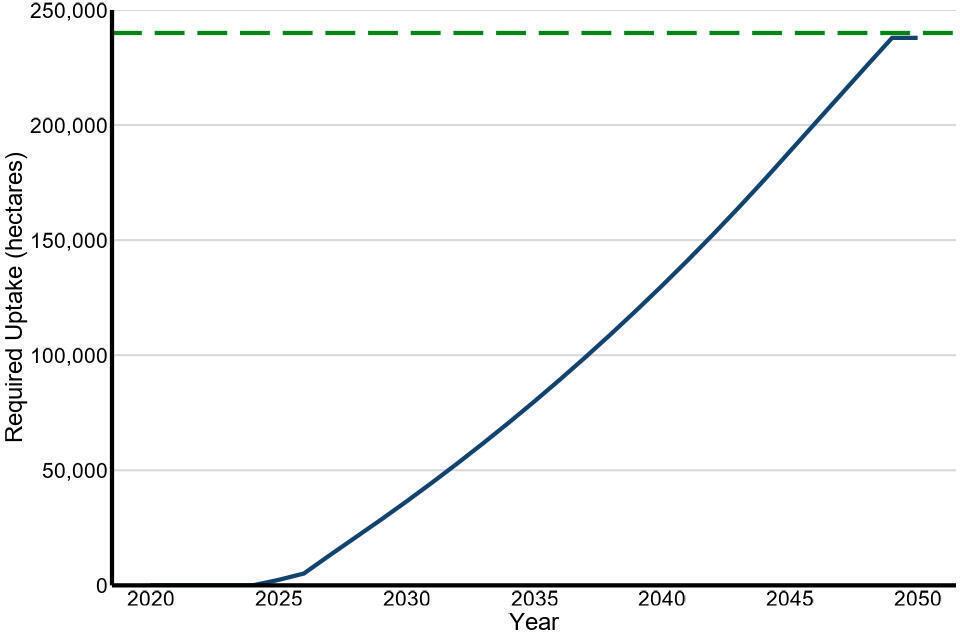
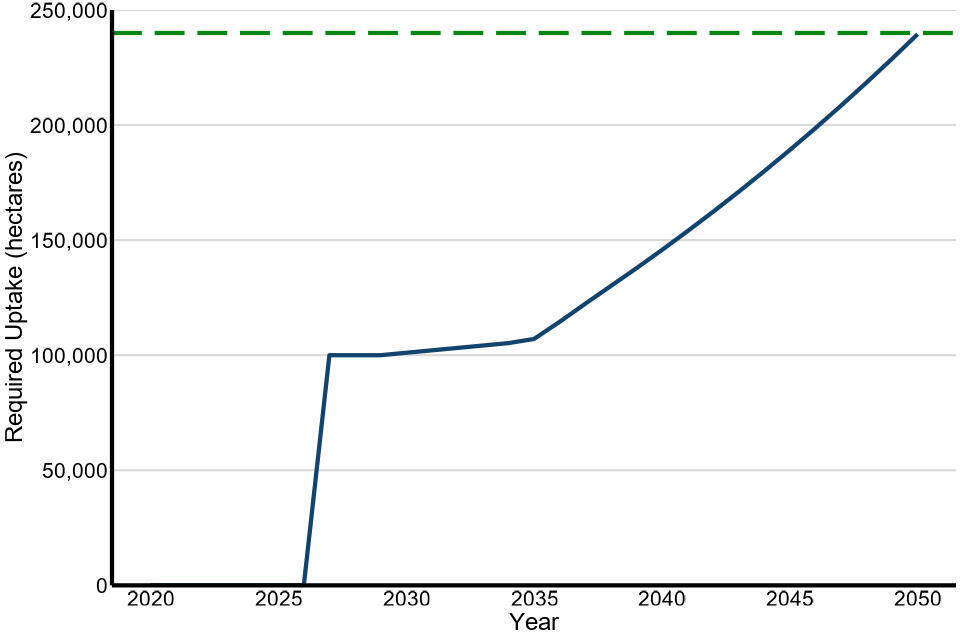
The required uptake of contributing actions has been calculated through to 2050 to meet the long-term objective.
This trajectory is based on analysis of historic uptake and illustrates the annual uptake that would be required to contribute to the environmental objective by the end of the assessment period. Its shape is informed by assumptions about economic and behavioural factors and delivery constraints.
As information on future schemes is not currently available, the trajectory should not be interpreted as a forecast of uptake or as an indication of future scheme availability.
Figure 3: Required uptake of actions contributing to peatland habitat creation and restoration to 2050, hectares
Source: Department for Environment, Food and Rural Affairs
Figure 4: Required uptake of actions contributing to peatland habitat management to 2050, hectares
Source: Department for Environment, Food and Rural Affairs
5. Technical information
| Objective | Peatland restoration and management |
|---|---|
| Related commitments | Statutory carbon emission reduction and wildlife-rich habitat creation targets |
| Reporting status | Interim |
| Contributing schemes | CS, CSHT, SFI |
| Aggregation method | Agreements live since January 2023 (restoration), agreements live as at the capture date (management) |
| Geographical scope | England |
| First reported | October 2026 |
| Last updated | October 2026 |