Farming Sector Environmental Objectives: wildlife-rich habitat creation and restoration
Published 22 October 2026
Applies to England

© Crown copyright 2026
This publication is licensed under the terms of the Open Government Licence v3.0 except where otherwise stated. To view this licence, visit nationalarchives.gov.uk/doc/open-government-licence/version/3 or write to the Information Policy Team, The National Archives, Kew, London TW9 4DU, or email: psi@nationalarchives.gov.uk.
Where we have identified any third party copyright information you will need to obtain permission from the copyright holders concerned.
This publication is available at https://www.gov.uk/government/publications/farming-sector-environmental-objectives/farming-sector-environmental-objectives-wildlife-rich-habitat-creation-and-restoration
1. Objective title
The farming sector and delivery partners will create and restore 300,000 hectares of wildlife-rich habitat outside protected sites by 2042, from a 2023 baseline.
2. Objective overview
A strong, well‑connected network of habitats is essential to support abundant and resilient wildlife across England.
The abundance of species across England has, on average, declined by around 40% since 1970, reflecting pressures on habitats and ecosystems. Known drivers of species decline across multiple taxonomic groups include land-use change, agricultural practices and habitat degradation.
Reducing pressures on wildlife and reversing these trends begins with restoring habitats locally, bringing them back to a condition capable of sustaining the species they are intended to support.
This objective aims to support the creation and restoration of grasslands, wetlands, shallow peatlands, and diverse coastal habitats to achieve wildlife‑rich status through agri‑environment schemes in England.
3. Relevant targets and commitments
30by30
Under the Global Biodiversity Framework, the UK government has agreed to:
- effectively conserve and manage 30% of our land and sea for nature by 2030
Wildlife-rich habitats created or restored under this objective could contribute to the 30by30 target, where they also meet the management and protection criteria.
Environment Act 2021
The Environment Act 2021 sets several statutory targets focussed on species abundance, reducing species extinction risk and wildlife-rich habitats, stating:
-
halt the decline in species abundance by 2030, as represented by the overall relative species abundance index
-
increase the relative species abundance index by 2042 so that it is greater than in 2022 and at least 10% greater than in 2030
-
restore or create in excess of 500,000 hectares of a range of wildlife-rich habitats, outside protected sites, by 2042
-
improve the Red List Index for England for species extinction by 2042 compared to 2022 levels
Environmental Improvement Plan
In order to meet the statutory targets set under the Environment Act 2021, the Environmental Improvement Plan 2025 sets an interim target for wildlife-rich habitats:
- restore or create a total of 250,000 hectares of a range of wildlife-rich habitats outside of protected sites by December 2030
Interactions with other environmental objectives
Once priority habitats have been successfully created or restored to wildlife‑rich condition under this objective, their ongoing management and maintenance will contribute to the Wildlife-Rich Habitat – Maintenance objective.
This objective also relates to other objectives contributing to statutory habitat creation targets under EIP25 and 30by30, including Tree Canopy and Woodland Cover and Peatland Restoration.
This objective also overlaps with Peatland Restoration as both have contributing actions that create or restore peatland. Actions cannot contribute to both objectives simultaneously, as this objective requires actions to be undertaken on shallow peat or soils with peaty pockets, whereas those on deep peat contribute to Peatland Restoration.
4. Delivery approach
Methodology
An internal review within Defra identified Environmental Land Management (ELM) actions that support the creation or restoration of wildlife-rich habitats in line with statutory target definitions. These actions have been categorised according to the habitat they support, namely:
-
coastal habitats, excluding intertidal and saltmarsh
-
saltmarsh and Intertidal habitats
-
arable Field Margins
-
grasslands
-
heathlands
-
riparian habitats
-
lakes and ponds
-
wetlands not on deep peat
-
trees and Scrub
This objective focusses on the implementation of ‘habitat creation’ and ‘habitat restoration’ actions on land to achieve ‘wildlife-rich’ habitat. Delivery towards this objective does not distinguish between ‘creation’ and ‘restoration’ actions as they are delivered through the same actions
Progress towards this objective is measured by total uptake of new key ELM actions under new agreements between 2023 and 2042. All key actions are measured in hectares. However, key actions that contribute to arable field margin (AFM), riparian or pond buffer habitats are measured by total in live agreements at the capture date.
Supporting actions make a direct or indirect contribution that is not measurable with current methodologies, and therefore not included in achieved uptake. Inclusion may change as further evidence and information becomes available.
Contribution of actions delivering AFM habitats is capped at 40,000 hectares. This is to ensure diversity of habitats delivered through this objective to support achievement of species outcomes, as uptake of actions delivering AFM habitats is likely to exceed requirement. A list of actions delivering AFM habitats can be found in Table 1.
Some ELM actions must be done in combination on the same area to contribute to this objective. These currently include:
-
actions that manage lowland raised bog (WT10/CWT10) must be undertaken with actions that block grips or drainage channels (WN1).
-
actions that carry out customised capital works to manage specific sites or species (FM2) must be undertaken with a supplement for either moorland re-wetting (UP5) or a raised water level/rewetting supplement (SP2/CSP2).
-
actions that block grips or drainage channels (WN1) must be undertaken with a supplement for either moorland re-wetting (UP5) or a raised water level (SP2/CSP2). In this instance, actions that manage lowland raised bog (WT10/CWT10) are not required, however may still be present.
-
actions that manage priority habitat species-rich grassland (GRH6/CGS22) must be undertaken with actions that provide floristically enhance seed mix for grassland habitat (GR3).
For this objective, eligible actions must be undertaken on soil where the majority has peat 10-40cm deep (shallow peat) or areas of mostly non-peat soils supporting pockets of deep peat (soil with peaty pockets). This definition aligns with wider peatland initiatives such as the International Union for Conservation of Nature (IUCN) UK Peatland Strategy. Agri-environment scheme actions that create or restore peatland which are undertaken on soils with deep peat contribute to Peatland Restoration instead.
Contribution towards this objective excludes uptake on existing protected sites. Namely, this excludes uptake on Sites of Special Scientific Interest, Special Areas of Conservation, Special Protected Areas, Ramsar sites and Marine Conservation Zones.
Baselines and Assumptions
For this objective, the definition of ‘wildlife-rich habitat’ is in line with The Environmental Targets (Biodiversity) (England) Regulations 2023. Namely, wildlife-rich habitat is a priority habitat or a habitat listed in Schedule 1 of The Environmental Targets (Biodiversity) (England) Regulations 2023 that is of sufficient quality that it is, or will be, capable of supporting flora and fauna which are typically found in the habitat in question.
A list of wildlife-rich habitats and the meaning of sufficient quality can be found in Environment Act Habitat Target – Definitions and Descriptions, however this also includes those that are the focus of other environmental objectives.
‘Habitat creation’ refers to actions that establish new habitats to a wildlife‑rich condition, meeting the quality required to support species typically found within that habitat type.
‘Habitat restoration’ refers to actions that achieve at least one of the following:
-
lead to expansion of wildlife-rich habitat by supporting fragmentated patches of priority habitat where it would previously have been more widespread or is currently not considered wildlife-rich (known as relict habitat).
-
address on or off-site pressures to allow wildlife-rich habitats of sufficient quality to become established in areas that no longer support the typical flora and fauna (known as degraded habitat).
-
are undertaken on existing priority habitat (potentially wildlife-rich) that has developed in a degraded ecosystem.
These definitions are in line with Environment Act Habitat Target – Definitions and Descriptions.
This objective uses the 1st January 2023 as the start of uptake, counting this date as having 0 hectares of contributing actions. However, this does not indicate the absence of relevant activity prior to this date. For AFM, pond buffer and riparian habitats, live uptake is measured as net increase compared to uptake as at 1st January 2023.
For this objective, hedgerow actions have been converted from metres to hectares, assuming that coverage extends 1.5 metres into the parcel. This is based on the minimum requirements for favourable width threshold for mature hedgerows established by Natural England and minimum width for new planting requirements under agri-environment schemes.
4.1 Key and Supporting Actions
Table 1: Environmental land management actions contributing to Wildlife-Rich Habitat – Creation and Restoration
| Action Code | Action Name | Scheme | Type | Habitat |
|---|---|---|---|---|
| CCT2 | Make space for new coastal habitat | CS Higher Tier | Key | Coastal habitats (excluding intertidal and saltmarsh) |
| CT2 | Creation of coastal sand dunes and vegetated shingle on arable land and improved grassland | Countryside Stewardship | Key | Coastal habitats (excluding intertidal and saltmarsh) |
| WT7 | Creation of reedbed | Countryside Stewardship | Key | Coastal habitats (excluding intertidal and saltmarsh) |
| CCT4 | Create intertidal and saline habitat on arable land | CS Higher Tier | Key | Saltmarsh and intertidal habitats |
| CCT5 | Create intertidal and saline habitat by non-intervention | CS Higher Tier | Key | Saltmarsh and intertidal habitats |
| CCT7 | Create intertidal and saline habitat on intensive grassland | CS Higher Tier | Key | Saltmarsh and intertidal habitats |
| CT4 | Creation of inter-tidal and saline habitat on arable land | Countryside Stewardship | Key | Saltmarsh and intertidal habitats |
| CT5 | Creation of inter-tidal and saline habitat by non-intervention | Countryside Stewardship | Key | Saltmarsh and intertidal habitats |
| CT7 | Creation of inter-tidal and saline habitat on intensive grassland | Countryside Stewardship | Key | Saltmarsh and intertidal habitats |
| CAB18 | Flower-rich grass margins, blocks, or in-field strips (on arable land or permanent crops) | CS Higher Tier | Key (n) | Arable field margins |
| CIPM2 | Flower-rich grass margins, blocks or in-field strips | SFI Expanded Offer | Key (n) | Arable field margins |
| IPM2 | Flower-rich grass margins, blocks, or in-field strips | Sustainable Farming Incentive 2023 | Key (n) | Arable field margins |
| AB8 | Flower-rich margins and plots | Countryside Stewardship | Key (n) | Arable field margins |
| CGS22 | Manage priority habitat species-rich grassland | CS Higher Tier | Key - Partial | Grasslands |
| GRH6 | Manage priority habitat species-rich grassland (endorsed) | SFI Expanded Offer | Key - Partial | Grasslands |
| GS7 | Restoration towards species-rich grassland | Countryside Stewardship | Key | Grasslands |
| GS8 | Creation of species-rich grassland | Countryside Stewardship | Key | Grasslands |
| GR1 | Create or restore grassland habitat | Capital Grants | Key - Partial | Grasslands |
| GR3 | Floristically enhanced seed mix for grassland habitat | Capital Grants | Key | Grasslands |
| CLH2 | Restore lowland heathland | CS Higher Tier | Key | Heathlands |
| CLH3 | Create lowland heathland | CS Higher Tier | Key | Heathlands |
| LH2 | Restoration of forestry and woodland to lowland heathland | Countryside Stewardship | Key | Heathlands |
| LH3 | Creation of heathland from arable or improved grassland | Countryside Stewardship | Key | Heathlands |
| CSW12 | Make room for the river to move | CS Higher Tier | Key (n) | Riparian habitats |
| CSW22 | Connect river and floodplain habitats | CS Higher Tier | Key (n) | Riparian habitats |
| BFS6 | 6m to 12m habitat strip next to watercourses | SFI Expanded Offer | Key (n) | Riparian habitats |
| SW11 | Riparian management strip | Countryside Stewardship | Key (n) | Riparian habitats |
| SW12 | Making space for water | Countryside Stewardship | Key (n) | Riparian habitats |
| CWT1 | Buffer in-field ponds and ditches on improved grassland | CS Higher Tier | Key | Lakes and ponds |
| CWT2 | Buffer in-field ponds and ditches on arable land | CS Higher Tier | Key | Lakes and ponds |
| BFS2 | Buffer in-field ponds on arable land | SFI Expanded Offer | Key | Lakes and ponds |
| BFS3 | Buffer in-field ponds on improved grassland | SFI Expanded Offer | Key | Lakes and ponds |
| WN5 | Pond management (less than 100 square metres) | Countryside Stewardship | Key | Lakes and ponds |
| WN6 | Pond management (more than 100 square metres) | Countryside Stewardship | Key | Lakes and ponds |
| WT1 | Buffering in-field ponds and ditches in improved grassland | Countryside Stewardship | Key | Lakes and ponds |
| WT2 | Buffering in-field ponds and ditches on arable land | Countryside Stewardship | Key | Lakes and ponds |
| WN7 | Restoration of large water bodies | Capital Grants | Key | Lakes and ponds |
| WN12 | Create or restore ponds | Capital Grants | Key | Lakes and ponds |
| CUP3 | General moorland management | CS Higher Tier | Undetermined | Wetlands (not on deep peat) |
| CWT10 | Manage lowland raised bog | CS Higher Tier | Key - Partial | Wetlands (not on deep peat) |
| CWT14 | Create fen, reedbed or wetland mosaics | CS Higher Tier | Key | Wetlands (not on deep peat) |
| UP3 | Management of moorland | Countryside Stewardship | Undetermined | Wetlands (not on deep peat) |
| UP5 | Moorland re-wetting supplement | Countryside Stewardship | Key - Partial | Wetlands (not on deep peat) |
| WT9 | Creation of fen | Countryside Stewardship | Key - Partial | Wetlands (not on deep peat) |
| WT10 | Management of lowland raised bog | Countryside Stewardship | Key - Partial | Wetlands (not on deep peat) |
| CWS2 | Manage and restore plantations on ancient woodland sites (PAWS) supplement | CS Higher Tier | Key | Trees and scrub |
| CWD8 | Create scrub and open habitat mosaics | CS Higher Tier | Key | Trees and scrub |
| SCR1 | Create scrub and open habitat mosaics | SFI Expanded Offer | Key | Trees and scrub |
| WS2 | Plantations on Ancient Woodland Sites (PAWS) - restoration and maintenance | Countryside Stewardship | Key | Trees and scrub |
| WD8 | Creation of successional areas and scrub | Countryside Stewardship | Key | Trees and scrub |
| BN7 | Hedgerow gapping-up | Capital Grants | Key | Trees and scrub |
| BN11 | Planting new hedges | Capital Grants | Key | Trees and scrub |
| FM2 | Major preparotory work for Priority Habitats (creation and restoration) and Priority Species | Capital Grants | Key | Undetermined |
| WN1 | Blocking Grips or Drainage Channels | Capital Grants | Key | Undetermined |
| GRH7 | Haymaking supplement | SFI Expanded Offer | Supporting | Grasslands |
| GRH8 | Haymaking supplement (late cut) | SFI Expanded Offer | Supporting | Grasslands |
| GRH11 | Cattle grazing supplement (non-moorland) | SFI Expanded Offer | Supporting | Grasslands |
| GS15 | Haymaking supplement | Countryside Stewardship | Supporting | Grasslands |
| TE16 | Use tree surgery to ‘hinge’ a tree into a watercourse | CS Higher Tier | Supporting | Rivers |
| FG1 | Fencing | Capital Grants | Supporting | Undetermined |
| FG2 | Sheep netting | Capital Grants | Supporting | Undetermined |
| FG3 | Permanent electric fencing | Capital Grants | Supporting | Undetermined |
| FG4 | Rabbit fencing supplement | Capital Grants | Supporting | Undetermined |
| PA1 | Implementation plan | Capital Grants | Supporting | Undetermined |
| PA2 | Feasibility study | Capital Grants | Supporting | Undetermined |
| PA5 | Moorland mapping | Capital Grants | Supporting | Undetermined |
| SB3 | Tree removal | Capital Grants | Supporting | Undetermined |
| SB4 | Chemical Bracken Control | Capital Grants | Supporting | Undetermined |
| SB5 | Mechanical Bracken Control | Capital Grants | Supporting | Undetermined |
| SB6 | Rhododendron Control | Capital Grants | Supporting | Undetermined |
| WN3 | Ditch, dyke and rhine restoration | Capital Grants | Supporting | Undetermined |
| WN4 | Ditch, dyke and rhine creation | Capital Grants | Supporting | Undetermined |
| WN8 | Timber sluice | Capital Grants | Supporting | Undetermined |
| WN9 | Brick, Stone or Concrete Sluice | Capital Grants | Supporting | Undetermined |
| WN10 | Construction of water penning structures | Capital Grants | Supporting | Undetermined |
Note: (n) denotes actions required to be in live agreements at the capture date
Trajectory
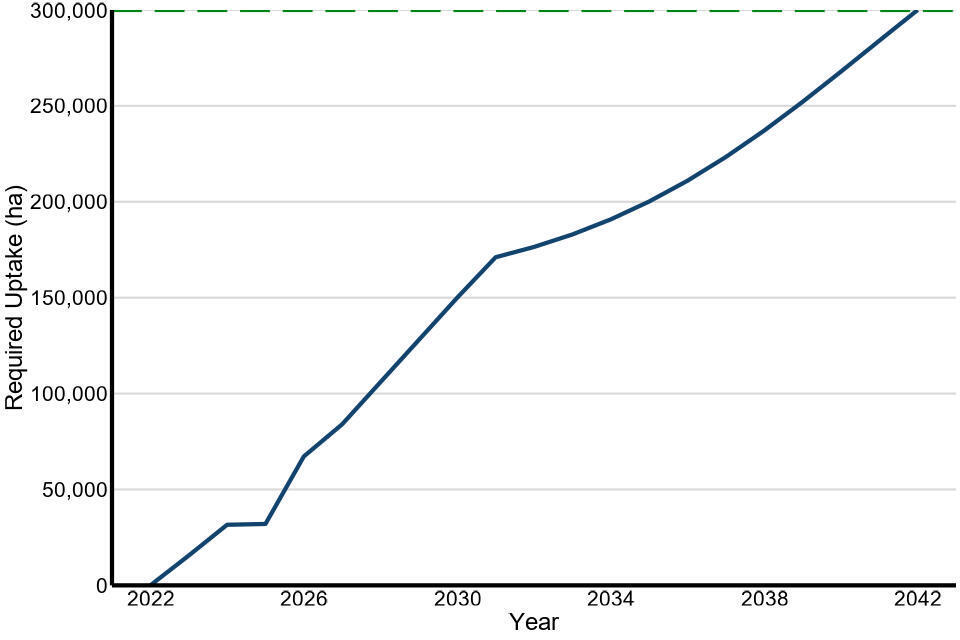
The required area of contributing actions has been calculated through to 2042. This trajectory is based on analysis of historic uptake and illustrates the annual uptake that would be required to contribute to the environmental objective by the end of the assessment period. Its shape is informed by assumptions about economic and behavioural factors and delivery constraints.
As information on future schemes is not currently available, the trajectory should not be interpreted as a forecast of uptake or as an indication of future scheme availability.
Figure 2: Required uptake of actions contributing to Wildlife-Rich Habitat – Creation and Restoration to 2042, hectares
Source: Department for Environment, Food and Rural Affairs
5. Metadata
| Objective | Wildlife-Rich Habitat – Creation and Restoration |
|---|---|
| Related commitments | Statutory wildlife-rich habitat creation targets |
| Reporting status | Final |
| Contributing schemes | CS, CSHT, SFI |
| Aggregation method | Agreements live since January 2023 |
| Geographical scope | England |
| First reported | October 2026 |
| Last updated | October 2026 |