Facts and figures: patents, trade marks, designs and hearings: 2025
Published 30 July 2026

© Crown copyright 2026
This publication is licensed under the terms of the Open Government Licence v3.0 except where otherwise stated. To view this licence, visit nationalarchives.gov.uk/doc/open-government-licence/version/3 or write to the Information Policy Team, The National Archives, Kew, London TW9 4DU, or email: psi@nationalarchives.gov.uk.
Where we have identified any third party copyright information you will need to obtain permission from the copyright holders concerned.
This publication is available at https://www.gov.uk/government/publications/facts-and-figures-patents-trade-marks-designs-and-hearings-2025/facts-and-figures-patents-trade-marks-designs-and-hearings-2025
Note: This document is to be used in conjunction with the data download for patent, trade mark, design and hearing data for 2025 and provides further insight for these statistics.
1. Main points
These statistics include the latest annual figures for patents, trade marks, and designs, based on IPO administrative data:
Applications
The number of applications to the UK IPO for trade marks has increased in 2025 to a record high, surpassing 200,000 applications for the first time. Meanwhile applications for both patents and designs have also increased. Patent applications increased by 19.8% between 2024 and 2025 to a 10-year high of 22,701. Trade mark applications increased by 17.3% to a record high of 203,194 applications in 2025. Design applications increased to 79,542 applications in 2025, a 2.7% increase.
Registrations and grants
Trade mark registrations followed the same trend as applications to a record high in 2025. Registrations and grants for designs and patents decreased in 2025. Patent grants have decreased by 32.9% to 5,522. A record number of trade marks were registered in 2025 with 177,093 registrations, an increase of 13.1%. The number of designs registered in 2025 decreased by 1.1% to 73,774 registrations.
International
For patents, trade marks and designs, the highest number of non-UK applications came from China and the USA. The USA has the highest number of patent applications filed at the UK IPO by non-UK applicants. China has the highest number of trade mark and designs applications by non-UK applicants.
Hearings
Cases relating to trade marks make up the largest proportion of hearings activity at the UK IPO. A total of 7,579 oppositions were filed in relation to trade marks (including Fast Track options) in 2025.
2. Facts and figures: patents, trade marks, designs and hearings
Table 1: Summary of all registered intellectual property rights [1]
| Intellectual Property Right | 2020 | 2021 | 2022 | 2023 | 2024 | 2025 | |
|---|---|---|---|---|---|---|---|
| Patents [2] | Applications | 20,651 | 18,858 | 19,487 | 19,964 | 18,956 | 22,701 |
| Publications | 10,040 | 11,267 | 11,790 | 11,701 | 11,068 | 11,154 | |
| Grants | 9,772 | 10,895 | 10,578 | 8,377 | 8,228 | 5,522 | |
| Trade marks [3] | Applications | 137,035 | 196,639 | 158,821 | 163,725 | 173,180 | 203,194 |
| Registrations | 96,204 | 168,991 | 163,104 | 143,513 | 156,596 | 177,093 | |
| Designs [4] | Applications | 31,460 | 72,157 | 67,315 | 81,215 | 77,486 | 79,542 |
| Registrations | 27,220 | 59,983 | 70,098 | 77,254 | 74,619 | 73,774 |
Notes:
[1] Values from this table report annual counts based on a calendar year. Therefore, there may be differences when comparing to counts in other tables, as these may be based on a financial year.
[2] Patents filed directly at the UK IPO and Patent Cooperation Treaty (PCT) applications.
[3] Domestic trade mark applications and International Registrations (excluding additional classes).
[4] Domestic design applications and international Hague applications.
Patents
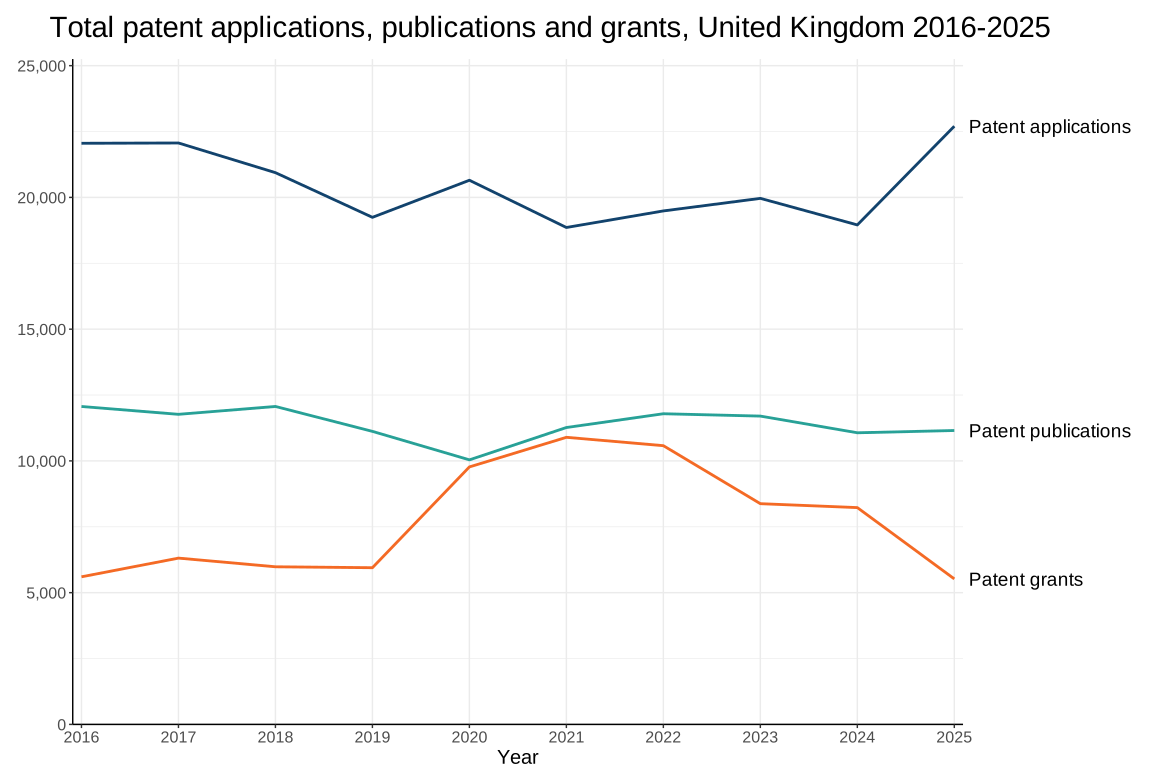
Between 2024 and 2025, the number of patent applications1 to the UK IPO increased by 19.8% from 18,956 to 22,701. This is the highest annual application count since 2015 (see Figure 1).
This increase is driven by a substantial increase in domestic applications from UK-based applicants which increased by 39.4% from 11,093 in 2024 to 15,460 in 2025. Meanwhile applications from international applicants (both direct and through the Patent Cooperation Treaty (PCT) filing route) have seen a 7.9% decrease (from 7,860 applications in 2024 to 7,241 in 2025). International applications from both filing routes have decreased, with direct applications from international applicants decreasing by 7.8% from 5,387 in 2024 to 4,967 in 2025. PCT applications have seen a steady decrease in the past two years, with applications decreasing by 14.7% between 2023 and 2024 and by 8.0% between 2024 and 2025.
The top 50 applicants, excluding private applicants, accounted for 19.9% of all applications in 2025. The top applicant, Jaguar Land Rover Limited contributed 2.0% of all patent applications in 2025. Only applications with company names supplied are included in the list of top 50 applicants and individuals (“private applicants”) are not included in this list. For 2025, if private applicants were included, the top 50 applicants would include 6 individuals. This is unusual as the top 50 is usually comprised of larger, established businesses.
The number of patents published increased slightly by 0.8% from 11,068 to 11,154 between 2024 and 2025. This is driven by applications published by international applicants which increased by 2.8%. In contrast, published applications from UK-based applicants decreased by 1.3%. Publication trends may not follow application trends, as there is typically an 18 month delay between application and publication.
The number of patents granted at the IPO has steadily declined in recent years since its peak in 2021 (See Table 1). In 2025, the number of patent grants has decreased significantly from 8,228 in 2024 to 5,522 in 2025, a decrease of 32.9%. This represents the lowest number of patents granted since 2015. The main factor which caused the large drop in the number of patents granted was the introduction and implementation of the new patents service. The new service began to be used in August 2025, and as can be seen from IPO Monthly statistics publication, the number of granted patents declined from August. The implementation of the new service led to a temporary reduction in publishing capacity due to significant changes to the publishing process. The decrease in granted patents is consistent between UK-based applicants which decreased by 32.6% (to 2,886) and international applicants which decreased by 33.1% (to 2,636).
Figure 1: Patent applications and publications have increased while grants have decreased in 2025
Source: Intellectual Property Office.
Notes:
[1] Patents filed directly at the UK IPO and Patent Cooperation Treaty (PCT) applications.
The majority of patent applications to the UK IPO are from UK-based applicants. In 2025 there were 15,443 domestic applications from UK-based applicants, representing 68.0% of all applications received. This is a substantial shift in percentage as domestic applications tend to vary between 55% to 60%. For example, in 2024 the percentage of domestic applications was 58.5%. Applications increased for all regions across the UK. However, there were notable increases in applications from Wales (82.5% increase, 564 applications) and North West England (71.1% increase, 1,275 applications). The smallest increase in applications was from the West Midlands (increase of 18.0%, 1,335 applications). However this region has seen the largest increase in applications in the previous two years with a 56.6% increase between 2022 and 2024.
Following the same trend from the past several years, the highest number of non-UK based applications came from the USA. Although for the second year in a row there has been a sizable decrease in applications from the USA in 2025 (1,681 applications, a 15.9% decrease from 2024). Applications from the USA have dropped from 2,649 in 2023 to 1,681 in 2025, a 36.5% decrease. The second highest number of international applications came from China, though the number of applications also continued to decrease, falling by 1.5% (919 applications). The third ranked country is Germany which has seen a 22.4% increase (628 applications).
Prior to 2022, licences of right had remained relatively stable, with 1,058 licences issued in 2022. In 2023 however, the number of licences of right increased to 2,046, a 93.4% increase. This increased further in 2024 to 2,128, an increase of 4.0% (see Table 2.11). This increase has been driven by licences of right on European Patent Office patents with UK designation which increased from 758 licences in 2022 to 1,786 in 2024. In 2025 the Licences of right decreased significantly to 813, a 61.7% decrease.
Green Channel patents
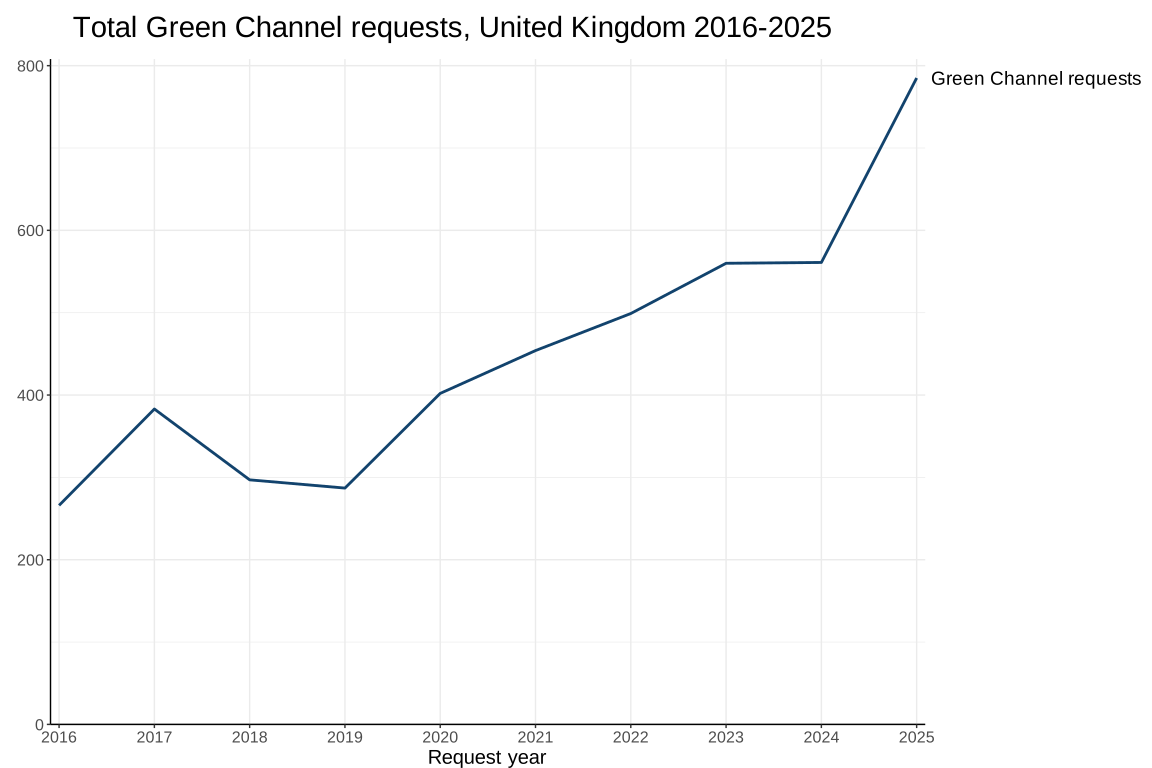
The Green Channel for patent applications was introduced in 2009 and allows applicants to request accelerated processing of their patent application if the invention has an environmental benefit. The UK IPO received a record high of 785 requests in 2025 through the Green Channel (a 39.9% increase, see Table 2.7). Further analyses on the current patent and trade mark landscapes relating to green technologies can be found in the recent race to net zero publication.
There have been 140 Green Channel requests which were published [1] in 2025 [1],[2], which is 56 less than 2024. As the publication of a patent application usually takes place 18 months from the filing or priority date, the current number of published Green Channel requests is a provisional count and will likely increase.
Figure 2: Green Channel requests increase to a record high
Source: Intellectual Property Office.
Notes:
[1] According to Intellectual Property Office - Green Channel Patent Applications.
[2] The application filing date may differ from the Green Channel patent request date.
Trade marks
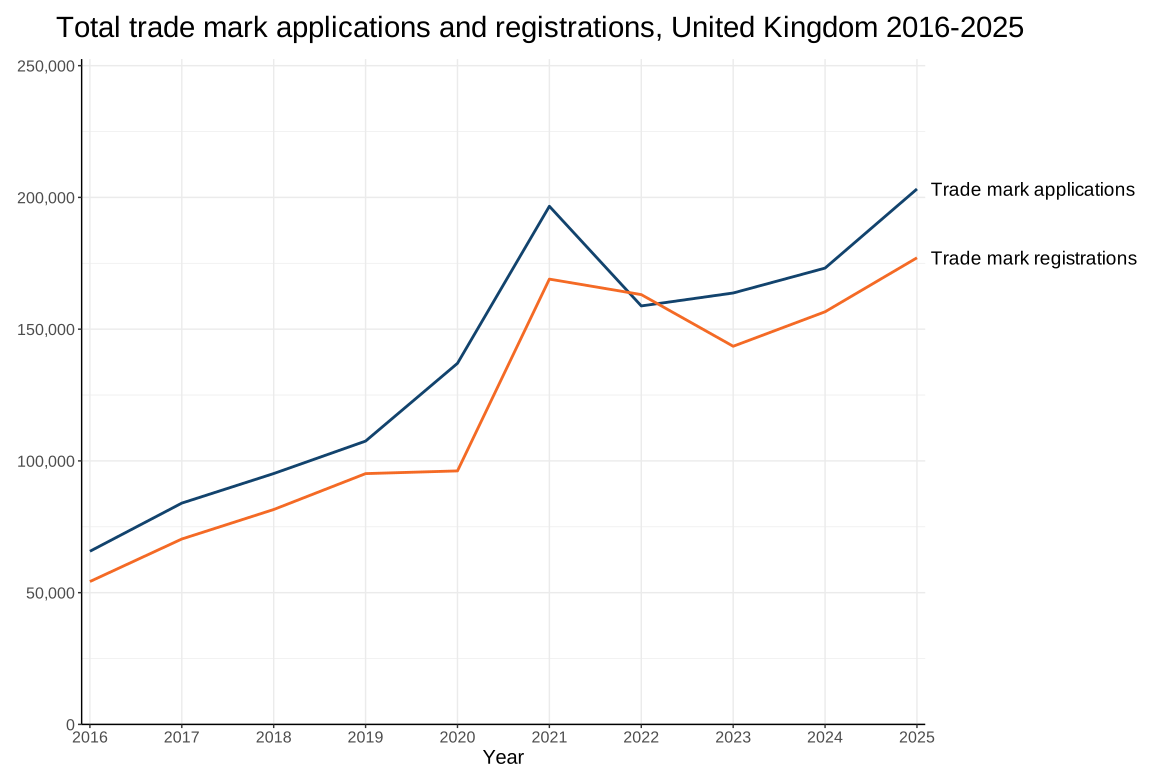
For the first time, the number of trade mark applications [1] received at the UK IPO surpassed 200,000 applications to 203,194 in 2025. This is the highest number of applications to the UK IPO ever in a calendar year and represents a 17.3% increase compared to 2024 (173,180 applications). Much of this increase was driven by an increase in domestic applications filed directly with the UK IPO which rose by 20.5% from 144,055 in 2024 to 173,531 in 2025. In contrast applications from the international route only increased by 1.8%.
The number of trade mark registrations has increased from 156,596 in 2024 to 177,093 in 2025, an increase of 13.1%. This is also the highest number of registrations in a calendar year, ahead of the previous record in 2021 of 168,991. The significant increases in trade mark applications and registrations seen since 2016 are believed to have been driven by three factors. A significant surge in applications from China, the COVID-19 pandemic and filings driven by the UK’s exit from the European Union. The first two reasons have seen the number of applications increase for the majority of IP offices globally [2]. However the relative size of this increase is smaller in these IP offices compared to the increase in the UK, as the UK’s exit from the European Union is an extra factor in increased trade mark filings for the UK IPO.
One further potential driver in the increase in trade mark applications in 2025 is the IPO’s fee change that took effect on 1 April 2026. With fees increasing from that date, businesses may have chosen to submit their applications prior to March 2026 to take advantage of the lower rates.
Figure 3: Trade mark applications and registrations have increased again in 2025
Source: Intellectual Property Office
Notes:
[1] Domestic trade mark applications and International Registrations (excluding additional classes).
[2] According to World Intellectual Property Organization IP statistics.
In 2025, 111,611 trade mark applications were filed directly with the UK IPO (domestic applications) from UK-based applicants, which represents an increase of 23.4% compared to 2024. UK-based applicants account for 54.9% of all trade marks filed to the UK IPO in 2025. Applications filed in 2025 from UK-based applicants increased across almost every region, except for Northern Ireland which saw a 9.4% decrease to 1,615 applications in 2025. It is worth noting trade mark applications from Northern Ireland increased substantially between 2022 and 2023 by 46.1% and again between 2023 and 2024 by 33.5%, and therefore has nearly doubled in the space of the previous two years. With the exception of Northern Ireland, the remaining UK regions all saw an increase in trade mark applications between 18% and 31% with this highest increase in Wales (a 30.2% increase to 2,941 applications). For the second year in a row, the top company for both applications and registrations is L’OREAL with 234 applications and 217 registrations.
In 2025, 61,920 domestic applications to the UK IPO were from non-UK-based applicants, which is a 15.6% increase from 2024 (53,575) and is the second highest number of international applications received by the UK IPO from international applicants after 2021 (67,347 applications). In contrast, there were 29,662 trade mark applications through the ‘Madrid’ International Registration (IR) route, an 1.8% increase. The number of ‘Madrid’ International Registration applications have generally declined since 2020, whereas domestic applications from international applicants have increase in this time period.
Similar to the past several years, the highest number of non-UK based applications in 2025 (combined domestic and IR) came from China with 37,931 applications (36,050 domestic and 1,881 IR) which is a 19.5% increase compared to 2024. The second highest number of non-UK based applications came from the USA with 16,525 applications (8,875 domestic and 7,650 IR), a 7.2% increase on 15,416 in 2024. Trade mark applications from China and the USA (a total of 54,456) account for 59.5% of all non-UK-based applications and 26.8% of all trade mark applications to the UK IPO in 2025.
Registered trade marks provide protection within different classes of goods and services. For example, in the UK, the word ‘Polo’ is protected simultaneously by different applicants in relation to different goods: a type of mint, a clothing brand and a model of car. The total number of classes in all applications in 2025 was 428,482 (356,318 domestic and 72,164 IR), an increase of 20.0% from 2024 (357,136). This means there was an average of 2.1 classes per application. The increase in classes was primarily driven by an increase in classes in domestic applications, up by 23.8% on 2024, while the number of classes applied for in IR applications increased by 3.9%.
Designs
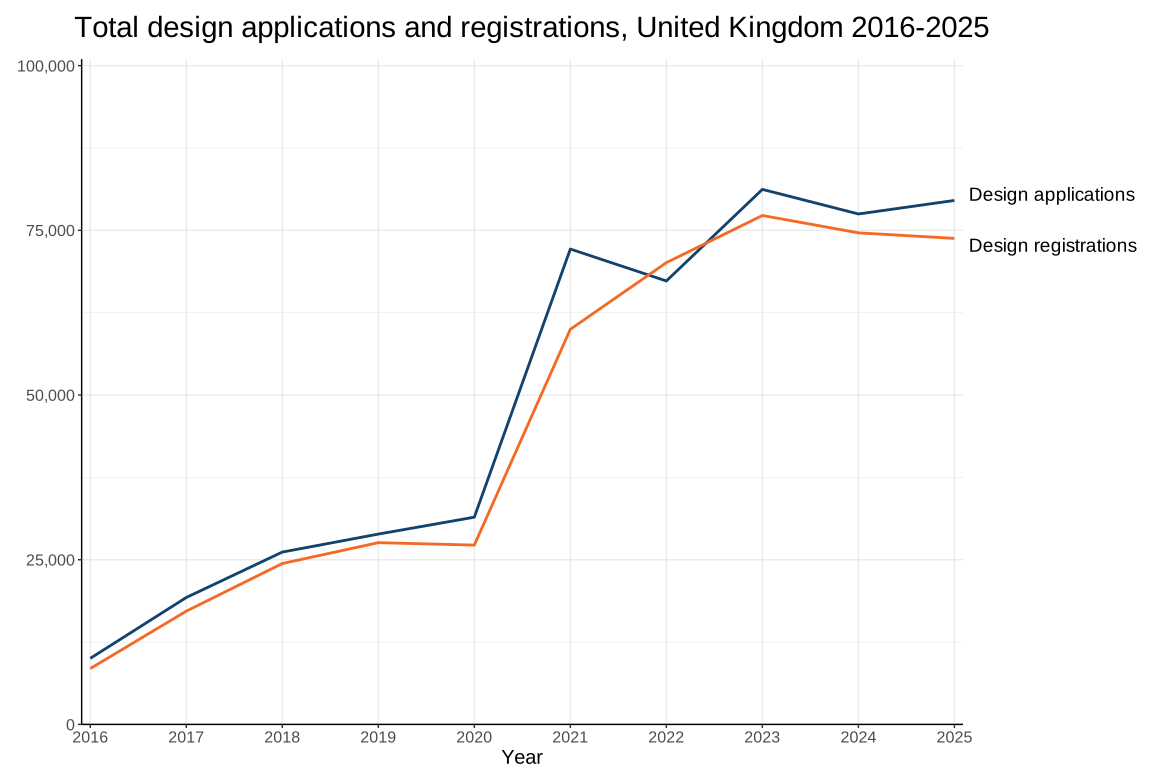
Design applications to the UK IPO have seen a dramatic increase since 2015, with the number of applications growing 1129.0% between 2015 and 2025. The process of applying for registered design protection with the UK IPO has changed in recent years, with a new fee structure coming into force in October 2016 and an online application form in October 2017. These changes were intended to make the process more straightforward and cost-effective for applicants and are likely to have contributed to increased filing activity. Other drivers to these increases include a significant surge in applications from China, the COVID-19 pandemic and filings driven by the UK’s exit from the European Union.
As of May 2018, the UK became a member of the Hague Agreement for International Registrations [1]. These figures,15,274 international applications for 2025, are included within this publication, which accounts for a portion of the applications and registrations shown. The number of international ‘Hague’ applications increased by 6.7% in 2025.
Figure 4: Design applications increase and registrations decrease in 2025
Source: Intellectual Property Office.
Notes:
[1] Designs registrations include the international Hague applications and registrations. This is a route for applying for designs through World Intellectual Property Organization (WIPO), which the UK joined in 2018. This allows for a single international application filed with WIPO rather than a whole series of applications which would otherwise have to be filed with different national offices.
Design applications increased slightly from 2024 and is now the second highest annual counts. Designs applications increased by 2.7% between 2024 and 2025, from 77,486 to 79,542. This increase is solely influenced by international applicants which increased by 7.0% from 46,498 to 49,769 in 2025.
A total of 29,773 design applications to the UK IPO were from UK-based applicants which accounted for 37.4% of all design applications in 2025. This is a 3.9% decrease compared to 2024. Looking at the differences by UK region, this decrease largely is due to a decrease in applications from London, which saw a 23.9% decrease to 8,045 applications. Wales (643 applications, decrease of 14.9%) and East of England (2,664 applications, a decrease of 5.5%) also saw decreases in applications in 2025. Meanwhile all other regions in the UK saw increases, notably Scotland saw a 58.9% increase to 1,697 applications and the East Midlands a 23.3% increase to 2,063 applications. The East Midlands has seen significant increases in design applications in recent years. Between 2022 and 2025 design applications from the East Midlands have increased from 668 to 2,063, a 208.8% increase.
As previously mentioned, international applications increased by 7.0% from 46,498 to 49,769 in 2025. Similar to previous years, over half (60.2%) of applications from international countries in 2025 were from either China or the USA (20,438 and 9,546 respectively) with the number of applications from China increasing by 21.7% compared to 2024. Design applications from India have increased considerably between 2022 and 2025, from 103 applications in 2022 to 2,493 in 2025, increasing by 12% between 2024 and 2025.
For the second year in a row, the number of registrations decreased in 2025 to 73,774, a decrease of 1.1%. Despite this decrease, the number of registrations in 2025 is the third highest, only behind 2023 and 2024. Much of this decrease is due to a decrease in registrations from UK-based applicants which fell by 7.0%. Applications by the top 10 applicants of designs in 2025 consists of 5.7% of all applications, and registrations by the top 10 applicants of design registrations consists of 6.2% of all design registrations. The top 50 design registrations represent 14.7% of all registrations. For a second year in a row, Nike Innovate C.V. is the top of both applicant and registration lists with 585 applications and 748 registrations.
Hearings
In addition to processing and examining applications for intellectual property rights, the UK IPO also runs the resolution of IP disputes through hearings and tribunals. Holding hearings at the UK IPO means that cases can be processed faster and gives businesses a more affordable dispute option than seeking redress through the courts. Cases relating to trade marks make up the largest proportion of hearings activity at the UK IPO. There was a total of 7,579 oppositions filed (an increase from 6,695 in 2024) in relation to trade marks in 2025 (including Fast Track oppositions) and 859 ex parte hearings taken to challenge examiners’ objections to trade marks.
3. Facts and figures: patent, trade mark, design and hearing data
The full dataset which contains further breakdowns of these data is available to download in the data download for 2025.
4. Glossary
Patents
A patent protects inventions. It gives the right to take legal action against anyone who makes, uses, sells or imports it without the patent holder’s permission.
To be granted a patent, the invention must be all of the following: something that can be made or used, new, and inventive - not just a simple modification to something that already exists.
Patent cannot be granted for certain types of invention, including:
- literary, dramatic, musical or artistic works
- a way of doing business, playing a game or thinking
- a method of medical treatment or diagnosis
- a discovery, scientific theory or mathematical method
- the way information is presented
- some computer programs or mobile apps
- ‘essentially biological’ processes like crossing-breeding plants, and plant or animal varieties
Application
An application for a patent includes a full description of the invention (including any drawings), a set of claims defining the invention, and a short abstract summarising the technical features of the invention.
Search
The UK IPO carries out a search to check whether the invention is new and inventive. The results of the search and any defects in the application are reported. Search reports can take up to 6 months.
Publication
Applications are published 18 months from filing or priority date, provided they are complete and pass the search.
Substantive examination
The examination checks whether an invention is new and inventive enough. It also checks that the description and claims match and are good enough to patent. The examination will show if an application meets the legal requirements. Examination of a patent application must be requested within 6 months of publication. Examinations can take place several years after the filing date of an application.
European patent protection
European patents (EP) can also provide protection in the UK. Applications can be made through the UK IPO or directly to the European Patent Office (EPO). Once granted an application becomes separate patents in the countries designated.
Patent Cooperation Treaty (PCT)
Patents providing protection in the UK may also be received by the UK IPO through the international route. International applications use the Patent Cooperation Treaty (PCT) to pursue patent rights across many countries from a single filing.
Licences of right
Some patent applicants may wish to let other people licence their patent, usually for a fee, and make this known publicly. These granted patents (both UK and EP (designating UK)) are recorded on a register and the applicant is entitled to pay renewal fees at half the normal rate.
Trade mark
A trade mark is a sign which can distinguish goods and services from those of other traders. A sign includes, for example, words, logos, colours or a combination of these. A trade mark can be used as a marketing tool so that customers recognise products or services.
Trade marks are not granted for words, logos, colours or other signs which are unlikely to be seen as a trade mark by the public. For example, marks which describe goods or services or any characteristics of them (e.g. marks which show the quality, quantity, purpose, value or geographical origin of goods or services). Terms that have become customary (e.g. technical terms that are in common use. Or are not distinctive (e.g. promotional advertising slogans); or a combination of these.
Trade marks will not be granted if they are offensive (e.g. taboo swear words), against the law (e.g. promoting illegal drug use). Or deceptive (e.g. there should be nothing in your mark which would mislead the public). In addition, UK IPO will object to marks that contain specially protected emblems (e.g. the Red Cross or Olympic symbols).
To be registrable, a trade mark must be distinctive for the goods and services that are applied for registration.
Design
A registered design protects the visual appearance of a product, part of a product, or its ornamentation. This can also apply to an industrial or handicraft item. This IP right gives no protection for how a product works but merely for its appearance. That appearance can be affected by a number of contributory features including: lines, contours, colours, shape, texture, material.
The protection lasts for five years and can be renewed every five years, for up to 25 years.
Hearings
A hearing is an open attendance before a Hearing Officer at the UK IPO, which is normally open to the public.
An ex parte hearing is the name given to hearings held between a single party (either private individuals or firms) and the UK IPO. An ex parte hearing is a way of taking things forward with a patent, trade mark or design application or granted application. It allows the IP right holder to explain their case in person to a ‘hearing officer’. The hearing officer is trained to be independent and to look at all sides of the arguments and make the final decision about the case.
Opposition
An opposition is the procedure where a third party may formally object to an application for registration of a trade mark.
For a glossary of terms relating to trade mark hearings, please see this trade mark hearings glossary of terms.
5. Data
Data source
The statistics in this release are produced using administrative data from the UK Intellectual Property Office (UK IPO), covering various aspects of UK IPO business. For patents, trade marks, and designs, snapshots of administrative databases for the calendar year 2025 were taken between April and June 2026. Data relating to hearings activity are provided directly by the relevant teams within the UK IPO. Due to the cessation of internal collection of some data points, certain tables and data points relating to Hearings have been removed from this publication.
Coverage
Patent protection in the UK can also be obtained from the European Patent Office (EPO). Prior to 2021, trade mark and design protection was also available through the EU Intellectual Property Office (EUIPO), this route is no longer available. Statistics relating to the EPO and the EUIPO are not covered in this publication and as such, the statistics in this publication do not represent all intellectual property activity in the UK. While all EPO applications are automatically designated to the UK, applicants have the option to specify otherwise.
6. Strengths and limitations
It is important to note that the UK IPO’s data is collected for business purposes, not statistical purposes, and it is therefore subject to a number of limitations from a statistical perspective.
Intellectual property (IP) statistics should not be used alone to describe the level of innovation in the UK, or as a measure of inventorship. See the patent guide, or the trade mark guide for information on the limitations of using patents and trade marks as proxies for measuring innovation.
Accuracy of the statistics
Administrative data at the UK IPO are generated through receipt of forms to the office, which can be filed online or in paper format. To compile statistics on the three registered intellectual property rights (patents, trade marks and designs), data are extracted from the relevant databases. The extraction of data is not performed immediately at the close of the calendar year but is delayed allowing for any necessary retrospective amendments to be made in the databases. This ensures that the statistics presented in this release have a higher level of accuracy. Patent statistics may appear particularly volatile in 2025 due to the introduction of the new patents system.
Name consistency
Applicants are free to write their name as they choose, which can lead to variation over multiple applications. For example, one individual may write “Limited” as part of the company name on whose behalf they are applying, while another individual may use the abbreviation “Ltd.” on a later application for the same company. We therefore use probabilistic matching to produce the “Top 50” and “Top 10” tables in this release, aiming to group all variations of a company name together.
Address consistency
Applicants are free to write their address as they choose, which can lead to variation over multiple applications in a similar manner to names (please see Name consistency). The address listed on application may not represent the location of where the IP was generated. For example, a patent for a product invented in one location may be filed under a company headquarters address in a completely different location (which could be in a different country). Address data on trade mark and design applications represents the current address the rights owner wishes to use for correspondence. This may not be the address that the application was originally filed under.
“Rejected” patent applications
The UK IPO does not formally issue decisions rejecting patent applications. Furthermore, we do not associate withdrawals or abandonment with specific decisions. Applications that do not become granted patents include applications which had outstanding objections at expiry of the compliance period, applications withdrawn, and applications abandoned.
IP timelines
The applications granted/registered in a given calendar year often refer to applications filed in a previous year. It is therefore not possible to use the number of applications filed in 2025 and the number of grants/registrations in 2025 to calculate the proportion of “successful” applications.
Applicants’ characteristics
It is not a requirement for applicants to provide information such as sex, ethnicity, or disability status in order to obtain intellectual property rights, and these questions are not asked on our forms. We cannot provide statistics on the diversity of applicants; however, the UK IPO has published research into the gender of inventors on patents using name-gender inference.
The UK IPO is responsible for copyright legislation in the UK but does not produce statistics on this intellectual property right as there is no copyright register. For further information, is available on copyright page.
7. Related links
Monthly statistics: Patents, trade marks and designs: May 2026
Official Statistics | Released 25 June 2026
The statistics in this release provide factual information relating to monthly applications and registrations of intellectual property registered rights (patents, trade marks, and designs).
Facts and figures: patents, trade marks, designs and hearings: 2024
Official Statistics | Released 26 June 2025
These statistics include annual data for designs, patents, trade marks and hearings for 2024, based on administrative data.
Trends at UK Intellectual Property Office 1995 to 2017
Official Statistics | Released 13 July 2018
A report on the trends of patent, trade mark and design applications, publications and grants at the UK IPO over 1995 to 2017.
The changing profile of users of the UK patent system
Official Statistics | Released 9 August 2021
This paper formed part of the IPO’s research into the drivers of IP demand. This research paper investigates the changing profile of users of the UK patent system.
The race to net zero: Tracking the green industrial revolution through IP
Official Statistics | Released 26 February 2024
A landscape analysis of IP trends relating to green technology. This looks at both patenting trends and trade mark trends.
We are seeking feedback
We are always looking to improve our release for these statistics and datasets. Feedback on this release is welcomed at statistics@ipo.gov.uk.