Evaluation of the initiatives to enhance the move on process
Published 10 June 2026

© Crown copyright 2026
This publication is licensed under the terms of the Open Government Licence v3.0 except where otherwise stated. To view this licence, visit nationalarchives.gov.uk/doc/open-government-licence/version/3 or write to the Information Policy Team, The National Archives, Kew, London TW9 4DU, or email: psi@nationalarchives.gov.uk.
Where we have identified any third party copyright information you will need to obtain permission from the copyright holders concerned.
This publication is available at https://www.gov.uk/government/publications/evaluation-of-the-initiatives-to-enhance-the-move-on-process/evaluation-of-the-initiatives-to-enhance-the-move-on-process
Author
National Centre for Social Research
35 Northampton Square,
London,
EC1V 0AX.
Telephone: 020 7250 1866
www.natcen.ac.uk
A Company Limited by Guarantee.
Registered in England No.4392418.
A charity registered in England and Wales (1091768) and Scotland (SC038454).
This project was carried out in compliance with ISO20252.
Acknowledgements
The research team would like to thank the individuals and organisations who participated in this research, as well as those who helped to approach participants about taking part.
We would also like to thank the members of our steering and working groups, for their ongoing support and expertise provided throughout the evaluation, and to the 2 anonymous peer reviewers for their insight and guidance.
For any questions relating to this report, please email:
AsylumAccommodationResearch@homeoffice.gov.uk
Report considerations
First, this report presents the views and experiences of participants who chose to take part in this evaluation. It does not measure the prevalence of these perspectives and categorising them by importance or frequency could lead to misinterpretation. Furthermore, the findings reflect only the perspectives of those who participated and should not be extrapolated to all stakeholders involved in the ‘move on’ process.
Any identifying details such as names of participants are not included. This was to enable participants to contribute more openly to the research process.
Finally, the findings in this report are based on fieldwork conducted between April and September 2025. Therefore, findings are reflective of this period, and do not reflect changes incorporated since then.
Executive summary
Context
The move on period supports asylum seekers granted leave to remain as they transition from asylum support to mainstream support services. The move on period was temporarily extended to 56 days under a pilot which was launched in December 2024 and ended (for single adults) in September 2025. Prior to the pilot, asylum seekers granted leave to remain were given 28 days to move on from the date they received their Asylum Support Discontinuation Letter (ASDL). Alongside this, 2 additional initiatives were introduced:
- deployment of Asylum Move on Liaison Officers (AMLOs) in select local authorities (LAs)
- recognition payments (£2.8 million) to LAs most affected by increased asylum decisions
Separately, UK Visas and Immigration (UKVI) rolled out eVisas, replacing physical documents with digital immigration status records.
The Home Office commissioned the National Centre for Social Research (NatCen) and Fortia Insight (formerly Strategy, Economics and Policy at RSM UK) to evaluate these initiatives, focusing on implementation, early impacts and value for money (VfM). The evaluation reflects primary data collection from April to September 2025, when the pilot of the extension to 56 days ended (for single adults). The 56-day period was retained for families, pregnant women, individuals aged 65 and over, and for those with a disability as defined in the Equality Act 2010. Throughout the report, for ease of reference, our research participants who have lived experience of move on are referred to as newly-recognised refugees or ‘refugees’. However, not all may have been granted a status of ‘refugee’ and may have another form of leave to remain.
Evaluation approach
Evaluation components: the study comprises 3 workstreams: a process evaluation, secondary analysis of Management Information (MI) data, and a VfM assessment.
Methods:
- 76 qualitative encounters (interviews and focus groups) with 110 participants, including representatives from the Home Office; other central government departments; Strategic Migration Partnerships (SMPs); the Local Government Association (LGA); LAs; voluntary community sector (VCS) organisations, and refugees
- 2 online surveys: one with AMLOs (28 usable responses, 57% completion rate) and another with LAs (135 usable responses, 47% completion rate)
- analysis of Home Office operational MI and Ministry of Housing, Communities and Local Government (MHCLG) homelessness data
- Cost-Benefit Analysis (CBA)
Limitations: the evaluation faced several limitations, including recruitment challenges, lack of control groups, attribution issues, data gaps, and confounding factors (eVisa rollout, housing shortages).
Key findings
Extension of the move on period to 56 days
The pilot, introduced in December 2024, extended the move on period for newly recognised refugees to 56 days. This change aimed to reduce some of the pressure that refugees and support providers (LAs and VCS organisations) face, by allowing refugees more time to secure housing, apply for Universal Credit, and set up bank accounts.
Positive impacts: all groups of participants welcomed the extension of the move on period to 56 days. Local authority (LA) and VCS participants highlighted that the additional time enabled more trauma-informed support for refugees and reduced crisis-driven interventions. LAs reported improved planning and partnership working, while VCS organisations noted fewer safeguarding concerns and judicial reviews (where the Home Office’s decision on an individual’s asylum claim is challenged via a court proceeding).
Challenges: some LAs reported confusion around which notification received during the move on period triggered the point at which they can perform their statutory duties to prevent homelessness. Some LAs also reported delays in receipt of discontinuation and Notice to Quit (NTQ) letters, which resulted in participants understanding that refugees could not use the full 56-day period effectively (that is, at the time of receiving a notification, some of the 56-days had already elapsed). Communication gaps between the Home Office and LAs, and some LAs learning of the new move on initiatives informally, also created uncertainty about timelines.
Homelessness outcomes: in England, the prevention duty, which requires councils to help people at risk of homelessness within 56 days to stay in their home or find alternative accommodation, saw an increase in cases. In addition, the number of relief duty cases – helping those already homeless to secure suitable housing – decreased, suggesting earlier intervention by LAs and a reduced risk of homelessness.
Length of stay in Home Office support:
- comparing the 6-month period prior to the introduction of the 56-day move on period to the following 6 months: the median duration of length of stay rose from 41 to 56 days
- the percentage of cases that departed support within 56 days of their asylum decision fell – from 64% before the pilot to 52% after
- however, the share of cases with exceptionally long stays in Home Office support fell markedly; before the introduction of the 56-day move on period, 17% of cases took 6 months or more to exit support, compared with just 4% afterwards
These differences in length of stay may reflect the policy changes assessed in this evaluation, for example, potentially indicating fuller use of the move on period granted to asylum leavers. However, it may also be influenced by other policy and operational changes and overall case volumes. Complicating factors, including challenges within individual journeys (such as whether cases involved single individuals or families) and the prevalence of additional barriers or blockers that delay discontinuation of support, may also have shaped these differences.
Case complexity: reinstatements (which represent one aspect of case complexity and occur when an individual’s asylum support or accommodation provision is reactivated after being notified of their support end date) fell from 25% to 10% during the pilot period.
Departure by planned support end date: the introduction of the 56-day move on period was associated with an improvement in timely departures from Home Office support. In the 6 months before the pilot, 76% of support leavers exited by their scheduled date; this rose to 80% during the pilot period.
Introduction of AMLOs
AMLOs were deployed in select LAs from September 2024 to provide practical support to newly recognised refugees. Support included checking Home Office documents, assisting with Universal Credit applications, making housing referrals, and resolving eVisa issues.
Positive impacts: some LA participants credited AMLOs with reducing overstayers and improving coordination in some areas, particularly in addressing eVisa-related issues. Likewise, the majority of AMLOs surveyed (93%) felt they were meeting refugees’ needs.
Challenges: feedback on the AMLO role was mixed. Many VCS participants perceived AMLOs as primarily signposting rather than offering holistic support. Visibility and integration with local services were inconsistent. Some LA and VCS participants confused AMLOs with an earlier Home Office initiative involving Home Office Liaison Officers (HOLOs), who had had some responsibilities in common with AMLOs. Earlier experiences of HOLOs shaped some expectations (both negative and positive) of the AMLO role.
Some LAs expressed disappointment that AMLOs could not provide support outside the LA in which the AMLO was based (even if that was outside the scope of how the AMLO role was designed to be delivered). Operational issues included high caseloads in some areas, which impacted AMLOs’ ability to support all refugees who needed assistance; some LA participants reported that in their area, they would like the AMLOs to offer a structured appointment system for refugees, in addition to the more ad-hoc drop-in support sessions on offer.
Caseloads: MI data analysis showed that AMLO teams supported nearly 10,000 refugees and raised 3,644 escalation issues (94% of which were resolved) between September 2024 and September 2025.
Length of stay, case complexity and departure by planned support end date: analysis of MI data shows that the median length of stay in Home Office support after an asylum decision increased by a similar amount in areas with and without AMLO support when comparing the same 6-month period before and after the introduction of the 56-day period. Likewise, improvements in the proportion of cases reinstated to support and those departing by their planned exit date were comparable across AMLO and non-AMLO areas. This suggests that AMLOs did not have a significant impact on these outcomes.
However, these findings should be interpreted with caution, as not all refugees in LAs with AMLOs received their support. AMLO provision was also introduced in a phased way rather than uniformly across all LAs from 9 December 2024. This staggered rollout is likely to have diluted any measurable effect of AMLOs’ work. AMLOs were also targeted towards LAs with higher volumes of cases being processed, meaning the challenges in these areas may have been greater at the outset of the policy.
Recognition payments to LAs
A £2.8 million fund was allocated to select LAs and devolved governments (DGs) to acknowledge pressure on their services caused by increased asylum decisions (the funding instruction was issued in March 2025). Payments were discretionary and not ringfenced.
Positive impact: among surveyed LAs that received the payment, 73% reported that the recognition payment had had a positive impact. Where known, funds were spent on homelessness support (19%), advice and assistance (16%), general costs (10%) and signposting (4%).
Challenges: lack of advance notice of receiving a payment reinforced LA perceptions that the approach to making payments was reactive. Participants in central government highlighted a risk of payments being absorbed into broader homelessness budgets rather than being targeted at move on support. More than half (51%) of surveyed LAs who had received a recognition payment were unsure of how the payment had been used. LA participants described the payments as helpful but reported that the amount was insufficient given the scale of the challenges.
Cross-cutting contextual challenges
Housing shortages were the most significant barrier reported across all initiatives, overshadowing the benefits of extended timeframes and additional support. All participant groups stressed that without addressing housing shortages, the risk of homelessness persisted, regardless of the length of the move on period.
Other systemic challenges included
Interactions with early eVisa rollout– the introduction of eVisas (digital immigration status records), interacted with the move on period; technical and operational issues created delays and stress for refugees. Obstacles included incorrect personal details, expired share codes, and poor digital literacy among refugees. Language barriers and unclear escalation processes compounded difficulties. However, LA and VCS participants in interviews and focus groups reported that, over time, technical issues decreased and eVisa issuance times shortened (with one LA reporting a reduction in resolution time from 14 days to 48 hours).
Fragmented support and lack of joined-up working between LAs, VCS organisations and the Home Office can lead to refugees feeling as though they are being passed from one organisation to another. Refugees described the move on period as overwhelming and disjointed, suggesting integrated support hubs and follow-up checks post-move on as potential improvements to the move on process.
Data-sharing constraints between the Home Office, LAs, and housing providers impacted the ability of AMLOs to share case details of refugees. This limited the ability of different stakeholders involved in the refugee’s support to work together effectively.
Value for money
The initiatives could have delivered VfM, which might be sustained over time if the initiatives remained in place. It’s not possible to say for definite whether the initiatives (or which ones) delivered VfM due to challenges in attributing observed changes specifically to the initiatives. The main monetisable benefit was a reduction in the average (mean) length of stay in asylum accommodation in areas included in the VfM assessment (that is, where recognition payment data was available). Beyond the core monetisable benefit, the Theory of Change (ToC) identified potential additional benefits, such as reduced rough sleeping and improved signposting and integration for newly granted refugees. Due to the identified challenges in attribution to the move on initiatives, these benefits were not monetised or included in the CBA assessment.
Conclusions
The move on initiatives, especially the extension of the move on period to 56 days, improved refugee experience and operational planning, but were constrained by systemic housing shortages and the concurrent rollout of eVisas. The evaluation findings suggest the following 6 recommendations for the Home Office, and some broader systemic recommendations:
-
extend the move on period and consider an even longer move on period for single adults (especially males and those aged 34 and under for whom it is more difficult to find housing); whilst increasing demand on Home Office resources regarding implementation, extending the move on period would give refugees, LAs and VCS organisations valuable time that is needed to find suitable housing and access to benefits
-
strengthen AMLO integration within the support sector and clarify roles and responsibilities; this would help reduce any replication with existing support services
-
provide sustainable, ring-fenced funding where possible for LAs with advance notice; this would reduce the perception that recognition payments were tokenistic and reactive
-
address housing shortages to provide refugees with a better chance of finding appropriate housing by the end of the move on period
-
improve communication between the Home Office and LAs and provide training for Home Office and LAs on notice periods; this would help reduce confusion in some LAs around when support ends
-
improve data sharing and monitoring for robust evaluation
1. Introduction
The Home Office’s move on period supports asylum seekers granted leave to remain as they transition from Home Office accommodation and support to mainstream support services. ‘Mainstream support services’ refers to support available to members of the public, as opposed to those available to groups with specialist support needs. During the move on period, individuals can apply for Universal Credit, open bank accounts, and begin seeking employment. While the Home Office oversees the end of asylum support, responsibility for housing and welfare lies with the Department for Work and Pensions (DWP), with housing support delivered by LAs.
In late 2024, the Home Office introduced 3 initiatives to improve the move on process:
-
temporary extension of the move on period to 56 days: this was on a 6-month pilot basis from December 2024 to June 2025, which was then extended for an additional 3 months and ended in September 2025 for single adults; the 56-day period was retained for families, pregnant women, individuals aged 65 and over, and for those with a disability as defined in the Equality Act 2010
-
provision of AMLOs in select LAs to support those granted leave to remain to successfully move on from asylum accommodation and support
-
allocation of £2.8 million in recognition payments to select LAs to recognise their support with move on following an increase in asylum decision making which took place during the latter half of 2024/2025
The Home Office commissioned the NatCen and Fortia Insight (formerly Strategy, Economics and Policy at RSM UK) to conduct a mixed-methods evaluation (primary data collection taking place from April 2025 to September 2025) of the implementation, perceived early impacts and VfM of the 3 move on initiatives.
Separately, UKVI introduced eVisas, replacing physical documents with a secure digital record of immigration status. While not the primary focus of this evaluation, the rollout of eVisas is considered as a contextual factor.
This introductory chapter outlines the research questions, methodology, policy context, and provides an overview of the initiatives.
1.1 Evaluation aims and research questions
The evaluation consisted of 3 main workstreams: 1) process evaluation; 2) secondary analysis of MI data; and 3) a VfM assessment. The table below outlines the research questions (RQs) addressed by the evaluation, organised by workstream.
Table 1: Workstream research questions
| Workstream 1: Process evaluation | |
| RQ1 | What changes have been introduced to the move on period and under which timescales? |
| RQ2 | To what extent have these changes been implemented and delivered as intended? |
| RQ3 | How are the changes perceived and experienced by different participant groups? |
| RQ4 | What has worked well, less well and why? What lessons can be learned from how the changes have been implemented? |
| RQ5 | How have contexts influenced implementation and delivery? |
| RQ6 | How are the move on changes interacting with the eVisa roll out? |
| Workstream 2: Secondary analysis of MI data | |
| RQ7 | What differences have the new move on initiatives and changes introduced? |
| RQ8 | What early outcomes have been realised as a result of the move on changes? |
| RQ9 | How have contexts influenced outcomes? |
| Workstream 3: VfM assessment | |
| RQ10 | Do the move on changes deliver VfM? |
| RQ11 | Do any realised benefits outweigh the costs of implementing the changes? |
As part of workstream 2, we explored outcomes related to change in length of stay, changes in case complexity, and rates of homelessness.
1.2 Policy context
In late 2024, the Home Office introduced measures to improve the transition for asylum claimants granted leave to remain. These included:
- the pilot of an extension of the move on period to 56 days
- deploying AMLOs in select LAs
- providing recognition payments to select LAs
Pilot of the extension to the move on period
Where an asylum claim is granted, the individual remains eligible for asylum support until the end of the grace period, known as the move on period. The move on period allows individuals to transition from asylum support to mainstream support services. This period is 28 days from the date of notification of the initial asylum decision or the conclusion of any successful appeal. The legislative basis for the 28-day prescribed period is paragraph 2(2) of the Asylum Support Regulations 2000 (as amended by the Asylum Support (Amendment) Regulations 2002), made under section 94 of the Immigration and Asylum Act 1999. During the move on period, individuals are expected to secure alternative accommodation and financial support. Many apply for Universal Credit, open bank accounts, and begin seeking employment.
On 9 December 2024, the Home Office piloted a UK wide extension of the move on period to 56 days from the date of asylum decision. The date triggering the 56-day move on period during the pilot was the date of receipt of the asylum decision letter. Prior to the pilot, the move on period of 28 days was triggered by receipt of the ASDL (see below). Additional initiatives, introduced to improve the move on process, included the deployment of AMLOs to assist refugees and a £2.8 million recognition payment shared between select LAs to acknowledge the impact of an increase in positive asylum decisions. Separately, UKVI also rolled out eVisas to support the transition to a fully digital immigration system.
How the move on period operates
Once granted leave to remain, individuals receive written notification from the Home Office. Several letters are sent by the Home Office, which trigger different stages of the move on process:
Asylum decision letter: formal notification from the Home Office informing an individual of the outcome of their application and stating that support will end in 56 days.
Asylum Support Discontinuation Letter (ASDL): a letter which informs refugees when their asylum support will end.
Notice to Quit (NTQ): a letter informing a refugee that support is being discontinued and that the individual must leave Home Office accommodation. There will be at least 7 days’ notice before the individual has to leave Home Office accommodation.
Advice during the move on period is provided through the Home Office-funded Migrant Help service, accommodation providers, and AMLOs in select areas. LAs and VCS organisations also offer practical support, particularly around housing and welfare access. LAs may intervene where statutory homelessness duties apply, and DWP administers mainstream benefits, facilitated by the LA.
Initially scheduled to end in June 2025, the pilot was later extended for a further 3 months until September 2025. In September 2025, the pilot ended for certain cohorts, reverting to 28 days for single adults. The 56 day pilot remained in place for families with children, pregnant women, those aged 65 and over, and people with disabilities under the Equality Act 2010.
AMLOs
AMLOs were introduced from September 2024 to assist refugees with the move on period. They are responsible for checking Home Office documents, providing support with Universal Credit applications, making housing referrals, and helping resolve issues with eVisas. By May 2025, AMLOs had a physical presence in more than 50 LAs (with a total of 382 LAs across the UK) with a virtual escalation service open to all LAs. LAs with AMLOs were selected based on Home Office forecasting of areas expected to experience the greatest volume of positive asylum decisions.
An AMLO Legacy Team was created to manage complex, long-standing cases. In some areas, AMLOs facilitated information sharing, for example, through weekly meetings with LA staff to communicate safeguarding issues and share positive outcomes.
Key agencies involved in the set-up of AMLOs included:
-
operational, strategic, and policy staff from the Home Office, who selected local areas to deploy AMLOs and facilitated engagement with ministers to get resources for set-up and implementation
-
SMPs and LAs were involved in co-designing the AMLO role and its implementation
-
other government departments for example, DWP and MHCLG supported set-up conversations
Recognition payments
A one-off £2.8 million fund was shared between select LAs across the UK (funding instruction issued in March 2025). The amount allocated to each area was weighted, taking into account increased asylum decisions and homelessness pressures (move on funding 2024 to 2025 Q&A, March 2025 [internal document]). Payments were not ringfenced and could be used at the LA’s discretion. Each LA that received a payment was issued a minimum of £20,000. LAs in Northern Ireland, Scotland and Wales received an uplift of x2.4 to reflect differing legislation on housing duties (Move on funding 2024 to 2025 Methodology, March 2025 [internal document]).
Appendix A provides more detail on the initiatives.
1.3 Evaluation methodology
The evaluation comprised 6 work packages (as outlined in Figure 1 below) combining qualitative and quantitative research methods. Fieldwork was conducted between April 2025 and September 2025.
Before fieldwork began, NatCen carried out a review of relevant Home Office documents, alongside a stakeholder mapping exercise, to inform the evaluation and to gain a better understanding of the roles and responsibilities of strategic stakeholders (for example, representatives from national VCS providers, the Home Office, and other government departments). Stakeholder mapping involved a series of consultation calls with key Home Office staff with responsibility for the move on policy, and with SMPs and LGA representatives to consult on the structure and set-up of the new initiatives, and collaborative work to establish a sampling frame of key contacts as potential participants.
SMPs are local-government partnerships that facilitate collaboration between various stakeholders and coordinate and support the delivery of national programmes related to asylum and refugee schemes, as well as regional and devolved migration priorities. The LGA is a national membership body providing advice, support and services to LAs in England and Wales.
Figure 1: Evaluation methodology
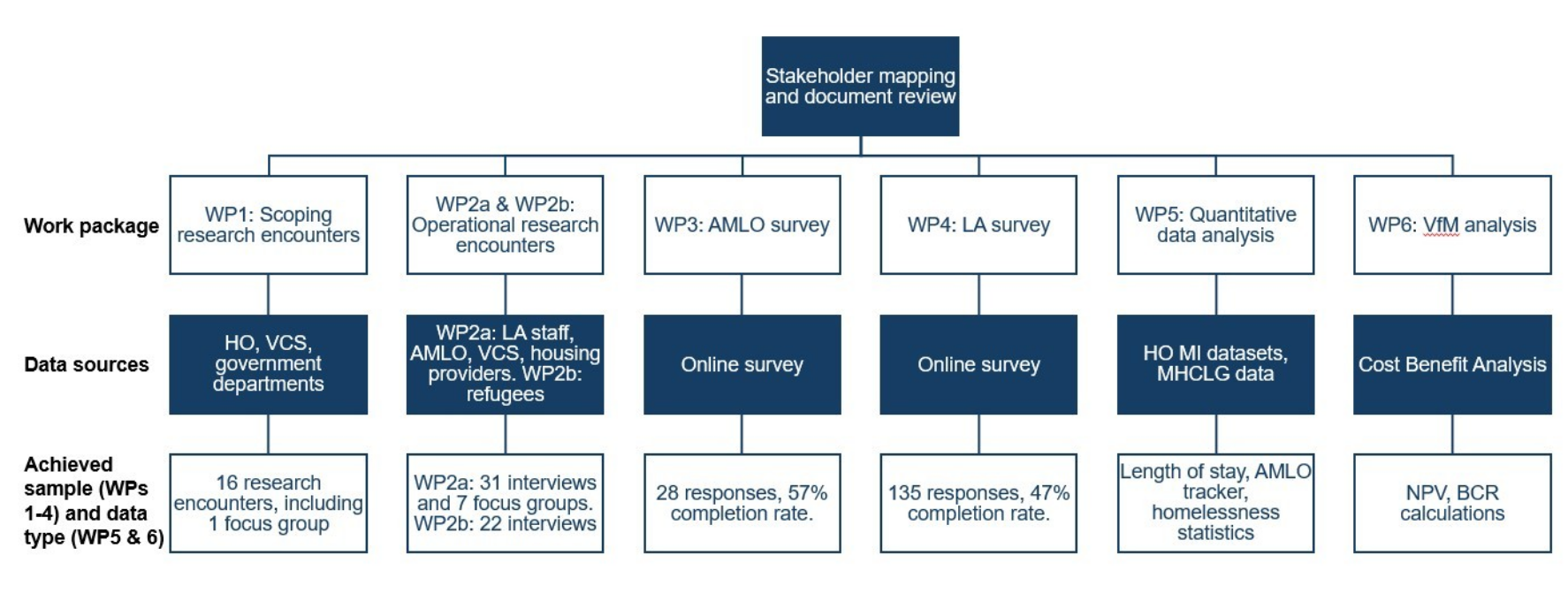
Evaluation methodology accessible version
WP1: Scoping (strategic) research encounters
Sixteen research encounters (including one-to-one and paired interviews, and one focus group) were conducted with Home Office Staff, VCS organisations, and other central government departments between April 2025 and July 2025. These research encounters began at an early stage of fieldwork, and the focus was on strategic design and policy around the initiatives. Interviews explored participant understanding and expectations of the changes in the move on period, expected outcomes, anticipated and actual challenges, and suggestions for improvements.
WP2a and 2b: Qualitative (operational) research encounters
WP2a involved 31 interviews and 7 focus groups with LA staff, housing providers, AMLOs and VCS organisations and took place between July 2025 and September 2025. WP2a focused on delivery experiences, operational enablers and barriers, and perceived outcomes.
WP2b involved 22 interviews with refugees in August 2025 and September 2025. WP2b interviews explored refugees’ experiences of the move on period, including their views on the clarity and timeliness of written communication; contact with and support received from the Home Office, AMLOs, the LA, and VCS agencies; views on what had worked well and what could have been improved; and specific experiences of support related to housing, access to benefits, and their eVisa documentation. These participants represented a diverse mix of gender, age, and asylum experiences, including whether they had claimed asylum alone or as part of a family.
The table below summarises the total number of research encounters and participants for WPs 1 and 2.
Table 2: Research encounters for WP1, WP2a, and WP2b
| WP1 | WP2a | WP2b | Total | |
|---|---|---|---|---|
| Research encounters | 16 | 38 | 22 | 76 |
| Participants | 23 | 65 | 22 | 110 |
Recruitment initially focused on participants within purposively selected LA areas with the intention of following a local area case study design. NatCen recruited research participants for WP2a and WP2b concurrently to support a purposive sampling strategy. Purposive sampling is a method where participants and locations are deliberately selected to ensure that a broad range of experiences and perspectives are captured. NatCen monitored recruitment to ensure diversity across factors, including whether AMLOs were available in the LA, whether the area received recognition payments, and whether the area was rural or urban (based on the 2011 Rural Urban classification from the Department for Environment, Food & Rural Affairs).
However, following challenges in recruiting sufficient participants in some of these areas, NatCen agreed with the Home Office to expand the research to include interviewees from additional locations to ensure an adequate and diverse sample.
Detail on the achieved sample for WP 1, 2a and 2b is included in Appendix B.
SMPs assisted the NatCen research team with LA participant recruitment. SMPs acted as gatekeepers for LA engagement in the evaluation, helping to identify and facilitate contact with relevant areas. SMPs invited LAs to take part in the evaluation and shared information directly with LAs to encourage participation. The recruitment approach aimed to identify a gatekeeper within each LA who could participate in the evaluation and/or invite other staff to take part. This approach enabled the inclusion of individuals best placed to speak about changes to the move on period and its outcomes, while also capturing a diverse range of LA participants. Appendix B provides details on the methodology, recruitment documents and topic guides. Appendix C includes copies of the information sheet and privacy notice. Copies of the topic guides for each of these WPs are included in Appendix D.
WP3: AMLO survey
An online survey with AMLOs (which was live between May 2025 and July 2025) captured perspectives on AMLO training, roles, and experiences. NatCen shared a link to the survey with the AMLO team leads via email and asked them to disseminate it to all AMLOs. The survey received 28 complete and usable responses (49 responses were received in total, but 21 responses only answered the background questions and therefore were not used). The completion rate for the survey was 57%.
More details on the online survey for AMLOs can be found in Appendix E.
WP4: LA survey
A UK-wide online survey with LAs (live between July and August 2025) gathered views on support provision and perceived impacts of the initiatives. The survey link was shared with SMPs via email, who then distributed the link directly to LA contacts within their regions to encourage participation. Each LA was invited to submit a single response to ensure consistency and avoid duplication. The survey received 135 responses (290 responses in total; 155 respondents answered only the background questions and were not included). The completion rate for the LA survey was 47%.
Further details on the online survey for LAs can be found in Appendix F.
WP5: Analysis of Home Office MI data and published data on homelessness support
Analysis of Home Office MI data and MHCLG homelessness data assessed changes in support journeys, including length of stay, reinstatements, and homelessness outcomes. Trends were calculated monthly before and after each initiative. Individuals were grouped into ‘pre’ and ‘post’ initiative categories based on departure dates. Each initiative had a different start date, so different cut-off dates were used. Comparison groups were available for AMLOs and the recognition payments, as not all LAs received these. For the 56-day move on period, the change was applied nationally, so there was no separate comparison group; analysis was limited to changes over time within the same population.
The analysis is based on MI provided by the Home Office and MHCLG quarterly published datasets on statutory homelessness duties. The 3 main data sources used are:
-
a dataset on length of time spent in Home Office support, covering all individuals with an approved asylum claim who exited support within 6 months before or after 9 December 2024; the unit of analysis is the individual, although in some cases the claimant also has a family linked to the application; in addition, an aggregated weekly version of this dataset was used for the calculation of average length of stay
-
a series of AMLO Tracker datasets; these consist of administrative records maintained by AMLO teams for all individuals who received AMLO support, whether in contingency or dispersed accommodation
-
MHCLG quarterly published datasets for England on statutory homelessness duties, showing the number of households provided with homelessness support after leaving Home Office asylum accommodation
Table 3 outlines the use of each data source and the key metrics taken from each source.
Table 3: Home Office MI and homelessness support data
| Data source | Purpose of use | Key metrics |
| Home Office Length of Stay dataset | Assess changes in length of stay in Home Office support, to monitor discontinuation delays and reinstated journeys | Percentage of refugees who left Home Office support within 56 days; percentage who had their support reinstated; percentage which departed before their planned support end date. |
| Home Office Length of Stay data – aggregated to provide an average length of stay among people exiting in each week | Assess changes in average duration of Stay in Home Office support | Average amount of time for people to leave Home Office support (from asylum decision date). |
| AMLO tracker datasets | Quantify AMLO activity and support outcomes | Total number of people reached by AMLO support; Share of people who exited Home Office support after AMLO intervention; indicators of readiness to leave Home Office support (for example, ability to set up a bank account, access integration loan). |
| Legacy AMLO tracker | Assess work delivered by the AMLO legacy team dedicated to long-standing cases | Number of cases worked; processing time from legacy team engagement to existing support. |
| AMLO Escalation Trackers | Understand issues raised by AMLOs preventing people exiting support | Number of issues escalated; proportion of issues resolved. |
| AMLO Operational Tracker | Quantify AMLO staff days worked | Staff days worked by AMLOs. |
| MHCLG Homelessness Statistics (England only) | Identify homelessness prevention and relief duties post-HO accommodation | Number of cases owed prevention duty by LAs after leaving Home Office accommodation; number of cases owed homelessness relief duty by LAs after leaving Home Office accommodation. |
Further details on the analysis of Home Office MI and published data on homelessness support is available in Appendix G.
WP6: Value of money assessment
The evaluation adopted a Cost-Benefit Analysis (CBA) approach to assess whether the move on initiatives delivered VfM. This involved comparing the direct costs, such as staffing, data systems, and recognition payments to LAs, with the benefits realised to the Home Office, LAs, and wider UK society. The benefits were based on the intervention’s ToC, and were:
- reduced average length of stay in asylum accommodation from asylum decision to exit
- reduced number of rough sleepers amongst newly granted refugees and newly granted refugees experiencing homelessness
- improved signposting to support (for example, benefits/work, housing, opening bank account, eVisas), to better prepare refugees for post-move on journey
The benefits were monetised using unit costs derived from published sources. The CBA enabled the calculation of a Net Present Value (NPV) and Benefit-Cost Ratio (BCR), which measure the overall economic gain and the return on each pound spent, respectively. For the period 2024/25 to 2025/26, the initiatives generated a positive NPV and a BCR above one, meaning that should assumptions hold (particularly being able to attribute findings to move on initiatives) it demonstrated VfM. The analysis treated the initiatives as a cohesive package due to overlapping implementation, and incorporated sensitivity analysis to account for uncertainty in assumptions. Further details can be found in Section 4 and Appendix H.
1.3.1 Methodological limitations
Recruitment challenges: limited staff capacity and overlapping invitations to take part in both surveys and interviews could have reduced engagement. This required expansion beyond the original sampling frame resulted in some overrepresentation of urban areas with AMLOs and areas which received recognition payments in the survey responses, which meant that those experiences were heard more in survey responses than AMLOs from non-urban areas. However, the experiences of participants in rural areas were explored in depth as part of WP2a.
Regional analysis: due to sampling challenges, the study design was unable to use a case study design, as intended. As such, no regional analysis has been included. In addition, to ensure buy-in from participants, reassurances were given around geographical anonymity.
Survey limitations: completion rates were good (AMLO survey: 57%; LA survey: 47%). Reliance on self-reported data introduces potential bias, including participants’ differentiated understandings of questions and potential recall issues.
Single respondent approach: each LA provided one consolidated response, which may not capture the full range of internal perspectives.
No statistical significance testing: the analysis is descriptive and does not include statistical significance testing. This means that the results reflect observed trends and associations but do not provide causal estimates or measures of uncertainty.
There is no robust untreated comparison group: the 56-day move on period was introduced nationally, allowing only pre-treatment comparisons, while the AMLO and LA funding initiatives were targeted by need, introducing selection bias as supported areas likely faced greater service demand. In the case of the AMLOs, not all individuals within treated areas necessarily received or needed support, which may dilute observed effects. It is also important to note that AMLOs’ work focused on LAs handling higher volumes of cases. As a result, these areas may have faced greater challenges, which could limit the direct comparability of changes observed there.
Outcome measures displayed considerable temporal variability: including marked fluctuations prior to the introduction of the initiatives. This volatility further constrains the ability of the evaluation to attribute observed changes to the intervention, particularly given the absence of a robust control group. As a result, it is not possible to attribute causal effects directly to the 56-day move on period.
Local housing stock as a variable: the evaluation did not consider local housing stock as a data point for the evaluation. Local housing stock is likely to have had an impact on timeliness of move on and create variations across LAs in the ability to move people on to suitable housing within the timeframe.
Confounding factors: additional confounding factors, such as overlapping initiatives – for example, the introduction of eVisas to replace physical documentation – may have influenced outcomes.
Quality and completeness of length of AMLO data: the data used for AMLO analysis are administrative records. As such, data gaps were present. Most notably, the recorded date for people first meeting the AMLOs had one-fifth of cases missing (1,973 missing cases). Where missing data risks notably influencing the analysis, this is highlighted.
Quality and completeness of Length of Stay data: the Length of Stay data provides a record of individual asylum cases’ progress through the application system. This data is based on administrative records and was made available to the researchers in 2 formats – as a more detailed individual level dataset and as a weekly aggregated copy of the same data, including median length of stay by week for each reporting unit.
As is common in administrative data produced for operational purposes, minor inconsistencies between the 2 data sources were present. For example, there are 14,742 individual records in the pre-56 day move on period used in this analysis (1 May 2024 to 9 December 2024) though only 13,661 cases are included in the weekly data for the same period. The data owner advised that the weekly aggregated estimates data was the source for average duration of length of stay in Home Office support. All other outcome measures (for example, whether a case had their support reinstated) were contained in the individual level dataset.
In consequence, the total number of length of stay cases for a specific period will vary slightly in the reporting depending on the measure reported on. This matters because analyses intended to draw on the same source may, in practice, use slightly different sample sizes, meaning the populations analysed for certain outcomes do not fully correspond.
An established inconsistency in the weekly data, which will not have affected the individual data, is duplicate records for the same time period and reporting unit – with conflicting data reported for the number of cases, service users (SUs) and/or median support length. For the analysis, rather than removing these rows, the analysis was weighted by the number of cases in each week, allowing duplicated weeks to remain in the dataset but ensuring they were given appropriate weight based on their size.
Misalignment of administrative data with delivery: homelessness outcome data is reported quarterly. Interpretations of this data in relation to the initiatives are complicated by initiatives being introduced midway through a quarter.
There are several limitations to the VfM evaluation, which are presented below, with a discussion on how these affect the interpretation of results.
Data quality and completeness: there is also a known time lag due to how information was passed on from accommodation providers (see Appendix H for details on the data sources). This delay can lead to the recorded figure being higher than the actual number of days in Home Office accommodation. This affects both the baseline and post-intervention figures and means they should be treated as approximate rather than exact values. It is not possible to determine accurately how many days should be subtracted from each record, as delays between staff and providers were not recorded.
Contextual considerations: several external conditions may influence outcomes regardless of the move on funding. These include variations in refugee intake volumes, differences in local housing and employment market conditions, and the availability of services. Differences in data quality and completeness in LA datasets can also influence how changes appear in the data. Policy-level factors include:
-
right to rent checks: refugees may face delays in securing housing, especially during the short move on window
-
LA Homelessness Duties: homelessness duties vary by nation. Scotland, Wales, and Northern Ireland operate under different legislation and practices including vulnerability assessments; in England, LAs have a duty to prevent homelessness under the Homelessness Reduction Act 2017, but its implementation varies based on their capacity and interpretation
-
LA Resettlement and Integration Funding: this may support services that overlap with or complement move on, such as housing or employment support
Together, these factors may confound results and reduce the ability to directly attribute outcomes to the initiatives.
Selection bias: the LAs receiving a recognition payment were chosen because they faced higher refugee caseloads or had greater need (the amount allocated to each area was weighted, taking into account increased asylum decisions and homelessness pressures (Move on funding 2024 to 2025 Q&A, March 2025 [internal document]). This means they were not randomly selected. Without random selection, it is challenging to separate the effect of funding from the conditions that already existed in those areas, such as demand pressures or local priorities. As a result, the findings cannot be treated as strong causal evidence.
Policy spillover: the LAs that did not receive the recognition payment may still benefit indirectly. For example, they may have improved practice through guidance or better coordination. These spillover effects in LAs which did not receive the recognition payment were not captured (due to data availability). As a result, reported benefits may be smaller than the true effect. Conversely, negative policy spillovers may arise from structural shortages in affordable housing. For example, reduced length of stay in Home Office accommodation could result in increased length of stay in LA accommodation because housing is not readily available.This move from Home Office accommodation into LA-funded temporary accommodation presents only an isolated reduction in length of stay in Home Office accommodation due to the move on initiatives and is unlikely to reduce the overall use of other government-funded accommodation.
Baseline availability: the pre-intervention versus post-intervention analysis represents additionality (a real increase in social value that would not have occurred in the absence of the intervention), yet only to the Joined Data dataset that included pre-intervention data. As confirmed by the data owner, all individuals in the AMLO datasets were either seen directly by AMLOs or, if deemed ‘unreachable’ supported through behind-the-scenes case-working. This means that the AMLO datasets did not have pre-intervention data. Constructing a counterfactual using external baseline evidence may not be fully comparable with the post-intervention data, due to differences in collection methods and geographic coverage. Because of this, the CBA did not separate benefits by region and only assessed the benefit for which both pre- and post-intervention data is available.
Timing effects: the policy was introduced in December 2024, so early 2025 data may not fully reflect its impact.
1.4 Note on contextual considerations
This evaluation was conducted during a period of heightened political debate on asylum and immigration policy.
-
protests outside asylum hotels and a legal challenge that led to hotel closures created operational pressures and may have influenced participant availability and responses
-
the pilot extending the move on period from 28 to 56 days ended on 1 September 2025 for single adults, after which the standard 28-day move on period was reinstated for single adults who received a positive asylum decision; the extended 56-day move on period continued to apply to families, to individuals who are pregnant, aged 65 and over, or have a disability
-
these findings represent a snapshot of conditions at the time of data collection and do not account for any subsequent changes
1.5 Report outline
The evaluation findings are organised into 3 main chapters:
Chapter 2: Experiences of changes in the move on period
This chapter explores the implementation and delivery of the changes; how the initiatives were experienced by different groups; summarises key challenges; and provides context to implementation (including how the move on initiatives interact with the rollout of eVisas). The chapter draws on primary data collected through qualitative research encounters (interviews and focus groups) and surveys.
Chapter 3: Outcomes of the initiatives
This chapter explores outcomes of the initiatives based on secondary analysis of MI data, including changes in duration of support; changes in case complexity and delayed discontinuations; and homelessness.
Chapter 4: Value for money assessment
This chapter presents the findings from the VfM work package of the evaluation.
Conclusion
The final chapter provides an overall conclusion of the evaluation and highlights key considerations for the ongoing delivery of the move on period and initiatives.
A series of appendices provide further information and context for the findings, including detailed descriptions of the initiatives, recruitment materials, topic guides, surveys, data tables, and additional analysis.
2. Experiences of changes in the move on period
This chapter presents findings related to the process evaluation of implementation and delivery of the pilot of the 56-day move on period. The findings draw on data from the LA survey and interviews and focus groups with Home Office staff, representatives from other central government departments, SMPs, the LGA, VCS organisations, LAs, and refugees.
The following research questions are addressed in this chapter:
Table 4: Implementation research questions
| Research questions | |
| RQ1 | What changes have been introduced to the move on period? What timescales have these been under? |
| RQ2 | To what extent have these changes been implemented and delivered as intended? |
| RQ3 | How are the changes perceived and experienced by different stakeholder groups? |
| RQ4 | What has worked well, less well and why? What lessons can be learned from how the changes have been implemented? |
| RQ5 | How have contexts influenced implementation and delivery? |
| RQ6 | How are the move on changes interacting with the eVisa roll out? |
2.1 Key findings
Extension of move on period (56 days)
The extension to 56 days was widely welcomed by all participant groups, who emphasised how the extension enabled more organised and less chaotic transitions for refugees from asylum support accommodation to mainstream support services.
LA and VCS participants reported that the extra time provided by the extension improved planning, reduced stress for both refugees and for support workers within LAs and VCS organisations, and enabled trauma-informed approaches.
LA and VCS participants highlighted positive impacts of the extension, which included better housing assessments, fewer crisis interventions, improved partnership working, and reduced safeguarding concerns.
Challenges included:
-
a perceived lack of communication about the pilot between the Home Office and LAs
-
reported delays in receiving critical letters (such as the NTQ), and some confusion amongst LAs about the notice period meant that the full time period was not used effectively
There was a strong consensus among participants that the move on period should be extended; some suggested a longer extension for those for whom it is more difficult to find housing (for example, adult males).
AMLO role
There was mixed feedback on the effectiveness of the AMLO role. Participants in central government were clearer about the role’s intended purpose than those in LAs or the VCS.
AMLOs helped resolve eVisa issues, reduced the number of overstayers, and improved coordination in some LA areas.
In some LA areas there was limited visibility of the AMLOs, and LAs and VCS participants were unclear on AMLO responsibilities, identifying overlap with existing services. Some AMLOs were required to cover large, dispersed distances which diluted the time available in each area.
Refugees were often unaware of AMLO support; some VCS participants questioned the effectiveness of the AMLO role in signposting refugees to local services due to perceptions of limited AMLO local knowledge.
Suggestions for improvement, made by LAs and VCS organisations, included better integration with local networks, regular check-ins with other support providers, and shadowing opportunities between AMLO, LAs and VCS organisations.
Recognition payments
Fifty-four per cent of surveyed LAs received a recognition payment. Of the surveyed LAs that received a payment, 73% reported they had had a positive impact, but just over half (51%) were unsure how funds were used.
Central government participants identified a risk of funds being absorbed into general homelessness services rather than targeted move on support.
Contextual challenges affecting the move on initiatives
Severe housing shortages remain the biggest barrier affecting the move on initiatives, cited by all participant groups. Such a fundamental structural barrier led one devolved government (DG) participant to describe the move on initiatives as “tinkering around the edges”.
The private rental sector was reported as being largely inaccessible for refugees, partly because of affordability and partly because of landlord reluctance to accept refugees and/or people in receipt of housing benefit.
Refugees reported a lack of joined up working across agencies, with some refugees feeling as though they had been passed between providers.
The rollout of eVisas intersected with the new move on initiatives. Some early challenges with issuance and errors in refugee eVisas were mitigated by the 56-day extension, which allowed more time for problems to be resolved. Challenges included digital barriers (especially for older refugees), expired share codes which meant refugees could not always show proof of immigration status to banks or landlords, and frequent errors (for example, incorrect immigration status). Errors and delays initially undermined access to housing and benefits, although the speed of issuance improved and initial errors were rectified over time.
What worked well
SMPs played a critical role in bridging communication gaps between the Home Office and LAs/VCS.
The longer move on period was felt to have helped to restore refugees’ sense of empowerment and reduce crisis-driven interventions, especially related to housing.
Participants from central government reported that the move on initiatives have helped broaden understanding of the challenges refugees face, enabling non-migration stakeholders working across wider policy areas to better recognise and respond to these issues.
Unintended consequences
Duplication of services where AMLOs overlapped with VCS roles led to concern that some VCS support could be stopped, which would be difficult to reinstate if the AMLO initiative did not continue.
2.2 Implementation and delivery of the initiatives
This section examines the implementation of each initiative and assesses whether they were delivered as intended. The analysis draws on interviews, focus groups and data from the LA and AMLO surveys.
2.2.1 Delivery of the extended 56-day move on period
The extension of the move on period to 56 days was widely welcomed by all participant groups. It eased the urgency associated with the previous 28-day timeframe, and allowed LAs, VCS organisations and refugees to manage the move on period in a more organised and less stressful way. However, 2 key challenges limited effective implementation of the 56-day move on period.
Communication challenges: LA staff reported inconsistent and unclear communication around the move on period extending to 56 days. While some Home Office and SMP staff shared updates via multiple channels, some LAs reported receiving only briefing notes or having learned of the change after the pilot began. In some cases, LA staff first heard about the extension informally, such as via WhatsApp, or via mainstream news outlets. This led to anxiety that they would only receive notification of any subsequent return to the 28-day move on period via similarly informal routes. LA participants also criticised the implementation of the extended 56-day move on period for being rushed, leaving little time for colleagues within the LA to liaise with housing providers and VCS organisations.
Despite communication challenges, LA representatives considered the role of SMPs as critical in bridging communication gaps between the Home Office and LAs. SMPs were praised for clarifying processes and providing timely answers that helped LAs and VCS organisations navigate any confusion they had about the changes to the move on process. This intermediary role was seen as essential for ensuring that the Home Office could understand what was happening on a regional basis.
Uncertainty around notice periods: LAs and VCS organisations expressed confusion about how notice periods should be calculated. Under the pilot, refugees had 56 days from the date of their asylum decision letter to leave Home Office accommodation, but delays in issuing discontinuation and NTQ letters often meant the full period was not useable.
“I think most of us would expect that a notice period would apply from the date at which we were alerted to that notice period. That appears not to be the case in terms of the 56 [days]. So, it’s the point at which a decision is made. Some people receive that decision promptly and some don’t […] clearly the clock starts ticking at the point at which a decision is made. People can only act on that as soon as they’re aware of it and that information doesn’t flow through the system consistently for folk.” (LA)
Participants’ understandings of notice periods did not always align with official policy and guidance. Some Home Office staff suggested that additional training and refresher sessions would have helped clarify processes, including on notification timelines.
Despite these 2 underlying challenges in delivery and implementation, the experience of all research participants of the pilot extension was overwhelmingly positive (as outlined in Section 2.4 below). All research participants agreed that the 56-day extension was a significant improvement over the previous 28-day period.
2.2.2 Implementation of the AMLO role
There were reported mixed experiences with the AMLO role, with some uncertainty about its purpose. In several areas, VCS participants were unaware of their presence. Local VCS organisations and some LAs noted overlap with existing support services.
Participants in the Home Office, other central government departments and the DGs had a much clearer understanding of the AMLO role than LAs or the VCS. They reported the role of AMLOs as being to:
- enhance refugee support by addressing eVisa issues and directing individuals to relevant services, reducing pressure on LAs and reducing hotel stays
- improve communication and collaboration between LAs, the Home Office, and refugees
- manage refugee expectations by providing accurate information on timelines, housing availability, and next steps
Operational challenges included:
Limited cross-authority support: LA participants were critical of AMLOs not being able to assist outside their designated areas. However, Home Office representatives confirmed that such assistance was considered out of scope of AMLO responsibility.
Geographic dispersion: in some cases, AMLO teams covered multiple areas, creating increased referral patterns concentrated in short periods of time in some areas when the AMLO was present. This model of working, designed to increase efficiency, led to batches of referrals when an AMLO was physically present in a local area for a relatively short period of time, placing additional pressure on local homelessness teams and creating temporary spikes in their caseloads.
LA participants in some areas reported limited space within hotels for confidential meetings and the absence of structured appointment systems (with most AMLO support being offered on a drop-in basis). Some refugees reported that they would have welcomed the opportunity to make appointments in advance (in addition to drop-in support).
2.2.3 Recognition payments overview
The Home Office, in collaboration with MHCLG, the LGA and DGs, developed an approach to allocating recognition payments based on the risk of homelessness and numbers of asylum decisions in LA areas. These one-off payments were designed to acknowledge pressures caused by high asylum volumes and decision backlogs, while allowing LAs discretion over spending.
Among surveyed LAs (n=135), 54% (n=73) reported receiving a recognition payment. Of these, 73% (n=53) said the payment had a positive impact on refugee support. However, 51% (n=37) were unsure how the payment had been used. Of those aware, 49% (n=36) reported using the payment on:
- homelessness or housing application support: 19% (n=14)
- advice and assistance in finding accommodation or applying for rent-deposit loans/grants: 16% (n=12)
- absorbed into general costs: 10% (n=7)
- signposting to other services to assist with move on: 4% (n=3)
Central government stakeholders highlighted a risk that payments could be absorbed into broader homelessness services rather than being targeted at the move on process.
2.3 Participant perceptions on implementation and impact
This section documents experiences of the initiatives from the point of view of different participant groups, drawing on findings from interviews and focus groups with representatives from central government departments, LAs, VCS organisations and refugees. Where relevant, survey data is also highlighted.
2.3.1 Perceived impact of the 56-day extension
The extension of the move on period to 56 days was widely welcomed across all participant groups. LA representatives noted that it had helped to rebuild trust between the Home Office, LAs and VCS organisations.
“I think […] that they [the Home Office] actually are responsive and they –[…] are listening and want to do things better. So that’s been positive, I think. It’s helped build that trust a bit more.” (VCS organisation)
LA and VCS participants highlighted that the move on period is inherently stressful for refugees and the staff and volunteers who support them. VCS participants highlighted that whilst an asylum seeker is waiting for an outcome on their immigration case, they may be in a period of limbo, unable to progress with many aspects of their lives, including sourcing post-asylum accommodation, employment or training, opening bank accounts, and accessing longer-term healthcare. VCS participants flagged that some asylum seekers may be reluctant to consider the logistics of their future in the UK whilst there are still uncertainties surrounding their asylum claim.
According to LA participants, the 56-day extension helped to ease this transition out of Home Office accommodation, offering ‘breathing space’ that enabled refugees to plan their next steps with greater stability and dignity. Many VCS participants described the discontinuation letter as a ticking clock, and extending the period to 56 days reduced the acute pressure and anxiety experienced by both refugees and staff during the previous 28-day period.
VCS support workers reported moving from ‘extreme firefighting’ to a more trauma-informed approach. A trauma-informed approach applies a grounded understanding of the impact which trauma exposure could have had, to support work with refugees, thereby reducing pressure and improving service delivery. The additional time was reported to allow for less chaotic engagement, better housing assessments and fewer crisis interventions.
“We’re able to engage with them a little bit earlier, so we’re not at that crisis point when they’ve got 2 days left, and we’ve got to move heaven and earth. So, all I would say is, please don’t stop with the 56 days, because it puts pressure on everybody, every service, and sometimes, it’s not doable. I hate seeing my staff go home upset because they haven’t been able to do something in time and they know this guy’s going to be on a park bench until they can get all the paperwork ready and do this, that and the other. It’s not nice.” (VCS organisation)
VCS participants also credited improved partnership working to the 56-day move on period. With reduced pressure, staff had greater capacity to collaborate across the sector, which in turn contributed to improved outcomes for refugees.
“It’s very, very hard for an organisation - we have to turn people away [during the 28-day move on period], the organisations we’re referring to have to turn people away. We’re having to, at some points, just hand out sleeping bags to young people rather than do anything else. That human impact then affects partnership relationships as well.” (VCS organisation)
VCS organisations noted improved trust-building with refugees (which they attributed to the extra time afforded by the extension to 56 days), enabling disclosure of health issues relevant to priority housing decisions. They reported fewer judicial reviews and legal challenges occurring, as cases were resolved before reaching crisis point.
Eighty-eight percent (n=119) of LAs surveyed reported that the pilot of the 56-day move on period was working very or fairly well in their area. Almost all AMLOs (93%, n=26) believed that the 56-day move on period was helping to meet refugees’ needs. Additionally, 82% (n=23) of AMLOs agreed that the 56-day move on period made applying for benefits easier.
Most (68%, n=19) AMLOs agreed or strongly agreed that the 56-day move on period improved overall service user experience. Sixty-four per cent (n=18) said that the 56-day move on period reduced the number of overstayers and reinstatements and 57% (n=16) stated that the extended move on period made it easier to find housing. AMLO perceptions of other early outcomes of the 56-day move on period were more mixed: 46% (n=13) of AMLOs reported that the extended move on period made it easier to find employment and 39% (n=11) of AMLO survey respondents were unsure if the 56-day move period had improved LA engagement with refugees.
Seventy-six (n=103) of LA survey respondents reported that the 56-day move on period improved refugees’ overall experience, and 73% (n=99) said it enhanced their ability to plan and deliver services. For example, LA staff reported that the 56-day move on period allowed them to provide better housing support.
The 56-day pilot was reported to have changed the nature of support work, especially for VCS organisations. Throughout the pilot, many refugees had already completed basic casework before contacting the VCS, enabling organisations to focus on those with complex needs. LA and VCS participants reported that staff burnout decreased and partnership working improved, contributing to better outcomes. LA and VCS participants reported benefits including reduced homelessness, fewer safeguarding concerns and lower stress among refugees. One supported housing scheme for young people found that 50% of placements during the pilot were preventative rather than reactive, reducing homelessness locally.
VCS staff also reported young refugees presenting with lower levels of stress and anxiety because they know they will have more time to access housing. One VCS organisation reported a 50% reduction in safeguarding concerns during the 56-day pilot and, and that the majority of safeguarding concerns prior to that were homelessness-related. VCS participants reported that whilst people were having to sleep rough, this was for less time than during the 28-day period.
However, data from the LA survey showed mixed perceptions on housing outcomes. When asked whether increasing the move on period to 56 days had reduced the number of individuals requiring homelessness relief duties, responses were evenly split: one-third (n=45) agreed, one-third (n=45) disagreed, and one-third (n=45) were neutral.
Similarly, respondents were equally divided on whether the 56-day move on period reduced rough sleeping: 33% were neutral (n=45), 33% agreed (n=45), and 33% disagreed (n=45). Importantly, these response patterns were consistent across regions, indicating a uniform distribution of views regardless of geographic differences. (Percentages do not add up to 100% due to rounding).
All participants indicated that 56 days should remain the minimum, expressing strong opposition to reverting to 28 days.
“The main thing is that I think 56 days should be the minimum, and we can’t go back to having 28 days. We just can’t. […] I’m quite concerned about potentially going back to 28 days in some areas, because 28 days is just not long enough for anything […] It’s kind of a necessity that - the 56 days is a necessity now.” (VCS organisation)
Some VCS participants suggested the move on period should be extended beyond 56 days for individuals who face greater barriers to securing housing, such as single men or those with mental health or chronic health conditions, who may not meet the threshold for being considered priority groups. However, all emphasised that housing shortages remain a critical barrier, regardless of the move on period timeframe.
The few research encounters (4) conducted after the move on period had reverted from 56 to 28 days for some individuals indicated that some refugees housed during the extension – such as single adult males – were less likely to secure housing under the shorter timeframe.
“I do worry that the people that we saw successfully housed because of 56 days are exactly the people who wouldn’t now get 56 days, if that makes sense.” (VCS organisation)
2.3.2 Perceived impact of the AMLO role
Feedback on the AMLO role was mixed and less positive than for the 56-day move on extension pilot. One DG participant observed that the AMLO role appeared focused on ‘moving out’ (of Home Office accommodation) rather than ‘moving on’, with limited attention to broader support needs other than housing. Some DG and LA participants confused AMLOs with the earlier Home Office Liaison Officer (HOLO) pilot, which influenced their expectations of the role. A precursor to the introduction of AMLOs, the HOLO pilot was a programme which aimed to support newly recognised refugees’ transition from government asylum support into mainstream support services and offered those who had not been granted leave to remain support to return to their country of origin. In some areas which had HOLOs, AMLOs were perceived as being less engaged and primarily focused on signposting refugees to other services rather than resolving issues.
One DG participant described the move on period as the beginning of a new journey for refugees, during which they are starting to establish building blocks for the rest of their lives in the UK. This participant described the move on period as “an exciting stage but one fraught with reality”. DG participants described the AMLO role as a catalyst in helping refugees to reflect on and process the reality of their future lives in the UK. Several participants from LAs and VCS organisations described the need to manage refugee expectations during the move on period, especially regarding the availability of local housing. LA participants considered the AMLO to be key in explaining to refugees the reality of their next steps (and to counter an expectation amongst some refugees that an appropriate house will be immediately available in the local area).
In some areas, AMLOs were credited with helping to reduce the number of overstayers by addressing eVisa-related issues. Staff from the Home Office and other government departments believed that AMLOs would help to reduce the length of refugees’ stays in hotels. One view among housing staff in DGs was that the total number of overstayers was the lowest it had ever been in their area, and that no overstayers had eVisa issues due to the support from AMLOs. They attributed these assertions to DG operational data, which indicated that in areas where AMLOs were deployed, the average number of days newly recognised refugees stayed in hotels had reduced.
AMLO survey data indicated that 93% (n=26) of AMLOs felt they were meeting refugees’ needs effectively.
Some LAs valued AMLOs as escalation points and appreciated their role in reducing workloads and facilitating refugee engagement during the move on period. However, many participants within LAs and the VCS reported a lack of clarity about the AMLO role and inconsistent engagement with local services. Others reported limited visibility, unclear responsibilities, and weak integration with local support structures. One VCS felt that AMLOs were much more ‘hands off’ than HOLOs had been, and questioned what AMLOs were actually doing and whether they had the necessary knowledge of local services to offer effective support to refugees.
Several VCS organisations noted minimal impact on their caseloads and described AMLOs as ‘a signposting service’. Some LA participants reported that they saw the AMLO role as being primarily ‘refugee-facing’ and felt the perceived disconnect between the AMLO role and other support providers was not necessarily a problem.
Refugees were generally unaware of whether support came from AMLOs or other providers. One VCS participant in an area where there was AMLO presence reported that they “had never seen an AMLO in the wild” and had just heard of them at ‘policy-related meetings’. This participant expressed disappointment that the AMLO was not providing more of a liaison role with housing teams in the LA. They cited examples of refugees who had not received their notification letters and who were being evicted from Home Office accommodation, with a perception being that the AMLO had not provided effective support in time to prevent those refugees from being homeless.
One VCS participant expressed disappointment around how AMLO support had translated into practice.
“I’ve never met the AMLO. We did lots and lots of discussions at the start with the Home Office and, ‘Oh, we’ve recruited and we’re going to bring them over and we’ll introduce them’, and I think once they got into their battle rhythm all of that dissipated. I couldn’t tell you who it is. I couldn’t even tell you at this stage what their job is… We’re just cautious about sending our clients to them because we’re not 100 per cent sure what they do.” (VCS organisation)
VCS and LA participants suggested that the AMLO role could be improved through greater integration of AMLOs with local support networks, potentially achieved through regular check-ins with VCS providers or the provision of shadowing opportunities between AMLOs and the VCS, and between AMLOs and LAs, to build mutual understanding of roles.
2.3.3 Perceived impact of recognition payments
Participants in WP1 and WP2 were generally less familiar with recognition payments compared to the 56-day pilot (and to a lesser extent the AMLO role). Among those aware of the payments – primarily LA representatives – the consensus was that their impact was limited, regardless of the amount received.
Larger payments were allocated to areas with greater need, but when distributed to areas with high refugee numbers, the effect remained minimal. While some LA participants described the payments as a ‘drop in the ocean’, they were nonetheless considered preferable to receiving nothing.
2.4 Cross-cutting contextual factors
This section discusses general challenges affecting the move on period (as opposed to the individual initiatives). Findings draw on interviews and focus groups across all participant groups. The most significant challenge identified across all initiatives is systemic: the shortage of housing. This was reported consistently in both urban and rural areas. While the 56-day move on period was welcomed for providing additional time, LA and VCS participants stressed that with limited available housing, the risk of homelessness remains regardless of the length of the move on period. As one DG participant noted, “the move on period could be 156 days and we still wouldn’t be able to find housing”. Another DG participant described the initiatives as “tinkering around the edges” rather than addressing the core problem.
VCS and LA participants highlighted that the private rental sector remains largely inaccessible, regardless of timeframe. VCS representatives also pointed to structural barriers, such as LA housing support only commencing after refugees receive a NTQ letter, increasing vulnerability at the end of the move on period. They recommend earlier engagement from LAs to mitigate this risk. Key challenges included:
- accessibility of private rented sector, including affordability and reported landlord reluctance to accept tenants who are refugees or in receipt of benefits; this impacts ability to access appropriate housing locally
- language barriers, which may limit refugees’ ability to access services and support during the move on period
- data-sharing constraints, resulting from the Home Office’s initial reluctance to facilitate data-sharing agreements, which hindered collaboration (for example, discussing case details at meetings) between housing providers, AMLOs and LAs; this impedes close partnership working between AMLOs, LAs and housing providers
Refugee participants highlighted a lack of joined-up working across different organisations during the move on period. Refugee participants described the move on period as overwhelming and disjointed, feeling “bounced from one support provider to another”. Whilst the AMLO role went some way towards mitigating that perception, the support was perceived to be limited only to hotels in some areas and was viewed as not going far enough. Alternative suggestions included establishing city-wide hubs offering integrated support – housing, healthcare, benefits, employment, and education – and providing at least one follow-up check after leaving Home Office accommodation to ensure stability.
“Just one follow-up after, after you’ve been moved out of their accommodation. Just one check-up after to ask, ‘Are you okay after you’ve been moved out? Are you facing this and this challenge?’ Then that would be more helpful, rather than you are in a stable place because at that point where I was very stable.” (Refugee)
2.4.1 Interactions between the initiatives and the eVisa rollout
This evaluation did not include a focus on the rollout of eVisas. However, the introduction of eVisas intersected with the new move on initiatives and perceptions of the eVisa rollout were explored to contextualise the move on initiatives. Among LA respondents (n=135), 70% (n=94) reported a significant impact of eVisa rollout on the temporary changes to the move on period, 19% (n=26) a moderate impact, and 11% (n=15) no impact. LA and VCS participants highlighted the following challenges in eVisa implementation and its interaction with the move on period.
eVisa key challenges which impacted the move on experience:
-
digital and technical barriers: limited digital literacy, poor internet access, and lack of devices hindered navigation of the technology, particularly for older and disabled individuals; the eVisa is equipped with different ‘share codes’ which a refugee can share with different service providers (for example, banks, landlords) as evidence that they are entitled to a certain service; expired share codes caused delays in accessing essential services
-
administrative barriers: unclear escalation processes and limited awareness of self-service recovery options left many refugees unable to regain account access when they changed their contact details
-
communication barriers: language limitations restricted refugees’ ability to correct errors or share eVisa details with banks or housing providers, increasing delays in accessing services
eVisa operational issues
Over time, as the eVisa , VCS organisations, LAs, and Home Office staff reported fewer technical issues and faster eVisa issuance, with one LA interview participant reporting wait times dropping from 14 days to 48 hours. A LA participant estimated that in January 2025, 1 in 3 eVisas contained errors, and that by April 2025, this had improved to 1 in 25.
2.5 Unintended consequences
Several impacts emerged that may not have been part of the original aims of the move on objectives. These include both positive and negative unintended consequences.
Extended hotel stays: increasing the move on period to 56 days provided both refugees and support providers with valuable time to secure housing. However, as outlined in Chapter 3, this also prolonged stays in Home Office accommodation. LAs and VCS participants reported negative effects on refugees’ wellbeing and safety due to protests outside hotels housing refugees (irrespective of the move on period).
Overlap with local services: some areas experienced duplication of support where AMLO roles coincided with existing VCS services. VCS participants raised concerns that if VCS services were decommissioned in favour of AMLOs, reinstating them would be difficult should the AMLO initiative end.
Increased awareness of refugee challenges: changes to the move on process have improved understanding among stakeholders outside the migration sector (for example, DWP) of the difficulties refugees face during both the asylum application and move on stages.
“Just by having attention to it and getting information about how the move on process works, that has helped other organisations and national services catch up a bit and understand. So I think that that has been an outcome, and I think it’s been, yes, a positive one.” (VCS organisation)
2.6 Summary of initiatives’ perceived impact
The initiatives introduced by the Home Office – the pilot extension of the move on period from 28 to 56 days, AMLO deployment to select LAs, and recognition payments to select LAs – collectively aimed to ease refugees’ transition to mainstream support services post-asylum. The 56-day extension was the most impactful of the initiatives introduced, improving planning, reducing stress for refugees and staff who support them, and fostering better partnerships between LAs, VCS organisations, and housing providers. However, housing shortages and systemic barriers limited its full potential. AMLOs provided valuable support in some areas but suffered from unclear roles and inconsistent integration with other support providers. Recognition payments whilst welcomed were considered insufficient.
Overall, while these measures – particularly the extension to 56 days – improved aspects of the move on process and partnership working between the Home Office, LAs and the VCS, they did not address the fundamental issue of housing scarcity as a significant contextual factor.
Despite systemic challenges around housing availability, the extended move on period in particular was regarded as restoring control for refugees following a time (throughout their asylum application) when they may have felt a lack of agency over their own future. The additional time allowed individuals to better understand their eVisa, benefit entitlements, and housing options, reducing the need for crisis-driven interventions. VCS participants noted that this shift enabled refugees to take greater ownership of their transition, fostering independence and confidence, and contributing to improved refugee wellbeing.
3. Impact of initiatives on length of stay, case complexity and homelessness
This chapter presents evidence on the outcomes of the initiatives to enhance the move on period. The findings presented comprise analysis of MI of refugees’ journeys out of Home Office support, tracker datasets maintained by the AMLO teams for use in their work, and national statistics from the MHCLG.
The following research questions are addressed in this chapter to the extent that the data permits:
Table 5: Impact research questions
| Research questions | |
| RQ7 | What differences have the new move on initiatives and changes made? |
| RQ8 | What early outcomes have been realised as a result of the move on changes? |
| RQ9 | How have contexts influenced outcomes? |
3.1 Key findings
Extension of the move on period increased support duration:
- the median time from asylum decision to support exit rose from 41 days before the pilot to 56 days after the pilot; this increase is expected, given that the 56-day pilot was designed to allow a longer period for move on support to be delivered
- following the introduction of the 56-day pilot fewer cases left within 56 days of decision; the proportion of cases departing support within 56 days of their asylum decision fell from 64% before the pilot to 52% after
- however, there was also a decline in very long stays; the share of cases remaining in Home Office support for 6 months or more (after asylum decision) dropped from 17% before the 56-day move on period to 4% afterwards
Reduced case complexity coincides with both move on initiatives and eVisa introduction:
- the percentage of cases exiting Home Office support with a reinstatement of support fell from 25% to 10% when the 56-day move on period was introduced, suggesting smoother transitions and fewer disruptions in the move on process
- however, the introduction of eVisas which took place in the same period, as well as other overlapping policy changes, means it is not possible to attribute this improvement to the move on initiatives directly
- Biometric Residence Permit (BRP) related reinstatements declined sharply as BRPs were phased out, and although eVisa related issues emerged as a cause of reinstatements, they were not observed to be as prevalent as BRPs had been – suggesting that eVisas likely contributed to the overall reduction in reinstatements across the pilot period
Departure by planned support end date:
- the introduction of the 56-day move on period also coincided with an improvement in the proportion of cases exiting support by their schedule support end date; in the 6 months prior to implementation, 76% of support leavers exited by their scheduled date; this increased to 80% in the period following the change
Deployment of AMLOs was not found to impact the duration from decision to support exit:
- in LAs where AMLOs were implemented, the median duration from asylum decision to support exit increased, from a baseline of 39 days prior to AMLO introduction to 56 days afterwards; this was an expected outcome as the overall length of time of the move on period increased during the pilot
- LAs without AMLOs experienced a similar increase, with the median duration rising from 42 days to 57 days; as noted above, these increases are consistent with the extended timeframe permitted under the 56-day pilot, which allowed for an extended period in Home Office support
- improvements in the proportion of cases reinstated to support (complex cases) and those departing by their planned exit date were comparable across AMLO and non-AMLO areas
Interventions may have enabled earlier support to those at risk of homelessness:
- the MHCLG data covering England showed a rise in prevention duty cases and a fall in relief duty cases over the course of the evaluation
- prevention duty is provided before households become homeless, while relief duty is provided to those already homeless, which suggests these initiatives may have enabled earlier intervention to those at risk of homelessness
Limitations:
- it should be noted that there was no control group available for comparison, and other policy changes were implemented during the same period; this limits the ability to directly attribute observed changes to either the 56-day pilot, the introduction of AMLOs, or the recognition payments
- in addition, AMLOs were deployed mainly in LAs with higher case volumes, and differences in case load and complexity may limit direct comparability of outcomes between AMLO and non-AMLO areas; in addition, not all refugees in AMLO areas received their support, which will dilute any potential impact they had
3.2 Change in duration of support
The following findings draw on the Length of Stay MI data and include all people exiting Home Office support with a positive outcome on their asylum case in the 6 months before and after the 9 December 2024 (the day that the 56-day move on period pilot started).
The median number of days between receiving an asylum decision and leaving Home Office support increased after the 56-day move on period was introduced. The median was 41 days in the 6 months before the introduction of the 56-day move on period, and 56 days in the 6 months after the pilot was introduced. Similarly, over the same time period, the proportion of cases departing support within 56 days fell from 64% in the 6 months before the policy change to 52% in the 6 months following, which may reflect support leavers’ use of the extended period of support available to them compared to their pre-pilot period – when there was no policy requirement for support to be offered for this length of time.
Figure 2 below provides a more detailed summary of the length of time refugees spent in Home Office (HO) support after their asylum decision date – before and after the introduction of the 56-day move on period. It shows a decline in the percentage of cases with longer term journeys of more than 6 months, from 17% to 4% in the period after the 56-day move on period’s introduction.
Figure 2: Time taken to depart Home Office Support, before and after the introduction of the 56-day move on period (data from May 2024 to August 2025)
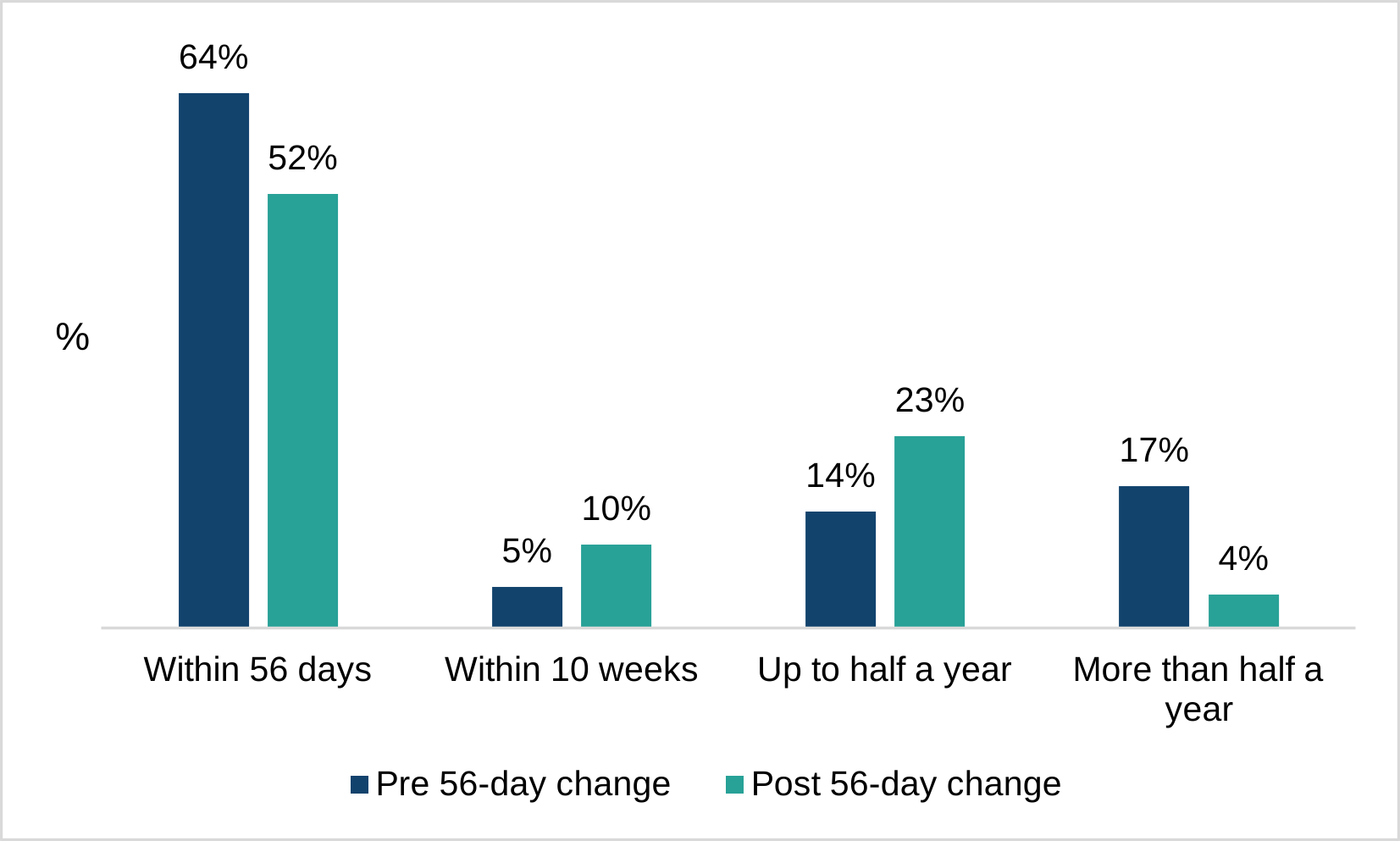
Source: Length of Stay MI data, Home Office.
Changes in support duration among different groups of refugees
Following the introduction of the 56-day move on period, changes in the time from asylum decision to leaving Home Office support varied by accommodation type, with a larger increase among those in contingency accommodation, as shown in the table below. Contingency accommodation – such as hotels and former military sites – is used when dispersal accommodation is unavailable, and tends to be more concentrated. In contrast, dispersed accommodation is longer-term temporary housing provided under the UK government’s asylum dispersal policy. There was also a different experience for families, among whom length of stay fell, albeit from a high baseline, compared to cases relating to a single person, where length of stay rose.
Table 6: Changes in support duration among different refugee groups, by number of days
| Refugee group | Median length of stay pre-56 day move on period | Median length of stay post-56 day move on period |
|---|---|---|
| Refugees exiting from contingency accommodation | 36 | 55 |
| Refugees exiting from dispersed accommodation | 43 | 58 |
| Cases relating to a single person | 38 | 56 |
| Cases linked to a family group | 68 | 62 |
Source: Length of Stay MI data, Home Office.
3.1 Contribution of AMLOs to length of stay
The analysis compared outcomes in LAs with AMLOs to outcomes in LAs that were not part of the AMLO initiative. The analysis compared the experiences of people who left support before 9 December 2024 (when the 56-day move on period was introduced) with those who left after that date. It should be noted that the introduction of AMLOs was phased, meaning that AMLOs in different LAs had varying start dates across the UK.
Between September 2024 and September 2025, AMLO teams supported 9,948 SUs, of whom:
- 82% (8,142 cases) were in contingency accommodation and 18% (1,806) in dispersed accommodation
- 78% (7,719 cases) were confirmed to have exited Home Office support
- between October 2024 and July 2025, AMLOs assisted 23% (7,719) of all cases who exited Home Office support; this figure was derived by combining 2 datasets: the AMLO trackers, which recorded the total number of cases supported by AMLOs, and the Home Office Length of Stay data, which provided a sample of approximately 36,000 cases exiting support during the same period
Between October 2024 and September 2025, AMLOs raised 3,644 escalation issues, with 94% resolved. These typically involved notifications, housing coordination, or benefit access. The median resolution time was 8 days, though case length varied considerably and reinstated cases did on occasion exceed 100 days.
Whether a LA took part in the AMLO initiative was not found to impact the duration from decision to support exit:
- in LAs where AMLOs worked, the median time from asylum decision to support exit increased, from a median of 39 days in the 6 months before the AMLO introduction to 56 days in the following 6-month period
- a similar change was seen in areas without AMLOs, where the median time from asylum decision to support exit increased from a median of 42 days to 57 days across the same period
Figure 3 below shows the trends in the average number of days from asylum decision to support exit, comparing AMLO and non-AMLO areas. The 2 groups follow a similar pattern over time. A fall in median duration is observed from September 2024 onwards, when AMLOs were still operating on a relatively small scale. This drop is similar for AMLO and non-AMLO areas, indicating that it was likely driven by broader system changes. From September 2024 onwards, the median length of time spent in Home Office support is consistently comparable for AMLO and non-AMLO areas.
Figure 3: Median number of days from asylum decision to support exit date, in AMLO and non-AMLO areas, May 2024 to August 2025
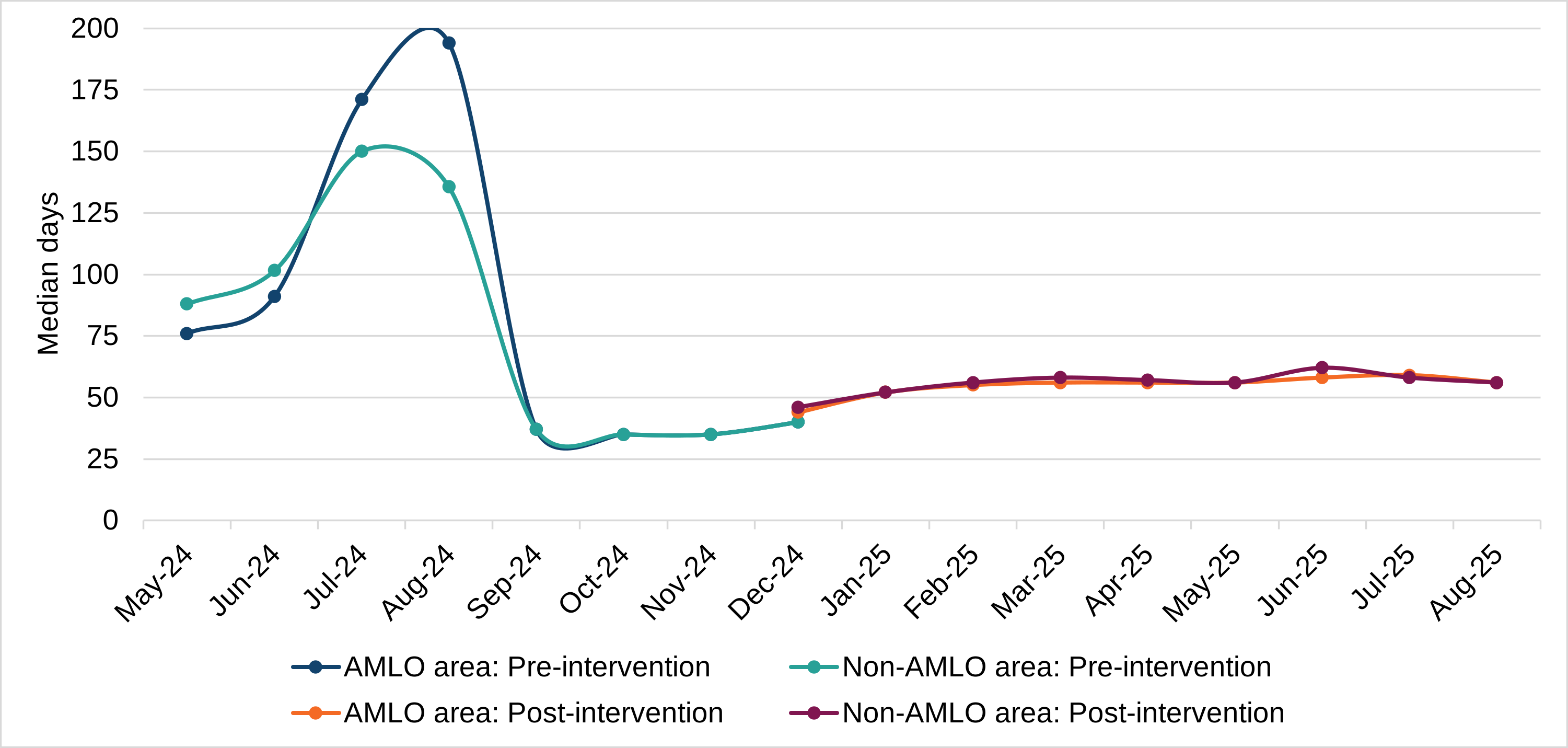
Source: Length of Stay MI data, Home Office.
The percentage of cases exiting support after 56 days also followed a very similar pattern between the 2 groups, as illustrated in Figure 4. In AMLO areas, this proportion increased from 35% to 47% among people departing before and after the introduction of the 56-day period. In non-AMLO areas, the change was similar: increasing from 38% to 49%. Figure 4 shows that month-on-month patterns after AMLO support began, both groups display broadly similar trends in the proportion of cases exceeding 56 days.
Figure 4: Percentage of cases exiting support after 56 days, in AMLO and non-AMLO areas, May 2024 to July 2025
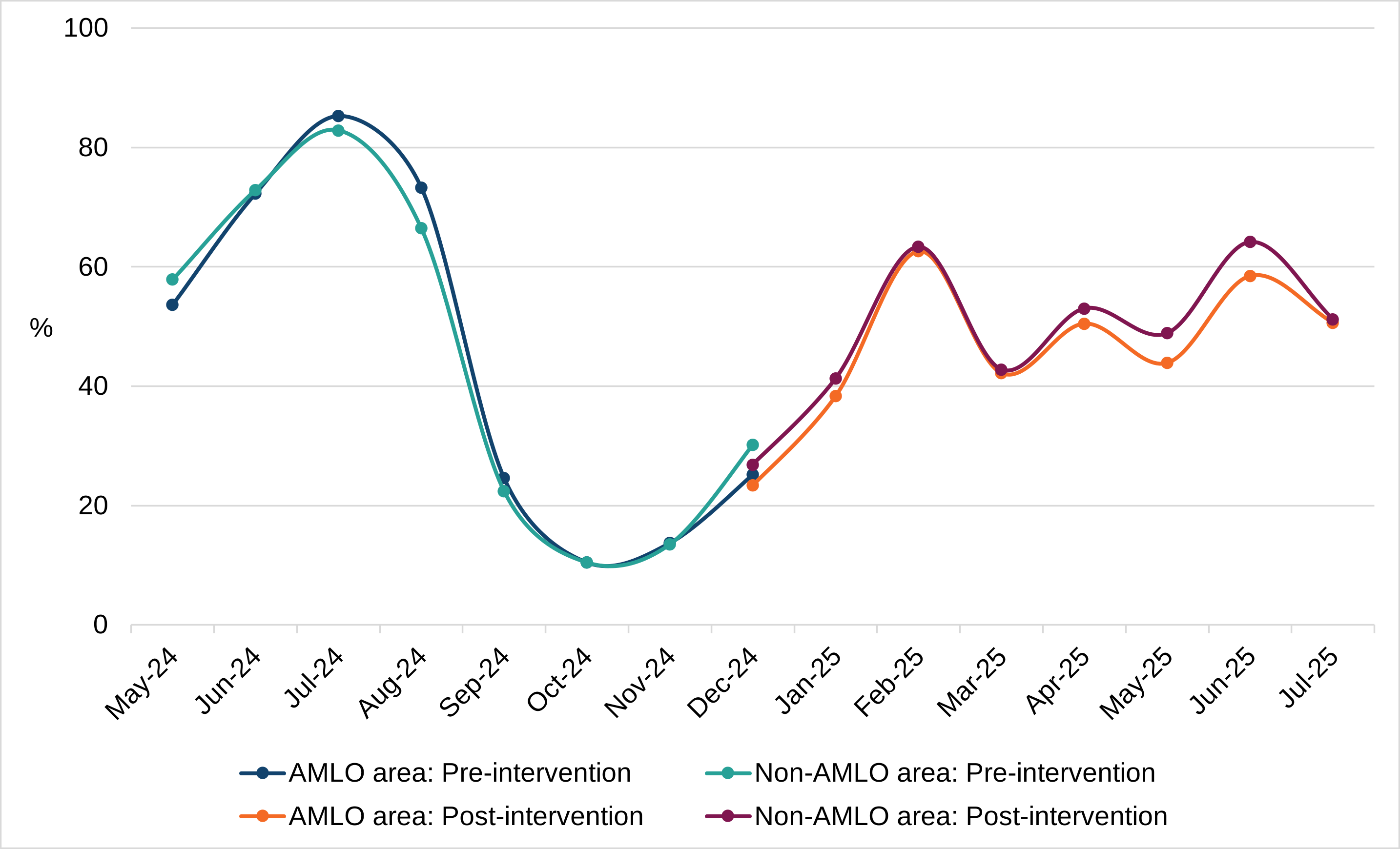
Source: Length of Stay MI data, Home Office.
Limitations in the analysis of the AMLO data
The available data does not allow the identification of individual asylum support leavers who received support from AMLOs; it allows analysis at the level of the LA – meaning all asylum support leavers in areas where AMLOs worked were treated as receiving AMLO support, which in practice will not always have been the case. In addition, AMLOs did not begin working in all LAs at the time of the cut-off date used in this analysis (9 December 2024). This is a limitation as it means not all refugees in AMLO areas will have received support from an AMLO and this may dilute observed effects. It should also be noted that AMLOs may have been deployed in areas with higher demand or more reinstated cases, which is not adjusted for in the direct comparison between the 2 groups.
Therefore, any interpretation of the AMLOs’ effectiveness should be made with caution, as differences in case load and complexity may have influenced the results. Finally, AMLOs’ work was directed toward LAs managing higher case volumes, which suggests these areas may have faced greater challenges at the outset of the policy. This focus could also limit the direct comparability of changes observed in these areas. Data to enable a more detailed comparison between those who received AMLO support and those who did not would provide further insight.
3.4 Changes in case reinstatement and scheduled support end date
The proportion of cases where support was reinstated at least once, referred to as reinstatement cases, fell significantly after the introduction of the 56-day move on period. The share of reinstatement cases fell from 25% in the 6 months preceding the introduction of the 56 day move on period to 10% in the 6 months following its implementation, indicating that the 56 day period enabled smoother transitions compared with the previous 28 day move on period.
- in areas with AMLOs, the share of cases classed as reinstatement dropped from 24% before 9 December 2024 to 10% after they began
- in non-AMLO areas, there was a similar decline from 26% to 10%
Comparing the change in AMLO areas to non-AMLO areas, there was an improvement in the number of cases exiting before their planned support end date in both areas, but a slightly larger change was observed in AMLO areas.
- in LAs with AMLOs, the percentage of cases that departed support before their planned support end date was 75% in the period before the introduction of the 56-day move on period – increasing to 81% in the period after its introduction
- this compares to a change from 77% to 80% in areas where AMLOs were not working
Other factors, such as wider structural reforms, may have contributed to these changes and should be considered when interpreting the findings. In particular, the introduction of eVisas may have played an important role in reducing the number of reinstatement cases. In the 6 months before the pilot of the 56-day move on period – where the reason for a case’s latest reinstatement is recorded – 77% were due to a BRP-related issue. This fell to 25% over the following 6 months, whilst in the same period eVisa-related issues accounted for 34% of reinstatements (up from 0%). This suggests that the transition to eVisas may have contributed to the reduction in the number of reinstatement cases among Home Office support leavers.
However, the reinstatement reason was recorded only for the most recent reinstatement and was missing for 48% of cases, which introduces some uncertainty into the findings, although similar proportions were missing in the pre- and post-56-day periods. It should be noted that eVisas may also have had a broader impact beyond the reinstatement of support, for example, by improving the processing speed of departures from HO support.
3.5 Homelessness
Homelessness was evaluated quantitatively using publicly available MHCLG data.
The MHCLG publishes quarterly statistics collected by LAs in England, recording the number of households that had experienced homelessness in their area. LAs also record the number of households owed homelessness-related support duties who have departed from Home Office asylum seeker support. These homelessness-related support duties are:
Prevention duty: the number of households owed a prevention duty because they have been required to leave accommodation provided by the Home Office as asylum support. Prevention duty is support that is offered from local housing authorities to help households threatened with homelessness within a period of 56 days, aimed at preventing them from becoming homeless. However, prevention duty does not necessarily equate to successful housing outcomes.
Relief duty: the number of households owed a relief duty because they have been required to leave accommodation provided by the Home Office as asylum support. Relief duty is made available to a household that is already homeless and is owed to households that approach the authority for support.
The MHCLG homelessness data showed an increased number of people owed homelessness prevention duties during this period, but a fall in those owed relief duty. This suggests that extending the move on period led to a reduction in the likelihood of cases who are discharged from Home Office support, becoming homeless, as reflected in lower numbers of cases owed homelessness relief duty by LAs.
- the number of households that were required to leave Home Office accommodation and subsequently supported through the prevention duty rose from 1,400 in the quarter ending December 2024 to 1,610 in the quarter ending June 2025, although the figure from January-March 2025 was 1,950
- the number of households that were required to leave Home Office accommodation owed relief duty decreased from 3,650 in the quarter ending December 2024 to 3,350 in the quarter ending June 2025, although the figure in January-March 2025 was 4,140
While the total figures provide a broad overview, they do not account for fluctuations in the number of people leaving Home Office support over time. To address this, we calculated the total number of asylum cases exiting Home Office support in each quarter and expressed the MHCLG figures as a percentage of these exits. This helps adjust for changes in exit volumes and makes trends more meaningful. However, it is important to note that an ‘asylum case’ in Home Office data can refer to an individual or a family group, whereas MHCLG data counts households. Because these units are not directly comparable, the resulting percentages should be interpreted with caution.
-
the proportion of households owed a homelessness prevention duty remained at similar levels; prevention duty does not necessarily equate to successful housing outcomes; however, between October and December 2024, 17% of those exiting Home Office support received the homelessness prevention duty; this rose to 20% in the quarter ending March 2025, before returning to 17% in the quarter ending June 2025
-
whereas, the proportion of households owed homelessness relief duty fell. In the quarter ending December 2024, this stood at 43%, remained steady at 42% in the quarter ending March 2025, and declined to 36% by June 2025
These figures suggest that LAs may have become more able to engage with individuals leaving Home Office support before they reach the point of becoming homeless and require assistance under the relief duty.
3.6 Summary of findings
Overall, the MI data analysis shows that over the pilot period, the median length of stay after asylum decision increased and a slightly greater share of people departed support after more than 56 days after their asylum decision date. Furthermore, a reduction in the percentage of cases experiencing reinstated journeys, where support is reinstated after someone’s initial discontinuation, was observed, as well as a reduction in the number of very long stays. The reduction in reinstatement cases may indicate that the initiative afforded greater flexibility to individuals needing time to navigate the process of exiting support. System-wide operational reforms, such as eVisas, may also have contributed to these changes, particularly the decline in cases involving reinstated journeys.
However, this is a complex issue, so the observed fall in reinstated journeys cannot be directly attributed to the introduction of eVisas. The trends in published homelessness statistics suggest that LAs were more able to intervene early with those leaving Home Office asylum support, with fewer individuals reaching the point of becoming homeless and requiring LA assistance.
4. Value for money
This chapter outlines the key themes of the VfM evaluation for the move on initiatives. It describes the evaluation’s research questions, methodology, ToC, and the main limitations encountered. The chapter summarises how VfM was assessed in line with HM Treasury Magenta Book, the types of benefits and costs considered in line with HM Treasury Green Book, and the challenges in interpreting the results.
The VfM evaluation was designed to answer the following 2 research questions (RQs).
Table 7: Value for money research questions
| Research questions | |
| VfM RQ1 | Do the move on initiatives deliver VfM? |
| VfM RQ2 | Do any realised benefits outweigh the costs of implementing the changes? |
4.1 Key findings
Cost-Benefit Analysis (CBA) was used to compare direct costs to direct, indirect, and wider benefits for the Home Office, LAs, and UK society. A CBA allows for multiple benefits to be considered, and provides a direct comparison of costs against the benefits delivered in monetary terms. This CBA involves comparing the direct costs to the Home Office, against the direct, indirect, and wider non-cash-releasing benefits to the Home Office, LAs, and wider UK society, respectively.
The benefits are derived from the outcomes in the ToC, which include:
- reduced length of stay in asylum accommodation
- decreased overstayers
- reduced homelessness risk
- improved stakeholder engagement
- better planning
- enhanced integration
The costs include AMLO staff, data tools, and recognition payments to select LAs.
Only the most robust benefit (reduced length of stay) was included in the CBA; other benefits were discussed qualitatively due to data and attribution limitations.
Findings are indicative rather than definitive and should be interpreted with caution due to the following limitations and constraints:
- data quality and completeness issues
- attribution challenges due to contextual considerations leading to difficulty isolating benefits to move on initiatives
- selection bias
- policy spillover effects
- the short-term nature of the initiatives and timing effects leading to the inability of monetising certain long-term impacts and, therefore, possibly understating true impacts
All quantitative VfM estimates are presented in Appendix H. Given the challenges in attributing benefits specifically to the move on initiatives, the analysis presented is a high-level summary. Subject to the limitations outlined above, the benefits generated by the move on initiatives may exceed the costs, particularly through reduced average length of stay in asylum accommodation. Additional benefits, such as reduced rough sleeping and improved integration, may be realised, if assumptions hold. The report did not consider rough sleeping data.
Sensitivity analysis confirmed the robustness of the VfM findings, though further research is needed to capture wider impacts.
Use of means and median:
-
this report uses both the median and the mean length of stay, as each provides different but complementary insights
-
median length of stay rose after the 56-day change because many people used more of the time available; however, a small number of exceptionally long cases were no longer seen to the same extent – likely because more complex situations could be resolved within 56 days; as a result, while the median increased, the mean time on support fell, reflecting fewer extreme long stays; full discussion of mean versus median is provided in Appendix H
4.2 Theory of Change
The move on ToC is structured around the elements illustrated in Figure 5.
Figure 5: Move on ToC
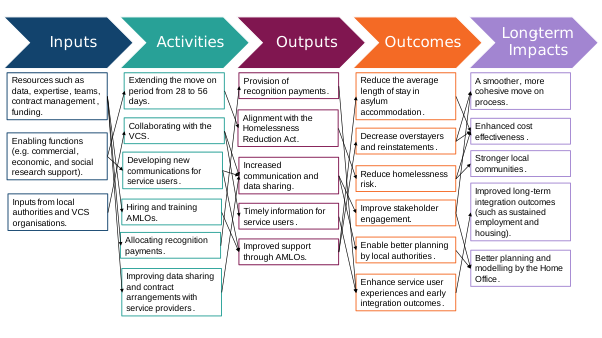
Theory of change accessible version
Evaluating these changes is critical to understanding how the initiatives were implemented to improve practice and processes, and to identify lessons learned.
The evaluation acknowledges challenges in data quality and coverage in demonstrating VfM.
4.3 Overview of the value for money evaluation
CBA was used to evaluate the VfM of the move on initiatives (the extension of the move on period from 28 to 56 days, the introduction of AMLOs in select LA areas, and a £2.8 million recognition payment shared between select LA areas) in 2024/25 to 2025/26.
The analysis faces inherent limitations, including challenges in isolating costs and benefits to move on initiatives, the absence of robust counterfactuals, and difficulty in monetising intangible impacts. A detailed VfM assessment is provided in Appendix H, while this section offers a high-level summary, outlining key themes and limitations.
4.4 Value for money: key themes
Cost analysis
The assessment details costs by type and year, including staff costs, data collection tools, and recognition payments to LAs under pressure from increased asylum decisions. Costs were provided by the Home Office and adjusted for inflation and discounted to present value.
Benefit analysis
The main monetisable benefit included in the analysis is the reduction in average (mean) length of stay in accommodation, attributed to the extension of the move on period and the introduction of AMLOs. Other potential benefits, such as reduced rough sleeping and improved integration, were not included in the CBA due to data limitations and attribution challenges.
Monetised benefits
The move on initiatives aimed to help refugees complete essential steps, such as securing housing, setting up Universal Credit, and arranging financial inclusion, preventing delays and reducing accommodation stays. By extending the move on period from 28 to 56 days and introducing AMLOs, the initiatives were introduced to assist newly granted refugees to transition more efficiently into mainstream housing and services. The challenge is in isolating the impacts of these initiatives and being able to attribute any cost savings resulting from fewer nights in accommodation to the move on initiatives.
The extended period, combined with AMLO support, was reported to enable better planning and coordination between agencies, potentially reducing downstream costs and reportedly improving outcomes for both refugees and the wider system. The benefit was estimated using pre- and post-intervention data; it formed the core of the CBA, representing the most quantifiable potential impact of the intervention and showing that it could outweigh the costs of the move on initiatives, if there was ability to control for other confounding factors that might have led to the observed reduction in mean time spent in accommodation.
Non-monetised benefits
The move on initiatives, particularly the extension of the move on period and targeted support, were expected to help newly granted refugees avoid rough sleeping and experiencing homelessness after leaving asylum accommodation. Data from MHCLG indicated a reduction in the number of households required to leave Home Office accommodation and subsequently experience rough sleeping and homelessness. Although a proxy calculation suggests a possible reduction in rough sleeping and homelessness cases, this benefit was not included in the NPV or BCR due to limitations in isolating impact on granted asylum seekers due to the move on initiatives (for example, AMLOs) and incomplete data across LAs. If assumptions hold, this benefit could represent cost savings to government for public services provided to those newly granted refugees who are rough sleeping and experiencing homelessness.
The move on initiatives also aimed to improve refugees’ access to essential services such as banking, Universal Credit, housing plans, and integration loans. Evidence from external research suggests that better signposting and integration support can lead to reduced reliance on welfare and improved long-term outcomes for refugees, including employment and social inclusion (Home Office, 2025; LSE, 2024). The VfM assessment tracked increases in cases where refugees successfully accessed these services, using proxies like opening a bank account or setting up Universal Credit. While these improvements could lead to cost savings, the direct attribution to the move on initiatives is uncertain, and the benefit was not included in the NPV or BCR.
Cost-Benefit Analysis
The move on initiatives could demonstrate good VfM, generating benefits that could exceed costs (although attribution challenges mean this is not certain). However, the analysis was limited to LAs most affected by the initiatives and did not account for wider policy effects. It focused only on benefits that could be reliably monetised. Qualitative evidence suggests the potential for continued positive impact, especially in access to mainstream services and housing. While the move on initiatives likely generated additional benefits and wider impacts in reducing rough sleeping and improving integration, these were excluded from the formal VfM calculations due to data and attribution limitations.
These non-monetised benefits, alongside potential long-term outcomes for refugees and LAs, should be considered in decision-making to ensure a holistic view of the initiatives’ effectiveness and sustainability. Further research and improved data would be needed to monetise these additional benefits with confidence. Additionally, cost savings were assumed for the Home Office, not refugees themselves. Further research could capture additional benefits for authorities which did not receive the recognition payment, refugees, and other sectors.
5. Conclusion
This evaluation assessed the impact and implementation of initiatives designed to improve the asylum move on period. The initiatives were a temporary extension of the move on period to 56 days, the introduction of AMLOs in some LA areas, and a recognition payment of £2.8 million shared between select LAs. Together, these measures sought to support a more planned and coordinated transition from asylum support to mainstream support services. Separately, but alongside these initiatives, eVisas were rolled out and the evaluation includes findings on how this rollout interacted with the initiatives.
The initiatives were reported to have strengthened collaboration between the Home Office, LAs and VCS organisations, while enhancing trust in the Home Office among VCS partners supporting refugees during the move on period.
Extension to 56 days
The temporary extension of the move on period was widely welcomed by all research participants. It was reported to have reduced stress for refugees and service providers, improved planning, and enabled more trauma-informed support. LAs and VCS organisations reported better partnership working and fewer crisis interventions. However, delays in receiving discontinuation and NTQ letters limited the full benefit of the extension, as participants reported that some refugees could not fully utilise the 56-day period. During the pilot of the 56-day move on period, the median time from asylum decision to support exit increased, as expected, while reinstatement rates declined. Fewer cases experienced extended stays of 6 months or more, suggesting the extension helped resolve documentation issues and enabled more efficient exits.
The 56-day pilot also improved the timeliness of departures (within the planned exit period) compared to the previous 28-day period, which could have created a more structured and less stressful process for refugees and staff supporting them. Despite these improvements, housing shortages were reported to remain a significant barrier, meaning additional time alone cannot address this systemic challenge. While all participants agreed that the move on period should be extended, some VCS participants recommended longer periods for some groups, particularly single adult men who face greater difficulties securing accommodation.
AMLO role
Feedback on AMLO roles was mixed. Whether a LA took part in the AMLO initiative was not found to be associated with the duration from decision to support exit or the change in reinstatement rates. While AMLOs were valued for escalation and reducing overstayers in some areas, their visibility and integration with local services were inconsistent. Many VCS participants perceived the role as primarily signposting rather than providing holistic support. Suggestions for improvement included stronger collaboration with local networks and clearer role definition.
Recognition payments
Recognition payments were considered helpful (by survey respondents) but limited in impact (by qualitative interviews participants). Their discretionary nature and limited amount per LA meant they were often absorbed into general costs rather than targeted at move on support. LAs suggested that regular, ringfenced funding would be more effective.
Cross-cutting contextual factors
The most persistent challenge within the context of the move on initiatives was the shortage of housing, which overshadowed the benefits of all initiatives. Other structural issues included the simultaneous rollout of eVisas (where initial challenges improved over time), fragmented support, and data-sharing constraints. These factors underline the need for broader systemic reforms beyond the scope of the pilot. Overall, the initiatives were reported to have improved of the refugee experience and operational planning despite structural barriers. The evidence suggests that future policy should focus on: extending the move on period beyond 28 days; strengthening AMLO integration; ensuring timely and accurate eVisa processing; and providing sustainable funding for LAs. However, without tackling housing shortages and systemic coordination gaps, the benefits of the move on initiatives will remain limited.
Value for money
The VfM evaluation was shaped by 2 research questions: whether the move on initiatives deliver VfM, and whether the benefits realised outweigh the costs of implementing these changes. Using CBA in line with HM Treasury Green Book guidance, the evaluation compared the direct costs to the Home Office against a range of direct, indirect, and wider benefits to the Home Office, LAs, and UK society.
The assessment found that the move on initiatives may have generated benefits that exceeded their costs, indicating value for money, but only if observed impacts could be attributed with confidence to the move on initiatives. This is not possible because a lack of granularity in the data and other potential confounding factors. The main monetisable benefit was a reduction in the average (mean) length of stay in asylum accommodation, but attributing it to the extension of the move on period and the implementation of AMLOs is challenging for the reasons above.
Beyond the core monetisable benefit, the evaluation identified additional positive impacts, such as reduced rough sleeping and improved signposting and integration for newly granted refugees. Overall, the move on initiatives could have demonstrated value for money, with potential to continue to deliver value for money over time. Future initiatives would benefit from robust baseline data, consistent reporting across LAs, and consideration of spillover effects to better capture the full impact of such interventions.
5.1 Recommendations
To inform future policy and operational decisions, policy makers should consider both targeted actions focused on the move on initiatives and broader system improvements. Effective implementation of new move on initiatives requires clear, consistent communication between LAs, the Home Office, and VCS organisations. For ongoing research and evaluation, robust monitoring of key metrics - such as length of stay, reinstatement rate and housing outcomes is essential.
Length of move on period
Extend the move on period; research indicates that a longer move on period alleviates pressure on LAs and VCS providers, impacts refugee and LA and VCS organisation support staff wellbeing, and decreases the risk of homelessness. Recognising that SUs have diverse circumstances and may face different barriers to securing housing, extending the move on period is likely to mitigate some of these challenges and provide essential flexibility for those at greater risk.
Improve communication and guidance
- provide clear, consistent communication to LAs and VCS organisations about upcoming policy changes and notice periods
- develop structured training and refresher sessions for Home Office staff and partners to ensure clarity on notice periods
- strengthening advance notification systems between housing providers and LAs could also help ensure timely communication with refugees
Strengthen the AMLO role and its integration with wider support sector
- clarify AMLO responsibilities and improve visibility among LAs and VCS organisations; expand the AMLO initiative
- enhance embedding of AMLOs with local support networks through regular check-ins, shadowing opportunities, and joint planning
- address operational challenges such as geographic dispersion and lack of structured appointment systems
Address housing shortages and structural barriers
- explore strategies to increase access to affordable housing and private rental options for refugees
- encourage earlier engagement from LAs before NTQ letters are issued to reduce crisis-driven interventions
Target recognition payments more effectively
- ensure payments are ring-fenced for move on support to mitigate the risk of payments being absorbed into general homelessness budgets
- improve transparency and advance notification of payments to allow proactive planning
Strengthen data-sharing and coordination
- facilitate data-sharing agreements between Home Office, LAs and housing providers to improve case management
- explore city-wide hubs for integrated support services, providing a one-stop shop for housing, healthcare, access to benefits and employment
Value for money
- improve the consistency and completeness of data reporting across all LAs, including areas in receipt of the recognition payment and those which were not, and develop mechanisms to capture pre-intervention data for all relevant datasets to enable robust before-and-after comparisons
- address time lags and missing data in accommodation records by standardising communication protocols between staff and providers; this would allow more refined outputs from the datasets that were used to inform the VfM evaluation
- undertake further research to quantify the long-term impacts of move on initiatives, including on employment, housing stability, and other integration outcomes of newly-granted refugees
Introduction to appendices
These appendices provide further information and context for the findings presented throughout the evaluation report, including detailed descriptions of the initiatives, recruitment materials, topic guides, surveys, data tables, and additional VfM analysis.
Appendix A: Policy intervention
Introduction
The Home Office’s move on period supports asylum seekers granted leave to remain as they transition to mainstream support services during the ‘grace period’ or ‘move on period’. In 2024, the Home Office introduced 3 initiatives to improve this process:
- a temporary extension of the move on period from 28 to 56 days
- provision of AMLOs in selected LAs to assist refugees in securing housing and benefits
- recognition payments totalling £2.8 million shared between LAs experiencing increased demand following a rise in asylum decisions
Pilot of the 56-day move on period
On 9 December 2024, the Home Office piloted an extension of the move on period to 56 days from the date of asylum decision. The date triggering the 56-day move on period during the pilot was the date of receipt of asylum decision letter. Prior to the pilot, the move on period on 28 days was triggered by receipt of the ASDL. The move on period was initially scheduled to run until June 2025, the pilot was extended for 3 months before being paused on 1 September 2025 for single adults, except for pregnant individuals, those aged 65 and over, and those with disabilities under the Equality Act 2010.
During the pilot, refugees had 56 days from the date of their asylum decision to leave Home Office accommodation. LAs can provide statutory housing and homelessness support from the start of this notice period. Accommodation providers are required to notify LAs within 2 days of a positive decision.
Introduction of AMLOs
AMLOs, introduced (primarily) in contingency accommodation (asylum hotels), provide support with Universal Credit applications, housing referrals, and eVisa issues. They complement Migrant Help’s Advice, Issue Reporting and Eligibility (AIRE) service, which offers advice and issue reporting. AMLO leads attend multi-agency forums, identify emerging issues, and escalate reinstated cases to the Home Office escalation team for resolution. It should also be noted that the AMLOs’ introduction was gradual: they began work in different LAs at different times, meaning there are different start dates in different areas.
Recognition payments
A £2.8 million recognition payment was shared between LAs most affected by increased asylum decisions. Payments were weighted by decision volumes and homelessness pressures, with a minimum allocation of £20,000 per authority. Payments aimed to offset financial pressure caused by high volumes of asylum cases.
eVisas
UKVI introduced eVisas on 4 November 2024, replacing physical documents such as Biometric Residence Permits (BRPs). eVisas provide a secure digital record of immigration status, reducing risks associated with lost or incorrect physical documents and enabling faster verification for employers and landlords. eVisa access details are issued via the ASDL.
Appendix B: Qualitative methodology
This appendix gives further information about the qualitative methodology used for the interviews and focus groups.
Ethics
This evaluation was reviewed and approved by NatCen’s Research Ethics Committee (REC), in line with Government Social Research (GSR) guidance and the Social Research Association (SRA) Ethics Framework.
The study was designed to uphold high ethical standards for both stakeholders and refugee participants.
Recruitment and participant information
Recruitment materials ensured informed consent by clearly explaining the survey’s purpose, NatCen’s independence from the Home Office, and how findings would be used. The privacy notice outlined data collection, storage, and use in compliance with data protection legislation. Participation was voluntary, with the right to skip questions or withdraw at any time without consequence. Refugees were assured that involvement would not affect their case or access to support. Recruitment materials were translated into relevant languages and adapted for accessibility, with options for telephone interviews where preferred.
Anonymity and consent
Consent was treated as a staged process: confirmed during recruitment, reconfirmed before interviews, and recorded at the start of each qualitative encounter. Participants were informed that outputs would be anonymised. Identified details such as names and case specifics were removed from transcripts and at reporting. No personal data was shared with the Home Office.
Participant safeguarding and support
Researchers took steps to minimise burden, offering interviews at different times of the day, and avoiding out-of-scope sensitive topics. Interviews concluded with neutral questions, and participants were provided with details of support organisations if needed. The interview schedule avoided Friday afternoon interview times to ensure that support services would be available, if necessary.
Researchers were briefed to be alert to signs of participant distress and were prepared to end interviews if consent appeared uncertain. All researchers received detailed fieldwork briefings covering pacing, breaks, safeguarding, and handling disclosures to ensure interviews were conducted ethically and sensitively.
Researcher wellbeing
All researchers received detailed briefings on project aims, ethical considerations, and safeguarding protocols. Senior team members were available for debriefing after every interview.
Recruitment and sampling
Work package 1
Recruitment
Participants, including staff from the Home Office, other government departments and VCS organisations, were identified in collaboration with the Home Office. The Home Office obtained consent to share contact details with NatCen or participants were encouraged to contact NatCen directly via email.
Stakeholder sample: the final sample included 16 stakeholder encounters, comprising one-to-one interviews, paired interviews and a focus group. The final sample for work package 1 is shown in Table 8, below.
Table 8: Stakeholder sample characteristics from WP1 (n=16)
| Type of stakeholder | Number in sample |
|---|---|
| Home Office | 5 |
| External stakeholders (VCS, LGA, SMPs) | 9 |
| Other government departments | 2 |
Work packages 2a and 2b
Recruitment
To support recruitment, the research team developed a range of materials, including:
- a recruitment briefing note for SMPs, which provided background on the evaluation, its objectives, and the recruitment process; it gave guidance around approaching LA staff about participating in the evaluation
- a recruitment briefing note for the LA gatekeeper, which outlined the purpose of the evaluation, expectations for participation, and provided guidance around approaching staff both working for the LA and in other areas such as the VCS and housing providers
- a recruitment briefing note for organisations which provided information about the study and practical guidance for organisations in the VCS who could help identify and invite newly recognised refugees to take part
- participants opted in via the study email inbox or freephone number; refugee participants also used a webform to express their interest in taking part
Focus group sampling
Seven focus groups were conducted under WP2a within LAs across England and with all 3 DGs between July and September 2025. Table 9 outlines the key characteristics of each group and the initiatives that they received.
Table 9: Focus group characteristics (n=7)
| Number of focus groups |
Urban/rural | AMLOs | Recognition payment |
|---|---|---|---|
| 2 | Rural | N | N |
| 2 | Urban | Y | Y |
| 2 | Urban | N | Y |
| 1 | Urban | N | N |
Local area representation: WP2a sample
WP2a participants were drawn from a diverse range of geographic regions, each with varying policy contexts. These included areas both with and without AMLOs and recognition payments. As a result of expanded recruitment, urban regions featuring both policy elements were over-represented. For further details, refer to Table 10 (regional sampling) and Table 11 (encounter types and policy characteristics).
Table 10: Regional distribution of WP2a participants (n=31)
| Region | Frequency |
|---|---|
| Scotland | 5 |
| Northern Ireland | 5 |
| North West | 5 |
| Yorkshire and Humber | 3 |
| East Midlands | 1 |
| West Midlands | 3 |
| East Anglia | 3 |
| London | 3 |
| South West | 1 |
| National | 2 |
Table 11: Wider characteristics of WP2a participants (n=31)
| Number of encounters | Urban/rural | AMLOs (Y/N) | Recognition payment (Y/N) | Encounter type and count |
|---|---|---|---|---|
| 15 | Urban | Y | Y | 5x LA; 9x external stakeholders; 1x AMLO |
| 4 | Urban | N | N | 3x LA; 1x external stakeholders |
| 4 | Urban | Y | N | 4x LA |
| 1 | Rural | Y | Y | 1x LA |
| 5 | Rural | N | N | 4x LA; 1x external stakeholders, and 2x interviews with staff from national VCS |
Refugee sample
For refugee participants, most opted in via the research team’s shared inbox, which is a dedicated project email account. Refugees could also register their interest through a survey link by submitting their contact details. The research team then reviewed these responses and contacted individuals to provide further information about the interviews. Only 2 LA areas provided direct referrals. Recruitment was also supported by VCS networks and word of mouth. Screening calls confirmed eligibility and helped arrange interviews.
We conducted 22 one-to-one interviews with refugees from across the UK. Refugees were invited to answer sampling questions; 14 responded, while 8 declined. The final sample include a range of characteristics in terms of gender, age and whether participants claimed asylum alone or with others. Further detail is provided in Table 12 below.
Table 12: Refugee sample characteristics (n=14)
| Sampling | Frequency | |
|---|---|---|
| Age | 18 – 24 | 1 |
| 25 – 34 | 6 | |
| 35 – 44 | 5 | |
| 45 – 54 | 2 | |
| Claimed asylum alone/with others |
Alone | 8 |
| With others [family] | 4 | |
| Prefer not to say | 2 |
Fieldwork and Analysis
Fieldwork materials
To ensure consistency, researchers used tailored topic guides across all interviews and focus groups. While the guides provided structure, researchers applied them flexibly to adapt to the specific content of each discussion. Researchers used open, non-leading questions and fully explored responses to capture detailed insights.
Interviews and focus groups typically lasted one hour and were conducted via Microsoft Teams. For refugee participants requiring interpreters, researchers extended interviews to 90 minutes and offered telephone and Zoom options to improve accessibility. Researchers digitally recorded the encounters with participants’ consent and transcribed the recordings verbatim for analysis.
Data analysis
The research team managed and analysed the transcribed qualitative data using the framework approach developed by NatCen (Ritchie et al., 2014). This is a flexible approach which uses a thematic framework to classify and organise data according to key themes, concepts, and emergent categories. This approach also allows mapping of a range of experiences and differences between groups. Researchers created a series of matrices, each relating to a different thematic issue. The columns in each matrix represented key sub-themes or topics, and the rows represented individual interviewees or focus groups. Data from each interview or focus group was summarised and entered into the relevant section of the matrix to organize the information systematically and accurately reflect participants’ accounts.
The final analytical stage involved working through the managed data to map the range and diversity of experiences and views, including exploration of any patterns, similarities, and differences between and within the participant group.
Work package 3
The online survey for AMLOs was a Computer-Assisted Personal Interviewing (CAPI) survey. It was shared via email with AMLO team leads who distributed the online weblink and a survey invitation email with all AMLOs. Prior to its distribution, the survey was piloted with 5 AMLO team leads to check for usability, accessibility of the questions and time taken to complete the survey.
Work package 4
The online survey for LAs was programmed using Smart Survey. The survey followed a similar structure to the LGA survey to ensure that it was accessible to LAs.
The survey link and invitation email text was shared with SMP leads who disseminated the emails across all LAs. The invitation email asked each LA to only provide one response per LA. The research team asked SMP leads to share the emails with relevant colleagues in LAs who could provide information about their experiences with the move on period.
Appendix C: Participant documentation
A range of materials were used to support the recruitment of participants to take part in the research. This included a recruitment briefing note for SMPs who approached LA staff about participating in the stakeholder interviews, focus groups and LA survey. Information sheets and privacy notices were given to all participants in advance of taking part in an interview or focus group. A copy of the information sheet for refugees and stakeholders is shown below, with slightly different versions being used for the other stakeholder groups taking part. A copy of the privacy notice is also shown below. The fieldwork started later than originally planned, and later than stated in the participant information below. Fieldwork ran from April 2025 to September 2025.
Stakeholder participant information sheet – focus groups
An evaluation of initiatives to enhance the move on process
Participant information sheet
What is the project about?
The Home Office has commissioned the NatCen and RSM to carry out an independent evaluation of the initiatives to enhance the move on process for asylum seekers who have recently been granted leave to remain. NatCen is the largest independent, non-profit social research organisation in the UK. RSM is a global firm providing independent consultancy and evaluation services to UK public sector clients.
The initiatives include:
- the temporary extension to the move on period from 28 days to 56 days
- introduction of AMLOs in some areas
- additional move on grant funding for select LAs
The UKVI has also introduced a digital immigration system and rolled out the use of digital visas (eVisas) to replace physical documentation. This is being rolled out to the Asylum cohort at the same time as the above interventions. The evaluation will also assess the early impacts that eVisa rollout is having on the move on process and the interaction with the above initiatives.
The evaluation, running from February to August 2025, will explore these initiatives introduced to support the move on period and their implementation. The evaluation will also gather stakeholder perceptions on early outcomes and effectiveness of these interventions, and capture SUs’ experiences of the move on process.
To do this, we will be conducting research with a wide range of individuals across different contexts and will aim to capture stakeholders working in different roles and areas. This includes an online survey with AMLOs, an online survey and focus groups with LAs, local area case studies (which will do deeper dives in local areas, capturing staff and service user perspectives), and wider stakeholder interviews.
What does participation in the research involve?
As part of the evaluation, we are hoping you would consider taking part in a focus group discussion about the move on initiatives in your LA. We will conduct 8 focus groups between May and early June. Each focus group will have up to 6 participants from up to 2 different LAs. The focus group will last for approximately one hour and it will be conducted online on Microsoft Teams.
The key topics which we are interested in exploring with you include:
- your role and experiences of the move on process
- any experiences with set-up or delivery of temporary initiatives to support the move on process
- any perceived impacts of the move on initiatives in scope for this evaluation
- what has worked well and less well with the temporary initiatives to support the move on process, and the lessons that can be learned from how they have been implemented.
Participating in this research is entirely voluntary. You do not have to take part if you do not want to. If you do agree to participate, it is up to you how much or how little you contribute. All information you provide will be anonymised.
If you decide not to take part, it will have no negative impact on your role or working relationship with the Home Office or any other organisations involved in the research.
Unfortunately, it may not be possible to speak to everyone who would like to take part.
How will data be processed and used?
Everything shared in the discussion will be treated in the strictest confidence. With your permission, the discussion will be audio recorded and transcribed to ensure an accurate record of what you say. The audio recording and transcript will be stored securely in line with data protection legislation. Only the NatCen and RSM research teams will have access to this.
The data collected will be used for research purposes only, and the information you provide will be used to produce a range of research outputs for the Home Office and may include a published report. We may use quotes of what you have said but your views will not be attributed to you by name or by any other identifying characteristic. Although NatCen will strive to ensure confidentiality, it may be possible for individuals directly involved in the evaluation to know your identity and/or LA area from your responses. The research team will discuss this with you before the focus group and ensure that you are able to review your contribution at the end of the discussion if necessary.
We will not share what you say with anyone outside our team of researchers, unless you say something that makes us think you or someone else might be at risk of serious harm and is identifiable.
The privacy notice provides further information on how data will be processed, used, stored and deleted as part of the research.
Next steps
If you are happy to be involved in the research or if you require further information, please contact the NatCen team at [email] or by calling [number].
Stakeholder participant information sheet - interviews
An evaluation of initiatives to enhance the move on process: participant information sheet
What is the project about?
The Home Office has commissioned the NatCen and RSM to carry out an independent evaluation of the initiatives to enhance the move on process for asylum seekers who have recently been granted leave to remain. NatCen is the largest independent, non-profit social research organisation in the UK. RSM is a global firm providing independent consultancy and evaluation services to UK public sector clients.
The initiatives include:
- the temporary extension to the move on period from 28 days to 56 days
- introduction of AMLOs in some areas
- additional move on grant funding for select LAs
The UKVI have also introduced a digital immigration system and rolled out the use of digital visas (eVisas) to replace physical documentation. This is being rolled out to the asylum cohort at the same time as the above interventions. The evaluation will also assess the early impacts that eVisa rollout is having on the move on process and the interaction with the above initiatives.
The evaluation, running from February to September 2025, will explore these initiatives introduced to support the move on period and their implementation. The evaluation will also gather stakeholder perceptions on early outcomes and effectiveness of these interventions, and capture SUs’ experiences of the move on process.
To do this, we will be conducting research with a wide range of individuals across different contexts and will aim to capture stakeholders working in different roles and areas. This includes an online survey with AMLOs, an online survey and focus groups with LAs, local area case studies (which will do deeper dives in local areas, capturing staff and service user perspectives), and wider stakeholder interviews.
What does participation in the research involve?
As part of the evaluation, you have been invited to take part in an interview for the local area case studies. A range of LA areas have been selected to take part across the UK. Within each local area we will conduct:
- 3 individual or paired interviews with a range of staff working with newly recognised refugees
- 2 interviews with newly recognised refugees (or individuals with lived experience of the move on process)
The interview will take place between June and July 2025 and last approximately one hour. It will be conducted by telephone or on Microsoft Teams. You can choose a date and time that is convenient for you.
The key topics which we are interested in exploring with you include:
- your role and experiences of the move on process
- any experiences of set-up, implementation and/or delivery of the temporary initiatives to support the move on process
- any perceived impacts of the move on initiatives in scope for this evaluation
- what has worked well and less well with the temporary initiatives to support the move on process, and the lessons that can be learned from how they have been implemented
Participating in this research is entirely voluntary. You do not have to take part if you do not want to. If you do agree to participate, it is up to you how much or how little you contribute, and you will be able to withdraw your contribution for up to 2 weeks after your participation. All information you provide will be anonymised.
If you decide not to take part, it will have no negative impact on your role or working relationship with the Home Office or any other organisations involved in the research.
Unfortunately, it may not be possible to speak to everyone who would like to take part.
How will data be processed and used?
Everything shared in the discussion will be treated in the strictest confidence. With your permission, interviews will be audio recorded and transcribed to ensure an accurate record of what you say. The audio recording and transcript will be stored securely in line with data protection legislation. Only the NatCen and RSM research teams will have access to this.
The data collected will be used for research purposes only, and the information you provide will be used to produce a range of research outputs for the Home Office and may include a published report. We may use quotes of what you have said but your views will not be attributed to you by name or by any other identifying characteristic. Although NatCen will strive to ensure confidentiality, it may be possible for individuals directly involved in the evaluation to know your identity and/or LA area from your responses. The research team will discuss this with you before the interview and ensure that you are able to review your contribution at the end of the discussion if necessary.
We will not share what you say with anyone outside our team of researchers, unless you say something that makes us think you or someone else might be at risk of serious harm and identifiable.
The privacy notice provides further information on how data will be processed, used, stored and deleted as part of the research. You can read further information about the evaluation and a copy of the privacy notice here.
Next steps
If you are happy to be involved in the research or if you require further information, please contact the NatCen team at [email] or by calling [number].
Refugee information sheet
Privacy notice
An evaluation of initiatives to enhance the move on process: privacy notice
In line with the General Data Protection Regulation (GDPR), we need to inform those who choose to participate in our research projects about how their information will be processed. This privacy notice will explain the legal basis for data processing, who will have access to your personal data, how your data will be used, stored, and deleted, and who you can contact for queries or complaints.
The Home Office is the data controller of this information. More information about the Home Office and how the data will be controlled can be found at www.gov.uk/government/organisations/home-office/about/personal-information-charter. The NatCen is the data processor and is responsible for the collection, processing and storage of the data. Further information on NatCen and its policies can be found at www.natcen.ac.uk. NatCen will also be conducting this project with RSM, a global firm providing independent consultancy and evaluation services to UK public sector clients. RSM is on NatCen’s approved supplier list and are compliant with all their information security policies.
How and why the Home Office uses your information
The Home Office collects, processes, and shares personal information to enable it to carry out its statutory and other functions. The Home Office is only permitted to process your data where there is a lawful basis for doing so. For this research, data will be processed for the purpose of delivering a public task under GDPR Article 6(1)e.
NatCen and RSM will be collecting and processing data for this project (on the Home Office’s behalf). The Home Office will not have access to any personal data collected by NatCen/RSM as part of the research.
Who will access my personal data?
NatCen and RSM are conducting this research, and will have access to the names, contact details, and for staff and stakeholders job role information, of those who agree to take part or are contacted about the evaluation, where permission has been given to share this information. NatCen and RSM will also have access to the survey and proforma data, recordings and transcripts of the interviews and focus groups, fieldwork notes made by researchers during the interviews/discussions, and information for sample monitoring purposes that will be collected as part of this evaluation.
McGowan Transcriptions is the transcription service used by NatCen to transcribe qualitative research recordings. They will have access to recordings and transcriptions (written accounts) from all interviews and focus groups. McGowan Transcriptions is on NatCen’s approved supplier list and are compliant with all their information security policies.
Clear Voice is the translation and transcription agency NatCen and RSM will use to translate any interviews that take place in languages other than English. Clear Voice is on NatCen’s approved supplier list and is compliant with all information security policies.
How will the data be used?
The data collected will be used for research purposes only. All data held for this project, including personal information, will be securely deleted 5 years after the project is completed. The data will be retained for 5 years to enable NatCen to respond to any follow-up queries from the Home Office. The data will be stored securely and will not be used for any other purposes.
NatCen will write a report covering the main themes which are discussed in the research activities. NatCen will not include any names or specific details in the report, and it will not be possible to identify your contributions from your interview/focus group/survey data. Any quotations will be labelled anonymously, and any other identifiable information will be removed.
All information gathered from the various research activities will be used to inform our evaluation. All data will be treated with the strictest confidence, and only the research team will have access to this. The findings of this evaluation will not be attributed to specific individuals who take part, and no individual will be directly identified in any of the research outputs. Where appropriate, the Home Office may seek to publish outputs from this evaluation, however, any publications will not include personal nor identifying information.
Although we take all precautions to anonymise the information shared with us, and the findings of this research will not be attributed to specific named geographical areas, LAs or individuals, there are a small number of individuals who will be spoken with, and others may know if you choose to take part in the evaluation. This includes:
- the person who invited you to take part in this research
- other staff and gatekeepers involved in selecting the local case study areas, and inviting areas and individuals to take part and
- any participants who attend the focus group discussions and paired interviews with you
Therefore, it may be possible that specific LAs/areas and individual views could be identified by those who are directly involved in this evaluation, and other colleagues/people they know well.
Storing your information
The data collected and held by NatCen will be stored securely in the UK, in line with international best practice and NatCen’s ISO 27001, ISO 20252, and Cyber Essentials Plus certifications. Data will not be stored in servers overseas. All personal data will be securely deleted 5 years after project completion.
Requesting access to your personal data
You can request access to your personal data and for it to be updated or deleted by NatCen, as well as an explanation of how it has been used, at any point before it has been securely deleted. Rights requests will be responded to within 30 days. Please note that once your personal data is combined with other data and anonymised, we will not be able to change the findings by removing individual information. However, you can always request that your personal data be deleted or updated, and we will let you know immediately if this is possible or not. Individual rights requests apply to personal data only, and there may be some occasions where you will receive an explanation of why the request you have made cannot be complied with. If you would like to make a request about your data, please contact the NatCen team via the contact details provided below.
Questions or concerns about personal data
We would welcome the opportunity of discussing the research with you to address any concerns directly. Please do feel free to contact:
- the research team at NatCen via [email address] or telephone on [number] or by post to [office address]
- if you prefer to speak to somebody at the Home Office or you believe the evaluation has not complied with your data protection rights, you can contact the HO research lead at [email address]
Under GDPR, you can complain to the Information Commissioner’s Office if you are unhappy with the way your personal data is being processed. You can lodge a complaint at:
Post:
Information Commissioner’s Office,
Wycliffe House,
Water Lane,
Wilmslow,
Cheshire,
SK9 5AF.
Phone: 0303 123 1113
Website: https://ico.org.uk/concerns
Information for research participants
The NatCen and RSM are carrying out an independent evaluation of changes in support for asylum seekers who have been granted leave to remain and are being asked to leave Home Office accommodation.
We would like to speak to people who have recently been granted refugee status in the UK and have received asylum support. We are trying to understand some changes introduced by the Home Office to support people moving into mainstream services. This includes:
- the temporary extension to the period from 28 days to 56 days for when asylum support ends
- any extra support or guidance provided by Home Office staff after you were granted leave to remain
This research is funded by the Home Office, but NatCen is an independent organisation. This means we are not part of the Home Office or the government, and we do not affect decisions on whether people can stay in the UK.
What will you ask me about?
We will invite you to take part in a 60 to 90 minute interview as part of the evaluation, taking place in July until mid-August 2025.
The key topics which we are interested in exploring through these interviews include:
- your experiences of the period directly after being granted asylum
- your experiences with accessing and using your eVisa
- your experiences with applying for benefits, opening a bank account and finding somewhere to live
- the types of support that you received from your LA and/or Home Office staff after being granted asylum
What do I have to do?
- the interview will be with a NatCen or RSM researcher, and will last no longer than 60 to 90 minutes
- you can choose to do the interview in a language other than English if you would like to; we would use an interpreter to do this
- with your permission, we will record the interview to ensure that nothing you say is forgotten
- as a thank you for taking part, you will receive a £25 shopping gift voucher
- there are no right or wrong answers, we are interested in hearing all experiences
- you do not have to take part if you do not want to
What will happen to the information that I give you?
Everything shared in the discussion will be treated in the strictest confidence. With your permission, interviews will be recorded and transcribed to ensure an accurate record of what you say. The recording and transcript will be stored securely in line with data protection legislation. Only the NatCen and RSM research teams will have access to this.
The information collected will be used only for research purposes. It will be used to produce a range of outputs for the Home Office, which may include a published research report. We will not tell anyone, including the Home Office, who has taken part. We may include quotations of what you have said, but we will not include any names or specific details in the report.
We will not tell anyone who has taken part who has taken part or what you have personally said, unless you share something that makes us think you or someone else may be at risk of serious harm and is identifiable.
Do I have to take part?
You do not have to take part if you do not want to. Choosing to take part or not will have no impact on your right to stay here now or in the future. You can choose not to discuss certain topics if you feel uncomfortable. If you do agree to take part, you can ask for any information you provide to be removed from the research for up to two weeks after your interview.
Next steps
If you are happy to be involved in the research, then please contact NatCen via the weblink, email address or telephone number listed below, or speak with the person who gave you this information sheet. NatCen will then arrange an interview with you.
Contact information
If you have any questions about the evaluation, or would like any further information, please contact the NatCen research team, and a member of the team will respond to you. Our taking part page has more information available [here].
Where can I get support with my case?
Migrant Help: provides independent advice and guidance to people seeking asylum.
Website: www.migranthelpuk.org
Helpline (open 24/7 365): 0808 8010 503
Refugee Council: assists refugees in conditions of need, hardship and distress and provides advice and support to asylum seekers.
Website: www.refugeecouncil.org.uk
Helpline (open 9.30am to 12:30pm, Monday to Thursday): 0808 196 7272
Samaritans: provides free and confidential support to discuss any worries or concerns.
Website: www.samaritans.org
Email: jo@samaritans.org
Helpline (Freephone, 24 hours): 116 123
Appendix D: Topic guides
Topic guides that explored several aspects of the move on period and initiatives were developed to conduct interviews and focus groups with participants. Tailored topic guides were used to ensure a consistent approach across all the interviews and between members of the research team. The guides were used flexibly to allow researchers to respond to the nature and content of each discussion, so the topics covered, and their order varied between interviews.
Researchers used open, non-leading questions, and answers were fully probed to elicit greater depth and detail where necessary. Slightly different versions of the stakeholder guide were used for interviews with participant groups to ensure that topic guides reflected the nature of participants’ role and involvement. An outline of the topic guide used with LA staff and an outline of the guide used with refugees are shown below.
LA staff topic guide – used for WP2a
Introduction
- introduce self and NatCen
- introduce the study
- brief overview of topics to be covered in interview
- length (about 60 minutes)
- voluntary participation
- audio recording (including data storage)
- confidentiality, anonymity and potential caveats
- questions
- verbal consent recorded
Participant background and context
- participant’s current role and responsibilities
- overview of experience to date of the initiatives to support the move on period
- move on period prior to the changes made
Understanding of the move on period
- views on purpose and aims of the move on period
- views on purpose and aims of the new initiatives to support the move on process
Experiences with the move on process
- overview of guidance/information received about the initiatives
- if any, guidance/information received about the initiatives
- overview of funding and resources for move on
- partnership working/agencies involved in delivery
- internal changes to move on process (extension)
- [if relevant] recognition payment to LAs
- [if relevant] introduction of AMLOs
- Roll out of eVisas
- how eVisas interact with new initiatives to support move on process
- any challenges/enablers experienced in providing support to services users as result of initiatives
- overall, what has worked well in delivery of the initiatives to support the move on period
- overall, what has worked less well in delivery of the initiatives to support the move on period
Perceptions around early indicators/outcomes
- expected outcomes of initiatives to support the move on process
- perceived outcomes of the initiatives to support the move on process to date
- any other impacts (for example, positive/negative impacts on other areas of work)
- reflections on outcomes
Reflections (5 mins)
- key learning and reflections for the move on process
Next steps and close
- final closing comments – anything else to raise
Refugee topic guide – used for WP2b
Introduction
- introduce self and NatCen
- introduce the study
- brief overview of topics to be covered in interview
- length (about 60 minutes)
- voluntary participation
- audio recording (including data storage)
- confidentiality, anonymity and potential caveats
- questions
- verbal consent recorded
Participant background and context
- tell me a bit about you
- tell me a bit about your experience of being granted refugee status
Types of support available after being granted refugee status
- communication about move on period
- support received
- Home Office staff who provided guidance/support after a decision was granted/to leave HO accommodation (AMLOs or Contact Officers) (if relevant)
- support from LA support staff and voluntary community sector organisations
Access and understanding of services
- eVisa
- understanding of other services
Overall experience and views
- extent to which their expectations were met about the period after being granted asylum (including any reasons why/why not)
- overall views on the move on period
- if applicable, views on their experiences since they have moved out of asylum accommodation
- any other suggested improvements that haven’t been covered so far
- hopes and aspirations for the future
- anything else they would like to add
Next steps and close
- final closing comment
Appendix E: AMLO survey
NatCen piloted the AMLO survey with AMLO team leads to assess useability and completion time before wider distribution. This section presents the survey questions that were asked in the AMLO survey.
All questions included a ‘don’t know’ or ‘prefer not to say’ answer option.
Do you agree to take part in this survey?
- agree to take part in this survey
- do not agree to take part => [END SCREEN – “Thank you. Please exit this survey.”]
Background information
Please select what region you work in:
- England
- Scotland
- Wales
- Northern Ireland
How would you describe your role?
- AMLO
- AMLO team leader
- other (please specify)
How long have you been an AMLO?
- less than a month
- one month to less than 3 months
- 3 months to less than 6 months
- more than 6 months
Which of the following Home Office accommodation providers operate in the area/areas that you work in?
Please select all that apply.
- Serco
- Mears Group
- Clearsprings Ready Homes (CRH)
- unsure [exclusive code]
What region/regions do you work in? This will help us identify potential accommodation providers available in your region.
- [open text box]
How many LAs do you work with?
- one
- 2
- more than 2
AMLO training
The next few questions will ask you about any training or support that you might have received as a part of your role. Do you have a designated mentor who helps you with your role?
- yes
- no
How would you rate the quality of support that your mentor provides to you?
- excellent
- good
- fair
- poor
- very poor
Have you received any training which was related to your role as an AMLO?
- yes
- no
Who did you receive this training from? Please select all that apply.
- the Home Office
- the LA I work with
- AMLO team leaders
- mentors
- the escalations team at the Home Office
- organisations from the voluntary and community sector, such as Migrant Help/Crisis
- other (please specify) [open text box]
What kinds of training did you receive? Please select all that apply.
- day-to-day tasks and responsibilities of my role as an AMLO
- to understand the temporary changes that are being made to the move on process
- to understand eVisas
- to understand ways of working with SUs
- training related to the Home Office escalations team
- training about communications with LAs
- safeguarding training
- information security and/or data protection
- other (please specify) [open text box]
How would you rate the quality of the training that you received?
- excellent
- good
- fair
- poor
- very poor
Did you receive any additional support and guidance related to your role as an AMLO?
- yes
- no
Who did you receive additional support and guidance from? Please select all that apply.
- the Home Office
- the LA I work with
- AMLO team leaders
- mentors
- the escalations team at the Home Office
- organisations from the voluntary and community sector, such as Migrant Help/Crisis
- other (please specify) [open text box]
How would you rate the quality of the additional support or guidance that you received?
- excellent
- good
- fair
- poor
- very poor
How would you rate the quality of the tracker that you use for your day-to-day work?
- excellent
- good
- fair
- poor
- very poor
Role as an AMLO
The next set of questions are about the nature of the support that you provide to SUs, and what is working well and less well.
What kinds of support do you offer to SUs? Please select all that apply.
- checking Home Office documents
- Universal Credit applications
- LA housing referrals
- eVisas
- raising issues and concerns with the escalations team
- data issues
- other additional support not listed here
Does the support you provide differ in the LAs that you work in?
- yes
- no
- not applicable - I only work across one LA
What additional support do you provide to SUs? Please select all that apply.
- asylum accommodation related support
- job hunting
- opening a bank account
- help in understanding ASDL
- support understanding their asylum claim status
- signposting to other services
- other (please specify) [open text box]
Does the additional support you provide differ in the LAs that you work in?
- yes
- no
- not applicable – I only work across one LA
How familiar are you with the roll out of the eVisas?
- very familiar
- fairly familiar
- somewhat familiar
- not at all familiar
How would you rate the current process of accessing eVisas for SUs?
- excellent
- good
- fair
- poor
- very poor
What are the main issues that have been raised by SUs with accessing eVisas? Please select all that apply.
- mistakes on the service user’s eVisa
- the photo on the service user’s eVisa is incorrect
- unclear guidance on how to access eVisa accounts
- delays in receiving eVisa accounts
- uncertainty about how to use eVisas for housing, jobs
- limited availability of interpreters or translated documents
- misinformation among SUs about the eVisa
- IT or internet issues
- lack of support from the telephone services
- lack of support from the Home Office/escalations team
- other (please specify) [open text box]
- don’t know [exclusive]
- none of the above [exclusive]
In your experience, what has worked well in supporting SUs with eVisa accounts? Please select all that apply.
- clear guidance and communication on how to access eVisa accounts
- face to face support
- timely support and responses
- availability of interpreters and translated documents
- support from the Migrant Help telephone service
- support from the Home Office escalations team with errors
- IT availability
- other (please specify) [open text box]
- don’t know [exclusive]
- none of the above [exclusive]
In your work so far, how often have SUs raised issues with accessing eVisas?
- never
- rarely (for example, once or twice)
- occasionally (for example, a few times)
- frequently (for example, several times)
- very frequently (for example, almost every time)
In your work so far, how often have SUs raised issues with mistakes on eVisas?
- never
- rarely (for example, once or twice)
- occasionally (for example, a few times)
- frequently (for example, several times)
- very frequently (for example, almost every time)
In your experience, how well are you able to meet SUs’ requests around accessing eVisas?
- very well
- fairly well
- not very well
- not well at all
- unsure
In your experience, how well are you able to meet SUs’ requests around fixing mistakes in eVisa details?
- very well
- fairly well
- not very well
- not well at all
- unsure
How often do you support SUs with Universal Credit applications?
- rarely (for example, once or twice)
- occasionally (for example, a few times)
- frequently (for example, several times)
- very frequently (for example, almost every time)
In your experience, how prepared do you feel to support SUs with Universal Credit applications?
- very prepared
- fairly prepared
- not very prepared
- not prepared at all
- unsure
In your experience, what has worked well in supporting SUs with Universal Credit applications? Please select all that apply.
- clear guidance on how to apply for Universal Credit
- none or few IT or website issues
- timelines of receiving applications
- providing support face-to-face
- good availability of interpreters
- SUs have good information or prior knowledge about the process
- support from DWP or NI Department for Communities
- support from LAs
- support from Migrant Help
- support from other voluntary and community sector organisations
- other (please specify) [open text box]
- don’t know [exclusive]
- none of the above [exclusive]
In your experience, what has worked less well in supporting users with Universal Credit applications? Please select all that apply.
- unclear guidance on how to make applications for Universal Credit
- IT or website issues
- timelines of receiving applications
- providing support face-to-face
- limited availability of interpreters
- limited information about the process among SUs
- lack of support from DWP or NI Department for Communities
- lack of support from LAs
- lack of support from Migrant Help
- lack of support from other voluntary and community sector organisations
- other (please specify) [open text box]
- don’t know [exclusive]
- none of the above [exclusive]
Thinking about housing referrals, how well, do you think, are the LAs you work across able to help SUs with housing?
- very well
- fairly well
- not very well
- not well at all
- unsure
In your experience, what has worked well in the housing referral process for SUs? Please select all that apply.
- clear information and guidance for housing referrals
- good support from and/or communication with my LA
- timelines around receiving housing
- availability of LA housing
- support from housing providers
- other (please specify) [open text box]
- don’t know [exclusive]
- none of the above [exclusive]
In your experience, what has worked less well in the housing referral process for SUs? Please select all that apply.
- unclear information and guidance for housing referral process
- lack of support from and/or communication with my LA
- delays in receiving housing
- high pressures on LA housing
- lack of support from housing providers
- other (please specify) [open text box]
- don’t know [exclusive]
- none of the above [exclusive]
How successfully do you think you are able to meet the overall needs of SUs in your area?
- very successfully
- fairly successfully
- not very successfully
- not successfully at all
- unsure
Is there anything that has made it harder for you to carry out your responsibilities as an AMLO?
- yes
- no
- unsure
Please select anything that has made it harder for you to carry out your responsibilities as an AMLO.
- lack of resources at the accommodation sites that you support
- unclear guidance on processes
- time constraints
- delays in processes being completed (like housing and eVisas)
- Lack of support/engagement from LA
- lack of support from Home Office/escalations team
- lack of support/engagement from Migrant Help/Crisis
- lack of support/engagement from housing providers
- other (please specify) [open text]
Would any of the following help you, as an AMLO, to provide better support to those in the move on process? Please select all that apply.
- more training regarding my role as an AMLO
- more guidance to understand the move on process and related policies
- more financial resources
- clearer processes of sharing data
- more interpreters
- clearer guidance about what services to signpost to
- more support from my mentor
- more support/engagement from LAs
- more support/engagement from housing providers
- more support/engagement from VCS organisations
- other (please specify) [open text box]
- none of the above [exclusive]
Move on process changes
The next set of questions are about your views on the recent temporary changes that have been made to the move on process.
These temporary changes included an increase in the move on period from 28 days to 56 days, the introduction of AMLOs, changes to communication processes, and outcome-based funding for LAs.
How familiar are you overall with the recent temporary changes that have been made to the move on process?
- very familiar
- fairly familiar
- somewhat familiar
- not at all familiar
How would you rate the communication that you received about the temporary changes to the move on process?
- excellent
- good
- fair
- poor
- very poor
In your opinion, how well has the new AMLO model been working in the LAs you work across?
- very well
- fairly well
- not very well
- not well at all
- unsure
In your opinion, how well has the increase in the length of the move on period to 56 days been working in the areas you support?
- very well
- fairly well
- not very well
- not well at all
- unsure
How successfully do you think the increase in the length of the move on period to 56 days helps meet the needs of SUs in the areas you support?
- very successfully
- fairly successfully
- not very successfully
- not successfully at all
- unsure
How would you rate the communication that SUs received about the temporary increase in the length of the move on period to 56 days?
- excellent
- good
- fair
- poor
- very poor
How would you rate your experience of working with various LAs as part of the move on process?
- excellent
- good
- fair
- poor
- very poor
- I do not directly work with the LA
How would you rate your experience of working with Migrant Help as part of the move on process?
- excellent
- good
- fair
- poor
- very poor
- I do not directly work with Migrant Help
How would you rate your experience of working with other voluntary and community sector organisations (excluding Migrant Help) as part of the move on process?
- excellent
- good
- fair
- poor
- very poor
- I do not directly work with voluntary and community sector organisations
How would you rate your experience of working with the housing provider(s) in your areas? If you work across multiple areas, please select mixed or varied and enter ratings (excellent, good, fair, poor, or very poor) for each of the housing providers you work with:
- excellent
- good
- fair
- poor
- very poor
- mixed or varied (please specify) [open text box]
- I do not directly work with housing providers
How would you rate working with the Home Office escalations team?
- excellent
- good
- fair
- poor
- very poor
Perceptions of early outcomes
The next set of questions are about your perceptions of the outcomes that will be achieved as a result of the temporary changes that have been made to the support period.
These changes include a temporary increase in the support period to 56 days (from 28 days), the introduction of AMLOs, changes to communication processes and increased outcome funding for LAs.
Do you agree or disagree with the statement: increasing the move on period to 56 days has improved service user experience:
- strongly agree
- agree
- neutral
- disagree
- strongly disagree
- I do not think it has an impact on service user experience
To what extent do you agree or disagree with the statement: increasing the move on period to 56 days has made it easier for SUs to find housing:
- strongly agree
- agree
- neutral
- disagree
- strongly disagree
- I do not think it has an impact on housing
To what extent do you agree or disagree with the statement: increasing the move on period to 56 days has made it easier for SUs to find employment:
- strongly agree
- agree
- neutral
- disagree
- strongly disagree
- I do not think it has an impact on finding employment
To what extent do you agree or disagree with the statement: increasing the move on period to 56 days has made it easier for SUs to apply for universal credit and benefits:
- strongly disagree
- disagree
- neutral
- agree
- strongly agree
- I do not think it has an impact on applying for universal credit/benefits
To what extent do you agree or disagree with the statement: increasing the move on period to 56 days will reduce the average length of stay in asylum accommodation in the area or areas I work across:
- strongly disagree
- disagree
- neutral
- agree
- strongly agree
- I do not think it has an impact on average length of stay
To what extent do you agree or disagree with the statement: increasing the move on period to 56 days will reduce the number of overstayers and reinstatements in the area or areas I work across:
- strongly agree
- agree
- neutral
- disagree
- strongly disagree
- I do not think it has an impact on number of overstayers
To what extent do you agree or disagree with the statement: increasing the move on period to 56 days will reduce the number of rough sleepers in the area or areas I work across:
- strongly disagree
- disagree
- neutral
- agree
- strongly agree
- I do not think it has an impact on rough sleeping in my area
To what extent do you agree or disagree with the statement: increasing the move on period to 56 days will reduce the number of people who require homelessness relief duty (or support) in the area or areas I work across:
- strongly disagree
- disagree
- neutral
- agree
- strongly agree
- I do not think it has an impact on homelessness in my area
In your opinion, has LA engagement with SUs improved as a result of temporary changes to the move on process?
- yes
- no
- unsure
Appendix F: Local authority survey
The LA survey was designed collaboratively by NatCen in consultation with the Home Office project team and relevant Home Office policy team colleagues who reviewed the survey content to ensure questions were relevant, clear, and aligned with the evaluation objectives. They also tested the draft versions of the survey to check wording, flow, and usability before wider rollout.
All questions included a ‘don’t know’ or ‘prefer not to say’ answer option.
Do you agree to take part in this survey?
- agree to take part in this survey
- do not agree to take part => [END SCREEN – “Thank you. Please exit this survey.”]
Background information
Please select what region you work in:
- England
- Scotland
- Wales
- Northern Ireland
What LA area do you work in?
[open text box]
How long has your LA area been involved in asylum dispersal?
- less than one year
- one to 2 years
- 3 to 4 years
- 5+ years
On average, how many recently granted asylum seekers does your LA area support per month?
- none
- one to 5
- 6 to 10
- 11 to 15
- 16 to 30
- 31 to 50
- more than 50
Which of the following Home Office Asylum accommodation providers operate in the LA area that you work in? Please select all that apply:
- Serco
- Mears Group
- Clearsprings Ready Homes (CRH)
- unsure [exclusive code]
How would you describe the availability of suitable housing in your LA area for people leaving asylum support?
- very limited – major shortages across most housing types
- somewhat limited – difficult to find housing in many cases
- mixed – some housing options are available, others are not
- generally available – housing is usually possible to secure
- readily available – we rarely struggle to find suitable housing
- unsure
Which of the following types of support does your LA area provide to newly granted asylum seekers in the area? Please select all that apply:
- housing and benefits support
- support with integration
- dealing with complaints and issues
Which of the following housing and benefits support does your LA area provide to newly granted asylum seekers in the area? Please select all that apply:
- advice and assistance on housing and homelessness for newly recognised refugees
- developing specific information and/or workshop to help asylum seekers and newly recognised refugees understand the housing market
- support to access universal credit, including setting up bank account
Which of the following types of support with integration does your LA area provide to newly granted asylum seekers in the area?
- working with health partners to ensure all asylum seekers are registered with GPs ahead of moving
- arranging mental health/trauma informed support
- English for Speakers of Other Languages and education support
- employment support and advice
- translating materials for individuals
- transport for education purposes or medical/other appointments
- commissioning the voluntary and community sector to provide move on support/signpost individuals
Which of the following types of support with complaints and issues does your LA area provide to newly granted asylum seekers in the area?
- referral for legal advice
- escalating issues with Home Office/DWP
- support to help individuals access eVisas, including to resolve issues with eVisas
What does your LA area do to manage and monitor resourcing and support provision requirements?
- support to help individuals access eVisas, including to resolve issues with eVisas
- council redeploying staff to cope with increased demand
- hiring additional staff to provide advice and support including recruitment for specialised roles
- working with neighbouring councils to support individuals
- collating data/measured outcomes of those leaving asylum accommodation after having support ceased after receiving an asylum decision
Move on process changes
The next set of questions are about your views on the recent temporary changes that have been made to the move on process for people with a positive asylum decision.
These temporary changes included an increase in the move on period from 28 days to 56 days, the introduction of AMLOs, changes to communication processes for newly granted asylum seekers, and recognition payment funding for select LAs.
Your LA area might have had some of these temporary changes introduced, while other changes might not have been introduced in your area.
First, we will ask you some questions to understand what temporary changes to the move on process have taken place at your LA area.
Which of the following temporary changes to the move on process have been implemented in your LA area? Please select all that apply.
If you are unsure which changes have taken place in your LA area, we recommend that you check this with other colleagues in your LA area. If you feel that you are unable to provide this information, it will be very helpful if you could share this survey with a colleague in your LA area who is aware of these temporary changes.
- an extension in the move on period from 28 to 56 days - initiated from the point the asylum decision letter is issued to a newly granted refugee
- introduction of AMLOs
- recognition payment funding
- other (please specify)
How familiar are you overall with the recent temporary changes that have been made to the move on process in your area?
These temporary changes included an increase in the move on period from 28 days to 56 days, the introduction of AMLOs, changes to communication processes, and recognition payment funding for select LAs.
- very familiar
- fairly familiar
- somewhat familiar
- not at all familiar
How would you rate the communication that you received from the Home Office about the temporary changes to the move on process?
- excellent
- good
- fair
- poor
- very poor
You have indicated that newly granted asylum seekers in your LA area received an extension in the move on period from 28 days to 56 days. This meant that your LA area received an increased notice of asylum seekers leaving accommodation. The next set of questions will ask you about your views regarding this extension.
How would you rate the communication that you received from the Home Office about the increase in the length of the move on period to 56 days?
- excellent
- good
- fair
- poor
- very poor
How would you rate the communication that you received from the housing provider(s) in your area about the increase in the length of the move on period to 56 days?
- excellent
- good
- fair
- poor
- very poor
How successfully do you think the increase in the length of the move on period to 56 days helps meet the needs of newly granted asylum seekers in your LA area?
- very successfully
- fairly successfully
- not very successfully
- not successfully at all
- unsure
In your experience, how would you rate the awareness among newly granted asylum seekers of the temporary increase in the length of the move on period to 56 days?
- very good
- good
- fair
- poor
- very poor
- unsure/don’t know
How, if at all, has the 56 day move on period affected your LA area’s ability to plan and deliver support to newly granted asylum seekers?
- greatly improved it
- somewhat improved it
- no impact
- made it slightly harder
- made it much harder
You have indicated that your LA area has AMLOs working in your area. The next set of questions will be based on AMLOs role in your area.
How would you rate the communication that you received from the Home Office about AMLOs being assigned to your LA area?
- very good
- good
- fair
- poor
- very poor
When were AMLOs assigned to your LA area?
- less than one month ago
- one to 2 months ago
- to 3 months ago
- to 4 months ago
- to 5 months ago
- to 6 months ago
- more than 6 months ago
- unsure
In your LA area, what are the tasks that AMLOs help the newly granted asylum seekers with? Please select all that apply:
- checking Home Office documents
- Universal Credit applications
- referrals to homelessness services
- signposting to LA areas for housing support
- eVisas
- raising issues and concerns with the escalations team in the Home Office and helping correct eVisa issues
- other additional support not listed here [open text box]
- unsure
In your opinion, how well has the introduction of AMLOs supported newly granted asylum seekers in your LA area?
- very well – it’s made a big difference for newly granted asylum seekers
- fairly well – it’s been helpful in some cases
- not very well – it hasn’t made much difference
- not well at all – it hasn’t helped newly granted asylum seekers
- too early to say/unsure
How, if at all, has the introduction of AMLOs to your LA affected your area?
- greatly improved it
- somewhat improved it
- no impact
- made it slightly harder
- made it much harder
- too early to say/unsure
This evaluation also aims to understand experiences related to the eVisa process. The next set of questions will ask about your LA area’s experience with the rollout of eVisas for newly granted asylum seekers.
How familiar are you with the roll out of the eVisas for newly granted asylum seekers?
- very familiar
- fairly familiar
- somewhat familiar
- not at all familiar
How would you rate the communication that you received from the Home Office about the roll out of the eVisas for newly granted asylum seekers?
- excellent
- good
- fair
- poor
- very poor
In your experience, how well do you think newly granted asylum seekers’ requests around accessing eVisas have been answered locally?
- very well
- fairly well
- not very well
- not well at all
- unsure
In your experience, how significantly does the eVisa roll out impact the temporary move on changes?
- very significantly
- fairly significantly
- not very significantly
- not significantly at all
- unsure
In your experience, how well is your LA area able to support newly granted asylum seekers in resolving problems with eVisas?
- very well
- fairly well
- not very well
- not well at all
- unsure
- not relevant
You have indicated that your LA area received recognition payment funding. The next set of questions will ask about this funding in more detail. A reminder that all questions, including open text box questions are voluntary and optional, and if you would prefer to skip a question, ‘don’t know’ and ‘prefer not to say’ response options are included.
How would you rate the communication that you received from the Home Office about the move on recognition payment funding that was provided to your LA area?
- very good
- good
- fair
- poor
- very poor
How much impact has the additional move on recognition payment funding had on your LA area’s work supporting newly granted asylum seekers?
- significant impact
- limited impact
- no impact
- unsure
How has the move on recognition payment funding been used to support people leaving the asylum system? Please select all that apply:
- proactive contact with newly granted refugees following notification that a positive decision has been made by the Home Office
- supporting with homelessness/housing applications
- providing advice and assistance with finding accommodation, applying for loans or grants to help with rent deposits
- signposting to other services to assist with move on
- negotiating with landlords on behalf of newly granted refugees
- offer landlords deposits on behalf of newly granted refugees in certain circumstances
- other homelessness services provided, (please specify) [open text box]
- the funding was used to make up for existing spend/absorbed into costs
- the funding has not been used yet
Has the funding been enough to meet the support needs of newly granted asylum seekers moving into mainstream services in your LA area?
- yes – it has mostly covered our costs
- partially – it helped, but we still had to top it up
- no – we have had to use other LA funds
- too early to say
- unsure
Has your LA area experienced a financial overspend on move on asylum-related support provided to newly granted asylum seekers due to a recent increase in cases (for example, from the asylum backlog being cleared)? Please answer this question for the last financial year:
- yes
- no
- unsure
Roughly, how much overspend has your LA area incurred as a result of move on asylum-related support for newly granted asylum seekers?
[numeric open text box]
What activities has your LA area had to scale back or delay due to additional budget pressures caused by increased numbers of newly recognised asylum seekers in your area?
- housing or homelessness prevention work
- staffing or case management capacity
- support to access benefits or healthcare
- engagement with VCS partners
- services for other vulnerable groups (for example, non-asylum homeless)
- administrative support or data/monitoring work
- nothing has been cut back
- other (please specify): [open text box]
Perceptions of early outcomes
The next set of questions is about your perceptions of the outcomes that will be achieved as a result of the temporary changes that have been made to the support period.
These changes include a temporary increase in the support period to 56 days (from 28 days), the introduction of AMLOs, changes to communication processes and increased recognition payment funding for select LAs.
Your LA area might have had some of these temporary changes introduced, while other changes might not have been introduced in your area. We will only ask you questions based on the changes that have been implemented in your LA area.
Do you agree or disagree with the statement: increasing the move on period to 56 days has improved newly granted asylum seekers’ overall experience in my LA area:
- strongly agree
- agree
- neutral
- disagree
- strongly disagree
- I do not think this has an impact on service user experience
To what extent do you agree or disagree with the statement: increasing the move on period to 56 days has made it easier for newly granted asylum seekers to find housing in my LA area:
- strongly agree
- agree
- neutral
- disagree
- strongly disagree
- I do not think it has an impact on finding housing
To what extent do you agree or disagree with the statement: increasing the move on period to 56 days has improved the readiness of newly granted asylum seekers to support themselves:
- strongly agree
- agree
- neutral
- disagree
- strongly disagree
- I do not think it has an impact on readiness to find housing
To what extent do you agree or disagree with the statement: increasing the move on period to 56 days has made it easier for newly granted asylum seekers to find employment:
- strongly agree
- agree
- neutral
- disagree
- strongly disagree
- I do not think it has an impact on finding employment
- don’t know
To what extent do you agree or disagree with the statement: increasing the move on period to 56 days has made it easier for newly granted asylum seekers to apply for universal credit and benefits in my LA area:
- strongly disagree
- disagree
- neutral
- agree
- strongly agree
- I do not think it has an impact on applying for universal credit/benefits
To what extent do you agree or disagree with the statement: increasing the move on period to 56 days has reduced the number of overstayers in Home Office asylum accommodation in the LA area I work across:
- strongly agree
- agree
- neutral
- disagree
- strongly disagree
- I do not think it has an impact on number of overstayers in my area
- don’t know
To what extent do you agree or disagree with the statement: increasing the move on period to 56 days has reduced the number of rough sleepers in my LA area:
- strongly disagree
- disagree
- neutral
- agree
- strongly agree
- I do not think it has an impact on rough sleeping in my area
- not applicable in my local area (please specify) [open text box]
To what extent do you agree or disagree with the statement: increasing the move on period to 56 days has increased the ability of my LA area to provide homelessness prevention duties:
- strongly disagree
- disagree
- neutral
- agree
- strongly agree
- I do not think it has an impact on prevention duties in my area
- not applicable - LA in DG
To what extent do you agree or disagree with the statement: increasing the move on period to 56 days has reduced the number of people who require homelessness relief duty (or support) in my LA area:
- strongly disagree
- disagree
- neutral
- agree
- strongly agree
- I do not think it has an impact on homelessness in my area
- not applicable - LA in DG
To what extent do you agree or disagree with the statement: increasing the move on period to 56 days has reduced demand for housing support and homelessness services:
- strongly disagree
- disagree
- neutral
- agree
- strongly agree
- I do not think it has an impact on demand for housing support in my area
In your opinion, has your LA area’s engagement with newly granted asylum seekers improved as a result of increasing the move on period to 56 days?
- yes
- no
- unsure
Do you agree or disagree with the statement: The introduction of an AMLO has improved newly granted asylum seekers’ overall experience in my LA area:
- strongly agree
- agree
- neutral
- disagree
- strongly disagree
- I do not think AMLOs have an impact on service user experience
To what extent do you agree or disagree with the statement: AMLOs have made it easier for newly granted asylum seekers to find housing in my LA area:
- strongly agree
- agree
- neutral
- disagree
- strongly disagree
- I do not think AMLOs have an impact on housing
- don’t know
To what extent do you agree or disagree with the statement: AMLOs have made it easier for newly granted asylum seekers to find employment in my LA area:
- strongly agree
- agree
- neutral
- disagree
- strongly disagree
- I do not think AMLOs have an impact on finding employment
To what extent do you agree or disagree with the statement: AMLOs have made it easier for newly granted asylum seekers to apply for universal credit and benefits in my LA area:
- strongly disagree
- disagree
- neutral
- agree
- strongly agree
- I do not think AMLOs have an impact on applying for universal credit/benefits
In your opinion, has your LA area’s engagement with newly granted asylum seekers improved as a result of introducing AMLOs in your area?
- yes
- no
- unsure
Is there anything else about the move on process that you think would be useful to share with the evaluation team? For example, this may include suggestions and improvements to resolve any challenges you have faced with the move on process.
[Add open text box]
Appendix G: Quantitative analysis of MI datasets
Data sources
Two data sources were used in this strand of the evaluation. The first data source was MI on Home Office support leavers’ journeys out of Home Office support and tracker datasets maintained by the AMLO teams for use in their work (Table 13). The second data source was national statistics published by the MHCLG which record homelessness levels in each LA (outlined below).
Table 13: Summary of data sources for the MI analysis
| Data source | Summary | Unit of analysis |
|---|---|---|
| Length of Stay data | An operational dataset of asylum seekers, filtered to May 2024 to July 2025 and includes only cases with a granted outcome. | The asylum case – which is usually an individual, although some claims are also linked to a family unit. |
| Length of Stay data – weekly estimates of average length of stay | This file aggregated the Length of Stay data to provide an estimate of mean and median length of stay by week. | The calendar week. |
| AMLO tracker data | The administrative records of the AMLO teams, kept for all people who received support from an AMLO, in both contingency and dispersed accommodation. | The individual (although some claims are also linked to a family unit). |
| Legacy AMLO tracker | People supported by the ‘legacy’ AMLO team, who work remotely to resolve cases which have been active for an unusually long time. | The individual (although some claims are also linked to a family unit). |
| Escalation trackers (MEARS, Serco, CRH, External) | A record of each issue raised by AMLOs. | The issue (cannot be linked to individual claimants). |
| The AMLO operational tracker totals | A record of how many staff days were worked by AMLOs in each calendar day, by LA. The timeframe for this data does not align with start date of AMLO work, as it begins in April 2025, whereas the AMLO work started in September 2024. Therefore, this data provides an incomplete record of AMLO activity. | Calendar day. |
Analysing the weekly Length of Stay dataset
The aggregated copy of the Length of Stay dataset, unlike the individual-level data used elsewhere in the report, contained weekly averages of support duration. This was further broken down by key characteristics (for example, estimated length of stay for a particular week, for family cases, who were housed in contingency accommodation within AMLO LAs). This required a different approach than the individual data presented elsewhere. Using this information, we calculated weighted medians of length of stay for the pre- and post-implementation periods, as well as for AMLO versus non-AMLO areas, with each weekly estimate weighted by the number of cases departing support in that week.
A limitation of this approach is that all cases departing in a given week are assumed to have the median value for that week, which may result in a weighted median that differs from what would be obtained using individual-level data. The inclusion of subgroup variables in the dataset enabled the calculation of weighted medians for the pre- and post-intervention periods within these subgroups, allowing us to assess whether changes in average length of stay varied across different refugee groups.
It should also be noted that a data quality issue was identified with this dataset: some weeks contained duplicate estimates for the same subgroup (for example, 2 estimates for family cases departing contingency accommodation in the week commencing 3 March). These might differ in either the number of cases, the median length of stay, or both. This issue could not be fully resolved, but was partially mitigated by the analysis process we adopted of using a weighted median, weighted by the number of cases departing in each week. Both duplicate values were retained and then weighted by the number of cases, ensuring that each contributed proportionally to the overall estimate.
The MHCLG homelessness data
The MHCLG produces Statutory Homelessness Statistics which are released quarterly for all LAs in England. These include the number of households owed homelessness related support duties who have departed Home Office asylum seeker support:
- the number of households owed a prevention duty or owed a relief duty because they have been required to leave accommodation provided by Home Office as asylum support
- the number of households owed a homelessness duty, where the support needs of the household includes ‘former asylum seeker’
The prevention duty is support from local housing authorities to help households at risk of becoming homeless; while relief duty is help given to households who are homeless. This data is available at the LA level so can be aggregated to present the total number of households requiring support in each of these areas for LAs reached by the different initiatives. This analysis was conducted for England only. Comparable data for Scotland, Wales, and Northern Ireland could not be identified. The report did not consider rough sleeping data.
Analysis overview
To explore changes in the journeys of individuals who leave support, the following outcomes were analysed, drawing on the Length of Stay data – which includes all Home Office support leavers 6 months before and after the introduction of the 56-day move on period:
- the length of time from asylum decision to Home Office support exit
- the proportion of people leaving Home Office support within 56 days of asylum decision
- the proportion of cases which departed before their scheduled support end date: cases where the exit date from HO support fell before or on the planned support end date
- the proportion of cases with a reinstated journey: whether someone had their Home Office support reinstated
It should be noted that for the outcome ‘length of time from asylum decision to Home Office support exit’, our estimates are based on a dataset that is aggregated at the weekly level. This aggregate data was created from the underlying individual data to provide mean and median length of stay in each calendar week. Our estimates on this weekly data is therefore weighted estimates of median length of stay – with the weights for each week equal to the number of cases departing Home Office support in that week. This ensures that a week where, for example, 100 cases depart support are given proportionally more weight than a week where there is only one case departing support.
In addition, the 2 homelessness outcomes are also presented for England only. This data is available at the LA level rather than the level of the individual, so it has been aggregated to present the total number of people requiring support in each LA area reached by the different initiatives. This data is available only on a quarterly basis, so the start dates for each initiative did not fully align with the available data. Data from January 2024 to July 2025 have been used in this analysis.
For each outcome, the trends in these variables were calculated for each month, to illustrate how they varied over time – both before and after the initiatives were introduced. In addition, for each initiative, the analysis was separated into ‘pre’ and ‘post’ initiative groups – using the 9 December 2024 – when the change to the 56-day move on period was introduced. Cases were grouped based on whether they departed from Home Office support before or after that date.
In addition to the primary outcomes described above, the scale and scope of AMLO activity was described using the different tracker datasets, including the number of refugees engaged, issues raised and resolved, and days worked by AMLO staff across areas. NatCen also describe the current status of asylum seekers supported by AMLOs, indicating the proportion who have completed their move on period and those who have reached key milestones such as accessing Universal Credit. This provides an overview of these Home Office support leavers’ situation, but does not directly measure the outcomes attributable to AMLOs.
Limitations and considerations of the MI analysis
Availability of a control group: there is no robust untreated comparison group for these initiatives. In the case of the 56-day move on period, the initiative was introduced nationally, meaning only a pre-treatment comparison is possible. For the AMLOs and the LA funding, although there were LAs where these initiatives were not introduced, these were not randomly selected. Rather, there is likely to be some important selection bias in which authorities received support, as the decision was based on need. The supported authorities are therefore likely to be those with greatest demand on their services. As such, direct comparisons of trends in these ‘control’ areas may provide a biased estimate of the impact the initiatives had.
Analytical approach: the analysis is descriptive and does not include statistical testing of significance. Results reflect observed trends and associations within the data but do not provide estimates of causal effect or measures of statistical uncertainty.
Existing trends observed in the outcomes: the outcome measures show substantial variation over time, including in the period before the initiatives were introduced. This challenges the assumption that observed changes are attributable to the initiative itself, in particular for the introduction of the 56-day move on period – where there is no control group.
Coverage and aggregation: for the AMLOs, not all asylum seekers in the LAs where the AMLOs worked necessarily received support. However, all asylum seekers in that LA are considered as belonging to the ‘treatment’ group. This will, to some extent, dilute the effects of AMLOs work with asylum seekers.
Temporal alignment: there is misalignment between the initiative start dates and the timing of some of the outcome dates – in particular, the quarterly outcomes data used to assess homelessness. Where the move on period changes to 56 days, the quarter ending December 2024 has been considered as ‘pre’ the policy change with the one ‘post’ quarter available being January to March 2025. This complicates the interpretation and may obscure the true effects of the policy.
Other influencing factors: confounding factors, such as seasonal effects and overlapping initiatives, may also have influenced the outcome measures (and, as noted above, there were already changes observed in these outcomes prior to these initiatives), which limits our ability to isolate these initiatives’ impact. One particular factor that may have delayed the impact of these initiatives is the festive easement of work over the winter period – when there is a 2-week pause in operations – meaning people are not expected to exit Home Office support during the Christmas period.
MI Analysis tables
Table 14: Duration of Home Office support after asylum decision outcome, by month exited support and whether exited support before or after the introduction of the 56-day move on period (9 December 2024)
| Source: weekly Length of Stay data |
Source: individual Length of Stay data |
|||
|---|---|---|---|---|
| Exit date from Home Office | Median days from asylum decision to leaving Home Office support | Sample size | Proportion leaving after 56 days |
Sample size |
| May 2024 | 83 | 1,450 | 56% | 2,420 |
| June 2024 | 94 | 2,134 | 73% | 1,479 |
| July 2024 | 161 | 1,161 | 84% | 1,099 |
| August 2024 | 158 | 859 | 70% | 953 |
| September 2024 | 37 | 1,214 | 23% | 1,392 |
| October 2024 | 35 | 2,893 | 10% | 3,864 |
| November 2024 | 35 | 2,873 | 14% | 2,699 |
| December 2024 | 42 | 2,096 | 26% | 1,834 |
| January 2025 | 52 | 2,879 | 40% | 3,611 |
| February 2025 | 56 | 2,085 | 63% | 2,350 |
| March 2025 | 57 | 4,187 | 42% | 3,624 |
| April 2025 | 57 | 3,485 | 52% | 3,640 |
| May 2025 | 56 | 3,027 | 46% | 3,264 |
| June 2025 | 60 | 2,889 | 61% | 2,410 |
| July 2025 | 58 | 1,842 | 51% | 1,894 |
| Pre-56-day move on period | 41 | 13,661 | 36% | 14,742 |
| Post 56-day move on period | 56 | 21,840 | 48% | 22,269 |
Notes:
- Median days in Home Office support are derived from a version of the Length of Stay data aggregated to provide a weekly estimate of length of stay. The percentage of cases leaving within 56 days is based on the equivalent individual level data.
Table 15: Duration of Home Office support after asylum decision outcome, by whether departed support before or after introduction of the 56-day move on period, for those in contingency accommodation
| Source: weekly Length of Stay data |
Source: individual Length of Stay data |
|||
|---|---|---|---|---|
| Exit date from Home Office support | Median days from asylum decision to leaving Home Office support | Sample size | Proportion leaving after 56 days | Sample size |
| Pre-56-day move on period | 36 | 4,730 | 33% | 5,126 |
| Post 56-day move on period | 55 | 9,919 | 36% | 10,138 |
Notes:
- The change to the 56-day move on period was made on 9 December 2024. Estimates of the median days in Home Office support are derived from a version of the Length of Stay data aggregated to provide a weekly estimate of length of stay. The percentage of cases leaving within 56 days is based on the equivalent individual level data.
Table 16: Duration of Home Office support after asylum decision outcome, by whether departed support before or after introduction of the 56-day move on period, for those in dispersed accommodation
| Source: weekly Length of Stay data |
Source: individual Length of Stay data |
|||
|---|---|---|---|---|
| Exit date from Home Office support | Median days from asylum decision to leaving Home Office support | Sample size | Proportion leaving after 56 days |
Sample size |
| Pre-56-day move on period | 43 | 8,931 | 38% | 9,616 |
| Post 56-day move on period | 58 | 11,921 | 58% | 12,131 |
Notes:
- The change to the 56-day move on period was made on 9 December 2024. Estimates of the median days in Home Office support are derived from a version of the Length of Stay data aggregated to provide a weekly estimate of length of stay. The percentage of cases leaving within 56 days is based on the equivalent individual level data.
Table 17: Duration of Home Office support after asylum decision outcome, by whether departed support before or after introduction of the 56-day move on period, for those with a complex journey
| Source: individual Length of Stay data |
||
|---|---|---|
| Exit date from Home Office support | Proportion leaving after 56 days |
Sample size |
| Pre-56-day move on period | 69% | 3,678 |
| Post 56-day move on period | 85% | 2,258 |
Notes:
- The change to the 56-day move on period was made on 9 December 2024. Estimates of the median days in Home Office support are derived from a version of the Length of Stay data aggregated to provide a weekly estimate of length of stay. The percentage of cases leaving within 56 days is based on the equivalent individual level data.
Table 18: Duration of Home Office support after asylum decision outcome, by whether departed support before or after introduction of the 56-day move on period, for those with a simple journey
| Source: individual Length of Stay data |
||
|---|---|---|
| Exit date from Home Office support | Proportion leaving after 56 days |
Sample size |
| Pre-56-day move on period | 25% | 11,064 |
| Post 56-day move on period | 44% | 20,011 |
Notes:
- The change to the 56-day move on period was made on 9 December 2024. Estimates of the median days in Home Office support are derived from a version of the Length of Stay data aggregated to provide a weekly estimate of length of stay. The percentage of cases leaving within 56 days is based on the equivalent individual level data.
Table 19: Duration of Home Office support after asylum decision outcome, by whether departed support before or after introduction of the 56-day move on period, for cases linked to a family
| Source: weekly Length of Stay data |
Source: individual Length of Stay data |
|||
|---|---|---|---|---|
| Exit date from Home Office support | Median days from asylum decision to leaving Home Office support | Sample size | Proportion leaving after 56 days |
Sample size |
| Pre-56-day move on period | 68 | 2,444 | 52% | 2,573 |
| Post 56-day move on period | 62 | 3,449 | 60% | 3,482 |
Notes:
- The change to the 56-day move on period was made on 9 December 2024. Estimates of the median days in Home Office support are derived from a version of the Length of Stay data aggregated to provide a weekly estimate of length of stay. The percentage of cases leaving within 56 days is based on the equivalent individual level data.
Table 20: Duration of Home Office support after asylum decision outcome, by whether departed support before or after introduction of the 56-day move on period, for cases linked to a single person
| Source: weekly Length of Stay data |
Source: individual Length of Stay data |
|||
|---|---|---|---|---|
| Exit date from Home Office support | Median days from asylum decision to leaving Home Office support | Sample size | Proportion leaving after 56 days |
Sample size |
| Pre-56-day move on period | 38 | 11,217 | 33% | 12,169 |
| Post 56-day move on period | 56 | 18,391 | 46% | 18,787 |
Notes:
- The change to the 56-day move on period was made on 9 December 2024. Estimates of the median days in Home Office support are derived from a version of the Length of Stay data aggregated to provide a weekly estimate of length of stay. The percentage of cases leaving within 56 days is based on the equivalent individual level data.
Table 21: Whether support leaver experienced a reinstated journey (any support reinstatements), by month exited support and whether exited support before or after the introduction of the 56-Day move on period (9 December 2024)
| Exit date from Home Office support |
Proportion with reinstated journey |
Sample size |
|---|---|---|
| May 2024 | 28% | 2,485 |
| June 2024 | 42% | 1,519 |
| July 2024 | 53% | 1,122 |
| August 2024 | 52% | 994 |
| September 2024 | 27% | 1,428 |
| October 2024 | 12% | 3,919 |
| November 2024 | 10% | 2,728 |
| December 2024 | 11% | 1,848 |
| January 2025 | 10% | 3,647 |
| February 2025 | 20% | 2,386 |
| March 2025 | 11% | 3,651 |
| April 2025 | 7% | 3,654 |
| May 2025 | 7% | 3,285 |
| June 2025 | 9% | 2,439 |
| July 2025 | 9% | 1,906 |
| Pre-56-day move on period | 25% | 14,742 |
| Post 56-day move on period | 10% | 22,269 |
Table 22: Median duration of support, for different Home Office support user subgroups, among those who departed Home Office support before the introduction of the 56-day move on period (9 December 2024)
| Subgroup | Subgroup categories | Median number of days in Home Office support | Sample size |
|---|---|---|---|
| Cohort type | Family | 68 | 2,444 |
| Single | 38 | 11,217 | |
| Accommodation type | Contingency accommodation | 36 | 4,730 |
| Dispersed accommodation | 43 | 8,931 |
Notes:
- Median days in Home Office support are derived from a version of the Length of Stay data aggregated to provide a weekly estimate of length of stay. The percentage of cases leaving within 56 days is based on the equivalent individual level data.
Table 23: Median duration of support, for different Home Office support user subgroups, among those who departed Home Office support after the introduction of the 56-day move on period (9 December 2024)
| Subgroup | Subgroup categories | Median number of days in Home Office support | Sample size |
|---|---|---|---|
| Cohort type | Family | 62 | 3,449 |
| Single | 56 | 18,391 | |
| Accommodation type | Contingency accommodation | 55 | 9,919 |
| Dispersed accommodation | 58 | 11,921 |
Notes:
- Median days in Home Office support are derived from a version of the Length of Stay data aggregated to provide a weekly estimate of length of stay. The percentage of cases leaving within 56 days is based on the equivalent individual level data.
Table 24: Initiative outcomes cross-tabulated by cohort type and whether refugee exited support before the introduction of the 56-day move on period (9 December 2024).
| Outcome | Cohort type | Proportion | Sample size |
|---|---|---|---|
| Percentage departed support after 56 days | Family | 52% | 2,508 |
| Single | 33% | 11,944 | |
| Experienced a reinstated journey | Family | 34% | 2,573 |
| Single | 23% | 12,169 |
Notes:
- The change to the 56-day move on period was made on 9 December 2024.
Table 25: Initiative outcomes cross-tabulated by cohort type and whether refugee exited support after the introduction of the 56-day move on period (9 December 2024).
| Outcome | Cohort type | Proportion | Sample size |
|---|---|---|---|
| Percentage departed support after 56 days | Family | 60% | 3,449 |
| Single | 46% | 18,632 | |
| Experienced a reinstated journey | Family | 12% | 3,482 |
| Single | 10% | 18,787 |
Notes:
- The change to the 56-day move on period was made on 9 December 2024.
Table 26: Initiative outcomes cross-tabulated by accommodation type and whether SU exited support before the introduction of the 56-day move on period (9 December 2024)
| Outcome | Accommodation type | Proportion | Sample size |
|---|---|---|---|
| Percentage departed support after 56 days | Contingency accommodation | 33% | 5,028 |
| Dispersed accommodation | 38% | 9,424 | |
| Experienced a reinstated journey | Contingency accommodation | 25% | 5,126 |
| Dispersed accommodation | 25% | 9,616 |
Notes:
- The change to the 56-day move on period was made on 9 December 2024.
Table 27: Initiative outcomes cross-tabulated by accommodation type and whether SU exited support after the introduction of the 56-day move on period (9 December 2024)
| Outcome | Accommodation type | Proportion | Sample size |
|---|---|---|---|
| Percentage departed support after 56 days | Contingency accommodation | 36% | 10,006 |
| Dispersed accommodation | 58% | 12,075 | |
| Experienced a reinstated journey | Contingency accommodation | 10% | 10,138 |
| Dispersed accommodation | 10% | 12,131 |
Notes:
- The change to the 56-day move on period was made on 9 December 2024.
Table 28: Percentage of cases which departed support after 56 days, cross-tabulated by journey reinstatement and whether SU exited support before or after the introduction of the 56-day move on period (9 December 2024)
| Journey reinstatement | Move on period | Proportion | Sample size |
|---|---|---|---|
| Reinstated | Pre 56-day change | 69% | 3,602 |
| Post 56-day change | 85% | 2,241 | |
| Simple | Pre 56-day change | 25% | 10,850 |
| Post 56-day change | 44% | 19,840 |
Notes:
- The change to the 56-day move on period was made on 9 December 2024.
AMLO introduction
Table 29: Initiative outcomes, by exit date from Home Office support in the AMLO treatment group
| Exit date | AMLO group | Proportion leaving after 56 days | Proportion had a reinstated journey | Sample sizes |
|---|---|---|---|---|
| May 2024 | AMLO area – pre-treatment | 54% | 27% | 1,130 – 1,162 |
| June 2024 | AMLO area – pre-treatment | 72% | 42% | 700 – 722 |
| July 2024 | AMLO area – pre-treatment | 85% | 54% | 544 – 560 |
| August 2024 | AMLO area – pre-treatment | 73% | 55% | 448 – 471 |
| September 2024 | AMLO area – pre-treatment | 25% | 27% | 688 – 703 |
| October 2024 | AMLO area – pre-treatment | 10% | 12% | 2,039 – 2,084 |
| November 2024 | AMLO area – pre-treatment | 14% | 11% | 1,436 – 1,453 |
| December 2024 | AMLO area – pre-treatment | 25% | 15% | 287 – 291 |
| December 2024 | AMLO area – post-treatment | 23% | 10% | 597 – 623 |
| January 2025 | AMLO area – post-treatment | 38% | 9% | 1,800 – 1,886 |
| February 2025 | AMLO area – post-treatment | 63% | 21% | 1,133 – 1,228 |
| March 2025 | AMLO area – post-treatment | 42% | 11% | 1,782 – 1,939 |
| April 2025 | AMLO area – post-treatment | 50% | 7% | 1,714 – 1,918 |
| May 2025 | AMLO area – post-treatment | 44% | 7% | 1,474 – 1,595 |
| June 2025 | AMLO area – post-treatment | 59% | 10% | 1,149 – 1,186 |
| July 2025 | AMLO area – post-treatment | 51% | 10% | 905 – 926 |
| Total | AMLO area – pre-treatment | 35% | 24% | 7,272 – 7,446 |
| Total | AMLO area – post-treatment | 47% | 10% | 10,554 – 11,301 |
Notes:
- The number of cases with valid data for these outcomes varied, because of this the sample sizes column shows the range of sample sizes for the different statistics shown in this table, from smallest sample size to largest.
Table 30: Initiative outcomes, by exit date from Home Office support and AMLO treatment group
| Exit date | AMLO group | Proportion leaving after 56 days | Proportion had a reinstated journey | Sample sizes |
|---|---|---|---|---|
| May 2024 | Non-AMLO area – pre-treatment | 58% | 28% | 1,287 – 1,323 |
| June 2024 | Non-AMLO area – pre-treatment | 73% | 43% | 772 – 797 |
| July 2024 | Non-AMLO area – pre-treatment | 83% | 52% | 533 – 562 |
| August 2024 | Non-AMLO area – pre-treatment | 66% | 50% | 497 – 523 |
| September 2024 | Non-AMLO area – pre-treatment | 22% | 26% | 696 – 724 |
| October 2024 | Non-AMLO area – pre-treatment | 10% | 13% | 1,807 – 1,835 |
| November 2024 | Non-AMLO area – pre-treatment | 14% | 10% | 1,250 – 1,275 |
| December 2024 | Non-AMLO area – pre-treatment | 30% | 15% | 243 – 252 |
| December 2024 | Non-AMLO area – post-treatment | 27% | 10% | 643 – 676 |
| January 2025 | Non-AMLO area – post-treatment | 41% | 10% | 1,679 – 1,761 |
| February 2025 | Non-AMLO area – post-treatment | 63% | 19% | 1,063 – 1,158 |
| March 2025 | Non-AMLO area – post-treatment | 43% | 11% | 1,553 – 1,712 |
| April 2025 | Non-AMLO area – post-treatment | 53% | 8% | 1,567 – 1,736 |
| May 2025 | Non-AMLO area – post-treatment | 49% | 7% | 1,576 – 1,690 |
| June 2025 | Non-AMLO area – post-treatment | 64% | 8% | 1,221 – 1,253 |
| July 2025 | Non-AMLO area – post-treatment | 51% | 9% | 958 – 976 |
| Total | Non-AMLO area – pre-treatment | 38% | 26% | 7,093 – 7,291 |
| Total | Non-AMLO area – post-treatment | 49% | 10% | 10,260 – 10,962 |
Notes:
- The number of cases with valid data for these outcomes varied, because of this the sample sizes column shows the range of sample sizes for the different statistics shown in this table, from smallest sample size to largest.
Table 31: Initiative outcomes, by accommodation type and AMLO treatment group
| Accommodation type | AMLO group | Proportion leaving after 56 days | Proportion had a reinstated journey | Sample sizes |
|---|---|---|---|---|
| Contingency accommodation | AMLO area – pre-treatment | 33% | 25% | 2,776 – 2,852 |
| AMLO area – post-treatment | 36% | 11% | 5,159 – 5,761 | |
| Non-AMLO area – pre-treatment | 33% | 25% | 2,209 – 2,273 | |
| Non-AMLO area – post-treatment | 38% | 10% | 3,838 – 4,375 | |
| Dispersed accommodation | AMLO area – pre-treatment | 37% | 24% | 4,496 – 4,594 |
| AMLO area – post-treatment | 58% | 10% | 5,395 – 5,540 | |
| Non-AMLO area – pre-treatment | 40% | 26% | 4,884 – 5,018 | |
| Non-AMLO area – post-treatment | 57% | 10% | 6,422 – 6,587 |
Notes:
- The number of cases with valid data for these outcomes varied, because of this the sample sizes column shows the range of sample sizes for the different statistics shown in this table, from smallest sample size to largest.
Table 32: Initiative outcomes, by cohort type and AMLO treatment group
| Cohort type | AMLO group | Proportion leaving after 56 days | Proportion had a reinstated journey | Sample sizes |
|---|---|---|---|---|
| Family | AMLO area – pre-treatment | 52% | 33% | 1,124 – 1,154 |
| AMLO area – post-treatment | 60% | 11% | 1,460 – 1,580 | |
| Non-AMLO area – pre-treatment | 52% | 35% | 1,363 – 1,418 | |
| Non-AMLO area – post-treatment | 59% | 13% | 1,778 – 1,900 | |
| Single | AMLO area – pre-treatment | 32% | 23% | 6,148 – 6,292 |
| AMLO area – post-treatment | 45% | 10% | 9,094 – 9,721 | |
| Non-AMLO area – pre-treatment | 34% | 23% | 5,730 – 5,873 | |
| Non-AMLO area – post-treatment | 47% | 9% | 8,482 – 9,062 |
Notes:
- The number of cases with valid data for these outcomes varied, because of this the sample sizes column shows the range of sample sizes for the different statistics shown in this table, from smallest sample size to largest.
Table 33: Initiative outcomes, by journey type and AMLO treatment group
| Journey type | AMLO group | Proportion leaving after 56 days | Sample sizes |
|---|---|---|---|
| Complex |
AMLO area – pre-treatment |
69% | 1,775 – 1,783 |
|
AMLO area – post-treatment |
86% | 1,119 – 1,150 | |
| Non-AMLO area – pre-treatment | 70% | 1,809 – 1,818 | |
| Non-AMLO area – post-treatment | 84% | 1,063 – 1,089 | |
| Simple |
AMLO area – pre-treatment |
24% | 5,497 – 5,528 |
|
AMLO area - post-treatment |
42% | 9,435 – 10,068 | |
|
AMLO area – pre-treatment |
27% | 5,284 – 5,318 | |
| Non-AMLO area – post-treatment |
46% | 9,197 – 9,768 |
Notes:
- The number of cases with valid data for these outcomes varied, because of this the sample sizes column shows the range of sample sizes for the different statistics shown in this table, from smallest sample size to largest.
Table 34: Median length of stay in Home Office support, by AMLO treatment group
| Whether in area that received AMLO support; pre or post date AMLOs began work | Median number of days from asylum decision to exiting HO support | Sample size |
|---|---|---|
| Pre-treatment AMLO area | 39 | 6,902 |
| Post-treatment AMLO area | 56 | 10,984 |
| Pre-treatment non-AMLO area | 42 | 6,759 |
| Post-treatment non-AMLO area | 57 | 10,856 |
Notes:
- Estimates of the median days in Home Office support are derived from a version of the Length of Stay data aggregated to provide a weekly estimate of length of stay.
Table 35: Median length of stay in Home Office support, by AMLO treatment group, nested by accommodation and cohort type
| Subgroup | Subgroup category | Whether in area that received AMLO support, pre or post date AMLOs began work | Median number of days from asylum decision to exiting Home Office support | Sample size |
|---|---|---|---|---|
| Cohort type | Family | Pre-treatment AMLO area | 70 | 1,107 |
| Post-treatment AMLO area | 63 | 1,592 | ||
| Pre-treatment non-AMLO area | 68 | 1,337 | ||
| Post-treatment non-AMLO area | 62 | 1,857 | ||
| Single | Pre-treatment AMLO area | 38 | 5,795 | |
| Post-treatment AMLO area | 56 | 9,392 | ||
| Pre-treatment non-AMLO area | 41 | 5,422 | ||
| Post-treatment non-AMLO area | 56 | 8,999 | ||
| Accommodation type | Contingency accommodation | Pre-treatment AMLO area | 35 | 2,629 |
| Post-treatment AMLO area | 55 | 5,625 | ||
| Pre-treatment non-AMLO area | 36 | 2,101 | ||
| Post-treatment non-AMLO area | 55 | 4,294 | ||
| Dispersed accommodation | Pre-treatment AMLO area | 42 | 4,273 | |
| Post-treatment AMLO area | 58 | 5,359 | ||
| Pre-treatment non-AMLO area | 44 | 4,658 | ||
| Post-treatment non-AMLO area | 59 | 6,562 |
Notes:
- Estimates of the median days in Home Office support are derived from a version of the Length of Stay data aggregated to provide a weekly estimate of length of stay.
Table 36: Median length of stay in Home Office support, by AMLO treatment group and the month exited Home Office support, among SUs in AMLO areas
| Whether in area that received AMLO support; pre or post date AMLOs began work | Month exited Home Office support | Median number of days from asylum decision to exiting Home Office support | Sample size |
|---|---|---|---|
| Pre-treatment AMLO area | May 2024 | 76 | 698 |
| Pre-treatment AMLO area | June 2024 | 91 | 990 |
| Pre-treatment AMLO area | July 2024 | 171 | 582 |
| Pre-treatment AMLO area | August 2024 | 194 | 421 |
| Pre-treatment AMLO area | September 2024 | 37 | 600 |
| Pre-treatment AMLO area | October 2024 | 35 | 1,514 |
| Pre-treatment AMLO area | November 2024 | 35 | 1,556 |
| Pre-treatment AMLO area | December 2024 | 40 | 541 |
| Post-treatment AMLO area | December 2024 | 44 | 512 |
| Post-treatment AMLO area | January 2025 | 52 | 1,436 |
| Post-treatment AMLO area | February 2025 | 55 | 1,084 |
| Post-treatment AMLO area | March 2025 | 56 | 2,154 |
| Post-treatment AMLO area | April 2025 | 56 | 1,833 |
| Post-treatment AMLO area | May 2025 | 56 | 1,526 |
| Post-treatment AMLO area | June 2025 | 58 | 1,326 |
| Post-treatment AMLO area | July 2025 | 59 | 902 |
| Post-treatment AMLO area | August 2025 | 56 | 211 |
Notes:
- Estimates of the median days in Home Office support are derived from a version of the Length of Stay data aggregated to provide a weekly estimate of length of stay.
Table 37: Median length of stay in Home Office support, by AMLO treatment group and the month exited Home Office support, among SUs in non-AMLO areas
| Whether in area that received AMLO support; pre or post date AMLOs began work | Month exited Home Office support | Median number of days from asylum decision to exiting Home Office support | Sample size |
|---|---|---|---|
| Pre-treatment non-AMLO area | May 2024 | 88 | 752 |
| Pre-treatment non-AMLO area | June 2024 | 102 | 1,144 |
| Pre-treatment non-AMLO area | July 2024 | 150 | 579 |
| Pre-treatment non-AMLO area | August 2024 | 136 | 438 |
| Pre-treatment non-AMLO area | September 2024 | 37 | 614 |
| Pre-treatment non-AMLO area | October 2024 | 35 | 1,379 |
| Pre-treatment non-AMLO area | November 2024 | 35 | 1,317 |
| Pre-treatment non-AMLO area | December 2024 | 40 | 536 |
| Post-treatment non-AMLO area | December 2024 | 46 | 507 |
| Post-treatment non-AMLO area | January 2025 | 52 | 1,443 |
| Post-treatment non-AMLO area | February 2025 | 56 | 1,001 |
| Post-treatment non-AMLO area | March 2025 | 58 | 2,033 |
| Post-treatment non-AMLO area | April 2025 | 57 | 1,652 |
| Post-treatment non-AMLO area | May 2025 | 56 | 1,501 |
| Post-treatment non-AMLO area | June 2025 | 62 | 1,563 |
| Post-treatment non-AMLO area | July 2025 | 58 | 940 |
| Post-treatment non-AMLO area | August 2025 | 56 | 216 |
Notes:
- Estimates of the median days in Home Office support are derived from a version of the Length of Stay data aggregated to provide a weekly estimate of length of stay.
Table 38: Percentage of cases which exited Home Office support before their scheduled support end date, by whether departed support before or after introduction of the 56-day move on period
| Exit date from Home Office support | Percentage of cases which departed before their scheduled support end date | Sample size |
|---|---|---|
| Pre-56-day move on period | 76% | 8,075 |
| Post 56-day move on period | 80% | 17,097 |
Notes:
- The change to the 56-day move on period was made on 9 December 2024.
Table 39: Percentage of cases which exited Home Office support before their scheduled support end date, by AMLO treatment group
| Exit date from Home Office support | Percentage of cases which departed before their scheduled support end date | Sample size |
|---|---|---|
| AMLO area – pre-intervention | 75% | 4,196 |
| AMLO area - post-intervention | 81% | 8,747 |
| Non-AMLO area – pre-intervention | 77% | 3,876 |
| Non-AMLO area - post-intervention | 80% | 8,346 |
Notes:
- The change to the 56-day move on period was made on 9 December 2024.
Table 40: Percentage of cases taking different amounts of time to depart Home Office Support, before and after the introduction of the 56-day move on period (from May 2024 to August 2025)
| Length of time to departure from HO support | Pre-56-day move on period | Post 56-day move on period |
|---|---|---|
| Departed support within 56 days | 64% | 52% |
| Departed support within 10 weeks | 5% | 22% |
| Departed support within 6 months | 14% | 23% |
| Departed support in more than 6 months | 17% | 4% |
| Sample size | 14,452 | 22,081 |
Notes:
- The change to the 56-day move on period was made on 9 December 2024.
Appendix H: Value for money
CBA was used to evaluate the VfM of the move on initiatives, following the principles of the HM Treasury Green Book and evaluation standards in HM Treasury Magenta Book. This allowed for multiple benefits to be included and provided a direct comparison of costs against the benefits delivered, in monetary terms.
This CBA includes direct costs to the Home Office, and includes the direct, indirect, and wider non-cash-releasing benefits to the Home Office, LAs, and wider UK society, respectively. Other indirect benefits to supported SUs were considered qualitatively. This chapter details the costs and benefits considered in the CBA, their data sources, attribution strategy, and methods for monetisation of non-cash-releasing benefits.
The short-term nature of the move on initiatives introduces constraints on data availability, attribution, and comparability. These limitations mean that the VfM findings should be interpreted as indicative rather than definitive.
General appraisal approach
Optimism bias
Nominal benefits were revised downwards by adjusting for optimism bias. Optimism bias is the tendency for appraisers to be over-optimistic about key project parameters, including capital costs, operating costs, project duration, and benefits delivery. As the costs provided for the CBA were actual costs, no optimism bias was applied to costs. Conversely, given the assumption-driven nature of the benefits, an optimism bias of 15% was applied to all benefits for this CBA based on the HM Treasury Green Book guidance on optimism bias (HM Treasury, 2013).
Inflation and discounting
All nominal costs and benefits were then adjusted with 2024/25 as the base year – that is, nominal costs and benefits were converted into real, discounted values in the following manner:
Inflation rate adjustments: all cost and benefit estimates were presented in constant prices to remove the effect of general price changes using the Gross Domestic Product (GDP) Deflator (September 2025 figures) from the Office of Budget Responsibility. HM Treasury Green Book also recommends that the last full financial year, or the first year of an intervention, is used as the index to create a base year and 2024/25 was used as the base year.
Discounting: future costs and benefits need to be discounted to present value terms, in line with HM Treasury Green Book guidance. The recommended social time preference rate of 3.5% per annum was applied.
Value for money metrics and sensitivity analysis The BCR and the NPV were estimated to indicate potential VfM of the move on initiatives.
The following assumptions were also made:
Time period: the CBA was calculated for 2024/25 to 2025/26 to cover the duration of the move on initiatives, which were introduced in 2024/25. The CBA covers the period from 9 December 2024 to 31 August 2025, when the pilot extension of the grace period following a positive asylum decision from 28 days to 56 days ended for certain cohorts during the course of the evaluation.
Lagged benefits: given that the move on initiatives were gradually introduced in the financial year 2024/25, a one-year lag for benefits was assumed. This also aligns with the assumption that, while AMLOs manage expectations of newly recognised refugees, some interactions may be limited or not yet observable in the data.
Sensitivity analysis was performed on optimism bias for benefits and additionality for the improved signposting and integration benefit. It involved exploring the sensitivity of expected outcomes of the move on initiatives to potential changes in the key input variable by estimating the best- and worst-case scenarios for each benefit. The BCR and NPV were then estimated in both scenarios to provide a range within which it can be expected that the true BCR and NPV of the programme will lie, given the best available evidence.
Use of means and median
This report uses both the median and the mean length of stay, as each provides different but complementary insights.
For the analyses in Chapter 3, which describe changes in length of stay before and after the introduction of these initiatives, the median is used. The median is useful for describing the typical experience, because it is not overly influenced by ‘outliers’ - that is, a small number of very long or very short stays. This makes it suitable when the intent is to understand what most people experience, as was the aim in Chapter 3.
However, while the median is well-suited to describing the most common experience, it intentionally down-weights the influence of atypically long or short stays. In some contexts – particularly where these cases generate real financial or operational consequences – those outliers are important to include. For the VfM analysis presented in this chapter, the mean is used because it reflects the overall average cost or benefit per unit across all cases, making it more effective for evaluating efficiency and total returns. Including outliers – where they represent valid data rather than recording errors – is essential for an accurate assessment of overall efficiency. These cases can have a disproportionate impact on resource use and represent real costs to taxpayers. Using the mean ensures that every pound spent and each benefit received is captured in the assessment.
This matters because, while the median length of stay reported in Chapter 3 increases, the mean duration of HO support in this chapter actually falls. This is because, once the influence of a relatively small number of longstanding cases is considered, the total amount of time spent in HO support - on average per case – has reduced following the introduction of the 56-day period.
Cost analysis
This section provides a detailed breakdown of the costs associated with the move on initiatives. It categorises costs by type and year, and presents both nominal and real, discounted values. It also explains the rationale behind funding allocations and the assumptions used in cost estimation.
Costs were aligned with inputs in the programme ToC and include:
- direct staff costs of AMLOs
- data collection tools and equipment
- funding/financial resources (also known as recognition payments to select LAs who are deemed to experience the most pressure due to the move on initiatives)
Data sources for costs included Home Office spending data. Five interviews with Home Office and LA staff were undertaken to identify data availability and potential additional sources. There is currently no formal process for LAs to share financial information on their costs with the Home Office. A recent Home Office exercise highlighted challenges with collecting cost data from LAs, including a lack of consistency in financial reporting. Therefore, it was not possible for LAs to provide a cost per person of move on services. As defined by HM Treasury Green Book, the costs were direct to the Home Office and cash-releasing.
The cost data was provided by the Home Office and are summarised in Table 41.
Table 41: Move on monetisable costs (2024/25 to 2025/26)
| Costs | Description | 2024/25 | 2025/26 |
|---|---|---|---|
| Staff costs | This was covered by staff pay cost, including costs for AMLOs. This covers the staff costs for the grades G6, G7, SEO, HEO and EO.1 | £2,385,000 | £2,028,000 |
| Data collection tool(s) | The IT equipment costs (in 2024/25), and office supplies and services (in 2025/26). | £129,000 | £52,000 |
| Recognition payment | This considered the additional funding allocated to select LAs who were expected to experience the most pressure. The recognition payment was delivered to LAs in the latter half of 2024/25 as a one-off payment for the services select LAs provided to newly granted refugees during a period of increased asylum decision making. | £2,800,000 | £0 |
Source: Home Office. AMLO cost - evaluation work; Home Office. Annex A – move on grant funding LA allocations (England, Wales and Scotland only).
Notes:
- Staff grades were not broken down for 2024/2025 because that level of granularity was not available.
For the duration of the move on initiatives, 2024/2025 to 2025/2026, the total nominal costs equal £7.4 million.
Table 42 shows the nominal costs and their real, discounted costs, when adjusted for the inflation rate and discounted by the HM Treasury Green Book’s social time preference rate.
Table 42: Summary of Nominal and Real, Discounted Costs
| Type of cost | 2024/25 | 2025/26 | Total |
|---|---|---|---|
| Staff costs | £2,385,000 | £2,028,000 | £4,413,000 |
| Data collection tool(s) | £129,000 | £52,000 | £181,000 |
| Recognition payment | £2,800,000 | £0 | £2,800,000 |
| Nominal costs | £5,314,000 | £2,080,000 | £7,394,000 |
| Real, discounted costs | £5,315,000 | £1,891,000 | £7,026,000 |
Notes:
- The real, discounted costs equal £7 million for 2024/25 to 2025/26.
Benefit analysis
This section quantifies the benefits generated by the move on initiatives, using data from Home Office and external sources such as the MHCLG. It presents the volume of cases impacted, the unit costs applied, and the resulting monetary values. The section also outlines the assumptions and limitations underlying the benefit calculations.
Benefits of move on initiatives
While the benefits cannot be completely separated by move on initiatives due to overlapping implementation and shared outcome pathways, each initiative is expected to contribute in distinct ways. The 56-day extension was introduced to extend the critical time window for newly granted refugees to access services, such as Universal Credit, housing, and integration support. AMLOs operationalise this by acting as a bridge between refugees and local services to target support and signposting. They were introduced to help refugees spend the additional days effectively. The LA recognition payment can be used for activities or services that best ease specific local pressures arising from supporting newly granted refugees.
These initiatives reinforce one another. For example, AMLOs may be most effective when they have time to act, and LAs can better support housing transitions when refugees have that time in their Home Office accommodation (for example, to find suitable accommodation). However, these initiatives may also pull in different directions. For example, housing supply may be constrained or AMLO capacity may be uneven across regions. If AMLO areas are compared with non-AMLO areas after the recognition payments have been made to LAs and the extension period has been implemented, then their real impact can be valued at £4.9 million during the move on period. The VfM analysis appropriately treats these initiatives as a cohesive intervention package to conservatively estimate their collective impact.
The benefits were aligned with the outcomes and impacts in the ToC of the move on initiatives. The benefits were refined through a 90-minute structured workshop with representatives from Protection and Enforcement Analysis and Insight (Home Office), UKVI, AMLO Managers, LA Unit Heads, and the Home Office finance team.
After assessing for feasibility, the following list of benefits were confirmed for the CBA:
- reduced average length of stay in asylum accommodation from decision, which relates to granting asylum) to exit
- reduced number of rough sleepers amongst newly granted refugees and newly granted refugees experiencing homelessness
- improved signposting to support (for example, benefits/work; housing; opening bank account; eVisas), to better prepare SUs for post-move on journey, and improved early integration outcomes for SUs (for example, access to Universal Credit, employment, housing)
The improved signposting and improved early integration benefits from the ToC were merged into one benefit, as they were assumed to cover similar outcomes. They were also merged into one benefit based on the assumption that they lead to cost savings to HM Government through decreased reliance on welfare due to improved employment opportunities and social inclusion.
Classification of benefits
As defined by HM Treasury Green Book, the benefits included those that were direct to the Home Office, indirect to the LAs, and those that generate broader gains for society as a whole. ‘Reduced average length of stay in asylum accommodation from decision to exit’ and ‘reduced number of rough sleepers amongst newly granted refugees and newly granted refugees experiencing homelessness’ were non-cash-releasing benefits. ‘Improved signposting to support (for example, benefits/work; housing; opening bank account; eVisas), to better prepare SUs for post-move on journey’ and ‘Improved early integration outcomes for SUs (for example, access to Universal Credit, employment, housing)’ were also non-cash-releasing. However, due to limitations in attribution to the move on initiative with the available datasets, only the ‘reduced average length of stay in in asylum accommodation from decision to exit’ was included in the CBA.
The benefits for the move on initiatives were considered cost savings based on resource savings, such as public services and administrative activities. This is based on the assumption that the extension to 56 days and introduction of AMLOs enhanced collaboration between partners, thereby improving efficiencies and reducing the costs due to better planning and coordination of agencies. The move on initiatives helped newly recognised refugees to secure housing and allowed more time to access essential services.
Data sources
Table 43: Summary of data sources for the monetisable benefits
| Data | Data source | How it was used | Known limitations |
|---|---|---|---|
| Length of Stay data | Home Office | This data was merged with the AMLO data to create the joined data by the Home Office. | Time lag due to how information was passed on from accommodation providers (see Data quality and completeness in Chapter 1 for details). |
| AMLO data | Home Office | This data was merged with the Length of Stay data to create the joined data by the Home Office. | Post-intervention only (as confirmed by data owner); time lag (as above). |
| Joined data | Home Office | This data was used to estimate the volume of cases for the ‘reduced average length of stay in asylum accommodation from decision to exit’ benefit. | Time lag (as above). |
| Cost of asylum accommodation per person per night | Home Office data included in research published by the Migration Observatory (2025). | This data was used as the unit costs for the ‘reduced average length of stay in asylum accommodation from decision to exit’ benefit. | Non-market valuation techniques, as recommended by HM Treasury Green Book, were used. The market prices method was applied because data on both volumes and unit costs (that is, shadow prices) were available from the same sector. The non-cash-releasing benefits could be monetised. The target search found reputable published research that included relevant unit costs, also known as shadow prices. |
Notes:
- This unit cost was provided by the Home Office through a Freedom of Information request. Its use in this evaluation was confirmed by the Home Office on 17 November 2025.
All cost and benefit data was reviewed for completeness and consistency upon receipt. Any issues identified were recorded in a log, raised, and discussed with the Home Office and data owners, and resolved where possible to ensure accuracy.
Attributing impacts to move on
Two attribution methods were assessed: pre-intervention versus post-intervention; and control versus treatment. Based on data availability and replicability, the pre-intervention versus post-intervention attribution method was deemed feasible, given the difficulty in controlling for confounding variables. This attribution method measures the direct effect of the policy where move on funding was provided by averaging the difference of the volume of cases between those after and on 9 December 2024 and before 9 December 2024. The volume of cases in the pre-intervention and post-intervention groups are available in the ‘Joined data’ dataset. The post-intervention volume of cases runs to 31 August 2025, when the move on initiative ended. The pre-intervention volume of cases runs from 1 May 2024.
Estimating benefits
The monetisable benefits were estimated by multiplying the change in the volumes of cases from the Joined data from the Home Office by the unit costs identified through a targeted search. Given the interconnectedness of the initiatives, these benefits were estimated in total.
The move on period pilot extension to 56 days is one part of a multi-component intervention. Other elements, such as AMLOs and LA recognition payments, were introduced concurrently. These initiatives work at the same time, making it challenging to isolate the effect of any single one. For example, the outcomes to reduce rough sleeping or improve signposting are influenced by the time available to act, the availability of AMLOs in priority areas, and identifying LAs most impacted by increased decision making. Attributing these benefits to one move on initiative would oversimplify the causal chain.
Regarding the ‘reduced length of stay’ benefit, 1,357 cases per month were granted Home Office accommodation (that is, contingency accommodation or dispersed accommodation) in the pre period while 2,163 cases per month were granted in the post period.
Table 44: Benefits per month, pre- and post-intervention
| Monetisable benefit | Prior to the introduction of the 56-day move on period | Post introduction of the 56-day move on period | Change (post- minus pre-intervention) | Percentage of change |
|---|---|---|---|---|
| Reduced average length of stay in asylum accommodation from decision to exit | 86.35 days | 76.65 days | -9.69 days | -11% |
Source: Joined data.
Notes:
- The reduced length of stay benefit was measured per case per month, hence the change in volume was also scaled up by the number of cases per month, 1,357 prior to the introduction of the move on initiatives and 2,163 afterwards. This was calculated by dividing the total number of cases in the Joined data by the number of months for the ‘pre’ (7 months) and ‘post’ group (9 months) covered in the dataset.
The change in the ‘reduced length of stay’ benefit has a negative sign and reflects a benefit as opposed to a disbenefit because it shows a reduction in length of stay. Given the limitation of attributing to the move on initiatives, the ‘reduced rough sleepers’ and ‘improved signposting and integration’ benefits were not included in the NPV and BCR. However, if their assumptions hold true, the move on initiatives could generate these additional monetisable benefits. While these benefits were not included in the calculations of the NPV or BCR, the logic chain in the ToC highlight that they have the potential to accrue over time. These can be estimated using proxies.
Rough sleeping data is collected by MHCLG for England only. However, it is not possible to distinguish between granted and non-granted asylum seekers sleeping rough in the data and, therefore, MHCLG Rough Sleeping data was not deemed suitable for the evaluation. As other reputable sources were not available, this benefit was not monetised or included in the NPV and BCR. Also, England and Northern Ireland collect homelessness data, and Scotland holds inconsistent homelessness data. Wales does not collect homelessness data.
Conversely, the MHCLG Homelessness data (England only) (MHCLG, 2025) did show the number of households that are required to leave accommodation provided by Home Office as asylum support, but assumptions would need to be created to isolate any change due to the move on initiatives. It is, thus, not possible to isolate the refugees who are impacted by the move on initiatives unless proxies are introduced:
- prior to the introduction of the move on initiatives, 1,475 households per month were observed in the MHCLG Homelessness data; following the introduction of the move on initiatives, this decreased to 1,248 households per month. This provides a reduction in households of refugees that are homeless by 227 (-15%)
- this reduction may be attributable to the move on initiatives after adjusting the figures using the ratio of households owed a relief duty in National Asylum Seeker Support accommodation to the total number of households owed a relief duty in England; applying this adjustment results in an estimated 108 cases per month prior to the introduction of the move on initiatives and 84 cases per month afterwards; the unit costs for ‘reduced rough sleepers’ would be the annual cost of people sleeping rough per person, as defined by MHCLG’s Rough Sleeping Questionnaire (MHCLG, 2020) of £16,411; multiplied by the change in cases (24 cases per month), and assuming that these assumptions hold, the ‘reduced rough sleepers’ benefit could generate £3.6 million in 2024/25 to 2025/26 as a result of the move on initiatives
- likewise, the ‘improved signposting and integration’ benefit would be proxy-driven; it was based on the assumption that improved signposting and integration lead to financial inclusion, economic stability, and sustainable employment; however, despite applicability to the move on initiatives, attribution remains weak
Given the uncertainty of these benefits, only the ‘reduced length of stay’ benefit was included in the NPV and BCR. As mentioned, the monetary value of benefits, known as nominal benefits, were calculated by multiplying the change in the volumes of cases by the unit cost, or shadow price, drawn from the targeted search. The unit costs, outlined in Table 45, were adjusted to 2025/26 prices using GDP deflators (HM Treasury, 2025).
Table 45: Unit costs for each monetisable benefit (2025/26)
| Benefit | Description | Unit cost |
|---|---|---|
| Reduced average length of stay in asylum accommodation from decision to exit | Cost of asylum accommodation per person per night | £119 |
Source: Migration Observatory. (2025). Asylum accommodation in the UK.
Notes:
- This unit cost was provided by the Home Office through a Freedom of Information request. Its use in this evaluation was confirmed by the Home Office on 17 November 2025.
Table 46 shows the nominal benefits and their real, discounted benefits (the nominal benefits adjusted for the inflation rate and discounted by the HM Treasury Green Book’s social time preference rate) over 2024/25 to 2025/26.
Table 46: Nominal and real, discounted benefits
| Type of benefit | 2024/25 to 2025/26 |
|---|---|
| Nominal benefits: reduced average length of stay in asylum accommodation from decision to exit | £14,087,000 |
| Optimism bias for benefits (15%) | £11,974,000 |
| Real, discounted benefits | £10,890,000 |
The real, discounted benefits equal £10.9 million for 2024/25 to 2025/26.
Cost-Benefit Analysis
This section synthesises the cost and benefit data to assess the overall VfM of the move on initiatives. It presents the calculated NPV and BCR for 2024/25 to 2025/26 and interprets these findings in the context of public spending efficiency. The section also introduces sensitivity analysis to explore the robustness of the results.
Table 47 summarises the monetisable benefits and costs as well as presents the NPV and BCR for 2024/25 to 2025/26. The NPV and BCR were calculated using the real, discounted costs and benefits, known as Present Value of Costs (PVC) and Present Value of Benefits (PVB), respectively. The NPV is calculated by taking the difference between PVB and PVC to show the value of the overall benefit after costs. The BCR is calculated by dividing PVB by PVC to show the benefits relative to costs. These are shown in the following equations:
Equation 1: Net Present Value
NPV = PVB - PVC
Equation 2: Benefit-Cost Ratio
BCR = PVB/PVC
Table 47 presents the VfM assessment with equalised number of cases (that is, the number of cases prior to the move on initiatives using the Joined data from the Home Office).
Table 47: Value for money assessment with equalised number of cases
| Value for money assessment |
2024/25 to 2025/26 |
|---|---|
| PVB | £10,890,000 |
| PVC | £7,026,000 |
| NPV | £3,864,000 |
| BCR | 1.55 |
In 2024/25 to 2025/26, the NPV is £3.9 million and the BCR is 1.55. This reflects an adjusted total number of days before and after the intervention. Given that the number of cases increased after the move on initiatives were introduced, the number of cases were equalised in the pre- and post-intervention periods. Notably, the average length of stay did decrease due to the move on initiatives.
This BCR of 1.55 shows that, for every £1 of public spend, £1.55 of benefits are generated. Therefore, the move on initiatives could represent VfM on the basis of the monetised costs and benefits in this analysis. They have potential to continue to show good VfM in the long-term because the qualitative research suggests that some of these refugees may secure better access to mainstream services and housing in the long-term.
The following caveats hold:
- the analysis reflects the LAs that were recognised as having the most pressure due to move on – it does not cover other LAs, or policy spillover effects such as improved coordination
- cost savings were assumed to Home Office, LAs, and wider society, not the refugees themselves
- the focus is on move on initiatives, not wider impact on other sectors – this is beyond the scope of this evaluation
- where baselines are unavailable, external published sources were used as proxy baselines; differences in scope and timing mean results indicate correlation, not causation
These mean that the current benefits may be under or overestimated. Sensitivity analysis was performed to explore the sensitivity of expected outcomes of the initiative to potential changes in key input variables, and can be used to test the impact of changes in assumptions. In particular, the sensitivity analysis was performed with changes to optimism bias for benefits – 10% for the best case and 20% for the worst case (based on best practice). The NPVs and BCRs from the sensitivity analysis are shown in Table 48.
Table 48: Sensitivity analysis on move on benefits
| 2024/25 to 2025/26 | ||
|---|---|---|
| Worst case | Best case | |
| PVB | £10,249,000 | £11,530,000 |
| PVC | £7,026,000 | £7,026,000 |
| NPV | £3,223,000 | £4,504,000 |
| BCR | 1.46 | 1.64 |
In 2024/25 to 2025/26, the NPV ranges from £3.2 million to £4.5 million, and the BCR ranges from 1.46 to 1.64. This shows that, for every £1 of public spend, £1.46 to £1.64 of benefits is generated. This indicates that those refugees impacted by the move on initiative could generate positive benefits in cost savings to the Home Office, LAs, and wider UK society. The move on initiative represents good VfM in 2024/25 to 2025/26.
Glossary
Additionality: is a real increase in social value that would not have occurred in the absence of the intervention.
Advice, Issue Reporting and Eligibility Service (AIRE): the AIRE service is a UK-wide support service for people seeking asylum. It provides advice, guidance, help with reporting issues, and support with understanding eligibility. At the time of writing Migrant Help held the contract to deliver the service.
Asylum decision: an asylum decision is a legal ruling made by the UK Home Office on whether an asylum seeker is granted asylum in the UK. As part of the asylum process, every applicant receives a formal decision based on an assessment of their claim.
Asylum decision letter: an asylum decision letter is a formal written notification from the Home Office that informs an individual of the outcome of their asylum claim. It includes details such as the type of immigration status granted (if applicable) and the date the decision was made.
Asylum dispersal: a policy introduced under the Immigration and Asylum Act 1999 through which asylum seekers in the UK are allocated accommodation in various regions across the country, rather than being concentrated in a single area. This is designed to distribute the demand for housing and support services more evenly and to reduce pressure on LAs in high-demand areas.
Asylum Move On Liaison Officers (AMLOs): Home Office staff responsible for coordinating and facilitating the transition of newly recognised refugees from asylum support to mainstream support services. This takes place following a positive decision on their asylum claim.
Asylum Seeker Dispersal Fund: funding provided to help LAs cover the costs of housing and supporting asylum seekers placed in the area under the asylum dispersal policy.
Asylum support: assistance provided by the UK government to individuals who have claimed asylum and are either destitute or at risk of becoming destitute, while awaiting a decision on their application. Under section 95, the Home Office can provide housing and financial support to a person who is seeking asylum and is destitute or is likely to become destitute within 14 days. Support will continue until the person’s asylum claim is finally determined by the Home Office or appeal courts.
Eligible families with a child aged 17 and under will remain on section 95 support if they become ARE. Under Section 4 of the Immigration and Asylum Act 1999, the Home Office can provide housing and financial support to a person who becomes Appeal Rights Exhausted (ARE) when their asylum claim is unsuccessful, if they do not have accommodation and/or cannot afford to meet their essential living needs. Emergency support under section 98 can be provided to a person who has claimed asylum and appears to be destitute whilst they await a decision on their application for section 95 support.
Asylum Support Discontinuation Letter (ASDL): a formal notification issued by the Home Office informing an individual that their asylum support will be stopped, typically following a decision on their asylum claim.
Benefit-Cost Ratio (BCR): provides a measure of the benefits relative to the costs over the life of the intervention. It is calculated by dividing the Present Value of Benefits by the Present Value of Costs. An intervention with a BCR above one is considered VfM; an intervention with a BCR below one is not considered VfM.
Biometric Residence Permit (BRP): were identity cards issued by the UK government to confirm a person’s immigration status and their right to live, work or study in the UK. Each BRP included biometric data such as fingerprints and a photograph. They were commonly used to prove the right to work, the right to rent accommodation, open a bank account, access certain public services, and register with a GP. These cards have now expired and have been replaced by eVisas.
Contingency accommodation: temporary housing solution that is provided when there is not enough dispersal accommodation available. This includes hotels and military sites.
Cost-Benefit Analysis (CBA): quantifies, in monetary terms, the effects of an intervention on UK social welfare. Costs to society are given a negative value and benefits to society are given a positive value.
Counterfactual: is the observed outcomes from a group (‘control’) that did not receive the intervention, which can be compared to outcomes from the intervention group.
Department for Work and Pensions (DWP): a government department which is responsible for welfare, pensions and child maintenance policy.
Devolved governments (DGs): the UK has DGs in Wales, Scotland and Northern Ireland.
Discontinuation: the termination of government-provided housing and/or support for individuals who had previously received support.
Discounting: is a technique that converts future values occurring over different periods of time to a present value by taking account of the human preference for value now rather than later. The social time preference rate is applied to real prices expressed in base year values to produce a discounted benefit or cost.
Discretionary Housing Payment (DHP): extra financial help that LAs can give to people receiving Housing Benefit or the housing element of Universal Credit, if they need additional support with rent or housing costs. It is discretionary and awarded based on individual need.
Dispersal accommodation: longer-term temporary housing provided to asylum seekers as part of the UK government’s asylum dispersal policy. This accommodation is arranged by the Home Office through contracted providers for people who have claimed asylum and are waiting on a decision.
eVisas: a digital record of a person’s immigration status, replacing physical documents such as BRPs. It allows individuals to view and share their immigration status securely online. The record includes details about the individual’s identity and conditions of their stay, such as the right to work.
GDP deflator: an index that measures the general price level of all goods and services produced in an economy. It is calculated as the ratio of nominal GDP (current prices) to real GDP (constant prices) and reflects the impact of inflation or deflation over time. The GDP deflator is used to convert nominal values into real values, enabling consistent comparisons across different time periods.
Grace period: a period of time, during which a person who has been granted asylum continues to receive support before it is discontinued, also referred to as the move on period.
Home Office (HO): government department responsible for public safety and policing, border security, immigration, passports and civil registration.
Home Office Analysis & Insight (HOAI): is a directorate within the Home Office responsible for providing evidence-based analysis and insight to inform policymaking.
Home Office Escalation Team: is a team within the Home Office responsible for addressing issues and delays in immigration applications and services for non-UK national individuals who are homeless, rough-sleeping or at imminent risk of homelessness. Also known as the Homelessness Escalations Service (HES).
Homelessness: legally, a person is considered homeless if they do not have accommodation that they have a legal right to occupy, which is accessible and physically available to them (and their household), or which it would be reasonable for them to continue to live in. Rough sleeping is one form of homelessness.
Homelessness assistance: is support provided by local councils to individuals who are homeless or at risk of losing their home. This includes help with finding emergency accommodation, assessing housing needs, and offering advice or support to prevent homelessness. Eligibility may depend on factors like local connection, priority need, and whether the homelessness is unintentional.
Homelessness Code of Guidance: provides a summary of the homelessness legislation duties, powers and obligations on housing authorities and others towards people who are homeless or threatened with homelessness. The guidance is kept under review and updated regularly to provide up to date relevant advice, following changes to legislation and feedback from the Ministry of Housing, Communities and Local Government’s (MHCLG’s) Homelessness Advice and Support Team who meet regularly with LAs.
Housing authority: the local council responsible for carrying out statutory housing functions, including preventing and relieving homelessness, assessing housing need, and managing access to social housing. Under the Housing Act 1985, housing authorities include district councils, London borough councils, and the Common Council of the City of London.
Housing provider: an organisation, landlord, or agency that supplies or manages housing. This includes LAs, housing associations (registered providers), private landlords, and charities that provide accommodation. Registered providers of social housing are regulated by the Regulator of Social Housing (RSH) to ensure they meet required standards.
Leave to remain: permission granted to non-UK nationals to stay in the UK beyond the expiry of their initial visa or immigration status. It may grant the right to live, work, and study in the UK, and access public funds such as benefits. Asylum seekers can be granted limited or indefinite leave to remain.
Local authorities (LAs): administrative body responsible for providing a range of services to their communities. They can include councils, boroughs and unitary authorities, each with their own structure and responsibilities.
Local Government Association (LGA): national membership body providing advice, support and services to LAs in England and Wales.
Ministry of Housing, Communities and Local Government (MHCLG): is a government department responsible for housing, communities, and local government in England.
Move on period: the time newly recognised refugees are given to find alternative support and accommodation after receiving a decision and before their asylum support comes to an end. The move on period is also referred to as the grace period.
Net Present Value (NPV): provides a measure of the overall impact of an intervention, including any changes in costs. It is the present value of a stream of future costs and benefits to UK society. It is calculated by subtracting the Present Value of Costs from the Present Value of Benefits. An intervention with an NPV above zero is VfM, and an intervention with an NPV below zero is not VfM.
Newly recognised refugees: individuals who have been granted asylum, meaning they are granted 5 years of limited leave to remain, during which they may live, work, and study in the UK. They also gain access to public services and are able to apply for benefits. After 5 years, they may apply for indefinite leave to remain.
Nominal price: refers to prices that include the inflation rate. Nominal prices are the actual prices that are paid, or that are expected to be paid in the future.
Non-Cash-Releasing Benefits: benefits that can be quantified and monetised for appraisal purposes, but do not result in actual cash savings.
Non-priority need: refers to homeless applicants who do not meet any of the categories set out in law for having a ‘priority need’ for accommodation. While LAs must still provide advice and assistance, they are not legally required to secure accommodation for applicants who are not in priority need.
Notice to Quit (NTQ): a notification that an individual’s licence to occupy asylum accommodation is being terminated.
Optimism bias: reflects the tendency of evaluators or appraisers to be over-optimistic about assumptions. Adjusting for optimism bias adjusts down the nominal benefits and adjusts up the nominal costs.
Present Value of Benefits (PVB): is the real value of benefits today. It is calculated by adjusting the nominal benefits by the inflation rate and social time preference rate. This is used to calculate the BCR and NPV.
Present Value of Costs (PVC): is the real value of costs today. It is calculated by adjusting the nominal costs by the inflation rate and social time preference rate. This is used to calculate the BCR and NPV.
Prevention duty: requires local housing authorities (in England – under the Homelessness Reduction Act 2017) to take reasonable steps to help an eligible person and their household members who are likely to become homeless within 56 days to keep their current home or find somewhere else to live so they don’t become homeless.
Priority need: in England, Section 188 of the Housing Act 1996 requires housing authorities to secure accommodation for homeless applicants who have a priority need for accommodation based on certain circumstances (such as pregnancy or having child dependents, being homeless as a result of domestic abuse or an emergency disaster, being vulnerable as a result of a disability or a health condition, or having been in care, prison or the Armed Forces). The Housing Wales Act (2014) sets out homelessness duties for LAs in Wales, including the duty to provide accommodation to those with a priority need (defined in section 70). In Northern Ireland, the duty on the Northern Ireland Housing Executive (NIHE) is to secure accommodation for homeless households (and those threatened with homelessness) who are unintentionally homeless and in priority need (Housing (Amendment) Act (Northern Ireland) 2010.
Real price: is the nominal price (that is, current cash price at the time) deflated by a measure of general inflation.
Recognition payment: as part of move on initiatives, a one-off payment was distributed to a limited number of LAs assessed as being most impacted by increased decision making in recognition of the impact on their services and as a contribution to costs incurred.
Refugee Employability Programme (REP): is a Home Office initiative for the specific needs of refugees, to give them the support they need to find work and build their lives in England.
Reinstatement: administrative process through which an individual’s asylum support or accommodation provision is reactivated after being notified of their support end date.
Relief duty: requires local housing authorities (in England – under the Homelessness Reduction Act 2017) to take reasonable steps, for up to 56 days, to help an eligible person and their household members who are already homeless to secure suitable accommodation that is likely to last at least 6 months. Some people may be provided with temporary accommodation during this duty, depending on whether they are in priority need. If homelessness is not resolved after 56 days, the authority will then consider whether the person is owed a main housing duty under Part 7 of the Housing Act 1996.
Rough sleeping: the most acute and extreme form of homelessness, characterised by someone who is about to, or who is actually, bedding down in the open air (such as on the street, in tents, doorways, parks, bus shelters or encampments) or places not designed for habitation (including cardboard boxes, stairwells, cars and other makeshift and not fit-for-purpose places). Rough sleeping does not include instances of those in hostels, shelters, recreational shelters such as campsites or spaces of protest, squatters, and travellers.
Rural area: are defined as any settlements with populations of fewer than 10,000 residents.
Sensitivity analysis: involves exploring the sensitivity of expected outcomes of an intervention to potential changes in key input variables. The sensitivity analysis was performed by changing the optimism bias for benefits – it was decreased to form the worst case and increased to form the best case.
Service users (SUs): individuals or claimants in receipt of asylum support or services provided directly or indirectly by the Home Office.
Shadow price: refers to a market price to create an estimated value of a good when market prices are not available. A non-cash-releasing benefit can be multiplied by the shadow price to turn them into a monetary value.
Social time preference rate: defined as the value that society places on present consumption relative to future consumption. Benefits and costs are discounted over the life of an interventions by the appropriate His Majesty’s (HM) Treasury Green Book social time preference rate.
Strategic Migration Partnerships (SMPs): local government led partnerships covering the 12 regions and nations of the UK. SMPs facilitate collaboration between various stakeholders and coordinate and support the delivery of national programmes related to asylum and refugee schemes, as well as regional and devolved migration priorities.
Support end date: the date on which support from the Home Office ends following a positive decision on an individual’s asylum claim.
Temporary accommodation: short-term housing arranged by a LA for individuals or families who are homeless or at risk of homelessness. It provides a safe place to stay while the council assesses their case or helps them secure a more permanent home. This may include hostels, bed and breakfast rooms, or self-contained flats.
Theory of Change: captures the inputs, activities, outputs, outcomes, and long-term impacts of an intervention. It includes the theory of how the intervention is expected to work, the assumptions made, and wider contextual factors.
UK Visas and Immigration (UKVI): government department responsible for managing the UK’s immigration system. It oversees visa applications, asylum claims, and citizenship requests.
Urban area: areas with resident populations of 10,000 or more.
Voluntary and community sector (VCS): a wide range of organisations that operates with a social purpose rather than profit. These organisations include charities, community groups and associations.
References
Bolt, D. (2023) An inspection of contingency asylum accommodation. Independent Chief Inspector of Borders and Immigration. Available at: Bolt, D. (2023) An inspection of contingency asylum accommodation. Independent Chief Inspector of Borders and Immigration..
Centre for Homelessness Impact (2024) Economic Evaluation Guidance - Supplementary guidance on data sources. Available at: Centre for Homelessness Impact (2024) Economic Evaluation Guidance - Supplementary guidance on data sources.
Cuibus, M., Walsh, P.W. and Sumption, M. (2025) The UK’s asylum backlog. Migration Observatory, University of Oxford. Available at: Cuibus, M., Walsh, P.W. and Sumption, M. (2025) The UK’s asylum backlog. Migration Observatory, University of Oxford.
Greater London Authority (2025) Homelessness and asylum support data. Asylum Roadmap: Lessons Learned in London. Available at: Greater London Authority (2025) Homelessness and asylum support data. Asylum Roadmap: Lessons Learned in London.
HM Treasury (2013). Supplementary Green Book Guidance: Optimism Bias. Available at: HM Treasury (2013). Supplementary Green Book Guidance: Optimism Bias
HM Treasury (2022) The Green Book: Appraisal and Evaluation in Central Government. Available at: HM Treasury (2022) The Green Book: Appraisal and Evaluation in Central Government.
HM Treasury (2025). GDP deflators at market prices, and money GDP September 2025 (Quarterly National Accounts). Available at: HM Treasury (2025). GDP deflators at market prices, and money GDP September 2025 (Quarterly National Accounts).
Home Office (2025a) Annex A – Move on grant funding LA allocations. [Unpublished].
Home Office (2025b) AMLO Cost – Evaluation work. [Unpublished].
Home Office (2025) Asylum seekers in receipt of support by LA detailed datasets, year ending June 2025. Available at: Home Office (2025) Asylum seekers in receipt of support by LA detailed datasets, year ending June 2025.
Home Office (2025). Refugee Integration Outcomes Insights. Available at: Home Office (2025). Refugee Integration Outcomes Insights.
London School of Economics and Political Science (2024). The Asylum System and Refugee Integration: Economic Analysis. Available at: London School of Economics and Political Science (2024). The Asylum System and Refugee Integration: Economic Analysis.
London School of Economics and Political Science (2024) Economic Analysis of Refugee Integration in the UK. London School of Economics. Available at: London School of Economics and Political Science (2024) Economic Analysis of Refugee Integration in the UK. London School of Economics.
Migration Observatory (2025) Asylum Accommodation in the UK. University of Oxford. Available at: London School of Economics and Political Science (2024) Economic Analysis of Refugee Integration in the UK. London School of Economics.
Ministry of Housing, Communities and Local Government (2020). Understanding the Multiple Vulnerabilities, Support Needs and Experiences of People who Sleep Rough in England. Available at: Ministry of Housing, Communities and Local Government (2020). Understanding the Multiple Vulnerabilities, Support Needs and Experiences of People who Sleep Rough in England.
Ministry of Housing, Communities and Local Government (MHCLG) (2024) Statutory Homelessness Statistics. Available at: Ministry of Housing, Communities and Local Government (MHCLG) (2024) Statutory Homelessness Statistics.
Ministry of Housing, Communities and Local Government (2025). Tables on homelessness: Detailed local authority level tables: January to March 2025 (revised); Detailed local authority level tables: April to June 2025. Table A2R. Available at: Ministry of Housing, Communities and Local Government (2025). Tables on homelessness: Detailed local authority level tables: January to March 2025 (revised); Detailed local authority level tables: April to June 2025. Table A2R.
NACCOM (2024) Statement, NACCOM welcomes the interim 56-day move-on period. Available at: NACCOM (2024) Statement, NACCOM welcomes the interim 56-day move-on period.
Ritchie, J., Lewis, J., Nicholls, C.M. and Ormston, R. (2014). Qualitative Research Practice: A Guide for Social Science Students and Researchers. 2nd ed. London: SAGE Publications Ltd.
UNHCR (2024). An uncertain future, a journey through the move on period. Available at: UNHCR (2024). An uncertain future, a journey through the move on period.
UK Visas and Immigration (2025) Online immigration status (eVisa). Available at: UK Visas and Immigration (2025) Online immigration status (eVisa).