Gender Pay Gap Report 2025
Updated 11 March 2026
Applies to England, Scotland and Wales

© Crown copyright 2026
This publication is licensed under the terms of the Open Government Licence v3.0 except where otherwise stated. To view this licence, visit nationalarchives.gov.uk/doc/open-government-licence/version/3 or write to the Information Policy Team, The National Archives, Kew, London TW9 4DU, or email: psi@nationalarchives.gov.uk.
Where we have identified any third party copyright information you will need to obtain permission from the copyright holders concerned.
This publication is available at https://www.gov.uk/government/publications/equality-data-and-gender-pay-gap-reports-2025/gender-pay-gap-report-2025
Executive Summary
The Insolvency Service’s Gender Pay Gap Report for 2025 demonstrates significant progress in reducing pay disparities between men and women. Using the snapshot date of 31 March 2025, our analysis shows:
- Mean Gender Pay Gap: 4.6%, down from 6.2% in 2024 and 8.7% in 2023.
- Median Gender Pay Gap: 3.0%, a substantial reduction from 8.0% in 2024 and 11.1% in 2023.
- Bonus Gap: Women received higher average bonus values than men (mean bonus gap of -3.7%), and the median bonus gap is now 0%, indicating parity.
These improvements follow the August 2023 pay award, which addressed overlapping pay ranges and enhanced pay scales for lower grades. Our workforce remains predominantly female (57.3%), but men continue to hold a higher proportion of senior roles, which influences the overall gap.
Compared to the wider Civil Service, where the mean gender pay gap is 6.9%, the Insolvency Service performs favourably. We remain committed to closing the gap further through targeted actions, including gender-balanced recruitment, leadership development programmes, mentoring, and flexible working support for parents and carers.
Introduction
The Insolvency Service publishes its Gender Pay Gap annually in line with the Equality Act 2010 regulations. This report covers 1 April 2024 to 31 March 2025.
Our Commitment
We are committed to creating a diverse, inclusive workplace where everyone can thrive, aligned with our Five-Year Strategy (2021–2026) to Shape the Agency into a truly great place to work.
Gender Pay Gap Legislation
In 2017, the UK Government introduced pioneering legislation requiring organisations with 250 or more employees to report annually on their gender pay gap. Most government departments and their Executive Agencies are covered by the Equality Act 2010 (Specific Duties and Public Authorities) Regulations 2017, which came into effect on 31 March 2017.
These regulations support the Public Sector Equality Duty and require relevant organisations to publish their gender pay gap data by 30 March each year. This includes:
- Mean and median gender pay gaps
- Mean and median gender bonus gaps
- Proportion of men and women receiving bonuses
- Distribution of male and female employees across pay quartiles
Understanding Gender Pay Gap
The gender pay gap measures the difference in average pay between men and women across the workforce. It is not the same as equal pay, which is paying men and women equally for the same work.
Our Approach
The Insolvency Service is committed to fair treatment and equitable reward for all staff, regardless of sex. In February 2022, the Civil Service launched its new Diversity and Inclusion Strategy (2022–2025), part of the Government’s Levelling Up programme. This strategy aims to improve everyday life for citizens, ensure responsible use of taxpayers’ money, and deliver excellent public services.
Workforce Profile
Employee headcount by gender
| Date | Employee | Female | Male |
|---|---|---|---|
| 31 March 2025 | 1,856 | 57.3% | 42.7% |
| 31 March 2024 | 1,729 | 56.8% | 43.2% |
| 31 March 2023 | 1,649 | 57.6% | 42.4% |
| 31 March 2022 | 1733 | 57.4% | 42.6% |
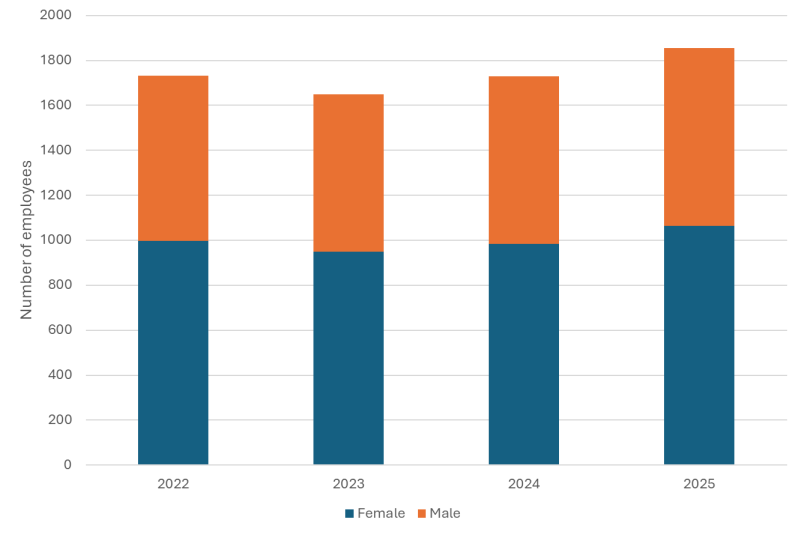
The Insolvency Service’s workforce is comprised of slightly more women than men, and this overall workforce split has remained consistent over the last 4 years.
Gender split by grade
The graph below shows how the representation of men and women differs at each grade and how this compares with parity (50:50) and equality (57:43).
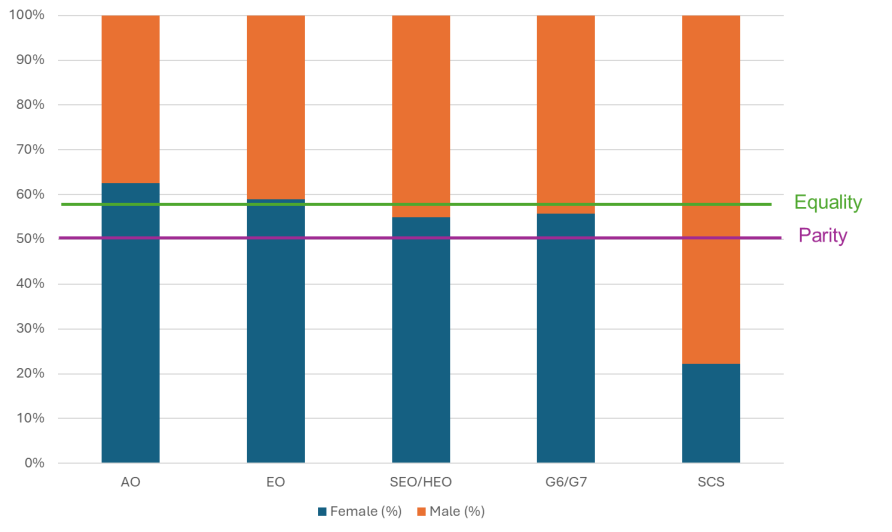
Women are slightly overrepresented at AO grade when compared with equality. Women are well represented at G6/G7 grades, representing 55.7% of these grades, which is above parity and close to equality. Women are notably underrepresented at SCS, making up 22.2% of roles in this grade.
Gender Pay Gap Headlines
Key figures for the last three years:
| Metric | 2023 | 2024 | 2025 | Change |
|---|---|---|---|---|
| Mean GPG | 8.7% | 6.2% | 4.6% | -1.6% |
| Median GPG | 11.1% | 8.0% | 3.0% | -5.0% |
| Mean Bonus GPG | -2.5% | -3.2% | -3.7% | +0.5% |
| Median Bonus GPG | -9.1% | -6.3% | 0% | -6.3% |
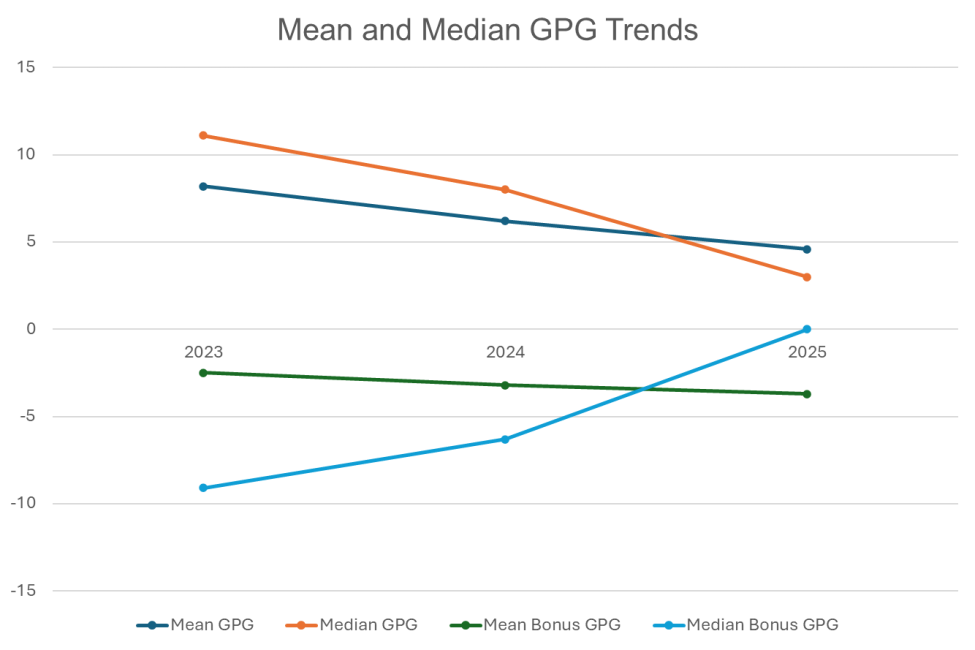
There is a positive story for the Insolvency Service (INSS) this year, with many of the headline figures improving:
- The Insolvency Service remains ahead of the wider Civil Service, which reports an overall mean gender pay gap of 6.9%.
- Our bonus gap performance is also strong, aligning closely with the Civil Service averages of -3.8% for the mean bonus gap and -6.1% for the median bonus gap.
Analysis of the Gap
Our 2025 GPG figures show a reduction in both our mean gender pay gap to 4.6% and median gender pay gap to 3%. The reduction follows the 1 August 2023 pay award, which began to address several longstanding pay issues. These include the removal of marked time pay, the elimination of overlapping pay ranges, and enhancements to pay scales across all grades, particularly benefiting the lowest-paid employees. These changes were made in preparation for alignment with the Civil Service grading structure. The improvements made have had a positive impact on our gender pay gap.
In comparison, the mean gender pay gap for the Civil Service reduced to 6.9% in 2025, and the median gender pay gap reduced to 6.4% in 2025. In analysing our GPG over a 3-year period, both the mean and median have continued to reduce.
The difference in grade distribution is likely to be the main driver of the overall gender pay gap. As the gender pay gap calculations look at the total workforce, the pay gap can be attributed to an uneven split of men and women by grade, with a predominately female workforce and more men at Senior Civil Servant level. In terms of the data relating to bonuses, the negative mean figure show women received higher value awards than men.
The main driver is grade distribution: more men occupy senior roles. Recent pay reforms in August 2023 improved lower-grade pay, positively impacting the gap.
Actions to Close the Gap
The Insolvency are committed to continually improving representation of talented women across all pay grades, a key step in closing our Gender Pay Gap We will continue to do this by taking the following actions:
Recruitment
Our Centralised Recruitment Team regularly review our recruitment practices, which will help women access opportunities. Actions include ensuring that recruitment panels are gender-balanced, addressing gender bias in job adverts, exploring alternative places to advertise jobs to attract a diverse pool of candidates and advertising expressions of interest through network groups.
Learning & Development
We have an annual budget for a Women into Leadership programme. We have also facilitated female SCS job shadowing and ‘day in the life’/’women in the SCS’ sessions for female G6 colleagues. The Agency has also created an Innovation Squad formed of five G6 female colleagues to address under-representation of female SCS in the Agency.
Women’s network
Our women’s network continues to help improve engagement and awareness, whilst also facilitating networking across the Agency. It also participates in our mentoring for success is aimed at underrepresented groups, where more junior members of staff mentor senior managers. The network helps women further their practical skills and have inspiring role models.
Supporting parents and carers
We know that returning to work after starting a family can be challenging. We are signatories of the Carers Charter to show our commitment to supporting carers in the workspace. Our Carers Network also provides support, insight, and advice to employees. Employees continue to welcome our flexible working options, which benefits all our people, especially carers and has the indirect effect of helping women. This year, we have further increased flexibility around working hours by removing fixed core hours. Employees now have the autonomy to determine their start and finish times, as well as breaks, enabling them to better balance work with personal commitments.
Please see Equality and Diversity pages for further details on work undertaken by the Agency, which will also help reduce our Gender Pay Gap.
Declaration
We confirm that this data is accurate and calculated in line with the Equality Act 2010 regulations.