Environmental Indicator Framework Theme J (Resource Use and Waste)
Updated 13 May 2026
Applies to England

© Crown copyright 2026
This publication is licensed under the terms of the Open Government Licence v3.0 except where otherwise stated. To view this licence, visit nationalarchives.gov.uk/doc/open-government-licence/version/3 or write to the Information Policy Team, The National Archives, Kew, London TW9 4DU, or email: psi@nationalarchives.gov.uk.
Where we have identified any third party copyright information you will need to obtain permission from the copyright holders concerned.
This publication is available at https://www.gov.uk/government/publications/environmental-indicator-framework-theme-j-resource-use-and-waste/environmental-indicator-framework-theme-j-resource-use-and-waste
J1: Carbon footprint and consumer buying choices
Short Description
This indicator tracks the carbon footprint of England’s residents, by showing changes in the greenhouse gas (GHG) emissions associated with final demand for goods and services in England. Unlike Indicator A2 which measures emissions on a territorial basis, this indicator includes GHG emissions embedded within goods and services consumed in England wherever these emissions arise across the globe. The indicator will show how consumer preferences and behaviour are impacting on the overall national carbon footprint.
Readiness and Links to Data
An interim indicator is presented here that shows consumption-based GHG emissions in England. Data underpinning this metric, as well as methodology and accompanying data are available in the UK and England's carbon footprint statistical notice.
The University of Leeds have carried out and published research developing indices of change for carbon emissions. This work provided data about the cause of changes in carbon emissions.
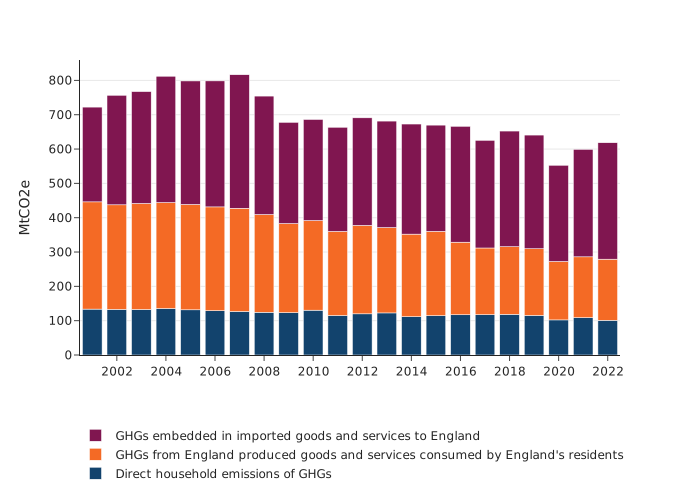
J1: Consumption based greenhouse gas emissions in England, 2001 to 2022
Source: Department for Environment, Food & Rural Affairs
Download the data for this chart in .csv format
Notes on Figure
The data used in the model to produce these statistics is updated with every annual update, which may result in changes to the time series.
The 2020 datapoint covers the first year of the COVID-19 pandemic and the associated national lockdowns and travel restrictions. This probably had an impact on emissions, especially on emissions from transport generated directly from households and the emissions associated with household spend on air travel, hotels and restaurants.
Trend Description
England’s carbon footprint (carbon dioxide, methane and nitrous oxides) was estimated to be equivalent to 618 million tonnes of carbon dioxide (MtCO2e) in 2022, a 14% reduction compared to 2001 (722 MtCO2e). GHGs emitted directly by households (which made up 16% of the footprint in 2022) were 24% (32 MtCO2e) lower in 2022 than in 2001. Total consumption-based emissions from the goods and services produced in England and consumed here have reduced by 43% (135 MtCO2e) since 2001. Emissions from imported goods and services decreased considerably between 2004 and 2020. Since then, they have increased to 339 MtCO2e in 2022. The 2022 figure is the largest amount of GHG emissions from this category since 2008.
Assessment: J1
While the data in figure J1 indicate little or no change over the short term, smoothing is applied across the whole time series in our assessment to account for natural interannual variability. The assessment of this smoothed trend showed an improvement in the total emissions of consumption-based GHGs over the short-, medium- and long-term time periods. This assessment does not consider whether any improvement is on a sufficient scale for meeting targets.
Change since 2018 has also been assessed, showing an improvement. This is based on only 5 data points so should be considered as indicative and not evidence of a clear trend.
Further information on this assessment, along with details on the methodology, is provided in the Assessment guide page. Summaries by Environmental Improvement Plan goal and information on indicator links are presented in the Assessment results pages.
| Component | Subcomponent | Period | Date range | Percentage change | Smoothing function | Assessment of change |
|---|---|---|---|---|---|---|
| J1 | Total | Short term | 2017 to 2022 | -8.48 | Loess | Improvement |
| J1 | Total | Medium term | 2012 to 2022 | -12.71 | Loess | Improvement |
| J1 | Total | Long term | 2001 to 2022 | -19.78 | Loess | Improvement |
Note that assessment categories were assigned based on smoothed data, so percentage change figures in Table J1 may differ from unsmoothed values quoted elsewhere. Percentage change refers to the difference seen between the first and last years in the specified date range.
Metadata
| Headline | Not applicable |
|---|---|
| Primary Goal | Climate change, Waste |
| Relevant Goals | Climate change, Waste |
| Relevant Targets | Making sure that all policies, programmes and investment decisions take into account the possible extent of climate change this century, Working towards our ambition of zero avoidable waste by 2050 |
| Natural Capital | Pressure on natural capital assets |
| Related Commitments | None |
| Geographical Scope | England |
| Development Status | Interim |
| First Reported | 2020 |
| Last updated | Dec 2025 |
| Latest Data | 2022 |
Return to Environmental Indicator Framework Collection Page
J2: Raw material consumption
Short Description
This indicator shows trends in the amount of (a) raw material consumption per capita and (b) the amount of gross value added per unit of raw material consumption. These measures give a proxy for the scale of our environmental impact associated with our material consumption, while helping identify how efficiently natural resources are being used and the extent to which economic output is being decoupled from consumption of materials.
Readiness and Links to Data
Data on raw material consumption underpinning each metric are available in the England’s material footprint release. Data on Nominal and real regional gross value added (balance) by industry and Estimates of the population for the UK, England and Wales, Scotland and Northern Ireland are published by the Office for National Statistics.
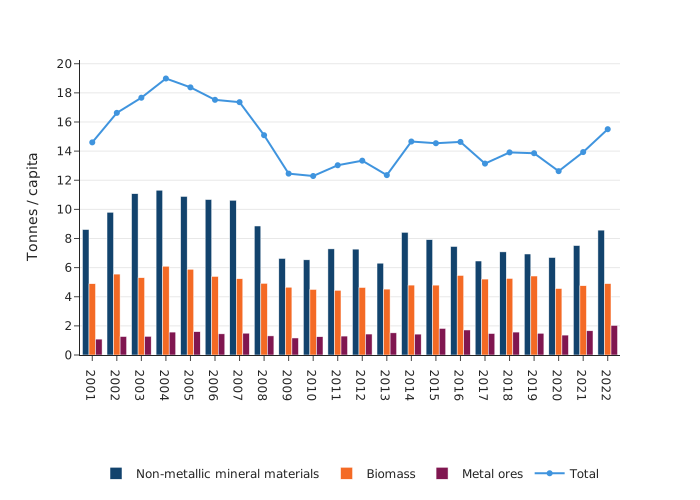
J2a: Raw material consumption (excluding fossil fuels) per capita in England, 2001 to 2022
Source: Department for Environment, Food & Rural Affairs
Download the data for this chart in .csv format
Notes on Component
The data used in the model to produce these statistics is updated with every annual update which may result in changes to the time series.
The 2020 datapoint covers the first year of the COVID-19 pandemic, and the associated national lockdowns and travel restrictions. This is likely to have impacted England's material footprint.
Trend Description
The average raw material footprint per capita in England (excluding fossil fuels) increased by 6% (0.9 tonnes per capita) between 2001 and 2022. Levels peaked in 2004, decreased steadily until 2007, and then fell sharply during the 2008 to 2010 recession. It fluctuated around this level until 2020.
Over the latest three years for which data are available (2020 to 2022), the average raw material footprint increased from 12.6 tonnes per capita in 2020 to 15.5 tonnes per capita in 2022.
Within the overall total, per capita consumption of non-metallic mineral materials and biomass were similar in 2022 compared to 2001, while per capita consumption of metal ores increased by 86% (0.94 tonnes per capita) over the same period.
Assessment: J2a
A decrease in the biomass component of England’s Material Footprint has been observed over the short- and long-term assessment periods, and an increase in the medium term, however it is not possible to simplistically categorise any change in biomass consumption as either an ‘improvement’ or ‘deterioration’ for the environment. England’s consumption of metal ores has increased (a deterioration) over the short-, medium- and long-term assessment periods. In the short term and medium term, consumption of non-metallic mineral ores has increased (a deterioration), and in the long-term assessment period consumption has decreased (an improvement).
Change since 2018 has also been assessed. Since 2018, there has been a decrease in the biomass component of England's Material Footprint, an increase (deterioration) of the metal ores component, and an increase (deterioration) of the non-metallic mineral ores component. This is based on 5 data points and should be considered as indicative and not evidence of a clear trend.
Further information on this assessment, along with details on the methodology, is provided in the Assessment guide page. Summaries by Environmental Improvement Plan goal and information on indicator links are presented in the Assessment results pages.
| Component | Subcomponent | Period | Date range | Percentage change | Smoothing function | Assessment of change |
|---|---|---|---|---|---|---|
| J2a | Biomass | Short term | 2017 to 2022 | -7.29 | Loess | Change (decreasing) |
| J2a | Biomass | Medium term | 2012 to 2022 | 3.92 | Loess | Change (increasing) |
| J2a | Biomass | Long term | 2001 to 2022 | -10.01 | Loess | Change (decreasing) |
| J2a | Metal ores | Short term | 2017 to 2022 | 10.89 | Loess | Deterioration |
| J2a | Metal ores | Medium term | 2012 to 2022 | 25.98 | Loess | Deterioration |
| J2a | Metal ores | Long term | 2001 to 2022 | 48.17 | Loess | Deterioration |
| J2a | Non-metallic mineral materials | Short term | 2017 to 2022 | 8.65 | Loess | Deterioration |
| J2a | Non-metallic mineral materials | Medium term | 2012 to 2022 | 11.60 | Loess | Deterioration |
| J2a | Non-metallic mineral materials | Long term | 2001 to 2022 | -17.84 | Loess | Improvement |
Note that assessment categories were assigned based on smoothed data, so percentage change figures in Table J2a may differ from unsmoothed values quoted elsewhere. Percentage change refers to the difference seen between the first and last years in the specified date range. It is not possible to define a simplistic desired direction of change for the biomass component of this indicator so we cannot assign ‘improvement’ or ‘deterioration’ label to these results.
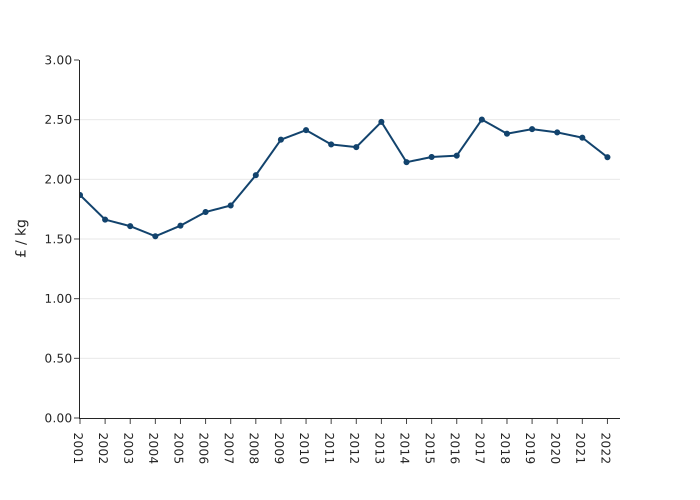
J2b: Gross value added per kg of raw material consumption (excluding fossil fuels) in England, 2001 to 2022
Source: Office for National Statistics
Download the data for this chart in .csv format
Notes on Component
The data used in the model to produce these statistics is updated with every annual update which may result in changes to the time series. The money value year used for GVA values in this metric is 2022.
Trend Description
In 2022, England generated approximately 17.0% more economic value than in 2001 (measured by gross value added per unit of raw material consumption (excluding fossil fuels), also described as resource productivity). Resource productivity measured on this basis rose from a low of £1.52 of gross value added per kg of raw material consumption in 2004 to a peak of £2.48 in 2013. It then declined to £2.14 in 2014 before rising to a new high of £2.50 in 2017. It has since declined to £2.19 in 2022.
Assessment: J2b
The gross value added per kg of raw material consumption (excluding fossil fuels) in England showed little or no change over the short and medium term, and an improvement in the long term.
Change since 2018 has also been assessed, showing little or no change. However, this is based on 5 years of data so should be considered as indicative and not evidence of a clear trend.
Further information on this assessment, along with details on the methodology, is provided in the Assessment guide page. Summaries by Environmental Improvement Plan goal and information on indicator links are presented in the Assessment results pages.
| Component | Period | Date range | Percentage change | Smoothing function | Assessment of change |
|---|---|---|---|---|---|
| J2b | Short term | 2017 to 2022 | -1.37 | Loess | Little or no change |
| J2b | Medium term | 2012 to 2022 | -1.50 | Loess | Little or no change |
| J2b | Long term | 2001 to 2022 | 34.64 | Loess | Improvement |
Note that assessment categories were assigned based on smoothed data, so percentage change figures in Table J2b may differ from unsmoothed values quoted elsewhere. Percent change refers to the difference seen between the first and last years in the specified date range.
Metadata
| Primary Goal | Resources |
|---|---|
| Relevant Goals | Resources, Climate change |
| Relevant Targets | Maximising the value and benefits we get from our resources, doubling resource productivity by 2050 |
| Natural Capital | Pressure on natural capital assets |
| Related Commitments | Links to the UN Sustainable Development Goals 8 and 12 |
| Geographical Scope | England |
| Development Status | Final |
| First Reported | 2019 |
| Latest Data | 2022 |
| Last Updated | May 2026 |
Return to Environmental Indicator Framework Collection Page
J3: Municipal waste recycling rates
Short Description
This indicator shows changes in municipal waste recycling rates in England. The municipal waste recycling rate is the fraction of household waste and waste similar in nature and composition to household waste, which is recycled. The indicator reflects levels of everyday waste that is recycled and not sent for final disposal. Development of the Defra ‘waste tracking’ tool and further integration with data collected by local authorities will close some of the data gaps and enable collection of more comprehensive data.
Readiness and Links to Data
An interim indicator is presented here that shows trends in ‘household waste’ and ‘waste from households’ recycling rates. These waste data are already published annually as Accredited Official Statistics. Further development is required to include waste that is similar in nature and composition to household waste such as non-household municipal waste. Information is available about the development of Defra’s ‘waste tracking’ tool.
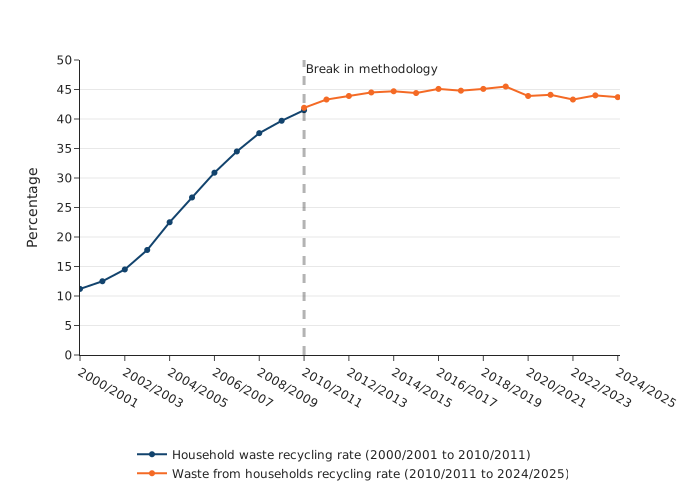
J3: ‘Household waste’ and ‘waste from households’ recycling rates in England, 2000/2001 to 2024/2025
Source: Department for Environment, Food & Rural Affairs
Download the data for this chart in .csv format
Notes on Component
The recycling measure reported in this indicator changed from ‘household waste’ to ‘waste from households’ in 2010/2011. The earlier ‘household waste’ recycling measure was based on a slightly broader definition of waste than the ‘waste from households’ measure and results from the 2 measures are therefore not directly comparable (see ‘glossary’ section of the source statistical publication on Local authority collected waste management for further details). Data for both measures are for April to March (financial years).
Trend Description
In the 2024/2025 financial year, the recycling rate for ‘waste from households’ was 43.7%, a slight increase of 1.8 percentage points compared to the equivalent figure for 2010/2011 (when the measure was first reported).
Assessment: J3
In 2011, there was a change in the methodology used to produce the municipal waste recycling rates interim indicator. As this was not directly comparable to the previous method, this indicator only assesses trends using data following the new method.
Over the long-term assessment period, an increase (improvement) was observed for waste from households recycling rate. Little or no change was observed over both the short- and medium-term.
Change since 2018 was also assessed. From 2017/2018 to 2024/2025, a decrease (deterioration) was observed for waste from households recycling rate.
Further information on this assessment, along with details on the methodology, is provided in the Assessment guide page. Summaries by Environmental Improvement Plan goal and information on indicator links are presented in the Assessment results pages.
| Component | Subcomponent | Period | Date range | Percentage change | Smoothing function | Assessment of change |
|---|---|---|---|---|---|---|
| J3 | Waste from households recycling rate | Short term | 2019/2020 to 2024/2025 | -2.75 | Loess | Little or no change |
| J3 | Waste from households recycling rate | Medium term | 2014/2015 to 2024/2025 | -2.18 | Loess | Little or no change |
| J3 | Waste from households recycling rate | Long term | 2010/2011 to 2024/2025 | 3.43 | Loess | Improvement |
Note that assessment categories were assigned based on smoothed data, so percentage change figures in Table J3 may differ from unsmoothed values quoted elsewhere. Percentage change refers to the difference seen between the first and last years in the specified date range.
Metadata
| Primary Goal | Waste |
|---|---|
| Relevant Goals | Waste |
| Relevant Targets | Working towards our ambition of zero avoidable waste by 2050 |
| Natural Capital | Pressure on natural capital assets |
| Related Commitments | None |
| Geographical Scope | England |
| Development Status | Interim |
| First Reported | 2019 |
| Latest Data | 2024/2025 |
| Last Updated | May 2026 |
Return to Environmental Indicator Framework Collection Page
J4: Residual waste arising by type and sector
Short Description
This indicator shows how much waste generated in England is landfilled, incinerated or sent for energy recovery, rather than recycled, reused or treated further up the waste hierarchy. Data presented are captured through the Environment Agency’s permitted site data, and annual monitoring reports and international waste shipments data. There are still gaps in the data and these will need to be addressed in order to provide reporting by source sector.
Readiness and Links to Data
This indicator shows waste generated in England that is landfilled or incinerated, or used in energy recovery. This indicator excludes major mineral wastes. The data are presented on both a per capita basis (J4i) and total tonnage (J4ii). Data are available via the statistical notice Estimates of Residual Waste (excluding Major Mineral Wastes) and Municipal Residual Waste in England.
These source data are currently published as official statistics in development as there may be refinements to the methodology following the introduction of digital waste tracking. We would welcome any feedback on these statistics, particularly on their usefulness and value, via environmentalindicators@defra.gov.uk.
Notes on Indicator
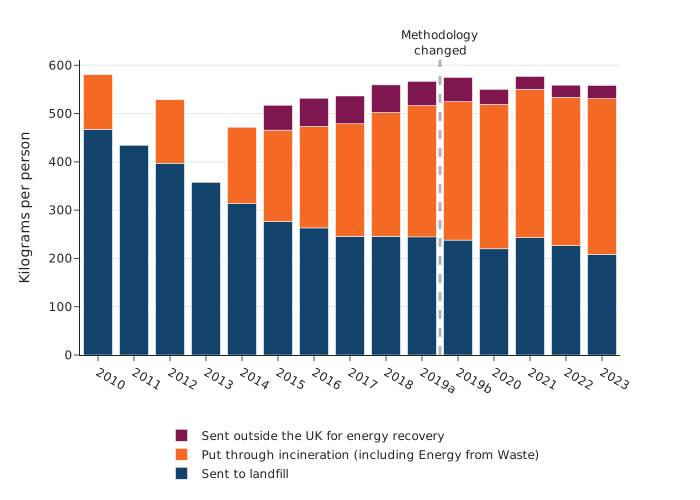
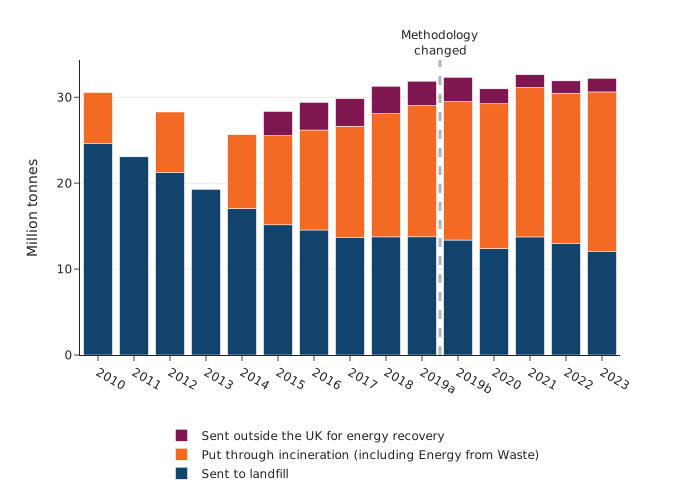
For the purposes of this indicator, residual waste refers to waste generated in England that is sent to landfill in the UK, put through incineration in the UK, used in energy recovery in the UK, or sent outside the UK for energy recovery.
Figures reported for the years 2020 to 2023 are not directly comparable to those reported from 2010 to 2018 due to methodological differences, and therefore comparisons should be made with care. For both components of indicator J4, there are 2 values available for the year 2019. The value for 2019a was derived from the 2010 to 2018 method, and 2019b is based upon the new method. Further detail on the methodological differences is available in the statistical notice underpinning the indicator presented here.
J4i: Residual waste (excluding major mineral wastes) per capita in England, 2010 to 2023
Source: Department for Environment, Food & Rural Affairs
Download the data for this chart in .csv format
Notes on Figure
Prior to 2014, incineration data were generated on a biennial basis, and therefore there are no incineration data available for the years 2011 and 2013. Prior to 2015, data on waste sent outside the UK for energy recovery included both waste originating in England and Wales so they are not included in these figures.
Trend Description
In 2023, the per capita quantity of residual waste (excluding major mineral wastes) was 558 kg per person, a small reduction on levels in 2019 (575 kg per person). Due to a methodological difference, levels of residual waste prior to 2019 are not comparable, however between 2010 and 2019, the amount of residual waste sent to landfill and put through incineration reduced to a low of 466 kg per person in 2015, before increasing to 517 kg per person in 2019 (under the old methodology). The amount of residual waste sent outside the UK for energy recovery fluctuated between 50.2 kg per person to 58.1 kg over the 2015 to 2019 period. Under the new methodology used for the data for 2019 to 2023, the amount of residual waste sent to landfill and put through incineration fluctuated between 519 kg per person and 550 kg per person, and residual waste sent outside the UK for energy recovery reduced from 50.2 kg per person to 27.4 kg per person.
Assessment: J4i
No assessment of change was undertaken for this indicator as a suitable time series is not yet available in the Environmental Indicator Framework. In previous years, a short-term assessment was presented for J4, however due to the methodology change in 2019, there are not currently enough datapoints available to carry out an assessment over this time period
J4ii: Residual waste (excluding major mineral wastes) in England, 2010 to 2023
Source: Department for Environment, Food & Rural Affairs
Download the data for this chart in .csv format
Notes on Figure
Prior to 2014, incineration data were generated on a biennial basis, and therefore there are no incineration data available for the years 2011 and 2013. Prior to 2015, data on waste sent outside the UK for energy recovery included both waste originating in England and Wales so they are not included in these figures.
Trend Description
In 2023, the amount of residual waste (excluding major mineral wastes) was 32.2 million tonnes, a marignal decrease compared to levels in 2019 (32.3 million tonnes). Due to a methodological difference, levels of residual waste prior to 2019 are not comparable, however between 2010 and 2019, the amount of residual waste sent to landfill or put through incineration reduced from 30.6 million tonnes to a low of 25.5 million tonnes in 2015, before increasing to 29.0 million tonnes in 2019. The amount of residual waste sent outside the UK for energy recovery increased slightly then decreased between 2016 and 2019, remaining at 2.8 million tonnes at the beginning and the end of the new methodology time series. With the methodology used for the data for 2019 to 2023, this waste stream reduced from 2.8 to 1.6 million tonnes.
Assessment: J4ii
No assessment of change was undertaken for this indicator component because when sufficient data are available, the assessment will now be based on the residual waste per capita data presented in component J4i.
Metadata
| Headline | Resource efficiency and waste |
|---|---|
| Primary Goal | Waste |
| Relevant Goals | Waste |
| Relevant Targets | Meeting all existing waste targets – including those on landfill, reuse and recycling – and developing ambitious new future targets and milestones, Working to a target of eliminating avoidable plastic waste by end of 2042, Working towards our ambition of zero avoidable waste by 2050 |
| Natural Capital | Pressure on natural capital assets |
| Related Commitments | None |
| Geographical Scope | England |
| Development Status | Interim |
| First Reported | 2020 |
| Last updated | Dec 2025 |
| Latest Data | 2023 |
Return to Environmental Indicator Framework Collection Page
J5: Prevent harmful chemicals from being recycled
Short Description
This indicator will track the amount of selected banned, restricted or soon to be restricted chemicals in waste which are being destroyed. The removal and proper destruction of such chemicals is necessary to prevent them contaminating recycled products or being released into the environment.
The indicator will use data on the amount of persistent organic pollutants (POPs) remaining in circulation and sent for destruction. This is in line with the commitment to substantially increase the amount of POPs material being destroyed or irreversibly transformed by 2030. Data on elimination of the use of polychlorinated biphenyls (PCBs), decabromodiphenyl ether (DecaBDE) and hexabromocyclododecane (HBCDD) have been included and data on other POPs will be included when they become available.
Readiness and Links to Data
An interim indicator is presented here which shows how the stockpile of PCBs, DecaBDE and HBCDD in the UK has changed over time. Additional data are provided for DecaBDE and HBCDD, which provides further clarity on how much of these chemicals are destroyed. Unlike PCBs which have very few applications and are relatively easy to track, DecaBDE and HBCDD are brominated flame retardants which have broad applications across a large number of products. Tracking incineration rates of these chemicals is valuable, as it allows policymakers to understand whether they are being destroyed at suitable rates.
A waste tool model has also been developed for medium chain chlorinated paraffins (MCCPs), which may be listed as a POP in the near future. Data from this model is intended to be incorporated into J5 in future. Additional work is planned to expand the waste tool to include more POPs as they become restricted and banned, and to improve the existing models as more data become available.
Data are available via the persistent organic pollutants multimedia emissions inventory (MMEI) waste tool report (Defra project code CX0114), including data on the amount of POPs that have been incinerated. Additional data are also published via the hazardous waste interrogator. Relevant data from the interrogator are incorporated into the model presented here.
Notes on Indicator
Currently, the overall uncertainty is derived from the best available estimates in uncertainty from the various data sources, however, many of these uncertainty estimates are based upon expert judgement. As such, there is considerable uncertainty in the model and this is currently reported as up to 30% of the values presented here, depending on the chemical. Future development work will include additional rounds of validation and continued development of the methodology used to derive uncertainty.
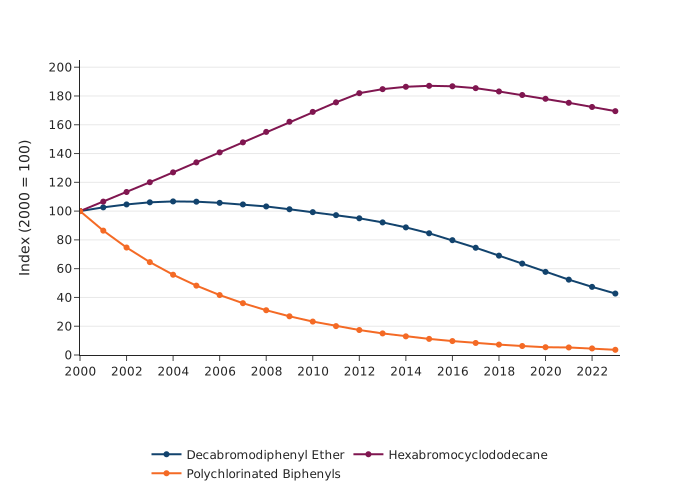
J5a: Stockpile of 3 persistent organic pollutants remaining in the UK, 2000 to 2023
Source: Department for Environment, Food & Rural Affairs, WSP UK Limited
Download the data for this chart in .csv format
Trend Description
The amount of PCBs in use in equipment in the UK has decreased by 96.4% since the start of the series (2000 to 2023), with most of the reduction occurring between the early and the mid-2000s. In addition to modelling the size of the remaining PCB stockpile, the waste tool for PCBs also models the destruction of PCBs. The full dataset can be viewed in the MMEI report, but to summarise, destruction rates were around 500 tonnes per annum in the year 2000, falling to below 150 tonnes per annum from 2010 onwards as the scale of the stockpile decreases.
Decreases have also been observed in DecaBDE. Despite a small increase to a peak in 2004, the stockpile of DecaBDE has reduced overall by 57.3% since the start of the series (2000 to 2023).
The stockpile of HBCDD increased by 87.2% between 2000 and the peak in 2015. Since 2015, the stockpile has decreased by 9.4%.
Assessment: J5a
Decreases (improvements) in the stockpile of in-use PCBs and DecaBDE have been observed over the short-, medium- and long-term time periods. Whilst the stockpile of HBCDD has increased over the long-term time period (a deterioration), it has decreased over the short- and medium-term time periods (an improvement).
Change since 2018 has also been assessed, which matches our short-term assessment. There has been decrease (improvement) in the stockpile of PCBs, HBCDD and DecaBDE in the UK.
Further information on this assessment, along with details on the methodology, is provided in the Assessment guide page. Summaries by Environmental Improvement Plan goal and information on indicator links are presented in the Assessment results pages.
| Component | Subcomponent | Period | Date range | Percentage change | Smoothing function | Assessment of change |
|---|---|---|---|---|---|---|
| J5a | Decabromodiphenyl Ether | Short term | 2018 to 2023 | -38.15 | None | Improvement |
| J5a | Decabromodiphenyl Ether | Medium term | 2013 to 2023 | -53.66 | None | Improvement |
| J5a | Decabromodiphenyl Ether | Long term | 2000 to 2023 | -57.30 | None | Improvement |
| J5a | Hexabromocyclododecane | Short term | 2018 to 2023 | -7.47 | None | Improvement |
| J5a | Hexabromocyclododecane | Medium term | 2013 to 2023 | -8.28 | None | Improvement |
| J5a | Hexabromocyclododecane | Long term | 2000 to 2023 | 69.45 | None | Deterioration |
| J5a | Polychlorinated Biphenyls | Short term | 2018 to 2023 | -50.08 | None | Improvement |
| J5a | Polychlorinated Biphenyls | Medium term | 2013 to 2023 | -75.94 | None | Improvement |
| J5a | Polychlorinated Biphenyls | Long term | 2000 to 2023 | -96.39 | None | Improvement |
Note that percentage change in Table J5a refers to the difference seen from the first to last year in the specified date range.
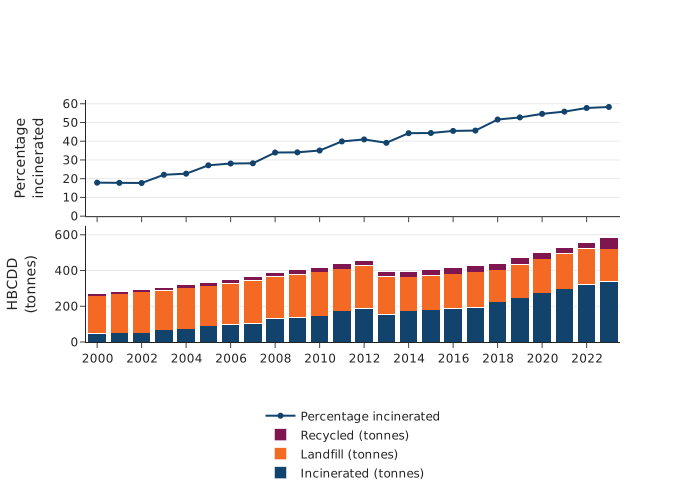
J5bi: The proportion of persistent organic pollutant hexabromocyclododecane (HBCDD) sent for destruction (incinerated) versus other waste treatment and disposal options, UK, 2000 to 2023
Source: Department for Environment, Food & Rural Affairs, WSP UK Limited
Download the data for this chart in .csv format
Trend Description
The total amount of HBCDD in waste has increased by 118% from an estimated 268 tonnes in the year 2000 to 582 tonnes in 2023. The increase has been steady across the series, apart from a temporary drop in 2013, linked to a reduction in construction waste (such as insulation offcuts) as the production of new construction products containing HBCDD rapidly reduced.
In 2023, the majority (58%) of HBCDD was incinerated with 31% sent to landfill and 11% sent for recycling. This reflects an overall increase in the percentage of HBCDD sent for destruction over the course of the series.
Assessment: J5bi
Increases (improvements) in the percentage of HBCDD being sent for incineration have been observed over the short-, medium- and long-term time periods.
Change since 2018 has also been assessed, which matches our short-term assessment. There has been an increase (improvement) in the percentage of HBCDD being sent for incineration.
Further information on this assessment, along with details on the methodology, is provided in the Assessment guide page. Summaries by Environmental Improvement Plan goal and information on indicator links are presented in the Assessment results pages.
| Component | Subcomponent | Period | Date range | Percentage change | Smoothing function | Assessment of change |
|---|---|---|---|---|---|---|
| J5bi | Percentage incinerated | Short term | 2018 to 2023 | 13.00 | None | Improvement |
| J5bi | Percentage incinerated | Medium term | 2013 to 2023 | 48.86 | None | Improvement |
| J5bi | Percentage incinerated | Long term | 2000 to 2023 | 225.97 | None | Improvement |
Note that percentage change in Table J5bi refers to the difference seen from the first to last year in the specified date range.
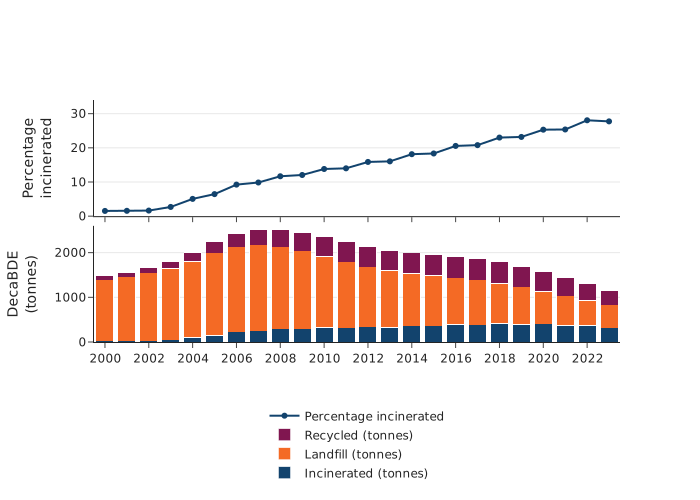
J5bii: The proportion of persistent organic pollutant decabromodiphenyl ether (DecaBDE) sent for destruction (incinerated) versus other waste treatment and disposal options, UK, 2000 to 2023
Source: Department for Environment, Food & Rural Affairs, WSP UK Limited
Download the data for this chart in .csv format
Trend Description
The total amount of DecaBDE in waste increased by 69% between 2000 and the peak in 2008 (a maximum of 2,510 tonnes). Since 2008, it has reduced by 54% to 1,145 tonnes in 2023.
Across the course of the series, the largest proportion of DecaBDE entering the waste stream has been via landfill, however this proportion has decreased, from 91% in 2000 to 44% in 2023.
Assessment: J5bii
Increases (improvements) in the percentage of DecaBDE being sent for incineration have been observed over the short-, medium- and long-term time periods (improvement).
Change since 2018 has also been assessed, which matches our short-term assessment. There has been an increase (improvement) in the percentage of DecaBDE being sent for incineration.
Further information on this assessment, along with details on the methodology, is provided in the Assessment guide page. Summaries by Environmental Improvement Plan goal and information on indicator links are presented in the Assessment results pages.
| Component | Subcomponent | Period | Date range | Percentage change | Smoothing function | Assessment of change |
|---|---|---|---|---|---|---|
| J5bii | Percentage Incinerated | Short term | 2018 to 2023 | 20.59 | None | Improvement |
| J5bii | Percentage Incinerated | Medium term | 2013 to 2023 | 72.96 | None | Improvement |
| J5bii | Percentage Incinerated | Long term | 2000 to 2023 | 1,713.91 | None | Improvement |
Note that percentage change in Table J5bii refers to the difference seen from the first to last year in the specified date range.
Metadata
| Headline | Resource efficiency and waste |
|---|---|
| Primary Goal | Chemicals |
| Relevant Goals | Chemicals, Waste |
| Relevant Targets | Fulfilling our commitments under the Stockholm Convention as outlined in the UK’s most recent National Implementation Plan, Seeking in particular to eliminate the use of Polychlorinated Biphenyls (PCBs) by 2025, in line with our commitments under the Stockholm Convention, Substantially increasing the amount of Persistent Organic Pollutants (POPs) material being destroyed or irreversibly transformed by 2030, to make sure there are negligible emissions to the environment, Working towards our ambition of zero avoidable waste by 2050 |
| Natural Capital | Pressure on natural capital assets |
| Related Commitments | Persistent Organic Pollutants Regulation (Article 13), UN Stockholm Convention on Persistent Organic Pollutants (Article 15) |
| Geographical Scope | UK |
| Development Status | Interim |
| First Reported | 2024 |
| Last updated | Dec 2025 |
| Latest Data | 2023 |
Return to Environmental Indicator Framework Collection Page
J6: Waste Crime
Short Description
This indicator tracks changes in the scale of key aspects of waste crime. Waste crime is a broad term encompassing fly-tipping, illegal waste sites, illegal waste exports, the misdescription of waste and illegal waste dumping, among other illegal waste-related activities. If not handled properly, waste can cause serious pollution of the environment – air, land and water, which can also be harmful to health. It further reduces the availability of resources from waste. Current data reported include illegal waste sites and fly-tipping. The underpinning data can be used to establish the level of criminal activity for some aspects of waste crime and geographic distribution. Options for further development will be considered, including the impacts and behavioural aspects of waste crime, the amount and types of potential resources lost through waste crime, and to reflect the need for targeting and effective enforcement to deliver reductions in the level of criminal activities.
Readiness and Links to Data
This indicator shows the number of: (a) illegal waste sites and (b) fly-tipping incidents in England. Some data on illegal waste sites (waste crime) and fly-tipping are already published, but further work aims to develop a final indicator.
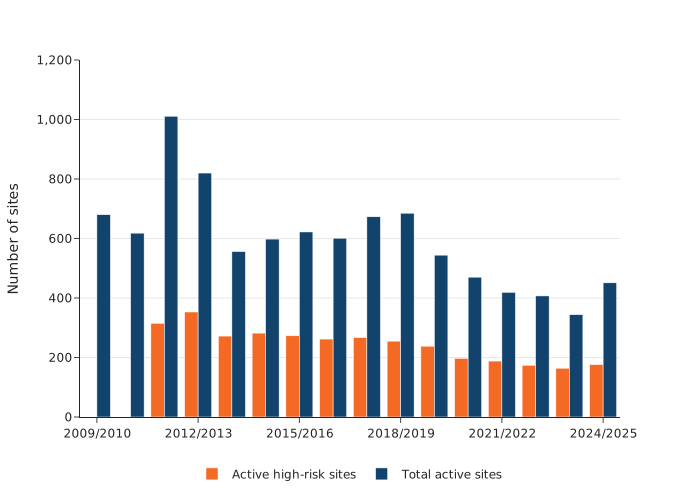
J6a: Illegal waste sites in England, 2009/2010 to 2024/2025
Source: Environment Agency
Download the data for this chart in .csv format
Notes on Component
Data are for April to March (financial years).
Illegal waste site data for 2009/2010 and 2010/2011 are for the total number of active waste sites; a breakdown of these data into active sites and active high-risk sites is not available.
Concerted sampling efforts from the Environment Agency to identify and investigate illegal waste sites resulted in a peak number being observed in 2011/2012. In subsequent years, activity focused on interventions to disrupt and deal with offenders and close down illegal waste sites.
Some of the reduction for 2020/21 may be due to reduced enforcement activity during the COVID-19 pandemic, which may have led to fewer sites being identified.
Trend Description
The total number of illegal waste sites in England fell from a peak of 1,011 active sites in the 2011/2012 financial year to 556 active sites in 2013/2014. Since then, the number increased gradually, reaching 685 sites in 2018/2019, before falling again to 344 sites in 2023/2024. More recently however, the number of illegal waste sites has increased to 451 in 2024/2025.
The number of active high-risk illegal waste sites fell by 54% from a peak of 353 sites in 2012/2013 to 164 sites in 2023/2024, before increasing slightly to 176 sites in 2024/2025.
Assessment: J6a
There has been a decrease (an improvement) recorded over the short-, medium- and long-term for the total number of active illegal waste sites in England.
Change since 2018 has also been assessed. The number of illegal waste sites has decreased since the 2018/2019 financial year.
Further information on this assessment, along with details on the methodology, is provided in the Assessment guide page. Summaries by Environmental Improvement Plan goal and information on indicator links are presented in the Assessment results pages.
| Component | Subcomponent | Period | Date range | Percentage change | Smoothing function | Assessment of change |
|---|---|---|---|---|---|---|
| J6a | Total active sites | Short term | 2019/2020 to 2024/2025 | -30.95 | Loess | Improvement |
| J6a | Total active sites | Medium term | 2014/2015 to 2024/2025 | -39.48 | Loess | Improvement |
| J6a | Total active sites | Long term | 2009/2010 to 2024/2025 | -46.63 | Loess | Improvement |
Note that assessment categories were assigned based on smoothed data, so percentage change figures in table J6a may differ from unsmoothed values quoted elsewhere. Percentage change refers to the difference seen from the first to last year in the specified date range.
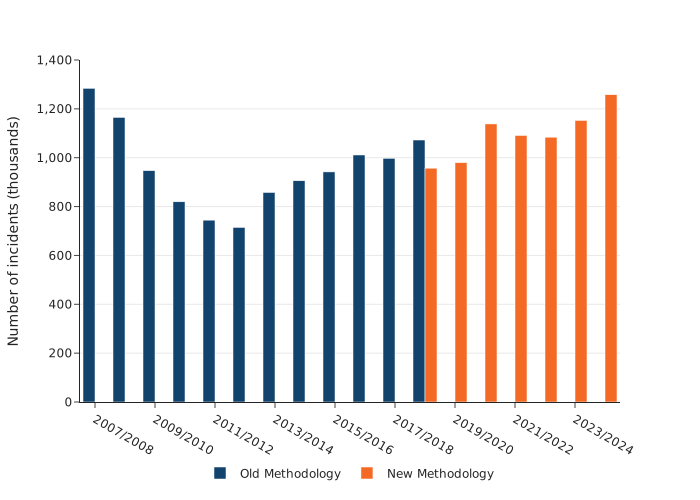
J6b: fly-tipping incidents in England, 2007/2008 to 2024/2025
Source: Department for Environment, Food & Rural Affairs
Download the data for this chart in .csv format
Notes on Component
Data are for April to March (financial years).
The methodology used to calculate the total number of fly-tipping incidents in England was changed in 2019/2020 and results derived by using the new methodology are not comparable to those derived from the old methodology. These methodological changes have also been applied to the 2018/2019 results in order to show the effects of adopting the new methodology. Detailed information on these changes can be found in the reporting basis section of the source Fly-tipping statistics publication.
There is some level of estimation in the fly-tipping data, where returns for certain local authorities were missing or incomplete.
Trend Description
The total number of fly-tipping incidents reported in England fell from 1.28 million incidents in the 2007/2008 financial year to 715,000 incidents in 2012/2013. Since these initial reductions, the number of incidents reported under the old methodology increased to 1.07 million between 2012/2013 and 2018/2019. The total number of fly-tipping incidents reported in 2018/2019 under the new methodology was 957,000. In the 6 years to 2024/2025, this total increased by 31.4% to 1.26 million incidents.
Assessment: J6b
A new methodology was introduced in 2018 for this indicator. There are 7 data points available using the new methodology, and so a short-term assessment on smoothed data has been conducted. There are insufficient data points using the new methodology to assess the long- and medium-term trends.
There has been an increase (deterioration) in the total number of fly-tipping incidents reported in England over the short term.
Further information on this assessment, along with details on the methodology, is provided in the Assessment guide page. Summaries by Environmental Improvement Plan goal and information on indicator links are presented in the Assessment results pages.
| Component | Subcomponent | Period | Date range | Percentage change | Smoothing function | Assessment of change |
|---|---|---|---|---|---|---|
| J6b | New Methodology | Short term | 2019/2020 to 2024/2025 | 22.94 | Loess | Deterioration |
| J6b | New Methodology | Medium term | N/A | N/A | N/A | Not assessed |
| J6b | New Methodology | Long term | N/A | N/A | N/A | Not assessed |
Note that assessment categories were assigned based on smoothed data, so percentage change figures in table J6b may differ from unsmoothed values quoted elsewhere. Percentage change refers to the difference seen from the first to last year in the specified date range.
Metadata
| Primary Goal | Waste |
|---|---|
| Relevant Goals | Waste |
| Relevant Targets | Seeking to eliminate waste crime and illegal waste sites over the lifetime of this Plan, prioritising those of highest risk. Delivering a substantial reduction in litter and littering behaviour |
| Natural Capital | Pressure on natural capital assets |
| Related Commitments | None |
| Geographical Scope | England |
| Development Status | Interim |
| First Reported | 2020 |
| Latest Data | 2024/2025 |
| Last Updated | May 2026 |