Environmental Indicator Framework Theme F (Resilience)
Updated 15 April 2026
Applies to England

© Crown copyright 2026
This publication is licensed under the terms of the Open Government Licence v3.0 except where otherwise stated. To view this licence, visit nationalarchives.gov.uk/doc/open-government-licence/version/3 or write to the Information Policy Team, The National Archives, Kew, London TW9 4DU, or email: psi@nationalarchives.gov.uk.
Where we have identified any third party copyright information you will need to obtain permission from the copyright holders concerned.
This publication is available at https://www.gov.uk/government/publications/environmental-indicator-framework-theme-f-resilience/environmental-indicator-framework-theme-f-resilience
F1: Disruption or unwanted impacts from flooding or coastal erosion
Short Description
This indicator will track changes in the impacts of flooding and coastal erosion on people’s lives. The approach to the finalisation of this indicator will continue to be refined to ensure it aligns with the government’s policy statement on Flood and Coastal Erosion Risk Management. Currently the indicator tracks changes in the number of residential and non-residential properties at risk from various sources of flooding by level of flood risk. The government works through Risk Management Authorities (RMAs) and Regional Flood and Coastal Committees (RFCCs) to reduce the risk of flooding and erosion. The policy statement sets out a commitment to develop a national set of indicators that will enable us to track progress towards our aim of increasing resilience in flood and coastal erosion risk management.
Readiness and Links to Data
An interim indicator is presented here covering a) the number of residential and non-residential properties at risk of flooding from rivers, seas and surface waters and b) the number of properties in areas at risk of flooding by source each year, allowing both a more detailed breakdown of the number of properties at risk from flooding (F1a) and the observed trends over time (F1b).
The Environment Agency modelling and mapping of the flood risk around a property is grouped into 4 categories of flood likelihood from high (a greater than 1 in 30 chance in any given year) to very low (a less than 1 in 1,000 chance of flooding in any given year). The modelling approach has gone through a significant update over the past few years, and a new National Flood Risk Assessment (NaFRA) using this approach was published in December 2024. This new approach combines national and local modelling into a single source of information on the likelihood of flooding to areas around a property. This approach takes into account river, sea and rainfall information, the topography, as well as flood assets, such as flood defences and their condition.
The data presented in this indicator is from the latest Flood and coastal erosion risk management report by the Environment Agency. It does not include the latest data from the latest NaFRA publication in December 2024, as the methodology for assessing risk has been changed, and this has resulted in different risk levels. As such, they are not directly comparable. Work is underway to integrate the new flood risk assessments into this indicator for the next publication. Alongside this, the Environment Agency is also developing richer information about flood risk, including the possible impacts of climate change for specific climate change scenarios.
The Environment Agency's National Flood and Coastal Erosion Risk Management Stategy for England sets out measures and actions to achieve a nation resilient to climate change. Delivery is led by the Environment Agency and other risk management authorities as set out in the Flood and Water Management Act 2010.
The Environment Agency's annual Flood and coastal erosion risk management report expands upon this indicator with additional datasets and case studies as well as highlighting details of government investment into tackling flooding and coastal erosion.
Although the Environment Agency does not routinely carry out economic cost analysis of all floods, it has published cost of flooding reports following the winter 2013 to 2014 and winter 2015 to 2016 floods. The flood and coastal erosion risk management annual reports (from 1 April 2011) provide further context and statistics about the impacts of recent major flood events.
Development of the indicator will be informed by the Environment Agency led research project into the development of long-term indicators, which was published in November 2022. Building on the research project, work is now underway to explore the further development and where possible, data collection, for a prioritised set of these indicators. This includes real world testing of some of the indicators at the local level through the £200 million flood and coastal resilience innovation programme.
Notes on Indicator
The level of risk of flooding is defined upon the likelihood of areas around a property flooding each year, broken down into 4 categories:
• High: each year there is a greater than 3.3% chance of flooding
• Medium: each year there is a chance of flooding between 1% and 3.3%
• Low: each year there is a chance of flooding between 0.1% and 1%
• Very Low: each year there is a less than 0.1% chance of flooding
Between the 2021/2022 and 2022/2023 datapoints the information surrounding the underlying property information has been improved, including individual properties in shared buildings, such as residential flats. This has increased the number of properties identified to be at risk since the previous datapoint. This does not reflect an increase in risk, but rather a better understanding of the level of risk.
Some properties are at risk from flooding from multiple sources. For example, it is estimated that 642,000 properties are at risk from flooding from rivers, the sea, and surface water. Due to the complexity and nature of groundwater flooding, it is not possible to assign a likelihood to it, however it is another source of flooding and poses a risk to properties. Between 122,000 and 290,000 properties are estimated to be in areas at risk of groundwater flooding, this may include properties also in areas at risk of surface water flooding
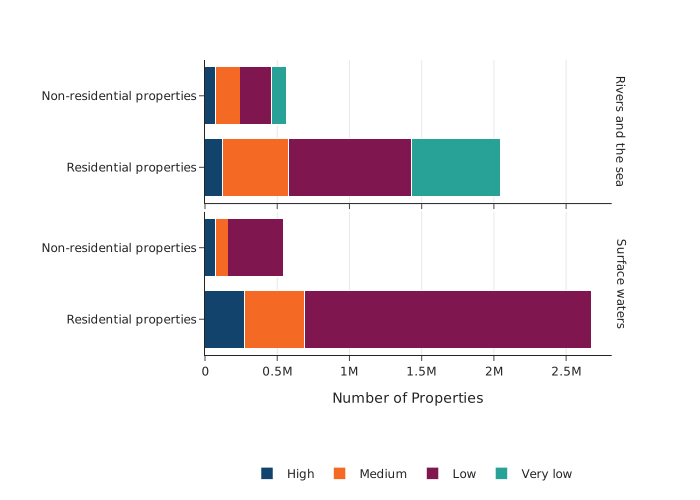
F1a: Number of properties in areas at different levels of risk of flooding from rivers and the sea, and from surface water, 2023/2024
Source: Environment Agency
Download the data for this chart in .csv format
Notes on Figure
Some properties are at risk from more than one source of flooding. Due to the complexity and nature of groundwater flooding, we are not able to assign a likelihood to it.
Trend Description
In total, across the 2023/2024 financial year 2,606,600 properties were at risk of flooding from rivers and the sea, of which 2,042,000 were residential properties. This total includes 196,100 properties at a high risk of flooding (greater than 3.3% annual likelihood) and 623,800 properties at a medium risk of flooding (between 1% and 3.3% annual likelihood).
Properties at risk of flooding from surface waters were 3,218,900 over the 2023/2024 financial year, of which 2,674,600 were residential properties. This total includes 344,100 properties at a high risk of flooding (greater than 3.3% annual likelihood) and 504,000 properties at a medium risk of flooding (between 1% and 3.3% annual likelihood).
Assessment: F1a
No assessment of change was undertaken for this indicator as it represents a snapshot in time across the 2023/2024 financial year and no trend is available for assessment.
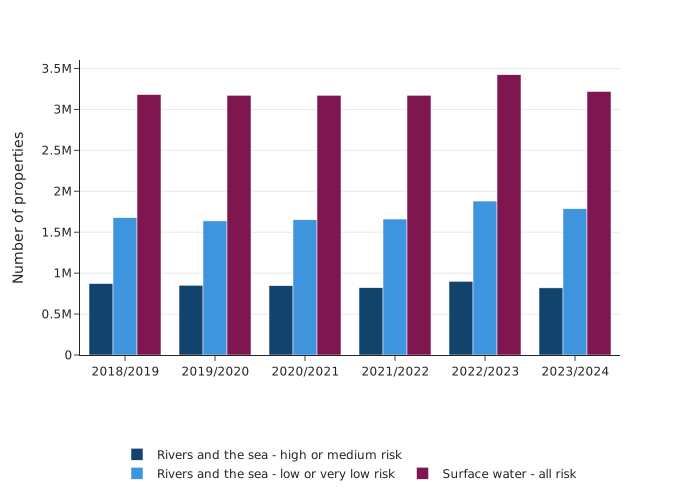
F1b: Number of properties in areas at risk of flooding by source each year in England, 2018/2019 to 2023/2024
Source: Environment Agency
Download the data for this chart in .csv format
Notes on Figure
Data is reported on each financial year from April to March of the following year. Some properties are at risk from more than one source of flooding. Due to the complexity and nature of groundwater flooding, we are not able to assign a likelihood to it.
Trend Description
The number of properties at risk from all sources of flooding peaked 2022/2023, with 900,000 at a medium or high risk and 1,880,400 at a low or very low risk from rivers and the sea. 3,423,400 properties were at risk from surface waters across all levels of risk. This peak, as outlined in the readiness and links to data section, is a result of methodological improvement and does not reflect an increase in risk.
The final year of data, 2023/2024, showed a reduction across all sources since this peak. 819,900 properties were at a medium or high risk and 1,786,700 at a low or very low risk from rivers and the sea. 3,218,900 properties were at risk from surface waters across all levels of risk.
Excluding the final two datapoints, since the time series began in 2018/2019, until the 2021/2022 financial year, the number of properties at risk from rivers, the sea and surface waters has remained fairly stable, with a gradual decrease observed. Overall the number of properties at a high or medium level of risk has fallen by 50,000 properties from 872,000 in 2018/2019 to 822,000 in 2021/2022, equating to a 5% reduction. The number of properties at a low or very low risk from rivers and the sea, as well as those at risk from surface water flooding have reduced by 0.2% and 1% respectively across the same timeframe.
Assessment: F1b
No assessment of change was undertaken for this indicator as there are insufficient datapoints since the methodological improvement in 2022/2023.
Metadata
| Headline | Resilience to natural hazards |
|---|---|
| Primary Goal | Reducing environmental hazards |
| Relevant Goals | Reducing environmental hazards |
| Relevant Targets | Boosting the long-term resilience of our homes, businesses and infrastructure |
| Natural Capital | Service or benefit associated with natural capital asset |
| Related Commitments | May provide evidence in support of Climate Change Risk Assessment under the Climate Change Act (2008), Relevant to Sustainable Development Goals 11 and 13, Section 18 of the Flood and Water Management Act |
| Geographical Scope | England |
| Development Status | Interim |
| First Reported | 2024 |
| Last updated | May 2025 |
| Latest Data | 2023/2024 |
Return to Environmental Indicator Framework Collection Page
F2: Communities resilient to flooding and coastal erosion
Short Description
This indicator will allow us to monitor trends over time to better understand the impact of our policies and take action to protect and benefit our communities to build resilience everywhere. Flood and coastal resilience is defined as the capacity of people and places to better plan, better protect, respond to and recover quickly from flooding and coastal change (FCERM Strategy 2020). The approach to the finalisation of this indicator will continue to be refined to ensure it aligns with the government’s policy on flood and coastal erosion risk management and the Statutory National Flood and Coastal Erosion Risk Management Strategy (approved by Parliament in 2020 and a requirement of the Flood & Water Management Act 2010).
Readiness and Links to Data
This indicator currently presents two metrics; F2a) the number of properties in at risk areas signed up to receive flood warnings and F2b) the percentage of flood and coastal risk management assets in the required condition. These are all published as part of the Environment Agency's annual Flood and coastal erosion risk management report.
The Environment Agency provide flood alerts and warnings for many properties that are at risk of flooding from rivers and the sea, as well as some properties in areas at risk of groundwater flooding. Warnings for surface water flooding are not yet available as it is difficult to determine where sudden rainstorms will occur, their intensity, duration and the effect they will have on the ground. Work is underway with the Met Office in order to develop short-range rapid forecasting to cover the type of rainfall that causes surface water flooding. Emergency alerts may also be issued in the most severe river and sea flooding incidents. The number of properties registered includes phone numbers in areas at risk from flooding that are automatically opted-in, but also includes individual uptake outside of the automatic flood warning area.
There are approximately 255,700 assets in England that have a flood or coastal risk management purpose, including Environment Agency and other public body owned assets and around 165,500 which are maintained by riparian owners who own the land next to the associated river. Regular inspection of the flood risk management assets is undertaken, across both the Environment Agency's and third party assets. The Environment Agency inspects and reports on 195,000 flood risk management assets. Where assets are not in required condition, this identifies that work is required. It does not present a risk of failure or compromise performance in a flood, because mitigation measures are put in place such as more frequent inspections from EA field teams. Asset condition can be affected by the number and severity of storms and flooding in a given year, which in turn impacts the costs of maintaining these assets. The Environment Agency report asset condition under the Environment Agency corporate scorecard. For the 2025/2026 spending review period, at the end of the financial year the target is that 92% of EA assets in high consequence systems to be in the required condition; if this target is met it is considered green in the scorecard reporting.
The Environment Agency’s National Flood and Coastal Erosion Risk Management Strategy for England, sets out measures and actions to achieve a nation resilient to climate change.
Although the Environment Agency does not routinely carry out economic cost analysis of all floods, it has published cost of flooding reports following the winter 2013 to 2014 and winter 2015 to 2016 floods. The Environment Agency's flood and coastal erosion risk management annual reports (from 1 April 2011) provide further context and statistics about the impacts of recent major flood events.
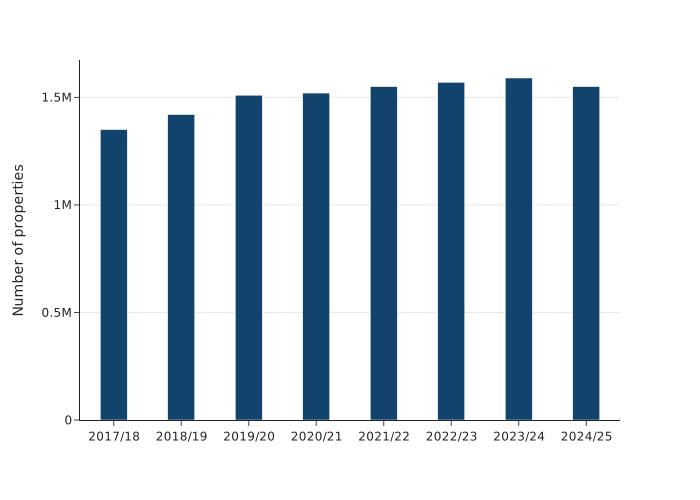
F2a: Number of properties registered for free flood warnings in England, 2017/2018 to 2024/2025
Source: Environment Agency
Download the data for this table in .csv format
Notes on Component
Data are reported on each financial year from April to March of the following year. Flood warning registration figures vary naturally throughout the year, for example, most registrations are added automatically using phone provider data and so these can change as people move or change numbers. Registrations can also fluctuate during flood events when awareness is higher and when flood risk areas are reviewed. Due to this variation, the figures are presented to the nearest 10,000.
Trend Description
As of the end of the 2024/2025 financial year, around 1.55 million properties were registered to receive free flood warnings, including those automatically opted in from areas at risk from flooding. This is an increase of around 0.2 million properties since the time series presented here began in March 2017.
Assessment: F2a
No assessment of change was undertaken for this indicator as further development is required to refine the methodology for the assessment.
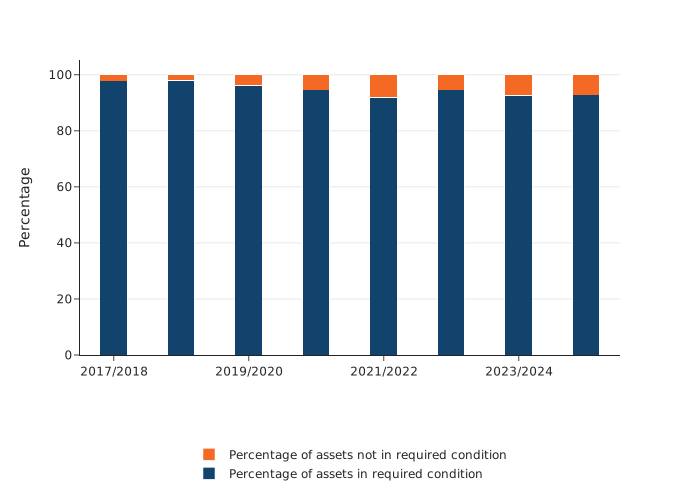
F2b: Percentage of flood or coastal risk management assets, in high consequence systems, in required condition in England, 2017/2018 to 2024/2025
Source: Environment Agency
Download the data for this table in .csv format
Notes on Component
Data are reported on each financial year from April to March of the following year. The percentage of assets in the required condition can vary from one year to another, winter storms and repeated flooding events can have a greater impact on the condition of assets and affect the overall percentage.
Trend Description
At the start of the latest Government Capital Investment Programme (2021/2022), 91.8% of assets that have a flood or coastal risk management purpose in England in high consequence systems met the required condition to continue operation and aid in the protection of properties. This figure rose by 2.7 percentage points to 94.5% in 2022/2023, before decreasing by 1.7 percentage points to 92.8% by the end of the 2024/2025 financial year. Overall, since the start of the time series presented here, the percentage of flood or coastal risk management assets in high consequence systems that are in the required condition has decreased by 4.9 percentage points from 97.7% in March 2017.
Assessment: F2b
No assessment of change was undertaken for this indicator as further development is required to refine the methodology for the assessment.
Metadata
| Primary Goal | Reducing environmental hazards |
|---|---|
| Relevant Goals | Reducing environmental hazards |
| Relevant Targets | Boosting the long-term resilience of our homes, businesses and infrastructure |
| Natural Capital | Service or benefit associated with natural capital asset |
| Related Commitments | May provide evidence in support of Climate Change Risk Assessment under the Climate Change Act (2008), Relevant to Sustainable Development Goals 11 and 13, Section 18 of the Flood and Water Management Act |
| Geographical Scope | England |
| Development Status | Interim |
| First Reported | 2024 |
| Latest Data | 2024/2025 |
| Last Updated | Apr 2026 |
F3: Disruption or unwanted impacts caused by drought
Short Description
The indicator focuses on disruption to public water supply due to drought by tracking changes in a Supply Demand Balance Index (SDBI). This indicator was reported by all water and sewerage companies for the first time in Summer 2022 as part of the Environment Agency’s Environmental Performance Assessment (EPA) annual report.
Water companies have a statutory duty to produce a water resources management plan (WRMP) and drought plan. These are prepared, published and maintained in accordance with provisions of the Water Industry Act 1991 and regulations and directions made under it. A WRMP must set out how a company plans to maintain the balance between supply and demand for water over at least the next 25 years. This includes how it will manage the increasing pressures on our water supplies from a growing population and climate change, whilst protecting the environment. A drought plan sets out the operational actions a water company will take before, during and after a drought to maintain a secure supply of water.
Readiness and Links to Data
An interim indicator is presented here highlighting the SDBI status of each water and sewerage company in England. The SDBI measures how a company is realistically able to meet water demand compared to the design drought event that is set out in the company’s WRMP. It will therefore test the theoretical risk that customers could face if there was a drought. In future publications of this indicator, trend information will be provided to track water companies’ performance over time.
Water only companies are being considered for inclusion in the EPA for the 2026 to 2030 data reporting period. The Environmental Performance Assessment report including the SDBI metric results are published annually in July in a performance report. This includes reports on each of the water companies.
F3: Supply Demand Balance Index (SDBI) status by water company, 2024/2025
| Water Company | Supply Demand Balance Index (SDBI) |
|---|---|
| Anglian Water | Achieved target or better |
| Northumbrian Water | Below target |
| Severn Trent Water | Achieved target or better |
| Southern Water | Achieved target or better |
| South West Water | Achieved target or better |
| Thames Water | Achieved target or better |
| United Utilities | Achieved target or better |
| Wessex Water | Achieved target or better |
| Yorkshire Water | Achieved target or better |
Source: Environment Agency
Download the data for this table in .csv format
Notes on Component
The SDBI metric is calculated based on data reported over a financial year (April to March) and measured on a 3-tiered system where water and sewerage companies are assessed to be performing; Achieved target or better, Below target or Significantly below target.
Trend Description
In 2024/2025, 8 water and sewerage companies in England were assessed to have an SDBI score of 100 and were considered to be operating on or better than target, whereas one company, Northumbrian Water, achieved a score of 99 and was considered to be performing below the target as defined by the WRMP.
Assessment: F3
No assessment of change was undertaken for this indicator as there are insufficient data points.
Metadata
| Primary Goal | Reducing environmental hazards |
|---|---|
| Relevant Goals | Reducing environmental hazards |
| Relevant Targets | Boosting the long-term resilience of our homes, businesses and infrastructure, Ensuring interruptions to water supplies are minimised during prolonged dry weather and drought |
| Natural Capital | Service or benefit associated with natural capital asset |
| Related Commitments | Relevant to Sustainable Development Goals 11 and 13, Water and sewerage companies currently provide SDBI data to the Environment Agency annually. This is published as part of the Environment Agency’s EPA report and is part of the water companies’ annual review of WRMPs |
| Geographical Scope | England |
| Development Status | Interim |
| First Reported | 2023 |
| Latest Data | 2024/2025 |
| Last Updated | Apr 2026 |