Environmental Indicator Framework Theme E (Natural Resources)
Updated 13 May 2026
Applies to England

© Crown copyright 2026
This publication is licensed under the terms of the Open Government Licence v3.0 except where otherwise stated. To view this licence, visit nationalarchives.gov.uk/doc/open-government-licence/version/3 or write to the Information Policy Team, The National Archives, Kew, London TW9 4DU, or email: psi@nationalarchives.gov.uk.
Where we have identified any third party copyright information you will need to obtain permission from the copyright holders concerned.
This publication is available at https://www.gov.uk/government/publications/environmental-indicator-framework-theme-e-natural-resources/environmental-indicator-framework-theme-e-natural-resources
E1: Area of productive agricultural land
Short Description
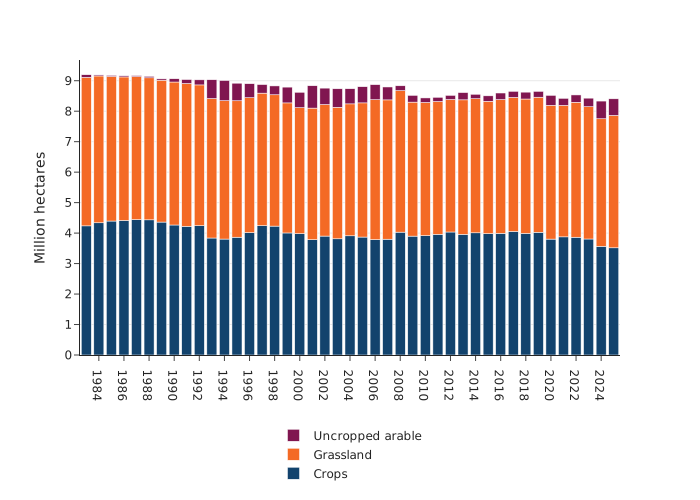
Agriculture provides around 75% of the indigenous food we eat (food which can be produced in the climatic conditions of the UK) and accounts for around 70% of land use. As well as being vital for food production, agriculture helps to shape the landscape, providing important recreational, spiritual and other cultural benefits. This indicator shows annual changes in land used for agriculture in 3 categories: grassland (including sole rough grazing); crops (including horticulture and perennial crops); and uncropped arable (land left fallow or under environmental management). Agricultural production and the associated land use and management are key drivers of the environmental impacts from the sector. A key policy challenge is to de-couple production from environmental impact. The indicator may be considered a measure of pressure on the environment, a measure of condition of the land asset, or a measure of service/benefit we derive from the land. The indicator is included in the framework to provide contextual information.
Readiness and Links to Data
Data on the structure of the agricultural industry in England are published annually as accredited official statistics.
E1: Area of productive agricultural land in England, 1983 to 2025
Source: Department for Environment, Food & Rural Affairs
Download the data for this chart in .csv format
Notes on Component
Annual datapoints reflect agricultural land use in England at 1 June each year.
Figures prior to 2009 relate to all farm holdings, whereas figures from 2009 onwards relate to commercial holdings only and thereby exclude holdings with very low levels of activity.
Trend Description
After a period of decline since the late 1980s, land use by agriculture has remained relatively stable in recent years. The split between crops and grazing has remained relatively constant over this time, with grassland accounting for around half of agricultural land (52% in 2025) and crops accounting for 42% in 2025.
Assessment: E1
There has been little or no change in the total area of productive agricultural land in England over the short and medium term, and a decrease in the long term. However, it is not possible to simplistically categorise any change as either an 'improvement' or 'deterioration' for the environment as this will depend on the farming practices driving change.
Change since 2018 has also been assessed. There has been 'little or no change' in the area of productive agricultural land since 2018.
Further information on this assessment, along with details on the methodology, is provided in the Assessment guide page. Summaries by Environmental Improvement Plan goal and information on indicator links are presented in the Assessment results pages.
| Component | Subcomponent | Period | Date range | Percentage change | Smoothing function | Assessment of change |
|---|---|---|---|---|---|---|
| E1 | Productive agricultural land | Short term | 2020 to 2025 | -0.86 | Loess | Little or no change |
| E1 | Productive agricultural land | Medium term | 2015 to 2025 | -1.69 | Loess | Little or no change |
| E1 | Productive agricultural land | Long term | 1983 to 2025 | -8.82 | Loess | Change (decreasing) |
Note that assessment categories were assigned based on smoothed data, so percentage change figures in Table E1 may differ from unsmoothed values quoted elsewhere. It is not possible to define a simplistic desired direction of change for this indicator so we cannot assign an ‘improvement’ or ‘deterioration’ label to these results.
Metadata
| Primary Goal | Resources |
|---|---|
| Relevant Goals | Resources |
| Relevant Targets | Ensuring that food is produced sustainably and profitably |
| Natural Capital | Condition of assets - land |
| Related Commitments | None |
| Geographical Scope | England |
| Development Status | Final |
| First Reported | 2019 |
| Latest Data | 2025 |
| Last Updated | May 2026 |
Return to Environmental Indicator Framework Collection Page
E2: Volume of agricultural production
Short Description
Farming produces a range of food, feed and fibre commodities. This represents a valuable output from the land and other resources used. Volume of agricultural production is considered to be a provisioning service provided by a range of natural capital assets (land, water, air, species and ecological communities). This indicator shows annual changes in the index of output volume which provides an overall measure of total production across the wide range of agricultural commodities. The index is calculated using agreed international standards.
Farm practices and the use of inputs (particularly fertilisers and pesticides) directly influence the environmental pressures from farming including the quality, composition and availability of habitats and impact on air, water and soils. This indicator should therefore be viewed alongside indicator ‘E3 Volume of inputs used in agricultural production’ and other indicators in the framework relating to the condition of natural capital assets.
Readiness and Links to Data
The data presented in this indicator are derived from the official statistics on total factor productivity for England by farm type. These total factor productivity data are collated via the Farm Business Survey and are updated annually.
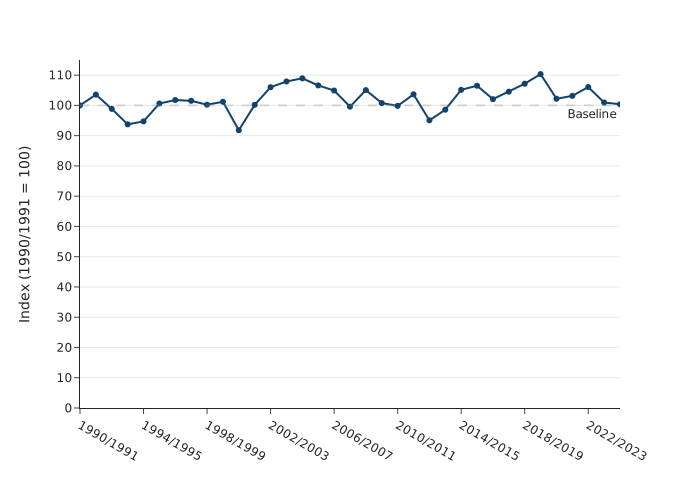
E2: Volume of agricultural production in England, 1990/1991 to 2024/2025
Source: Department for Environment, Food & Rural Affairs
Download the data for this chart in .csv format
Notes on Component
Data are reported on a March to February year, which is the average accounting year for respondents to the Farm Business Survey.
Trend Description
Since the start of the series in 1990/1991, the overall volume of agricultural production (outputs) in England has remained relatively stable, with some variation from year to year. Annual variations are generally driven by external factors, in particular, the weather affecting growing and harvest, and the variation in cropping driven by prices. Following a reduction in 2020/2021 attributed to decreases in crop output, livestock meat and livestock products, there was a slight increase between 2021/2022 and 2022/2023, followed by a decrease in recent years to just above the baseline value (100) at the start of the time series.
Assessment: E2
Little to no change in the volume of agricultural production has been observed over the short and medium term, with an increase seen in the long term (note that this is based on smoothed data). However, it is not possible to categorise this increase as either a simplistic ‘improvement’ or ‘deterioration’ as this will depend on numerous factors around farming practices. This indicator is included in the Environmental Indicator Framework to help interpret the reasons behind changes in ‘E4 Efficiency of agricultural production measured by Total Factor Productivity’, rather than to assess progress for a policy driver in the Environmental Improvement Plan.
Change since 2018 has also been assessed. There has been little or no change in volume of agricultural production since 2018.
Further information on this assessment, along with details on the methodology, is provided in the Assessment guide page. Summaries by Environmental Improvement Plan goal and information on indicator links are presented in the Assessment results pages.
| Component | Period | Date range | Percentage change | Smoothing function | Assessment of change |
|---|---|---|---|---|---|
| E2 | Short term | 2019/2020 to 2024/2025 | -0.08 | Loess | Little or no change |
| E2 | Medium term | 2014/2015 to 2024/2025 | 1.05 | Loess | Little or no change |
| E2 | Long term | 1990/1991 to 2024/2025 | 4.78 | Loess | Change (increasing) |
Note that assessment categories were assigned based on smoothed data, so percentage change figures in Table E2 may differ from unsmoothed values quoted elsewhere. It is not possible to define a simplistic desired direction of change for this indicator so we cannot assign an ‘improvement’ or ‘deterioration’ label to these results.
Metadata
| Primary Goal | Resources |
|---|---|
| Relevant Goals | Resources |
| Relevant Targets | Ensuring that food is produced sustainably and profitably |
| Natural Capital | Service or benefit associated with natural capital asset |
| Related Commitments | None |
| Geographical Scope | England |
| Development Status | Final |
| First Reported | 2019 |
| Latest Data | 2024/2025 |
| Last Updated | Mar 2026 |
Return to Environmental Indicator Framework Collection Page
E3: Volume of inputs used in agricultural production
Short Description
To produce food and feed, farming uses a range of inputs including fertilisers, pesticides, energy and animal feed. In addition, labour and land is required as well as depreciation of capital. Minimising the use of these inputs is an important policy driver to improve productivity and hence improve profitability whilst reducing the environmental impacts of farming. Farm practices and the use of inputs (particularly fertilisers and pesticides) directly influence the environmental pressures from farming including the quality, composition and availability of habitats and impact on air, water and soils. Volume of inputs may therefore be considered an indirect measure of pressure on a range of natural capital assets.
This indicator should be viewed alongside indicator ‘E2 Volume of agricultural production’ and other indicators in the framework relating to the condition of natural capital assets. The index of the volume of inputs is an overall measure of the total inputs used with price effects removed. This includes all inputs including intermediate consumption, land, labour and depreciation of capital.
Readiness and Links to Data
The data presented in this indicator are derived from the official statistics on total factor productivity for England by farm type. These total factor productivity data are collated via the Farm Business Survey and are updated annually.
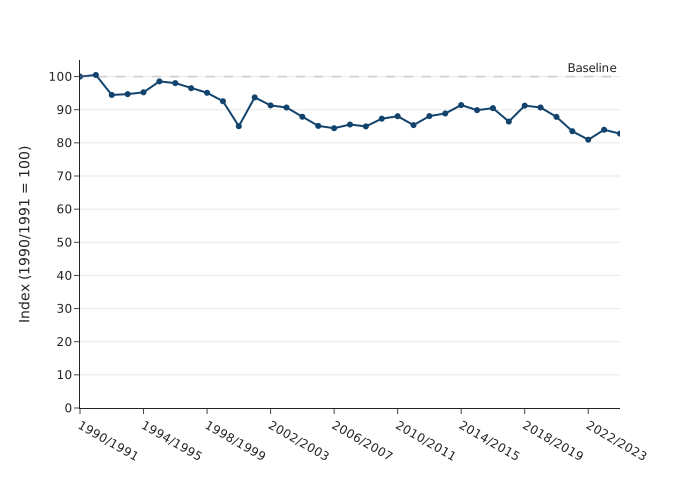
E3: Volume of inputs used in agricultural production in England, 1990/1991 to 2024/2025
Source: Department for Environment, Food & Rural Affairs
Download the data for this chart in .csv format
Notes on Component
The data are reported on a March to February year, which is the average accounting year for respondents to the Farm Business Survey.
Trend Description
The volume of inputs used in agricultural production in England has shown an overall decrease of 17.2% since 1990/1991. Most of this decrease took place between the mid-1990s and 2006/2007. Following a period of steady increase to 2014/2015, volumes remained relatively stable until 2019/2020, when they began to fall again. Most recently (between 2023/2024 and 2024/2025), the volume of inputs used in agricultural production in England has decreased by 1.4%.
Assessment: E3
There has been a decrease in the volume of inputs used in agricultural production over the short-, medium- and long-term assessment periods. However, it is not possible to simplistically categorise these changes as either an ‘improvement’ or ‘deterioration’ for the environment as this will depend on the types of input driving change. An increase in inputs of pesticide and fertiliser would likely have a negative effect, but this indicator also includes other inputs such as labour. This indicator is included in the Environmental Indicator Framework to help interpret the reasons behind changes in ‘E4 Efficiency of agricultural production measured by Total Factor Productivity’.
Change since 2018 has also been assessed. There has been a decrease in volume of inputs used in agricultural production since 2018.
Further information on this assessment, along with details on the methodology, is provided in the Assessment guide page. Summaries by Environmental Improvement Plan goal and information on indicator links are presented in the Assessment results pages.
| Component | Period | Date range | Percentage change | Smoothing function | Assessment of change |
|---|---|---|---|---|---|
| E3 | Short term | 2019/2020 to 2024/2025 | -5.82 | Loess | Change (decreasing) |
| E3 | Medium term | 2014/2015 to 2024/2025 | -7.17 | Loess | Change (decreasing) |
| E3 | Long term | 1990/1991 to 2024/2025 | -17.34 | Loess | Change (decreasing) |
Note that assessment categories were assigned based on smoothed data, so percentage change figures in Table E3 may differ from unsmoothed values quoted elsewhere. It is not possible to define a simplistic desired direction of change for this indicator so we cannot assign an ‘improvement’ or ‘deterioration’ label to these results.
Metadata
| Primary Goal | Resources |
|---|---|
| Relevant Goals | Resources |
| Relevant Targets | Ensuring that food is produced sustainably and profitably |
| Natural Capital | Pressure on natural capital assets |
| Related Commitments | None |
| Geographical Scope | England |
| Development Status | Final |
| First Reported | 2019 |
| Latest Data | 2024/2025 |
| Last Updated | Mar 2026 |
Return to Environmental Indicator Framework Collection Page
E4: Efficiency of agricultural production measured by Total Factor Productivity
Short Description
Total Factor Productivity is a well-established index of how efficiently farming inputs (such as fertilisers, labour) are converted into outputs (such as wheat, milk) giving an indication of changes in the efficiency and competitiveness of the agriculture industry. It is based on the ratio of inputs (indicator ‘E3 Volume of inputs used in agricultural production’) to outputs (indicator ‘E2 Volume of agricultural production’) such that the higher the value, the more efficiently inputs are converted into outputs. Data are based on volumes rather than values so that price effects are removed. The measure is known as Total Factor Productivity as it takes into account all output and input factors, including land, labour, intermediate consumption and depreciation of capital.
Readiness and Links to Data
The data presented in this indicator are derived from the official statistics on total factor productivity for England by farm type. These Total Factor Productivity data are collated via the Farm Business Survey and are updated annually.
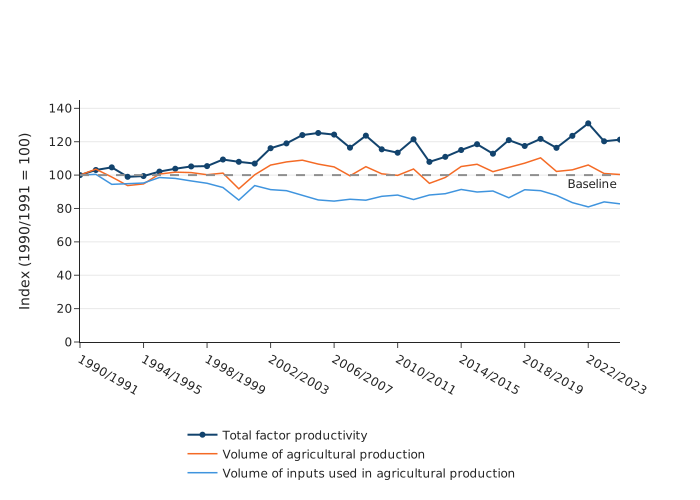
E4: Efficiency of agricultural production measured by Total Factor Productivity, England, 1990/1991 to 2024/2025
Source: Department for Environment, Food & Rural Affairs
Download the data for this chart in .csv format
Notes on Component
The data are reported on a March to February year, which is the average accounting year for respondents to the Farm Business Survey.
As of the 2024 update, data on the volume of agricultural production and the volume of inputs used in agricultural production (from indicators E2 and E3 respectively) have been added to this chart to aid interpretation.
Trend Description
Overall productivity is driven by both output and input components. Total Factor Productivity of the agricultural industry in England was 21.2% higher in 2024/2025 than it was in 1990/1991. This overall long-term increase has been driven by both increased outputs and a fall in inputs, although the separate trends (see indicators E2 and E3) have followed different patterns. There is considerable annual variation, driven mainly by variation in output volumes. More recently, following an increase to an all-time high of 131.01 in 2022/2023, Total Factor Productivity of the agricultural industry fell to 120.26 in 2023/2024 before increasing slightly (0.8%) to 121.24 in 2024/2025.
Assessment: E4
An increase in efficiency of agricultural production as measured by Total Factor Productivity has been observed over the short-, medium- and long-term assessment periods. However, it is not possible to simplistically categorise any change as either an ‘improvement’ or ‘deterioration’ for the environment as this will depend on the farming practices driving change.
Change since 2018 has also been assessed. There has been an increase in efficiency of agricultural production measured by Total Factor Productivity since 2018.
Further information on this assessment, along with details on the methodology, is provided in the Assessment guide page. Summaries by Environmental Improvement Plan goal and information on indicator links are presented in the Assessment results pages
| Component | Subcomponent | Period | Date range | Percentage change | Smoothing function | Assessment of change |
|---|---|---|---|---|---|---|
| E4 | Total factor productivity | Short term | 2019/2020 to 2024/2025 | 5.84 | Loess | Change (increasing) |
| E4 | Total factor productivity | Medium term | 2014/2015 to 2024/2025 | 8.71 | Loess | Change (increasing) |
| E4 | Total factor productivity | Long term | 1990/1991 to 2024/2025 | 26.87 | Loess | Change (increasing) |
Note that assessment categories were assigned based on smoothed data, so percentage change figures in Table E4 may differ from unsmoothed values quoted elsewhere. It is not possible to define a simplistic desired direction of change for this indicator so we cannot assign an ‘improvement’ or ‘deterioration’ label to these results.
Metadata
| Primary Goal | Resources |
|---|---|
| Relevant Goals | Resources |
| Relevant Targets | Ensuring that food is produced sustainably and profitably |
| Natural Capital | Service or benefit associated with natural capital asset |
| Related Commitments | None |
| Geographical Scope | England |
| Development Status | Final |
| First Reported | 2019 |
| Latest Data | 2024/2025 |
| Last Updated | Mar 2026 |
Return to Environmental Indicator Framework Collection Page
E5: Percentage of the annual growth of trees in English woodlands that is harvested
Short Description
This indicator shows changes in the percentage of annual softwood and hardwood growth in England that is harvested annually. Separate statistics are available for softwood, hardwood, and both in total. This indicator helps us to better understand the levels of, and trends in, the economic productive utilisation of English timber resources as a part of sustainable forest management policies and practices.
The underlying data sources are Accredited Official Statistics from Forest Research on UK Wood Production and Trade and National Forest Inventory forecasts of increase (increment) in the volume of wood that grows in England.
Readiness and Links to Data
Data on the percentage of the annual growth of trees in English woodlands that is harvested are published in the Forestry Commission’s Key Performance Indicators Reports. The total volume of timber harvested that forms a component of this indicator is shown in the report for indicator 'E6: Volume of timber brought to market per annum from English sources'.
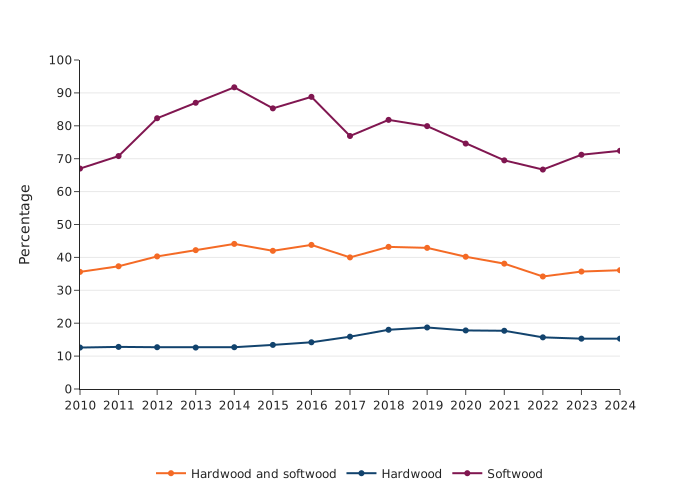
E5: Percentage of the annual growth of trees in English woodlands that is harvested, 2010 to 2024
Source: Forestry Commission
Download the data for this chart in .csv format
Trend Description
The percentage of softwood growth in England which is harvested has fluctuated between 66.7% and 91.7% over the 15 years for which these statistics are reported. The most recent year's figure is similar to that reported in 2010 when the time series began (72.4% and 67.0% respectively). These results reflect continued sustainable management of softwood resources. The percentage of hardwood growth which is harvested has increased slightly, although it remains much lower than the equivalent softwood figure (ranging between 12.6% and 18.7% over the same 15-year period), reflecting a lower level of active management of broadleaved woodland for timber supplies.
Assessment: E5
There has been a decrease (deterioration) in the percentage of total annual growth of trees in English woodlands that is harvested (hardwood and softwood combined) over the short- and medium-term assessment periods. However, there has been little or no change over the long-term assessment period.
Change since 2018 has also been assessed, over which there has been a decrease (deterioration) in the percentage of total annual growth of trees in English woodlands that is harvested (hardwood and softwood combined).
Further information on this assessment, along with details on the methodology, is provided in the Assessment guide page. Summaries by Environmental Improvement Plan goal and information on indicator links are presented in the Assessment results pages.
| Component | Subcomponent | Period | Date range | Percentage change | Smoothing function | Assessment of change |
|---|---|---|---|---|---|---|
| E5 | Hardwood and softwood | Short term | 2019 to 2024 | -15.85 | Unsmoothed | Deterioration |
| E5 | Hardwood and softwood | Medium term | 2014 to 2024 | -18.14 | Unsmoothed | Deterioration |
| E5 | Hardwood and softwood | Long term | 2010 to 2024 | 1.40 | Unsmoothed | Little or no change |
Note that percentage change in Table E5 refers to the difference seen from the first to last year in the specified date range.
Metadata
| Headline | Not applicable |
|---|---|
| Primary Goal | Resources |
| Relevant Goals | Resources |
| Relevant Targets | Increasing timber supplies |
| Natural Capital | Service or benefit associated with natural capital asset |
| Related Commitments | Some component statistics that make up this indicator are provided at UK level to Forest Europe for publication in the State of Europe’s Forests |
| Geographical Scope | England |
| Development Status | Final |
| First Reported | 2019 |
| Last updated | Dec 2025 |
| Latest Data | 2024 |
Return to Environmental Indicator Framework Collection Page
E6: Volume of timber brought to market per annum from English sources
Short Description
This indicator shows changes in the volume of commercial timber brought to market from woodlands in England by Forestry England from the nation’s forests, and by other managers of woodland in England. It is a measure of the level of sustainable management of woodland assets for economic productive purposes. The data are Accredited Official Statistics from Forest Research on UK Wood Production and Trade.
Readiness and Links to Data
Data on the volume of timber brought to market from English sources are published annually in the Forestry Commission’s Key Performance Indicators Reports. The data shown in this indicator are set in context of overall increases in tree growth in the report for indicator 'E5: Percentage of the annual growth of trees in English woodlands that is harvested'.
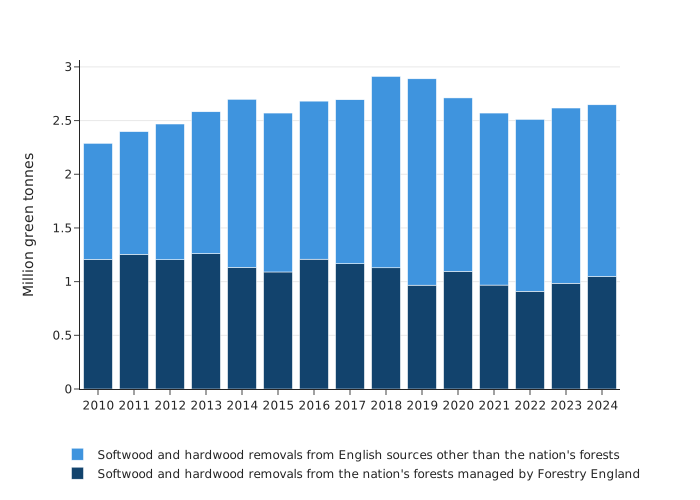
E6: Volume of timber brought to market from English sources, 2010 to 2024
Source: Forestry Commission
Download the data for this chart in .csv format
Notes on Figure
The statistics for 2024 shown here have been updated from Forestry Statistics 2025. Due to rounding these statistics may not sum to the total volume of timber brought to market per annum from English sources reported in the source publication (Forestry Commission’s Key Performance Indicators).
The 2023 datapoint has been revised since the previous version of this indicator in line with the latest data from Forestry Statistics 2025.
Trend Description
The total annual volume of softwood and hardwood timber brought to market from all sources in England has increased from 2.3 million green tonnes in 2010 to 2.6 million green tonnes in 2024. Total removals from the nation’s forests managed by Forestry England have fallen by 13.2% over this period, whereas removals from other English sources have increased by 47.9%.
Assessment: E6
A decrease (deterioration) was observed for the total volume of timber brought to market per annum from all English sources (softwood and hardwood combined) over the short-term assessment period. Over the medium-term assessment period, little or no change was observed, while an increase (improvement) was seen over the long-term assessment period.
Change since 2018 has also been assessed, over which there was a decrease (deterioration) observed for the total volume of timber brought to market per annum from all English sources (softwood and hardwood combined).
Further information on this assessment, along with details on the methodology, is provided in the Assessment guide page. Summaries by Environmental Improvement Plan goal and information on indicator links are presented in the Assessment results pages.
| Component | Subcomponent | Period | Date range | Percentage change | Smoothing function | Assessment of change |
|---|---|---|---|---|---|---|
| E6 | All English sources (softwood and hardwood combined) | Short term | 2019 to 2024 | -8.38 | Unsmoothed | Deterioration |
| E6 | All English sources (softwood and hardwood combined) | Medium term | 2014 to 2024 | -1.89 | Unsmoothed | Little or no change |
| E6 | All English sources (softwood and hardwood combined) | Long term | 2010 to 2024 | 15.69 | Unsmoothed | Improvement |
Note that percentage change in Table E6 refers to the difference seen from the first to last year in the specified date range.
Metadata
| Headline | Not applicable |
|---|---|
| Primary Goal | Resources |
| Relevant Goals | Resources |
| Relevant Targets | Increasing timber supplies |
| Natural Capital | Service or benefit associated with natural capital asset |
| Related Commitments | Related statistics on total UK fellings are provided to Forest Europe for publication in the State of Europe’s Forests |
| Geographical Scope | England |
| Development Status | Final |
| First Reported | 2019 |
| Last updated | Dec 2025 |
| Latest Data | 2024 |
Return to Environmental Indicator Framework Collection Page
E7: Healthy soils
Short Description
Healthy soils underpin the multiple functions of soils in food production, supporting wildlife, regulating water and regulating climate. More work is being done to define exactly what the indicator will include but it could include physical properties (such as a measure of soil structure), chemical properties (such as soil carbon, nutrients and pH), bare ground (soil) and a measure of soil biological activity. This indicator is not limited to agricultural soils. Further development of statistically and scientifically robust national monitoring programmes may be needed to provide data for this indicator.
Readiness and Links to Data
This indicator is not available for reporting in 2025 as further development work is required prior to inclusion in the Environmental Indicator Framework. The indicator will be published when sufficient data have been collected through the Natural Capital and Ecosystem Assessment (NCEA) programme. The indicator will use data currently being gathered on soil characteristics (physical, chemical and biological) and land use to show how different soils are contributing to different ecosystem services as a measure of soil health.
The final indicator will be drawn from a soil health indicator produced by the Joint Nature Conservation Committee (JNCC). A proof of concept (JNCC report 737) was published in 2023, and JNCC has recently published their soil indicator methods (JNCC report 763) which summarises the modelling methods that will be used to produce the indicator. An Annex has been published alongside, which presents a pre-experimental dataset indicative of the approach from Defra's NCEA programme.
National soil monitoring under the NCEA programme began in 2023. The delivery of an up-to-date and comprehensive soil health baseline through the England Ecosystem Survey (EES) and the National Forest Inventory+ (NFI+) is a priority of the programme. This is a 5-year survey which will have analysis-ready data from earlier years of the sampling being released from December 2025. The current phase of the programme has had capital investment to achieve 2 of the 5 years needed for a soil health baseline. The next phase of capital investment, needed to complete and publish the baseline in the 2028/2029 financial year, will be included in Defra's research and development spending review.
JNCC will finalise the indicator models based on feedback from expert panels and adapt them to utilise new data from the EES and the NFI+ (strategic surveys under the NCEA programme). The indicator will use data gathered through the NCEA to show how different soils are contributing to different ecosystem services as a measure of soil health and will contribute to a comprehensive and robust baseline for soil health by 2029. However, JNCC is planning to publish an initial, interim statistic, which can be improved on iteratively to enhance the indicator enabling the disaggregation of results by land use and soil type, for example.
Some data on aspects of soil health are already published in the Countryside Survey reports.
Metadata
| Headline | Production and harvesting of natural resources |
|---|---|
| Primary Goal | Resources |
| Relevant Goals | Resources |
| Relevant Targets | Improving our approach to soil management: by 2030 we want all of England’s soils to be managed sustainably, and we will use natural capital thinking to develop appropriate soil metrics and management approaches |
| Natural Capital | Condition of assets - land |
| Related Commitments | Climate Change Risk Assessment under the Climate Change Act (2008) |
| Geographical Scope | England |
| Development Status | In development |
| First Reported | NA |
| Last updated | May 2025 |
| Latest Data | NA |
Return to Environmental Indicator Framework Collection Page
E8: Efficient use of water
Short Description
Climate change and a growing population will put increasing pressure on our water supplies. Ambitious reductions in water consumption and leakage have a significant role in maintaining secure supplies and protecting the environment. This indicator shows changes in the efficient use of water, focussing on (a) leakage and (b) per capita consumption. Leakage and per capita household consumption of water in England are existing metrics reported to The Water Services Regulation Authority (Ofwat) and the Environment Agency.
Readiness and Links to Data
The indicator presented here reports on Water leakage (E8a) and average per capita water consumption (E8b). The data are published in the Water resources 2024-2025: analysis of the water industry's annual water performance, summarising the progress across wholesale water companies in England on key water demand and supply metrics. This data differs from the Ofwat data reported previously in this indicator on water companies in England and Wales where total leakage and per capita household consumption figures are reported annually as three-year moving averages. The main difference in results is that data are presented on a year-by-year basis instead of showing the average over a three-year period. The revised approach will highlight the variability of leakage and water consumption year on year.
Notes on Indicator
Indicator E8b was revised in December 2025 following the identification of a methodological error in the processing of the input data. This correction required updates to the underlying time series across the entire year range. Despite these revisions, the outcomes of the short-, medium-, and long-term assessments remain unchanged.
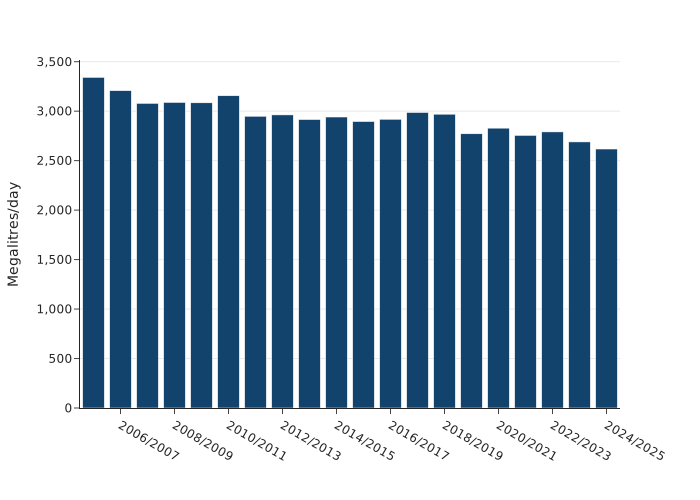
E8a: Water leakage in England, 2005/2006 to 2024/2025
Source: Environment Agency
Download the data for this chart in .csv format
Notes on Component
Data are reported on each financial year from April to March of the following year.
Trend Description
In 2024/25, total water leakage in England was recorded at 2,617 megalitres per day, 22% lower than that recorded in 2005/2006, which equates to a reduction of 724 megalitres per day. From 2023/24 to 2024/25, there has been a reduction of 73 megalitres per day (3%).
Assessment: E8a
An improvement was observed for water leakage in England (E8a) over the short, medium, and long term. This assessment does not consider whether any improvements seen in the medium or long term would be on a sufficient scale for meeting targets. See ‘Readiness and links to data’ section for this indicator for reference to water companies’ reporting against targets. Change since 2018 has also been assessed. There has been an improvement (reduction) in water leakage since 2018.
Further information on this assessment, along with details on the methodology, is provided in the Assessment guide page. Summaries by Environmental Improvement Plan goal and information on indicator links are presented in the Assessment results pages.
| Component | Period | Date range | Percentage change | Smoothing function | Assessment of change |
|---|---|---|---|---|---|
| E8a | Short term | 2019/2020 to 2024/2025 | -8.46 | Loess | Improvement |
| E8a | Medium term | 2014/2015 to 2024/2025 | -10.37 | Loess | Improvement |
| E8a | Long term | 2005/2006 to 2024/2025 | -20.19 | Loess | Improvement |
Percentage change refers to the difference seen between the first and last years in the specified date range.
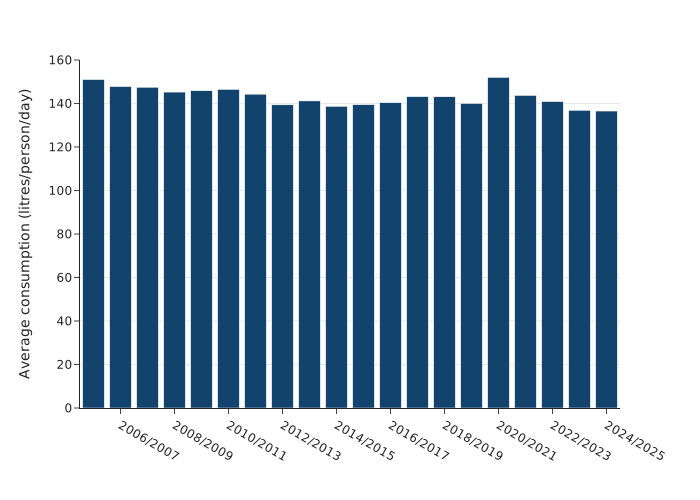
E8b: Per capita water consumption in England, 2005/2006 to 2024/2025
Source: Environment Agency
Download the data for this chart in .csv format
Notes on Component
Data are reported on each financial year from April to March of the following year.
Trend Description
Per capita household water consumption has fallen during the time period covered by this indicator, from an average of 151.0 litres per person per day in 2005/2006 to an average of 136.5 litres per person per day in 2024/2025, a 9.6% reduction.
Assessment: E8b
Per capita water consumption in England (E8b) showed little or no change in the medium term and decreased (improved) over the short and long term. This assessment does not consider whether any improvements would be on a sufficient scale for meeting targets. See ‘Readiness and links to data’ section for this indicator for reference to water companies’ reporting against targets. Change since 2018 has also been assessed. Per capita water consumption has shown little or no change over this period.
Further information on this assessment, along with details on the methodology, is provided in the Assessment guide page. Summaries by Environmental Improvement Plan goal and information on indicator links are presented in the Assessment results pages.
| Component | Period | Date range | Percentage change | Smoothing function | Assessment of change |
|---|---|---|---|---|---|
| E8b | Short term | 2019/2020 to 2024/2025 | -5.14 | Loess | Improvement |
| E8b | Medium term | 2014/2015 to 2024/2025 | -2.44 | Loess | Little or no change |
| E8b | Long term | 2005/2006 to 2024/2025 | -9.19 | Loess | Improvement |
Percentage change refers to the difference seen between the first and last years in the specified date range.
Metadata
| Primary Goal | Water |
|---|---|
| Relevant Goals | Water, Resources |
| Relevant Targets | Supporting OFWAT’s ambitions on leakage, minimising the amount of water lost through leakage year on year, with water companies expected to reduce leakage by at least an average of 15% by 2025, Work with the water industry to set a personal consumption target and agree cost-effective measures to meet it |
| Natural Capital | Service or benefit associated with natural capital asset |
| Related Commitments | Leakage and per capita consumption figures are reported annually as part of a water company’s statutory annual review of its water resources management plan, Relevant to Sustainable Development Goals 11 and 13 |
| Geographical Scope | England, and by water company area for those with customers wholly or mainly in England. |
| Development Status | Final |
| First Reported | 2021 |
| Latest Data | 2024/2025 |
| Last Updated | Feb 2026 |
Return to Environmental Indicator Framework Collection Page
E9: Percentage of our seafood coming from healthy ecosystems, produced sustainably
Short Description
This is a composite indicator that tracks the sustainability of seafood, fish and aquaculture products. It combines metrics on production (covering harvesting and subsequent preparation), management and impact on the environment. The indicator will use the data collected for the management of fish stocks to assess whether harvesting rates remain within sustainable limits. It will use equivalent data for aquaculture production. These data on harvesting and production will then be integrated with data on the impact of these activities on the wider environment together with social and economic data to provide an assessment of the sustainability of our seafood.
Readiness and Links to Data
An interim indicator is presented here that includes metrics that have been developed and compiled by the Centre for Environment, Fisheries and Aquaculture Science (Cefas) in a research report to Defra: Percentage of our seafood coming from healthy ecosystems, produced sustainably (project code EV0809).
Two components are presented here: E9a shows the live weight of quota fish and shellfish landed into English ports by sustainability outcome. The sustainability outcomes are drawn from the same data source as 'C10: Productive seas: fish and shellfish stocks fished sustainably'. C10 shows the proportion of stocks at management thresholds, whereas E9a shows landings split by sustainability outcomes to detail the status of our seafood. Additional charts, disaggregating landings by pelagic and demersal species, are available in the source publication. Some data on non-quota shellfish are also available, however sustainability status of these stocks is not currently available so they have not been included here. The data included here are for landings from any vessel size and nationality into ports in England, but the indicator does not track the amounts that are processed for human consumption in England.
E9b is a matrix showing trends in a range of production and environmental sustainability metrics for bivalve mollusc and finfish aquaculture sectors. It is presented this way as a robust method for combining the metrics is not currently available. Similar metrics for emerging aquaculture sectors (crustacean shellfish and seaweed) are not currently available.
Further development would be required to meet the E9 short description. English seafood supply chains would need to be examined not just for amounts produced, but also imported, exported, processed, consumed domestically as seafood, used for by-products, and lost as waste. The metrics for environmental health and pressures from seafood production activities would need refining to reflect environmental outcomes. Socio-economic metrics assessing the contribution of seafood activities to coastal and rural communities would need incorporating. A robust method for combining diverse metrics may also be needed. Such development would require collaboration across the various bodies managing English seafood.
This indicator is currently under review and its format may change. Therefore, we would welcome any feedback, particularly on the usefulness and value of this indicator, via environmentalindicators@defra.gov.uk.
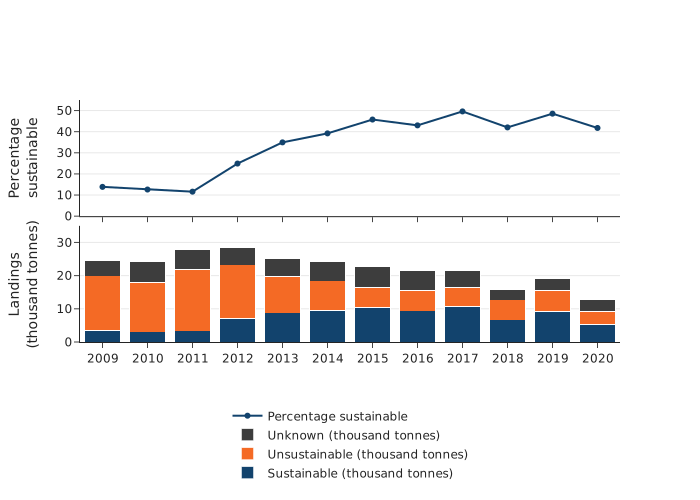
E9a: Landings of quota fish and shellfish into English ports by sustainability status, 2009 to 2020
Source: Centre for Environment, Fisheries and Aquaculture Science, Department for Environment, Food and Rural Affairs
Download the data for this chart in .csv format
Notes on Figure
This chart shows how much fish and shellfish (live weight) from quota stocks is landed at English ports from fisheries managed sustainably, unsustainably or with unknown status. For the percentage of landings from sustainably managed fisheries, refer to the upper graph. For total landings of quota fish and shellfish by sustainability status, refer to the lower graph.
Sustainable fisheries landings are those from fish stocks that either have a high spawning stock biomass (greater than or equal to MSY Btrigger) and are fished at or below the level capable of producing Maximum Sustainable Yield (FMSY), or have a high spawning stock biomass and are fished within a range consistent with internationally agreed management plans (up to FMSY upper). Unsustainable fisheries landings are those from fish stocks that either have a low spawning stock biomass (less than MSY Btrigger) or from fish stocks that are fished above limits (that is, FMSY or FMSY upper where applicable).
Trend Description
The total amount of fish and shellfish from quota stocks landed at English ports has decreased since the start of the time series, from 24,500 tonnes in 2009 to 12,700 tonnes in 2020, peaking at 28,500 tonnes in 2012. Of these, the amount landed at English ports from sustainably managed fisheries has increased from 3,400 tonnes in 2009 (14% of the total) to 5,300 tonnes in 2020 (42%). This peaked in 2017, at a value of 10,600 tonnes (50%). The amount of fish and shellfish from quota stocks landed from unsustainably managed fisheries has decreased from 16,500 tonnes in 2009 (67%) to 3,900 thousand tonnes in 2020 (31%).
Assessment: E9a
Assessments of change are made for the percentage of landings in English ports sourced from sustainably managed fisheries over the short and medium-term periods. In both cases there has been an improvement recorded.
Change since 2018 has also been assessed. There was little or no change in the percentage of landings in English ports sourced from sustainably managed fisheries since 2018. However, this is based on only 3 data points so should be considered as indicative and not evidence of a clear trend.
The assessment results reported here are not directly comparable with other analyses published elsewhere that use different methodologies to explore these indicator components.
Further information on this assessment, along with details on the methodology, is provided in the Assessment guide page. Summaries by Environmental Improvement Plan goal and information on indicator links are presented in the Assessment results pages.
| Component | Subcomponent | Period | Date range | Percentage change | Smoothing function | Assessment of change |
|---|---|---|---|---|---|---|
| E9a | Percentage sustainable | Short term | 2015 to 2020 | -2.67 | Loess | Little or no change |
| E9a | Percentage sustainable | Medium term | 2010 to 2020 | 211.78 | Loess | Improvement |
| E9a | Percentage sustainable | Long term | 2009 to 2020 | 271.33 | Loess | Improvement |
Note that assessment categories for the short and long term were assigned based on smoothed data, so percent change figures in Table E9a may differ from unsmoothed values quoted elsewhere. Percentage change refers to the difference seen from the first to last year in the specified date range.
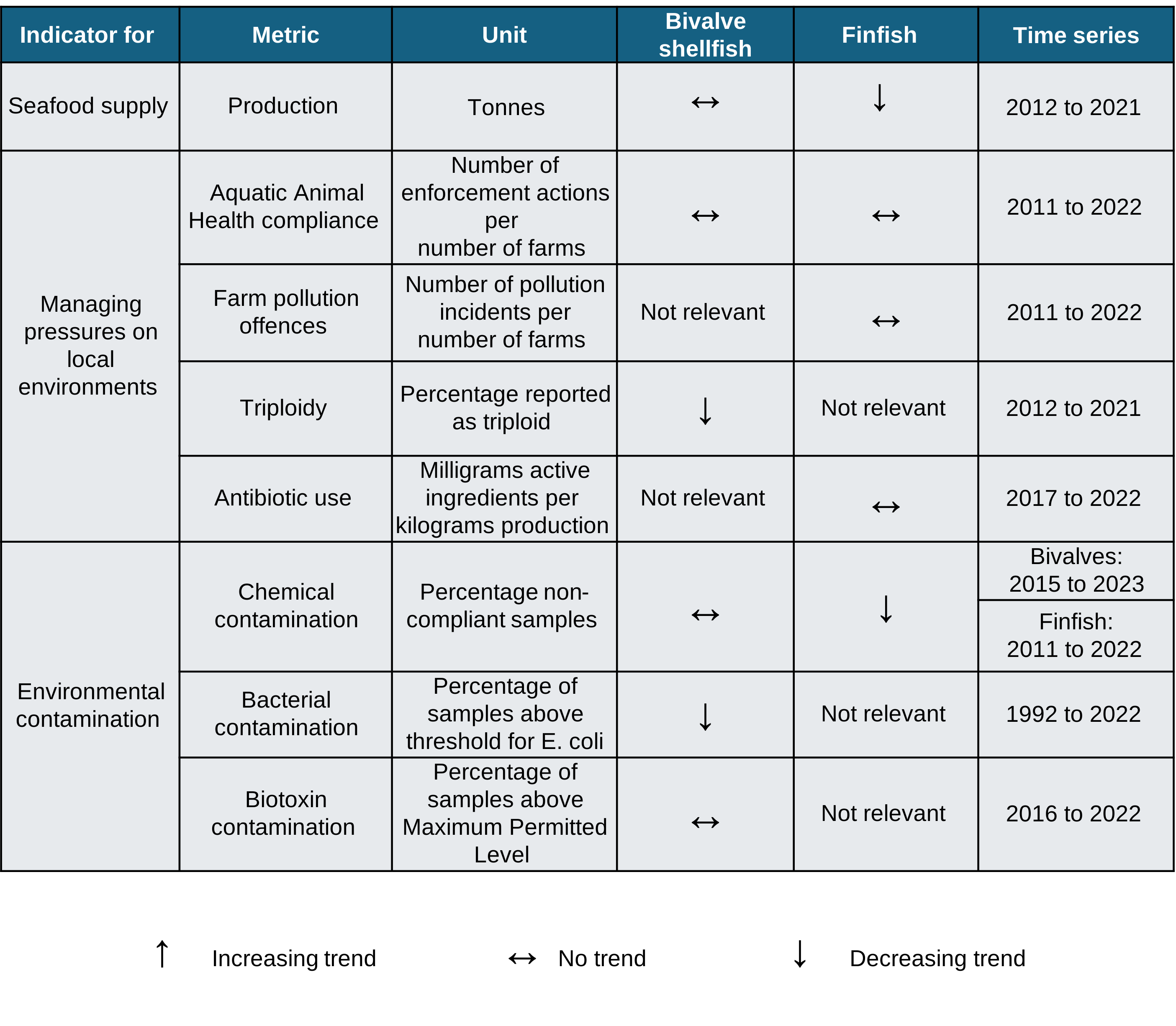
E9b: Matrix of environmental management metrics for English aquaculture, 1992 to 2023
Source: Centre for Environment, Fisheries and Aquaculture Science, Environment Agency, Veterinary Medicines Directorate, Food Standards Agency
Download the data for this chart in .csv format
Notes on Figure
Only statistically significant trends over the full time series are identified in figure E9b. Full details of the individual metrics are available in the source publication, including links to the underlying data or statistics.
Finfish refers to farmed rainbow trout, common carp, brown trout, other freshwater fishes and other salmonids. Bivalve shellfish refers to farmed sea mussels, Pacific cupped oyster, native flat oyster, cockle and clams.
Production refers to the live weight at harvest reported in tonnes for seafood (and angling for finfish).
The length of time series differs between metrics due to data availability, which can affect the identification of trends. Furthermore, for some metrics: not all farmed bivalve shellfish or finfish species may be included due to data availability or relevance; published data may be for the UK rather than just England; wild stocks may be included if not differentiated in the source data; the number of samples the annual statistics reflect may change over time.
Note:
-
Triploidy relates to just Pacific oyster - the production of triploid (sterile) stock in place of diploid stock should limit spread of this non-native species outside of farms.
-
Statistics for finfish antibiotic use and chemical contamination are available for trout at UK level.
-
Chemical contamination of bivalve shellfish data includes wild stocks, and monitoring is risk-based so sample numbers are low.
-
Bacterial contamination statistics for bivalve shellfish are for sea mussels, Pacific oyster and native oyster, and include wild stocks.
-
Biotoxin contamination statistics are for all bivalve shellfish species sampled, include wild stocks, and all biotoxins.
-
Biotoxins are naturally produced by some algal species, can accumulate in the tissues of bivalve molluscs, and cause severe health effects if ingested in sufficient quantities.
Trend Description
i) Seafood Supply:
Overall production of finfish in aquaculture has decreased over the period 2012 to 2022, whereas there is no trend in the production of bivalve shellfish. The total tonnage of these 2 aquaculture sectors was 12,500 tonnes in 2021, down from 13,800 tonnes in 2012.
ii) Managing pressures on local environments:
There is no trend in the proportion of farms subject to enforcement actions under the Aquatic Animal Health Regulations 2009 over the period 2011 to 2022, averaging 1.5% and 3% per year of bivalve shellfish and finfish farms respectively. Similarly, there is no trend in the proportion of finfish farms associated with causing pollution incidents, averaging 0.6% of farms per year. There is also no trend in antibiotic use in trout farms.
The percentage of Pacific oyster production reported as triploid has decreased over the period 2012 to 2021, from 50% to 33%.
iii) Environmental Contamination:
The percentages of non-compliant samples for chemicals in trout decreased from 1% in 2011 to 0% in 2022, whereas this exhibits no trend in bivalve shellfish, averaging 0.3% between 2015 and 2022.
The annual percentage of bivalve shellfish samples above a threshold for bacterial contamination (230 E. coli per 100g) has decreased, from 63% in the 1990s, but has remained around 45% in the 2020s.
There is no trend in the percentage of samples exceeding maximum permitted levels for biotoxins, averaging 3.5% per year.
Assessment: E9b
No assessment of change was undertaken for this indicator as a suitable time series is not yet available in the Environmental Indicator Framework.
Metadata
| Headline | Not applicable |
|---|---|
| Primary Goal | Restored nature |
| Relevant Goals | Restored nature, Resources |
| Relevant Targets | Ensuring that all fish stocks are recovered to and maintained at levels that can produce their maximum sustainable yield |
| Natural Capital | Service or benefit associated with natural capital asset |
| Related Commitments | Convention for the Protection of the Marine Environment of the North-East Atlantic (OSPAR), International Council for Exploration of the Sea (ICES), Relevant to Sustainable Development Goals 12 and 14 |
| Geographical Scope | England; UK for some elements of E9b |
| Development Status | Interim |
| First Reported | 2024 |
| Last updated | May 2025 |
| Latest Data | 2023 |