Enterprise Space Category: Supply Chain Risk Industry Round Table
Published 8 June 2026

© Crown copyright 2026
This publication is licensed under the terms of the Open Government Licence v3.0 except where otherwise stated. To view this licence, visit nationalarchives.gov.uk/doc/open-government-licence/version/3 or write to the Information Policy Team, The National Archives, Kew, London TW9 4DU, or email: psi@nationalarchives.gov.uk.
Where we have identified any third party copyright information you will need to obtain permission from the copyright holders concerned.
This publication is available at https://www.gov.uk/government/publications/enterprise-space-category-supply-chain-risk/enterprise-space-category-supply-chain-risk-industry-round-table
The Enterprise Space Category (ESC)
The Enterprise Space Category has established a cross-government Category team, with representatives from Defence Digital, Defence Equipment and Support (DE&S), Defence Science and Technology Laboratory (Dstl), Department for Science, Innovation and Technology (DSIT), Crown Commercial Services (CCS), Air Command and Space Command under the governance of a single Space Category Strategy.
Objectives for the Enterprise Space Category
- Continue to deliver critical government capabilities in space.
- Access market innovation in a timely and agile manner.
- Ensure coherence and alignment across the Ministry of Defence (MOD) and wider Government in terms of procurement within Space.
- Encourage the growth and further development of the UK Space Industry, providing improved Operational Advantage (through UK innovation) and Freedom of Action.
- Improve value for money in the procurement of solutions in the Space Category.
Benefits
- Delivering awareness and coherence in Space sourcing as one Government.
- Understand the value that early engagement with Commercial unlocks.
- Share market insights and good practice.
- Triage the Space value chain and collaborate on Category and Commercial Strategies.
- Identify benefits that contribute to delivery of outcomes, value for money and social value.
Delivered through
- Establishing cross-Government Space Category Communities of Practice.
- Develop Cross Government Space Category Strategy and collaborative Workstreams.
- Creation of a single Space Pipeline.
- Collaborate on Technology Roadmaps and Market Engagement.
- Sharing Training and Development offerings.
- Acting as one collaborative team.
Category annual spend by department or Top Level Budget (TLB) (%)
| Department | Percentage |
|---|---|
| Air Command | 2% |
| DE&S | 8% |
| Defence Digital | 79% |
| Dstl | 3% |
| UKSA | 3% |
| Crown Commercial Services (CCS) | 5% |
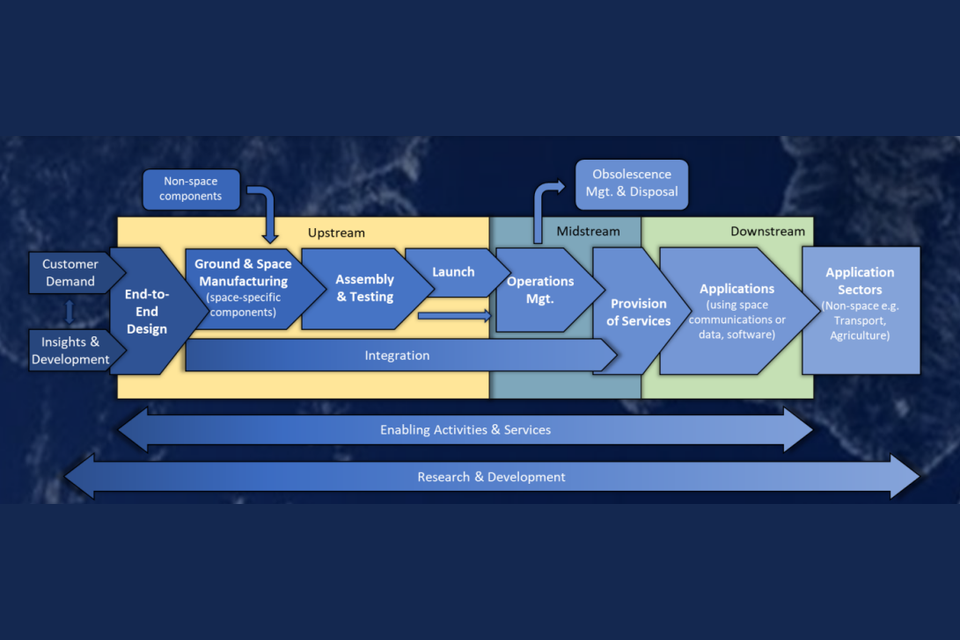
The diagram shows a simplified space-sector value chain that begins with customer demand and insights feeding into end‑to‑end design, followed by upstream activities such as manufacturing, assembly and testing, and launch. It then moves into midstream operations management and the provision of services, before reaching downstream uses where space-based data and communications are turned into applications for sectors like transport and agriculture. Integration runs through upstream and midstream activities, while enabling activities and research and development support the entire lifecycle, alongside considerations such as component supply and eventual disposal.
Also see the Enterprise Space Category Tree.
Supply chain risk
The purpose of the session was to gather Industry insights and help inform how Government can better understand, manage and mitigate supply chain risk in the Space Industry.
Why is supply chain risk important?
- Government buyers sit at the top of complex supply chains yet often have very poor visibility (structure, risks, vulnerabilities).
- Historically, we have largely relied on our Tier 1/Primes to manage the supply chain on our behalf, despite us ultimately owning the delivery risk.
- This has often led to reactively responding to supply chain issues after they arise.
- There is an increasing focus across Defence, Government and wider industry on resilience as a key metric of supply chain performance (rather than simply efficiency, or cost).
- Drive towards supply chains that have fewer vulnerabilities – just in case versus just in time
Strategy and policy context
- The Integrated Review (2021) – Stated desire to strengthen the resilience of our critical supply chains.
- Space Industrial Plan (2024) – One of the Missions to 2030 is to increase supply chain resilience.
- Defence Industrial Strategy (DIS) (2025) – “The conflict in Ukraine has provided a stark reminder of the importance of resilient supply chains and security of supply. We need to better understand our supply chain vulnerabilities, where we need to bolster business in the UK, and strengthen our approach to managing critical supply chains to guarantee continued access.”
- The DIS also highlights how difficult it is to gather meaningful and timely supply chain data.
The Department for Business and Trade (DBT) Supply Chains Resilience Framework (2022) recommends 5 options to strengthen long-term resilience:
- Diversification. Identify alternative sources of supply to create flexibility in the supply chain.
- International partnerships. Work with international partners to identify common challenges and strengthen the resilience of international supply chains and systems.
- Stockpiling and surge capacity. Identify where it may be beneficial to hold stocks or strategic reserve components or goods which are vulnerable or at risk.
- Onshoring. Identify whether increasing or expanding domestic capacity might be helpful in reducing risks.
- Demand management. Identify whether it may be beneficial to manage the demand for a product considering substitutes and alternatives, innovation and circularity.
ESC procurement perspectives
SKYNET 6 Wideband Satellite Systems (WSS)
WSS uses 2 frameworks to improve supply chain security, transparency and resilience:
Assured capability
- Significant supply chain visibility (based on system component breakdown)
- Targeted security measures in the supply chain
Technological capital
- Effectively mandates ‘on-shoring’ key elements of the satellite manufacture supply chain.
Perception of risk growing?
Engagements with companies across our procurements have highlighted a view of increasing supply chain risk in the space industry, relating to issues such as:
- Uncertainty over export controls and trade policies
- Critical material risks
- Bottleneck suppliers
WSS supply chain mechanisms
Assured Capability:
- Assurance Categories
- Protective Measures
Technological Capital:
- Design Authority in UK
- Assembly, Integration and Test (AI&T) in UK
- Critical Technologies in UK
Supply chain risk: discussion sessions
Discussions were held on:
What supply chain vulnerabilities and single points of failure are present in the space industry?
For example:
- Where is the most critical single-point dependency.
- Which element of the supply chain carries the highest risk?
- Where does Government procurement create risk?
What are the strategic / global disruption and geopolitical risks impacting your supply chain?
For example:
- Which part of the supply chain is most exposed to global disruption?
- What risks do you think the MOD underestimates?
- Impact of global trade controls on supply availability and cost?
Next steps
- For Space specifically we will continue to engage with industry quarterly via focussed Enterprise Space Category Round Tables.
- We would welcome any feedback on the session and please share any ideas that we didn’t have time to discuss by email: ukstratcomdd-cm-space-esc@mod.gov.uk