Education Estates Strategy: a decade of national renewal
Updated 16 February 2026
Applies to England

© Crown copyright 2026
This publication is licensed under the terms of the Open Government Licence v3.0 except where otherwise stated. To view this licence, visit nationalarchives.gov.uk/doc/open-government-licence/version/3 or write to the Information Policy Team, The National Archives, Kew, London TW9 4DU, or email: psi@nationalarchives.gov.uk.
Where we have identified any third party copyright information you will need to obtain permission from the copyright holders concerned.
This publication is available at https://www.gov.uk/government/publications/education-estates-strategy/education-estates-strategy-a-decade-of-national-renewal
Foreword from the Secretary of State for Education
Education is at the heart of this government’s mission to break down barriers to opportunity so that every child gets the best start in life and our children and young people can achieve and thrive. Today, the government sets out its plan to fix the foundations of the education estate so our schools and Further Education colleges across the country can deliver opportunity for all.
This starts with the buildings where learning happens – from early years through to post-16. Investing in safe, high-quality and inspiring school and college buildings is essential to delivering world-class education, creating the conditions for our children and young people to succeed.
The benefits are clear, yet we know the challenges are real. Sixteen years after the cancellation of the Building Schools for the Future programme, too much of the school and college estate is in poor condition. We know what can happen when it goes wrong with disruption to education as we have seen with Reinforced Autoclaved Aerated Concrete.
After years of underinvestment, too many children are learning in buildings that have already deteriorated, are in need of repair and at risk of overheating. At the same time, the availability of space and resources has not kept up with the need for specialist provision to support children with special educational needs.
That is why this government will turn the page on years of neglect through a 10 year plan for the education estate, with a decade of national renewal for schools and colleges across England backed by unprecedented long-term funding. Through our Plan for Change we are going further than ever before to ensure excellence everywhere. The education estate should match the ambitions we have for our young people with high-quality school and college buildings that sit at the heart of communities across the country supporting children from early years through to post-16.
We will continue to rebuild schools in the worst condition, but more needs to be done so our 22,000 schools and colleges are well managed, maintained and where necessary renewed so they can last for decades, alongside rebuilding those in most need.
Children, families and communities are at the core of this strategy. This is more than just buildings – it’s about showing children and young people that their education matters, their futures matter, and this government is determined to give them the best possible start in life. We are committed to working with those responsible for overseeing or managing their buildings – school and college leaders, estate managers, local authorities, academy trusts – who have the local knowledge of their estates and their communities. Together, we will deliver a decade of national renewal for the education estate, with school and college buildings where all children and young people can achieve and thrive.
The Rt Hon Bridget Phillipson MP
Secretary of State for Education
Those that run our schools and colleges
Throughout this document we refer to Responsible Bodies. For the purpose of this document Responsible Body is a term used to refer to those responsible for managing the school and college estate. These are the bodies that oversee and/or manage the property and infrastructure within schools and colleges or have responsibility for the day-to-day management and maintenance of the school and college estate. The government provides policy, support programmes, funding and guidance.
There are approximately 2,800 Responsible Bodies. These include:
- multi-academy trusts
- single academy trusts
- local authorities
- voluntary-aided school bodies
- church trustees (including dioceses)
- non-maintained special schools and
- Further Education (FE) and sixth-form college corporations
The exact legal responsibility within those organisations differs depending on how they were founded or the governance of those organisations. More detail is given in annex C.
Executive Summary
The education estate is more than its buildings – it is a platform for opportunity, learning and community. With over 22,000 schools and colleges, the education estate supports the outcomes, health and wellbeing of over 10 million children, young people and adult learners. Schools and colleges sit at the heart of communities across England, creating anchor points by providing good early years, school and college places where they are needed alongside housing, healthcare and youth facilities.
More needs to be done for an education estate that supports opportunity for all, from early years to post-16, with an education estate that is safe, suitable, sustainable and sufficiently sized. Evidence suggests that learning in buildings that are in poor condition can have a negative impact on attainment. The physical and natural environment can have a significant positive impact on the wellbeing and engagement for pupils with special educational needs and disabilities (SEND). Our colleges support regional growth and productivity.
Historical underinvestment and a lack of long-term funding certainty and strategic planning have contributed to a rising maintenance backlog. Schools and colleges have had to patch and mend buildings that have already deteriorated. The estate is not resilient enough to climate change, with schools overheating in the summer and many facing flood risks. The stop-start nature of capital funding meant there was not enough long-term certainty to maximise investment in technology, training and skills.
The estate needs to be suitably sized at both a local and national level and be flexible to meet changing needs from children, young people and the community. We want more children and young people with SEND to achieve and thrive in their local mainstream school – including through inclusion bases[footnote 1] – and for parents to have access to high-quality local early education provision that is right for their child, including school-based nurseries.
There are approximately 2,800 Responsible Bodies – a term used to refer to those responsible for managing school and college estates – who have the local knowledge of their estate and are responsible for keeping their buildings safe and well-maintained. The government provides programmes, funding and guidance, but it has not been clear what is expected on estate management and some Responsible Bodies need more support than others.
The government inherited a significant challenge, and it will take time to realise our vision for the education estate. This strategy is our commitment to do so with a 10 year plan that puts us on a trajectory to fix the foundations. At its core is a shift to more proactive management, long-term strategic maintenance and renewal that prioritises condition need, risk and resilience alongside delivering high-quality new buildings where they are needed. We will continue to ensure there are high-quality places from early years to post‑16 but will go further in aligning place creation with our ambitions, including on SEND and skills. Our aim is to take a coherent and joined up approach across the education estate whilst recognising the variation and individual circumstances of schools, sixth-form colleges and FE colleges.
This is backed by investment in education capital of £38 billion for 2025-26 to 2029-30 – the highest since 2010. This supports delivery from 2025-26 to 2029-30 with long-term funding confirmed through to 2034-35 for capital maintenance funding for schools and colleges and the School Rebuilding Programme.
We will drive change by bolstering estate management and doing more to improve and renew the estate alongside targeted building and rebuilding. This is built on the foundation of:
- Ensuring the education estate works for communities across England by moving to more strategic planning at a local level so we can better reflect patterns of growth, demographic changes and plans for housing and essential infrastructure.
- Data and digital transformation so that, collectively with Responsible Bodies, we can make informed decisions on what interventions are needed and make it easier for Responsible Bodies to engage with our programmes, funding and support.
Manage the estate – we will enable all Responsible Bodies to proactively and effectively manage their estates by setting out clear standards and expectations alongside guidance, tools and data to support them. This includes:
- Launching a new digital service – Manage Your Education Estate – in February 2026 to bring together our estates guidance, data, tools, programmes and funding in one place with easier access for Responsible Bodies and a clear route to share information and communicate with the department.
- Asking Responsible Bodies to make an annual return from autumn 2026 on how they are meeting the expectations in the School Estate Management Standards and developing an equivalent standard for FE colleges by summer 2026.
- Starting pilots in 2026-27 to test the approach of Responsible Bodies collecting their own data in line with common standards with national rollout planned from autumn 2027. Common data and digital structures, standards and guides will be published from April 2026 to support Responsible Bodies. Two-way data sharing will be introduced by 2028 to provide both Responsible Bodies and the department with better insights on the estate.
- Supporting Responsible Bodies to better utilise their surplus land and buildings by working with the sector to develop a decision-making framework by autumn 2026 around the use of mainstream school space during demographic change. This will be informed by new pathfinders to pilot flexible use of surplus spaces for join up with Best Start Family Hubs, housing, neighbourhood health service and youth centres.
Improve and renew the estate – we will focus on long-term strategic maintenance and renewal to improve the condition of the education estate, its resilience to risks from climate change, and its suitability for the changing needs of pupils. This includes:
- Investing almost £3 billion per year by 2034-35 in capital maintenance and renewal to improve the condition of the school and college estate and providing Responsible Bodies with greater certainty on their future maintenance funding to support planning.
- Introducing a new programme by autumn 2028 to replace the Condition Improvement Fund to make it easier for eligible Responsible Bodies to access this maintenance funding so they will no longer need to submit full bids.
- Simplifying programmes and funding into a clearer offer to improve school and college buildings and publishing new guidance to support Responsible Bodies with interventions that can address condition issues and climate resilience.
- Launching a new Renewal and Retrofit Programme backed by £710 million to 2029-30 for schools and colleges to tackle significant condition projects, increase resilience to climate change, access to nature and support decarbonisation of the estate. This will start with schools in the East Midlands, Yorkshire and the Humber and the South East from April 2026 and will be expanded from 2027, being national by 2029.
- Supporting solar and energy efficiency measures by unlocking private finance investment in solar and energy efficiency across schools and colleges.
- Increasing the reach of the Sustainability Support Programme to all settings to drive the behaviour change needed to make our education estate more climate resilient.
- Adapting the estate to make it more inclusive and accessible, supporting more children and young people with SEND to thrive in their local mainstream school. We are providing at least £3.7 billion in high needs capital between 2025-26 and 2029-30 which local authorities can use to support this and will publish new guidance on high-impact adaptations for inclusivity and accessibility of mainstream settings.
- Providing targeted support for digital connectivity with £325 million to 2029-30 for the expansion of Connect the Classroom and to support hard to reach schools to access fast, reliable gigabit-capable broadband.
Build and rebuild the estate – we will deliver high-quality build and rebuilding projects where they are needed, tackling the worst condition buildings and creating suitable places for children and young people to achieve and thrive. This includes:
- Investing almost £20 billion in the School Rebuilding Programme through to 2034-35 to rebuild over 750 schools and sixth-form colleges across England. Over 500 schools are already in the programme, and we will select a further 250 schools by early 2027, as part of a continued pipeline of projects. We will consult with local stakeholders and will prioritise the worst condition schools and sixth-form colleges where places will be needed now and in the future. All projects will be assessed for the need for school-based nurseries, dedicated specialist provision for SEND or Best Start Family Hubs.
- Maximising productivity and stimulating construction through our new construction framework and design specifications, driving high quality and better value and supporting local workforces and skills through requirements such as hiring apprentices.
- Using new design specifications to create healthy and sustainable places, supporting accessible and inclusive provision and using standardised yet adaptable solutions. Buildings will be future proofed for climate change with new designs that improve outdoor facilities, increase access to nature and improve indoor air quality.
- Continuing to develop design standards for more inclusive and long-lasting buildings and testing new solutions, technologies and construction methods.
- Permanently removing Reinforced Autoclaved Aerated Concrete (RAAC). By 2029, every school and college in England that is not being fully or substantially rebuilt will be RAAC-free, and every school needing to be rebuilt through the School Rebuilding Programme will be in delivery.
- Delivering thousands more school-based nursery places in areas where they are needed most, backed by £400 million from 2025-26 to 2029-30.
- Continuing to deliver mainstream, specialist and alternative provision places where they are needed – including more inclusive mainstream settings and a significant expansion in the number of schools offering dedicated specialist provision for SEND.
- Creating extra capacity to support increases in 16- to 18-year-old learners backed by £395 million to 2029-30, including devolving £184 million to Strategic Authorities.
We can only realise our vision for the education estate in partnership with those who run and maintain our schools and colleges. We have already taken steps to achieve this but there is more to do. The ambitious 10 year plan set out in this strategy is our commitment to continue that journey for an education estate that provides opportunity for all, with school and college buildings that are fit for now and the future.
Chapter 1: The case for change
The role of the education estate
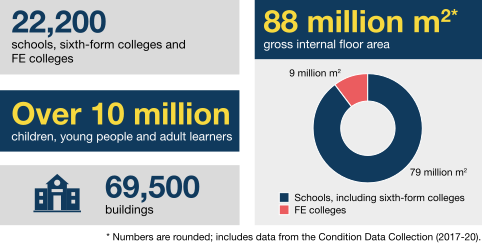
The education estate supports over 10 million children,[footnote 2] young people and adult learners in almost 70,000 buildings[footnote 3] across England.
The built environment impacts the educational outcomes, health and wellbeing of our children and young people:
- Evidence suggests that learning in school buildings that are in poor condition can have a negative impact on attainment.[footnote 4]
- The physical environment can have a significant positive impact on the wellbeing and engagement for pupils with SEND, for example by supporting physical accessibility, creating breakout spaces, and cultivating a more comfortable sensory environment.[footnote 5]
- Outdoor learning at school has been linked to improved motivation; some small-scale studies have found an improvement to attendance from learning in natural environments.[footnote 6]
- For some children, school is where they are most likely to spend time with nature, particularly for children with disabilities.[footnote 7]
- New buildings can boost staff satisfaction with emerging evidence from St Mary’s biophilic school of increased positive mood scores and life satisfaction scores.
- Our FE colleges support regional growth and productivity by improving educational outcomes, providing the skills and workforce needed now and in the future.
The benefits are clear, but we also know that building issues can lead to disruption to education. We want our schools and colleges to have the resources and buildings they need to give our young people the freedom to learn in safe and high-quality environments. More needs to be done for an education estate that is fit for the future and that supports opportunity for all.
The scale of the challenge
For too long our schools and colleges have had to patch and mend buildings that have already deteriorated – some schools have invested millions to keep them in just operational condition, instead of the rebuilds they need. Historical underinvestment and a lack of long-term funding certainty and strategic planning have contributed to a rising maintenance backlog[footnote 8]. Schools and colleges built between 1941-1980 represent a significant proportion of the estate – 43% of the school estate by size and 30% of the college estate – and many are in especially poor condition[footnote 9]. The Condition Data Collection 1 programme from 2017-2019 showed that there is large variation in the condition of the estate across the country[footnote 10]. We are currently collecting updated data as part of Condition Data Collection 2 which will conclude later this year – preliminary findings show that there has been continuing deterioration in the condition of the estate[footnote 11].
With global temperatures rising, we need to ensure the estate is resilient to climate change. This is not a future problem – the impacts are felt now with 32% of schools reporting overheating in at least one of their buildings[footnote 12]. Research by the Met Office and UCL is beginning to reveal concerning impacts if action is not taken. Subtle temperature increases could result in the equivalent of up to 12 lost learning days annually by 2100[footnote 13]. Without adaptation measures, extreme heat could make learning extremely difficult for up to 8 days per year by 2100. Many schools face significant flood risks, with 38% of secondary school buildings at high risk from surface water flooding[footnote 14].
The estate can drive environmental regeneration and can demonstrate a pathway to a net zero economy, providing over 10 million children and young people with the knowledge and skills to lead the change. The school estate has around 55 million square metres of roof area with the potential to support an additional estimated 0.8-1.9GW of solar power in its current condition. Sustainable and energy efficient buildings can drive down running costs with estimates that on average a typical school could save up to £25,000 per year if they had solar panels with complementary technologies installed such as batteries[footnote 15].
The estate – at a local and national level – needs to be suitably sized to accommodate pupils and learners, responding to changing demographics and remaining resilient for future changes. At a national level, primary pupil numbers have been falling since 2018/19; secondary pupil numbers are at a peak; and the 16– to 18-year-old peak is expected in 2030[footnote 16]. Local trends do not always follow national trends and can be shaped by housing developments and localised migration patterns. We must ensure that places continue to be added in areas where they are needed and support the system to make effective use of the spare space that is already materialising from this pupil number decline, all whilst remaining resilient for any potential future rise in birth rates.
Too many children are not getting the best start in life, and some parents cannot access high-quality local early education and childcare that is right for their child. More capacity needs to be built, particularly in disadvantaged areas, to give more children a strong educational foundation. That is why we are supporting schools to build capacity in areas of need by extending and repurposing unused space through the School-Based Nursery programme.
Every child deserves an education that meets their needs. We are determined to move towards a system where high-quality support for pupils with SEND is provided as soon as a need is identified, rather than delays while needs escalate, and that responding to the needs of children with SEND must become an intrinsic part of the mainstream system, rather than something additional. Tens of thousands of new SEND places have been added to the system in recent years, but the lack of availability of spaces is in part driving poorer outcomes and high costs. That’s why we’re investing at least £3.7 billion between 2025-26 and 2029-30 to create 60,000 more specialist places, on top of the 10,000 places that will be delivered through special and alternative provision free schools or alternative funding offered to local authorities.
Whilst the government has overall stewardship of the education estate through programmes, funding and guidance, the management and ownership of the estate is complicated with approximately 2,800 Responsible Bodies. Responsible Body is a term used to refer to those responsible for managing school and college estates. A definition of a Responsible Body is included at annex C.
Responsible Bodies have the local knowledge of their estates and communities and play a key role in managing their estates including building safety, maintenance, complying with regulations and managing climate, technology, cyber and security resilience. But the landscape is complex and can be fragmented and unclear. The capacity and capability of Responsible Bodies for estate management varies, with some needing more support than others, and it has not always been clear what is expected on estate management. We also know that Responsible Bodies can find the department’s programmes, funding and support difficult to access and confusing.
The estate has a key role in kickstarting economic growth by providing a future skilled workforce, supporting apprenticeships and boosting the construction sector. The Department for Education is one of the largest construction clients in England and investment in our programmes can drive growth and give the construction sector the confidence to invest in technology, skills and training. The stop-start nature of funding for capital programmes over time lowered the market’s confidence and did not provide long‑term certainty to maximise investment in the technology, training and skills needed to support delivery of projects. It meant that we could not realise the full benefits that a credible pipeline of projects can offer, such as improving productivity and efficiency to gain maximum benefit from capital investment and unlocking innovative approaches to delivery.
An estate that supports opportunity for all
We do not underestimate the scale of the challenge, but we are committed to fixing the foundations of the education estate so we can break down barriers to opportunity with safe and high-quality environments for children and young people across England.
To deliver our vision for an estate that is fit for education and skills provision now and in the future, we need to change the way we manage, maintain and improve our school and college buildings. This means breaking the cycle of patching and mending deteriorating buildings and only addressing those in the worst condition. We are – and will continue – rebuilding schools across England to tackle buildings in the very worst condition. We are also working with FE colleges to complete remaining FE Capital Transformation projects to address poor condition with the majority of projects now complete. However, this represents less than 4% of schools and colleges. It is not sustainable to rely on rebuilding alone – more is needed to maintain and improve the existing estate.
At the core of this strategy is a shift to more proactive management and long-term strategic maintenance and renewal that prioritises condition need, risk and resilience alongside delivering high-quality new buildings where they are needed. By focusing and taking action earlier in the building lifecycle we can maintain, improve and renew the existing estate. We can start to tackle the maintenance backlog, extend the life of our school and college buildings, improve their resilience to climate change and demonstrate a pathway to net zero, ensure they are fit for purpose and slow the rate of buildings deteriorating to the point where the only option is to rebuild them. We will continue to ensure there are sufficient places from early years to post-16 but go further in aligning place creation with our policy ambitions – particularly on SEND and disadvantage – and in expanding the education estate’s role in the community.
This strategy sets out how we can achieve our vision for the education estate that supports opportunity for all, backed by a 10 year plan.
Chapter 2: Vision and strategic principles
The benefits of the education estate are clear. Evidence suggests that learning in buildings that are in poor condition can have a negative impact on attainment. The physical environment can have a significant positive impact on the wellbeing and engagement for pupils with SEND. Access to nature can improve educational outcomes, health, and wellbeing, but children from low to middle income families are less likely to spend time outdoors.[footnote 17]
To support brilliant education and care outcomes we need an education estate that is safe, suitable, sustainable and sufficiently sized. Our success will be measured by how we deliver this.
Some of the principles are already part of estate management practice, whilst others will require collaboration and further development over time. By embedding these principles, we can work together for an education estate that supports every child and young person to achieve their potential.
Objective: safe
Buildings and spaces are structurally safe and meet health and safety requirements.
Strategic principles
Responsible Bodies proactively and effectively manage their estates including conducting regular inspections and maintenance to ensure safety and compliance is maintained.
Outcomes
All buildings meet or exceed statutory requirements.
Responsible Bodies have an asset management plan in place and conduct strategic reviews.
Objective: suitable
The estate is flexible to changes in demographics and suitable to deliver inclusive education, skills and support for children, young people and families.
Strategic principles
Create and develop adaptable flexible spaces that can evolve with changing education, technological and community needs.
The condition of the school and college estate supports education and skills provision.
Outcomes
An estate that is adaptable to changing educational, skills and community needs.
An estate that is inclusive and supports all learners’ needs, including those with SEND and vulnerable learners.
Schools and colleges have fast and reliable internet access.
Schools and colleges effectively use the full estate to support all learners and the community.
The condition of the estate is addressed through effective maintenance and renewal.
Objective: sustainable
The estate is designed with nature and climate in mind. It is sustainable and contributes to net zero targets. Buildings and spaces are adaptable and resilient to risks from climate change and cyber security.
Strategic principles
Design an education estate that prioritises access to nature, low carbon materials and renewable energy.
Adapt education buildings to be resilient to climate change prioritising low carbon materials and renewable energy to support net zero.
Design and adapt education buildings and spaces to increase access to nature, embedding climate and nature into settings.
Schools and colleges have access to the internet and robust cyber security to protect data and continuity of education.
Outcomes
All schools and colleges (new and existing) are designed or adapted to:
- be resilient to climate change including from overheating and flooding
- be energy efficient and where possible able to generate their own renewable energy for example through solar panels
- increase access to nature for children and young people
- reduce carbon emissions, for example through low-carbon boiler replacements
- reduce cyber risks and increase accessibility including having cyber security protocols in place to ensure data protection and operational continuity
Objective: sufficiently sized
There is sufficient and high-quality space for children and young people to achieve and thrive from early years through to post-16 education, where they are needed.
Strategic principles
Design and develop an education estate that is flexible to the changing needs of the population – ensuring sufficient spaces from school-based nurseries through to post-16 education.
Optimise and repurpose existing space where required.
Outcomes
Sufficient space in schools where it is needed in schools for mainstream, learners with SEND, and early years.
Sufficient space where it is needed in post-16.
Underutilised areas are repurposed in response to demographic changes and emerging skills priorities. Space is used efficiently to support wider priorities, including suitability, sustainability and sufficiency.
Chapter 3: A strategy for an opportunity driven estate
How we will realise our vision for the education estate
The government inherited a significant challenge, and it will take time to realise our vision for the education estate that is fit for both now and the future. Through this strategy, we are committed to fixing the foundations with a 10 year plan that puts us on the trajectory to do so.
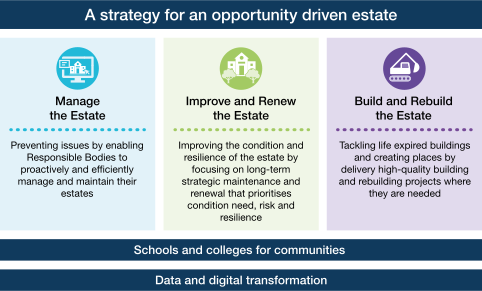
At the core of our 10 year plan is a shift to more proactive management, long-term strategic maintenance and more renewal of the existing estate. This is alongside building and rebuilding where renewal is not possible, and in the local areas where it is needed. In the short term we need to increase capacity in our rebuilding programmes to tackle the backlog of poor condition and life expired buildings whilst also increasing preventative maintenance to slow the flow of buildings becoming life expired. This is built on the foundation of ensuring an education estate that works for communities and is enabled by data and digital transformation.
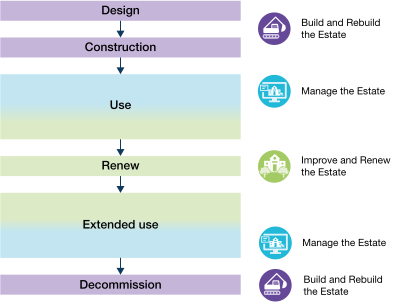
The size, age of buildings and type of construction varies across the estate and buildings are at different stages in their lifecycle. Data and digital transformation will let us and Responsible Bodies track buildings throughout their lifecycle which will help us have a shared understanding of the estate and collectively make informed decisions on what interventions are needed. We will be able to take a more holistic view of the building so that when action is taken, it is taken at the right time and at the right level.
Schools and colleges for communities
Although the education estate sits at the heart of communities, it is not always well connected to other essential services and infrastructure. We will move to more strategic planning at a local level, so we better reflect local patterns of growth, demographic changes and plans for housing and wider infrastructure. We will optimise our programmes and funding by better reflecting local factors, including for the School Rebuilding Programme, work with other government departments to join up public services at a local level, and continue to work with Mayoral Strategic Authorities on skills and post-16 provision.
To embed this strategic local planning further, we will work with the sector to develop a decision-making framework for the use of surplus mainstream school space during demographic change – one that balances the opportunities created by available space with a collective view on the long-term risks, whilst recognising that the school estate must remain flexible to respond to local need as it changes over time. This will recognise the different roles and responsibilities in the sector and support landowners, those running schools, and local authorities to work together on deciding on appropriate use of space. We will also create pathfinders to pilot how surplus spaces in the education estate can be used flexibly to meet wider community needs. We will publish the decision-making framework for use of surplus mainstream school space in autumn 2026 and will consider how we can go further to convene strategic discussions between key local partners and the department when determining and prioritising what is needed in local areas.
Data and digital transformation
We will transform data and digital architecture and capability, so data is captured in digital form across the lifecycle of the education estate, enabling Responsible Bodies to use data and digital services to manage their estate effectively and the department to make the best case for investment and better target programmes and funding.
In line with the School Estate Management Standards, we expect and will support Responsible Bodies to improve their data and digital capability. Reliable, timely and relevant data is essential to understand a building and how it performs, support actions to maintain the building and inform planning to identify, prioritise and track work to improve the building.
We will set clear expectations and technical standards for all Responsible Bodies to collect data on their estates and use digital tools to inform their own effective asset management plans. We will also set such expectations and standards for data to be shared with the department to inform policy and programmes; as well as being able to target funding without the need for full bids, including for the Condition Improvement Fund. The target is for full coverage of all Responsible Bodies for 2029-30, subject to further testing and piloting to put the necessary guidance, architecture and support in place.
We will move to a more strategic and joined up approach to estates data by introducing two-way data sharing between Responsible Bodies and the department. This will reduce costs and burdens from ad hoc and duplicative data collections and provide a single shared understanding of the data.
From April 2026 we will publish technical standards and guides to help Responsible Bodies to collect and commission data and digital services that meet a common minimum standard, as well as ensuring that data used to inform funding decisions is consistent and comparable across the whole estate, building on the consistent, high-quality data built up through the Condition Data Collection Programme.
Better and consistent data managed and used through digital tools will not only empower Responsible Bodies to meet the Estate Management Standards but can identify efficiencies and savings in how they manage their estate. It will also support further analysis and insights such as benchmarking performance, enabling predictive analytics and testing the potential of AI, for example to help automate routine tasks and planning, predict future needs, or link to live data (such as weather forecasts to manage heating).
The scale of the education estate means that data and digital transformation will stimulate the data collection and digital facilities management markets. It sets a clear direction and expectation on how public sector buildings should be managed to a common standard, whilst providing Responsible Bodies with a choice from providers who best meet their needs.
Chapter 4: A 10 year plan for the education estate
Through a 10 year plan, we will continue our journey to realising our vision for the education estate. This sets out how we will support and enable Responsible Bodies to manage the estate, how we will do more to improve and renew the existing estate and how we will continue to build and rebuild the estate where it is needed. Our 10 year plan embeds the important role of schools and colleges in communities and is enabled by data and digital transformation.
We have increased our investment in education capital to £38 billion for 2025-26 to 2029‑30 – the highest since 2010. This includes over £12 billion in maintenance funding for schools and colleges; over £10 billion for the School Rebuilding Programme; up to £3.1 billion for the provision of mainstream school places and at least £3.7 billion for new specialist places (this is on top of funding for new schools delivered by the department). It also includes £395 million to support FE providers to accommodate increasing student numbers; over £200 million for the Skills Mission Fund to support the industrial strategy priority skills, including Technical Excellence Colleges; £710 million for a new Renewal and Retrofit Programme to improve condition and resilience to climate change, including funding for flooding; £325 million to improve digital connectivity; and £400 million for new and expanded school-based nurseries.
This funding supports delivery of the 10 year plan from 2025-26 to 2029-30. In some areas long-term funding has been confirmed – this includes investing almost £3 billion per year by 2034-35 in capital maintenance funding for schools and colleges and investing almost £20 billion in the School Rebuilding Programme through to 2034-35. Where this is not the case, funding beyond 2029-30 will be confirmed at future fiscal events.
The implementation of the education estates strategy is intended to support commitments set out in HM Treasury’s Balance Sheet Framework[footnote 18] and Thematic Value for Money Review on the Maintenance of Public Sector Assets[footnote 19]. The Balance Sheet Framework sets out the government’s approach to managing assets on the public sector balance sheet and the principles for assets under the social portfolio (including schools and colleges), including guidance on asset registers and asset management plans across the life cycle of the asset. The Thematic Value for Money Review on the Maintenance of Public Sector Assets aims to strengthen the evidence base and improve asset maintenance across government, enabling better-informed investment decisions and supporting public service delivery. The implementation of the education estates strategy will also deliver on the ambition set out in the government’s 10 Year Infrastructure Strategy[footnote 20] and the social infrastructure roadmap, for example the role of data collection and strategic asset management plans.
Manage the estate
Effective and proactive estate management is key to maintaining a high-quality estate and preventing issues materialising that can disrupt access to education. We want to enable all Responsible Bodies to proactively manage their estates effectively and where they are not, ensure we are holding them to account. To do that, we need to set out clear standards and expectations for estate management and provide Responsible Bodies with the guidance, tools and information to do that well.
We have already made progress:
- Effective estate management is already reflected in the Academy Trust Handbook and in April 2025 we published the School Estate Management Standards. This sets out clear expectations, including a ‘fully effective’ standard for estate management that every Responsible Body for schools should aim to meet. This includes holding data to inform asset management plans, use of digital tools to support estate management and having a climate action plan in place. We have updated the Estate Management competency framework to provide guidance on the functions, skills, knowledge and training needed to manage the school estate.
- We have published guidance on estates management including Good Estate Management for Schools, Further Education Estates Planning, Managing Older Buildings, Land Transactions, Guide to PFI expiry checks, and breakfast club early adopters. We have a range of tools and products to support estate management including the Risk Protection Arrangement as an alternative to commercial insurance and the Good Estate Management for Schools self-assessment checklist.
- We have supported schools to manage their land and building space by allowing certain land transfers and disposals (including where schools are allowing others use of their land but will continue to have use of it too). This includes supporting consideration of how space can be used to support government priorities on school-based nurseries.
- We have and will continue to provide additional advice and support on a case-by-case basis where Responsible Bodies have serious and urgent issues with buildings that cannot be managed independently.
We will build on this by:
- Launching a new digital service – we will launch a digital service for Responsible Bodies, schools and colleges in February 2026 – Manage Your Education Estate – so there is an effective and efficient system to engage with programmes, funding and data on their estates. Manage Your Education Estate will bring together estates related guidance, tools, support, programmes, funding and data in one place. It will enable more efficient and effective engagement and support Responsible Bodies to manage their estates with better access to our programmes and funding. It will include presentation of key condition data on each Responsible Body’s settings in a format they can easily interrogate and use and minimum standards for the digital asset management systems they are expected to have. Manage Your Education Estate will continue to evolve with more content and functionality added, including a data dashboard.
- Data and digital transformation – we will support Responsible Bodies to collect data on their estates and adopt digital tools and solutions, with the ambition for all Responsible Bodies to be collecting and sharing data by 2029-30. We will start pilots in 2026-27 to test the approach of Responsible Bodies collecting their own data and using digital tools in line with common standards before national rollout planned from autumn 2027. We will publish common data and digital structures, standards and guides from April 2026 to help Responsible Bodies collect and commission data and digital services that meet a common minimum standard so that data is consistent and comparable across the whole estate. We will introduce two-way data sharing by 2028 providing both Responsible Bodies and the department better insights on the estate.
- Supporting Responsible Bodies to meet the estate management standards – in addition to making it easier to access resources through the Manage Your Education Estate service, we will provide additional materials such as a digital self-assessment tool, templates, relevant data and practical examples of how to meet the standards to help Responsible Bodies do this well. From autumn 2026, we will ask Responsible Bodies to make a light touch annual return via Manage Your Education Estate to confirm they are meeting the School Estate Management Standards. For those who are not meeting the standards, we will put in place an estate management capability support plan – an informal agreement with the Responsible Body setting out actions and support to bring estate management up to the expected standard within 12 months. We are developing an equivalent estate management standard for FE colleges by summer 2026 to ensure all Responsible Bodies are fully supported to manage their estates well.
- Embedding strategic planning for spare space in schools – to support strategic planning at a local level, we will work with the sector to develop a decision-making framework for the use of mainstream school space during demographic change. This will ensure that we are balancing the opportunities created by the current fall in birth rates – including delivery of priorities such as support for children and young people with SEND, school-based nursery provision and Best Start Family Hubs – with a collective view on the long-term risks. It will recognise that the school estate must remain flexible to respond to local need as it changes over time and, to create a more efficient system, we must align central investment with high-quality local strategies to optimise our collective resources. We are committed to co-creating this framework with the sector and will engage with key stakeholders throughout 2026, with a view to publishing a framework in autumn 2026.
- Supporting more alignment across the public estate – to support the development of this decision-making framework we will launch 5 pathfinders to pilot how surplus spaces in the education estate can be used flexibly to meet wider community needs. This includes join up across the public estate including Best Start Family Hubs and working closely with the Ministry of Housing, Communities and Local Government, the Department for Health and Social Care and the Department for Culture, Media and Sport to identify where new housing acceleration schemes, young futures hubs, and neighbourhood health centres may overlap with space opportunities in the education estate. This will also help form a blueprint for education’s integration in local community services for the delivery of new towns.
Case Study: Discovery Trust – optimising the use of surplus spaces in schools
Discovery Trust, a family of 18 schools across three Local Authorities, undertook a strategic review of the estate to understand how existing spaces could better support changing pupil numbers, childcare needs and community expectations. This highlighted significant opportunities to repurpose surplus rooms and low use areas in ways that would directly benefit children, families, and the wider community.
By converting these spaces into preschool rooms, wraparound care hubs and venues for Discovery Holiday Camps, the Trust has expanded provision across its schools, with nine preschools already operating and more planned. Schools now run activities from early morning to evening and throughout the holidays, offering families childcare and enriching experiences year-round. The community impact has been substantial. Schools have become neighbourhood hubs, extensively used by Scouts, sports clubs, and local groups. Families feel more connected to their school, and children benefit from consistent routines, safe environments, and wider opportunities. Financially, the approach is equally powerful and is expected to generate £1.1 million annually, strengthening long-term sustainability and enabling reinvestment into children’s learning and wellbeing.
This work demonstrates how surplus estate can be repurposed to meet community need, improve outcomes, and generate sustainable income — without capital expansion. Discovery Trust has created a scalable model for community centred estate utilisation that delivers measurable value for children, families, and the wider community.
Improve and renew the estate
Too many buildings are deteriorating to the point where the only option is to rebuild them. Not only is this not sustainable, but it is unfair and can harm our children and young people’s life chances. Learning environments have an impact on education, health and wellbeing and we need to improve the condition and resilience of the estate so that children and young people can learn in well-maintained and resilient environments.
We will work with Responsible Bodies to improve and renew school and college buildings, focusing on long-term maintenance that takes a more strategic approach to address poor condition, adapt the estate to mitigate risks such as the effects of climate change and cyber-attacks, and ensure it is suitable for education and skills provision. We will do this by providing long-term maintenance funding, providing practical guidance on maintenance, renewal and adaptation measures for inclusivity, and introducing a new targeted programme backed by new investment to renew and retrofit buildings.
We have already made progress:
- We have confirmed long-term maintenance funding through to 2034-35, investing almost £3 billion per year by 2034-35 in capital maintenance and renewal to improve the condition of the school and college estate, rising from £2.4 billion in 2025-26. We introduced the FE College Condition Allocation in 2025-26 for FE colleges to maintain, improve and ensure suitability of their estates.
- The Net Zero Accelerator and Great British Energy Solar Programme is working with 250 school and colleges in 2025-26 to help reduce emissions and deliver cost savings by installing solar, LED, EV and energy efficiency measures backed by £100 million investment. Through the Schools Water Strategy, we have invested in measures to reduce risk to flooding at over 700 schools to the end of 2025/26 and continue to invest in flood prevention. We have also provided £29 million to The Environment Agency to better protect schools in local communities.
- We have pioneered biophilic design approaches using nature first solutions that give young people greater access to outdoors, improving health and wellbeing, increasing biodiversity and use of ultra-low carbon sustainability pods built entirely from UK timber. We have tested high impact low-cost climate adaptations through the Bradford Resilient Schools Pilots to inform a scalable approach to creating climate-resilient learning environments.
- Through the Sustainability Support Programme, settings have access to online support and over 1,000 expert Climate Ambassadors, and children and young people are learning about climate and taking positive action through the National Education Nature Park. More than 9,000 settings have now accessed support.
- Through Connect the Classroom, we have funded almost 4,000 schools to upgrade wireless networks, ensuring that over 2.5 million pupils and 80,000 teachers stay connected. Through School Gigabit Broadband in collaboration with the Department of Science, Innovation and Technology we have connected over 1,400 schools to fibre, identifying and upgrading schools and communities.
We will build on this by:
- Reforming capital maintenance funding – we are investing almost £3 billion per year by 2034-35 in capital maintenance funding for schools and colleges. We will provide greater certainty to Responsible Bodies about their future funding allocations and advance notice of significant methodology changes to support longer-term strategic asset management plans. Responsible Bodies have told us that the Condition Improvement Fund process can be burdensome and does not allow them to plan sufficiently. We will make it easier for these Responsible Bodies to access capital maintenance funding by introducing a new programme from autumn 2028 to replace the Condition Improvement Fund so that they no longer need to submit full bids for this funding. This will be enabled by data transformation with more granular and timely data on the estate with Responsible Bodies collecting their own data in line with common standards and sharing data with the department.
- Taking a more strategic approach to condition, resilience and decarbonisation by simplifying programmes and funding – we will streamline our programmes and funding into a clearer offer to take a more strategic approach to addressing poor condition whilst also adapting buildings, so they are more resilient to climate change and supporting decarbonisation of the estate. This includes improving our funding model with a new Renewal and Retrofit Programme to address the gap between capital maintenance and rebuilding.
- Launching a new Renewal and Retrofit Programme – we will launch a new programme in April 2026 backed by £710 million to 2029-30 for renewal projects to improve the condition of school and college buildings and increase resilience to climate change so buildings can last for decades to come and are net zero ready.[footnote 21] The funding will also better protect more schools from flooding. This will start to address projects that fall between those typically delivered through capital maintenance funding and rebuilding. We will also publish new guidance in spring 2026 to support Responsible Bodies to deliver their own renewal projects with examples of interventions that not only address condition issues but can also improve the resilience to climate change and start to decarbonise school and college buildings so they are net zero ready. To inform how we can go further on adaptation, we are expanding the Resilient Schools Pilots to 12 new schools as part of a research and development programme supported by £33 million to 2029-30 to deliver innovative adaptation solutions that create climate-resilient environments through nature-based solutions.
A new Renewal and Retrofit Programme backed by £710 million to 2029-30
The Renewal and Retrofit Programme will improve the condition of schools and colleges, extending the life of buildings, reducing reactive patch and mend and preventing further deterioration to the point where rebuilding is the only solution. It will fund projects at buildings that typically cannot be delivered from existing maintenance funding but that are not at the point of needing to be rebuilt. The programme will take a holistic approach to individual sites, assessing needs and delivering projects that improve condition, increase resilience to climate change and cyber threats, and support decarbonisation – making them net zero ready.
From April 2026, we will pilot the Renewal and Retrofit Programme and deliver around 50 projects in schools across the East Midlands, Yorkshire and the Humber and the South East with an initial focus on replacing the worst condition, life-expired temporary buildings alongside installation of energy generation and efficiency measures. From 2027, learning from this pilot, we plan to extend the programme to all regions in England and deliver over £450 million in projects to fix buildings with extensive issues such as roofs, heating and electrical systems as well as assessing flood and overheating measures and technology connectivity requirements. Detailed delivery plans, including the number of projects, will be confirmed in due course. We will work with the sector to ensure that the programme is supporting our aim to improve the estate through a strategic, preventative approach and prolonging the life of buildings. From 2029, we expect the programme will provide the ability to deliver multifaceted projects across the country, funded through the Renewal and Retrofit Programme or alternative funding as available.
Delivery partners will work with settings to create a 5-15 year strategic asset management plan for the whole site. This will be used to identify, invest in and deliver the most impactful projects, reversing deterioration and stopping buildings slipping into disrepair to the point they need rebuilding. The Responsible Body will be supported to develop and own a clear plan and clarity on what projects to invest in going forward, for example through their maintenance allocations or if further funding becomes available in the future. This introduces a new delivery model that can be applied to capital projects with the ability for delivery partners to also offer support to Responsible Bodies for projects delivered through their wider funding, for example maintenance allocations, private finance for solar and energy efficiency, reserves. This can include support for projects to adapt the existing estate to improve the accessibility and inclusivity of mainstream settings. It also supports value for money by generating the ability to benefit from aggregated procurement and bulk purchasing at a regional level.
The funding will also better protect over 1,500 schools from flooding by 2030 by scaling up the approach to flood resilience alongside new tools and guidance. Increasing biodiversity and pupil wellbeing, reducing disruption to education from flooding, and supporting schools to self-deliver flood resilience through guidance and access routes to market.
Case Study: Hiltingbury Junior School – innovative approach to retention and recladding of a 1960’s building
This project piloted an innovative approach to the retention and recladding of an occupied 1960s system-built junior school, through the development of an offsite-manufactured structural timber replacement external envelope.
Delivered in 3 phases over 1 year, with its timber finish exposed internally, the scheme transforms the school both inside and out, achieving a fully refurbished, natural learning environment that is resilient to overheating with improved energy performance – for ¹/³ the cost and a ¼ of the embodied carbon of a complete re-build. With its rooftop photovoltaic array, the refurbished school’s heating load is sufficiently reduced to enable the replacement of its gas boiler with a ground source heat pump in the future and the completion of its decarbonisation.
“The children have commented on how calming and inviting the classrooms are. They like the smell of the wood too. We’re feeling cooler and not overheating – and are now looking forward to teaching in the summer!” – Headteacher, Hiltingbury Junior School
- Supporting solar and energy efficiency measures – we are working to unlock privately financed investment in solar and energy efficiency across schools and colleges to reduce the cost of energy. Working with HM Treasury and the National Infrastructure and Service Transformation Authority (NISTA), we are exploring ways to facilitate more schools and colleges to access a Department for Education approved Power Purchase Agreement for solar power, subject to confirming value for money. We aim to pilot this approach from April 2026 with a view to all schools and colleges being able to procure renewable energy in this way during 2027-28. This builds on progress made through the Net Zero Accelerator and Great British Energy Solar Programme that is already helping schools and colleges reduce emissions and save on energy costs.
- Increasing the reach of the Sustainability Support Programme – we will continue to drive the behaviour change needed to make the education estate more climate resilient by increasing the reach of the Sustainability Support Programme to all settings. More than 9,000 education settings are already accessing support. We will support all education settings to put in place climate action plans and appoint a sustainability lead through the Sustainability Support Programme until at least 2030.
Case Study: Goldsmith Primary Academy – saving energy and bringing nature into learning
Goldsmith Primary Academy, part of Windsor Academy Trust in the West Midlands, has embedded sustainability into everyday school life, with visible changes across its grounds that support both learning and biodiversity. Alongside improvements to the physical environment, the school has reduced its energy use through digital learning and the installation of solar panels, contributing to trust-wide savings of more than 700 tonnes of CO2 and over £200,000 in energy costs.
A central driver of this work has been the National Education Nature Park, which has helped the school plan, teach and track its sustainability journey. Using the platform’s curriculum-aligned resources, staff have integrated nature-based learning into regular lessons, while pupils have taken part in practical projects to improve the school environment. These include planting trees and hedges, creating an orchard and allotment, and giving every class responsibility for its own planter, transforming what was once a largely grey site into a greener, more engaging space.
Deputy headteacher Jennie Wilkes highlighted the impact of the Nature Park on teaching and learning, saying: “The Nature Park lessons are brilliant, very straightforward and accessible for all age groups, and they’ve helped us timetable sustainability into weekly and bi-weekly learning across the school.”
- Closing the digital divide – we are providing targeted support for digital connectivity, ensuring that where commercial fibre plans have failed, schools and the communities they support are not left behind. We will invest £325 million to 2029-30 to support digital connectivity. This includes expanding Connect the Classroom to thousands more schools in need, supporting schools and Responsible Bodies to build their underpinning technology infrastructure and resilience, with the expectation that all schools and colleges should meet core technology standards by 2030.
- Adapting the estate to be more inclusive and accessible – we will support more children and young people with SEND to thrive in their local mainstream school. Money saved from cancelling free schools projects in areas of surplus will be used to support new specialist places. We are investing at least £3.7 billion in high needs capital funding between 2025-26 and 2029-30 to create 60,000 specialist places. This will fund a transformative expansion of inclusion bases – a new term that will replace the current terms SEN unit, resourced provision and pupil support unit to make it easier for parents to understand the support available for their child.[footnote 22] Our investment will see this form of provision become a core part of the local education offer, delivering high quality teaching and support to children who would benefit from provision that bridges the current gap between mainstream and specialist. This is alongside enhancing the mainstream estate from early years to post-16 to be more inclusive and accessible for pupils with neurodivergence, disability and other types of SEND. We will publish new dedicated guidance on high-impact adaptations for the estate to make it more inclusive and accessible.
Case Study: Bartley C of E Junior School – repurposing space to provide specialist support
Surplus accommodation was identified at Bartley C of E Junior School that could be repurposed to meet the growing need for specialist support. Working with the school, Hampshire County Council created a 12-place Resourced Provision for pupils with Social, Emotional and Mental Health (SEMH) needs within a mainstream setting, funded by Hampshire’s high needs capital allocation.
The project delivered a self-contained annex with specialist teaching and wellbeing spaces supported by a secure external play area, and independent access for drop-off and pick-up. The provision is connected to the main school, enabling a hybrid offer of flexible support, with placements commissioned by the local authority – combining accessibility and inclusion with a calm, supportive learning environment.
Carefully designed internal and external spaces promote sensory regulation, flexibility, and inclusion, creating a safe and positive setting where pupils can thrive while remaining part of the wider school community.
Inclusive by design – an estate that supports children and young people with SEND
We will support more children and young people with SEND to thrive in their local mainstream school. We are investing at least £3.7 billion in high needs capital funding between 2025-26 and 2029-30 to create 60,000 specialist places. This will support the expansion of inclusion bases, which offer specialist provision in mainstream schools, colleges and nurseries. This is in addition to adaptations to improve accessibility and inclusivity in mainstream settings – for example, creating breakout rooms where pupils can access interventions and support, improving access to nature, and providing a more comfortable sensory environment by enhancing ventilation, acoustics and lighting. We know these interventions can have a positive impact on attendance, behaviour and wellbeing, especially for pupils with SEND – in some cases, enabling them to attend their local mainstream school by ensuring the environment is suitable to meet need.
We want buildings to be inclusive by design so that all pupils, especially those with SEND, can learn in high-quality, comfortable and supportive environments. We will provide new dedicated guidance to support the identification of targeted, high-impact adaptations in schools, as we know every learning environment is unique and will vary based on the setting and the needs of their pupils. The guidance will be published in spring 2026 and cover inclusive design principles for adaptations to the existing estate, alongside new builds and refurbishments to support an inclusive and accessible education estate.
All buildings delivered by the Department for Education follow our design specifications, delivering buildings that support inclusive and accessible provision for both mainstream and specialist settings. Buildings will not only be future proofed for climate change but will reflect inclusive approaches and best practice for accessibility to support children and young people with SEND. For example, better outdoor places with more variety, so pupils can undertake both quiet and energetic activities and enjoy nature, and buildings that are easy to navigate and have wider corridors with places to pause and views to the outside.
Schools and sixth-form colleges that are being rebuilt through the School Rebuilding Programme follow our design specifications. As part of delivery, our inclusively designed projects should incorporate clear wayfinding, good colour use, comfortable lighting, acoustics, ventilation and temperature, and access to support spaces. From this point forward, all projects will be assessed for the need for inclusion bases as well as school-based nurseries, and Best Start Family Hubs. We will continue to look at how we can go further with our design standards as we deliver more inclusive and long-lasting buildings. Our new design specifications are also available across the sector.
Case Study: St Stephen’s RC Primary – creating a new classroom and increasing access to nature to meet the needs of pupils with SEND
St Stephen’s RC Primary had an increasing number of pupils with special educational needs whose needs could not be fully met in the existing classroom provision. The classroom had no direct access to the outside and was in a busy, noisy part of the school that made transitions challenging.
The school identified surplus space which they repurposed into a dedicated SEND classroom. The new space is in a calm, quieter part of the school which not only has direct access outside but its own entrance for calmer drop-offs and pick-ups.
Combining the works with structural repairs, pupils now have access to a calmer teaching space, which can be used flexibly to support a range of individual needs – for example, serving as a dedicated area for pupils to receive 1-1 or small group interventions, or a re-regulation space for moments when a pupil is overwhelmed. Alongside this, the school have redesigned an outdoor space to support the wellbeing and learning of all pupils, whilst also providing targeted support for SEND learners.
Build and rebuild the estate
We need to deliver high quality build and rebuilding projects that are designed with inclusion and access to nature at their heart to create inspiring, healthy and sustainable places for children and young people to thrive. With the Plan for Change and Industrial Strategy, our FE colleges and Technical Excellence Colleges have a vital role to play ensuring we have an appropriately skilled workforce now and in the future.
We want to ensure new buildings are fit for the future and in the local areas where they are needed. To do this, we need to rebuild and refurbish schools and colleges where renewal is not possible and build new schools and colleges to match local need. This includes tackling the worst condition buildings and addressing potential safety issues through rebuilding and only building new school places where they are needed.
We have already made progress:
- We have committed almost £20 billion investment in the School Rebuilding Programme through to 2034-35, delivering rebuilding projects at over 750 schools and sixth-form colleges across England. There are over 500 schools already in the programme,[footnote 23] with well over half in delivery, and we will select a further 250 schools to join the programme. We have worked with schools and Responsible Bodies to rebuild 51 schools, with 39 of these completed since July 2024. We have upgraded the FE estate through the over £1.5 billion FE capital transformation programme including 16 colleges in some of the worst condition.
- RAAC has been permanently removed from 71 schools and colleges, and we have set clear plans to finish the job. By 2029, every school and college in England that is not being fully or substantially rebuilt will be RAAC-free, and every school with RAAC needing to be rebuilt through the School Rebuilding Programme will be in delivery, with half having started already.
- We have created places and capacity in early years, schools and post-16. We have delivered over 5,000 places in new or expanded school-based nurseries where they are needed most, including in areas of disadvantage. We have allocated funding to local authorities equivalent to 70,000 new mainstream school places. We have created extra capacity at post-16 providers through 89 projects to accommodate increases in 16- to 18-year-old learners.
- We have delivered buildings fit for the future through our build and rebuild programmes. Since 2021 all buildings delivered by Department for Education programmes are Net Zero in Operation (reducing carbon emissions, energy use and operating costs), resilient to climate change (designed for a 2°C rise in average global temperatures and future-proofed for a 4°C rise) and create a better environment for future generations by enhancing biodiversity and increasing access to nature.
We will build on this by:
- Selecting 250 schools for the School Rebuilding Programme – we will select 250 schools to join the programme by early 2027. Responsible Bodies are invited to nominate schools and sixth-form colleges that meet the criteria by Thursday 23 April 2026, with guidance and criteria available on GOV.UK. Places will be prioritised for the worst condition schools and sixth-form colleges in areas where places will be needed now and in the future. We will consult with local stakeholders, including local authorities who have a duty to ensure sufficient places are available, before finalising the individual schools in the programme.
School Rebuilding Programme
The School Rebuilding Programme carries out major rebuilding and refurbishment projects at school and sixth-form college buildings across England.
We are investing almost £20 billion in the School Rebuilding Programme through to 2034‑35, delivering rebuilding projects at over 750 schools across England. There are over 500 schools already in the programme, with over half in delivery. We will select a further 250 schools for the School Rebuilding Programme by early 2027. Places will be prioritised for schools and sixth-form colleges in the worst condition and in the local areas where places are needed now and in the future. From this point forward, all School Rebuilding Programme projects will be assessed for the need for school-based nurseries, inclusion bases or Best Start Family Hubs.
Projects are delivered through our construction framework and to our design specification. Buildings are Net Carbon Zero in Operation, increasing resilience to climate change and reducing carbon emissions, energy use and operating costs, enhance biodiversity and increase access to nature. Our new design specifications will go further to provide learning environments that create healthy and sustainable places, including use of standardised yet adaptable solutions with spaces that are naturally ventilated, simple to use and long lasting, supporting accessible and inclusive provision and improving outdoor facilities.
The School Rebuilding Programme provides a stable pipeline of standardised projects which provides confidence to the construction sector and stability that can unlock innovative delivery approaches, improve productivity and efficiency to gain maximum benefit from investment. Our new construction framework will require contractors to deliver to an even higher quality, better value and increased social value through requirements such as hiring apprentices, supporting local workforces.
Case Study: Carleton High School – School Rebuilding Programme
Carleton High School, in Pontefract, was rebuilt through the School Rebuilding Programme. Unveiled in September 2025, pupils are now learning in state of the art buildings and spaces. The new buildings were delivered using the Department for Education’s design standards, which have provided modern teaching spaces designed for comfort, efficiency and long-term operational resilience. The new buildings are net zero carbon in operation, energy efficient and future-proofed against the risks of climate change. As with all School Rebuilding Programme projects, there is a real focus on pupil engagement during the development. During the rebuilding of Carleton High School, the department and the contractor held inspirational pupil events, site visits, career talks and taster days for pupils, where they got to experience a range of construction skills, such as bricklaying and support the building of their new school.
“We feel incredibly fortunate as a school to have this new building. We are deeply grateful to the Department for Education for investing in our school, students, and the community, also to Morgan Sindall and their partners for bringing this vision to life. This new chapter means so much to us as a school, it ignites even greater ambition within our students and inspires them to aim higher for the future.” – Mrs Shaheen Shariff, Headteacher at Carleton High School
- Investing in the FE estate – we are continuing to work with FE colleges to complete FE Capital Transformation projects, with 16 of the worst college sites in the country being rebuilt and 75 refurbishment projects to address poor condition, the majority of which are complete. We are investing in the FE estate and facilities needed to deliver priority training with £200 million of capital investment to 2029-30 via a new Skills Mission Fund. This will focus on addressing skills shortages in priority sectors, including expanding Technical Excellence Colleges.
Case Study: The Manchester College – transforming educational infrastructure in Manchester
LTE Group is one of the UK’s largest integrated education and skills providers with The Manchester College being part of the Group. The college’s five-year strategy included estate transformation plans to address inefficiencies and replace outdated facilities with cutting edge facilities that aligned with Manchester and Greater Manchester’s growth sectors including engineering, construction and digital technology.
One of the strategic aims was to create facilities that reflect the environments students will encounter in the workplace, with curricula aligned to priority sectors and co-developed in partnership with employers. The college transformed its estate by consolidating the number of campuses and locations from 24 outdated facilities to five modern campuses. This included a new purpose build flagship city-centre creative and digital campus that has been a catalyst for urban regeneration in the area of Manchester City Centre in which is it built.
Through their estate rationalisation, the college reduced their property-related overheads by £7 million a year with more resources to focus on teaching and developing provision in the priority growth sectors. The transformation was designed to stimulate growth by creating sector-focused clusters of excellence aligned with Greater Manchester’s priority industries. It strengthened the college’s role in developing local skills, in line with the Local Skills Improvement Plan. The estate transformation has enabled the college to support the significant growth in post-16 students in Greater Manchester by increasing 16- to 18-year-old learner numbers by over 20% in priority skills areas since 2018/19.
The rationalisation of the estate also included the disposal of vacated assets with the LTE Group working with Manchester City Council to ensure that disposals align to the city’s plans, for example, the creation of affordable homes and for industrial use.
- Creating capacity at post-16 and devolving funding – we will invest £395 million of capital investment from 2025-26 to 2029-30 to support post-16 capacity to accommodate additional learners entering the system, with £184 million devolved to Strategic Authorities to ensure that extra capacity is provided locally where it is most needed to reflect regional priorities. This could include ensuring provision at level 1 and 2 is available to meet the needs of those not in education, employment or training (NEET) or to secure continued learner choice and to allow coordination with regional growth priorities. In addition, a total of £195 million will boost capacity in construction courses across the country, of which nearly £100 million will be devolved to Strategic Authorities where they exist.
Case Study: Milton Keynes College – expanding capacity to meet industry and learner demand
Milton Keynes College has shown how FE institutions can respond to demographic growth and evolving industry needs through estate investment. With a rapidly expanding population and rising demand for technical skills, including 16- to 18-year-old learner numbers increasing by 41% over the past four years, the college has faced the challenge of increasing its capacity while maintaining the quality of its courses and learning spaces.
Through a funding partnership with the local authority and housing developers, Milton Keynes College launched a major estate enhancement programme. Upgrades include state-of-the-art motor vehicle workshops, advanced engineering facilities, and additional classroom and workshop spaces, ensuring learners gain hands-on experience with industry-standard equipment. Learners have highlighted how the professional feel of these new spaces enhances their engagement and sense of belonging. This investment has created 364 additional full-time learner places, enabling the college to meet anticipated growth in 2025/26, support local skills development, and strengthen apprenticeship provision to meet workforce demand. Looking ahead, the college acknowledges it will need to continue working innovatively and secure further capital funding to deliver the next phase of its estate plan and respond to increasing skills needs across Milton Keynes and the wider region.
- Delivering more school-based nursery places – we are delivering thousands more school-based nursery places where they are needed most, especially in areas of disadvantage, backed by a total of £400 million between 2025-26 and 2029-30. Hundreds more projects will be delivered through phase 2, and phase 3 will fund hundreds more. In the future, the programme will strengthen links between nursery provision and local family services by offering capital funding to create or expand nurseries on Best Start Family Hub sites.
- Continuing to deliver school places where they are neede – we will continue to add places and build new schools to deliver mainstream, specialist and alternative provision places. We will invest at least £3.7 billion between 2025-26 and 2029-30 to create new specialist places, and up to £3.1 billion between 2025-26 and 2029-30 to support local authorities to create mainstream places where they are needed. This is on top of ongoing central delivery of whole new schools where they are still needed. We will build schools that meet the needs of communities, raising standards without harming local schools and colleges.
- Publishing new design specifications – we are publishing new design specifications and guidance for all buildings delivered by the Department for Education and making these available for use across the sector. Buildings are future proofed against the risks of climate change and will provide learning environments that create healthy and sustainable places by improving the quality of indoor and outdoor environments, increasing access to nature, enhancing biodiversity and more opportunities for sport and activity outdoors. We will create teaching spaces that are naturally ventilated, well lit, simple to use and long lasting, using standardised yet adaptable solutions and reducing the burden of technical requirements. This integrates best practice principles for accessibility and use by people with diverse needs. Specialist settings have more suitability specification enhancements, which reflect the inclusive design principles, and we welcome projects that have similar inclusivity enhancements in mainstream settings. Our new nature focused standards – to make every new school a “garden school” by improving outdoor facilities and supporting inclusive access – are informed by pilots such as the first biophilic primary school and Sustainability Pods with classrooms constructed from UK timber. As well as greater integration of indoor and outdoor facilities, the new space standards will increase the economy and efficiency of new buildings supporting a more standardised approach to school design and delivery, whilst retaining local flexibility.
- Testing new solutions, technologies and construction methods – we will continue to look at how we can go further for our future design specifications as part of a research and development programme supported by £33 million to 2029-30. This will prioritise regenerative approaches looking at a wide range of outcomes from energy storage to bio-based construction materials, such as timber and working closely with Department for Environment, Food and Rural Affairs (DEFRA) on the Timber in Construction Road Map. We will create a new Department for Education forest in partnership with the Forestry Commission that brings together forestry, manufacturing and skills to provide a catalyst for the UK construction timber market and use of local manufacturing. This builds on pilots that have delivered school buildings using UK grown and manufactured structural timber solutions.
- Boosting manufacturing and construction – the Department for Education is one of the largest construction clients in England and we will continue to maximise productivity through our programmes and boost manufacturing and construction. Through standardising designs through our UK leading specification, we have clarified requirements so the construction sector can maximise productivity through manufacturing and other approaches.
Supporting productivity and boosting manufacturing and construction
With our commitment to long-term funding to 2034-35, the School Rebuilding Programme now provides a stable pipeline of projects across England. This gives the market the confidence to invest in technology, training and skills, unlocking innovative delivery approaches, and improving productivity and efficiency to gain maximum benefit from investment.
Through our new construction framework and design specifications, we can stimulate construction manufacturing and maximise productivity. Construction Framework 2025 lasts twice as long as the previous one from 2021, giving the market and construction sector greater certainty to invest, innovate and drive long‑term productivity gains. It will deliver social value, creating around 13,000 skills opportunities including apprenticeships and T Level opportunities, with 90% of the workforce employed within 30 miles. Our new design specifications using standardised, yet flexible solutions can be applied more widely to deliver maximum value and outcomes across the widest possible set of sites.
Our first large scale alliancing approach will support construction industry transformation. By fostering deeper collaboration between the Department for Education, construction contractors and other local partners, we are testing new models that enable high-quality buildings to be completed at pace, efficiently and effectively. This aligns construction investment with the regional construction skills agenda, accelerating outcomes and amplifying impact.
Together with local Construction Technical Excellence Colleges and FE colleges, the alliance has a key role in ensuring the multi-million-pound investment strengthens regional workforce capability. We will focus on boosting apprenticeships, expanding entry routes, and supporting training completers into sustained employment.
Chapter 5: Conclusion
The scale of the challenge is significant, but we will not shy away from it. Through this 10 year plan, we are starting to fix the foundations with a decade of national renewal for the education estate. One that puts children, families and the community at its heart and is backed by unprecedented long-term funding.
We will deliver an education estate that is safe, suitable, sustainable and sufficiently sized – enabling every child and young person to achieve and thrive. We will work across government to ensure schools and colleges are anchored in communities, supporting local growth and productivity.
But we can only meet this challenge if we work together with Responsible Bodies to deliver an education estate that allows every child and young person to reach their full potential. Responsible Bodies and above all the children, young people and families we serve are central to our mission.
This 10 year plan for the education estate is how we will continue our journey to realise our vision for the education estate. We are committed to working together to deliver the Plan for Change with an education estate that supports opportunity for all.
Annexes
Annex A – What the strategy means for the sector
This document sets out key milestones for Responsible Bodies, schools and colleges until 2029. At the core of the education estates strategy is a shift to more proactive management, long-term strategic maintenance and more renewal of the existing estate. This is alongside building and rebuilding where renewal is not possible, and in the local areas where it is needed. These milestones cover the Manage the Estate pillar, data and digital transformation and key programmes and funding to improve the estate. It does not include all programmes, for example those that are more targeted. This will be updated in the future as we work with Responsible Bodies, schools and colleges to implement the education estates strategy.
2026
February 2026: Manage Your Education Estate – a new digital service will launch that will bring together estates related guidance, tools, support, programmes, funding and data. This will evolve over time and will be the main route to communicate and engage with estates programmes and funding. Responsible Bodies, schools and colleges will be able to log on with their DfE Sign-in account.
February 2026: School Estate Management Standards – Responsible Bodies for schools should review the School Estate Management Standards which will also be on Manage Your Education Estate ahead of the first annual return on how they are meeting the Standards in autumn 2026.
February 2026: Guidance on renewal projects – Responsible Bodies, schools and colleges will be able to access new guidance through Manage Your Education Estate and on GOV.UK to support them in delivering their own renewal projects with examples of interventions that can address condition issues as well as improving resilience to climate change and making buildings net zero ready.
February 2026: School Rebuilding Programme – Responsible Bodies can nominate schools or sixth-form colleges for the School Rebuilding Programme using the criteria and guidance published here by Thursday 23 April 2026.
Spring 2026
Spring 2026: School and college capital maintenance funding – Responsible Bodies, schools and colleges will receive a letter to notify them of capital maintenance funding for financial year 2026-27 (where eligible). This includes School Condition Allocations; Devolved Formula Capital school allocations, FE College Condition Allocations. These will also be shown on Manage Your Education Estate. The outcomes of the 2026-27 Condition Improvement Fund will be communicated in the spring.
Spring 2026: Guidance to support children and young people with SEND – local authorities, Responsible Bodies, schools and colleges will be able to access new guidance through Manage Your Education Estate and on GOV.UK to support the identification of targeted, high-impact adaptations in schools to improve accessibility and inclusivity.
From spring 2026: Spare space in schools – we will engage with stakeholders to develop a decision-making framework for spare space in schools. This will be informed by pathfinders to pilot how surplus spaces in the education estate can be used flexibly to meet wider community needs. Responsible Bodies and schools will be contacted directly if they are part of the pathfinders.
From April 2026: Data and digital – Responsible Bodies will be able to access common data and digital structures, standards and guides through Manage Your Education Estate to help them to adopt a common structure for their data, collect and commission condition data in a consistent way, and procure digital services that meet a common minimum standard. This should inform asset management plans.
From April 2026: Data and digital pilots – Responsible Bodies will be contacted to be part of pilots running in 2026/27 to test the approach of Responsible Bodies collecting their own condition data and using digital tools in line with common standards to share with the department. This will inform national rollout from autumn 2027.
From April 2026: Renewal and Retrofit Programme – the Renewal and Retrofit Programme will launch for renewal projects to improve the condition of school and college buildings, increase resilience to climate change and make buildings net zero ready. Responsible Bodies and schools do not need to apply for the Programme – they will be contacted directly if they are part of the Programme from April 2026 in East Midlands, Yorkshire and Humber and the South East. The programme will be expanded from 2027, being national by 2029.
By summer 2026: FE Colleges Estate Management Standards – Responsible Bodies for colleges will be able to access new Estate Management Standards for FE colleges that will set out clear expectations for estate management that every Responsible Body for FE colleges should aim to meet
Autumn 2026: School Estate Management Standards – Responsible Bodies for schools will be asked to make the first annual return through Manage Your Education Estate to confirm they are meeting the School Estate Management Standards.
Autumn 2026: Spare space in schools – Responsible Bodies, local authorities and schools will be able to access a new decision-making framework through Manage Your Education Estate and on GOV.UK for the use of mainstream school space during demographic change to support strategic planning on spare space in schools.
2027
By spring 2027: School Rebuilding Programme – Responsible Bodies will be notified to confirm if schools and sixth-form colleges they nominated have been selected to join the School Rebuilding Programme.
Spring 2027: School and college capital maintenance funding – Responsible Bodies, schools and colleges will receive confirmation of capital maintenance funding for financial year 2027-28 through Manage Your Education Estate.
From April 2027: Renewal and Retrofit Programme – Responsible Bodies, schools and colleges will be notified of the process to join the Renewal and Retrofit Programme from April 2027. This will deliver projects across all regions in England to fix buildings with extensive issues such as roofs, heating and electrical systems as well as assessing flood and overheating measures and technology requirements.
From autumn 2027: Data and digital national rollout – all Responsible Bodies will be expected to collect their own data and use digital tools in line with common standards from autumn 2027 to support better estate management. Common data and digital structures, standards and guides published from April 2026 onwards on Manage Your Education Estate will help Responsible Bodies to do this consistently and comparably.
By 2028: Two-way data sharing – Responsible Bodies and the Department for Education will share data through Manage Your Education Estate to provide both Responsible Bodies and the Department with a shared understanding and better insights on the estate.
2028
Spring 2028: School and college capital maintenance funding – Responsible Bodies, schools and colleges will receive confirmation of capital maintenance funding for financial year 2028-29 through Manage Your Education Estate.
By autumn 2028: Capital maintenance funding (Condition Improvement Fund) – Responsible Bodies that are eligible for the Condition Improvement Fund will receive this capital maintenance funding through a new programme where they will no longer need to submit full bids. Eligible Responsible Bodies will be contacted ahead of the launch of the new programme.
2029
From 2029: Renewal and Retrofit Programme – the delivery partners for the programme will be available across all regions of England. Responsible Bodies, schools and colleges will be able to contract the delivery partners to deliver projects using wider available funding, for example capital maintenance funding. Contact details for each delivery partner will be available on GOV.UK
Annex B – Governance to implement the strategy
The Education Estates Strategy Group was set up in January 2025 as the expert group advising the Department for Education on the development of a long-term strategy for the education estate in England. In February 2026, the group’s remit was updated to focus on the implementation of the education estates strategy.
The Education Estates Strategy Group will use their collective expertise to support the implementation of the strategy across the three pillars:
- Manage the estate – preventing issues by enabling Responsible Bodies to proactively and efficiently manage and maintain their estates
- Improve and renew the estate – improving the condition and resilience of the estate by focusing on long-term strategic maintenance and renewal that prioritises condition need, risk and resilience
- Build and rebuild the estate – tackling life expired buildings and creating places by delivering high-quality building and rebuilding projects where they are needed
The Group will also support implementation of key enabling functions – data and digital transformation and reflecting the role of schools and colleges in communities.
The Group will meet at least 3-5 times a year. The Group is chaired by the Department for Education and membership reflects our aim to take a joined up approach across the education estate whilst recognising the variation and individual circumstances of schools, sixth-form colleges and FE colleges. The Education Estate Strategy Group includes representatives from:
- Association of Colleges
- Brooke Weston Trust
- Catholic Education Service
- Church of England Education Office
- Confederation of School Trusts
- Discovery Trust
- Educational Building and Development Officers Group (EBDOG)
- Hampshire County Council
- Institute of School Business Leadership
- Local Government Association
- Lift Schools
- Ormiston Academies Trust
- Sixth Form Colleges Association
- The Trust Network
Annex C – Definition of a Responsible Body
Responsible Body is a term used to refer to those responsible for the oversight and management of the school and college estate, alongside individual schools. There are approximately 2,800 Responsible Bodies for schools and colleges. These include:
- multi-academy trusts
- single academy trusts
- local authorities
- voluntary-aided school bodies
- church trustees (including dioceses)
- non-maintained special schools and
- FE and sixth-form college corporations
In some cases, in the school sector, a school will have more than one Responsible Body, with responsibility shared between them. For example, in the case of a church school which is part of a church multi-academy trust (MAT), the MAT will normally have responsibility for management of the estate, but the relevant church trustees as owner of the land and buildings will also have certain rights and responsibilities relating to long-term stewardship of the assets, which will usually be facilitated on their behalf by the relevant diocese. Their consent will be needed for any works affecting the land and buildings. Local authorities also hold statutory responsibilities for providing sufficient school places, including for pupils with SEND.
In this strategy we use the term responsible body in two ways:
1. Responsibility for management of the estate
Expectations in relation to management of education estates, as set out in the School Estate Management Standards range across day-to-day maintenance, statutory compliance and strategic asset planning. These apply, as appropriate, to the Responsible Body listed above. Where that responsibility is shared, as in the example above, the Department for Education already recognises more than one responsible body for a school, for example in the Condition Data Collection (CDC) programme, where CDC school reports are shared with all the relevant Responsible Bodies for a school. In such cases, those Responsible Bodies need to work together to fulfil their shared responsibility for the estate.
2. Control of capital funding and accountability
For capital funding there is a more limited definition as only one Responsible Body can receive funding in respect of a particular school. For School Condition Allocations to support voluntary-aided (VA) church schools, whilst the governing body has the legal responsibility for meeting capital costs, the VA group will be the recipient of capital funding in order to make strategic allocations across the VA schools to prioritise projects, and, in that capacity, will be responsible to the Department for Education for accounting for that funding. In the case of church MATs, the MAT is the recipient of capital funding and responsible for accounting for it. In the case of voluntary-controlled church schools, the local authority will be in receipt of capital funding and be responsible for accounting for that funding.
Local authorities generally receive and are accountable for capital funding related to the creation of new school places. There are some exceptions to this, for example early phases of the school-based nursery programme, where funding has been provided directly to schools.
-
Inclusion bases is a new term that will replace the current terms SEN unit, resourced provision and pupil support unit to make it easier for parents to understand the support available for their child. ↩
-
Department for Education (2025), Schools, pupils and their characteristics. Schools, pupils and their characteristics, Academic year 2024/25 – Explore education statistics – GOV.UK and Association of Colleges (2025), College Key Facts 2025/26. College Key Facts - Association of Colleges ↩
-
Reference based on Department for Education (2021), Condition of School Buildings Survey. Available at: Condition of school buildings survey – key findings and FE CDC 2019 Key Findings ↩
-
Reference based on literature reviews undertaken in the US and UK including: The Relationship Between School Building Condition and Student Achievement, Earthman (2017): A Critical Examination of the Literature; PwC (2000, 2007, 2009), Williams et al (2014), McCulloch & and Thomson (2016). ↩
-
The British Standards Institution (2022), Design for the mind – Neurodiversity and the built environment – Guide, PAS 6463:2022. ↩
-
Dillon, J. & Lovell, R. (2022), Links between natural environments, learning and health: evidence briefing. Natural England Evidence Information Note. Links between natural environments, learning and health: evidence briefing – EIN063 ↩
-
Natural England (2024), The Children’s People and Nature Survey for England: 2024 update. The Children’s People and Nature Survey for England: 2024 update – GOV.UK ↩
-
National Audit Office (2025), Maintaining public service facilities. Available at: Maintaining public service facilities ↩
-
Based on analysis of Condition Data Collection 1 and data from Condition Data Collection 2 for over 90% of schools using an estimate of the cost of returning construction types identified during Condition Data Collection 2 visits to a good condition grade.” ↩
-
Department for Education (2021) Condition of School Buildings Survey: Key findings May 2021. Available at: Condition of school buildings survey – key findings ↩
-
Based on analysis of Condition Data Collection 1 and data from Condition Data Collection 2 for over 90% of schools using an estimate of the cost of returning construction types identified during Condition Data Collection 2 visits to a good condition grade. ↩
-
Based on analysis of a school survey completed alongside data available through Condition Data Collection 2 by October 2025. Schools were asked to rate each block bad, adequate or good in response to the question “How would you rate this block with regards to summer time thermal comfort issues?”. The above statistic relates to schools who rated at least 1 block as bad. ↩
-
Department for Education (2025), Summary of findings in relation to 3 climate risks: overheating, flooding and water scarcity. Available at: Summary of findings in relation to 3 climate risks: overheating, flooding and water scarcity – GOV.UK ↩
-
Department for Education (2025), Summary of findings in relation to 3 climate risks: overheating, flooding and water scarcity. Available at: Summary of findings in relation to 3 climate risks: overheating, flooding and water scarcity – GOV.UK ↩
-
Department for Energy Security and Net Zero, Great British Energy and Department for Education (2025), First schools install Great British Energy solar panels. Available at: First schools install Great British Energy solar panels – GOV.UK ↩
-
Department for Education (2025), National pupil projections, Reporting year 2025 – Explore education statistics – GOV.UK ↩
-
Natural England (2024) The Children’s People and Nature Survey for England: 2024 update. Available at: The Children’s People and Nature Survey for England: 2024 update – GOV.UK ↩
-
HM Treasury (2025) Balance Sheet Framework. Available at: Balance Sheet Framework – GOV.UK ↩
-
HM Treasure (2025) Terms of Reference for Thematic VfM Review on the Maintenance of Public Sector Assets. Available at: Terms of Reference for Thematic VfM Review on the Maintenance of Public Sector Assets – GOV.UK ↩
-
HM Treasury and National Infrastructure and Service Transformation Authority (2025), UK Infrastructure: A 10 Year Strategy. Available at: UK Infrastructure: A 10 Year Strategy – GOV.UK ↩
-
Future phases of the Retrofit and Renewal Programme will be subject to final approvals. ↩
-
More detail on inclusion bases will be set out in the Schools White Paper. ↩
-
Department for Education (2022), School rebuilding programme: schools in the programme. Available at: School rebuilding programme: schools in the programme – GOV.UK ↩