Roadmap for e-invoicing implementation
Published 28 October 2026

© Crown copyright 2026
This publication is licensed under the terms of the Open Government Licence v3.0 except where otherwise stated. To view this licence, visit nationalarchives.gov.uk/doc/open-government-licence/version/3 or write to the Information Policy Team, The National Archives, Kew, London TW9 4DU, or email: psi@nationalarchives.gov.uk.
Where we have identified any third party copyright information you will need to obtain permission from the copyright holders concerned.
This publication is available at https://www.gov.uk/government/publications/e-invoicing-implementation-roadmap/roadmap-for-e-invoicing-implementation
Foreword
The government is committed to making the United Kingdom the best place to start, scale, and sustain a business. Toward that goal, we want to support businesses to improve productivity, embrace innovation, and compete confidently in an increasingly digital economy.
Currently, the lack of a single recognised approach for invoices makes it harder for businesses to work together. That is why at Budget 2025, the government announces that e-invoicing will become mandatory for VAT invoices from 2029. Having VAT invoices provided electronically and in a single consistent format will support businesses to adopt digital systems, and means they will be better able to automate the receipt and payment of invoices. This is expected to support businesses to digitise and grow.
In addition to changes introduced through the Commercial Payments Bill, the adoption of e-invoicing can also help tackle late payments, which cost the UK economy £11 billion each year. By enabling invoice information to move digitally for business-to-business and business-to-government transactions, e-invoicing can make everyday processes simpler and more efficient, reducing errors and administrative burdens. It can also support businesses to get their tax right first time and strengthen tax compliance, supporting our aims to close the tax gap by modernising the tax system and ensuring everyone is paying what they owe.
We want to deliver a modern and interoperable system of e-invoicing that works for businesses. The success of this programme depends on partnership. We will take a practical approach, giving businesses time to prepare, supporting adoption, and working closely with industry to ensure implementation is proportionate and deliverable. This roadmap sets out the key milestones on the pathway towards implementation, giving businesses greater clarity about what will happen and when.
Lord Leong
Minister for Small Business and Enterprise
James Murray MP
Financial Secretary to the Treasury and Paymaster General
Executive summary
As announced at Budget 2025, the government will require that VAT invoices are issued as e-invoices from April 2029. From 1 April 2029, VAT-registered persons (including public sector bodies) will need to be able to issue and receive VAT invoices as e-invoices, unless a specific exemption applies.
This roadmap sets out the key decisions and products that the government will make to enable businesses and other organisations to adopt compliant e-invoicing. These include software standards, updates to VAT guidance, readiness testing and legislation.
The government will provide full details on the scope of the e-invoicing requirements 12 to 18 months before it takes effect. This will include any exemptions from the requirements, the standards for e-invoicing, obligations on e-invoicing software providers and users and governance of the e-invoicing system. This will give businesses, public bodies, software providers and any other affected organisation an implementation period of at least 12 months to prepare before the mandate takes effect. This will enable software providers to build, test and roll out their products to businesses and other organisations before the requirements come into effect from 1 April 2029.
E-invoicing is the exchange of structured invoice data directly between buyers’ and suppliers’ financial systems. Moving to e-invoicing will support greater automation, improve data quality, reduce manual processing and errors, and help businesses and public bodies operate more efficiently. In turn, this will support increased productivity and improvements in areas such as addressing business-to-business late payments. It also supports the wider modernisation of business and tax administration, building on Making Tax Digital (MTD) for VAT and HMRC’s wider transformation agenda.
For many businesses already using accounting software, the move to e-invoicing is expected to involve limited changes to familiar processes, with functionality provided through existing software providers. For businesses not currently using suitable software, free or low-cost digital invoicing products are already available. The government will continue to monitor the availability and cost of compliant products as the detailed requirements are developed.
Poor information flow is a major reason that businesses sometimes pay suppliers late [footnote 1]. If an invoice arrives incomplete, incorrect or to the wrong part of an organisation this can delay processing and ultimately payment, leading to increased work for both the invoice issuer and receiver. Late payments cost the UK economy £11 billion each year and, on average, small businesses spend 86 hours per year chasing late payments — equivalent of 133 million hours per year across the whole economy [footnote 2]. By enabling the automation of often manual processes (such as sending payment reminders and notifications), e-invoicing frees up businesses to put their time and energy into more valuable activities.
E-invoicing can also help businesses reduce the risk of invoice fraud. It can make it harder to create and issue fraudulent invoices, while enabling automated checks, such as comparing bank details on an invoice against those previously used by the same supplier, to help identify potential fraudulent activity.
Many small and medium enterprises (SMEs) will not need to purchase separate e-invoicing software. Several software providers already offer e-invoicing functionality, including through software used to meet their MTD obligations, and others have indicated they could expand their existing products in other jurisdictions to support UK e-invoicing requirements once published. Several software providers have committed to including e-invoicing products as part of their core package at no additional cost once e-invoicing is required in the UK. This means that, in many cases, adopting e-invoicing will not require a new product but can be an add on to existing software packages.
Larger companies, or companies with more complex systems, may prefer more bespoke e-invoicing solutions which can be integrated into their Enterprise Resource Planning (ERP), supply chain monitoring and accounting systems. Several e-invoicing software providers in the UK already serve this market. While this type of implementation of e-invoicing can be more costly and complex for a larger organisation, it can also deliver significant efficiency savings.
The government aims to deliver the 2029 e-invoicing requirements in a clear, proportionate, collaborative and workable way. The regime will be built around common standards, an interoperable network, trusted governance, appropriate safeguards, and sufficient support for businesses and public bodies. As announced at Tax Update 2026, the UK will adopt Peppol as the core interoperability framework for e-invoicing, enabling organisations using different software providers to exchange e-invoices securely and consistently through certified Access Points.
To achieve this, the e-invoicing regime will need to be built around a small number of important foundations. These include common standards, reliable ways to identify the parties to an invoice, appropriate governance, software readiness, support for smaller businesses, public-sector preparedness, and strong safeguards for privacy, security and trust. These are not optional extras. They are the conditions needed for e-invoicing to work effectively at scale and to avoid creating avoidable complexity for businesses and public bodies.
VAT-registered persons will be required to exchange VAT invoices electronically under UK VAT law. The requirements are expected to apply broadly across VAT-registered businesses, organisations and other entities, including public bodies. Limited exemptions are expected to apply, including for digitally excluded persons. Businesses and organisations outside the scope of the requirements, and those wishing to use e-invoicing for documents other than VAT invoices, will be able to adopt e-invoicing voluntarily.
Some businesses and other organisations may wish to begin planning for mandatory e-invoicing now. At this stage, ahead of confirmation of the detail of the e-invoicing requirements, preparation could include examining current invoicing processes, ensuring that finance, tax, procurement and digital teams are aware of the upcoming requirement, speaking to accountants or advisers, and beginning to research options for software providers.
The government will continue to co-create the regime with stakeholders, including businesses and business representative organisations, publish guidance ahead of the implementation period, and run communications and engagement activity to support awareness and adoption.
How to use this document
This document is a roadmap for the introduction of the VAT e-invoicing requirement, which will apply to VAT invoices 1 April 2029.
It sets out when the government will provide further detail on key elements of the UK’s future e-invoicing regime and explain what each element is and why they are important. Therefore, it has a wide audience, including software providers, businesses, public bodies, business advisers, tax and finance professionals and other VAT registered entities (such as charities or sole traders). Not every section will be relevant to all readers, so this chapter provides an overview of the document and signposts where to find the information most relevant to you.
Do I have to use e-invoices?
From 1 April 2029, VAT invoices will have to be issued as e-invoices. This means that if you or your organisation are VAT registered you will be required to issue VAT invoices as e-invoices, or if you need to receive formal VAT invoices for any other reason you will need to consider how you will receive e-invoices.
While the majority of VAT registered organisations are businesses, other organisations and sole traders are also able (and in some cases required) to register for VAT. VAT registered organisations and individuals are known collectively as VAT registered persons. This includes VAT registered businesses, sole traders, partnerships, Scottish Partnerships or charities, as well as any public or government bodies who are registered for VAT.
VAT registered persons are required to issue VAT invoices when they make a taxable supply to another VAT registered person within the UK. The rules governing the issue and content of VAT invoices are set out in VAT Notice 700, section 16 on GOV.UK. VAT invoices are not required when a business, or other VAT registered entity, makes a supply to anyone who is not VAT registered — this would include consumers and non-VAT registered businesses.
How should I use this document?
The roadmap uses 4 types of milestone:
Decisions
These are the points at which government expects to make policy, governance or technical decisions. A decision date indicates when an approach is expected to be settled.
Publication
These are the points at which information, guidance, standards or requirements are expected to be published. Publication dates indicate when organisations can expect to receive greater certainty about the future regime.
Readiness
These are the points at which businesses, software providers and public bodies should be able to begin testing, onboarding or preparing for implementation.
Implementation
These are the points at which requirements take effect or capabilities become operational.
Roadmap at a glance
| Stage | What’s happening |
|---|---|
| Already decided | Mandatory e-invoicing for VAT invoices will begin in April 2029. Peppol will be the UK’s core interoperability framework. |
| Budget 2026 to October 2027 | Government will continue developing the detailed design of the regime and consult on technical standards. |
| October 2027 to April 2028 | Government will publish the key requirements organisations need to prepare, including scope, exclusions, standards, guidance, business identifiers and service-provider requirements. |
| April 2028 to April 2029 | Government communications campaign runs. Software providers, service providers, businesses and public bodies prepare for implementation, testing and onboarding. |
| April 2029 | Mandatory e-invoicing begins |
Which chapters are most relevant to you?
If you or your organisation issue or receive VAT invoices, you will likely find parts of this document useful, however, some chapters are most relevant to particular audiences.
Chapters most relevant to businesses, public sector bodies and other VAT registered persons
| Background |
| Key milestones |
| Scope of the e-invoicing mandate |
| Helping Businesses adopt and benefit |
| Taxpayer obligations |
| Role of legacy or Electronic Data Interchange systems (most relevant for larger organisations) |
| Business identifiers |
| Relationship to digital reporting |
| What should I do now? |
Chapters most relevant to software providers
| Background |
| Key milestones |
| Scope of the e-invoicing mandate |
| Helping Businesses adopt and benefit |
| Taxpayer obligations |
| E-invoicing networks |
| Government role in e-invoicing management |
| Data Standards |
| Business Identifiers |
| Relationship to Digital Reporting |
| What happens next? |
| Annex: legislation |
| Annex: UK Peppol Authority specific requirements |
Chapters most relevant to tax professionals and advisers
| Background |
| Key milestones |
| Scope of the e-invoicing mandate |
| Helping Businesses adopt and benefit |
| Taxpayer obligations |
| Relationship to digital reporting |
| What should I do now? |
Background
Invoicing is a fundamental part of normal business practice. Businesses and other organisations issue invoices to document supplies made, communicate amounts due, support payment processes and maintain accounting records. Across the economy, invoices are routinely generated, exchanged, received and retained as part of day-to-day commercial activity.
E-invoicing is the digital exchange of invoice data directly between buyers’ and suppliers’ financial systems, even when those systems differ. This process enables invoices to be automatically integrated into the buyer’s system, reducing the need for manual processing and improving efficiency. Invoices shared as digital files, but not as structured data, are not classed as e-invoices. Therefore, formats such as PDF, word-processed documents, image files such as JPEG, HTML invoices on a web page or email and images sent via fax machine do not count as e-invoices.
The case for change
E-invoicing can help reduce some of the friction that businesses and public bodies experience today. Invoices are often still handled through manual processes, with inconsistent formats and systems that do not easily work together. Over time, structured e-invoices can support better data quality, fewer errors, faster processing and more automation between organisations.
These benefits are not automatic, and their scale will depend on effective implementation and adoption, but they are the clearest and most immediate reasons for moving to e-invoicing. Traditional invoicing arrangements have largely relied on paper documents, PDFs and other electronic formats exchanged between businesses. While these methods remain widely used, they can involve manual intervention, duplicate handling and re-keying of data, increasing the risk of inconsistencies, processing delays, avoidable errors and certain forms of invoice fraud, such as the interception and alteration of invoice details.
This creates a drag on business productivity. Research from other countries shows that e-invoicing can more than half the cost of processing paper documents, PDFs and other electronic formats [footnote 1]. Department for Business, Innovation, Science and Trade (BIST) research further shows that UK businesses spend 86 hours on average chasing late payments each year, which invoice errors can contribute to [footnote 2] [footnote 3].
In recent years, e-invoicing has developed around common standards which enable businesses to communicate with each other even when using different technology. These developments allow businesses to continue using their preferred software solutions while improving the efficiency, reliability and consistency of invoice processing.
Many countries, including Italy, Brazil and Chile, have well established e-invoicing mandates for certain types of transactions. Many major economies, including France, Germany and India are either in the process of introducing or have recently introduced mandates for e-invoices for certain transactions.
By enabling invoice data to move between systems in a structured format, interoperable e-invoicing can support greater automation, improve data quality and reduce the administrative effort associated with traditional invoicing processes.
The government will develop any further uses of e-invoicing openly, proportionately and with stakeholders. [Line to be added on digital reporting dependent on ministerial decision.] The immediate task is to make the 2029 mandate work well: creating common standards, trusted governance, effective safeguards, public-sector readiness, and a market that can support businesses of different sizes.
The wider digitalisation context
E-invoicing also supports the wider modernisation of the UK’s business, tax and public administration systems. Making Tax Digital has helped move tax administration towards digital record keeping and software-enabled reporting. E-invoicing builds on that progress by changing how transaction information is created and exchanged in the first place. It therefore has the potential to support a more efficient, lower-friction business environment, better public-sector processes and, in time, more joined-up digital services.
E-invoicing is part of a wider drive towards digitalisation of both business and tax administration processes.
As set out in HMRC’s Transformation Roadmap, HMRC will become a digital-first organisation with a minimum of 90% of interactions undertaken digitally by 2029 to 2030. In the transformation roadmap, HMRC committed to developing and delivering changes in greater consultation with stakeholders in the wider tax and customs landscape including agents and software developers and to working with other UK government departments to join up on similar work and share best practice. The e-invoicing programme is one example of this change taking place; the programme is jointly delivered by HMRC and BIST and policy development has made use of co-creation approaches to ensure stakeholder views, needs and inputs are reflected in the decisions being made.
E-invoicing particularly builds on the Making Tax Digital for VAT (MTD for VAT), which generally requires VAT-registered businesses and other VAT-registered entities to maintain digital records and submit VAT Returns using compatible software. The majority of VAT-registered organisations already use MTD compatible software to store records and file VAT returns, and e-invoicing builds on this foundation by extending the use of software to the invoicing process and enables businesses to link their invoicing and VAT accounting software.
Adoption of digital technology is key to unlocking the potential of all businesses, particularly the small and medium-sized enterprises (SMEs) that make up 99.9% of the business population. The government is committed to providing the support necessary for these businesses to thrive, grow and increase productivity.
Adoption of digital technology is key to helping firms reduce administrative burdens and streamline processes. According to a report published in 2023 by Enterprise Nation, leaders of the UK’s small businesses could get as much as three and a half weeks of productive working time back each year if they fully embraced even basic technology.
The SME Digital Adoption Taskforce brought industry stakeholders together to address digital adoption barriers amongst SMEs. Its focus was on increasing uptake of mass-market, basic digital technology. The Taskforce produced its final report on 31 July 2025 setting out ten recommendations to help the UK’s SMEs become the most digitally capable and AI confident in the G7 by 2035. This included a recommendation for economy-wide reforms such as common e-invoicing standards. Implementation of these recommendations will drive the UK’s productivity, competitiveness and innovation. The government published an update of its progress towards the Taskforce’s recommendations in June 2026.
Reasons for requiring use of e-invoices
In many cases, businesses will choose to adopt digital technology independently. However, to benefit from e-invoicing, businesses need their suppliers to also be able to send and receive e-invoices. This is why e-invoicing has so far been most prevalent in highly integrated supply chains or in areas where individual firms have significant buying power and can dictate invoicing terms to a wide range of suppliers. We therefore see fragmented uptake across the UK and many businesses, including large numbers of SMEs, are unable to benefit from this technology.
Therefore, following consultation in 2025, the government decided to require e-invoicing for VAT invoices from 1 April 2029. This mandate makes use of existing legislation and regulations around VAT invoices and, by digitising the VAT invoice process, creates a wide base of e-invoicing users. By providing clear common standards, government will ensure that businesses of all sizes and across all sectors can connect to the e-invoicing network and reach their business customers, minimising requirements to use multiple formats and platforms.
The government recognises that e-invoicing adoption may provide a foundation for further benefits over time. These could include: lower-friction business processes; improved public-sector procurement and payment processes; greater interoperability across digital trade and services; better quality data where there is a clear, lawful and trusted basis; and potential future tax and customs simplification. These are future possibilities, not automatic consequences of the 2029 mandate.
Developing the e-invoicing requirements
The immediate strategic priority is to deliver the 2029 e-invoicing requirements in a way that is clear, proportionate and workable for businesses, particularly smaller businesses. Businesses, software providers, public bodies and intermediaries need enough certainty to prepare with confidence. The government’s focus is therefore to establish a practical and trusted approach that supports adoption of e-invoicing, reduces unnecessary complexity and enables the market to provide solutions that work for different types of business. However, e-invoicing is part of a larger strategic picture.
E-invoicing also needs to be developed in a way that supports the whole UK economy. Core standards, interoperability, security and trust arrangements need to remain nationally coherent so that businesses and software providers can operate with confidence across the UK. At the same time, local, regional and devolved partners will have an important role in supporting adoption and engagement with businesses in different places and sectors.
To ensure the appropriate development of standards and enable interoperability, Peppol is an international framework that provides a global network that allows the efficient exchange of e-invoices, and other electronic business documents. It means that businesses using different software can exchange invoices and other documents without needing to know which software their customer is using.
Building on existing adoption
The government has previously consulted on the use of e-invoicing in the UK and gathered evidence on current levels of adoption, business experiences and stakeholder views on future reform. Many businesses already use e-invoicing, reporting benefits including faster processing, reduced administrative burdens, cost savings and improved data accuracy.
The UK’s e-invoicing programme is building on these existing practices and capabilities, supporting the wider digital transformation of tax administration while maintaining the core principles of the VAT invoicing framework.
As that capability matures, government will work with businesses, software providers, public bodies and other stakeholders to consider whether further uses could deliver additional value. This approach will help ensure that e-invoicing develops in a way that supports economic growth, businesses, and public sector reform, while maintaining trust and avoiding premature commitments.
Key milestones: headline dates
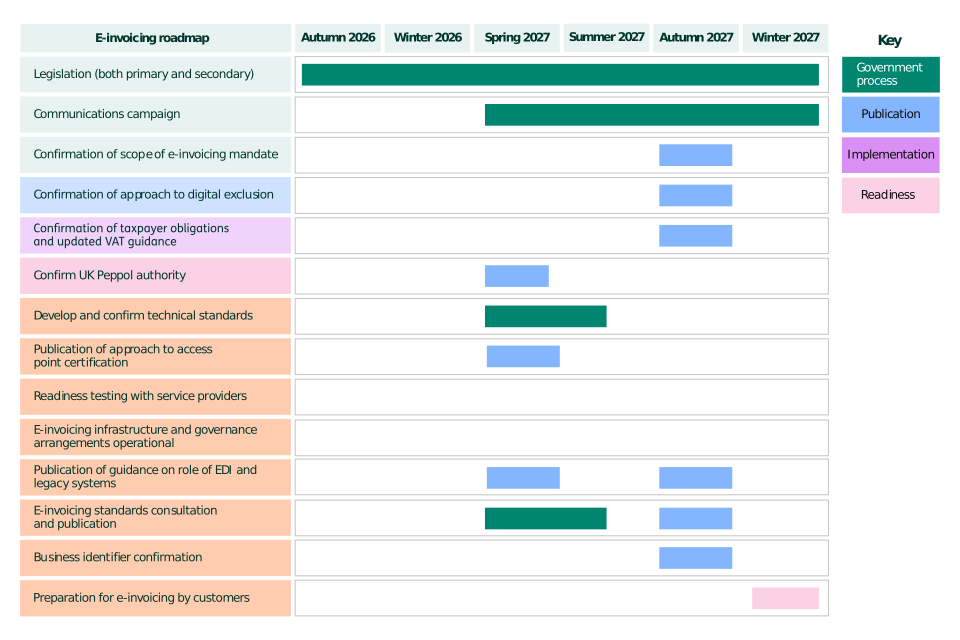
E-invoices will be required for VAT invoices from 1 April 2029, and the government aims to set out requirements for compliance with the e-invoicing requirements between October 2027 and April 2028.
From April 2029 VAT-registered persons will have to receive and issue VAT invoices as e-invoices unless a specific exemption applies.
VAT-registered persons are required to issue VAT invoices when they make a taxable supply to another VAT-registered person within the UK. This includes VAT-registered businesses, sole traders, partnerships, Scottish Partnerships or charities, as well as any public or government bodies who are registered for VAT. The rules governing the issue and content of VAT invoices are set out in [VAT Notice 700, section 16[(https://www.gov.uk/guidance/vat-guide-notice-700#section16) on GOV.UK. VAT invoices are not required when a business, or other VAT-registered entity, makes a supply to a consumer.
E-invoicing requirements will be confirmed between October 2027 and April 2028.
To give software providers and affected organisations sufficient time to prepare for the e-invoicing requirements to take effect, the government will provide at least 12 months’ notice of the e-invoicing requirements for the UK. This means that the e-invoicing requirements will be confirmed between October 2027 and April 2028 enabling software providers to build, test and roll out their products to businesses and other organisations before the mandate takes effect from 1 April 2029. In parallel, the government will run a large-scale communication and awareness campaign to ensure that businesses and other VAT-registered organisations are aware of the upcoming requirements and well placed to implement e-invoicing so that it delivers efficiencies for them.
Any changes to e-invoicing requirements after April 2028 will be kept to a minimum, and only made, if necessary, based on feedback from stakeholders.
The government will consult on e-invoicing standards in Spring 2027.
To test e-invoicing standards, we will launch a public technical consultation on the proposed UK e-invoicing standards in Spring 2027.
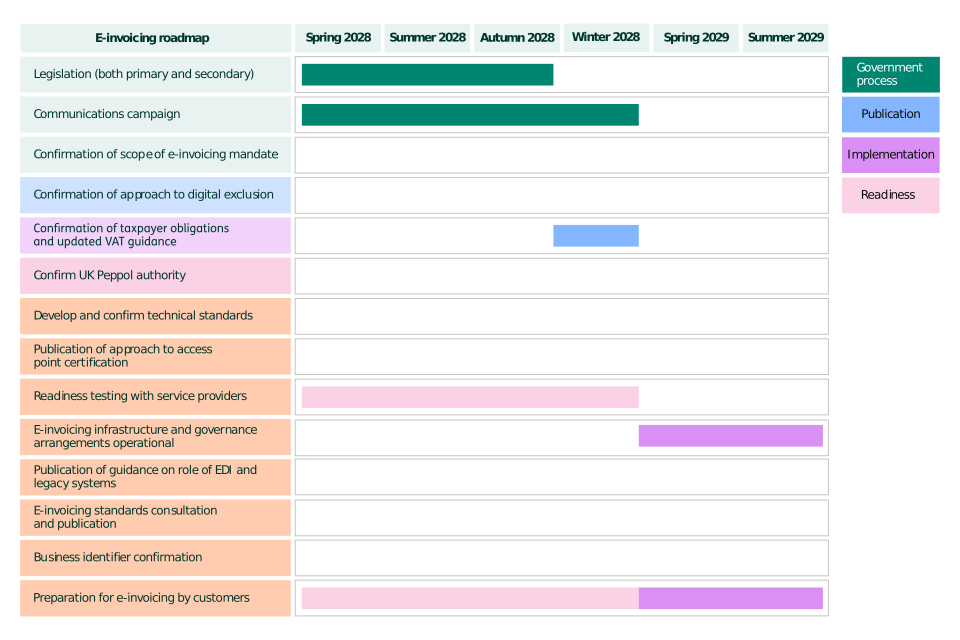
Figure 1: Placeholder image setting out key milestones
Scope of the e-invoicing requirements
The government will require the use of e-invoices to create a wide network of users and enable the UK economy to realise the benefits that e-invoicing can bring. E-invoicing adoption relies on a network of users, and therefore a mandate is required to ensure that there is adequate uptake for users to benefit. However, this does not mean that invoices outside the mandate cannot be issued as e-invoices and there are various situations where a business or other entity may wish to issue an e-invoice even when they are not required to do so.
Use of e-invoices for VAT invoices will be required from 1 April 2029. This means that UK VAT-registered persons will need to be able to receive e-invoices from 1 April 2029 and any VAT invoices they issue will be required to be e-invoices. If you are VAT-registered (and no specific exemption applies), you will need to, comply with these requirements by issuing a VAT e-invoice whenever your customer is also VAT-registered. This applies to organisations in both the public and private sectors.
Our intention is that the requirement to use e-invoices should apply broadly to VAT-registered persons, therefore any exemptions will be tightly defined and limited. Exemptions will be established either to accommodate digitally excluded persons (see below) or to clarify technical points where existing VAT rules have unusual or specific invoicing rules that are incompatible with e-invoicing. E-invoices will not be required for cross-border transactions as, VAT invoices are not required, but businesses may wish to issue them by agreement with their overseas customer. Existing place of supply rules will continue to govern cross border VAT arrangements.
Transactions where an e-invoice is required
- taxable transactions between VAT-registered entities where a VAT invoice is required
Transactions where an e-invoice is not required but might be sent
- small businesses who are not VAT-registered but would like to utilise the technology as best practice
- exempt, zero-rated or out of scope transactions between entities where no VAT invoice is required but a commercial e-invoice could be sent voluntarily
Transactions where no e-invoice will be sent
- transactions involving digitally excluded or exempt entities that are unable to do e-invoicing
- sales to end consumers — VAT invoices are not required and consumers are unlikely to have technology to receive an e-invoice
Invoices which are not covered by the e-invoicing requirements
Not all invoices are official VAT invoices. For example, invoices issued to consumers are not VAT invoices, invoices for transactions not subject to VAT are not VAT invoices, and invoices issued by businesses which are not registered for VAT are not VAT invoices. These invoices will not be required to be issued as e-invoices; however, some organisations may choose to issue non-VAT invoices as e-invoices on a voluntary basis.
The government wants to ensure that businesses and other entities that are not registered for VAT are able to benefit from the efficiencies that e-invoicing can deliver. Therefore, the standards and rules governing the exchange of e-invoices will be developed to ensure that non-VAT-registered entities can also use e-invoicing. This will ensure that smaller businesses can use e-invoicing without having to register for VAT.
VAT invoice requirements
Under existing VAT law, VAT invoices must be issued when a VAT-registered person makes a taxable supply to another VAT-registered person within the UK. This includes VAT-registered businesses, sole traders, partnerships, Scottish Partnerships and charities. The rules governing when VAT invoices must be issued will remain unchanged when the new e-invoicing requirements take effect from 1 April 2029.
Consideration of specific populations
The government will publish specific rules and some narrow exemptions for specific parts of the VAT-registered population, for example for those unable to make use of digital tools. Guidance for these groups will be provided by the end of 2027.
Digital exclusion
In keeping with existing policy on digital exclusion, we are developing an exemption from e-invoicing requirements for digitally excluded VAT-registered persons. MTD for VAT has already established criteria for an exemption where it is not reasonable or practical for a VAT-registered person to use computers, software or the internet to follow the rules for MTD for VAT. Typically, this would be because of age, health conditions, disability, where someone lives, religious objections to using computers or lack of access to the internet. We intend to follow the same approach to design an exemption from e-invoicing requirements. There may be other reasons someone may need to apply for an exemption from e-invoicing requirements, and these will be considered by HMRC on application.
The process and any further requirements for applying for an exemption from e-invoicing regulations will be set out by April 2028. This will include detail on how to apply for an exemption and how to communicate exempt status to suppliers and customers who would expect to issue or receive an e-invoice. We will also provide guidance on how businesses required to comply with e-invoicing regulations should interact with trading partners who are exempt, including any alternative invoicing arrangements that may be required.
The government will develop an exemption from the e-invoicing requirements for digitally excluded VAT-registered persons and will publish the details by April 2028.
Non-established taxable persons (NETPs)
Some businesses or other entities that are based outside the UK are required to register for UK VAT despite not having a location in the UK. These are known as ‘Non-established taxable persons’ (NETPs). In general, our policy is to treat NETPs the same as UK based VAT-registered businesses.
We have no plans to have different invoicing rules for NETPs and UK based organisations so, as with other invoicing rules, the e-invoicing rules for NETPs will be the same as for UK based entities. This would mean a UK-UK supply of goods subject to VAT made by a NETP, will require an e-invoice where the NETP’s customer is a VAT taxable person.
Non-established taxable persons will be subject to the same invoicing requirements as UK based entities.
Helping businesses adopt and benefit
Communications and engagement
Ensuring businesses understand, prepare for and ultimately comply with e-invoicing requirements will require a sustained communications campaign and an extensive programme of stakeholder engagement. Communications will focus on building awareness and driving behaviour change at scale, while engagement will focus on gathering insight, co-designing solutions, testing approaches and maintaining productive relationships with key stakeholders and intermediaries.
The communications and engagement approach will be phased and aligned to the wider e-invoicing roadmap. Activity will evolve through 4 stages:
- awareness: building understanding of what e-invoicing is and the potential benefits for businesses and the wider economy
- adoption: encouraging voluntary take-up and demonstrating the value of e-invoicing through case studies, partnerships and early adopter experiences
- readiness: supporting businesses and intermediaries to prepare for implementation, including understanding any requirements, available support and practical next steps
- compliance: helping businesses meet their obligations, embedding new behaviours and providing ongoing support during transition
Early engagement with businesses, software providers, representative bodies and professional intermediaries is already helping us understand audience needs, barriers, motivations and trusted channels, and this evidence will continue to shape campaign development. Stakeholder engagement will therefore play a critical role in informing communications throughout the programme lifecycle.
Reaching the UK’s diverse SME population at sufficient scale will be a challenge. While engagement with stakeholders has provided valuable insight, it cannot alone deliver the level of awareness required across the whole business population. The communications approach will therefore combine targeted stakeholder activity with broader marketing and communications channels to ensure we reach audiences beyond existing networks and representative bodies.
Communications activity will be designed to reach businesses of all sizes, while recognising that different audience groups will require different interventions at different stages. Alongside tax professionals and agents, we will also target finance, procurement and supply chain professionals, who are likely to play a key role in organisational adoption but are not always reached through traditional tax engagement routes. Partnerships with software providers, business representative organisations, trade associations, accountants and bookkeepers will help amplify messages through trusted voices and established networks.
Stakeholder engagement and audience insight will be used in the early phases to build understanding of behaviours, barriers and communication needs. An integrated paid marketing campaign would begin approximately one year before any future requirements take effect, providing sufficient time to build awareness, support readiness and drive action. Campaign intensity would then increase as key implementation milestones approach, ensuring communications are delivered at the point they are most relevant and actionable for businesses. This is consistent with lessons learned from other large scale transformation programmes such as Making Tax Digital.
Communications and engagement activity will be co-created with stakeholders wherever possible, tested with audiences before launch, and evaluated throughout delivery so that we can adapt our approach in response to emerging insight and evidence.
Information and advice for businesses
The government will work with stakeholders on an ongoing basis to consider how best to help businesses and other organisations with the transition to e-invoicing and ensure they have all the information and advice they need to prepare for the e-invoicing requirements and take advantage of e-invoicing.
Support will be available through dedicated online platforms, such as GOV.UK and the Business Growth Service. We will explore options and opportunities for dedicated e-invoicing information and guidance to be provided via these platforms. This may include practical implementation guidance, step-by-step adoption journeys, and online learning modules. It may also include a variety of case studies illustrating how businesses of different sizes, sectors and levels of digital maturity have adopted e-invoicing, including the different approaches available and the costs and practical considerations involved. We may also work with software providers to ensure their product offerings are affordable, accessible and meet the needs of business. This includes work to ensure interoperability, enabling businesses to integrate e-invoicing with existing systems.
As requirements are finalised, HMRC will continue to work with software providers and business representatives to understand changes businesses will need to make, including the likely costs and savings, taking account of the final decision of the regime and the market for compliant software.
Taxpayer obligations
VAT invoices play an important role in the operation of the VAT system. They provide evidence of taxable supplies, support the correct accounting of VAT and enable businesses to recover VAT incurred on their purchases.
To support these objectives, the government sets out the information that must be included on a VAT invoice, requires VAT-registered businesses to issue VAT invoices in relevant circumstances, and requires the issuer to keep them as part of their records.
Other than designated exemptions, VAT-registered organisations will be responsible for issuing compliant e-invoices where a VAT invoice is required. Organisations that receive VAT invoices will also need to be able to receive e-invoices.
As far as possible, we plan to use the existing VAT invoicing penalties framework as a basis for our approach. We will focus next on how compliance will be supported and administered.
Our aim is to ensure penalties support robust requirements to use e-invoices while ensuring that we are proportionate.
The government recognises that successful implementation will depend on businesses understanding and meeting their obligations under the new regime. We will continue to engage with stakeholders to inform the development of the regime and identify the most effective ways to support compliance. The government will provide details of the obligations on taxpayers and guidance to support compliance with them by April 2028.
VAT guidance updates
HMRC provides guidance to help taxpayers understand what they need to do to meet their obligations. Guidance reflects HMRC’s view of law and provides practical information to assist businesses comply with it. It does not replace, override the law or alter a taxpayer’s responsibility to comply with legislation.
We will publish guidance to taxpayers so that they can take practical steps to prepare for and comply with e-invoicing obligations, as we move closer toward implementing the policy. The work will involve reviewing the range of existing VAT guidance and communications that may be affected by the introduction of e-invoicing, as well as considering the different needs of the customers, agents, businesses who may rely on them.
The majority of VAT guidance will not be affected by the requirement for VAT invoices to be issued as e-invoices. This change aims to digitise the existing VAT invoicing process, so does not change the rules on when a VAT invoice must be issued or what it must contain. We anticipate that most changes to guidance will be minor and focused on areas where there are specific rules for invoicing or direct interactions with invoicing processes.
Updated guidance will be available by April 2028 to enable businesses to plan and identify any changes to their processes that they may need to make.
We intend to publish updated VAT guidance by April 2028, even if this means publishing guidance pending secondary legislation being made.
E-invoicing networks
This chapter is primarily aimed at software providers, as interoperability and access to e-invoicing networks will generally be managed through the technical solutions and services they provide.
E-invoicing networks provide the connections through which electronic invoices can be exchanged between businesses. They allow invoice information to move securely from the sender’s software provider to the recipient’s system, without both businesses needing to use the same technology or provider.
Networks are important because no single software provider will serve every business. Without a common way for different systems and networks to connect, businesses may need separate technical arrangements for individual customers or suppliers. This would add complexity and make it more difficult for businesses to change provider or establish new trading relationships.
For e-invoicing to work effectively across the economy, these different systems and networks need to be able to communicate with one another. This is known as interoperability. In practical terms, interoperability means that a business using one software package or software provider can exchange an e-invoice with a trading partner using another, without having to create a bespoke connection for that particular relationship.
Interoperability supports a more open and connected e-invoicing environment. It allows businesses to choose software and services that meet their needs while retaining the ability to exchange invoices with customers and suppliers using other providers. By reducing the need for separate arrangements between individual trading partners, it can also make it easier for businesses to connect with new customers and suppliers and support greater competition and innovation among providers.
E-invoicing is increasingly being developed around common international standards and networks. Aligning the UK approach with established international arrangements will help UK businesses exchange e-invoices with overseas trading partners and reduce the need to adopt entirely different processes for domestic and cross-border transactions. It will also support businesses operating across multiple countries by providing a more consistent approach, while allowing for requirements needed to reflect UK tax, legal and business needs.
Most businesses will not need to connect directly to an e-invoicing network or manage the technical arrangements that make networks interoperable. Their accounting software, finance system or e-invoicing software provider is likely to manage that connection on their behalf. Businesses will need to ensure that their chosen software or provider supports the future UK requirements and can exchange invoices with the systems used by their trading partners.
Peppol
As interoperability is central to the future UK e-invoicing approach, the government announced at Tax Update Day 2026 that the UK will adopt Peppol as its core interoperability framework for e-invoicing.
Peppol (formerly PEPPOL — Pan-European Public Procurement On-Line) is an established international framework that enables organisations using different software providers to exchange electronic invoices securely and consistently through a common set of standards, operating rules and network arrangements. By providing this shared framework, Peppol helps businesses exchange e-invoices without needing bespoke connections or separate arrangements for every trading relationship.
Organisations will typically access Peppol through an Access Point provided by their software provider. Access Points act as the connection between a business and the wider Peppol network, securely transmitting e-invoices and supporting compliance with the framework’s technical and operational requirements. As the policy progresses, communications will focus on Access Point certification, how software providers can achieve certification to meet demand and how businesses will interact with Access Points. Access Point certification is discussed below.
The Peppol network is governed internationally by OpenPeppol, the organisation responsible for maintaining the framework and supporting its use across participating countries. While the core framework is managed at an international level, countries adopting Peppol typically establish a national Peppol Authority to oversee how the framework operates within their jurisdiction and ensure any country specific requirements remain aligned with the wider international network. Further detail on the UK Peppol Authority can be seen below.
UK Peppol Authority
Peppol has been used in the UK for a number of years, particularly within the NHS, following the NHS eProcurement Strategy. As a result, the UK Peppol Authority function currently sits within the NHS Supply Chain. While this arrangement has been sufficient to support the NHS’s use of Peppol, the planned expansion of e-invoicing across the wider economy means that consideration is now being given to whether this remains the most appropriate long-term location for the Authority function.
The Authority acts as the UK’s stewardship body for Peppol, helping ensure that the framework operates effectively within the UK while remaining aligned to the wider international network. Its role includes overseeing compliance with both the core Peppol framework and any UK-specific requirements, supporting software provider assurance, coordinating with OpenPeppol, and helping to maintain a trusted e-invoicing ecosystem.
The Peppol Authority will not receive copies of VAT invoices for business transactions. We recognise that businesses and software providers will want clarity on how their data is handled and protected, and the development of appropriate safeguards and governance arrangements will form a core part of the programme.
HMRC will become the UK Peppol Authority, taking on responsibility for the governance and oversight of the Peppol framework in the UK. Further work will be undertaken to determine the timing and detailed governance arrangements for the transition.
Guidance on UK Peppol requirements
While Peppol provides a common international framework, some implementation decisions are made at a national level to reflect domestic legal, regulatory and business needs. As part of implementing Peppol in the UK, there are still important decisions to be made on what UK specific requirements will be needed and how those requirements should apply to software providers operating within the UK market.
UK needs: Peppol Authority specific requirements
While Peppol provides a common international framework for exchanging e-invoices, individual countries can define additional requirements to reflect their own legal, regulatory and operational needs. These are known as Peppol Authority Specific Requirements (PASRs) and are published by a country’s Peppol Authority. PASRs apply to software providers operating within that jurisdiction and help ensure that the international framework can be used effectively in a local context, supporting interoperability.
PASRs are important because countries often have different tax rules, business practices, security requirements and government policy objectives. The government will consider a range of factors when deciding whether UK-specific requirements are needed. These include existing VAT rules, wider legal and regulatory obligations, information security considerations, the needs of different business sectors, and the importance of maintaining interoperability with the wider international Peppol network. Any UK-specific requirements will seek to balance these considerations while minimising unnecessary complexity for businesses and software providers.
The government will consult on the technical standards that underpin the future UK e-invoicing regime, working with businesses, software providers, public sector organisations and other interested parties before the standards are finalised.
We will launch a public technical consultation on the proposed UK e-invoicing standards in Spring 2027. Whilst all interested parties will be welcome to participate, we expect the consultation to be most relevant to software providers, and other organisations responsible for implementing the technical standards.
Access Point certification
To send and receive e-invoices through the Peppol network, businesses will typically use a software provider. This functionality may be built into their accounting or finance software, or the software provider may work with a specialist provider that acts as an Access Point.
Software providers and Access Points are not always the same organisation. A software provider may offer e-invoicing solutions, software, implementation support, or managed services, while an Access Point provides the accredited connection to the Peppol network. Some software providers operate their own Access Point, while others use a third-party Access Point provider on behalf of their customers.
An Access Point is operated by a trusted intermediary that connects businesses to the Peppol network, enabling e-invoices to be exchanged securely and consistently between organisations using different systems and providers. By connecting through a single Access Point, businesses can exchange invoices with other participants across the network without needing separate technical connections for each customer or supplier.
Access Points help route invoices to the correct recipient, support checks against agreed standards, and provide assurance that invoices have been exchanged through a recognised network route. This ensures that e-invoices are sent to the right place, in the right format, and in a way that both sides can trust. For businesses, this helps reduce complexity and supports more automated processing of invoices.
Businesses will not need to become Access Points themselves. Instead, they are likely to access the Peppol network through their existing software provider, allowing them to benefit from e-invoicing without managing the network connection directly.
What is certification?
Access Point providers need to be certified before they can operate on the Peppol network. Certification provides assurance that the provider can exchange e-invoices reliably and consistently with other certified providers. It also helps maintain trust across the network, because all certified providers are expected to meet common technical, security and interoperability requirements.
The certification process checks that a provider is ready to operate as part of the Peppol network. This includes preparing and assessing their systems, applying through OpenPeppol, completing conformance testing, and receiving certification before being listed as a certified provider. These detailed technical steps are for software providers, rather than something most businesses will need to manage themselves.
How does certification work?
To operate as a Peppol Access Point, a software provider must complete a certification process. This process is designed to ensure that all Access Points can exchange e-invoices securely, reliably and consistently with other participants across the network.
Figure 2: Peppol technical certification process
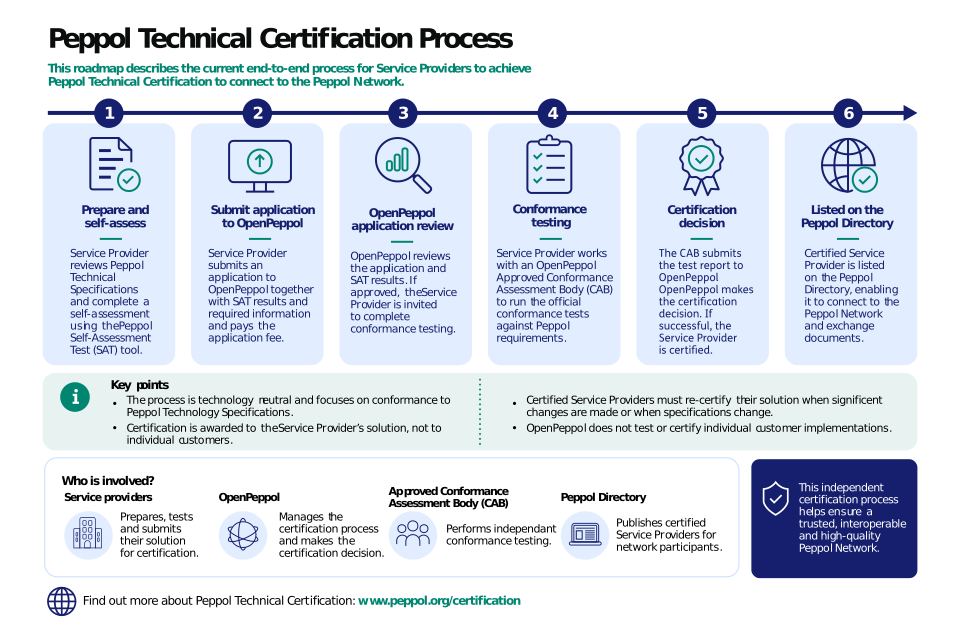
In the UK, this process is expected to flow as follows:
-
The software provider prepares its systems and services to meet the requirements set by OpenPeppol and the UK Peppol Authority. These requirements cover areas such as interoperability, security and the ability to exchange documents using the agreed standards. Software providers wishing to operate within the UK Peppol network may also need to meet additional UK-specific requirements set by the UK Peppol Authority.
-
The software provider then applies to join the Peppol network and completes the required testing and assurance activities. This testing is intended to confirm that the provider can successfully send, receive and process e-invoices in a safe, secure and compatible way.
-
Once these requirements have been met, the software provider can be certified as a Peppol Access Point. Certification gives businesses confidence that their chosen software provider has met recognised standards and can connect reliably with other participants across the network. Businesses can access the Peppol network either directly through a certified Peppol Access Point or via a software provider that connects to the network on their behalf.
-
After certification, the Access Point can offer access to the Peppol network to businesses, helping them connect to the Peppol network and exchange invoices with organisations using other certified software providers. Certification may also need to be maintained over time as standards evolve and network requirements change.
We will launch a public technical consultation in Spring 2027 on the proposed UK e-invoicing Access Point Certification requirements. The consultation will be open to all interested parties, although we expect it to be most relevant to software providers.
We will publish software provider management requirements, including on access point certification, between October 2027 and April 2028.
Please, also see the Next steps and Timeline sections under government role in e-invoicing management for further Milestones for Software Providers.
Government role in e-invoicing management
Software providers will play an important role in supporting the future UK e-invoicing framework. They will provide the services and technology that enable businesses to connect to e-invoicing networks, exchange invoices electronically and comply with the requirements of the future e-invoicing requirements. Given the critical role of invoicing to day-to-day business operations, it is important that organisations can trust the software providers they interact with and have confidence that appropriate assurance and governance arrangements are in place.
The Peppol framework already includes governance and assurance arrangements for Access Points through the Peppol Authority model. As the UK develops its approach to e-invoicing, consideration is being given to whether any additional UK-specific requirements, oversight or assurance arrangements are needed for software providers operating within the UK framework. This section explains the respective roles of the Peppol Authority and government, and how software providers will fit within the future UK e-invoicing ecosystem.
Responsibilities of software providers
We recognise the importance of providing clarity on the responsibilities that will apply to software providers operating within the future UK e-invoicing framework. As businesses will rely on software providers to connect to the network and exchange invoices, it is important that software providers understand the role they are expected to play and that businesses have confidence in the services they receive.
We are therefore developing a clear and proportionate framework for software provider responsibilities. The framework will apply to software providers operating within the UK e-invoicing ecosystem, including software providers that do not operate a Peppol Access Point and are not subject to Peppol accreditation requirements. This will include setting out any UK-specific requirements, assurance arrangements and service expectations that may be needed to support the effective operation of the UK e-invoicing ecosystem, while maintaining interoperability with the wider Peppol framework.
As part of this work, we will provide greater clarity on the legal position of software providers. Some responsibilities may arise through existing Peppol rules, certification requirements or contractual arrangements, while others may reflect expectations designed to support the effective operation of the UK framework. We will work with stakeholders to ensure software providers have a clear understanding of the requirements that apply to them and sufficient time to prepare for implementation.
Next steps
We recognise the importance of providing early clarity on whether any additional authorisation, accreditation or assurance requirements will apply to software providers operating within the future UK e-invoicing framework. This includes providing clarity on which requirements apply specifically to Access Point operators, and which apply more broadly to other software providers. We will continue to work with software providers, businesses and industry representatives to consider whether any UK-specific requirements are needed in addition to existing OpenPeppol arrangements.
Our approach is to build on established Peppol governance wherever possible and avoid creating unnecessary additional requirements. However, consideration is being given to whether any additional UK-specific arrangements are needed to support the effective operation of the UK e-invoicing framework and provide confidence for businesses and government.
Timeline
Spring 2028
Publication of Software Provider Management requirements. This will communicate a decision on additional authorisation, accreditation and whether assurance requirements will apply to software providers operating within the UK framework. The publication will also detail how these requirements will relate to existing OpenPeppol governance arrangements.
Summer 2028
Readiness testing with software providers, including testing of any operational, reporting and assurance requirements that will apply within the UK e-invoicing framework. This will help ensure that software providers are able to meet the requirements of the framework ahead of implementation.
Winter 2028
Infrastructure and governance arrangements will be operational. This will enable software providers to complete any required onboarding, assurance and accreditation activities before the requirements take effect.
1 April 2029
We expect all software providers operating within the UK e-invoicing regime to have completed any required accreditation process with the UK Peppol Authority. This will support a consistent and trusted approach to service provision across the UK e-invoicing ecosystem
Role of legacy or Electronic Data Interchange systems
Electronic Data Interchange (EDI) is one of the ways businesses exchange invoices and other commercial documents electronically between their systems. EDI is used across a range of sectors and can support the electronic exchange of invoices, purchase orders, delivery information and payment data.
During the e-invoicing consultation and subsequent co-creation activities, some businesses highlighted that their existing invoicing arrangements are built around EDI and other legacy systems that support established business processes and trading relationships. As a result, businesses have asked how these systems will interact with the future UK e-invoicing framework, whether different approaches can coexist, and what changes may be required over time.
While EDI enables electronic exchange of invoice data, many existing implementations rely on bespoke connections and sector-specific standards agreed between trading partners. This can mean businesses need separate arrangements for different customers and suppliers, making it more difficult for different systems and networks to work together.
The government’s e-invoicing approach is intended to simplify this by supporting greater interoperability promoting common standards and open networks. This should make it easier for organisations using different software providers to exchange invoices electronically, even if using different systems.
Next steps
EDI is an established approach used by businesses to exchange invoices and other commercial documents electronically as part of their wider procurement, supply chain and business-to-business processes. The government recognises that existing EDI and legacy systems may form part of businesses’ wider commercial operations and represent significant investment.
The government’s intention is that businesses can continue using these arrangements alongside the future UK e-invoicing framework. However, businesses using them will also need to be capable of exchanging e-invoices through the future framework, supporting interoperability between trading partners using different systems and software providers.
Further policy, technical and implementation work will determine how these arrangements will operate in practice. We will continue to engage with affected sectors, businesses, technical experts and software providers, and will publish further guidance in Autumn 2027.
Data standards
E-invoicing is more than simply sending an invoice electronically. For different software systems to exchange and process invoice information automatically, they must use a common set of rules about what information is included, how that information is structured and how it should be interpreted. These rules are known as data standards. They provide a shared approach that allows businesses and software providers to exchange invoice data consistently and reliably, even when they use different systems.
Most businesses will not need to interact directly with e-invoicing data standards or understand their technical requirements. Instead, these standards are likely to be implemented through accounting software, finance systems and e-invoicing software providers. For this reason, much of the detail in this chapter is primarily aimed at software providers and other organisations responsible for implementing the technical standards. Businesses will mainly need to ensure that their chosen software provider supports the UK e-invoicing standards, allowing invoices to be exchanged and processed correctly on their behalf.
Why are data standards important?
Data standards are important because the benefits of e-invoicing depend on invoices being exchanged and processed consistently. By creating a common approach, standards help reduce manual processing, minimise errors and enable greater automation.
A shared standard means an invoice created in one system can be correctly understood and processed by another system, regardless of the software provider being used. This supports interoperability, allowing organisations to exchange invoice data without needing bespoke arrangements for every trading relationship.
The government’s approach will build on established international standards, including those already used within the Peppol framework. However, international standards do not always reflect the specific requirements of every country. The UK may therefore need to introduce a limited number of UK-specific requirements to support domestic VAT, business and operational needs. Any such additions will be proportionate, clearly governed and designed to maintain interoperability with international standards wherever possible. Further information on this can be found in the Peppol chapter.
The future UK e-invoicing standards framework
The government will publish a package of standards, guidance and supporting requirements that together will form the foundation of the future UK e-invoicing framework. The aim is to provide businesses and software providers with a clear and consistent approach for creating, exchanging and processing e-invoices.
The standards package is expected to include:
- the core standards that define the information required within an e-invoice and how that information should be structured
- the technical specifications that support the exchange of e-invoices and related documents between different systems and networks
- any UK-specific requirements needed to support domestic VAT, business and operational needs
- requirements relating to business identifiers, validation rules and other supporting controls that help invoices be exchanged and processed consistently
- guidance and supporting materials to help organisations understand and implement the standards in practice
Together, these elements will provide a common framework that supports interoperability while giving organisations the certainty they need to prepare for implementation.
Next steps
The development of UK e-invoicing standards has so far been informed by evidence gathered through the government’s e-invoicing consultation and ongoing co-creation with businesses, software providers, representative bodies and other stakeholders. This engagement has helped shape our understanding of how invoices are exchanged today, the barriers to interoperability, and the areas where UK-specific requirements may be needed to support businesses and the wider economy.
As this work progresses, we will continue to engage stakeholders to ensure that the future standards are practical, proportionate and support interoperability. Building on established international standards, we will consult on any proposed UK-specific requirements before they are finalised.
We will launch a public technical consultation on the proposed UK e-invoicing standards in Spring 2027. The consultation will be open to all interested parties, although we expect it to be most relevant to software providers and other organisations responsible for implementing the technical standards.
Following consultation, we will review stakeholder feedback, refine the proposed standards where appropriate, and publish final requirements between October 2027 and April 2028 to provide businesses and providers with sufficient time to prepare for implementation.
Business identifiers
Business identifiers play an important role in e-invoicing. In an e-invoicing network, invoices need to be sent to the correct organisation. A business identifier acts as a digital address, helping software providers identify the organisations sending and receiving e-invoices and ensuring invoice data is routed correctly. Within the Peppol framework, business identifiers form part of an organisation’s Peppol participant identity, enabling organisations to be located, recognised and identified by trading partners across the network.
Business identifiers are an element of the e-invoicing framework that will be relevant to all those utilising e-invoicing. To send and receive e-invoices through the Peppol network, all e-invoicing users will need to register a business identifier as part of their Peppol participant identity.
While the technical setup will usually be handled by software providers, businesses will need to ensure they have an appropriate identifier so that they can be located on the network and exchange e-invoices with their trading partners.
What is a business identifier?
To exchange e-invoices through the Peppol network, organisations use a business identifier as part of their Peppol participant identity. This enables organisations to be located on the network and helps ensure e-invoices are delivered to the correct recipient. Business identifiers support the efficient and reliable exchange of e-invoices across the network. Peppol supports a range of different business identifiers, and countries adopting the framework can determine which identifiers they wish to support within their national implementation.
As part of aligning with the Peppol framework, the UK therefore needs to consider which business identifiers organisations will be able to use when registering on the network. These decisions are important because they will help determine how businesses identify themselves, how trading partners locate one another, and how invoices are routed across the future UK e-invoicing ecosystem.
Why do business identifiers matter?
From 1 April 2029, VAT-registered businesses (and other organisations) will be required to exchange e-invoices. To support this, businesses and software providers need clarity on the identifiers that can be used within the future e-invoicing framework.
We also recognise that organisations which are not required to do so may wish to adopt e-invoicing voluntarily because of the wider business benefits it can offer. Consideration is therefore being given to how the future approach to business identifiers can support broad participation across the e-invoicing ecosystem, whilst maintaining interoperability and providing clarity for businesses and software providers.
As the UK does not have a single identifier that applies across all organisation types, consideration is being given to how different business identifiers could support a wide range of businesses and sectors, while ensuring the future e-invoicing framework remains simple, interoperable and accessible.
Next steps
The development of our approach to business identifiers has been informed by engagement with businesses and software providers as well as wider work on the future e-invoicing framework. We will continue to work with stakeholders to ensure the final approach is practical, proportionate and supports adoption across the UK economy.
We intend to publish a decision on the business identifiers that will be accepted or supported within the UK e-invoicing framework between October 2027 and April 2028.
Relationship to digital reporting
E-invoicing will create a standardised flow of invoice data. At Budget 2026, the government launched a consultation on e-invoicing digital reporting to explore whether information created through e-invoicing could be used more effectively to support tax administration.
The consultation will seek views from businesses, software providers, agents, representative bodies and other stakeholders on the potential benefits, costs, risks and practical considerations associated with e-invoicing digital reporting. HMRC will also continue to explore potential use cases, delivery considerations and lessons from international experience.
This is an early-stage, exploratory exercise intended to gather evidence and stakeholder views. No decisions have been taken on whether e-invoicing digital reporting should be introduced. Any future decisions will be informed by the evidence gathered through the consultation and further analysis.
What happens next
What should I do now?
If you expect to be affected by the e-invoicing requirements, because you either send or receive VAT invoices, you should read this roadmap and begin planning for how you will implement e-invoicing in your organisation.
Figure 3: Draft diagram — do I need to prepare for e-invoicing?
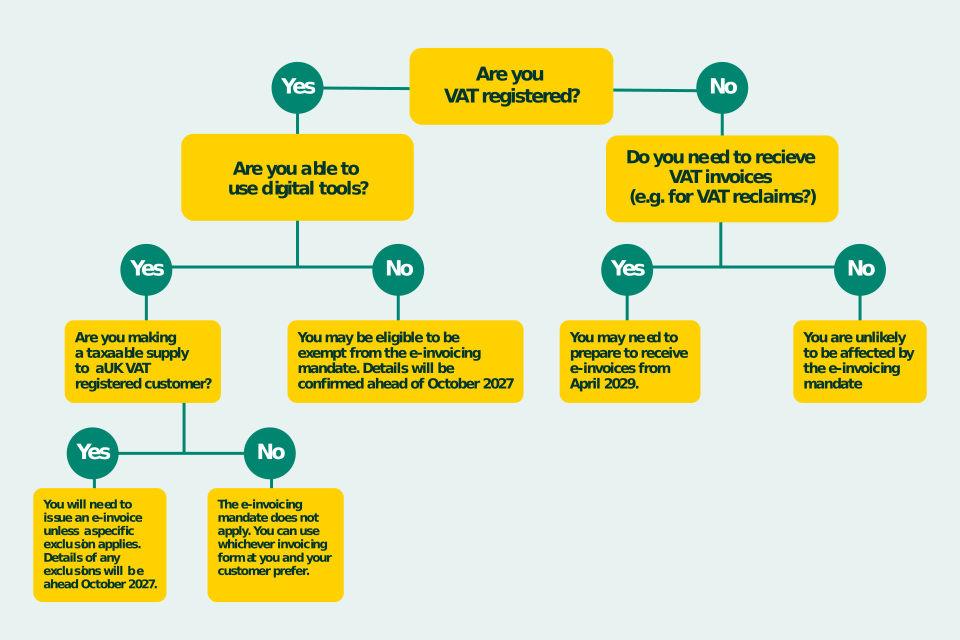
If you are VAT-registered and receive or issue VAT invoices you will need to be ready to adopt e-invoicing by 1 April 2029. E-invoicing implementation will vary across different organisations. Smaller organisations may find suppliers of accounting software can fulfil their e-invoicing needs; larger, more complex organisations may want to integrate e-invoicing into larger business systems and implementation may require co-ordination across tax, finance and digital functions.
There are already a range of e-invoicing software providers serving the UK market, including several who also provide MTD software, and we expect this provision to increase as we develop the UK’s e-invoicing regime.
There is no need to begin implementing e-invoicing before the detailed requirements are published. However, you may wish to begin researching the market of e-invoicing software providers, learning how other businesses in your sector or of a similar structure are implementing e-invoicing or talk to your accountant or adviser about how you will implement e-invoicing in your organisation.
The government will publish guidance on each element of the e-invoicing regime between October 2027 and April 2028, to give software providers and users of e-invoicing at least 12 months to prepare to comply with the e-invoicing requirements. Future communication will provide more advice on how to prepare for the e-invoicing requirements and adopt e-invoicing in a way that works for you.
If you would like to get in touch to participate in any of our work to develop and test our policy, standards and guidance please contact einvoicingengagement@hmrc.gov.uk.
Annex 1: Legislation
Existing legislation for invoicing and e-invoicing
The UK already has detailed rules about VAT invoices. These rules explain when VAT-registered persons must issue invoices, what those invoices must include, and how invoices must be kept. However, the UK does not currently have requirements to use e-invoices. At present, the law allows businesses to use electronic invoices for VAT, but it does not require them to do so.
The starting point for the current rules is the Value Added Tax Act 1994 (VATA 1994). This is primary legislation, (an Act of Parliament). It provides the broad legal powers for the VAT system, including powers that allow the government to make more detailed VAT invoicing rules in regulations (known as secondary legislation).
Schedule 11 to the VATA 1994 gives powers to require VAT invoices, to set out what information they must contain, and to require VAT-registered persons to keep VAT records. This is part of the legal basis for keeping and retaining invoices.
The detailed rules for VAT invoices are set out in the VAT Regulations 1995. These are the specific rules businesses must follow.
For example, the VAT Regulations 1995 explain when a VAT invoice must be issued. They also include rules for specific types of transactions, such as self-billing, simplified invoices, retailers’ invoices, credit notes and debit notes.
These regulations also allow VAT invoices to be sent electronically. Businesses need to ensure that they can prove authenticity of origin, integrity of content, legibility of the invoices and that they have their customers approval to receive invoices electronically. This means electronic invoices are already permitted, but only as an option for businesses.
HMRC also publishes guidance to help businesses understand how the rules work. The current guidance is technology neutral. Businesses can use PDFs, EDI systems, structured invoice formats, or other electronic methods, provided the legal requirements for authenticity, integrity and legibility are met.
The sections below explain how the different layers of legislation work together: primary legislation provides the power and authority for the regime, while secondary legislation supplies the operational detail.
Role of primary legislation
Primary legislation is law passed by Parliament. It is used to set the main legal framework and to give the government powers to make more detailed rules later. For e-invoicing, primary legislation will provide the legal framework for a mandatory regime. It will make clear that a mandate can be introduced and will give the government the necessary powers to set out the detailed requirements in secondary legislation.
Powers are needed because the current VAT framework allows e-invoicing but does not clearly authorise HMRC or the government to mandate it or set detailed operational requirements.
The primary legislation signals Parliament’s approval of the e-invoicing regime and provides certainty that a mandate will be imposed. It also ensures that detailed regulations (rules) can be made to govern the e-invoicing for VAT regime.
The government intends to introduce the necessary primary legislation into Parliament shortly as part of Finance Bill 2026, and subject to Parliamentary approval, is expected to become law in Spring 2027. The explanatory notes published alongside the Bill will provide further information about the purpose of the provisions and how they intend to work.
Role of Secondary legislation
Secondary legislation contains the detailed rules that sit underneath an Act of Parliament. For VAT invoicing, secondary legislation already covers practical matters such as when an invoice must be issued, what information it must contain, time limits for issuing invoices, and rules for simplified invoices and credit notes.
Some decisions covered elsewhere in this roadmap will need to be taken before the detailed rules can be finalised. Once those decisions are clear we can use secondary legislation to make them legal requirements.
Timing will depend on those decisions being taken and parliamentary time being available. Secondary legislation takes a significant amount of time to prepare and take through the process that makes it law so the formal process may not be concluded until Autumn 2028 or early 2029. However, we will ensure that decisions are clearly communicated so that the parliamentary timetable does not delay preparations.
Annex 2: Peppol Authority Specific Requirements
Peppol Authority Specific Requirements (PASRs) are published by a country’s Peppol Authority and apply to software providers operating within that jurisdiction. The PASRs cover a range of themes including:
- business identifiers: used to identify organisations on the network, such as VAT-registration numbers or other recognised identifiers — the PASR would need to define which identifiers are appropriate to use in the UK for e-invoicing purposes
- security: requirements that help ensure organisations and software providers using the network are genuine and operate securely — the PASR could define any UK-specific security, verification or assurance requirements
- reporting and transaction information: requirements relating to the information software providers may need to share about network activity — this can help support oversight of the network and ensure processes are operating correctly
- service level requirements: confirming the service level standards that software providers are expected to meet when supporting businesses on the network — this could include requirements relating to service performance, operational processes and customer support
- local interoperability requirements: additional requirements needed to ensure the Peppol framework works effectively alongside UK business practices, legal requirements and existing document types
- software provider accreditation: requirements relating to how software providers demonstrate that they can meet any UK-specific standards — this could include assurance, testing or accreditation arrangements where appropriate
Work is ongoing to consider whether any UK-specific requirements are needed in these areas and how they can best reflect the needs of UK businesses and industry. Any future requirements would be informed by further stakeholder engagement and consultation and developed in a way that supports interoperability with the wider Peppol network.
-
Sage (2024): E-invoicing, paving the way to a connected, real-time economy ↩ ↩2
-
DBT (2025): Estimating the total economic cost of late payments and their impact on the UK economy ↩ ↩2
-
Late payments research: performance and practices across business published on GOV.UK. — 24% of surveyed businesses attributed late payments they received from their business customers to administrative errors, including failing to log invoices or other invoicing errors. ↩