Performance report
Updated 17 December 2025

© Crown copyright 2025
This publication is licensed under the terms of the Open Government Licence v3.0 except where otherwise stated. To view this licence, visit nationalarchives.gov.uk/doc/open-government-licence/version/3 or write to the Information Policy Team, The National Archives, Kew, London TW9 4DU, or email: psi@nationalarchives.gov.uk.
Where we have identified any third party copyright information you will need to obtain permission from the copyright holders concerned.
This publication is available at https://www.gov.uk/government/publications/dsit-annual-report-and-accounts-2024-to-2025/performance-report
Department for Science, Innovation and Technology Annual report and accounts 2024–25
For the period 1 April 2024 to 31 March 2025
Accounts presented to the House of Commons pursuant to Section 6(4) of the Government Resources and Accounts Act 2000.
Annual report presented to the House of Commons by Command of His Majesty.
Ordered by the House of Commons to be printed on 10 July 2025
HC 1046
This is part of a series of departmental publications which, along with the Main Estimates 2025–26 and the document Public Expenditure: Statistical Analyses 2024, present the government’s outturn for 2024–25 and planned expenditure for 2025–26.
© Crown copyright 2025
This publication is licensed under the terms of the Open Government Licence v3.0 except where otherwise stated. To view this licence, visit nationalarchives.gov.uk/doc/open-government-licence/version/3.
Where we have identified any third party copyright information you will need to obtain permission from the copyright holders concerned.
This publication is available at www.gov.uk/official-documents.
Any enquiries regarding this publication should be sent to us at
Finance department
Department for Science, Innovation and Technology
22 Whitehall
London
SW1A 2EG
ISBN 978-1-5286-5672-6
E03346552 07/25
Performance report
Performance overview
Purpose of the performance overview
The performance overview gives the lay user a short summary of DSIT’s priorities, performance and key risks for the period.
Secretary of State for Science, Innovation and Technology’s statement on performance
Today, the Department for Science, Innovation and Technology (DSIT) is a completely different department to the one which welcomed me almost a year ago. I came with a clear ambition: to put working people at the heart of everything we do. We brought together tech experts from across Whitehall to create the digital centre of government in DSIT – the Government Digital Service (GDS). GDS was tasked with driving forward the digital transformation of our public services. We refocused DSIT’s work around 3 priorities: growing the economy, improving the performance and productivity of government, and empowering citizens.
We published the ‘AI Opportunities Action Plan’ – our strategy to put the UK at the forefront of the AI revolution. It focused on infrastructure, adoption and skills and was welcomed by the world’s leading AI companies. It stands as an example of how nations can use the power of technology to promote their prosperity and protect their security. Since July 2024 DSIT has landed £44 billion of private sector investment commitments in AI, to run over multiple years.
We made relentless efforts to deliver a better environment for businesses in Britain. We designated data centres as ‘Critical National Infrastructure’ to protect our digital economy from cyber-attacks. The protections included a dedicated team to monitor and anticipate potential threats. We also launched the Regulatory Innovation Office to get innovative new products and services into the hands of citizens faster.
Protecting our people will always come first. We worked with Ofcom to implement the Online Safety Act as quickly and effectively as possible. The Illegal Harms Codes are already in force – they mark the biggest material change to online safety in a generation.
We are making citizens’ lives easier, too. GDS have revealed plans for ‘GOV.UK App’, ‘Wallet’, and ‘Chat’. All these will make it more convenient than ever to engage with the state. GDS have also released a suite of innovative tools to make the civil service more efficient. They are working with HM Revenue and Customs and the Department for Work and Pensions to demonstrate the potential of technology in the public sector.
I am immensely proud of what we have achieved. But, to deliver our plan for change, there is much more to do. I am confident DSIT will rise to the challenge.
Permanent Secretary’s statement on performance
DSIT’s second year has seen a significant expansion of both the department and of our agenda. We have continued to play a central role in driving the UK’s leading position in science and technology, and I want to pass on my wholehearted thanks to colleagues and stakeholders for all their support.
We have become the digital centre of government. Following the general election, a machinery of government (MOG) change brought together the former Central Digital and Data Office (CDDO), Government Digital Service (GDS), and incubator for AI (i.AI) into one organisation within DSIT, with the whole organisation now integrating under the GDS banner. This has been a significant organisational effort, involving not only substantial work to both build out DSIT as a whole, and build a new integrated organisation within GDS itself. Since the MOG we have published the ‘State of Digital Government Review’ and the ‘Blueprint for Modern Digital Government’ as part of our goal to overhaul the British public’s experience of interacting with government. Our launch of GOV.UK Chat and the continued expansion of the successful OneLogin programme have paved the way for the launch of GOV.UK App and Wallet coming later in 2025. It has been a delight to welcome GDS colleagues into DSIT, and to see the department increasingly stepping into a leadership position across not just the UK’s digital economy, but the development of the digital state.
We have also launched ambitious new programmes with a focus on growth. DSIT has established the Regulatory Innovation Office (RIO) to develop regulatory reforms to unleash the potential of innovative products and services. We have also led on 2 of the 8 growth sectors identified within the government’s Industrial Strategy - the Digital and Technologies and Life Sciences sector plans. DSIT also set out the first steps in our ‘Digital Inclusion Action Plan’ ensuring everyone has the access, skills, and support to engage in our modern digital society and economy.
Artificial Intelligence has continued to be at the heart of many of our activities, and the publication of the ‘AI Opportunities Action Plan’ sets out how the government will shape its application. The UK’s AI Safety Institute became the AI Security Institute, reflecting its focus around strengthening protections against the risks AI poses to national security. DSIT is also championing the use of AI across the public-sector, for example through a 20,000 user cross-government trial of Microsoft 365 Co-Pilot displaying potential for significant time savings and further trials of i.AI products, ‘Redbox’ and ‘Minute’, taking place across the department. £42 million fund for 3 DSIT-led ‘Frontier AI Exemplars’ was announced at the Spring Statement – focused on driving efficiency and improving customer service in areas such as call centres and casework, right across government.
Our busy legislative agenda has continued, with the Digital Markets, Competition and Consumers Act 2024, which ensures free and vigorous competition amongst businesses both online and on the high street, receiving royal assent in May 2024. The Data (Use and Access) Bill continued its passage through Parliament, which will improve public services and making people’s lives easier – from speeding up checks when moving house or changing job, to speeding up care and improving patient outcomes by driving up NHS information standards.
At Autumn Budget 2024 we secured our 2025–26 funding settlement which provided the critical investment required to further the UK’s science and technology ambitions. This included £15.1 billion total funding for DSIT, as well as protecting record levels of spending in public R&D with £20.4 billion in 2025–26. We continued to prepare our bid for the 2025 Spending Review as well as leading a zero-based review of digital spending across government to advise HM Treasury and maximise the value of taxpayer pounds spent on digital transformation.
The evolution of DSIT as an organisation continues, with the final stages of the original MOG that created the organisation completing before the election, and the ongoing creation of GDS over the year. Since April 2024, we have continued a focus on secondments, and brought over 100 external experts into DSIT covering teams from AI Policy to International Research. We also continue to expand our presence across the UK and hit our 2027 target for 25% of our roles to be based outside of London in early 2025. We continue on this journey and I was particularly pleased with the announcement of our role in leading the future Manchester Digital Campus.
I have been very proud of DSIT this year as the department has continued to manage a large amount of change, not just internally (where we have been handling both a new administration and a new scope) but also externally, where we continue to operate on some of the country’s fastest-moving and most important opportunities and challenges. I look forward to seeing the department continue to mature and to grow its impact even further over the coming year.
About DSIT
Purpose
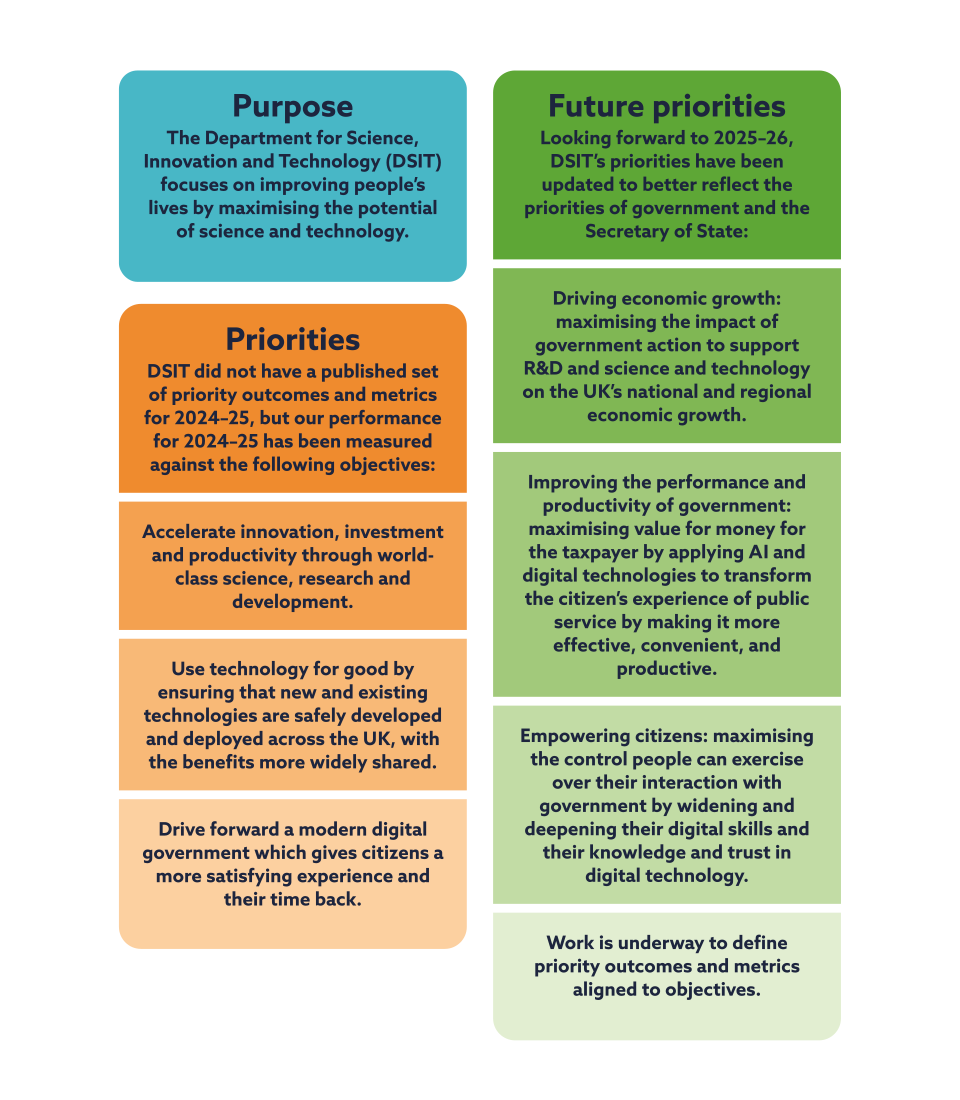
The Department for Science, Innovation and Technology (DSIT) focuses on improving people’s lives by maximising the potential of science and technology.
Priorities
-
DSIT did not have a published set of priority outcomes and metrics for 2024–25, but our performance for 2024–25 has been measured against the following objectives:
-
Accelerate innovation, investment and productivity through world-class science, research and development.
-
Use technology for good by ensuring that new and existing technologies are safely developed and deployed across the UK, with the benefits more widely shared.
-
Drive forward a modern digital government which gives citizens a more satisfying experience and their time back.
Future priorities
-
Looking forward to 2025–26, DSIT’s priorities have been updated to better reflect the priorities of government and the Secretary of State:
-
Driving economic growth: maximising the impact of government action to support R&D and science and technology on the UK’s national and regional economic growth.
-
Improving the performance and productivity of government: maximising value for money for the taxpayer by applying AI and digital technologies to transform the citizen’s experience of public service by making it more effective, convenient, and productive.
-
Empowering citizens: maximising the control people can exercise over their interaction with government by widening and deepening their digital skills and their knowledge and trust in digital technology.
-
Work is underway to define priority outcomes and metrics aligned to objectives.
DSIT business model and environment
-
DSIT was formed in February 2023 and brought together parts of the former Department for Business, Energy & Industrial Strategy (BEIS), the Department for Digital, Culture, Media & Sport (DCMS) and the Cabinet Office. A machinery of government (MOG) change in July 2024 brought the Government Digital Service (GDS), Central Digital and Data Office (CDDO), and the Incubator for Artificial Intelligence (i.AI) under DSIT.
-
DSIT annual funding is agreed with HM Treasury and Parliament. To the extent permissible, ministers, with advice from the board, executive committee and officials, decide the allocation of resources. See the summary of expenditure below for DSIT’s expenditure in 2024–25.
-
The core department is made up of 4 groups, employing over 3,000 people, with regional offices across the UK.
-
DSIT also sponsors arm’s length bodies (ALBs) which contribute to its work. Further information on DSIT ALBs is provided in the accountability report, in the governance statement.
-
The department consults a range of stakeholders while delivering its objectives, including small and large businesses, business representative organisations, unions, and research institutions. It also consults the public on critical policy decisions.
Organisational structure
Our core department is made up of 4 groups:
-
Digital, Technology and Telecoms
-
Science, Innovation and Growth
-
Corporate Services
-
Government Digital Service (GDS)
These were supported by 2 adviser roles:
-
National Technology Adviser
-
DSIT Chief Scientific Adviser
DSIT also administers the Government Office for Science, but it is led by the Government Chief Scientific Adviser, and is functionally independent from the core department.
Summary of performance in delivering DSIT priorities in 2024–25
A full review of DSIT’s performance can be found in the Performance analysis section of the annual report; below are some examples of the steps DSIT has taken against each of its objectives.
A. Accelerate innovation, investment and productivity
-
The AI Opportunities Action Plan set out how we will achieve our AI ambitions by driving adoption and building UK capability.
-
Phase 3 of the Life Sciences Innovative Manufacturing Fund (LSIMF) was opened to Expressions of Interest (EOI) in October 2024, with £520 million available to firms investing in the manufacture of human medicines.
B. Use technology for good
-
In November 2023, gigabit broadband was available to less than 80% of UK premises. Total gigabit broadband availability rose over the period by 6.1%, and was 85.7% in November 2024.
-
The Digital Inclusion Action Plan was launched in February 2025. It will significantly impact citizens’ lives by reducing social isolation, enhancing education and access to online services.
C. Driving forward a modern digital government
-
A GOV.UK Chat pilot in November 2024 saw over 10,000 business users ask the tool almost 24,000 questions. The AI-powered chatbot provides quick, personalised answers to questions based on GOV.UK guidance.
-
The ‘Blueprint for Digital Government’ was published in January 2025. It aims to build a digital state where services work across institutional boundaries.
Summary of principal risks as at 31 March 2025
The risks the department identified as most significant for the delivery of its objectives are listed below. These have been updated to reflect the current government’s priorities and have been regularly reviewed and iterated during the year to reflect changing external and internal conditions, with additional or revised mitigating actions adopted as appropriate.
Further information on Principal risks can be found in the performance analysis, and on the department’s risk management approach (Governance statement part 2: Risk assessment) in the Accountability report.
DSIT priorities for 2024–25:
A: Accelerate innovation, investment and productivity
B: Use technology for good
C: Drive forward a modern digital government
| Risk | Mapping to DSIT priorities | |
|---|---|---|
| 1 | Skills and capability: lack of the right skills and experience to deliver on DSIT’s agenda could impede progress. | A, B and C |
| 2 | Higher education financial sustainability: a lack of sustainability and resilience of university funding streams undermines their ability to deliver excellent research. | A |
| 3 | Geopolitical conditions: failing to prepare for, and react to, significant changes in geopolitical conditions, which could increase legal, regulatory, and operational barriers for UK businesses, researchers, and innovators. | A |
| 4 | Major incidents: insufficient preparation for major incidents, including cyber, telecoms, and space, pose significant risks. | A, B and C |
| 5 | Digital Centre: the new Digital Centre is not set up/designed to make a step change in digital government. | A and C |
| 6 | UK R&D and innovation competitiveness: DSIT’s R&D and innovation policies and investments might not create a sufficiently competitive innovation ecosystem to attract top talent and investment to the UK. | A |
| 7 | Loss of reputation of DSIT’s digital products and services: users and departments might lose trust and confidence in DSIT’s digital products and services due to ineffective data management, cyber-attacks, or poor design. | C |
| 8 | Shifting tech trends: a technology or technology subset might emerge with a significant impact on the economy or daily life, which government had not anticipated. | A |
| 9 | Research security: the balance between openness and security on R&D undertaken in the UK might not be maintained, leading to its use by hostile actors. | A |
| 10 | Loss of critical public-facing products and services in the new Government Digital Service: successful attacks by malicious actors or unintended technical issues might disrupt services beyond tolerance. | C |
| 11 | Resilience: DSIT might become less resilient, characterised by leadership or people metrics highlighting organisational-wide issues. | A, B and C |
| 12 | Secure technology – protecting critical public sector digital infrastructure: the UK public sector might suffer a sustained and continuous large-scale loss or hijack of its internet domains. | C |
Summary of expenditure
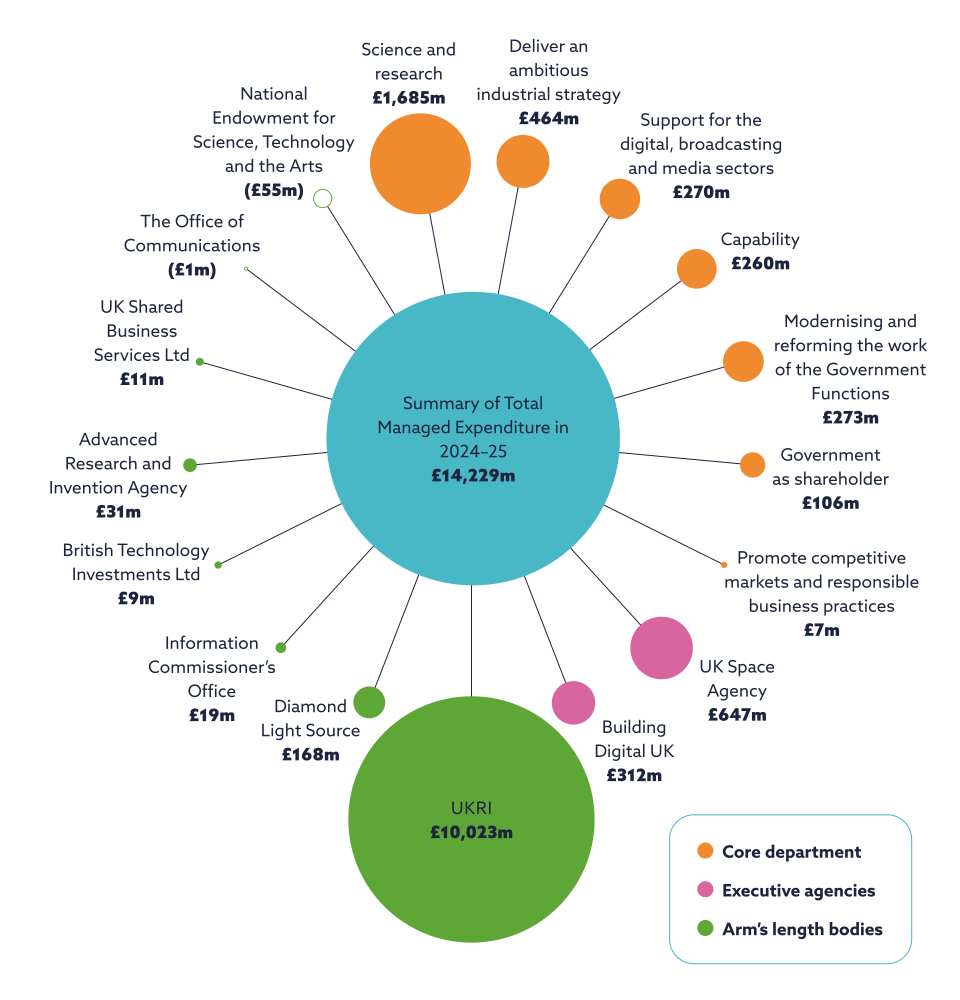
The chart below shows the total departmental spend in 2024–25, by major areas of spend. For the core department, spending is shown by the Estimate line. For all arm’s length bodies and agencies, spending is shown by entity. Some entities are included within the core department in line with Estimate reporting.
See the Financial review and the Statement of outturn against parliamentary supply (SOPS) for further information on departmental expenditure.
View data in an accessible table format.
Performance analysis
The performance analysis provides more detail on DSIT’s performance than the performance overview. It consists of the following sections:
-
performance in delivering DSIT priorities for 2024–25 (below)
Performance in delivering DSIT priorities for 2024–25
In 2023–24, and at the beginning of 2024–25, DSIT’s priority outcomes under the previous government were defined by the overarching ‘Science and Technology (S&T) Framework’.
A new government was elected in July 2024. The new government is committed to the S&T framework as a systems-based approach. However, from July 2024, DSIT’s priorities changed to: accelerating innovation, investment and productivity, using technology for good, and driving forward a modern digital government. DSIT’s priorities were updated again in February 2025.
We report against the 3 priorities in place from July 2024 to February 2025 as they were in place for most of 2024–25. They cover performance for the full year.
Priority A: accelerate innovation, investment, and productivity
-
The AI Opportunities Action Plan was launched in January 2025. It set out how we will achieve our AI ambitions by driving adoption and building UK capability. The government accepted all 50 recommendations in the Action Plan. Their implementation is underway.
-
Culham Campus was identified as the first AI Growth Zone (AIGZ) in January 2025. In February 2025, there was an initial expression of interest for future AIGZs which had over 200 responses. Potential sites include former industrial areas ready for redevelopment.
-
Phase 3 of the Life Sciences Innovative Manufacturing Fund (LSIMF) was opened to Expressions of Interest (EOI) on a rolling basis in October 2024, with £520 million available as capital grants to firms investing in the manufacture of human medicines, including Active Pharmaceutical Ingredients (API) and finished drug products, medical diagnostics for both disease identification and monitoring, and medical devices related to human health. Projects with a total cost of at least £8 million are eligible for funding through the LSIMF.
-
The UK became an associated country to Horizon Europe in January 2024. In 2024–25 DSIT continued to implement the UK’s association to Horizon Europe. DSIT have continued to deliver the remainder of the UK guarantee, which to 31 March 2025 has issued over 4300 grants, worth over £2.1 billion. The UK’s overall funding share in Horizon Europe is starting to increase. Initial data suggests it is currently still well below the high levels achieved in Horizon 2020. DSIT continues to address key barriers to UK participation such as awareness, complexity of the application process, and forming consortia. Initiatives to boost participation included: roadshow events across the UK with over 1,400 attendees, provision of over 170 pump priming grants via Innovate UK and the British Academy, information and brokerage events in the UK and Europe, and large-scale advertising campaigns.
-
The ChipStart programme had its second and third cohort which consisted of 11 and 10 semiconductor companies respectively. They joined in August 2024 and March 2025. The companies were given access to design capabilities, commercial expertise and exposure to private capital including over 270 Silicon Catalyst advisers. The first two cohorts have raised over £40 million in private investment. The third cohort was backed by £1.1 million in government funding.
-
In the first year of the Manchester prize, 10 finalists received £100,000 each and support to further develop their innovations. Polaron was selected as the winner in March 2025 and received £1 million in government funding. Polaron is a British AI-driven startup. It speeds up the development of advanced materials. A second round was launched in November 2024, which focused on ‘AI for Clean Energy Systems’. The prize winner will be announced in March 2026. While the prize received a healthy volume of applications, broader media coverage of key announcements could have helped build its profile through the cycle. This was considered to negatively affect the brand recognition and reach of the prize.
-
In January 2025, Orbex received £20 million of government investment to construct and launch its rocket, Prime. Prime will be the first UK-manufactured and UK-launched orbital rocket. The investment will encourage economic investment and support high-skilled jobs in the sector.
-
The Regulatory Innovation Office is initially supporting 4 fast-growing areas of technology including engineering biology, space, AI and digital in healthcare and drones and autonomous technology. RIO has also incorporated the Regulatory Horizons Council and the Regulators’ Pioneers Fund. DSIT has funded the Food Standards Agency (FSA) with a total of £3 million to safely speed up approval times for innovative products including Cell-Cultivated Products (CCP) and Precision Fermented Foods (PFF).
-
The first ever UK flight to test 2 quantum technologies, an Inertial Sensing System and an Optical Atomic Clock, took place in May 2024. Led by Infleqtion UK, a quantum technology firm, the project has received £8 million backing from government and could help to make transport safer and support resilient Position, Navigation and Timing (PNT) systems.
Priority B: use technology for good
-
In November 2023, gigabit broadband was available to less than 80% of UK premises. By introducing rolling market reviews, adding a 12 further signed contracts, tactical delivery through voucher projects and efforts to remove barriers on regulations, DSIT through BDUK almost doubled premises under contract, to over 1million premises. Total gigabit broadband availability rose over the period by 6.1%, and was 85.7% in November 2024.
-
The Digital Inclusion Action Plan was launched in February 2025. It will significantly impact citizens’ lives by reducing social isolation, enhancing education and access to online services. The plan outlines 5 actions to tackle digital exclusion. This includes funding local initiatives and donating refurbished government laptops. The policy team engaged departments across government given the cross-cutting nature of digital inclusion.
-
DSIT and Ofcom legislated to hold companies providing online services legally responsible to keep people safe online, especially children. Ofcom’s illegal harms statement put duties on illegal content from March 2025. Services must comply with them or face a fine up to £18 million or 10% of their revenue. DSIT consulted on the Statement of Strategic Priorities for Online Safety. DSIT classified the sharing of intimate images without consent as priority offences, and set the thresholds for classification. The government and Ofcom have been working closely over this period to help explain the positive change that the Online Safety Act is seeking to drive to the public. It is a complex piece of legislation and the changes it is seeking to make to the online environment are not yet that well understood by external stakeholders.
-
In November 2024, a project was begun to use Oxford Nanopore’s genetic sequencing technology to analyse 50,000 blood samples from the UK Biobank. This will create the world’s first ‘epigenetic map’, a dataset to capture epigenetic markers in the human genome. This could unlock new insights into the causes of diseases like cancer and dementia.
-
The Technology Security Initiative (TSI) with India was launched in July 2024. This is a landmark agreement negotiated by DSIT. It deepens the UK’s strategic partnership with India, with a clear focus on technology cooperation to drive breakthroughs. The TSI fosters cooperation between government, industry, and academia across 7 critical technologies, including AI, telecoms, critical minerals and biotechnology.
-
The EDITH trial is supported with a funding of £11 million from the National Institute for Health and Care Research (NIHR). Nearly 700,000 women across the country will take part in the trial. The 30 testing sites across the country are being enhanced with the latest digital AI technologies. They will assist radiologists to screen to patients to detect changes in breast tissue and possible signs of cancer.
-
In February 2025, the AI Safety Institute was relaunched and renamed as the AI Security Institute. This reflects its renewed focus on serious AI risks with security implications. It was strengthened by a new criminal misuse (CM) team to research AI-enabled crimes like fraud, and counter terrorism. The CM team works jointly with the Home Office and has built partnerships with private sector experts, and National Security partners.
Priority C: driving forward a modern digital government
-
During the GOV.UK Chat pilot, over 10,000 real business users asked the tool almost 24,000 questions, and received relevant answers in 90% of cases. The tool effectively detected and thwarted 100% of the attempts to break or manipulate it.
-
The ‘Blueprint for Digital Government’ was published in January 2025. It aims to build a digital state where services work across institutional boundaries, and where digital credentials enable a more timesaving, personalised user experience.
-
GOV.UK One Login had over 3 million accounts created between its launch in June 2023 and October 2024, to access an initial set of 50 central government services. An AI Playbook for civil servants was published in February 2025. It set out advice on building AI products and using them safely and responsibly in government.
-
The Data (Use and Access) Act received Royal Assent on 19 June 2025. The Act aims to harness the power of data for economic growth. It aims to establish digital verification services, develop a national underground asset register, enable more digital public services, help researchers to use data, and ensure people’s data is protected.
-
The first cohort of apprentices for TechTrack started in February 2025, training to become Software Developers and DevOps Engineers. 70% of TechTrack applicants came from minority backgrounds, and over 60% were based outside London. The AI Accelerator programme had a first cohort of 25 data scientists. They began their 12-week course in March 2025 to upskill them into machine learning engineers, to build useful AI tools for government.
-
The Expert Exchange Programme has made it easier to bring experts into DSIT. It promotes and embeds a culture that values external expertise. From April 2024 onwards, 104 external experts had been brought into DSIT, covering a variety of teams from AI policy to international research.
-
DSIT’s commercial team delivered savings of £36 million for 2024–25. They were recognised by the government commercial function as the ‘best commercial team’ in 2024. DSIT commercial set up a grants hub to manage DSIT’s £1.4 billion grant expenditure for 2024–25.
Metrics
DSIT tracks several indicators that relate to the progress of science, innovation, and technology in the UK. The following metrics cover key areas that DSIT is working to impact. These align with DSIT priorities to grow the UK economy and empower its citizens with digital skills and better access to technology.
Metric 1: gross expenditure on research and development as a percentage of GDP
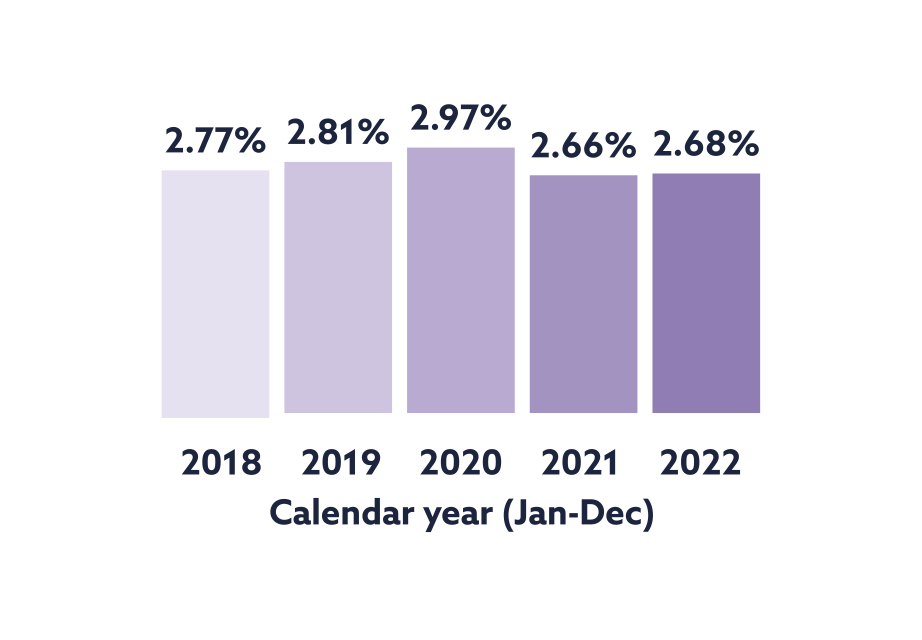
Gross expenditure on research and development (GERD) is the total spent on R&D across all industries. GDP or R&D intensity is the country’s total economic output. So, GERD, as a percentage of GDP or R&D intensity, is the contribution of R&D industries to a country’s economy.
Chart 1: UK gross expenditure on R&D as a percentage of GDP
Notes
Source title:
ONS Gross Expenditure on R&D statistics (2022)
Release schedule: annual with a 2-year lag approximately. The next update is expected in summer 2025.
Note: GERD is a combination of business expenditure on government expenditure and higher education expenditure on R&D. Following convention, the yearly figures are based on the sum of these over the calendar, financial and academic periods respectively.
View data in an accessible table format.
Metric 2: business expenditure on R&D
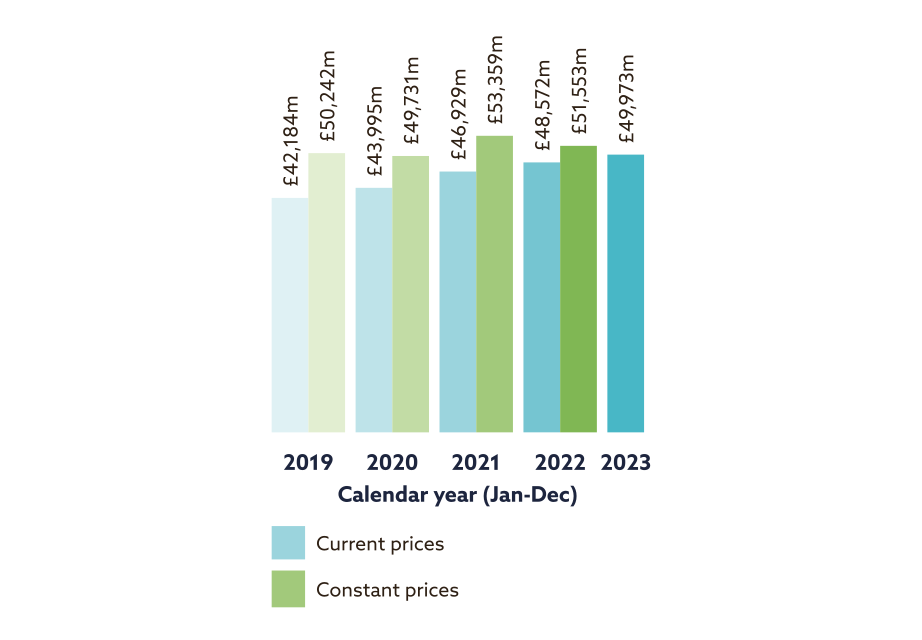
Business expenditure on R&D (BERD) is the total expenditure on R&D performed by UK businesses. For time series analysis, it is recommended to use constant prices to account for the effect of inflation.
Chart 2: expenditure on R&D performed by UK businesses, current (constant) prices
Notes
Source title:
ONS Business Expenditure on R&D statistics (2023)
Release schedule: annual with a 2-year lag approximately.
View data in an accessible table format.
Metric 3: field weighted citation impact
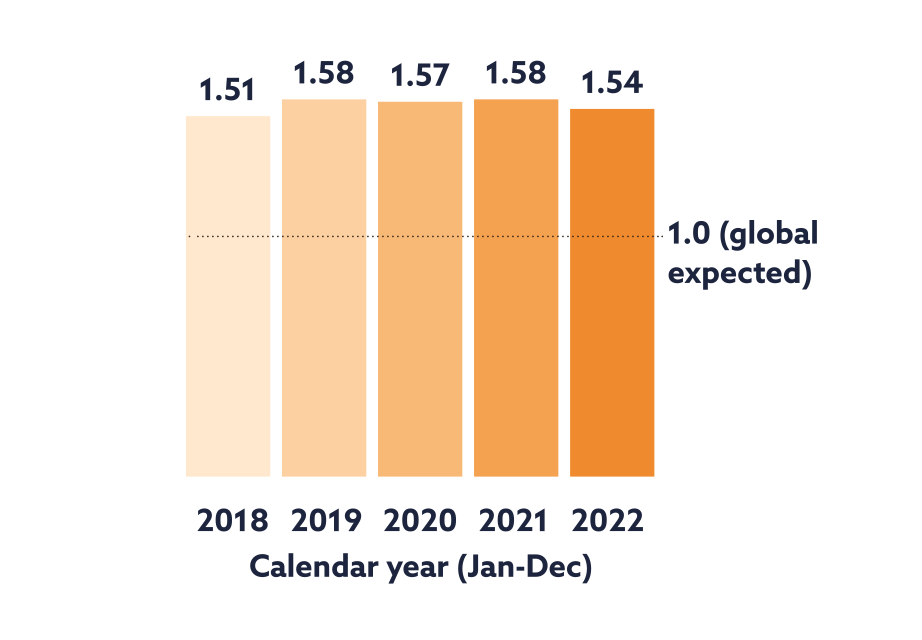
Field weighted citation impact (FWCI) is the number of citations received by a publication divided by the number of citations expected of a publication in that field, of that type and age. Individual publications are combined to produce a country’s FWCI. This indicates how much more (or less) its research publications are cited than expected globally.
Chart 3: UK Field weighted citation impact
Notes
Source title:
International comparison of the UK research base, 2025
Release schedule: 2–3 years
Note: SciVal® database, Elsevier B.V.,
http://www.scival.com (downloaded on 28/11/2024)
View data in an accessible table format.
Metric 4: number of new UK unicorns
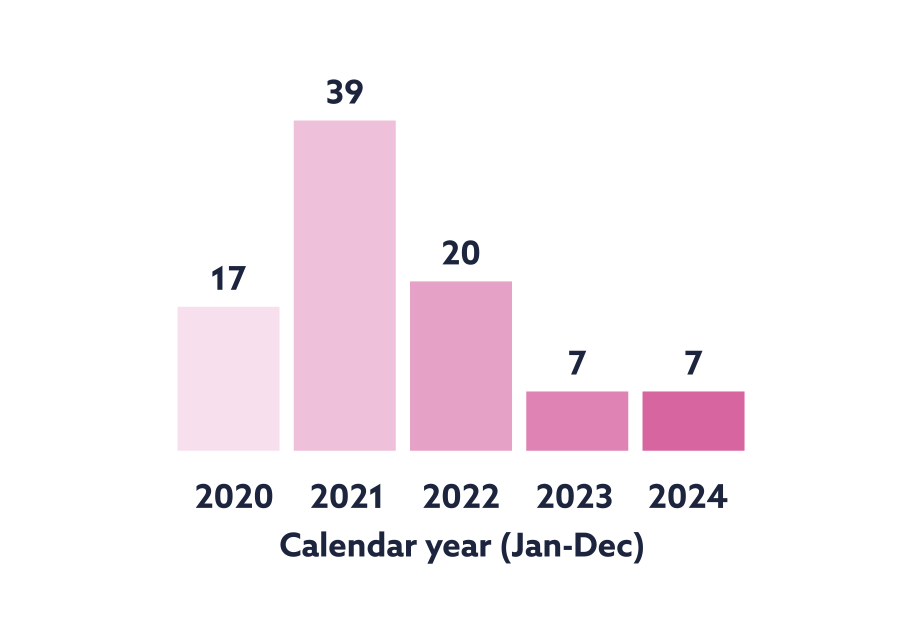
Unicorns refers to start-up companies reaching a valuation of over $1 billion. The number of new unicorns is a measure of UK companies effectively scaling up. DSIT policy contributes to a variety of sectors and ecosystem development so indirectly contributes to this outcome.
Following 2 strong venture capital investment years in 2021 and 2022, the drop in new unicorns for 2023 and 2024 was also seen for USA, China and other European countries.
Chart 4: number of new UK unicorns by calendar year
Notes
Source title:
Release schedule: continuously updated
View data in an accessible table format.
Metric 5: value of equity investment into R&D-intensive businesses
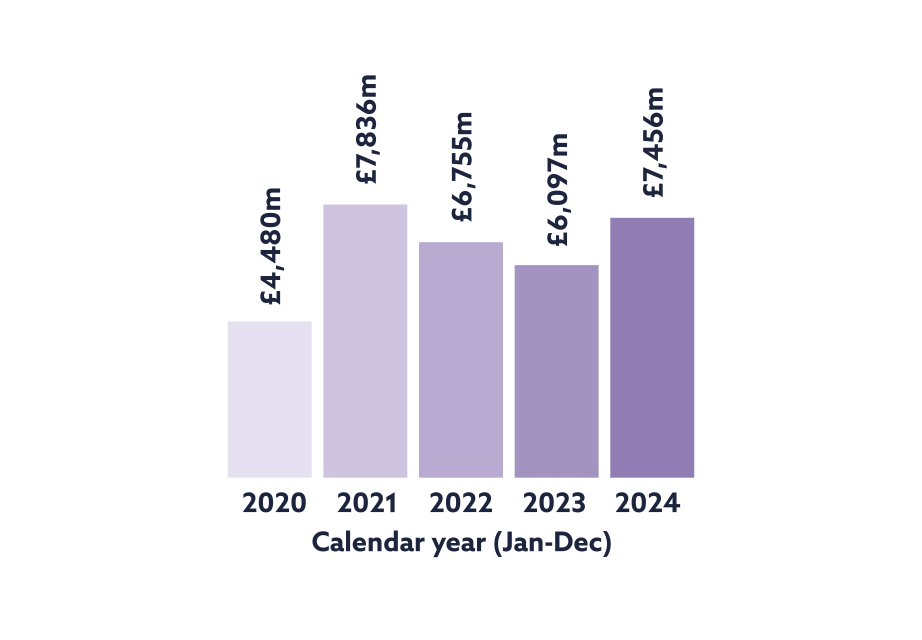
DSIT policy for innovation, R&D spending, access to finance and regulation should encourage increased investment in R&D companies.
This metric uses a high-level keyword selection to define the R&D sector in line with British Business Bank’s Small Business Equity Tracker 2024. It provides an indicative measure of the scale of investment into R&D-intensive companies.
Chart 5: value of equity investment into R&D-intensive businesses (£m)
Notes
Source title:
Release schedule: continuously updated
Note: data has not been reviewed by PitchBook analysts.
View data in an accessible table format.
Metric 6: digital sector annual gross value added
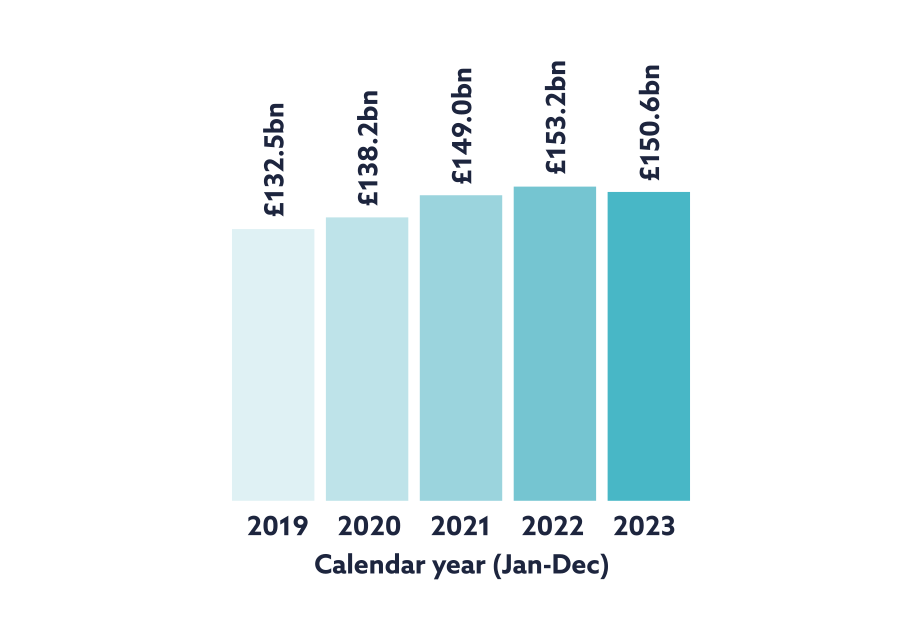
These statistics provide an estimate of the annual contribution of the digital sector to the UK economy, measured by gross value added (GVA). GVA is the measure of the value of goods and services produced in an area, industry or sector of an economy, defined by the value of output minus the value of intermediate consumption.
The figures show that the sector experienced substantial growth throughout the Covid-19 pandemic but contracted in 2023. This is predominantly due to falls in the ‘Computer programming, consultancy and related activities’ and ‘Film, TV, video, radio and music’ subsectors, which have been partially offset by strong growth in the Telecoms subsector.
Chart 6: estimated annual gross value added (GVA) in 2022 prices expressed in chained volume measures digital sector, 2019 to 2023 (£bn)
Notes
Source title:
Economic Estimates: Digital Sector Annual Gross Value Added (2019 to 2023)
View data in an accessible table format.
Release schedule: Annual (next update expected summer 2025)
Metric 7: percentage of premises passed with gigabit-capable broadband
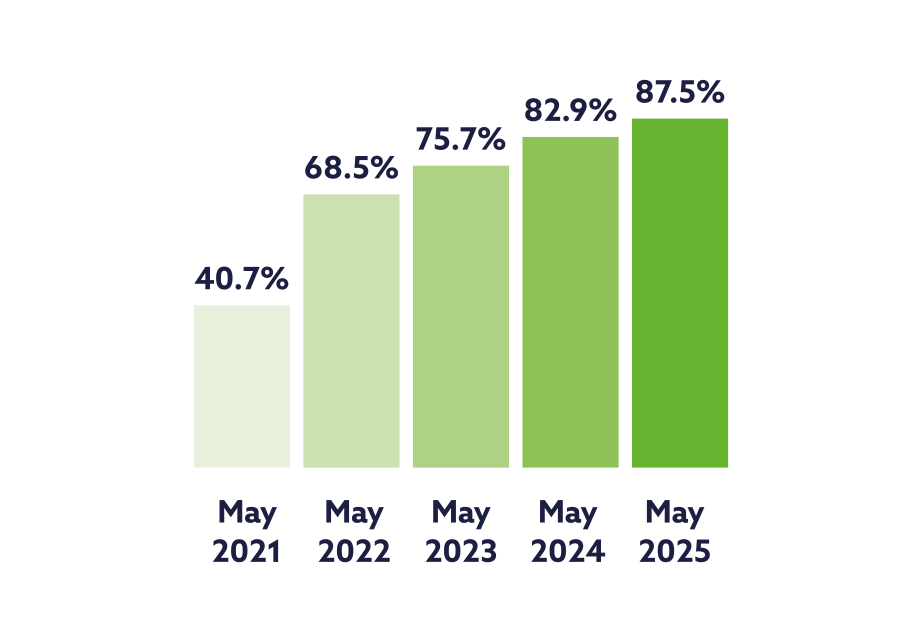
The government ambition is to deliver high quality digital infrastructure to citizens and businesses across the UK. We have made substantial progress in extending connectivity across the UK, mainly through our flagship programme Project Gigabit, which delivers gigabit-capable broadband to UK premises not included in suppliers’ commercial plans. According to independent website ThinkBroadband, over 87% of UK premises can now access gigabit-capable broadband, which is more than double the coverage level in 2021.
Chart 7: percentage of premises passed with gigabit-capable broadband
Notes
Source title:
Release schedule: monthly
Notes: includes premises with access to FTTP and/or DOCSIS3.1 technologies. Excludes a small number of premises that have gigabit-capable services available from mobile broadband (Fixed Wireless Access).
View data in an accessible table format.
Metric 8: percentage of geographic area with 4G coverage from at least one mobile network operator (UK, outdoor)
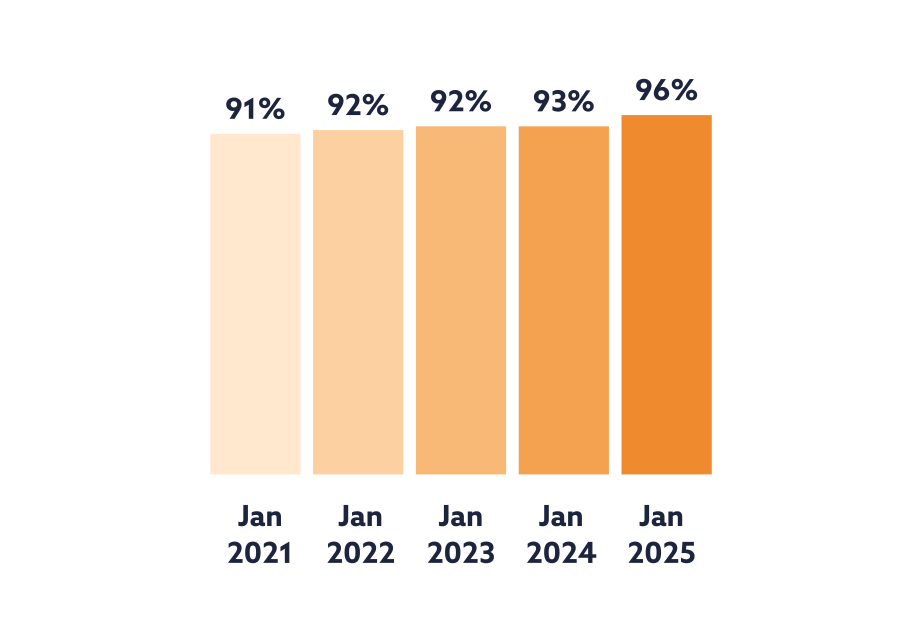
Through the Shared Rural Network, we are delivering 4G coverage to places where there is either limited or no 4G coverage at all. Ofcom reported that the Government 95% geographic UK landmass target for the programme was met at the end of 2024, a year ahead of the December 2025 deadline.
Chart 8: 4G geographic coverage from at least one mobile network operator
Notes
Source title:
Ofcom Connected Nations reports
Notes: coverage figures are rounded to the nearest 1%. It is possible that small changes in the data from one year to the next may be due to continual improvements to the modelling methodology used and therefore should be treated with caution.
Release schedule: twice yearly
View data in an accessible table format.
Metric 9: percentage of premises with 5G coverage from at least one mobile network operator (UK, coverage outside premises)
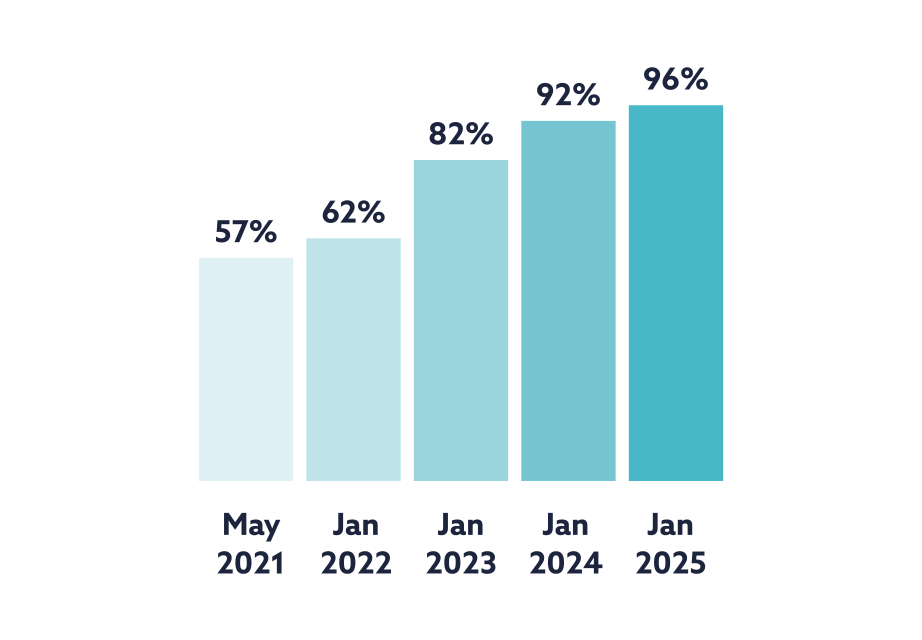
The government aims for all populated areas, including rural communities, to have higher-quality standalone 5G from at least one mobile operator by 2030. 5G coverage (combined standalone and non-standalone) is now available outside 95% of premises across the UK.
Chart 9: 5G coverage outside premises from at least one mobile network operator
Notes
Source title:
Ofcom Connected Nations reports
Release schedule: twice yearly
Notes: Includes non-standalone and standalone 5G. Coverage figures are rounded to the nearest 1%.
View data in an accessible table format.
Metric 10: percentage of UK internet users who claim they have experienced at least one example of potentially harmful online content or behaviour in the last 4 weeks
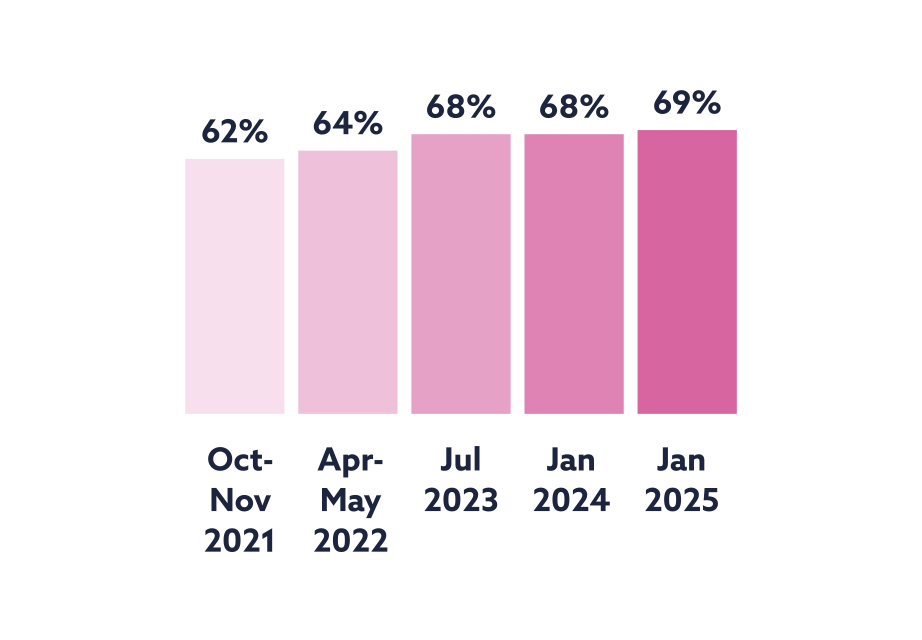
People’s experiences of using online services are surveyed twice a year by Ofcom. The below table provides the proportion of the UK who have seen or experienced potentially harmful online content in the four-week period preceding the survey date. This uses a list of approximately 50 types of potential harms, which extend beyond the list of illegal, priority, and primary priority harms listed within the Online Safety Act.
Chart 10: percentage of UK internet users who claim they have experienced at least one example of potentially harmful online content or behaviour in the last 4 weeks
Notes
Source title: Ofcom:
Online Experiences Tracker survey
Release schedule: twice yearly.
View data in an accessible table format.
United Nations Sustainable Development Goals
The United Nations (UN) Sustainable Development Goals (SDGs) are 17 goals for sustainable development set up in 2015 to be achieved by 2030. They are adopted by all UN member states. The UK government is delivering its commitment to the SDGs through its existing performance frameworks. Departments are responsible for delivering the SDGs within their policy areas.
DSIT contributes directly to SDGs 8: decent work and economic growth and SDG 9: industry, innovation and infrastructure. The table provides some DSIT outputs relevant to these SDGs.
| UN SDGs | Some DSIT outputs |
|---|---|
|
UN SDG 8 Decent work and economic growth: promote sustained inclusive and sustainable economic growth, full and productive employment, and decent work for all. |
AI Growth Zones Digital Inclusion Action Plan TechTrack apprenticeships and the AI Accelerator Programme the Life Sciences Innovative Manufacturing Fund (LSIMF) |
|
UN SDG 9 Industry, innovation and infrastructure: build resilient infrastructure, promote inclusive and sustainable industrialisation and foster innovation. |
Regulatory Innovation Office (RIO) Project Gigabit GOV.UK one login and GOV.UK Chat the Government Digital Service (GDS) |
Principal risks
Principal risks were the risks on the departmental risk register during the year.
The executive committee (Exco) held a risk horizon scan in September 2024 following the election of the new government and changes to departmental objectives. This resulted in some risks being closed or rearticulated. An innovative risk appetite statement was developed to encourage thoughtful risk taking where there are significant benefits and to enable innovation. The department has started refining what is within its gift to influence the outcome for these risks and ensure that is happening. Further information on risk management is covered within the governance statement in the Accountability report.
How risks have affected DSIT in achieving its objective
The principal risks have been controlled sufficiently to allow the department to continue to achieve its objective. The period has seen both opportunities and threats from the new commitments and priorities. The period was also marked with additional uncertainty of future spend allocations which was reflected in the need to manage the resilience of the department’s workforce.
1. Skills and capability
| Description | |
|---|---|
| Risk | Skills and capability: There is a risk that a skills gap analysis will identify that DSIT does not build sufficient specialist skills to deliver against our demanding, agile, complex and fast-moving agenda within the next 6–12 months |
| Mapping to DSIT priority | All 3 DSIT priorities |
| Mitigation | Business planning for 2025–26 was used to identify perceived skill gaps. Early insight has informed initial understanding of capability. We are prioritising targeted development in key areas: digital & data, science & engineering, cyber security, AI, analytical skills, project delivery, and line manager capability across DSIT. Heads of professions will be engaged for further insights into these areas. |
| Continuing or emerging risk | Emerging risk. Risk opened Sept 2024. |
| Opening risk rating | Impact: Medium. Probability: Likely (Rating at Nov 2024) |
| Closing rating: 31 Mar 2025 | Impact: Medium. Probability: Likely |
| Summary of change | Constant |
| How risk may affect delivery of plans and performance and plans in future years | Failure to manage this risk, particularly for digital skills, may affect delivery of digital objectives, including the OneGov programme. It may exacerbate risk 10 (loss of critical public-facing products and services in the new Government Digital Service) and risk 12 (secure technology – protecting critical public sector digital infrastructure) below. |
2. Higher education financial sustainability
| Description | |
|---|---|
| Risk | There is a risk that a Higher Education provider(s) is forced to exit the market or close significant research departments due to the combined effects of a constrained funding framework and inflationary pressures jeopardising their ability to deliver excellent research. This would have significant implications for the UK’s R&D skills base, research quality, research outputs/assets and the UK’s reputation |
| Mapping to DSIT priority | A: innovation, investment and productivity |
| Mitigation | Actions included: working with UKRI, Department for Education (DFE), and Office for Students (OFS) on a coordinated response, developing a DSIT response playbook, and working on legislative programmes to ensure Higher Education sector access to an insolvency regime. |
| Continuing or emerging risk | Emerging risk. Risk opened Sept 2024. |
| Opening risk rating | Impact: Very High. Probability: Possible (Rating at Nov 2024.) |
| Closing rating: 31 Mar 2025 | Impact: Very High. Probability: Possible |
| Summary of change | Constant |
| How risk may affect delivery of plans and performance and plans in future years | Failure to manage this risk may lead to a loss of R&D talent and capability and reduce high quality research being done in the UK. This may result in reputational damage to UK science and reductions in private R&D investment into higher education providers. |
3. Geopolitical conditions
| Description | |
|---|---|
| Risk | Geopolitical conditions: failing to prepare for, and react to, significant changes in geopolitical conditions, which could increase legal, regulatory, and operational barriers for UK businesses, researchers, and innovators. |
| Mapping to DSIT priority | A: innovation, investment and productivity |
| Mitigation | Convened cross-government groups on both security and international engagement for information sharing and collective agreement on approach. Ensured all critical tech policy teams had dedicated leads. Maintained overseas networks for information gathering. |
| Continuing or emerging risk | Emerging risk. Risk opened Sept 2024. |
| Opening risk rating | Impact: Very high. Probability: Unlikely (Rating at Nov 2024.) |
| Closing rating: 31 Mar 2025 | Impact: High. Probability: Unlikely |
| Summary of change | Decreased impact |
| How risk may affect delivery of plans and performance and plans in future years | Failure to manage this risk in future years may impact barriers to national growth |
4. Major incidents
| Description | |
|---|---|
| Risk | Major incidents: There is a risk that DSIT is insufficiently prepared to play our role in responding to major incidents. Including situations where DSIT is appointed Lead Government Department (LGD) for the response, and where we will play a significant supporting role, in accordance with the National Security Risk Assessment (NSRA). |
| Mapping to DSIT priority | All 3 DSIT priorities |
| Mitigation | Actions included: Appointed an Emergency Response Team. Published DSIT concept of operations. Appointed Crisis Management SROs. Set up 24/7 out of hours duty rota. Working on resilient satellite communications. Engaging closely with NSRA teams on crisis planning. Providing training to crisis response staff. |
| Continuing or emerging risk | Emerging risk. Risk opened Sept 2024. |
| Opening risk rating | Impact: High. Probability: Likely (Rating at Nov 2024.) |
| Closing rating: 31 Mar 2025 | Impact: High. Probability: Likely |
| Summary of change | Constant |
| How risk may affect delivery of plans and performance and plans in future years | Failure to manage this risk in the various policy areas of responsibility could potentially contribute to a national crisis. |
5. Digital Centre
| Description | |
|---|---|
| Risk | Digital Centre: the new Digital Centre is not set up/designed to make a step change in digital government. |
| Mapping to DSIT priority | A: innovation, investment and productivity C: modern digital government |
| Mitigation | Established a project to design the digital centre, with a delivery roadmap and success criteria in place, and a steering group to oversee project delivery. Engagement plan to get buy-in from external stakeholders and following the announcement ongoing engagement at senior level and among communities of practice. |
| Continuing or emerging risk | Emerging risk. Risk opened Sept 2024. |
| Opening risk rating | Impact: High. Probability: Likely (Rating at Nov 2024.) |
| Closing rating: 31 Mar 2025 | Impact: High. Probability: Possible |
| Summary of change | Decreased probability |
| How risk may affect delivery of plans and performance and plans in future years | This risk has the potential to destabilise the new Government Digital Service (GDS) and exacerbate risks 10, 11 and 12. Risk 10: loss of critical public facing products and services in the new Government Digital Service Risk 11: resilience Risk 12: secure technology – protecting critical public sector digital infrastructure |
6. UK R&D and innovation competitiveness
| Description | |
|---|---|
| Risk | UK R&D and innovation competitiveness: DSIT’s R&D & innovation policies and investments and the UK business environment they operate in, do not create a sufficiently internationally competitive innovation ecosystem to attract top talent and investment to the UK. Resulting in a detrimental impact on economic growth and knowledge generation |
| Mapping to DSIT priority | A: innovation, investment and productivity |
| Mitigation | Supported cross-government alignment on measures to support business environment, developed policies to support spinouts and scale-ups, and work on immigration barriers for innovation talent. |
| Continuing or emerging risk | Emerging risk. Risk opened Sept 2024. |
| Opening risk rating | Impact: High. Probability: Likely (Rating at Nov 2024.) |
| Closing rating: 31 Mar 2025 | Impact: High. Probability: Likely |
| Summary of change | Constant |
| How risk may affect delivery of plans and performance and plans in future years | Failure to manage this risk has the potential to stifle innovation across the UK which may result in a lack of economic growth. |
7. Loss of reputation of DSIT’s digital products and services
| Description | |
|---|---|
| Risk | Loss of reputation of DSIT’s digital products and services: Users and departments might lose trust and confidence in DSIT’s digital products and services due to ineffective data management, cyber-attacks or poor design. |
| Mapping to DSIT priority | C: modern digital government |
| Mitigation | GDS takes a “defence in depth” approach to protecting against known and unknown threats to the confidentiality, availability and integrity of its digital services. All services are regularly tested and assessed against relevant standards such as the NCSC Cyber Assessment Framework. |
| Continuing or emerging risk | Emerging risk. Risk opened Sept 2024. |
| Opening risk rating | Impact: Very High. Probability: Possible (Rating at Nov 2024.) |
| Closing rating: 31 Mar 2025 | Impact: High. Probability: Unlikely |
| Summary of change | Decreased impact, decreased probability |
| How risk may affect delivery of plans and performance and plans in future years | Failure to manage this risk in future could result in the UK public not using the government’s digital products which may affect the services that government departments are able to provide. |
8. Shifting tech trends
| Description | |
|---|---|
| Risk | Shifting tech trends: a technology or technology subset might emerge with a significant impact on the economy or daily life, which government had not anticipated. |
| Mapping to DSIT priority | A: innovation, investment and productivity |
| Mitigation | Establish a clear process for escalating tech trend analysis, develop an engagement plan with key industry stakeholders, and recruit STEM skills. |
| Continuing or emerging risk | Emerging risk. Risk opened Sept 2024 |
| Opening risk rating | Impact: High. Probability: Possible (Rating at Nov 2024) |
| Closing rating: 31 Mar 2025 | Impact: High. Probability: Possible |
| Summary of change | Constant |
| How risk may affect delivery of plans and performance and plans in future years | The failure to manage this ongoing risk may result in government losing pace with tech development. |
9. Research security
| Description | |
|---|---|
| Risk | Research security: the balance between openness and security on R&D undertaken in the UK might not be maintained, leading to its use by hostile actors. |
| Mapping to DSIT priority | A: innovation, investment and productivity |
| Mitigation | Strategies include: legislative and non-legislative measures, funding the Research Collaboration Advice Team, and ongoing review of research security policy measures. |
| Continuing or emerging risk | Emerging risk. Risk opened Sept 2024. |
| Opening risk rating | Impact: High. Probability: Likely (rating at Nov 2024.) |
| Closing rating: 31 Mar 2025 | Impact: High. Probability: Likely |
| Summary of change | Constant |
| How risk may affect delivery of plans and performance and plans in future years | The failure to manage this risk may result in incidents which leave UK research vulnerable and open to exploitation. |
10. Loss of critical public facing products and services in the new Government Digital Service
| Description | |
|---|---|
| Risk | Loss of critical public-facing products and services in the new Government Digital Service: Either successful attacks by malicious actors or unintended technical issues disrupt services beyond tolerance or lead to a loss of data or integrity. |
| Mapping to DSIT priority | C: modern digital government |
| Mitigation | Implement cyber security and resilience practices as defined in the GovAssure assessment framework and Secure by Design standard. |
| Continuing or emerging risk | Emerging risk. Risk opened Sept 2024 |
| Opening risk rating | Impact: Very high. Probability: Very likely (Rating at Nov 2024) |
| Closing rating: 31 Mar 2025 | Impact: Very high. Probability: Likely |
| Summary of change | Decrease |
| How risk may affect delivery of plans and performance and plans in future years | Lack of management of this ongoing risk may result in the disruption of government digital services which could affect the delivery of those services including to the most vulnerable in society. Loss of government reputation may follow. |
11. Resilience
| Description | |
|---|---|
| Risk | Resilience: DSIT might become less resilient, characterised by systemic leadership or people metrics highlighting organisational wide issues and trends which demonstrate reduced wellbeing. These may include a drop in productivity, higher levels of absence, calls to Health, Safety and Wellbeing or survey outcomes |
| Mapping to DSIT priority | All 3 priorities |
| Mitigation | We have implemented health, safety and wellbeing comms and engagement plans. They are regularly discussed with our people and operations committee. Line managers and SCS have increased communication of wellbeing offers and support available. We have reviewed DSIT’s response to geopolitical events. |
| Continuing or emerging risk | Emerging risk. Risk opened Sept 2024 |
| Opening risk rating | Impact: High. Probability: Possible (Rating at Nov 2024). |
| Closing rating: 31 Mar 2025 | Impact: High. Probability Possible |
| Summary of change | Constant |
| How risk may affect delivery of plans and performance and plans in future years | Failure to manage this ongoing risk could result in increased sick absence rates, reduced productivity, reduced morale and high turnover rates. |
12. Secure technology – protecting critical public sector digital infrastructure
| Description | |
|---|---|
| Risk | Secure technology – protecting critical public sector digital infrastructure: The UK public sector might suffer a sustained and continuous large-scale loss or hijack of its internet domains. |
| Mapping to DSIT priority | C: modern digital government |
| Mitigation | Boosted permanent capacity of the team providing domains scanning and remediation service and improved automated tooling. |
| Continuing or emerging risk | Emerging risk. Risk opened Jan 2025 |
| Opening risk rating | Impact: Very high. Probability: Very likely (Rating at Jan 2025). |
| Closing rating: 31 Mar 2025 | Impact: High. Probability: Very likely |
| Summary of change | Decreased impact |
| How risk may affect delivery of plans and performance and plans in future years | Failure to manage this risk could result in significant loss of information and reputation. This ongoing risk will need constant monitoring and management as hostile actors continually improve their digital skills. |
Risks closed between April 2024 and March 2025
These risks were closed, de-escalated or reframed following the horizon scan by Exco in September 2024.
| Closed risks | Comment | Rating at closure |
|---|---|---|
| Failure to achieve strategic advantage through science & technology: the risk of not harnessing cross-government efforts to implement science and technology strategies effectively. | Closed in horizon scan in Sept 2024 | Impact: Medium Probability: Possible |
| Lack of conversion to economic benefit: the risk that scientific research in universities and other institutions would not translate into economic benefits for the UK. | Incorporated into risk number 6: UK R&D and innovation competitiveness | Impact: High Probability: Possible |
| Short term pressures: urgent short-term pressures and reactive priorities could overwhelm DSIT’s ability to deliver long-term strategic priorities. | Closed in horizon scan in Sept 2024. Reframed and incorporated into risk number 11: resilience | Impact: Medium Probability: Likely |
| Budget management: over-commitment against budgets could lead to under delivery and financial scrutiny. | Closed in horizon scan in Sept 2024 | Impact: High Probability: Likely |
| Speed of technology: rapid technological advancements pose a risk as DSIT could struggle to respond appropriately to emerging opportunities and threats. | Reframed into risk number 8: shifting tech trends | Impact: High Probability: Likely |
| Geopolitical conditions: changing geopolitical conditions, such as conflicts and competition, could threaten DSIT’s ability to deliver on its goal of creating a UK science and technology superpower. | Reframed into risk number 3: geopolitical conditions. Risk rating changed to: high impact and unlikely probability |
Impact: Medium Probability: Possible |
| Risk rating changed to: high impact and unlikely probability | Impact: Medium Probability: Possible | Impact: High Probability: Possible |
| Management of Intellectual Property: insufficient preparation to manage the security of UK intellectual property could pose risks to national and global security. | Reframed and incorporated into risk number 4: major incidents and risk number 9: research security | Impact: High Probability: Possible |
| Balancing research priorities: challenges in finding the right balance between funding R&D for national priorities and investing in foundational science. | De-escalated to group level | Impact: High Probability: Possible |
Financial review
The financial review highlights key points from the Statement of outturn against parliamentary supply (SOPS) and the Financial statements.
The SOPS report on DSIT’s budget and outturn for the year. The financial statements follow the international financial reporting standards/accounting standards. Both statements are prepared for the departmental group.
Budgets and outturn
Understanding budgets
HM Treasury issue the departmental budgets, which are also approved by Parliament. Departments must monitor budgets to avoid overspending. Budgets are spent within the core department and distributed as grants to agencies and ALBs. Departments must inform HM Treasury if actual spending is expected to rise above forecast. The total budget for the year is referred to as the total managed expenditure (TME).
TME can be classified as resource or capital expenditure. Resource expenditure is for the current year to deliver the department’s priorities. It may be further split into programme and admin funding. Capital expenditure is for buying or creating assets. Capital spending in DSIT includes investment in digital infrastructure and in research and development (R&D).
TME can also be classified as Departmental Expenditure Limits (DEL) or Annually Managed Expenditure (AME). DEL is subject to limits set in Spending Reviews, which occur every few years. AME has limits set yearly. It includes areas of inherently volatile, demand-led expenditure and technical accounting matters.
Table 1: Outturn compared to budget for 2024–25
| Outturn £m |
Estimate £m |
|
|---|---|---|
| TME | 14,229.0 | 14,964.5 |
| Resource DEL | 865.3 | 1,035.9 |
| Resource AME | 365.6 | 661.3 |
| Capital DEL | 13,156.7 | 13,267.0 |
| Capital AME | (158.5) | 0.3 |
Notes
In this summary table totals and calculations might not add up exactly due to rounding. Please see the summary table in the SOPS section, Statement of outturn against parliamentary supply, for further detail.
Table 2: Explanation of variances
| Variance | Explanation |
|---|---|
| Resource DEL £170.7m Underspend |
Includes £125.4 million underspend against the budget for ring fenced depreciation across the department. £8.4 million underspend relating to Matrix programme £6.9 million pressure within the Science and Innovation Group, excluding ring fenced depreciation, primarily due to a write-off within BTI. Digital, Technology and Telecoms £14.2 million underspend, includes Building Digital (BDUK) £4.2 million, Digital Infrastructure £3.1 million and Digital £2.4 million |
| Resource AME £295.7m Underspend |
£180 million underspend against the budget for EU Programmes for foreign exchange Losses & Gains provision, not fully utilised in 2024–25. £49.4 million underspend in relation to the NESTA fund investment movements, following year end revaluations. £40.0m underspend for Eutelsat impairment unutilised provision. |
| Capital DEL £110.3m Underspend |
£13.7 million underspend in Financial Transactions, primarily due to slippage on investments in BTI. £22 million underspend against core UKRI budgets driven by slippage in Innovate UK. £39 million underspend on DSIT managed programmes delivered by UKRI, including £25m underspend relating to AI Research Resource. £40.2 million underspend in DTG relating to Building Digital UK (BDUK), mainly due to lower than expected delivery on the Gigabit programmes. £12.0 million pressure related to IFRS16 adjustments |
| Capital AME £158.8m Underspend |
£51.0 million underspend in relation to the NESTA Trust investment movements £107 million underspend due to unbudgeted IAS19 capital pension adjustments within Medical Research Council (MRC). |
| Total £735.5m Underspend |
Mainly from RAME as above |
Trend analysis
The table below shows historic outturn and planned outturn for the next year. This summary has been extracted from the Core tables in annex A.
Table 3: Trend analysis by budget classifications
| 2020–21 outturn | 2021–22 outturn | 2022–23 outturn | 2023–24 outturn | 2024–25 outturn | 2025–26 plans | |
|---|---|---|---|---|---|---|
| Resource DEL | 596.5 | 598.5 | 678.8 | 814.8 | 865.3 | 1,072.1 |
| Resource AME | 75.8 | 278.3 | 214.1 | 231.0 | 365.6 | 679.5 |
| Capital DEL | 10,331.0 | 9,862.8 | 10,872.3 | 12,438.3 | 13,156.7 | 14,669.5 |
| Capital AME | (57.4) | (67.0) | (68.5) | (104.9) | (158.5) | 0.3 |
| TME | 10,945.9 | 10,672.6 | 11,696.7 | 13,379.2 | 14,229.0 | 16,421.3 |
Table 4: Trend analysis by patterns of spend over time
| 2020–21 outturn | 2021–22 outturn | 2022–23 outturn | 2023–24 outturn | 2024–25 outturn | 2025–26 plans | |
|---|---|---|---|---|---|---|
| UK Research & Innovation (UKRI) | 9,090.4 | 8,707.9 | 9,397.0 | 9,579.9 | 10,023.3 | 8,880.1 |
| Diamond Light Source | 119.0 | 117.5 | 104.8 | 46.2 | 167.9 | 36.4 |
| Meteorological Office | 153.8 | 240.4 | 191.5 | 183.7 | 255.2 | 458.6 |
| National Measurement System | 119.6 | 126.3 | 124.1 | 152.7 | 153.3 | 220.6 |
| Building Digital UK (Building Digital UK was established as an executive agency from 2022–23) | - | - | 101.7 | 132.7 | 311.8 | 623.0 |
| UK Space Agency | 491.4 | 493.8 | 626.8 | 680.8 | 651.5 | 733.3 |
| Other Science and Research | 372.4 | 310.7 | 420.4 | 825.6 | 503.1 | 1,220.6 |
| Horizon and Copernicus association | - | - | - | 1,059.9 | 1,155.3 | 2,571.3 |
| Digital, Broadcasting, Media and Broadband | 288.6 | 288.8 | 175.6 | 251.3 | 288.0 | 365.1 |
| Geospatial Commission¹ | 153.8 | 135.5 | 139.7 | 149.9 | 147.1 | - |
| Government Digital Service | 97.1 | 101.5 | 170.6 | 254.8 | 273.4 | 418.5 |
| Other | 59.8 | 150.0 | 244.4 | 61.7 | 299.1 | 893.7 |
| Total | 10,945.9 | 10,672.6 | 11,696.7 | 13,379.2 | 14,229.0 | 16,421.3 |
Note
- In line with the announcement on GOV.UK, the Geospatial Commission became part of the Government Digital Service (GDS) as of January 2025. For operational purposes, previous years’ outturns are shown separately to GDS. The Geospatial Commission plans for 25/26 are shown within the Government Digital Service line in this table, as it now forms part of this organisation.
Reconciliation between budgets and the financial statements
SOPS 2 provides a reconciliation between the SOPS (budget and outturn) and the financial statements. The financial statements are prepared according to international financial reporting standards (IFRS).
Official development assistance
Official development assistance (ODA) refers to UK government aid to developing countries, to support economic development. ODA expenditure is reported for the calendar year and as cash spend. ODA spend for DSIT relates to research and innovation.
The final figure for 2024 submitted to Foreign, Commonwealth and Development Office (FCDO) is £213.8 million. The final figure, for 2024 including the breakdown by sector will be published by the FCDO in September 2025. ODA spend in 2023 was £166.1 million.
Financial position
The table below shows the value of assets and liabilities for the departmental group. As at 31 March 2025, the department remains in a net asset position. Net assets have decreased from £7.4 billion at 31 March 2024 to £6.3 billion at 31 March 2025. The biggest changes in financial position this year are related to an increase in current trade payables relating to the department’s participation in the Horizon Europe programme and UKRI grant accruals. There was also a small £0.5 billion increase in non-current assets which was offset by £0.6 billion decrease in current assets.
Table 5: Value of assets and liabilities for the departmental group
| 2024–25 £m |
2023–24 restated £m |
|
|---|---|---|
| Non-current assets | 7,873 | 7,302 |
| Current assets | 3,691 | 4,334 |
| Current liabilities | (4,776) | (3,809) |
| Non-current liabilities | (519) | (429) |
| Net assets/liabilities | 6,269 | 7,398 |
Sustainability report
Task Force on Climate-Related Financial Disclosures
Introduction
The Task Force on Climate-Related Financial Disclosures (TFCD) developed a framework for reporting climate related financial information. In 2017, they published 4 areas against which organisations should report their approach to climate-related risks and opportunities. These are:
-
Governance
-
Strategy
-
Risk management
-
Metrics and targets
HM Treasury requires departments to comply with TCFD incrementally over a 3-year period. 2024–25 was the second phase of TCFD implementation, where DSIT built on phase one by making enhanced climate-related financial disclosures on risk management and refined metrics and targets. See the table below for details of the phased introduction:
Table 6: Phased introduction
| Annual report and accounts | TCFD disclosure |
|---|---|
| 2023–24: phase 1 completed | Governance |
| 2024–25: phase 2 completed | Governance, risk management, metrics and targets |
| 2025–26: phase 3 | Governance, risk management, metrics and targets, strategy |
Compliance statement
DSIT has reported on enhanced climate-related financial disclosures in a manner consistent with HM Treasury’s TCFD aligned application guidance. The guidance interprets and adapts the framework for the UK public sector.
DSIT has complied with all of the TCFD recommendations for phase 1 disclosures around governance in 2023–24 and in 2024–25, and has complied with recommendations for phase 2 disclosures to assess our most significant risks and opportunities and work towards incorporating them into our risk management processes. This is aligned with HM Treasury’s mandated timeframe.
DSIT welcomes the TCFD initiative. We have previously established processes for identifying and reporting climate change related impacts against earlier initiatives, such as the Greening Government Commitments.
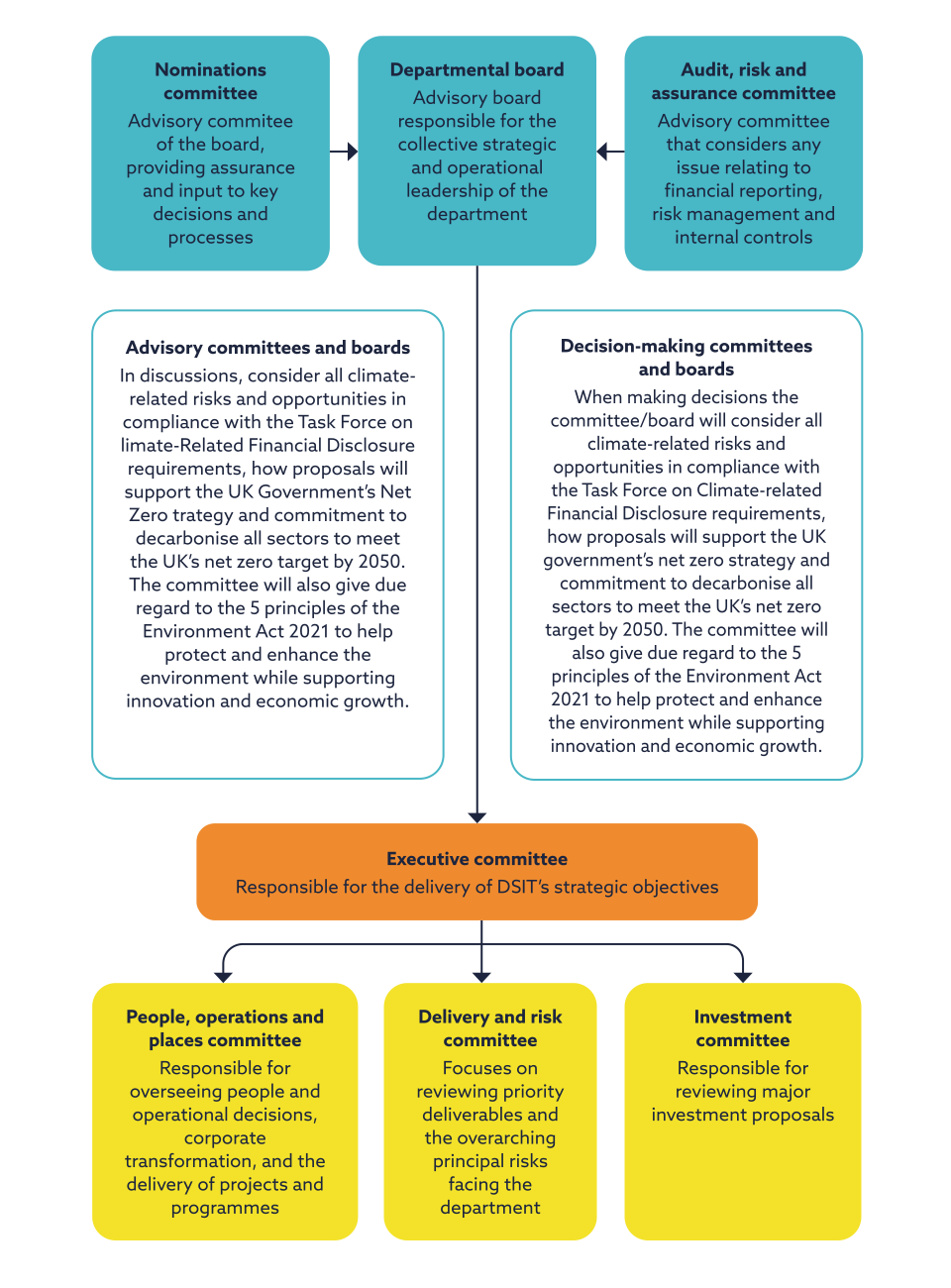
Nominations committee
Advisory committee of the board, providing assurance and input to key decisions and processes
Departmental board
Advisory board responsible for the collective strategic and operational leadership of the department
Audit, risk and assurance committee
Advisory committee that considers any issue relating to financial reporting, risk management and internal controls
Advisory committees and boards
In discussions, consider all climate-related risks and opportunities in compliance with the Task Force on limate-Related Financial Disclosure requirements, how proposals will support the UK Government’s Net Zero trategy and commitment to decarbonise all sectors to meet the UK’s net zero target by 2050. The committee will also give due regard to the 5 principles of the Environment Act 2021 to help protect and enhance the environment while supporting innovation and economic growth.
Decision-making committees and boards
When making decisions the committee/board will consider all climate-related risks and opportunities in compliance with the Task Force on Climate-related Financial Disclosure requirements, how proposals will support the UK government’s net zero strategy and commitment to decarbonise all sectors to meet the UK’s net zero target by 2050. The committee will also give due regard to the 5 principles of the Environment Act 2021 to help protect and enhance the environment while supporting innovation and economic growth.
Executive committee
Responsible for the delivery of DSIT’s strategic objectives
People, operations and places committee
Responsible for overseeing people and operational decisions, corporate transformation, and the delivery of projects and programmes
Delivery and risk committee
Focuses on reviewing priority deliverables and the overarching principal risks facing the department
Investment committee
Responsible for reviewing major investment proposals
Governance
DSIT governance for climate-related risks and opportunities follows the core corporate governance board operating model. This is illustrated in the governance statement under the DSIT Departmental Board structure. A similar diagram that applies to TCFDs is shown above. Note that this is not the full DSIT corporate governance board operating model.
Executive committee (Exco): Exco supports DSIT’s accounting officer in the running of the department, and supports the deputy director of financial reporting & controls in implementing the TCFD framework and meeting its reporting rules. When possible, Exco considers climate-related risks and opportunities, and how it plans to support the UK government’s goal to reach net zero emissions by 2050. It also gives due regards to the 5 principles of the Environment Act 2021 to help protect the environment while encouraging innovation and economic growth.
Departmental board (the board): The board helps lead the department and supports the accounting officer in making decisions. It looks at climate risks and opportunities when possible and checks how the department’s plans support the UK’s goal to reach net zero emissions by 2050. The board also gives due regards to the 5 principles of the Environment Act 2021 to help protect the environment while encouraging innovation and economic growth. In 2023–24, the board learned more about climate reporting through a presentation on TCFD. The audit and risk assurance committee (ARAC) helps the board by focusing on how DSIT reports on climate-related issues.
Delivery & risk committee (DRC): DRC considers the financial and non-financial impact of environmental, social and governance risks, including climate-related risks. Climate-related risks form part of the overall risk consideration for the department and are escalated to DRC accordingly. DRC advises the board on the implementation of TCFD from a risk management perspective.
Investment committee and the people, operations and places committee: These committees will also consider all climate related risks and opportunities in compliance with the TCFD requirements.
Strategy
The actual and potential impacts of climate related risks and opportunities on our business, strategy and financial planning
DSIT reinforces its commitment to transparency and to work towards net-zero decarbonisation by 2050, with the integration of the greening government commitments (GGCs) framework into our decision-making process. This set out our performance against GGC, outlining environmental impact reduction targets and also including disclosures on the United Nations sustainable development goals (SDGs).
Risk management
The processes we use to identify, assess, and manage climate-related risks
DSIT has established structured risk management processes. These enable us to outline principal risks and better understand and proactively respond to the financial and non-financial risks that climate change presents to DSIT, the global economy and UK taxpayers. This ensures that as a department, we can robustly deal with challenges.
Description of the organisation’s processes for identifying and assessing climate-related risks
DSIT has a structured risk management framework that outlines principal risks for 2024–25 and this includes clear details on identified risks, their likelihood, potential impact and corresponding management strategies. This ensures and supports proactive risk identification. DSIT acknowledges the need to enhance its climate risk assessment and is working to incorporate this in strategic planning across its operations.
Description of the organisation’s processes for managing climate-related risks
DSIT has a structured risk management process that applies to all risks, including climate risks, and follows a four-stage methodology with clear escalation procedures. The risk framework provides a foundation for managing environmental risks, and climate risks can theoretically be escalated to Exco for quarterly review. Additionally, risk escalation pathways are clearly outlined, with significant risks being escalated to Exco, which reviews risks quarterly at its delivery and risk meetings.
Description of processes for identifying and assessing and managing climate-related risks are integrated in the organisation’s overall risk management
DSIT recognises the importance of integrating climate-related risks into its broader risk management framework and has begun discussions about how best to achieve this. Climate resilience planning is included within DSIT’s broader resilience agenda, aligning with strategic objectives and ensuring a degree of consideration of climate risk into long-term strategic planning.
We also integrate climate risk identification, assessment, and management within the overall risk management framework. However, climate-related risks have not been designated as a principal risk.
Metrics and targets
The metrics and targets we use to assess and manage relevant climate-related risks and opportunities
Climate change is not designated as a principal risk at this stage. However, DSIT is committed to working towards net zero decarbonisation and we are working on understanding the impact of our department on emissions.
We have established a number of sustainability-related metrics, which enable us to track our progress on reducing emissions. This is an important foundation to build on our understanding of managing climate-related risks and provide opportunities to enhance the resilience of the department. The metrics are reported within the sustainability report and are aligned with broader government sustainability targets. They also have some overlaps with TCFD. Please refer to The Greening Government Commitments for more information.
The Greening Government Commitments
The Greening Government Commitments (GGCs) relate to environmental sustainability. They are a framework for departments to reduce the environmental impact of their operations. The targets for emissions are bespoke to each department, while other targets are generic for all departments. The targets are set by the Department for Environment, Food & Rural Affairs (Defra).
The current GGC framework is for 2021–25. It has a baseline year of 2017–18 with targets to achieve by March 2025. Departments report GGCs for their core department and public bodies in scope, collectively known as the GGC family. DSIT has these 7 public bodies in scope, as determined by Defra:
-
Information Commissioner’s Office (ICO)
-
Intellectual Property Office (IPO)
-
Met Office (MO)
-
National Physical Laboratory (NPL)
-
Ordnance Survey (OS)
-
UK Space Agency (UKSA)
-
UK Research and Innovation (UKRI)
A proportion of the DSIT GGC family occupy estates managed by the Government Property Agency (GPA). GPA are responsible for ensuring their estate is sustainable and delivers on GGCs on behalf of DSIT. DSIT performs an assurance role to support the GPA to achieve DSIT’s GGC targets.
Summary of targets and progress
| GGC targets by March 2025 | Outcomes in 2024–25 compared to 2017–18 baseline | Met/not met | |
|---|---|---|---|
| Overall emissions | 62% reduction (BEIS target) | 43% reduction | Not met |
| Direct building emissions (scope 1) | 30% reduction (BEIS target) | 18% reduction | Not met |
| Ultra-low emission vehicles (ULEV): less than 50g CO₂ per km | 25% of fleet by 31 Dec 2022 | 62% of fleet | Met |
| Emissions from domestic flights | Reduce emissions by 30% | 54% reduction | Met |
| Overall waste | 15% reduction | 33% reduction | Met |
| Waste to landfill | Reduce to less than 5% of overall waste | 1% of overall waste | Met |
| Recycling | Increase to 70% of overall waste | 56% of overall waste | Not met |
| Finite resource: paper use | Reduce by 50% | 76% reduction | Met |
| Finite resource: water use | Reduce by 8% | 23% reduction | Met |
Emissions
Most of the core department and some public bodies occupy estates managed by the GPA. The GPA are running a net-zero programme to reduce carbon emissions and energy use across its estate. Public bodies who do not occupy the GPA estate have also made efforts to reduce emissions.
DSIT has not reached its reduction target for overall emissions and direct building emissions, but it has made progress towards them. These 2 targets are bespoke to each department, while other GGC targets are generic for all departments.
These targets were inherited from the Department for Business, Energy and Industrial Strategy (BEIS). Therefore, they were tailored for the BEIS profile and its opportunities to reduce emissions. As a result, they were less achievable for DSIT. The new targets under the future 2025–30 GGC framework should be more appropriate for DSIT’s profile, and therefore more achievable.
The core department continues to work with the GPA to improve the sustainability of the London estate. This aligns with the Government Property Strategy 2022–30 mission to move to a smaller, better, and greener estate.
The core department also developed and implemented a sustainability strategy to integrate sustainability into its operations. This involved creating and executing a plan that addresses environmental, social, and economic aspects of its activities.
Emissions from domestic flights have exceeded the reduction target. Flight data was not wholly available for 2017–18, therefore 2018–19 has been used as the baseline year here as per guidance from Defra. Overall, the total distance travelled by domestic air travel was 1,779,261 kilometres, and international air travel was 66,631,266 kilometres.
Table 7: Carbon emissions
| Unit | 2024–25 | 2023–24 | 2017–18 | |
|---|---|---|---|---|
| Emissions scope 1 (sources owned or controlled) | Tonnes CO₂ equivalent | 17,716 | 15,813 | 22,107 |
| Related gas consumption scope 1 (includes self-generated energy) | KWh | 97,559,363 | 94,587,660 | 104,288,856 |
| Emissions scope 2 (supplied by another party) | Tonnes CO₂ equivalent | 51,267 | 53,164 | 98,935 |
| Related energy consumption scope 2 | KWh | 247,775,442 | 256,809,954 | 281,635,125 |
| Emissions scope 3 (official business travel) – international | Tonnes CO₂ equivalent | 8,800 | 7,564 | 5,746 |
| Emissions scope 3 (official business travel) – domestic | Tonnes CO₂ equivalent | 6,344 | 6,571 | 2,931 |
| Expenditure on scopes 1 and 2 emissions: purchase of energy | £’000 | 72,575 | 62,810 | 20,807 |
| Expenditure on scope 3: official business travel | £’000 | 15,300 | 14,694 | 12,420 |
Waste minimisation and management
Significant progress has been made against some of the GGC waste targets across DSIT family, exceeding overall waste reduction and waste to landfill targets.
Recycling rates have not yet reached the 70% target. However, DSIT aims to improve on this for the upcoming GGC framework which runs from 2025–30. DSIT continues to work with its public bodies to find ways to reduce the quantity of waste produced and advise the GPA on how to facilitate this across the estate.
For example, DSIT is supporting the GPA to provide a range of waste recycling streams at the new London headquarters to ensure the correct segregation of waste for recycling and reduce the risk of contamination.
Table 8: Waste minimisation and management
| Unit | 2024–25 | 2023–24 | 2017–18 | |
|---|---|---|---|---|
| Total waste arising, of which: | Tonnes | 2022 | 1930 | 3035 |
| Recycled | Tonnes | 1,013 | 931 | 1,872 |
| ICT waste recycled, reused and recovered (externally) | Tonnes | 2¹ | 3¹ | 57 |
| Composted/food waste from 2022 | Tonnes | 116 | 163 | - |
| Incinerated with energy recovery | Tonnes | 833 | 685 | 706 |
| Incinerated without energy recovery | Tonnes | 51 | 73 | 2 |
| To landfill | Tonnes | 10 | 75 | 242 |
| Expenditure on total waste arising, of which: | £’000 | 1,497 | 850 | 809 |
| Recycled | £’000 | 463 | 424 | - |
| ICT waste recycled, reused and recovered (externally) | £’000 | 33 | 37 | - |
| Composted/food waste from 2022 | £’000 | 20 | 48 | - |
| Incinerated with energy recovery | £’000 | 103 | 30 | - |
| Incinerated without energy recovery | £’000 | 126 | 137 | - |
| To landfill | £’000 | 30 | 15 | - |
Notes
-
Expenditure on recycled: Only includes ICO, IPO, OS & UKRI, other departments’ data is unavailable.
-
Expenditure on ICT waste recycled, reused and recovered (externally): only includes IPO, UKSA & UKRI, other departments’ data is unavailable. Only includes OS & UKSA, other departments’ data is unavailable.
-
Expenditure on Composted/food waste from 2022: Only includes ICO, IPO, OS, UKSA & UKRI, other departments’ data is unavailable.
-
Expenditure on Incinerated with energy recovery: Only includes OS & UKRI, other departments’ data is unavailable.
-
Expenditure on Incinerated without energy recovery: Only includes IPO & UKRI, other departments’ data is unavailable.
- ICT waste recycled, reused and recovered (externally): only includes figures for reused and recovered. Excludes recycled waste.
Paper use
Paper usage across DSIT has continued to reduce year upon year. It has significantly exceeded the framework target.
Table 9: paper use
| Unit | 2024–25 | 2023–24 | 2017–18 | |
|---|---|---|---|---|
| Quantity of paper purchased | A4 reams equivalent | 9,383 | 9,685 | 39,581 |
Finite resource consumption
GPA continued to implement water efficiency measures across the estate. DSIT has met the relevant target, though there was a slight increase in usage from 2023–24 to 2024–25.
Apart from the GGC disclosures below, there is no use of other finite resources across the estate occupied by DSIT.
Table 10: finite resource consumption
| Unit | 2024–25 | 2023–24 | 2017–18 | |
|---|---|---|---|---|
| Water consumption | cubic meters m³ | 284,235 | 272,157 | 368,370 |
| Water supply and sewage costs | £’000 | 964 | 1,249 | 803 |
Consumer single use plastics and re-use schemes
The core department has eliminated a wide range of consumer single use plastics such as plastic cutlery, cups and unsustainable stationary items, for several years now. The public bodies are progressing in a similar direction and have had a significant reduction in usage from last year.
Nature recovery and biodiversity action planning
The GPA continues to work towards the targets in their Nature Recovery Plan for their DSIT occupied estate. They facilitate protection, and where possible, enhance biodiversity across the estate. The core department also has a Nature Recovery Plan, which feeds into the GPAs plan. Many public bodies have also done the same.
Climate change adaptation plan
The GPA has completed a Climate Change Adaptation Strategy and Action Plan for their DSIT occupied estate, helping to mitigate against the impacts of climate change. Roll-out of the action plan will continue into 2025 and beyond.
The core department has also developed a climate change adaptation plan. It consists of a climate change risk assessment across the relevant proportion of GPAs estate, and a climate adaptation plan. It aims to feed into GPAs plan, and support DSIT’s assurance role.
Sustainable construction
GPA construct and fit-out the estate on behalf of the core department and many public bodies. Therefore GPA are wholly responsible for sustainable construction. DSIT, plays an assurance role to ensure the GPA are aiming for the appropriate levels of sustainability accreditation and certification.
In 2024–25, GPA updated their published design guide with a Net Zero and Sustainability Annex. Thís sets out the ambitions for both new buildings and major refurbishments they undertake for clients such as DSIT. The guide considers carbon emissions from construction and operations. It also considers Building Research Establishment Environmental Assessment Method (BREEAM) and National Australian Built Environment Rating System, UK adaptation (NABERS UK) targets. For example, it is aiming for BREEAM ‘Very Good’ for the refurbishment of the new core department headquarters at 22–26 Whitehall, London.
Sustainable procurement
-
We have a supplier code of conduct and a departmental environmental policy. Both documents outline our expectations for suppliers and the supply chain, in relation to minimising social and environmental impacts.
-
We prepared guidance to support the implementation of sustainable procurement practices. The guidance and resources reference the Government Buying Standards (GBS).
-
We provided training to commercial colleagues and contract managers on topics including tackling modern slavery, social value and supply chain diversity.
-
We have a dedicated team to provide coaching to major projects. This supports teams to embed sustainability into their sourcing approaches.
-
At year-end, we were in the process of setting spend targets for Small & Medium Enterprises (SMEs) and Voluntary, Community and Social Enterprises (VCSEs).
Reducing environmental impacts from ICT and digital
How DSIT is reducing environmental impacts from ICT and digital
-
DSIT remains committed to minimising colour printing and reducing paper usage.
-
DSIT’s two main ICT suppliers are Dell and Apple. They are using more recycled or renewable materials in its PCs, Macs, iPhones, displays and accessories to reduce the environmental impact of their products.
-
Dell is now using reduced packaging for their laptops by implementing multipacks – where 5 laptops are packed together in a single box instead of individual boxes.
-
DSIT will continue to review its device donation schemes.
Measures and tangible outcomes
-
100% traceability of ICT at end of life.
-
As part of the Greening Government Commitment, DSIT and their agencies will provide actions they will take to reduce their impacts on the environment.
The overall ICT and digital policy – ethical and environmental standards
-
Ensure suppliers are committed to DSIT’s sustainability goals, such as reducing carbon emission and provide DSIT with their CO2e data.
-
Ensure DSIT ICT suppliers fully comply with the Social Value Framework and Modern Slavery Assessment Tool (MSAT).
Other performance
Fraud and error analysis
Major areas of spend or high-risk areas of fraud: activities to prevent, detect and estimate fraud
DSIT’s counter fraud, bribery and corruption is provided by Counter Fraud Expert Services (CFES), within Integrated Corporate Services (ICS).
CFES directly supports those business areas where the fraud risk is deemed to be greatest. This includes programmes designed to build Artificial Intelligence (AI) capability and programmes that fund innovative manufacturing initiatives.
During 2024–25 DSIT developed an Organisational (Enterprise) Fraud Risk Assessment. This highlights key areas where fraud risk is greatest identified using indicators such as value, inherent risk, existing fraud capability and accountability. The areas identified are as follows:
-
cyber security
-
grant delivery
-
delivery through ALBs
-
commercial operations
-
culture & awareness
-
recruitment (including vetting)
-
onboarding new organisations (including transfers into the core department)
Major areas of spend or high-risk areas of fraud: estimate of fraud and error
DSIT has yet to conduct a full fraud loss measurement exercise. Over the last year the department has focused on improving its reporting of fraud and error and building a counter fraud framework. Improvements in the department’s reporting will be a key enabling factor in accurately estimating fraud and error and programme level. UKRI, who have been allocated £8.8 billion of DSIT’s £13.9 billion research and development budget, have committed to producing a fraud and error estimate in the 2024–25 annual report and accounts.
All areas of spend: general counter fraud activities
DSIT has a Counter Fraud, Bribery & Corruption Strategy and Policy. These key documents are supported by a Fraud Response Plan and a Fraud Risk Assessment. All documents are available to DSIT staff via the department’s intranet platform.
Staff are required to complete mandatory Civil Service training on fraud, bribery and corruption. In addition, CFES holds a monthly fraud awareness training session for all DSIT staff, and those of DSIT’s arm’s length bodies (ALBs). New starters to DSIT are automatically enrolled in this training session as part of their induction. This training was complemented by the delivery of International Fraud Awareness Week in November 2024. The week included several talks on fraud and error to improve awareness and engagement with the government’s counter fraud agenda. The talks were supported by external sector speakers.
Fraud and error reporting
The Public Sector Fraud Authority’s (PSFA) requires departments to report details of fraud detected, recovered and prevented. This reporting is conducted quarterly.
The table below show the quarterly figures reported for DSIT group (including public bodies) and DSIT core (excluding public bodies), for 2023–24. Reporting from 2023–24 is the latest available for publication. 2024–25 fraud and error data is undergoing validation and will be published in due course.
Table 11: DSIT fraud and error 2023–24
| Q1: Apr–Jun | Q2: Jul–Sep | Q3: Oct–Dec | Q4: Jan–Mar | Total | |
|---|---|---|---|---|---|
| DSIT group | |||||
| Detected fraud | £177,915 | - | £2,145,090 | £1,663,615 | £3,986,620 |
| Recovered fraud | - | - | £37,500 | £167,650 | £205,150 |
| Prevented fraud | £4,257,627 | £1,103,724 | £10,967,032 | £118,772 | £16,447,155 |
| Detected error | £388,287 | £722,136 | £681,126 | £1,421,812 | £3,213,361 |
| Recovered error | £299,236 | £74,910 | £21,716 | £64,989 | £460,851 |
| DSIT core | |||||
| Detected fraud | - | - | - | - | - |
| Recovered fraud | - | - | - | - | - |
| Prevented fraud | - | - | - | - | - |
| Detected error | £221,986 | £71,401 | £21,554 | £189,832 | £504,773 |
| Recovered error | £212,587 | £58,911 | £19,216 | £61,088 | £351,802 |
Advertising campaigns in 2024–25
Our communications work supports the department to deliver its priorities. The Government Communications Plan also directs the communications for all government departments. We work with partners who can help us reach and influence our audiences. Where necessary, we use paid publicity and advertising. Key areas of paid advertising in 2024–25 are summarised below.
Campaign: Boosting participation in Horizon Europe
The UK became an associated country to the Horizon Europe scheme in January 2024. This opened opportunities for UK businesses and researchers to access the world’s largest research and innovation funding programme, worth over £80 billion (2021–2027).
Following the successful pilot campaign in 2023–24, DSIT continued to deliver a campaign over 2024–25 aimed at UK R&D small and medium enterprises (SMEs). This campaign looked to raise their awareness of the scheme and, ultimately, encourage them to apply. Adverts drove traffic through to the newly revamped website (horizoneuropeuk.org).
The campaign launched in January 2025 and ran until the end of March. It was live across: LinkedIn, search (Google ads), digital audio (podcast advertising), conversational display advertising (interactive ads), and adverts and long-form sponsored content on The Times’ website.
Campaign: Cyber Explorers
Cyber Explorers is a free learning platform introducing key stage 3 pupils to cybersecurity concepts such as digital forensics and encryption.
DSIT delivered marketing activity to promote the platform and to drive sign-ups to the annual Cyber Explorers competition. Adverts drove the audience to the campaign website page:
https://www.cyberexplorers.co.uk/knowledge-hub/2024/12/cyber-explorers-cup-2025
The campaign was delivered using digital advertising and media partnerships with outlets such as Teach Secondary. Through the delivery partner QA, DSIT worked with educational influencer and teacher Baasit Sadiqqi. They delivered in-person and virtual workshops for students and published promotional social media posts.
Campaign: UK Cyber team competition
The UK Cyber Team competition was a new initiative to establish a team of 30 young people aged 18–25 to represent the UK in international cyber competitions.
DSIT delivered marketing to drive applications to a domestic competition run to find elite talent who could form the team. Adverts drove the audience to the campaign website page:
The campaign was delivered using digital advertising and media partnerships with outlets such as the Register.
Performance in responding to public correspondence
DSIT receives written enquiries from the public and aims to respond to 80% of these within 20 working days.
The table below shows the number of enquiries received in 2024–25 and our performance in responding to them. Departmental performance for public correspondence improved from 2023–24, when it was 57%. However, it is still below the target of 80%. Significant investment in resource and digital tools has been undertaken to improve this for 2025–26.
Table 12: Public correspondence
| No. of written enquiries received | No. responded to within 20 working days | % responded to within 20 working days | |
|---|---|---|---|
| Apr 2024 | 322 | 223 | 69% |
| May 2024 | 163 | 105 | 64% |
| Jun 2024 | 92 | 71 | 77% |
| Jul 2024 | 258 | 111 | 43% |
| Aug 2024 | 326 | 175 | 54% |
| Sep 2024 | 370 | 265 | 72% |
| Oct 2024 | 515 | 362 | 70% |
| Nov 2024 | 428 | 273 | 64% |
| Dec 2024 | 396 | 250 | 63% |
| Jan 2025 | 225 | 98 | 44% |
| Feb 2025 | 207 | 111 | 54% |
| Mar 2025 | 242 | 155 | 64% |
| Total | 3,544 | 2,199 | 62% |
Complaints to the Parliamentary Ombudsman
DSIT’s complaints procedure
The department has 2 stages to its complaints process. At stage 1, the relevant policy team investigates the complaint, and an outcome is cleared by their senior civil servant (SCS). If the complainant is unsatisfied, it proceeds to stage 2 – an independent SCS investigates and responds. If the complainant remains unsatisfied, they are directed to take the matter up with the Parliamentary and Health Service Ombudsman.
There were 26 complaints to DSIT between 1 April 24 and 31 March 25. (In 2023–34, from August 2023 to April 2024: 17 complaints.)
Complaints to the Parliamentary Ombudsman
The information below is taken from the Parliamentary Ombudsman complaints report 2023–24, the latest available. The data covers the period 1 April 2023 to 31 March 2024. The report is available here:
Table 13: Complaints to the Parliamentary Ombudsman
| Complaints | Number |
|---|---|
| Number of complaints accepted for investigation by the Parliamentary Ombudsman in the year | 1 |
| Number of investigations reported on by the Parliamentary Ombudsman in the year: | 0 |
| % of those reports where the complaint was upheld in full | Not applicable |
| & of those reports where the complaint was upheld in part | Not applicable |
| % of those reports where the complaint was not upheld | Not applicable |
| Number of Ombudsman recommendations complied with | Not applicable |
| Number of Ombudsman recommendations not complied with | Not applicable |
Sarah Munby
Permanent Secretary and Principal Accounting Officer
30 June 2025
Data tables for figures and charts
Figure 1: Summary of expenditure
| Area of spend | Type of entity | 2024-25 Total managed expenditure (outturn) (£m) |
|---|---|---|
| Science and Research | Core department | 1685 |
| Deliver an ambitious industrial strategy | Core department | 464 |
| Support for the Digital, Broadcasting and Media sectors | Core department | 270 |
| Capability | Core department | 260 |
| Modernising and reforming the work of the Government Functions | Core department | 273 |
| Government as Shareholder | Core department | 106 |
| Promote competitive markets and responsible business practices | Core department | 7 |
| UK Space Agency | Executive Agency | 647 |
| Building Digital UK | Executive Agency | 312 |
| UKRI | Arm’s length body | 10023 |
| Diamond Light Source | Arm’s length body | 168 |
| ARIA | Arm’s length body | 31 |
| UKSBS | Arm’s length body | 11 |
| BTI | Arm’s length body | 9 |
| ICO | Arm’s length body | 19 |
| Ofcom | Arm’s length body | -1 |
| The NESTA Trust | Arm’s length body | -55 |
| Total | 14229 |
See Figure 1
Chart 1: UK gross expenditure on R&D as a percentage of GDP
| Year | Expenditure (%) |
|---|---|
| 2022 | 2.77 |
| 2021 | 2.81 |
| 2020 | 2.97 |
| 2019 | 2.66 |
| 2018 | 2.68 |
See Chart 1.
Chart 2: expenditure on R&D performed by UK businesses, current (constant) prices
| Expenditure current (constant) prices, £m | |
|---|---|
| 2023 Jan - Dec | 49,973 (49,973) |
| 2022 Jan - Dec | 48,572 (51,553) |
| 2021 Jan - Dec | 46,929 (53,359) |
| 2020 Jan - Dec | 43,995 (49,731) |
| 2019 Jan - Dec | 42,184 (50,242) |
See Chart 2.
Chart 3: UK Field weighted citation impact
| UK Field weighted citation impact | |
|---|---|
| 2022 Jan - Dec | 1.54 |
| 2021 Jan - Dec | 1.58 |
| 2020 Jan - Dec | 1.57 |
| 2019 Jan - Dec | 1.58 |
| 2018 Jan - Dec | 1.51 |
See Chart 3.
Chart 4: number of new UK unicorns by calendar year
| Number | |
|---|---|
| 2024 Jan - Dec | 7 |
| 2023 Jan - Dec | 7 |
| 2022 Jan - Dec | 20 |
| 2021 Jan - Dec | 39 |
| 2020 Jan - Dec | 17 |
See Chart 4.
Chart 5: value of equity investment into R&D-intensive businesses (£m)
| Year | Value £m |
|---|---|
| 2024 Jan - Dec | 7,456 |
| 2023 Jan - Dec | 6,097 |
| 2022 Jan - Dec | 6,755 |
| 2021 Jan - Dec | 7,836 |
| 2020 Jan - Dec | 4,480 |
See Chart 5.
Chart 6: estimated annual gross value added (GVA) in 2022 prices expressed in chained volume measures digital sector, 2019 to 2023 (£bn)
| Year | Gross Value Added (GVA) £bn |
|---|---|
| 2023 Jan - Dec | £150.6 |
| 2022 Jan - Dec | £153.2 |
| 2021 Jan - Dec | £149.0 |
| 2020 Jan - Dec | £138.2 |
| 2019 Jan - Dec | £132.5 |
See Chart 6.
Chart 7: percentage of premises passed with gigabit-capable broadband
| Premises % | |
|---|---|
| 2025 May | 87.5 |
| 2024 May | 82.9 |
| 2023 May | 75.7 |
| 2022 May | 68.5 |
| 2021 May | 40.7 |
See Chart 7.
Chart 8: 4G geographic coverage from at least one mobile network operator
| Coverage % | |
|---|---|
| 2025 Jan | 96% |
| 2024 Jan | 93% |
| 2023 Jan | 92% |
| 2022 Jan | 92% |
| 2021 Jan | 91% |
See Chart 8.
Chart 9: 5G coverage outside premises from at least one mobile network operator
| Coverage % | |
|---|---|
| 2025 Jan | 96% |
| 2024 Jan | 92% |
| 2023 Jan | 82% |
| 2022 Jan | 62% |
| 2021 May | 57% |
See Chart 9.
Chart 10: percentage of UK internet users who claim they have experienced at least one example of potentially harmful online content or behaviour in the last 4 weeks
| Users % | |
|---|---|
| 2025 Jan | 69% |
| 2024 Jan | 68% |
| 2023 Jul | 68% |
| 2022 Apr - May | 64% |
| 2021 Oct - Nov | 62% |
See Chart 10.