Accountability report
Updated 17 December 2025

© Crown copyright 2025
This publication is licensed under the terms of the Open Government Licence v3.0 except where otherwise stated. To view this licence, visit nationalarchives.gov.uk/doc/open-government-licence/version/3 or write to the Information Policy Team, The National Archives, Kew, London TW9 4DU, or email: psi@nationalarchives.gov.uk.
Where we have identified any third party copyright information you will need to obtain permission from the copyright holders concerned.
This publication is available at https://www.gov.uk/government/publications/dsit-annual-report-and-accounts-2024-to-2025/accountability-report
The purpose of the accountability section of the annual report is to meet key accountability requirements to Parliament. Parliament is the primary user of the annual report and accounts. The accountability report consists of the 3 sections listed below.
Corporate governance report
- The corporate governance report explains the composition and organisation of DSIT’s governance structures and how they support achievement of DSIT objectives.
Remuneration and staff report
- The remuneration and staff report sets out DSIT’s remuneration policy for directors and ministers. It sets out the amounts awarded to directors and ministers. Where relevant it sets out the link between performance and remuneration. Other staff disclosures, such as staff numbers, staff costs and staff composition are also provided.
Parliamentary accountability and audit report
It brings together the key parliamentary accountability documents within the annual report and accounts
Statement of accounting officer’s responsibilities
Statutory instrument
Under the Government Resources and Accounts Act 2000 (the GRAA), HM Treasury has directed the Department for Science, Innovation and Technology (DSIT) to prepare, for each financial year, consolidated resource accounts detailing the resources acquired, held or disposed of, and the use of resources, during the year by the department (inclusive of its executive agencies) and its sponsored non-departmental (and other arm’s length) public bodies designated by order made under the GRAA by Statutory Instrument 2025 No. 268 together known as the ‘departmental group’, consisting of the department and sponsored bodies listed in note 24. List of bodies in the DSIT group in the Notes to the accounts.
The accounts are prepared on an accruals basis and must give a true and fair view of the state of affairs of the department and the departmental group and of the income and expenditure, statement of financial position and cashflows of the departmental group for the financial year.
Government Financial Reporting Manual
In preparing the accounts, the accounting officer of the department is required to comply with the requirements of the Government Financial Reporting Manual and in particular to:
-
observe the accounts direction issued by HM Treasury, including the relevant accounting and disclosure requirements, and apply suitable accounting policies on a consistent basis
-
ensure that the department has in place appropriate and reliable systems and procedures to carry out the consolidation process
-
make judgements and estimates on a reasonable basis, including those judgements involved in consolidating the accounting information provided by non-departmental (and other arm’s length) public bodies
-
state whether applicable accounting standards as set out in the Government Financial Reporting Manual have been followed and disclose and explain any material departures in the accounts
-
prepare the accounts on a going-concern basis
-
confirm that the annual report and accounts together are fair, balanced and understandable and take personal responsibility for the annual report and accounts and the judgements required for determining that they are fair, balanced and understandable
Accounting officer
HM Treasury has appointed the permanent head of the department as accounting officer of the Department for Science, Innovation and Technology. The accounting officer of the department has also appointed the chief executives (or equivalents) of its sponsored non-departmental (and other arm’s length) public bodies as accounting officers of those bodies.
The accounting officer of the department is responsible for ensuring that appropriate systems and controls are in place to ensure that any grants that the department makes to its sponsored bodies are applied for the purposes intended and that such expenditure and the other income and expenditure of the sponsored bodies are properly accounted for, for the purposes of consolidation within the resource accounts.
Under their terms of appointment, the accounting officers of the sponsored bodies are accountable for the use, including the regularity and propriety, of the grants received and the other income and expenditure of the sponsored bodies.
The responsibilities of an accounting officer, including responsibility for the propriety and regularity of the public finances for which the accounting officer is answerable, for keeping proper records and for safeguarding the assets of the department or non-departmental (or other arm’s length) public body for which the accounting officer is responsible, are set out in Managing Public Money, published by HM Treasury.
Accounting officer’s confirmation
-
As the accounting officer, I have taken all the steps that I ought to have taken to make myself aware of any relevant audit information and to establish that the DSIT auditors are aware of that information. So far as I am aware, there is no relevant audit information of which the auditors are unaware.
-
As the accounting officer, I confirm that the annual report and accounts as a whole is fair, balanced and understandable. I take personal responsibility for the annual report and accounts and the judgments required for determining that it is fair, balanced and understandable.
Sarah Munby
Permanent Secretary and Principal Accounting Officer
30 June 2025
Lead non-executive director’s report
Since taking up the role as lead non-executive board member in August 2024, it has been a privilege to see the department continue to build on the successes of its first year.
Achievements in 2023–24 include the announcement of the new Digital Design Centre and supporting the Prime Minister in developing the AI Opportunities Action Plan. The department has also overseen and introduced the Cyber Security and Resilience Bill, new cyber laws aimed at safeguarding the UK economy and driving long-term growth and secured a record of over £13 billion of research & development funding to boost innovation, jobs, and growth.
In November 2024, the department welcomed interim non-executive board members Adam Tickell, Nicola Hodson, Helen Milner and Paul Willmott. I look forward to working with them, alongside existing non-executive board members Liz Cohen and Jason Chin, to continue to provide external support, challenge, and assurance to the department. As a non-executive team, we bring deep and relevant experience and expertise, and remain invested in the department’s success, committed to supporting officials and the ministerial team to deliver the government’s ‘Plan for Change’ and DSIT’s key priorities.
I would like to thank Shonnel Malani, Melissa Di Donato and Saul Klein, who departed as non-executive board members in August 2024, for generously supporting DSIT and for all of their valuable contributions to the department. I wish them all the best.
In this period of ongoing change, and on behalf of the whole non-executive team, I want to thank colleagues across DSIT for their continued hard work and dedication to public service and congratulate them on their achievements over the last 12 months.
Dominic Field, Interim Lead Non-Executive Director
Directors’ report
The directors’ report covers the period from 1 April 2024 to 31 March 2025. It provides ministerial titles and names of all ministers during the year. It also provides names of senior officials non-executive directors who are members of the departmental board (the board), the audit, risk and assurance committee (ARAC), and the nominations committee (noms).
Ministers
All ministers were part of the departmental board, and they were not part of any other committees.
| Ministerial titles and names | Tenure (if applicable) |
|---|---|
| Rt Hon Peter Kyle MP Secretary of State for Science, Innovation and Technology |
From 5 Jul 2024 |
| Lord Vallance of Balham Minister of State for Science, Research and Innovation |
From 5 Jul 2024 |
| Rt Hon Sir Chris Bryant MP Minister of State for Data Protection and Telecomms |
From 8 Jul 2024 |
| Rt Hon Feryal Clark MP Parliamentary Under-Secretary of State for AI and Digital Government |
From 9 Jul 2024 |
| Baroness Jones of Whitchurch Parliamentary Under-Secretary of State for the Future Digital Economy and Online Safety |
From 9 Jul 2024 |
| Rt Hon Michelle Donelan MP Secretary of State for Science, Innovation and Technology |
To 5 Jul 2024 |
| Rt Hon Julia Lopez MP Minister of State for Data and Digital Infrastructure |
To 5 Jul 2024 |
| Rt Hon Andrew Griffith MP Minister of State for Science, Research and Innovation |
To 5 Jul 2024 |
| Rt Hon Saqib Bhatti MP Parliamentary Under-Secretary of State for Tech and the Digital Economy |
To 5 Jul 2024 |
| Viscount Camrose Parliamentary Under-Secretary of State for AI and Intellectual Property |
To 5 Jul 2024 |
Composition of the management board
| Non-executive directors | Tenure (if applicable) | Board | Noms | ARAC |
|---|---|---|---|---|
| Dominic Field Interim Lead Non-executive director from 1 Aug 2024 |
From 22 Apr 2024 | Y | Y | |
| Liz Cohen, ARAC Chair | From 22 Apr 2024 | Y | Y | |
| Nicola Hodson | From 1 Nov 2024 | Y | ||
| Helen Milner | From 1 Nov 2024 | Y | ||
| Adam Tickell | From 1 Nov 2024 | Y | ||
| Paul Willmott | From 1 Nov 2024 | Y | ||
| Bryan Ingleby | Y | |||
| Gillian Leng | From 22 Apr 2024 | Y | ||
| Mark Poulton | From 22 Apr 2024 | Y | ||
| Vikas Shah | Left 31 Dec 2024 | Y | ||
| Saul Klein | Left 1 Aug 2024 | Y | ||
| Melissa Di Donato ARAC Chair to 22 Apr 2024 |
Left 1 Aug 2024 | Y | Y | |
| Shonnel Malani Lead Non-Executive Director |
Left 1 Aug 2024 | Y | Y | Y |
| Alison Wolf | Left 22 Apr 2024 | Y | ||
| Ron Dennis | Left 22 Apr 2024 | Y | ||
| Jason Chin | Left 22 Apr 2024 | Y | Y |
| Senior officials | Tenure (if applicable) | Board | Noms | ARAC |
|---|---|---|---|---|
| Sarah Munby Permanent Secretary |
Y | Y | Y | |
| Angela McLean | Y | |||
| Freya Guinness | Y | Y | ||
| Emran Mian | Y | Y | ||
| Alexandra Jones | Y | Y | ||
| Dave Smith | Y | |||
| Jessie Mitchell and Leah Sparks (job share) | Y | |||
| Joanna Cavan | From 1 May 2024 | Y | ||
| Christine Bellamy | Board: from 8 Jul 2024 ARAC: from 5 Dec 2024 |
Y | ||
| Joanna Davison | From 9 Dec 2024 | Y | ||
| Helen Mills | Y | |||
| Tim Sparrow | Y | |||
| Ian Webber | Y | |||
| Emily Middleton | Y | |||
| Chris Johnson | Y | |||
| David Knott | From 1 Oct 2024 to 8 Dec 2024 | Y | Y |
Biographies of board members
Biographies of board members are available at
Personal data-related incidents
This section is covered in the governance statement below.
Conflicts of interest
Members of the board and ARAC are required to declare any conflicts of interest. These are personal or business interests which may conflict with their management responsibilities. Conflicts of interest may be actual or perceived (seen as being a conflict).
Board members are invited to declare any relevant interests at the start of board meetings. Where a board member declares a potential conflict at meetings, it is recorded in the minutes, and the board member takes no part in the meeting for the duration of that item of discussion.
Non-executive directors
Shonnel Malani
| Position held | |
|---|---|
| Advent International | Managing partner |
| Advent International Limited | Board member |
| European Investment Advisory Committee and Investment Advisory Committee, Advent International | Member |
| Rubix Limited | Non-executive director |
| Cobham Limited | Non-executive director |
| Ultra Electronics Group | Non-executive director |
| Maxar Technologies | Non-executive director |
| British Asian Trust | Trustee |
Dominic Field
| Position held | |
|---|---|
| Executive Council of o9 | Member |
| The Design Museum | Trustee |
| London & Partners | Non-executive director |
Liz Cohen
| Position held | |
|---|---|
| The Copper Mark | Independent director |
| Australian Doctors International | Director |
Jason Chin
| Position held | |
|---|---|
| MRC Laboratory of Molecular Biology | Programme leader and executive committee member |
| Cambridge University | Professor of chemistry and chemical biology |
| Wellcome Trust Sanger Institute | Associate faculty |
| Trinity College, Cambridge | Fellow |
| Genus Plc | Non-executive board member |
| Constructive Biology Ltd | Director |
| Recorded Genomics (subsidiary of Constructive Bio) | Director |
| Synaffix | Member of scientific advisory board |
| Okapi Bioscience Ltd | Member |
| The Royal Society | Fellow |
| The Academy of Medical Science | Fellow |
| European Molecular Biology Organisation | Fellow |
| Oxford University | Advisor to the E.P. Abraham fund |
| Biochemistry at ACS Publications; Cell Chemical Biology, Cell Press; Current Opinion in Chemical Biology, Cell Press | Member of the editorial board (scientific journals) |
Melissa Di Donato
| Position held | |
|---|---|
| Kyriba Corp. | Chair, chief executive officer and shareholder |
| Porsche AG | Supervisory board member |
| Mews | Non-executive director and shareholder |
| JPM Europe, Ltd | Independent non-executive director and nominations committee member |
Nicola Hodson
| Position held | |
|---|---|
| IBM UK Ltd | Chair |
| Drax Group PLC | Non-executive director |
| Beazley PLC | Non-executive director |
| techUK | Deputy president |
| Moebius one LTD | Director |
| Moebius two LTD | Director |
Helen Milner
| Position held | |
|---|---|
| Good Things Foundation | Group CEO and trustee |
| Climate Subak CIC (known as ‘Subak’) | Chair and non-executive director |
Adam Tickell
| Position held | |
|---|---|
| University of Birmingham | Vice chancellor |
| Universities Superannuation Scheme Ltd (USS) | Non-executive director |
Paul Wilmott
| Position held | |
|---|---|
| KIRBI A/S (Holding company of Lego A/S) | Employee |
| BrainPOP inc. | Board member |
| Area 9 Lyceum A/S | Board member |
| Spouse is a trustee of a charity related to another government department’s portfolio |
Saul Klein
| Position held | |
|---|---|
| Phoenix Court Spaces Limited | Director |
| Phoenix Court Works Limited | Director |
| Phoenix Court Group Limited | Director |
| Zinc Ventures Limited | Director |
| Faculty Science Limited | Director |
| Radix DLT | Director |
| The Manchester Academy | Director |
| Newton Venture Education | Director |
| Exodus Capital Limited | Director |
| The Next Economy Works Limited | Director |
| London Business School | Executive fellow |
Alison Wolf
| Position held | |
|---|---|
| King’s College London | Professor of public sector management |
| King’s College London | Mathematics school governor |
| Department for Levelling Up, Housing and Communities (as then called) | Member of Levelling-up Advisory Council |
| House of Lords | Cross-bench peer |
| University Mathematics Schools Network (U-Maths) | Trustee |
Ron Dennis
| Position held | |
|---|---|
| Lavendo Holdings Ltd (and its subsidiaries) | Owner |
| King Bourne Estates Ltd | Owner |
| Dreamchasing (and its subsidiaries) | Owner |
| Podium Analytics | Chairman and founder |
| Varley International Holdings Ltd | Director and shareholder |
| Podium Applied Technologies Ltd | Director and shareholder |
| Persica Pharmaceuticals | Shareholder |
| Coeus International Ltd | Director |
| British East Asian Council (dormant) | Director |
Bryan Ingleby (ARAC)
| Position held | |
|---|---|
| Frimley Health NHS Foundation Trust | Chair |
| Department for Business, Energy and Industrial Committee Strategy; Department for Energy Security and Net Zero |
Formerly a non-executive director of the audit, risk and assurance committee |
| Alliance For Better Care Community Interest Company | Senior independent director |
| Origin Housing Limited (resigned April 2024) | Executive director and deputy chair |
| Bryan Ingleby Consulting Limited (currently dormant) | Director |
Vikas Shah (ARAC)
| Position held | |
|---|---|
| Solicitors Regulation Authority | Non-executive board member |
| Shoosmiths LLP | Non-executive board member |
| University of Manchester’s Incubation Facility | Consultant |
| Alliance Manchester Business School | Member of the advisory board |
| RDentify Ltd | Board member |
| Enspec Power | Non-executive board member |
| Department for Energy Security and Net Zero | Chair of the audit, risk and assurance committee |
| We are Family Foundation | Trustee |
| North of England Zoological Society (trading as Chester Zoo) | Trustee |
| Greater Manchester Lieutenancy | Deputy lieutenant |
Gillian Leng (ARAC)
| Position held | |
|---|---|
| Brevia Health | Adviser |
| The Royal Society of Medicine | President |
| Department of Health and Social Care | Independent reviewer |
| Atheneum and IQVIA | Occasional ad hoc paid consultancy |
| Cochrane Collaboration | Trustee |
| Cambridge Life Science Group | Member |
| NHS innovation and Life Science Commission | Contributor |
| Family member is a civil servant at the Department for Energy Security and Net Zero |
Mark Poulton (ARAC)
| Position held | |
|---|---|
| Industrial Development Advisory Board | Member |
| London School of Hygiene and Tropical Medicine | Independent member of council |
| Spouse is a non-executive board member of S4C and trustee of the National Lottery Heritage Fund and the National Heritage Memorial Fund |
Officials who are board members
In line with the current SCS declaration of interest policy, officials serving on the Board have declared any relevant interests or confirmed that they do not consider themselves to have any relevant interests. The returns have been reviewed, and the following are set out in public:
| Relevant interest | |
|---|---|
| Emran Mian | Spouse is the CEO of Unizima; while in post, Emran will not be involved in any discussion or decision relating to Unizima or the biomanufacturing sector |
| Alexandra Jones | Spouse works at UK Export Finance; while in post, Alexandra will not be involved in any discussion or decision relating to UK Export Finance. |
| Joanna Cavan | Partner works at PA Consulting; while in post, Joanna will not be involved with any DSIT commercial contracts with PA Consulting |
| Angela McLean | Partner holds roles with Waltonwell Ltd and Oxford Capital Partners; Angela will alert DSIT if potential issues arise |
| Angela McLean | Fellow, the Royal Society and member, Academia Europaea; no risks identified from academic memberships |
| Angela McLean | Honorary distinguished professor, University of Loughborough; while in post, measures are in place to prevent Angela influencing on Research Excellence Framework (REF) outcomes |
Governance statement
The governance statement report demonstrates how the department was managed during the year. It has 3 components: corporate governance, risk management, and oversight of local responsibilities.
The Accounting Officer System Statement (AOSS) is a separate document which stands alongside this governance statement in the annual report and accounts (ARA). The AOSS will be published alongside the 2024–25 ARA.
Governance statement part 1: Corporate governance
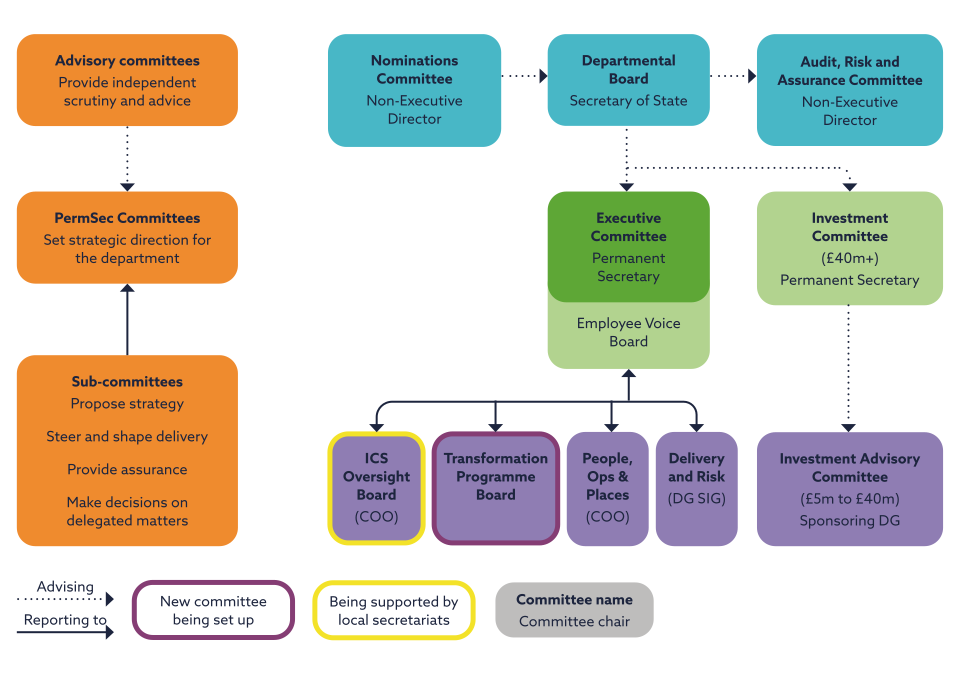
Board’s committee structure
See diagram on the following page for the structure of the board committees.
Board’s attendance and coverage of work
| Coverage of work | Number of meetings held | |
|---|---|---|
| Departmental board (the board) | The board provides advice and challenge to DSIT on its performance. It comprises, officials, and non-executive directors (independent experts). The board advises DSIT and its public bodies which it sponsors, on 6 key areas: strategic clarity, delivery monitoring, change management, commercial sense, risk and assurance, and talent and capability. | 3 |
| Nominations committee (Noms) | Noms advises on processes for rewarding senior executives to help DSIT achieve its goals. Noms does not decide the level of reward of a particular senior executive. Noms does not make decisions on senior appointments in DSIT public bodies, but it may discuss a key appointment if appropriate. Noms is chaired by the lead non-executive director. | 1 |
| Audit, risk and assurance committee (ARAC) |
ARAC supports the accounting officer and the board by reviewing the assurances provided on governance, risk management and controls. ARAC is chaired by a non-executive director. It may consider issues relating DSIT public bodies. ARAC has no delegated powers to take decisions but may consider the factors being assessed. The board delegates responsibility to ARAC for making sure DSIT’s reporting obligations to HM Treasury, Cabinet Office and Parliament are met efficiently and effectively. |
4 |
The board’s performance, including assessment of its own effectiveness
The key areas of focus for the board in 2024–25 were:
-
departmental election preparedness
-
AI and tech (including workstreams on AI adoption, tech adoption and the AI Opportunities Plan)
-
future departmental vision
-
workstreams on research and development, including investment
-
Digital Centre Design
A formal board effectiveness evaluation was completed in 2024–25. After each meeting, all board members were asked to reflect and offer suggestions to improve the board’s effectiveness so that it is performing in line with its terms of reference and the Corporate Governance Code for central government departments. The results will inform improvements to the board, and its subcommittees (ARAC and Noms), for the year ahead.
Highlights of board committee reports: nominations committee
The key areas of focus for the nominations committee in 2024–25 were:
-
structures of senior civil servants (SCS) in the department
-
senior talent management
-
senior performance management
-
SCS learning and development
-
leadership succession planning
Highlights of board committee reports: ARAC
The key areas of focus for the ARAC in 2024–25 were:
-
principal risks and DSIT’s approach to risk management including mitigations and risk appetite statement
-
oversight of DSIT’s public bodies including their reporting and risk management
-
preparation of the annual report and accounts
-
internal governance arrangements and DSIT’s board operating framework
-
the work of internal audit
-
the work of external audit
-
DSIT’s anti-fraud strategy and approach
-
grants continuous improvement plan
-
assurance mechanisms including assurance framework and assurance mapping
The formal meetings were supplemented with informal focus sessions on:
-
integrated corporate services
-
identifying and managing risk in AI policy
-
DSIT’s transformation programme
-
Government Digital Service (GDS)
-
cyber security
An account of corporate governance, including the board’s assessment of compliance with the corporate governance code
DSIT has undertaken an assessment of its compliance with the ‘Corporate Governance in Central Government Departments: Code of Good Practice’. This assessment has provided assurances that DSIT complies with the principles of the code.
The board operates according to the corporate governance code and the recognised principles of good corporate governance in business: leadership, effectiveness, accountability and sustainability.
In particular, the formal board effectiveness evaluation completed in 2024–25 has shown that DSIT, the board and its subcommittees, are compliant with the Corporate Governance Code. The results of the evaluation, including key actions, will now inform improvements to the board and its subcommittees.
Quality of data used by the board
All boards and committees are provided with high quality papers and in a standard way to ensure that risks, resource implications, and the Public Sector Equality Duty and Environmental Principles Duty are considered. In 2024–25, meetings were held either virtually or as hybrid meetings and challenge and discussion were encouraged.
DSIT’s corporate governance function has provided a comprehensive secretariat service. The team works closely with the department to ensure members and presenters have all the information they need and the chairs are well prepared.
Governance statement part 2: Risk assessment
See the performance report for the list of principal risks during the year.
Risk management
Responsibilities for risk management and internal controls
The department is responsible for having a risk management framework, an internal controls system and reviewing their effectiveness.
Processes to identify and manage risks
-
Principal risks were identified through horizon scanning by the executive committee (Exco). The outputs were reviewed the delivery and risk committee (DRC), and the audit and risk assurance committee (ARAC).
-
Risk owners were identified for the risks, and they provided information on ratings and mitigation activity.
-
In 2024–25 we developed a Risk Appetite Statement for DSIT. It clearly set the amount of risk DSIT is willing to accept in pursuit of its objectives. The categories for risk appetite are taken from HM Treasury’s Orange Book guidance. The risk appetite has been identified for principal risks, and work is underway to bring the risks into appetite.
Systems in place during the year
- We operated a manual process to track and report principal risks, while a reporting tool was being developed. The risk reporting and management tool was soft-launched in April 2025.
Features that support regular monitoring and assurance
-
Principal risks and director general group-level risks are fully reported at the end of every quarter to DRC and Exco and ARAC. They are reported annually to the board. In the intervening months, exception reporting takes place and is reported monthly to the DRC.
-
We are developing comprehensive documentation for controls. It will define the key control activities and decision points within DSIT. This will support effective risk mitigation.
Process applied in reviewing the effectiveness of the system of risk management and internal controls
-
The Government Internal Audit Agency (GIAA) provides the internal audit services for DSIT.
-
For 2024–25, the annual GIAA internal audit opinion on the framework of governance, risk management and control within DSIT, provided an overall ‘moderate’ opinion.
-
GIAA concluded that DSIT made good progress in establishing a robust governance framework despite challenges from the machinery of government (MOG) change in July 2024. The MOG change expanded DSIT and established the Government Digital Service (GDS), as the digital centre of government. Efforts continue to improve consistency in risk management, reporting, and policies. However, workforce challenges persist. There are complexities in resourcing and leadership uncertainties, including recruitment of a new permanent secretary in 2025–26 and interim senior roles.
-
GIAA highlighted that risk management is developing, and senior leaders are engaged and supported by ARAC. However, projects with lower financial values lack formal reporting. This risks inconsistencies and missed opportunities to collaborate. Business continuity planning and enhancing data governance arrangements remain a work in progress.
-
There were 61 GIAA recommendations from the 2024–25 internal audit reports. There were 61 GIAA recommendations from the 2023–24 internal audit reports, and all these actions have been closed by GIAA.
Compliance with the HM Treasury Orange Book on the risk control framework
The HM Treasury Orange Book sets out mandatory principles for risk management. Each government organisation must disclose compliance or explain their reasons for departure. DSIT was created 2 years ago and has focused on building fundamental risk management practices. This is shown by improved performance against the Orange Book principles in 2024–25 compared to 2023–24. However, DSIT has not yet fully complied with all 5 principles. The identified gaps are being addressed through structured plans.
Principle A: leadership and governance: risk management shall be an essential part of governance and leadership, and fundamental to how the organisation is directed, managed and controlled at all levels.
-
Principle A is partially complied with.
-
DSIT has established a Risk and Issues Management framework and a Risk Appetite Statement. Governance committees focussed on the path to bring principal risks into appetite.
-
Principal risks are evaluated comprehensively. The findings enhance decision-making processes. Risk information was shared monthly with DRC, quarterly with Exco, quarterly with ARAC, and from January 2025, with the board. The risk team aligned activities and adhered to committee directives through weekly meetings with the governance team.
-
The chief risk officer co-chairs the DRC. To fully comply with this principle, we will integrate risk effectiveness assessments into committee reports. The new risk reporting tool will improve access to risk information and effectiveness assessments.
Principle B: integration: risk management shall be an integral part of all organisational activities to support decision making in achieving objectives.
-
Principle B is partially complied with.
-
Risks are integrated into organisational activities – they are assessed during business case lifecycles, and identified through Exco horizon scanning. However the department lacks consistent evidence of compliance across the department.
-
Risk management isn’t fully embedded in all activities, nor do we yet routinely include opportunities in our risk identification. Emphasis on risks in strategic planning is growing. Our new risk reporting tool, launching in April 2025, will better link risks to priorities. To fully comply with the principle the risk team will continue to upskill the department to integrate risk management in its work.
-
Scenario planning is anticipated for the Exco horizon scan in 2025.
Principle C: collaboration and information: risk management shall be collaborative and informed by the best available information and expertise.
-
Principle C is partially complied with.
-
Risk information from arm’s length bodies (ALBs) is analysed by the partnerships team, who provide insights to Exco and ARAC. The new reporting tool will improve transparency and sharing of information.
-
The intranet has a risk portal which is kept updated with the latest risk guidance, templates and training. Engagement with internal stakeholders is supplemented through presentations and discussions with the subject matter experts in the central risk team.
-
Assessments on the use of functional standards assessments are commissioned centrally – as part of the commissions for the annual report and also planning for Outline Delivery Plans. There is a gap in evidence of collaboration between internal and external stakeholders on risk management.
-
To enable compliance with this principle, risk management between DSIT and ALBs needs improvement. A risk management session with public body Chief Operating Officers and DSIT COO took place during April 2025.
Principle D: risk management processes: risk management shall be collaborative and informed by the best available information and expertise.
-
Principle D is not fully complied with however DSIT complies with most of the compliance questions on the risk control framework.
-
Annual horizon scans for principal risks are conducted. However, evidence of similar approaches for risk identification at group, directorate or divisional level is limited.
-
Risk appetite is set for the department and used for principal and group level risks. The new reporting tool promotes risk appetite usage through specific fields. Key processes are in place, and we are maturing our approach. Documented processes and risk appetite statements comply with the principle.
-
Teams are adopting central processes. This will require continued effort for full departmental embedding. The new tool will enhance compliance visibility and reporting capabilities.
-
To improve compliance DSIT needs to continue to embed the existing processes and guidance and improve the identification and assessment of interdependencies.
Principle E: Continuous improvement – Risk management shall be continually improved through learning and experience.
-
Principle E is not fully complied with yet. DSIT is still integrating cultures from the predecessor department from the 2023 and 2024 machinery of government changes. Foundational elements are being embedded, reviewed annually, and improved with stakeholder feedback. The risk appetite statement is tested against risks, with lessons learned incorporated by December 2025.
-
Continuous improvement will complement the increase in risk maturity across the department and an assessment is currently underway to inform a comprehensive risk improvement plan.
Ministerial directions given
Ministerial directions are issued by the Secretary of State. They allow the department to proceed with a spending proposal, where the accounting officer has raised an objection. The accounting officer is accountable to Parliament to ensure that all expenditure meets these standards set out under Managing Public Money (MPM) – regularity, propriety, value for money and feasibility. The accounting officer has a duty to seek a direction if they believe one of these standards has not been met.
There were no ministerial directions issued in DSIT during 2024–25.
Data protection – personal data breaches
Under UK data protection law, a personal data breach is defined as a security incident in which personal data is accidentally lost, destroyed, disclosed to, or accessed by an unauthorised party. Organisations are required to report data breaches to the Information Commissioner’s Office (ICO), the UK regulator for data protection compliance – where the breach is likely to result in a risk to individuals’ rights and freedoms. This risk could include identity theft, financial loss, discrimination or damage to an individual’s reputation.
In 2024–25, DSIT did not report any personal data breaches to the ICO. The data protection team investigates all personal data breaches reported to it. It assesses the risk ofharm, decides whether the breach meets the threshold for ICO reporting and recommends action to prevent reoccurrence.
Governance statement part 3: Oversight of local responsibilities
Application of Business Appointment Rules
How DSIT implements and assesses Business appointment Rules applications
-
Business Appointment Rules (BARs) ensure ethical transitions when staff take on new roles after leaving government. Their purpose is to prevent any perception of appointments being rewards for past favours. They protect against employers gaining unfair advantages through privileged government knowledge. They restrict former officials from exploiting insider contacts for personal or professional gain. By following these rules, individuals contribute to maintaining public trust and fairness in both government and the private sector.
-
All DSIT staff looking to leave the Civil Service, and staff who have left, must review the BAR policy and discuss with their line manager to decide if they are eligible to complete an application, prior to accepting any new roles.
-
For SCS, BARs applies for up to 2 years after leaving the Civil Service. For those below SCS, it applies for up to one year. HR review all departmental BAR applications.
-
Once the outcomes are agreed with HR and the line manager, they are communicated to the individual via a letter. It is for the individual to then communicate outcomes to their new employer.
Steps taken to increase awareness of BARS
- To raise awareness, DSIT includes information on BARs on the departmental intranet pages and within the leavers’ process.
Table: Statistics on BARs
| Total, of which: | SCS pay band 2 | SCS pay band 1 | G6 | G7 | SEO | Special advisers | |
|---|---|---|---|---|---|---|---|
| Number of exits from the Civil Service at SCS level | 2 | 1 | 1 | Not applicable to G6 | Not applicable to G7 | Not applicable to SEO | Not applicable to special advisers |
| Number of BARS applications assessed by DSIT over the year | 5 | 1 | 2 | 1 | 1 | - | - |
| Number of BARS applications where conditions were set | 5 | 1 | 2 | 1 | 1 | - | - |
| Number of applications found to be unsuitable for the applicant to take up | - | - | - | - | - | - | - |
| Number of breaches of the rules in 2024–25 | - | - | - | - | - | - | Not applicable to special advisers |
Summary statement on compliance with BARs
-
In compliance with the BAR, DSIT is transparent in the advice given to individual applications for senior staff. Advice regarding specific business appointments for SCS1 and SCS2 is published quarterly on GOV.UK – https://www.gov.uk/government/collections/DSIT-business-appointment-rules-advice.
-
For any SCS3 and ministers leaving the Civil Service, an application is required to be put into the Advisory Committee of Business Appointments (ACOBA) for consideration. The department will be responsible for providing views and suggestions to feed into the considerations.
Effectiveness of our whistleblowing arrangements
Whistleblowing arrangements provide opportunities for staff to raise concerns about something they feel may be wrong.
Internal routes for staff to whistleblow and its effectiveness
-
Following the establishment of DSIT as a department, work is still ongoing to harmonise the whistleblowing policies of the former departments. DSIT directed new joiners and former employees of the Department for Business, Energy and Industrial Strategy (BEIS) to use the BEIS whistleblowing policy. DSIT directed former employees of the Department for Digital, Culture and Media and Sport (DCMS) to use the DCMS policy. And DSIT directed former employees of Cabinet Office (CO) to use the CO policy.
-
The whistleblowing policies contain process maps to report concerns and escalate within DSIT. DSIT appointed whistleblowing officers, who were deputy directors or directors to ensure whistleblowers felt empowered. DSIT also held a ‘Speak Up’ campaign to promote awareness of whistleblowing, and reassure staff that all concerns will be taken seriously.
-
The 2024 People Survey, as in 2023, highlighted that the majority of DSIT employees had confidence that any concerns raised under the Civil Service Code would be properly investigated.
-
DSIT did not receive any whistleblowing reports via the internal route.
External routes for staff to whistleblow and its effectiveness
-
The former BEIS, DCMS and CO whistleblowing policies also include routes to raise a concern outside of the department through a whistleblowing hotline and Civil Service Commission. These routes form a part of the policy and process maps and escalation routes.
-
DSIT did not receive any whistleblowing reports via the external route.
Fraud and bribery
-
Reports of fraud and bribery made directly to the DSIT counterfraud function in ICS could potentially be whistleblowing. In this case, the concern will be referred to the DSIT HR team, and it will follow the whistleblowing policy, which offers the individuals protection.
-
In 2024–25, the department received no whistleblowing reports made directly to the counterfraud function. This was the same in 2023–24. This is due to the creation of reporting routes direct to enforcement partners – such as the Insolvency Service or National Investigation Service.
Quality assurance of analytical models
We use analytical models to inform policymaking, evaluation and operations. We quality assure these models to ensure they are fit for purpose, and comply with the government’s Analytical Quality Assurance (AQUA) Book.
The department has 19 business-critical models. As of March 2025, 13 of the 19 models had been quality assured. Plans are in place to achieve quality assurance across all models. DSIT is establishing a monitoring system where models are quality assured proportionately to reflect the level of risk and complexity.
The department also provide quality assurance governance support to DSIT public bodies undertaking modelling. This is to ensure they have quality assurance processes which are compliant with the AQUA Book.
Use of functional standards
Government Functional Standards are ways of working for functions that are consistent with each other and across government. Functions include finance, human resources, digital, project delivery, and others. They support efficient and effective delivery of public services. All departments and their arm’s length bodies are required to use these standards. In 2024–25 compliance assessments were conducted for all functional standards. Where areas for improvement were identified these have been built into business plans.
Shared services
-
The Integrated Corporate Services (ICS) is a shared service provider serving DSIT, Department for Energy, Security and Net Zero (DESNZ). and the Department for Business and Trade (DBT). It provides corporate services to DSIT across HR, Finance, Digital, Security, Estates and Commercial.
-
The ICS oversight board is co-chaired by the DSIT director general for corporate services and includes DSIT functional directors. It meets every fortnight and provides quarterly updates to the DSIT executive committee.
National Audit Office reports and the Public Accounts Committee
The National Audit Office (NAO) produces reports on departments’ public spending and assesses the value for money. For some of these reports, the Public Accounts Committee (PAC) require departments to provide an oral briefing.
The NAO finalised 3 reports in 2024–25.
-
The National Space Strategy and the UK Space Agency (23 July 2024).
-
DSIT 2023–24 departmental overview (19 November 2024).
-
Government’s approach to technology suppliers: addressing the challenges (16 January 2025).
DSIT provides responses to NAO recommendations, which are published on the NAO website – NAO recommendations tracker.
In 2024–25, the PAC held evidence sessions with oral briefings from DSIT officials, on 4 NAO reports.
-
Supporting mobile connectivity.
-
Use of AI in Government.
-
Government’s relationship with digital technology suppliers.
-
Government cyber resilience.
DSIT provides responses to the PAC after each hearing via the HM Treasury minutes, and twice a year via the Treasury minutes progress report.
Management of outside interests
Managing outside conflicts of interests of board members
- This is covered in the directors’ report above in Conflicts of interest.
Managing outside conflicts of interests of staff, including senior civil servants
-
DSIT has a Conflicts of Interest (COI) policy which applies to all individuals working with DSIT. This includes permanent and fixed-term staff, secondees, contractors, consultants, temporary agency staff, and non-executive directors. It sets out procedures for declaring and managing any actual or perceived conflicts. In addition, the DSIT new starter checklist includes a requirement to explain and clarify conflicts of interests. This ensures new joiners are informed as part of their onboarding process.
-
Staff must make declarations once they are aware a conflict of interest may exist. Line management must then review the declaration and agree mitigating actions. All declarations must be submitted to the DSIT partnerships team via the central email account for recording and oversight. The partnerships team is responsible for managing the declarations database and offering advice on appropriate mitigations.
-
Staff must ensure that declarations are kept up to date throughout the year, not just during the annual review.
-
The department recognises 8 categories of potential conflict: 1) sources of remuneration, 2) contracts, 3) shares and securities, 4) houses, land, and buildings, 5) gifts and hospitality, 6) non-financial interests, 7) related party interests, 8) other perceived conflicts.
-
All senior civil servants (SCS) are required to fill in a conflicts of interest declaration form every year. Nil returns should also be declared. The forms are reviewed by the partnerships team and reported to the Cabinet Office.
-
Departments must publish on GOV.UK, details of any paid outside employment held by SCS and agreed as part of the process for declaration and management of outside interests. The weblink must be included in the annual report.
-
For 2024–25 there are no SCS declarations of paid outside employment.
Special advisers’ conflicts of interest
-
Special advisers are temporary civil servants and subject to similar requirements, including declaring relevant interests on appointment. Departments must publish relevant interests for special advisers in or alongside their ARA.
-
In line with the current ‘Declaration of Interests’ policy for special advisers, all special advisers have declared any relevant interests or confirmed they do not consider they have any relevant interests. The permanent secretary has considered these returns and the following relevant interests are set out in public:
| Full name | Details of interest |
|---|---|
| Darren Murphy | Doctoral researcher at the University of Birmingham |
| Nicola Barlett | Local Councillor for the West Green Ward at Haringey Borough Council |
Governance of DSIT public bodies
Public bodies could be arm’s length bodies (ALBs), public corporations or unclassified bodies.
In 2024–25, DSIT had responsibility for 14 public bodies. During the year, legislative action commenced to close Phone-Paid Services Agency (PSA) and transfer the functions to Ofcom from 1 February 2025. The PSA’s final accounts will cover the period up to the end of January 2025.
Table: DSIT public bodies in 2024–25
| DSIT public bodies | Organisations | Number of organisations |
|---|---|---|
| ALBs: Executive agencies | Building Digital UK (BDUK), Intellectual Property Office (IPO), Met Office, UK Space Agency (UKSA) | 4 |
| ALBs: Non-departmental public bodies (NDBP) | Advanced Research and Invention Agency (ARIA), British Technology Investments (BTI,) Copyright Tribunal (CT), Information Commissioner’s Office (ICO) UK Shared Business Services Ltd (UKSBS) UK Research and Innovation (UKRI) | 6 |
| Public corporations | National Physical Laboratory (NPL), Ordnance Survey (OS) | 2 |
| Unclassified bodies | Ofcom, Phone-paid Services Authority (PSA) | 2 |
Note
This list of entities is regulated by the Cabinet Office. However, the entities considered for the DSIT group within the financial statements are regulated by the ONS. They are a different set of entities. The financial statements are based on ONS classifications.
DSIT held lead policy responsibility over the Met Office and IPO during the year; both of these bodies are public non-financial corporations that lie outside the DSIT boundary.
Governance
Ministers usually appoint the chair and the non-executive directors of the public bodies. Each public body has its own independent board and governance structures. They also publish separate accounts.
Each public body has a designated senior sponsor in DSIT. The senior sponsor oversees strategic engagement with the body. They are supported by policy sponsors within relevant policy teams who lead the day-to-day relationship with public bodies.
The DSIT Permanent Secretary, chairs of public bodies, and CEOs met to discuss strategic priorities and cross-cutting governance issues. There were also meetings between DSIT’s chief operating officer and those of the public bodies.
Public bodies reported their full risk registers and significant risks to DSIT. A summary of these are reviewed by DRC and ARAC. Senior sponsors led quarterly meetings with the public body to review risk and performance. They also oversee the chair’s annual appraisal.
Sponsors usually attend boards of public bodies as observers and may also attend their ARAC meetings.
Governance assurance process
A Governance Assurance Panel (GAP) was held for each director general group to reflect on the effectiveness of governance arrangements, risk management and internal controls. The results of these panel meetings were reported to the ARAC who then provided independent assurance to the board and permanent secretary.Overall, the 2024–25 GAP exercise concluded that governance structures are operating effectively in DSIT and where issues have been identified there is an action plan in place.
Accounting officer’s conclusion
I have considered the evidence provided regarding the annual governance statement and the independent assurance provided by ARAC. Overall, I am satisfied that the department has set up an appropriate system of internal control and risk management during this reporting period to improve and adapt its governance arrangements considering the needs and responsibilities of the department as well as the risks being managed. This work will continue as the department matures.
Sarah Munby
Permanent Secretary and Principal Accounting Officer
30 June 2025
Staff and remuneration report
Staff report
Staff composition as at 31 March 2025
Numbers for staff composition are based on headcount on payroll. This aligns with staff numbers in the Annual Civil Service Employee Survey (ACSES) publication.
Table: Gender
| 2025 | 2024 | |
|---|---|---|
| All staff | 2,319 | 2,069 |
| Of which men | 48% | 48% |
| Of which women | 52% | 52% |
| Senior civil servants | 138 | 128 |
| Of which men | 44% | 41% |
| Of which women | 56% | 59% |
| Senior officials on departmental board | 13 | 11 |
| Of which men | 4 | 8 |
| Of which women | 9 | 3 |
Table: Disability
| 2025 | 2024 | |
|---|---|---|
| No | 78% | 80% |
| Yes | 16% | 13% |
| Prefer not to say | 7% | 6% |
| Declaration rate | 59% | 51% |
Table: Ethnicity
| 2025 | 2024 | |
|---|---|---|
| White | 75% | 73% |
| BAME | 21% | 23% |
| Prefer not to say | 4% | 4% |
| Declaration rate | 72% | 61% |
Table: Sexual orientation
| 2025 | 2024 | |
|---|---|---|
| Straight | 75% | 77% |
| LGBO | 13% | 12% |
| Prefer not to say | 11% | 11% |
| Declaration rate | 71% | 60% |
Diversity and inclusion
Inclusion is a priority for the department to ensure that we have a workforce that reflects the communities we serve in order to better serve citizens. This last year we have:
-
Commenced priority inclusion activities, for example we have a key focus on increasing diversity declarations to ensure we continue to make data driven and evidence-based decisions. We remain aligned to the Civil Service D&I Strategy 2022–25, Declaration of Government Reform, and Inclusive Britain.
-
Championed and sustained the development of staff network contributions to inclusion in line with the Civil Service D&I Strategy 2022–25.
-
Continued to take forward work as a Disability Confident Leader, and started work in preparation for Carers Confident accreditation.
-
Promoted and supported PSED requirements across the department through regular consultation, publishing internal guidance and continued to develop our Public Sector Equality Duty (PSED) objectives working with the Equality and Human Rights Commission.
-
Achieved a high ‘inclusion and fair treatment’ score of 81% in the Civil Service People Survey 2024.
Sickness absence data
| 2024–25 | 2023–24 | |
|---|---|---|
| Average working days lost to sickness absence | 3.7 | 2.2 |
Note
In 2023–24, the 2.2 was for the period August 2023 to March 2024, which was 8 months of the year. DSIT was created in February 2023, but DSIT records began in August 2023.
Staff turnover percentage
Table: Staff turnover percentage
|
DSIT core dept 2024–25 |
DSIT core dept 2023–24 |
Civil service 2023–24 (bench mark) |
|
|---|---|---|---|
| Turnover (Those who left the core department and did not stay within the Civil Service) |
6.3% | 5.7% | 7.5% |
| Departmental turnover (Those who left the core department but stayed within Civil Service.) |
13.6% | 13.8% | - |
Notes
- 2023–24 Civil Service wide turnover rate of 7.5%: This can be found in the published report: Civil Service Statistics 2024
Staff engagement scores
| 2024–25 | 2023–24 | |
|---|---|---|
| Engagement score | 61% | 60% |
-
DSIT People Survey 2024 was open from 19 September to 13 October 2024, and the response rate was 88%.
-
The staff engagement index score was 61%. This is 3 percentage points lower than the Civil Service average and 1 percentage point higher than DSIT’s 2023 score.
-
The lowest scoring areas were on pay and benefits (29%), learning and development (51%), and leadership and managing change (55%).
-
The highest scoring areas were on my manager being considerate of my life outside work (90%), interest in my work (87%), and team reliability during difficult times (87%).
-
Directors are encouraged to analyse the scores locally and take actions to improve engagement within their teams. This is then supported by cross-cutting actions in response to departmental priorities at organisational level.
Staff policies for disabled persons
Applications for employment
- We are accredited under the Disability Confident Leader scheme.
Continuing employment
-
We offer reasonable adjustments, where practical, for both office and home working.
-
We support staff who are disabled or have long-term health conditions by carrying out assessments, providing equipment and training.
-
We work closely with our disability staff network.
Training, career development and promotion
For individuals who declare themselves as having a disability, we support and encourage them to engage with any process related to training, career development and promotion by ensuring the offer of reasonable adjustments is actively communicated and delivered at the right time.
Trade union facility time
Facility time is paid time off given to employees who are recognised Trade Union representatives to perform their related duties. Trade Union duties are work or training directly related to supporting the workforce.
Trade Union activities (different to duties) relate to internal trade union business. A small amount of paid time may exceptionally be permitted for Trade Union Activities at an employer’s discretion. Executive Agencies permitted a minimal amount of time to be spent on trade union activities in 2024.
Table: Trade union facility time
|
DSIT core |
BDUK | UKSA | IPO | Met Office | Total | |
|---|---|---|---|---|---|---|
|
Relevant union officials Number of employees who were relevant union officials |
8 | 1 | 2 | 31 | 18 | 60 |
| Number of relevant union officials by working hours spent on facility time: 0% of working hours | - | - | - | 4 | - | 4 |
| Number of relevant union officials by working hours spent on facility time: 1–50% of working hours | 8 | 1 | 2 | 27 | 18 | 56 |
| Number of relevant union officials by working hours spent on facility time: 51–99% of working hours | - | - | - | - | - | - |
| Number of relevant union officials by working hours spent on facility time: 100% of working hours | - | - | - | - | - | - |
|
Spend on facility time Percentage of the total pay bill spent on facility time [(total cost of facility time ÷ total pay bill) x 100] |
0.045% | 0.01% | 0.25% | 0.08% | 0.05% | 0.06% |
|
Time on paid trade union activities Time spent on paid trade union activities as a % of total paid facility time hours |
0.00% | 0.00% | 0.0% | 0.50% | 12% | - |
Notes
- Time on paid trade union activities: Negligible time spent on paid TU activities.
Health and safety at work
We continued to provide a safe work environment. We ensured staff had the correct equipment and training to carry out their duties safely, both in the office and working from home.
In 2024–25, there were no reported accidents within ‘Reporting of Injuries, Diseases and Dangerous Occurrences Regulations 2013’.
The wellbeing offer during the year included:
-
stress management guidance
-
resilience and mental health training
-
health, wellbeing and disability campaigns
-
access to the Employee Assistance Programme for confidential counselling
-
over 71 trained Mental Health First Aiders
-
staff networks to provide peer support
Number of senior civil servants by pay band
The table below shows the number of senior civil servants (SCS) grouped by pay band.
SCS numbers are measured as at 31 March and exclude inactive workers such as those on maternity leave and outward loans.
Table: Number of senior civil servants by pay band
| Pay band | Number of SCS as at 31 Mar 2025 | Restated Number of SCS as at 31 Mar 2024 |
|---|---|---|
| SCS 1 | 133 | 112 |
| SCS 2 | 35 | 35 |
| SCS 3 | 6 | 6 |
| Permanent Secretary | 2 | 2 |
| Total | 176 | 155 |
Staff numbers
This is audited information.
Staff numbers are the average number of full-time equivalent persons employed during the year. Staff numbers include active workers and exclude inactive workers such as those on maternity leave and outward loans.
Due to the MOG change prior year balances have been restated in accordance with transfer by merger principles to aid comparability. The MOG change expanded DSIT and established the Government Digital Service (GDS).
Table: Staff numbers
| 2024–25 Permanent employed staff |
2024–25 Others |
2024–25 Ministers |
2024–25 Special advisers |
2024–25 Total |
2023–24 restated Total |
|
|---|---|---|---|---|---|---|
| Core dept | 2,829 | 137 | 5 | 3 | 2,974 | 2,576 |
| Agencies | 574 | 26 | - | - | 600 | 627 |
| Non departmental public bodies (NDPBs) and other designated bodies | 11,734 | 1,785 | - | - | 13,519 | 13,129 |
| Total | 15,137 | 1,948 | 5 | 3 | 17,093 | 16,332 |
| Of which: core dept and agencies | 3,403 | 163 | 5 | 3 | 3,574 | 3,203 |
| Of which: NDPBs and other designated bodies | 11,734 | 1,785 | - | - | 13,519 | 13,129 |
| Total | 15,137 | 1,948 | 5 | 3 | 17,093 | 16,332 |
Staff costs
This is audited information.
Table: Staff costs
| 2024–25 Permanent employed staff £m |
2024–25 Others £m |
2024–25 Total £m |
2023–24 Permanent employed staff £m |
2023–24 Others £m |
2023–24 restated Total £m |
|
|---|---|---|---|---|---|---|
| Wages and salaries | 853 | 93 | 946 | 773 | 119 | 892 |
| Social security costs | 99 | - | 99 | 87 | - | 87 |
| Other pension costs | 207 | - | 207 | 181 | - | 181 |
| Sub total | 1,159 | 93 | 1,252 | 1,041 | 119 | 1,160 |
| Less recoveries in respect of outward secondments | (1) | - | (1) | (1) | - | (1) |
| Total net costs | 1,158 | 93 | 1,251 | 1,040 | 119 | 1,159 |
| Of the total: Core dept and agencies | 278 | 37 | 315 | 236 | 54 | 290 |
| Of the total: NDPBs and other designated bodies | 880 | 56 | 936 | 804 | 65 | 869 |
| Total net costs | 1,158 | 93 | 1,251 | 1,040 | 119 | 1,159 |
Staff costs – others
‘Others’ in the table above includes ministers’ total net costs of £215,690 (2023–24: £151,737).
Table: Staff costs capitalised
| 2024–25 DSIT group |
2023–24 restated DSIT group |
|
|---|---|---|
| Number of employees engaged on capital projects | 701 | 560 |
| Capitalised staff costs | 50,968,899 | 38,178,607 |
Staff severance costs
Staff severance costs are included in ‘wages and salaries’ in the staff costs table. For further details see disclosures on exit packages below.
Staff costs – pensions
Principal civil service pension scheme
The principal civil service pension scheme (PCSPS) and the civil servant and other pension scheme (CSOPS), known as ‘alpha’, are an unfunded multi-employer defined benefit scheme in which the department is unable to identify its share of the underlying assets and liabilities. The scheme actuary valued the PCSPS as at 31 March 2020. Further details can be found in the resource accounts of the Cabinet Office Civil Superannuation:
www.civilservicepensionscheme.org.uk/about-us/resource-accounts/.
For 2024–25, employer contributions of £124,272,091 were payable to the PCSPS (2023–24: £99,253,496) at one of four rates in the range 26.6% to 30.3% (2023–24: 26.6% to 30.3%) of pensionable pay, based on salary bands.
The scheme’s actuary reviews employer contributions usually every four years following a full scheme valuation. The contribution rates are set to meet the cost of the benefits accruing during 2024–25 to be paid when the member retires, and not the benefits paid during this period to existing pensioners.
Employees can opt to open a partnership pension account, a stakeholder pension with an employer contribution. Employers’ contributions of £1,433,680 (2023–24: £1,065,782) were paid to one or more of the panel of three appointed stakeholder pension providers. Employer contributions are age-related and range from 8% to 14.75%. Employers also match employee contributions up to 3% of pensionable earnings. In addition, employer contributions of £8,501 (2023–24: £6,184), 0.5% (2023–24: 0.5%) were payable to the PCSPS to cover the cost of the future provision of lump sum benefits on death in service and ill health retirement of these employees.
Contributions due to/(from) the partnership pension providers as at 31 March 2025 were £72,832 (2023–24: £62,865). Contributions prepaid at that date were £nil (2023–24: £nil).
Ill-health retirement
In 2024–25, 10 persons (2023–24: 5 persons) across the DSIT group retired early on ill-health grounds; the total additional accrued pension liabilities in the year amounted to £nil (2023–24: £nil).
Other pension schemes
Employer contributions to other pension schemes in 2024 –25, amounted to £84,006,173 (2023–24: £80,876,622). Employer contributions include employers’ contributions, current service costs and, where appropriate, past service costs of funded pension schemes. Further details can be found in the accounts of the department’s NDPBs and other designated bodies. A list of these bodies is provided in note 24. List of bodies in the DSIT group in the Notes to the accounts.
Consultancy and temporary staff expenditure
Consultants are hired to work on projects in specific situations:
-
where the department does not have the skill set required
-
where the requirement falls outside the core business of civil servants
-
where an external, independent perspective is required
When used appropriately, consultancy can be a cost effective and efficient way of getting the temporary and skilled external input that the department needs. We are committed to the consistent application of the Cabinet Office’s 2010 and 2024 controls on consultancy and other spending.
Table: Expenditure on consultancy and temporary staff expenditure
| 2024–25 Core dept & agencies £m |
2024–25 DSIT group £m |
2023–24 restated Core dept & agencies £m |
2023–24 restated DSIT group £m |
|
|---|---|---|---|---|
| Consultancy expenditure | 52 | 54 | 26 | 28 |
| Temporary staff expenditure | 36 | 93 | 54 | 119 |
Temporary staff
Also detailed under staff costs in note 3. Staff costs in the Notes to the accounts.
Off-payroll engagements
Off-payroll engagements refer to workers who are paid off-payroll, without deducting tax and national insurance at source, typically contractors.
Table 1: Highly paid off-payroll worker engagements as at 31 March 2025, earning £245 per day or greater
| Core dept | Agencies | Arm’s length bodies | |
|---|---|---|---|
| No. of existing engagements as of 31 Mar | 119 | 25 | 280 |
| Less than 1 year | 33 | 12 | 91 |
| Between 1 and 2 years | 54 | 12 | 62 |
| Between 2 and 3 years | 15 | 1 | 61 |
| Between 3 and 4 years | 12 | 0 | 30 |
| Four or more years | 5 | 0 | 36 |
Table 2: All highly paid off-payroll workers engaged at any point during the year ended 31 March 2025, earning £245 per day or greater
| Core dept | Agencies | Arm’s length bodies | |
|---|---|---|---|
| No. of temporary off-payroll workers engaged during the year ended 31 Mar | 119 | 30 | 466 |
| Not subject to off-payroll legislation | 0 | 0 | 30 |
| Subject to off-payroll legislation and determined as in-scope of IR35 | 96 | 29 | 395 |
| Subject to off-payroll legislation and determined as out-of-scope of IR35 | 23 | 1 | 41 |
| Total | 119 | 30 | 466 |
| No. of engagements reassessed for compliance or assurance purposes during the year | 0 | 1 | 11 |
| Of which: No. of engagements that saw a change to IR35 status following review | 0 | 1 | 0 |
Table 3: For any off-payroll engagements of board members, and/or senior officials with significant financial responsibility, between 1 April 2024 and 31 March 2025
| Core dept | Agencies | Arm’s length bodies | |
|---|---|---|---|
| No. of off-payroll engagements of board members, and/or, senior officials with significant financial responsibility, during the financial year | 0 | 0 | 2 |
| Total no. of individuals on payroll and off-payroll that have been deemed ‘board members and/or senior officials with significant financial responsibility’, during the financial year. | 33 | 19 | 52 |
Note
Core total no. of individuals on payroll and off-payroll that have been deemed ’board members and/or senior officials with significant financial responsibility’ during the financial year is made up of 12 non-executive directors, 10 ministers and 11 senior officials.
Details of the exceptional circumstances that led to the off-payroll engagement of board members/senior officials with significant financial responsibility.
UKRI: An individual was appointed as interim Chief People Officer in March 2022, following the departure of the previous on-payroll position holder. The contract was extended in March 2023 into 2024–25, as UKRI is at a critical delivery point for a number of key people-led programmes that demand continuity of service and a high degree of expertise to ensure impactful delivery. This individual left the post in January 2025 and was replaced with another interim Chief People Officer.
Exit packages
This is audited information.
Exit packages refer to Civil Service and other compensation schemes.
Redundancy and other departure costs have been paid in accordance with the provisions of the Civil Service Compensation Scheme (CSCS), a statutory scheme made under the Superannuation Act 1972.
Where the department has agreed early retirements, the additional costs are met by the department and not by the Civil Service pension scheme.
Ill-health retirement costs are met by the pension scheme and are not included in the table.
The table below shows the total cost of exit packages agreed and accounted for in 2024–25. £6,737,934 exit costs were paid in 2024–25, the year of departure (2023–24: £1,066,658).
Table: Number and costs of exit packages
| 2024–25 Number of compulsory redundancies |
2024–25 Number of other departures agreed |
2024–25 Total number of exit packages by cost band |
2023–24 restated Number of compulsory redundancies |
2023–24 restated Number of other departures agreed |
2023–24 restated Total number of exit packages by cost band |
|
|---|---|---|---|---|---|---|
| Less than £10,000 | - | 13 | 13 | 2 | 10 | 12 |
| £10,000–£25,000 | 2 | 36 | 38 | 3 | 12 | 15 |
| £25,000–£50,000 | 3 | 32 | 35 | 4 | 5 | 9 |
| £50,000–£100,000 | 1 | 53 | 54 | - | 5 | 5 |
| £100,000–£150,000 | - | 4 | 4 | - | - | - |
| £150,000–£200,000 | - | 1 | 1 | - | - | - |
| Total number | 6 | 139 | 145 | 9 | 32 | 41 |
| Of which: core dept & agencies | 1 | 3 | 4 | - | 3 | 3 |
| Of which: NDPBs and other designated bodies | 5 | 136 | 141 | 9 | 29 | 38 |
| Total cost (£) | 207,286 | 6,655,119 | 6,862,405 | 205,704 | 781,720 | 987,424 |
| Of which: core dept & agencies | 19,448 | 273,515 | 292,963 | - | 157,305 | 157,305 |
| Of which: NDPBs and other designated bodies | 187,838 | 6,381,604 | 6,569,442 | 205,704 | 624,415 | 830,119 |
Staff redeployments
The table below shows the number of staff loaned and hosted as at 31 March 2025.
Staff loaned are staff permanently employed by the core department, who were on loan to another organisation. If the core department paid the cost as the home department, short-term costs were charged to the administration budget.
Staff hosted are those attached to the core department, who were on loan from other organisations. If the core department paid the cost as the host department, short-term costs were charged to the administration budget.
The department does not currently hold information centrally to support the disclosure of average likely durations of redeployments.
Table: Loans in
| Short term Non-payroll |
Short term Payroll |
Short term Total |
Longer term Non-payroll |
Longer term Payroll |
Longer term Total |
|
|---|---|---|---|---|---|---|
| EO | 2 | - | 2 | - | - | - |
| HEO | 4 | 1 | 5 | - | 15 | 15 |
| SEO | 7 | 1 | 8 | 1 | 17 | 18 |
| G6 | 7 | 1 | 8 | 3 | 33 | 36 |
| G7 | 13 | 2 | 15 | 2 | 49 | 51 |
| SCS 1 | 5 | 1 | 6 | - | 12 | 12 |
| SCS 2 | 2 | - | 2 | - | 2 | 2 |
| Total | 40 | 6 | 46 | 6 | 128 | 134 |
Loans out
| Short term Non-payroll |
Short term Payroll |
Short term Total |
Longer term Non-payroll |
Longer term Payroll |
Longer term Total |
|
|---|---|---|---|---|---|---|
| EO | - | - | - | 3 | - | 3 |
| HEO | - | - | - | 16 | - | 16 |
| SEO | - | 1 | 1 | 16 | 3 | 19 |
| G6 | - | - | - | 4 | 1 | 5 |
| G7 | - | - | - | 10 | 8 | 18 |
| SCS 1 | - | 1 | 1 | 4 | 1 | 5 |
| Total | - | 2 | 2 | 53 | 13 | 66 |
Remuneration report
Service contracts
The Constitutional Reform and Governance Act 2010 requires Civil Service appointments to be made on merit on the basis of fair and open competition. The Recruitment Principles published by the Civil Service Commission specify the circumstances when appointments may be made otherwise.
Unless otherwise stated below, the officials covered by this report hold appointments which are open-ended. Early termination, other than for misconduct, would result in the individual receiving compensation as set out in the Civil Service Compensation Scheme.
Further information about the work of the Civil Service Commission can be found at
www.civilservicecommission.org.uk
Remuneration policy
Remuneration policy for ministers
Remuneration of ministers is determined in accordance with the provisions of the Ministerial and other Salaries Act 1975 (as amended by The Ministerial and other Salaries Order 1996) and the Ministerial and other Pensions and Salaries Act 1991.
Remuneration policy for executive directors
The Senior Salaries Review Body provides independent advice to the Prime Minister on the remuneration of senior civil servants. The review body considers economic considerations such as local variations in labour markets and funds available to departments. Further information about the work of the review body can be found at
https://www.gov.uk/government/organisations/review-body-on-senior-salaries.
Remuneration (salary, benefits in kind and pensions)
This is audited information.
Table: single total figure of remuneration: ministers
Salary FYE stands for ’full year equivalent’.
| 2024–25 Salary £ |
Severance payment | 2024–25 Pension benefits (nearest £1,000) |
2024–25 Total (nearest £1,000) |
2023–24 Salary £ |
Severance payment | 2023–24 Pension benefits (nearest £1,000) |
2023–24 Total (nearest £1,000) |
|
|---|---|---|---|---|---|---|---|---|
| Secretary of State Rt Hon Peter Kyle MP (from 5 Jul 2024) |
49,903 (FYE: 67,505) |
- | 13,000 | 63,000 | - | - | - | - |
| Secretary of State Rt Hon Michelle Donelan MP (to 5 Jul 2024) |
17,784 (FYE: 67,505) |
16,876 | 4,000 | 39,000 | 67,505 | - | 18,000 | 86,000 |
| Minister of state Sir Chris Bryant MP (from 8 Jul 2024) |
23,419 (FYE: 31,680) |
- | 6,000 | 29,000 | - | - | - | - |
| Minister of state Lord Patrick Vallance (from 5 Jul 2024) |
60,238 (FYE: 81,485) |
- | 15,000 | 75,000 | - | - | - | - |
| Minister of state Julia Lopez MP (to 5 Jul 2024) |
- | - | - | - | - | - | - | - |
| Minister of state Andrew Griffith MP (from 13 Nov 2023 to 5 Jul 2024) |
- | - | - | - | - | - | - | - |
| Parliamentary under-secretary of state Feryal Clark (from 9 Jul 2024) |
16,541 (FYE: 22,375) |
- | 4,000 | 21,000 | - | - | - | - |
| Parliamentary under-secretary of state Baroness Jones of Whitchurch (from 9 Jul 2024) |
- | - | - | - | - | - | - | - |
| Parliamentary under-secretary of state Viscount Camrose (to 5 Jul 2024) |
- | - | - | - | - | - | - | - |
| Parliamentary under-secretary of state Saqib Bhatti MP (from 13 Nov 2023 to 5 Jul 2024) |
5,894 (FYE: 22,375) |
5,593 | 1,000 | 12,000 | 8,577 (FYE: 22,375) |
- | 2,000 | 11,000 |
Notes
-
Salary information excludes employers’ National Insurance contributions. None of the ministers of the department received benefits in kind during the year. Minsters in the House of Commons are remunerated on a different basis to those in the House of Lords as explained in notes to the remuneration report.
-
The value of pension benefits accrued during the year is calculated as (real increase in pension multiplied by 20) less (contributions made by the individual). Real increase excludes increases due to inflation or any increase or decrease due to transfer of pension rights.
-
Rt Hon Michelle Donelan MP: Minister on Leave from 28 April to 20 July 2023. Her role was covered by Rt Hon Chloe Smith MP during this time.
-
Sir Chris Bryant MP: has a joint role with DSIT & Department for Culture, Media and Sport (DCMS), which is paid for by DSIT.
-
Julia Lopez MP: had a joint role with DSIT and DCMS, which was paid for by DCMS. From 9 May 2023 to 20 December 2023 she was a minister on leave and her role was covered by Rt Hon John Whittingdale MP.
-
Andrew Griffith MP and Viscount Camrose: were not paid for their ministerial roles.
-
Baroness Jones of Whitchurch: has an unpaid joint role with DSIT and Department for Business and Trade. She is paid by HM Treasury for her role as Baroness in Waiting (Government Whip).
Table: Single total figure of remuneration: Officials
| 2024–25 Salary £’000 |
2024–25 Bonus £’000 |
2024–25 Pension nearest £1,000 |
2024–25 Total £’000 |
2023–24 Salary £’000 |
2023–24 Bonus £’000 |
2023–24 Pension nearest £1,000 |
2023–24 Total £’000 |
|
|---|---|---|---|---|---|---|---|---|
| Permanent secretary Sarah Munby |
180–185 | - | 70 | 250–255 | 170–175 | - | 67 | 240–245 |
| Director general Freya Guinness |
165–170 | 5–10 | 65 | 240–245 | 160–165 | 0–5 | 62 | 225–230 |
| Director general Alexandra Jones (from 15 May 2023) |
135–140 | 5–10 | 47 | 190–195 | 110–115 (FYE: 125–130) |
5–10 | 50 | 170–175 |
| Director general Emran Mian (from 1 Aug 2023) |
135–140 | 10–15 | 64 | 215–220 | 85–90 (FYE: 130–135) |
- | 63 | 150–155 |
| Government chief scientific adviser Angela McLean |
205–210 | - | 81 | 290–295 | 195–200 | - | 77 | 275–280 |
| National technology adviser Dave Smith (from 1 Oct 2023) |
140–145 | 0–5 | 54 | 195–200 | 65–70 (FYE: 130–135) |
- | 27 | 90–95 |
| Strategic finance director Jessie Mitchell (from 20 Sep 2023) |
75–80 | 5–10 | 31 | 115–120 | 35–40 (FYE: 70–75) |
5–10 | 15 | 60–65 |
| Strategic finance director Leah Sparks (from 20 Sep 2023) |
100–105 | 5–10 | 43 | 150–155 | 50–55 (FYE: 95–100) |
5–10 | 19 | 75–80 |
| Strategy and implementation director Joanna Cavan (from 1 May 2024) |
130–135 (FYE: 145–150) |
- | 83 | 215–220 | - | - | - | - |
| Government chief digital officer Joanna Davinson (from 9 Dec 2024) |
30–35 (FYE: 100–105) |
0–5 | 13 | 45–50 | - | - | - | - |
| Government chief technology officer David Knott (1 Oct to 8 Dec 2024) |
30–35 (FYE: 165–170) |
- | 12 | 40–45 | - | - | - | - |
| Government chief product officer Christine Bellamy (from 8 Jul 2024) |
115–120 (FYE: 155–160) |
5–10 | 40 | 160–165 | - | - | - | - |
Notes
-
Salary: None of the board members received benefits in kind during the year.
-
Pension benefits (to nearest £1000): The value of pension benefits accrued during the year is calculated as (the real increase in pension multiplied by 20) plus (the real increase in any lump sum) less (the contributions made by the individual). The real increases exclude increases due to inflation or any increase or decreases due to a transfer of pension rights.
-
Accrued pension benefits included in this table for any individual affected by the Public Service Pensions Remedy have been calculated based on their inclusion in the legacy scheme for the period between 1 April 2015 and 31 March 2022, following the McCloud judgment. The Public Service Pensions Remedy applies to individuals that were members, or eligible to be members, of a public service pension scheme on 31 March 2012 and were members of a public service pension scheme between 1 April 2015 and 31 March 2022. The basis for the calculation reflects the legal position that impacted members have been rolled back into the relevant legacy scheme for the remedy period and that this will apply unless the member actively exercises their entitlement on retirement to decide instead to receive benefits calculated under the terms of the Alpha scheme for the period from 1 April 2015 to 31 March 2022.
Single total figure of remuneration
This is standardised text copied from the ’Employee Pension Notices’ (EPN).
Salary
‘Salary’ includes gross salary; overtime; reserved rights to London weighting or London allowances; recruitment and retention allowances; private office allowances and any other allowance to the extent that it is subject to UK taxation. This report is based on accrued payments made by the Department and thus recorded in these accounts. In respect of Ministers in the House of Commons, departments bear only the cost of the additional Ministerial remuneration; the salary for their services as an MP £91,346 (from 1 April 2024) and various allowances to which they are entitled are borne centrally. However, the arrangement for Ministers in the House of Lords is different in that they do not receive a salary but rather an additional remuneration, which cannot be quantified separately from their Ministerial salaries. This total remuneration, as well as the allowances to which they are entitled, is paid by the Department, and is therefore shown in full in the figures above.
Benefits in kind
The monetary value of benefits in kind covers any benefits provided by the Department and treated by HM Revenue and Customs as a taxable emolument. Minister 1 received living accommodation provided at public expense and chargeable to tax under s163 of the Income and Corporation Taxes Act 1988. The Permanent Secretary had the private use of an allocated car in the circumstances permitted by the Civil Service Management Code.
Bonuses
Bonuses are based on performance levels attained and are made as part of the appraisal process. The bonuses reported in 2024–25 relate to end of year performance awards in 2023–24 and some in year awards. The bonuses reported in 2023–24 relate to end of year performance awards in 2022–23 and some in year awards.
Fair pay
This is audited information.
The disclosures below show the relationship between the remuneration of the highest-paid director and the remuneration of the total workforce.
The banded remuneration of the highest-paid director in DSIT in 2024–25 was £205,000–£210,000 (2023–24: £195,000–£200,000). This was 3.5 times the median remuneration of the workforce (2023–24: 3.5 times), which was £59,379 (2023–24: £55,805).
In 2024–25, 23 (2023–24: 3) employees received remuneration in excess of the highest-paid director. Remuneration ranged from £22,375 to £259,896 (2023–24: £23,610–£364,000).
Total remuneration includes salary, non-consolidated performance-related pay, and benefits-in-kind. It does not include severance payments, employer pension contributions and the cash equivalent transfer value of pensions.
Table: Percentage change in remuneration between 2024–25 and 2023–24
| Highest paid director | Staff average | |
|---|---|---|
| Salary and allowances | +5.1% | +13.5% |
| Performance pay & bonuses | Nil | -28.8% |
Table: Remuneration of highest paid director vs workforce at lower quartile, median, and upper quartile
| 2024–25 Lower quartile |
2024–25 Median |
2024–25 Upper quartile |
2023–24 Lower quartile |
2023–24 Median |
2023–24 Upper quartile |
|
|---|---|---|---|---|---|---|
| Workforce salary | 42,495 | 58,040 | 62,738 | 36,860 | 52,715 | 58,232 |
| Workforce total pay & benefits (includes salary, non-consolidated performance related pay and benefits) |
44,557 | 59,379 | 66,974 | 39,468 | 55,805 | 62,420 |
| Ratio: highest paid director to workforce total pay and benefits | 4.7 to 1 | 3.5 to 1 | 3.1 to 1 | 5.0 to 1 | 3.5 to 1 | 3.2 to 1 |
Pension benefits
This is audited information.
Table: Pension benefits: Ministers
| Pension benefits at age 65 as at 31 Mar 2025 £’000 |
Real increase in pension at age 65 £’000 |
CETV at 31 Mar 2025 £’000 |
CETV at 31 Mar 2024 £’000 |
Real increase in CETV £’000 |
|
|---|---|---|---|---|---|
| Secretary of State Rt Hon Peter Kyle MP (from 5 Jul 2024) |
0–5 | 0–2.5 | 15 | - | 9 |
| Secretary of State Rt Hon Michelle Donelan MP (to 5 Jul 2024) |
0–5 | 0–2.5 | 58 | 53 | 2 |
| Minister of State Sir Chris Bryant MP (from 8 Jul 2024) |
0–5 | 0–2.5 | 31 | 23 | 5 |
| Minister of State Lord Patrick Vallance (from 5 Jul 2024) |
0–5 | 0–2.5 | 22 | - | 15 |
| Minister of State Julia Lopez MP (to 5 Jul 2024) |
- | - | - | - | - |
| Minister of State Andrew Griffith MP (from 13 Nov 2023 to 5 Jul 2024) |
- | - | - | - | - |
| Parliamentary Under-Secretary of State Feryal Clark MP (from 9 Jul 2024) |
0–5 | 0–2.5 | 4 | - | 2 |
| Parliamentary Under-Secretary of State Baroness Jones of Whitchurch (from 9 Jul 2024) |
- | - | - | - | - |
| Parliamentary Under-Secretary of State Viscount Camrose (to 5 Jul 2024) |
- | - | - | - | - |
| Parliamentary Under-Secretary of State Saqib Bhatti MP (from 13 Nov 2023 to 5 Jul 2024) |
0–5 | 0–2.5 | 3 | 2 | 1 |
Notes
-
Where ministers joined or left during the year, their CETV opening or closing amounts are as at their joining or leaving dates.
-
Julia Lopez MP: Paid by Department for Culture, Media and Sport (DCMS). Pension details will be disclosed in the DCMS 2024–25 annual report and accounts.
-
Andrew Griffith MP and Viscount Camrose: were not paid for their ministerial roles.
-
Baroness Jones of Whitchurch: has an unpaid joint role with DSIT and Department for Business and Trade.
Pension benefits: ministers
This is standardised text copied from the ’Employee Pension Notices’ (EPN).
Ministerial pensions
Pension benefits for Ministers are provided by the Parliamentary Contributory Pension Fund (PCPF). The scheme is made under statute and the rules are set out in the Ministers’ etc. Pension Scheme 2015, available at
https://mypcpfpension.co.uk/wp-content/uploads/2019/09/ministerial-pension-scheme-rules.pdf.
Those Ministers who are Members of Parliament may also accrue an MP’s pension under the PCPF (details of which are not included in this report).
Benefits for Ministers are payable from State Pension age under the 2015 scheme. Pensions are re-valued annually in line with Pensions Increase legislation both before and after retirement. The contribution rate from May 2015 is 11.1% and the accrual rate is 1.775% of pensionable earnings.
The figure shown for pension value includes the total pension payable to the member under both the pre- and post-2015 Ministerial pension schemes.
The Cash Equivalent Transfer Value (CETV)
This is the actuarially assessed capitalised value of the pension scheme benefits accrued by a member at a particular point in time. The benefits valued are the member’s accrued benefits and any contingent spouse’s pension payable from the scheme. A CETV is a payment made by a pension scheme or arrangement to secure pension benefits in another pension scheme or arrangement when the member leaves a scheme and chooses to transfer the pension benefits, they have accrued in their former scheme. The pension figures shown relate to the benefits that the individual has accrued because of their total Ministerial service, not just their current appointment as a Minister. CETVs are calculated in accordance with The Occupational Pension Schemes (Transfer Values) (Amendment) Regulations 2008 and do not take account of any actual or potential reduction to benefits resulting from Lifetime Allowance Tax which may be due when pension benefits are taken.
The real increase in the value of the CETV
This is the element of the increase in accrued pension funded by the Exchequer. It excludes increases due to inflation and contributions paid by the Minister. It is worked out using common market valuation factors for the start and end of the period.
Table: Pension benefits: Officials
| Accrued pension at pension age as at 31 Mar 2025 and related lump sum £’000 |
Real increase in pension and related lump sum at pension age £’000 |
CETV at 31 Mar 2025 £’000 |
CETV at 31 Mar 2024 £’000 |
Real increase in CETV £’000 |
Employer contribution to partnership pension account Nearest £100 |
|
|---|---|---|---|---|---|---|
| Permanent secretary Sarah Munby |
20–25 | 2.5–5 | 289 | 221 | 36 | - |
| Director general Freya Guinness |
70–75 | 2.5–5 | 1,170 | 1,019 | 49 | - |
| Director general Alexandra Jones |
20–25 | 2.5–5 | 295 | 239 | 27 | - |
| Director general Emran Mian |
35–40 | 2.5–5 | 654 | 579 | 41 | - |
| Government chief scientific adviser Angela McLean |
20–25 | 2.5–5 | 379 | 272 | 67 | - |
| National technology adviser Dave Smith |
0–5 | 2.5–5 | 83 | 26 | 44 | - |
| Strategic finance director Jessie Mitchell |
20–25 | 0–2.5 | 261 | 222 | 16 | - |
| Strategic finance director Leah Sparks |
20–25 | 2.5–5 | 323 | 267 | 27 | - |
| Strategy and implementation director Joanna Cavan (from 1 May 2024) |
55–60 | 2.5–5 | 1,000 | 908 | 54 | - |
| Government chief digital officer Joanna Davinson (from 9 Dec 2024) |
20–25 | 0–2.5 | 396 | 383 | 11 | - |
| Government chief technology officer David Knott (from 1 Oct to 8 Dec 2024) |
5–10 | 0–2.5 | 97 | 83 | 9 | - |
| Government chief product officer Christine Bellamy (from 8 Jul 2024) |
5–10 | 0–2.5 | 143 | 106 | 28 | - |
Pension benefits: Civil Service pensions
Civil Service Pensions
Pension benefits are provided through the Civil Service pension arrangements. Before 1 April 2015, the only scheme was the Principal Civil Service Pension Scheme (PCSPS), which is divided into a few different sections – classic, premium, and classic plus provide benefits on a final salary basis, whilst nuvos provides benefits on a career average basis. From 1 April 2015 a new pension scheme for civil servants was introduced – the Civil Servants and Others Pension Scheme or alpha, which provides benefits on a career average basis. All newly appointed civil servants, and the majority of those already in service, joined the new scheme.
The PCSPS and alpha are unfunded statutory schemes. Employees and employers make contributions (employee contributions range between 4.6% and 8.05%, depending on salary). The balance of the cost of benefits in payment is met by monies voted by Parliament each year. Pensions in payment are increased annually in line with the Pensions Increase legislation. Instead of the defined benefit arrangements, employees may opt for a defined contribution pension with an employer contribution, the partnership pension account.
In alpha, pension builds up at a rate of 2.32% of pensionable earnings each year, and the total amount accrued is adjusted annually in line with a rate set by HM Treasury. Members may opt to give up (commute) pension for a lump sum up to the limits set by the Finance Act 2004. All members who switched to alpha from the PCSPS had their PCSPS benefits ‘banked’, with those with earlier benefits in one of the final salary sections of the PCSPS having those benefits based on their final salary when they leave alpha.
The accrued pensions shown in this report are the pension the member is entitled to receive when they reach normal pension age, or immediately on ceasing to be an active member of the scheme if they are already at or over normal pension age. Normal pension age is 60 for members of classic, premium, and classic plus, 65 for members of nuvos, and the higher of 65 or State Pension Age for members of alpha. The pension figures in this report show pension earned in PCSPS or alpha – as appropriate. Where a member has benefits in both the PCSPS and alpha, the figures show the combined value of their benefits in the two schemes but note that the constituent parts of that pension may be payable from different ages.
When the government introduced new public service pension schemes in 2015, there were transitional arrangements which treated existing scheme members differently based on their age. Older members of the PCSPS remained in that scheme, rather than moving to alpha. In 2018, the Court of Appeal found that the transitional arrangements in the public service pension schemes unlawfully discriminated against younger members (the ’McCloud judgment’).
As a result, steps are being taken to remedy those 2015 reforms, making the pension scheme provisions fair to all members. The Public Service Pensions Remedy is made up of two parts.
www.gov.uk/government/collections/how-the-public-service-pension-remedy-affects-your-pension
The first part closed the PCSPS on 31 March 2022, with all active members becoming members of alpha from 1 April 2022. The second part removes the age discrimination for the remedy period, between 1 April 2015 and 31 March 2022, by moving the membership of eligible members during this period back into the PCSPS on 1 October 2023.
The accrued pension benefits, Cash Equivalent Transfer Value and single total figure of remuneration reported for any individual affected by the Public Service Pensions Remedy have been calculated based on their inclusion in the PCSPS for the period between 1 April 2015 and 31 March 2022, following the McCloud judgment. The Public Service Pensions Remedy applies to individuals that were members, or eligible to be members, of a public service pension scheme on 31 March 2012 and were members of a public service pension scheme between 1 April 2015 and 31 March 2022. The basis for the calculation reflects the legal position that impacted members have been rolled back into the PCSPS for the remedy period and that this will apply unless the member actively exercises their entitlement on retirement to decide instead to receive benefits calculated under the terms of the alpha scheme for the period from 1 April 2015 to 31 March 2022.
The partnership pension account is an occupational defined contribution pension arrangement which is part of the Legal & General Master trust. The employer makes a basic contribution of between 8% and 14.75% (depending on the age of the member). The employee does not have to contribute but, where they do make contributions, the employer will match these up to a limit of 3% of pensionable salary (in addition to the employer’s basic contribution). Employers also contribute a further 0.5% of pensionable salary to cover the cost of centrally provided risk benefit cover (death in service and ill health retirement).
Further details about the Civil Service pension arrangements can be found at the website:
www.civilservicepensionscheme.org.uk
Cash Equivalent Transfer Values
A Cash Equivalent Transfer Value (CETV) is the actuarially assessed capitalised value of the pension scheme benefits accrued by a member at a particular point in time. The benefits valued are the member’s accrued benefits and any contingent spouse’s pension payable from the scheme. A CETV is a payment made by a pension scheme or arrangement to secure pension benefits in another pension scheme or arrangement when the member leaves a scheme and chooses to transfer the benefits accrued in their former scheme. The pension figures shown relate to the benefits that the individual has accrued as a consequence of their total membership of the pension scheme, not just their service in a senior capacity to which disclosure applies.
The figures include the value of any pension benefit in another scheme or arrangement which the member has transferred to the Civil Service pension arrangements. They also include any additional pension benefit accrued to the member as a result of their buying additional pension benefits at their own cost.
CETVs are worked out in accordance with the Occupational Pension Schemes (Transfer Values) (Amendment) Regulations 2008 and do not take account of any actual or potential reduction to benefits resulting from Lifetime Allowance Tax which may be due when pension benefits are taken.
Real increase in CETV
This reflects the increase in CETV that is funded by the employer. It does not include the increase in accrued pension due to inflation, contributions paid by the employee (including the value of any benefits transferred from another pension scheme or arrangement) and uses common market valuation factors for the start and end of the period.
Fee entitlements for non-executive board members
This is audited information.
The table below shows fees to the non-executive directors who were also members of departmental board.
Table: Fee entitlements for non-executive board members
| 2024–25 Fee entitlement £’000 |
2024–25 Fee entitlement: full year £’000 |
2023–24 Fee entitlement £’000 |
2023–24 Fee entitlement: full year £’000 |
|
|---|---|---|---|---|
| Dominic Field From 22 Apr 2024 Interim lead non-executive board member from 1 Nov 2024 |
15–20 | - | - | - |
| Liz Cohen From 22 Apr 2024 Chair of audit and risk and assurance committee (ARAC) |
15–20 | - | - | - |
| Jason Chin From 22 Apr 2023 |
10–15 | - | 10–15 | - |
| Nicola Hodson From 1 Nov 2024 |
5–10 | 10–15 | - | - |
| Helen Milner From 1 Nov 2024 |
5–10 | 10–15 | - | - |
| Adam Tickell From 1 Nov 2024 |
- | - | - | - |
| Paul Wilmott From 1 Nov 2024 |
- | - | - | - |
| Shonnel Malani To 1 Aug 2024 |
0–5 | 15–20 | 15–20 | - |
| Melissa Di Donato To 1 Aug 2024 |
0–5 | 15–20 | 15–20 | - |
| Saul Klein To 1 Aug 2024 |
0–5 | 10–15 | 10–15 | - |
| Alison Wolf To 21 Apr 2024 |
0–5 | 10–15 | 10–15 | - |
| Ron Dennis To 21 Apr 2024 |
0–5 | 10–15 | 10–15 | - |
Notes
-
Adam Tickell and Paul Wilmott: This is an unpaid role.
-
Shonnel Malani: Lead non-executive board member until 1 August 2024. This was an unpaid role from 22 April 2024 to 1 August 2024.
-
Melissa Di Donato: Chair of ARAC until 21 April 2024. This was an unpaid role from 22 April 2024 to 1 August 2024.
-
Saul Klein: This was an unpaid role from 22 April 2024.
Parliamentary accountability report
Statement of outturn against parliamentary supply
This is audited information.
Overview
In addition to the primary statements prepared under International Financial Reporting Standards (IFRS), the Government Financial Reporting Manual (FREM) requires the Department for Science, Innovation and Technology to prepare a Statement of Outturn against Parliamentary Supply (SOPS) and supporting notes.
The SOPS and related notes are subject to audit, as detailed in the certificate and report of the comptroller and auditor general to the House of Commons.
The SOPS is a key accountability statement that shows, in detail, how an entity has spent against their supply estimate. Supply is the monetary provision (for resource and capital purposes) and cash (drawn primarily from the Consolidated Fund), that Parliament gives statutory authority for entities to utilise. The estimate details supply and is voted on by Parliament at the start of the financial year.
Should an entity exceed the limits set by their supply estimate, called control limits, their accounts will receive a qualified opinion.
The format of the SOPS mirrors the supply estimates, published on GOV.UK, to enable comparability between what Parliament approves and the final outturn.
The SOPS contain a summary table, detailing performance against the control limits that Parliament have voted on, cash spent (budgets are compiled on an accruals basis and so outturn will not exactly tie to cash spent) and administration.
Non-voted Budgets generally comprise CFERs (Consolidated Fund Extra Receipts) that represent operating income or expenditure financed directly from the Consolidated Fund as a standing service or from the National Insurance Fund. Non-voted expenditure does not require Parliamentary authority but is included within budgets set by HM Treasury for completeness.
Estimates and outturn spend are disclosed gross (gross expenditure and income) for activities of the core department and net for the activities of the DSIT group’s arm’s length bodies.
The supporting Notes to the Statement of Outturn against Parliamentary Supply, 2024–25 detail the following: outturn by estimate line, providing a more detailed breakdown (note 1); a reconciliation of Outturn to Net operating expenditure in the Statement of Comprehensive Net Expenditure (SOCNE), to tie the SOPS to the financial statements (note 2); a reconciliation of Outturn to Net cash requirement (note 3); and, an analysis of income payable to the Consolidated Fund (note 4).
The SOPS and estimates are compiled against the budgeting framework, which is similar to, but different from, IFRS. An understanding of the budgeting framework and an explanation of key terms is provided on understanding budgets, in the financial review section of the Performance report. Further information on the public spending framework and the reasons why budgeting rules are different to IFRS can also be found in chapter 1 of the Consolidated Budgeting Guidance, available on GOV.UK.
The SOPS provides a detailed view of financial performance, in a form that is voted on and recognised by Parliament. The financial review, in the performance report, provides a summarised discussion of outturn against estimate and functions as an introduction to the SOPS disclosures.
Summary tables – mirrors part 1 of the Estimates
-
Figures in the areas outlined in thick line cover the voted control limits voted by Parliament. Refer to the Supply Estimates guidance manual, available on GOV.UK, for detail on the control limits voted by Parliament.
-
Significant variances between Outturn and the Estimate are explained in the financial review in the performance report.
Summary table, 2024–25, in £000’s
| Outturn Voted |
Outturn Non-voted |
Outturn Total |
Estimate Voted |
Estimate Non-voted |
Estimate Total |
Outturn vs Estimate: saving or (excess) Voted |
Outturn vs Estimate: saving or (excess) Total |
Prior year outturn total restated 2023–24 |
|||||
|---|---|---|---|---|---|---|---|---|---|---|---|---|---|
| Resource DEL See SOPS 1.1 | 865,250 | - | 865,250 | 1,035,931 | - | 1,035,931 | 170,681 | 170,681 | 814,814 | ||||
| Capital DEL See SOPS 1.2 | 13,156,677 | - | 13,156,677 | 13,266,951 | - | 13,266,951 | 110,274 | 110,274 | 12,438,258 | ||||
| Total DEL | 14,021,927 | - | 14,021,927 | 14,302,882 | - | 14,302,882 | 280,955 | 280,955 | 13,253,072 | ||||
| Resource AME See SOPS 1.1 | 365,590 | - | 365,590 | 661,296 | - | 661,296 | 295,706 | 295,706 | 231,030 | ||||
| Capital AME See SOPS 1.2 | (158,535) | - | (158,535) | 272 | - | 272 | 158,807 | 158,807 | (104,922) | ||||
| Total AME | 207,055 | - | 207,055 | 661,568 | - | 661,568 | 454,513 | 454,513 | 126,108 | ||||
| Total resource See SOPS 1.1 | 1,230,840 | - | 1,230,840 | 1,697,227 | - | 1,697,227 | 466,387 | 466,387 | 1,045,844 | ||||
| Total capital See SOPS 1.2 | 12,998,142 | - | 12,998,142 | 13,267,223 | - | 13,267,223 | 269,081 | 269,081 | 12,333,336 | ||||
| Total budget expenditure | 14,228,982 | - | 14,228,982 | 14,964,450 | - | 14,964,450 | 735,468 | 735,468 | 13,379,180 | ||||
| Total budget and non-budget | 14,228,982 | - | 14,228,982 | 14,964,450 | - | 14,964,450 | 735,468 | 735,468 | 13,379,180 |
Net cash requirement, 2024–25, in £000’s
| SOPS note | Outturn | Estimate | Outturn vs Estimate: saving or (excess) | Prior year outturn total restated 2023–24 | |
|---|---|---|---|---|---|
| Net cash requirement | SOPS 3 | 13,163,402 | 16,485,001 | 3,321,599 | 13,813,547 |
Administration costs, 2024–25, in £000’s
| SOPS note | Outturn | Estimate | Outturn vs Estimate: saving or (excess) | Prior year outturn total restated 2023–24 | |
|---|---|---|---|---|---|
| Administration costs | SOPS 1.1 | 310,255 | 337,860 | 27,605 | 254,038 |
Notes
- Although not a separate voted limit, any breach of the administration budget, will also result in an excess vote.
Notes to the Statement of Outturn against Parliamentary Supply, 2024–25
This is audited information.
SOPS 1. Outturn detail, by estimate line
The financial review in the performance report explains the significant variances between outturn and estimate.
SOPS 1.1: Analysis of resource outturn by estimate line, in £000s
-
The total estimate columns include virements. Virements are the reallocation of provision in the Estimates that do not require parliamentary authority (because Parliament does not vote to that level of detail and delegates to HM Treasury). Further information on virements is provided in the Supply Estimates Manual, available on GOV.UK.
-
The outturn vs estimate column is based on the total including virements. The estimate total before virements have been made is included so that users can tie the estimate back to the Estimates laid before Parliament.
Significant variances between Outturn and Estimate are explained in the financial review section of the Performance report.
| Resource spend by section | Section | Admin Gross |
Admin Income |
Admin Net |
Prog Gross |
Prog Income |
Program Net |
Resource outturn Total |
Estimate Total |
Estimate Virements |
Estimate Total inc. virements |
Outturn vs Estimate: saving/(excess) | Prior year outturn total restated 2023–24 |
||||
|---|---|---|---|---|---|---|---|---|---|---|---|---|---|---|---|---|---|
|
DEL voted |
A) Deliver an ambitious industrial strategy | - | - | - | 37,112 | (31,734) | 5,378 | 5,378 | 13,459 | 7,058 | 20,517 | 15,139 | 23,066 | ||||
|
DEL voted |
C) Science and Research | 1,112 | - | 1,112 | 34,541 | (218) | 34,323 | 35,435 | 35,117 | 88,907 | 124,024 | 88,589 | 32,047 | ||||
|
DEL voted |
D) Capability | 209,590 | (1,081) | 208,509 | 2,411 | (4) | 2,407 | 210,916 | 280,132 | (66,707) | 213,425 | 2,509 | 165,713 | ||||
|
DEL voted |
E) Government as Shareholder | - | - | - | 1,500 | (20,360) | (18,860) | (18,860) | (16,040) | - | (16,040) | 2,820 | (70,290) | ||||
|
DEL voted |
F) Support for the Digital, Broadcasting and Media sectors | 39,281 | (7) | 39,274 | 49,436 | - | 49,436 | 88,710 | 136,421 | (7,793) | 128,628 | 39,918 | 115,719 | ||||
|
DEL voted |
G) Modernising and reforming the work of the Government Functions | 46,366 | (1,786) | 44,580 | 203,636 | (43,841) | 159,795 | 204,375 | 175,659 | 28,716 | 204,375 | - | 179,698 | ||||
|
DEL voted |
H) Building Digital UK | - | - | - | 42,781 | (81) | 42,700 | 42,700 | 46,484 | - | 46,484 | 3,784 | 39,669 | ||||
|
DEL voted |
I) Science and Research (ALB) net | 62 | - | 62 | 266,020 | - | 266,020 | 266,082 | 342,928 | (69,310) | 273,618 | 7,536 | 307,064 | ||||
|
DEL voted |
J) Capability (ALB) net | 8,726 | - | 8,726 | - | - | - | 8,726 | 1 | 8,725 | 8,726 | - | 3,171 | ||||
|
DEL voted |
K) Government as Shareholder (ALB) net | - | - | - | 8,893 | - | 8,893 | 8,893 | 1,100 | 7,793 | 8,893 | - | 1,526 | ||||
|
DEL voted |
L) Broadcasting and Media ALB (net) | 7,992 | - | 7,992 | 4,903 | - | 4,903 | 12,895 | 23,281 | - | 23,281 | 10,386 | 17,431 | ||||
| DEL voted | Total | 313,129 | (2,874) | 310,255 | 651,233 | (96,238) | 554,995 | 865,250 | 1,038,542 | (2,611) | 1,035,931 | 170,681 | 814,814 | ||||
| DEL non-voted | M) Science and Research (CFER) | - | - | - | - | - | - | - | (2,611) | 2,611 | - | - | - | ||||
| DEL non-voted | Total | - | - | - | - | - | - | - | (2,611) | 2,611 | - | - | - | ||||
| DEL | Total | 313,129 | (2,874) | 310,255 | 651,233 | (96,238) | 554,995 | 865,250 | 1,035,931 | - | 1,035,931 | 170,681 | 814,814 | ||||
|
AME voted |
N) Deliver an ambitious industrial strategy | - | - | - | 153 | - | 153 | 153 | 40,153 | - | 40,153 | 40,000 | 154 | ||||
|
AME voted |
O) Science and Research | - | - | - | 249,578 | (413) | 249,165 | 249,165 | 432,948 | - | 432,948 | 183,783 | 158,522 | ||||
|
AME voted |
P) Capability | - | - | - | 34 | - | 34 | 34 | 288 | - | 288 | 254 | (53) | ||||
|
AME voted |
Modernising and reforming the work of the Government Functions | - | - | - | - | - | - | - | - | - | - | - | 376 | ||||
|
AME voted |
Q) Deliver an ambitious industrial strategy (ALB) net | - | - | - | (3,702) | - | (3,702) | (3,702) | 39,141 | - | 39,141 | 42,843 | 1,212 | ||||
|
AME voted |
R) Science and Research (ALB) net | - | - | - | 127,699 | - | 127,699 | 127,699 | 141,026 | - | 141,026 | 13,327 | 71,584 | ||||
|
AME voted |
S) Capability (ALB) net | - | - | - | - | - | - | - | 519 | - | 519 | 519 | 2 | ||||
|
AME voted |
T) Government as Shareholder (ALB) net | - | - | - | (8,403) | - | (8,403) | (8,403) | 1,650 | 1,477 | 3,127 | 11,530 | - | ||||
|
AME voted |
U) Broadcasting and Media ALB (net) | - | - | - | 644 | - | 644 | 644 | 5,571 | (1,477) | 4,094 | 3,450 | (767) | ||||
| AME voted | Total | - | - | - | 366,003 | (413) | 365,590 | 365,590 | 661,296 | - | 661,296 | 295,706 | 231,030 | ||||
| AME | Total | - | - | - | 366,003 | (413) | 365,590 | 365,590 | 661,296 | - | 661,296 | 295,706 | 231,030 | ||||
| Resource | Total | 313,129 | (2,874) | 310,255 | 1,017,236 | (96,651) | 920,585 | 1,230,840 | 1,697,227 | - | 1,697,227 | 466,387 | 1,045,844 | ||||
| Resource | Total resource and non-budget spending | 313,129 | (2,874) | 310,255 | 1,017,236 | (96,651) | 920,585 | 1,230,840 | 1,697,227 | - | 1,697,227 | 466,387 | 1,045,844 |
SOPS 1.2: Analysis of capital outturn by estimate line, in £000s
| Section | Outturn Gross |
Outturn Income |
Capital Outturn Net total |
Estimate Total |
Estimate Virements |
Estimate Total inc. virements |
Outturn vs Estimate, savings or (excess) | Prior year outturn total restated 2023–24 |
|||||
|---|---|---|---|---|---|---|---|---|---|---|---|---|---|
|
DEL voted |
A) Deliver an ambitious industrial strategy | 477,809 | (19,621) | 458,188 | 475,544 | - | 475,544 | 17,356 | 280,633 | ||||
|
DEL voted |
B) Promote competitive markets and responsible business practices | 6,522 | - | 6,522 | 7,800 | (1,278) | 6,522 | - | 3,826 | ||||
|
DEL voted |
C) Science and Research | 2,105,389 | (57,874) | 2,047,515 | 2,727,707 | (622,377) | 2,105,330 | 57,815 | 2,404,166 | ||||
|
DEL voted |
D) Capability | 49,260 | (28) | 49,232 | (14,209) | 63,441 | 49,232 | - | 4,109 | ||||
|
DEL voted |
E) Government as Shareholder | 159,245 | (33,979) | 125,266 | 236,538 | (77,293) | 159,245 | 33,979 | 78,748 | ||||
|
DEL voted |
F) Support for the Digital, Broadcasting and Media sectors | 181,403 | - | 181,403 | 199,655 | (18,252) | 181,403 | - | 111,119 | ||||
|
DEL voted |
G) Modernising and reforming the work of the Government Functions | 69,016 | - | 69,016 | 59,260 | 9,756 | 69,016 | - | 74,734 | ||||
|
DEL voted |
H) Building Digital UK | 270,251 | (1,124) | 269,127 | 384,356 | (114,105) | 270,251 | 1,124 | 93,028 | ||||
|
DEL voted |
I) Science and Research (ALB) net | 9,935,707 | - | 9,935,707 | 9,171,216 | 764,491 | 9,935,707 | - | 9,361,266 | ||||
|
DEL voted |
J) Capability (ALB) net | 1,793 | - | 1,793 | - | 1,793 | 1,793 | - | 4,162 | ||||
|
DEL voted |
K) Government as Shareholder (ALB) net | 8,589 | - | 8,589 | 20,000 | (11,411) | 8,589 | - | 14,650 | ||||
|
DEL voted |
L) Broadcasting and Media ALB (net) | 4,319 | - | 4,319 | 1,209 | 3,110 | 4,319 | - | 7,817 | ||||
|
DEL voted |
Total | 13,269,303 | (112,626) | 13,156,677 | 13,269,076 | (2,125) | 13,266,951 | 110,274 | 12,438,258 | ||||
|
DEL non-voted |
M) Science and Research (CFER) | - | - | - | (2,125) | 2,125 | - | - | - | ||||
|
DEL non-voted |
Total | - | - | - | (2,125) | 2,125 | - | - | - | ||||
| DEL | Total | 13,269,303 | (112,626) | 13,156,677 | 13,266,951 | - | 13,266,951 | 110,274 | 12,438,258 | ||||
|
AME voted |
N) Deliver an ambitious industrial strategy | (2) | - | (2) | - | - | - | 2 | - | ||||
|
AME voted |
O) Science and Research | - | - | - | 200 | - | 200 | 200 | - | ||||
|
AME voted |
P) Capability | - | - | - | 72 | - | 72 | 72 | - | ||||
|
AME voted |
Q) Deliver an ambitious industrial strategy (ALB) net | (50,974) | - | (50,974) | - | - | - | 50,974 | (935) | ||||
|
AME voted |
R) Science and Research (ALB) net | (107,559) | - | (107,559) | - | - | - | 107,559 | (103,987) | ||||
|
AME voted |
Total | (158,535) | - | (158,535) | 272 | - | 272 | 158,807 | (104,922) | ||||
| AME | Total | (158,535) | - | (158,535) | 272 | - | 272 | 158,807 | (104,922) | ||||
| Capital | Total | 13,110,768 | (112,626) | 12,998,142 | 13,267,223 | - | 13,267,223 | 269,081 | 12,333,336 | ||||
| Capital | Total capital and non-budget spending | 13,110,768 | (112,626) | 12,998,142 | 13,267,223 | - | 13,267,223 | 269,081 | 12,333,336 |
Notes
-
The total estimate columns include virements. Virements are the reallocation of provision in the Estimates that do not require parliamentary authority (because Parliament does not vote to that level of detail and delegates to HM Treasury). Further information on virements is provided in the Supply Estimates Manual, available on GOV.UK.
-
The outturn vs estimate column is based on the total including virements. The estimate total before virements have been made is included so that users can tie the estimate back to the Estimates laid before Parliament.
Significant variances between Outturn and Estimate are explained in the financial review section of the Performance report.
SOPS 2. Reconciliation of outturn to net operating expenditure
As noted in the overview to the SOPS, outturn and the estimates are compiled against the budgeting framework – which is similar to, but different from, IFRS. Therefore, this reconciliation bridges the resource outturn to net operating expenditure, linking the SOPS to the financial statements.
The prior year comparatives present the restated net operating expenditure as at 31 March 2024.
Table: SOPS 2. Reconciliation of outturn to net operating expenditure, in £000s
| SOPS note | Outturn total | Prior year outturn total restated 2023–24 |
|
|---|---|---|---|
| Total resource outturn in Statement of Outturn against Parliamentary Supply | SOPS 1.1 | 1,230,840 | 1,045,844 |
| Add | |||
| Capital grants | 578,644 | 1,193,989 | |
| Share of profit/loss of joint ventures and associates | 76,312 | 70,347 | |
| Other non-budget | (99,016) | (21,046) | |
| Research and development costs | 13,637,441 | 11,093,177 | |
| Total | 14,193,381 | 12,336,467 | |
| Less | |||
| Profit on disposal of shares | - | 42,789 | |
| Expected return on pension scheme assets | (95,955) | (89,967) | |
| Capital income in SOCNE | (5,519) | (65,594) | |
| Research and development income | (998,686) | (754,203) | |
| Other | |||
| Impact of intra group transactions | - | (168) | |
| Other differences | 7,515 | - | |
| Total | (1,092,645) | (867,143) | |
| Net operating expenditure for the period in consolidated SOCNE | SOCNE | 14,331,576 | 12,515,168 |
Notes
-
Capital grants are budgeted for as capital departmental expenditure limit (CDEL) but accounted for as expenditure and income in the SOCNE, and therefore function as a reconciling item between resource and net operating expenditure.
-
Share of profit/loss of joint ventures and associates is accounted for in the SOCNE as a non-budget item and therefore function as a reconciling item.
-
Other non-budget includes intra group transactions where the cash payment is eliminated, and the budget impact is therefore recognised as a reconciling item.
-
Research and Development is budgeted for as CDEL but accounted for as income and expenditure in the SOCNE and therefore function as a reconciling item.
The department’s contributions to Horizon Europe and Copernicus programmes are accounted for by apportioning the annual expected cost evenly across the calendar year, resulting in nine months’ worth of the 2024 contributions and three months’ worth of the 2025 contributions included in the SOCNE. This is different to the budgeting treatment where contributions are budgeted for in the period in which each invoice is received and paid, with the majority of costs classed as CDEL. This is therefore included as a reconciling item between resource outturn and net operating expenditure
SOPS 3. Reconciliation of net resource outturn to net cash requirement, in £000s
As noted in the overview to the SOPS, outturn and the estimates are compiled against the budgeting framework – not on a cash basis. Therefore, this reconciliation bridges the resource and capital outturn to the net cash requirement.
| SOPS note | Outturn | Estimate | Outturn vs Estimate: saving/(excess) | |
|---|---|---|---|---|
| Total Resource Outturn | SOPS 1.1 | 1,230,840 | 1,697,227 | 466,387 |
| Total Capital Outturn | SOPS 1.2 | 12,998,144 | 13,267,223 | 269,079 |
| Adjustments for ALBs | ||||
| Remove voted resource and capital | (10,204,709) | (9,747,642) | 457,067 | |
| Removal of intra-group transactions | 22,041 | - | (22,041) | |
| Add cash in grant-in-aid | 9,752,621 | 11,176,058 | 1,423,437 | |
| Adjustments to remove non-cash items | ||||
| Depreciation | (97,507) | (186,818) | (89,311) | |
| New provisions and adjustments to previous provisions | (223) | (288) | (65) | |
| Other non-cash items | (78,257) | (269,375) | (191,118) | |
| Adjustments to reflect movements in working balances | ||||
| Increase/(decrease) in receivables | (183,312) | - | 183,312 | |
| (Increase)/decrease in payables | (276,236) | 543,880 | 820,116 | |
| Total | (1,065,582) | 1,515,815 | 2,581,397 | |
| Removal of non-voted budget items | ||||
| Other non-voted budget items | - | 4,736 | 4,736 | |
| Total | - | 4,736 | 4,736 | |
| Net cash requirement | 13,163,402 | 16,485,001 | 3,321,599 |
SOPS 4. Amounts of income to the Consolidated Fund
SOPS 4.1. Analysis of income payable to the Consolidated Fund , in £000s
In addition to income retained by the department, the following income is payable to the Consolidated Fund.
The type of income allowed to be retained by the department is set out in the ambit of the Supply Estimate. Income of a type not included in the Estimate, or in excess of amounts agreed with HM Treasury, is required to be surrendered to the Consolidated Fund.
| 2024–25 Accruals |
2024–25 Cash basis |
2023–24 Accruals |
2023–24 Cash basis |
|
|---|---|---|---|---|
| Income outside the ambit of the Estimate | 2,638 | 2,638 | - | - |
| Total amount payable to the Consolidated Fund | 2,638 | 2,638 | - | - |
SOPS 4.2: Consolidated Fund income
The amounts collected as agent for the Consolidated Fund (which are otherwise excluded from these group financial statements) are set out in the table below.
The significant income streams collected as agent are:
| Description | |
|---|---|
| Licence Fees | Spectrum management annual licence fees – these are annual licences issued by Ofcom under the Wireless Telegraphy Act (WTA) and charges for Crown use of spectrum. |
| Other | BDUK superfast broadband programme – take-up claw-back – recovery of grants paid to suppliers for provision of superfast broadband in areas that were deemed at the time not to be commercially viable. Since installation and with the increased uptake of broadband nationally, suppliers have made higher than originally anticipated profits in some areas. Under the terms of this grant programme, these excess profits are clawed back by the department. |
Table: SOPS 4.2 Consolidated Fund income, in £000s
| 2024–25 | 2023–24 | |
|---|---|---|
| Taxes and licences fees | ||
| Spectrum Management fees: Wireless Telegraphy Act annual licence fees and charges to Crown spectrum users | 418,441 | 186,909 |
| Total | 418,441 | 186,909 |
| Fines and penalties | ||
| Information Commissioner civil monetary penalties issued | 2,272 | 5 |
| Total | 2,272 | 5 |
| Other | ||
| BDUK Superfast Broadband Programme – take-up claw-back | 34,584 | 34,561 |
| Innovate UK Interest Income | 463 | 676 |
| CFER Overpayment recovered from HM Treasury | 6,465 | - |
| Amount payable to the Consolidated Fund | 462,225 | 222,151 |
| Balance held at start of year | 134,501 | 3,301 |
| Payments into the Consolidated Fund | (598,743) | (112,500) |
| Balance held on trust at end of year | 621 | 134,501 |
Other parliamentary accountability disclosures
This is audited information.
Losses
Table: losses statement
| 2024–25 Core dept & agencies |
2024–25 DSIT group |
2023–24 restated Core dept & agencies |
2023–24 restated DSIT group |
|
|---|---|---|---|---|
| Total number of losses | 52 | 88 | 47 | 214 |
| Total value of losses £’000 | 11,504 | 11,703 | 222 | 732 |
Details of individual losses over £300,000
The core department incurred exchange rate and hedging losses of £6.9 million in 2024–25. This arose as a result of the settlement of 3 forward contracts used to hedge against the Horizon and Copernicus EU programme contract costs, which resulted in a realised revaluation loss on these financial instruments at the date of settlement. This was offset by the relative FX gain achieved on the hedged item upon settlement of the contract.
Building Digital UK incurred a loss of £955,115. This debt arose as a result of suspected fraudulent activity on the voucher scheme. Two over-arching issues were identified; (1) Installation of non-compliant equipment, and (2) Claims for ineligible beneficiaries. In February 2025 there was a debt oversight meeting where current spend on chasing the debt was reviewed; it was decided that it was not value for money to continue chasing the debt and the decision was made to write it off.
UK Space agency incurred a foreign exchange loss of £2.2 million. This occurred following completion of a forward contract and subsequently entering a buy back arrangement with the Bank of England to sell surplus foreign currency. This loss arose due to changes in ESA commitments from the time the forward contract was entered into to its maturity.
In addition, UKSA incurred a loss of £397,000 for early termination fees in relation to a lease for a property owned by Government Property Agency. This is due to transition to a new office location in London as part of the Cabinet Office ‘Plan for London’ initiative.
Finally, there was a £840,000 loss arising to UKSA from writing off a debt following the debtor entering into administration during the year. The debt arose due to claw back of grant funding.
Special payments
Special payments include extra-contractual, ex gratia, compensation, special severance payments, extra-statutory and extra-regulatory.
Table: special payments
| 2024–25 Core dept & agencies |
2024–25 DSIT group |
2023–24 restated Core dept & agencies |
2023–24 restated DSIT group |
|
|---|---|---|---|---|
| Total number of special payments | 3 | 13 | 4 | 7 |
| Total value of special payments – £’000 | 162 | 532 | 171 | 217 |
Details of individual special payments over £300,000
There were no individual special payments above £300,000 made by the core department or DSIT group.
There were 2 special severance payments for the core department with a maximum of £90,000 a median of £74,871 and a minimum of £59,743. The total amount of special severance payments paid out was £149,743.
Gifts over £300,000
During 2024–25, the core department did not give any reportable gifts above £300,000.
Fees and charges
See note 5.1 for further detail.
Core department and agencies
The core department and agencies income related to fees and charges was £58 million as at 31 March 2025 (31 March 2024: £49 million).
Arm’s length bodies
The majority of the DSIT group’s income relating to fees and charges was attributable to the Office of Communications, £184 million as at 31 March 2025 (31 March 2024: £164 million). The Office of Communications sets fees to recover its costs from its regulatory sectors, and has a range of fees including:
-
Networks and services, postal services administrative charges
-
Broadcasting licence and application fees
-
Network and information systems regulatory fees
-
WTA receipts retention, related to relevant expenditure including spectrum management duties
No subsidy or overcharging arose from provisions of relevant facilities. All under or over recovery of fees are included in the following year’s charges in accordance with statutory requirements
Remote contingent liabilities
In addition to contingent liabilities reported in the financial statements, under IAS 37, the department also reports remote contingent liabilities. These are liabilities that have a small, remote likelihood of resulting in a transfer of economic benefit by the department. The department has given the following guarantees, indemnities, or letters of comfort.
Table: quantifiable remote contingent liabilities
| 1 Apr 2024 £m |
Increase/(decrease) in year £m |
31 Mar 2025 £m |
|
|---|---|---|---|
| BT Guarantee | 3,700 | - | 3,700 |
| BDUK Shared Rural Network indemnity | 15 | (6) | 9 |
| Total | 3,715 | (6) | 3,709 |
BT guarantee
When BT was privatised in 1984 the government gave a guarantee (contained in the Telecommunications Act 1984) in respect of certain liabilities of the privatised company. Following High Court and Court of Appeal proceedings on the terms and scope of the Crown Guarantee, which would only apply if BT were to enter insolvent winding-up, the contingent liability is approximately the size of the BT pension scheme (BTPS) deficit. The last triennial actuarial valuation of the pension scheme as at 30 June 2023 valued the deficit at £3.7bn. BT has closed the BTPS for future accruals of benefit from 1 June 2018, as a result the liabilities covered by the Crown guarantee will be limited to those relating to benefits accrued before that date (together with indexing and any legally required increments). These liabilities remain with BT plc and so legislation is no longer required on the scope of the guarantee. The contingent liability largely consists of the considerable deficit on the BTPS fund but, providing BT takes steps to reduce that, possible growth in the liability should now be limited.
BDUK Shared Rural Network indemnity
BDUK Shared Rural Network indemnity results from a legally binding agreement to indemnify mobile network operators (MNO), via their subsidiary, Digital Mobile Spectrum Limited in respect of costs up to £9 million that may arise if there is a change in the operator of the Emergency Services Network (ESN). The probability of crystallisation occurring from 2024 is low, due to a possible extension of the existing ESN contract and ongoing merger discussions between MNOs. The liability will cease to exist in 2041 which marks the end of the programme.
Unquantifiable remote contingent liabilities
Core department
| Description | |
|---|---|
| Statutory indemnities | The Cabinet Secretary has provided a government wide indemnity to Public Appointments Assessors (PAAs). This will ensure that PAAs will not have to meet any personal civil liability incurred in the execution of their PAA functions. |
| Intellectual property | A liability to the European Patent Office could arise under Article 40 of the European Patent Convention of 1973 as the UK is one of the contracting states. A liability to the World Intellectual Property Organisation could arise under Article 57 of the Patent Cooperation Treaty as the UK is one of the contracting states. |
| Indemnities against personal liability | Indemnities have been given to the directors appointed by the core department to wholly owned subsidiaries. These indemnities are against personal liability following any legal action against the companies. |
| Others | A contingent liability exists in relation to the disposal of radioactive sources on the Teddington site should the radiological work at NPL cease and the normal practice of returning depleted sources to the supplier of replacement sources, no longer occurs. These costs cannot be reliably estimated. As a member of EUMETNET, the Met Office is indemnified to pay any liabilities transferred to the individual member state shareholders in the event that the organisation was no longer a going concern. Ordnance Survey issue indemnity letters to non-executive directors. |
DSIT group
UK Space Agency (UKSA)
Under the UN Space Treaties (the Outer Space Treaty and the Convention on International Liability for Damage Caused by Space Objects (the ‘Liability Convention’)), the government is ultimately liable to pay compensation to third parties for damage caused by its space objects. For damage arising on the surface of the earth, or to an aircraft in flight the liability is absolute (which means that the claimant does not have to prove fault), whereas damage arising in space is a fault-based regime.
To manage the risk to the government, the Outer Space Act 1986 (which regulates spaceflight activities carried out by UK entities overseas) and the Space Industry Act 2018 (which regulates spaceflight activities in the UK) requires licensees to indemnify the government against any claims made by third parties against the government. The Space Industry Act also requires the licensee to indemnify claims made by third parties against the licensee with respect to damage arising in the UK. Limits of operator liability are to be included as licence conditions in all licences issued under both Acts.
The UK Space Agency and DSIT hold the contingent liability arising from satellite operations and procuring a launch under both the Space Industry Act and the Outer Space Act. In the event that a contingent liability crystallises, the UK Space Agency will in the first instance assess whether it can meet the level of claim. If this is not the case, it is expected that the department will fund this liability. The Department for Transport holds the contingent liability for launch activities taking place from the UK.
In conjunction with the contingent liabilities stemming from the Space Industry Act 2018 and the Outer Space Act 1986, a contingent liability relevant to the Crown Dependencies and Overseas Territories (CDOTs) also exists for historic and extant licences issued under the Outer Space Act 1986. This pertains to scenarios where the government has agreed to address any claims directed at a CDOT concerning licensed activities within that jurisdiction where a licence has either been issued through the Civil Aviation Authority or by the jurisdiction itself.
UKRI
UKRI collaborates with a number of other international partners in the funding, management and operation of technical facilities which are not owned by UKRI. In the event of a decision to withdraw from any of these arrangements, it is likely that UKRI would assist in the search for a replacement partner to ensure that technical commitments were met. The most significant international collaborations are in respect of European Organisation for Nuclear Research (CERN) and European Southern Observatory (ESO). For both of these facilities there is the possibility that UKRI would be obliged to contribute to decommissioning costs arising from a decision taken to discontinue operations. The decisions to decommission are not wholly within UKRI’s control.
Reconciliation of contingent liabilities included in the supply estimate to the accounts
This is not audited information.
A reconciliation of differences between contingent liabilities reported in the supply estimates and those reported in the annual report and accounts are set out below. Further detail on the contingent liabilities can found be in note 21 contingent liabilities and in the Supplementary Estimates 2024–25.
Table: reconciliation of quantifiable contingent liabilities
| Description | Amount per supply estimate £’000 |
Amount disclosed in ARA £’000 |
Variance £’000 |
|---|---|---|---|
| DSIT core department – BT guarantees | Not disclosed | 3,700,000 | £3,700,000 |
| UKRI – STFC share of Institut Laue-Langevin (ILL) unfunded provision for staff related costs and decommissioning on closure | 10,500 | 9,400 | £1,100 movement as a result of the costs changing in the year alongside foreign exchange movements. |
Table: reconciliation of unquantifiable contingent liabilities
| Description | Included in the supply estimates £’000 |
Disclosed in the ARA £’000 |
Explanation of difference £’000 |
|---|---|---|---|
| Core | |||
| DSIT core and group – claims from suppliers, employees and third parties. | Unquantifiable | Unquantifiable | No variance |
| Indemnities to directors of wholly owned subsidiaries | Unquantifiable | Unquantifiable | No variance |
| Intellectual Property – liabilities to European Patent Office under Article 40 of the European Patent Convention and Article 57 of the Patent Cooperation Treaty | Unquantifiable | Unquantifiable | No variance |
| Indemnity to Public Appointment Assessors | Unquantifiable | Unquantifiable | No variance |
| Disposal of reactive sources at the Teddington site | Unquantifiable | Unquantifiable | No variance |
| EUMETNET – Met Office is indemnified to pay liabilities transferred to the individual member shareholders | Unquantifiable | Unquantifiable | No variance |
| Ordnance Survey indemnities | Unquantifiable | Unquantifiable | No variance |
| DSIT group | |||
| BDUK Shared Rural Network | Unquantifiable | £9,000 | £9,000 |
| BDUK ERDF | Unquantifiable | £2,500 | £2,500 |
| UKSA – liability for accidental damage arising from UK space activities | Unquantifiable | Unquantifiable | No variance |
| UKRI – decommissioning of CERN and ESO | Unquantifiable | Unquantifiable | No variance |
| UKRI – operations linked to global fiscal obligations | Not disclosed | Unquantifiable | Undisclosed in supply estimates |
| Harwell-guarantee to HSIC General Partner Ltd | Not disclosed | Unquantifiable | Undisclosed in supply estimates |
Sarah Munby
Permanent Secretary and Principal Accounting Officer
30 June 2025