
Dry weather and drought in England: 7 to 13 August 2026
Updated 16 October 2026
Applies to England

© Crown copyright 2026
This publication is licensed under the terms of the Open Government Licence v3.0 except where otherwise stated. To view this licence, visit nationalarchives.gov.uk/doc/open-government-licence/version/3 or write to the Information Policy Team, The National Archives, Kew, London TW9 4DU, or email: psi@nationalarchives.gov.uk.
Where we have identified any third party copyright information you will need to obtain permission from the copyright holders concerned.
This publication is available at https://www.gov.uk/government/publications/dry-weather-and-drought-in-england-2026-summary-reports/dry-weather-and-drought-in-england-7-to-13-august-2026
1. Summary
Warm and dry weather continued for much of England, with many regions receiving less than 1mm of rainfall. The north-west was the wettest part of the country, although it received just 6mm of rainfall.
For August so far, England has received 6% of the long-term average (LTA) for the month as a whole.
The majority of river flow sites are below normal or lower for the time of year, with 15 sites now classed as exceptionally low. Groundwater levels continue their seasonal recession, with a third of sites classed as below normal or lower.
Reservoir storage for England has fallen to 65.9%, 13.8% below the LTA, and 5 reservoirs are now classed as exceptionally low.
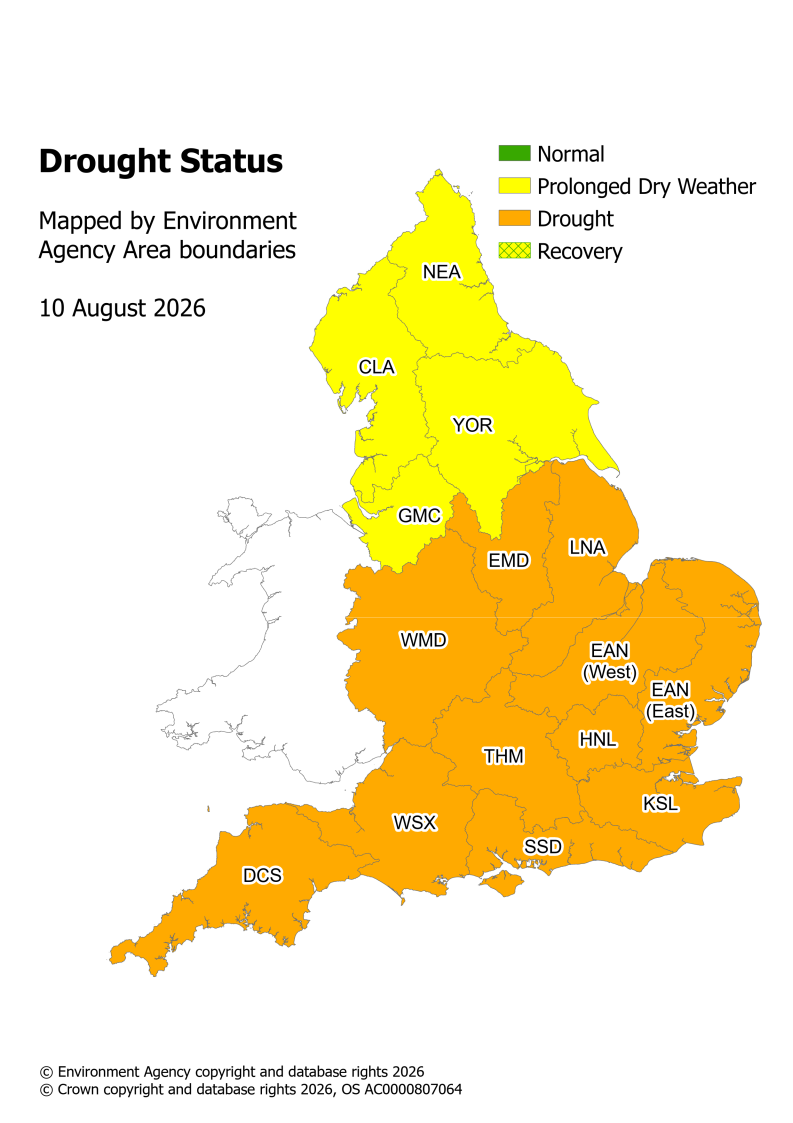
Four Environment Agency areas have moved to drought status since the last briefing: East Midlands, Lincolnshire and Northamptonshire and the parts of Kent and South London and parts of Solent and South Downs that were in prolonged dry weather status. The North East and Yorkshire have moved to prolonged dry weather status. No areas are at Normal status. 71% of England by land area is now in drought.
Public water supplies remain under increasing pressure with continued dry weather and high demand. Eight water companies have implemented temporary use bans (TUBs) across all or parts of their supply areas, while several companies have escalated their drought response to higher operational drought levels. Over 27 million people have restrictions on their water use.
The drought conditions are having significant impacts beyond public water supply. The agriculture sector reports reduced crop yields, poor grass growth and pressure on winter livestock forage stocks. Water resource pressures have intensified, with over 1,500 abstraction restrictions in place. The Environment Agency has introduced formal spray abstraction restrictions in parts of East Anglia to protect exceptionally low river flows and is considering the same in other areas.
Low river flows and declining water levels are affecting navigation, with increasing canal restrictions and pressure on reservoir-fed waterways, prompting a national incident response by the Canal and River Trust. The River Nene has low flows due to water being used to fight a wildfire on Holme Fen.
Environmental impacts are becoming more evident, with rising numbers of drought-related incidents including low-flow events, algal blooms, fish deaths and deteriorating water quality. The continued hot, dry conditions are also increasing wildfire risk, with the Environment Agency enhancing monitoring and interventions to help mitigate impacts.
2. Active hosepipe bans (TUBs)
The following companies have implemented TUBs, in all or part of their supply areas:
- Affinity Water – central region, covering Bedfordshire, Berkshire, Buckinghamshire, Hertfordshire, Surrey, and parts of London and Essex
- Anglian Water – whole company area, excluding Hartlepool
- Cambridge Water – whole company area
- Essex and Suffolk Water – whole company area
- Southern Water – Hampshire and the Isle of Wight
- South East Water – whole company area
- South West Water – Mid Devon and parts of East Devon and Dorset
- Thames Water – whole company area
3. Area drought status
There have been the following changes in area drought status this week:
- East Midlands changed from prolonged dry weather to drought
- Lincolnshire and Northamptonshire changed from prolonged dry weather to drought
- remaining parts of Solent and South Downs which were in prolonged dry weather changed to drought
- remaining parts of Kent which were in prolonged dry weather changed to drought
- North East moved to prolonged dry weather
- Yorkshire moved to prolonged dry weather
3.1 Areas in drought
- East Anglia
- Hertfordshire and North London
- Thames
- Devon, Cornwall and Isles of Scilly
- West Midlands
- Wessex
- Kent and South London
- Solent and South Downs
- East Midlands
- Lincolnshire and Northamptonshire
3.2 Areas in prolonged dry weather
- North East
- Yorkshire
- Cumbria and Lancashire
- Greater Manchester, Merseyside and Cheshire
3.3 Figure 1: Environment Agency drought status
3.4 How the stages of drought response work
Each area is reviewing its status depending on the triggers they have outlined in their drought plan.
More detail of how we manage drought, including our 4 stages of drought response, is available in Drought: how it is managed in England.
4. Current water situation
It was another dry week for England, with north-west England being the wettest region after receiving just 6mm of rainfall. In central, east, south-east and south-west England less than 1mm of rainfall was received. So far in August, rainfall totals range from 1% of the long term average (LTA) in east and south-east England to 15% in the north-west. England as a whole has received 4mm, which is 6% of the LTA.
River flows decreased at almost all sites we report on as dry conditions continued across England. Only 5 sites (9% of the total) were classed as normal for the time of year. All remaining sites were classed as below normal or lower, with 17 (31%) below, another 17 (31%) notably low, and 15 (28%) exceptionally low. Many of the exceptionally low sites were found in south-west, east and north-east England.
The seasonal recession of groundwater levels continued at all sites in England. Many chalk sites were normal for the time of year but some sites in the Wessex Downs, Yorkshire Wolds, and North and South Downs were classed as below normal or notably low. In the oolite limestone of the Cotswolds in south-east England, levels at Jackaments Bottom were classed as exceptionally low.
In the last week, reservoir storage has continued to fall in all reservoirs. Storage for England was 65.9% on 11 August, having fallen 3.1%. This is 13.8% below the LTA for the time of year of 79.7%. With support of river flows in the River Severn continuing, Clywedog saw the greatest decrease of 6.6%. The majority of reservoirs are now classed as below normal or lower, with 5 classed as exceptionally low for the time of year including (Figure 2):
- Clatworthy reservoir operated by Wessex Water
- Clywedog operated by Hafren Dyfrdwy under direction of Environment Agency and National Resources Wales
- Dove Group operated by Severn Trent Water
- Hanningfield operated by Essex and Suffolk Water
- Wimbleball operated by South West Water
More details are available in our water situation reports for England.
4.1 Figure 2: Reservoir stocks at key individual and groups of reservoirs for week ending 11 August 2026 as a percentage of total capacity and classed relative to an analysis of historic values
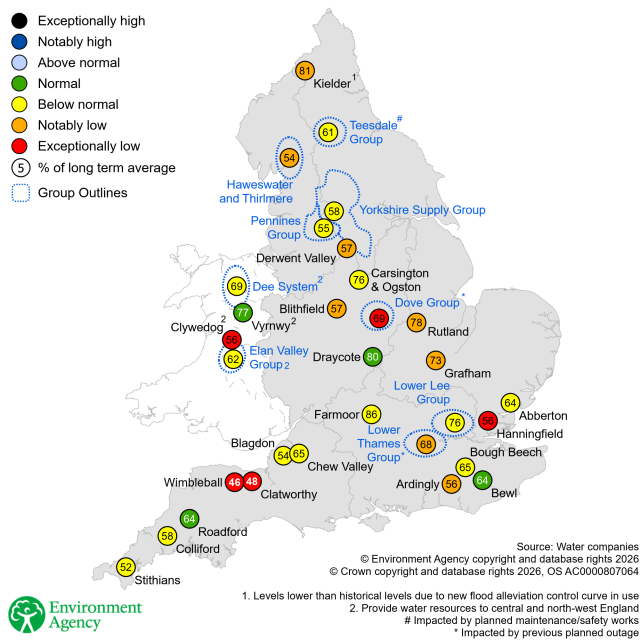
Note: Classes shown may not necessarily relate to control curves or triggers for drought actions. As well as for public water supply, some reservoirs are drawn down to provide flood storage, river compensation flows or for reservoir safety inspections. In some cases, current reservoir operating rules may differ from historic ones.
Kielder reservoir levels are lower than historic levels due to a new flood alleviation control curve in use. The Dee System, Elan Valley Group, Clywedog and Vyrnwy reservoirs provide water resources to central and north-west England. Dove Group and Teesdale Group reservoirs are impacted by planned maintenance and safety works. The Lower Thames Group is impacted by previous planned outage.
5. Public water supply
Many water companies are continuing to experience significant demand for water, due to the ongoing high temperatures. Combined with below-average rainfall, this has increased pressure on water resources, with reservoir storage, groundwater levels and river flows continuing to decline.
Water companies report their drought response using operational drought levels, from drought level (DL) 1 escalating to level 4. We expect water companies to follow their drought plans and act early to ensure there are sufficient supplies.
5.1 Affinity Water
Affinity Water (AFW) The company remains at BAU and is at its environmental trigger in its East region. TUBs remain in place for customers in its Central region.
5.2 Anglian Water
Anglian Water (AWS) The company remains at DL2 in its Fenland and Norfolk, Norwich and in its Broads water resource zones (WRZ), and is at DL1 in Ruthamford, Lincolnshire and Suffolk. TUBs remain in place across the whole company area, except for Hartlepool.
5.3 Cambridge Water
Cambridge Water (CW) remains at DL1. TUBs remain in place for all its customers.
5.4 Essex and Suffolk Water
Essex and Suffolk Water (ESW) remains at DL2 in all WRZs. TUBs remain in place for all its customers.
5.5 Northumbrian Water
Northumbrian Water (NWL) has moved into DL1 in all its WRZs.
5.6 Severn Trent Water
Severn Trent Water (SvT) remains at DL1 in its North Staffs WRZ. Reservoir storage at Tittesworth reservoir continues to decline.
5.7 Southern Water
Southern Water (SWS) is at DL2 in its Hampshire and Isle of Wight WRZs. TUBs are still in force for customers in the Hampshire and the Isle of Wight area. The company applied to Defra for a drought order on the River Test and a non-essential drought order, on 31 July.
5.8 South East Water
South East Water (SEW) remains at DL2 in its Eastbourne and Haywards Heath WRZs. All other WRZs are at DL1. Companywide TUBs remain in force.
5.9 South West Water
South West Water (SWW) Wimbleball remains at DL1. Isle of Scilly went into DL1 on 29 July. TUBs remain in place for all SSW customers, excluding in Bristol. Overall demand remains high. The company applied for a drought permit on 20 July.
5.10 South Staffs Water
South Staffs Water (SSW) remains at DL1. Reservoir storage at Blithfield reservoir has declined from last week.
5.11 Thames Water
Thames Water (TWS) remains at DL2 in all its WRZs. Companywide TUBs remain in force.
5.12 United Utilities
United Utilities (UU) remains at enhanced monitoring and operations (EMO) for its Haweswater and Thirlmere WRZs. Its Carlisle WRZ remains at DL1.
5.13 Wessex Water
Wessex Water (WW) remains at DL1 in its Grid WRZ. Reservoir storage continues to decline.
5.14 Yorkshire Water
Yorkshire Water (YW) remains at DL1 in its Grid WRZ. Reservoir storage continues to decline.
We are regularly engaging with all water companies. The companies not included above are in ‘business as usual’. Further information on the situation can be found on each water company’s website.
6. Agriculture
With August continuing to see very little rainfall, significant pressures continue in the agriculture sector. With a reduction in crop quality and yields, there are concerns on the economic impacts extending into next year, with several reports of crops being lost due to the drought conditions.
Livestock farmers continue to be impacted by poor grass growth, placing increased pressures on winter forage stocks. The loss of mains water supply or pressure incidents reported to the National Farmers Union are increasing and many farmers are reporting boreholes drying up.
Significant pressures continue on water resources, and many river levels range between below normal to exceptionally low. There are 1,544 restrictions on abstraction licences and farm reservoirs remain very low.
Section 57 restrictions have been implemented in parts of East Anglia from the 10 August until 31 October, with a 50% reduction on abstraction affecting 288 spray licences to protect the environment. 14 abstractors in the Wensum catchment in Norfolk are now required to cease abstraction completely.
192 voluntary abstraction restrictions have been implemented in East Anglia and 300 in the Thames area. Voluntary restrictions may be required in other areas such as West Midlands, Lincolnshire and Northants and Cheshire if the dry weather continues. The Environment Agency continues to work closely with abstractors and partners regarding the implementation of any formal restrictions.
With the ground conditions so dry, water does not easily soak into baked and compacted soils, increasing the risk of run-off. The Environment Agency is advising farmers to assess ground and weather conditions carefully before spreading organic manures, including slurries, and to comply with the Farming Rules for water to protect rivers from pollution.
7. Environment
Confirmed incidents caused by drought and dry weather have been steadily rising, with a total of 180 incidents recorded since the start of 2026. This is slightly lower than at this time in 2025 (201). Relatively high numbers of these incidents have been reported in Greater Manchester and Chesire, Herts and North London, Solent and South Downs, West Midlands, Thames, and Kent and South London areas.
There have been 21 confirmed algae and 21 confirmed dead fish incidents attributed to drought and dry weather since the start of 2026. This is now above the figures for this time in 2025 for algae but lower for dead fish, attributed to drought and dry weather.
The number of estimated and confirmed incidents with dead fish has rapidly increased in recent weeks and is now above confirmed numbers for August 2025. There have been 107 confirmed abstraction or low flow incidents, with highest numbers in West Midlands, Lincolnshire and Northamptonshire, Hertfordshire and North London, and Thames areas. Numbers of estimated and confirmed continue to rapidly increase suggesting the final confirmed numbers may exceed that of 2025.
The dry, hot weather has also led to wildfires breaking out at various places around the country. The Environment Agency is working with the relevant authorities to support as required.
8. Navigation
The Canal and River Trust water resources position has deteriorated. Several heatwaves have led to a rapid draw down of water supply reservoirs due to high demands on the network. Several reservoirs are operating with reduced storage because of ongoing engineering works, further increasing pressure on water resources.
Reservoir-fed canals are most affected, while river navigations, such as the River Severn, remain more resilient. Many canals are open for navigation but there are an increasing number of localised impacts due to low water levels. In particular, 26 closures related to water, 19 restrictions for opening hours and windows of passage and more than additional 20 closures due to infrastructure or fallen trees. Without rainfall, restrictions will become closures in the coming weeks. All river users are being advised to take extra care when navigating.
The Canal and River Trust have activated a national incident response, supported by regional incident groups to manage impacts and reduce risks. They are carrying out a repairs programme, prioritising key routes for boating and water transfer.
The risk of emergency abstraction requests in some areas remains high.
Within Environment Agency’s navigation remit, low levels are having impacts on houseboat communities on the lower Thames, boat trips on the River Stour and sometimes stopping navigation altogether. In some instances, the low levels are due to water being abstracted to provide resources to fight wildfires on Holme Fen. There are also reports of some fish and canoe passes being closed on the River Medway, as well as several reports of vandalism at locks, which is impacting navigation and increasing issues with water resources management.
9. Weather forecast
Friday will stay hot across much of England, although a weak cold front will bring cooler and cloudier weather into the west as the day progresses. Isolated afternoon thunderstorms are possible in the south-east. Saturday and Sunday are expected to remain dry and sunny for much of England, although there is a chance of some showers in the south-east. On Monday a change is expected towards rainier, breezier conditions, which will continue for most of the week. However, the highest rainfall totals are expected over high ground in the north-west, with totals elsewhere remaining small.
10. Drought readiness actions
The Environment Agency has activated its incident response arrangements, with ‘gold command’ structures in place and drought plans being implemented to support early intervention and coordinated action.
Enhanced communications activity being taken includes:
- issuing press notices and holding media briefings
- increasing engagement with stakeholders, local partners and Members of Parliament
- publishing this weekly drought update on GOV.UK
The Environment Agency has strengthened environmental monitoring, increasing both surveillance and operational interventions to identify, assess and mitigate potential environmental impacts as drought conditions develop.
The National Drought Group was reconvened on 20 July to monitor risks, preparation and impacts. It will meet approximately every 2 weeks through the summer. The next meeting is scheduled for 27 August.
Check the information on staying safe in hot weather.
11. Contact us
Contact drought.national@environment-agency.gov.uk if you have questions about this report.