
Dry weather and drought in England: 20 to 26 November 2026
Updated 27 November 2026
Applies to England

© Crown copyright 2026
This publication is licensed under the terms of the Open Government Licence v3.0 except where otherwise stated. To view this licence, visit nationalarchives.gov.uk/doc/open-government-licence/version/3 or write to the Information Policy Team, The National Archives, Kew, London TW9 4DU, or email: psi@nationalarchives.gov.uk.
Where we have identified any third party copyright information you will need to obtain permission from the copyright holders concerned.
This publication is available at https://www.gov.uk/government/publications/dry-weather-and-drought-in-england-2026-summary-reports/dry-weather-and-drought-in-england-20-to-26-november-2026
1. Summary
Recent rainfall and ongoing drought conditions continue to create a mixed weather picture across England. It has been a drier week across the country, except for southwest England which received more rainfall than the previous week. Rainfall totals were highest in the southwest (49mm) and lowest in eastern England (11mm). River flows decreased at more than three-quarters of the sites we report on in response to reduced rainfall across much of England. Most sites are now classed as below normal or lower for the time of year, with 3 sites classed as exceptionally low.
Groundwater levels decreased at the majority of sites, as drier than average soils continue to delay recharge to groundwater resources. Reservoir storage increased at most sites, with total storage for England rising to 60.2% as of 24 November. Fourteen reservoirs or reservoir groups remain less than 50% full, with 8 classed as exceptionally low.
Severe drought remains in parts of Cornwall, Devon, Dorset, Somerset, East and West Sussex. This reflects the continued pressure on water resources in areas reliant on Ardingly Reservoir, Wimbleball Reservoir, and several smaller reservoirs in Devon and west Cornwall.
Public water supplies remain under pressure in some drought-affected areas, with significant rainfall needed over autumn and winter to restore normal water resource conditions. We need at least 120% of average rainfall over the next 5 months for the entire country to be out of drought by the spring. Several water companies remain at higher operational drought levels, and temporary use bans remain widespread. Companies continue to progress drought measures, including drought permits and drought orders.
Refilling irrigation reservoirs over winter remains a primary concern for the agriculture sector, with many reservoirs at historic lows at the start of the refill season. Low river flows continue to prevent some farmers from refilling, particularly in eastern England. There are currently 386 restrictions on abstraction licences, down from 431 last week following recent rainfall. The Environment Agency continues to support farmers to improve water resilience and access to water and is advising the sector to act now in case drought continues into spring.
The water resources situation across the Canal & River Trust and Environment Agency canal networks has improved, particularly in the more responsive northern reservoirs. However, some reservoirs have shown little or no response to recent rainfall. Seven navigation closures and four restrictions remain in place on the Canal & River Trust network due to low water levels. The Environment Agency is managing water levels carefully and passage restrictions for boats are still in place to minimise water loss through lock opening. Winter maintenance and drought preparedness work are under way across the Canal & River Trust and Environment Agency networks.
Confirmed new environmental incidents caused by drought and dry weather have slowed since the end of August, with no new incidents in the last 2 weeks. The total for 2026 is now 440. While recent rainfall will contribute to a reduction in drought and dry weather incidents, prolonged rain and wet weather will be required for significant improvements to become evident.
2. Active temporary use bans (TUBs)
The following companies have implemented TUBs, in all or part of their supply areas:
- Affinity Water – Central and East regions, covering Bedfordshire, Berkshire, Buckinghamshire, Hertfordshire, Surrey, and parts of London and Essex
- Anglian Water – whole company area, excluding Hartlepool
- Bristol Water – whole company area
- Cambridge Water – whole company area
- Essex and Suffolk Water – whole company area
- Southern Water – Hampshire and the Isle of Wight
- South East Water – whole company area
- South West Water – whole company area, excluding Bournemouth
- Thames Water – whole company area
- Wessex Water – whole company area
The Water Industry Act 1991 incorporates legislation which makes provision for another water undertaker to supply sites within an existing water undertaker’s area. Where an alternative undertaker is appointed, a New Appointment and Variation (NAV) is made by Ofwat. Companies operating as a NAV have the same legal duties and responsibilities as other water companies to produce drought plans. NAVs can have their own sources of supply but are primarily supplied by bulk supply agreements with the water undertaker in the area. NAV TUBs were introduced at the same time as their respective incumbent companies as follows:
- Leaf Water implemented TUBs for its customers in areas supplied by South East Water, Essex and Suffolk Water and Cambridge Water
- Albion Water implemented TUBs for its customers in areas supplied by Thames Water
- Leep Water implemented TUBs for its customers in areas supplied by South East Water, Southern Water, South West Water, Thames Water, Wessex Water, Anglian Water, Affinity Water, Bristol Water and Essex and Suffolk Water
- Independent Water Networks (IWN) implemented TUBs for its customers in areas supplied by South East Water, Southern Water, South West Water, Thames Water, Wessex Water, Anglian Water, Affinity Water, Bristol Water, Cambridge Water and Essex and Suffolk Water
- Last Mile Water implemented TUBs for its customers in areas supplied by South East Water, Southern Water, South West Water, Anglian Water, Affinity Water, Thames Water, Essex and Suffolk Water, Wessex Water and Bristol Water
- MUA implemented TUBs for its customers in areas supplied by Affinity Water and Anglian Water
- ESP implemented TUBs for its customers in areas supplied by Bristol Water, Wessex Water, Thames Water, South East Water, Affinity Water and Anglian Water
- Matrix implemented TUBs for its customers in areas supplied by Thames Water
Further information can be found on each company’s website.
3. Environment Agency Area drought status
There have been no changes in area drought status this week.
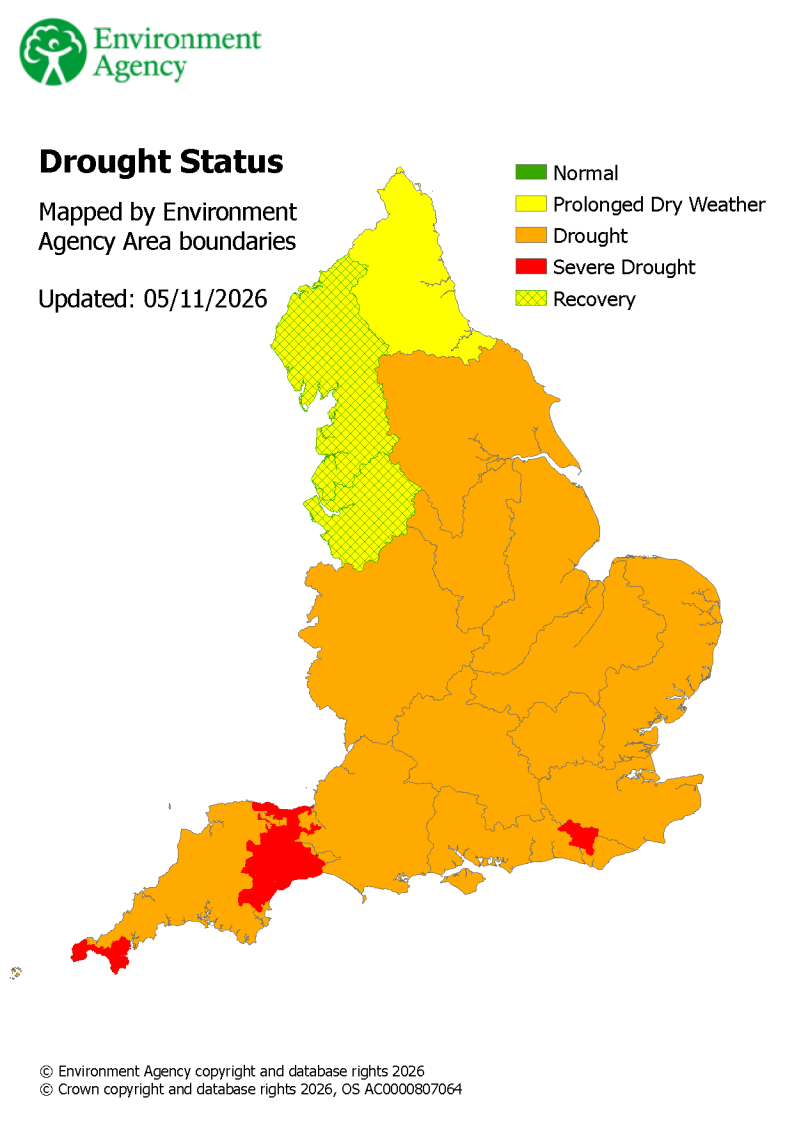
3.1 Environment Agency Areas in severe drought
- Parts of Devon and Cornwall and Wessex Areas that are supplied by Wimbleball reservoir, Kenninck, Tottisford & Trenchford (KTT) and Venford reservoirs, and Stithians and Drift reservoirs
- Parts of Solent and South Downs and Kent and South London Areas that are supplied by Ardingly reservoir
3.2 Environment Agency Areas in drought
- remaining parts of Devon, Cornwall and Isles of Scilly that are not in severe drought
- remaining parts of Wessex that are not in severe drought
- remaining parts of Kent and South London that are not in severe drought
- remaining parts of Solent and South Downs that are not in severe drought
- East Anglia
- Hertfordshire and North London
- Thames
- West Midlands
- East Midlands
- Lincolnshire and Northamptonshire
- Yorkshire
3.3 Environment Agency Areas in prolonged dry weather
- Northeast
3.4 Environment Agency Areas in recovery
- Cumbria and Lancashire
- Greater Manchester, Merseyside and Cheshire
3.5 How drought response stages work
Each Environment Agency Area reviews its status depending on the triggers they have outlined in their drought plan.
More detail of how we manage drought, including our 4 stages of drought response, is available in Drought: how it is managed in England.
4. Current water situation
It has been a drier week across much of England, except in the southwest, which received more rainfall than the previous week. Rainfall totals ranged from 11mm in east England to 49mm in the southwest. November rainfall to date varies from 33% of the long-term average (LTA) in northwest England to 84% in the southwest. For England as a whole, rainfall so far is 56mm, which is 61% of the LTA.
In response to reduced rainfall across much of England, river flows decreased at more than three-quarters of the sites we report on, with 44 sites (80%) recording a decrease compared with the previous week. River flows were classed between exceptionally high and exceptionally low for the time of year, reflecting the varying effects of recent rainfall and ongoing drought conditions across England. Thirteen sites (24% of the total) were classed as normal for the time of year. Two sites (4%) were classed as above normal, while one site (2%) in the southwest was classed as notably high and one site (2%), the River Kenwyn in the southwest, was classed as exceptionally high. Twenty-two sites (40%) were classed as below normal, while 13 sites (24%) were classed as notably low. Three sites (5%) were classed as exceptionally low for the time of year, the Rivers Ely Ouse, Cam and Derwent in eastern and northern England.
Groundwater levels decreased at the majority of sites, as drier than average soils continue to delay recharge to groundwater resources. More than half of sites (15 sites, 58% of the total) are now classed as below normal or lower for the time of year. Most of these sites are found in chalk aquifers, including Tilshead, Chipstead, Woodyates and Chilgrove in southern England, which remain classed as exceptionally low for the time of year.
As of 24 November, reservoir storage has increased in most of the reservoirs or reservoir groups we report on, with 28 showing an increase and three showing a decrease. Kielder, Haweswater and Thirlmere Group, and Farmoor decreased in storage. Storage for England increased by 2.2 percentage points to 60.2%. Fourteen reservoirs or reservoir groups are less than 50% full. Only one reservoir group is classed as normal for the time of year, the Lower Lee Group in southeast England, while all others are below normal or lower. Eight reservoirs or reservoir groups are now classed as exceptionally low (Figure 2):
- Ardingly reservoir operated by South East Water
- Dove Group operated by Severn Trent Water (where winter refill was impacted by water quality and operational issues)
- Grafham Water operated by Anglian Water
- Hanningfield reservoir operated by Essex and Suffolk Water
- Wimbleball, Colliford, and Roadford reservoirs operated by South West Water
- Haweswater and Thirlmere Group operated by United Utilities
More details are available in our water situation reports for England.
Figure 2: Reservoir stocks at key individual and groups of reservoirs for week ending 24 November 2026 as a percentage of total capacity and classed relative to an analysis of historic values.
Classes shown may not necessarily relate to control curves or triggers for drought actions. As well as for public water supply, some reservoirs are drawn down to provide flood storage, river compensation flows or for reservoir safety inspections. In some cases, current reservoir operating rules may differ from historic ones.
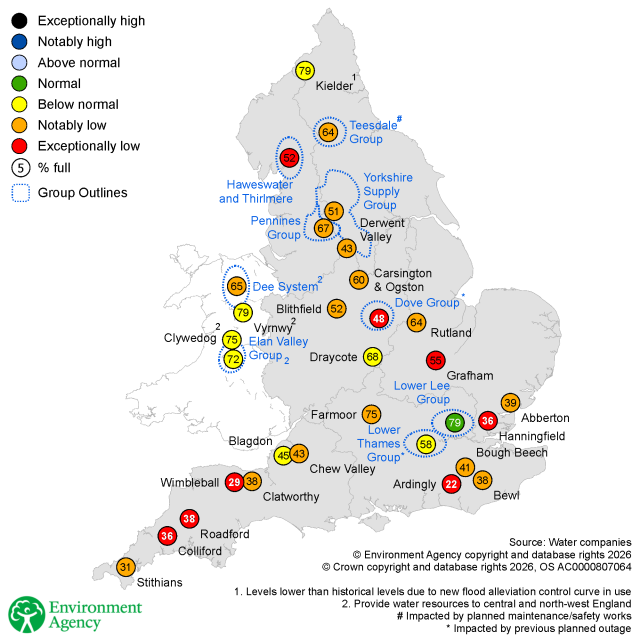
Kielder reservoir levels are lower than historic levels due to a new flood alleviation control curve in use. The Dee System, Elan Valley Group, Clywedog and Vyrnwy reservoirs provide water resources to central and north-west England. Teesdale Group is impacted by planned maintenance and safety works. The Dove Group and Lower Thames Group are impacted by a previously planned outage.
5. Public water supply
Although reservoir stocks across England have increased with the recent rainfall, public water supply remains under pressure in some drought-affected areas. Significant rainfall is needed to return to normal water resource conditions. Water companies are focused on autumn and winter recovery, with continuing risks if conditions are drier than average.
Water companies report their drought response using operational drought levels, from drought level (DL) 1 escalating to DL4 as conditions deteriorate. We expect water companies to follow their drought plans and act early to ensure there are sufficient supplies.
Since August this year the Environment Agency has granted 3 drought permits to help water companies protect public water supply, one to South East Water, one to Thames Water and one to South West Water. There are 3 drought permits and 3 drought orders currently being determined – these are detailed in the following sections.
We regularly engage with all water companies. The companies not included here have not needed to activate their drought plans. Further information on the latest situation can be found on each water company’s website.
5.1 Affinity Water
Affinity Water remains at business as usual (BAU) – its East region has reached the company’s environmental trigger. TUBs remain in place for customers in its Central region and East region, driven by high demand.
5.2 Anglian Water
Anglian Water remains at DL2 in its Fenland and Norfolk, Norwich and Broads water resource zones (WRZ). Suffolk West and Cambs WRZ has now entered DL1, increasing the number of zones operating at DL1 to 8: Essex South, Ruthamford Central, North, South and East, Lincolnshire, and Suffolk. TUBs remain in place across the whole company area, except for Hartlepool. Anglian Water has applied for its Wellington Wellfield drought permit.
5.3 Cambridge Water
Cambridge Water remains at DL1. TUBs remain in place for all its customers.
5.4 Essex and Suffolk Water
Essex and Suffolk Water’s Essex WRZ remains at DL3a. All other WRZs remain at DL2. TUBs remain in place for all its customers.
5.5 Northumbrian Water
Northumbrian Water remains at DL1 in all its WRZs.
5.6 Severn Trent Water
Severn Trent Water’s Strategic Grid North WRZ remains at DL1.
5.7 Southern Water
Southern Water is at DL1 in its Hampshire and Isle of Wight WRZs. Its Kent Medway East and West WRZs and Sussex Hastings WRZ remain at DL2. Other WRZs remain at BAU. TUBs are still in force for customers in the Hampshire and the Isle of Wight area.
5.8 South East Water
South East Water remains at DL3 in its Eastbourne and Haywards Heath WRZs. All other WRZs remain at DL1. Company-wide TUBs remain in force, with exemptions removed in areas at DL3. A Non-Essential Use Ban (NEUB) drought order application was submitted on 2 October. South East Water has applied for its Arlington reservoir drought permit.
5.9 South West Water
South West Water’s Colliford WRZ, Roadford WRZ remain at DL1, Isles of Scilly WRZ has moved to DL1, and Wimbleball WRZ has moved to DL2. TUBs remain in place for all South West Water customers, excluding Bournemouth. An application for a NEUB drought order was submitted on 6 October for its Wimbleball WRZ. The company has also applied for its Restormel drought permit.
5.10 South Staffordshire Water
South Staffordshire Water remains at DL2.
5.11 Thames Water
Thames Water remains at DL3 in its Swindon and Oxfordshire (SWOX) WRZ, the rest of the WRZs remain at DL2. Company-wide TUBs remain in force.
5.12 United Utilities
United Utilities Strategic Resource Zone (SRZ) remains in Enhanced Monitoring and Operations.
5.13 Wessex Water
Wessex Water remains at DL3. Company-wide TUBs remain in force. An application for a NEUB drought order was submitted on 6 November.
5.14 Yorkshire Water
Yorkshire Water remains at DL1.
6. Agriculture
The recharge of storage reservoirs remains a primary concern for abstractors in the agriculture sector as many irrigation reservoirs were at historic lows at the start of the winter refill season. Some farmers are still unable to refill irrigation reservoirs where river flows remain low, particularly across eastern parts of England.
There are currently 386 restrictions on abstraction licences. This is a decrease from last week (431) due to an increase in river flows following recent rainfall.
The Environment Agency continues to work closely with abstractors and is supporting farmers to help improve water resilience and access to water. To date we have received 44 flexible abstraction requests from the agriculture sector, of which 13 have been approved, and 30 have either been rejected or withdrawn.
Applications for the third round of water management grants open on Monday 30 November to support farmers with agricultural storage and irrigation infrastructure projects. For more information on this scheme and how to apply see Water management grant round 3. Applications close on 23 February 2027.
Our agriculture reservoir refill prospect report details further information on the key risks from a dry winter and the actions that are needed to mitigate the impacts of drought continuing into spring. We are advising the sector to take action now to build resilience over the winter should drought conditions continue into next spring.
7. Environment
Numbers of confirmed incidents caused by drought and dry weather have slowed since the end of August, with no new incidents in the last 2 weeks. The total of 440 incidents recorded since the start of 2026 exceeds the overall total for 2022 (380) and 2025 (321). This figure of 440 is likely to increase further due to reporting lags. Whilst recent rainfall will contribute to a reduction in incidents, prolonged rain and wet weather will be required for significant improvements to become evident.
Relatively high numbers of incidents have been reported in Devon, Cornwall and the Isles of Scilly, East Anglia, Greater Manchester, Merseyside, and Cheshire, Hertfordshire and North London, Solent and South Downs, West Midlands, and Thames over this year.
8. Navigation
Water resources have improved across much of the Canal & River Trust network, with more responsive reservoirs seeing some refill. Slower responding reservoirs have shown little or no improvement. There are areas of continued concern with closures and restrictions remaining.
The Canal & River Trust is continuing its drought response and winter preparedness. Its activities include tracking winter reservoir refills, modelling dry weather scenarios and undertaking drought related works such as leak repairs.
There is a reduction in the number of canal restrictions and closures, with some localised low water levels in places. The latest can be found at Notices and stoppages, Canal & River Trust:
- 7 navigation closures in place related to low water levels (some on the same canal) (31 at the mid-August peak).
- 4 restrictions in place (opening hours, windows of passage) (19 at the mid-August peak)
This year it is possible that drought and flooding events could disrupt the Environment Agency delivery of services and maintenance on its navigation network. Impacts from this may extend into future years. The Environment Agency is managing water levels carefully and passage restrictions for boats are still in place. With reduced boat traffic and a reduced use of locks, loss of water through lock openings is now minimal.
Winter programmes of capital works and substantial maintenance are now commencing on the in-water assets, for example, the Environment Agency Thames Lock programme. This programme will mean assets are intermittently unavailable to assist in holding water levels – some lock chamber drain downs may be planned and there will be localised increases in lock movements for staff and contractors. The programme is being managed taking account of the current drought restrictions.
9. Weather forecast
Thursday will be a cold but dry day for England. On Friday outbreaks of rain are expected for many areas with the chance of hill snow across northern England. The unsettled conditions continue into Saturday with further rain and showers. Sunday is forecast to be warmer with a mix of showers and sunnier spells. On Monday and Tuesday, Atlantic frontal systems will move across the country bringing the wettest conditions to western areas of England.
10. Drought readiness actions
The Environment Agency has activated its incident response arrangements, with Gold Command structures in place and drought plans being implemented to support early intervention and coordinated action.
Enhanced communications activity being taken includes:
- issuing press notices and holding media briefings.
- increasing engagement with stakeholders, local partners and MPs
- publishing a weekly drought update on GOV.UK
The Environment Agency has strengthened environmental monitoring, increasing both surveillance and operational interventions to identify, assess and mitigate potential environmental impacts of the drought.
The National Drought Group continues to meet regularly to monitor risks, preparation and impacts of the ongoing drought. The next scheduled meeting is on 3 December.
11. Contact us
Contact drought.national@environment-agency.gov.uk if you have questions about this report.