
Prospects for refilling agriculture storage reservoirs this winter
Published 2 November 2026
Applies to England

© Crown copyright 2026
This publication is licensed under the terms of the Open Government Licence v3.0 except where otherwise stated. To view this licence, visit nationalarchives.gov.uk/doc/open-government-licence/version/3 or write to the Information Policy Team, The National Archives, Kew, London TW9 4DU, or email: psi@nationalarchives.gov.uk.
Where we have identified any third party copyright information you will need to obtain permission from the copyright holders concerned.
This publication is available at https://www.gov.uk/government/publications/drought-prospects-for-agriculture/prospects-for-refilling-agriculture-storage-reservoirs-this-winter
This report reviews the prospects for refilling agriculture storage reservoirs in the winter of 2026 using a range of long-term average rainfall scenarios. It also explores the risks for the sector if there is a dry winter and actions farmers and growers can take to reduce the impacts from drought continuing into spring 2027.
1. Winter reservoir refill prospects
The impact of 2026 drought on agriculture has been significant. The drought and successive heatwaves this year have created challenging growing and harvesting conditions, resulting in a difficult season for farmers. This has resulted in lower yields and reduced crop quality across many parts of the country. Poor grass growth during the summer meant that many livestock farmers had to use winter forage reserves earlier than planned, leaving reduced supplies available for the winter months. Many storage reservoirs remain at low levels and some river flows are still below normal for the time of year. This is limiting the ability for abstractors to refill storage reservoirs.
This winter will be critical for refilling storage reservoirs and rebuilding resilience ahead of the 2027 growing season. Reservoir refill levels this winter period will influence water availability for irrigation and the sector’s ability to withstand further dry conditions next year.
This section examines the prospects for reservoir refill under a range of winter rainfall scenarios. It considers outcomes based on winter rainfall (November to March) under 100%, 80%, and 60% of the long-term average across each of the Environment Agency geographic areas.
1.1 Irrigation reservoir refill prospects under 100% long-term average rainfall scenario
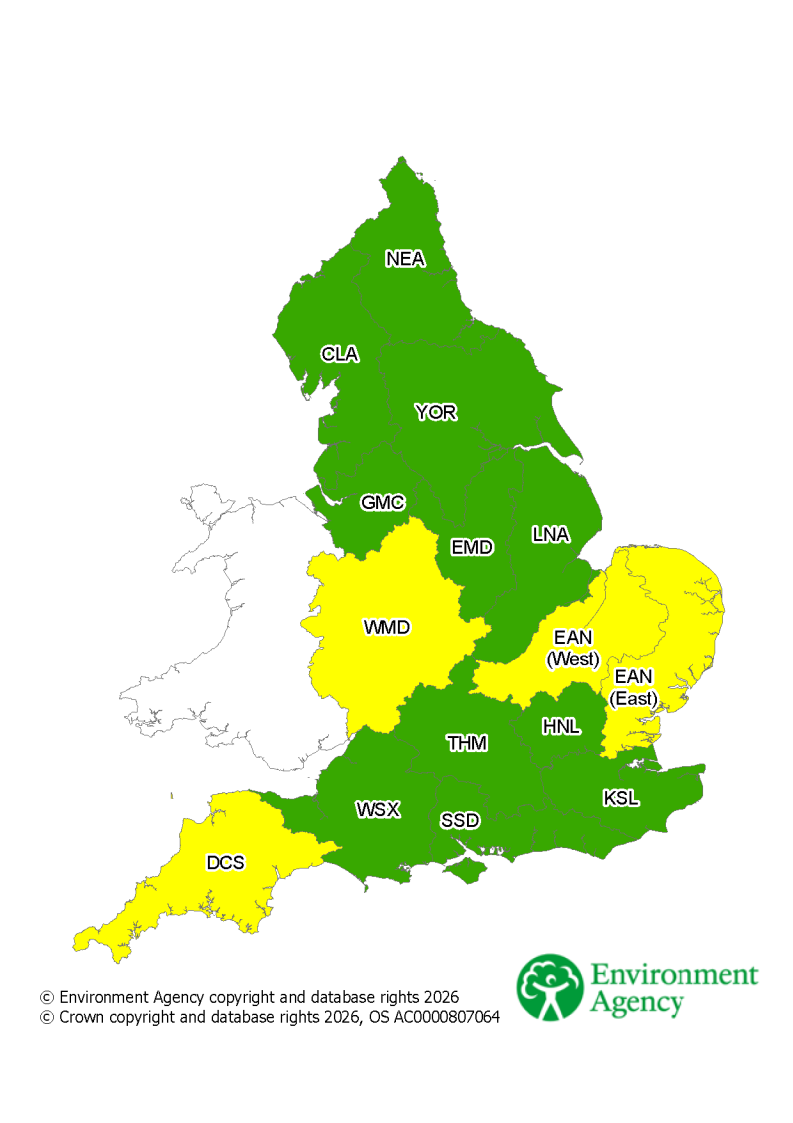
In this rainfall scenario, reservoir refill prospects are generally expected to be good across most of England, with the majority of storage reservoirs projected to refill sufficiently ahead of spring.
However, where river flows and groundwater levels remain below normal throughout winter, there is a risk that local abstraction restrictions may be required. These restrictions could limit opportunities for abstractors to refill storage reservoirs, reducing water availability for the following irrigation season.
Projections indicate moderate refill prospects in the West Midlands, Devon, Cornwall and East Anglia. In these locations, there is a greater risk that storage reservoirs may not be fully refilled by the start of spring. The risk is higher where there is a delay in the recovery of baseline river flows and groundwater. Consequently, some irrigators may enter the 2027 growing season with reduced water storage and lower resilience to further dry conditions.
1.2 Irrigation reservoir refill prospects under 80% long-term average rainfall scenario
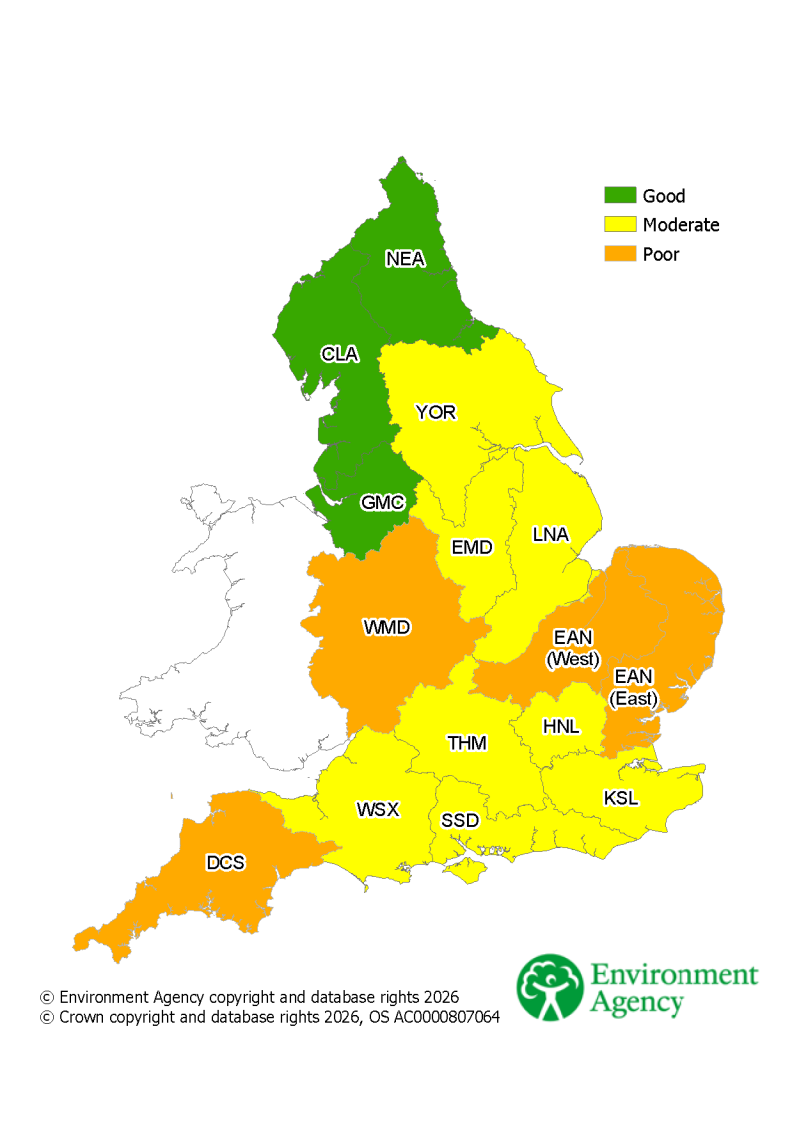
In this rainfall scenario, there is an increased risk that winter recharge will not be sufficient to fully replenish storage reservoirs before the start of the 2027 irrigation season. Refill prospects are:
- moderate across southern, central and eastern England
- poor in West Midlands, Devon, Cornwall, and East Anglia – in these areas, more significant abstraction restrictions may be required if groundwater and river flow recovery remains limited over winter
Under an 80% winter rainfall scenario, there is an increased likelihood that Section 57 restrictions may be needed in some catchments during the 2027 irrigation season. This is particularly likely where river flows remain significantly below average.
Section 57 restrictions are emergency powers used to restrict spray irrigation abstraction when water resources are under severe pressure. They form part of a phased approach to managing abstraction during a drought to protect the environment. The Environment Agency and farmers work together to avoid such restrictions.
The likelihood, extent and timing of any Section 57 restrictions will depend on winter recharge and hydrological conditions through the irrigation season. We will provide a more detailed assessment in the next spray irrigation prospects report, to be published in February.
1.3 Irrigation reservoir refill prospects under 60% long-term average rainfall scenario
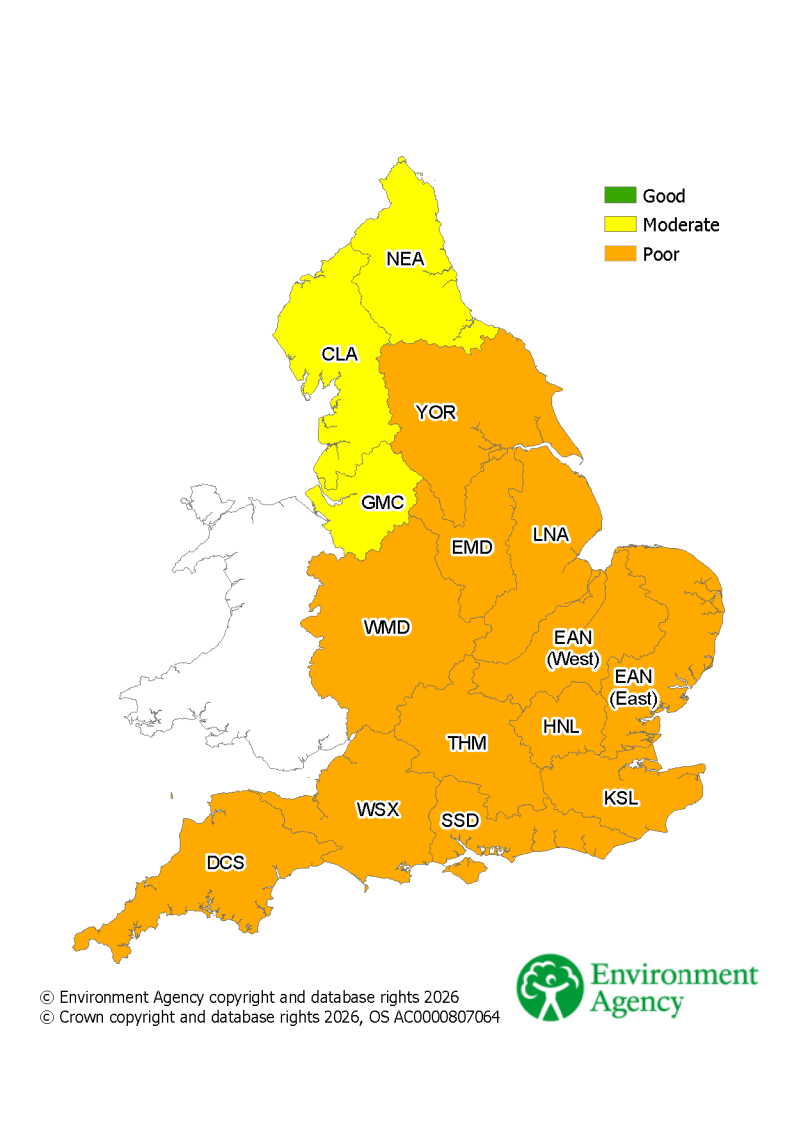
In this rainfall scenario, prospects for the refill of storage reservoirs are expected to be poor across many parts of the country with widespread impacts.
Winter hands-off flow restrictions on licences are expected to be widespread, as river flows and groundwater levels are projected to remain well below normal for the time of year. These conditions are likely to significantly limit opportunities for winter abstraction and reservoir recharge across many areas. More information on river flow and groundwater projections up to March 2027 can be found in our full national water situation report for September.
By the start of spring 2027, many storage reservoirs are unlikely to have refilled sufficiently to meet irrigation demands for the growing season. As a result, resilience is likely to be significantly reduced, with conditions expected to be worse than those experienced at the start of spring 2026.
Hands-off flow restrictions are also likely to remain in place into spring, affecting direct spray irrigation abstractions. With soils unlikely to have fully wetted over the winter, conditions for the establishment of spring-sown crops could be particularly challenging. Vegetable producers may face additional pressures from reduced water availability. There is a significant risk of Section 57 restrictions being implemented during spring, particularly where river flows and groundwater are well below normal. Expectation will include outright bans at some stage through the season.
Low rainfall could have significant impacts on livestock farmers by reducing spring grass growth and limiting opportunities to rebuild forage stocks ahead of the next grazing season. Following this year’s drought, many livestock producers have already experienced lower forage yields and have had to draw on winter feed reserves earlier than usual. Consequently, forage availability may be more constrained than normal, increasing the risk of feed shortages. This could potentially drive up costs should dry conditions continue into spring.
2. Water resources situation
September was the third consecutive month of below average rainfall for England which recorded 65% of long-term average (LTA) rainfall for the month. Up to 24 October, England overall has received 99% of the LTA rainfall. There were some regional variations with the north-east receiving 91% of LTA rainfall, while the south-east received 107% of LTA rainfall to the 24 October.
Recent rainfall has helped increase some river flows at three-quarters of monitoring sites. Just under half of monitoring sites are classed as normal for the time of year. The rest of monitoring sites are below normal or lower, many of which are in south-east and south-west England. Four sites are classed as exceptionally low including the Ely Ouse in east England, the Rivers Derwent and Swale in the north-east and the River Tone in south-west England. With river flows remaining below normal or lower in many parts of England, opportunities for farmers to abstract water are limited and this further increases pressures on the agriculture sector.
At the end of September, soils were much drier than would be expected across most of England, with particularly dry soils along the south coast, in south Wales and in the far north-east of England. In north-west England, soil moisture deficits are closer to average, with some near the Scottish border now wetter than would be expected for the time of year.
Groundwater levels continue to decline at many sites, as soils need to be saturated before rainfall can effectively recharge resources. Sites in chalk aquifers are all normal or lower for the time of year, with 3 sites in southern England classed as exceptionally low.
This year has seen significant demands on agriculture storage reservoirs due to the early start to the irrigation season and widespread abstraction restrictions that were in force during the summer. As a result, reservoir levels in some areas have fallen to record lows ahead of the winter recharge season. It will therefore be crucial that reservoirs are sufficiently replenished over the winter to secure water supplies for the 2027 irrigation season.
More information on the current water situation and a forward look is available in our water situation reports for England.
3. Long range weather forecast
For the end of October, conditions are likely to become less unsettled with rain and stronger winds becoming more confined to northwestern areas. In early November high pressure will become more dominant bringing more settled conditions across the country with the potential for fog and frost overnight.
In mid-November, there is an increased chance of more unsettled weather with more frequent spells of rain for many areas. However, confidence is lower further into the forecast period due to uncertainty in the development and track of weather systems.
More information on long range weather forecasts is available at the Met Office.
4. Actions by the agriculture sector to reduce the impacts of a dry winter and drought in spring 2027
Farmers and growers should review their water requirements now in preparation for the next growing season, particularly where crops require significant volumes for irrigation.
With increasing pressure on water resources, access to water cannot always be guaranteed in the future. Farmers and growers must act to improve both short-term and long-term resilience to drought.
Mark Betson, Water Resources Specialist at the National Farmers’ Union, highlighted the importance of planning ahead to ensure future water needs can be met and businesses remain resilient in the face of increasing climate and water resource pressures.
“The exceptional summer of 2026 has created a water deficit which will be difficult to make up over the winter. The clear message is that we have to be prepared for higher risks going into 2027 with any dry weather we experience. For those with the ability to store water, accessing water when it is available will be important as there is no guarantee it will be available later in the season, or there will be additional flexibility with licencing.
There has been a lot of work with the Environment Agency to boost local communications with abstractors this year and where particular areas are encountering problems with refilling storage, they should talk to their local Environment Agency teams. We have also seen a growth in water abstractor groups as networks of local growers are more empowered to engage with water planning and providing farmer-to-farmer support. We continue to advocate for more abstractors to think about starting or joining groups to benefit from this support.”
4.1 Short term support and actions
Farmers and growers should consider the following actions and support measures to help increase resilience over this winter and in the long term.
Manage and review your abstraction licence
Review your abstraction licence to ensure it still meets your needs and that you can comply with its conditions. Short term options are available to improve your access to water outside of your licence conditions. Contact the Environment Agency as early as possible to discuss your requirements. Further information is available in our guidance on water abstraction during prolonged dry weather and drought.
Sign up to manage your water abstraction or impoundment licence online. This allows you to submit abstraction returns and view your licence information. Licence holders can also opt-in to receive water abstraction email alerts, helping you receive notifications more quickly.
Regulatory position statements
Our regulatory position statements are available to support you with short term access to water:
Abstraction outside the authorised period for filling water storage reservoirs: RPS 382 allows the abstraction of water outside the authorised abstraction period for the purpose of filling existing water storage reservoirs from 1 to 31 October. We will assess the drought situation later in the winter and communicate information on any further extensions to the refill season in our spring irrigation prospects report.
Abstracting floodwater outside of licence conditions during flood events: RPS 300 covers information on when abstractors can take water outside of abstraction licence conditions during a flood or severe flood warning. Farmers should be ready to take water during any high flow events to maximise the fill of on-farm reservoirs.
Trading water rights
Consider trading water with other licence holders to improve access to water supplies. You can find out more about trading water abstraction rights or find abstractors with potential for trade on our water rights trading map.
4.2 Long term support and actions
The Prime Minister announced a new round of the Water Management Grant on 15 August 2026, with up to £15 million available to help farmers build on-farm reservoirs.
The grant will be designed to support construction of on-farm reservoirs, to store water when it’s available and use it when most needed. This will improve resilience during dry periods and helping protect crop production. The scheme will focus on supporting water storage for crop irrigation, helping the horticulture and arable sectors adapt to climate change and improve resilience to drought. The Department for Environment, Food and Rural Affairs (Defra) will publish more details in autumn on the grant structure and application process.
Read more about how to develop your own on-farm reservoir through these case studies focused on the East of England and Essex and Suffolk natural landscapes.
We are encouraging farmers to develop and join water abstractor groups. The National Farmers’ Union and regional water resources groups are actively meeting with groups of farmers to support the formation of new groups. The UK Irrigation Association has a directory of existing water abstractor groups and hosts a booklet explaining how they can support abstractors and form a new group.
We will publish an updated irrigation prospect report at the end of February 2027. This will reflect any changes in the drought situation and key risks ahead of spring.
5. Definitions
Prospects for winter refill prospects are defined as ‘good’, ‘moderate’ or ‘poor’.
Good
Water resources are average or above. There is a possibility of minor local controls on abstraction from surface water but water resources are expected to be in a good position by spring and most irrigation reservoirs refilled.
Moderate
Water resources are below average. Some controls on surface water abstraction are possible if rainfall is below average into autumn and winter. Controls on abstraction from groundwater are possible in sensitive areas or where there has been insufficient groundwater recharge. Some irrigation reservoirs may not be completely refilled and irrigation may be at risk ahead of spring.
Poor
Water resources are well below average. Wider restrictions on abstraction from surface and groundwater are likely especially where there has been limited recharge. There is a high risk that irrigation reservoirs may not be sufficiently refilled by spring and will likely impact on resilience for next year irrigation season.