RO and ECO costs schemes direction 2026 (HTML)
Published 18 March 2026
Applies to England, Scotland and Wales

© Crown copyright 2026
This publication is licensed under the terms of the Open Government Licence v3.0 except where otherwise stated. To view this licence, visit nationalarchives.gov.uk/doc/open-government-licence/version/3 or write to the Information Policy Team, The National Archives, Kew, London TW9 4DU, or email: psi@nationalarchives.gov.uk.
Where we have identified any third party copyright information you will need to obtain permission from the copyright holders concerned.
This publication is available at https://www.gov.uk/government/publications/domestic-energy-tariff-reductions-2026-ministerial-direction/ro-and-eco-costs-schemes-direction-2026-html
Part A: General
1. Background
- 1.1 At Budget 2025, the Chancellor of the Exchequer announced two policies with a view to reducing household energy bills:
- (a) “government funding 75% of the domestic cost of the legacy Renewables Obligation…from 2026-27 to 2028-29”; and
- (b) “ending the Energy Company Obligation which is currently funded through energy bills”.
- (together, “the relevant Budget 2025 policy”).
- 1.2 This Direction gives effect to the relevant Budget 2025 policy, in particular by:
- (a) requiring domestic electricity suppliers to reduce their electricity charges by adjusting their tariffs with effect from 1 April 2026 as specified in this Direction;
- (b) providing for the making of payments (“RO costs payments”) by the Secretary of State to domestic electricity suppliers, each representing 75% of the assumed RO costs of the domestic electricity supplier to which it is made in respect of a scheme month; and
- (c) requiring ECO suppliers to reduce their energy charges by adjusting their tariffs, with effect from 1 April 2026, to reflect the fact that ECO suppliers will be relieved of relevant ECO and GBIS costs from that date.
2. Title, commencement and cessation
- 2.1 This Direction:
- (a) is made by the Secretary of State under section 22(1)(b)(iv) of the Energy Prices Act 2022;
- (b) may be cited as the RO and ECO Costs Schemes Direction 2026;
- (c) subject to paragraphs 2.2 and 2.3, is given to each domestic supplier; and
- (d) has effect once it is signed by or on behalf of the Secretary of State.
- 2.2 No person is under any obligation under this Direction until they have received a copy of it, and for these purposes, a person receives a copy of the direction when it is:
- (a) provided to them by email from the Secretary of State; or
- (b) published by the Secretary of State.
- 2.3 This Direction ceases to have effect when it is revoked by a further direction, except to the extent that that direction provides otherwise.
3. Interpretation
- 3.1 Except as otherwise provided in this Direction, words and phrases:
- (a) that are defined in the ROO or the ROSO;
- (b) in the case of words and phrases whose initial letters are in upper case:
- (i) that are defined, in relation to an electricity contract, in Condition 1, Condition 28AD or Condition 30 of the ESLCs; or
- (ii) that are defined, in relation to a gas contract, in Condition 1 or Condition 28AD of the GSLCs,
- have the same meanings in this Direction.
- 3.2 In this Direction:
- “affiliate”, in relation to an undertaking, means an undertaking that—
- (a) is one of its group undertakings, as defined in section 1161(5) of the Companies Act 2006, or would be one of its group undertakings as so defined but for the fact that shares owned by an undertaking are registered in the name of—
- (i) a nominee or other person acting on behalf of that undertaking; or
- (ii) another person by way of security over those shares; or
- (b) is one of its associates, as defined in section 435 of the Insolvency Act 1986;
- (a) is one of its group undertakings, as defined in section 1161(5) of the Companies Act 2006, or would be one of its group undertakings as so defined but for the fact that shares owned by an undertaking are registered in the name of—
- the “assumed RDES” of a domestic electricity supplier for a quarter means the amount of electricity that the Secretary of State assumes, based on historic data, that a domestic electricity supplier will supply in a quarter for the purpose of calculating the amount of RO costs payments to be made to that domestic electricity supplier in respect of each scheme month in that quarter;
- “assumed RO costs” means, in respect of a domestic electricity supplier and a scheme month, the Secretary of State’s estimate, for the purposes of the RO costs scheme, of a proxy value for the relevant RO costs incurred or to be incurred by that domestic electricity supplier in consequence of the quantity of electricity supplied by it to domestic electricity customers during that scheme month, calculated using the formula in paragraph 10.2;
- “the Authority” means the Gas and Electricity Markets Authority;
- “designated officer” has the meaning given in paragraph 18;
- “domestic customer” means, in respect of a domestic supplier, a person who is its domestic electricity customer or its domestic gas customer;
- “domestic electricity customer” means a person who is a Domestic Customer as defined in Condition 1 of the ESLCs;
- “domestic electricity supplier” means a person who holds an electricity supply licence and supplies electricity under it to domestic electricity customers;
- “domestic gas customer” means a person who is a Domestic Customer as defined in Condition 1 of the GSLCs;
- “domestic gas supplier” means a person who holds a gas supply licence and supplies gas under it to persons who are domestic gas customers;
- “domestic supplier” means:
- (a) a domestic electricity supplier; or
- (b) a domestic gas supplier that is an ECO supplier;
- “ECO costs scheme” means the scheme comprised in the provisions of this Direction relating to relevant ECO and GBIS costs and ECO costs tariff reductions;
- “ECO costs tariff reduction” has the meaning given in paragraph 13;
- “ECO Order 2022” means the Electricity and Gas (Energy Company Obligation) Order 2022;
- “ECO Order 2023” means the Electricity and Gas (Energy Company Obligation) Order 2023;
- “ECO supplier” means a domestic electricity supplier or a domestic gas supplier who is, at the date on which this direction is given, a participant in relation to a phase within the meaning of article 4 of the ECO Order 2022 or ECO Order 2023;
- “electricity charges” means the Charges for the Supply of Electricity, payable by a domestic electricity customer under an electricity contract;
- “electricity contract” means a Contract under which a domestic electricity supplier supplies electricity to a domestic electricity customer;
- “electricity supply licence” means a licence granted under section 6(1)(d) of the Electricity Act 1989;
- “energy” means electricity or gas;
- “energy charges” means electricity charges or gas charges;
- “energy company obligation” means an obligation imposed on a domestic electricity supplier or domestic gas supplier by the ECO Order 2022 or the ECO Order 2023;
- “energy contract” means an electricity contract or a gas contract;
- “energy discounts deed” means a deed in the form at Annex 1 to this Direction, entered into between a domestic electricity supplier and the Secretary of State;
- “ESLCs” means the conditions which are, by virtue of section 33(1) of the Utilities Act 2000, the standard conditions for the purposes of electricity supply licences;
- “gas charges” means the Charges for the Supply of Gas, payable by a domestic gas customer under a gas contract;
- “gas contract” means a Contract under which a domestic gas supplier supplies gas to a domestic gas customer;
- “gas supply licence” means a licence granted under section 7A(1) of the Gas Act 1986;
- “grant determination letter” means a letter from the Secretary of State to a domestic electricity supplier specifying the amount of an RO costs payment;
- “GSLCs” means the conditions which are, by virtue of section 81(2) of the Utilities Act 2000, the standard conditions for the purposes of gas supply licences;
- “kWh” means kilowatt hours;
- “paragraph 4 tariff” has the meaning given in paragraph 4;
- “p/kWh” means pence per kilowatt hour;
- “qualifying bank account” means a bank account established and maintained by a domestic electricity supplier in accordance with paragraph 19;
- “quarter” means any of the following periods within a scheme year:
- (a) 1 January to 31 March;
- (b) 1 April to 30 June;
- (c) 1 July to 30 September;
- (d) 1 October to 31 December;
- “relevant 28AD customer” means:
- (a) a relevant 28AD domestic electricity customer; or
- (b) a Relevant 28AD Customer of a domestic gas supplier;
- “relevant 28AD domestic electricity customer” means a Relevant 28AD Customer of a domestic electricity supplier;
- “the relevant Budget 2025 policy” has the meaning given in paragraph 1.1;
- “relevant ECO and GBIS costs” means costs incurred by a domestic electricity supplier in complying with its obligations as a participant under the ECO Order 2022 or the ECO Order 2023;
- “relevant ECO costs adjustment” means an adjustment made by the Authority, under Condition 28AD of the ESLCs, to the Policy Cost Allowance used for the purposes of calculating the Relevant Maximum Charge applicable in respect of a 28AD Charge Restriction Period, to reflect the fact that domestic suppliers are not required to incur relevant ECO and GBIS costs after 31 March 2026;
- “relevant RO costs” means costs incurred or to be incurred by a domestic electricity supplier in complying with its obligations under:
- (a) Part 2 or Part 8 of the ROO or ROSO; or
- (b) Condition 30 of the ESLCs,
- and includes costs incurred in purchasing renewables obligation certificates, making payments to the Authority to discharge its renewables obligation, or otherwise making payments required under any of those provisions, but only to the extent that such costs are incurred as a result of the supply of electricity to domestic electricity customers;
- “relevant RO costs adjustment” means an adjustment made by the Authority, under Condition 28AD of the ESLCs, to the Policy Cost Allowance used for the purposes of calculating the Relevant Maximum Charge applicable in respect of a 28AD Charge Restriction Period, to reflect the obligation of domestic electricity suppliers to give their domestic electricity customers an RO costs tariff reduction under paragraph 6;
- “RO costs payment” means a grant payment made to a domestic electricity supplier by the Secretary of State, as described in paragraph 1.2(b), pursuant to paragraph 10;
- “RO costs scheme” means the scheme provided for in this Direction and the energy discount deeds that are to be entered into by each domestic electricity supplier;
- “RO costs tariff reduction” has the meaning given in paragraph 6;
- “the ROO” means the Renewables Obligation Order 2015;
- “the ROSO” means the Renewables Obligation (Scotland) Order 2009; “scheme month” means a calendar month (January, February, March, April, May, June, July, August, September, October, November or December) of a scheme year;
- “scheme obligation” means an obligation imposed on a domestic supplier under or by virtue of this Direction or an energy discounts deed;
- “scheme period” means the period from 1 April 2026 to 31 March 2029;
- “scheme year” means a period of 12 months beginning on 1 April 2026, 1 April 2027 or 1 April 2028;
- “the Secretary of State” means the Secretary of State for Energy Security and Net Zero;
- “standard RO volumetric discount” has the meaning given in paragraph 7.2;
- “supply”, in relation to electricity, has the meaning given in section 4(4) of the Electricity Act 1989;
- “supply period” means a period:
- (a) which ends on a date in the scheme period;
- (b) during which a domestic supplier has supplied, or is to supply, a domestic customer with electricity or gas under an energy contract, and
- (c) in respect of which that energy contract provides, or is deemed to provide, that certain electricity charges are to be paid by the customer for that supply, provided that, where such a period includes any day before 1 April 2026, that day does not form part of the supply period for the purposes of this Direction;
- “tariff” means a Tariff;
- “unit rate” has the meaning given in paragraph 5.1;
- “volume-weighted average unit rate” has the meaning given in paragraph 5.2;
- “working day” means any day other than a Saturday or Sunday, Christmas Day, Good Friday or a day which is a bank holiday under the Banking and Financial Dealings Act 1971 in England, Wales or Scotland.
- “affiliate”, in relation to an undertaking, means an undertaking that—
- 3.3 Any reference in this Direction:
- (a) to a unit rate or other price included in the calculation of energy charges payable by a domestic customer, or of an RO costs tariff reduction or ECO costs tariff reduction to be given by a domestic supplier, is to that rate or price excluding any Value Added Tax that may be chargeable in respect of such energy charges;
- (b) to a paragraph is to a paragraph of this Direction;
- (c) to the publication of any document or information by the Secretary of State is to that document or information being published online on gov.uk.
- 3.4 In this Direction:
- (a) the words “include,” “including” and “in particular” indicate examples only and do not limit the general nature of any preceding words;
- (b) the meaning of a phrase finishing with the words “or other” or “otherwise” is not limited by any words preceding them where a wider interpretation is possible.
4. Paragraph 4 tariff
- 4.1 A tariff is an “paragraph 4 tariff” in any of the cases specified in this paragraph.
- 4.2 The first case specified is where a domestic supplier’s tariff includes a unit rate that:
- (a) is chargeable in respect of energy supplied to a domestic customer in April 2026 or another scheme month; but
- (b) was not chargeable in respect of energy supplied to that customer in the last period before 1 April 2026 for which a unit rate was set for that domestic customer’s tariff.
- 4.3 The second case specified is where:
- (a) a domestic supplier’s tariff forms part of the terms of an energy contract under which a domestic customer who is not a relevant 28AD customer is supplied with energy;
- (b) when the Authority makes a relevant RO costs adjustment, or a relevant ECO costs adjustment, the energy charges payable by that customer in respect of a supply period that falls within a 28AD Charge Restriction Period to which a relevant RO costs
adjustment, or relevant ECO costs adjustment, applies (a “relevant supply period”)
are reduced or increased to reflect the relevant RO costs adjustment, or relevant ECO
costs adjustment, as the case may be:
- (i) automatically, under the terms of that energy contract; and
- (ii) by the amount by which the customer’s energy charges in respect of the
relevant supply period would have been reduced or increased to reflect the relevant RO costs adjustment, or the relevant ECO costs adjustment, as the case may be, if:
- (A) the customer had been a relevant 28AD customer; and
- (B) the same quantities of energy had been supplied to them, at the same times, during that relevant supply period; and
- (c) the domestic supplier provides the Secretary of State with a copy of the terms of that energy contract and such other information in relation to it or its application to particular domestic customers as the Secretary of State may by notice require.
5. Unit rates and weighted average unit rates
- 5.1 In this Direction, “unit rate” means:
- (a) a monetary amount that, as part of the tariff applicable in respect of the supply of energy under an energy contract, is expressed to be chargeable in respect of:
- (i) each unit of electricity or gas supplied under an energy contract; or
- (ii) a unit of electricity or gas in respect of the supply of which certain conditions are satisfied – for example, that it is supplied at a particular time of day specified under the contract, or where the quantity of energy supplied under the contract during a period specified under the contract has not reached, or has exceeded, a threshold so specified
- (b) a notional value, or one of two or more notional values, which, where an energy
contract does not provide for a monetary amount to be chargeable as described in
sub-paragraph (a), but the energy charges applicable under that energy contract are so
structured that:
- (i) it is possible to derive a notional value or values from those applicable energy charges; and
- (ii) that notional value or those notional values can be used as if they were unit rates within the meaning of sub-paragraph (a), to calculate accurately the energy charges payable in respect of a given supply period by multiplying:
- (A) the aggregate amount of energy supplied to a domestic customer in that period by a single notional value; or
- (B) the amounts supplied in respect of which certain conditions are satisfied as described in sub-paragraph (a)(ii) by one of those notional values.
- (a) a monetary amount that, as part of the tariff applicable in respect of the supply of energy under an energy contract, is expressed to be chargeable in respect of:
- 5.2 For the purposes of this Direction, a “volume-weighted average unit rate” is calculated by applying the following formula:
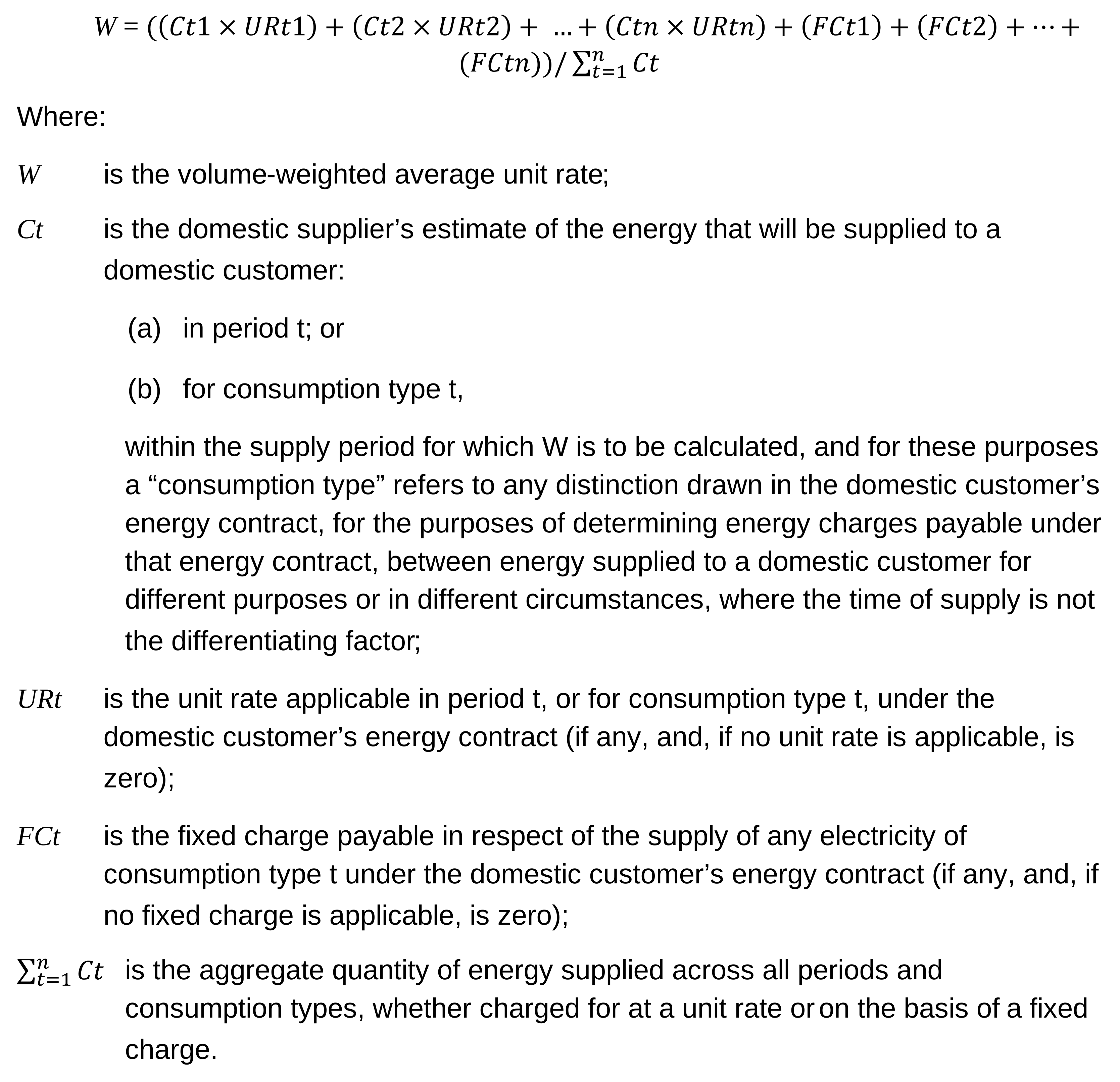
- 5.3 In calculating a volume-weighted average unit rate, a domestic supplier may determine the unit rate applicable in respect of energy supplied during certain periods within a given supply period by reference to data about the quantities of energy supplied to a domestic customer in an equivalent period within a previous supply period, provided that:
- (a) such determination is made on the basis of the best evidence available to the domestic supplier; and
- (b) the charges payable by a domestic customer to whom the energy supplied in a supply period matches the pattern of supply on the basis of which such unit rates have been determined would be reduced by the same amount, in aggregate, as the charges payable by a domestic customer who receives an RO costs tariff reduction or ECO costs tariff reduction in respect of the supply of the same aggregate quantity of energy within that supply period, but whose domestic supplier applies the methodology described in paragraph 7 or 14, as the case may be.
Part B: RO costs tariff reductions
6. Core obligations of domestic electricity suppliers
- 6.1 Subject to paragraph 9, a domestic electricity supplier must give each of its domestic electricity customers an RO costs tariff reduction, with effect from 1 April 2026, until the end of the scheme period.
- 6.2 In respect of each of its relevant 28AD electricity customers, a domestic electricity supplier gives an RO costs tariff reduction by complying with Condition 28AD of the ESLCs.
- 6.3 In respect of each of its domestic electricity customers under whose energy contract:
- (a) a paragraph 4 tariff within the case specified paragraph 4.2 applies, a domestic electricity supplier gives an RO costs tariff reduction by complying with paragraph 6.5;
- (b) a paragraph 4 tariff within the case specified paragraph 4.3 applies, a domestic
electricity supplier gives an RO costs tariff reduction by the operation of the
mechanism described in paragraph 4.3(b).
- 6.4 In respect of each of its other domestic electricity customers, except those in respect of whose energy contracts paragraph 9 applies, a domestic electricity supplier must give an RO costs tariff reduction by following:
- (a) the methodology described in paragraph 7; or
- (b) the methodology described in paragraph 8.
- 6.5 A domestic electricity supplier must not make, and must ensure that none of its affiliates makes, a charge to any of its domestic customers, any Non-Domestic Customer, or any other person, the economic effect of which would be that the domestic electricity supplier would recover, otherwise than in the form of an RO costs payment, any of the value of an RO costs tariff reduction that the domestic electricity supplier is required to give to the domestic electricity customer.
7. Applying the standard volumetric discount
- 7.1 A domestic electricity supplier follows the methodology described in this paragraph 7 where:
- (a) it applies the standard RO volumetric discount to a unit rate chargeable under a domestic electricity customer’s electricity contract in respect of a supply period, to produce a “discounted rate” expressed in p/kWh to two decimal places; and
- (b) it calculates, or re-calculates, the electricity charges payable by that customer in respect of the electricity supplied in that supply period using the discounted rate.
- 7.2 The “standard RO volumetric discount” means the discount, in p/kWh, that is notified to domestic electricity suppliers, and published on gov.uk for the purposes of this Direction, as such, having been calculated in accordance with the following formula:
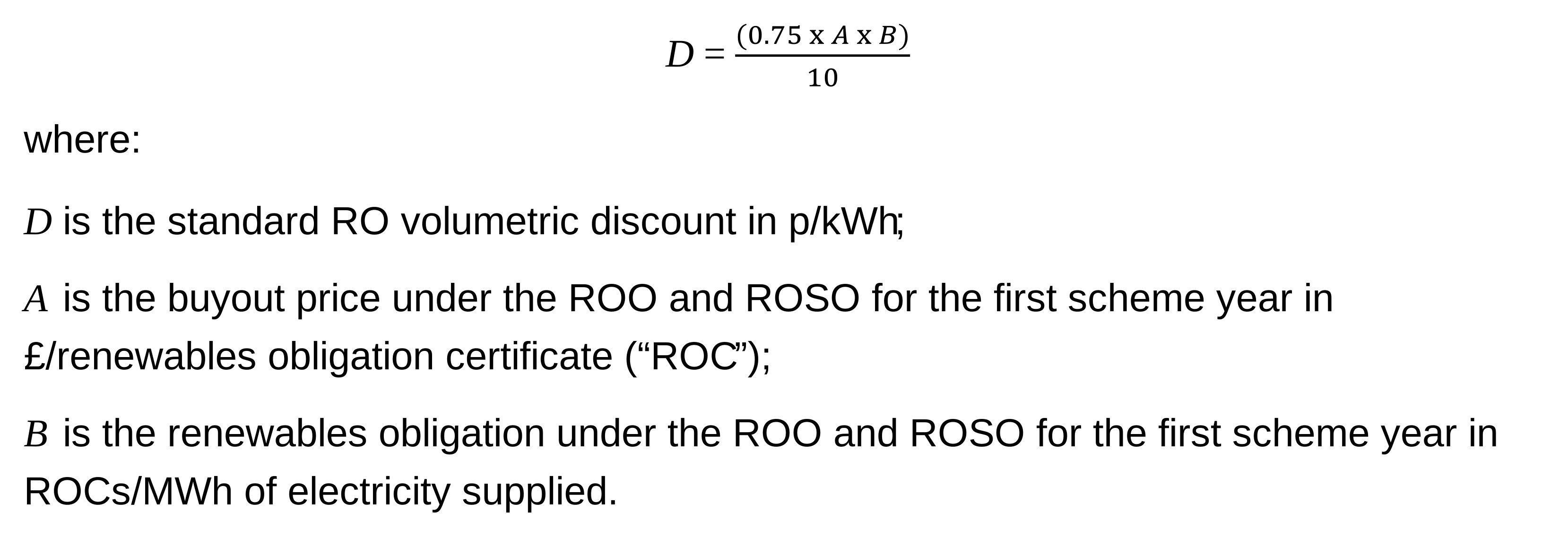
8. Applying the standard RO volumetric discount to volume-weighted average unit rates
- A domestic electricity supplier applies the methodology described in this paragraph 8 where:
- (a) in respect of energy supplied during a given supply period, two or more unit rates are chargeable under a domestic electricity customer’s electricity contract for the purposes of calculating the customer’s electricity charges in respect of a supply period, as described in paragraph 5.1(a)(ii) or 5.1(b)(ii); and
- (b) the domestic electricity supplier:
- (i) calculates a volume-weighted average unit rate for the supply period from those unit rates;
- (ii) applies the standard RO volumetric discount to that volume-weighted average unit rate, to produce a “discounted volume-weighted average unit rate”, expressed in p/kWh to two decimal places; and
- (iii) calculates, or re-calculates, the electricity charges payable by that customer in respect of the electricity supplied in that supply period using the discounted volume-weighted average unit rate.
9. Disapplication of RO costs tariff reduction obligation in exceptional cases
- 9.1 This paragraph applies in respect of an energy contract where the following conditions are satisfied:
- (a) but for the application of this paragraph, paragraph 6.4 would apply;
- (b) the domestic electricity supplier that is a party to the energy contract:
- (i) reasonably considers that it is not practicable to follow the methodology described in paragraph 7 or the methodology described in paragraph 8 in respect of it;
- (ii) notifies the Secretary of State to that effect before 1 April 2026, providing a copy of the terms of that energy contract; and
- (c) the Secretary of State:
- (i) determines:
- (A) that it is appropriate for the domestic electricity supplier not to give the domestic electricity customer that is a party to the energy contract an RO costs tariff reduction; and
- (B) that such an outcome is not inconsistent with the relevant Budget 2025 policy as it relates to the RO costs scheme; and
- (ii) notifies the domestic electricity supplier to that effect.
- (i) determines:
- 9.2 Where this paragraph applies, the domestic electricity supplier must, if the Secretary of State by notice requires, provide the Secretary of State with documents or information relating to the operation of the energy contract as specified in the notice.
Part C: RO costs payments
10. Making of RO costs payments
- 10.1 Subject to the necessary authorisations, the Secretary of State will make an RO costs payment, into each domestic electricity supplier’s qualifying bank account, of a sum equivalent to 75% of the domestic electricity supplier’s assumed RO costs:
- (a) in respect of April 2026 no later than 24 April 2026;
- (b) in respect of each scheme month from May 2026, no later than 5 (five) working days after the first day of that month.
- 10.2 A domestic electricity supplier’s assumed RO costs in respect of a scheme month will be calculated by the Secretary of State using the formula:
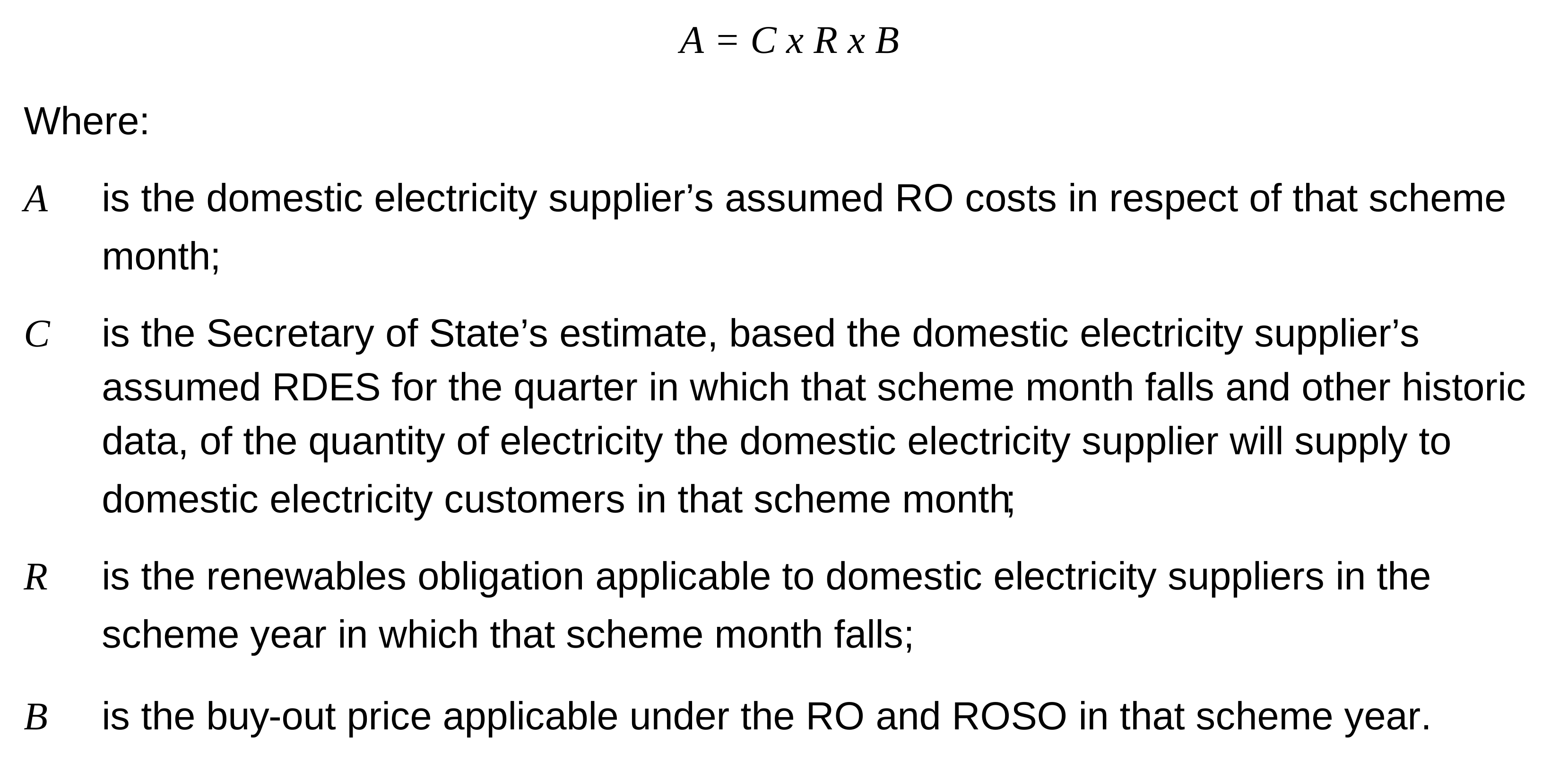
- 10.3 The amount of each RO costs payment to be made to a domestic electricity supplier, being its assumed RO costs for the scheme month to which the payment relates multiplied by 0.75, will be communicated to the domestic electricity supplier to which it is to be made in a grant determination letter sent to the domestic electricity supplier no later than two (2) working days before the date by which the RO costs payment must be made under paragraph 10.1.
- 10.4 A domestic electricity supplier has no entitlement to receive an RO costs payment if it has materially failed to comply with any of its scheme obligations.
- 10.5 If, by virtue of paragraph 10.4 or for any other reason, the Secretary of State intends, in respect of a scheme month:
- (a) to make no RO costs payment to a domestic electricity supplier; or
- (b) to make an RO costs payment to a domestic electricity supplier that is smaller than the amount set out in respect of that scheme month in the grant determination letter most recently sent to the domestic electricity supplier in respect of that scheme month, the Secretary of State will notify the domestic electricity supplier of that intention, and the reasons for it, in a revised grant determination letter, as soon as is reasonably practicable.
11. Overpayments and underpayments
- 11.1 For the purposes of this paragraph 11:
- (a) an “overpayment” occurs if an RO costs payment made to a domestic electricity supplier exceeds the amount set out in the most recent grant determination letter that the domestic electricity supplier has received in respect of the scheme month to which the RO costs payment relates;
- (b) an “underpayment” occurs if an RO costs payment made to a domestic electricity
supplier falls short of the amount set out in the most recent grant determination letter
that the domestic electricity supplier has received in respect of the scheme month to
which the RO costs payment relates.
- 11.2 If:
- (a) a domestic electricity supplier becomes aware that an overpayment or underpayment has occurred in respect of one of its RO costs payments, it must give notice of its occurrence to the Secretary of State;
- (b) the Secretary of State becomes aware that an overpayment or underpayment has occurred, they must give notice of its occurrence to the domestic electricity supplier to which the RO costs payment in respect of which the overpayment or underpayment occurred was made.
- 11.3 If the Secretary of State receives notice under paragraph 11.2(a), or otherwise becomes aware (including as a result of any audit activity) of:
- (a) an overpayment, the Secretary of State must, within seven (7) working days, give the domestic electricity supplier to which the overpayment has been made notice that its next RO costs payment, or another RO costs payment specified in the notice, will be reduced by the amount of the overpayment, attaching a revised grant determination letter to that effect in respect of the scheme month in respect of which the reduced RO costs payment will be made, and reduce that payment by that amount, unless, and to the extent that, the Secretary of State:
- (i) disagrees that there has been an overpayment and notifies the domestic electricity supplier of the reason for its disagreement; or
- (ii) determines, in the Secretary of State’s sole discretion, that the amount of the overpayment should be repaid by the domestic electricity supplier, and requires the domestic electricity supplier by notice to do so;
- (b) an underpayment, the Secretary of State must, within seven (7) working days, give
the domestic electricity supplier to which the underpayment has been made notice
that its next RO costs payment or another RO costs payment specified in the notice,
will be increased by the amount of the underpayment, attaching a revised grant
determination letter to that effect in respect of the scheme month in respect of which
the increased RO costs payment will be made, and increase that payment by that
amount, unless, and to the extent that, the Secretary of State:
- (i) disagrees that there has been an underpayment; or
- (ii) determines, in the Secretary of State’s sole discretion, that the amount of the underpayment should be paid to the domestic electricity supplier more quickly and pays the domestic electricity supplier that amount within 7 (seven) working days of so determining,
- provided that, except as provided in paragraph 11.4, the amount of such increase or decrease, or payment paragraph 11.3(a)(ii) or 11.3(b)(ii) is to be the exact value of the overpayment or underpayment, and is not to be adjusted in any way, by the payment of interest, to reflect the fact that the scheme month in which it takes effect falls in a different scheme year (and thus in a different compliance year for the purposes of the ROO and ROSO), or otherwise.
- (a) an overpayment, the Secretary of State must, within seven (7) working days, give the domestic electricity supplier to which the overpayment has been made notice that its next RO costs payment, or another RO costs payment specified in the notice, will be reduced by the amount of the overpayment, attaching a revised grant determination letter to that effect in respect of the scheme month in respect of which the reduced RO costs payment will be made, and reduce that payment by that amount, unless, and to the extent that, the Secretary of State:
- 11.4 If a domestic electricity supplier:
- (a) receives an overpayment; and
- (b) is notified by the Secretary of State that it is required to repay the amount of that
overpayment or any portion of it specified in the Secretary of State’s notice,
the domestic electricity supplier must repay that amount or the specified portion of it to the Secretary of State within 7 (seven) working days.
- 11.5 Interest is payable on any amount that a domestic electricity supplier is required to repay and does not repay as and when required, and the Secretary of State may deduct the amount of such interest from the next RO costs payment made to the domestic electricity supplier.
- 11.6 For the purposes of paragraph 11.5, interest is to be calculated on a daily basis at the rate of the Retail Prices All Items Index published by the Office for National Statistics in the scheme month in respect of which the overpayment was made, provided that if that index is negative in respect of that scheme month, the applicable rate of interest is 0% (zero per cent).
12. Reconciliation
- 12.1 In this paragraph 12:
- (a) the “actual RDES” for a quarter means the amount of electricity that a domestic electricity supplier supplies to domestic electricity customers in that quarter;
- (b) a “negative discrepancy” arises where the actual RDES of a domestic electricity supplier for a given quarter is smaller than the assumed RDES;
- (c) a “positive discrepancy” arises where the actual RDES of a domestic electricity supplier for a given quarter is larger than the assumed RDES;
- (d) references to one quarter “preceding” or “following” another are to the quarter
immediately preceding or following that quarter.
- 12.2 Within five (5) working days of the Authority notifying a domestic electricity supplier’s actual RDES for a given quarter to the Secretary of State, the Secretary of State will notify the domestic electricity supplier, in a grant determination letter:
- (a) whether there is a positive discrepancy or a negative discrepancy in respect of that quarter, and
- (b) what adjustments are to be made to future RO costs payments, or what other payments are to be made, in consequence of that positive discrepancy or negative discrepancy.
- 12.3 If there is a positive or negative discrepancy in respect of the quarter preceding a given quarter Q:
- (a) the Secretary of State will increase or decrease the amount of the RO costs payments that are to be made in respect of those scheme months in quarter Q in respect of which an RO costs payment has not yet been made, in comparison to what they would otherwise have been based on the assumed RDES for that quarter, by an amount that, in aggregate, equals the amount of that positive or negative discrepancy, so as to ensure that, by the end of quarter Q, taking account of that increase or decrease and the RO costs payments already received in respect of the quarter preceding quarter Q, the domestic electricity supplier will have received RO costs payments that reflect its actual RDES for the quarter preceding quarter Q; or
- (b) if no further RO costs payments would otherwise be made (because the end of the
scheme period has been reached or for any other reason), the Secretary of State will:
- (i) in the case of a positive discrepancy, pay the amount of the positive discrepancy to the domestic electricity supplier;
- (ii) in the case of a negative discrepancy, send the domestic electricity supplier a
notice requiring it to pay the amount of the negative discrepancy to the Secretary of State by a date specified in the notice.
- 12.4 The obligations of a domestic electricity supplier in respect of its domestic electricity customers are unaffected by the operation of this paragraph 12.
Part D: ECO costs tariff reductions
13. Core obligations of ECO suppliers
- 13.1 An ECO supplier must give each of its domestic customers an ECO costs tariff reduction with effect from 1 April 2026.
- 13.2 In respect of each of its relevant 28AD customers, an ECO supplier gives an ECO costs tariff reduction by complying with Condition 28AD of the ESLCs or Condition 28AD of the GSLCs as the case may be.
- 13.3 In respect of each of its domestic customers under whose energy contract a paragraph 4 tariff within the case specified in paragraph 4.2 applies, an ECO supplier gives an ECO costs tariff reduction by virtue of the application of that tariff.
- 13.4 In respect of each of its domestic customers under whose energy contract a paragraph 4 tariff within the case specified in paragraph 4.3 applies, an ECO supplier gives an ECO costs tariff reduction by the operation of the mechanism described in paragraph 4.3(b).
- 13.5 In respect of each of its other domestic customers, an ECO supplier must give an ECO costs tariff reduction by following:
- (a) the methodology described in paragraph 14;
- (b) the methodology described in paragraph 15; or
- (c) the methodology described in paragraph 16.
14. Applying the standard ECO volumetric discount methodology
- 14.1 An ECO supplier follows the methodology described in this paragraph 14 where:
- (a) it applies the standard ECO volumetric discount to a unit rate chargeable under a domestic customer’s energy contract in respect of a supply period, to produce a “discounted rate” expressed in p/kWh to two decimal places; and
- (b) it calculates, or re-calculates, the energy charges payable by that customer in respect of the energy supplied in that supply period using the discounted rate.
- 14.2 For the purposes of this paragraph 14, the standard ECO volumetric discount is:
- (a) 0.89 p/kWh in respect of electricity;
- (b) 0.31 p/kWh in respect of gas.
15. Applying the standard ECO volumetric discount to volume-weighted average unit rates
- An ECO supplier applies the methodology described in this paragraph 15 where:
- (a) in respect of energy it supplies during a given supply period, two or more unit rates are chargeable under a domestic customer’s energy contract for the purposes of calculating the customer’s energy charges in respect of a supply period, as described in paragraph 5.1(a)(ii) or 5.1(b)(ii); and
- (b) the domestic supplier:
- (i) calculates a volume-weighted average unit rate for the supply period from those unit rates;
- (ii) applies the standard ECO volumetric discount to that volume-weighted average unit rate, to produce a “discounted volume-weighted average unit rate”, expressed in p/kWh to two decimal places; and
- (iii) calculates, or re-calculates, the energy charges payable by that customer in respect of the energy supplied in that supply period using the discounted volume-weighted average unit rate.
16. Alternative ECO discount methodology
- 16.1 An ECO supplier may follow the methodology described in this paragraph 16 where:
- (a) the energy charges payable by a domestic customer under its energy contract are not, or cannot accurately be, calculated based on a unit rate;
- (b) in determining the charges that would, apart from this Direction, be payable by a domestic customer in a supply period, the ECO supplier has included a value, including any element or proportion of a unit rate, by which it intended to recover relevant ECO costs (a “relevant value”); and
- (c) the conditions in paragraph 16.3 are satisfied.
- 16.2 An ECO supplier follows the methodology described in this paragraph 16 where the ECO supplier determines and applies a discount or other modification to the charges payable by a domestic customer that causes the energy charges payable to the ECO supplier by that domestic customer to be reduced by the relevant value.
- 16.3 The conditions are:
- (a) that the ECO supplier provides the Secretary of State with such documents and information as they may by notice require in relation to:
- (i) how the relevant value was calculated; and
- (ii) when it was included in the charges payable by domestic customers or the ECO supplier’s calculation or modelling of its costs of supplying energy;
- (b) that the Secretary of State, having reviewed the information provided by the ECO
supplier, gives the ECO supplier notice that they are satisfied that:
- (i) the relevant value has been appropriately calculated; and
- (ii) the application of the discount or other modification determined by the ECO supplier under paragraph 16.2 is an appropriate methodology by which to comply with paragraph 13.1.
- (a) that the ECO supplier provides the Secretary of State with such documents and information as they may by notice require in relation to:
Part E: Further obligations of domestic suppliers
17. Execution of energy discounts deed etc
- 17.1 A domestic electricity supplier must on or before the relevant date:
- (a) complete and execute a copy of the template deed, and
- (b) send it to the Secretary of State,
- and for the purposes of this paragraph 17.1, the “relevant date” is 25 March 2026, or, in the case of a person who was not a domestic electricity supplier on that date, the date that is 2 (two) working days after the date on which that person is granted an electricity supply licence.
- 17.2 A domestic electricity supplier must enter into such further agreements in connection with this Direction as the Secretary of State may from time to time require.
18. Designated officer
- 18.1 A domestic supplier must ensure that at all times during the scheme period:
- (a) a member of its board of directors, to whom specific responsibilities for financial
matters, or the domestic supplier’s compliance with its obligations under its electricity
supply licence or gas supply licence, have been delegated, is appointed to be:
- (i) the officer of the domestic supplier principally responsible for ensuring that the domestic supplier complies with the domestic supplier’s scheme obligations, and
- (ii) the Secretary of State’s and the Authority’s primary point of contact in respect of all matters relating to the domestic supplier’s scheme obligations;
- (b) any person appointed to the functions set out in sub-paragraph (a):
- (i) is fully aware of the domestic supplier’s scheme obligations and the responsibilities conferred on them under that sub-paragraph; and
- (ii) ensures that persons to whom they delegate a matter relating to compliance with those obligations are also fully aware of those obligations and
responsibilities.
- (a) a member of its board of directors, to whom specific responsibilities for financial
matters, or the domestic supplier’s compliance with its obligations under its electricity
supply licence or gas supply licence, have been delegated, is appointed to be:
- 18.2 The person appointed from time to time under paragraph 18.1(a) by a domestic supplier is referred to in this Direction as the domestic supplier’s “designated officer”.
- 18.3 A domestic supplier may appoint a replacement designated officer at any time.
- 18.4 When appointing its first designated officer or any replacement designated officer, a domestic supplier must send to the Secretary of State the name, position and contact details of:
- (a) the individual it is appointing as designated officer, including their business postal and email addresses and telephone contact details, including at least one mobile phone number; and
- (b) another individual who holds a senior executive role within the domestic supplier’s business to act as an alternative point of contact when the designated officer is not available or is not able to be contacted.
- 18.5 A domestic supplier must:
- (a) send details as set out in paragraph 18.4 in respect of its first designated officer to the Secretary of State on or before 25 March 2026;
- (b) whenever it appoints a replacement designated officer, notify their appointment and contact details as set out in paragraph 18.4 to the Secretary of State no later than the next working day after the appointment takes effect.
19. Qualifying bank accounts
- 19.1 Throughout the scheme period, and until such date after 31 March 2029 as the Secretary of State by notice to a domestic electricity supplier appoints for its obligations under this paragraph 19.1 to cease, a domestic electricity supplier must hold and maintain, as its “qualifying bank account” for the purposes of receiving RO costs payments, a bank account with a bank incorporated or authorised in the United Kingdom:
- (a) which is open and active; and
- (b) in respect of which the domestic electricity supplier has given the Secretary of State notice:
- (i) of the name, number and sort code of the account;
- (ii) that it is, or, in the case of a change in qualifying bank account, will be, from a date specified in the notice, the domestic electricity supplier’s qualifying bank account; and
- (iii) whether it is an RO Credit Cover Trust Account.
- 19.2 If, and to the extent that:
- (a) a domestic electricity supplier does not, for the purposes of compliance with Condition 30 of the ESLCs, protect its RO Credit Cover Amount by means of cash deposited in an RO Credit Cover Trust Account; and
- (b) the Secretary of State gives the domestic electricity supplier a notice requiring it to do so by a date specified in the notice, and to use its RO Credit Cover Trust Account as its qualifying bank account for the purposes of this Direction,
- the domestic supplier must comply with the requirements of that notice.
- 19.3 A domestic electricity supplier must provide to the Secretary of State, if the Secretary of State gives the domestic electricity supplier notice to do so, such information relating to its qualifying bank account as the Secretary of State may from time to time by notice require it to provide.
- 19.4 A domestic electricity supplier must not, without the prior written consent of the Secretary of State, close a qualifying bank account before 31 March 2029, or such later date as the Secretary of State may appoint by notice to the domestic electricity supplier under paragraph 19.1.
20. Communication of reduction in bills to domestic customers
- 20.1 A domestic supplier must ensure that it communicates to each person who is its domestic customer on 1 April 2026, no later than the date when a customer receives their first bill or statement for energy used after 1 April 2026, the following message: “your energy bill [has been / will be] discounted from the 1st of April 2026 following action taken by the UK Government in the 2025 Budget. You can find more information at www.gov.uk/government/news/your-energy-bill-from-april-whats-changing.”.
- 20.2 A domestic supplier may comply with paragraph 20.1:
- (a) by using any means of communication by which it is entitled to communicate Relevant Billing Information;
- (b) by using suggested short URLs:
- (i) gov.uk/your-energy-bill for written communications;
- (ii) gov.uk/yourenergybill for spoken communications.
21. Solvency statements
- 21.1 A domestic electricity supplier must send the Secretary of State a completed solvency statement in the form of the template at Annex 2:
- (a) at the same time as it sends the Secretary of State a completed energy discounts deed under paragraph 17;
- (b) on either of the two working days immediately preceding the 25th day of each of March, June, September and December in a scheme year;
- (c) at such other times as the Secretary of State may by notice require it to do so.
- 21.2 A solvency statement completed under paragraph 21.1 must be signed by the designated officer of the domestic electricity supplier to which it relates.
22. Duty of cooperation
- 22.1 Without prejudice to any other obligation imposed on a domestic supplier under this Direction or an energy discounts deed, a domestic supplier must comply with any notice given to it by the Secretary of State requiring it to provide to the Secretary of State specified information or assistance for the purposes of facilitating the carrying out by the Secretary of State of any of their functions under this Direction, or the exercise of any rights of the Secretary of State under an energy discounts deed, relating to that domestic supplier.
- 22.2 The obligation in paragraph 22.1 includes co-operating with any form of due diligence checks carried out by or on behalf of the Secretary of State.
23. Retention of documents, and audit
- 23.1 A domestic supplier must retain all invoices, receipts, accounting records or other
documentation (including internal and external correspondence) relating to:
- (a) the domestic supplier’s compliance with paragraph 6 or 13;
- (b) RO costs payments;
- (c) its relevant RO costs; and
- (d) if it is an ECO supplier, its relevant ECO costs, during the scheme period and for a period of 7 (seven) years after it ends.
- 23.2 The Secretary of State may, at any time during the scheme period or up to 7 (seven) years after it ends, give a domestic supplier notice requiring it:
- (a) to enable the Secretary of State, or a person named in the notice and appointed by the Secretary of State, to audit the books, records, systems and processes of a domestic supplier, in order to:
- (i) ascertain whether the domestic supplier is complying or has complied with its scheme obligations;
- (ii) ascertain whether any amount is payable by the domestic supplier to the Secretary of State under this Direction or an energy discounts deed;
- (iii) otherwise ensure the proper accounting for, tracing or control of public money under the RO costs scheme;
- (b) to provide to the Secretary of State, or a person named in the notice and appointed by the Secretary of State, free of charge, such information or copies of documents as are specified, for any purpose within paragraph (a), by the date specified in the notice.
- (a) to enable the Secretary of State, or a person named in the notice and appointed by the Secretary of State, to audit the books, records, systems and processes of a domestic supplier, in order to:
- 23.3 For the purposes of paragraph 23.2, a domestic supplier must:
- (a) provide the Secretary of State, or a person named in a notice under paragraph 23.2 and appointed by the Secretary of State, with:
- (i) any information or document that falls into a category of information or documents listed in paragraph 23.4 that they require;
- (ii) all reasonable assistance and co-operation in relation to that information or document, including any explanation relating to it, that they require; and
- (iii) such other assistance as they require in connection with any audit or assurance process carried out to ensure that public money paid to domestic electricity suppliers under the RO costs scheme is used for its intended purpose;
- (b) allow any person authorised or appointed by the Secretary of State reasonable access, with or without notice, to its employees, agents, premises, facilities and records, for the purpose of discussing, monitoring and evaluating a domestic supplier’s compliance with its scheme obligations, and provide appropriate oral or written explanations to that person as required; and
- (c) notify the Secretary of State as soon as reasonably practicable of any actual or potential failure to comply with any of its scheme obligations, including those caused by any administrative, financial or managerial difficulty.
- (a) provide the Secretary of State, or a person named in a notice under paragraph 23.2 and appointed by the Secretary of State, with:
- 23.4 The categories of document or information listed are:
- (a) information about any tariff that applies, or that has applied during the scheme period, under an energy contract under which a domestic supplier supplies energy to domestic customers;
- (b) where a domestic electricity supplier follows the methodology described in paragraph 8 or paragraph 15, evidence of how it has followed that methodology;
- (c) data about the energy supplied to individual consumers during particular periods and the charges payable by them in respect of such supply;
- (d) any other Information which the domestic supplier could be required to provide to the Authority under Condition 5 of the ESLCs or GSLCs.
24. Financial management and prevention of bribery, corruption, fraud or other irregularity
- 24.1 A domestic supplier must at all times, and in particular in relation to the performance of its scheme obligations, comply with all applicable enactments and rules of law relating to anti-bribery and anti-corruption and fraud, including the Bribery Act 2010 and the Economic Crime and Corporate Transparency Act 2023.
- 24.2 A domestic supplier must:
- (a) have a sound administration and audit process, including internal financial controls to safeguard against fraud, theft, money laundering, financing of terrorism, or any other impropriety or mismanagement, in connection with the administration of the RO costs scheme, including in particular RO costs payments, and the ECO costs scheme; and
- (b) require that its internal and external auditors report on the adequacy or otherwise of that system.
- 24.3 As soon as reasonably practicable after a domestic electricity supplier identifies evidence:
- (a) that there has been fraud, or that theft has occurred or is occurring in relation to the administration of RO costs payments; or
- (b) that would cause a reasonable domestic electricity supplier to suspect that such fraud or theft may have occurred or be occurring,
- the domestic electricity supplier must notify that evidence to the Secretary of State and explain to the Secretary of State the steps it is taking to investigate the irregularity.
- 24.4 A domestic electricity supplier must keep the Secretary of State informed about the progress of any investigation into actual or suspected fraud or theft notified under paragraph 24.3.
- 24.5 On being notified under paragraph 24.3, the Secretary of State may by notice to the domestic electricity supplier require the domestic electricity supplier to refer the matter to external auditors or another third party as the Secretary of State considers appropriate.
- 24.6 The Secretary of State may, by notice to a domestic supplier:
- (a) require the domestic supplier to take the action specified in the notice to address; or
- (b) suspend the making of RO costs payments to the domestic supplier in consequence of, any actual or suspected fraud, theft, tax evasion or aggressive tax avoidance in the opinion of the Commissioners for Revenue and Customs, or other financial irregularity that the notice specifies that the domestic supplier has engaged in.
- 24.7 For the purposes of this paragraph 24:
- (a) “financial irregularity” includes potential fraud or other impropriety, mismanagement, or the use of RO costs payments for any purpose that is inconsistent with a domestic supplier’s scheme obligations; and
- (b) a designated officer or any other director, officer, employee or contractor of a domestic supplier may be required to provide statements and evidence to the Secretary of State or an appropriate third party in the course of:
- (i) any investigation into the domestic supplier’s compliance with its scheme obligations; or
- (ii) the taking of any enforcement action, including criminal or civil proceedings, arising from the breach or suspected breach of such obligations.
- 24.8 A domestic supplier must have and keep in place adequate procedures to manage and monitor any actual or perceived bias or conflicts of interest with any of its scheme obligations.
Part F: Supplementary
25. Guidance
When publishing or otherwise providing guidance to domestic suppliers in connection with the RO costs scheme or the ECO costs scheme, the Secretary of State may include guidance on the form and manner in which information is to be communicated, statements made, or notices given for the purposes of this Direction.
26. Notices and electronic communications
- 26.1 A domestic supplier must comply with any instruction given to it by the Secretary of State in a notice under this Direction.
- 26.2 Any reference in this Direction to:
- (a) the making of any notification, statement or request, the giving of any notice, certificate or approval; or
- (b) the provision of any information or plan by or to any person,
is to such notification, statement or request being made, such notice, certificate or approval being given, or such information or plan being provided, in writing.
- 26.3 Subject to paragraph 26.4, any communication of a kind referred to in paragraph 26.2(a) or (b) may be sent by email, including in an attachment to an email, or uploaded to an online portal (in either case being an “electronic communication”).
- 26.4 An electronic communication:
- (a) from a domestic supplier to the Secretary of State must be sent to such email address or uploaded to such online portal as the Secretary of State has published or notified to domestic suppliers as the address or portal to be used in relation to such communications generally or in relation to communications of a particular class to which that electronic communication belongs;
- (b) from the Secretary of State to the domestic supplier will be sent to the email address provided by the domestic supplier for its designated officer under paragraph 18 unless the domestic supplier has indicated that a different email address should be used either generally or for communications of a particular class to which that electronic communication belongs.
Signed by the Secretary of State for Energy Security and Net Zero
Secretary of State for Energy Security and Net Zero, Department for Energy Security and Net Zero
18 March 2026
Annex 1: Template form of energy discounts deed
RO costs scheme: Deed of Grant to Supplier
- Dated [insert date] 2026 [DESNZ to complete when seal is affixed]
-
Between
- (1) The Secretary of State for Energy Security and Net Zero, whose principal address is at 3-8 Whitehall Place, London SW1A 2AW (the “Secretary of State”), and
- (2) [name of Supplier] [Limited]/plc] [Supplier to insert and delete as appropriate], a company incorporated in [England and Wales]/[Scotland] [Supplier to insert and delete as appropriate] (registered number [ ]) [Supplier to insert company number] whose registered office is at [ ] [Supplier to insert registered office address] (the “Supplier”).
1. Introduction
- 1.1 This Deed is entered into by the Supplier under paragraph 17.1 of the Costs Schemes Direction (the “Direction”) and by the Secretary of State in furtherance of the policy of HM Government set out in the relevant Budget 2025 policy as it relates to the RO costs scheme.
- 1.2 The Supplier is a domestic electricity supplier as defined in the Direction.
- 1.3 This Deed supplements the Direction in so far as it relates to the RO costs scheme and sets out or incorporates the terms on which the Secretary of State of State will make RO costs payments to the Supplier.
- 1.4 This Deed may only be amended with the written agreement of the Secretary of State.
2. Definitions and interpretation
- 2.1 Except where otherwise provided in this Deed:
- (a) expressions used in this Deed which are also defined in the Direction have the same meanings as in the Direction;
- (b) the rules of interpretation set out in paragraph 3 of the Direction apply in the construction of this Deed as if references in those paragraphs to the Direction were references to this Deed.
- 2.2 Paragraphs 25 and 26 of the Direction apply in relation to this Deed as if references in those paragraphs to the Direction were references to this Deed.
- 2.3 References to the Supplier’s scheme obligations in this Deed are references to its scheme obligations in so far as they relate to the RO costs scheme.
3. Supplier to comply with Direction
- By executing this Deed and returning a copy of it to the Secretary of State, the Supplier agrees:
- (a) to be bound by the terms of this Deed;
- (b) to comply with its scheme obligations, in particular as set out in the Direction,
including in respect of:
- (i) reducing electricity charges;
- (ii) RO costs payments, including in respect of any overpayment made or reconciliation required in respect of them;
- (iii) the avoidance of bribery, fraud, corruption and other financial irregularity;
- (iv) administrative matters, including the appointment of a designated officer, establishment and operation of a qualifying bank account, and the making of solvency statements.
4. Events of Default and clawback
- 4.1 For the purposes of this clause 4, an Event of Default occurs if:
- (a) a condition specified in clause 4.2(a) to 4.2(g) is satisfied; and
- (b) the condition specified in clause 4.2(h) is satisfied.
- 4.2 The conditions are:
- (a) that the Supplier materially fails to comply with a scheme obligation;
- (b) that the Secretary of State reasonably suspects that the Supplier is about to fail to comply with a scheme obligation;
- (c) that information provided by the Supplier in connection with its scheme obligations is materially inaccurate or misleading;
- (d) that the Supplier engages in any bribery, fraud or corruption in connection with the RO costs scheme, or any of its scheme obligations;
- (e) that the Secretary of State determines that the Supplier has:
- (i) acted dishonestly or negligently at any time during the scheme period and/or to the detriment of the Secretary of State;
- (ii) taken any action which unfairly brings or is likely to unfairly bring the Secretary of State’s name or reputation and/or the Secretary of State into disrepute (actions include omissions in this context); or
- (iii) failed to act lawfully, which includes incurring expenditure on unlawful activities;
- (f) that any insolvency event (as defined in the template form of solvency statement at Annex 2 to the Direction) has occurred or is about to occur in relation to the Supplier;
- (g) that a court, tribunal or independent body or Secretary of State of competent jurisdiction requires any RO costs payment to be recovered by reason of the Supplier putting the Secretary of State in breach of its domestic obligations under the Subsidy Control Act or the UK in breach of its international obligations (including under the EU-UK Trade and Cooperation Agreement);
- (h) the Secretary of State, having consulted the Authority, is satisfied that it is that
necessary or expedient to take the action that the Secretary of State proposes to take
under clause 4.3 in order to:
- (i) secure the objectives of the relevant Budget 2025 policy as it relates to the RO costs scheme; or
- (ii) otherwise ensure that the Supplier complies with its scheme obligations,
- having regard, in particular, to the extent to which the Authority may be able to take, under section 25 of the Electricity Act 1989 or otherwise, action that would achieve results identical or similar to those of the Secretary of State’s proposed action.
- 4.3 Where an Event of Default occurs, the Secretary of State will notify the Supplier to that effect in writing, setting out any relevant details, and may by notice:
- (a) suspend or terminate the making, or reduce the amount, of RO costs payments for such period as the Secretary of State shall determine and specify in the notice;
- (b) require the Supplier to repay to the Secretary of State the whole or part of any RO costs payment previously paid to the Supplier, recoverable as a civil debt; or
- (c) give the Supplier an opportunity to remedy the Event of Default, if it is capable of remedy, in accordance with paragraphs 4.4 to 4.10.
- 4.4 If Secretary of State considers that:
- (a) an Event of Default has occurred which is capable of remedy; and
- (b) it is appropriate, having regard to the purposes of taking action under clause 4.3 as set out in clause 4.2(h), not to proceed immediately to taking action under clause 4.3(a) or 4.3(b),
- the Secretary of State will notify the Supplier that it is to be given an opportunity to remedy the Event of Default and require it to produce a draft remedial action plan.
- 4.5 On receiving notification from the Secretary of State under clause 4.4, the Supplier must submit to the Secretary of State a draft remedial action plan for approval within 5 (five) working days.
- 4.6 A draft remedial action plan must set out details of the Event of Default and the steps which the Supplier proposes to take to address it, including:
- (a) how the Supplier will ensure that any reduction in a domestic customer’s energy charges:
- (i) that is required to have been applied in respect of a previous supply period and has not been applied; or
- (ii) that is required to be applied in respect of a future supply period, will be given effect in respect of that customer; and
- (b) the timescales for taking the relevant remedial actions.
- (a) how the Supplier will ensure that any reduction in a domestic customer’s energy charges:
- 4.7 On receiving the draft remedial action plan, the Secretary of State will submit its comments on it to the Supplier as soon as reasonably practicable.
- 4.8 The Secretary of State may approve or reject the draft remedial action plan. If the Secretary of State rejects the draft remedial action plan, the Secretary of State must notify to the supplier the reasons for rejecting it and whether the Supplier is required to submit an amended remedial action plan to the Secretary of State.
- 4.9 If the Secretary of State directs the Supplier to submit an amended draft remedial action plan, the Secretary of State, having consulted the Supplier, will set a timescale for the Supplier to amend the draft remedial action plan to take into account the Secretary of State’s comments.
- 4.10 If the Secretary of State does not approve the draft remedial action plan, or the Supplier fails to carry it out once it has been approved, the Secretary of State may, at their absolute discretion, take action under clause 4.3(a) or 4.3(b).
5. Consequences of Supplier’s non-compliance: remedies cumulative
The Supplier acknowledges that any powers of the Secretary of State to enforce compliance with applicable provisions of the Direction under this Deed are additional to, and may be exercised either in conjunction with or separately from the exercise by the Authority of its powers to enforce against the Supplier for such non-compliance by virtue of section 25 of, and paragraph 6 of Schedule 6A to, the Electricity Act 1989.
6. Counterparts
- 6.1 This Deed may be executed in any number of counterparts. Any party may enter into this Deed by executing any such counterpart, but this Deed is not effective until each party has executed at least one counterpart.
- 6.2 Each counterpart shall constitute an original of this Deed but all counterparts together constitute the same instrument.
7. Entry into force
This Deed has effect once executed by both parties.
8. Audit
- The Supplier agrees:
- (a) that the Secretary of State is entitled to audit compliance by the Supplier with its scheme obligations; and
- (b) to provide all information, documents and other assistance reasonably required to be provided in connection with such audit activity in the Direction.
9. Governing law and disputes
- 9.1 This Deed and any dispute or claim arising out of or in connection with it shall be governed by and construed in accordance with the law of England and Wales.
- 9.2 Without prejudice to any rights of the Secretary of State to enforce the Supplier’s scheme obligations as relevant requirements under the Electricity Act 1989, the courts of England and Wales shall have exclusive jurisdiction over any dispute arising in connection with this Deed or the enforcement by the Secretary of State of any of the Supplier’s scheme obligations.
This document has been executed as a deed and is delivered and takes effect on the date stated at the beginning of it.
THE CORPORATE SEAL OF THE SECRETARY OF STATE FOR ENERGY SECURITY AND NET ZERO is affixed and is authenticated by
An official in the Department for Energy Security and Net Zero
[Supplier to fill in and delete below as applicable]
Executed as a deed by [Supplier]
acting by [NAME OF FIRST DIRECTOR], a director,
[SIGNATURE OF FIRST DIRECTOR]
Director
and
[NAME OF SECOND DIRECTOR/SECRETARY], [a director OR its secretary]
[SIGNATURE OF SECOND DIRECTOR OR SECRETARY]
[Director OR Secretary]
OR
Executed as a deed by [NAME OF Supplier] acting by [NAME OF DIRECTOR], a director
[SIGNATURE OF DIRECTOR]
Director
in the presence of
[SIGNATURE OF WITNESS]
[NAME, ADDRESS AND OCCUPATION OF WITNESS]
Annex 2: Template form of solvency statement
RO costs scheme (the “Scheme”): solvency statement made by [insert domestic electricity supplier’s company name] (the “Company”)
From: [insert name of domestic electricity supplier’s designated officer]
To: The Secretary of State for Energy Security and Net Zero
Dated: [insert date]
I acknowledge that
- the provision of this statement is a requirement of paragraph 21 of the RO scheme costs direction 2026 (the “Direction”), and
- the Secretary of State for Energy Security and Net Zero (the “Secretary of State”) and their officials will rely on this statement in discharging their functions, including the making of payments in respect of the Company’s assumed RO costs, under the RO costs scheme, as provided for in the Direction and the energy discounts deed entered into between the Secretary of State and the Company.
I am the designated officer of the Company under paragraph 18 of the Direction.
I declare that:
- no insolvency event, as defined below, has occurred in respect of the Company, and
- having made reasonable enquiries I am not aware of any circumstances that could reasonably be expected to give rise to such an insolvency event in respect of the Company during the scheme month in which this statement is made or in the next two immediately following scheme months.
- In this statement:
- “insolvency event” means the occurrence of any of the following in relation to the Company:
- (a) the Company is:
- (i) unable or admits inability to pay its debts as they fall due;
- (ii) suspends making payments on any of its debts (or announces an intention to do so); or
- (iii) by reason of actual or anticipated financial difficulties, commences negotiations with one or more of its creditors with a view to rescheduling any of its indebtedness;
- (b) the Company stops carrying on business;
- (c) the value of the assets of the Company is less than its liabilities (taking into account contingent and prospective liabilities) and it does not have access to support (e.g. from a parent) to continue trading for at least the next six months;
- (d) a moratorium has been declared in respect of the Company; or
- (e) any action, legal proceedings or other procedure or step has been taken in relation to the Company with respect to:
- (i) the suspension of payment of debts, a moratorium, winding-up (whether voluntary or compulsory), dissolution, receivership, an energy supply company administration or an administration relating to the Company;
- (ii) a reorganisation, voluntary arrangement, scheme of arrangement, or a restructuring plan relating to the Company (except, in the case of a reorganisation or a scheme of arrangement, on a genuine solvent reorganisation, reconstruction or merger);
- (iii) a composition, compromise, assignment or arrangement with any creditor of the Company;
- (iv) the giving of a Last Resort Supply Direction to any person in relation to the Company;
- (v) the appointment of a liquidator, receiver, supervisor, trustee, monitor, administrative receiver, administrator, compulsory manager or other similar officer or other encumbrancer in respect of the Company or any of its assets;
- (vi) enforcement of any security over any assets of the Company; or
- (vii) the steps identified in paragraphs 43(3) or (4) of Schedule B1 to the Insolvency Act 1986;
- (f) any event occurs which would result in a floating charge crystallising over any of the Company’s assets;
- (g) any step has been taken to take possession of, seize, or levy a distress or execution against any of the Company’s assets;
- (a) the Company is:
- terms used in the Direction have the same meaning when used in this statement.
- “insolvency event” means the occurrence of any of the following in relation to the Company:
This statement and any non-contractual obligations arising out of or in connection with it are governed by the law of England and Wales.
Yours faithfully
[name of designated officer]
For and on behalf of
[name of the Company]