Disability foresight research: UK – final report
Published 30 July 2026

© Crown copyright 2026
This publication is licensed under the terms of the Open Government Licence v3.0 except where otherwise stated. To view this licence, visit nationalarchives.gov.uk/doc/open-government-licence/version/3 or write to the Information Policy Team, The National Archives, Kew, London TW9 4DU, or email: psi@nationalarchives.gov.uk.
Where we have identified any third party copyright information you will need to obtain permission from the copyright holders concerned.
This publication is available at https://www.gov.uk/government/publications/disability-foresight-research-future-trends-for-disabled-people/disability-foresight-research-uk-final-report
Disability Foresight Research: UK
Final Report
Authors: Dr Alessandra Radicati, Charlotte Bowen, Tulika Chakraborty, Yasmin Begum, Duncan Grimes and Dr Jasna Magić
Prepared for: Cabinet Office Disability Unit
March 2026
Executive summary
Disabled people in the UK face multiple intersecting challenges. Being disabled impacts many people’s experiences of access to employment, healthcare, education, and other critical services. In addition, when thinking about the future, disabled people will be impacted differently by structural challenges such as climate change and the rise of artificial intelligence (AI). To better understand how the needs and experiences of disabled people will evolve over the next 5, 10 and 20 years, in January 2025 the Cabinet Office Disability Unit (DU) commissioned the National Centre for Social Research to carry out a programme of foresight research involving 12 disabled people’s organisations (DPOs).
Method and objectives
Foresight research is a method that helps people think about the future. It uses imagined future worlds (speculative examples of what could happen) to help people think beyond existing constraints and discuss solutions to complex challenges.[footnote 1] In this project we used a structured creative world-building exercise to engage stakeholders on 2 future focused questions:
-
What social (including demographic), environmental, economic, and technological trends are likely to impact disabled people in the UK over the next 5, 10, and 20 years?
-
How might these emerging trends generate new challenges and opportunities for disabled people?
To answer these questions, we recruited 12 DPOs to participate in 3 online workshops lasting between 90 and 180 minutes. To inform the design of the workshop we undertook a scoping review of research and policy documents regarding disabled peoples’ needs and experiences, a workshop with policymakers and initial depth interviews with the 12 participating DPOs.
Our structured approach combined both predictive and speculative ways of thinking about the future. Predictive questions asked stakeholders to consider what they believed is most likely to happen based on current trends and conditions. Speculative questions, by contrast, invited stakeholders to imagine future worlds that differed radically from the present, to identify how change could happen. Interviews with DPOs focused on predictive questions to understand stakeholder perceptions about anticipated changes in different policy areas over the next 5, 10 and 20 years.
In the DPO workshops – our core research activity – we explored speculative questions. We used a structured future world-building approach to understand DPOs’ views on hypothetical futures relating to a range of topics. This allowed participants to move away from current day challenges to identify potential enablers of change.
The first workshop built on insights from the interviews to identify the 6 future themes (AI, employment, climate change, welfare, cost of living and social attitudes) we would focus on in the world-building activity. In workshop 2, DPOs were divided into 3 groups and assigned a combination of 2 of these themes (for example, ‘climate change’ and ‘welfare’). Then, through structured exercises, they imagined extreme hypothetical outcomes for each of the themes and built 3 different speculative futures:
- a world with no climate change and high standard of living
- an equitable world with a high cost of living
- an AI-assisted world where disabled people are in full employment
Throughout DPOs were instructed to think creatively and draw on their lived experience to build out these speculative futures, no matter how unlikely they may seem. NatCen then analysed transcripts of the discussions and data generated in the workshops to identify key trends, challenges and enablers for change.
Key findings
The scoping exercise employed a STEEPV[footnote 2] approach to identify trends relevant to disabled people’s lived experiences of the world and how it’s changing. Findings were predominantly negative in nature, with research documents focusing primarily on concerning trends that would require attention to address. At a very high level, headlines from the STEEPV themes are broadly:
- social – the proportion of the UK population that is disabled is set to continue to grow, with implications for public spending, particularly given the continuation of disabled people’s experiences of barriers (environmental, social and attitudinal)
- technological – technological advances have the potential to improve or further exclude disabled people, and currently more engagement with disabled people is thought to be needed to ensure accessibility
- economic – a number of trends were highlighted as likely to disproportionately impact disabled people’s financial situations
- environmental – existing accessibility issues in the built environment were highlighted, as were the negative and disproportionate impacts on disabled people of climate change and climate mitigation policies which are not disability inclusive
- political – barriers to participation were highlighted as persisting
- values – the need for increased representation and acknowledgement of the intersectional and diverse experiences of disabled people
DPOs’ largely positive views of the future diverged from the findings of our scoping review. The evidence sources considered in the scoping review tended to provide a very negative view of trends impacting disabled people across 6 distinct policy domains. The worlds DPOs created were considerably more positive and highlighted opportunities and possibilities not captured in the existing evidence. This contrast highlights how desk research can contextualise the insights and value added by foresight research.
The DPO workshops showed that:
Aspirational futures helped DPOs articulate how they can make change
Most participants envisioned optimistic worlds. One group created a more ‘complex’ world characterised by a mix of positive and negative future circumstances, but no group focussed on a dystopian future. Many DPOs stated that positive future worlds gave them something to work towards, and reflected their belief that they can make meaningful change. This suggests an appetite within the sector for discussing the future in an optimistic way, despite significant present day challenges such as funding for public services, which were mentioned in the workshop.
DPOs envisioned a significant role for government in addressing emerging issues, especially through increased funding and expanded public services
Most DPOs created future worlds in which the government would drive change. Participants felt that the government had an enormous role to play in funding services to support disabled people, enforcing legislation to ensure disabled people’s rights, and involving disabled people in policy-making processes. Participants also felt the government could lead by example and set the tone for inclusion of disabled people across UK society.
DPOs viewed the private sector as an important secondary actor, envisioning significant changes for how companies engage with disabled people
While the government played a key role in most DPOs’ imagined worlds, some participants envisioned a significant role for the private sector as well. This ranged from ideas like increased accountability in the private sector for the effects of climate change, to commercial companies hiring more disabled employees. Participants also noted the role that the private sector could play in innovation of assistive technologies, which they believed could alleviate pressure on state resources.
DPOs highlighted ongoing biases and negative social attitudes against disabled people as important considerations for the present and the future
Across all 3 future worlds, DPOs highlighted discrimination against disabled people as something to tackle through their speculative policies. Many participants noted discrimination against disabled people and exclusionary social attitudes as major challenges that need to be overcome to build a more optimistic future. Some participants expressed concern that current social attitudes were in fact going ‘backwards,’ and becoming more exclusionary than 10 or 20 years ago.
These high-level headlines are a summary of overall findings and observations from the DPO workshops. The subsequent sections detail the larger findings and reflections from the DPO workshops, which led to the identification of the key enablers for change.
Further research and engagement
When given space to creatively consider future worlds, DPOs had many compelling ideas to share. Future foresight research could build on this work in the following ways:
Further engagement with DPOs
It was notable that this research highlighted a major role for government, and a secondary role for the private sector in bringing about change for disabled people, but most participants did not envisage a large role for DPOs or the third sector. Further research with DPOs could use a foresight approach specifically aimed at understanding possible futures for the third sector over the next 5, 10 and 20 years.
Testing specific policy ideas
This research used a structured world-building exercise to understand DPOs views on wide-ranging emerging issues (for example, ‘AI’ or ‘climate change’). Future work could use similarly creative exercises to understand how stakeholders think specific policies might impact disabled communities (for example, government policies to achieve Net Zero, or the use of AI by specific government departments).
Work with other marginalised groups
This research highlighted the benefits of foresight research in helping participants move beyond day-to-day challenges and frustrations. Further use of this method could enhance policymakers’ understanding of the experiences and perspectives of stakeholders working with other groups.
Expanding into new topic areas
The world-building exercise drew on 6 broad topic areas identified through interviews with stakeholders. While this yielded rich insights, some topic areas which were less explored – such as healthcare, education and housing – could form the basis of future foresight research activities with DPOs.
1. Introduction
In January 2025, the Cabinet Office Disability Unit (DU) commissioned the National Centre for Social Research to conduct a foresight research programme to better understand emerging issues for disabled people over the next 5, 10, and 20 years. This report reflects findings from interviews and interactive workshops with 12 stakeholders between May and June 2025. It describes how this engagement was shaped by a scoping review of pre-identified sources, and a policy-maker workshop.
1.1 Background and policy context
Disabled people in the UK face numerous challenges and barriers to full inclusion. A recent evidence review by the Centre for Disability Studies and the University of Leeds and Disability Rights UK highlighted persistent obstacles across 13 policy areas including healthcare, justice, housing and social attitudes. One of the starkest examples is the disability employment gap, the difference in employment rates between disabled and non-disabled people, which remains around 30%.
In this context, DPOs play a critical role. They are often consulted by the government as key stakeholders in efforts to improve the lives of disabled people. Unlike charities or other organisations working on behalf of disabled people, DPOs are led by disabled people themselves: at least 75% of board members and 50% of staff are disabled.
1.2 Research aims and objectives
The findings of this research are intended to equip government and other stakeholders with insights to better anticipate and respond to the evolving needs of disabled people. The research was guided by 2 overarching questions:
-
What social (including demographic), environmental, economic, and technological trends are likely to impact disabled people in the UK over the next 5, 10, and 20 years?
-
How might these emerging trends generate new challenges and opportunities for disabled people?
To address these questions, we undertook a programme of work comprising a scoping review (see Annex B and C), a workshop with policymakers, interviews with 12 DPOs, and a series of 3 workshops with DPO representatives. Details of this approach are set out in the Methods chapter.
Throughout the project, we used the acronym STEEPV to refer to the domains explored: Social, Technological, Economic, Environmental, Political, and Values-based. These STEEPV domains were used to structure the scoping review, interview questions and the selection of themes assigned to stakeholders in the workshops.
1.3 Overview of the foresight approach
Foresight research is a method that explores emerging issues with the understanding that the future is uncertain and current-day realities may change rapidly.[footnote 3] Rather than assuming a single, linear future, foresight encourages preparation for a variety of possible futures.
Our approach combined both predictive and speculative ways of thinking about the future. Predictive questions asked stakeholders to consider what they believe is most likely to happen based on current trends and conditions. Speculative questions, by contrast, invited stakeholders to imagine future worlds that differ radically from the present. The purpose of this speculative element was to generate unexpected or novel insights that cannot be reached through traditional, trend-based research alone.
The next chapter provides a detailed explanation of our methodology. Central to the foresight process was a world-building exercise, conducted during workshops 2 and 3. In this exercise, participants constructed future worlds based on a set of pre-assigned themes developed during earlier phases of the research.
1.4 Structure of the report
The report is organised as follows:
Chapter 2 sets out our methodological approach, providing detail on sampling, recruitment, and the foresight exercises used in the workshops.
Chapter 3 presents a snapshot of the 3 future worlds created by participants, outlining the key features of each.
Chapter 4 explores the enablers to change that were identified by stakeholders across these worlds.
Chapter 5 reflects on the methodology and considers avenues for further engagement and research.
The report focuses primarily on the world-building activities, as these generated the richest and most distinctive insights from DPOs, highlighting the value of the foresight approach. Where relevant, we draw on findings from the interviews, scoping review and policy-maker workshop to complement and contextualise the world-building results.
A note on terminology
Throughout, we use the terms ‘participants’, ‘stakeholders’ and ‘DPOs’ interchangeably, as all interview and DPO workshop participants were drawn from DPO stakeholders. We use the term ‘policymakers’ to indicate findings from the policy-maker workshop, and we specify when insights are drawn from the scoping review. To reflect participants’ own language and experiences, we use the term ‘deaf and disabled’ in the report where stakeholders specifically used this phrasing. Elsewhere, we use the term ‘disabled’ as in ‘disabled people’ to reflect participants’ wording and/or as a way of summarising information.
2. Methods
This chapter provides an overview of the world-building activity which formed the basis of the workshops, before explaining the different research phases and the approach to recruitment, sampling and analysis.
2.1 World-building exercise and DPO workshops
At the core of this research were 3 online workshops held with DPOs in June 2025. These workshops engaged DPOs in a world-building exercise which is the primary focus of this report. This exercise enabled groups to collaboratively build future worlds and reflect on what realities disabled people might face in this world. Participants were asked to use their lived experience and professional expertise to identify how different emerging trends may impact disabled people. This approach supported participants to think beyond current day challenges and identify enablers for change.
Workshops lasted between 90 minutes (workshop 1) and 3 hours (workshops 2 and 3). All DPOs but one attended all 3 workshops. Workshops took place online via Zoom. NatCen facilitated large-group discussions in the main room with all 12 participants, and the world-building exercises took place in small breakout rooms of 3 to 4 people. Groups rejoined the main room periodically to share progress and discuss emerging ideas. NatCen facilitators used Miro,[footnote 4] a digital whiteboard tool, to note down participants’ ideas for the world-building exercise. Each workshop had a different focus that built upon the previous one.
Workshop 1: 90 minutes – introduction to the research
This workshop introduced the foresight approach and workshop structure as well as establishing rapport between NatCen and stakeholders. DPOs held open discussions about the main trends and issues impacting disabled people over the next 5, 10 and 20 years,[footnote 5] and how these were distributed across the STEEPV domains. Then in small groups of 3 to 4, participants reflected on their attitudes towards the future and their theories of change, laying the groundwork for the world-building activities in the next workshop.
Workshop 2: 180 minutes – world-building
The purpose of this workshop was for DPOs to build informed speculative worlds. Stakeholders were placed in breakout rooms of 3 to 4 DPOs and asked to spend time building their world using pre-assigned themes, thinking through the features of this hypothetical future and impacts on disabled people. They were also asked to envision a timeline for the world they had created, imagining key events over the next 5,10 and 20 years. Participants were directed to envision extreme outcomes for each of the themes and subsequently create a fictional world based on the intersection of 2 such extreme scenarios.
DPOs were encouraged to prioritise creativity and to use their lived experience to develop these speculative worlds, regardless of their plausibility. This is a core element of foresight research, as creative thinking can help identify underexplored or less well-understood themes. Further information on the world-building exercise and how it was conducted is available in Appendix A. The table below shows the themes each group were assigned and the 3 worlds they created. The parameters for the speculative worlds were informed by the scoping review and areas within the STEEPV domains identified during DPO interviews.
Figure 1. Themes assigned in the world-building exercise
| Themes assigned | Climate change Welfare |
Cost of living Social attitudes |
AI Employment |
| World created | A world with no climate change and high standard of living | An equitable world with a high cost of living | An AI-assisted world where disabled people are in full employment |
Workshop 3: 180 minutes – drivers for change and priorities
The purpose of this workshop was to look more deeply at the main drivers for change across the worlds and assess priorities. Groups were asked to consider the role that different actors (for example, government, private sector, communities) would play in the futures they had created. They were also asked to vote on the world they would most like to create, and to reflect on what could be done to mitigate negative and promote positive outcomes. Throughout the workshop, participants switched between breakout rooms and the main room.
The world-building activities described highlighted a more diverse set of issues and considerations than those that emerged solely through asking predictive questions during the interviews or through the scoping review. One example of this can be seen in the way the groups approached AI. The group focused on AI laid out an extremely positive vision of the future, which contrasts with the more sceptical views of AI expressed in the interviews carried out prior to the workshops. When given the opportunity to reflect in an open-ended manner on a future world defined by AI and work, participants envisioned many surprising and positive possibilities for AI to contribute to the lives of disabled people. This highlights one of the strengths of a foresight approach, which is its ability to move away from current day challenges to identify enablers of change.
2.2 Scoping research activities
The figure below shows how scoping activities fed into the DPO interviews and workshops.
Figure 2. Research stages and associated activities
Scoping phase:
- Evidence review
- Policy-maker workshop
DPO recruitment:
- Developing sample strategy
- Reaching out to stakeholders
DPO interviews:
- Predictive questions
- Deepening understanding of STEEPV areas
DPO workshops:
- Engaging DPOs in dialogue
- World-building exercise
Scoping phase
The scoping phase took place between February and March 2025 and aimed to identify key trends and issues across the STEEPV areas. It included a scoping review and a policy-maker workshop.
Scoping review
The research began with a high-level scoping review of evidence across February and March 2025. This included:
- a high-level review of a systematic review and 8 thematic reports provided by DU
- a high-level review of UK disability statistics
- a high-level review of non-academic research and reports
- a targeted supplementary search for future-orientated UK-based studies that specifically explore emerging issues and priorities for disabled people living in the UK
Further information on the evidence sources considered is available in Appendix B. Key findings from the scoping review mapped against the STEEPV domains are provided in Appendix C. These findings informed our approach to the policy-maker workshop and the DPO interviews as well as foresight design. In workshop 1, we shared the main findings from the scoping review with DPOs and asked for their views on main trends impacting disabled people in the UK. We used feedback to agree priority areas for the world-building exercises and set parameters. For example, the ‘Economic’ domain in the scoping review included mention of the impact of cost of living rises on disabled people. In workshop 1, this was a major topic raised by DPOs. For this reason, we ensured that one of the worlds would engage with the topic of cost of living.
Policy-maker workshop
Following the completion of the scoping review, we held an online workshop with policymakers on 2 April 2025. Building on the trends and themes identified in the review, we conducted a semi-structured 60-minute discussion with 6 representatives from the Department for Education, the Cabinet Office, the Department for Communities (Northern Ireland), and the Department for Work and Pensions, to gather their perspectives on the key issues affecting disabled people in the UK across the STEEPV domains. The workshop did not represent all relevant government departments and was not exhaustive in its coverage of relevant policy areas. However, given that the purpose of the workshop was to provide additional context to policy literature reviewed previously, the workshop findings were still useful for shaping our approach to the DPO workshops.
2.3 Engagement with DPOs
Primary data collection was conducted in May and June 2025 and consisted of 12 interviews followed by the 3 workshops with representatives from DPOs from across the UK described above.
DPO recruitment
We approached 25 DPOs to achieve a sample of 12 participating across interviews and workshops. We used a staged recruitment process combining NatCen and DU networks.
DPOs were invited to opt in to the research and provided with detailed information on their participation, including a participant agreement, remuneration details, and a privacy notice. Participants were asked to commit to all stages of the research and to indicate any accessibility requirements in their agreements. In response, NatCen provided adjustments such as Easy Read slides and BSL interpretation at all research activities.
We purposely sampled DPOs to capture a diverse range of impairment types, geographical locations, organisation sizes and intersectional characteristics, as agreed with DU at the outset of the project. Given the small sample size, and targeted nature of recruitment, these considerations were treated as soft rather than strict quotas. A full overview of the DPOs represented is in Appendix C.
DPO interviews
We interviewed 12 DPOs between 16 May and 6 June 2025. Interviews were conducted remotely, were semi-structured, and lasted approximately 60 minutes. Topic guides were developed based on insights from the scoping phase. The interviews served a dual purpose: they introduced the research in more detail, and they informed the workshop design by highlighting emerging issues and priorities for disabled people over the next 5, 10, and 20 years. Findings from the interviews fed into the workshop design, as outlined below.
2.4 Data analysis
NatCen researchers analysed the data produced by the DPO interviews and workshops. All interviews and workshops were audio recorded and the recordings were saved securely. Interview data was converted into transcripts and then analysed and mapped using Miro, an online whiteboard tool, against the STEEPV categories to assess common trends and themes. We used these as the basis for discussions in workshop 1 and to inform the combinations of themes to be used in the world-building exercise as described above.
Workshop data was recorded on Miro during the workshops themselves, and each workshop breakout room and plenary session was audio recorded. NatCen researchers created transcripts of all workshop data. The data was then inductively coded to assess emerging themes from across the worlds and groups. Inductive coding is an approach where researchers organise the data by assigning each response a code (for example, public services). Then, once all codes have been assigned, researchers review the data within each code and report the key themes that are relevant to the research objectives. Over the course of 2 analysis sessions, the NatCen team consolidated and agreed key themes.
3. Three future worlds
This chapter describes the 3 worlds created by participants, highlighting the key impacts and challenges for disabled people. The future worlds were not based on contemporary constraints or policies and reflect highly speculative potential futures.
DPO stakeholders created 3 distinct future worlds based on pre-assigned themes, themselves informed by the findings of the scoping review examining the STEEPV categories, and the DPO interviews. Some groups created worlds that were aspirational or utopian, highlighting a positive vision of the future, while other groups laid out a more complex vision with tension between positive and negative circumstances.
Groups were encouraged to create the worlds collaboratively, and to focus on possible futures rather than on present-day constraints. As a result, some of the worlds include features which may appear unrealistic in relation to current circumstances. The objective of the exercise was not to focus on the feasibility of the proposed worlds, but rather to surface unanticipated aspects of how various broad themes (for example, ‘climate change’ or ‘AI’) might evolve in their impact on disabled people’s lives. Once these worlds had been developed, stakeholders discussed the factors that enabled change (either positive or negative), which are reported in chapter 4 – enablers to change.
3.1 World 1: Utopian/aspirational – a world with no climate change and high standard of living
In this world, stakeholders imagined a comprehensive benefits system to ensure a high standard of living. Alongside this benefits system. effective regulation of the fossil fuel industry and incentives for green energy reversed the negative impacts of climate change.
A high standard of living is supported through the introduction of a minimum basic income, which ensures that no-one – including disabled people – is living in poverty and gives them greater agency over their lives. Specialist healthcare services are funded through the NHS, contributing to improved well-being.
The reversal of climate change brings additional health benefits, as green energy reduces pollution. Greener initiatives also allow cities to be redesigned in ways that make infrastructure and public transport more accessible and reduce isolation for disabled people. Housing stock in this world is also adapted to be more accessible – further enhancing independence, agency, and control over daily life, while reducing reliance on care staff.
3.2 World 2: Moderate/complex – an equitable world with a high cost of living
In this world, greater representation of disabled people in influential and decision-making roles has driven legislative reform, creating a more equitable society despite a worsening cost-of-living crisis. As such, this world considered the change needed to ensure that disabled people were not disproportionately impacted when wider social issues (in this case economic hardships) arose rather than how to avoid the issue itself arising.
In this imagined future world, financial hardship, marked by job cuts, stagnant wages, fuel poverty, food insecurity, and choices between heating and eating, does not disproportionately affect disabled people. Positive social attitudes fostered through mandated education about disability-related issues from early childhood to employment help protect disabled people. In addition, legislation guarantees access to support (such as financial support, personalised assistance, support groups, home adaptations) that ensures people are not disabled by their environment. Disabled children have access to educational provisions, providing equal life chances and enabling fair competition.
In this world, a tension emerges between achieving equity through strong, centralised legislation and the risk of authoritarianism. To address this, the government actively involves and empowers disabled people as citizens, ensuring they can meaningfully inform decision-making locally and nationally.
3.3. World 3: Optimistic/tech-driven – an AI-assisted world where disabled people are in full employment
In this world, stakeholders envisioned a well-regulated AI system supporting more disabled people into work, increasing their inclusion and societal value. Central government (participants highlighted the Department of Work and Pensions) funded AI and led by example in its own operations. A greater number of disabled people employed within DWP are well placed to assist and support others into the workforce.
Access to Work (ATW) is well funded and designed to meet individual needs, fully addressing the requirements for deaf and disabled people. It is bespoke, tailored, and capable of fully addressing each person’s requirements. AI streamlines recruitment processes by managing applications, filtering candidates and screening applicants, creating a more positive experience for disabled jobseekers. Unlike contemporary AI which may be based on algorithms that can be biased negatively towards deaf and disabled people, in this world, AI corrects human bias and supports people from marginalised groups. Societal attitudes improve, as ATW demonstrates clear benefits showing that deaf and disabled people contribute to the economy rather than draw from it, increasing public support for the system.
4. Enablers to change
This chapter highlights the main factors that enabled change across the 3 future worlds. Drawing on transcript data it describes the roles that government, private sector and wider society have in bringing about the futures that stakeholders imagined.
Across all 3 groups, participants created future worlds in which the government had a significant role in driving change through funding and legislation, and the private sector through innovation and employment. This was notable given that the stakeholders themselves came from third sector organisations. Some participants shared the view that the charity sector did not have the same ‘sway’ as the government. Increased representation of disabled people in both private and public sector leadership was an additional factor that emerged and was seen to support a change towards more positive attitudes toward disabled people. Involving disabled people more actively in policy-making was the final enabler that emerged across all words.
4.1 Government funding and legislation
Participants imagined a significant role for the government in their future worlds. Some of the ways in which they envisioned government playing a role included:
-
expansion of public services and increased investment in infrastructure including the NHS, transportation and housing
-
full enforcement of the Equality Act (2010)[footnote 6]
-
full adoption of the Social Model of Disability by government bodies
-
increased involvement and inclusion of disabled people in policy-making processes
- increase in the number of disabled people serving as elected representatives
- leading by example and setting the tone for greater inclusion of disabled people across society
Discussing positive futures in which the government plays a large role illuminated some participants’ frustrations with government policies and practices. These frustrations mostly stemmed from a wish for government involvement to be greater, or to make more of a difference in disabled people’s lives, rather than a desire to see a smaller role for government. This was particularly evident through discussions of government funding for services to support disabled people, and a desire for the government to more actively enforce legislation and do more to support inclusion of disabled people. Many participants were comfortable with, or advocated for, a ‘top-down’ model of change, in which the government would drive change for a more inclusive society which other sectors of society would follow.
Funding
Across all worlds, participants emphasised that government investment in public services was essential, though the scale and scope varied depending on the economic and social scenario considered. Some of the specific investments and programmes highlighted by DPOs included:
-
universal basic income
-
increased investment in public transport generally, and with more accessibility provisions
-
increased government investment in public housing stock with accessible features
- increased government funding for services for disabled people, social care and the NHS
- increased funding for Access to Work and Disabled Students Allowance
While some participants took a more utopian approach to the exercise, envisioning enormous expansion of public investments without focusing on the cost, others spoke about challenges to public finances and the changes to taxation that would be required to fund various programmes and investments. This was most prominent in the equitable/high cost of living world, in which participants envisioned a society in which goods and services would cost more, and taxation rates would have to increase to fund a variety of public services.
Enforcement of legislation
The worlds created by DPOs envisioned a significant role for the government in enforcing legislation aimed at protecting the rights of disabled people. Mention of the Equality Act (2010) featured prominently across all groups, with most participants stating that the act is not currently being enforced properly. Though the discussion remained general and did not go into specifics of the Equality Act (2010), these statements suggest that some of the most important opportunities for the government relate to doing more to leverage existing legislation rather than transforming or adding new legislation.
However, some participants did point to a need for more legislation, for example through greater regulation of the media to stop harmful trends stemming from social media (equitable/high cost of living world). In the AI/full employment world, participants felt new institutions and legislation would also be needed, specifically an independent body established to regulate AI. Participants in this world also envisioned new legislation being put forward to protect BSL, which they feared could be at risk of disappearing if AI replaced human use of BSL.
DPOs also recognised the limits of legislation. The AI/full employment world’s discussion of the need for AI to help employers hire disabled workers, and the equitable/high cost of living world’s emphasis on equity over equality highlight the feeling among many participants that despite legislation, many employers and institutions lack understanding of how to properly provide adjustments for disabled people.
4.2 Private sector innovation and employment
Participants saw the private sector playing a smaller role than government in most of their future worlds. However, the private sector was still an important actor, with scope to change the lives of disabled people through employing more disabled workers and creating new technologies which could improve disabled people’s lives. Areas where the private sector were considered to have an impactful role to play included:
-
innovation in assistive technologies which can support disabled people
-
increased use of AI in ways that would support disabled people
-
improving the user experience of disabled people using various services and technologies
-
addressing and/or taking accountability for climate change
-
increasing employment of disabled people
Actors within the private sector were seen as playing a key role in disabled people’s lives, particularly through innovation in technologies that can support and assist disabled people. For example, in the AI/full employment world, AI tools could be used to drastically enhance disabled people’s employment by simplifying screening and filtering of applications, and informing employers of relevant features of the Access to Work system. In this world, the government or an independent body would regulate AI, but AI technologies developed by the private sector would play a key role in hiring processes. Participants imagined AI eliminating rather than contributing to human bias in hiring processes.
Some participants viewed the private sector as being able to ‘relieve pressure’ on government by providing for disabled people’s accessibility needs and thus reducing the need for government support, as in the equitable/high cost of living world. By contrast, other participants took a more sceptical view of the private sector’s role, saying that as their primary motive was profit, there was still a need for the government to play a significant role in enforcing legislation to ensure the rights of disabled people, and regulating the private sector. For example, in the no climate change/high living standard world, the role of the private sector was seen exclusively as taking accountability for climate change, rather than the more positive role or leadership that government might take.
4.3 Leadership and representation across society
Participants envisioned dramatically increased representation for disabled people within government and other significant institutions. This included the government fully adopting the social model of disability, thus setting the tone for other sectors of society, as well as more disabled people being represented in elected office. In the no climate change/high living standard world, some participants also spoke of the importance of having a dedicated minister or commissioner for disabled people who would themselves be a disabled person. In the equitable/high cost of living world, DPOs emphasised that the government’s stance on championing disabled people would not change with the party in power at any given time but would be consistent and stable over time due to overall improved social attitudes towards disabled people.
Participants also envisaged more positive representation of disabled people in the media and broader culture. Particularly in the equitable/high cost of living world and the AI/full employment worlds, participants linked improved representation of disabled people in the workforce, government and culture to them being seen as equal members of society, rather than a strain on public resources.
Changing social attitudes
Many groups noted discrimination against disabled people and exclusionary social attitudes as major challenges still to be overcome. Some participants expressed concern that current social attitudes were in fact going ‘backwards,’ and becoming more exclusionary than 10 or 20 years ago. Therefore, participants emphasised the importance of more inclusive social attitudes in all future worlds.
Some DPOs linked social attitudes to negative or absent representations of disabled people in the media. Others drew a link between social attitudes and education, saying that the general public lacked awareness of different impairments and conditions, and suggested this could be remedied by investment in education. Several participants, especially in the equitable/high cost of living world and the no climate change/high standard of living world, noted the prevalence of a negative view that disabled people were a strain on public services. They welcomed the idea of future worlds where disabled people would not be blamed or seen as detracting from the economy but would be seen as equal members of society.
4.4 Involvement of disabled people in policy-making
Across all worlds, DPOs shared a vision that disabled people would be more involved in policy-making. This was distinct from representation of disabled people in positions of power and referred instead to disabled people taking a larger role in policy-making and decision-making both locally and nationally.
Across the worlds, DPOs’ visions for the future highlighted many similar themes, including the importance of lived experience being used as an evidence-base for policy-making.
Participants in the no climate change/high standard of living world envisioned co-production of policy as part of the utopian world they had created, which was characterised by significant transformations in how our society is organised. In the equitable/high cost of living world and the AI/full employment world, disabled people being more involved in policy-making was seen as a mitigation of some of the risks they envisaged in these future worlds. For example, participants in the equitable/high cost of living world spoke about the danger of authoritarian or paternalistic policies whereby the state might decide what was best for disabled people without due consultation. These participants emphasised that increased public spending would need to be accompanied by an appropriate level of involvement of disabled people in the policy-making process to fully understand their needs. Participants in the AI/full employment world emphasised the importance of human lived experience informing policy-making, to prevent overreliance on AI (which was a key feature of their world).
5. Conclusions and future research
This chapter offers further reflections on the world-building activities used in this research. It also identifies possibilities for future research.
5.1 Reflections on world-building
The findings of the workshops offered a sharp contrast with the findings of the scoping review – see Appendix A. While the sources in the scoping review present a largely negative view of the way that trends across the STEEPV domains will impact disabled people over the next 5, 10 and 20 years, when given the opportunity to engage in a structured, creative world-building exercise, it was striking that DPO stakeholders developed scenarios which were largely positive. This highlights the value of the mixed-method approach to foresight research employed in this project, which allowed us to add participants’ lived experience and goals for the future into conversation with policy literature.
In the final workshop, participants were asked to vote on the world that they would most like to work towards achieving. They chose the no climate change/high standard of living world, which focused on the reversal of climate change and expanded welfare benefits.
When reflecting on this exercise and the reason this world won the vote, many participants debated the pros and cons of being optimistic about the future. For some participants, the optimism of the no climate change/high standard of living world felt unrealistic or even troubling in light of the many barriers disabled people in the UK face. These participants questioned the value of speculative exercises which focused on aspirational futures. They also questioned why climate change mattered for disabled people, and whether this was a worthwhile area of focus. By contrast, other participants emphasised the importance of imagining more optimistic futures. As one participant noted, ‘if you don’t think positively you’re just accepting things as they are.’ For these participants, envisioning a more hopeful and positive future was seen as crucial to their work with disabled communities, as it gave them something meaningful to work towards.
These reflections on the world-building activity suggest that further foresight research with disabled people and other marginalised groups could be extremely valuable for policymakers. Given that the no climate change/high standard of living world, won the group’s vote for the world they would most like to build, foresight research on the intersections of climate change with the lives of disabled people may be particularly valuable. This type of research could delve more deeply into how specific topics under the broad umbrella of climate change – such as home heating or natural disasters – impact disabled people in the UK.
5.2 Further engagement and research
The findings of this foresight research suggest several avenues for further engagement and research. First, it was notable that this research highlighted a major role for the government, and a secondary role for the private sector in bringing about change for disabled people. Interestingly, most participants did not describe a large role for DPOs or the third sector, with discussions focusing instead on engagement in decision-making processes and greater representation of disabled people across a number of platforms as a means to increase disabled people’s influence. Further research with DPOs could use a foresight approach specifically aimed at understanding possible futures for third sector actors over the next 5, 10 and 20 years.
Another possible use of foresight research building on the findings shared in this report would be to test specific policy ideas. This research engaged DPOs through a structured world-building exercise aimed at gauging their views on several emerging issues (for example, ‘AI’ or ‘climate change’). Future work might use similarly creative exercises to explore the impact of specific policy ideas on disabled communities (for example, government policies to achieve Net Zero, or the use of AI by specific government departments). Underpinned by STEEPV analysis (or similar models), this type of foresight research could, for example, encourage participants to think more clearly about policy trade-offs, or financial implications of different policies.
This research highlighted the benefits of foresight research in surfacing unexpected or unanticipated reactions and opportunities to future worlds on the part of stakeholders representing disabled people. Further use of this method could enhance policymakers’ understanding of the experiences and perspectives of stakeholders working with other marginalised groups whose lived experiences intersect with disability, such as ethnic minorities, young people, and people facing financial hardship.
Finally, further foresight research could build on the findings of this report by expanding into new topic areas relevant to disabled people in the UK. The world-building exercise drew on 6 broad topic areas identified during the interview portion of the research: climate change, welfare, AI, employment, cost of living and social attitudes. While this yielded rich insights, some topic areas which were less explored – such as healthcare, education and housing – could form the basis of future foresight research activities with DPOs, or disabled people from the general public.
6. Appendix
Appendix A: World-building exercise
The world-building exercise was the core activity in the workshops and is the primary focus of this report. The exercise was a group activity taking place in breakout rooms facilitated by a NatCen researcher. Each group was made up of 3 to 4 DPO representatives. All BSL users were placed in one group together with BSL interpreters for ease of communication.
The other 2 groups were assigned randomly, and were not divided by disability, impairment, or other considerations.
The purpose of this exercise was to allow groups to collaboratively build a future world characterised by extreme circumstances and reflect on what the features of this world would be, what realities disabled people might face in this world, and how the future described in the world might unfold. NatCen facilitators were present to ensure flow of conversation, assist with any technological or accessibility related issues, and answer questions, but they did not influence or shape the world. Participants were asked to use their imaginations and work together to envision a potential future world fulfilling specific conditions.
Based on the findings from the scoping review, policy-maker workshop, interviews and the discussions in workshop 1, the NatCen team assigned each group 2 themes or policy areas to explore. These are displayed below.
Figure 3. Themes assigned in the world-building exercise
| World 1 | World 2 | World 3 |
|---|---|---|
| Climate change | Cost of living | AI |
| Welfare | Social attitudes | Employment |
Once in their groups, participants were instructed to consider extreme circumstances capturing both extreme positives and extreme negatives of each theme, on a single axis. Using the example of World 1, the horizontal climate change axis was constructed as per the image below:
Figure 4. Horizontal axis used in the world-building activity
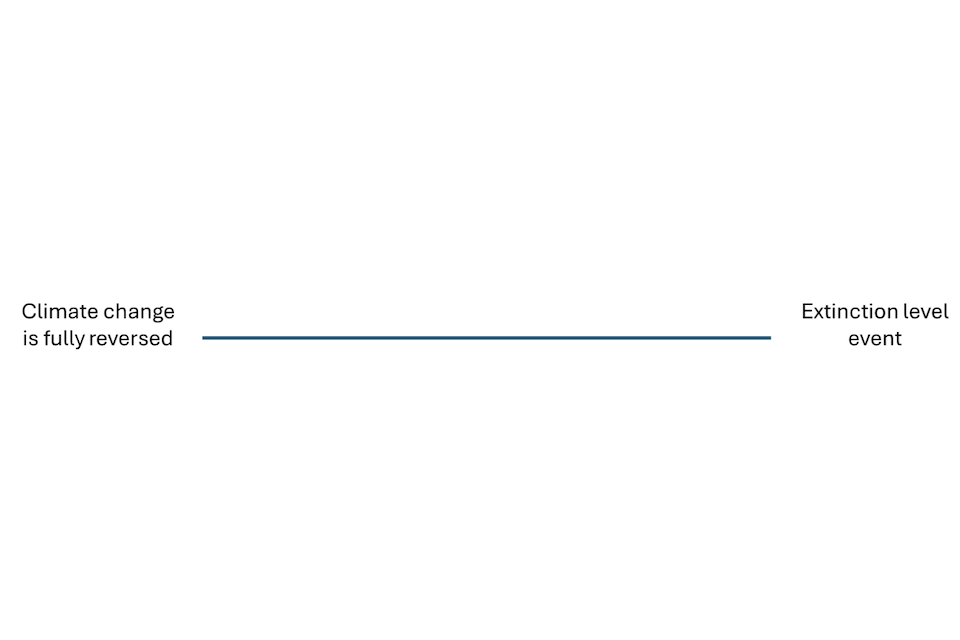
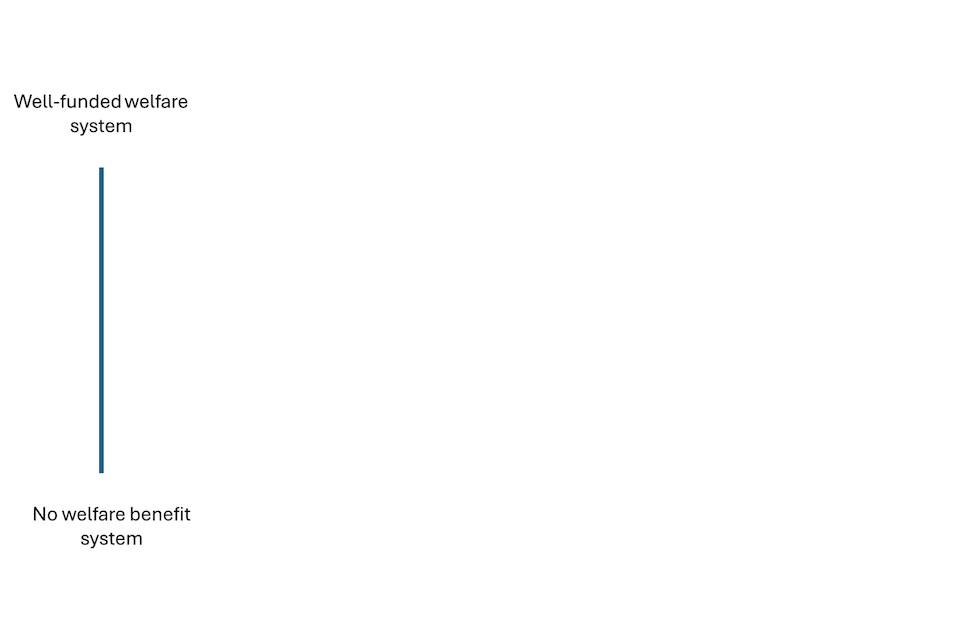
Groups were then instructed to create a vertical axis mapping extreme outcomes of the other theme they had been assigned. Continuing the example of World 1, the vertical welfare axis was constructed as follows.
Figure 5. Vertical axis used in the world-building activity
When plotted against each other, the vertical and horizontal axes create 4 quadrants as per below.
Figure 6. Quadrants created by overlaying 2 axes in the world-building activity
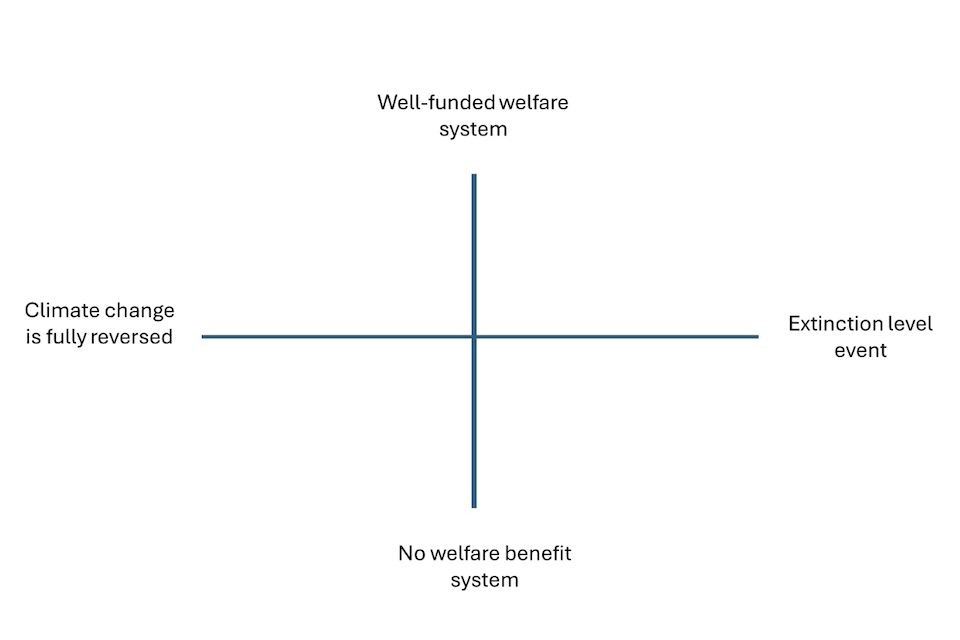
Participants were then instructed to select one quadrant as a speculative world they would build, imagining likely features of this world. World 1 was constructed in the upper left quadrant, imagining a world with a well-funded welfare system and reversal of climate change. This was an optimistic scenario characterised by 2 positive conditions. Each group conducted its own version of this process and chose which quadrant they wanted to develop into a world.
Appendix B: Scoping review reference list
Alma Economics (2024) Consultation on the Disability Action Plan 2023 to 2024: Analysis and Reporting, Prepared for the Cabinet Office’s DU.
Bacon A, Hyland A, James S, Martin N, O’Brien G, Premkumar P, Takhar S and Wilkinson P (2024) Disability, Loneliness and Relationships: A thematic report on relationships with family and friends among disabled people in the UK.
Brown N, Martin N and Premkumar P (2024) “Not as simple as right or wrong”: A themed report on social care and support for disabled people in the UK, London South Bank University.
Business Disability Forum (2025) Manifesto for a disability inclusive UK.
Council of Europe (2017) Human Rights: A Reality for All: Council of Europe Disability Strategy 2017-2023.
Croft E, Olsen J and Blackmore T (2023) Disabled people’s employment in the UK: A thematic review of the literature.
DPO Forum (2024) The Disabled People’s Manifesto.
Equality and Human Rights Commission (2023) Equality and Human Rights Monitor.
Equality and Human Rights Commission (2023) United Nations Convention on the Rights of Persons with Disabilities: UK Independent Mechanism.
Foreign, Commonwealth and Development Office (2022) FCDO Disability Inclusion and Rights Strategy 2022-2030: Building an Inclusive Future for All: A Sustainable Rights-Based Approach.
Hollomotz A, Priestley M, Andre D, Lavery B and Hadi F (2021) The lived experience of disabled people in the UK: a review of evidence.
Hollomotz A and Priestley M (2022) Disabled people’s experiences of and access to justice in the UK.
Evennett H (2022),The Equality Act 2010: Impact on disabled people, House of Lords Library.
Lane L and Provan B (2024) Disability and Housing Report on Housing Literature, London School of Economics.
Mencap (2024) Mencap Manifesto.
Scope (2024) An Equal Future: A manifesto for change.
Sense (2025) A plan for change: Improving the lives of people with complex disabilities.
Simmons B, Read S and Parfitt A (2023) Thematic report on the education of disabled people in the UK.
Simmons B, Read S, Parfitt A and Blackmore T (2024) Thematic report on public perceptions and attitudes towards disabled people.
Solfagnano (2024) G7 Inclusion and disability.
Appendix C: Scoping review STEEPV findings
The following presents a high-level overview of key external factors that our evidence sources suggest could influence the future of disabled people living in the UK. Organised using the STEEPV framework, it examines social, technological, economic, environmental, political, and values-based factors in turn. This scoping review was not exhaustive, and the sources reviewed presented a largely negative view of trends across the STEEPV domains. The findings below thus highlight more negative factors impacting disabled people, which contrasts with the workshop findings.
Additionally, we acknowledge that some evidence sources consulted in the scoping review used language and terminology which does not align with the Social Model of Disability. We report the main themes below retaining the language used in the evidence sources to maintain accuracy.
Social
[footnote 7][footnote 8][footnote 9][footnote 10][footnote 11][footnote 12][footnote 13][footnote 14][footnote 15]
An ageing population presents a direct correlation between life expectancy and a decrease in disability-free life expectancy. This, in turn, is expected to increase demand on health, social care and social protection systems.
Decreased disability-free life expectancy will require the social protection system to increasingly consider extra costs faced by disabled people and their families across a prolonged life cycle.
The proportion of the population reporting a disability has risen among all age groups (except those aged 75 to 84). The largest increases have been in people aged 16 to 24, among whom reported disability prevalence has more than doubled from 8% to 17%, and those aged 25 to 34 (from 11% to 18%).
There has been an increase in mental health conditions reported among children and working-age adults. Much of the projected growth in illness relates to conditions such as anxiety and depression, chronic pain and diabetes, which are predominantly managed in primary care and the community.
Disabled people are expected to continue to face significant social barriers due to negative attitudes, stereotypes, and discrimination. There is a need to promote attitudinal change in communities, through creating positive representations of disability.
Shifts in political views could present a risk of reduced public support for disability rights.
Technological
[footnote 16][footnote 17][footnote 18][footnote 19][footnote 20][footnote 21]
Inclusive technology to carry out daily tasks, communicate, work, learn, and access digital services is crucial for disabled people. The rapid pace of technological advancement and an over-reliance on assistive technology may leave disabled people behind if new innovations are not designed with accessibility in mind.
If technology is not disability-informed, it may create new barriers, such as the risk that AI hiring tools reject disabled job applicants.
The potential impact of AI on employment and accessibility remains largely overlooked, whether positive or negative.
The shift to remote work and services may further disadvantage those without accessible technology.
Disabled people remain underrepresented in the discourses around AI development. Currently AI literature disproportionately refers to disabled people as passive users rather than active contributors.
Economic
[footnote 22][footnote 23][footnote 24][footnote 25][footnote 26][footnote 27][footnote 28][footnote 29][footnote 30]
Discussions around automation fail to consider the potential negative consequences for disabled workers. Automation and AI may disproportionately affect disabled workers.
The risk of future recession may disproportionately impact disabled people as employers prioritise cost-cutting rather than promoting accessibility.
Risk of future welfare reform shifting disability benefits that are not currently means-tested to means-tested models.
Rising cost of living, including higher energy costs, increased costs of care and constraints on welfare spending, may continue to disproportionately impact disabled people.
Disparities in pension savings for disabled people vis-à-vis the general population as a result of employment disparities and worsening economic inequality.
Increased health and impairment-related costs associated with an ageing population, due to the increased prevalence and progression of some health conditions and impairments in older age groups.
Environmental includes climate change, sustainability, natural disasters and resource availability
[footnote 31][footnote 32][footnote 33]
Disabled people may be disproportionately affected by extreme weather and climate change due to their reliance on energy-intensive equipment and difficulties accessing emergency services.
Extreme weather (and air pollution) can worsen health conditions, and climate policies may fail to account for the specific needs of disabled individuals.
Environmental policies, such as Ultra Low Emission Zones (ULEZ) and Clean Air Zones, could create new accessibility and affordability barriers.
A lack of accessible infrastructure (like transport) may limit mobility and participation in society for disabled people.
Increased urbanisation may lead to more barriers, such as uneven streets and inadequate public transport.
Political
There is limited representation of disabled individuals in politics.
Barriers to political participation remain, including inaccessible polling stations and voter ID requirements that may exclude disabled voters.
Values
[footnote 36][footnote 37][footnote 38]
There is a need to promote positive representations of disability in society.
Acknowledgement of the specific barriers faced by disabled people who are at the intersection of identities or in a difficult socioeconomic or other vulnerable situations is required.
Appendix D: Sampling
This section provides a detailed breakdown of the 12 DPOs that participated in our interviews and workshops, categorised by both their type and geographic region. It lists each DPO according to the disability it focuses on, alongside the region in which it operates.
Among the 12 participating organisations, there is a mix of national, regional, and local groups, many of which take an intersectional approach to their work. This includes focus on diverse characteristics such as disability, ethnicity, gender, age groups including children and young people, and in some cases specific communities such as Deaf ethnic minority women.
General
Generalist organisations focused on a range of impairments.
- Disability Rights UK (England)
- Inclusion Scotland (Scotland)
- Disability Action Northern Ireland (Northern Ireland)
- Disability Stockport (England)
Visual
Partial or total loss of sight. Cerebral vision impairment (how the brain processes visual information), night-blindness.
- Royal National Society of Blind People (RNIB) (England)
Auditory
d/Deaf user of BSL, total or partial hearing loss, unilateral or bilateral (one or both ears), age related, noise-induced, tinnitus.
- British Deaf Association (BDA) (England)
- Deaf Ethnic Women’s Association (DEWA) (England)
- The Deaf Health Charity SignHealth (England)
- Manchester Deaf Centre (MDC) (England)
Mental health
Depression, bipolar, schizophrenia and psychosis, anxiety (for example, PTSD, OCD, social anxiety, generalised, phobia, health anxiety), food related (anorexia, bulimia, BED), personality disorders, addiction, postnatal and perinatal.
- Anxiety UK (England)
Learning disability
Intellectual / cognitive impairment, difficulty with everyday activities, take longer to learn and need support to develop new skills, understand complicated information, and interact with other people.
- Mencap Cymru (Wales)
Neurodivergence
Range of differences in individual brain function and behavioural traits that diverge from what is considered typical or neurotypical. A variety of conditions that affect cognition, attention, mood, learning, and social interaction including: autism, ADHD/ADD, dyslexia, dyscalculia, dyspraxia, Tourette’s, dysgraphia, synaesthesia
- ADHD Babes (England)
Appendix E: Consent from organisations to be acknowledged in the report
- ADHD Babes
- Anxiety UK
- British Deaf Association (BDA)
- Deaf Ethnic Women’s Association (DEWA)
- Disability Action Northern Ireland
- Disability Rights UK
- Disability Stockport
-
Inclusion Scotland
- Manchester Deaf Centre (MDC)
- Mencap Cymru
- Royal National Society of Blind People (RNIB)
- SignHealth – The Deaf Health Charity
About the National Centre for Social Research
We believe that social research has the power to make life better.
By really understanding the complexity of people’s lives and what they think about the issues that affect them, we give the public a powerful and influential role in shaping decisions and services that can make a difference to everyone. And as an independent, not for profit organisation we’re able to put all our time and energy into delivering social research that works for society.
National Centre for Social Research
250 City Road London EC1V 2AB
020 7250 1866
A Company Limited by Guarantee
Registered in England
No.4392418
A Charity registered in England and Wales (1091768) and Scotland (SC038454)
This project was carried out in compliance with ISO20252
-
Throughout the project, we used the acronym STEEPV to refer to the domains explored: Social, Technological, Economic, Environmental, Political, and Values-based. ↩
-
Trends and issues as identified via the scoping review, interviews and policy-maker workshop. ↩
-
Guzman-Castillo, M. and others (2017) ‘Forecasted trends in disability and life expectancy in England and Wales up to 2025: a modelling study’ Available at: Forecasted trends in disability and life expectancy in England and Wales up to 2025: a modelling study - PMC ↩
-
UK disability statistics: Prevalence and life experiences. UK disability statistics: Prevalence and life experiences - House of Commons Library ↩
-
Evennett, H. (2022) The Equality Act 2010: Impact on disabled people. ↩
-
UK disability statistics: Prevalence and life experiences. UK disability statistics: Prevalence and life experiences - House of Commons Library ↩
-
UK disability statistics: Prevalence and life experiences. UK disability statistics: Prevalence and life experiences - House of Commons Library ↩
-
No identified evidence outlined whether attitudes toward Disabled people are expected to improve, worsen or remain the same. Data from the British Social Attitudes Survey in 2017 found that 83% of respondents thought of disabled people as the same as everyone else, compared with 77% in 2005] - Rights and Perceptions: National Disability Strategy explained – The Disability Unit ↩
-
Consultation on the Disability Action Plan 2023 to 2024: Analysis and Reporting ↩
-
Health in 2040: projected patterns of illness in England – The Health Foundation ↩
-
DPO Forum. Nd. The Disabled People’s Manifesto. ↩
-
Jertha and others (2023a) The future of work in shaping the employment inclusion of young adults with disabilities: a qualitative study ↩
-
Jertha (2023b) Divided in a digital economy: Understanding disability employment inequities stemming from the application of advanced workplace technologies ↩
-
Carbl and others (2023) Assistive technology for people with visual disability: Future prospects through a technology foresight exercise ↩
-
Bennett, (2024) Exploring mobility and transportation technology futures for people with ambulatory disabilities: A science fiction prototype ↩
-
Lilywhite, (2024) Coverage of well-being within artificial intelligence, machine learning and robotics academic literature: the case of disabled people ↩
-
DPO Forum. Nd. The Disabled People’s Manifesto. ↩
-
Wolbring (2016) Employment, disabled people and robots: What is the narrative in the academic literature and canadian newspapers? ↩
-
Russo (2016) National disability futures - How the NDS and futures studies are helping service providers to create preferred futures ↩
-
Croft, E., Olsen J., Blackmore T. nd. Disabled People’s Employment in the UK: a thematic review of the literature. ↩
-
Sense, 2024. A plan for change for people with complex disabilities. Available at: https://www.sense.org.uk/get-involved/campaign/general-election/plan/ ↩
-
Equality and Human Rights Commission. 2023. Equality and Human Rights Monitor. Available at: https://www.equalityhumanrights.com/our-work/equality-and-human-rights-monitor/equality-and-human-rights-monitor-2023 ↩
-
Business Disability Forum. 2024. Manifesto for a Disability Inclusive UK. Available at: https://businessdisabilityforum.org.uk/resource/manifesto-for-a-disability-inclusive-uk/ ↩
-
Mencap. 2024. Mencap Manifesto. Available at: https://www.mencap.org.uk/sites/default/files/2024-03/Mencap.Manifesto_05.03.2024%20v2.pdf ↩
-
Hollomotz, A., Priestley, M., Andre, D., Lavery B., Hadi, F. 2021. The Lived Experience of Disabled People in the UK: A Review of Evidence. Centre for Disability Studies, University of Leeds. ↩
-
Consultation on the Disability Action Plan 2023 to 2024: Analysis and Reporting ↩
-
DPO Forum. Nd. The Disabled People’s Manifesto. ↩
-
Scope. 2024. An Equal Future: A Manifesto for Change ↩
-
Alma Economics. 2024. Consultation on the Disability Action Plan 2023-2024: Analysis and Reporting. Prepared for the Cabinet Office Disability Unit. ↩
-
DPO Forum. Nd. The Disabled People’s Manifesto. ↩
-
FCDO. 2022., FCDO Disability Inclusion and Rights Strategy: Building an Inclusive Future for All: A Sustainable Rights-Based Approach. UK Foreign, Commonwealth and Development Office. ↩
-
Union of Equality: Strategy for the Rights of Persons with Disabilities 2021-30. ↩
-
Simmons, B., Read, S., Parfitt, A., Blackmore, T., 2024. Thematic report on public perceptions and attitudes towards disabled people. ↩
-
Hollomotz, A., Priestley, M., Andre, D., Lavery B., Hadi, F. 2021. The Lived Experience of Disabled People in the UK: A Review of Evidence. Centre for Disability Studies, University of Leeds. ↩