Disability Confident reform: launch pack
Published 26 November 2026
Applies to England, Scotland and Wales

© Crown copyright 2026
This publication is licensed under the terms of the Open Government Licence v3.0 except where otherwise stated. To view this licence, visit nationalarchives.gov.uk/doc/open-government-licence/version/3 or write to the Information Policy Team, The National Archives, Kew, London TW9 4DU, or email: psi@nationalarchives.gov.uk.
Where we have identified any third party copyright information you will need to obtain permission from the copyright holders concerned.
This publication is available at https://www.gov.uk/government/publications/disability-confident-reform/disability-confident-reform-launch-pack
Disability Confident reform at a glance
Introduction
Disability Confident has helped thousands of employers take positive action since 2016 and remains an important part of the government’s ambition to improve employment opportunities for disabled people. However, employers, disabled people and stakeholders have told us that the scheme now needs to do more to demonstrate what membership means in practice, support continuous improvement and provide greater confidence that employers are taking meaningful action.
Our ambition
The ambition for the reformed Disability Confident scheme is simple.
We want Disability Confident to help more employers create inclusive workplaces, give disabled people confidence in what the scheme stands for, and demonstrate the positive difference that disability inclusion can make.
The reforms are designed to make participation in the scheme more valuable by providing clearer expectations, stronger support, greater recognition of progress and increased confidence in what Disability Confident membership represents.
What employers, disabled people and stakeholders told us
Through extensive engagement with employers, disabled people and representative organisations, alongside independent research and evaluation, several consistent themes emerged:
-
employers value practical guidance and want clearer support on what good disability inclusion looks like in practice
-
disabled people want to know what being Disability Confident actually means when they see an employer displaying the Disability Confident badge
-
small and medium-sized employers want a pathway that is achievable and proportionate to their size and resources
-
smaller employers told us that expectations should reflect the realities of running a small organisation:
-
many might recruit infrequently, or only occasionally need to implement workplace adjustments or absences
-
they want a scheme that recognises preparedness and confidence as well as evidence from past activity
-
-
people want to see evidence that Disability Confident leads to real action and positive change
-
employers want greater clarity about progression between levels and how they can improve
-
members value recognition but also want access to tools, resources and support that help them succeed
What’s changing
The reformed Disability Confident scheme will:
-
introduce a straightforward progression journey, with clearer expectations at each level
-
support employers of all sizes, recognising that outcomes may be achieved and evidenced differently depending on the size and structure of the organisation
-
encourage continuous improvement through time-limited membership periods - Level 1 is an entry level membership with a maximum of 2 years at this level
-
strengthen assurance and verification arrangements at higher levels
-
ask employers at Level 2 to complete an annual Progress Statement
-
ask Level 3 Verifiers to complete an action-based Verification Report for each organisation they work with
-
provide more guidance, tools and support to help employers succeed
-
increase confidence among disabled people, employers and stakeholders about what Disability Confident membership represents
-
introduce an annual Disability Confident Performance Report to provide greater transparency, accountability and insight into how the scheme is performing and evolving over time
What will stay the same
The core purpose of Disability Confident remains unchanged:
-
encouraging employers to recruit and retain disabled people
-
supporting workplace inclusion and progression
-
sharing good practice across employer networks
-
showing disabled people that employers are committed to inclusion
-
helping create a more inclusive labour market for everyone
What happens next
Changes to the scheme will not be introduced immediately. Employers will continue using existing Disability Confident arrangements while implementation preparations are completed and further guidance is published.
For current members:
-
continue meeting your Disability Confident commitments
-
maintain your current membership status
-
look out for future communications explaining transition arrangements and key implementation milestones
-
begin familiarising yourself with the reformed scheme and the support and information available
For employers considering joining:
-
continue to join Disability Confident through the current route
-
further information on the reformed scheme will be provided before changes are implemented
Reform timeline
The reform will be introduced gradually to allow employers time to understand the changes, prepare for transition and access new guidance and support as it becomes available.
November 2026
Publication of reform package and early guidance.
December 2026 to March 2027
Further guidance, tools and products released in support of the reformed scheme.
1 April 2027
Phased introduction of reform arrangements begins.
2027 to 2030
Existing members transition to the reformed scheme.
Supporting existing members
Existing Disability Confident members will not be required to re-join the scheme because of reform, nor will memberships end automatically when the reforms come into effect.
Transition arrangements will be phased and communicated in advance, with support available to help employers move successfully into the reformed scheme. Where organisations choose not to continue their membership, they will be supported with information and resources they can use outside the scheme to help them continue building inclusive workplaces and supporting disabled people in work.
Find out more
This document provides an overview of the reforms. Further sections in the Disability Confident launch pack explain:
-
the detailed changes being introduced
-
transition arrangements for existing members
-
how the future Disability Confident levels will operate
Understanding the new Disability Confident levels and criteria
A practical guide to what each level means, what employers need to do and how to progress.
What’s changing
Disability Confident is changing to provide a clearer and more supportive framework for employers to build confidence, improve disability inclusion and demonstrate progress over time.
The reformed scheme reflects what employers, disabled people and stakeholders told us through extensive engagement and research. They want a scheme that provides clearer expectations for employers and gives greater confidence in what Disability Confident membership represents.
The new framework has been designed to recognise that employers are on different journeys. Some organisations may be taking their first steps towards becoming more disability inclusive, while others may already have well-established approaches and wish to demonstrate leadership across the sector.
To support this, the scheme remains built around 3 levels.
Level 1 - Foundation (Respond)
Building confidence and putting key approaches in place.
Level 2 - Practitioner (Make it routine)
Embedding disability inclusion within everyday organisational practices.
Level 3 - Champion (Improve and influence)
Driving continuous improvement and supporting positive change both within and beyond the organisation.
At every level employers work through the same 3 core themes:
-
recruitment and onboarding
-
in-work support
-
absence and return to work
What changes between levels is not the focus of activity, but the maturity, consistency and impact of an employer’s approach.
The framework recognises that employers will start from different positions, while setting clear expectations for continuous improvement and progression. Employers are supported to build on what they already do, identify opportunities for improvement and take practical steps towards creating more inclusive workplaces.
Alongside the core framework, employers can choose to participate in Innovation Zones. Further information and examples are provided later in this document.
How the framework works for smaller employers
Smaller employers may have fewer opportunities to recruit or support disabled people, make workplace adjustments or manage periods of sickness absence. The framework recognises that employers’ experience of these situations will vary.
The Disability Confident criteria recognises both experience and preparedness. Employers can demonstrate progress not only through what they have done, but through having clear approaches, confident managers and suitable plans in place to respond effectively when situations arise.
This document explains the expectations associated with each level and provides an overview of how employers can progress through the reformed Disability Confident scheme.
Overview of core criteria and progression within the scheme
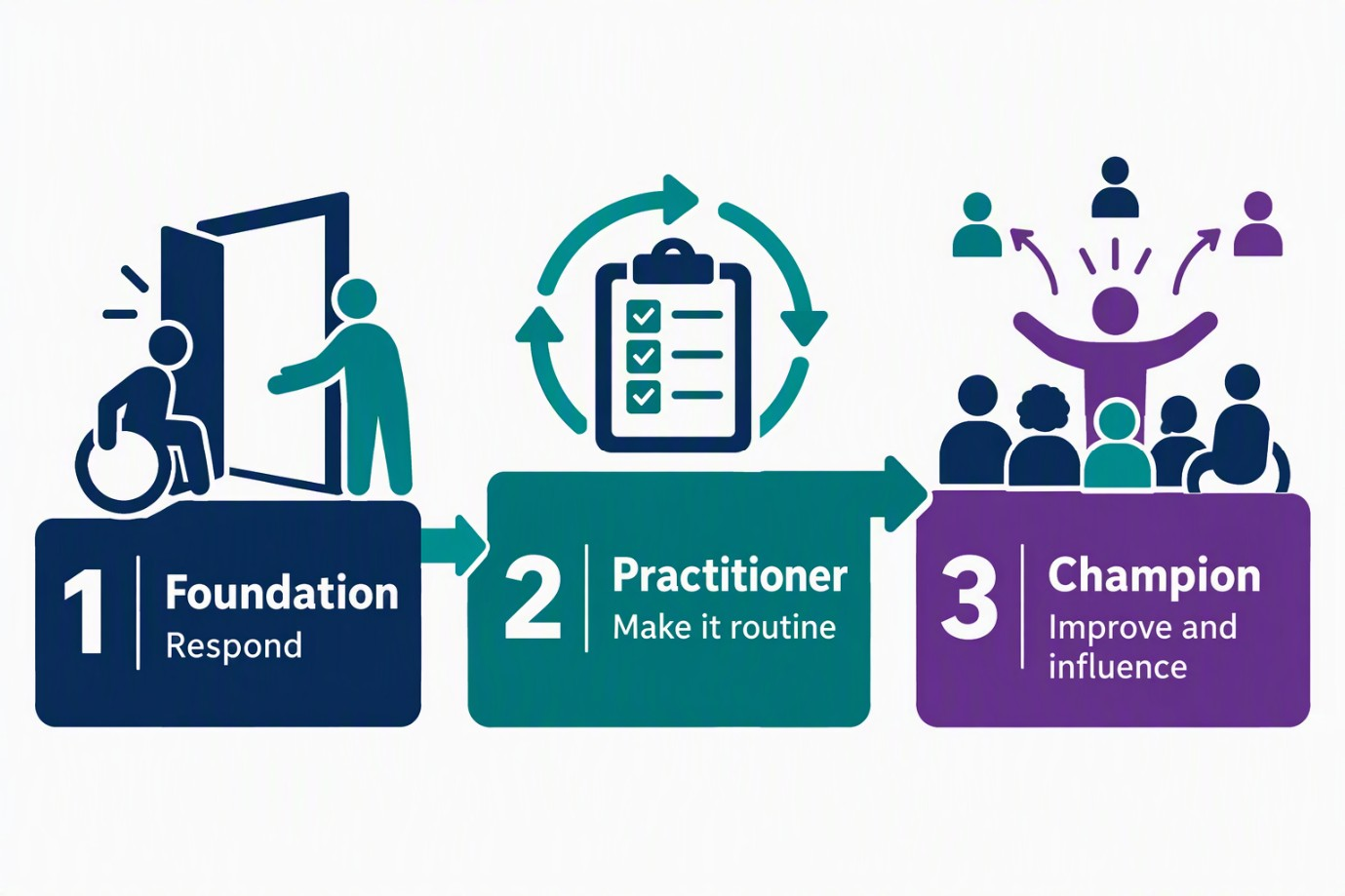
Level 1 - we respond, Level 2 - we make it routine, Level 3 - we improve and influence.
| Area | Level 1 - Foundation | Level 2 - Practitioner | Level 3 - Champion |
|---|---|---|---|
| Overall focus | Putting the basics in place and removing barriers as they arise. | Making inclusive practice routine and reliable, not dependent on a few individuals. | Leading by example, with inclusion shaping decisions and shared beyond the organisation. |
| Recruitment and onboarding | Recruitment is easy to access, with support offered when needed and issues sorted out as they come up. | Inclusive recruitment is applied consistently across roles and teams, so candidates know what to expect and have a consistent experience. | Recruitment is designed to work for everyone and improved over time using regular feedback from managers and lived experience. |
| In-work support | Support is agreed through conversations, with adjustments made as needed. | Support is planned, recorded and reviewed so it is consistent and predictable over time. | Employees help inform how support works, improving inclusion for others through feedback and learning. |
| Absence and return to work | People are supported to stay in work, and return where possible, with wellbeing and adjustments discussed openly. | Employers learn from key moments such as absence and use this to improve retention following a return to work. | Employers routinely use feedback and lived experience to identify patterns, remove barriers and improve retention outcomes for disabled employees. |
Progressing through the scheme
The reformed Disability Confident scheme is designed to encourage improvement over time.
Employers are not expected to move immediately between levels. Instead, organisations can use each level to build confidence, strengthen their approach and develop their capability for disability inclusion.
As employers develop and are ready to meet the next level’s requirements, they may progress to the next stage of the scheme. Guidance, tools and support will be available throughout the Disability Confident Journey.
The core criteria - detailed
Foundation Level 1
At Level 1, employers begin their disability inclusion journey by putting practical foundations in place, removing barriers and building confidence to support disabled people effectively. This level focuses on preparedness and capability, ensuring employers can respond appropriately when recruitment, workplace support or health-related situations arise.
Recruitment and onboarding:
-
recruitment is easy to access, with support offered when needed and barriers addressed once identified, including flexibility in how applications, assessments or work patterns operate where this would remove barriers
-
managers understand their role in supporting disabled applicants fairly and know where to go for advice when unsure
-
physical spaces, digital systems and communications are adjusted when accessibility issues are identified
In-work support:
-
support and workplace adjustments are agreed through conversation and tailored to individual needs and strengths, including changes to how work is organised where this would help someone stay well and perform
-
employers act when they know, or reasonably ought to know, that someone may need support to remove or reduce barriers
-
employees are offered conversations to understand what works for them, with adjustments changed as needs change
-
issues raised by employees are listened to and acted on
Absence and return to work:
-
employers take steps, including making reasonable adjustments or workplace adjustments, to support disabled employees to stay in work before health issues escalate, and return where possible following an absence
-
wellbeing and inclusion are part of open, ongoing conversations, including during and after a period of absence
-
career development and progression routes are considered so disabled people are not unfairly disadvantaged
Practitioner Level 2
At Level 2, employers move to consistent action, embedding disability inclusion into the way their organisation works. This may look different depending on the size and structure of the employer. For some organisations this will involve formal processes and systems, while for others it may be demonstrated through consistent approaches, shared understanding and clear responsibilities that do not depend on any one individual.
Recruitment and onboarding:
-
recruitment and onboarding practices are applied consistently whenever recruitment takes place and reviewed to identify and remove barriers
-
workplace adjustments are considered as part of normal recruitment activity and offered consistently - roles are reviewed before being advertised to identify where flexibility in hours, location or tasks would remove unnecessary barriers
-
everyone involved in recruitment understands what inclusive practice means in their role
-
accessibility is embedded routinely across recruitment platforms, assessment methods and communication
In-work support:
-
workplace adjustments and support plans are agreed, noted and reviewed so those who need to, know what support is in place
-
support arrangements and agreed changes to role design or workload do not depend on individual managers and continue if roles or managers change
-
adjustment requests are responded to in a timely way, with clear communication and interim support where needed
-
support and adjustments are part of routine conversations about wellbeing and performance
-
managers are supported to have confident, timely conversations about disability, health, flexibility and adjustments, and know when and how to act without unnecessary delay
-
development and progression opportunities are inclusive and tailored to the aspirations of individuals
Absence and return to work :
-
employers reflect on what helps disabled employees stay, progress and succeed within the organisation, using learning and feedback to improve how support is provided
-
flexible working as an adjustment, adjusted duties or job carving and crafting opportunities are considered as part of supporting a phased return or retaining an individual
-
feedback is gathered at key moments including emerging health or workload concerns, sickness absence and return to work and used to improve how things are done
Champion Level 3
At Level 3, employers show sustained leadership and demonstrate a disability inclusive culture through the decisions they make, the experiences of their employees and the influence they have within and beyond their organisation. Employer may demonstrate leadership in different ways depending on their size and circumstances, but all Level 3 employers use learning and lived experience to drive continuous improvement.
Recruitment and onboarding:
-
recruitment is designed to work for everyone, with barriers removed across the whole candidate journey
-
recruitment approaches and role design are changed and improved using feedback from managers and lived experience
-
adjustments are openly discussed and proactively considered (where appropriate) at attraction, application, recruitment and onboarding
-
employees and applicants with lived experience can help inform how recruitment and onboarding approaches are designed, reviewed and improved
In-work support:
-
employees actively inform how support is provided, influencing policies, practices and everyday decisions
-
feedback and lived experience are actively gathered and used to improve the support offer for everyone
-
peer support and other tailored approaches are used to build inclusion and confidence from day one
-
support approaches for individuals and the design of roles and workloads are reviewed and improved over time to reflect what employees say works best
Absence and return to work :
-
employers use feedback and lived experience insight to improve retention, progression and job satisfaction
-
learning from absence and return to work leads to changes in roles or ways of working across the whole organisation, not just individual support
-
employees continue to help inform recruitment, development and employment practices
-
employers share learning, collaborate with others and help influence positive change beyond their organisation through networks, partnerships, peer support, supply chains or wider engagement opportunities
Remember, Champion organisations are not defined by size, but by their commitment to continuous and sustained improvement, learning and sharing good practice.
Promoting innovation and creativity
Innovation Zones are optional. They give employers the chance to try small improvements that build on the core criteria.
They are not requirements, should not add burden, and do not replace meeting the core criteria.
Employers should focus on one or two changes that make a real difference, rather than lots of activity. For smaller employers, innovation may be as simple as trying one new approach and seeing whether it works.
Innovation should:
-
build on the core criteria, not duplicate them
-
focus on addressing real barriers or improving consistency
-
be realistic for the size of your organisation
-
not rely on extra or unpaid work from employees
The examples below are illustrative only. Employers may choose approaches that best suit their organisation and workforce.
Innovation Zone (Level 1) - test small changes that remove barriers
This goes beyond responding to individual issues by testing a different way of working.
At Level 1, Innovation focuses on safe, low-risk experimentation linked to real barriers that have already been identified.
Example approaches may include:
-
use outside support to solve a known challenge - talk to government backed, local or specialist organisations to find out about other ways you could address a known access or inclusion challenge
-
trial a small change to an existing process - test a simple adjustment to recruitment, onboarding or in-work support to see whether it improves access or experience
Innovation Zone (Level 2) - improve consistency and reliability
This goes beyond having consistent practice by deliberately reducing variation and learning what works best.
At Level 2, innovation focuses on making sure things are done in a consistent way whoever the manager is.
Example approaches may include:
-
make responses more consistent - try simple tools or prompts (for example, a checklist or short guide) to help managers respond in a similar way to recruitment, support requests or absence
-
refine systems learning from practice - use insights from key moments (for example, adjustments, sickness absence and return to work) to test improvements that strengthen consistency across teams
Innovation Zone (Level 3) - scale, impact and influencing others
This goes beyond internal improvement by influencing practice beyond your organisation.
At Leve 3, innovation focuses on scaling what works and influencing wider practice using evidence and learning.
Example approaches may include:
-
scale approaches that improve outcomes - expand practices that have clearly improved outcomes in retention, progression, access or experience across the organisation
-
share what works - share approaches, tools or learning that have clearly improved outcomes, so other employers can use them
What happens next
The reforms outlined in this document will be introduced gradually. Existing Disability Confident members will continue to receive information about transition arrangements and available support.
Employers do not need to make immediate changes as a result of this publication. Further guidance, resources and support materials will be published before implementation.
Existing Disability Confident member transition guide
Introduction
On 26 November 2026, Minister for Social Security and Disability announced reforms to the Disability Confident scheme which take effect from 1 April 2027.
This guide is for employers who are already Disability Confident members.
It explains what the reform of Disability Confident means for you, what happens next, and how you will be supported throughout the transition to the reformed scheme.
If you’re not currently a Disability Confident member you can continue to join through existing arrangements and these arrangements will then come into effect for you in the same way as existing members.
For existing Disability Confident members, the transition to the reformed Disability Confident scheme will be guided by 4 principles:
-
existing members will be given advance notice of any changes affecting them
-
employers will be supported to understand and adapt to new requirements
-
organisations will not be expected to immediately meet new requirements introduced after they joined the scheme
-
changes to the scheme will be introduced gradually to allow a fair and proportionate transition
Changes will start to be implemented from 1 April 2027.
If you are already a Disability Confident member, your current membership remains valid.
You do not need to re-join the scheme because reform has been announced, and your membership will not end automatically when the changes are introduced.
Changes will be introduced gradually over time, with advance notice, guidance and support to help you understand what is changing and what it means for you.
What’s changing
The reformed Disability Confident scheme will bring:
-
stronger requirements at higher levels
-
enhanced verification for Level 3
-
greater focus on continuous improvement
-
clearer progression through the scheme
-
improved support and guidance for employers
Key things to know
The key things to know ahead of the scheme reform are:
-
your current Disability Confident membership remains valid
-
you do not need to take any immediate action
-
you will receive advance notice of any changes affecting you
-
transition arrangements will be introduced gradually
-
you will move to the new scheme when you are next due to renew after 1 April 2027
-
support and guidance will be available throughout the transition period
-
expectations will remain proportionate to the size and circumstances of your organisation
A proportionate approach for employers of different sizes
The reformed scheme is designed to work for employers of all sizes.
Employers will demonstrate progress in different ways depending on their size, structure and circumstances. While some organisations may have extensive experience of recruitment, workplace adjustments or managing sickness absence, others may encounter these situations less frequently.
The reformed scheme recognises both experience and preparedness. Employers can demonstrate progress through clear plans, manager confidence and readiness to respond effectively when situations arise.
Being a smaller organisation is not a disadvantage.
What you need to do now
No immediate action is required.
For now, you should:
-
continue meeting the commitments associated with your current Disability Confident level
-
maintain your existing membership
-
familiarise yourself with information about the upcoming changes
-
consider how Disability Confident is managed within your organisation and whether current arrangements remain effective
-
look out for future communications about transition arrangements
If you would like to prepare in advance, you may wish to:
-
review the disability inclusion activity already taking place within your organisation
-
consider how well managers are equipped to recruit, retain and support disabled employees
-
identify existing examples that demonstrate your commitment to disability inclusion
What happens at your current level
As the reformed scheme is introduced, you will receive information about future progression expectations, available support and any changes that affect you. You will be given time to prepare before new requirements take effect.
Below is an overview of the transition arrangements through the phases by level to help you understand what you need to do and by when.
Future expectations: Level 1 (Foundation)
Under the reformed scheme, Level 1 will become a time-limited entry level designed to support progression and continuous improvement.
Employers will normally have up to 2 years to progress from Level 1 to Level 2. During this period, members will have access to guidance, tools and support to help build confidence and prepare for progression.
Members who choose not to progress to Level 2 will leave the scheme at the end of their 2-year membership period. They will receive a support pack before their membership ends.
Further details will be published before these changes take effect.
Future expectations: Level 2 (Practitioner)
As a current Level 2 member you will retain your existing membership status.
Level 2 will continue to recognise employers that are taking positive action to attract, recruit, retain and develop disabled people.
As the reformed scheme is introduced, you will receive guidance explaining any changes to expectations, evidence requirements and available support. You will be given advance notice of any future changes affecting your membership.
Further implementation information will be published ahead of transition.
Future expectations: Level 3 (Champion)
As a current Level 3 member you will retain your existing membership status.
Level 3 will continue to represent the highest level of Disability Confident membership.
As part of the reforms, the verification process will be strengthened to provide greater confidence that Level 3 employers are demonstrating leadership in disability inclusion and delivering meaningful outcomes.
The new verification arrangements will be introduced gradually and aligned with existing membership cycles.
Existing Level 3 members will receive support throughout the transition period and advance notice of any new requirements.
Phase 1: Introduction and preparation (December 2026 to 31 March 2027 )
During this period, existing Level 3 members will retain their membership status.
Employers will receive:
-
information about the enhanced verification framework
-
guidance on future expectations
-
tools and supporting materials
-
opportunities to become familiar with the revised approach before formal verification begins
Phase 2: Supported verification year (renewals between 1 April 2027 to 31 March 2028)
The first year of enhanced verification activity will operate as a supported transition period.
Verification activity will focus on learning, support and continuous or sustained improvement. Where opportunities for development are identified, employers will receive constructive feedback and signposting to relevant guidance and resources.
Phase 3: Full verification arrangements (from 1 April 2028)
The enhanced verification framework will become fully operational.
At this stage:
-
verification requirements will apply consistently across Level 3 members
-
employers will be expected to demonstrate that they meet the published criteria
-
verification outcomes will inform ongoing membership decisions
-
guidance and support will continue to be available
By this point, employers will have had advance notice of requirements, access to supporting resources and experience of the verification process through the supported transition period.
If you choose not to continue with your membership
Participation in Disability Confident remains voluntary.
While we expect many employers to continue their Disability Confident journey, organisations that choose not to continue their membership will have access to information and resources to help them continue building inclusive workplaces and supporting disabled people in work.
Find out more
The following sections provide further information about Disability Confident reform:
-
Disability Confident changes at a glance
-
future level criteria and expectations
As further implementation details are confirmed, employers will be notified through Disability Confident communication channels.
Strengthening confidence in Disability Confident
Why reform is needed
Disability Confident has helped thousands of employers demonstrate their commitment to recruiting, retaining and developing disabled people over the past decade. However, through our research and stakeholder engagement a consistent message emerged: confidence in the scheme depends on confidence in what membership represents.
Disabled people, employers and stakeholders told us they wanted:
-
clearer expectations of members
-
stronger assurance that commitments are being met
-
greater transparency about member performance and progress
-
a stronger role for employee voice
-
greater visibility of whether the scheme is delivering meaningful improvements
The reforms have been designed to respond directly to these issues while maintaining a scheme that remains accessible and proportionate for employers of different sizes and sectors.
Ultimately, confidence in Disability Confident matters because disabled people, job applicants, employers and stakeholders should be able to understand what scheme membership represents and have confidence that participating employers are taking meaningful action to support disability inclusion.
Understanding Disability Confident
Disability Confident is a voluntary scheme that supports employers to improve disability inclusion in their workplace.
The scheme is designed to help employers build their capability and confidence, recognise progress and share good practice.
What Disability Confident is:
-
a framework for improving disability inclusion
-
a way for employers to demonstrate commitment and progress
-
a source of practical guidance, support and good practice
-
a scheme that encourages continuous and sustained improvement
What Disability Confident is not:
-
a legal compliance or enforcement regime
-
a guarantee that every disabled person’s experience will be the same
-
a replacement for employers’ responsibilities under equality legislation
-
a one-off award that employers can achieve and never revisit
The reforms strengthen confidence in the scheme through clearer expectations, stronger assurance, greater transparency and stronger focus on employee experience.
What we heard and what we’re changing
We have engaged with employers, disabled people, stakeholders and experts to understand what works well in Disability Confident and where improvements could be made. Through evaluation activity, stakeholder engagement and testing of potential reforms, a number of consistent themes emerged.
The reforms presented in this pack have been shaped by that evidence. The table below highlights some of the key messages we heard and how these views have informed the next phase of Disability Confident.
| What we heard | What we’re changing |
|---|---|
| Disabled people wanted greater confidence in what Disability Confident membership represents. | Introducing clearer expectations at every level, stronger verification and greater transparency. |
| Employees wanted more opportunities to share their experiences and see employers act on feedback. | Embedding employee voice more strongly throughout the scheme and encouraging approaches such as anonymous feedback mechanisms. |
| Stakeholders wanted stronger accountability and evidence of progress. | Introducing Progress Statements and Annual Performance Reports to help demonstrate action and improvement over time. |
| Employers wanted clearer guidance and practical examples. | Developing revised criteria, guidance and support materials to help employers understand what good practice looks like. |
| Smaller employers wanted flexibility and proportionate requirements. | Ensuring expectations remain scalable and can be met in different ways depending on the size and nature of the organisation. |
| Employers broadly supported stronger assurance, provided it remained practical and proportionate. | Introducing enhanced verification that strengthens credibility while avoiding unnecessary administrative burdens. |
| Employees highlighted the importance of line managers and day-to-date workplace experiences. | Increasing focus on areas such as adjustments, retention, progression, wellbeing and supportive workplace conversations. |
| Stakeholders wanted Disability Confident to encourage continual improvement rather than become a one-off commitment. | Introducing a clearer progression journey and time-limited Level 1 membership. |
How the reforms strengthen Disability Confident
Taken together, the reforms introduce stronger progression expectations, greater transparency, enhanced assurance arrangements and a stronger emphasis on employee voice.
These changes are intended to strengthen confidence in Disability Confident while continuing to support organisations at different stages of their disability inclusion journey.
Time-limited Level 1 membership
Under the reformed scheme, Level 1 becomes a supported entry point rather than a permanent destination.
Employers will normally have up to 2 years to progress from Level 1 to Level 2. This replaces the current approach, where organisations can remain indefinitely at the entry level.
The change creates a clearer expectation that participation should lead to development and progression over time, while recognising that employers may need time and support to build confidence, knowledge and capability.
Employers will have access to guidance, tools and practical support throughout their Level 1 membership. Employers that choose not to progress beyond Level 1 will leave the scheme at the end of their membership period and will be provided with information and resources to support their ongoing disability inclusion journey outside the scheme.
Greater transparency
Stakeholders consistently told us that transparency plays an important role in building confidence and trust.
The reformed scheme therefore introduces greater transparency at employer, verification and scheme level.
At Level 2, employers will be expected to complete an annual Progress Statement:
-
activities undertaken during the previous year
-
progress made
-
priorities and ambitions for the year ahead
At Level 3, independent verifiers will complete a Verification Report as each new organisation reaches Champion status. Employers will be expected to meet any requirements relating to Progress Statements or Verification Reports in accordance with scheme guidance.
At scheme level, government will publish an annual Disability Confident Scheme Performance Report providing information on overall scheme performance, participation and progress.
Greater transparency will help employers share good practice and learn from one another, while giving disabled employees and the wider public greater confidence in what Disability Confident membership represents. At the higher levels of the scheme, greater visibility of employers’ action, progress and challenges will demonstrate their commitment to continuous improvement and strengthen trust in the scheme.
The intention is not to create unnecessary reporting burdens, but to provide greater visibility of action being taken and encourage a more open conversation about progress, challenges and continuous improvement.
Strengthening employee voice
Disabled people have a vital role in shaping workplace inclusion.
The reformed scheme places greater emphasis on listening to, understanding and responding to the experiences of disabled employees and, where possible, disabled job applicants.
Employers will be encouraged to gather proportionate feedback, reflect on lived experience and use those insights to inform future improvement activity.
To support this, the reformed scheme introduces ways for an employer to gather insights from employees, including anonymous feedback approaches. These approaches provide employers with an opportunity to better understand the experiences of disabled employees and help ensure that improvement activity is informed by lived experience rather than by assumptions about their experience.
Embedding employee voice more consistently helps ensure that disability inclusion is guided not only by policies and processes, but also by the experiences of the people those policies and processes are intended to support.
Enhanced independent verification at Level 3
Level 3 remains the highest level of Disability Confident membership and is intended to recognise organisations demonstrating leadership in disability inclusion.
To strengthen confidence in what Level 3 membership represents, enhanced independent verification arrangements are being introduced.
These include:
-
more structured scoring and assessment frameworks
-
clearer and more consistent evidence requirements
-
greater use of employee insight, including pulse surveys and employee engagement activity
-
strengthened quality assurance arrangements for the verifier community
Verifiers will participate in calibration activities and community roundtables, supporting consistency of decision-making and providing opportunities to share learning and good practice.
These changes are intended to improve the consistency, robustness and independence of verification decisions, providing greater confidence that organisations recognised at Level 3 are demonstrating the behaviours, leadership and commitment associated with Champion status.
Implementation will be supported through a phased transition period, ensuring that existing members and verifiers have time, guidance and support to prepare for the revised framework.
Quotas, targets and compliance
Some stakeholders have rightly challenged whether stronger assurance should involve mandatory targets or quotas.
The reforms take a different approach.
Disability Confident is designed to support employers to build confidence, remove barriers and make sustained improvements in the recruitment, retention and progression of disabled people. It aims to encourage meaningful action across employers of difference sizes, sectors and levels of experience. The purpose therefore is to support and encourage improvement rather than act as a regulatory or enforcement framework.
The reforms focus on strengthening expectations, increasing transparency and bolstering assurance and accountability across the employer journey and within the scheme itself.
We will continue to monitor the impact of the reforms, gather evidence and listen to stakeholder feedback as the scheme evolves.
Monitoring, evaluation and accountability
Building confidence in Disability Confident requires more than changes to the scheme itself.
We will continue to monitor participation, gather evidence and evaluate the impact of the reforms over time.
Monitoring activity will draw on a range of evidence sources, including:
- membership data
- progression rates between levels
- verification outcomes
- employer feedback
- employee feedback
- wider stakeholder insight
This information will be used to assess whether the reforms are delivering the intended objectives including increased confidence, credibility, transparency and positive employer action.
To support public accountability, government will also publish an annual Disability Confident Scheme Performance Report. The report will provide greater visibility of scheme performance, emerging findings and progress over time, helping employers, stakeholders and disabled people understand how the scheme is evolving and where further improvements may be required.
Monitoring and evaluation are therefore not simply measures of success. They are important tools for learning, transparency and continuous improvement.
Continuous and sustained improvement
Disability Confident itself should be subject to the same principle that underpins the reformed scheme: continuous and sustained improvement.
The reforms outlined in this document represent a significant strengthening of the scheme however, improving employment outcomes for disabled people cannot be addressed through a single intervention.
We will continue to gather evidence, evaluate the impact of the reforms and listen to employers, disabled people and stakeholders as implementation progresses. Insights gained through monitoring, evaluation and stakeholder engagement will help the scheme to continue to evolve, improve and support better outcomes over time.
What Disability Confident reform means for jobseekers and employees
Why we’re reforming Disability Confident
Disabled jobseekers, employees and stakeholders told us that it is not always clear what Disability Confident membership means in practice, or what they can expect from an employer displaying the Disability Confident badge. Changes to the scheme are designed to provide greater clarity, consistency, and confidence in what membership represents.
When applying for a role with a Disability Confident employer, or when working for one, people often wanted to know:
-
what they can expect from this employer
-
how the employer is supporting disabled people
-
what makes this employer different from one that is not a member
Historically, Disability Confident membership signalled a commitment to disability inclusion, but the experience and support available could vary significantly between employers.
What to expect from the scheme now
Changes to the scheme introduce clearer expectations at every level, making it easier to understand what Disability Confident employers are expected to do and how they are expected to develop over time.
The changes are designed to provide greater confidence that employers displaying the Disability Confident badge are actively working to recruit, retain and support disabled people. They also place greater emphasis on continuous and sustained improvement, ensuring that employers are encouraged to build on their progress, and maintain their high standards, rather than stand still.
If you’re a jobseeker or employee, this should mean greater clarity about what Disability Confident membership represents and should give you increased confidence that participating employers are taking meaningful action to create more inclusive workplaces.
While employers will continue to take different approaches depending on their size, sector and circumstances, the badge should increasingly signal that an employer is:
-
actively working to recruit, retain and support disabled people
-
meeting clear expectations appropriate to their level of membership
-
committed to continuous improvement rather than a one-off commitment
-
seeking to understand and respond to the experiences of disabled people
-
being more open about their disability inclusion activity and progress
The aim is not that every Disability Confident employer looks exactly the same, but that there is greater consistency in what Disability Confident membership represents.
What this means
The reformed scheme places a greater emphasis on:
-
recruitment and onboarding - employers will be working to make recruitment and onboarding processes more inclusive and accessible for disabled candidates
-
supporting people in work - employers will be creating working environments where employees can thrive, access support and request workplace adjustments where needed
-
managing absences and return to work - employers will be supporting employees during periods of ill health and helping them return to work successfully where appropriate
These themes now sit at the heart of every level of the reformed scheme.
How employee voices will be heard
Employers will be encouraged to gather feedback from employees, and where possible those who apply for their vacancies, reflect on those experiences and use those insights to improve workplace practices.
Employers should seek to create opportunities for employees to share their experiences in ways that feel safe, constructive and accessible. This may include the use of anonymous feedback approaches, pulse surveys and other mechanisms that allow employees to contribute honestly without feeling under pressure to disclose personal information or concerns publicly.
The aim is not to collect information for its own sake, but to ensure that employee experiences help inform meaningful workplace improvements.
At the highest levels of the scheme, employee insight will also contribute to verification and assurance activities, helping to ensure that assessments are informed by lived experience as well as organisational policies and processes.
By placing greater emphasis on employee voice, the reformed scheme seeks to ensure that disability inclusion is shaped not only by what employers say they do, but also by the experiences of the people they employ.
What Disability Confident reform does not mean
The Disability Confident badge is not a guarantee that every disabled person will have the same experience. Creating an inclusive workplace takes ongoing effort, and employers will be at different stages of that journey.
Some organisations may have formal policies and specialist teams, while others may rely more on direct conversations and personalised support. The scheme does not expect every employer to take the same approach. What matters is that disabled people are treated fairly, listened to and supported to succeed at work.
Next steps
The reforms will be introduced gradually over time, starting on 1 April 2027.
Employers that are already members of Disability Confident will move into the reformed scheme over time. This will happen as their membership comes up for renewal, rather than all at once.
Disabled people will continue to play an important role in shaping the future of the scheme. Feedback, research and ongoing engagement will help ensure Disability Confident continues to develop in ways that reflect real experiences and needs.
The success of Disability Confident will not be measured by how many employers join the scheme, but by the difference it can make to experiences, opportunities and outcomes of disabled people. The reforms are intended to strengthen confidence in what the scheme represents today while creating a foundation for further improvement in the future.