Department for Transport annual report and accounts 2024 to 2025 (HTML version)
Published 22 July 2025

© Crown copyright 2025
This publication is licensed under the terms of the Open Government Licence v3.0 except where otherwise stated. To view this licence, visit nationalarchives.gov.uk/doc/open-government-licence/version/3 or write to the Information Policy Team, The National Archives, Kew, London TW9 4DU, or email: psi@nationalarchives.gov.uk.
Where we have identified any third party copyright information you will need to obtain permission from the copyright holders concerned.
This publication is available at https://www.gov.uk/government/publications/dft-annual-report-and-accounts-2024-to-2025/department-for-transport-annual-report-and-accounts-2024-to-2025-html-version
For the period 1 April 2024 to 31 March 2025:
- accounts presented to the House of Commons pursuant to section 6(4) of the Government Resources and Accounts Act 2000
- annual report presented to the House of Commons by Command of His Majesty
- ordered by the House of Commons to be printed on 21 July 2025
Foreword by the Secretary of State
The Department for Transport (DfT) has a crucial role to play in supporting the government’s primary mission of growing the economy. We cannot deliver this government’s Plan for Change when our trains and buses are unreliable and holding back the potential of our cities; when our roads are full of potholes, costing working families and businesses, and when capacity constraints are hindering our ability to reap the benefits of aviation growth.
I believe passionately that transport can change lives for the better. It can connect people to new opportunities for work or education. It can attract investment to regenerate our town centres and build the homes we need. That’s the challenge I accepted when I took this job and together with the talent and dedication existing right across the DfT – we will reform and renew our transport network and get Britain moving.
We wasted little time in reforming our railways, with the Public Ownership Bill receiving Royal Assent. This will bring an end to the costly failure of privatisation and lay the groundwork for Great British Railways – a single directing mind that brings together track and train. It will mean we can finally put passengers and freight customers at the heart of a more efficient, reliable, and accountable railway.
Our roads, and our strategic road network (SRN), are a crucial part of our growth agenda, especially as we ensure our freight network continues to underpin the country’s economy. Through funds like the major road network and large local majors programme, we’re properly funding key regional roads that are vital for connectivity, economic growth, and housing development.
Buses are the most popular form of public transport, and we have invested to improve services, protect vital routes, and keep fares affordable. The Bus Services Bill (No.2) will enable local leaders to choose the model that works for them – be it franchising, strengthened enhanced partnerships with private operators, or local authority owned bus companies. As we aim to increase bus usage across the country, passengers will also see improved accessibility and safety standards.
The government has a mission to make Britain a clean energy superpower. In 2022, domestic transport accounted for 28% of total domestic emissions in the UK, reflecting the colossal responsibility our department has in greening transport across the country. We are delivering on the government’s manifesto commitments to accelerate the transition to electric vehicles, increase the roll out of electric vehicle charge points, and have introduced a world leading sustainable aviation fuels mandate that will help decarbonise our aviation sector.
I’m incredibly proud of the work across DfT throughout this year to build a transport system that is empowering communities, unlocking opportunity, and connecting people to what matters most.
Finally, I wanted to take this opportunity to thank Bernadette Kelly, for her 8-year tenure as Permanent Secretary at DfT and to congratulate Jo Shanmugalingam on her appointment. Having worked closely with Jo since taking up my role, I know she will provide exemplary leadership as we continue delivering for this government and the public.
The Rt Hon Heidi Alexander
Secretary of State for Transport
Foreword by the previous Permanent Secretary (in post till June 2025)
I present this annual report and accounts for 2024 to 2025. In doing so I would like to recognise the dedication and hard work of colleagues across the department and in its arm’s length-bodies who have continued to deliver good transport outcomes during a year of change.
Following the arrival of a new government in July 2024, the department aligned swiftly to focus on the Prime Minister and Secretary of State’s priorities for transport.
Transport plays a key part in the delivery of all the government’s missions:
- investment in road and rail infrastructure and high-quality transport services play a key role in growing the economy
- accessible and affordable public transport enables people and communities to access training and jobs
- improving air quality and making it easier for people to be active in their everyday journeys improves health outcomes and reduces demands on the NHS
- driving the transition to low and zero carbon transport is vital to enable the UK to achieve its clean energy goals
- safer travel is a key element of safer streets
The government has an ambitious programme to reform transport. During 2024 to 2025 the department made progress on public ownership of train operators and on the transition to Great British Railways. The Bus Services Bill was laid before Parliament in December 2024, marking a key step in the government’s plan to provide more reliable, accessible, and locally responsive networks across England. The Automated Vehicles Act has set the stage for self-driving vehicles by 2027, and 1 in 5 new cars sold are now zero-emission.
During the period the department has continued to grow its offices in Leeds and Birmingham, ensuring career opportunities are spread across the country, while at the same time managing operational costs and investing in people and technology. A voluntary exit scheme saw the departure of around 300 staff from the central department in May 2025 and helps us to focus on future skills requirements.
At time of publication, I will have departed from my role as Permanent Secretary. It’s been a privilege, and I wish Jo every success in taking the department forwards.
Dame Bernadette Kelly DCB Previous Permanent Secretary
Foreword by the Permanent Secretary (in post from July 2025)
I am honoured to take on the role as Permanent Secretary for DfT and build upon the amazing legacy left by Bernadette.
Transport is fundamental to the opportunities for everyone in the UK, and for generating the growth that will build more opportunities in the future. From keeping passengers safe or freight moving smoothly, improving the performance of our railways or ensuring we have the best transport infrastructure possible, the work of this department matters.
As we look ahead to the year to come, DfT is doing so with a deep sense of purpose. I am committed to leading the department in delivering a transport system that is safer, greener, more reliable and more inclusive – one that connects people to opportunity, drives economic growth, and supports a healthier future for the UK.
Jo Shanmugalingam
Permanent Secretary
Performance report
Report purpose
This performance report outlines DfT’s key successes and challenges in relation to its 3 priority outcomes and 4 strategic enablers.
Due to the 2024 General Election, DfT did not publish an outcome delivery plan (ODP) for 2024 to 2025; however, this report aligns to the priorities DfT was working to after the election. It also aligns with the government’s 5 missions, the Prime Minister’s ‘Plan for Change’ and DfT’s 3 priority outcome’s set out by the Transport Secretary in February 2025 and as set out in DfT’s ODP for 2025 to 2026.
Organisational structure
DfT consists of the central department (DfTc) and several public bodies. These are classified according to the level of ministerial control required for them to best perform their functions. These organisations have their own governance structures and publish annual reports, with their accounts consolidated into the departmental group’s annual report and accounts.
Executive agencies act as an arm of DfT and typically carry out services or functions with a focus on delivering specific outputs, with policy set by ministers. Non-departmental public bodies (NDPBs) and non-ministerial departments (NMDs) are separate legal entities from DfTc. DfT usually sets its strategic framework, appoints the chair of their boards, approves all non-executive board member appointments, and appoints an accounting officer.
The wider departmental family includes other public bodies helping to achieve our objectives, which have more autonomy over their own policies and are not consolidated into the group’s financial statements. Further details can be found in the accountability report.
Governance
Governance structure
DfT’s governance arrangements reflect best practice and the importance of giving Parliament confidence that DfT uses resources cost-effectively when delivering its priority outcomes. The full governance statement can be found in the accountability report.
Parliament
Parliament checks and challenges the work of DfT through questioning ministers and senior civil servants. It is responsible for debating and committee work checks and approves DfT spending.
Secretary of State for Transport and ministers
The Secretary of State is appointed by the Prime Minister, and has overall responsibility for DfT and its public bodies. The Secretary of State makes policy decisions based on advice from officials and presents and accounts for policy publicly and in Parliament.
Permanent Secretaries and Principal Accounting Officer
The Permanent Secretaries and Principal Accounting Officer are responsible for the effectiveness and efficiency of DfT. They work to support ministerial policies and objectives. They are responsible for the DfT’s leadership, management and staffing. The Permanent Secretary acts as the Principal Accounting Officer and is responsible for the propriety and regularity of the DfT group’s expenditure.
Department for Transport Board
The DfT Board consists of the Secretary of State for Transport, ministers, non-executive board members, permanent secretaries and directors general. It’s an advisory body that supports and challenges both DfT ministers and the Principal Accounting Officer. It provides strategic focus by advising on the operational implications and effectiveness of policy proposals.
Department for Transport Executive team
Department for Transport Executive team consists of the permanent secretaries, directors general, Director of Group Human Resources, Director of Group Communications, Director of Strategy, Chief Scientific Adviser and Chief Analyst. Director of Legal, and non-executive board members can attend by invitation. They support the permanent secretaries in the management of DfT business in-line with ministerial priorities.
Internal and external audit
The internal and external audits review processes and procedures to help us improve our risk management, control and governance. Internal audit provides independent assurance to the Permanent Secretary and DfT Board. External audit undertakes a statutory audit of DfT’s consolidated annual report and accounts.
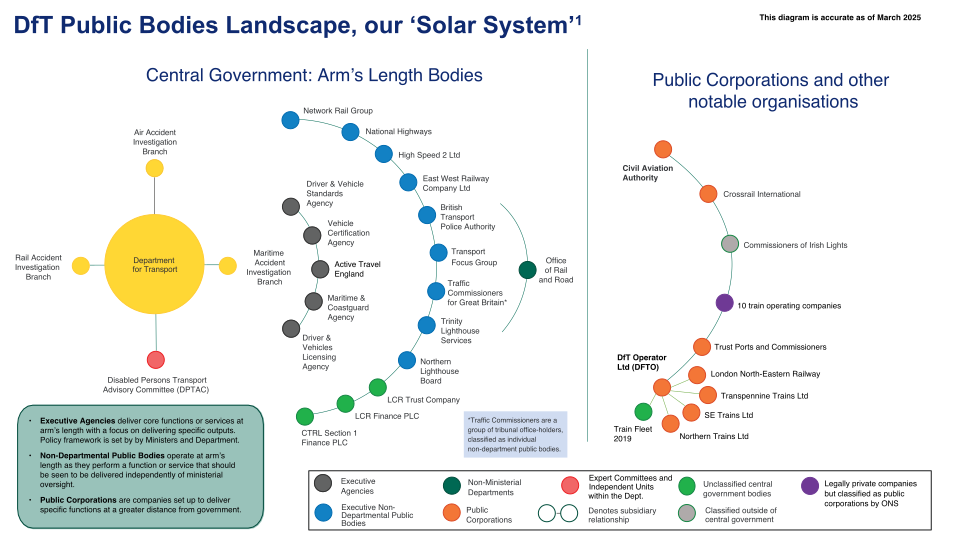
DfT public bodies landscape, our 'Solar System'
Note: On 25 May 2025, South Western Railway (SWR) became publicly owned and managed by DfT Operator LTD (DFTO). On 20 July 2025, Trenitalia c2c Limited (c2c) transfers to public ownership and will be managed by DFTO.
DfT’s risk management
Risk management is an integral part of DfT’s work to deliver ministerial priorities. This includes how DfT manages its programmes and public money, to how DfT develops policies and works with its public bodies. DfTc’s risks represent the overall risk profile and consider the risks carried and managed by public bodies.
The governance statement contains details on its internal controls and risk management approach and sets out the principal risks faced by DfTc during 2024 to 2025, DfTc’s ‘Taskforce on Climate-Related Financial Disclosures’ and ‘His Majesty’s Treasury Orange Book Principles – comply or explain’ statements.
Performance overview
DfT has responsibility for ensuring that the transport system meets the needs of people today and in the future and ensures that it is safe and secure for all those who use it. DfT does this through its priority outcomes and strategic enablers, which are set out in detail in this report. DfT also works to build resilience for issues which may affect the system, such as extreme weather events and pandemics.
As part of delivering its priority outcomes, DfT has a complex capital portfolio. For 2024 to 2025 DfT had a capital budget of £20.8 billion, a full policy agenda and a wide range of direct operational delivery activities which were mainly delivered through its public bodies and the private sector.
Strategic context
Transport and the Prime Minister’s ‘Plan for Change’
In July 2024, the new government set out its mission-led approach to delivering on people’s priorities. It established 5 missions built on the foundations of a stable economy, national security and secure borders.
In December 2024, the next phase of this approach was announced as the Prime Minister set out the Plan for Change. This plan sets out clear milestones for change and the government’s plan to achieve them. DfT plays a critical role in advancing these missions.
Kickstart economic growth
A strong transport network is essential for economic recovery and long-term growth. DfT has continued to invest in key infrastructure to support immediate growth through maintenance and renewals, with £1.2 billion invested into the strategic road network. DfT has driven local growth via the City Region Sustainable Transport Settlements, and secured longer-term benefits through major projects such as HS2, East West Rail, and the Transpennine route upgrade.
The first year of Control Period 7 for Network Rail has also concluded, with a total ring-fenced budget of £44.1 billion over 5 years in England and Wales continuing to sustain efficient operations, maintenance and renewal of the existing infrastructure to ensure long term affordability of the railway. Finally, the contribution of the transport network in assisting achievement of the government’s housing milestone also plays a critical role in enabling economic development across the country.
Make Britain a clean energy superpower
Transport is the largest emitter of greenhouse gas emissions. Therefore decarbonising the transport sector is key to achieving the mission to make Britain a clean energy superpower. Throughout the year DfT has driven this shift by supporting the uptake of zero emission vehicles, advancing the transition to zero emission buses, and implementing our sustainable aviation fuels mandate – all of which are accelerating the decarbonisation of travel.
Safer streets
Transport policies are vital in enhancing public safety and security. DfT works with local authorities and law enforcement to make transport safer and more reliable. Key initiatives include strengthening taxis and private hire vehicle licensing, progressing the Roads Policing Review in partnership with the British Transport Police, and introducing measures in the Bus Services Bill, such as enhanced driver training on tackling anti-social behaviour.
Break down barriers to opportunity
To give every child the opportunity to succeed, both children and their parents need equitable access to education. This means ensuring that transport systems are not only available, but also accessible and affordable for everyone – including disabled people, older adults, and those living in remote or underserved areas.
Throughout 2024 to 2025, DfT has been working to improve local transport connectivity by focusing on affordable bus fares, improving reliability of bus services, and progressing the Rail and Bus Services Bills to support long-term, inclusive improvements.
DfT is also investing in local transport and active travel infrastructure with accessibility at the core-such as step-free access, safer walking and cycling routes and better integration across transport modes. These efforts are helping to connect communities to education, jobs, and healthcare, ensuring that opportunity is not limited by geography, mobility or income.
Build an NHS fit for the future
DfT’s work on walking, wheeling and cycling, air quality, public transport and road safety all contribute to healthier lives, reducing demand on the National Health Service (NHS). By tackling physical inactivity, improving air quality, and promoting road safety, DfT is directly benefiting public health outcomes and helping to ease pressure on health services across the country.
DfT’s priority outcomes and strategic enablers
DfT’s priority outcomes have been crafted in-year to align with the new government’s ‘Plan for Change’. These priority outcomes are interconnected, and DfT recognises the natural cross-cutting nature of these outcomes. They are also supported by a new suite of performance metrics to measure progress in delivering these outcomes.
Financial overview from the Director General for the Corporate Delivery Group
Introduction
The 2024 to 2025 financial period was the final year for which departmental spending plans were covered by Spending Review 2021. Since the general election in July 2024, the government has undertaken a number of fiscal events which now set the overall financial envelope for the remainder of the current Parliament.
In July 2024, HM Treasury (HMT) published its spending audit to ensure the government’s immediate financial commitments remained within its tax and spending plans and within the Chancellor’s fiscal mandate. In order to support the government’s overall savings requirement, this resulted in the cancellation of a small number of DfT’s capital projects including the A303 Stonehenge and A27 Arundel Bypass road schemes.
Departmental spending plans for 2025 to 2026 were agreed alongside the 2024 Autumn Budget as phase 1 of Spending Review 2025 (SR25).
Phase 2 of SR25 was published in June 2025. SR25 determined departmental funding settlements until 2028 to 2029 for day-to-day resource spending, and until 2029 to 2030 for long-term capital spending.
DfT’s overall resource spending is forecast to reduce over the Spending Review period: this will require a reduction in the department’s financial support to train operating companies which currently remains above pre-pandemic levels through increased ridership, and therefore income, as well as driving efficiencies across the sector. Alongside this, ongoing spending efficiencies are required across the core department’s activities.
DfT’s capital spending will continue to increase over the Spending Review period: this provides major investment in our road and railway transport networks, in addition to supporting mayoral combined authorities and local authorities with enhancing and renewing regional and local transport infrastructure. The key funding settlements secured in SR25 are described in this annual report.
This report provides a high-level overview of our financial performance in 2024 to 2025. figure 1 summarises spend against the final control totals voted by Parliament at the supplementary estimate and figure 1.1 shows a breakdown by transport mode.
The final budgets for the year were authorised through the supplementary estimate: this year, most departmental in-year funding adjustments were agreed with HMT alongside the Autumn Budget, at which point the outlook for the final quarter of the financial year remained uncertain.
Figure 1: Outturn and control totals authorised by Parliament
The budgeting framework for central government is further explained in figure 4.
| Control total | 2024 to 2025 budget £m | 2024 to 2025 outturn £m | 2024 to 2025 variance £m | % |
|---|---|---|---|---|
| Resource DEL | 20,545 | 18,728 | 1,817 | 10% |
| Of which: administration | 380 | 370 | 10 | 3% |
| Capital DEL | 20,666 | 20,523 | 143 | 1% |
| Resource AME | 4,711 | 2,131 | 2,580 | 121% |
| Capital AME | 149 | (92) | 241 | -262% |
| Net cash requirement | 33,757 | 30,141 | 3,616 | 12% |
This figure shows the total DEL and AME spending (net of income) by estimate line, with Estimate lines grouped by transport mode. Total DEL and AME spending includes both resource and capital cash spending in addition to non-cash resource costs such as depreciation. Net cash requirement represents the total level of supply funding drawn down from HMT during the year to support DfT’s spending, demonstrating DfT’s total call on taxpayer funds.
As required by Parliament, DfT remained within all of the budget limits set by Parliament. Significant variances between budget and outturn are explained in the statement of outturn against parliamentary supply.

Figure 1.1: sets out the breakdown of spending across DfT by transport mode
Income and funding
Alongside the supply funding received from HMT described in figure 1, DfT Group received £7.2 billion in income from other sources. These are summarised in figure 2 and more detail can be found in note 4 to the financial statements.
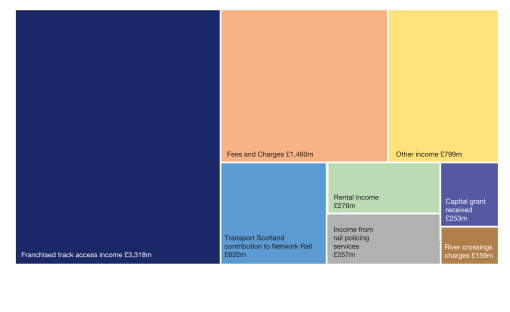
Figure 2: main sources of income received in year
Figure 2.1 below shows the net movement in Income by revenue source in the year ended 31 March 2025. Key movements are discussed below:
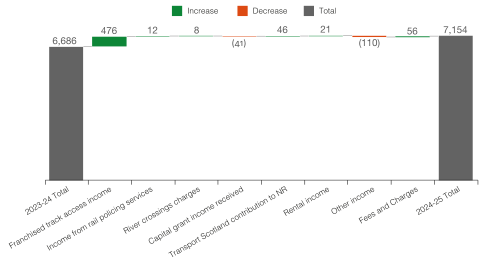
Figure 2.1: movement in DfT revenue streams, £m
Source: Financial statements note 4, cash items
This year franchised track access income increased due to the lower levels of compensation incurred by Network Rail payable to rail operators in respect of network access issues: these charges are offset against track access income. The higher levels of these charges in the prior year arose from some planned disruption for network maintenance and enhancement, and some unplanned disruption because of severe weather. In addition, track access charges are indexed upwards as prescribed by the ORR.
Revenues from DfT’s other income streams were broadly comparable with the prior year.
Expenditure
As reported in the statement of comprehensive net expenditure in the financial statements, DfT Group incurred £32 billion of expenditure in 2024 to 2025 compared to £33 billion in the previous year. Figure 3 shows the headline movements in expenditure during the year.
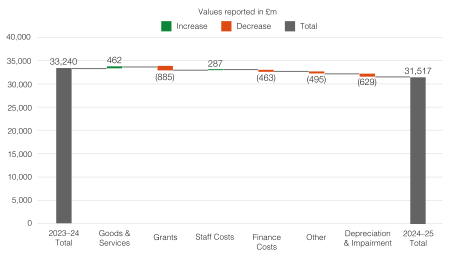
Figure 3: movements in DfT expenditure in 2024 to 2025
Goods and services costs increased in 2024 to 2025 primarily driven by increased expenditure on rail and road network maintenance.
Grant expenditure includes amounts issued to local authorities and mayoral combined authorities for investment in local transport and local roads improvement, in addition to other grant schemes such as support for the local bus sector. Overall grants decreased by £885 million in the year, primarily driven by a decrease in grants to the Greater London Authority (GLA) and Transport for London (TFL).
The TfL capital settlement ended in 2023 to 2024: in 2024 to 2025, DfT provided a smaller grant to TfL which supported the procurement of additional rolling stock for the Elizabeth Line. This decrease in grant spending was partially offset by increases to the Bus Service Operators Grant, a discretionary grant given to eligible community transport operators to help them cover some of their fuel costs and increases in low emission motoring grants including the local EV infrastructure fund and Plug in Van grant.
Staff costs increased due to pay awards during the year.
Finance costs primarily comprise interest charges on legacy debt owed by the group to bondholders. The debt supported investment in infrastructure projects relating to the railway assets now held by Network Rail Ltd and High Speed 1 Ltd. These finance costs decreased in 2024 to 2025 due to a reduction in index linked finance costs on the bonds, in line with the reduction in retail price inflation during the year.
The decrease in other costs primarily reflects 2 technical non-cash movements. Firstly, Network Rail incurred a lower deferred tax charge in 2024 to 2025 than in the prior year; and secondly, National Highways incurred one-off costs in the prior year relating to the detrunking transfer of some A14 road assets from National Highways to local authorities.
Depreciation and Impairment are non-cash costs relating to DfT’s fixed assets. Depreciation costs reflect the consumption of assets in the course of their operational use. Impairments are one-off costs reflecting a permanent drop in an asset’s value: in DfT’s circumstances, material impairments primarily arise where an infrastructure scheme is cancelled.
Depreciation increased in 2024 to 2025 driven by the inflationary increase in the valuation of the railway network. Further detail on the accounting approach to estimating the balance sheet valuation and the associated depreciation charge for the road and railway networks is provided in note 1 to the financial statements.
Impairment costs decreased by £835 million in 2024 to 2025. Impairment costs in the prior year included £1,002 million arising from the cancellation of HS2 Phase 2 from Birmingham to Manchester and £62 million arising from the cancellation of future smart motorway schemes. In 2024 to 2025, DfT incurred £428 million impairments arising from the cancellation of a number of road schemes through the 2024 Spending Audit and Autumn Statement.
Total managed expenditure
Total managed expenditure (TME) represents the total funds spent by DfT against a series of different budget types, which are depicted in figure 4. A comparison of TME in 2024 to 2025 to recent years is shown in figure 5, with 2024 to 2025 values corresponding to the statement of outturn against parliamentary supply. Net cash requirement (NCR) is a separate parliamentary control total which limits the cash funding departments can draw from the Exchequer to finance their TME spending for the year.
Our budget framework
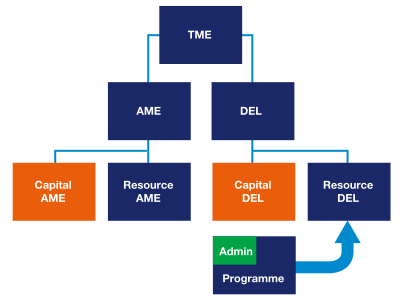
Figure 4: our budgetary framework
The total amount DfT spends is referred to as total managed expenditure (TME); which splits into:
- annually managed expenditure (AME)
- departmental expenditure limit (DEL)
AME expenditure is typically volatile or demand-led. AME budgets are agreed with HMT on an annual basis. DEL expenditure reflects the cost of delivering front-line and back-office activities. Long-term DEL budgets are set through spending reviews which usually occur every 3 to 5 years.
Budgets are also classified into resource and capital.
Resource DEL is further split into:
- Programme budgets for frontline services
- admin budgets such as back-office functions
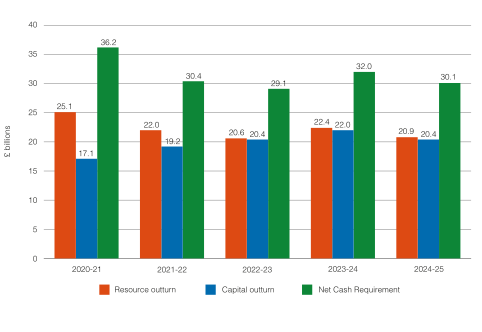
Figure 5: total managed expenditure and net cash requirement by year
Our resource DEL covers the expenditure associated with the day-to-day running of the group, including the costs our arm’s length bodies incur to support delivery of our major projects and to operate and maintain the elements of the transport network they are responsible for.
Our capital DEL covers the major capital programmes described above and other investment to enhance the transport system. Network Rail, National Highways and DfTc received material levels of capital income: these relate to contributions from other bodies towards capital projects.
TME includes our non-cash budget requirements, such as: depreciation in resource DEL; deferred tax and interest accretion charges in Resource AME; and capital provisions in capital AME.
Figure 5 includes our net cash requirement for the year, which represents the department’s total call on taxpayer funds from the Exchequer to finance its spending activities for the year.
Figure 5.1 shows how our biggest areas of capital spend – HS2, Network Rail and National Highways – have evolved in recent years. Spending plans for 2025 to 2026 reflect amounts agreed in main estimate 2025 to 2026. HS2’s capital spending varies by year in line with the construction profile of the project. Capital spending by Network Rail and National Highways is more stable between years, in line with the long-term investment programmes agreed through the Office of Rail and Road (ORR) Control Period and the Road Investment Strategy mechanisms respectively.
In October 2023, ORR issued its final determination for Network Rail’s Control Period 7 funding from 1 April 2024 to 31 March 2029, providing security of long-term investment in the UK rail network. The second Road Investment Strategy (RIS2) ended on 31 March 2025, with RIS 3 expected to run for a full 5 years from 2026 to 2031. Until a new RIS has been set, the arrangements for 2025 to 2026 are covered by an interim settlement for the one financial year.
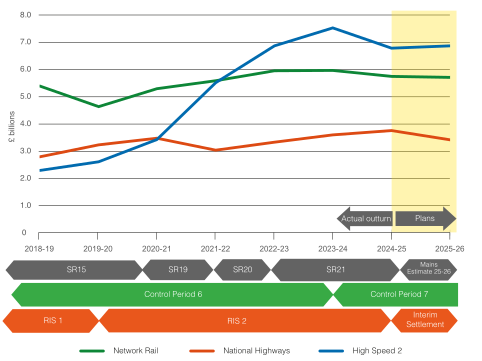
Figure 5.1: key areas of capital spend
Assets and liabilities
| Assets | 2024 to 2025 £m | 2023 to 2024 (restated) £m | Increase / (decrease) £m |
|---|---|---|---|
| Property, plant and equipment, including leases and assets held for sale | 685,302 | 668,007 | 17,295 |
| Receivables | 2,246 | 2,574 | (328) |
| Loans | 2,331 | 2,494 | (163) |
| Investments in equities & associates | 1,181 | 1,191 | (10) |
| Cash | 1,385 | 610 | 775 |
| Inventories | 1,234 | 1,209 | 25 |
| Derivatives | 22 | 72 | (50) |
| Investment properties | 195 | 227 | (32) |
| Pension asset | 1,238 | 92 | 1,146 |
| Intangible assets | 630 | 363 | 267 |
| Total assets | 695,764 | 676,839 | 18,925 |
| Liabilities | 2024 to 2025 £m | 2023 to 2024 (restated) £m | Increase / (decrease) £m |
|---|---|---|---|
| Borrowings | 34,311 | 33,272 | 1,039 |
| Payables | 8,052 | 8,670 | (618) |
| Pensions | 614 | 719 | (105) |
| Deferred tax | 7,630 | 6,995 | 635 |
| Provisions | 1,531 | 1,628 | (97) |
| Derivatives | 67 | 153 | (86) |
| Total liabilities | 52,205 | 51,437 | 768 |
| Net assets | 643,559 | 625,402 | 18,157 |
Note 1.25 in the notes to the financial statements describes why the 2023 to 2024 values have been restated and the impact of the change.
Assets
DfT had £696 billion of assets at 31 March 2025, an overall increase of £19 billion on the prior year. Notable changes are set out below.
As at 31 March 2025, £490 billion of assets related to the Railway Network in Great Britain and £152 billion related to the strategic road network in England, which are the responsibility of Network Rail and National Highways respectively. In addition, the group held assets under construction relating to HS2 of £38 billion. The increase in assets was driven largely by £17 billion additions and £11 billion of revaluation increases, offset by £10 billion of depreciation charges.
Additions to the rail network comprised £2.5 billion of enhancements and £3.7 billion of Renewals. Major schemes included: Transpennine route upgrade; Midland Main Line and East Coast Main Line route enhancements, on-network works relating to East West Rail, and in Scotland, improvements at East Kilbride.
Additions to AUC include £7 billion relating to HS2 construction works undertaken during the year. Additions to the strategic road network comprised: £2.4 billion of capital enhancements including improvements to the surroundings of the network, supporting sustainability, protecting quality of life and the environment and delivering safety and congestion relief schemes; and £1.2 billion of asset renewals.
Significant additions included the M6 Lune Gorge structure scheme and the M62 Ouse Bridge Joint replacement project. The road and railway networks are valued using a depreciated replacement cost valuation methodology as required under HMT financial reporting rules. The revaluation gains represent increases in the estimated cost of constructing a modern equivalent infrastructure asset. DfT’s approach to valuing these assets is set out in notes 1 and 5 to the financial statements.
Investments in equities and associates of £1 billion comprise DfT’s shareholdings in entities which are not consolidated into the financial statements, primarily London & Continental Railways Ltd (LCR), DfT Operator Ltd, Network Rail Insurance Ltd and NATS Holdings Ltd.
Loans decreased by £0.2 billion, primarily driven by £0.1 billion repayment of loans for the Crossrail project made available to the GLA and TfL.
Retirement benefit assets of £1.2 billion represent defined benefit pension schemes which are reporting a surplus of scheme assets over actuarial liabilities at 31 March 2025. Further details are provided in note 24 of the financial statements.
Liabilities
DfT held £52 billion of liabilities at 31 March 2025 (2023 to 2024: £51 billion). These comprise:
- Network Rail has £29 billion (2023 to 2024: £28 billion) of debt payable to bondholders, reflecting third party borrowing entered into before the company joined DfT Group. In addition, £4 billion of debt (2023 to 2024: £4 billion) is payable to institutional investors holding bonds issued by DfT’s finance companies, LCR Finance plc and CTRL Section 1 Finance plc. This stock of debt matures by 2052. The increase in the value of the borrowings during the year is caused by capital accretion on the index-linked bonds, which is accounted for as finance costs.
- £8 billion of trade and other payables (2023 to 2024: £9 billion).
- Network Rail has a total deferred tax liability of £8 billion. This has increased by £0.6 billion since the prior year, due to accelerated tax depreciation and revaluation of the railway network.
- £1 billion of defined benefit pension liabilities, which is £1.3 billion (net of pension surpluses separately disclosed as Assets) lower than last year due to the net effect of changes in key financial assumptions on assets and liabilities. The pension schemes accounted for within this liability are described in note 24 to the accounts: this liability excludes civil servants in the PCSPS, for which accounting rules require that liabilities are recognised in year as the employer contributions fall due.
- £2 billion of provisions, of which £1 billion is for land and property purchases along the HS2 route.
- £1 billion of lease liabilities in respect of right-of-use assets (2023 to 2024: £ 1billion).
Further details can be found in notes 13, 18 to 22 and 24 to the financial statements.
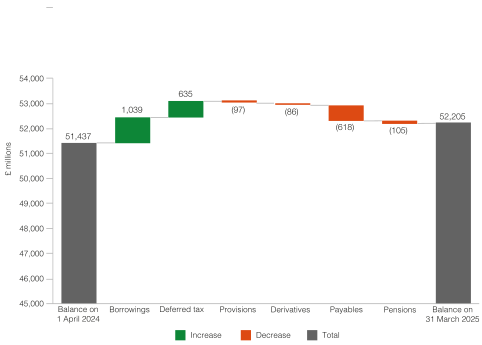
Figure 6: increase / (decrease) in DfT liabilities during the year £m
Train operating companies (TOCs)
In November 2024, the Passenger Railway Services (Public Ownership) Act 2024 obtained Royal Assent. This act provides the legislative framework to bring all 14 TOCs into public ownership. The transfer to public ownership will take place on a rolling programme as the existing contracts with commercial operators come to an end. DfT expects this will conclude by the end of 2027.
The holding company for publicly owned TOCs is DfT Operator Ltd (DFTO), which is a fully owned subsidiary of DfT. DFTO previously served as DfT’s operator of last resort under section 30 of the Railways Act, ensuring continuity of passenger rail services when contracts with commercial operators ended.
In 2024 to 2025, DFTO managed 4 TOCs under these operator of last resort arrangements, which will now remain in public ownership following the passing of the 2024 Act: London North Eastern Railway Ltd, Northern Trains Ltd, Southeastern Trains Ltd, and TransPennine Trains Ltd.
In 2025 to 2026, DfT has commenced the public ownership programme under the Passenger Railway Services (Public Ownership) Act. The South Western contract transferred to DFTO in May 2025 and the Essex Thameside (C2C) contract transferred in July 2025. Alongside the public ownership programme, DfT is establishing Great British Railways to merge responsibility for track and train operations into a single organisation, aiming to simplify operations and improve service quality.
Accounting and disclosure of train operating companies
DFTO and the TOCs are classified by ONS as public corporations. Under HMT’s financial reporting rules, they are therefore excluded from the annual statutory instrument which prescribes DfT’s accounting and budgeting boundary.
A breakdown of DfT’s financial support in 2024 to 2025 to each TOC is provided in note 27, alongside a summary of each TOC’s own most recently published statutory financial results.
For TOCs not yet owned by DFTO, in some cases the most recent published financial results are those for the year-ending 2024. In addition, some TOCs not owned by DFTO apply FRS 102 accounting framework rather than IFRS. For these reasons, the totals shown in note 27 should be considered only as illustrative.
The TOCs’ own financial statements include 2 significant accounting judgements which are material to their balance sheets, arising from the relatively short-term duration of TOCs’ operating contracts with DfT.
Firstly, TOCs limit their recognition under IAS 19 of defined benefit pension scheme deficits and surpluses for their sections of the Railways Pension Scheme (RPS). This adjustment reflects that the time-limited periods of the TOCs’ operating contracts with DfT are significantly shorter than the remaining average scheme duration of these pension sections, and therefore that the long term surpluses and deficits in those pension sections are unlikely to produce any economic benefits or costs to the TOCs during their current contract period, other than the obligation to meet employer contributions as they fall due.
TOCs disclose the full pension scheme deficits and surpluses in the notes to their accounts: a summary of these is also included in note 27 in these financial statements.
Secondly, TOCs limit their measurement of lease liability and right-of-use asset valuations to the shorter of the lease term and the anticipated remaining duration of the TOC’s own contract with DfT. TOCs lease their rolling stock from private sector rolling stock owning companies (ROSCOs). In some cases, this approach produces a materially lower measurement of the lease liability and right-of-use asset in the TOCs’ own financial statements than would be produced if valued for the full remaining lease term.
Based on management information, DfT estimates the gross right of use asset and corresponding lease liability reflecting the full remaining lease term is c.£10 billion. In addition, DfT has issued some guarantees and indemnities to promote long-term investment by ROSCOs into rolling stock, most materially a number of usage guarantees to ROSCOs that future train operators will continue to lease certain rolling stock up to a specified date. The estimated value of these guarantees is disclosed as a remote contingent liability in the parliamentary and accountability report and is partially quantified.
Further information on the train operating companies can be found in the below sections of the financial statements:
- usage guarantees to ROSCOs are disclosed as remote contingent liabilities in the parliamentary accountability report
- financial support for rail services provided by DFT to TOCs through support for passenger rail services is shown as expenditure in note 3.2
- track access charges payable by TOCs to Network Rail for use of the railway infrastructure are shown in DfT Group financial statements as income in note 4
- DfT’s equity investment in DFTO and its TOC subsidiaries already under public ownership is shown in note 12 – an additional summary of DFTO’s own financial results for the year is provided in note 26.2
- a summary of DfT’s transactions with each TOC in 2024 to 2025 is shown in note 27 – note 27 also provides a summary of the TOC’s most recently published financial position and financial performance
- those TOC contracts which have passed into public ownership since 31 March 2025 are disclosed as after the reporting period in note 31
Future outlook
HMT’s Spending Review 2025 was published in June 2025 and saw the conclusion of a significant piece of work for DfT, setting future year budgets up to 2028 to 2029 for resource DEL and 2029 to 2030 for capital DEL expenditure.
At the heart of the settlement, DfT has secured a clear commitment to protect vital public transport services, maintain and renew our infrastructure, and invest in the long-term future of our transport system. This plan will deliver improvements to roads, rail and local transport - and build for the future, supporting growth, housing and sustainability in every region. The ongoing financial risks to the deliverability of this capital programme are managed through the mitigating actions identified for DfT’s affordability principal risk.
Excluding HS2, capital DEL spending will continue to increase at an average real terms growth rate of 3.9% per year between 2025 to 2026 and 2029 to 2030.
Resource DEL spending will be more constrained and decrease over the remaining period of this Parliament; this is in line with the wider government fiscal position as DfT and wider government seeks to deliver more with less, and also aligns with DfT’s intent to reduce the net subsidy provided to train operators.
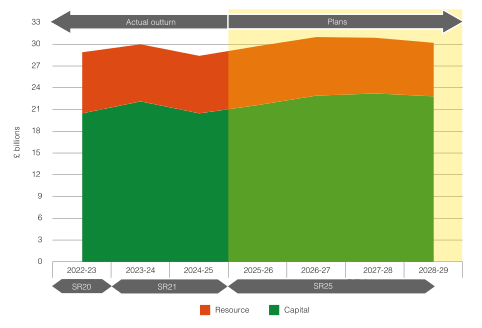
Figure 7: total net expenditure (exc. depreciation) split between capital and resource net expenditure
Nick Joyce
Director General, Corporate Delivery Group
DfT’s priority outcomes and strategic enablers
DfT’s priority outcomes have been crafted in-year to align with the government’s ‘Plan for Change’. These priority outcomes are interconnected, and DfT recognises the natural cross-cutting nature of these outcomes. They are also supported by a new suite of performance metrics to measure progress in delivering these outcomes.
DfT’s priority outcomes are:
-
Growth (including place, freight and housing) – boosting economic growth through a transport network and improved infrastructure that, together with freight, housing, skills, innovation and trade, raises living standards and productivity for people, places, and businesses across the country.
-
Greener, safer and healthier transport – continue the greening of transport to meet environmental targets, adapt to climate change, and improve public health by enabling walking, wheeling and cycling, promoting cleaner air, improving road safety and other key interventions, contributing to a more resilient and future-ready NHS.
-
Improving transport for people – improving the transport system to focus on people’s needs, ensuring it is safe, accessible, reliable and integrated, enabling people to access work, essential services and opportunities.
Delivery of DfT’s priority outcomes are guided by 4 strategic enablers:
-
Safety, security and resilience – transport connects people and places, enabling increased prosperity and quality of life. It is therefore vital that the transport network remains safe, secure and resilient. DfT works with industry, international partners, and the rest of government to mitigate against a wide range of current and future risks and threats – bolstering the UK’s national security foundation.
-
Science, innovation, technology and data – science underpins policy and decision-making, innovation creates new solutions to key challenges, technology offers opportunities to transform the transport system and data is the lifeblood that provides the insights to design a better future. Together, they are essential to DfT and the transport sector to deliver goals of a green, safe, inclusive and efficient transport system which are critical to supporting productivity and growth.
-
International – in an increasingly interconnected but uncertain world, with a rapidly changing geopolitical landscape, domestic and international policies are now inextricably intertwined, with global events directly impacting on delivery of our domestic transport objectives. It is therefore essential for the UK to engage confidently in the international system to deliver a safe, resilient and sustainable transport for the benefit of passengers and UK businesses.
-
An excellent department – this enabler supports more efficient working across all DfT sites by building on existing foundations to drive ongoing improvement and flexibility. Aligned with the Places for Growth 2030 ambition, it promotes a Civil Service that’s better connected to communities across the country. It also helps attract talent by investing in skills and fostering a supportive, fulfilling workplace. Ultimately, this will strengthen DfT’s ability to address complex transport challenges and deliver best value for taxpayers.
Performance overview: DfT’s ‘performance on a page’
Growth
Boost economic growth through a transport network and improved infrastructure that, together with freight, housing, skills, innovation and trade, raises living standards and productivity for people, places, and businesses across the country.
Place, housing and infrastructure
- £1.3 billion funded into East West Rail
- 73% of all tunnel drives completed for HS2
- £415 million funding boost for the Transpennine route upgrade
Freight
- £1.2 billion invested into renewing the strategic road network
- the development consent order for the construction of the Lower Thames Crossing was approved
Greener, safer and healthier transport
Continue the greening of transport to meet environmental ambitions, adapt to climate change, and improve public health by enabling walking, wheeling and cycling, promoting cleaner air, improving road safety and other key interventions, contributing to a more resilient and future-ready NHS.
Greener
- +75,000 public charge points installed in total
- +2.2,000 zero emission buses funded
- Sustainable Air Fuels Mandate came into law, requiring 2% of jet fuel to be SAF
Safer
- £500 million in funding uplift confirmed by the Chancellor for local highway maintenance for 2025 to 2026 and made available to local authorities responsible for delivery of this crucial maintenance work
Healthier
- £291 million of investment into 300 miles of walking, wheeling and cycling routes, encouraging 30 million healthier journeys every year
- 6.5% reduction in NOx emissions
Improving transport for people
Improving the transport system to focus on people’s needs, ensuring it is safe, accessible, reliable and integrated, enabling people to access work, essential services and opportunities.
Safe
- Automated Vehicles Act received Royal Assent, enabling the deployment of safe self-driving vehicles on Great British roads by 2027
- 822 stations installed, in total, with platform edge tactile pavements
Accessible and reliable
- launched the cross-government motor insurance taskforce to tackle the high cost of motor insurance
- 83% of disabled users were ‘very’ or ‘fairly’ satisfied with their bus journey, up 4% on last year
Integrated
- 6,000 responses to our ‘call for ideas’ to help shape our integrated national transport strategy
- Shadow Great British Railways formed, a significant step toward implementing Great British Railways
Performance analysis
Priority outcome: growth (including place, freight and housing)
Boosting economic growth through a transport network and improved infrastructure that, together with freight, housing, skills, innovation and trade, raises living standards and productivity for people, places and businesses across the country.
Summary
Kickstarting economic growth is the number one mission of this government, in order to create more jobs, put more money in peoples’ pockets and help rebuild Britain.
As noted by the National Infrastructure Commission’s Second National Infrastructure Assessment transport connectivity is vital for good growth, ensuring access to social and economic opportunity, reducing business costs through the efficient movement of goods and enabling agglomeration, and unlocking land for housing and commercial development.
DfT has driven forward a range of activity to catalyse these mechanisms in the short, medium and long-term, to ultimately boost productivity, living standards and quality of life.
DfT has prioritised boosting economic growth in the UK through a transport network and improved infrastructure that, together with freight, housing, skills, innovation and trade, raises living standards and productivity for people, places, and businesses across the country.
DfT’s primary contribution to the growth mission is by increasing connectivity between people and organisations, boosting the economic density of the country. This catalyses growth’s 4 main channels: lower costs, better ideas, more jobs and stiffer competition.
| Region | National connectivity score |
|---|---|
| South West (England) | 61.9 |
| South East (England) | 66.9 |
| London | 85.8 |
| East (England) | 64.5 |
| West Midlands | 72.1 |
| East Midlands | 67.4 |
| Yorkshire and the Humber | 70.0 |
| North West | 74.3 |
| North East | 72.5 |
| England | 71.1 |
Core metric 1: overall national connectivity metric by region in the UK
DfT’s core metric on overall national connectivity (see core metric 1) measures how well-connected the average postal code is to services and employment opportunities. The regional comparison illustrates how connectivity in London has outpaced other English regions. This is a newly developed metric and will be reported annually.
As of June 2025, DfT have produced a version that uses much more recent data. Therefore, the time lag is variable by input source. Over time, the aim is to see all scores rising, particularly connectivity outside of London, raising productivity and boosting economic growth. DfT has invested over £1 billion in funding to local highway authorities across England to maintain and improve road surface conditions.
DfT also tracks connectivity to employment (core metric 2) – the ease by which people can reach employment opportunities using the transport network. This metric helps to understand how transport improvements are expanding skills to match productivity.
This core metric is calculated using a combination of travel time data and accessibility metrics. Since this metric is a relative measure – meaning that the score for each postal code is placed on a relative scale between 1 and 100 – the aggregate measure for England will become insightful once DfT begins to track its progress over time to illustrate how effective our delivery plans have been in driving connectivity to employment.
In 2024 to 2025, DfT continued to deliver its portfolio of committed major infrastructure projects, driving economic growth in the immediate term by creating jobs and stimulating investment, and boosting productivity in the longer term through improved connectivity.
Significant progress was made on the Transpennine route upgrade (TRU), with electrified services launched, new stations opened, and over £7.4 billion committed, around 75% of the total projected cost. This critical investment strengthens connectivity between northern economic hubs and enhances reliability for both passengers and freight.
Delivery of HS2 also advanced at pace, with 73% of tunnelling completed and major engineering milestones reached, including the Colne Valley viaduct becoming the UK’s longest rail bridge. HS2 is set to unlock tens of thousands of jobs and homes across the West Midlands and West London, catalysing regeneration and regional growth.
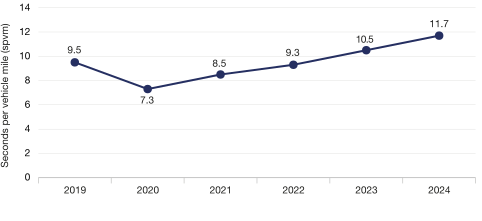
Core metric 3: average delays on the strategic road network from 2019 to 2024
The strategic road network (SRN) remained a cornerstone of our growth agenda, with £1.2 billion invested in maintenance and upgrades to ensure efficient connections to ports, airports, and distribution centres. This year’s programme focused particularly on freight resilience.
While average delays on the SRN have increased since 2020, short-term impacts from works such as the smart motorway national emergency area retrofit (NEAR) programme and shifting traffic profiles (for example, more HGVs and speed-limited vehicles) are being managed to ensure long-term asset reliability and performance.
In parallel, DfT progressed its transport devolution agenda, launching the devolution priority programme with the Ministry of Housing, Communities and Local Government (MHCLG) and publishing the English Devolution White Paper, paving the way for 6 new mayoral areas. Integrated settlements in Greater Manchester and the West Midlands provided local leaders with greater control over strategy and delivery, marking a shift toward more locally driven, outcome-focused infrastructure planning.
To align housing and transport planning, DfT embedded an integrated approach across Government programmes. This includes supporting MHCLG led schemes like the long-term housing strategy (publishing July), the new towns programme, and the new homes accelerator.
A major innovation was the development of the DfT connectivity tool, believed to be the most sophisticated measure of connectivity yet, which will guide sustainable housing growth by helping local authorities identify and unlock well-connected development sites.
DfT’s investment in green and innovative transport continues to support the UK’s longer-term productive capacity. For example, promoting sustainable aviation fuels (SAF) is helping to grow new green industries, while the Automated Vehicles Act creates a regulatory environment that could unlock £42 billion in industry value and up to 38,000 skilled jobs.
Together, these initiatives reflect DfT’s commitment to a modern, integrated transport network that supports jobs, drives innovation and boosts UK productivity.
Areas of work
Key progress made under this priority outcome is summarised below.
Rail connectivity programmes
DfT’s rail connectivity programmes are central to the UK’s strategy for enhancing national infrastructure and driving sustainable economic growth. By investing in improved rail links across cities, regions, and rural areas, this workstream aims to reduce journey times, increase capacity, and boost reliability–making it easier for people to access jobs, businesses to reach markets and communities to thrive.
From major upgrades on key intercity routes to the development of regional rail schemes, these programmes not only support a more efficient and integrated transport network but also unlock opportunities for investment, productivity and regional development across the country.
High Speed 2 (HS2)
Despite challenges, DfT continues to make good strides forward with HS2, a new high-speed railway that will provide much-needed extra capacity between London and Birmingham, as well as faster and more reliable trains from London to Manchester, Liverpool and Scotland.
After years of repeated cost increases, the government is committed to bringing the project under control. DfT has taken action to bring the project back on track, including reviewing HS2 Ltd.’s main works civils contracts to make sure they deliver the best possible value for taxpayers and reinstating ministerial oversight to ensure greater accountability.
DfT has tasked the new CEO of HS2 Ltd, Mark Wild, with undertaking a comprehensive reset of the programme to recommend revised cost and schedule estimates and deliver the remaining work at the lowest reasonable cost. This work will continue over the coming months, and the government will report on progress.
The government is also committed to bringing HS2 to Euston, with funding confirmed to proceed with tunnelling from Old Oak Common to the central London terminus. This public investment will catalyse private investment into Euston station and the local area and support national growth. DfT continues to work with key partners to develop affordable, integrated plans for the HS2 station and the wider Euston station campus – including redeveloping the existing station – and is evaluating different models of delivering and financing the works.
In the meantime, HS2 is well into its construction phase and being delivered between London and the West Midlands, including four new stations. HS2 tracks will end with 2 branches in the Midlands: one to Curzon Street station in central Birmingham and one to Handsacre Junction, near Lichfield. From there, HS2 trains will be able to travel on to Liverpool, Manchester and Scotland via the West Coast Main Line.
Research from the February 2024 report ‘From trains to cranes: HS2 and the West Midlands’ development boom’ estimates that HS2 will add £10 billion to the West Midlands’ economy over the next 10 years. The report predicts HS2 will bring about the delivery of over 41,000 new homes and over 30,000 new jobs within HS2’s West Midlands impact zones.
Research from the March 2025 report ‘From trains to cranes: HS2 and the West London development boom’ predicts that HS2 will add £10 billion to the west London economy over the next 10 years. The report highlights the prediction of over 22,000 new homes and over 18,000 new jobs within the Old Oak Common impact zone.
The 2 reports highlight that both the West Midlands and west London have already seen a significant increase in the number of planning applications and planned homes since Royal Assent in 2017.
2024 to 2025 – key delivery: In September 2024 the Colne Valley viaduct’s 2.1-mile-long deck was assembled. With the installation of the 1,000th deck segment, it became the UK’s longest rail bridge.
HS2 Ltd, to date, has successfully completed 73% of the tunnel drives across the length of the route.
Transpennine route upgrade (TRU)
DfT continued to deliver the TRU, a £11 billion modernisation programme for the key East-West rail link across the north of England from Manchester to York, via Huddersfield and Leeds. The improvements will enable faster and more frequent passenger services and provide significant additional freight capacity. The investment will also improve the reliability of assets and drive up the performance.
2024 to 2025 – key delivery: In spring 2024, DfT announced an additional £415 million funding injection into TRU, meaning £7.4 billion has been committed to date which represents c.70% of the total expected cost.
In spring 2024, diversionary route capacity was delivered for 3 routes (Calder Valley, Castleford, and Healey Mills) to keep passengers moving during line closures.
In the summer of 2024, Network Rail contracted the 2 largest sub-projects of the TRU programme between Huddersfield, Leeds and Church Fenton.
In December 2024, Northern and TransPennine Trains commenced the operation of electricfied services between Manchester Victoria and Stalybridge and this was the first phase of electrifying the whole route. The second phase (York to Church Fenton) will open for electric services by the middle of 2025.
Northern Powerhouse Rail (NPR)
NPR will improve east-west connectivity across the North, connecting people and businesses more effectively. It will build on the improvements achieved through the TRU upgrade to boost economic growth in the north of England by better connecting people, jobs, and places.
NPR will deliver more frequent, reliable, and accessible rail services between the cities of the north and other significant economic centres, opening fresh opportunities, including access to more and higher-paid jobs. DfT announced in the Autumn Budget that it is maintaining momentum on NPR by progressing planning and design works to support future delivery.
NPR is the government’s long-term programme to further improve rail connectivity in the North of England, building on the TransPennine Route Upgrade. It will provide faster and more frequent services between the key economic centres, including Liverpool, Manchester, Bradford, Leeds, Sheffield and York; delivering improvements to rail capacity and journey times via electrified, upgraded, and new railway lines.
2024-2025 – key delivery: Throughout the year, HS2 Ltd have advanced strategic scheme development for the geography between Liverpool and West Yorkshire.
Throughout the year, design options for stations at both Manchester Airport and Manchester Piccadilly have been revised.
Throughout the year, Network Rail continued the next stage of design work for several NPR upgrade corridors in Yorkshire, including Leeds, Sheffield and Bradford.
In February 2025 the first iteration of Bradford’s strategic outline business case was completed.
NPR’s accounting officer assessment was completed in March 2024 under the previous government and publication was delayed during the general election, with the AOA being published in July 2024 demonstrating responsible financial management, strengthening public trust in NPR’s use of public funds.
Northumberland Line
The Northumberland Line runs from Ashington and Blyth to Newcastle and is vital for connecting people in southeast Northumberland to education, employment, and leisure opportunities. Passengers can currently travel from 3 new stations (Ashington, Seaton Delaval and Newsham) into Newcastle Central and Manors. The remaining 3 stations (Blyth Bebside, Northumberland Park and Bedlington) are due to open by the end of 2025, which Northumberland County Council will confirm in due course.
2024 to 2025 – key delivery: In December 2024, the Northumberland Line reopened for passenger services, marking the first time in over 6 decades that passengers could travel between Ashington and Newcastle on this railway line.
In June 2025, the line achieved the milestone of 400,000 passenger journeys since reopening.
West Midland Trains (WMT) and stations
WMT operates under 2 brands - Northwestern Railway (LNR) and West Midlands Railway (WMR). Through the LNR brand, they facilitate connections between London and the Midlands and the North West, while WMR operates train services in the West Midlands region.
West Midlands Rail Executive (WMRE), with whom DfT jointly manages the operator contract, is currently building new stations along the Camps Hill Line and the Darlaston Line. This initiative aims to enhance rail connectivity to Birmingham City and thereby improve access for residential communities in the surrounding areas.
2024 to 2025 – key delivery: Successful entry into service of the Class 730 3-car fleet, enabling the transition of Cross City services from the older Class 323 fleet to the modern Class 730 electric multiple units (EMUs) with greater capacity.
Received delivery of 18 5-car Class 730 trains, which began entering into service on 9 June 2025, following resolution of technical issues (related to cab noise) and driver training.
East Midlands Railway (EMR)
EMR serves routes across the East Midlands and beyond. EMRs new Aurora bi-mode trains will run using electric overhead lines from the £1.5 billion Midland Main Line upgrade and will cut harmful emissions by up to 90% compared to the legacy high speed trains.
A £60 million programme funded by the rolling stock companies which is being paid back via increased lease charges for the trains, to refurbish East Midlands Railway regional and Connect fleet, commenced and will continue over the next few years. With the introduction of the new Aurora Intercity trains, over the next few years all EMR trains will either be replaced or refurbished.
2024 to 2025: key delivery: In November 2024, an extension to Etches Park Depot was completed, which is now ready for the 33 new Aurora bi-mode trains that are being built by Hitachi in the north-east of England through a £400 million contract, which is also funded by the rolling stock companies and are due to replace EMR’s current Intercity fleet. These should enter service in late 2025.
Midlands Rail Hub (MRH)
MRH supports the government’s mission to kickstart economic growth and break down barriers to opportunity, by upgrading connectivity and reliability, delivering benefits right across the Midlands and across the country. This means providing capacity for over 100 extra trains per day into central Birmingham and improving the performance of services which run through New Street station, by making better use of Moor Street station.
2024 to 2025: key delivery: In February 2024, DfT announced £123 million in funding for design work to begin on Midlands Rail Hub. The first phase could be complete by the early 2030s.
East West Rail (EWR)
EWR is a new railway which aims to unlock growth for Oxford, Milton Keynes, Bedford, Cambridge and beyond. It will transform connectivity for residents and businesses, supporting economic growth and local housing plans.
EWR is split into 3 connection stages:
- connection stage 1 (CS1) will create a direct rail service from Oxford to Bletchley and Milton Keynes
- connection stage 2 (CS2) will provide services between Oxford-Bedford
- connection stage 3 (CS3) will provide the full service from Oxford-Cambridge and is subject to further public consultation before a development consent order application is submitted
2024 to 2025: key delivery: In the Autumn Budget, the Chancellor announced that CS2 works would be accelerated to allow EWR services to reach Bedford from 2030, with the full CS3 Oxford-Cambridge services due to begin in the mid-2030s.
In December 2024, the infrastructure for connection stage 1 was completed.
In March 2025 DfT announced Chiltern as the operator for the first (CS1) services between Oxford, Bletchley and Milton Keynes, due to commence later this year.
Major road and local transport funding
This workstream forms a crucial part of the government’s wider strategy to improve connectivity, support economic growth and enhance the reliability of England’s Road infrastructure.
Initiatives like the major road network and large local majors programme sit alongside traditional local transport fstreams, including City Region Sustainable Transport Settlements and wider local transport funding, helping to reduce regional disparities and unlock local growth.
These investments support economic growth by reducing journey times, improving business productivity, and enabling housing development. For freight, they offer critical reliability, reduce fuel costs, and enhance last-mile access to key sites such as ports, distribution hubs, and freeports. By easing strategic bottlenecks and aligning with decarbonisation goals through smarter traffic flow and modal shift opportunities, this workstream complements a broader effort to build a more integrated and resilient freight network.
Major road network (MRN) and large local majors (LLM) programmes
The MRN programme provides a route for local authorities to seek DfT funding for schemes on the middle tier of England’s busiest and most economically important local authority ‘A’ roads. Interventions include enhancements and structural renewals. DfT can contribute up to 85% of scheme costs with schemes costing c.£20 to £250 million+.
The MRN programme has 5 strategic objectives:
-
Reduce congestion, through investments which enhance roads on the MRN, making it better able to cope with demand by adding capacity.
-
Support economic growth and rebalancing, through investments into the MRN that connect people and businesses to markets and international gateways, boosting economic productivity. This makes places more attractive, encouraging investment. Schemes can also provide benefits of improved resilience, including from climate change impacts. The schemes provide a regional spread across England.
-
Support housing delivery, ensuring that the programme supports the delivery of thousands of new homes.
-
Support all road users, through local authorities that are required to consider the needs of and deliver benefits for all users.
-
Support the SRN and ensure a seamless transition between the MRN and SRN.
Since its inception in 2019, the MRN programme has been instrumental in improving major local authority-managed roads through the development of over 90 schemes with a cost of £7.45 billion, of which DfT contribution is £5.44 billion.
The LLM programme was set up in 2016 to cater for the small number of exceptionally large local highway authority transport schemes that could not be funded through the normal routes. The process for submitting scheme proposals for the LLM programme aligns with the MRN investment planning process.
Work in this area is also directly linked to DfT’s priority outcome to deliver greener, safer and healthier transport, with work to repair our local highways being a key in ensuring safer roads.
2024 to 2025: key delivery: In 2024 to 2025, the programme has made substantial progress, with £205 million in funding paid across multiple regions to support the continued delivery of schemes despite challenges such as inflationary costs in construction, constrained local authority budgets, and delays due to the General Election and new government policies.
Throughout the year, 3 schemes opened to the public: Lake Lothing Third Crossing in Suffolk and Redbridge Causeway in Hampshire (both opened in September 2024); and North Devon Link Road in December 2024.
Seven schemes also began construction during 2024 to 2025 with a combined government funding commitment of over £190 million.
City Region Sustainable Transport Settlements (CRSTS)
DfT’s CRSTS programmes provide eligible city regions and local authorities with funding to invest in transport infrastructure.
DfT is now more than halfway through the first 5-year CRSTS period, with many schemes completing development and entering their delivery phases.
It is worth noting that the SR25 announced that Transport for City Region (TCR) settlements to follow CRSTS from 2027-28 to 2031-32, and that funding would increase to £15.6 billion. Over £500 million of the £15.6 billion TCR funding has been brought forward into 2025 to 2026 and 2026 to 2027 to enable preparation and early delivery of programmes.
2024 to 2025: key delivery: In July 2024, the West Yorkshire Combined Authority delivered the £20 million ‘Halifax bus station’ project – bringing a modern, fit-for- purpose bus station into the town centre.
In October 2024, an additional £200 million was allocated to CRSTS projects. This includes an uplift in revenue funding to support development and acceleration of projects, both in CRSTS1 and CRSTS2.
In December 2024, the Northeast Mayoral Combined Authority agreed their £563 million CRSTS1 plan, which runs until 2027 – this will see the delivery of the North Shields Ferry Landing, additional gate lines for the Metro and the new Sunderland station central entrance.
Throughout the year, Greater Manchester have delivered the £4.5 million Bolton carriageway maintenance scheme, improving the quality of their key route network.
Transforming Cities Fund (TCF)
DfT’s TCF is an initiative that invests in public and sustainable transport infrastructure that improves connectivity and reduces congestion across the country.
Allocations for this year’s TCF programmes have been paid to cities, and this completes the final funding for the programme.
2024 to 2025: key delivery: In March 2025, Leicester completed delivery of their £40 million TCF programme. The funding has been used to provide a new orbital city centre electric bus service; improve park and ride provisions; prioritised bus measures/lanes and cycling and walking routes; and improved city connectivity.
In March 2025, Portsmouth completed delivery of their £60 million TCF programme. The funding has been used to provide new and improved bus corridors; walking and cycling improvements; Ryde transport hub, highway and bus interchange and rail station improvements on the Isle of Wight.
At 2024 to 2025-year end, TCF cities had completed 92% of delivery milestones programme wide.
Local transport funding
DfT’s local transport funding improves transport in our smaller cities, towns, villages and rural areas.
This includes funding to progress transport-related Levelling Up Fund projects (such as delivering new and improved cycling and walking routes, upgrading road junctions, installing new EV charging, and rail station upgrades) and the integrated transport block (ITB).
DfT recently confirmed funding allocations for 2025 to 2026 for the ITB and additional resource funding for local authorities and announced allocations for the one-year local transport grant (LTG) in 2025 to 2026 for specific local authorities
2024 to 2025: key delivery: Throughout 2024 to 2025, DfT progressed on 54 Levelling Up Fund transport schemes in 2024 to 2025; and allocation of £170 million ITB funding was made to local authorities to deliver small local transport renewals and enhancements.
Lower Thames Crossing (LTC)
The LTC is a key part of the government’s Plan for Change and will support delivery of missions including driving economic growth and drive towards clean energy through its revolutionary approach to building new infrastructure by delivering a new blueprint for net-zero construction using hydrogen.
It is a new 14.3-mile road and tunnel which will pass under the river Thames connecting Kent and Essex. It will almost double the road capacity across the river Thames east of London and is the largest single road investment project in the UK since the M25 was completed more than 30 years ago
2024 to 2025: key delivery: In January 2025, the Chancellor announced that DfTc and National Highways were exploring all funding options for the LTC, including private finance.
In March 2025, the Lower Thames Crossing was granted development consent by the Secretary of State.
Bus reform and Initiatives
DfT has been working to control bus travel costs, encouraging greater use of it as a mode of transport, particularly for lower-income communities, thereby improving access to jobs, education, and services, putting more money into people’s pockets. The Bus Services Bill will deliver on the government’s manifesto commitment to reform funding and give greater control to local leaders for bus services, strengthens local powers to plan and manage services, helping ensure networks better align with economic needs.
Bus Services Bill (No.2)
DfT is delivering the government’s manifesto commitment to reform funding and give greater control to local leaders for bus services and local transport priorities.
The Bus Services Bill (No.2) is a key part of the government’s bus reform agenda, aimed at improving the passenger experience and increasing bus usage. The bill will grant local leaders the ability to choose the best bus service management model for their areas, whether that be franchising, strengthened enhanced partnerships with private operators, or local authority owned bus companies.
The bill will aim to make bus travel more accessible and inclusive and accelerate the decarbonisation of bus services. It will also devolve grant design and payment powers to local transport authorities (LTAs), giving them greater control over bus funding.
DfT are expecting Royal Assent later into 2025, subject to parliamentary time. Once achieved, there will be a programme of Statutory Instruments, alongside guidance published by DfT, to implement the bill’s measures. The bill was preceded by a statutory instrument that opened the ability to franchise bus services to all LTAs. Prior to this, only Mayoral Combined Authorities or Mayoral County Combined Authorities were able to franchise.
2024 to 2025: key delivery: In the Autumn Budget, the Chancellor announced over £1 billion of investment in 2025 to 2026 to support and improve bus services in England outside London and keep fares affordable, reinforcing its commitment to improving bus services.
In December 2024, DfT published updated bus franchising guidance and delivered a statutory instrument which grants bus franchising powers to all LTAs in England.
Demand responsive transport (DRT) trials
DRT trials supported by DfT’s £20 million Rural Mobility Fund (RMF) have continued, with all but 2 schemes now launched.
Some schemes have now completed their initial pilot period but continue to operate either in a similar way or have expanded, including Nottinghamshire and Surrey who have added new zones to their DRT operations. The rural mobility fund evaluation: interim report was published in September 2023 and a further final process evaluation report will be published in the latter half of 2025, with a value for money and impact evaluation expected to be published in the latter half of 2026.
DRT schemes supported by bus service improvement plan funding are operating in multiple areas across England, including East and West Sussex and the West of England. These schemes are run by LTAs with further details found on each of their websites.
2024 to 2025: key delivery: In March 2024, Derby City Council initiated the procurement process for a new DRT service targeting underserved southern areas of the city.
By November 2025, Hertfordshire’s HertsLynx service had reached 50,000 passenger journeys, demonstrating its effectiveness in connecting rural communities to key hubs.
National bus fare cap (NBFC)
The NBFC helps millions of people across the UK to access better opportunities, thanks to investment of more than £150 million. The £3 NBPC replaced the £2 fare cap, which was in place from January 2023 until the end of 2024, helping passengers to save on their regular travel costs.
The increase in the fare cap from £2 to £3 was necessary as maintaining the lower cap would have required significant additional funding, which is not affordable within DfT’s current baseline. The fare cap was originally introduced as a short-term cost-of-living intervention. However, it becomes increasingly expensive to sustain over time due to inflation driving up industry costs and widening the gap between the cap and commercial fares. The longer the cap remains in place, the harder it becomes to withdraw, as passengers become more anchored to the subsidised fare and competition between operators diminishes.
The monitoring and evaluation of the £2 NBFC report found that the scheme met its 2 objectives, which were to reduce the cost of living, particularly for low-income households, and to support recovery in bus patronage.
The £2 NBFC contributed approximately a 5% increase in bus patronage compared to the previous year. Bus operator data suggests that £2 NBFC led to a 27% reduction in the price of single tickets, which cost more than £2 before the scheme was introduced. DfT anticipate that the £3 NBFC will continue to enable additional bus journeys and improve access to jobs, education, and services.
2024 to 2025: key delivery: In November 2024, DfT announced the £3 NBFC on single bus fares in England outside London from 1 January 2025 through to 31 December 2025.
In February 2025, a report covering the first 10 months of the initial £2 NBPFC was published.
English devolution
This workstream is working to allow areas to tailor transport policies, spending, and services to local needs and priorities. In England, devolution has taken shape through the creation of Mayoral Combined Authorities and bespoke devolution deals, granting regions greater control over budgets and long-term investment.
Devolution is seen as a key mechanism for driving regional growth, improving public services, and addressing inequalities by empowering local leaders to deliver place-based solutions and unlock economic potential more effectively than top-down governance alone.
The English Devolution White Paper
DfT is delivering the government’s manifesto commitment to empower mayors to create integrated transport systems and ensure efficient infrastructure delivery.
The government outlined its plans to widen and deepen devolution in the English Devolution white paper in December 2024.
The white paper sets out a new, standardised devolution framework which will be set in legislation for the first time. The framework includes powers and functions which will help unlock regional growth, delivering on the government’s Plan for Change.
It will empower local leaders to have greater control over their local transport networks and greater influence over rail and our strategic road network.
The government also announced the devolution priority programme in February 2025 – one of the largest-ever packages of mayoral devolution in England – to support 6 new areas to become mayor-led strategic authorities by May 2026. This builds on the progress already made to extend devolution across the UK and would see 80% of England or over 44 million people, benefitting from devolution.
Local transport is a key pillar of the first cross-departmental integrated funding settlements developed for launch with Greater Manchester and West Midlands Mayoral Combined Authorities in the first instance in April 2025. Integrated settlements, which will be extended to other ‘established strategic authorities’ in future, giving local leaders the ability to move funding between themes, with delivery assessed against agreed outcomes and outputs.
Greater autonomy and flexibility in how local leaders spend their budgets should facilitate increasingly joined-up planning and policymaking and better- targeted interventions, resulting in higher value for money and improved outcomes.
2024 to 2025: key delivery: In December 2024, the MHCLG published the English Devolution White Paper.
In February 2025, Places were confirmed in the devolution priority programme, DfT is actively engaging with the 6 confirmed places.
Airport and seaport planning and infrastructure
This workstream is critical to economic growth as airports and seaports act as gateways for international trade, tourism, and investment. Efficient, well-connected airports and seaports support supply chain resilience, reduce costs for businesses, and enable faster movement of goods and people.
Heathrow runway expansion
The government supports and is inviting proposals for a third runway at Heathrow, and will review the Airports National Policy Statement. This provides the basis for decision making on granting development consent for a new runway at Heathrow, to ensure that any scheme is delivered in line with our legal, environmental and climate obligations.
Promoters have been asked to submit proposals to the government in the summer of 2025, with the goal of securing planning permission before the end of the next parliament.
2024 to 2025: key delivery: In January 2025, the government officially supported and has invited proposals for a new third runway at Heathrow Airport and committed to review the Airports National Policy Statement when these proposals are received.
London City Airport expansion
London City Airport’s expansion plans aim to increase annual passenger capacity from 6.5 to 9 million by 2031, while maintaining the existing flight cap of 111,000 per year.
2024 to 2025: key delivery: In August 2024, DfT approved the plan to expand London City Airport. The approval includes additional early morning flights on weekdays but rejects proposals to extend Saturday afternoon operating hours.
London Stansted expansion
London Stansted is working to extend its terminal and enhance the passenger journey, which is expected to double the airports economic contribution and create up to 5,000 new jobs in the area. The airport has since submitted a further planning application to increase its annual passenger limit from 43 million up to 51 million passengers by the 2040s.
2024 to 2025: key delivery: In October 2024, the Secretary of State welcomed Stansted’s £1.1 billion investment alongside the launch of the government’s industrial strategy.
London Gatwick Airport
An application for a DCO has been made by Gatwick Airport Limited to bring their existing Northern runway into routine use alongside their main runway. Gatwick estimates the airport could serve around 75 million passengers per annum by 2038, compared to 46.6 million in 2019.
2024 to 2025: key delivery: Following the Planning Inspectorate’s report and recommendation, the Secretary of State issued a ‘minded to approve’ letter, recommending an alternative DCO including a range of controls on the operation of the scheme.
Gatwick responded to the Secretary of State in the April 2025. Following a 6 week consultation, the Secretary of State will now review all information provided before making a final decision by 27 October 2025. If approved, construction could begin by the end of the year.
Luton Airport expansion
Luton Airport aims to expand its passenger capacity via the construction of a new passenger terminal and additional aircraft stands. It is estimated that a London Luton Airport handling 32 million passengers per annum by the mid-2040s could support delivery of almost 11,000 new jobs.
The contribution of an expanded London Luton Airport could provide an additional economic benefit of £1.5 billion every year.
2024 to 2025: key delivery: The Secretary of State approved Luton Airport’s development consent order in April 2025.
Doncaster Sheffield Airport reopening
The government will work with City of Doncaster Council and the Mayor of South Yorkshire to support efforts to re-open Doncaster Sheffield Airport as a regional airport.
2024 to 2025: key delivery: The government has established a working group to support local efforts to reopen the airport and unlock wider benefits in the region.
Freight
A strong, integrated freight network is essential to unlocking economic growth in the UK, as it enables the efficient movement of goods across the country. This supports everything from manufacturing and retail to agriculture and e-commerce.
When freight can move reliably and quickly by road, rail, sea, or air, businesses enjoy lower transport costs, reduced delays, and greater productivity.
Strategic road network (SRN)
The SRN is a critical piece of England’s infrastructure, connecting millions of people and businesses every day, right across the country. The SRN carries two-thirds of the miles that lorries drive and linking most major ports and airports, it is vital to maintain a free-flowing network, operated to a high standard, to support economic growth.
DfT has already invested a record £5.1 billion through the second Road Investment Strategy (RIS2). Including completing works on 7 major enhancements, from A1 Birtley to Coal House in the north-east, to A30 Chiverton to Carland Cross in the south-west.
Renewals ensure the network remains fit for purpose, providing reliable journeys to millions of users who depend on the SRN for their work or connecting their communities.
2024 to 2025: key delivery: From February 2025, work began on major schemes on the A47 in the East and the A57 in the north-west, reducing congestion and improving journey times.
In 2024 to 2025, £1.2 billion was spent on renewing elements of the network, including the road surface and significant structures, reducing the risk of costly and disruptive unplanned work in the future.
At year end, National Highways had met its target of 96.2% of the pavements to be rated in ‘good’ condition.
New plan for freight
DfT has continued to gather data and generate insights on the UK’s multimodal domestic freight and logistics network to improve decision-making. This will make sure the strongest evidence is available to share and use in support of policy development and decision making across government and the freight and logistics system.
Through the Freight Energy Forum which aims to accelerate the deployment of zero-emission infrastructure and build confidence in the provision of the necessary energy, DfT and industry are working together to address key challenges in the transition to zero emission freight.
2024 to 2025: key delivery: Collaborative work alongside industry has commenced on a new freight plan, which the DfT will publish in late 2025. This plan will outline actions to ensure that the freight sector contributes to economic growth and decarbonisation.
National planning policy framework (NPPF)
Following the substantial evidence provided in response to a 2023 Call for Evidence, for the first time ever, freight and logistics have been included as a key growth industry in the NPPF.
The NPPF now explicitly encourages local planning authorities to pay regard to facilitating development to meet the needs of a modern economy, and DfT will continue to work with the MHCLG to ensure the planning system appropriately reflects the needs of the sector.
2024 to 2025: key delivery: In December 2024, freight and logistics were formally integrated into the NPPF.
Freight Innovation Fund (FIF)
The FIF is a targeted initiative that supports the decarbonisation and efficiency of the UK freight sector.
It brings together innovators, industry partners, and government to trial and scale technologies that improve freight movement across modes -road, rail, air, and maritime. FIF aims to make freight cleaner, more reliable and integrated.
2024 to 2025: key delivery: FIF has supported 10 SMEs to trial their technology in the real world through the FIF accelerator.
The SMEs supported have gone on to leverage over £2 million of additional capital funding already, adding to the over £100 million of additional funding raised across all three cohorts.
The Freight Innovation Cluster (FIC) has grown by 29%, with almost 400 members, and has funded two collaborative competitions worth £200,000. The FIC aims to accelerate the adoption of innovative freight solutions by creating a robust ecosystem.
Kent resilience strategy
This strategy explores a new approach to traffic management, using technology such as a mobile app and off-road sites, using existing lorry parks and HMG sites to manage and hold HGVs when there is short straits disruption rather than holding them on major roads.
In 2023, a technology discovery project was carried out and further work on how a technology could be used to help coordinate the flow of HGVs for traffic management purposes.
2024 to 2025: key delivery: Throughout the year, further work has been undertaken with key stakeholders and progressing the requirements and specification for the alpha stage of technology development, including a day with potential suppliers informing us of what the technologies are available/possible in the market.
Rail freight
DfT has continued to work with industry on the government’s policy to grow the use of rail freight on the network. DfT continues to work towards the reform of the railways through the development of a statutory duty on Great British Railways to promote the use of rail freight.
2024 to 2025: key delivery: Work has begun developing settings and targets for rail freight growth, as set out in ‘Getting Britain moving’.
Mode shift grants
DfT’s Mode Shift Revenue Support (MSRS) scheme helps to reduce road congestion and emissions by encouraging the movement of freight from road to rail or inland waterways. The scheme prevents around 1 million lorry journeys each year, saving 45,000 tonnes of CO2 emissions.
Subject to budget approval, DfT will be commencing a process and impact evaluation which will update the findings of the previous review in 2020 which estimated that removing the MSRS scheme could result in c.50% to 60% of traffic moving to roads and having a net negative impact of around £57.9 million per annum.
2024 to 2025: key delivery: In February 2025, DfT announced an extension to the MSRS scheme until 31 March 2026.
Priority outcome: greener, safer and healthier transport
Continue the greening of transport to meet environmental targets, adapt to climate change, and improve public health by promoting active travel, cleaner air, improving road safety, contributing to a more resilient and future-ready NHS.
Summary
DfT’s work to combat environmental challenges facing the UK covers a broad set of outcomes – the environment is a critical thread that guides our work.
As the largest carbon emitter in the UK, transport must have a robust plan for delivering its contributions to UK-wide carbon targets, protecting our planet for future generations, and DfT must also support the decarbonisation of industry through ensuring our infrastructure is decarbonised.
One of DfT’s core metrics to measure progress against this outcome is UK greenhouse gas emissions from all domestic transport, and international aviation and shipping bunkers, measured in million tonnes of CO2 equivalent (see core metric 4).

Core metric 4: greenhouse gas emissions from Transport, 2019 to 2024
This metric has decreased year-on-year for the last 3 consecutive years in part due to increasing electrification of road transport.
The effects of improving air quality directly link to the government’s missions to make Britian a clean energy superpower. Cleaner air and ensuring that more journeys can be taken by walking and cycling will help to improve people’s health and well-being.
DfT’s core metric on air quality measures the percentage change in annual fine particulate matter (PM2.5) emissions from transport compared to the level of emissions in 2005 (referred to as the ‘baseline’) (see core metric 5).
| year | % Change from baseline |
|---|---|
| 2022 | -0.627 |
| 2021 | -0.639 |
| 2020 | -0.665 |
| 2019 | -0.558 |
Core metric 5: air quality rates, and their change from a baseline, 2019 to 2022
This metric has decreased meaningfully from the baseline largely in part due to increased vehicle emissions standards that have dramatically reduced exhaust emissions of PM2.5.
Our infrastructure must also support the natural environment and must adapt to the impacts of climate. 2024 was the hottest year on record globally, at 1.55oC above pre-industrial temperatures. The UK continues to witness an increase in frequency and intensity of extreme weather events due to climate change, which is affecting the ability of the transport network to operate safely and reliably.
DfT consulted on a draft transport adaptation strategy in April 2024 to address knowledge gaps and raise ambition across the sector on adaptation through DfT strategic leadership. A final Transport Adaptation Strategy will be published in 2025. Further details are provided in the sustainability report.
With over 1.4 million zero emission vehicles (ZEVs) on the roads, 2024 saw ZEVs account for nearly 20% of new car sales–cementing the UK as Europe’s largest ZEV market. To support uptake, the government restored the 2030 phase-out date for new petrol/diesel cars, increased flexibility of the ZEV mandate, and launched consumer protections and incentives – including extended plug-in grants and updated licence rules.
DfT’s core metric on the percentage of the UK’s overall vehicle fleet that is zero emissions (see core metric 6) illustrates this surge. The metric comprises licensed road- using vehicles at the end of June of each year and includes buses, coaches, cars, HGVs, LGV, motorcycles and ‘other vehicles’.
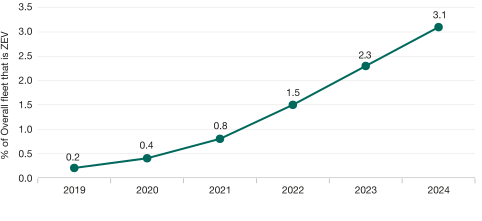
Core metric 6: zero emission vehicle percentage uptake, 2019 to 2024
Electric vehicle (EV) infrastructure surged, with 75,000+ public charge points now installed (up 32% year-on-year) and improved reliability standards. The government supported local EV access through the Local Electric Vehicle Infrastructure (LEVI) Fund and rapid charging near motorways increased by 53%.
DfT has invested over £1 billion in funding to local highway authorities across England to maintain and improve road surface conditions. This funding aimed to tackle potholes, enhance safety, and ensure smoother journeys for all road users.
DfT has committed to improving its oversight of how funding is spent and the impact on road conditions. This ambition is illustrated in our core metric that measures the percentage of road length in England where maintenance should have been considered (see core metric 7). The measure reports separately for i) local A Roads and Motorways, and ii) B and C Roads, and will measure progress against the metric as a measure of our commitment to ensuring that roads across the country are well maintained and therefore safer.
The percentage of local A roads and motorways that should have been considered for maintenance has been 4% since 2020. The percentage of B and C road that should have been considered for maintenance had been stable at 6% since 2016 but increased to 7% in 2023 and remained at that level in 2024. The proportion of the network receiving maintenance treatment has been decreasing year on year since 2017, while maintenance expenditure (when adjusted for inflation) has remained stable.
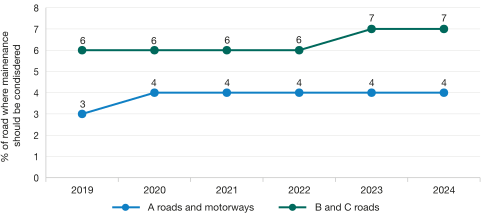
Core metric 7: road surface conditions chart showing the percentage of A, B and C roads, and motorways where maintenance should be considered in the UK, 2019 to 2024
However well-maintained roads alone cannot deliver safer roads for people. DfT is also working to reduce road casualties by investing in safer infrastructure, enhancing data collection through new road condition standards, and supporting local authorities with guidance and funding.
DfT is also developing a new road safety strategy aiming to set strategic direction for the country. DfT’s core metric on road casualties is calculated through the ‘killed or serious injured’ (KSI) rate, which is calculated by dividing the total number of people killed or seriously injured in road traffic collisions by billion miles travelled (see core metric 8). The killed or seriously injured (KSI) rate has continued to remain broadly static over the last 5 years.
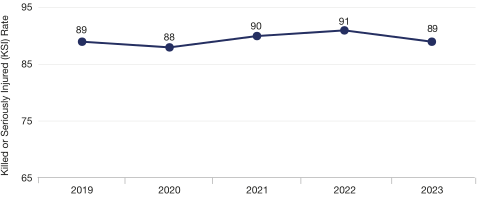
Core metric 8: road casulaties chart showing the killed or seriously injured rate on UK roads, 2019 to 2023
DfT is also continuing to expand its active travel agenda, aiming to make walking, wheeling, and cycling safer, more accessible, and a natural choice for short journeys.
In February 2025, DfT announced £291 million in investment through the Active Travel Fund, supporting the development of approximately 300 miles of new footpaths and cycle tracks. This is expected to enable 30 million additional active travel journeys annually, including 20 million walk-to-school trips.
DfT’s core metric measuring the average number of walking, wheeling and cycling travel ‘stages’ (or segments of a journey) taken per person, per year (see core metric 9), illustrates our focus on delivering greener, safer and healthier transport options for people.
Walking stages have increased over the last 3 years, which is in line with overall trends in personal travel returning towards pre-pandemic levels. Since 2020, walking has represented a slightly higher share of personal travel than pre-pandemic, and DfT will continue to monitor and assess the effectiveness of its policies when considering the longer-term trend.
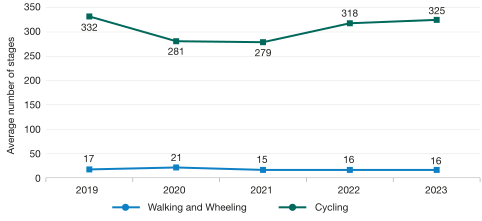
Core metric 9: average number of walking, wheeling and cycling stages in the UK, 2019 to 2023
DfT’s approach to achieving its greener, safer and healthier transport priority outcome has clear connections to both of its other priority outcomes. For example, major rail connectivity programmes like HS2 also unlock environmental benefits such as carbon reduction.
The programme has been designed with climate change adaptation in mind, meaning that HS2 will provide a far lower carbon alternative than road transport.
In delivering our priority outcome to improve transport for people, the new fleet on the East Midlands Railway will run using new electric overhead lines; as a result, journeys on the line will have far fewer carbon emissions and will contribute to better environments along the line for passengers.
Areas of work
Key progress made under this priority outcome is summarised below.
Low carbon/decarbonisation
In 2022, domestic transport accounted for 28% of total domestic emissions in the UK, making transport the UK’s largest source of greenhouse gas (GHG) emissions, with 36% of the UK’s GHG emissions in 2023 originating from domestic and international journeys.
This workstream’s aim is to reduce emissions from various modes of transport, including road, rail, maritime and aviation. These activities collectively aim to reduce greenhouse gas emissions, improve air quality, and support the UK’s broader net zero ambitions.
Accelerating the transition to electric vehicles (EVs) and the roll out of charge points
DfT is delivering the government’s manifesto commitment to accelerate the transition to Electric Vehicles and support buyers of second hand EVs.
Road transport accounts for 89% of domestic transport GHG emissions, with cars alone responsible for 57% of those emissions. The government has committed to the transition to electric vehicles by accelerating the rollout of charge points, giving certainty to manufacturers by restoring the phase-out date of 2030 for new cars with internal combustion engines, and supporting buyers of second-hand electric cars by standardising the information supplied on the condition of batteries.
In 2024, ZEV represented 19.6% of total UK new car sales, up from 16.5% in 2023, making it the largest ZEV market in Europe. The ZEV mandate – which sets a minimum share of new vehicles sold by manufacturers to be zero emission each year – provides certainty for the sector during the transition to ZEVs.
For EVs, at year end:
-
nearly 382,000 battery electric vehicles (BEV) cars were registered for the first time in 2024, compared to nearly 315,000 in 2023 (over 21% increase)
-
nearly 20% BEV share of the new car market in full year 2024 (up from 16.5% in 2023)
-
over 22,000 new zero-emission vans sold in 2024, an increase of 3.3% compared to 2023
-
over 6% BEV share of the new van market in 2024
-
in February 2025, BEVs represented 25.3% of the UK’s new car market, a 41.7% increase in volumes sold compared to February 2024
-
the UK’s BEV van share of new registrations was 9.7% in February 2025
Public Charge Point Regulations on contactless payments, open charge point data, and reliability came into force in November 2024. This requires operators to achieve an average reliability of 99% across their network of charge points of 50 kW and above, share open data freely, offer contactless payment options across many charge points and give consumers 24-hour access to free helplines.
These measures will help consumers get free, up-to-date and reliable information always and enable them to access charge points through a variety of providers and apps, helping to improve their charging experience as the public charging network grows.
Over the past year, through our various grants, DfT has supported the installation of thousands of charges point sockets in homes, workplaces, and schools. DfT has provided guidance for local authorities on EV installation and cross-pavement solutions, confirmed intention to streamline planning rules, and introduced legislation to simplify street works, cutting costs and time.
DfT has strengthened collaboration between the transport and energy sectors by publishing our grid connection review to support faster and more efficient charge point deployment.
With regards to the charge point rollout:
-
there were over 75,000 charge points at year end, up 32% from the same time last year. This includes over 15,000 50kw or above charging devices, which have increased by 38% over the same period
-
in the 12-month period leading up to 1st March 2025, on average, 50 charging devices were added to the public network per day, and 11 charging devices rated 50kW or above were added to the public network per day on average
-
20% of public charging devices in the UK were rated at 50kW or above at year-end – this figure increased from 18.8% at the same point in the previous year
2024 to 2025: key delivery: The UK’s transition to ZEVs is now well underway, with over 1.4 million ZEVs on UK roads, according to industry.
In November 2024, Public Charge Point Regulations came into force.
In February 2025, DfT announced the extension of the plug-in grant funding for new vans, taxis, motorcycles, and wheelchair-accessible vehicles to March 2026. In addition, DfT also announced further regulatory changes to ZEV driving licence requirements. Standard (category B) licence holders will be able to drive zero-emission vehicles up to 4.25 tonnes.
The legislation will remove the additional training requirement, remove the requirement to drive for the purpose of transporting goods, and allow drivers to tow a trailer. These changes will enable more drivers to switch to zero emissions without needing to train and test for a higher licence entitlement.
In March 2025, 54 planned charging and fuelling infrastructure locations were released across the UK as part of the zero emission HGV and infrastructure demonstrator (ZEHID) programme, over 75,000 public EV charging devices are now installed throughout the UK and nearly 40 LEVI Fund projects have been approved to go to delivery, with an expected continued steady stream of local authority procurements over the next year.
In April 2025 and following consultation on the 2030 phase-out date and the ZEV mandate, DfT confirmed its commitment to phasing out new cars that rely solely on internal combustion engines by 2030, alongside increased flexibility on how vehicle manufacturers meet the ZEV mandate target. This provides certainty to industry and ensures consumers can benefit from cleaner vehicles.
Rapid Charging Fund (RCF) pilot
The £70 million Rapid Charging Fund (RCF) Pilot part-funds major grid upgrades at motorway service areas and DfT co-sponsors a £12 million project with National Highways to roll out energy storage systems at motorway sites to improve access to power.
The pilot has now concluded without making any grant awards, but this process has been rich in lessons and outcomes, including how much the market has changed. There has been good progress on charging infrastructure roll-out. Future policy to close gaps in provision and future-proof the network in line with demand will be informed by learnings from the RCF pilot alongside wider market developments.
2024 to 2025: key delivery: As of January 2025, there were more than 1,100 open-access rapid and ultra-rapid charge points at motorway service areas in England, an increase of over 40% since January 2024.
In the same time period, over 5,200 open-access rapid and ultra-rapid charge points were within one mile of the SRN, an increase of around 53% since January 2024.
Local Electric Vehicle Infrastructure (LEVI) Fund
The LEVI Fund will deliver a step change in the deployment of local, primarily low-power on-street charging infrastructure across England. This will particularly support residents without access to off-street parking to have better access to EV chargers, as well as grow the charging network across the country.
2024 to 2025: key delivery: As of April 2025, there were more than 76,000 publicly available charging devices in the UK, up 28% since April 2024.
As of March 2025, all 113 local authorities across England are actively engaged with the LEVI Fund through 78 projects. Around half of these projects have been approved to go to delivery, and many tenders are currently live. A expect steady stream of procurements is expected over the next year.
The majority of LEVI funded chargepoints should be installed over the next 2 to 4 years, depending on when contracts are signed and the individual timelines agreed between local authorities and their supplier(s). DfT expects over 100,000 chargepoints to be installed through LEVI.
Decarbonising the HGV sector
In order to decarbonise the HGV sector, DfT must ensure a reliable and accessible charging and fuelling network, both at sites along motorways, major A-roads and at depots. This network must meet the business needs of hauliers, ensuring resilience across the supply chain.
The ZEHID programme, which is up to £200 million, will be deploying hundreds of zero-emission battery electric and hydrogen fuel cell HGVs, and their associated infrastructure by March 2026.
Data gathered as part of the programme will build an evidence base on which zero emission HGV technology may be better suited for specific use cases and journey types. This data will be used by the sector to inform their own commercial investment decisions, bringing forward the decarbonisation of the sector by up to four years. By the end of March 2025, 300 zero-emission vehicles have been ordered as part of the programme, with 37 having been delivered. 54 planned infrastructure locations have also been announced.
Live Labs 2 programme
DfT also continued to support the £30 million Live Labs 2 programme, which is funding various local authorities to trial innovative low-carbon methods of maintaining their local highway networks, and the lessons are being shared with other local highway authorities to help reduce the overall carbon footprint of the sector.
Low Carbon Fuels and the Sustainable Aviation Fuel (SAF) Mandate
DfT is delivering the government’s manifesto commitment to increase sustainable aviation fuel production.
Low carbon fuels are crucial to decarbonising aviation and maritime. The government is actively supporting the development and deployment of SAF to decarbonise the aviation sector.
This work aims to increase domestic SAF production, promote innovation, and meet the UK’s ambitious SAF blending targets for 2025 and beyond.
2024 to 2025: key delivery: In January 2025, DfT established the SAF Mandate, which delivers GHG emission savings by setting a legal obligation on fuel suppliers in the UK to supply an increasing proportion of SAF over time.
DfT also announced an extension of support for SAF producers by investing a further £63 million into the Advanced Fuels Fund.
Zero emission buses (ZEBs)
The full transition to ZEBs is a vital part of the government’s plan to make buses better for passengers and to realise the benefits of lower running costs, cleaner air and smoother, quieter journeys.
Since 2021, DfT has awarded over £460 million of dedicated funding for ZEBs in England (outside London). The Zero Emission Bus Regional Areas (ZEBRA) programme has awarded funding to 41 LTAs to deliver over 2,200 ZEBs and supporting infrastructure.
Each zero-emission bus, on average, saves around 46kg of NOx and 67 tonnes of CO2 per year, relative to a diesel equivalent.
The transition to ZEBs represents a great opportunity for UK bus manufacturers, both to supply the ZEBs needed here in the UK and to win export orders abroad as other countries upgrade their bus fleets.
The Bus Services (No. 2) Bill includes a measure to accelerate decarbonisation of bus services by placing a requirement on bus operators not to use new non-ZEBs on local bus routes in England from a date no earlier than 2030.
2024 to 2025: key delivery: In March 2025, DfT launched the UK’s Bus Manufacturing Expert Panel, bringing together industry experts and local leaders to make sure the UK remains a leader in bus manufacturing.
Maritime decarbonisation
The maritime decarbonisation strategy outlines the government’s vision for the future of the maritime sector, setting new domestic decarbonisation goals and key policies to achieve them. The government’s goal is to reduce greenhouse gas emissions from the maritime sector by 30% by 2030, 80% by 2040 (both relative to 2008), and to zero by 2050.
This sits alongside our continued leadership to decarbonise the global maritime sector through the International Maritime Organization.
2024 to 2025: key delivery: In March 2025, DfT published its maritime decarbonisation strategy.
In April 2025, DfT was proud to work with other member states to reach a landmark agreement at the International Maritime Organization on global measures to regulate greenhouse gas emissions from international shipping. DfT are now working towards adoption in October 2025.
UK Shipping Office for Reducing Emissions (UK SHORE)
The UK SHORE programme in DfT provides research and development funding to accelerate the technologies necessary to decarbonise the maritime sector.
UK SHORE has funded a suite of interventions aimed at addressing different barriers to maritime decarbonisation, including the Zero Emission Vessels and Infrastructure (ZEVI) scheme, the Clean Maritime Demonstration Competition (CMDC) and the Clean Maritime Research Hub.
2024 to 2025: key delivery: In January 2025, UK SHORE announced the sixth round of the CMDC, which will allocate up to £30 million for pre-deployment trials and feasibility studies in clean maritime solutions.
In March 2025, projects funded through the third and fourth rounds of the CMDC were completed and ZEVI projects completed their DfT funded construction period and will now commence their self-funded demonstration in a fully operational environment for at least three years.
In March 2025, DfT published a report setting out the early outcomes of the evaluation of the UK SHORE programme, which has assessed the processes and impact of the schemes to date.
Carbon Offsetting and Reduction Scheme for International Aviation (CORSIA)
CORSIA, adopted by the International Civil Aviation Organization (ICAO) in 2016, remains a key element of the government’s approach to addressing international aviation’s CO2 emissions.
DfT held a public consultation on implementing CORSIA in the UK, in partnership with UK Emissions Trading Scheme (UK ETS) Authority. The consultation sought views on draft legislation for CORSIA and options for how CORSIA could interact with the UK ETS on flights in scope of both schemes. Following analysis of the feedback and final policy development, a government response will be published as soon as possible in 2025.
To support the scheme’s wider international success, and UK influence on global aviation policy, DfT provided capacity-building assistance to developing countries for their own implementation of CORSIA. This drew on £450,000 funding announced in November 2024 by the Secretary of State and was delivered by the Civil Aviation Authority (CAA). The UK also continues to contribute to technical work to strengthen CORSIA and monitor its progress as an active member of ICAO’s Committee on Aviation Environment Protection.
2024 to 2025: key delivery: From December 2024 to February 2025 DfT led a public consultation on implementation of CORSIA in the UK.
In November 2024, the Secretary of State announced £450,000 in funding for support to developing countries on CORSIA and other aviation environment measures.
Airspace modernisation
DfT is delivering the government’s manifesto commitment to transform the UK’s airspace through airspace modernisation.
Airspace modernisation is a major national programme which will deliver quicker, quieter, and cleaner journeys by air. The airspace modernisation strategy (AMS) outlines how this will be achieved, with DfT principally involved in 3 areas of work:
-
the future airspace strategy implementation (FASI) programme, which aims to improve the efficiency, resilience, and environmental impact of air traffic services at the UK’s busiest airports
-
establishing the new UK airspace design service (UKADS), which will deliver holistic airspace design, initially prioritising the complex London region
-
integration, to support all aircraft, including drones and general aviation, to share UK airspace safely in a coordinated and efficient manner
2024 to 2025: key delivery: In October 2024, DfT published the annual report on the CAA’s progress in delivering the AMS, and in July 2024 the CAA published part 3 of the AMS. DfT and the CAA launched a joint consultation on plans for the new UKADS.
In March 2025, a decision to proceed with the UKADS and conduct a review of the airspace change process was announced.
Throughout the year, DfT provided the CAA with over £1 million of funding to develop options for mandating the use of electronic conspicuity (technology that enhances situational awareness in airspace by making aircraft and other airspace users digitally visible to each other) for all airspace users.
Improving our environment
DfT plays a key role in protecting the environment by ensuring that transport policies and investments actively contribute to reducing biodiversity loss, adapting to climate change and lowering transport pollution. Through planning guidance, vehicle emissions standards, and sustainable infrastructure programmes, this workstream works to align the transport network with the UK’s wider environment.
Biodiversity
DfT and its public bodies are taking action on the transport estate to support national objectives to restore nature.
DfT has undertaken consideration of how it can conserve and enhance biodiversity across its functions, as part of the ‘biodiversity duty’ established by the Environment Act 2021.
2024 to 2025: key delivery: National Highways delivered 1,775 biodiversity units (a way to measure and express the value of natural habitats) in 2024 to 2025, exceeding the annual target of 1,200 and achieving the no-net-loss target for the second Roads Period.
In November, HS2 Ltd published the Environmental Sustainability Progress Report for the 2023 to 2024 reporting period, which in particular set out positive progress towards the scheme’s no net loss target.
Climate change adaptation
The climate of the UK is changing. Weather in recent decades has been more extreme than the 20th century and projections suggest the UK will experience more frequent and severe weather events even if warming is capped at 1.5 degrees globally.
Extreme weather reduces the efficiency of the transport network through damage to infrastructure and delays to journeys. This, in turn, disrupts economic activity. The OBR estimates that physical damage from climate change could permanently lower GDP by 3 to 5% compared to a ‘no climate change’ scenario by 2074.
Under the 2008 Climate Change Act, DfT has a legal responsibility to address our transport-related climate risks. This is being achieved through DfT’s contribution to the third national adaptation programme which included a commitment to consult on a transport adaptation strategy.
2024 to 2025: key delivery: In April 2024, DfT launched a consultation on ‘Fit for a changing climate? Adapting the UK’s transport system.’ A final transport adaptation strategy will be published in 2025.
In December 2024, Network Rail published its fourth adaptation report which summarises its progress towards understanding the potential impacts of climate change on the performance and safety of the rail network, and the actions taken to increase its resilience.
In 2024 National Highways published its fourth adaptation report. It outlines how adaptation to climate change remains a strong business priority for National Highways, with continued efforts to embed climate change into its organisational strategies, funding decisions, and technical standards to work towards a strategic road network in England that is resilient to the impacts of climate change.
Air Quality
Poor air quality poses a significant risk to public health. DfT is committed to cleaning up our air and protecting the public from the harms of pollution. DfT is continuing to make progress in reducing air pollution, with the latest figures for 2023 showing reductions in transport’s emissions of NOx (6.5%), PM10 (1.0%), and PM2.5 (1.9%) compared to 2022. This is in line with the longer-term trend, where compared to 2013, 2023 figures were all lower for NOx (43.9%), PM10 (24.5%), and PM2.5 (35.3%). However, DfT recognises there is more to do to improve air quality. The progress made in our transition to ZEVs will continue delivering improvements in air quality from reductions in exhaust emissions.
2024 to 2025: key delivery: Throughout the year, DfT has progressed its 4 year research project aimed at better understanding how to measure and control brake and tyre wear emissions, including from ZEVs (which tend to be heavier than internal combustion engine vehicles on average).
NO2 programme
Road transport was responsible for, on average, 68% of NOx concentrations at the roadside in 2023. DfT in partnership with the Department for Environment, Food and Rural Affairs (Defra) is responsible for the NO2 programme, which, since it was established in 2017, has provided £576 million to help local authorities to develop and implement measures to address their NO2 exceedances in the shortest possible time and improve the health of their residents.
2024 to 2025: key delivery: In January 2025, Greater Manchester’s NO2 reduction plan was approved, aiming to achieve compliance with NO2 limits as quickly as possible, potentially before 2026.
Greater Manchester represents 10 local authorities and the final approved clean air quality plan to reduce NO2 exceedances includes an investment package as follows:
- £51.1 million towards bus investment, including 40 zero-emission buses, 77 Euro VI standard buses and charging infrastructure
- £5 million for local traffic management measures
- £8 million to support moving Greater Manchester’s taxi fleet to cleaner vehicles
- ip to £21.9 million for administration, delivery, monitoring and other associated costs
Road safety
DfT holds national responsibility for improving road safety across the UK. This workstream includes setting strategic direction, policy, and funding to reduce fatalities and serious injuries on the road network. This includes overseeing vehicle safety standards, supporting local authorities with data and guidance, and investing in safer infrastructure.
Road safety strategy
This government treats road safety seriously and is committed to reducing the numbers of those killed and seriously injured (KSI) on our roads. In 2023, 1,624 people were killed on GB roads. In total, 29,711 people were killed or seriously injured. The strategy will set out a suite of road safety interventions with the aim of increasing the safety of our roads and reducing the number of KSIs.
During 2024 to 25, DfT has been engaging the devolved governments, local authorities and road safety stakeholders to further understand key road safety issues. Through this ongoing stakeholder engagement and thorough policy development, DfT is gathering valuable insight to publish a clearer and refocused road safety strategy for publication during 2025 to 2026.
2024 to 2025: key delivery: Throughout 2024 to 2025, DfT ministers have reinforced their commitment to publishing a road safety strategy in 2025 to 2026.
Pothole repairs
DfT is delivering the government’s manifesto commitment to fix up to an extra million potholes across England in each year of the next Parliament.
In 2024 to 2025, DfT invested a total of £1.067 billion of capital funding into local highway authorities in England to enable them to maintain their local highway networks.
This area of work came under intense scrutiny in 2024 to 2025 with the publication of the National Audit Office report and thereafter a Public Accounts Committee (PAC) hearing in November and a subsequent report in January 2025. These suggested that DfT needed to improve its understanding of how the funding is spent by local highway authorities and of the impact that it has on the condition of the local road network. DfT will respond to the various PAC recommendations during 2025 to 2026.
DfT has also taken steps to improve the data collected by local authorities with regards to road maintenance and has worked with the British Standards Institute to publish a new road condition monitoring data standard, PAS:2161. This will enable local authorities to collect data using a wider range of technologies and to have a better understanding of their networks.
2024 to 2025: key delivery: In September 2024, the new road conditions monitoring data standard was published.
In the Autumn Budget, the Chancellor confirmed a £500 million funding uplift for local highway maintenance for the 2025 to 2026 financial year.
In December 2024, the Secretary of State announced how this funding would be allocated to local highway authorities.
In March 2025, DfT announced the steps local authorities would need to take to unlock the funding uplift in full. This includes a requirement for local authorities to publish reports on how much they are spending on highways maintenance and in how far they are following best practice.
Active Travel
This workstream promotes active travel as a key part of a healthier, more sustainable transport system. DfT is providing targeted investment to local authorities to deliver safe, reliable, accessible and integrated infrastructure for walking, wheeling, and cycling. This supports the ambitions of the walking, wheeling and cycling investment strategy, which sets out the government’s long-term vision to make active travel the natural choice for short journeys.
Active Travel Fund
The Active Travel Fund delivers investment in walking, wheeling and cycling infrastructure and behaviour change initiatives.
Based on analysis of previous investment, it is estimated the fund will lead to 43,000 fewer sick days a year to ease pressure on the NHS and help deliver the government’s mission of building an NHS fit for the future.
By March 2026 all schemes and initiatives will be either in delivery or completed, and in September 2025 DfT will have provided all funding, and most of the capital schemes will have been assured.
2024 to 2025: key delivery: In February 2025, DfT announced £291 million in investment in active travel, covering the 2024 to 2025 and 2025 to 2026 financial years. This will fund approximately 300 miles of brand-new footpaths and cycle tracks which will help encourage 30 million more journeys by bike or on foot every year, including 20 million new walk-to-school journeys.
Walking, wheeling and cycling investment strategy
DfT’s ambition is that walking, wheeling and cycling are the natural choices for shorter journeys or as part of a longer journey.
Active travel supports greener, safer and healthier transport, for example, by preventing ill health through increased physical activity and reducing air pollution and carbon emissions. Active Travel England (ATE) was established in 2022 as a DfT executive agency to improve active travel.
Since 2022, ATE has invested more than £245m to deliver walking and cycling routes and safer crossings and junctions.
1.6 million people have participated in ATE’s training programmes, including 500,000 children receiving cycle training last year.
ATE upskills and builds capability in local authorities through guidance, training and supporting scheme development. This improves the quality of active travel infrastructure, including addressing safety risks and concerns, and with ATE expert support, authorities have delivered active travel schemes at more than twice the rate of other small transport schemes.
2024 to 2025: key delivery: In March 2025, a written ministerial statement was laid in parliament to set out the government’s plans to publish a third cycling and walking investment strategy (CWIS3) following the conclusion of the Spending Review. This approach will enable CWIS3 to say more on the long-term funding for active travel. The government will consult on CWIS3, with relevant stakeholders, ahead of its publication.
Micromobility
Through ongoing e-scooter trials, policy development, and engagement with industry stakeholders, DfT is gathering valuable data to inform future regulations and ensure the safe integration of micromobility into the UK’s transport network.
By fostering innovation and investment in this sector, the government aims to provide low-carbon, accessible transport options that reduce congestion, improve air quality, and support the transition to a more sustainable urban mobility system.
2024 to 2025: key delivery: In December 2024, the government announced it would empower local leaders to regulate shared cycle schemes by bringing forward an on-street micromobility regulatory framework.
In November 2024, the government invited towns and cities to express an interest in opening an e-scooter trial in their area.
In March 2025, the government began a second evaluation of the e-scooter trials to continue learning.
Priority outcome: improving transport for people
Improving the transport system to focus on people’s needs, ensuring it is safe, accessible, reliable and integrated, enabling people to access work, essential services and opportunities.
Summary
Transport plays a central role in people’s daily lives, and in 2024 to 2025 DfT focussed on improving the end-to-end journeys people make, recognising that many involve multiple transport modes. DfT’s approach considers how different types of journeys are made and aims to improve connectivity and reliability across the network.
Progress is tracked through user satisfaction data from the National Travel Survey (see core metric 10), which measures how well the transport system is meeting people’s needs. Satisfaction levels remained broadly stable for walking, major roads, and local buses compared to the pre-pandemic period. Satisfaction with cycling provision improved, while satisfaction with local roads and trains showed a downward trend.
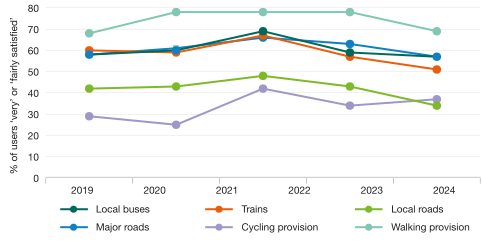
Core metric 10: satisfaction with provision, by local transport mode, showing the percentage of users that were very or fairly satisfied with using the mode
DfT continued its work to make the transport network more inclusive and accessible, in line with its obligations under the Public Sector Equality Duty (PSED - section 149 of the Equality Act 2010). This includes addressing barriers to access, creating opportunities, and improving experiences for people with a range of needs. One key metric (see core metric 11) measures satisfaction with bus journeys among disabled people and those aged 60 or older, showing a rise in satisfaction between 2023 and 2024.
| Year | Aged 60 or above | Disabled |
|---|---|---|
| 2024 | 89 | 83 |
| 2023 | 86 | 73 |
Core metric 11: satisfaction of disabled users or users over 60 who were very or fairly satisfied with their bus journey, 2023 to 2024
In terms of delivery, rail remained a key area of focus. The East Coast Main Line timetable upgrade was approved for implementation in 2025. Significant progress was also made on the Midland Main Line electrification and the East Coast Digital Programme, supporting long-term improvements in rail reliability and performance. A core metric for DfT, and one most often felt by people on our rail network, is the percentage of planned trains which either did not run their full planned journey or did not call at all of their planned station stops (see core metric 12).
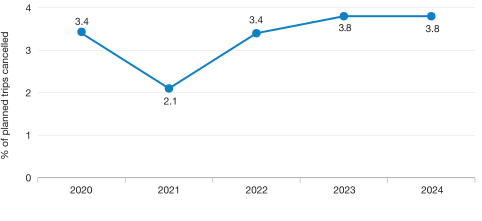
Core metric 12: rail cancellations, percentage of planned train trips that were cancelled, 2020 to 2024
So far in 2025, DfT has carried out a call for ideas to feed into the integrated national transport strategy which received over 6,000 responses and held 11 regional roadshow where insights were gathered from councils, businesses and communities. The outputs from this engagement will be considered in the development of the strategy. Later in 2025 DfT will publish the integrated national transport strategy, setting a long-term vision for a better-connected, user-focused transport system in England.
Developed through extensive engagement, the strategy will support place-based solutions while promoting national coherence. A key part of this will be integrating rail through the creation of Great British Railways, which will unify track and train under one public body. This system-wide approach will simplify governance, improve value for money, and empower devolved leaders, helping to connect local strategies into a joined-up national network that better meets the needs of passengers, communities, and the economy.
DfT’s core metric that measure the percentage of all trips made by public transport is taken directly from the National Travel Survey. The metric (see core metric 13) indicates the level of integration available to people on the transport network. The percentage of trips made by public transport has increased year-on-year following a drop during the pandemic period, however remains below pre-pandemic levels.

Core metric 13: public transport trips, percentage of trips made by public transport, 2019 to 2023
DfT’s approach to achieving its priority outcome to improve transport for people has clear connections to both of its other priority outcomes. For example, the expansion of Heathrow to include a third runway, a clear driver of growth into the country, will also improve the passenger experience with more connections and fewer delays
Areas of work
Key progress made under this priority outcome is summarised below.
Safer transport
A safe transport system plays a vital role in giving the public the confidence to travel by ensuring their safety and wellbeing throughout their journey. When people feel protected from threats such as crime, antisocial behaviour, or terrorism, they are more likely to use public transport regularly. This workstream acts to deliver a safer transport system that makes it easier for everyone to travel.
Automated vehicles
Following Royal Assent of the Automated Vehicles (AV) Act in 2024, DfT has been progressing delivery of the Automated Vehicles Act implementation programme. This programme is central to enabling the deployment of safe self-driving vehicles on Great Britain’s roads by 2027, providing regulatory certainty for industry and ensuring public confidence in this transformative technology.
The AV Act implementation programme is purposefully designed over the next two years to prioritise the development of a regulatory framework that maximises innovation, public safety and strengthens public confidence.
In June 2025, DfT launched a call for evidence on the statement of safety principles, ensuring safety remains at the heart of our approach. Additionally, DfT launched a protecting marketing terms for automated vehicles consultation to protect consumers and promote transparency.
In autumn 2025, DfT will launch the consultation on automated vehicles regulatory framework, covering key aspects such as incident investigation, monetary penalties, and authorisation processes.
DfT is aiming to launch a consultation on the automated passenger services permitting scheme in summer 2025. This will provide businesses with the regulatory confidence to invest in testing and deploying these innovative services on our streets, reinforcing the UK’s position among the world leaders in tech deployment. It will help facilitate commercial pilots of services with paying passengers and no safety driver to be deployed from spring 2026.
DfT remain committed to delivering a world-leading regulatory framework that balances innovation with safety, transparency, and consumer protection.
2024 to 2025: key delivery: In May 2024, the Automated Vehicles Act achieved Royal Assent.
Maritime and aviation safety regimes
In January 2024, DfT established the Cranston Inquiry regarding the tragic events of 24 November 2021, when at least 27 people died attempting to cross the Channel in a small boat. Following the conclusion of the Cranston Inquiry, the relatives of the deceased have previously indicated an intention to bring claims against the government, under the Human Rights Act (within 3 months of the conclusion of the Inquiry, expected autumn 2025) or personal injury/negligence (3 or 6 year deadline, so may have expired). Total liability is dependent on a number of factors, but potentially between £2-8 million, plus legal costs of both sides.
2024 to 2025: key delivery: In March 2025, hearings concluded, and the inquiry is now reviewing all the information and evidence. DfT will carefully consider the Inquiry’s report and recommendations when they are submitted to the Secretary of State.
Accident investigation branches (AIB)
The Air, Marine and Rail Accident Investigation Branches (Air Accidents Investigation Branch (AAIB), Marine Accident Investigation Branch (MAIB) and Rail Accident Investigation Branch (RAIB)) are stand-alone branches of DfT. The 3 AIBs fulfil the UK’s international obligations to establish permanent bodies to undertake independent investigation of rail, maritime and air accidents.
For all three branches, the sole objective of investigating an accident is to determine its circumstances and causes, with the aims of improving safety and avoiding future accidents. It is not their purpose to apportion liability, nor to apportion blame.
It is essential that the 3 AIBs are, and are seen to be, entirely independent, including from their parent department, in carrying out their prime purposes of investigating accidents and making recommendations to improve safety in their respective sectors.
UK 2nd Generation Search and Rescue (SAR) Aviation
The Maritime and Coastguard Agency’s UK Second-Generation Search and Rescue Aviation programme is designed to ensure the continued provision of a world-leading fleet of advanced search and rescue aircraft. This includes the introduction of 2 new seasonal bases in Scotland and Northern England, a change to the mix of rotary aircraft and an increase in the number of fixed wing and unmanned assets to better serve the UK’s operational demand. It is underpinned by the digital ‘OneLink’ system, which brings together aircraft mission systems and communication and planning software to increase shared situational awareness and use of data to enhance successful mission outcomes.
2024 to 2025: key delivery: In October 2024, a phased transition began and the full transition will be completed by the end of December 2026.
Prevention of violence against women and girls (VAWG)
DfT is collaborating with the Home Office and other government departments to develop a cross-government VAWG strategy, due to be published in spring 2025.
The Bus Services Bill also has a range of measures aimed at improving the personal safety of bus users, including women and girls. These are:
- mandatory training of bus drivers, frontline staff and other relevant bus workers to enable them to identify and respond appropriately to incidents of crime, including VAWG, and anti-social behaviour
- enabling the Secretary of State to issue statutory guidance about the location, design, construction and maintenance of bus stops and stations to improve safety
- requiring public service vehicle operators to only allow drivers to drive a ‘closed’ school service if they have checked the relevant enhanced criminal record certificate of the driver
- giving all LTAs the power to make bus byelaws to tackle anti-social behaviour, which can be enforced by local authority officers on vehicles and at bus stations and stops. This will enable other authorities to consider introducing transport safety officers on their own networks
DfT works closely with the rail industry to tackle VAWG. This includes the work of the British Transport Police (BTP) who are tackling VAWG on the rail network as a priority. BTP recorded 10% more sexual offences in 2024 to 2025 than 2023 to 2024 (increase from 2,437 to 2,670). This does not necessarily mean an increase in occurrence of these crimes, but that victims may be more willing to report it because of the messaging efforts across the network.
BTP undertakes enhanced patrols with a directed, intelligence-led focus around the nighttime economy, providing a high visibility presence to reassure rail staff and the public. They actively encourage members of the public and rail staff to come forward and report incidents to them.
DfT continues to support the government’s mission to deliver safer streets, through work such as the Rail Delivery Group’s ‘zero tolerance’ campaign for the railway, which is aimed at educating people about the different types of sexual harassment and encouraging reporting to the BTP or a dedicated anonymous CrimeStoppers line.
2024 to 2025: key delivery: In the summer of 2024, the BTP were successful in getting major phone providers to make the emergency ‘61016’ number free to contact.
In their recently published 2025 to 2027 policing plan, tackling VAWG is a strategic priority for the BTP.
BTP were able to apply 2 new tools in the prevention of domestic abuse from November 2024, becoming 1 of 4 police forces to take part in a year-long government pilot in the use of domestic abuse protection notices (DAPNs) and orders (DAPOs).
In February 2025, BTP issued its first DAPO.
As part of DfT’s rail operators annual business planning process DfT require rail operators to develop plans by the end of the year to carry out a basic DBS check on all new employees prior to commencing employment.
Accessible
Accessibility is fundamental to creating a transport system that works for everyone. When transport is accessible, it enables people to reach jobs, education, healthcare, and social opportunities–empowering greater independence, equality, and inclusion.
For disabled people, older adults, and those with reduced mobility, accessible infrastructure and services are not just conveniences; they are essential for full participation in daily life. By prioritising accessibility, the transport system becomes more user-friendly, equitable and responsive to the diverse needs of all passengers, helping to unlock wider social and economic benefits.
Tackling the high cost of motor insurance
The cross-government motor insurance taskforce is comprised of ministers from relevant government departments, the Financial Conduct Authority and Competition and Markets Authority. It is supported by a separate stakeholder panel of industry experts representing the insurance, motor and consumer sector.
The taskforce has a strategic remit to set the direction for government policy, identifying short- and long-term actions for departments that may contribute to stabilising or reducing premiums while maintaining appropriate levels of cover. It is looking at the increased insurance costs on consumers and the insurance industry, including how this impacts different demographics, geographies and communities. The taskforce is continuing its work into the 2025 to 2026 financial year.
2024 to 2025: key delivery: In October 2024, DfT launched the cross-government motor insurance taskforce in partnership with HMT.
Cross modal accessibility
DfT is committed to cross modal accessibility and delivering a transport network which allows disabled people and those with restricted mobility, to be able to travel easily and confidently, with dignity and without extra cost.
This is done through delivering and steering DfT’s compliance with the PSED and Equality Act 2010 and is reflected in our current programme of work across the transport system, such as challenging inaccessibility by using the Bus Services (No. 2) Bill to incorporate provisions which will require all relevant operator staff to complete both disability awareness and assistance training and requiring local authorities to pay regard to new statutory guidance on the safety and accessibility of bus stopping places.
2024 to 2025: key delivery: In November 2024, the Aviation Accessibility Task and Finish Group, chaired by Baroness Tanni Grey-Thompson, was created. The group brings together industry and consumer representatives to identify practical and achievable actions to improve aviation accessibility.
Throughout the year, DfT has continued the implementation of the Public Service Vehicle (Accessible Information) Regulations 2023, which require the provision of audible and visible route and location announcements on board local services. This includes steps to support small operators through a £4.65 million Accessible Information Grant and work to facilitate greater compliance in the rail replacement coach sector through tech innovation funding.
Access for All
The Access for All programme was launched in 2006 to address the issues faced by disabled passengers and passengers facing mobility restraints (such as heavy luggage or pushchairs) when using railway stations in Great Britain.
The programme delivers an obstacle free, accessible route from the station entrance to all platforms. This generally includes providing lifts or ramps, as well as associated works and refurbishment along the route.
2024 to 2025: key delivery: The programme has delivered step free access upgrades at 25 stations in 2024 to 2025, with more than 260 since 2006.
Tactile edge programme
Network Rail has completed a £75 million programme to ensure that by the end of 2025, all mainline station platforms in Britain have tactile edges for the safety of blind and partially sighted passengers.
2024 to 2025: key delivery: By year end. 86 platform edge tactiles had been installed totalling 822 stations across Britain since the programme began.
Tactiles will be delivered at a final 6 stations across Britain as part of other fully funded projects by the end of 2025.
Reliable
This workstream drives a wide range of initiatives to improve performance and reliability on the railways. DfT is supporting significant investments in renewing and upgrading the network to improve transport for people. Major renewal investment included in this workstream are enhancing capacity, reducing journey times, and cutting carbon emissions, as well as modernising signalling on key routes and improving safety and reliability. This workstream also works on investing in better infrastructure across the region, helping to build a transport system that is reliable.
Improving performance on the railways
Operational performance, especially in cancellations, has been deteriorating over the past decade. DfT’s objectives are to stop this deterioration and stabilise and then improve performance to acceptable levels.
In response to DfT ministers’ challenge to improve performance, the rail industry has set out a performance restoration framework, with 5 clear areas of focus to recover performance to appropriate levels. These focus areas will take some time to have an effect and are as follows:
- the resilience of the timetable
- resources needed to operate reliably (staff and rolling stock)
- infrastructure
- trespass
- how to keep trains safely moving during disruptive events
The Rail Minister is meeting with managing directors of train operating companies and their Network Rail counterparts to discuss performance and hold the industry to account.
To improve visibility to passengers, DfT asked operators to make station-specific performance information available to passengers at stations. The new performance measures are more passenger centric as they are measures of performance at stations, which is what the passenger experiences.
2024 to 2025: key delivery: In September 2024, DfT developed a new, station-specific reliability metrics so for the first time, passengers can see how the railway is performing for them.
In March 2024, DfT ushered in a new era of transparency and accountability with performance information clearly displayed on digital screens at stations wherever possible. All stations should also display clear links directing passengers to information online where suitable screens were not available. This new information allows passengers to see reliability and punctuality at a local level and understand what is being done to improve railway performance on the routes they travel on every day.
In September 2024, ministers ended a long period of disruption and reduced train cancellations by agreeing a pay deal with train drivers.
Between December 2024 and April 2025, DfT carried out a programme of deep dives into train operator resource planning to identify further train crew risks and appropriate mitigations
Control Period 7 (CP7)
Network Rail has now concluded the first year of CP7 which is being delivered over a 5-year period according to agreed funding and objectives for Network Rail’s operations, maintenance, and renewal of its infrastructure. Network Rail is on track to deliver its planned maintenance and renewals volumes, alongside planned efficiency savings of £325 million this year.
Network Rail continues to be impacted by the effect of recent levels of inflation. It is developing climate adaptation strategies to help defend against more frequent extreme weather events due to a changing climate. Network Rail is not currently meeting industry passenger performance targets and is drawing down on risk funding to pay schedule 8 compensation payments to train operators.
Improving performance remains a priority for the whole system, and work is underway at the ORR to review performance measures for the last three years of the control period (2025/6 to 2028/9). Metrics have been aligned across industry, and ORR will publish new targets at the end of the year. See CP7 passenger train performance reset: consultation on performance measures for 2026 to 2029.
2024 to 2025: key delivery: The planned efficiency target for 2024 to 2025 was £263 million. Network Rail has exceeded this target by £62 million, resulting in a total of £325 million in reported efficiencies.
East Coast Mainline (ECML)
The rail industry has been developing plans to amend services on the ECML since 2019 and an agreement is now in place to implement a new timetable which will provide more capacity with extra intercity trains to Newcastle.
The timetable change will provide more capacity with extra intercity trains to Newcastle.
Passengers will further benefit from quicker journeys between London, the northeast and Edinburgh to make sure the service better reflects the journeys passengers make whilst significantly reducing the burden on taxpayers.
Beyond the infrastructure upgrades already delivered to support the introduction of the route’s major timetable change, DfT also continues to invest in enhancements across the ECML, with significant progress having been made over the past 12 months on the delivery of a package of upgrades at Darlington Station, which are due to be completed in December 2025.
2024 to 2025: key delivery: In December 2024, the Secretary of State, and the Rail Minister have agreed to the delivery of the East Coast upgrade timetable by December 2025. This decision followed a review undertaken by a special industry task force.
Midland Main Line (MML)
New class 810 bi-mode trains are planned to be introduced on the MML later in 2025 following the completion of infrastructure works to enable these trains to operate using electric traction between London and Wigston (south of Leicester). The introduction of the new trains will provide more capacity and a better ambience for passengers as well as being greener and more reliable.
The Midland Main Line electrification (MMLE) programme is in development and comprises the electrification of the remainder of the route to Nottingham and Sheffield via Derby. As a rolling programme of electrification, MMLE aims to realise significant efficiencies to reduce the unit cost of electrification and provide an affordable template for future electrification programmes. The benefits of electrification are dominated by environmental benefits, both carbon reduction and improvements in local air quality. As electric rolling stock is cheaper to run than diesel, MMLE would also help to improve the financial sustainability of the railway.
2024 to 2025: key delivery: In March 2025, the extension of electrification from Kettering to Wigston was completed. Enhancements to existing overhead line equipment south of Bedford, to enable trains to run at up to 125mph, have progressed well and are due to be complete by August 2025.
European train control system (ETCS)
The ETCS, also known as digital signalling, is replacing ‘conventional’ colour light signaling in England and Wales. The pathfinder scheme for this rollout is the East Coast digital programme (ECDP), which is the first implementation on a mixed-use (passenger and freight train) GB mainline.
ECDP analysis shows the whole-life carbon footprint of ETCS signaling on ECML(S) is circa 40% less than that of conventional signaling, due to the reduction in the volume of trackside infrastructure required. Over a 60-year period, the total CO2 saving is projected to be 55,000 tonnes.
Digital signaling will also provide safety benefits as the technology helps to prevent overspeeding train services and reduces the need for workers to be on the tracks.
During 2024 to 2025, the programme (partnership of organisations across track and train) has made good progress towards completion in the early 2030s. Full ETCS operations on Northern City Line (NCL), including the removing of conventional colour light signals commenced in May 2025.
2024 to 2025: key delivery: Nearly all services on the NCL have been running on the ETCS since December 2024.
North-east programme
As part of our north-east programme, DfT is also continuing to develop proposals for a range of rail infrastructure enhancements in and around Leeds Station and across the West Yorkshire region, with the aim of increasing capacity and improving performance, reliability and passenger experience. As part of this, elsewhere in the north-east, the £362 million phased replacement of the Tyne and Wear Metro fleet is underway with new trains now in service. The rollout will continue throughout 2025 and into 2026.
2024 to 2025: key delivery: This year, £35 million has been provided to deliver a new platform and improved track capacity at Bradford Forster Square station (opening in May 2025), in support of Bradford’s 2025 ‘City of Culture’ status.
Also, platform extension works have been completed at Burley-in-Wharfedale, Guiseley, Menston, Shipley and Apperley Bridge as part of an ongoing £32.4 million scheme to increase capacity on the rail network around Leeds, allowing longer trains to be rolled out from 2028.
A further £55 million of funding was secured in October 2024 to acquire new operational accommodation for train and station staff at the Princes Exchange building adjacent to Leeds Station and to begin strengthening works outside the station in Princes Square, to de-risk future construction projects.
Integrated
This workstream features DfT’s work to deliver a more integrated and user-friendly transport system that connects people and places efficiently across all modes of transport. Central to this drive is DfT’s work to deliver on the government’s commitment to rail reform and new strategies for a longer-term vision of better aligning road, rail, bus,and active travel networks, ensuring that services are planned together and support seamless end-to-end travel for passengers and freight alike.
Integrated national transport strategyy (INTS)
DfT is delivering the government’s manifesto commitment to publish an integrated national transport strategy.
In 2025, DfT will publish the INTS. This will set the long-term vision for transport in England, focusing on how transport should be designed, built and operated to better serve the people who use it - addressing the fragmentation and inefficiencies of transport services which have led to poorer transport for people in recent years.
The strategy will reflect transport’s key role in supporting economic growth and breaking down barriers to opportunity, enabling the efficient movement of goods and services and access to jobs, education, healthcare, housing and other public services.
It will also recognise that different places face different transport challenges and enable local leaders to get on and deliver good transport that is right for their communities. To achieve this, DfT is developing the INTS through open engagement and collaboration with the transport sector and public.
2024 to 2025: key delivery: Up until February 2025, DfT carried out a call for ideas which received over 6,000 responses from the public, people who work in transport, and organisations.
By March 2025, DfT held 11 regional roadshows where insights were gathered from councils, businesses and communities. The outputs from this engagement will be considered in the development of the strategy.
Establishing Great British Railways (GBR)
DfT is delivering the government’s manifesto commitment to establish Great British Railways and deliver wider sector transformation including the Passenger Standards Authority. The government will overhaul Britain’s railways, putting passengers at the heart of the service by reforming the railways and bringing them back into public ownership.
Great British Railways will deliver a unified system that focuses on reliable, affordable, high-quality, and efficient services, along with ensuring safety and accessibility. It will be responsible for investment, day-to-day operational delivery and innovations and improvements for passengers, working with publicly owned rail operators in Wales and Scotland.
Mayors will have a role in designing the services in their areas. There will be a duty to promote and grow the use of rail freight. The government will also create a tough new passenger watchdog, focused on driving up standards.
2024 to 2025: key delivery: in July 2024, the Kings Speech set out that legislation was to be introduced in the first Parliamentary session to deliver a once-in-a-generation overhaul of the fundamental rules, structures, and bodies that make up the rail industry via the Railways Bill.
In September 2024, and further advancing the reform, the Secretary of State announced the formation of Shadow Great British Railways, marking a significant step toward implementing GBR and prioritising passengers on the railway system.
From February to April 2025, a public consultation on measures to be included in the Railways Bill ran. The government’s response is currently being prepared ahead of introducing the bill.
Bringing train operating companies (TOCs) back into public ownership
DfT is delivering the government’s manifesto commitment to bring passenger services run by private sector train operating companies (TOCs) into public ownership.
As part of our wider sector transformation, DfT is bringing passenger services run by private sector TOCs back into public ownership.
DfT is doing this as contracts with existing operators expire or are broken through a failure to deliver, without costing taxpayers in compensation.
2024 to 2025: key delivery: In November 2024, the Passenger Railways Services (Public Ownership) Bill received Royal Assent.
In May 2025, South Western Railway (SWR) became publicly owned and managed by DfT Operator LTD (DFTO), in July 2025, Trenitalia c2c Limited (c2c) transfers to public ownership and will be managed by DFTO.
Rail ticket sales
DfT is improving the rail passenger experience by implementing fares that are easier to understand. This aligns with the government’s agenda for rail reform, supporting a better integrated, publicly owned railway and encouraging more people to choose public transport.
2024 to 2025: key delivery: In autumn 2024, the London North Eastern Railway ‘simpler fares’ trial was expanded to include more routes and stations. This trial helps to smooth out demand and reduce crowding, making travel more comfortable for passengers while providing an easier choice of fares with greater flexibility.
Pay-as-you-go (PAYG) roll out
PAYG seeks to simplify the experience for passengers, offering convenience and the potential for integrated multi-modal travel, with a simplified fares offer to support PAYG travel. This should help to improve confidence in the fares that passengers are charged, encourage a shift to digital channels and increase rail patronage. This ensures that passengers can access a simplified fare offering and pay the best price for their journey.
DfT have also announced a PAYG pilot in the West Midlands for 75 stations, enabling passengers in the region to access an integrated, multi-modal PAYG offer for the first time. In addition, 17 stations will be upgraded to support PAYG with contactless payment in Greater Manchester.
2024 to 2025: key delivery: At year end, PAYG had been rolled out to 47 more stations around London and the South East, using contactless bankcard technology, with 49 further stations planned for later this year.
In November 2024 and January 2025, for West Midlands and Greater Manchester respectively, full business cases for the PAYG pilots were approved, allowing these schemes to move into mobilisation.
Throughout the year, DfT progressed workstreams to better enable contactless bankcard on rail outside of London and to create a central PAYG back-office system to support these new schemes.
In February 2025, DfT announced the start of the procurement process for digital PAYG trials in the North and Midlands later in 2025.
At year end, DfT updated its smartcard (integrated transport smartcard organisation (ITSO) 2.15)) standards, with an aim to enable use of ITSO on all mobile devices.
Strategic enabler: safety, security and resilience
Transport connects people and places, enabling increased prosperity and quality of life. It is therefore vital that the transport network remains safe, secure and resilient. DfT works with industry, international partners, and the rest of government to mitigate against a wide range of current and future risks and threats – bolstering the UK’s national security foundation.
Summary
Our safety, security and resilience strategic enabler makes sure DfT stays firmly focused on protecting the people who use the UK’s transport system, alongside the goods and supply chains that also depend on its safety, security and resilience. This is central to the work of everyone in DfT, its delivery partners, and the transport sector, underpinning everything DfT does.
Areas of work
Key progress made under this strategic enabler is summarised below.
Integrated
Transport safety
Transport should be safe and accessible to all users. Through taking a ‘whole transport system’ view of safety, DfT aims to:
- reduce the number of deaths and serious injuries for all road users caused by road traffic accidents
- maintain the UK’s existing high safety standards for aviation, maritime and rail
- make the necessary regulatory and other steps needed to allow new transport technologies (such as autonomous vehicles and micro- mobility) to be used safely
DfT has considered how safety is approached, governed and managed across the transport sector by undertaking a review of current practices across different modes of transport. DfT will now focus on implementing the recommendations identified by the transport safety review, including improving how lessons are learnt and shared across modes and how cross-cutting safety issues are identified, managed and resolved.
2024 to 2025: key delivery: In December 2024 DfT reformed the State Safety Board to improve its aviation safety effectiveness. DfT also finalised our new state-level state safety programme which sets our oversight of all UK aviation authorities with publication due in the first quarter of 2025 to 2026. DfT also continued to provide oversight and support to the UK Overseas Territories on their aviation safety, ensuring compliance with International Civil Aviation Organization (ICAO) standards.
In March 2025, National Highways successfully completed its work to construct over 150 additional emergency areas across all lane-running motorways.
At year end, National Highways had also delivered all its actions in response to the March 2020 Smart motorway safety evidence stocktake and action plan.
Transport security
Risks to the transport sector are evolving, encompassing long-standing threats such as terrorism and serious organised crime, alongside emerging risks from cyber-attacks, rapid technological change, geopolitical tensions, and climate change.
DfT plays a central role in the UK’s national security system and supports the National Security Foundation of the government’s Plan for Change. It works in partnership with industry, international bodies, and other government departments to identify threats and deliver proportionate mitigations that protect the transport system and the travelling public.
DfT’s approach includes the use of legislation, regulation, and industry guidance, as well as sharing best practice. It collaborates with transport infrastructure owners and operators to ensure security measures deliver appropriate outcomes and are responsive to global events. DfT also supports international capacity-building, particularly in the aviation and maritime sectors, to reduce risks to UK nationals and goods travelling abroad.
2024 to 2025: key delivery: Throughout the year, DfT:
- delivered security compliance regimes across rail networks, port facilities, and in collaboration with the CAA for aviation
- provided targeted security advice to the UK aviation and maritime sectors, including UK and Red Ensign Group shipping, in response to threats in the Red Sea, Eastern Mediterranean, and Black Sea – supported cross-government efforts to uphold freedom of navigation
- maintained the UK’s aviation security through the continued roll-out of next-generation security checkpoints, introducing advanced screening technologies to detect and deter threats
- engaged regularly across all four transport modes on cyber security regulation and compliance – this included supporting the expansion of cyber regulations and providing crisis support in response to increased cyber-attack activity affecting the transport sector
Transport resilience
DfT maintains an established crisis management and resilience function to enable effective mitigation, preparation, response and recovery from emergencies and disruption to the transport network.
In 2024, this work has been enhanced by the establishment of a new Transport Resilience Division to co-ordinate work across the DfT and with the sector to improve the resilience of the transport system to a wide range of risks now and in the future. It achieves this through detailed risk assessment and planning (including for the most impactful risks); exercising and planning for transport elements of major national events; and driving a coordinated effort to strengthen transport capabilities to reduce the impact of incidents that do occur – and to prevent them wherever possible.
DfT monitors for any near-term events that may impact the UK’s transport network and passengers, makes sure DfT has the capability to respond, and responds to acute national emergencies.
DfT achieve this through preparing crisis response activity across DfT, developing clear situational awareness in an emergency and representing transport interests in government crisis management structures, including for meetings such as those in Cabinet Office Briefing Rooms (COBR).
2024 to 2025: key delivery: Throughout the year, DfT continued to enhance capability to enforce the UK’s transport sanctions and support enforcement activity in the Crown Dependencies and Overseas Territories. This has included supporting the UK’s further sanction measures against Russia, Belarus and Iran.
DfT also responded to several incidents, including storms Darragh and Éowyn, the Crowdstrike and e-Gate outage incidents affecting the aviation industry and the recent North Sea maritime vessel collision.
Strategic enabler: science, innovation, technology and data
Science underpins policy and decision-making, innovation creates new solutions to key challenges, technology offers opportunities to transform the transport system and data is the lifeblood that provides the insights to design a better future. Together, they are essential to DfT and the transport sector to deliver goals of a green, safe, inclusive and efficient transport system which are critical to supporting productivity and growth.
Summary
Science, technology, innovation and data as a strategic enabler was established in 2024 and builds on the previous ‘science and technology’ strategic enabler, in addition to all the embedded work that has been done for many years ensuring that science, engineering, innovation, technology and data feed into policy making and delivery across DfT’s work.
Areas of work
Key progress made under this strategic enabler is summarised below.
Research and development (R&D) portfolio
The R&D portfolio continues to support emerging technologies and innovation, along with critical business research, analysis, and revaluation to support departmental policy and decision-making.
This includes research into the public perceptions of autonomous and connected vehicles. A significant proportion of the portfolio in 2024 to 2025 supported programmes that deliver specific, time-critical pull-through of technology and innovation at scale to support transport decarbonisation.
The Transport Research and Innovation Grants (TRIG) programme is DfT’s flagship innovation programme. During 2024 to 25, 32 projects were funded, including:
- Streetwise Technology LTD: creating dynamic pedestrian zones to improve road safety and accessibility
- Vox Aeris: using sound waves to reduce particulate matter pollution in underground transport hubs
- SYSTRA Ltd: addressing road accidents through novel application of artificial intelligence
- University of Nottingham: developing a green, less toxic and more sustainable, carbon-reducing microalgae binder
2024 to 2025: key delivery: Throughout the year, £1.4 million in grant support was awarded into the Transport Research and Innovation Grants Programme.
Transport Research and Innovation Board (TRIB)
TRIB’s aim is to accelerate the development, assessment and adoption of impactful research and innovation within the transport sector. The board brings together the key public funders of transport R&D and takes a cross sectoral co-ordinated approach to address challenges that no-one organisation can do on its own.
2024 to 2025: key delivery: Throughout the year, the TRIB supported initiatives which have driven the adoption of calcined clay concrete, a low carbon material, within the industry, provided guidance on how to use the powers in the new Procurement Act to support the development and adoption of innovation, and shared best practices relating to a range of topics including AI, telecommunications, connected autonomous plant, monitoring and evaluation etc.
Decarbonised, adaptable and resilient transport infrastructure (DARe) research hub
The Research Hub for DARe was launched in September 2023 and is providing at least £10 million of funding until 2027 and aims to leverage a further £10 million of industry funding to deliver co-created research that plots viable pathways and solutions for delivering a resilient, net-zero transport system that works for people and communities.
Strategic enabler: international
In an increasingly interconnected but uncertain world, with a rapidly changing geopolitical landscape, domestic and international policies are now inextricably intertwined, with global events directly impacting on delivery of our domestic transport objectives. It is therefore essential for the UK to engage confidently in the international system to deliver a safe, resilient and sustainable transport for the benefit of passengers and UK businesses.
Summary
DfT has a significant international policy role in government, namely, to maintain the safety, security and resilience of our transport systems, to ensure international connectivity and to leverage opportunities to benefit UK trade and investment interests. The transport sector is vital to the UK and global economy, facilitating trade, connecting people and resources and, by doing so enabling economic growth. DfT is navigating an increasingly volatile geopolitical environment.
Areas of work
Key progress made under this strategic enabler is summarised below.
International engagement
Following the General Election, the DfT ministerial team has engaged with several international counterparts, reflecting the global nature of transport and the shared challenges DfT face. Ministers have held introductory phone calls and met with delegations from several countries, including Canada, the United States of America, Qatar, Saudi Arabia, Spain, Greece and Germany.
DfT has continued to build on its strong relationship with the United Nations Economic Commission for Europe’s (UNECE) Inland Transport Committee (ITC). The UK holds a position on the bureau of the ITC and has proactively engaged with the bureau throughout 2024 to 2025, allowing the UK to influence the direction of the ITC and its various programmes.
DfT engaged positively and proactively with the International Transport Forum (ITF) throughout 2024 to 2025, engaging on issues covering resilience, decarbonisation and support for Ukraine.
2024 to 2025: key delivery: In April 2024, DfT’s Secretary of State visited Milan, Italy, for a meeting of G7 transport ministers under the Italian Presidency. The meeting focused on resilience and maritime issues, with discussion on issues such as AI, growing geopolitical tensions, climate change and the impact of cyber-attacks. DfT negotiated on a ministerial declaration which was agreed by ministers in Milan, setting out a G7 vision for the future of transport and global maritime connectivity.
In May 2024, a DfT delegation of senior officials represented the UK at the ITF Annual Summit in Leipzig. DfT hosted a stand at the summit focused on SAFs and Flight 100, the first 100% sustainable aviation-fuelled commercial transatlantic flight. The UK also hosted a summit side event with one of ITF’s corporate partners, the UK company Mott MacDonald, on building nature-rich, climate resilient transport networks.
In February 2025, a senior DfT delegation attended the 87th ITC annual session in Geneva. The Parliamentary Under Secretary of State for Aviation, Maritime and Security delivered a speech, communicating the UK’s vision for delivering greener inland transport to an international audience.
Ukraine recovery and reconstruction
DfT continues to leverage UK public and private sector expertise to support the recovery and reconstruction of Ukraine’s transport sector while creating opportunities for UK businesses in Ukraine as part of the government’s growth mission.
The UK’s commitment to deepening transport collaboration with Ukraine was included in the UK and Ukraine 100 year partnership to deepen security ties and strengthen partnership, signed by the Prime Minister and President Zelenskyy in January 2025.
Throughout 2024 to 2025, DfT has worked closely with Ukrainian counterparts, the Foreign, Commonwealth and Development Office (FCDO), the Department for Business and Trade (DBT) and industry partners to deliver a series of projects.
2024 to 2025: key delivery: DfT has coordinated a network of approximately 170 businesses committed to supporting Ukraine’s transport reconstruction, regularly sharing opportunities to work in Ukraine.
Following the signing of a memorandum of understanding (MoU) between the Secretary of State and the Mayor of Kharkiv, DfT contracted a UK business to deliver a transport strategy to underpin reconstruction master planning.
Lviv transport hub scoping project: DfT has funded a consortium of UK-Japanese businesses to undertake a scoping study for a new railway hub in Lviv, in Western Ukraine. The proposed hub would improve regional, national and intercity connectivity, integrating key infrastructure such as new hospitals and healthcare facilities.
Third ITF high-level dialogue on Ukraine: The UK Ambassador to Ukraine attended this event in Kyiv. This was the latest in a series of ITF events, focused on support to rebuild and integrate Ukraine’s transport networks in the future.
In addition to coordinating a free onwards travel scheme, DfT has worked with Driving and Vehicle Licensing Agency (DVLA) to ensure Ukrainians can continue to use their Ukrainian-plated vehicles and driving licences while temporarily in the UK to flee Russia’s aggression.
International Maritime Organization (IMO)
The UK has continued to pursue and defend its interests at the IMO. In an increasingly volatile geopolitical landscape, it has advocated for safer, more secure and more sustainable shipping whilst championing the effective governance of the organisation and its role within the UN system. The UK continues proudly to fulfil its responsibilities as host government of the IMO.
Following several years of challenging negotiations, IMO member states approved new GHG reduction measures for international shipping in April 2025 which will mark a significant step forward towards net zero for the global maritime sector once these measures are adopted later this year.
The UK played a significant role in securing this landmark agreement, which is the first in the world to combine mandatory emissions limits and GHG pricing across an entire industry sector. The UK has contributed actively at the IMO to initiatives intended to tackle the shadow fleet (a covert or unofficial group of ships, often used to evade sanctions, obscure ownership, or conduct illicit trade outside regular regulatory oversight).
2024 to 2025: key delivery: In April 2025, the IMO’s 83rd Marine Environment Protection Committee (MEPC 83) approved global GHG reduction measures for international shipping that will put the global maritime sector on a path to net zero. A new emission control area in the North East Atlantic Ocean was also approved which will reduce harmful emissions in the territorial seas and exclusive economic zones (EEZ) of Greenland, France, Iceland, Ireland, Portugal, Spain, the UK and the Faroes.
In March 2025, IMO members approved a proposal, co-sponsored by the UK, to conduct a regulatory scoping exercise to develop further actions aimed at preventing illegal operations by the shadow fleet.
International Civil Aviation Organization (ICAO)
The UK has continued to pursue and defend UK interests at the ICAO. Through the ICAO Council, the UK has managed a complex geopolitical environment to progress UK policy interests and guide the development of ICAO’s 25-year strategic plan. DfT has continued to defend UK interests in 2 article 84 dispute settlement cases in which DfT is a party, securing a positive result in one case in which the ICAO Council found in the UK’s favour and rejected Iran’s preliminary objections. The second case, brought against the UK and 36 other states by Russia, alleging breaches of international law due to the introduction of sanctions, is progressing.
2024 to 2025: key delivery: In November 2024, DfT continued to strengthen our relationship with ICAO by signing a new MoU with the organisation, committing us to continue to support ICAO to maintain the safety, security and sustainability of international aviation.
Transport decarbonisation
Transport decarbonisation is crucial for achieving the government’s clean energy mission by reducing carbon emissions, promoting sustainable energy sources, and facilitating the transition to a low-carbon economy. This work also closely aligns with our priority outcome to deliver greener, safer and healthier transport.
International successes this year included playing a leading role at the IMO’s Marine Environment Protection Committee, laying the groundwork and convening member states to push for agreement in April 2025 on ambitious global regulatory measures which will help deliver the emissions reduction targets set out in the 2023 IMO Greenhouse Gas (GHG strategy). DfTc has also played a leading role in the ICAO integrated review of standards for aeroplane CO2 emissions and noise since 2022: in February 2025, ICAO agreed to make both standards more stringent, ensuring that new aeroplanes designed in the next decade will be significantly more efficient and quieter than today.
2024 to 2025: key delivery: In November 2024, DfT and ATE representatives contributed to the UK government engagement at UN Climate Change Conference COP29 in Baku, Azerbaijan including participating in discussions on transport decarbonisation led by the 4 UN transport bodies (UNECE, Inland Transport Committee, IMO, ICAO) and the Azerbaijani Presidency.
International trade
DfT is actively strengthening international rail partnerships to enhance the UK’s global rail influence and grow the economy by facilitating export opportunities for the UK rail supply chain.
Recent engagement at major global industry events such as Middle East Rail (April 2024) InnoTrans (September 2024) and Saudi Rail (November 2024) reaffirmed the government’s commitment to promoting UK rail expertise and fostering bilateral collaboration.
DfT has worked proactively to support and promote international rail services through the Channel Tunnel, given the significant socio-economic benefits they provide in transporting millions of passengers and tonnes of freight between the UK and mainland Europe each year, all of which contributes to economic growth and productivity.
DfT has negotiated and concluded several bilateral agreements with France to establish a new regulatory framework for the Channel Tunnel, following the UK’s departure from the EU. The fourth and final treaty, which represents several years of intensive efforts between UK and French officials to deliver a highly complex, technical agreement, is due to be signed in April 2025, after which DfT will proceed with parliamentary procedures to ratify and implement it.
DfT has also supported industry efforts to prepare for the implementation of the EU Entry/Exit System (EES), given the significant impacts EES could have at juxtaposed borders, including St Pancras and Cheriton (Eurotunnel). The EES, initially slated for launch in 2022, has faced multiple delays due to technical and logistical challenges, with the latest postponement pushing the rollout to at least October 2025.
2024 to 2025: key delivery: In November 2024, DfT signed a Rail MoU with the Ministry of Transport of Türkiye to share best practices and technical rail policy on subjects of mutual interest. This agreement builds on UK Export Finance’s successes with high-speed rail projects in the region. Ongoing collaboration under existing MoUs with Chile, Czechia and the Kingdom of Saudi Arabia continue to facilitate technical rail collaboration and strengthen international partnerships.
In December 2024, DfT attended the 18th annual UK-Japan Rail Working Group, which enabled policy sharing on priority areas such as rail passenger experience, climate resilience, and cooperation in third-country rail projects, as well as business-to-business discussions.
Crossrail International (CI)
CI is a public body owned by DfT, CI’s work contributes to DfT’s priority outcome and the government’s growth mission by supporting UK exports. CI achieves this by providing strategic advice to foreign governments on their major infrastructure schemes, actively building trade links that benefit the UK and embedding UK best practice.
CI was set up to share the valuable experience and expertise generated by the Crossrail project internationally and to create export opportunities for the UK. CI’s work also contributes to strengthening the UK’s influence by supporting international partners to drive economic development, leading to stronger relationships and supporting the government’s growth mission in the UK.
CI has further developed its relationship with the FCDO, having expanded its role as a delivery partner for the green cities and infrastructure programme. CI has been responsible for delivering 8 projects across 7 countries for this programme.
2024 to 2025: key delivery: Throughout the year, CI built on its strong reputation internationally and expanded the scope and volume of its work. CI continues to act as a trusted intermediary for foreign government clients, coordinating and convening UK interests in public and private infrastructure schemes. It has expanded on earlier successes in Colombia, Indonesia and Israel to build a strong pipeline of future work in these countries and new opportunities in the broader regions. CI has also signed MoUs with India, Mongolia and Vietnam, alongside securing new commissions in Argentina, South Africa and the Philippines.
Developing the DfT programme at World Expo 2025 in Osaka, Japan
As one of the co-funding government departments for the UK’s participation at World Expo 2025 in Osaka, DfT has focused over the last year on developing a programme of transport-focussed events to contribute to the 6-month UK programme at Expo.
DfT’s programme focuses on the following strategic objectives:
- increase positive perceptions of the UK as a leader in green transport (also linked to the clean energy mission) and maximise opportunities to enable economic growth
- strengthen DfT’s bilateral relationship with Japan
To ensure DfT achieve those objectives, DfT’s programme at Expo will include a combination of public-facing events, business-targeted engagements and ministerial bilateral meetings with key stakeholders in the region. DfT’s Expo programme will be largely concentrated during the month of May 2025 (The Future of Community and Mobility Expo 2025 theme weeks) but may also include contributions in July and September (The Future of Earth and Biodiversity 2025 theme weeks).
With 160 countries expected to participate and 28 million visitors forecasted, Expo provides a unique international platform to promote our innovative transport businesses and thought leadership on the future of transport. In line with the government’s growth mission, Expo is also an opportunity to advance partnerships between Japanese and UK companies.
Strategic enabler: an excellent department
This strategic enabler aims to enable continuous improvement and innovative delivery. It also aims to ensure DfT embraces an multi-site working in our hub locations across the UK, building on existing strategies to maximise opportunities to work efficiently and support delivery against Places for Growth 2030 ambitions.
This enabler seeks to support investment in attracting and retaining required capabilities and ensure where people feel well supported, can reach their potential, learn and enjoy working. This in turn will help deliver complex transport challenges, maximising public money for the greatest outcomes for the taxpayer.
Summary
An excellent department aims to enable continuous improvement and innovative delivery, ensuring DfT realises the benefits of true multi-site working. This enabler seeks to support investment in attracting and retaining required capabilities and the long-term health of the organisation.
Areas of work
Key progress made under this strategic enabler is summarised below.
Workplace
DfTc has initiated work to develop workspace and demand management parameters to enable strategic and integrated decisions about our workforce and workplaces. This builds on existing management strategies to maximise efficiency opportunities and support delivery against Places for Growth 2030 ambitions.
DfT has also made improvements across our estate to enable staff to make the most of their time in the office and in response to feedback, ensuring that our people have a range of work settings available to them, appropriate for the task at hand. This supports staff in meeting the 60% workplace attendance requirement and using the workplace flexibly.
2024 to 2025: key delivery: In March 2025, DfT established the Estates and People Task and Finish groups.
In February 2025, the new total facilities management contract was put in place in to manage workplaces and provide a wide range of benefits and improvements within several buildings across multiple locations.
Workforce capacity
Moving senior civil servants’ (SCS) roles out of London has proven challenging, and DfT has missed our target for 2025. However, DfT continue to make steady progress, achieving 84% of our target of 41 roles out of London.
DfT has maintained a role-agnostic approach, enabling staff across multiple professions, including policy, to work effectively in locations other than London.
Workforce affordability challenges continued into this financial year. DfT conducted a strategic departmental review to support our Executive Leadership team in identifying efficiency opportunities and laying the foundations for prioritisation during business planning.
Attention now shifts to forward planning and rebuilding for future delivery needs, with transformation activity planned over the SR25 period to protect the long-term health of the organisation and build even greater resilience.
2024 to 2025: key delivery: In September 2024, DfT achieved its March 2025 ‘Places for Growth’ target to recruit 681 roles from grades AA to G6 in Birmingham, Leeds, and Edinburgh.
In September 2024, DfT launched a voluntary exit scheme to complement our ongoing quarterly workforce review process to reduce headcount and create space to bring in critical skills. DfTc has supported 288 members of staff to leave the organisation through this scheme and worked with senior leaders to proactively manage headcount. DfTc has also identified opportunities to use voluntary exits to make further progress in moving SCS roles out of London.
Building skills and capacity
DfT is working to ensure the workforce feel empowered to excel in their roles by enhancing their skills, knowledge and capability. DfT provides opportunities for professional growth, enabling individuals to reach their full potential.
DfTc continues to develop capability in Civil Service and core skills through a varied learning offer. This includes workshops, programmes and e-learning for individuals and groups. Development opportunities are refreshed quarterly and aligned with departmental and Civil Service priorities. Corporate induction has been enhanced through additional networking sessions with the Permanent Secretaries.
DfTc continues to promote and monitor annual mandatory learning for all colleagues. The learning and development theme score on the People Survey dropped by 3 percentage points, returning to the level seen in 2022. This is likely due, at least in part, to perceptions of limited career development opportunities because of DfTc’s commitment to Places for Growth and recruitment policies. The score around accessing appropriate learning and development opportunities in a timely way remained high at 72%.
There is continued development of specialist skills and specific transport sector learning across the professions. This year, the focus has been on strengthening professions data across the organisation, with the relaunch of a professions dashboard. This is intended to help us better understand the skills profile of DfT and better target future development.
2024 to 2025: key delivery: Throughout the year, DfT has enhanced its professions data and corporate induction to strengthen it’s offer to staff.
DfT has continued to deliver and improve its learning offer, where evaluation shows 85% learners feel more equipped to do their role because of the learning.
Leadership and management
DfTc continues to promote, deliver, and evolve the line management capability offer according to priorities and organisational needs, including workshops, programmes, and e-learning. A revised ‘Management 101’ session, compulsory for new line managers, was launched in January 2025, designed around the line management standards by a multidisciplinary HR team.
In May 2023, DfTc launched ‘Elevate,’ a leadership development programme for all senior leaders, supporting the creation of confident leaders who can support change and drive delivery.
Elevate learning continues to be embedded across DfTc, including embedding learning into practical change products.
The wider SCS development offer focuses on improving leadership capability across the cadre. This includes:
- a new SCS induction, tailored to individual requirements, including a ‘Welcome to the SCS’ session, executive coaching, and buddying
- access to a range of professional development, including systems thinking and SCS masterclasses
- executive coaching provided by EY as part of the Government Campus learning framework
2024 to 2025: key delivery: In June 2024, DfTc supported the Cabinet Office in testing, developing and launching the Civil Service line management standards. These standards are being integrated into the employee lifecycle, including recruitment, induction, performance, reward and development processes, to set expectations for great management practice.
At year end, 264 SCS had completed the ‘Elevate’ leadership development programme.
Talent and apprenticeships
Currently, 2.6% of DfTc’s workforce are studying as part of an apprenticeship.
Across DfTc, apprenticeships continue to be supported across a variety of professions, with a renewed focus on STEM and digital and data skills. DfT is beginning to work closely with the newly established Skills England organisation and are considering our use of apprenticeships to build skills and create opportunities in the future.
Going forward, our priority is to make sure our apprenticeship offer is an appropriate upskilling tool for existing employees and that DfT has a range of options on offer within priority skills areas.
DfTc will continue to support the Movement to Work scheme and have committed to hosting a cohort of 10 within 2025 to 2026. To improve efficiency and enable better strategic decision-making, DfT has aligned its delegated (Grade 6 and Grade 7) and SCS talent management cycle. This has enabled better use of data to build talent pipelines and pathways from G7 to SCS.
2024 to 2025: key delivery: In January 2025, DfTc reformed its approach to Internships, prioritising Places for Growth locations and high priority STEM roles.
Throughout the year, DfT has supported 13 apprentices to complete training across levels 3 to 5 in Business Management, Leadership, HR, Finance and Commercial.
Senior Civil Servant (SCS) talent
DfT continue to deliver the annual talent cycle for all members of the SCS. This ensures that a career conversation takes place, helping individuals realise their potential and allowing DfTc to have a view of the strength and diversity of talent, along with utilising the insight to support SCS applying for accelerated development schemes.
2024 to 2025: key delivery: Throughout the year, DfT has supported 24 SCS to enrol onto accelerated talent schemes to support their career progression and skills within the organisation.
Throughout the year DfT conducted an SCS workforce review across the organisation which allowed DfT to refresh director succession plans and to identify SCS critical roles for succession planning activity to be taken forward.
Efficiencies and technology
DfTc is committed to identifying, developing, and implementing innovative technological solutions, including AI, that enhance operational efficiency across DfT.
This initiative promotes a culture of continuous improvement, inspiring staff to embrace new technologies and practices.
2024 to 2025: key delivery: DfT has continued to digitise internal processes relating to declarations of interest.
DfT has already piloted AI for correspondence, consultation analysis and EV chargepoint grant fraud detection. DfT are now looking to scale these tools and expand use of AI into other high impact areas, including working more closely with our ALBs (arm’s length bodies).
DfT has published the Transport AI Action Plan, which sets the direction for the implementation of AI across the transport system, guiding an equitable and beneficial transition.
People-centred systems and policies
DfTc is committed to providing people-centred systems and policies for our people. In line with the shared services strategy for government, DfT transitioned into the Unity cluster at the end of February 2023, creating a partnership with HM Revenue and Customs (HMRC) and the MHCLG.
Unity will create a single shared services function for the three departments, operating from a single technology platform. All 3 departments have been brought together to design a common operating model, share business process services, and implement standardised, common enterprise resource planning services, finance and HR shared services.
2024 to 2025: key delivery: In June 2024, DfT Shared Services successfully transitioned over to Unity Business Services.
In October 2024, Unity appointed the future technical delivery partner.
In March 2025, discovery phase was completed for the 3 Unity projects (HR, Finance and Payroll).
Sustainability report
UN sustainability development goals (SDGs)
The 2030 Agenda for Sustainable Development is a historic global agreement to eradicate extreme poverty, fight inequality and injustice and leave no one behind. Agreed at United Nations in 2015, the 17 sustainable development (SDG) goals succeed the millennium development goals (MDGs). The SDGs are universal, with all signatories expected to contribute to them internationally and deliver them domestically.
The UK was at the forefront of negotiating the SDGs and will be at the forefront of delivering them. The UK lobbied hard to make sure the SDGs support the continuation of work undertaken through the MDGs.
DfT is directly working towards contributing to the achievement of the following 7 goals:
- SDG 3: good health and wellbeing.
- SDG 4: quality education
- SDG 8: decent work and economic growth
- SDG 9: industry, innovation and infrastructure
- SDG 11: sustainable cities and communities
- SDG 13: climate action
- SDG 15: life on land
SDG 3: good health and wellbeing
In 2024 the government committed to a mission to build an NHS fit for the future, requiring a shift from ‘sickness to prevention’. This will reform the way our health services deliver care and aims to shorten the amount of time people spend in ill-health by preventing illnesses before they happen. DfT supports this mission through our prevention priorities to reduce physical inactivity, improve air quality and improve road safety.
DfT helps reduce physical inactivity through the work on active travel, better bus and rail services, transport integration and road safety, all of which combine to make it easier for people to incorporate walking, wheeling and cycling into their everyday journeys. More details are set out in the performance report, under our outcome to deliver greener, safer and healthier transport.
DfT is reducing air pollution through transformative work to decarbonise the transport system and, alongside Defra, deliver the NO2 programme to help local authorities meet legal air quality limits. Further details can also be found under the greener, safer and healthier transport outcome.
In July 2024, the government announced a rapid review of the Environmental improvement plan (EIP) 2023 as part of wider statutory review to be completed with the introduction of the revised EIP in 2025.
The EIP includes goals for clean air, mitigating and adapting to climate change and thriving plants and wildlife, all of which transport plays a role in. The EIP is a long-term plan that supports delivery against the legally binding long-term targets set through the Environment Act, including targets to cut exposure to fine particulate matter (PM2.5).
DfT is committed to reducing the negative impacts of transport on water quality and since 2020, DfT has worked to improve water quality through the Road Investment Strategy 2 (RIS2): 2020 to 2025, with National Highways having delivered over 37 water quality initiatives, improving ~43 km of water bodies, which includes rivers, streams, lakes, transitional waters, coastal waters and groundwaters. Further improvements to waterbodies during the 2024 to 2025 period have been undertaken through the installation of new nature-based solutions for flood alleviation schemes under National Highway’s national flood management pilot project.
Building on their 2030 water quality plan, National Highways is now working with a technical partner to accelerate the approach to investigating, designing and retrofitting outfall improvements to mitigate pollution arising from historic design practices at highway outfalls across the strategic road network. Wider joint research, between National Highways and the Environment Agency, into microplastic pollution from road run-off is underway, including an expanded monitoring programme across the strategic road network.
Although by global standards, roads in the UK are very safe, every road death and injury is a tragedy. DfT continues to work on a variety of road safety interventions. Provisional estimates show that in 2024, there were 1,633 people killed on the roads in Great Britain – an increase of 1% compared to 2023. There was a total of 128,375 casualties of all severities, which is 3% lower than in 2023 and is among the lowest levels since 1979 (when DfT began reporting road casualty statistics with current definitions and detail). This decrease is also illustrated in DfT’s core metric 8, which tracks the rate of people killed or seriously injured on UK Roads.
Since March 2024 DfT has invested £10 million to improve the safety of a further 2 of the country’s most high-risk roads, taking the total invested to £195.4 million and a total of 100 roads improved. In November 2024, The Road Vehicles (Construction and Use) (Amendment) Regulations 2024 came into force. This allows emergency services drivers, while performing their duties to use their radios while driving.
SDG 4: quality education
Accessible, affordable transport is essential for enabling access to education and training particularly for low-income families and socially excluded groups. DfT is supporting this through a range of targeted investments and partnerships.
To improve affordability, DfT introduced a £3 cap on single bus fares in England outside London, helping millions access education and job opportunities. In addition, over £1 billion is being invested to enhance bus service reliability and frequency. For broader regional impact, DfT is allocating over £1.1 billion in 2025 to 2026 through the CRSTS and more than £650 million for local transport outside city regions.
DfT is also addressing skills shortages in the rail sector through collaboration with the National Skills Academy for Rail (NSAR). NSAR’s 2024 workforce survey highlighted persistent annual deficits of 2,000 to 3,000 workers in key areas such as signalling and telecoms, systems engineering, and electrification and plant. To tackle this, NSAR supports apprenticeships and runs the Routes into Rail initiative, which promotes rail careers – including in sustainability – via a dedicated website and partnerships with UCAS.
HS2 Ltd is playing a major role in upskilling the UK’s construction workforce. Its innovation programme is delivering hundreds of projects with significant carbon savings, and by the end of 2023 to 2024, it had supported over 30,000 jobs and launched more than 1,300 apprenticeships out of a planned 2,000. In the freight sector, DfT published a future skills assessment in September 2024, identifying needs in areas such as decarbonisation, warehouse automation, data analytics, electric vehicle maintenance and AI.
This followed the work of the Future of Freight People and Skills Delivery Group (July 2023 to October 2024), which examined recruitment and training gaps. Building on this, a new Freight Workforce Group is developing an action plan in spring 2025 to address these challenges.
Since August 2022, DfT has supported the Generation Logistics campaign, which promotes logistics careers to young people and underrepresented groups. The campaign includes an ambassador network, educational materials for schools and Jobcentres, podcasts, virtual work experiences, a careers booklet, an online hub and a jobs board.
In the maritime sector, DfT is working to ensure equal opportunities across gender and background, especially as the industry embraces AI, automation and green technologies. Through the diversity in maritime programme and initiatives like the Maritime Roadshow for Girls, DfT promotes STEM careers. The Maritime Skills Commission, chaired by Prof. Graham Baldwin, leads on skills development and reports to the Maritime Minister and Maritime UK.
DfT and the Maritime and Coastguard Agency (MCA) are modernising seafarer training based on the Cadet Training Review (2021) and Ratings Review (2023). Workstreams include future ports workforce, green skills, labour market assessment, and human skills and behaviours.
Finally, DfT has developed a digital carbon eLearning training package as part of its shared digital carbon architecture programme, available to all staff via the DfTc learning management system, supporting DfT’s commitment to sustainable infrastructure.
SDG 8: decent work and economic growth
DfT plays a crucial role in promoting sustainable, inclusive economic growth and productive employment by improving connectivity and supporting the decarbonisation of the transport network.
Following the announcement of the ZEV mandate, vehicle manufacturers announced £20 billion of investment into the UK automotive sector and the charging sector has committed £6 billion before 2030, according to industry figures.
In 2024, Go-Ahead announced a £500 million investment to deliver 1,200 ZEBs over the next three years, supplied by the UK-based bus manufacturer Wrightbus. This investment, supported by the government’s ZEBRA funding, will increase decarbonisation, support hundreds of jobs, deliver growth and ensure greener and better journeys for passengers across the country.
In 2050, up to 15,000 jobs and £5 billion in ‘gross value added’ in the UK could be supported with future low carbon fuel production for the domestic and international markets.
SDG 9: industry, innovation and Infrastructure
DfT is committed to building resilient infrastructure, promoting inclusive and sustainable industrialisation, and fostering innovation. One of DfT’s key initiatives is the Transport Research Innovation Grant (TRIG) – a competitive grant programme that supports research and innovation aimed at enhancing the UK’s transport system across all modes.
TRIG focuses on early-stage innovation and prototyping, with a strong emphasis on engaging small and medium-sized enterprises (SMEs). Grants of up to £45,000 are awarded through an open competition, allowing organisations to apply for either policy-defined challenges or the SciTech-funded open call. In its most recent round, TRIG funded 41 projects, including:
- liquid hydrogen refuelling technology for aircraft
- an AI tool to optimise passenger flow during station disruptions
- zero-emission parcel and crate logistics using waterways
In a recent evaluation, covering the period from 2019 to 2024, DfT awarded £10.8 million in TRIG grants to 288 projects. These projects subsequently secured £94 million in follow-on funding from Innovate UK and attracted £97.8 million in private investment. DfT has 3 streams of monitoring and evaluation for TRIG. First, an in-year project evaluation that focuses on the immediate impacts of each individual cohort. Second, an overarching alumni network supports longer-term reporting and evaluation across multiple cohorts. Third, the CPC Agreement M&E programme captures broader lessons learned and identifies opportunities for improving programme design and delivery.
In addition, the Tackling Loneliness with Transport Fund pilot concluded in July 2023. Approximately one-third of the funded pilots were located in rural areas of England. The outcomes of these schemes are currently being evaluated and will help shape future transport initiatives aimed at reducing loneliness in communities.
DfT has also continued to support demand responsive transport (DRT) trials through its £20 million Rural Mobility Fund (RMF), with all but 2 schemes now launched.
When it comes to highways, DfT’s funding methodology for maintenance is generally proportionate to the size of the local highway network, typically larger in rural areas. The formula considers factors such as road length and classification, as well as the number of bridges and lighting columns maintained at public expense. Full details are available on GOV.UK. However, decisions on how this funding is spent rest with the relevant local authorities, as outlined on the highway maintenance funding allocations webpage.
Improving bus services is also a central part of the government’s growth strategy. DfT is working to make bus franchising quicker, easier and more cost-effective. The forthcoming Buses Bill will give local areas the option to pursue franchising, strengthen enhanced partnerships with the private sector, or establish local authority-owned bus companies.
While the franchising model used in Manchester is being explored by other mayoral combined authorities, DfT recognises that this approach may not suit LTAs which often lack the resources, skills or scale of mayoral combined authorities and serve different demographics. To address this, DfT has engaged with LTAs and operators, and examined international models – including those incorporating DRT – to identify viable alternatives. These are detailed in the revised statutory guidance to franchising authorities, published in December 2024 alongside the bill’s introduction.
Finally, DfT funded the rural transport accelerator, delivered by Connected Places Catapult, with £1.1 million over 2 years to support innovations aimed at improving rural transport. Eight SMEs were selected through a competitive process to tackle challenges related to safety, resilience, sustainability and accessibility in the UK’s rural transport network. The trials have now concluded and an evaluation report will be published shortly.
SDG 11: sustainable cities and communities
DfT and its public bodies are contributing to the delivery of sustainable cities and communities. DfT continues to implement biodiversity requirements as per the Environment Act. This includes action to implement the Biodiversity Duty, whereby DfT and its public bodies must consider how they can conserve and enhance biodiversity, as well as action to deliver biodiversity net gain (BNG) for transport developments under the Town and Country Planning Act.
SDG 13: climate action
2024 was the warmest year in global temperature records going back to 1850 and the UK’s fourth warmest year. Alongside this, the UK also experienced 10 named storms in 2024 to 2025 which caused disruption to the transport network.
Decarbonising the economy will not be enough to prevent extreme weather events caused by climate change from having an impact on all forms of transport and the infrastructure that it relies upon. In response, DfT is strengthening transport adaptation policy across the transport sector. Further details can be found in the priority outcome greener, safer and healthier transport under the workstream ‘climate change adaptation’.
DfT published its first transport adaptation strategy for consultation in 2024: Fit for a changing climate? Adapting the UK’s transport system, building on the commitments in the third national adaptation programme (NAP3). A final transport adaptation strategy will be published in 2025.
DfT published Climate risk assessment guidance in March 2025 to support transport infrastructure operators to identify their climate risks and prioritise adaptation actions. The practical guidance aims to increase the uptake of climate risk assessments, reduce uncertainty and improve consistency across the sector.
Actions in response to climate change risks are primarily taken by transport infrastructure operators. 2024 was a reporting year under the Adaptation Reporting Power (as part of the 2008 Climate Change Act), so transport organisations have published reports which outline their plans on adapting to the impacts of climate change.
For the rail sector, alongside the infrastructure operators, organisations running the trains also have adaptation responsibilities. 2024 was the first time that 2 TOCs piloted the adaptation reporting process. In addition, adaptation commitments are being progressed in the TOC annual business planning process for the first time. DfT continues to work alongside the Rail Safety and Standards Board on rail adaptation and was supportive of the industry’s decision to agree unified climate change scenarios for consistent planning across the rail sector. This scenario agreement was a first within the transport sector and could only be achieved through the rail industry’s exceptional collaboration and drive.
DfT understands that the transport needs of communities in rural areas differ from those in urban environments for a variety of reasons, which include demographics, lower population density and travel distances. DfT’s appraisal system is consistent with Defra’s national rural proofing guidelines, ensuring that policy makers address the needs of rural areas throughout the policy cycle.
As of March 2024, second zero-emission bus regional areas programme (ZEBRA 2) funded 9 projects that predominantly serve rural areas, investing £40 million and delivering up to 318 ZEBs for rural areas.
DfT report via the GGC’s and as such are required to complete climate risk assessments for operational sites. Within this framework DfT are not required to complete risk assessments for the transport network however this work has been completed. Within the next reporting year, DfT will work to combine these risk assessments to understand their co-dependencies.
SDG 15: life on land
DfT’s cross-modal approach to biodiversity conservation, guided by its legal duty under the Environment Act 2021, reflects a proactive commitment to integrating ecological sustainability into transport infrastructure.
In February 2025, integration of biodiversity metrics into Active Travel England’s assessment tools ensured that nature-positive outcomes were now fully embedded within infrastructure funding decisions, promoting long-term ecological value.
The example of habitat-enhancing work, where dead trees are modified to simulate natural decay, supporting woodland species, demonstrates practical action to enhance ecosystem complexity and habitat provision. These targeted interventions support conserving biodiversity and natural habitats, particularly through sustainable management practices that align economic infrastructure with ecological resilience. More details are set out in our performance report.
Sustainable procurement
DfT recognises the significant impact procurement decisions can have on sustainability outcomes; therefore, DfT is committed to ensuring the supply chain supports sustainable development goals.
DfT has a corporate environment policy, which is included in tenders setting out the minimum environmental and sustainability standards that potential suppliers to DfT must meet to win contracts, in line with the Government Buying Standards. Upon publication of the expected new Government Buying Standards in 2025, this will be updated to reflect the new standards. The updated corporate environment policy will also reference the National Procurement Policy Statement launched as part of the Procurement Act 2023, as well as DfT’s social value priorities.
DfT has the CIPS kite mark, a statement of our commitment to ethical sourcing and supplier management, and as part of our CIPS accreditation, commercial staff must complete an ethical sourcing assessment which includes a module on environmentally sustainable procurement.
The commercial lifecycle assurance function provides a risk-based, line of defence assurance process against commercial activity on DfT’s portfolio, to provide confidence to the investment boards that they are being managed effectively, efficiently and compliantly. This includes consideration of the inclusion of relevant sustainability targets by ensuring consultation with appropriate sustainability experts at appropriate points in the procurement phase. Through this assurance, value for money is considered from an environmental perspective, as well as financial value.
DfT has a range of contractual clauses which can be used to drive sustainability and decarbonisation outcomes, such as the carbon reduction contract schedule, a schedule of optional carbon clauses which include topics such as holding suppliers to net zero commitments, gainshare and incentivisation.
DfT also requires all suppliers bidding for contracts with a value of £5 million per annum to submit carbon reduction plans or face being excluded from the procurement. DfT also requires all major procurements (above public procurement thresholds) to attribute a minimum 10% weighting to social value outcomes as part of the tender evaluation criteria.
To ensure that these commercial mechanisms are used widely and appropriately across DfT, an internal commercial sustainability strategy has been produced to address the common challenges faced across DfT and its ALBs. This includes a focus on upskilling staff in commercial sustainability, strengthening assurance processes and promoting the range of options to non-commercial colleagues to drive better uptake.
DfT has fully implemented the Construction Playbook, a best-practice principles framework published in 2020, which is aimed at getting construction projects right from the start and as green as possible through requirements for Net Zero 2050 strategies, whole life carbon cost assessments such as PAS 2080, and an emphasis on modern methods of construction and off-site construction where possible, which is much less carbon intensive than traditional construction.
Infrastructure projects delivered by DfT and its public bodies are required to assess all carbon impacts in line with recognised industry standards (such as PAS 2080). For these infrastructure projects, DfT has introduced standardised carbon management plans to make sure carbon is considered throughout the project’s lifecycle, containing a section on procurement. The contents of these carbon management plans are translated into tender or contract documentation to contractualise them and make sure delivery partners enact them.
DfT has both category management and supply chain management functions which are concerned with identifying supply chain risks that include the environmental impact of DfT’s supply chain. A Supply Chain Sustainability Forum has been created that brings together DfT’s public bodies and strategic suppliers to share best practices on how sustainability is embedded into procurement and to gain feedback from the supplier community on opportunities and barriers to sustainable delivery.
Sustainable development
DfT has been working to deliver major projects and programmes to support the UK’s transition to a sustainable transport system. DfT’s estate and operations are closely managed, and DfT strives to continually improve environmental performance and reduce operational impact.
DfTc is part of the Government Greening Commitments (GGCs), under which Defra provides the structure and standard of sustainability performance for all government departments to achieve. In 2021 Defra published a new phase of GGC targets covering 2021 to 2025. DfTc reports its performance against GGC targets quarterly to Defra, which produce a cross-government annual report. The data provided to Defra and outlined below covers the operations of DfTc and the public bodies. More detail on the activities of individual organisations to improve their own sustainable performance can be found in their individual annual reports and accounts.
DfT continues to work towards delivering the actions in our operational sustainability strategy 2021 to 2025, published in 2021, to meet the GGCs by 2025 and further refine our pathway to Net Zero by 2050.
In 2024 to 2025 DfTc has focussed on completing full climate risk assessments of the office estate, allowing DfTc to ensure business continuity whilst also highlighting areas of future work, allowing DfT to develop a pipeline of projects to enable further decarbonisation and resilience. DfTc has also explored potential to map the DfTc estate, including habitat types and natural features.
DfTc has recently been awarded a grant from the public sector decarbonisation scheme to, almost completely, decarbonise the power and heating requirements of the Air Accident Investigation Branch site at Farnborough. This will be used as a pilot project to understand how best other DfTc sites can be made more efficient and decarbonised.
Jo Shanmugalingam, 21 July 2025
Permanent Secretary and Principal Accounting Officer
Department for Transport
Great Minister House
33 Horseferry Road
London SW1P 4DR
The accountability report
Lead Non-Executive Board Member (NEBM) foreword
The government’s manifesto has set out 5 missions to deliver its long term aims for the country. DfT has a crucial role in delivering these missions and as the DfT non-executive board members (NEBM), we have an important role in supporting the department’s contributions to the government’s objectives.
Our role as non-executives provides us with the opportunity to offer an independent voice across several areas including policy, business improvement, project delivery, risk management and governance. We can share the benefit of our expertise and experience with the DfT Executive team, as well as with policy and project teams across DfT.
This can most readily be seen in the support, advice and challenge we continue to provide to various departmental workstreams and cross-government fora. For instance, Tony Poulter has provided advice and serves as a member of the Great British Railway Transition Team which supports rail reform, a key area of focus of the Secretary of State. Furthermore, both Tony Poulter and I have also been involved in the department’s response to Spending Review 2025, with key roles in the Zero-Based Review Challenge Panel which has scrutinised and challenged the department’s resource budgets.
We are also involved in forward looking areas like artificial intelligence (AI) in transport, where Tracy Westall has provided contributions to roundtables on AI. Tracy also chairs the department’s Public Appointments Diversity Engagement Group. Sarah Storey has contributed to the development of upcoming departmental strategies like the national road safety strategy and the integrated national transport strategy; these are key planks in the department’s work on improving transport for the people who use the system.
Richard Keys has undertaken focused reviews on areas like the department’s approach to management assurance, AI, and climate strategic risks. My role, as HS2 Special Director, and work on the reset of HS2 also highlight the support non-executives offer to the wider DfT Group. These workstreams demonstrate the wide breadth of activities NEBMs undertake on behalf of the department.
As NEBMs, we also have an active role in DfT’s key governance structures, both chairing and sitting as members of committees such as the:
- Group Audit, Risk and Assurance Committee (GARAC), chaired by Richard Keys which oversees the delivery of the annual report and accounts, DfT’s internal audit programme, and conducts deep dives into areas of interest and risk management
- Nominations Committee, which I chair, has an advisory role in scrutinising and challenging DfT’s processes for developing talent and succession planning across its arms-length bodies
- DfT Board, where the NEBM team provide scrutiny and challenge on DfT’s strategy, performance and capability – as a part of this scrutiny, I have been commissioned by the Secretary of the State to conduct a light touch board effectiveness review (BER) for this year, which will be followed up with a more comprehensive and independent review in the next year
- Investment, Portfolio, Delivery Committee where we use our experience of major projects and their financing to test the programmes that come through the investment approval process, as well as render advice on the management of the DfT’s Tier 1 portfolio of projects and programmes
- executive and non-executive meetings – where we engage with DfT’s Executive Committee to provide advice on key strategic issues and challenges facing DfT
The department’s aims; to deliver growth, provide greener, safer and healthier transport and to improve transport for people will need to be delivered within a challenging fiscal context.
The NEBM team and I continue to stand ready to support DfT on the delivery of these objectives.
Ian King
Lead NEBM
Summary
The corporate governance report explains the composition and organisation of DfT’s governance structures and shows how they support DfT in achieving its objectives.
Statement of Principal Accounting Officer’s responsibilities
Under the Government Resources and Accounts Act 2000 (the GRAA), HMT has directed me, Jo Shanmugalingam, to prepare for each financial year, consolidated resource accounts detailing the resources acquired, used or disposed of, during the year by my department, including its public bodies and other public bodies designated by order made under the GRAA by Statutory Instrument 2024 no 1323 (together known as the ‘departmental group’, consisting of the department and designated bodies listed in note 25 to the accounts.
The accounts are prepared on an accruals basis and must give a true and fair view of the state of affairs of the Department for Transport and the departmental group and of the net resource outturn, application of resources, statement of financial position, changes in taxpayers’ equity and cash flows for the financial year.
In preparing the accounts, I am required to comply with the requirements of the government financial reporting manual and in particular to:
- observe the accounts direction issued by HMT, including the relevant accounting and disclosure requirements, and apply suitable accounting policies on a consistent basis
- ensure that the department has in place appropriate and reliable systems and procedures to carry out the consolidation process
- make judgements and estimates on a reasonable basis, including those judgements involved in consolidating the accounting information provided by non-departmental and other delivery bodies
- state whether applicable accounting standards as set out in the government financial reporting manual have been followed, and disclose and explain any material departures in the accounts
- prepare the accounts on a going concern basis
- confirm that the annual report and accounts as a whole is fair, balanced and understandable and take personal responsibility for the annual report and accounts and the judgements for determining that it is fair, balanced and understandable
HMT has appointed me as Principal Accounting Officer for DfT.
The department has appointed the chief executive of each sponsored delivery body as the Accounting Officer for their delivery body.
As the department’s Principal Accounting Officer, I am responsible for ensuring that appropriate systems and controls are in place to ensure that any grants that the department makes to its sponsored bodies are applied for the purposes intended and that such expenditure and the other income and expenditure of the sponsored bodies are properly accounted for, for the purposes of consolidation within the resource accounts. Under their terms of appointment, the accounting officers of the sponsored bodies are accountable for the use, including the regularity and propriety, of the grants received and the other income and expenditure of the sponsored bodies.
The general responsibilities of an accounting officer, which includes responsibility for the propriety and regularity of the public finances for which the accounting officer is answerable; for keeping proper records; and for safeguarding the assets of the DfTc or non-departmental and other delivery bodies for which the Principal Accounting Officer is responsible, are set out in full in section 3.3.3 of ‘Managing Public Money’ published by HM Treasury.
As the Principal Accounting Officer, I have taken all necessary steps to make myself aware of any relevant audit information, and to establish that the National Audit Office has been made aware of all relevant information connected with its audit. Insofar as I know, there is no audit information of which the National Audit Office is not aware.
I confirm that the annual report and accounts as a whole are fair, balanced and understandable. I take personal responsibility for the annual report and account and the judgements required for determining that they are fair, balanced and understandable.
Directors’ report
The Secretary of State for Transport, appointed by the Prime Minister, has overall responsibility for DfT and its public bodies. In 2024 to 2025, DfT had one Permanent Secretary and one Second Permanent Secretary who were responsible for the effectiveness and efficiency of work to support ministerial policies and objectives.
The permanent secretaries were also responsible for DfT’s leadership, management and staffing. As of July 2025, Jo Shanmugalingam has been confirmed as the new Permanent Secretary for Department for Transport, following Bernadette Kelly’s retirement from the Civil Service. Our first Permanent Secretary is the Principal Accounting Officer, responsible for the propriety and regularity of the DfT group expenditure.
Further information about the Principal Accounting Officer’s responsibilities set out in this report. DfT’s funding sits in several categories and HMT holds DfT accountable to agreed funding limits for each category. Detail of outturn against these funding limits is shown in the statement of outturn against parliamentary supply.
Governance statement
The governance statement describes how the DfT Board and its supporting governance structures work. It provides an assessment of how DfT is managed, including the effectiveness of the systems of internal control, risk management and accountability.
The Secretary of State for Transport was supported by ministers, the Permanent Secretary and the Second Permanent Secretary, NEBMs and Directors General. This structure is set out in Our governance and the DfT governance structure chart. The composition of the DfT Board is set out in the next section.
DfTc Board members as of 31 March 2025
- Rt Hon Heidi Alexander, Secretary of State for Transport, 29 November 2024
- Rt Hon Louise Haigh, Secretary of State for Transport, 5 July 2024 to 29 November 2024
- Lord Hendy of Richmond Hill, Minister of State for Rail, 8 July 2024
- Lilian Greenwood MP, Parliamentary Under-Secretary of State for Transport, 9 July 2024
- Simon Lightwood MP, Parliamentary Under-Secretary of State for Transport , 9 July 2024
- Mike Kane MP, Parliamentary Under-Secretary of State for Transport, 9 July 2024
- Rt Hon Mark Harper MP, Secretary of State for Transport, 25 October 2022 to 5 July 2024
- Huw Merriman MP, Minister of State (Rail and HS2), 27 October 2022 to 5 July 2024
- Anthony Browne MP, Parliamentary Under-Secretary of State for Transport, 13 November 2023 to 5 July 2024
- Guy Opperman MP, Parliamentary Under-Secretary of State for Roads and Local Transport, 13 November 2023 to 5 July 2024
- Lord Davies of Gower, Parliamentary Under Secretary of State for Transport, 14 November 2023 to 5 July 2024
- Ian King, Lead Non-Executive Director and Non-Executive Board Member with responsibility for the union, 1 November 2017
- Tony Poulter, Non-Executive Board Member, 19 September 2016
- Richard Keys, Non-Executive Board Member, 1 December 2017
- Tracy Westall, Non-Executive Board Member, 1 November 2017
- Dame Sarah Storey, Non-Executive Board Member, 1 April 2021
- Dame Bernadette Kelly DCB, Permanent Secretary, 18 April 2017
- Jo Shanmugalingam, Second Permanent Secretary, 30 May 2023
- Nick Joyce, Director General Corporate Delivery Group, 18 December 2017
- Alan Over, Director General Major Rail Projects Group, 1 April 2024
- Dr Rannia Leontaridi, Director General Aviation, Maritime and Security, 21 June 2022
- Alex Hynes, Director General Rail Services Group, 1 April 2024
- Emma Ward, Director General Road Transport Group, 17 March 2020
- Conrad Bailey, Director General Public Transport and Local Group, 3 March 2021
- Richard Goodman, Director General Rail Reform and Strategy, 11 March 2025
Groups, as of 31 March 2025
DfTc is organised into 8 groups. The Decarbonisation, Technology and Strategy Group was led by the Second Permanent Secretary and the 7 other groups are each led by a director general.
The group structure at DfT changed on 10 March 2025 with the appointment of a new director general following a restructure to enable DfT to rebalance its efforts across modes and further embed a culture of delivery, performance and joining up. The text below outlines the groups as they stood for the reporting year 2024 to 2025.
The main responsibilities for these 8 groups are set out below:
Decarbonisation, Technology and Strategy (DTS) Group
Leads on:
- UK, International and Trade
- analysis
- strategy, Private Office and governance
- science, innovation and technology
- planning and growth
- integrated national transport strategy
- environment strategy
Rail Services Group (RSG)
Leads on:
- rail Infrastructure central, southern, environment and digital
- rail Infrastructure north and west
- public ownership transition programme
- strategy and portfolio
- rail markets strategy and planning
- markets south
- markets north
Public Transport and Local Group (PTLG)
Leads on:
- buses
- accessibility and Inclusion
- local and regional transport strategy
- English devolution
- regions and cities partnership and delivery
- public transport strategy
- land transport national security
Rail Reform and Strategy Group (RRSG)
Leads on:
- rail change portfolio
- Great British Rail set up and design
- rail reform
- fares, ticketing and retail and Passenger Services Authority
- rail strategy and analysis
Major Rail Projects Group (MRPG)
Leads on:
- Euston
- HS2
- Northern Powerhouse Rail
- future strategic rail infrastructure and network planning
Corporate Delivery Group (CDG)
Leads on:
- portfolio and project delivery
- shareholdings, appointments and inquiries response
- corporate finance and property
- Group Finance
- Group Commercial
- Group Human Resources / change and organisational design
- digital information and security
- Group Communications
Aviation, Maritime and Security (AMS) Group
Leads on:
- aviation
- Heathrow expansion programme
- maritime
- transport security
- resilience, analysis, international and sanctions
- accident investigation branches (air, marine and rail)
Road Transport Group (RTG)
Leads on:
- motoring and freight
- freight and borders
- EU entry and exit system (EES)
- contingency planning
- roads and projects infrastructure delivery
- roads strategy
- Office for Zero Emissions
- future transport systems
Government Legal Department (GLD) provides legal advice to DfT and is not part of the DfT group structure.
Corporate governance, management and internal control
DfT is governed by the:
- Secretary of State for Transport who has overall responsibility
- First Permanent Secretary’s responsibilities, both to the Secretary of State for Transport and directly to Parliament, as the Principal Accounting Officer for DfT expenditure and management
- DfT Board’s collective responsibility for overseeing the work
The system of control includes the DfT Board sub-committees, the Executive Committee and its sub-committees, and our public bodies. These are governed by the control framework, which is supported by internal and external assurance processes. The DfT governance structure chart provides an illustration of the Board and the sub-committee structure in DfT and the chair of each committee.

DfT governance structure as at 31 March 2025
DfT Board and its responsibilities
The Secretary of State for Transport chairs the DfT Board. The Board has oversight of 5 main areas, as outlined in the tables below.
It advises and challenges on our strategic direction and on the operational implications and effectiveness of our portfolio. The Board operates by delegating advisory responsibilities to several of its sub-committees and retains accountability for our public bodies. The Board achieves all of the above by drawing on the commercial, operational, and political expertise of its members, which comprise of ministers, civil service leaders and NEBMs.
The ‘Corporate governance in central government departments: code of good practice’ requires the DfT Board to meet at least quarterly. During 2024 to 2025, the Board met twice, which was primarily due to the general election and the impact of political changes in the year. A summary of the discussions during 2024 to 2025 is provided in the tables below.
| Area | Responsibilities of the Board | Topics Discussed |
|---|---|---|
| Strategy | Setting the priority putcomes and ensuring activities contribute towards them and advising on major policies, projects, and programmes. | DfT is developing and will publish an integrated national transport strategy to set out the Secretary of State’s vision for how transport should be designed, built and operated in the future, putting the people who use it at its heart. |
| Resources | Ensuring sound financial management and considering the appropriate allocation of DfT resources. | A management information report is shared with the Board for each meeting. The pack provides an overview of performance, DfT’s financial position and risks, along with milestones and delivery of DfT’s portfolio, resourcing and workforce allocation and updates on secondary legislation. Certain aspects of risk were delegated to ExCo (including the Executive Risk Sub-Committee) and GARAC conducted a series of deep dive reviews of key risks. |
| Capability | Ensuring DfT has the capability to deliver and ensuring DfT plans to meet current and future needs. | The management information report provides an overview of DfT resources and capabilities. Many of the strategic papers also cover relevant capacity and capability issues. |
| Risk | Reviewing the risk appetite, reviewing key DfT risks and, ensuring controls are in place to manage risk | Certain aspects of risk were delegated to ExCo (including the Executive Risk Sub-Committee). A risk overview is provided to the Board via the management information report. |
| Performance | Scrutinising the performance of DfT, setting standards and values | DfT operates within a strategic model which outlines the government’s missions, DfT’s internal work to contribute to these, DfT measures performance through this model. |
Compliance with HM Treasury’s corporate governance code
DfT has assessed its compliance with the ‘Corporate governance code for central government departments’ and has remained compliant with the spirit and principles of the code.
Board effectiveness evaluation
DfT is required under HMT’s corporate governance code to carry out a Board effectiveness evaluation annually, with independent input at least once every three years. The last independent evaluation was conducted in March 2022. Due to the general election and subsequent changes to Board membership, DfT undertook a light touch review for 2024 to 2025, with an external review taking place in 2026, once the new DfT Board is more established.
For 2024 to 2025, DfT undertook an internal board effectiveness evaluation, the results of which will help continue DfT’s commitment to continuous improvement of its corporate arrangements. The board effectiveness highlighted the following areas of focus:
- enhancing the relationship between DfT (and Board) and its ALBs
- further improving the DfT Board’s strategic oversight and direction setting with progress regularly reviewed against the ODP
- taking a holistic view of governance to ensure increased NEBM engagement across the governance landscape
Overview of the Board’s subcommittee decisions
Executive Committee (ExCo)
The committee met 31 times and held 12 deep dive sessions during 2024 to 2025. Discussions around key areas included the following.
Growth
Discussions on:
- Network North lessons learned
- bus strategy
- winter resilience
- local authorities and devolution – DfT’s role
Improving transport
Discussions on:
- integrated ticketing improvements
- rail reform
- connected vehicles
- integrated national transport strategy
- local authorities and devolution – DfT’s role
‘An excellent department’
Discussions on:
- re-imagining DfT (corporate transformation)
- workforce planning and workforce review
- strategic workforce review
- people strategy
- staff networks
- strategic questions – approach to prioritisation
- General Election planning
- Great Minster House – accommodation redesign
- voluntary exit scheme
- pay award for delegated grades
- One Big Thing
- project delivery change programme – update and future priorities
- 2024 to 2025 Budget and 2025 Spending Review
- DfT’s public bodies reviews
- People Survey
- DfT departmental health and safety
- internal communications plan
- DfT organisational AI programme
- environmental principles inclusion into DfT governance processes
- DfT locations and Places for Growth
- Diversity and Inclusion Strategy
- ethnicity and Gender Pay Gap reporting
- workplace attendance implementation review
- priority projects team update
- annual principal risk review
- 6-monthly legal updates
- annual report and accounts 2023 to 2024
- annual report and accounts 2024 to 2025 planning
- monthly management information reports
- monthly reports from ExCo’s sub-committees
- legal updates
- appraisal priorities and modelling strategy
- performance deep dive
- horizon scanning for future changes in the transport system
- management assurance
- strengthening delivery through effective public body sponsorship
International
Discussions on:
- EU Entry and Exit system, borders and resilience
- safety and security
- quarterly security briefings
- transport safety review
- transport resilience
- science, innovation, technology and data
- research and development priorities
- analysis strategy
- transport AI strategy
- transport network performance reporting – improvements
- transport resilience strategy and capabilities assessment
- cross function analyst review
Nominations Committee
The committee met 3 times between April 2024 and March 2025 and discussions around key areas included the following.
Nominations Committee discussions
- public appointments updates and recruitment activity
- general election planning and strategic risks
- review of Arm’s Length Bodies’ Board effectiveness reviews
- DfT Board effectiveness review – results and analysis
- public appointments update (recruitment activity, events and risks)
- non-executive directors’ induction/engagement improvements
- voluntary exit scheme
- chair capabilities and board effectiveness and expectations
- public bodies chairs – onboarding and acclimatisation
- Public Appointments Diversity Engagement Group
Group Audit and Risk Assurance Committee (GARAC)
Between April 2024 and March 2025, GARAC met 7 times. In these meetings, the committee covered the following discussions.
GARAC discussions
- Government Internal Audit Agency (GIAA) updates
- National Audit Office (NAO) updates
- update on use, benefit and and risk of generative artificial intelligence (AI)
- IT back up processes
- annual report and accounts planning
- risk and risk management updates
- senior civil servants declaration of interests
- portfolio risk management update
- management assurance – second line of defence
- business appointment rules
- shareholding and its interaction with policy and ALBs
- climate risk update
- updates on the Unity programme (Shared Services)
GARAC also held a deep dive on DfT’s climate risk.
Investment Portfolio and Delivery Committee (IPDC)
The committee met 28 times between April 2024 and March 2025. Meeting on a regular basis enabled the assurance and controls to be maintained on decisions for investments and other financial interventions. This also ensured that business cases were considered in a timely manner and that the review of procurement activity across several different areas was maintained regularly throughout the year. The committee oversaw DfT’s project portfolio and scrutinised projects during the business case preparation and delivery phases as well as considered lessons learnt.
IPDC also met quarterly as part of ‘portfolio mode’, which reviews the future pipeline of investments and evaluation of implemented projects, as well as monitoring the progress and performance of the projects during implementation and ongoing evaluation of their impact. The committee continues to develop its portfolio management approach with increasing focus on the balance and deliverability of the portfolio.
Projects considered and programmes considered by IPDC during 2024 to 2025 included the following.
Rail projects
Discussions on:
- Southeastern rolling stock procurement
- TransPennine Route upgrade – train operator outline business case
- Alstom – funding for up to 10 Elizabeth Line trains
- Midland Main Line – full business case delay update
- Northern rolling stock – proceed to invitation to negotiate
- Southwestern rolling stock – direct awards contracts for fleets
- East Midlands Railway and Great Western Railway – investment proposals for additional rolling stock
- Transport for London – Elizabeth Line rolling stock procurement
High Speed 2
Discussions on:
- Euston Quarter Programme – interim delivery outline business case
- Curzon Street contract management and risk
- HS2 Phase 2 – performance management baseline for closure
- HS2 rail services contract award
- HS2 rail system contract award
- Euston delivery model
Road
Discussions on:
- M5 Junction 9 and A46 (Ashchurch) Transport Scheme – strategic outline business case
- A303 Amesbury to Berwick Down (Stonehenge) updates and project close down
- A428 Black Cat to Caxton Gibbet improvements
- Project Harrier – motorway services area – leases
- legacy concrete roads reconstruction framework
- Lower Thames Crossing
- national emergency area retrofit
Other Investment Decisions
Discussions on:
- Trinity House Patricia Vessel replacement project
- national parking platform
- South Yorkshire Mass Transit
- National Highways – national roads telecommunication service – strategic outline business case and outline business case
- West Yorkshire Mass Transit – strategic outline business case
- Manchester and North-West transformation programme – governance approach
- Unity programme business case
- Sevington Inland Border Facility – strategic outline business case and strategic plan
- Transport for London’s FY25/26 – capital funding
- Evolve DVLA – update
- Wednesbury to Brierley Hill metro extension – full business case
- public ownership transition programme
Overview of the Board’s subcommittee attendance up to 31 March 2025
| Board member | DfT Board | Executive and Non-Executive Meeting (ENEM) | Executive Committee (ExCo) | Group Audit and Risk Assurance Committee (GARAC) | Investment Portfolio and Delivery Committee (IPDC)* | Nominations Committee (NomCom) |
|---|---|---|---|---|---|---|
| Rt Hon Heidi Alexander | 1/1 | N/A | N/A | N/A | N/A | N/A |
| Rt Hon Louise Haigh | 1/1 | N/A | N/A | N/A | N/A | N/A |
| Lord Hendy of Richmond Hill | 1/2 | N/A | N/A | N/A | N/A | N/A |
| Lilian Greenwood MP | 2/2 | N/A | N/A | N/A | N/A | N/A |
| Simon Lightwood MP | 1/2 | N/A | N/A | N/A | N/A | N/A |
| Mike Kane MP | 1/2 | N/A | N/A | N/A | N/A | N/A |
| Ian King | 2/2 | 4/4 | 1/1 | N/A | 25/29 | 3/3 |
| Tony Poulter | 2/2 | 3/4 | 1/1 | N/A | 25/29 | N/A |
| Richard Keys | 2/2 | 3/4 | N/A | 7/7 | N/A | N/A |
| Tracy Westall | 2/2 | 4/4 | N/A | 5/7 | N/A | 3/3 |
| Dame Sarah Storey | 2/2 | 3/4 | N/A | N/A | N/A | N/A |
| Dame Bernadette Kelly DCB | 2/2 | 3/4 | 27/31 | 2/7 | 7/13 | 3/3 |
| Jo Shanmugalingam | 2/2 | 3/4 | 25/31 | N/A | 11/13 | 3/3 |
| Alex Hynes | 2/2 | 4/4 | 24/26 | N/A | 25/29 | N/A |
| Nick Joyce | 2/2 | 4/4 | 30/31 | 6/7 | 29/29 | 2/3 |
| Emma Ward | 1/2 | 2/4 | 23/31 | N/A | 22/29 | N/A |
| Conrad Bailey | 2/2 | 3/4 | 27/31 | N/A | 21/29 | N/A |
| Rannia Leontaridi | 2/2 | 4/4 | 25/31 | N/A | 9/13 | N/A |
| Alan Over | 1/2 | 4/4 | 28/31 | N/A | 25/29 | N/A |
| Richard Goodman | 1/1 | N/A | 3/3 | N/A | N/A | N/A |
- There was a change in the ‘core’ membership of investment mode IPDC starting from November 2024. The current core members of IPDC within the list include Nick Joyce (who now chairs investment mode IPDC), Alan Over, Emma Ward, Alex Hynes and Richard Goodman. All DGs attend IPDC when it meets in ‘portfolio’ mode. Non-core members of IPDC may attend IPDC when there are items of interest. This accounts for slightly lower attendance numbers for ‘non-core’ IPDC members. This is represented by the core different totals for ‘core’ members (29) and ‘non-core’ members (13).
Governance of public bodies
Public body reviews
DfT is committed to ensuring that all its public bodies are strategically aligned to ministerial priorities and that they continue to deliver high-quality public services and provide excellent value for money to the taxpayer.
Public body reviews play a key role in helping DfT achieve this by assessing the efficiency and efficacy of a body together with the robustness of the governance and accountability arrangements to ministers and Parliament.
In 2024 to 2025, DfT completed a review of the DVLA and published the report in November 2024. An internal review of the DfT’s AIBs was also completed in April 2025. A review of the DVSA is due to be completed in summer 2025.
Diversity in public appointments
The DfT strategy for diversity in public appointments aims to improve data, attract more diverse talent, develop a more inclusive application processes and provide more ongoing candidate support. Progress has been made in all these areas, and the diversity strategy has been refreshed to build on our successes and make further improvements from 2024 to 2026.
From data captured in March 2024, 30% of board members in DfT’s public bodies were female, and 11% were from ethnic minority backgrounds (as a percentage of all incumbents). In line with government aspirations, DfT continues to work to improve diversity in public appointments and now collects more comprehensive diversity data on current appointees, including regional and socio-economic data, to build a fuller picture of the diversity of our public appointments. As of March 2025, of all (193) DfT public appointees:
- 23.8% are female
- 13% have declared a disability
- 12.4% are from an ethnic minority background
- 30% reside outside of London and the South East
- 30.1% are aged 55 to 64
As part of the updated diversity strategy, DfT has taken significant steps to attract diverse talent to public appointment roles. This includes working with diversity organisations to promote roles; partnering the Boardroom Apprentice programme with DfT host boards; delivering information events and webinars for potential candidates; providing application and interview top tips; widening our candidate talent pool and enhancing communication; building a diverse list of independent panel members (IPMs); and permitting candidates to submit their supporting statement in different formats to present themselves most ably.
In 2024, DfT implemented a Public Appointments Diversity Engagement Group which meets quarterly and is chaired by a DfT NEBM as DfT’s Public Appointment Diversity Champion. Group members included chairs, non-executive directors and executives from across DfT’s public body portfolio who share learning and best practices and provide ideas to help DfT to improve diversity in public appointments while keeping the importance and benefit of diversity in our public appointments alive and current.
Ministerial direction
There were no ministerial directions during 2024 to 2025.
Declarations of interest
In December 2024, DfTc updated its outside interest policy and guidance to include declaration of political interests to reflect the latest changes to the Cabinet Office guidance on declaration and management of outside interests.
For the 2024 to 2025 SCS annual confirmation of declaration exercise, all DfTc SCS were invited to use the online tool (declaration of outside interest application) to record their return with the option to update any existing declaration or make a new declaration for review, assessment, and approval / sign-off by the appropriate senior manager. The SCS in the executive agencies continue to manage their annual confirmation of declaration exercise offline. However, details of all the SCS with outside employment, work, or appointments (paid or otherwise remunerated) are centrally collated, scrutinised and signed off by DfTc Permanent Secretaries and published. DfTc’s NEBMs declaration is noted below:
| Name | Name of company or organisation | Position held in DfT | Type of interest (for example, pay, fees, shareholding) | Other relevant information |
|---|---|---|---|---|
| Ian King | Ashtead Group Plc | Lead DfT NEBM | Shareholding | |
| Ian King | Breedon group | Lead DfT NEBM | Shareholding | |
| Ian King | Morgan Sindall group | Lead DfT NEBM | Shareholding | |
| Ian King | Brewin Dolphin investment funds. Managed by a third party | Lead DfT NEBM | Shareholding | |
| Ian King | AIM investment funds. Managed by a third part |
Lead DfT NEBM | Shareholding | |
| Ian King | Cherished investments. Covers BAE systems, Schroders and Senior | Lead DfT NEBM | ||
| Ian King | Ashtead Group Plc | Lead DfT NEBM | Shareholding | |
| Ian King | HS2 Ltd | Lead DfT NEBM | Special Director | |
| Ian King | HS2 Ltd | Lead DfT NEBM | Non-Executive Director | |
| Ian King | Senior Plc | Lead DfT NEBM | Chair | |
| Ian King | Schroders Plc | Lead DfT NEBM | Senior Independent Director | |
| Ian King | Gleacher Shacklock LLP | Lead DfT NEBM | Senior Adviser | |
| Richard Keys | Merrill Lynch International | DfT NEBM and GARAC Chair | Non-Executive Director | |
| Richard Keys | AWE plc | DfT NEBM and GARAC Chair | Non-Executive Director | |
| Richard Keys | Worshipful Company of Glaziers and Painters of Glass | DfT NEBM and GARAC Chair | Assistant; member of the Court | |
| Richard Keys | Institute of Chartered Accountants in England and Wales | DfT NEBM and GARAC Chair | Fellow | |
| Richard Keys | Pension and ISA investments in a wide range of funds managed by a third party. Decisions on investments largely made by third party | DfT NEBM and GARAC Chair | Shareholding | |
| Tracy Westall | Westmill Solutions | DfT NEBM | Shareholding | |
| Tracy Westall | Westmill Solutions Limited - | DfT NEBM | Director | |
| Tracy Westall | WM5G Limited | DfT NEBM | Chair | |
| Tracy Westall | Zaizi Limited | DfT NEBM | Non-Executive Director | |
| Tracy Westall | Agena Limited | DfT NEBM | Non-Executive Director | |
| Tracy Westall | Curium Solutions Trustee Limited | DfT NEBM | Trustee | |
| Tony Poulter | Investments in a wide range of funds managed by third parties. | DfT NEBM | Financial | |
| Tony Poulter | GBRTT Ltd | DfT NEBM | Non-Executive Director | |
| Tony Poulter | London and Continental Railways (LCR) Property Limited | DfT NEBM | Special Director | |
| Tony Poulter | Cubico Sustainable Investments Ltd | DfT NEBM | Non-Executive Director | |
| Tony Poulter | Civil Service Commission | DfT NEBM | Civil Service Commissioner | |
| Tony Poulter | State Honours Committee | DfT NEBM | Member | |
| Tony Poulter | Oxford University Finance Committee | DfT NEBM | External Member | |
| Dame Sarah Storey | Greater Manchester Combined Authority | DfT NEBM | Active Travel Commissioner | |
| Dame Sarah Storey | Manchester Metropolitan University | DfT NEBM | Visiting Professor | |
| Dame Sarah Storey | Lancashire Cricket Club | DfT NEBM | President | |
| Dame Sarah Storey | Personal | DfT NEBM | Member of British Cycling |
Special advisers
In line with the current declaration of interests policy for special advisers, all special advisers have declared any relevant interests or confirmed they do not consider they have any relevant interests. The Permanent Secretary has considered these returns, and there are no relevant interests to be published.
Business appointment rules (BAR)
The business appointment rules (BAR) process is in place to uphold and protect the core values of the Civil Service Code if a former civil servant takes up an external appointment or employment (which includes civil servants at all grades and special advisers). The rules apply for up to 2 years after an employee has left our employment. The purpose of the rules is to address any reasonable concerns that a new employer might gain an improper advantage by appointing a former official and the risk of a former official improperly exploiting privileged access to contacts in government.
During the 2024 to 2025 reporting year, DfT received 11 business appointment rules applications from employees leaving the SCS including special advisors to join external organisations. There were zero applications received at SCS2, SCS1 or below SCS which were deemed unsuitable for the applicant to take up the new role with the new employer without conditions being in place. Decisions on business appointment rules applications for SCS3 and above remains with the Advisory Committee on Business Appointments (ACOBA).
Number of BARs applications assessed by DfT during 2024 to 2025
| Grade | Applications |
|---|---|
| SCS2 | 2 applications received |
| SCS1 | 2 applications received |
| Special advisers | 7 applications received |
| Below SCS | 16 applications received |
Number of BARs application approved by DfT with conditions set during 2024 to 2025
| Grade | Applications |
|---|---|
| SCS2 | 1 application |
| SCS1 | 2 applications |
| Special advisers | 6 applications |
| Below SCS | 12 applications |
There have been zero reported breaches of the business appointment rules during 2024 to 2025.
In compliance with BARs, DfT is transparent in the advice given to individual applications for senior staff, including special advisers. Advice regarding specific business appointments for members of the SCS has been published. GARAC also receive a bi-annual paper on business appointment rules, to monitor DfT’s application of the rules.
DfT’s approach to risk
DfT’s risk management policy promotes a no-surprises, no-blame culture, where well-managed risk taking is encouraged and managers are asked to lead by example. Risk management behaviours should be embedded into all departmental activities. DfT’s leadership understands that considered and well-managed risk taking is necessary to deliver organisational objectives.
As a result, there is regular monthly reporting of the group’s top risks to ExCo and additional reporting to ENEM and the DfT Board. The Executive Risk Committee conducted a deep dive of a specific principal risk and of a group’s risk management framework and top risks.
During the year, DfT reviewed and further developed the principal risks, which now consider the wider impact on the transport system and delivery against the government’s priorities, as well the reporting of the same to senior management. The purpose has been, and continues to be to update, clarify and clearly identify DfT’s top risks. These risks were managed and mitigated throughout the year and will continue to be updated.
DfT also reviewed and updated its risk policy, which included much clearer guidance around the definition and use of risk appetite and tolerance, and risk escalations. DfT now has 17 risk themes which align with the Orange Book risk categories and align with DfT’s principal risks.
There is no principal risk specifically on legal risks, however, DfT is mindful that its projects and programmes can attract legal challenge, and it is important that DfT operates within the law. Legal risks are assessed, monitored and mitigated project-by-project and programme-by-programme and DfT takes appropriate measures to meet legal or regulatory requirements or to protect our assets.
DfT is fully engaged on cross-government improvement work to strengthen risk management – DfT’s principal risks align closely to those managed by the Civil Service Board.
DfT recognises that many risks are carried by its public bodies and works with them to ensure that risks are widely understood, and opportunities are taken to collectively manage them. The risk escalation protocol continues to give direction to the public bodies on what they need to escalate to DfT and when. DfT works with them to ensure that risks are widely understood, and opportunities are taken to collectively manage them.
The reporting year has again brought many challenges and as a result, DfT has continued to deliver its risk action plan to further address and strengthen risk management. This plan was agreed and supported by the Executive Risk Committee (incorporating departmental risk champions).
Key elements of the plan included more consistency with how risks are managed by the top boards, strengthening the feedback loops across the whole department and renewing the commitment to build staff capability. Increased, dedicated, risk management training for all staff, where appropriate, will continue to be taken forward during the coming year.
His Majesty’s Treasury Orange Book principles – comply or explain
For 2025 DfT has been given a ‘moderate’ rating from GIAA.
DfT’s risk management practices fully comply with 4 of the 5 requirements of the Orange Book’s principles.
Although the 4 principles A, B, D and E are fully compliant, DfT have identified actions that would ensure continuous improvement and further mature our risk management culture, processes and effectiveness.
Principle C is partially complied with, and DfT plan to make improvements and aim to achieve full compliance for next year’s statement. Details of how DfT will achieve this can be found below.
Principle A – risk management shall be an essential part of governance and leadership and fundamental to how DfT is directed, managed and controlled at all levels
DfT fully complies with ‘principle A’.
Senior management regularly discuss both emerging risks and principal risks at the group level with a clear escalation path to ExCo, and the DfT Board. This, along with regular deep dives at the Executive Risk Committee and GARAC, actively shapes DfT’s strategy and ensures regular reviews take place.
DfT’s risk appetite statements and policy have been signed off at multiple governance levels (Risk Committee, ExCo, and GARAC), while over 1,000 staff have undergone relevant training, emphasising senior leaders’ visible engagement.
Transparent lines of risk ownership, bolstered by letters of delegation and a dedicated central risk function, further solidify accountability. DfT also undertakes periodic reviews of its policy, incorporating feedback loops via various risk forums. Although there remains scope to clarify public body escalation paths and risk ownership, evidence of leadership, active risk culture and alignment with Orange Book guidance underpins DfT’s compliance with this principle.
Principle B – risk management shall be an integral part of all organisational activities to support decision making in achieving objectives
DfT fully complies with ‘principle B.’
Risk management is a consistent element of decision-making processes, including monthly and quarterly governance reviews and portfolio-level appraisals. Important steps such as the monthly reporting cycle, DfT’s central risk management system categorisation functionality, and the use of the National Risk Register and National Security Risk Assessment show DfT’s commitment to systematic horizon scanning and alignment with civil contingencies.
Staff training, policy workshops, and the identification of risk interdependencies at the Executive Risk Committee underline that risk is considered both in day-to-day operational choices and in shaping medium-term strategy.
While some refinements remain – for example, further embedding risk analyses at the earliest appraisal stages across the portfolio – DfT clearly treats risk as a central and integrated part of driving outcomes.
Principle C – risk management shall be collaborative and informed by the best available information and expertise
DfT partially complies with ‘principle C.’
In DfT’s efforts to continually improve, a risk maturity assessment was conducted, which provided greater evidence to draw on when assessing DfT’s compliance with the Orange Book’s principles. As such, it has now been determined that while risk approaches with partners (particularly public bodies) are developing, they are not yet consistently implemented or fully matured. This provides an explanation as to why the status of this principle has shifted from ‘fully complies’ to ‘partially complies’ since the 2023 to 2024 annual report and accounts.
To strengthen compliance going forward, DfT has set out a series of improvement actions to enhance engagement with external bodies. These include streamlining governance processes, embedding cross-cutting risk data sharing to improve timeliness and consistency, and enhancing feedback mechanisms.
Principle D – risk management processes
These shall be structured to include:
- the selection, design and implementation of risk treatment options that support the achievement of intended outcomes and manage risks to an acceptable level
- risk identification and assessment to determine and prioritise how the risks should be managed
- the design and operation of integrated, insightful and informative risk monitoring
- timely, accurate and useful risk reporting to enhance the quality of decision-making and to support management and oversight bodies in meeting their responsibilities
DfT fully complies with ‘principle D.’
Annual reviews of the principal risks at ExCo, a clear risk framework, business continuity tests, and an evolving toolkit (for example, bowtie analysis, workshop templates and enhanced risk management system functionality) foster consistency in how risks are managed and reported. These all ensure that the appropriate risk-mitigating actions are implemented and clearly outline when risks should be escalated.
The frequency of risk reporting remains aligned to the general level of risk. ExCo and group boards undertake monthly risk reviews, while at a portfolio level, IPDC conducts similar assessments quarterly. These, alongside new training initiatives and deep-dive sessions, drive continuous refinement and ensure that the right level of risk data is reviewed at the appropriate time to inform decision-making.
DfT’s systematic, well-structured approach demonstrates robust risk management processes.
Principle E – risk management shall be continually improved through learning and experience
DfT fully complies with ‘principle E.’
A strong culture of continuous improvement and structured learning is underpinned by a growing emphasis on lessons learnt, risk maturity assessments, and comprehensive training programmes for over 1,000 staff. Structured review points, such as those conducted through IPDC, annual compliance surveys and ongoing GIAA assurance, ensure that feedback is promptly acted upon. The most recent maturity survey concluded that there is a core group of sufficiently skilled individuals who can drive, embed, and improve risk management across DfT.
Moreover, dedicated risk forums, along with newly refined training (for instance, risk appetite and tolerance and bowtie analysis), underscore a transparent and collaborative culture of continual learning.
DfT’s 2-pronged risk maturity approach, combining the Orange Book risk control framework with HMT’s risk management assessment framework, has systematically highlighted further improvements. These feed into an ongoing ‘risk action plan’, enabling the department to continually improve its risk management maturity.
Overall, these measures demonstrate that DfT’s risk management practices are routinely refreshed, embedded, and refined.
Principal risks
DfT has identified principal risks covering the following areas:
- affordability
- projects/programmes
- environmental
- people capacity
- capability and wellbeing
- cyber
- strategy
- commercial
- border delays
- infrastructure health
- operational performance
Earlier this year, the Executive Committee reviewed the DfT principal risks. Following the review, it was agreed that the principal risks should place greater emphasis on the wider impacts to the transport system and delivery against the government’s priorities.
Other key changes made were:
- the DfT ‘environmental’ risk was disaggregated, with adaptation being addressed in the ‘condition of the transport infrastructure system’ risk
- the scope of the ‘capability and capacity’ risk was expanded to include the DfT public bodies (excluding the notable organisations)
- the ‘commercial’ risk was removed as a principal risk and continues to be monitored within the DfT risk framework
- a new principal risk was identified to reflect the risk to the performance of the transport system – as a new principal risk, the full scope and mitigating actions of this risk are being developed
These risks and associated mitigating actions are summarised in the table below. Due to changes in their scope, direct comparison of those risks and mitigations with prior year disclosures would not be meaningful.
In addition to the principal risks noted below, DfT has also managed risks on ‘security, resilience and international crises’ and ‘cyber threats’ and the impact on the transport systems, but due to the security sensitivity, their disclosures have not been disclosed.
| Principal risk | Mitigating actions |
|---|---|
|
Affordability Drivers and assumptions for costs and revenues deviate from plan without being addressed, leading to a mismatch between the department’s delivery commitments and priorities and the funding available to deliver these. |
The Autumn Budget set departmental budgets for 2024 to 2025 and 2025 to 2026 and were translated into an agreed departmental business plan for 2025 to 2026. DfT maintains processes in-year to monitor the department’s financial position and address any affordability concerns. In 2024 to 2025 this included requiring Finance Centre of Expertise clearance for all advice that would impact spending, monthly internal reforecasting compared to budget, and quarterly review points at senior level internally, continued with the periodic review points with HMT to consider the latest affordability picture and any risks and opportunities. Given the tight fiscal constraints, the quarterly reviews of in-year forecasts were key to ensure they were as robust as possible. SR Phase 2 has now agreed the department’s medium-term funding. The settlement aligns delivery plans and forecast funding, albeit (inevitably given the settlement looks out over 4 year) it also has risks, such as forecast inflation. DfT will need to use the annual business planning process to ensure plans and funding remain aligned, and would expect to continue the in-year financial management approach that has proved valuable over the last 12 months. |
|
Projects / programmes That major projects and programmes in the DfT portfolio are not delivered to schedule, cost and/or quality, undermining the achievement of government priorities. |
In addition to the core DfT portfolio and project delivery function that leads on investment governance arrangements, assurance and the project delivery profession, DfT delivers a rolling programme of improvement activities to advance project delivery policies, processes, governance arrangements and capability. Following endorsement of the most recent 12-month plan, priorities have included the new DfT project initiation approach from 1 April 2025, strengthening technical capability within project teams, and setting our principles of good sponsorship of projects and programmes. The IPDC discussed a cross-departmental achievability assessment as part of the SR decision-making, and the resulting recommendations were factored into the SR advice to the Secretary of State and SR bid to HMT. This management of delivery risks through the SR was an important factor as DfT work to improve the delivery confidence of it’s portfolio of projects and programmes. |
|
Environmental The department does not act to sufficiently reduce greenhouse gas and air pollutant emissions from vehicles (all modes) in line with agreed targets and as required by law. |
DfT implemented the zero emission vehicle mandate in January 2024 – the largest carbon-saving measure across government. The certainty provided by the ZEV mandate is facilitating private sector investment in the transition. DfT is also implementing changes across modes that will support in the reduction of pollutants. For example, in March 2024, DfT announced that a further 25 LTA had successfully secured up to £142.8 million of ZEBRA 2 funding In January 2025, the UK’s SAF Mandate became law, requiring 2% of jet fuel to be SAF (rising to 10% by 2030). Cars and vans: The ZEV mandate sets targets for a percentage of manufacturers’ new car and van sales to be zero emission each year. DfT consulted on the end-sales date for cars solely powered by internal combustion engines and has published the response which reaffirms the government’s commitment to ending the sale of new internal combustion engine cars by 2030, with a requirement for all new cars and vans to be fully zero emission by 2035. The response also clarifies the technology and emissions reduction standards that will apply post-2030. Grants are available towards the installation of EV chargepoints and infrastructure at eligible residential properties and workplaces. The Renewable Transport Fuel Obligation (RTFO) underpins use of low carbon fuels and has delivered the bulk of transport’s emissions savings to date. DfT are undertaking a review of the RTFO, informed by a call for evidence. HGVs: The £200 million ZEHID programme focusing on larger HGVs (40 to 44 tonne) will deploy hundreds of ZE HGVs and their associated recharging and refuelling. Aviation: The SAF Mandate sets a legal obligation on fuel suppliers in the UK to supply an increasing proportion of SAF over time. This will be supported by a revenue certainty mechanism to drive investment in SAF production in the UK. Maritime: DfT published the maritime decarbonisation strategy (MDS). Following publication, DfT will develop policies set out in the MDS, including through a consultation on fuels regulation. Rail: Decarbonising the railway with major electrification programmes including the TRU and the Wigan-Bolton line. Buses: DfT is taking forward a bill measure that will seek to end the use of new non-zero emission buses on registered bus services in England, excluding London and franchised areas on a date not before 2030. Reduce air pollutant emissions from vehicles: Decarbonisation will improve air quality, as electrification of road vehicles will tackle the largest contributor to domestic NOx emissions within the transport sector. However, this will not tackle non-exhaust emissions such as from brake and tyre wear and road abrasion. DfT is in the final phase of a 4-year research project to better understand the measurement and control of brake and tyre wear emissions, including from electric vehicles. The government is legally mandated to deliver compliance with NO2 concentration limits in the shortest possible time. DfT in partnership with the Defra has provided more than £550 million to help local authorities to develop and implement measures to address their NO2 exceedances. |
|
People capability and capacity The department or its public bodies do not have the capacity and/or capability to; deliver its priorities and objectives across all modes and sectors; or minimise industrial action. |
DfT’s 3-year plan aims to: improve future leadership and professional skills through yearly talent programmes, a ‘foundation line manager’ programme and a SCS leadership training offer ‘elevate’; develop career pathways and get a new apprenticeship provider and ‘commercial apprenticeship route’ offer and launch a new mentoring platform. DfT has also improved workforce planning practices such as regular reviews and forecasts; made a strategic workforce plan focused on recruitment and retention, skills development and an agile workforce. Looking ahead, DfT will work with public bodies to develop robust processes to capture senior capacity and capability risk information. Early work is underway to build relationships and gather high-level data to shape a clearer risk profile across the wider department. This approach reflects our commitment to proactive risk management and to ensuring DfT has the right people, skills, and structures in place to deliver effectively. |
|
Strategy The department does not adequately anticipate or plan for future technological developments in the transport system, resulting in ineffective decision making and an incoherent transport landscape. |
DfT has explored geospatial artificial intelligence ‘foundation models,’ to identify opportunities and barriers to understand how the technology could benefit transport. DfT has also examined how futures techniques can support preparation of possible future micromobility legislation, and published the transport adaptation strategy monitoring and action plan. Looking ahead, work will continue to build broad futures capability and embed the consideration of impactful uncertainties into analysis from the beginning of the policy and project cycles. A key focus for this will be on setting an overarching technology strategy and engaging more widely with other government bodies and ALBs. Setting overarching technology strategy to manage the T(technology) of PESTEL and understand the cascading effect of T in the other elements. |
|
Property Failure to maintain the condition of the transport infrastructure system to a sufficient level, including to adapting to climate change, results in infrastructure degradation and the increased risk of experiencing asset failures. |
DfT gave local highway authorities long-term funding awards, including £150 million of additional capital specifically for upkeep, providing enhanced security to facilitate better planning for local road maintenance. On the strategic road network, National Highways utilised asset data and implemented a strategic, evidence-based approach for maintenance decisions and execution, making the best use of maintenance plans. For the rail network, the ORR provided oversight to Network Rail, ensuring they had suitable and balanced asset management plans in place to preserve condition. As part of the SR25 settlement, DfT agreed long-term funding certainty to support, not only, the renewal of assets, but also the maintenance of the national highways and local highway authorities’ older structures. |
Taskforce on Climate-Related Financial Disclosure (TCFD)
DfT has reported on climate-related financial disclosures consistent with HMT TCFD-aligned disclosure application guidance, which interprets and adapts the framework for the UK public sector. DfT considers climate to be a principal risk and has therefore complied with the TCFD recommendations and recommended disclosures around:
- governance – recommended disclosures (A) and (B)
- risk management – recommended disclosures (A) to (C)
- metrics and targets – recommended disclosures (A) to (C)
This is in line with the central government’s TCFD-aligned disclosure implementation timetable for phase 2. DfT plans to provide recommended disclosures for strategy in future reporting periods in line with the central government implementation timetable.
DfT have, where possible, estimated and disclosed the impact of climate change. Metrics and targets are derived from Defra and DESNZ and are primarily driven by the GGC. These targets are absolute ones and do not incorporate changes to the operations of the department, such as intensifying periods of construction.
Methodologies used for calculating risk and impacts differ across DfT. Due to the operational nature of DfT’s ALBs’ individual methodologies are used to reflect different primary risks. For example, the Tri-GLA light house boards, focus on methodologies which assess the impact of extreme weather and sea level rise. These factors are only minimally considered within DfTc’s approach, given the majority of the estate is inland.
KPIs are incorporated into DfT contracts, these KPIs reflect the targets set by Defra and DfTs commitment to net zero. DfT suppliers must be able to support our emissions reduction targets and, where possible, set their own ambitious targets which exceed DfT’s.
Governance recommended disclosures (A)
DfT Board’s oversight of climate-related issues
The DfT Board receives updates on the progress made in managing DfT’s Principal Risks, which also includes those related to climate change.
GARAC, a sub committee of the DfT Board, oversees the DfT’s assurance programme, reviews the internal audit strategy and the performance of both the government Internal Audit Agency and external auditors. It ensures effective systems are in place for internal control, financial reporting, governance, assurance, and risk management.
All paper authors are expected to consider climate-related issues in relation to compliance with the environmental principles policy statement (EPPS) through the cover sheet when submitting papers to the DfT Board.
Governance recommended disclosures (B)
DfT management’s role in assessing and managing climate-related issues
ExCo is the main overseer of climate related risks, ranging from climate risk and impact to and strategies to manage these risks.
ExCo members have also read the EPPS and consider the principles during their discussions.
DfT’s climate-related principal risk is discussed at the Executive Risk Committee chaired by the Corporate Delivery Group Director General. At these meetings the committee conducts a deep dive on at least an annual basis, which involves reviewing the appetite and tolerance levels and providing challenges on the mitigating actions and whether they are suitable to maintain or get within tolerance.
DfT’s climate related risks impact both operations and DfT policy. Whilst the ALBs directly manage their risks, they are accountable to DfTc ExCo and Permanent Secretary.
Recommended disclosure for risk management (A)
DfT’s processes for identifying and assessing climate-related risks
DfT does not currently purchase any carbon credits, and emissions trading eligibility is currently under review. DfTc have estimated that the cost to decarbonise the DfTc office estate is approximately £92.1 million; this does not include DfT’s commitment to the government fleet commitment.
Due to the operational nature and level of infrastructure construction currently being undertaken by DfT’s public bodies, it is unlikely that DfT group will be able to entirely decarbonise. DfT will begin to investigate the use and potential cost of carbon credits to offset these emissions, but currently DfT’s focus is on emission reduction activities.
DfT employs a robust process for identifying and assessing climate-related risks, aligning closely with HMT’s Orange Book. Recognising the significance of these risks, DfT has developed a bespoke risk category: carbon savings / air quality / biodiversity, for which it maintains an overall cautious appetite. To determine the relative significance of climate-related risks compared to others, DfT uses a reporting functionality for category-specific risk comparison.
DfT actively considers existing and emerging regulatory requirements related to climate change, such as the legally binding net-zero target by 2050 and 5-yearly carbon budgets under the Climate Change Act 2008. It also considers the Environment Act 2021 biodiversity targets. Furthermore, DfT assesses other relevant factors, including climate change impacts (acute and chronic risks necessitating adaptation), biodiversity loss from infrastructure projects, technological transition, modal shift and policy integration across government. This is underpinned by DfT’s risk management policy, providing a structured framework. Stakeholder engagement with transport organisations also informs their understanding of these risks.
The assessment of the potential size and scope of identified climate-related risks involves evaluating both their likelihood and potential impact using a 5-point scale. These scores are multiplied to provide an overall risk exposure score, assessed at inherent, current and target risk levels.
When documenting risks, DfT clearly articulates their cause, event and consequences. risks, including climate-related ones, are recorded and updated in DfT’s internal risk management system. While aiming for consistency with defined criteria, DfT acknowledges the importance of informed judgement in the assessment process.
The risk policy defines key risk terminology and grounds the framework in the Orange Book while also referencing British standard ISO 31000:2018 and Axelos management of risk (MoR) guidance. This comprehensive approach ensures a consistent and well-understood method for identifying and assessing climate-related risks.
Recommended disclosure for risk management (B)
DfT’s processes for managing climate-related risks
DfT fully complies with the requirements found in disclosure B.
DfT primarily uses the Cabinet Office estates adaptation framework as the basis for its climate risk assessments. This methodology involves screening sites for climate risk before completing a more in-depth assessment of sites where a potential risk is identified. Adaptation strategies and mitigation methods are then devised and are used to inform DfT’s estate improvement project pipeline.
DfT has established processes for managing climate-related risks, embedded within its overall risk management framework. This involves decisions to mitigate, transfer, accept or control these risks. These decisions, which form part of the risk treatment stage, depend on the nature of the risk, the risk assessment, DfT’s risk appetite and the cost-benefit analysis of potential actions. The 4 main approaches are to tolerate, treat (mitigate), transfer or terminate the risk.
Prioritisation of climate-related risks is informed by their assessed significance, potential impact on objectives and outcomes, alignment with priority outcomes like greener, safer, healthier transport and DfT’s risk appetite.
Determining the materiality of climate-related risks aligns with TCFD-aligned disclosure application guidance and the FReM. Materiality is assessed based on whether the omission or misrepresentation of information could reasonably influence primary users’ decisions, including Parliament and the public. This assessment considers legal and regulatory requirements such as the Environment Act 2021 and the Climate Change Act 2008, the identification of climate as a principal risk, its impact on priority outcomes, and the magnitude and scale of impacted activities.
Climate-related risks are managed using DfT’s internal risk management system for recording, updating, and monitoring. Established escalation routes ensure significant risks receive senior-level attention. The management of these risks is integrated into DfT’s overall risk management framework, aligned with the HMT Orange Book principles.
Recommended disclosure for risk management (C)
DfT’s processes for identifying, assessing, and managing climate-related risks are integrated into the organisation’s overall risk management
DfT is federated, and the public bodies manage their climate-related risks in different ways depending on their operational requirements. DfTc, which primarily manages an office-based estate, manages climate risk alongside its Group Property risk portfolio, and these risks and adaptation strategies are focussed more on maintaining business continuity.
DfT integrates its processes for identifying, assessing, and managing climate-related risks into its overall risk management framework, as detailed in the sources. This integration ensures a consistent and comprehensive approach to addressing all uncertainties that could impact the achievement of DfT’s objectives.
DfT’s approach recognises that climate risk can exacerbate existing strategic risks, and therefore, are not considered in isolation but are integrated into DfT’s strategy. DfT applies the same 4 main approaches for managing climate-related risks as it does for other risks: tolerate, treat, transfer or terminate. By embedding climate-related risk management within its broader framework, DfT aims for good governance and the achievement of its strategic priorities in building a resilient and sustainable transport system.
Recommended disclosure for metrics and targets (A)
This section discloses the metrics used by DfT to assess climate-related risks and opportunities in line with its strategy and risk management process
DfT risk assessment methodology is based on tested methods developed by other government departments and seeks to address the following points:
- existing vulnerabilities to weather-related hazards
- whether existing vulnerabilities are likely to change over time
- additional vulnerability likely to arise in the future
- the likely direct and indirect impacts on defence output
- actions and measures to build resilience into the defence function of the establishment
- any opportunities created by changes in climate
Each area of risk is assessed for existing, medium and long-term risk and integrates the representative concentration pathways (RCP) scenarios. Hazards are categorised into the following broad areas:
- drought
- flood
- high temperatures
- low temperatures
- sea level rise
- other risks
The risk impact is then categorised as being focused on the following areas:
- business resilience
- infrastructure
- natural environment and people
Each asset is comprehensively assessed, and a risk score is given. This risk score is then mitigated based on specific adaptations in place in buildings, such as the presence of pumps in basements or more general adaptations, such as the ability of all staff to work from home if buildings are temporarily uninhabitable. These risks are managed in the same way as other building-related risks, such as the assessment and repairs of buildings containing RAAC concrete.
Table 1: partial example of risk assessment for the Colmore Building, Birmingham
| Risk category | Specific risk | Risk score likelihood / impact |
Mitigation | Post mitigation score likelihood / impact |
|---|---|---|---|---|
| Drought / flood | Based on RCP 8.5 Birmingham is expected to be 23% drier in the summer and 7% wetter in the winter. There is not watercourse flooding risk in the area, but surface water flooding is likely given the urban and non-permeable nature of the roadways and footpaths surrounding the building. There is a risk to business continuity and to the building fabric; there is a risk to building users if exit routes are blocked by surface water flooding. There is no risk to office fittings | 3/5 | All DfT staff based in Birmingham have the ability to work from home, which enables business continuity in the event of the office building closing. The building has an established evacuation process with multiple exit routes available. In particular, the exit routes at the rear of the building are on a slope and are unlikely to be subject to surface water flooding. The building employs a team of managers who are able to quickly remove water from the basement and foyer of the building in the event of water ingress. DfT occupy a non-ground-level floor, so there is no risk of damage to IT, office fittings or sensitive material. If the Colmore building became unusable it would take approximately 6 months to find and establish a new office base in Birmingham. | 1/5 |
Core risks identified
DfT are currently completing a full financial assessment which will indicate the total cost to DfT of the indicated climate risks. DfTc have estimated that the cost to achieve net zero on the central department estate alone will be £92.1 million. This estimate does include some mitigation measures which will limit the impact of climate change; however, this will not be sufficient to fully adapt to / mitigate the risks below.
Table 2: an example of the initial analysis completed, which is currently being further developed to include weighted density maps (an initial example of a density map can be seen below)
| Climate risk | Potential financial implications | Adaptation measures |
|---|---|---|
| Flooding (coastal and inland) | Repair / replacement costs for damaged infrastructure. Increased insurance premiums. Service disruption. |
Elevate or relocate critical infrastructure. Enhance drainage systems. Implement flood barriers and resilient design standards. |
| Extreme heatwaves | Rail track buckling and road surface damage Increased cooling costs. Increased cooling requirement in buildings. Risk to health for the workforce, particularly outdoor workers. |
Upgrade rail tracks to heat-resistant materials. Use heat-resilient asphalt. Install cooling systems in vehicles and buildings, including temporary ones. |
| Storms and high winds | Damage to bridges, ports, airports, railways, and roads. Emergency repairs. Damage to office sites and temporary structures. |
Reinforce structures (for example, wind-resistant bridges). Early warning systems. Vegetation management near transport lines. Use established design protocols and climate risk assessments to ensure buildings are fit for purpose. |
| Sea-level rise | Long-term coastal defence investments. Potential relocation of assets. |
Build or strengthen sea defences around ports and coastal roads. Strategic retreat from highly vulnerable sites. |
| Heavy rainfall and landslides | Disruptions causing delays and maintenance costs. Drainage upgrades needed. |
Improve drainage and culvert capacity. Slope stabilisation works. Install real-time monitoring systems. |
| Cold weather variability | Increased snow clearance and maintenance costs. Infrastructure damage. |
Invest in all-weather-resilient materials. Improve weather forecasting and response planning. |
| Wildfires | Transport disruption and potential infrastructure loss. | Create firebreaks near critical infrastructure. Use fire-resistant building materials. Emergency response planning. |
| Supply chain disruptions | Cost inflation and project delays. | Diversify supply chains. Develop domestic supply capabilities. Maintain strategic material reserves. |
| Changes in public transport demand | Revenue losses. Need for new investments in resilient modes. |
Flexibly redesign transport services. Promote active and resilient travel modes (cycling, walking etc). |
| Transition risks | Stranded assets. Upfront low-carbon investment costs. |
Proactively shift to electrified and low-emission transport. Plan phased retirement of carbon-intensive assets. |
Table 3: density map indicating the assessed impact level of the identified climate risks
| Category | Low impact | Medium impact | High impact |
|---|---|---|---|
| Low cost | Cold weather variability | Wildfires | Changes in public transport demand |
| Medium cost | Supply chain disruptions | Heavy rainfall and landslides | Storms and high winds |
| High cost | – | Extreme heatwaves | Flooding / sea-level rise / transition risks |
Recommended disclosure for metrics and targets (B and C)
B: DfT disclosers for scope 1 and scope 2 GHG emissions, and the related risks.
C: These targets are used by DfT to manage climate-related risks and opportunities and performance against targets.
DfTc report into the GHG targets, on behalf of DfT group and have incorporated these into the departmental sustainability strategy. DfT committed to an emissions reduction goal of 62% which DfT has met (table 5). Whilst there has been a small increase in emissions between 2023 to 2024 and 2024 to 2025 DfT are still exceeding the Defra set emissions reduction target.
The full GGC figures will be reported by Defra in the 2024 to 2025 GGC report; therefore, the figures included below are an abridged version. These emissions figures represent DfT’s operations and estate and do not include the emissions from the wider transport network. DfT use DESNZ conversion factors to calculate the emissions based on the type of fuel / energy and the quantity being used.
DfT are working towards compliance with the government fleet commitment but due to the very large fleet managed by the ALBs progress has been limited. Currently 4% of the DfT fleet are electric vehicles and 26% of the fleet is ULEV. DfTc and its ALBs have developed electric vehicle transition plans to detail the approach and timelines for meeting the 2027 target of 100% of the DfT fleet being EV.
Table 4: 2024 to 2025 emissions (tonnes) by scope
| Emission type | KWh | Tonnes CO2e year (2024 to 2025) | Tonnes CO2e year (2023 to 2024) | Baseline tonnes CO2e Year (2024 to 2025) | % |
|---|---|---|---|---|---|
| Scope 1 (gas and solid fuels) | 177,766,436.70 | 32,513 | 18,668 | – | – |
| Other scope 1 (not travel, including fuels such as aviation fuel, kerosene, LPG and marine gas oil) | 30,476,24.78 | 2,270.45 | 3,249 | 3,643 | |
| Scope 2 (electricity) | 464,057,201.03 | 133,152 | – | – | – |
| Total | 641,823,637.70 | 139,382.42 | 135,422.45 | 406,689 | 65.7% reduction |
DfT group has also committed to targets to reduce DfT’s waste production, paper and water use and business flights (tables 6 and 7). DfT group will not meet the waste reduction goal, primarily due to several public bodies beginning or accelerating operations during the 2020 to 2025 reporting period. These public bodies include HS2 and East West Rail.
DfT have significantly exceeded the target for water use reduction with an 86% reduction being recorded across the estate. It is not currently possible for DfT to calculate indirect water use accurately and it has therefore not been reported.
Table 5: breakdown of waste production in 2024 to 2025
| Resource | Total waste (tonnes) | Recycled | Landfill | Composted | Combustion with energy recovery | Water use (m3) |
|---|---|---|---|---|---|---|
| 2024 to 2025 waste | 32,527.7571 | 21,360.6146 | 207.7245 | 313.9952 | 10,645.4227 | 307,373.7046 |
| Percentage of total | 65.67 | 0.64 | 0.97 | 32.73 | – |
Table 6: breakdown of performance against waste targets in 2024 to 2025
| Resource | Total waste tonnes | % sent to landfill | Waste recycled | Total water |
|---|---|---|---|---|
| Baseline (2017 to 2018) | 29,261 | 10.8% | 49.3% | 2,219,367 |
| Targets | 15% reduction | 5% of total | 70% of total | 8% reduction |
| Result | 11.16 % increase (target not met) | 0.64% (target met) | 65.67% (target not met) | 86.15% (reduction target met) |
These financial figures currently do not include Network Rail usage.
Table 7: financial disclosures
| Energy / resource and potential emissions reduction cost | Actual and projected spend | Potential additional cost |
|---|---|---|
| 2024 to 2025 natural gas | £2,963,168.71 | – |
| 2024 to 2025 electricity | £137,117,400.40 | – |
| 2024 to 2025 water | £38,925,450.30 | – |
| 2024 to 2025 waste | Not possible to define as part of facilities management contracts | – |
| Predicted cost for DfTc to complete all works required for net zero | £92.1 million |
Defra use the 2017 to 2018 year as a baseline for domestic flight use. In 2017 to 2018 DfT internal flights produced 867 tonnes of CO2e. In previous years DfT have exceeded the 80% reduction target. In 2024 to 2025 the use of domestic flights increased, producing 414.24 tonnes of CO2e, which represents a 52% reduction in domestic flight emissions.
Defra set a target of a 91% reduction in international flight passenger km travelled, based on the 2017 to 2018 baseline. DfT have realised a 91.8% reduction in passenger miles travelled over this period, exceeding the Defra target.
Table 8: breakdown of business flight data in 2024 to 2025
| Flight type and class | Passenger km | Tonnes CO2e | CO2e factor (Defra provided) |
|---|---|---|---|
| Domestic, to / from UK | 1,239,466.7500 | 199.55415 | 0.161 |
| International, to / from non-UK – Economy class | 3134.12 | 0.2491625 | 0.0795 |
| Long-haul, to / from UK – economy class | 629,146.6400 | 74.302218 | 0.1181 |
| Long-haul, to / from UK – business class | 50,766.1400 | 17.387403 | 0.3425 |
| Long-haul, to / from UK – premium economy class | 4,553.2800 | 0.5377424 | 0.1181 |
| Long-haul, to / from UK – seating unknown | 32,985.6000 | 5.0863795 | 0.1542 |
| Medium-haul (from 483 km to 3700 km) – economy class | 47,157.0000 | 5.5692417 | 0.1181 |
| Medium-haul (from 483 km to 3700 km) – seating unknown | 2,175.0000 | 0.335385 | 0.1542 |
| Short-haul, to / from UK – economy class | 994,596.2900 | 107.31694 | 0.1079 |
| Short-haul, to / from UK – seating unknown | 35,574.4000 | 3.9025117 | 0.1097 |
| Total | 3,039,555.2200 | 414.2411 | – |
Single use plastics
DfT group do not intentionally procure single use plastics. DfT currently cannot provide an exact figure for disposed single use plastics as they are collected alongside other recyclable materials. DfT are working with suppliers and catering companies, used across the estate to minimise the use of single use plastics. DfT does not currently have re-use schemes in place, however this is currently being explored.
Nature recovery
DfT has drafted a nature recovery plan which will be published alongside the GGC return for 2024 to 2025. This details our approach to estate management which balances operational need and nature recovery.
DfT is currently completing baseline mapping of the estate which will then allow more detailed habitat mapping which in turn will support the development of the DfT’s natural capital assessment and completion of the Taskforce for Nature Related Financial Disclosures (TNFD).
Sustainable ICT
DfT and its ALBs complete annual STAR returns, submitted to Defra, where DfT detail ICT purchases and disposals. A range of disposal routes are used including DfT ICT being re-purposed by other departments and being recycled. DfT works with suppliers to minimise ICT waste being sent to landfill.
Sustainability and TCFD compliance statement
DfT has reported on climate-related financial disclosures consistent with HMT’s TCFD – aligned disclosure application guidance, which interprets and adapts the framework for the UK public sector. This statement includes the TCFD recommended disclosures for phase 2 on:
- governance – recommended disclosures (A) and (B)
- risk management – recommended disclosures (A) to (C)
- metrics and targets – recommended disclosures (A) to (C)
This is in line with the central government’s TCFD-aligned disclosure implementation timetable. DfT plans to make disclosures for strategy recommendation and recommended disclosures (A) to (C) in future reporting periods in line with the central government implementation timetable.
Jo Shanmugalingam, 21 July 2025
Permanent Secretary and Principal Accounting Officer
Department for Transport
Great Minister House
33 Horseferry Road
London SW1P 4DR
Functional standards
Where applicable, DfT staff strive to adhere to the mandated government functional standards in a way that aligns with DfT’s business needs and priorities. GovS 001 (government functions) establishes expectations for the consistent management of all functions and functional standards across government.
The subsequent standards, from GovS 002 onwards, define expectations for specific functional areas such as project delivery and commercial operations. These standards provide a stable foundation for assurance, risk management, capability development, and ensuring value for money for the taxpayers. This work complements DfT’s management assurance process, which provides the ExCo and GARAC assurance on compliance with process and controls.
Financial governance and management control
DfT’s business planning process distributes the budget voted by Parliament across all areas of DfT. Financial plans are established through agreement between DfT and HMT as part of the Spending Review process.
At the start of each financial year, Parliament grants statutory authority for DfT’s budget through the main estimate. Simultaneously, the Principal Accounting Officer formally delegates budgets to directors general and public bodies.
Through ExCo, DfT reviews actual and forecast spending each month to ensure expenditure aligns with approved budgets, taking necessary actions to maintain control. This monitoring helps prevent breaches of Parliament-approved spending limits while advising ministers and the board on optimal use of available resources to achieve DfT’s priority outcomes.
Budget adjustments during the year are agreed upon with HMT, alongside strategic decisions made by ministers and the DfT Board. Any in-year budget changes requiring statutory approval are submitted to Parliament through the supplementary estimate. Final budget delegations are then issued to directors general and public bodies. At year-end, actual spending is compared with the final budgets approved by Parliament in the statement of outturn against Parliamentary supply.
Financial control and counter fraud
DfT continued to deploy the Control Network Group (CNG), comprising senior subject matter experts from key functional areas, to oversee and strengthen controls, counter fraud activity efforts, and ensure compliance with HMT, the Cabinet Office and internal controls. Assurance is provided through the management assurance activity on the control’s framework, and CNG provides strategic oversight on key risks and any retrospective approvals.
DfT upholds a zero-tolerance policy on fraud, bribery and corruption. Reported incidents are investigated, with disciplinary and / or legal action taken as needed, following DfT and Public Sector Fraud Authority (PSFA) guidelines. DfT advanced its 2023 to 2025 counter fraud, bribery and corruption strategy, focusing on prevention, risk reduction, and awareness, including participation in the International Fraud Awareness Week.
Detection efforts included the use of Spotlight, a due diligence tool for identifying risk areas and detecting fraud and error.
Quarterly meetings with senior counter fraud managers, DfT representatives and the GIAA enabled updates, best practice sharing and insights from PSFA. This collaboration improved fraud awareness and strengthened compliance with government counter-fraud functional standards.
All DfT staff are required to undertake annual online fraud awareness training.
Under PSFA’s across-government internal fraud policy, employees dismissed for fraud, bribery or corruption are added to the Cabinet Office internal fraud database and barred from civil service re-employment for 5 years. In 2024 to 2025, no cases fell within this scope.
Fraud cases within DfT’s public bodies are recorded in their respective governance statements.
Raising a concern and whistleblowing
DfT remains committed to building a culture where people feel safe to speak up about perceived wrongdoing and inappropriate behaviour and to report any concern in the knowledge that these will be heard and concerns taken seriously.
To continue to improve awareness of reporting routes, DfT participated in ‘Speak Up’ week in November 2024. This is a civil service-wide campaign. Its key aims are to improve understanding of how to raise concerns and to help people to feel comfortable doing so.
A series of events was delivered across the DfT Group with a particular focus on building an inclusive working environment, becoming an active bystander, how to raise a concern and who to turn to, fair treatment and psychological safety. The week was championed by our Fair Treatment co-champions and also supported by the Permanent Secretaries and the Secretary of State.
The People Survey also provides DfT with information and insight on how employees feel about DfT at a point in time. This data provides an opportunity to improve, develop and strengthen existing processes and practice going forward.
Overall, for DfT, there has been a reduction in positive responses to People Survey questions about how safe employees feel to challenge and their awareness of the Civil Service Code compared to 2023. Several high-profile change initiatives across the DfT Group over the last 12 months, including increased workplace attendance expectations, recruitment controls, and a voluntary exit scheme in DfT may be contributing factors in the overall reduction in staff engagement and the decrease in how comfortable staff feel in raising concerns and challenging the way that things are done.
Our processes for raising concerns about wrongdoing are of a satisfactory standard, and an annual update on our processes and the concerns raised each year is provided to the DfT GARAC. DfT continue to focus on building awareness with staff of the importance of raising concerns and the avenues they can use to do this.
Over the past 12 months DfT has also worked with the Cabinet Office and other departments to implement the recommendations of the NAO report and PAC recommendations and to consider where, as a department, DfT can take further improvement action. This has included the launch of a new Whistleblowing Hotline. The hotline provides DfT employees with an alternative route to raise a concern outside of the management chain with DfT’s Employee Assistance provider and is available 24/7, 365 days of the year.
Management assurance
DfT carried out management assurance activities to assess the implementation and effectiveness of processes, procedures, controls and compliance across DfTc and our public bodies within its accounting boundary.
DfT’s approach to assurance involved a 3-stage review process:
1. First line of defence: Directors and CEOs from public bodies provided assurance over key control areas within their responsibility.
2. Second line of defence: Policy leads and / or subject matter experts conducted independent assessments of these areas.
3. Third line of defence: The GIAA provided audit opinions for relevant audits and an overall independent audit opinion.
Directors and CEOs were required to create action plans for areas rated below ‘substantial’. Findings from these assurance activities were reviewed by CNG and presented to ExCo and GARAC.
-
The first line of defence review for 2024 to 2025 has been completed, with an initial second line of defence assessment placing the overall result in the ‘substantial’ range.
-
The full second line of defence opinion will be finalised by late summer 2025. Additionally, the 2023 to 2024 second line of defence review confirmed a ‘moderate’ overall rating.
-
For 2024 to 2025, the GIAA’s third line audit opinion for DfTc is also rated ‘moderate’based on the GIAA audit plan.
Analytical assurance
Analytical Quality Assurance (AQA) involves the consideration and communication of the strengths, weaknesses, and limitations of analysis. This allows decision-makers to better understand the quality of the evidence base they use. DfT’s analytical assurance framework, Strength in Numbers, aims to strengthen the standard of analytical quality assurance in DfT.
The government analytical function is currently updating its central guidance on producing quality analysis – the Aqua book. Once published, DfT are committed to reviewing the internal analytical assurance framework and DfT is working with the executive agencies to ensure alignment of standards across the group.
As part of the framework, DfT maintains and publishes a register of business-critical models, each of which has an appointed senior model owner responsible for ensuring appropriate governance and quality assurance of the model and its outputs throughout its lifecycle. Business critical models are used to drive essential decisions and have robust governance regimes in place to assure against errors which could cause serious financial, legal and/or reputational damage to DfT.
Where analysis is used to inform or underpin decision-making, papers must include an analytical assurance statement. These statements highlight the strengths, limitations and uncertainties in the analysis, ensuring decision-makers are fully informed. When included in submissions to ministers, if the decision exposes DfT to significant legal, financial or reputational risk, and for all tier 1 and tier 2 investment boards, analysis must be reviewed by an independent assurer to make sure all relevant information has been communicated and the extent to which the analysis is considered reasonable and robust is clear.
There is good governance and assurance of analysis produced by public bodies to inform decisions taken by DfT, facilitated by strong working relationships between analysts across the organisations. Where responsibility for decision-making is delegated to public bodies, responsibility for AQA is also delegated.
Independent assurance
DfT’s internal audit service is provided by the Government Internal Audit Agency (GIAA), an executive agency of HMT. GIAA operates to the public sector internal audit standards, confirmed through its last external quality assessment undertaken by the Institute of Internal Auditors between July and October 2020.
The Group Head of Internal Audit (Group HIA) provides the DfT’s Accounting Officer with an independent opinion on the adequacy and effectiveness of the DfT’s systems of internal control and makes recommendations for improvement. The work of GIAA is based on its analysis of the DfT’s risks and its audit programme, which is approved by GARAC. Regular reports are provided by GIAA to the DfT’s management, GARAC and to the Executive Committee.
The Group HIA has provided the Permanent Secretary with an annual report on internal audit activity in DfT and its ALBs over the course of 2024 to 2025. This report summarises each of the individual Head of Internal Audit annual opinions for DfT and its ALBs; movement from 2023 to 2024 and provides the Group HIA’s independent opinion for 2024 to 2025 on the level (substantial, moderate, limited or unsatisfactory) of assurance that can be placed on the adequacy and effectiveness of DfT and ALB’s governance, risk management and internal control arrangements.
The report showed that across DfT and its ALBs, internal audit found evidence that the control environment established over recent years has broadly been sustained. As a result, the Group Internal Audit Opinion for 2024 to 2025 is ‘moderate’.
It is highlighted that the Head of Internal Audit for HS2 Ltd has provided a limited opinion on the governance, internal control and risk management arrangements at the ALB. Their opinion recognised work carried out in-year by management to improve known and previously identified areas of weakness at HS2 Ltd. Further progress is needed, at greater speed, to enhance risk management, programme controls and, for programme assurance, an effective first and second line of defence across the business.
The Executive Team has identified control improvement as one of the critical priorities for HS2 Ltd in 2025 to 2026. With effective tracking of management action to manage risks and a strong focus on improving internal controls, the trajectory is positive.
Looking ahead, DfT and its ALBs are subject to high levels of challenge with delivery of the new government’s priorities, including efficiencies, significant rail reform, focus on decarbonisation, the wars in Ukraine and the Middle East. With senior management attention directed to these, and the appointment of a new Permanent Secretary, it remains important that there is adequate oversight, and capability across the core areas to ensure that a robust control environment is operating in 2025 to 2026.
Auditors
This section sets out the costs of auditing the DfT Group accounts along with the costs of auditing the organisations which form part of the DfT Group. Audit fees are not included in this section for other entities who are outside DfT’s consolidation boundary. The Comptroller and Auditor General (C&AG) carries out the audit of the consolidated accounts of the DfT Group, as well as the audits of the following executive agencies:
- Maritime and Coastguard Agency
- Driver and Vehicle Licensing Agency
- Driver and Vehicle Standards Agency
- Vehicle Certification Agency
- Active Travel England
These audits are conducted under the Government Resources and Accounts Act 2000 (GRAA), at an annual notional cost of £1,254,000 (2023 to 2024: £1,268,500).
The audits of the following entities are completed by the C&AG, but incur a cash or real charge of £1,773,450 (2023 to 2024: £1,640,300):
- Network Rail Ltd (and its substantial subsidiary bodies, Network Rail Infrastructure Ltd and Network Rail Infrastructure Finance plc)
- National Highways
- British Transport Police Authority
- HS2 Ltd
- Transport Focus
- CTRL Section 1 Finance plc
- LCR Finance plc
- East West Rail Ltd
Network Rail’s audit fee of £731,700 includes £39,000 for other audit-related services including the audit of the Network Rail regulatory accounts.
In addition to these entities, the C&AG audits the accounts of the General Lighthouse Fund (GLF), which consolidates the General Lighthouse Authorities (GLAs). While the GLAs are consolidated into the DfT group, the GLF is not consolidated. As such, the audit fee for the GLF is not included in this total. The audit fee for the GLF for 2024 to 2025 is £140,000 (2023 to 2024: £128,000)
PwC audits the following entities, providing audit assurance to the C&AG as the group auditor. These audits incur a real cost charge of £283,680 (2023 to 2024: £292,616):
- smaller Network Rail subsidiary bodies
- Train Fleet (2019) Ltd
Deloitte audits the following entity, providing audit assurance to the C&AG as the group auditor. This audit incurs a real cost charge of £163,500 (2023 to 2024: £161,500):
- Air Travel Trust Fund
BDO LLP audits the following entity, providing audit assurance to the Comptroller and Auditor General as the group auditor. This audit incurred a real cost charge of £12,738 (2023 to 2024: £9,300):
- Air Safety Support International Ltd
The NAO in its work to scrutinise public spending for Parliament also performs other work under statute, including value-for-money and assurance work.
Accounting Officer system statement
DfT intends to publish an updated Accounting Officer system statement during 2025.
Correspondence
DfT aims to respond to correspondence from members of the public in 20 working days. During 2024 to 2025, 8,256 cases were received (an 8% decrease from 2023 to 2024), and 92% of replies were sent on time. DfT’s target response time for correspondence from MPs, peers and key stakeholders was 10 working days in April 2024, changing to 15 working days in May and for the remainder of the financial year. DfT received 6754 cases in 2024 to 2025 (a 31% decrease in 2023 to 2024) and 53% of replies were sent by the target deadline.
Information rights, including personal data related incidents
DfT and its executive agencies received 3331 requests for information under either the Freedom of Information Act 2000 (FOI) or the Environmental Information Regulations 2004 (EIR). DfT met the statutory response deadlines in 92% of these cases. DfT publishes a list of FOI and EIR disclosure responses where some or all the requested information has been disclosed.
DfT also answered 18,024 valid requests from individuals exercising their rights under data protection legislation. These consisted mainly of subject access requests, 96% of which were answered within the statutory deadline.
DfT holds personal data on millions of drivers in Great Britain, vehicle keepers across the UK plus those taking driving tests, driving instructors, and seafarers. Every year DfT process millions of transactions and billions of digital interactions, so DfT takes the protection of personal data very seriously.
During 2024 to 2025, DfT notified 5 breaches to the Information Commissioner’s Office (ICO). Every personal data related incident is investigated fully to identify the cause and ensure action is taken to reduce the likelihood of recurrence.
Complaints handling: Parliamentary and Health Service Ombudsman
DfTc is committed to responding to complaints within 20 working days and our public bodies have their own complaints procedures and timelines within an overall DfT policy framework in accordance with the Parliamentary and Health Service Ombudsman Principles.
The number of complaints handled by DfTc, our executive agencies, and other public bodies (where data is available) during 2024 to 2025 and the previous 3 years is provided in DfT’s independent complaints assessors (ICA) annual report, including lessons learnt and subsequent changes to complaint handling and / or service delivery to reduce complaints.
Complaints to the Parliamentary and Health Service Ombudsman
The Parliamentary and Health Service Ombudsman (PHSO) investigates complaints about DfT and its delivery bodies when referred by an MP on behalf of a complainant. Generally, the PHSO will expect the ICAs to have reviewed the matter before they consider investigating.
Where the PHSO believes there is evidence that there has been maladministration, unfair treatment, or poor service, it will investigate the issues, review the remedy provided, and may recommend further actions to resolve the matter. All recommendations made by the PHSO were implemented in the year by DfT.
Table 9: number of complaints investigated, upheld, and not upheld by PHSO
| Organisation | Complaints accepted for detailed investigation 2024 to 2025 | Complaints accepted for detailed investigation 2023 to 2024 | Complaints accepted for detailed investigation 2022 to 2023 | Investigations upheld or partly upheld 2023 to 2024* | Investigations upheld or partly upheld 2023 to 2024* | Investigations upheld or partly upheld 2022 to 2023* | Investigations not upheld or discontinued 2024 to 2025 | Investigations not upheld or discontinued 2023 to 2024 | Investigations not upheld or discontinued 2022 to 2023 |
|---|---|---|---|---|---|---|---|---|---|
| DfT (department) | 0 | 0 | 0 | 0 | 0 | 1 | 0 | 0 | 0 |
| DfT ICAs | 0 | 0 | 0 | 0 | 0 | 0 | 0 | 0 | 0 |
| CAA | 1 | 1 | 0 | 0 | 0 | 1 | 1 | 0 | 0 |
| DVLA | 3 | 3 | 1 | 0 | 2 | 4 | 1 | 1 | 3 |
| DVSA | 0 | 0 | 0 | 0 | 0 | 0 | 0 | 0 | 0 |
| HS2 Ltd | 0 | 0 | 0 | 0 | 0 | 0 | 0 | 0 | 0 |
| National Highways | 1 | 1 | 0 | 1 | 0 | 0 | 0 | 0 | 0 |
| MCA | 0 | 0 | 0 | 0 | 0 | 0 | 0 | 0 | 0 |
| VCA | 0 | 0 | 0 | 0 | 0 | 0 | 0 | 0 | 0 |
| Total | 5 | 5 | 1 | 1 | 2 | 6 | 2 | 1 | 3 |
*Completed investigations often occur from cases accepted for detailed investigation in previous years
Investigations into complaints by PHSO into DfT or its public bodies
When PHSO concludes an investigation, it may do so in the year(s) following when it was accepted. In addition, there can be several recommendations made to DfT or its public bodies to resolve a complaint, and the time between the conclusion of an investigation; issue of a report with recommendations, and when those recommendations are complied with or not can fall into a subsequent year.
Table 10 includes the number of recommendations made by PHSO following an investigation of a complaint and whether those have been complied with over the last 3 years.
Table 10: recommendations made by PHSO and compliance
| DfT centre or DfT public body | No. of cases with recommendations 2024 to 2025 | No. of cases with recommendations 2023 to 2024 | No. of cases with recommendations 2022 to 2023 | No. of recommendations 2024 to 2025 | No. of recommendations 2023 to 2024 | No. of recommendations 2022 to 2023 | Closed: complied with 2024 to 2025 | Closed: complied with 2023 to 2024 | Closed: complied with 2022 to 2023 | Open: in compliance 2024 to 2025 | Open: in compliance 2023 to 2024 | Open: in compliance 2022 to 2023 |
|---|---|---|---|---|---|---|---|---|---|---|---|---|
| DfTc | 0 | 0 | 1 | 0 | 0 | 4 | 0 | 3 | 3 | 0 | 1 | 2 |
| CAA | 0 | 0 | 1 | 0 | 0 | 4 | 0 | 1 | 4 | 0 | 0 | 0 |
| DVLA | 0 | 2 | 4 | 0 | 3 | 13 | 0 | 1 | 13 | 0 | 1 | 0 |
| HS2 | 0 | 0 | 0 | 0 | 0 | 2 | 0 | 0 | 2 | 0 | 0 | 0 |
| National Highways | 1 | 0 | 0 | 2 | 0 | 0 | 2 | 0 | 0 | 0 | 0 | 0 |
Better regulation
DfT has continued to ensure that regulation in the transport sector is effective, proportionate and does not impose unwarranted burdens on business.
DfT has engaged closely with the DBT and the Regulatory Policy Committee (RPC) on the successful development and implementation of the new better regulation framework, which took effect on 1 September 2024. Over the coming year, DfT will continue to work with DBT and RPC to ensure DfT’s policy development is fully supported by high-quality evidence.
Between 1 April 2024 and 31 March 2025, DfT has submitted impact assessments for key regulatory reforms to the RPC as required under the better regulation framework. DfT has maintained its 100% green ‘fit-for-purpose’ rating record with regards to RPC scrutiny.
These green ratings include the impact assessments for the Bus Services Bill. This bill, currently undergoing parliamentary scrutiny, demonstrates DfT’s commitment to modernising transport infrastructure and improving the bus network by putting control of local services back into the hands of communities.
DfT also received green ratings for the Aviation Safety Regulations and Airports Slot Allocation Regulations impact assessments, highlighting DfT’s commitment to producing robust analysis in support of its legislation.
For regulatory provisions with impacts below +/-£10 million, DfT has continued to produce proportionate de minimis assessments in accordance with the better regulation framework.
DfT is also committed to ensuring a high quality of monitoring and evaluation of its regulations. Over the last year, DfT has published 13 post-implementation reviews on legislation (GOV.UK).
Health and safety
Each business unit within the DfT group is legally accountable for the health, safety and welfare of its employees. DfTc and the executive agencies are autonomous in developing and implementing health and safety policy and arrangements, and managing risk and compliance according to their risk profile and the requirements of their senior leadership teams.
DfT’s Health and Safety Group Forum brings together the occupational health and safety leads from across DfT to share best practices and to collaborate on common issues. They voluntarily participate in benchmarking of reactive indicators such as reports of work-related injuries, ill health and near misses.
The chart below shows the number of incidents reportable to the Health and Safety Executive (HSE) during 2021-22 to 2024-25, under the Reporting of Injuries, Diseases and Dangerous Occurrences Regulations (RIDDOR).
There were a total of 26 RIDDOR reports made in this reporting period.
Table 11: RIDDOR reportable incidents by business unit between 2021 to 2022 and 2024 to 2025
| Organisation | 2021 to 2022 | 2022 to 2023 | 2023 to 2024 | 2024 to 2025 |
|---|---|---|---|---|
| DfTc | 0 | 0 | 1 | 1 |
| ATE | N/A | N/A | 0 | 0 |
| DVLA | 1 | 3 | 16 | 4 |
| DVSA | 20 | 13 | 19 | 15 |
| MCA | 5 | 6 | 8 | 4 |
| VCA | 0 | 0 | 0 | 2 |
| DfT total | 26 | 22 | 44 | 26 |
Conclusion
As Principal Accounting Officer, I have responsibility for the effectiveness of the system of internal control. Management assurance is confirmed by executive managers within DfT, who are responsible for upholding a robust internal control framework, and by our agencies and arm’s length bodies who are responsible for their internal controls and delegated spending.
I am supported by the work of the internal audit and by the comments made by the NAO in their management letter and other reports. Based on these assurances, I am content that DfT upheld a satisfactory level of internal control and corporate governance throughout the reporting period.
People and remuneration report 2024 to 2025
Remuneration and staff report
The remuneration and staff report summarises DfT’s policy on remuneration of ministers, executive board members, non-executive board members and staff. It also provides details of actual costs and contractual arrangements. The remuneration and staff report has been prepared in accordance with the requirements of the Government Financial Reporting Manual as issued by HMT.
Remuneration policy – Senior Civil Service
Senior Civil Service (SCS) pay, and conditions are not delegated to individual departments. The SCS is a corporate resource, employed with a common framework of terms and conditions across government departments.
The remuneration of senior civil servants is set by the Prime Minister following independent advice from the Senior Salaries Review Body (SSRB). The review body on senior salaries also advises the Prime Minister from time to time on:
- the pay and pensions of MPs and their allowances
- peers’ allowances
- the pay, pensions and allowances of ministers and others whose pay is determined by the ministerial and Other Salaries Act 1975 (as amended)
In reaching its recommendations, the review body on senior salaries has regard to the following considerations:
- the need to recruit, retain and motivate suitably able and qualified people to exercise their different responsibilities
- regional and local variations in labour markets and their effects on the recruitment and retention of staff
- government policies for improving the public services, including the requirement on departments to meet the output targets for the delivery of departmental services
- the funds available to departments as set out in the government’s departmental expenditure limits
- the government’s inflation target
The government’s response to the recommendations of the SSRB is communicated to departments by the Cabinet Office through annual SCS pay guidance, which sets out the parameters for base pay and non-consolidated pay for the relevant financial year.
DfT’s Pay and Performance Committee takes decisions on the remuneration of our senior civil servants, in line with this central guidance.
Remuneration (including salary) and pension entitlements
Ministers
The following sections on ministerial remuneration and pension disclosures are audited information.
Salary
Salary’ includes gross salary; overtime; reserved rights to London weighting or London allowances; recruitment and retention allowances; ministers and permanent secretaries offices allowances and any other allowance to the extent that it is subject to UK taxation. This report is based on accrued payments made by DfT and thus recorded in these accounts.
In respect of ministers in the House of Commons, departments bear only the cost of the additional ministerial remuneration; the salary for their services as an MP £93,904 (from 1 April 2025) and various allowances to which they are entitled are borne centrally.
However, the arrangement for ministers in the House of Lords is different in that they do not receive a salary but rather an additional remuneration, which cannot be quantified separately from their ministerial salaries. This total remuneration, as well as the allowances to which they are entitled, is paid by DfT and is therefore shown in full in the figures below.
Benefits in kind
The monetary value of benefits in kind covers any benefits provided by DfT and treated by HMRC as a taxable emolument. There were no benefits in kind reported in 2024 to 2025 for ministers.
Compensation for loss of office (audited information)
The Rt Hon Mark Harper MP left government on 5 July 2024. He received a compensation payment of £16,876.
Huw Merriman, MP left government on 5 July 2024. He received a compensation payment of £7,920.
Guy Opperman, MP left government on 5 July 2024. He received a compensation payment of £5,593.
Anthony Browne, MP left government on 5 July 2024. He received a compensation payment of £5,593.
The Rt Hon Louise Haigh, MP left government on 28 November 2024. She received a compensation payment of £16,876.
Table 12: ministers’ remuneration (audited information)
| Ministers | 2024 to 2025 Salary (£) | 2024 to 2025 full year equivalent salary (£) | 2024 to 2025 pension benefits (to nearest £1000) | 2024 to 2025 total benefits (to nearest £1000) | 2024 to 2025 severance payments (to nearest £1000) | 2023 to 2024 salary (£) | 2023 to 2024 full year equivalent salary (£) | 2023 to 2024 pension benefits (to nearest £1000) | 2023 to 2024 total benefits (to nearest £1000) | 2023 to 2024 severance payments (to nearest £1000) |
|---|---|---|---|---|---|---|---|---|---|---|
|
Rt Hon Mark Harper MP, Secretary of State until 4 July 2024 |
17,783 | 67,505 | 4,000 | 22,000 | 17,000 | 67,505 | 67,505 | 18,000 | 86,000 | |
| Huw Merriman MP, Minister of State until 4 July 2024 |
8,345 | 31,680 | 2,000 | 10,000 | 8,000 | 31,680 | 31,680 | 8,000 | 40,000 | |
| Anthony Browne MP, Parliamentary Under Secretary of State until 4 July 2024 |
5,894 | 22,375 | 1,000 | 7,000 | 6,000 | 8,515 | 22,375 | 2,000 | 11,000 | |
| Guy Opperman MP, Parliamentary Under Secretary of State until 4 July 2024 |
5,894 | 22,375 | 1,000 | 7,000 | 6,000 | 7,458 | 22,375 | 2,000 | 10,000 | |
| Lord Davies, Parliamentary Under Secretary of State until 4 July 2024 |
18,696 | 70,969 | 5,000 | 24,000 | 35,778 | 70,969 | 9,000 | 44,000 | ||
|
Rt Hon Heidi Alexander MP, Secretary of State from 29 November 2024 |
22,900 | 67,505 | 6,000 | 29,000 | ||||||
|
Rt Hon Louise Haigh MP, Secretary of State from 5 July to 28 November 2024 |
27,026 | 67,505 | 7,000 | 34,000 | 17,000 | |||||
| Lord Hendy of Richmond Hill CBE, Minister of State from 8 July 2024 |
44,669 | 0 | 0 | 45,000 | ||||||
| Simon Lightwood MP, Parliamentary under Secretary of State from 9 July 2025 |
16,300 | 22,375 | 4,000 | 20,000 | ||||||
| Lilian Greenwood MP, Parliamentary under Secretary of State from 9 July 2025 |
16,300 | 22,375 | 4,000 | 18,000 | ||||||
| Mike Kane MP, Parliamentary under Secretary of State from 9 July 2025 |
16,300 | 22,375 | 4,000 | 20,000 | ||||||
| Rt Hon Jesse Norman MP, Minister of State, from 26 October 2022 to 13 November 2023 | N/A | N/A | N/A | N/A | N/A | 19,624 | 31,680 | 5,000 | 24,000 | 8,000 |
| Baroness Vere of Norbiton, Parliamentary Under Secretary of State, from 2 August 2019 to 13 November 2023 | N/A | N/A | N/A | N/A | N/A | 49,819 | 70,969 | 10,000 | 60,000 | |
| Richard Holden MP, Parliamentary Under Secretary of State, from 28 October 2022 to 12 November 2023 | N/A | N/A | N/A | N/A | N/A | 13,860 | 22,375 | 3,000 | 16,000 |
Note 1: Lord Davies was in receipt of a Lords allowance of £36,366pa.
Note 2: Lord Hendy was in receipt of a Lords allowance of £4,680pa. From 1 January 2025 he became an unpaid minister.
Note 3: Lord Hendy has opted out of the Ministerial Pension Scheme.
Executive members of the DfT Board
Salary
‘Salary’ includes gross salary; reserved rights to London weighting or London allowances; recruitment and retention allowances; minsters and permanent secretaries offices allowances and any other allowance to the extent that it is subject to UK taxation. This report is based on accrued payments made by DfT, and thus recorded in these accounts.
Bonuses are based on performance levels attained and relate to the relevant performance year. Under SCS pay guidance, DfT are permitted to pay in-year awards related to recognise in-year performance as well as end-year bonuses to those determined ‘exceeding’ and ‘high performing’ through the SCS appraisal process which are paid in arrears in the next financial year.
The bonuses reported in 2024 to 2025 relate to in-year performance during the 2024 to 2025 performance year and end-year performance for the 2023 to 2024 performance year.
Benefits in kind
The monetary value of benefits in kind covers any benefits provided by DfT and treated by HMRC as a taxable emolument. There were no benefits in kind reported in 2024 to 2025 or 2023 to 2024 for executive board members.
Compensation payments (audited information)
There were no compensation payments for executive members of the DfT board in 2024 to 2025.
Table 13: officials’ remuneration (audited information)
| Officials | 2024 to 2025 salary (£000) | 2024 to 2025 full year equivalent salary (£000) | 2024 to 2025 bonus payments (£000) | 2024 to 2025 pension benefits (£000) | 2024 to 2025 total benefits (£000) | 2023 to 2024 salary (£000) | 2023 to 2024 full year equivalent salary (£000) | 2023 to 2024 bonus payments (£000) | 2023 to 2024 pension benefits (£000) | 2023 to 2024 total benefits (£000) |
|---|---|---|---|---|---|---|---|---|---|---|
| Bernadette Kelly (Permanent Secretary) | 190-195 | 190-195 | 10-15 | 0 | 205-210 | 185-190 | 185-190 | 10-15 | 0 | 195- 200 |
| Jo Shanmugalingam (Second Permanent Secretary) from 30 May 2023 | 145-150 | 160-165 | 0 | 95 | 240-245 | 115-120 | 150-155 | 10-15 | 85 | 215- 220 |
| Nick Joyce (Director General) | 165-170 | 165-170 | 5-10 | 97 | 265-270 | 155-160 | 155-160 | 5-10 | 88 | 250- 255 |
| Emma Ward (Director General) | 145-150 | 145-150 | 5-10 | 78 | 230-235 | 140-145 | 140-145 | 5-10 | 57 | 200- 205 |
| David Hughes (Director General) till August 2023 | N/A | N/A | N/A | 0 | N/A | 55-60 | 150-155 | 0 | 0 | 55- 60 |
| Conrad Bailey (Director General) | 140-145 | 140-145 | 0-5 | 110 | 250-255 | 135-140 | 135-140 | 0-5 | 51 | 185-190 |
| Marianthi Leontaridi (Director General) | 140-145 | 140-145 | 0-5 | 85 | 225-230 | 130-135 | 130-135 | 0-5 | 59 | 190- 195 |
| Alan Over (Director General) | 140-145 | 140-145 | 0-5 | 67 | 205-210 | 135-140 | 135-140 | 10-15 | 53 | 200- 205 |
| Richard Goodman (Director General) from 10 March 2025 | 5-10 | 140-145 | 0 | 33 | 40-45 | N/A | N/A | N/A | N/A | N/A |
| Alex Hynes (Director General) from 15 April 2024 | N/A | N/A | N/A | N/A | N/A | N/A | N/A | N/A | N/A | N/A |
Note 1: Jo Shanmugalingam’s 2023 to 2024 bonus payment related to performance at her previous organisation, which was awarded by BEIS.
Note 2: Alex Hynes is on secondment to DfT from Network Rail.
Note 3: Bernadette Kelly and David Hughes are both members of the Partnership Pension Scheme.
Non-executive board members
The following section on NEBMs remuneration is subject to audit.
Each of the NEBMs, Ian King, Richard Keys, Tony Poulter, Tracy Westall and Dame Sarah Storey, is entitled to claim annual fees, currently £15,000 per annum, and reasonable expenses (including travel and subsistence in line with DfT’s policy on such expenses).
Ian King, as the lead NEBM, receives an additional £5,000 in recognition of this role. Similarly, Richard Keys, as Chair of the Department’s Group Audit and Risk Assurance Committee (GARAC), receives an additional £5,000 per annum in recognition of this role. The membership of the GARAC also includes Kathryn Cearns and Mark Bayley, who receive a fee for attending and preparing for meetings.
NEBMs are appointed on fixed terms. Their fees for 2024 to 2025 are set out in the table below.
Table 14a: non-executive board members’ fees, 2024 to 2025 (audited information)
| Non-executive board member fees | 2024 to 2025 (£000) | 2023 to 2024 (£000) |
|---|---|---|
| Ian King | 20-25 | 20-25 |
| Richard Keys | 20-25 | 20-25 |
| Tracy Westall | 15-20 | 15-20 |
| Anthony Poulter | 15-20 | 15-20 |
| Dame Sarah Storey | 15-20 | 15-20 |
Table 14b: Group Audit and Risk Assurance Committee members’ fees, 2024 to 2025 (audited information)
| Group Audit and Risk Assurance Committee member fees | 2024 to 2025 (£000) | 2023 to 2024 (£000) |
|---|---|---|
| Kathryn Cearns | 0-5 | 0-5 |
| Mark Bayley | 0-5 | 0-5 |
| Ranjit Baxi | n/a | 15-20 |
Ministerial pensions
Pension benefits for ministers are provided by the Parliamentary Contributory Pension Fund (PCPF). The scheme is made under statute, and the rules are set out in the ministers etc. Pension Scheme 2015.
Those ministers who are MPs may also accrue an MP’s pension under the PCPF (details of which are not included in this report).
Benefits for ministers are payable from State Pension age under the 2015 scheme. Pensions are re-valued annually in line with pensions increase legislation both before and after retirement. The contribution rate from May 2015 is 11.1% and the accrual rate is 1.775% of pensionable earnings.
The figure shown for pension value includes the total pension payable to the member under both the pre-2025 and post-2015 ministerial pension schemes.
Table 15: ministerial pensions (audited information)
| Ministers | Accrued pension at age 65 as at 31 March 2025 (£000) | Real increase in pension at age 65 (£000) | CETV at 31/03/2025 (£000) | CETV at 31 March 2024 (£000) | Real increase in CETV funded by taxpayer (£000) |
|---|---|---|---|---|---|
| Rt Hon Mark Harper MP, Secretary of State until 4 July 2024 | 5-10 | 0-2.5 | 140 | 135 | 3 |
| Huw Merriman MP, Minister of State until 4 July 2024 | 0-5 | 0-2.5 | 15 | 13 | 1 |
| Anthony Browne MP, Parliamentary Under Secretary of State until 4 July 2024 | 0-5 | 0-2.5 | 5 | 3 | 1 |
| Guy Opperman MP, Parliamentary Under Secretary of State until 4 July 2024 | 0-5 | 0-2.5 | 76 | 72 | 1 |
| Lord Davies, Parliamentary Under Secretary of State until 4 July 2024 | 0-5 | 0-2.5 | 40 | 33 | 4 |
| Rt Hon Heidi Alexander MP, Secretary of State from 29 November 2024 | 0-5 | 0-2.5 | 10 | 4 | 3 |
| Rt Hon Louise Haigh MP, Secretary of State from 5 July to 28 November 2024 | 0-5 | 0-2.5 | 6 | 0 | 3 |
| Lord Hendy of Richmond Hill CBE, Minister of State from 8 July 2024 | 0 | 0 | 0 | 0 | 0 |
| Simon Lightwood MP, Parliamentary under Secretary of State from 9 July 2025 | 0-5 | 0-2.5 | 4 | 0 | 2 |
| Lilian Greenwood MP, Parliamentary under Secretary of State from 9 July 2025 | 0-5 | 0-2.5 | 26 | 20 | 3 |
| Mike Kane MP, Parliamentary under Secretary of State from 9 July 2025 | 0-5 | 0-2.5 | 5 | 0 | 3 |
| Rt Hon Jesse Norman MP, Minister of State, from 26 October 2022 to 13 November 2023 | N/A | N/A | N/A | 57 | 4 |
| Baroness Vere of Norbiton, Parliamentary Under Secretary of State, from 2 August 2019 to 13 November 2023 | N/A | N/A | N/A | 131 | 7 |
| Richard Holden MP, Parliamentary Under Secretary of State, from 28 October 2022 to 12 November 2023 | N/A | N/A | N/A | 21 | 1 |
Note 1: Lord Hendy has opted out of the Ministerial Pension Scheme.
‘Pensions benefit’: the value of pension benefits accrued during the year is calculated as (the real increase in pension multiplied by 20) less (the contributions made by the individual). The real increase excludes increases due to inflation or any increase or decrease due to a transfer of pension rights.
The cash equivalent transfer value (CETV)
This is the actuarially assessed capitalised value of the pension scheme benefits accrued by a member at a particular point in time. The benefits valued are the member’s accrued benefits and any contingent spouse’s pension payable from the scheme.
A CETV is a payment made by a pension scheme or arrangement to secure pension benefits in another pension scheme or arrangement when the member leaves a scheme and chooses to transfer the pension benefits, they have accrued in their former scheme. The pension figures shown relate to the benefits that the individual has accrued as a consequence of their total ministerial service, not just their current appointment as a minister.
CETVs are calculated in accordance with The Occupational Pension Schemes (Transfer Values) (Amendment) Regulations 2008 and do not take account of any actual or potential reduction to benefits resulting from Lifetime Allowance Tax which may be due when pension benefits are taken.
The real increase in the value of the CETV
This is the element of the increase in accrued pension funded by the Exchequer. It excludes increases due to inflation and contributions paid by the minister. It is worked out using common market valuation factors for the start and end of the period.
Pensions benefits (officials)
Table 16: officials’ pensions (audited information)
| Officials | Accrued pension at Pension age as at 31 March 2025 and related lump sum (£000) | Real increase in pension and related lump sum at pension age (£000) | CETV at 31 March 2025 (£000) | CETV at 31 March 2024 (£000) | Real increase in CETV (£000) | Employer contribution for those with a partnership pension account (nearest £100) |
|---|---|---|---|---|---|---|
| Bernadette Kelly (Permanent Secretary) | N/A | N/A | N/A | N/A | N/A | 28,700 |
| Joanna Shanmugalingam (Second Permanent Secretary) | 40 to 45 plus a lump sum of 100 to 105 | 5 to 7.5 plus a lump sum of 5 to 7.5 | 836 | 730 | 67 | N/A |
| Nick Joyce (Director General) | 55 to 60 | 5 to 7.5 | 1,187 | 1,052 | 81 | N/A |
| Emma Ward (Director General) | 55 to 60 plus a lump sum of 80 to 85 | 2.5 to 5 plus a lump sum of 2.5 to 5 | 1,061 | 943 | 57 | N/A |
| David Hughes (Director General) | N/A | N/A | N/A | N/A | N/A | N/A |
| Conrad Bailey (Director General) | 70 to 75 | 5 to 7.5 | 1,365 | 1,222 | 89 | N/A |
| Marianthi Leontaridi (Director General) | 55 to 60 | 2.5 to 5 | 1,169 | 1,048 | 71 | N/A |
| Alan Over (Director General) | 40 to 45 | 2.5 to 5 | 692 | 584 | 47 | N/A |
| Richard Goodman (Director General) from 10 March 2025 | 25 to 30 | 0 to 2.5 | 360 | 338 | 22 | N/A |
| Alex Hynes (Director General) from 15 April 2024 | N/A | N/A | N/A | N/A | N/A | N/A |
Note 1: Bernadette Kelly is a member of the Partnership Pension Scheme.
Note 2: Alex Hynes is on secondment to DfT from Network Rail and was not a member of the PCSPS during the accounting period.
Note 3: David Hughes is member of the Partnership Pension Scheme.
Civil Service Pensions
Pension benefits are provided through the Civil Service pension arrangements. Before 1 April 2015, the only scheme was the Principal Civil Service Pension Scheme (PCSPS), which is divided into a few different sections – classic, premium, and classic plus provide benefits on a final salary basis, whilst nuvos provides benefits on a career average basis.
From 1 April 2015 a new pension scheme for civil servants was introduced – the Civil Servants and Others Pension Scheme or alpha, which provides benefits on a career average basis. All newly appointed civil servants, and the majority of those already in service, joined the new scheme.
The PCSPS and alpha are unfunded statutory schemes. Employees and employers make contributions (employee contributions range between 4.6% and 8.05%, depending on salary). The balance of the cost of benefits in payment is met by monies voted by Parliament each year.
Pensions in payment are increased annually in line with the Pensions Increase legislation. Instead of the defined benefit arrangements, employees may opt for a defined contribution pension with an employer contribution, the partnership pension account.
In alpha, pension builds up at a rate of 2.32% of pensionable earnings each year, and the total amount accrued is adjusted annually in line with a rate set by HMT. Members may opt to give up (commute) pension for a lump sum up to the limits set by the Finance Act 2004. All members who switched to alpha from the PCSPS had their PCSPS benefits ‘banked’, with those with earlier benefits in one of the final salary sections of the PCSPS having those benefits based on their final salary when they leave alpha.
The accrued pensions shown in this report are the pension the member is entitled to receive when they reach normal pension age, or immediately on ceasing to be an active member of the scheme if they are already at or over normal pension age. Normal pension age is 60 for members of classic, premium, and classic plus, 65 for members of nuvos, and the higher of 65 or State Pension Age for members of alpha.
The pension figures in this report show pension earned in PCSPS or alpha – as appropriate. Where a member has benefits in both the PCSPS and alpha, the figures show the combined value of their benefits in the 2 schemes but note that the constituent parts of that pension may be payable from different ages.
When the government introduced new public service pension schemes in 2015, there were transitional arrangements which treated existing scheme members differently based on their age. Older members of the PCSPS remained in that scheme, rather than moving to alpha. In 2018, the Court of Appeal found that the transitional arrangements in the public service pension schemes unlawfully discriminated against younger members (the ‘McCloud judgment’).
As a result, steps are being taken to remedy those 2015 reforms, making the pension scheme provisions fair to all members. The public service pensions remedy is made up of 2 parts.
The first part closed the PCSPS on 31 March 2022, with all active members becoming members of alpha from 1 April 2022. The second part removes the age discrimination for the remedy period, between 1 April 2015 and 31 March 2022, by moving the membership of eligible members during this period back into the PCSPS on 1 October 2023.
The accrued pension benefits, cash equivalent transfer value and single total figure of remuneration reported for any individual affected by the Public Service Pensions Remedy have been calculated based on their inclusion in the PCSPS for the period between 1 April 2015 and 31 March 2022, following the McCloud judgment.
The Public Service Pensions Remedy applies to individuals that were members, or eligible to be members, of a public service pension scheme on 31 March 2012 and were members of a public service pension scheme between 1 April 2015 and 31 March 2022. The basis for the calculation reflects the legal position that impacted members have been rolled back into the PCSPS for the remedy period and that this will apply unless the member actively exercises their entitlement on retirement to decide instead to receive benefits calculated under the terms of the alpha scheme for the period from 1 April 2015 to 31 March 2022.
The partnership pension account is an occupational defined contribution pension arrangement which is part of the Legal and General Mastertrust. The employer makes a basic contribution of between 8% and 14.75% (depending on the age of the member).
The employee does not have to contribute but, where they do make contributions, the employer will match these up to a limit of 3% of pensionable salary (in addition to the employer’s basic contribution). Employers also contribute a further 0.5% of pensionable salary to cover the cost of centrally provided risk benefit cover (death in service and ill health retirement).
Further details about the Civil Service pension arrangements can be found online.
Cash equivalent transfer values
A cash equivalent transfer value (CETV) is the actuarially assessed capitalised value of the pension scheme benefits accrued by a member at a particular point in time. The benefits valued are the member’s accrued benefits and any contingent spouse’s pension payable from the scheme.
A CETV is a payment made by a pension scheme or arrangement to secure pension benefits in another pension scheme or arrangement when the member leaves a scheme and chooses to transfer the benefits accrued in their former scheme. The pension figures shown relate to the benefits that the individual has accrued as a consequence of their total membership of the pension scheme, not just their service in a senior capacity to which disclosure applies.
The figures include the value of any pension benefit in another scheme or arrangement which the member has transferred to the Civil Service pension arrangements. They also include any additional pension benefit accrued to the member as a result of their buying additional pension benefits at their own cost.
CETVs are worked out in accordance with The Occupational Pension Schemes (Transfer Values) (Amendment) Regulations 2008 and do not take account of any actual or potential reduction to benefits resulting from Lifetime Allowance Tax which may be due when pension benefits are taken.
Real increase in CETV
This reflects the increase in CETV that is funded by the employer. It does not include the increase in accrued pension due to inflation, contributions paid by the employee (including the value of any benefits transferred from another pension scheme or arrangement) and uses common market valuation factors for the start and end of the period.
Our staff numbers (audited information)
Details on the average number of whole-time equivalent persons employed during the year, the staff costs and gender composition are set out in the tables below.
Table 17: Staff numbers (departmental group including delivery bodies) – average number of staff, permanently employed staff, others, ministers, special advisers
| Average number of staff | Permanently employed staff | Other staff | ministers | Special advisers | Total 2024 to 2025 | Total 2023 to 2024 |
|---|---|---|---|---|---|---|
| DfTc | 3,778 | 12 | 5 | 3 | 3,798 | 3,783 |
| Agencies | 11,589 | 157 | 0 | 0 | 11,746 | 11,654 |
| Other delivering bodies | 54,870 | 1,365 | 0 | 0 | 56,235 | 55,904 |
| Total average number of persons employed | 70,237 | 1,534 | 5 | 3 | 71,779 | 71,341 |
- The special adviser numbers are taken on a snapshot date as of 31 March 2025.
Table 18: staff costs £m (audited information) – numbers are rounded to nearest million
| Permanently employed staff | Other staff | Total 2024 to 2025 | Total 2023 to 2024 | |
|---|---|---|---|---|
| Wages and salaries | 3,945 | 44 | 3,989 | 3,806 |
| Social security costs | 437 | 0 | 437 | 415 |
| Other pension costs | 400 | 0 | 400 | 375 |
| Sub total | 4,782 | 44 | 4,826 | 4,596 |
| recoveries in respect of outward secondments | (1) | 0 | (1) | (1) |
| Less capitalised staff costs | (1,161) | (18) | (1,179) | (1,236) |
| Total net costs | 3,620 | 26 | 3,646 | 3,359 |
| Core department and agencies | 867 | 17 | 884 | 839 |
| Departmental group | 3,620 | 26 | 3,646 | 3,359 |
‘Other staff’ includes ministers and special advisers, who were paid £259,000 and £0,000 respectively (2023 to 2024: £246,000 and £0,000).
Special advisers are temporary civil servants. In order to improve efficiency, the administration of staff costs for all special advisers across government is managed by the Cabinet Office, with corresponding budget cover transfers. Therefore, all special adviser costs are reported in the Cabinet Office annual report and accounts. Special advisers remain employed by the respective department of their appointing minister.
Table 19: number of persons of each sex who were employees of DfTc and its executive agencies as at 31 March 2025
| Grade | Men at 31 March 2025 | Women at 31 March 2025 | Men at 31 March 2024 | Women at 31 March 2024 |
|---|---|---|---|---|
| Number of persons of each sex who were DfTc Permanent Secretary and Directors General | 5 | 4 | 4 | 4 |
| Number of persons of each sex who were senior managers of DfTc of the Senior Civil Service (excluding above) | 119 | 132 | 112 | 119 |
| Number of persons of each sex who were employees of DfTc | 2,019 | 1,766 | 2,031 | 1,751 |
| Number of persons of each sex who were employees of DfT agencies | 6,092 | 5,803 | 6,919 | 5,925 |
Staff movement
This data refers to the DfT central department.
Typically, around half of the staff leaving DfTc each year will be moving to other government departments to progress their careers. However, with the significant fall in vacancies across the Civil Service over the last year, DfTc’s annual staff turnover (staff leaving DfTc), has reduced by more than 4 points to 12.5%. A fall in vacancies outside of the Civil Service over this period will also have played a part in this reduction.
Around 10% of DfTc staff make lateral moves or are promoted internally within the department each year and, whilst this speaks positively to the scale of careers and opportunities for staff, it does equate to additional turnover and a need for further recruitment to backfill vacancies created.
DfTc has been running an exit survey for a number of years now, which is completed by a high proportion of staff leavers, and which has provided valuable insights into what staff have valued about working at DfTc, and their reasons for leaving. These insights are regularly reviewed and appropriate responses form part of an evolving retention plan that seeks to mitigate reasons for leaving and to hold onto more staff for longer.
Table 20: number of staff loaned into DfTc
| Staff Loaned into DfTc | Total loaned in | Loaned in short term (6 months or less) | Loaned in long term (more than 6 months) |
|---|---|---|---|
| EO | 1 | 0 | 1 |
| HEO | 4 | 0 | 4 |
| SEO | 6 | 1 | 5 |
| Grade 7 | 4 | 0 | 4 |
| Grade 6 | 5 | 0 | 5 |
| SCS | 0 | 0 | 0 |
| Total | 20 | 1 | 19 |
The cost of staff on loan to DfT in 2024 to 2025 is £1.188 million (2023 to 2024: £782,000). There were 16 staff loaned to DfT on a paid basis (excluding fast streamers), and a further 55 staff whose salary costs were not paid by us, as these were covered by their home department.
Loans have been used largely as a short-term solution for resourcing priority areas. There are longer-term loans in place to fill key roles and support the career development of these individuals, this can be seen in an increase in the average duration of loans.
Resourcing
DfTc and its executive agencies have control systems requiring recruitment to be approved by the most appropriate authority up to and including directors general. 2,009 successful applicants were recruited to DfT Group during 2024 to 2025. DfT has moved from a ‘poor’ rating to ‘fair’ in the 2024 to 2025 Civil Service Commissioners Audit which is a significant improvement with no serious breaches identified.
Recommendations have been embedded in the new service delivery model.
Service contracts
The Constitutional Reform and Governance Act 2010 requires Civil Service appointments to be made on merit based on fair and open competition.
The recruitment principles published by the Civil Service Commission specify the circumstances when appointments may be made. Unless otherwise stated below, the officials covered by this report hold appointments which are open-ended. Early termination, other than for misconduct, would result in the individual receiving compensation as set out in the Civil Service Compensation Scheme.
Performance management – Senior Civil Service
DfT follow the Cabinet Office performance management framework. Performance outcomes are assessed against Cabinet Office determined core objectives, and relative to SCS peers in-year to determine allocation to a performance group, to which non-consolidated variable pay is linked. There are 4 performance groups:
- exceeding
- high performing
- achieving
- partially met
To be allocated to the exceeding performance group, an individual must have performed above and beyond their agreed stretching objectives, as well as evidenced exemplary behaviours throughout the performance year.
Number of Senior Civil Service staff by band (audited information)
The number of SCS employed by DfT, including its executive agencies (DVLA, MCA, DVSA, VCA and ATE), as at 31 March 2025, is disaggregated in table 21.
Table 21: number of SCS within DfTc and its agencies by salary range
| 31 March 2025 salary range (1) | Distribution of senior civil service salaries within the department staff numbers (2) |
|---|---|
| £70,000 to £74,999 | 0 |
| £75,000 to £79,999 | 7 |
| £80,000 to £84,999 | 81 |
| £85,000 to £89,999 | 57 |
| £90,000 to £94,999 | 21 |
| £95,000 to £99,999 | 16 |
| £100,000 to £104,999 | 4 |
| £105,000 to £109,999 | 26 |
| £110,000 to £114,999 | 9 |
| £115,000 to £119,999 | 11 |
| £120,000 to £124,999 | 3 |
| £125,000 to £129,999 | 2 |
| £130,000 to £134,999 | 3 |
| £135,000 to £139,999 | 3 |
| £140,000 to £144,999 | 6 |
| £145,000 to £149,999 | 2 |
| £150,000 to £154,999 | 1 |
| £155,000 to £159,999 | 1 |
| £160,000 to £164,999 | 1 |
| £165,000 to £169,999 | 1 |
| £170,000 to £174,999 | 0 |
| £175,000 to £179,999 | 0 |
| £180,000 to £184,999 | 0 |
| £185,000 to £189,999 | 0 |
| £190,000 to £194,999 | 1 |
| £260,000 to £264,999 | 1 |
| Total SCS staff numbers | 257 |
Note 1: the minimum annual salary for SCS is £75,000.
Note 2: staff numbers are actual, not full-time equivalents, so a part-time member of staff counts as 1.
Pay and Performance Committee
Table 22: Pay and Performance Committee members
| Name | Role |
|---|---|
| Bernadette Kelly | Permanent Secretary, Department for Transport |
| Jo Shanmugalingam | Second Permanent Secretary, Department for Transport |
| Alan Over | Director General, Major Rail Projects Group |
| Nick Joyce | Director General, Corporate Delivery Group |
| Emma Ward | Director General, Road, Transport Group |
| Conrad Bailey | Director General, Public Transport and Local Group |
| Marianthi Leontaridi | Director General Aviation, Maritime and Security Group |
| Alex Hynes | Director General, Rail Strategy Group (membership from 1 April 2024) |
| Richard Goodman | Director General, Rail Reform Strategy Group (membership from 10 March 2025) |
| James Norton | Director, Group Human Resources |
The remit of Pay and Performance Committee includes making pay, performance, talent and development decisions for Directors (SCS2) and Deputy Directors (SCS1). The Permanent Secretaries, in consultation with the Group HR Director, decide on pay and talent for directors general (SCS3).
Pay multiples for DfT and its executive agencies (including agency staff and secondees)
The following section on pay multiples is audited information.
Reporting bodies are required to disclose the relationship between the remuneration of the highest-paid director in their organisation and the lower quartile, median and upper quartile remuneration of the organisation’s workforce.
Table 23: percentage change in salary and bonuses for the highest paid director and the staff average for 2024 to 2025
| Band | Salary and allowances | Bonus payments |
|---|---|---|
| Staff average | 9.3% | 11.3% |
| Highest paid director | 5.0% | 50.0% |
Table 24: ratio between the highest paid directors’ total remuneration and the lower quartile, median and upper quartile for staff pay
| Category | 2024 to 2025 | 2023 to 2024 |
|---|---|---|
| Band of highest paid board member’s total remuneration (£000) | 205 to 210 | 195 to 200 |
| Median remuneration (£) | 31,976 | 30,446 |
| Ratio | 6.5 | 6.5 |
| 25th percentile remuneration (£) | 26,392 | 26,037 |
| Ratio | 7.9 | 7.6 |
| 75th percentile remuneration (£) | 45,619 | 43,897 |
| Ratio | 4.5 | 4.5 |
Table 25: lower quartile, median and upper quartile for staff pay for salaries and total pay and benefits
| Gender | Lower quartile 2024 to 2025 | Lower quartile 2023 to 2024 | Median 2024 to 2025 | Median 2023 to 2024 | Upper quartile 2024 to 2025 | Upper quartile 2023 to 2024 |
|---|---|---|---|---|---|---|
| Salary | 25,159 | 23,847 | 31,249 | 28,704 | 44,062 | 41,512 |
| Total Pay and Benefits | 26,392 | 26,037 | 31,976 | 30,466 | 45,619 | 43,897 |
The above statistics for 2024 to 2025 were calculated using individual-level data from DfT’s Annual Civil Service Employment Survey (ACSES) returns. All staff in post (on full or reduced pay) on 31 March 2025 are included from the central department, ATE, DVLA, DVSA, MCA and VCA. Their salaries are full-time equivalent on an annualised basis.
Total remuneration includes this salary, non-consolidated performance-related pay for the financial year, and allowances. It does not include severance payments, employer pension contributions, or the cash equivalent transfer value of pensions.
The ratios are calculated by taking the mid-point of the banded remuneration of the highest paid executive board member and calculating the ratio between this and the lower quartile, median, and upper quartile remuneration of the department’s staff.
The banded remuneration of the highest paid executive board member in DfT in the financial year 2024 to 2025 was £205,000 to £210,000. This compares with £195,000 to £200,000 for 2023 to 2024.
This was:
- 7.9 times the lower quartile remuneration of the workforce (£26,392)
- 6.5 times the median remuneration of the workforce (£31,982)
- 4.5 times the upper quartile remuneration of the workforce (£45,619)
These figures are similar to those for 2023 to 2024.
In 2024 to 2025, as in 2023 to 2024, one employee received higher remuneration than the highest paid executive board member. Remuneration ranged from £23,310 to £273,000, compared with a range of £21,209 to £274,300 for the previous financial year.
Pension arrangements across the departmental group
Employees of entities included in these accounts benefit from a range of pension scheme arrangements. Some are members of employee-specific defined benefit schemes, set out in note 24 to the financial statements. Others may be members of the Principal Civil Service Pension Scheme (PCSPS), or of defined contribution arrangements. The key schemes and associated costs for the departmental group are disclosed below.
The PCSPS is an unfunded multi-employer defined benefit scheme, but DfT is unable to identify its share of the underlying liabilities. A full actuarial valuation was carried out in 2020. Details can be found in the resource accounts of the ‘Cabinet Office: civil superannuation annual report and accounts’.
For 2024- to 2025, employers’ contributions of £160.96 million were payable to the PCSPS (2023 to 2024: £146.29 million) at the rate of 28.97% (2023 to 2024: 26.6% to 30.3%) of pensionable pay, based on salary bands. The scheme’s actuary reviews employer contributions every 4 years following a full scheme valuation. The contribution rates are set to meet the cost of the benefits accruing during 2024 to 2025 to be paid when the member retires and not the benefits paid during this period to existing pensioners.
Employees can opt to open a partnership pension account (a stakeholder pension with an employer contribution). For 2024 to 2025, employers’ contributions of £1.31 million (2023 to 2024: £1.25 million) were paid to Legal and General. Employer contributions are age-related and range from 8% to 14.75% of pensionable pay. Employers also match employee contributions up to 3% of pensionable pay.
In addition, employer contributions of £43,978 0.5% (2023 to 2024: £43,157, 0.5%) of pensionable pay, were payable to the PCSPS to cover the cost of the future provision of lump sum benefits on death in service and ill health retirement of these employees.
The core department and its executive agencies neither owed or had prepaid any contributions to partnership pension providers as at 31 March 2024 and 2025.
There were 18 early retirements as a result of ill-health (2023 to 2024: 14).
Network Rail
Network Rail has 2 defined pension schemes. The RPS and Career Average Revalued Earnings (CARE) schemes are both shared cost in nature, so the cost of benefits being earned and the cost of funding any shortfall in the schemes are normally split in the proportion 60:40 between the group and the members. In practice, the contributions are adjusted at each triennial valuation to reflect the funding position of the schemes at that time. For 2023 to 2024, the current service cost was £176 million (2022 to 2023: £324 million).
On 1 April 2004, a defined contribution pension scheme was introduced, the Network Rail Defined Contribution Pension Scheme (NRDCPS). This is an auto-enrolment scheme for all new employees of Network Rail, except those who have the legal right to join the Railway Pension Scheme (RPS), in compliance with regulations made under the Pensions Act 2008.
Any employee who wishes to transfer from the Network Rail Section of the RPS to the NRDCPS is entitled to do so. For 2023 to 2024 employers’ contributions of £24 million were payable into this scheme (2022 to 2023: £27 million).
National Highways
National Highways offers employees access to; The Civil Service Pension Schemes, National Highways Personal Pension Scheme and the Mercer Defined Benefit Master Trust (previously known as the Federated Pension Scheme). These are described in more detail below including the eligibility criteria applied.
Under the PCSPS, CSOPS, and the NHPP, pension liabilities do not rest with the company. For these schemes, employer pension contributions are recognised as they become payable following qualifying service by employees.
The Principal Civil Service Pension Scheme
This is an unfunded public sector pension scheme, operated under the cost control mechanism as outlined in Section 12 of the Public Service Pension Act 2013. A full actuarial valuation was carried out as at 31 March 2016. Details regarding the scheme can be found in the resource accounts of the Cabinet Office: civil superannuation.
The operation of the cost control mechanism in relation to the 2016 valuations was paused on 30 January 2019. Contribution rates for employers and members have, therefore, remained unchanged from the previous year.
For the year to 31 March 2024, employers’ contributions of £21.5 million (2022 to 2023 £21.5 million) were payable to the Principal Civil Service Pension Scheme and Public Service (Civil Service and Others) Pensions Scheme at 1 of 4 rates in the range 26.6% to 30.3% of pensionable earnings, based on salary bands.
Our people can choose to switch to a Partnership Pension Account. This is a defined contribution scheme operated by Legal and General, the scheme manager (Cabinet Office) appointed single provider. Employer contributions are age-related and range from 8% to 14.75%.
The company also matches employee contributions up to 3% of pensionable earnings. Contributions due to the partnership pension account as of 31 March 2024 were £0.13 million (2022 to 2023 £0.11 million). In addition, employer contributions of £0.005 million (2022 to 2023 £0.003 million). 0.5% of pensionable pay, were payable to the Principal Civil Service Pension Scheme to cover the cost of the future provision of lump sum benefits on death in service or ill health retirement of these employees.
The National Highways Pension Plan
Employees who joined the company with effect from 1 April 2015 are eligible to participate in the National Highways Personal Pension Scheme. The pension scheme came into effect on 1 April 2015 and is a defined contribution group personal pension plan provided by a Legal and General Ltd.
As this is a defined contribution scheme, our company incurs no liability for future pension costs of members of the pension plan. For the year to 31 March 2024, employers’ contributions of £31.6 million (2022 to 2023 18.7 million) were payable to the plan.
The Mercer Defined benefit Master Trust
National Highways are a participating employer within the multi-employer Mercer Defined Benefit Master Trust scheme. It is operated by Mercers, with the organisation holding responsibility for future member pension costs for the 2 sections to which National Highways are registered as sponsoring employer: the National Highways Company Limited Section and the National Highways (Severn Bridges Section).
Mercers both manage and administrate the scheme, with trusteeship provided by professional trustees: PAN Trustees, Independent Trustee Services and PTL. National Highways are required to meet each section’s liabilities and full actuarial valuations are completed by the scheme’s appointed trustees on a triennial basis.
The National Highways Company Limited Section
This section was established on 1 July 2016 to protect the defined benefit pension rights of individuals joining the company via a ‘transfer of undertakings regulations’. The current membership is low, and instances of new joiners are limited.
The National Highways (Severn Bridges) Section
This section was established when the existing Severn River Crossing Pension Fund was wound up and transferred on the 31 December 2019, when National Highways assumed responsibility for the Severn River Crossing from Severn River Crossing Plc.
The current active membership of the scheme is limited; this section is made up of predominately deferred or pensioner members. The contribution rates are based on an actuarial valuation of the scheme as at 5 April 2020, outlined in the statement of funding principle and agreed with the trustees in August 2021. Employer contributions are 38.3% of pensionable earnings.
Employer’s contributions of £0.1 million were paid to this section in the period to 31 March 2024 (2022 to 2023 £0.1 million).
The actuarial valuation of this section as at 5 April 2020 revealed a funding shortfall. To eliminate the funding shortfall, a recovery plan was agreed with the trustees with additional contribution to be paid of £1.1 million per annum until 31 March 2024. A preliminary actuarial valuation was received for the 5 April 2023 triannual review, which shows a further shortfall and funding is currently being agreed with the trustees. A provision for £4.8 million has been recognised in the accounts.
British Transport Police
| British Transport Police has 2 defined benefit pension schemes; the British Transport Police Force Superannuation Fund (‘Police Officer scheme’) and the British Transport Police Shared Cost Section of the Railways Pension Scheme (‘Staff scheme’). Both schemes registered pension schemes are intended to be a fully funded providing benefits on a ‘defined benefit’ basis. For 2023 to 2024, the current service cost for both schemes were £41.5 million (2022 to 2023: £105.5 million). |
Off payroll engagements
As part of the review of tax arrangements of public sector appointees published by the Chief Secretary to HMT on 23 May 2012, departments and their public bodies were asked to report on their off-payroll engagements.
Data on these appointments is set out in the following tables.
Table 26: off-payroll engagements as at 31 March 2025, earning £245 per day or greater
| DfTc | BTPa | DVSA | DVLA | NH | HS2 Ltd | MCA | NR | VCA | ATE | EWRco | Total | |
|---|---|---|---|---|---|---|---|---|---|---|---|---|
| No. of existing engagements as at 31 March 2025* | 14 | 3 | 192 | 91 | 13 | 277 | 21 | 652 | 5 | 3 | 12 | 1,283 |
| Of which: | ||||||||||||
| No. of existing engagements, as at 31 March 2025, that have existed for less than 1 year at time of reporting | 7 | 1 | 141 | 54 | 5 | 176 | 15 | 187 | 0 | 2 | 10 | 598 |
| No. of existing engagements, as at 31 March 2025, that have existed for between 1 and 2 years at time of reporting | 3 | 1 | 50 | 26 | 7 | 38 | 3 | 159 | 0 | 1 | 2 | 290 |
| No. of existing engagements, as at 31 March 2025, that have existed for between 2 and 3 years at time of reporting | 3 | 0 | 0 | 9 | 1 | 32 | 0 | 113 | 3 | 0 | 0 | 161 |
| No. of existing engagements, as at 31 March 2025, that have existed for between 3 and 4 years at time of reporting | 1 | 0 | 1 | 2 | 0 | 18 | 0 | 89 | 2 | 0 | 0 | 113 |
| No. of existing engagements, as at 31 March 2025, that have existed for 4 or more years at time of reporting | 0 | 1 | 0 | 0 | 0 | 13 | 3 | 104 | 0 | 0 | 0 | 121 |
Organisations with a nil return are not included in the above table.
DfTc, its executive agencies, and public bodies have clearly defined governance and challenge processes in place to ensure they are compliant with the off-payroll (IR35) working rules.
The Departmental Approvals Committee provides independent challenge and seeks assurance from the core department and the executive agencies that: every effort is being made to reduce its reliance on off-payroll resource; that a process is in place to transfer skills from off-payroll resource to permanent staff, and that alternative resourcing options have been considered. Similar governance arrangements exist within the arm’s length bodies.
DfT undertakes a risk-based sampling exercise where a selection of engagements, which include those previously assessed as being out-of-scope, are reassessed for consistency to ensure that the status of the role has not changed, which would thus deem them to be in-scope of IR35 legislation. Table 27 shows the number of engagements that were reassessed for consistency purposes during the 2024 to 2025 financial year.
DfT confirms that all the engagements reported in table 26 and 27 where applicable have been considered using HMRC’s IR35 assessment tool, apart from those in HS2 Ltd, where the default is that all roles are assessed as being in scope of the off payroll working rules. The assessment tool is then only used when a role is identified to be out of scope, to assess its compliance against the legislation.
Table 27: all off-payroll engaged at any point between 1 April 2024 and 31 March 2025, earning £245 per day or greater
| DfTc | BTPa | DVSA | DVLA | NH | HS2 Ltd | MCA | NR | VCA | ATE | EWRco | Total | |
|---|---|---|---|---|---|---|---|---|---|---|---|---|
| No. of engagements between 1 April 2024 and 31 March 2025 | 25 | 6 | 337 | 155 | 26 | 393 | 29 | 959 | 5 | 7 | 20 | 1,962 |
| Of which: | ||||||||||||
| No. of engagements between 1 April 2024 and 31 March 2025 not subject to off-payroll legislation | 21 | 3 | 337 | 147 | 26 | 1 | 29 | 906 | 0 | 5 | 20 | 1,495 |
| No. of engagements between 1 April 2024 and 31 March 2025 assessed in scope of IR35 | 3 | 3 | 0 | 6 | 0 | 378 | 0 | 48 | 0 | 0 | 0 | 438 |
| No. of engagements between 1 April 2024 and 31 March 2025 assessed as out of scope of IR35 | 1 | 0 | 0 | 2 | 0 | 14 | 0 | 5 | 5 | 2 | 0 | 29 |
| No. of engagements between 1 April 2024 and 31 March 2025 reassessed for consistency / compliance purposes during the year* | 1 | 0 | 0 | 2 | 0 | 16 | 0 | 0 | 0 | 0 | 0 | 19 |
| No. of engagements between 1 April 2024 and 31 March 2025 whose IR35 status changed following reassessment | 1 | 0 | 0 | 0 | 0 | 0 | 0 | 0 | 0 | 0 | 0 | 1 |
Organisations with a nil return are not included in the above table.
These figures represent the number of engagements which were reassessed during the period to ensure compliance with IR35 legislation.
Core department (DfTc): Engagements deemed in-scope of the legislation are recruited through the public-sector resourcing framework and placed on the payroll of the department’s chosen commercial framework supplier to ensure tax deductions are taken at source. Most off-payroll engagements were via umbrella companies and as a result, not subject to the IR35 legislation.
British Transport Police Authority (BTP): A robust governance process is in place to challenge and control the use of off-payroll engagements and ensure compliance. No engagements were deemed to be out of scope, as a result no sample tests were undertaken to reassess consistency and compliance.
Driver and Vehicle Standards Agency (DVSA): Use of contingent labour for financial year 2024 to 2025 is managed closely with only essential requests being agreed internally before being escalated for DfT DAC clearance. As previous years, these have been for roles where there is a temporary need for specialist skills (for example, project management) on digital or estates projects and strategic communications or where DVSA has faced real challenges in the recruitment market for specific skill types (for example, financial accountants and digital development roles).
As reported last year, in line with HMT guidance on IR35 compliance, DVSA extended its checks to include resources engaged through managed service arrangements. DVSA confirms that the managed services suppliers have reported that resources are either on their payroll, or they have carried out the necessary IR35 checks.
The total number of contingent labour engagements for 2024 to 2025 was 337 compared to 255 the previous year. Of these, DVSA directly hired 27 workers during this period, a decrease of 25 on last year’s reported figures. The remaining 310 engagements were managed through the managed service arrangement (see previous paragraph), who supplied workers to fulfill their obligations under DVSA statement of work contracts.
Driver and Vehicle Licensing Agency (DVLA): All engagements are assessed for compliance prior to recruitment, at the outset. Engagements that are both in scope and out of scope of the IR35 legislation are reviewed for consistency. Two engagements were reassessed for consistency and assurance purposes, without resulting in a change to their initial status.
The increased volume of engagements is due to an increase of approved IT change projects and a finite number of internal resources have driven the need for more external resources in order to meet the delivery.
National Highways (NH): A robust governance process is in place to challenge and control the use of off-payroll engagements and ensure compliance. All existing off payroll engagements, outlined above, have at some point been subject to a risk-based assessment. This covered whether assurance was required around whether the individual is paying the right amount of tax; where necessary, further evidence was sought.
High Speed 2 Ltd (HS2 Ltd): A central recruitment authorisation panel ensures governance and challenge for the recruitment of off-payroll workers with representation from finance and human resources. A process is in place to provide independent assessment of engagements deemed out-of-scope of the IR35 legislation to ensure compliance. In the period, 16 engagements were reassessed for consistency and compliance, and 2 resulted in a change to their initial status.
Maritime and Coastguards Agency (MCA): A process is in place to challenge the business on the use of off-payroll engagements. Hiring managers must critically consider alternative resourcing options including looking at in-house capability before off-payroll engagements are approved. All requests for, and extensions of, contingent labour and off-payroll engagements require sign off from the MCA Departmental Approvals Committee. It is the expectation of the MCA that all contingent labour is procured and placed on a payroll, be that of a recruitment agency or a specialist payroll company.
Network Rail (NR): Robust processes and procedures are in place to determine the status of off-payroll engagements against the IR35 legislation. Random reviews of determinations are carried out during the year to ensure accuracy. This provides assurance that all workers engaged in the business are being correctly paid and fulfilling all income tax and national insurance obligations.
During this year NR have worked to deliver year 1 of the CP7 strategy with a focus on delivering a simpler, better, greener railway and improving performance, while developing the strategy for GBR. NR continues to monitor budgets closely and actively to ensure resources are managed efficiently and effectively to align with the CP7 strategy and the implementation of GBR.
Vehicle Certification Agency (VCA): A process is in place to assess compliance with the IR35 legislation. Majority of engagements were not subject to IR35 legislation.
Active Travel England (ATE): A process is in place to assess compliance with the IR35 legislation. All engagements are reviewed internally by corporate services to ensure consistency and compliance. ATE has engaged contingent labour to fill short-term specialist skill gaps around project management and digital and data. These workers have supported the growth of the agency and helped deliver key organisational priorities.
East West Rail Company Limited (EWRco): A process is in place to manage compliance and recruitment of off-payroll engagements. None of the engagements that were recognized as being ‘off-payroll’ workers from the outset were subject to IR35 legislation.
Table 28: off-payroll engagements of board members, and / or, senior officials with significant financial responsibility, between 1 April 2024 and 31 March 2025
| DfTc | BTPa | DVSA | DVLA | NH | HS2 Ltd | MCA | NLB | NR | TF | THLS | VCA | ATE | EWRco | Total | |
|---|---|---|---|---|---|---|---|---|---|---|---|---|---|---|---|
| No. of off-payroll engagements of board members, and / or, senior officials with significant financial responsibility, during the financial year | 2 | 0 | 0 | 0 | 0 | 3 | 0 | 0 | 0 | 0 | 0 | 0 | 0 | 0 | 5 |
| Total no. of individuals that have been deemed ‘board members, and / or, senior officials with significant financial responsibility’, during the financial year (this figure includes both on payroll and off-payroll engagements) | 47 | 10 | 6 | 13 | 16 | 32 | 15 | 0 | 18 | 1 | 0 | 5 | 1 | 12 | 176 |
Details of the exceptional circumstances that led to the above off-payroll engagements with significant financial responsibility, and the duration of the engagement is as follows:
DfTc High Speed Rail: on 1 July 2018 a Construction Commissioner was appointed for 3 years, ending on 30 September 2021, the appointment was extended by 3 months in 2021 and ministers agreed to formal reappointment with effect from 1 January 2022. The reappointment was for a 2 year and 9-month continuation of the extended term, which was due to end on 30 September 2024. Submission was also approved by ministers for another extension to the end of June 2025 (9 extra months), however end date was brought forward to 31 March 2025.
On 18 April 2022 a Resident Commissioner was appointed for 3 years, which ended 17 April 2025. A new commissioner, whose role will combine as both the Construction and Resident Commissioner, is due to start soon, official start date and end date TBC but should hopefully be confirmed by next IR35 commission.
Consultancy and temporary staff costs
During 2024 to 2025, DfTc, it’s executive agencies and delivery bodies employed a number of consultancy and temporary staff.
Consultancy is the provision of objective advice relating to strategy, structure, management or operations of an organisation in pursuit of its purposes and objectives. Such advice is provided outside the ‘business-as-usual’ environment when inhouse skills are not available and will be time-limited. Consultancy may include the identification of options with recommendations, or assistance with (but not the delivery of) the implementation of solutions.
Consultancy costs are incurred primarily on specialist transport-related activities across the group, notably in Network Rail and the central department.
Temporary staff costs are incurred when staff are brought in to supplement the existing workforce, this could be due to a surge in demand, to address a short-term resourcing need or in a temporary capacity for specialist skills.
Temporary staff costs are incurred primarily in major infrastructure programme across the group, notably in Network Rail and High Speed 2 and continue to be the most significant driver of these costs.
Table 29: consultancy and temporary staff costs (audited information)
| Consultancy | Temporary staff | Total | |
|---|---|---|---|
| Network Rail | 72,612,883 | 94,717,300 | 167,330,183 |
| DfTc | 58,091,944 | 2,364,109 | 60,456,053 |
| High Speed 2 | 13,983,178 | 16,069,812 | 30,052,990 |
| East West Rail | 694,105 | 2,593,430 | 3,287,535 |
| DVLA | 619,608 | 2,053,060 | 2,672,668 |
| DVSA | 325,627 | 2,534,835 | 2,860,462 |
| National Highways | 3,566,469 | 3,161,609 | 6,728,078 |
| BTP | 5,005 | 875,914 | 880,919 |
| MCA | 699,680 | 3,495,416 | 4,195,096 |
| VCA | 1,540,497 | 627,654 | 2,168,151 |
| Northern Lighthouse Board | 0 | 828,064 | 828,064 |
| Trinity House | 0 | 567,462 | 567,462 |
| Transport Focus | 0 | 305,059 | 305,059 |
| Commission for Irish Lights | 4,500 | 89,162 | 93,662 |
| Air Travel Trust Fund | 0 | 0 | 0 |
| LCR Finance Company | 0 | 0 | 0 |
| CTRL Finance Company | 0 | 0 | 0 |
| Air Safety Support International | 26,575 | 0 | 26,575 |
| Trainfleet | 0 | 0 | 0 |
| ATE | 968,989 | 763,153 | 1,732,142 |
| Department total | 153,139,060 | 131,046,039 | 284,185,099 |
Exit Packages (audited information)
Table 30: DfTc and agencies (audited information)
| Exit package cost band | 2024 to 2025 compulsory redundancies | 2023 to 2024 compulsory redundancies | 2024 to 2025 other departures agreed | 2023 to 2024 other departures agreed | 2024 to 2025 total exits | 2023 to 2024 total exits |
|---|---|---|---|---|---|---|
| <£10,000 | 1 | 0 | 13 | 13 | 14 | 13 |
| £10,000-£25,000 | 1 | 1 | 14 | 7 | 15 | 8 |
| £25,000-£50,000 | 0 | 0 | 11 | 8 | 11 | 8 |
| £50,000-£100,000 | 0 | 0 | 8 | 3 | 8 | 3 |
| £100,000-£150,000 | 0 | 0 | 0 | 0 | 0 | 0 |
| £150,000-200,000 | 0 | 0 | 0 | 0 | 0 | 0 |
| >£200,000 | 0 | 0 | 0 | 0 | 0 | 0 |
| Total number of exit packages | 2 | 1 | 46 | 31 | 48 | 32 |
| Total cost (£) | £21,571.28 | £21,221 | £1,270,185.44 | 583,094 | £1,291,756.72 | 604,315 |
Table 31: whole department group (audited information)
| Exit package cost band | 2024 to 2025 compulsory redundancies | 2023 to 2024 compulsory redundancies | 2024 to 2025 other departures agreed | 2023 to 2024 other departures agreed | 2024 to 2025 total exits | 2023 to 2024 total exits |
|---|---|---|---|---|---|---|
| <£10,000 | 69 | 34 | 144 | 49 | 213 | 83 |
| £10,000 to £25,000 | 84 | 70 | 83 | 91 | 167 | 161 |
| £25,000 to £50,000 | 206 | 134 | 144 | 470 | 350 | 604 |
| £50,000 to £100,000 | 34 | 21 | 288 | 654 | 322 | 675 |
| £100,000 to £150,000 | 2 | 1 | 56 | 60 | 58 | 61 |
| £150,000 to £200,000 | 0 | 0 | 15 | 7 | 15 | 7 |
| >£200,000 | 1 | 0 | 1 | 2 | 2 | 2 |
| Total number of exit packages | 396 | 260 | 731 | 1,333 | 1,127 | 1,593 |
| Total cost (£) | 11,730,773.50 | 7,475,107.16 | 37,343,008.40 | 72,694,236 | 49,073,781.90 | 80,169,343 |
Redundancy and other departure costs have been paid in accordance with the provisions of the Civil Service Compensation Scheme, a statutory scheme made under the Superannuation Act 1972 (with the exception of Network Rail, which is not governed by Cabinet Office controls and runs separate exit schemes).
Exit costs are accounted for in full in the year of departure. Where DfT has agreed early retirements, the additional costs are met by DfT and not by the Civil Service pension scheme. Ill-health retirement costs are met by the pension scheme and are not included in the table.
In line with the Constitutional Reform and Governance Act 2010 and the model contract for special advisers, a special adviser’s appointment automatically ends when their appointing minister leaves office. Special advisers are not entitled to a notice period but receive contractual termination benefits to compensate for this.
Termination benefits are based on length of service and capped at 6 months’ salary. If a special adviser returns to work for UK government following the receipt of a severance payment, the payment is required to be repaid, less a deduction in lieu of wages for the period until their return. Termination costs for special advisers are reported in the Cabinet Office annual report and accounts.
Trade unions
Industrial relations
A pay dispute dating back to 2022 with PCS, the union representing the largest number of DfT employees, remained unresolved at the beginning of the period. Despite this, relations between the department and its recognised trade unions have been largely positive and cordial. Regular engagement between the unions and officials was supplemented by meetings with ministers and Permanent Secretaries, and at the end of the period unions and management reached agreement on establishing a more structured engagement process to replace the former Whitley structure.
Pay negotiations in July and August resulted in a pay settlement that was agreed with 2 unions (FDA and Prospect). While the pay offer did not resolve the ongoing dispute with PCS, the union acquiesced to the offer being implemented and did not pursue industrial action.
Separate negotiations with Unite the Union, representing drivers in the Government Car Service (GCS), also resulted in a pay offer being rejected.
The transfer of GCS to the Cabinet Office (announced in July 2024) was the subject of consultation with both Unite and DfT Trade Union Side (FDA, PCS and Prospect), with agreement reached on protecting terms and conditions at the point of transfer and on a statement of change issued by the Cabinet Office to harmonise terms and conditions following the transfer. The transfer of staff was affected on 1 April 2025. Despite the potential challenge of industrial action, Unite’s dispute over pay was resolved prior to the transfer and a pay award implemented by DfT.
Table 32: Trade union representative – the total number of employees who were TU representatives during the relevant period
| No. of employees who were relevant union officials during the relevant period | FTE employee number |
|---|---|
| 122 | 112.5 |
Table 33: percentage of time spent on facility time – how many employees who were TU representatives’ officials employed during the relevant period spent (a) 0%, (b) 1%-50%, (c) 51% to 99% or (d) 100% of their working hours on facility time
| Percentage of time | Number of employees |
|---|---|
| 0% | 33 |
| 1-50% | 89 |
| 51%-99% | 0 |
| 100% | 0 |
Table 34: percentage of pay bill spent on facility time – the figures requested in the first column of the table below will determine the percentage of the total pay bill spent on paying employees who were TU representatives for facility time during the relevant period
| Category | Figures |
|---|---|
| Total cost of facility time | £187,178.14 |
| Total pay bill | £883,987,295.82 |
| Percentage of the total pay bill spent on facility time, calculated as: (total hours spent on paid TU activities by TU representatives during the relevant period / total paid facility time hours) x 100 | 0.02% |
Table 35: paid TU activities – as a percentage of total paid facility time hours, how many hours were spent by employees who were TU representatives during the relevant period on paid TU activities
| Category | Figure |
|---|---|
| Time spent on paid TU activities as a percentage of total paid facility time hours calculated as: (total hours spent on paid TU activities by TU representatives during the relevant period ÷ total paid facility time hours) x 100 | 0% |
Sickness absence
Overall average working days lost (AWDL) per staff year in DfTc and its executive agencies was 9.2 days in the year ending 2025. This is up from 8.6 during the same period last year. Of these average working days lost (AWDL) 5.7 days per staff year were lost to long term sickness, this is an increase on the same period last year, where this value was 5.3.
Mental ill health remains the largest long term absence type. This is reflected at DfTc and its executive agencies with 2.9 days per staff year lost, a slight increase from the same period last year, where this value was 2.6.
All absence is reviewed to ensure that support is offered and occupational health reports, action plans and interventions are progressed as appropriate. DfT is focused on improving wellbeing and supporting mental health. The organisation recently started a contract with a new employee assistance programme (EAP) provider, PAM assist: DfT has 42 trained mental health first aiders (MHFA) across DfTc.
The workplace adjustments (WPA) team has a fluid process in place to ensure WPA referrals are documented and trackable from day 1. The WPA team consistently promote the use of the workplace adjustment passport, to allow all WPA recommendations for DSE and neurodiverse adjustments to be recorded and for individuals to have regular reviews with line managers to discuss any ongoing WPA needs. The WPA team is also working closely with our occupational health provide to ensure a high standard of service for users.