Developer remediation contract: guidance for local regulators
Updated 12 October 2026
Applies to England

© Crown copyright 2026
This publication is licensed under the terms of the Open Government Licence v3.0 except where otherwise stated. To view this licence, visit nationalarchives.gov.uk/doc/open-government-licence/version/3 or write to the Information Policy Team, The National Archives, Kew, London TW9 4DU, or email: psi@nationalarchives.gov.uk.
Where we have identified any third party copyright information you will need to obtain permission from the copyright holders concerned.
This publication is available at https://www.gov.uk/government/publications/developer-remediation-contract/developer-remediation-contract-guidance-for-local-regulators
This guidance is intended to support local authorities and fire and rescue services in carrying out their statutory functions in relation to buildings covered by the developer remediation contract (the Contract). It provides an overview of the purpose and scope of the Contract, which incorporates the self-remediation terms. It explains the obligations placed on signatory developers (referred to as Participant Developers) and is intended to promote a consistent and coordinated approach between regulators, Participant Developers and the Ministry of Housing, Communities and Local Government (MHCLG).
It also supports a shared understanding of how the Contract interacts with existing regulatory regimes and how information should be shared effectively. MHCLG will keep this guidance under review and may revise it periodically to reflect user feedback and changes relevant policy or legal frameworks.
This guidance provides general guidance only. It does not constitute legal advice. Regulators should seek their own legal advice where appropriate. The developer remediation contract creates a legal relationship between the Secretary of State and each Participant Developer. This guidance refers to relevant provisions of the publicly available self-remediation terms, which are annexed to each Contract, but does not otherwise comment on that legal relationship.
For ease of reference, where this guidance refers to clauses, obligations or requirements under the Contract, these should be read as references to the self-remediation terms contained in Schedule 1 to the Contract. Capitalised terms are as defined in Annex 1 of the self-remediation terms. The developer remediation contract, the self-remediation terms, relevant Annexes, and a published list of Participant Developers are available on GOV.UK: Developer remediation contract.
Developer remediation contract
Overview of the developer remediation contract
The Contract, which incorporates the self-remediation terms (SRTs), is a contract which 53 major developers have signed with the Secretary of State. Each contract creates binding legal obligations on both the developers and the Secretary of State. By entering into the Contract, the developers have made binding commitments to address historic life-critical fire safety defects in residential buildings they developed or refurbished in England over a 30-year period. Developers that have signed the Contract are referred to as ‘Participant Developers’. Further information on the Contract is available on GOV.UK: Developer remediation contract.
The Contract is underpinned by the Responsible Actors Scheme. The Scheme was established by regulations made under sections 126-129 of the Building Safety Act 2022, which provides the statutory framework supporting developer obligations in this area. Regulations enable Ministers to impose prohibitions on developers in certain circumstances.
Find out if a building is covered by the Contract or whether a developer has signed the Contract
MHCLG sends data to local regulators every quarter which includes a list of buildings covered by the Contract. You can check whether a building in your jurisdiction is covered by the Contract by referring to this data. Further information on this data share is elaborated in the “Data about buildings covered by the Contract” section of this guidance.
If you want to know whether a developer has signed the Contract, you can check the list of signatories: Developer remediation contract.
Buildings in scope of the Contract
The Contract applies to residential buildings that are 11 metres or more in height, located in England, which a Participant Developer (or one of its group companies) developed or refurbished during the 30‑year period ending on 4 April 2022. Under the Contract, height is measured in accordance with Building Regulation 2010, Approved Document B, Diagram D6. Ownership, management arrangements or freehold interests are not relevant to a developer’s liability in respect of a building.
The Contract requires Participant Developers to identify all buildings that fall within the scope of the Contract (regardless of whether they require works). If works are required, then Participant Developers are required to carry out the necessary works and demonstrate that those works have been completed in line with the relevant standards.
As of July 2026, the 53 developers who signed the Contract have identified over 4,500 buildings (see definition of “Building” in Annex 1 of the SRTs) covered by the Contract, of which over 2,500 have been found to require remedial works. These figures exclude buildings being remediated through government-funded schemes, where developers are responsible for reimbursing government. The latest published data on this is available on GOV.UK: Building regulation.
If anyone has concerns about the external wall system of a building and believes that it should be covered by the Contract and is not, they can flag it at Tell Homes England about unsafe cladding on a building.
Defects covered by the Contract
‘Defect’ is defined in Annex 1 of the Contract to cover defects, faults, shrinkage or other failings that give rise to a life-critical fire safety risk in a building, and which arose from the design, construction or refurbishment of the building. Developers must identify and remediate relevant defects, so that the fire safety risk associated with the building is reduced to a tolerable level.
Defects are identified in risk assessments that Participant Developers are required to obtain and submit to MHCLG. These are: a Fire Safety Assessment (FSA) which must follow BS 9792: 2025; and, where appropriate, a Fire Risk Appraisal of the External Walls (FRAEW) for external defects which must follow PAS 9980. Those assessments must be undertaken by suitably qualified fire safety professionals and involve risk-based judgements by those professionals about the scope of works necessary to achieve a tolerable level of risk.
The remediation required to address life-critical fire safety defects in an existing building may not be identical to the standards that would be required for a newly constructed building. Participant Developers are, however, responsible for making sure that remediation works undertaken comply with applicable legislation, including the Building Regulations 2010, the Building Safety Act 2022 and any other relevant legislation.
The Contract does not require Participant Developers to:
- carry out general improvements or upgrades beyond what is necessary to remediate life‑critical fire safety defects;
- address defects arising from poor maintenance, normal wear and tear; or
- remedy issues caused solely by alterations made by third parties after the building’s original completion.
Where additional works are necessary to complete remediation and obtain required regulatory approvals or final assessments, the Participant Developer is required to carry out or pay for those works only if they meet the definition of “Necessary Betterment Work”, set out in Annex 1 of the SRTs, and are directly linked to achieving compliant remediation outcomes.
Disputes between parties over whether a particular defect is covered by the Contract can delay remediation. If this arises, we encourage local regulators to discuss the issues with the Participant Developer in the first instance, keeping MHCLG informed via: LocalRegulatorEngagement@communities.gov.uk.
The team overseeing this inbox leads MHCLG’s engagement with local regulators on matters relating to building safety. It works with the MHCLG team responsible for overseeing developer compliance with the Contract to investigate such inquiries.
Finding out the remediation status of a building covered by the Contract, and speaking to a Participant Developer
In the first instance, we encourage you to consult the quarterly data that MHCLG shares with all local regulators, which contains data on buildings covered by the Contract. This data provides a high-level overview of remediation progress across all developer portfolios.
For building-specific technical details or proposed remediation solutions, we encourage local regulators to contact the Participant Developer, who will be best placed to provide a detailed and up-to-date response.
Early and open communication can resolve queries quickly. For example, developers can share information on proposed remediation works that will help regulators to understand what fire safety defects are being addressed and whether any defects may fall outside the scope of the developer’s works.
If you would like MHCLG to put you in touch a Participant Developer, or your organisation is a regulator that believes should be included on MHCLG’s distribution list for the quarterly data on buildings in your area, or require the latest data for your jurisdiction, contact: LocalRegulatorEngagement@communities.gov.uk.
A process map detailing how MHCLG can support information-sharing and engagement on a building covered by the Contract is at Annex A.
MHCLG oversight of Participant Developer remediation performance
MHCLG’s monitoring of Participant Developer performance
Under the Contract, Participant Developers are required to submit detailed quarterly data reports to MHCLG setting out progress on all their buildings, including remediation status and timelines for start and completion of works where available (Clause 9).
A dedicated MHCLG casework team monitors the progress that each Participant Developer is making (Clause 10), holds them to account, and works with developers and other parties to overcome barriers to remediation.
MHCLG is committed to making sure that Participant Developers fulfil their obligations under the Contract and will intervene where it believes that performance is falling short.
Developers who do not comply with their contractual obligations face significant commercial consequences. In serious cases of poor performance, eligible developers risk having their membership of Responsible Actors Scheme (RAS) revoked, which would result in restrictions on commercial activity in the form of planning and building control prohibitions.
MHCLG’s oversight of the Contract does not set out to provide assurance that buildings covered by the Contract comply with relevant fire safety or other related legislation. Local authorities, fire and rescue services, and the Building Safety Regulator must continue to exercise their enforcement and monitoring functions under their respective regimes.
How Participant Developers prioritise remediating buildings they are responsible for
The Contract requires Participant Developers, shortly after signing the Contract, to produce ordered lists of buildings for both assessment and remediation work, and to justify that ordering by reference to specific factors, including life-critical fire safety risks, available information, and practical considerations (Clause 5.1 and Clause 9.4). In practice, programmes are complex and will likely be re-sequenced over time as new information emerges or constraints change.
Where local regulators want to understand how a Participant Developer is prioritising buildings in their jurisdictions, they should raise this directly with the developer in the first instance. To request an introduction to a Participant Developer, contact: LocalRegulatorEngagement@communities.gov.uk.
Participant Developer insolvency or inability to fulfil remediation obligations
If a Participant Developer enters administration or liquidation, this may affect its ability to meet its commitments under the Contract. In the case of liquidation, there will no longer be a Contract signatory. In those circumstances, MHCLG would write to the relevant Responsible Entities to highlight the availability of government remediation funding, where applicable, so that eligible external wall defects can be addressed through the appropriate fund. MHCLG works to make sure that Participant Developers are complying with the Contract, taking appropriate action where necessary.
Legal duties and enforcement
Participant Developers’ duties under fire safety and housing legislation
Enforcement powers under both the Regulatory Reform (Fire Safety) Order 2005 and Housing Act 2004 are usually exercisable against the person with control of the premises. Local regulators should make their own assessment under relevant legislation on who they can lawfully enforce against.
Where regulators believe enforcement action may be needed and are uncertain of the appropriate party, funding for legal support can be sought through the Remediation Enforcement Support Fund: Remediation Enforcement Support Fund: application guidance.
Responsibility for enforcement where a building is covered by the Contract
The Contract does not alter or replace existing statutory responsibilities. Local authorities, fire and rescue services, and the Building Safety Regulator must continue to exercise their enforcement and monitoring functions under their respective regimes.
If a Participant Developer is failing to comply with its obligations under the Contract, MHCLG is responsible for holding the developer to account for its contractual obligations.
If a local regulator has reason to believe that a Participant Developer is not complying with its contractual obligations, these concerns should be raised with MHCLG via: LocalRegulatorEngagement@communities.gov.uk.
Engagement with MHCLG where enforcement is being considered on buildings covered by the Contract
Local regulators retain full autonomy to act under statutory powers without delay. We encourage regulators to consider the information available on Contract buildings shared by MHCLG and to keep MHCLG informed where regulators are considering enforcement action on a building covered by the Contract. Contacting MHCLG early would support it in considering whether the issue should be raised in the context of its contractual relationship with the Participant Developer.
Where there is an imminent risk to life, regulators should act immediately in line with their statutory powers and keep MHCLG informed via: LocalRegulatorEngagement@communities.gov.uk.
If local authorities take enforcement action on Contract buildings, we ask that they continue to assist MHCLG in tracking the pace of enforcement by reporting all enforcement activity where there are suspected cladding related issues via the Delta system.
Addressing a regulator’s concerns about a Participant Developer
Where a regulator has concerns about a Participant Developer, we encourage engagement directly between the regulator and the Participant Developer in the first instance. If concerns remain after engagement with the Participant Developer, we encourage the regulator to contact MHCLG via: LocalRegulatorEngagement@communities.gov.uk.
Differences between a Participant Developer’s scope of works and Joint Inspection Team recommendations
Regulators are entitled to exercise their statutory functions based upon their own assessment of risk.
Participant Developers are contractually obligated to fix or mitigate life-critical fire safety defects caused by the original design, construction or refurbishment of the building, bringing the fire safety risk to a tolerable level, as set out by the Contract. This means that the defects which a Participant Developer is contractually obligated to fix or mitigate may differ from those identified in a Joint Inspection Team report.
MHCLG encourages Participant Developers and Responsible Entities to work together to try to agree a common-sense approach to making a building safe. If regulators have concerns about a particular building that is covered by the Contract, contact MHCLG via: LocalRegulatorEngagement@communities.gov.uk.
How the Contract interacts with the Building Safety Regulator for Higher-Risk Buildings
Participant Developers are required to obtain all planning, building control and other statutory or regulatory permissions, consents and approvals needed for the works for which they are responsible under the Contract. This may include engagement with the Building Safety Regulator’s Gateway approval processes. Where the Responsible Entity is undertaking remediation works and the Participant Developer is funding those works, the Participant Developer must meet the Responsible Entity’s reasonable costs of obtaining those permissions, consents or approvals.
Engaging with the Building Safety Regulator about a building covered by the Contract
Regulators may wish to engage with the Building Safety Regulator (BSR) where this would assist them in exercising their statutory functions, for example to obtain up-to-date information on any relevant BSR activity in relation to a building, including work undertaken by the Remediation Enforcement Unit, investigations, enforcement activity, Building Assessment Certificates, or building control matters. Regulators can contact the BSR Remediation Enforcement Unit at remediation@buildingsafety.gov.uk.
Using the Remediation Enforcement Support Fund for buildings covered by the Contract
The Remediation Enforcement Support Fund (RESF) is available to support local authorities and fire and rescue services with funding for legal advice on enforcement, including on buildings covered by the Contract. Guidance on the RESF is available on GOV.UK: Remediation Enforcement Support Fund: application guidance.
If you apply to the RESF for a case involving a building covered by the Contract, the application will be considered alongside relevant information held by the team overseeing compliance with the Contract to ensure that decisions on applications are informed by the latest information about the building. We may contact you further to discuss this. If you would like to discuss a potential case before applying, contact: LocalRegulatorEngagement@communities.gov.uk.
Responding to emergency situations, such as potential decants, for buildings covered by the Contract
Where a potential decant relates to a building covered by the Contract, local regulators should contact MHCLG as soon as possible so that officials can raise the matter with the Participant Developer and discuss how the decant can be avoided or how residents can be supported where the decant is unavoidable. Early communication has often enabled action that avoided the need to decant the building and reduced distress and disruption for residents.
Imminent, statutory, or out of hours decants should be raised as soon as possible through: RedControl@communities.gov.uk. For decisions prior to statutory decants and non-statutory decants, local regulators should contact: LocalRegulatorEngagement@communities.gov.uk.
Where local regulators identify an emergency or serious building safety risk, they should consider whether the MHCLG Major Decants Protocol may be relevant to their circumstances. The Protocol provides a framework for managing large-scale resident decants arising from serious 11m+ building safety risks and sets out its own eligibility criteria and scope. Regulators should review the Major Decants Protocol to assess its applicability. Copies can be requested from: LocalRegulatorEngagement@communities.gov.uk.
The Protocol defines roles, reporting lines and coordination through Tactical Co‑ordination Groups (TCGs) and clear exit arrangements. Early notification by local regulators is encouraged, with TCGs convened for major decants. Short‑term evacuations of less than 24 hours would not normally trigger the Protocol unless impacts extend beyond that period. A decant refers specifically to the temporary relocation of residents to enable the mitigation of imminent risks to life relating to internal or external fire risks and structural defects, typically, though not always, following service of a Prohibition Notice.
Nothing within the Contract, associated processes or notification arrangements should delay emergency intervention by local regulators where immediate action is required to protect life.
For non‑emergency cases, regulators are encouraged to discuss proposed action with the Participant Developer and Responsible Person in the first instance, whilst keeping MHCLG informed via: LocalRegulatorEngagement@communities.gov.uk.
Responsible Entities
The Responsible Entity under the Contract and how it differs from the Responsible Person under fire safety legislation
The Responsible Entity and Responsible Person are distinct legal concepts that arise from different frameworks. In some cases, they may be the same organisation, but this will depend on the ownership and management arrangements for the building.
The Responsible Entity, defined in Annex 1 of the Contract, is the freeholder or superior leaseholder, including any building management company or managing agent acting on their behalf.
The Responsible Person is defined under the Regulatory Reform (Fire Safety) Order 2005 and is the statutory fire safety duty holder responsible for fire risk management during occupation of the building.
MHCLG has published guidance to help Responsible Entities to understand how the Contract works: Guidance for Responsible Entities: Developer Remediation Contract.
Responsibility for updating the Responsible Entity on progress to assess or remediate a building
Participant Developers are obligated under the Contract to provide updates as often as reasonably necessary to the Responsible Entity about progress of remedial works. MHCLG expects the Responsible Entity to use this information to keep residents and leaseholders informed, but if a Responsible Entity is failing to pass on information, then MHCLG expects Participant Developers to find ways to send updates to residents and leaseholders directly.
Participant Developers are also obligated to establish processes to receive and promptly respond to communications from any of the leaseholders, residents, occupiers and other users of the buildings for which they are responsible (Clause 8). Many developers have established dedicated inboxes, and some have put in place resident portals to make it easier for residents and leaseholders to get information about their building.
Disputes
Disputes between Participant Developers and Responsible Entities
The Contract requires Participant Developers to use all reasonable endeavours to resolve third-party disputes fairly and as quickly as possible, and to ensure a dispute resolution clause is incorporated into the Works Contract (Clause 6.3 and Clause 16).
MHCLG has published guidance for Participant Developers and Responsible Entities on dispute resolution processes for matters that are causing delays before a Works Contract is signed between the Responsible Entity and the Participant Developer, or where an existing Works Contract does not contain a dispute resolution clause: Developer Remediation Contract: Dispute resolution guidance and mediation agreement.
Where disputes or disagreements arise in relation to the terms of access to a building, MHCLG has also published a template access agreement: Template Access Agreement for buildings covered by the Developer Remediation Contract. This is intended to assist parties to agree the terms on which access can be provided for an assessment of the building to be carried out.
MHCLG works with Participant Developers and Responsible Entities to support constructive engagement, encourage timely resolution of issues and, where possible, avoid disputes. Where appropriate, MHCLG may also convene meetings between parties.
Data about buildings covered by the Contract
Data MHCLG shares with local regulators
MHCLG shares quarterly data with every local authority, fire and rescue service, and Mayoral Strategic Authority about the buildings in their area. The data is shared in January, April, July and October. It covers all buildings covered by a government remediation scheme and all buildings covered by the Contract.
For Contract buildings, the data is drawn from quarterly reports that Participant Developers are contractually obligated to submit to MHCLG for over 4,500 buildings covered by the Contract. MHCLG is working with Homes England to develop a National Remediation Database (NRD) that will in future make it easier to access remediation data. Pending migration to the NRD, MHCLG will continue to share remediation data with local regulators on a quarterly basis where it is required for the exercise of their functions.
Data that Participant Developers send to MHCLG may be confidential under the Contract and subject to GDPR. Whilst there are instances in which confidential information may be shared with regulators, there are limitations on what data MHCLG can share and when. Any party to whom confidential information is disclosed is under a duty to ensure that confidential information that is disclosed is kept confidential (Clause 32). If you have questions about the data, feedback about the data-sharing arrangements, or if you believe that you are not receiving the data that you require for exercising your functions, contact MHCLG at: LocalRegulatorEngagement@communities.gov.uk.
MHCLG publishes aggregated data for all developers and aggregated data for each developer on GOV.UK: Building regulation. This includes a dashboard comparing the progress that each developer is making to that of its peers. MHCLG does not publish building-specific data for safety reasons and because of concerns expressed by residents and other parties that doing so would be counter-productive.
Risk assessments
Assessments needed to determine and demonstrate remediation under the Contract
Under the Contract, Participant Developers are obligated to determine whether a building requires remediation. In doing so, they must use all reasonable endeavours to obtain up‑to‑date fire safety assessments (Clause 5), including:
- a Fire Safety Assessment (FSA)
- where relevant, a Fire Risk Appraisal of External Walls (FRAEW)
Those assessments must comply with standards which are set out in the Contract (PAS 9980 for external defects and BS 9792: 2025 for internal defects). The obligation to obtain assessments is subject to the exclusions set out in Clause 5.4.
Where a building requires remedial works, the Participant Developer must send MHCLG new or revised safety assessments after the works have been completed, to provide assurance that relevant risks have been reduced to a tolerable level (Clause 6.7).
Local regulators may ask developers to share assessments where this may assist them in carrying out their statutory functions. To request an introduction to a Participant Developer, contact: LocalRegulatorEngagement@communities.gov.uk.
Fire Safety Assessments
A Fire Safety Assessment (FSA) is an assessment of fire safety risks carried out in accordance with the Standard (both capitalised terms are defined in Annex 1 of the SRTs).
This term was introduced to make sure that MHCLG can, if needed, require developers to submit additional data to provide the necessary assurance, and to allow for any assessment commissioned by the Participant Developer to focus on fire safety matters relating to the design and construction of the building, rather than the management of the building. In practice, a Fire Risk Assessment (FRA) will often meet the requirements of a Fire Safety Assessment, provided that it satisfies the wider requirements set out in the Contract.
Sharing assessments (ie, FRAs and FRAEWs) with Responsible Entities, residents and leaseholders
While the Contract does not require Participant Developers to share fire safety assessments (ie, FRAs and FRAEWs) with Responsible Entities or residents, they are obligated to keep the Responsible Entity updated as often as reasonably necessary in relation to commencement and progress of works (Clause 8).
If the Responsible Entity fails to pass on that information to residents and leaseholders, the Participant Developer must provide it directly to leaseholders, residents, occupiers or other users within 10 business days of a written request, at the Responsible Entity’s cost (Clause 8.4).
Audits of Participant Developers’ assessments
MHCLG regularly commissions independent audits of assessments provided by Participant Developers to make sure that they meet the Standards set out in the Contract (PAS 9980 for external defects and BS 9792: 2025 for internal defects), as well as checking that the conclusions of assessments are justified and that assessors are qualified, experienced, competent and independent (Clause 5.9 and Clause 11.2). Such audits do not replace independent regulatory assessment of fire safety risk.
Where an audit finds that assessment does not meet the requirements of the Contract, developers will be provided with the questionnaire completed by the auditor. MHCLG includes the auditor’s completed questionnaire in the audit outcome letter so that the developer can understand the reason(s) for the outcome of the audit and decide what action to take to address concerns raised by the auditor, where appropriate.
Developers should review this questionnaire and address any specific issues raised by the auditor, especially where the audit criteria have not been met. Developers will be given time to address these issues and typically re-submit the assessment. The assessments will then be audited again and the outcome shared with developers.
If an assessment obtained by a developer, or remediation works carried out by a developer, do not meet the required standard, the developer is contractually obligated to go back and put things right at its own expense.
Interim measures
Paying for interim measures
Under the Contract:
- Participant Developers are not required to fund interim fire safety measures, including waking watches. Some developers have decided to fund interim measures in some buildings despite not being contractually obligated to do so
- Participant Developers are obligated to fund moving residents out of a building to avoid an immediate or imminent threat to life or other personal injury, and where the works create or are reasonably expected to create circumstances with which residents cannot reasonably be expected to live. This includes any associated temporary accommodation costs (Clause 6)
Government has made grant funding available to support the installation of common fire alarm systems where interim measures are required. From 1 April 2026, this is provided through the £62.7 million Interim Measures Alarm Fund (IMAF), delivered by Homes England via the Cladding Safety Scheme platform. The fund is intended to provide a longer-term, sustainable alternative to waking watch arrangements and to protect leaseholders from the ongoing costs of interim measures while remediation is completed. Further information on the IMAF is available on GOV.UK: Interim Measures Alarm Fund (IMAF).
Annex A: Engagement with MHCLG on buildings covered by the Contract
This process map details how MHCLG can support information sharing and engagement in relation to buildings covered by the Contract. It should be read alongside the published Remediation enforcement: guidance for regulators. Decisions on regulatory activity and enforcement remain a matter solely for the relevant regulator(s).
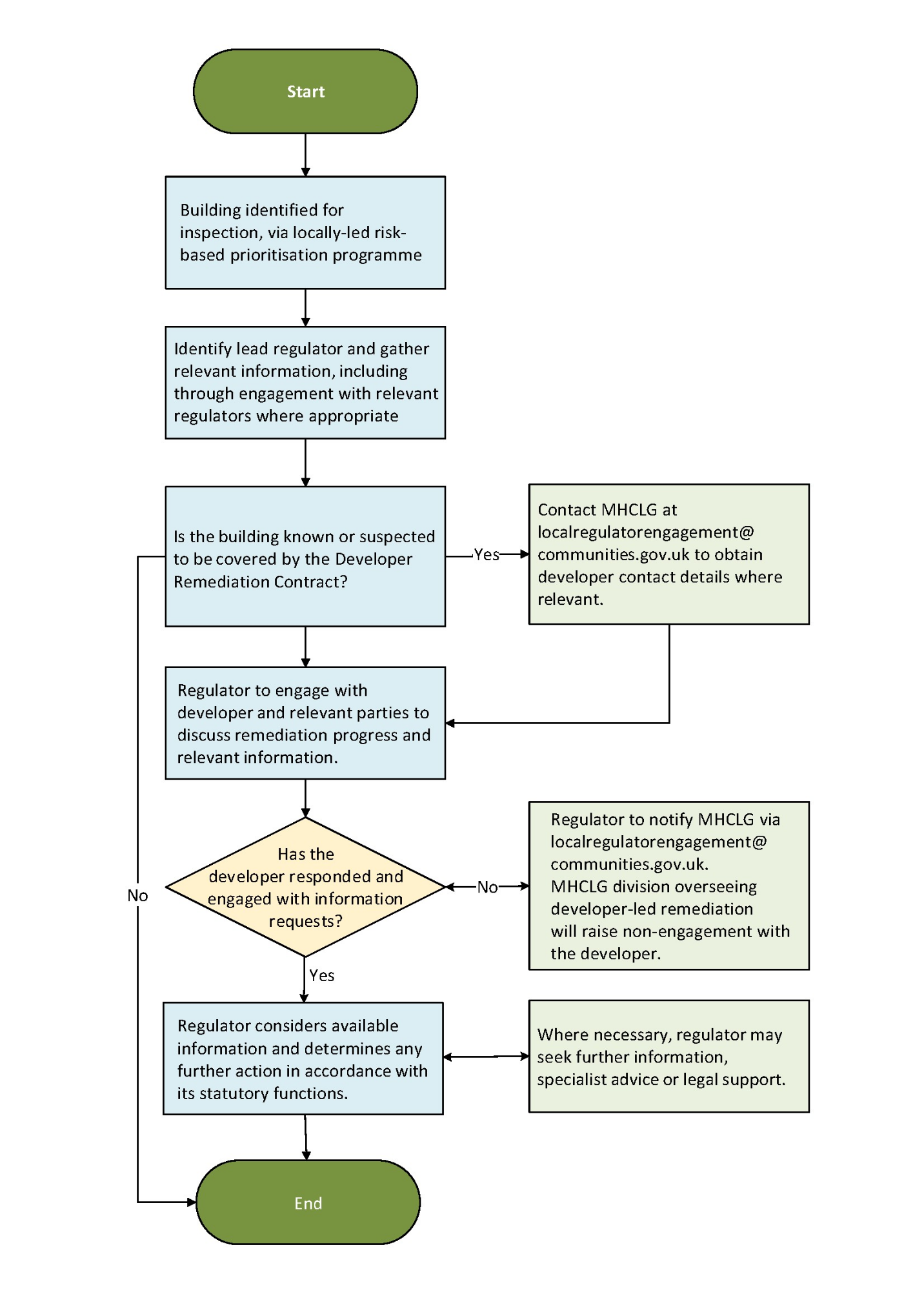
Start.
Step 1: Building identified for inspection via a locally led, risk-based prioritisation programme.
Step 2: Identify lead regulator and gather relevant information, including through engagement with relevant regulators where appropriate.
Step 3: Is the building known or suspected to be covered by the Developer Remediation Contract?
- If yes, contact MHCLG at localregulatorengagement@communities.gov.uk to obtain developer contact details where relevant. Then continue to step 4.
- If no, end of process.
Step 4: Regulator to engage with developer and relevant parties to discuss remediation progress and relevant information.
Step 5: Has the developer responded and engaged with information requests?
- If no, regulator to notify MHCLG via localregulatorengagement@communities.gov.uk. The MHCLG division overseeing developer-led remediation will raise non-engagement with the developer. Return to step 4.
-If yes, continue to step 6.
Step 6: Regulator considers available information and determines any further action in accordance with its statutory functions.
Step 7: Where necessary, regulator may seek further information, specialist advice or legal support.
End of process.