Contingencies Fund Account 2025-26
Published 18 June 2026

© Crown copyright 2026
This publication is licensed under the terms of the Open Government Licence v3.0 except where otherwise stated. To view this licence, visit nationalarchives.gov.uk/doc/open-government-licence/version/3 or write to the Information Policy Team, The National Archives, Kew, London TW9 4DU, or email: psi@nationalarchives.gov.uk.
Where we have identified any third party copyright information you will need to obtain permission from the copyright holders concerned.
This publication is available at https://www.gov.uk/government/publications/contingencies-fund-account-2025-to-2026/contingencies-fund-account-2025-26
1. Overview
1.1 Purpose and activities of the Contingencies Fund
The Contingencies Fund was established in its current form by the Contingencies Fund Act 1974, having been first established in May 1862. It is used to finance payments for urgent services in anticipation of provision for those services by Parliament. It can also be used to provide funds required temporarily by government departments and certain public sector bodies for necessary working balances, or to meet other temporary cash deficiencies.
It can also be used to temporarily lend money to government departments and some public sector organisations when they need extra cash to keep things running smoothly or to cover short-term gaps.
HM Treasury controls access to the Contingencies Fund to ensure that all advances made are appropriate and consistent with the requirements set out in Managing Public Money and Supply Estimates: a guidance manual. Wherever possible and required, Parliament is made aware of the intention to use the Contingencies Fund and incur associated resources through a written ministerial statement made in advance of any advances being made. During periods of recess, when an advance must be made that requires a written ministerial statement, Parliament is informed of the advance as soon as possible after the House returns. All advances from the Contingencies Fund must be repaid. In the case of advances in support of voted expenditure, Parliamentary authority is needed to enable sums advanced to departments to be repaid to the Contingencies Fund.
Whenever possible, the money lent out by the Contingencies Fund is paid back within the same financial year. Normally, government departments repay what they owe through additional funding requests made during the year, or, if that’s not an option, in the following year’s funding plans. Departments do not have to pay any interest on the money they borrow from the Contingencies Fund.
The Contingencies Fund is prepared on a going concern basis because it receives its funding from the Consolidated Fund and expects that all loans it gives to government departments will be repaid. For the next financial year (2026-27), the Fund’s limit has already been set, and requests for advances have been approved by Parliament before 31 March 2026 (see Note 7, Commitments). There are no planned changes to the way government funding works that would affect this assessment of the Fund’s ability to keep operating.
1.2 Key issues and risks
The cash requirements of the Contingencies Fund are met from the Consolidated Fund, and so liquidity risk is borne by the Exchequer. The Contingencies Fund is not subject to foreign currency or interest rate risk. Credit risk is limited as advances are only made to public sector entities (see Note 6, Financial Risks to the Contingencies Fund). Other key issues and risks facing the Contingencies Fund are considered in the Governance Statement.
1.3 Performance Overview
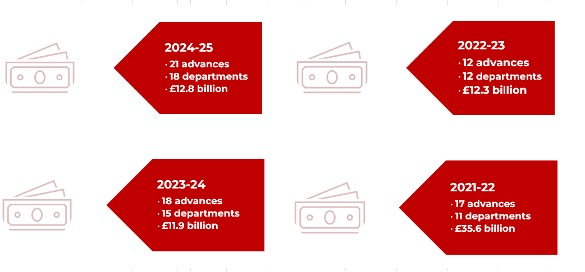
Advances made 2025-26: 11 advances made to 10 departments/public bodies totalling £4.5 billion
Departments receiving advances made:
Advances by category
*Category D advances of £0.1bn made
Maximum capital:
2% of authorised supply expenditure for the year-ended the previous 31 March.
2025-26: £17.1 billion (2024-25: £16.6 billion)
1.4 Performance Overview
In 2025-26, the Contingencies Fund advanced £4.5 billion to government departments and public sector bodies (2024-25: £12.8 billion).
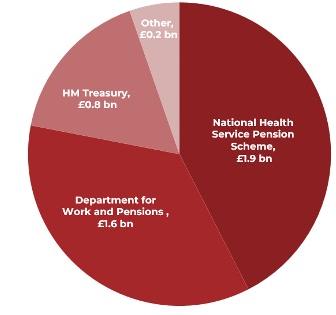
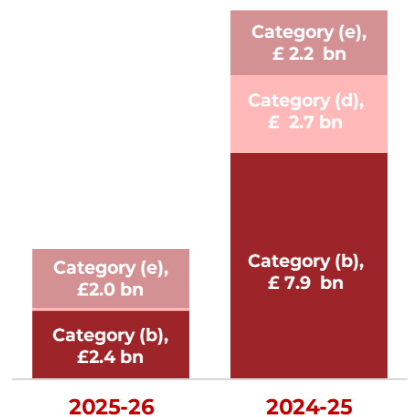
Advances are demand led, so year-on-year changes largely reflect the timing and scale of in-year cash requirements. Total advances fell in 2025-26 mainly due to lower Category B and Category D advances. Category B was lower because the unusually large advance issued in 2024-25 (principally to the Ministry of Defence) did not recur. Category D was lower because fewer departments exhausted their voted net cash requirement and required urgent additional cash support. For advances excluding category E further information on written ministerial statements can be found in Appendix B.
Advances provided urgent or temporary cash support until Parliament could approve the related spending, and all advances were repaid before the year end. The Fund can make advances only in specific circumstances set out by government; the table below summarises advances by category for 2025-26, with comparative figures for 2024-25. Further details are in section 5.14 of Supply Estimates: a guidance manual.
| Advances issued by category | 2025-26 £m | 2024-25 £m |
|---|---|---|
| a During the Vote on Account period, to meet urgent cash requirements (other than supporting a new service) in excess of the net cash requirement granted in the Vote on Account | - | - |
| b to meet the cash requirement supporting an urgent service which Parliament has already approved through specific enabling legislation but for which existing provision is not available | 2,362.7 | 7,856.2 |
| c to meet the cash requirement supporting a new service which is urgent and cannot await Parliamentary approval of both the specific enabling legislation and the necessary Estimate | 8.0 | 1.2 |
| d to meet a further urgent cash requirement for existing services when provision for the total net cash requirement on the Estimate is exhausted | 111.7 | 2,717.2 |
| e in the case of an Estimate where expenditure is largely financed from income, advances may be made in anticipation of the receipt of cash associated with such income | 2,045.0 | 2,235.0 |
| Sub total | 4,527.4 | 12,809.6 |
| f in anticipation of revenue, as distinct from income, receipts | - | - |
| Total | 4,527.4 | 12,809.6 |
Category B advances accounted for 52 per cent of funding issued in 2025-26. Of the £2.4 billion advanced in this category, £1.6 billion was to the Department for Work and Pensions and £0.8 billion to HM Treasury.
The Capital of the Contingencies Fund
The Contingencies Fund has a level of permanent capital of £1.5 million (section 52 of the Finance Act 1921). Under section 3 of the Miscellaneous Financial Provisions Act 1946 (as amended by the Contingencies Fund Act 1974), the Fund’s capital may be increased as necessary up to 2 per cent of the authorised supply expenditure for the year ended the previous 31 March. The table below shows the limits for the current and prior year.
| 2025-26 £m | 2024-25 £m | |
|---|---|---|
| Total cash supply expenditure authorised in prior financial year | 854,416 | 831,616 |
| Maximum capital (2% of prior year total cash supply expenditure and includes £1.5m permanent capital) | 17,088 | 16,632 |
The Exchequer Funds and Accounts (EFA) Team at HM Treasury closely monitors requests for money from the Contingencies Fund every day to ensure advances stay within legal limits. If the Contingencies Fund receives money from the Consolidated Fund, it does not have to pay interest on the amount received.
Long-term expenditure trends
The Contingencies Fund has no long-term expenditure trends since its function is to:
- finance payments for urgent services in anticipation of Parliamentary provision for those services becoming available,
- provide funds required temporarily by government departments and certain public sector bodies for necessary working balances, or
- to meet other temporary cash deficiencies, it has no long-term expenditure trends.
Sustainability reporting
The Contingencies Fund is administered by HM Treasury and therefore does not have its own staff or buildings. The Fund’s impact on the environment is the same as that of the department. Further details on the environmental impact and climate change adaptation, including how it is embedded within overall decision making and assurance processes is provided within HM Treasury’s Annual Report and Accounts.
Conrad Smewing
Accounting Officer
HM Treasury
12 June 2026
2. Accountability report
The accountability report contains the following sections:
- Corporate governance report which explains the composition and organisation of the Contingencies Fund’s governance structures and how they support the achievement of the Contingencies Fund’s objectives. It includes the Statement of Accounting Officer’s responsibilities and the Governance statement.
- Parliamentary accountability and audit report which includes key Parliamentary accountability information on regularity of expenditure and remote contingent liabilities as well as the Certificate and Report of the Comptroller and Auditor General to the House of Commons.
2.1 Corporate governance report
The Contingencies Fund is administered by HM Treasury, with all staff being employees of the department. Consequently, the Fund does not have its own workforce. Further information of HM Treasury’s staffing and related costs is available in HM Treasury’s Annual Report and Accounts.
Conflicts of interest
HM Treasury requires all employees to disclose any actual or perceived conflict of interest. Conflicts of interest may be financial and can also stem from the interests of household members or other associates; all potential conflicts must be declared and assessed to ensure they do not undermine integrity, reputation or decision-making of HM Treasury.
Staff receive clear guidance on how to identify and manage conflicts, and what to do if one arises. There is a strong process in place for declaring, reviewing, approving, mitigating and recording both actual and perceived conflicts. With proportionate measures put in place to manage them and sanctions (up to contract termination) for failure to declare or comply, whether intentional or not. The declarations process utilises a digital system, which has enhanced both the efficiency and accessibility of declaring conflicts across the department
In 2025-26, no material conflicts of interest have been noted by the senior management overseeing the Contingencies Fund (2024-25: none).
Personal data related incidents
The Contingencies Fund does not hold any protected personal data.
Statement of Accounting Officer’s responsibilities
HM Treasury is required to prepare accounts of the Contingencies Fund for each financial year in the form and on the basis set out in the Treasury Minute dated 13 May 1862.
In preparing the accounts the Accounting Officer is required to:
- observe the Treasury Minute dated 13 May 1862 and apply suitable accounting policies on a consistent basis.
- prepare the accounts on a going concern basis; and
- confirm that the annual report and accounts are fair, balanced, and understandable and take personal responsibility for the annual report and accounts and the judgements required for determining that they are fair, balanced and understandable.
HM Treasury has appointed Conrad Smewing, Director General Public Spending, as Accounting Officer for the Contingencies Fund.
The responsibilities of the Accounting Officer, including responsibility for the propriety and regularity of the public finances for which the Accounting Officer is answerable, and for keeping proper records, are set out in Managing Public Money.
Statement regarding the disclosure of information to auditors
As Accounting Officer, I have taken all the steps that I ought to have taken to make myself aware of any relevant audit information and to establish that the Contingencies Fund’s auditors are aware of that information. So far as I am aware, there is no relevant audit information of which the auditors are unaware.
I also confirm that the annual report and accounts are fair, balanced, and understandable and I take personal responsibility for judgements required for determining that they are fair, balanced and understandable.
Audit arrangements
The accounts are audited by the Comptroller and Auditor General (C&AG) in accordance with HM Treasury Minute dated 13 May 1862. The National Audit Office (NAO) bears the cost of all external audit work performed on the Contingencies Fund. During the financial year, no non-audit work was undertaken by the NAO in relation to the Contingencies Fund.
2.2 Governance statement
Governance Framework
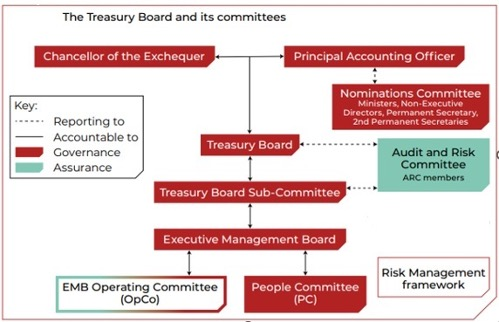
The Contingencies Fund is managed within HM Treasury’s overall risk and governance framework as set out in the Governance Statement in HM Treasury’s Annual Report and Accounts. This includes HM Treasury Board’s assessment of its compliance with the Corporate Governance Code.
The Chancellor of the Exchequer, as Minister in charge of HM Treasury, is responsible and answerable to Parliament on all the policies, decisions, and actions of HM Treasury, and ultimately of the Contingencies Fund.
As Accounting Officer for the Contingencies Fund, I am personally responsible and accountable to Parliament for the organisation and quality of management of the Contingencies Fund, including its use of public money and the stewardship of its assets, in line with those responsibilities assigned to me in Managing Public Money.
Audit and Risk Committee (ARC)
The Audit and Risk Committee provide advice to the Treasury Board, the Permanent Secretary (Principal Accounting Officer) and HM Treasury’s additional Accounting Officers to support the effective discharge of their duties and responsibilities for risk, internal control and governance. The Committee considers the integrity of the financial statements and HM Treasury Group’s Annual Report and Accounts in relation to the Consolidated Fund, National Loans Fund, Contingencies Fund, Exchange Equalisation Account and Whole of Government Accounts.
In line with its role, the Committee provides independent challenge on the adequacy of the assurance available to the Board and Accounting Officers and oversees the work of GIAA and the NAO. Representatives from both organisations attend meetings as appropriate. The Committee met five times during 2025-26. Pre-meeting discussions with the NAO and GIAA were held where needed.
Internal audit provides an independent internal function forming a key part of the department’s overall framework of governance, risk management and internal control. It provides objective assurance to the principal accounting officer on whether controls are properly designed and operating effectively. The committee approves the annual Internal Audit Plan, which is risk based, forward looking and aligned to the department’s strategic objectives.
In accordance with the ARC Handbook[footnote 1], the Committee provides independent challenge on the robustness of the mechanisms in place, and the evidence provided, to deliver the assurance needed by the Board and departmental Accounting Officers. The committee provides oversight of activity performed by the GIAA and NAO.
HM Treasury recognises the importance of maintaining an appropriate balance of skills, experience and capacity across its governance structures. In line with the ARC Handbook, the Audit and Risk Committee will consider the adequacy of skills, experience and capacity across the Committee and will undertake a formal skills audit in 2026-27 to assess whether any capability gaps exist and to inform future Committee composition.
Representatives from GIAA and NAO attend each meeting and provide updates on the plan’s delivery, including reporting on key controls and undertakes independent scrutiny of the department’s performance. The ARC also receives reports on the work of the Fund’s external auditors, the NAO.
Members of the Committee are appointed by the Chair along with the Principal Accounting Officer. The Committee met five times during 2025-26. and membership of the committee at included:
| Committee member | Role | Attended |
|---|---|---|
| Edward Twiddy [footnote 2] | Chair of the Audit and Risk Committee | 4/4 |
| Sir Edward Braham | Member of the Audit and Risk Committee | 5/6 |
| Catherine Vaughan [footnote 2] | Independent member of the Audit and Risk Committee | 4/4 |
| Former committee members leaving in year | ||
| Jane Hanson CBE (to 31/12/2025) [footnote 2] | Member of the Audit and Risk Committee | 4/4 |
| Zarin Patel (to 31/07/2025) [footnote 2] | Chair of the Audit and Risk Committee | 2/2 |
The Committee has a robust Conflicts of Interest Policy, which requires members to excuse themselves from discussions where potential conflicts may occur. Members are required to inform HM Treasury’s Permanent Secretary and Principal Accounting Officer about any potential conflicts and highlight these at the start of each meeting as appropriate.
Internal Audit
Internal audit for the Contingencies Fund is provided by GIAA as part of their wider work on the departmental group. The internal audit team evaluated the governance, accuracy and completeness of transactions and found no errors. For the period, a substantial opinion was issued, providing assurance on the adequacy and effectiveness of the risk management, control and governance relevant to the Fund.
During 2025-26, internal audit work undertaken by GIAA across business continuity and resilience, including cyber related dependencies, confirmed that core controls are in place and operating effectively while identifying opportunities to further strengthen elements of the control framework.
HM Treasury is taking forward actions to support a programme of continuous improvement. This is consistent with the department’s wider approach to governance, risk management and internal as set out in HM Treasury Group’s Annual Report and Accounts.
Management of the Contingencies Fund
I have delegated authority for approval of most advances from the Contingencies Fund to the Estimates Clerk (or staff with authority delegated by the Estimates Clerk) in HM Treasury’s Public Spending Group. I approve advances considered to be novel or contentious. HM Treasury’s EFA Team administers the account.
Detailed guidance on the purpose of and procedures relating to the Contingencies Fund, including advice on processes when dealing with the Contingencies Fund, is set out in Managing Public Money and Supply Estimates: a guidance manual.
Once an advance has been made it is the responsibility of the receiving department to ensure that the cash is used only for the purpose(s) for which it was advanced and to make repayment at the earliest opportunity (though HM Treasury will follow up outstanding repayments as necessary).
Reporting to HM Treasury’s Boards
The Contingencies Fund operates within HM Treasury’s wider governance and risk management framework. Departmental risk reporting to HM Treasury’s Boards covers strategic and operational risks across the department, while risks specific to the administration and operation of the Contingencies Fund are identified and managed separately through EFA’s control and risk management processes.
HM Treasury’s risk management framework supports the identification and management of risks to the department’s strategic objectives. Directors, specialist Risk Groups and the Operating Committee and the Executive Management Board (EMB) are responsible for monitoring, challenging and reporting on performance against risks and HM Treasury’s objectives.
HM Treasury’s approach to risk management is compliant with the principles set out in The Orange Book. In accordance with this guidance, risk management is embedded in the department’s governance, leadership, and activities. HM Treasury’s ARC supports the Accounting Officers in overseeing the Risk Management Framework.
Organisational risks that exceed the department’s risk appetite are escalated to senior managers via quarterly risk reporting and, where necessary for appropriate action. The EFA’s control and risk management processes feed into this.
In 2025-26, the department undertook comprehensive work to review and strengthen its risks and crisis management frameworks. This resulted in streamlined reporting, clear lines of accountability and escalation, and refreshed business continuity arrangements. This will enable the department to respond more effectively to the crystallisation of acute risks in the future.
Following the publication of the updated 2025 National Risk Register in January 2026, the department continues to own four risks under the Lead Government Department Model. Updates on these four risks are included in the Quarterly risk note.
Throughout 2025-26 the HM Treasury Operating Committee held discussions on the risk landscape and undertook deep dives into high-priority risks flagged through the quarterly reporting system. These processes have produced tangible recommendations for teams to improve the department’s resilience. Risks assessed this year include cyber security, departmental oversight of Arm’s Length Body (ALB) governance arrangements and impacts from the voluntary exit scheme on workforce planning. EMB has also addressed varied risks through its regular meetings.
Contingencies Fund Risk management
EFA is managed within HM Treasury’s risk management framework, as set out in HM Treasury’s Annual Report and Accounts. In addition, specific risks relating to the administration and operation of the Contingencies Fund are identified, assessed and managed by EFA.
The Treasury Accountant holds day-to day responsibility for risk management of those Funds managed by EFA, ensuring that my financial, regularity and propriety responsibilities as Accounting Officer of the Contingencies Fund are met. Key operational staff with responsibilities relating to the Contingencies Fund are trained and equipped to manage risk appropriately within their roles.
Risk management underpins all EFA processes, including business continuity resilience planning for the public funds for which EFA is responsible. Business continuity arrangements are regularly tested, both within EFA and business partners, and lessons learned are used to strengthen and improve these arrangements.
Cyber security and information resilience form an integral part of this overall control environment. The administration of the Contingencies Fund relies on HM Treasury systems, infrastructure and cross government partners to support critical financial operations. These arrangements are supported by established security controls, resilience measures and incident response processes, underpinned by ongoing monitoring, assurance activity and alignment with cross-government standards. Business continuity planning explicitly considers disruption scenarios, including those arising from cyber incidents and wider system dependencies.
The Treasury Accountant chairs the Public Finance Business Continuity group, a network that brings together relevant teams across HM Treasury, the Bank of England, Debt Management Office, NAO, HMRC and Government Banking. The Group helps ensure business continuity risks are identified, managed and addressed in a consistent and coordinated manner across all operational partners involved in the stewardship of Exchequer funds. Annual certificates of assurance are obtained from all member organisations.
The risk management strategy includes periodic horizon scanning to identify any changes in risk exposure, to evaluate their potential impact and to determine appropriate mitigating actions. Significant risk issues are recorded in a risk register and are assessed by likelihood and impact. Each risk has an appointed risk owner, who is responsible for its management. The risk register is reviewed quarterly by EFA management and is provided to me alongside the quarterly risks and controls report.
The system of internal control
As Accounting Officer, I am responsible for maintaining a sound system of internal control that supports the achievement of the Contingencies Fund’s policies, aims and objectives, whilst safeguarding the public funds and assets, for which I am personally responsible, in accordance with the responsibilities assigned to me in Managing Public Money.
The system of internal control is designed to manage risk to an acceptable level, balancing the impact of potential risks with the resources required to manage them, rather than eliminate all risk. It can therefore only provide reasonable and not absolute assurance of effectiveness. The system of internal control is based on an ongoing process designed to identify and prioritise the risks to the achievement of the Contingencies Fund’s policies, aims, and objectives; to evaluate the likelihood of those risks being realised and the impact should they be realised; and to manage them efficiently, effectively, and economically.
The system of internal control has been in place throughout the year ended 31 March 2026 and up to the date of approval of the financial statements and accords with Treasury guidance. There were no significant changes to the control environment during the year.
Risk profile
The Contingencies Fund is managed within the framework of HM Treasury’s system of internal control. Within that broader framework, EFA identifies and manages the principal risks specific to the administration and operation of the Contingencies Fund. This includes resourcing the administration of the Contingencies Fund, security, and the management of risks across HM Treasury’s business.
The key operational and control risks specific to the Contingencies Fund, and the main controls in place to mitigate them, are set out in the table below. These risks relate specifically to the operation and administration of the Contingencies Fund and should be read alongside, rather than as a substitute for, HM Treasury’s wider departmental risk reporting.
| Risk Category | Description | Key controls | Status |
|---|---|---|---|
| Breach of the Contingencies Fund capital limit | Risk that advances made exceed the statutory limit | EFA review the outstanding advances and ensure that the capital limit will not be breached. | Stable |
| Irregularity of transactions (including fraudulent or erroneous payments) | Risk that payments are made incorrectly, unlawfully or fraudulently either within EFA or through counterparties, leading to financial loss or reputational damage. | Clear separation of duties enforced through user permissions and payment approval panels. Departments and certain public sector bodies seeking advances from the Contingencies Fund are required to comply with procedures set out in Managing Public Money and Supply Estimates: a guidance manual. | Stable |
| Incorrect accounting | Risk of material misstatement in accounts due to system errors, incorrect inputs or misapplication of accounting standards. | Application controls in IT system used to manage accounting entries. Alongside daily bank reconciliations. Monthly management accounts reviewed by HM Treasury Accountant and Accounting Officer. | Stable |
| Failure of IT systems | Risk that failure of core HM Treasury or communication channels prevents processing of payments or access to critical financial data leading to disrupted operations. | HM Treasury network infrastructure, which is provided by an outsourced supplier, has a high level of resilience including a near instant failover should an issue arise. | Stable |
| Failure to provide an effective service in adverse circumstances, including cyber incidents and disasters | Risk that delivery partners fail to provide essential services, disrupting payments, reporting or wider public finance operations. | Cross‑trained EFA staff ensure operational resilience. Continuity arrangements regularly tested under Treasury‑wide Business Continuity structures. | Stable |
| Failure of principal counterparties to provide agreed services | Risk of unauthorised access to, loss of, or misuse of data, reporting and debt operations. | Well‑developed Service Level Agreements detailing monitoring and control arrangements. | Stable |
| Information risk | Risk of unauthorised access to, or misuse of, sensitive data leading to legal, financial or reputational consequences. | Data and information risk managed under Treasury policies incl. encryption and physical/IT security. EFA Data Handling Policy reviewed periodically. | Stable |
Review of effectiveness
In line with HM Government guidance, set out within the Corporate Governance Code of Good Practice for central government departments, I have reviewed the effectiveness of the system of internal control.
My review is informed by the work of GIAA who provided positive assurance as to the management and control of the Contingencies Fund in 2025-26 and EFA management who have responsibility for the development and maintenance of the internal control framework, as well as comments made by external auditors in their management letter and other reports.
I have taken account of the oversight provided by HM Treasury Group ARC, and the actions of risk owners, in addressing weaknesses and ensuring continuous improvement in the system of internal control. Further information about the effectiveness of HM Treasury’s overall system of governance including board effectiveness, attendance, compliance with the Corporate Governance Code for central government departments and quality of management information reviewed, is reported in HM Treasury’s Annual Report and Accounts, Accountability Report. The ARC considered the 2025-26 accounts in draft and provided me with its views before I formally signed the accounts.
No significant internal control issues, including data-related incidents, have been identified in 2025-26, and no significant new risks specific to the operational management and administration of the Contingencies Fund were identified during the year. Wider risks affecting HM Treasury as a department continue to be identified and managed through the department’s established governance and risk management framework. No ministerial directions have been given in 2025-26.
In my opinion, the system of internal control was effective throughout the financial year and remains so on the date I sign this report.
2.3 Parliamentary accountability and audit report
Regularity of expenditure (audited)
The advances of the Contingencies Fund were applied to the purposes intended by Parliament.
Losses, special payments and gifts (audited)
During 2025-26 the Contingencies Fund had no losses, special payments or gifts totalling over £300,000 (2024-25: Nil).
Fees and charges (audited)
The Contingencies Fund does not have any fees or charges.
Remote contingent liabilities (audited)
The Contingencies Fund had no remote contingent liabilities as of 31 March 2026 (31 March 2025: Nil)
Functional Standards
Operationally, the Contingencies Fund is part of HM Treasury. Further information on the Department’s application of the Government Functional Standards is provided within the Parliamentary accountability and audit report included in HM Treasury Annual Report and Accounts.
Conrad Smewing
Accounting Officer
HM Treasury
12 June 2026
2.4 The Report of the Comptroller and Auditor General to the House of Commons
Opinion on financial statements
I have audited the financial statements of the Contingencies Fund for the year ended 31 March 2026 under the Treasury Minute dated 13 May 1862.
The financial statements comprise the Contingencies Fund’s
- Statement of Financial Position,
- Statement of Cash Flows; and
- the related notes including the significant accounting policies.
The financial reporting framework that has been applied in the preparation of the financial statements is applicable law and the Treasury Minute dated 13 May 1862.
In my opinion, the financial statements:
- properly present the Contingencies Fund’s receipts and payments for the year ended 31 March 2026; and
- have been properly prepared in accordance with the Treasury Minute dated 13 May 1862.
Opinion on regularity
In my opinion, in all material respects, the receipts and payments recorded in the financial statements have been applied to the purposes intended by Parliament and the financial transactions recorded in the financial statements conform to the authorities which govern them.
Basis for opinions
I conducted my audit in accordance with International Standards on Auditing (UK) (ISAs UK), applicable law and Practice Note 10 Audit of Financial Statements and Regularity of Public Sector Bodies in the United Kingdom (2024). My responsibilities under those standards are further described in the Auditor’s responsibilities for the audit of the financial statements section of my report.
Those standards require me and my staff to comply with the Financial Reporting Council’s Revised Ethical Standard 2024. I am independent of the Contingencies Fund in accordance with the ethical requirements that are relevant to my audit of the financial statements in the UK. In applying the Ethical Standards, I have considered the potential implications for my audit arising from the extension of a loan staff arrangement with the Office of Value for Money within HM Treasury to November 2025. The loan staff arrangement concerned one of my directors (unconnected with our audit of the Contingencies Fund Accounts prepared by HM Treasury) and was for an initial period of 12 months from September 2024. The arrangement was extended by a further two months so that the secondee was able to support the completion of the Office for Value for Money’s work. I am satisfied that appropriate safeguards have been implemented to protect my and the NAO team’s independence and objectivity throughout the audit. My staff and I have fulfilled our other ethical responsibilities in accordance with these requirements.
I believe that the audit evidence I have obtained is sufficient and appropriate to provide a basis for my opinion.
Conclusions relating to going concern
In auditing the financial statements, I have concluded that the Contingencies Fund’s use of the going concern basis of accounting in the preparation of the financial statements is appropriate.
Based on the work I have performed, I have not identified any material uncertainties relating to events or conditions that, individually or collectively, may cast significant doubt on the Contingencies Fund’s ability to continue as a going concern for a period of at least twelve months from when the financial statements are authorised for issue.
My responsibilities and the responsibilities of the Accounting Officer with respect to going concern are described in the relevant sections of this report.
Other information
The other information comprises information included in the Annual Report but does not include the financial statements and my auditor’s report thereon. The Accounting Officer is responsible for the other information.
My opinion on the financial statements does not cover the other information and, except to the extent otherwise explicitly stated in my report, I do not express any form of assurance conclusion thereon.
My responsibility is to read the other information and, in doing so, consider whether the other information is materially inconsistent with the financial statements or my knowledge obtained in the audit, or otherwise appears to be materially misstated.
If I identify such material inconsistencies or apparent material misstatements, I am required to determine whether this gives rise to a material misstatement in the financial statements themselves. If, based on the work I have performed, I conclude that there is a material misstatement of this other information, I am required to report that fact.
I have nothing to report in this regard.
Opinion on other matters
In my opinion, based on the work undertaken in the course of the audit:
- the parts of the Accountability Report subject to audit have been properly prepared in accordance with directions made under the Treasury Minute dated 13 May 1862; and
- the information given in the Performance and Accountability Reports for the financial year for which the financial statements are prepared is consistent with the financial statements and is in accordance with the applicable legal requirements.
Matters on which I report by exception
In the light of the knowledge and understanding of the Contingencies Fund and its environment obtained in the course of the audit, I have not identified material misstatements in the Performance and Accountability Reports.
I have nothing to report in respect of the following matters which I report to you if, in my opinion:
- adequate accounting records have not been kept by the Contingencies Fund or returns adequate for my audit have not been received from branches not visited by my staff; or
- I have not received all of the information and explanations I require for my audit; or
- the financial statements and the parts of the Accountability Report subject to audit are not in agreement with the accounting records and returns; or
- the Governance Statement does not reflect compliance with HM Treasury’s guidance.
Responsibilities of the Accounting Officer for the financial statements
As explained more fully in the Statement of Accounting Officer’s Responsibilities, the Accounting Officer is responsible for:
- maintaining proper accounting records;
- providing the C&AG with access to all information of which management is aware that is relevant to the preparation of the financial statements such as records, documentation and other matters;
- providing the C&AG with additional information and explanations needed for his audit;
- providing the C&AG with unrestricted access to persons within HM Treasury from whom the auditor determines it necessary to obtain audit evidence;
- ensuring such internal controls are in place as deemed necessary to enable the preparation of financial statements to be free from material misstatement, whether due to fraud or error;
- preparing financial statements and Annual Report which are in accordance with the applicable financial reporting framework; and
- assessing the Contingencies Fund’s ability to continue as a going concern, disclosing, as applicable, matters related to going concern and using the going concern basis of accounting unless the Accounting Officer either intends to liquidate the entity or to cease operations, or has no realistic alternative but to do so.
Auditor’s responsibilities for the audit of the financial statements
My responsibility is to audit and report on the financial statements in accordance with the Treasury Minute dated 13 May 1862.
My objectives are to obtain reasonable assurance about whether the financial statements as a whole are free from material misstatement, whether due to fraud or error, and to issue a report that includes my opinion. Reasonable assurance is a high level of assurance but is not a guarantee that an audit conducted in accordance with ISAs (UK) will always detect a material misstatement when it exists. Misstatements can arise from fraud or error and are considered material if, individually or in the aggregate, they could reasonably be expected to influence the economic decisions of users taken on the basis of these financial statements.
Extent to which the audit was considered capable of detecting non-compliance with laws and regulations, including fraud
I design procedures in line with my responsibilities, outlined above, to detect material misstatements in respect of non-compliance with laws and regulations, including fraud. The extent to which my procedures are capable of detecting non-compliance with laws and regulations, including fraud is detailed below.
Identifying and assessing potential risks related to non-compliance with laws and regulations, including fraud
In identifying and assessing risks of material misstatement in respect of non-compliance with laws and regulations, including fraud, I:
- considered the nature of the sector, control environment and operational performance including the design of the Contingencies Fund’s accounting policies;
- inquired of management, Contingencies Fund’s head of internal audit and those charged with governance, including obtaining and reviewing supporting documentation relating to the Contingencies Fund’s policies and procedures on:
- identifying, evaluating and complying with laws and regulations;
- detecting and responding to the risks of fraud; and
- the internal controls established to mitigate risks related to fraud or non-compliance with laws and regulations including the Contingencies Fund’s controls relating to the Contingencies Fund’s compliance with the Treasury Minute dated 13 May 1862, the Contingencies Fund Act 1974 and Managing Public Money;
- inquired of management, Contingencies Fund’s head of internal audit and those charged with governance whether:
- they were aware of any instances of non-compliance with laws and regulations;
- they had knowledge of any actual, suspected, or alleged fraud,
- discussed with the engagement team regarding how and where fraud might occur in the financial statements and any potential indicators of fraud.
As a result of these procedures, I considered the opportunities and incentives that may exist within the Contingencies Fund for fraud and identified the greatest potential for fraud in the following areas: revenue recognition and posting of unusual journals. In common with all audits under ISAs (UK), I am required to perform specific procedures to respond to the risk of management override.
I obtained an understanding of the Contingencies Fund’s framework of authority and other legal and regulatory frameworks in which the Contingencies Fund operates. I focused on those laws and regulations that had a direct effect on material amounts and disclosures in the financial statements or that had a fundamental effect on the operations of the Contingencies Fund. The key laws and regulations I considered in this context included the Contingencies Fund Act 1974 and Managing Public Money.
I considered all advances issued in year to confirm the regularity of each advance and that the Capital Limit set by the Contingencies Fund Act 1974 was not breached during the year.
Audit response to identified risk
To respond to the identified risks resulting from the above procedures:
- I reviewed the financial statement disclosures and testing to supporting documentation to assess compliance with provisions of relevant laws and regulations described above as having direct effect on the financial statements;
- I enquired of management and the Audit and Risk Committee concerning actual and potential litigation and claims;
- I reviewed minutes of meetings of those charged with governance and the Board; and internal audit reports; and
- in addressing the risk of fraud through management override of controls, I tested the appropriateness of journal entries and other adjustments; and evaluated the business rationale of any significant transactions that are unusual or outside the normal course of business.
I communicated relevant identified laws and regulations and potential risks of fraud to all engagement team members and remained alert to any indications of fraud or non-compliance with laws and regulations throughout the audit.
A further description of my responsibilities for the audit of the financial statements is located on the Financial Reporting Council’s website at: www.frc.org.uk/auditorsresponsibilities. This description forms part of my certificate.
Other auditor’s responsibilities
I am required to obtain sufficient appropriate evidence to give reasonable assurance that the payments and receipts recorded in the financial statements have been applied to the purposes intended by Parliament and the financial transactions recorded in the financial statements conform to the authorities which govern them.
I communicate with those charged with governance regarding, among other matters, the planned scope and timing of the audit and significant audit findings, including any significant deficiencies in internal control I identify during my audit.
Gareth Davies
Comptroller and Auditor General
15 June 2026
National Audit Office
157-197 Buckingham Palace Road
Victoria
London
SW1W 9SP
3. Financial Statements
3.1 Statement of Financial Position as at 31 March 2026
| Note | 31 March 2026 | 31 March 2025 | |
|---|---|---|---|
| £m | £m | ||
| Assets | |||
| Current Assets | |||
| Cash and cash equivalents | 3 | 1.5 | 1.5 |
| Total assets | 1.5 | 1.5 | |
| Liabilities | |||
| Sums repayable to the Consolidated Fund | |||
| Non-current liabilities | 4 | 1.5 | 1.5 |
| Total liabilities | 1.5 | 1.5 |
The Contingencies Fund does not receive any income, nor does it incur any expenditure. Accordingly, no Statement of Comprehensive Net Expenditure is presented. There were no other gains or losses in the year (2024-25: Nil).
The Notes to the accounts form part of these accounts.
Conrad Smewing
Accounting Officer
HM Treasury
12 June 2026
Statement of Cashflows for the year ended 31 March 2026.
| Note | 2025-26 £m | 2024-25 £m | |
|---|---|---|---|
| Receipts | |||
| Issues from the Consolidated Fund | 3,000.0 | 10,000.0 | |
| Recovered advances | 5 | 4,527.4 | 12,809.6 |
| Total Receipts | 7,527.4 | 22,809.6 | |
| Payments | |||
| Repayments to the Consolidated Fund | (3,000.0) | (10,000.0) | |
| Recoverable advances | 5 | (4,527.4) | (12,809.6) |
| Total Payments | (7,527.4) | (22,809.6) | |
| Surplus of payments over receipts for the financial year | - | - |
The Notes to the accounts form part of these accounts.
3.2 Notes to the accounts
3.3 1. Accounting policies
Basis of preparation
The accounts of the Contingencies Fund have been prepared in accordance with the Treasury Minute dated 13 May 1862.
The Contingencies Fund receives its funding annually from the Consolidated Fund and expects to recover all advances it makes to departments and public sector bodies. The limit for the Contingencies Fund in 2026-27 was set and advances authorised prior to 31 March 2026 (see Note 7, Commitments).
There are no areas of the financial statements that are reliant on management’s judgement in the process of applying the Contingencies Fund’s accounting policies. There are no sources of estimation uncertainty at the balance sheet date.
The financial statements of the accounts are rounded to the nearest £0.1 million.
Functional and presentation currency
The financial statements of the Contingencies Fund are presented in sterling, the Contingencies Fund’s functional currency.
Financial Assets and Liabilities
All assets and liabilities are accounted for as financial assets and liabilities.
3.4 2. Income and expenditure
As interest is not receivable on its advances nor payable on its liabilities, the Contingencies Fund does not receive any income, nor does it incur any expenditure. Consequently, no Statement of Comprehensive Net Expenditure is presented.
3.5 3. Cash and cash equivalents
Cash and cash equivalents comprise a cash balance held by Government Banking. A balance of £1,500,000 was held at both the start and end of the financial year 2025-26. This is equal to the permanent capital of the Contingencies Fund, as specified by section 52 of the Finance Act 1921.
3.6 4. Liabilities
The Contingencies Fund’s has permanent capital amounting to £1,500,000. This is recorded as a non-current liability to the Consolidated Fund.
At the end of the financial year, there were no advances outstanding. Since there were no advances outstanding, there were also no current liabilities to the Consolidated Fund. This has been consistent for the past two financial years.
3.7 5. Advances and repayments
Contingencies Fund advances and repayments that contributed to cash flow in 2025-26 are detailed in the table below. There were no advances made, or repayments received in relation to advances in anticipation of revenue (Category (f)), as distinct from income, receipts in 2025-26 (2024-25: Nil). See Performance Analysis for more detail on the categories of advances. For advances excluding category E further information on written ministerial statements can be found in Appendix B.
All advances made were repaid within the financial year. Departments may have received more than one advance within each category.
| Department | Cat. | 2025-26 | 2024-25 |
|---|---|---|---|
| £m | £m | ||
| Department for Work and Pensions | (b) | 1,610.0 | - |
| HM Treasury | (b) | 752.7 | 752.7 |
| Ministry of Defence | (b) | - | 5,994.5 |
| Department of Health and Social Care | (b) | - | 837.0 |
| Cabinet Office | (b) | - | 272.0 |
| Department for Work and Pensions | (c) | 4.5 | - |
| Department for Culture Media and Sport | (c) | 3.5 | - |
| Ministry of Justice | (c) | - | 1.2 |
| Export Credits Guarantee Department | (c) | - | 0.1 |
| National Savings and Investments | (d) | 109.0 | 57.7 |
| Export Credits Guarantee Department | (d) | 2.7 | - |
| Department of Health and Social Care | (d) | - | 1,400.0 |
| Ministry of Defence | (d) | - | 500.0 |
| Ministry of Justice | (d) | - | 300.0 |
| Security and Intelligence Agencies | (d) | - | 276.6 |
| Crown Prosecution Service | (d) | - | 60.0 |
| UK Atomic Energy Authority Pension Schemes | (d) | - | 55.0 |
| Independent Parliamentary Standards Authority | (d) | - | 52.8 |
| Serious Fraud Office | (d) | - | 15.0 |
| NHS Pension Scheme | (e) | 1,923.0 | 1,950.0 |
| Office of Gas and Electricity Markets | (e) | 49.0 | 42.0 |
| HM Procurator General and Treasury Solicitor | (e) | 30.0 | 30.0 |
| Office of Rail and Road | (e) | 25.0 | 25.0 |
| Water Services Regulation Authority | (e) | 18.0 | 13.0 |
| Teachers’ Pension Scheme | (e) | - | 175.0 |
| Total | 4,527.4 | 12,809.6 |
3.8 6. Financial Risks related to the Contingencies Fund
Liquidity risk
The cash requirements of the Contingencies Fund are met from the Consolidated Fund and so liquidity risk is borne by the Exchequer.
Foreign currency & interest rate risk
All the transactions of the Contingencies Fund occur in sterling, and no interest is paid on issues to the Contingencies Fund from the Consolidated Fund, nor received on advances made by the Contingencies Fund. As a result, the Contingencies Fund is not subject to foreign currency or interest rate risk.
Credit risk
The Contingencies Fund’s advances are solely to public sector entities which limits credit risk. The largest advance in 2025-26 of £1,923m to the National Health Service Pension Scheme, was made in anticipation of the receipt of cash, where that income is used to fund expenditure (category (e)). Category (e) advances are made to regulatory bodies providing short-term liquidity until sufficient income is received from the industries regulated. The table below provides an assessment of credit risk for each category of advance.
| Category | Credit risk assessment | Explanation |
|---|---|---|
| a | Limited risk | The Vote on Account provides authority for spending on continuing services in the early part of the following financial year, until the Main Estimates obtains Royal Assent. Departments then seek cover in the relevant Main Estimates, and once these are approved, the Contingencies Fund is repaid. |
| b | Limited risk | Advances are only made once it has been confirmed that parliamentary approval will be sought through the Estimates for new enabling legislation. Repayment occurs when the relevant Supply and Appropriation Bill has received Royal Assent. |
| c | Limited risk | Advances are only made once the enabling legislation has received its Second Reading in the House of Commons. This provides assurance that resource and capital cover will be obtained through the Estimates, enabling repayment once Royal Assent has been granted. |
| d | Limited risk | Repayment to the Contingencies Fund once the relevant Supply and Appropriation Bill has received Royal Assent. |
| e | Limited risk | Advances are generally made to regulatory bodies that expect to raise income from the industries they regulate, or from fees charged. If income is not received as expected, the body would seek provision through a Supplementary Estimate or make savings within existing provision to repay the advance. |
| f | Limited risk | Repayments are funded through tax revenue and are normally made on the next working day, and no later than a week. |
3.9 7. Commitments
Where an advance for payment in the 2026-27 financial year has been authorised before 31 March 2026, they are reported as commitments.
| Category | 31 March | 31 March | |
|---|---|---|---|
| 2026 | 2025 | ||
| £m | £m | ||
| NHS Pension Scheme | (e) | 1,434.0 | 1,923.0 |
| Office of Gas and Electricity Markets | (e) | 62.0 | 49.0 |
| HM Procurator General and Treasury Solicitor | (e) | 30.0 | 30.0 |
| Office of Rail and Road | (e) | 25.0 | 25.0 |
| Water Services Regulation Authority | (e) | 18.0 | 18.0 |
| 1,569.0 | 2,045.0 |
3.10 8. Related parties
HM Treasury has a custodian role in relation to the Contingencies Fund and is therefore considered a related party for advances from and repayments to the Contingencies Fund. During the year, HM Treasury received and fully repaid advances totalling £752.7m (2024-25: £752.7m). The Contingencies Fund has also transacted with several government departments and public sector bodies during the year, all of which are detailed in Note 5, Advances and Repayments.
Banking services are provided by Government Banking and its commercial banking partners. Government Banking itself is part of HM Revenue and Customs.
3.11 9. Events after the reporting period
There are no events after the reporting period to report.
3.12 10. Date of Authorisation for Issue of Accounts
These financial statements have been authorised for issue by the Accounting Officer on the same date as the Comptroller and Auditor General’s Audit Report.
4. Appendix A – Glossary
| Authorised supply expenditure | See Supply |
|---|---|
| Consolidated Fund | The Government’s current account, operated by HM Treasury, through which pass most government payments and receipts. |
| Estimate | A statement of how much money the government needs in the coming financial year, and for what purpose(s), by which parliamentary authority is sought for the planned level of expenditure by a government department. |
| Main Estimate | The means through which departments seek parliamentary approval for their spending plans for the year ahead. |
| Managing Public Money | A publication produced by HM Treasury which is concerned with regularity and propriety and sets out the main principles for dealing with resources used by public sector bodies. |
| National Audit Office (NAO) | Office of the Comptroller and Auditor General, which audits accounts of government bodies and carries out value for money inspections within the bodies it audits |
| National Loans Fund (NLF) | The fund through which passes most of the government’s borrowing transactions and some domestic lending transactions. |
| Net Cash Requirement | The limit voted by Parliament reflecting the maximum amount of cash that can be released from the Consolidated Fund to a department in support of expenditure in its Estimate. In the case of a negative net cash requirement, the department must generate a surplus of at least that amount. |
| Supplementary Estimate | The means by which departments seek to amend parliamentary authority provided through Main Estimates by altering the limits on resources, capital and/or cash or varying the way in which provision is allocated. Normally presented in January each year. |
| Supply | The process whereby Parliament gives statutory authority for both the consumption of resources (for resource and capital purposes) and for cash to be drawn from the Consolidated Fund. |
| Vote on Account | Presented to Parliament by HM Treasury in January to provide necessary provision for voted resources, capital and cash for each departmental Estimate in the early months of the following financial year. For each department it generally seeks up to 45 per cent of the amounts voted in the current year’s Main Estimate. |
5. Appendix B - House of Commons Written Ministerial Statements
Links to House of Commons Ministerial Written Statements (WMS) for Contingencies Fund Advances made in 2025-26, excluding category E where a WMS is not required.
| Department/Public Body | Category of Advance | Written Ministerial Link | Title |
|---|---|---|---|
| HM Treasury | B | HCWS595 | Ukraine: Extraordinary Revenue Acceleration Second Tranche Disbursal |
| Department for Work and Pensions | C | HCWS631 | Contingencies Fund Advance |
| Department for Culture, Media and Sport | C | HCWS688 | Contingencies Fund Advance: Independent Football Regulator |
| Export Credits Guarantee Department | D | HCWS958 | UK Export Finance: Contingencies Fund |
| Department for Work and Pensions | B | HCWS1047 | Contingencies Fund Advance for Cash Paid in to Social Fund |
| National Savings and Investments | D | HCWS1233 | Contingencies Fund Advance: National Savings and Investments |
-
Further information on how the Treasury manages risk can be found in the HMT Group Accounts. ↩
-
Zarin Patel retired from her post as Non-Executive Board member and Chair of the Audit and Risk Committee on the 31 July 2025. Jane Hanson CBE’s term ended on 31 December 2025, after it was extended for four months for continuity of experience during a period of change. Catherine Vaughan has also joined the Audit and Risk Committee. Edward Twiddy took on the role of Chair from 1 January 2026. ↩ ↩2 ↩3 ↩4