
Appendices A1 and A2: Report checklists for participants
Published 30 July 2026

© Crown copyright 2026
This publication is licensed under the terms of the Open Government Licence v3.0 except where otherwise stated. To view this licence, visit nationalarchives.gov.uk/doc/open-government-licence/version/3 or write to the Information Policy Team, The National Archives, Kew, London TW9 4DU, or email: psi@nationalarchives.gov.uk.
Where we have identified any third party copyright information you will need to obtain permission from the copyright holders concerned.
This publication is available at https://www.gov.uk/government/publications/comply-with-the-energy-savings-opportunity-scheme-esos-phase-4/appendices-a1-and-a2-report-checklists-for-participants
Section 10 of the ESOS guidance onsets out the mandatory requirements for the ESOS report that organisations must prepare unless either:
- they have zero energy supplies
- they are complying exclusively using ISO 50001 certification covering either the total or significant energy consumption, as applicable
The report records the outcome of the ESOS assessment and provides the basis for director sign-off and compliance notification through the Manage your ESOS (MESOS) online notification system.
Participants with zero energy use or choosing the ISO 50001 route must confirm this when submitting their notification of compliance within MESOS.
Section ref: 10.1.1 – Details of the responsible undertaking and individuals
You must include:
- name of responsible undertaking
- director(s) or equivalent (for example, responsible officer(s)) name and full title or position in the participant
- where recorded, names of personnel who have contributed at least 5% of the total time spent on site visits, data collection or drafting of ESOS report
Section ref: 10.1.2 – Relevant undertakings (if applicable)
You must include:
- the number of relevant undertakings comprising the participant
- corporate group structure chart (see example) or other information setting out the relationship between the undertakings
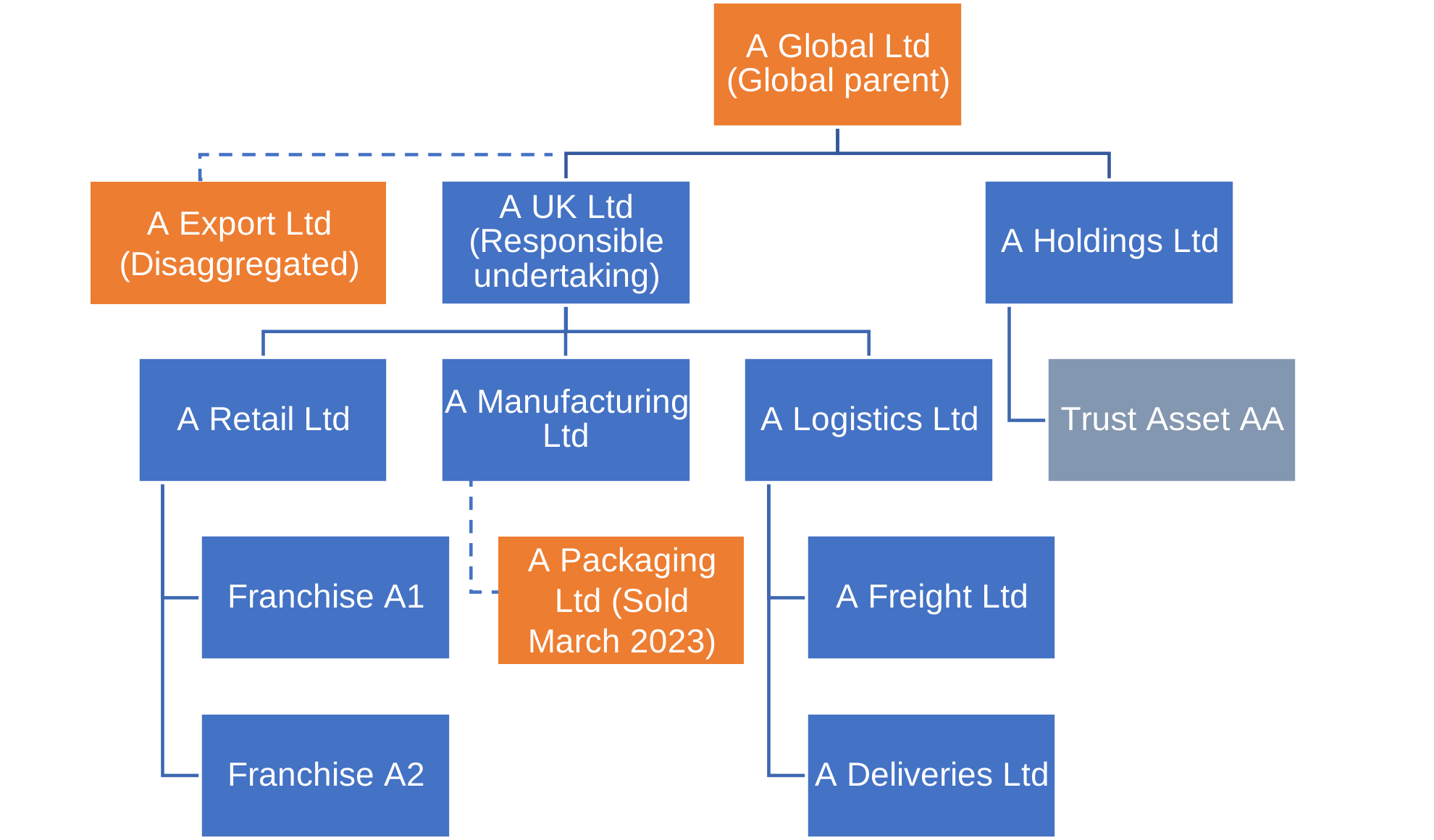
Written explanation of flowchart for accessibility:
A Global Ltd is the Global parent overseeing all entities. Under A Global Ltd is A Export Ltd (disaggregated), A UK Ltd (Responsible undertaking) and A Holdings Ltd.
Under A Holdings Ltd is Trust Asset AA.
Under A UK Ltd (Responsible undertaking) is A Retail Ltd, A Manufacturing Ltd and A Logistics Ltd.
Under A Retail Ltd is Franchise A1 and Franchise A2.
Under A Manufacturing Ltd is A Packaging Ltd (Sold March 2023).
Under A Logistics Ltd is A Freight Ltd and A Deliveries Ltd.
Section ref: 10.1.3 – Lead assessor details (where required to be appointed)
You must include:
- the name of the lead assessor
- the name of the approved register listing the lead assessor
Section ref: 10.1.4 – Calculations relating to the ESOS assessment
You must include:
- total energy consumption in kWh
- significant energy consumption in kWh (if applicable)
- percentage of total energy consumption which the significant energy consumption represents (if applicable)
- energy intensity ratios for each organisational purpose
Section ref: 10.1.5 – Details of energy saving opportunities (from audits) and energy saving measures (from the deemed compliance route )
Include information obtained through energy audits where reasonably practicable, or from the deemed compliance route where available:
- any way for the participant to improve its energy efficiency through recommended energy saving opportunities or measures
- for each energy saving opportunity or measure, the organisational purpose and energy saving category to which it most closely relates
- any considerations relevant to its implementation of the energy saving opportunity or measure, including, where applicable obligations under part 3 of Energy Efficiency (Private Rented Property) (England and Wales) Regulations 2015 in relation to buildings where the ESOS participant is a landlord or tenant
- schemes under which grants or public funds could support implementation of each energy saving opportunity or measure, if applicable
- estimate of the annual reduction in energy spend and the annual reduction in energy consumption in kWh which would be achieved as a result of implementing each energy saving opportunity or measure
- a recommended programme, including a timescale, for implementing the energy saving opportunities or measures
Section ref: 10.1.6 – Estimates of the potential annual reduction in energy spend and energy consumption from implementing energy saving opportunities and measures
Include information obtained through energy audits, or through a deemed compliance route where such information is available. This should cover the following in both pounds sterling and energy units for all energy audits and deemed compliance routes used:
- the total potential annual reduction in energy spend and energy consumption in kWh from carrying out all energy saving opportunities or measures
- the potential annual reduction in energy spend and energy consumption in kWh for carrying out energy saving opportunities or measures, broken down by organisational purpose
- the potential annual reduction in energy spend and energy consumption in kWh for carrying out energy saving opportunities or measures, broken down by energy saving category
Section ref: 10.2 – Additional requirements for participants complying using an energy audit
For each energy audit carried out, you must include:
- date or period over which the energy audit was carried out
- 12-month period to which the energy audit relates
- energy consumption relating to, as applicable, areas of significant energy consumption or total energy consumption, calculated for the purpose of the audit
- total number of sites covered by the audit
- number of sites visited for the audit
- reasons why the sites visited for the energy audit are representative
- so far as reasonably practicable, a description of the analysis carried out of the participant’s energy consumption and energy efficiency
Where reasonably practicable through the energy audit, include the following information.
For each energy saving opportunity:
- an estimate, in pounds sterling of the costs and benefits of implementing the energy saving opportunity
- any other non-financial costs and benefits of implementing the energy saving opportunity
- the payback period calculated for the energy saving opportunity
For the recommended programme for implementing the energy saving opportunities:
- estimated costs and benefits of implementing the programme
- the payback period calculated for the programme
Section ref: 10.3 – Additional requirements for participants complying using a deemed compliance route
You may not need to submit an energy report if you have a valid ISO50001 certification which covers 95% or more of the total energy consumption or all of the significant energy consumption. You must provide detail on:
- which assets and activities are covered by the ISO50001 certification
- the percentage of the total energy consumption covered by the ISO50001 certification
- GDA and DECs are no longer valid as an alternative compliance route, but the data collected for these schemes can be used as part of your ESOS report
Section ref: 10.4 – Estimating energy savings since the previous ESOS assessment
You must include an estimate of energy savings achieved, in kWh, in the compliance period (from immediately after the previous compliance date up to the current compliance date).
Where reasonably practicable, include the measures implemented by the participant to achieve the energy savings in the compliance period.
Section ref: 10.4.1 – Categorising energy savings and calculating subtotals
You must include:
- estimates of the proportion of energy savings achieved in kWh in the compliance period that most closely relate to each organisational purpose
- for each measure identified as achieving energy savings in the compliance period, the energy saving category to which it most closely relates
- estimated energy savings, in kWh, achieved by each implemented measure
Action plan review
You must (subject to having produced an action plan):
- identify any measures proposed in the EOS action plan which were not implemented in the compliance period
- for each measure proposed but not implemented in the previous ESOS action plan, provide an explanation of the reasons
If applicable, confirm you did not produce an ESOS action plan when you were required to produce one.
Section ref: 10.5 – Sign-off of ESOS report
Confirmation must be provided in MESOS that:
- the director(s) or equivalents (for example, responsible officer(s)) have seen and considered recommendations (energy saving opportunities and measures) of the audit and any ISO 50001 certification used in conjunction with the audit
- the ESOS report includes all information required by the ESOS Regulations