CBGDP investor factsheet: Heat and buildings (web accessible)
Published 23 June 2026

© Crown copyright 2026
This publication is licensed under the terms of the Open Government Licence v3.0 except where otherwise stated. To view this licence, visit nationalarchives.gov.uk/doc/open-government-licence/version/3 or write to the Information Policy Team, The National Archives, Kew, London TW9 4DU, or email: psi@nationalarchives.gov.uk.
Where we have identified any third party copyright information you will need to obtain permission from the copyright holders concerned.
This publication is available at https://www.gov.uk/government/publications/carbon-budget-and-growth-delivery-plan-heat-and-buildings-factsheet/cbgdp-investor-factsheet-heat-and-buildings-web-accessible
Summary
In October 2025, we published the Carbon Budget and Growth Delivery Plan (CBGDP)[footnote 1] which sets out the UK’s policies and proposals to meet our statutory emissions reductions targets up to Carbon Budget 6 (2033-2037). As part of that package, we also published the Investor Prospectus[footnote 2], the first document from the Department for Energy Security and Net Zero (DESNZ) aimed at setting out opportunities for investors right across the economy focused on the delivery of the UK’s carbon budgets. We are now publishing a series of investor-facing materials including:
- factsheets for investors that focus on the investment opportunity for individual sectors of the economy as defined by the carbon budget framework
- sub-sectoral investment prospectuses for specific clean energy technologies
This Heat and buildings factsheet is the first in this series and supports the launch in January 2026 of the UK’s Warm Homes Plan[footnote 3].
Overall trends
Low carbon heating
In 2024, the UK’s building stock contributed 81.8 MtCO₂e of carbon emissions (22% of the UK’s total)[footnote 4]. Therefore cutting emissions in residential, commercial and public sector buildings is essential in meeting the UK’s carbon targets.
Figure 1: Since 2019, heat pump sales have been trending upwards in the U K. In 2024, the UK was the fastest growing heat pump market in Europe, with growth set to continue. Source: Heat Pump Association.
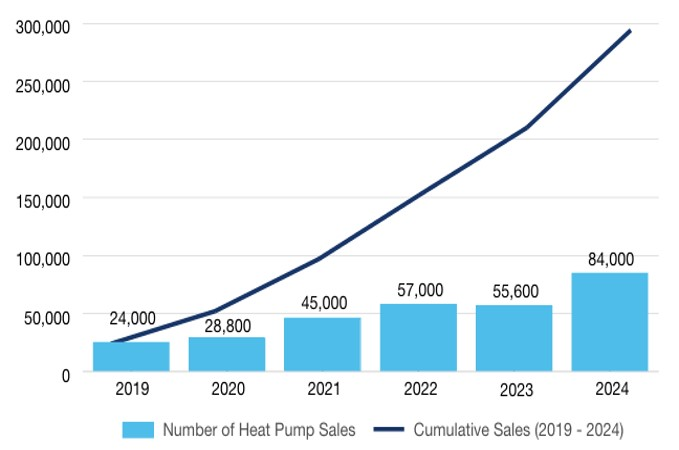
Reduction of energy costs is a priority for this government, and our commitment to lower bills for families is shown through the recent Warm Homes Plan (WHP), a £15 billion public investment and the biggest home upgrade plan in British history. Announced in the WHP, the Warm Homes Fund will have £5 billion of capital for investment via Financial Transactions[footnote 5] and could deliver a huge increase in the investment going into low carbon technologies such as heat pumps and heat networks by overcoming barriers to deployment, such as upfront costs[footnote 6].
Our commitment to reduce bills for consumers and businesses represents a substantial opportunity to reimagine the supply chains, technologies and business models in the transition away from natural gas to low carbon heating alternatives. Investment in this sector will directly benefit consumers and businesses, alongside reducing the burden on the public purse for heating and cooling in public sector real estate such as hospitals and schools.
Whilst the UK has made real progress in some areas, such as clean electricity generation, reducing greenhouse gas emissions in the buildings sector has been slower. High upfront costs and regulatory barriers can get in the way of adoption of clean energy technologies.
Relative gas and electricity retail prices are an important additional factor in heat pump adoption and heat network connections, even though heat pumps can be over three times more efficient than boilers, which is why at the last Budget the government took steps to reduce electricity prices by taking the costs of some historic levies into general taxation.
Policy intervention is also essential to accelerate the transition to clean heat for manufacturers, supply chains and consumers. Heat pumps and heat networks are already well-established technologies, so the challenge of scaling is not due to technological readiness, but rather the complexity of deployment for very different types of user-profiles across commercial, residential and public sector real estate for both new-build and retrofit.
A market for clean heat would not develop quickly enough to meet decarbonisation targets without interventions to address both cross-cutting and specific challenges in different market segments, for example support for heat pumps for retrofits in individual dwellings vs heat networks for new-build multiple occupancy property. Natural displacement of fossil-fuels by low carbon technologies, as seen with the market growth in electric vehicles, are being accelerated with effective supply and demand policy. Policies in the Warm Homes Plan will support effective supply and demand side interventions for UK housing, setting us on track so that by Carbon Budget 6, heat pumps will be the best and cheapest form of electrified heating for the majority of our homes[footnote 7].
However, acceleration of the UK’s housing sector to net zero requires a more complex policy response. Applicability for heat pumps in UK housing stock is high, but due to the lifecycle of heating systems, there is limited opportunity to switch old for new technology, and the diversity of user profiles and building types necessitate distinct consumer offers.
For investors, the size of the policy challenge, coupled with clear Government direction and support corresponds with an equally sizeable investment opportunity, with the potential for deep pools of value in this highly disaggregated market.
In Tables 1 to 3 (see the PDF version of this document) we show how the UK market for clean heat is segmented by residential, commercial and public sector. Each of these sub-segments have interventions available, either government or private sector, to support the development of clean heat. User profiles determine revenue models and therefore investment propositions, for example residential multiple occupancy bill payers would be more likely to have access to a heat network than single occupancy bill payers.
Revenue model definitions:
- lease models - often a third-party financier funds and owns the equipment, which is then leased (for example, to housing association) over a fixed term in exchange for regular rental payments
- Heat/Energy-as-a-Service (HaaS/EaaS) - a specialist provider funds, owns, and operates the energy infrastructure, charging the landlord a service fee based on the delivery of guaranteed heat/energy
- Power Purchase Agreement (PPA) - a third-party installs and owns solar assets on the property, selling the generated electricity back to the owner or tenants at a predetermined rate
Summary of enabling policy and activity for Warm Homes Plan
Future Homes Standard
New homes will be required to have low-carbon heating, for example heat pumps or heat networks, and high levels of energy efficiency. Gas boilers will not meet the required performance standard. Solar panels will be included for majority of new homes.
Update: Full technical specification published on 24 March 2026. Standards come into force on 24 March 2027 followed by a one-year transitional period to allow the construction sector to adjust smoothly. Higher risk buildings (above 18 metres) will be subject to longer transitional arrangements.
Boiler Upgrade Scheme (BUS)
£2.7bn in funding to 2030 to cover £7,500 towards the cost and installation of ground and air source heat pumps, including water source heat pumps, £2,500 grants for air-to-air heat pumps and £5,000 off the cost and installation of a biomass boiler. A £2,500 grant for heat batteries will also be available once the legislation and appropriate product standards are in place.
Update: Funding was part of 2025 budget, but an increase in budget was announced in WHP.
From July 2026 air-to-water heat pumps and ground source heat pumps replacing oil or LPG systems will receive a grant level of £9,000 for the 2026/27 financial year.
Clean Heat Market Mechanism (CHMM)
CHMM incentivises domestic supply chain investment through incremental targets for appliance manufacturers, helping to stimulate the market investment required to further bring down upfront costs.
Update: Precedes WHP – manufacturers are required to meet target of 6% of sales with heat pumps or acquire credits from 1 April 2026.
Warm Homes skills programme
The programme will support up to 9,000 subsidised training places for installers and retrofit professionals.
Update: Precedes WHP. The WHP includes funding uplift focuses on the heat training grant (for HP installations and heat networks).
Heat Pump Investment Accelerator Competition
The competition offers £90 million to support major investment in UK-based manufacturing of heat pumps and key components.
Update: Round 2 opened on 21 April 2026, through to 5 August 2026, with funding to be provided from April 2027 through to March 2030.
Warm Homes: Local Grant
Provides energy performance measures and low carbon heating to low-income households living in privately owned EPC band D-G homes in England.
Update: Scheme predates WHP but funding allocation announced in WHP (funding was part of 2025 budget, but not allocated to a specific scheme).
Warm Homes: Social Housing Fund
Provides energy performance measures and low carbon heating to social housing residents in EPC band D-G homes in England.
Update: Wave 3 scheme predates WHP and its original funding allocation announced in WHP (funding was part of 2025 budget, but not allocated to a specific scheme), alongside an additional £295m for FY 26/27. A further £100m was announced in April, with a focus on solar PV and battery installation.
Green Heat Network Fund (GHNF)
Update: Scheme predates WHP. Additional funding announced in WHP for FYs 27/28-29/30.
Heat Network Efficiency Scheme (HNES)
Provides grants to existing heat networks in England and Wales to improve their efficiency.
Update: Scheme predates WHP. Additional funding announced in WHP for FY 28/29 and 29/30.
Government support for new markets for clean heat
UK policy on clean heat is largely driven by the deployment of heat pumps across residential, commercial and public sectors. Demand for this well-established technology is forecast to soar with an aim of 450,000 annual installations per year by 2030, 70% of which are targeted to be manufactured in the UK by 2035[footnote 8]. Installations in the UK are already accelerating, with a record 125,000 heat pumps sold in 2025, a 27% increase over 2024, with approximately 45,000 manufactured in the UK[footnote 9].
Substantial policy support is helping to grow that deployment and crowd in private investment alongside public expenditure. For instance, the Boiler Upgrade Scheme will be spending nearly £2.7 billion over the period to 2029/30 on consumer and small business grants, a further £4.4 billon will be supporting home upgrades for low-income households, and we launched a call for evidence on use-cases for the £5 billion Warm Homes Fund,[footnote 10] which will enable the government to make loan or equity investments across the home upgrades financial transactions facility, including to support low-interest consumer finance. Complementing these demand-side measures, the Clean Heat Market Mechanism, like equivalent policy frameworks in other key low-carbon sectors,[footnote 11] acts to bolster long-term market signals and provide industry with the confidence and incentives to invest in accelerating the transition and developing the supply chain.
In addition, the government is providing direct co-investment support for manufacturers looking to invest in plant and facilities to begin or expand the UK production of heat pumps and their components, through the £90 million Heat Pump Investment Accelerator Competition.
The Heat Pump Ready[footnote 12] programme to support innovation and deployment of heat pumps has been extended with £30 million of funding from the £15 billion of public investment package announced in the Warm Homes Plan.
The Future Homes Standard further strengthens long-term market signals for developers, installers and manufacturers by ensuring all new homes have low-carbon heating and that gas boilers will not meet the standard.
To build on the certainty that heat network zoning provides, we are committing to £195m per year investment through the Green Heat Network Fund until 2029/30.
Today, around 70% of the ~1.4 million natural gas boilers sold each year are produced in the UK. Around 35% of the ~125,000 heat pumps sold in the UK in 2025 were made here. The government’s ambition is that by 2035 the market would be served by a similar proportion of around 70% UK-made. The Heat Pump Investment Accelerator Competition and the wider policy framework described above are key to enabling that substantial industrial growth. The expansion of a heat pump manufacturing base in the UK will not only retain the supply of domestic heating equipment in the UK, but open up the potential for export to expanding heat pump markets overseas.
Innovation and investment
Figures from the Energy Innovation Needs Assessment (EINA), which the government uses to inform policy, suggests that Gross Value Added (GVA)[footnote 13] for heat and buildings technologies (heat pumps and insulation) grows from around £0.9 billion in 2025 to between £5.2 and £5.7 billion in 2050, depending on the scenario. GVA would be driven initially by domestic demand with some expansion into markets in continental Europe, such as the Netherlands and Ireland[footnote 14].
Investment potential for clean heat is not just limited to appliances such as heat pumps. Innovation has great potential to attract investment from all stages of the capital cycle – early stage investors may be interested in innovative technology, componentry or new systems software platforms for demand flexibility, while institutional investors may be interested in understanding revenue models that can establish reliable long term cashflows, for example Property Linked Finance.
In order to decarbonise the UK’s heat demand, a systems approach is required to build a full supply chain with UK based manufacturing capacity, and the development of a skilled workforce to install and maintain clean heating systems.
Energy Innovation Needs Assessment for Heating and Buildings[footnote 15] recognises this systems-approach to innovation potential across the supply chain, including innovation in equipment (for example, component R&D), installation (for example, software and integration), manufacturing (for example, automation) and operation and maintenance (for example, demand response and connectivity to batteries).
Finally, while heat pumps are the single dominant technology, they have many applications and therefore different investment propositions. For example, heat pumps installed in new builds vs retrofit require different finance models and could benefit from corresponding innovation in revenue models such as Energy or Heat as a Service, leasing or Property Linked Finance. Increased deployment of heat pumps will also have to be supported by grid investment and innovation on the low voltage network to facilitate the transition from natural gas to electrified heat sources.
Recognising the ongoing need for innovation, government is establishing the Cleantech Innovation Challenges initiative, which was launched in the Carbon Budget and Growth Delivery Plan in autumn 2025 and will be co-developed with industry. These challenges will set ambitious and measurable goals for innovation that will be used to engage and inspire innovators and investors, mobilise public and private sector investment and focus efforts on creating market pull to accelerate the deployment of new technologies and solutions. The initiative is scoping the potential for challenges in mission-critical areas of innovation, such as heat and buildings.
Policy: residential
Warm Homes Plan (WHP)
The WHP will deliver £15 billion of public investment to upgrade up to 5 million homes and lift up to 1 million households out of fuel poverty by 2030.
The Plan commits £15 billion in government spending to 2030 that will include a £5 billion Warm Homes Fund overseen by a new Warm Homes Agency to support the home upgrade and retrofit supply chain, that will cover:
- £1.7 billion allocated to low- and zero-interest consumer loans (supported by £300 million in capital grants), supported by the Green Home Finance Strategic Partnership
- £2.7 billion for innovative finance through the Warm Homes Fund to invest in home upgrades
- £1.5 billion in other funding for Warm Homes Plan Programmes and Devolved Administrations
- £5 billion for low-income schemes with £4.4 billion in direct capital grants backed by an additional £600 million from the Warm Homes Fund
- £2.7 billion for an expanded Boiler Upgrade Scheme (BUS)
- £1.1 billion for Heat Networks
The Plan is supported by numerous other policies and mandates, such as the Future Homes Standard which was published in March 2026. Under this standard all new homes will need to have high levels of insulation, low carbon heating systems, and in most cases, solar panels.
The Future Homes Standard will come into force on 24 March 2027 and there will be a further transitional period for one year afterwards to allow the construction sector to transition smoothly to the new standards. There are separate longer transitional arrangements for higher-risk building work to reflect the additional complexity posed by the construction of these buildings.
Non-domestic
The commercial real estate sector alone is worth approximately £949 billion to the UK economy[footnote 16], supporting over 2.6 million jobs, with annual economic output being over £137 billion in 2022, representing about 7% total UK GVA[footnote 17].
The around 1.8 million[footnote 18] non-domestic buildings in England and Wales in 2024 produced 22 MtCO2e - accounting for 27% of total UK emissions from the buildings sector[footnote 19]. Since 2000, these emissions have fallen by 18% in commercial buildings, whereas public sector buildings have fallen by 39% and residential emissions have dropped by 37%. The majority of the stock will require retrofits for efficiency, clean heat and climate adaptation in the next 25 years.
Clean energy technologies and infrastructure, including heat pumps, heat networks and electricity networks, are central to this transition, enabling the non-domestic sector to decarbonise. Approximately 79% of gas-connected non-domestic buildings have annual gas consumption levels typical of domestic buildings (less than 73 MWh)[footnote 20] and therefore will be supported by demand-based policies such as the Clean Heat Market Mechanism and may be able to receive funding through the BUS.
The Future Buildings Standard, which was published in March 2026, will ensure all new non-domestic buildings, such as schools, hospitals, warehouses and offices will have high levels of insulation, low-carbon heating systems, and in most cases, solar panels.
From 2031, it is proposed that private rented non-domestic buildings over 1,000 square metres in England and Wales will be required to meet a higher energy efficiency standard of EPC B where cost effective [footnote 21].
Impact of non-domestic policy on UK commercial real estate
UK commercial real estate operates in a global market, and many well-capitalised landlords have a net zero strategy with targets validated by the Science Based Targets Initiative (SBTi) and are aligning to existing Minimum Energy Efficiency Standards (MEES), with some aspiring to go to high EPC standards of B and above. In some cases, the catalyst may have come from the pressure that property funds began to face from investors, who are typically aligned under the EU’s Sustainable Financial Disclosure Regulations (SFDR), which encourages investors to consider sustainability factors in their investment decision making process. Depending on the type of fund (for example, Article 8 or 9), sustainability may be the core objective. These investors have been greening their portfolios and putting pressure on their investment companies to do the same for their own portfolios. The EU’s Energy Performance of Buildings Directive (EPBD) and the UK’s MEES which sets standards for privately rented property have led to a broad move by the European property market to decarbonise their estates since the start of the decade.
Public sector
There is strong ambition to decarbonise within the public sector. Where routes to support action have been made available, such as the Public Sector Decarbonisation Scheme[footnote 22] and Low Carbon Skills Fund, they have been consistently oversubscribed due to high demand.
Recent work led by the National Infrastructure and Service Transformation Authority (NISTA) has identified private finance models that could be used to deliver decarbonisation measures in the public sector, such as power purchase agreements, energy performance contracts and energy/heat as a service contracts. At Budget 2025, the Government announced that it would consider private sources of finance to decarbonise the public sector estate where these offer value for money.
The NISTA Infrastructure Pipeline[footnote 23] captures a forward look of investment into major UK capital infrastructure for construction firms and investors looking to understand future demand. NISTA will include central government estate decarbonisation investment opportunities in the Infrastructure Pipeline to give developers, suppliers and investors greater confidence to commit resources to this area.
Heat networks
Heat networks are a critical part of this Government’s clean energy mission, to deliver low-cost, low-carbon heat to consumers. They are a place-based solution, able to utilise otherwise-inaccessible sources of heat, and reach high efficiencies through economies of scale. Our target is for heat networks to provide 7% (27 TWh) of heat to consumers in England by 2035, and we expect a fifth of all heat will be from heat networks in 2050.
Heat Network Zoning will transform the market for heat networks in England, by giving investors and developers the certainty they need to bring new projects to market. Zoning will designate the areas where heat networks can provide the lowest-cost, low-carbon heat, and give local areas the tools to bring projects to market at a greater scale and pace. We will be supporting at least 10 of the largest English towns and cities to establish their heat network zones soon after heat network zoning regulations go live later in 2026, with further zones to follow.
As of January 2026, a new heat network regulatory regime has been introduced to provide heat network consumers with equivalent protections to those in gas and electricity markets, including designating Ofgem as the sector regulator, and consulted on proposals to mandate minimum heat network technical standards, through the forthcoming Heat Network Technical Assurance Scheme (HNTAS)[footnote 24]. The regulations are proportionate to the size of Government’s ambitions for the heat network sector, and give a strong foundation for future growth.
To support existing heat networks to make efficiency improvements, the Heat Network Efficiency Scheme (HNES) currently provides up to £15 million per year in capital grants until 2029/30.
The Green Heat Network Fund (GHNF) is a capital grant fund that supports the commercialisation and construction of new low- and zero-carbon heat networks, along with retrofitting and expanding existing heat networks. In the first nine rounds of the GHNF, around £792 million was allocated to projects. Funding of £195 million a year is available up to 2029-30, and this government will review its ongoing funding.
Figure 2: The UK has a target to more than double heat demand met with heat networks in England by 2035, to at least 7% (27 TWh).
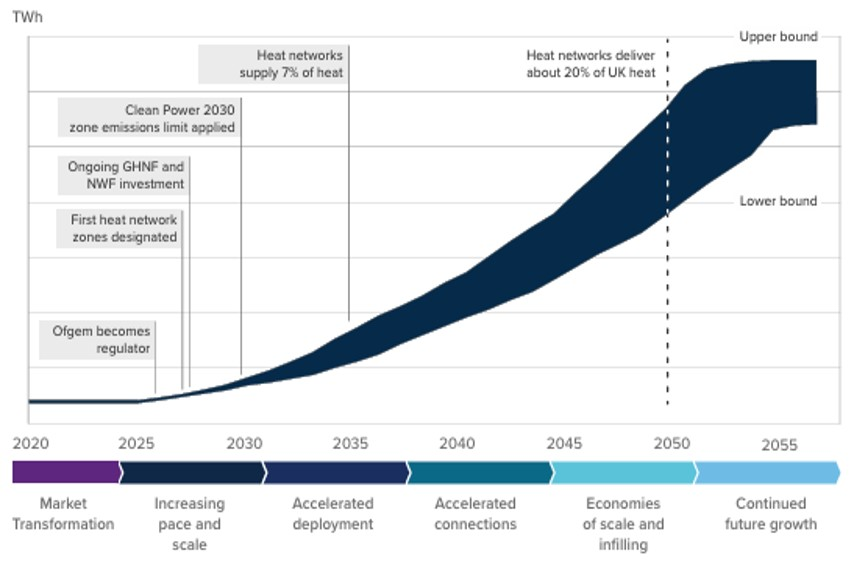
Doubling the size of the heat network sector in 10 years will confirm the UK as one of the fastest growing markets for heat networks in Europe. Source: Warm Homes Plan ##UK Public Finance Institutions
The National Wealth Fund has so far issued £1.3 billion in guarantees[footnote 25] for the retrofit of housing association owned residential buildings in the UK, including:
- £400 million to cover a series of new loans provided by NatWest Group
- £350 million for Barclays UK Corporate Bank
- £400 million for Lloyds Banking Group
- £150 million for The Housing Finance Corporation
There are 4.5 million social homes in the UK with 2.9 million owned by private registered providers[footnote 26]. Of these homes in England and Wales, 28% have an EPC rating of D or worse. An estimated £36 billion of new investment is needed to decarbonise housing association properties[footnote 27].
Blended solutions
Case study: Innovative funding in Heat Networks
We are continuing to work with the National Wealth Fund (NWF), the Green Finance Institute (GFI) and others on innovative finance options (equity and debt) that could reduce the sector’s need for grant funding over time. There is currently a limited private debt market in the UK for financing heat network construction and projects rely heavily on equity that requires a higher rate of return, which results in higher fixed tariffs, costs and connection charges than if debt financing were used. Therefore, we would expect debt solutions to help reduce the cost of heat for consumers, increasing the attractiveness of connecting and in turn increasing the investability of the project. Other proposals, such as patient equity delivered via a Public Finance Institution such as the NWF, could also make a valuable contribution to scaling the sector. Such products would contribute to a quicker rollout of strategically important projects, such as zonal scale networks, as well as lower the cost of capital for projects.
To address these issues, the GFI have been developing a range of proposals for catalytic funding that could use a combination of funding from the DESNZ, potentially Public Financial Institution (PuFIn) and private capital to deploy the capital financing necessary for the development of the heat network sector.
Case study: Social Rented Sector
The social housing sector is a significant part of the UK housing stock. As of March 2025, England alone had 4.5 million social and affordable rented homes. This equates to about 17% of total dwellings. Of these, 1.6 million are owned by local authorities, the rest (2.9m) are owned by private registered providers (including housing associations). Social and affordable rented housing includes categories like council housing and supported housing. As such, local authorities and housing associations have a big role to play in upgrading the UK’s housing stock to be energy efficient: in making sure new build housing is of high quality but also in retrofitting existing stock.
Solar and battery systems in social housing have historically been delivered through Government Warm Homes: Social Housing Fund or ECO, with far fewer projects financed directly by RSLs or investors. This is a missed opportunity, as decentralised energy assets can generate multiple revenue streams that make these models commercially viable. Unlocking these opportunities could help scale deployment, supporting fuel poverty, net zero and clean power goals while improving value for money by blending private finance with grants. This is essential given the estimated £36 billion cost[footnote 28] of fully decarbonising England’s social rented sector (SRS) stock, far exceeding available public funding.
A growing number of organisations are developing business models for solar and batteries in the social rented sector. Peabody[footnote 29] has installed solar panels and batteries at 300 homes in London. Hackney Council[footnote 30] is running a residential solar project on council estates in partnership with Emergent Energy. Metis also develops fully funded solar and battery systems off-balance sheet for social landlords[footnote 31].
Market solutions
Case study: Property Linked Finance new source of finance for clean heat
Upfront costs and monetising cost savings are two big challenges to investing in clean heat in the UK. Lenders and investors in the UK have been considering expanding the suite of financial solutions available in this sector with the introduction of Property Linked Finance (PLF) that has a successful track record in the US [footnote 32] and Australia[footnote 33].
PLF refers to long-term finance linked to the property, rather than the property owner, and can fund up to 100% of the upfront costs of projects that would reduce energy costs over the term of the contract.
The GFI estimates that PLF could mobilise between £52 billion and £70 billion of the £360 billion investment needed to decarbonise UK residential buildings by 2050[footnote 34].
The repayment term of PLF often matches the useful lifetime of the improvement projects, which helps to make the repayments more affordable when compared to shorter term borrowing options including mortgage terms.
The responsibility to meet regular PLF payments remains with the property, even after the property has transferred to a new owner. As a result, the property owner that benefits from energy efficiency improvements is also responsible for meeting the PLF payments. Transfer of the payment obligation could be achieved via a new type of Local Land Charge or a Restriction on Title. Local Land Charges are generally financial charges or restrictions on the use of land and are currently imposed by public authorities under statutory powers, otherwise known as originating authorities.
We will engage with the commercial buildings sector to evaluate the benefit of progressing local land charges which, based on advice from the GFI, are likely to require primary legislation.
-
Carbon Budget and Growth Delivery Plan, October 2025 ↩
-
UK net zero transition: Investor Prospectus, October 2025 ↩
-
2024 UK GHG emissions figures, based on ‘Buildings and product uses’ category. This figure is split between residential buildings, at 54.3 MtCO2e (66.3%), commercial buildings, at 13.4 MtCO2e (16.3%), and public sector buildings, at 9.0 MtCO2e (11.0%), with emissions associated with other buildings and product uses making up the balance. Note: Emissions reported by sector on a source basis. Emissions from electricity and fuel supply are allocated their own sectors rather than where the electricity and fuels are used. ↩
-
Financial transaction control framework - GOV.UK, March 2025 ↩
-
Across CB6 (2033 to 2037) policies represent an investment opportunity of £20 billion per year on average, incentivised through policies such as capital support schemes and Heat Network Zoning. Carbon Budget and Growth Delivery Plan, Section 14, page 229, October 2025 ↩
-
Electrification of Heat Demonstration Project – Energy Systems Catapult ↩
-
Warm Homes Plan, published January 2026. ↩
-
The Heat Pump Association estimates that the number of heat pumps manufactured in the UK increased by 38% relative to 2024. ↩
-
Warm Homes Fund: innovative finance for investments and loans - GOV.UK ↩
-
Such as the Zero Emissions Vehicles mandate for automotive manufacturers, which is complemented by EV subsidies for consumers on the demand side. ↩
-
Gross Value Added (GVA) – a measure of the value generated by the production of goods and services. GVA can be thought of as broadly equivalent to the contribution of that sector/activity to Gross Domestic Product. ↩
-
The Size & Structure of the UK Property Market Year-end 2023 (March 2025) Report ↩
-
UK Commercial Real Estate Economic Footprint, May 2023 cl16688-01-bpf-economic-footprint-may23-v5-hi-res-single-pages.pdf ↩
-
Non domestic national energy efficiency data-framework (ND-NEED) 2025 ↩
-
Provisional UK greenhouse gas emissions statistics 2024 - GOV.UK ↩
-
ND-NEED 2025, supporting data tables, table 16: Non-domestic National Energy Efficiency Data Framework (ND-NEED), 2025 - GOV.UK ↩
-
Written statements - Written questions, answers and statements - UK Parliament, June 2026 ↩
-
Since 2020, the Public Sector Decarbonisation Scheme (PSDS) allocated over £3.4 billion in grant funding to more than 1,400 projects to enable public sector organisations to decarbonise their heating systems. Public Sector Decarbonisation Scheme - GOV.UK ↩
-
National Infrastructure and Service Transformation Authority, March 2026 ↩
-
These are all part of the loans from commercial banks being made available to housing associations, backed by the NWF. National Wealth Fund News, National Wealth Fund News, National Wealth Fund News ↩
-
Social landlords continue to build new homes, according to RSH statistics - GOV.UK ↩
-
National Housing Federation - Decarbonising housing associations’ homes to cost £36bn, according to National Housing Federation ↩
-
National Housing Federation - Decarbonising housing associations’ homes to cost £36bn, according to National Housing Federation ↩
-
Sustainability Victoria – Environmental Upgrade Finance programme in Australia ↩