Candidozyma auris in England: data up to September 2025
Updated 10 December 2025

© Crown copyright 2025
This publication is licensed under the terms of the Open Government Licence v3.0 except where otherwise stated. To view this licence, visit nationalarchives.gov.uk/doc/open-government-licence/version/3 or write to the Information Policy Team, The National Archives, Kew, London TW9 4DU, or email: psi@nationalarchives.gov.uk.
Where we have identified any third party copyright information you will need to obtain permission from the copyright holders concerned.
This publication is available at https://www.gov.uk/government/publications/candidozyma-auris-in-england-biannual-epidemiological-commentaries/candidozyma-auris-in-england-data-up-to-september-2025
Main points
During the latest 6 months, 1 April 2025 to 30 September 2025:
- 86 new Candidozyma auris (C. auris) cases in England were reported to the UK Health Security Agency (UKHSA) [note 1]
- this was a 31% decrease compared with the previous 6 months
- C. auris cases remain predominantly non-invasive (80% colonised, 19% invasive, 1% unknown specimen type) [note 2]
- 19 healthcare organisations reported C. auris cases to UKHSA, of which 6 had not previously reported any C. auris cases
- on 1 April 2025 there were 2 continuing outbreaks in 2 NHS trusts; a further 3 outbreaks in 2 NHS trusts were declared within the time period 1 April to 30 September 2025; of these 5 outbreaks, 2 were declared over during this time period
- London remains the region reporting the majority of C. auris cases (0.83 reports per 100,000 population)
Note 1: a case is defined as a person from whom there is a first laboratory confirmed isolate of C. auris (colonisation or infection).
Note 2: an invasive infection is defined as a first case of C. auris with one of the following reported specimen types: blood, tissue, bone, intravenous line, endotracheal aspirate or pleural fluid.
Epidemiological analyses of C. auris cases
For context, between January 2013 and September 2025 inclusive, a total of 862 C. auris cases (both colonisations and infections) were reported in England (Figure 1). Between January 2013 and September 2025, of 744 cases with an NHS number, 115 (15%) died within 60 days of a positive C. auris specimen being taken (all-cause mortality). Whilst 60-day all-cause mortality was 15% for patients with a positive reported C. auris sample, the primary cause of death was attributed to other clinical causes for the majority of cases (114 out of 115; 99%) reported to UKHSA. C. auris was reported on the death certificate for 1% (1 out of 115) of reported cases during this period.
Figure 1. Annual cases of C. auris by year, England 2013 to 2025

Note: data from the most recent year (from the dotted line onwards) is not complete and is therefore provisional.
Between January 2023 and September 2025, most C. auris cases represented colonisation (84%, 416 out of 496) rather than invasive disease (14%, 68 out of 496) (Figure 2). Patients with C. auris were more likely to be male (75%, 373 out of 496) and aged over 50 (84%, 418 out of 496). Cases have predominantly been identified in vascular and cardiothoracic wards, and in intensive care units (ICUs).
Figure 2. Monthly cases of C. auris by specimen type and month, January 2023 to September 2025

C. auris became a notifiable organism from 6 April 2025 (indicated by the dotted line).
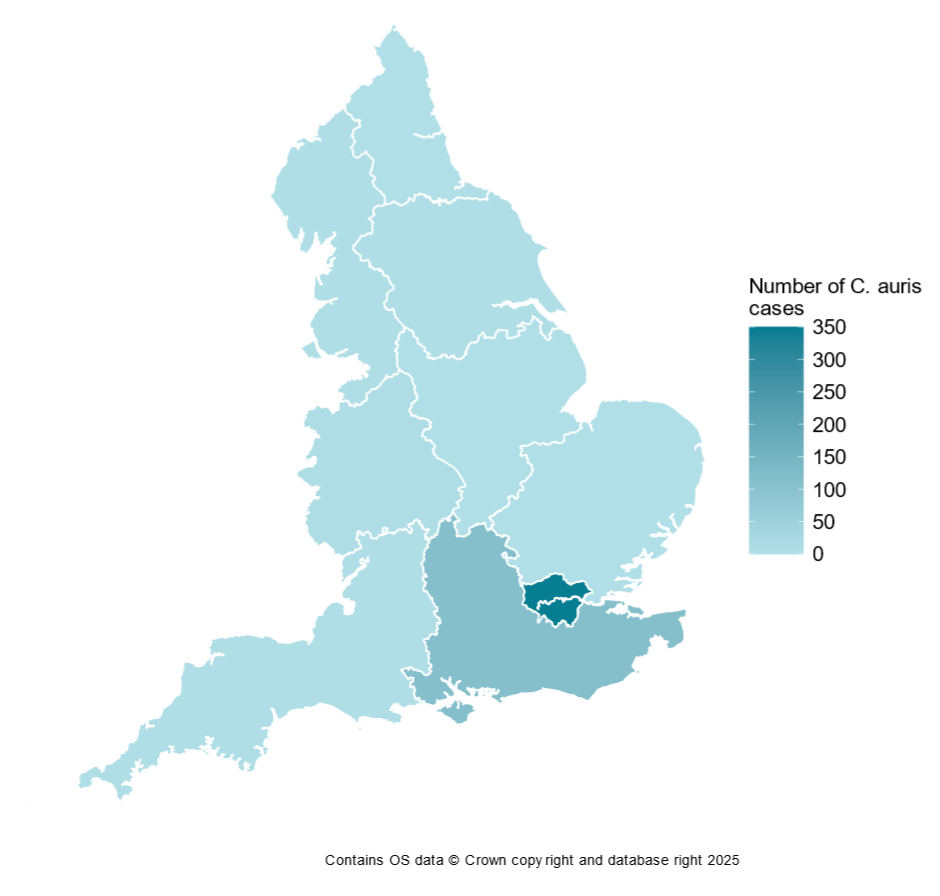
Since January 2023, most cases have been reported from the London and South-East regions (346 (70%) and 111 (22%) cases respectively; Figure 3). Seven regions have reported C. auris cases in the past 6 months. Tables of cases by region can be found in the data tables accompanying this report.
Figure 3: Map of C. auris cases by region, England 2023 to 2025
Data sources
For this analysis, a confirmed case of C. auris is defined as the first laboratory-confirmed isolate (colonisation or infection) of C. auris identified from a patient.
Incidence data were sourced from the C. auris national linelist on 17 November 2025. The linelist collates data from the UKHSA Second Generation Surveillance System (SGSS) antimicrobial resistance (AMR) and communicable disease reporting (CDR) modules as well as referrals to the UKHSA National Mycology Reference Laboratory.
The population denominator for the reported England and regional incidence rates was based on the mid-year resident population estimates released by the Office for National Statistics.
All-cause mortality was determined by linkage to NHS patient records though the demographics batch service (DBS). Attributable mortality was determined by searching the Office for National Statistics Mortality Business Information System (ONS-MBIS) for all mentions of ‘auris’.
Caveats
The C. auris national linelist reports patients with a first detection of C. auris. Patients colonised with C. auris may remain colonised for long periods of time and we assume lifelong carriage once colonised. Therefore, the linelist does not report repeat screens or admissions of the same patient to the same or different healthcare organisations.
There is likely under-ascertainment of cases. There is incomplete information on which healthcare organisations screen for C. auris and the degree to which healthcare organisations are screening (including which patient populations or frequency). Healthcare organisations reporting more cases may have a higher ascertainment rate because they are screening more.
There is likely under-reporting of cases. In April 2025, C. auris became a notifiable organism and reporting became mandatory. However, not all laboratories are currently configured to report routinely. Prior to this date there was variable reporting of isolates across the healthcare sector, including whether isolates that were considered not clinically significant (for example from patients who were colonised) were reported. Therefore healthcare organisations reporting more cases may have greater reporting coverage, and numbers on the C. auris national linelist may differ from figures from healthcare organisations’ laboratory systems.
Despite these caveats, ascertainment and reporting are increasing. Given that reporting is now mandatory, more laboratory systems are being configured to report C. auris. Awareness of C. auris is also increasing and more hospitals are conducting screening as recommended in guidance for acute care settings updated by UKHSA in 2025. Therefore, an increase in cases may relate to an increase in screening of patients and reporting by laboratories.
There may be delays in reporting and incomplete information in reports to UKHSA. For example, cases may be assigned to the healthcare organisation of the reporting laboratory rather than the requesting healthcare organisation for the diagnostic test of the specimen. Furthermore, cases assigned to a healthcare organisation may have acquired their infection elsewhere. UKHSA does not routinely collect information on where cases are likely to have acquired their infection, for example from abroad or another healthcare organisation.
There are continual efforts to validate data, including geographical assignment of cases, and the information published here is subject to change.