Calibrating tomorrow: the future mortality improvement assumption
Published 17 March 2026

© Crown copyright 2026
This publication is licensed under the terms of the Open Government Licence v3.0 except where otherwise stated. To view this licence, visit nationalarchives.gov.uk/doc/open-government-licence/version/3 or write to the Information Policy Team, The National Archives, Kew, London TW9 4DU, or email: psi@nationalarchives.gov.uk.
Where we have identified any third party copyright information you will need to obtain permission from the copyright holders concerned.
This publication is available at https://www.gov.uk/government/publications/calibrating-tomorrow-the-future-mortality-improvement-assumption/calibrating-tomorrow-the-future-mortality-improvement-assumption
How long people are expected to live and how this changes over time is a key assumption for public policy and long-term finance. Amongst other factors, it informs timetables for State Pension age, the demand for public services, and the funding of pensions and annuities.
Views on the pace of future improvement span a wide spectrum. At one end are more pessimistic perspectives that emphasise headwinds such as further pandemics, antibiotic resistance, new diseases, economic downturn and even civil unrest because of climate-change related migration. In the middle sits a more mainstream view that expects steady, gradual gains driven by better prevention, earlier diagnostics, and incremental clinical advances.
At the other end are claims of a step-change in longevity: biohackers experimenting with lifestyle and pharmacological regimes and advocates of radical life extension. Some commentators have even suggested the first person to live to 1,000 may already have been born. These visions are provocative and help map the outer edges of possibility; they are also highly uncertain and contested by many experts.
This wide range and uncertainty complicates public policy and long-term financial planning, which rely on assumptions about future life expectancy.
Decisions taken today need to be anchored in observable evidence and plausible horizons, while remaining alert to upside and downside risks from innovation, behaviour, and system shocks. That is where actuarial judgement adds value: combining historical data with structured expert input to set a transparent central view and using scenarios to test resilience against credible alternatives.
Why do we need to set mortality assumptions about the future?
In policy making, government uses life expectancy projections to plan for State Pension outgo, health and social care demand, and wider policies affected by the structure of the population. The prescribed proportion-of-adult-life framework used in the last State Pension age review depends directly on assumed future mortality improvements.
The government stands behind the UK’s public service pension promises, which, according to the most recently published Whole of Government Accounts, 2023-24 are of the order of £1.3 trillion in present value terms. A small change in assumed mortality improvement rates can shift liabilities by billions of pounds, with consequences for employer contributions and public spending plans.
What information do we have?
Two pillars support a robust future improvement assumption:
- Past trends: we study how mortality has changed over time, including periods of rapid gains, slowdowns, and one-off shocks. Analysing which causes of death drove change, and at what ages, helps us to judge how likely past patterns are to continue.
- Future drivers: Statistical models cannot, alone, anticipate structural change. The Office for National Statistics (ONS) convenes an Expert Advisory Panel to advise on appropriate long-term improvement rates and the path to them, complementing historical models with judgement on healthcare, behaviour, and wider risks.
Past trends: what history tells us
Over the 20th century, UK life expectancy rose steadily as mortality rates fell. But that improvement came in waves, driven by different forces at different times.
- From the early to mid-20th century, big reductions in infant deaths and infectious diseases, alongside improved sanitation and public health, delivered rapid gains.
- The period after the Second World War saw the introduction of the NHS, better working conditions and road safety as well as falling prevalence of smoking.
- From the 1990s, a cardiovascular “revolution” – prevention, effective drugs, and quicker treatment – produced particularly strong improvements at older ages.
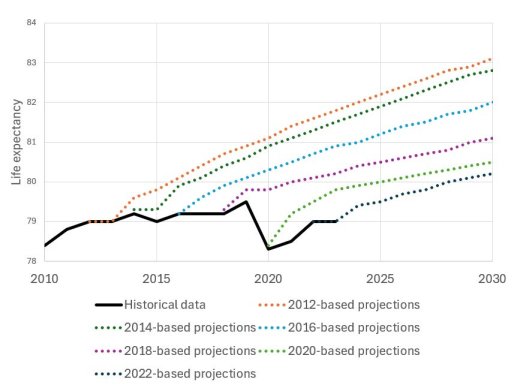
In the 1980s to 2000s models typically underestimated this rapid rate of improvement. Actuaries and statistical agencies were repeatedly surprised on the upside as older-age mortality improved faster than expected, particularly for males, which is illustrated in Chart 1.
Chart 1: ONS actual and projected period life expectancy at birth: selected projections, UK, males

Source: GAD chart based on ONS data
From around 2011, improvements slowed markedly, especially at older ages, as the earlier rapid declines in deaths from heart disease and stroke stalled once many of the easier gains in prevention and treatment had been realised. At the same time, dementia and Alzheimer’s became more prominent due to population ageing and better recognition. Post‑financial‑crisis pressures on health and social care capacity likely also hindered further gains in mortality improvements.
Following years of under estimation of future improvements, the tide turned and forward-looking assumptions became too optimistic, even ahead of the COVID-19 pandemic. This is illustrated for males in Chart 2.
Chart 2: ONS Principal period life expectancy at birth: changes between 2012-based and 2022-based projections, UK, males
Source: GAD chart based on ONS data
Future drivers
Mortality improvements in the future are likely to be affected by a range of interconnected factors, including:
- Clinical innovation: The speed and widespread availability at which innovations move from trials into routine care will shape the next wave of mortality gains. New obesity drugs, Alzheimer’s treatments, precision medicine for cancer and combined AI-enabled diagnostics, could change future life expectancy.
- System capacity/investment: Mortality improvements depend on a system that can prevent, diagnose and treat on time. The new National Cancer Plan for England sets targets to meet waiting time targets by 2029 and plans to save 320,000 lives by 2035. More generally, the NHS England’s 10-year plan sets out its plans to improve both life expectancy and healthy life expectancy.
- Behavioural change: Smoking, diet, physical activity and alcohol use remain key risk factors affecting life expectancy.
- Systemic risks: Setbacks from antimicrobial resistance, emergent pathogens or extreme weather could erase hard-won gains. Surveillance, medical stockpiles, adaption and rapid-response capability could help minimise the size of any shock.
- Impacts for different generations: The health trajectories of younger cohorts may diverge from predecessors. Early-life obesity, vaping and mental ill-health, compounded by delayed care during the pandemic, could raise midlife mortality, whereas preventative care and improved treatments may pull the other way.
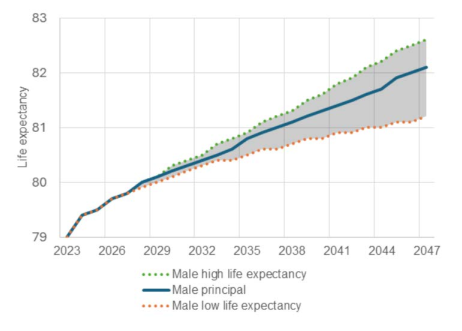
In the most recent ONS 2022-based national population projections, the long-term rate of future improvements (applicable at most ages from 2047) was revised downwards to 1.1% p.a. (1.2% p.a. had been used for projections since 2010). This reflected both the slowing of improvements in recent years, and the considerable uncertainty about the prospects for improvement rates in the long-term.
Other considerations
Inequality and place
National averages conceal stark differences, in particular, regional and local variation. Life expectancy varies across the UK, with inner-urban pockets and coastal towns often lagging behind. Socio-economic status, based on wealth and related determinants (housing, employment, education, environment), has been shown to be a strong predictor of life expectancy. We don’t know how life expectancy improvements will vary by group in the future – will the more deprived catch up, or could the gap widen? Broader socio-economic policies to reduce health inequalities might be expected to play a substantial role in shaping the outcomes for different groups.
Healthy life expectancy (HLE) vs life expectancy (LE)
HLE is the average time an individual is expected to live in good health and is somewhat lower than LE. The rates of improvement of HLE have not kept pace in recent years with LE. In fact, data from the ONS suggest falls in average HLE in the last decade. The gap between HLE and LE, representing years lived in poor health, appears to have widened over the 2010s in the UK. Chart 3 shows this is particularly evident for women, increasing from around 19 years to 22 years. We will be looking into this difference in more detail in a future publication.
Arguably, increasing the number of years people live in a healthy state is more important than increasing the total number of years lived, however data on HLE is less robust. HLE, in part, relies on survey data and on individuals’ self-perceived health. Read more about healthy life expectancies in our previous Mortality Insights.
Chart 3: Life expectancy and healthy life expectancy at birth in the UK

Source: GAD calculations based on ONS data
Allowing for uncertainty
As actuaries, we use models to inform our assumptions. Historic models have either tended to rely too heavily on past trends or have not sufficiently factored in the headwinds and tailwinds driving future improvements. Many models used today are informed by expert opinion on future drivers of mortality improvement combined with projections from past experience.
Sound policymaking and financial governance involves exploring risk. Sensitivities and scenarios representing downside and upside risk are key to decision making.
In GAD’s work with public sector pensions, a change of a few tenths of a percent per annum in long-term improvements in mortality rates can meaningfully change liabilities and contribution rates. For social security, the proportion-of-adult-life in receipt of pension framework used for the State Pension age review could bring forward the calculated date of an increase by many years if longevity improvements were assumed to be higher, albeit other factors are also relevant in considering changes to State Pensions age.
Chart 4 shows ONS’s 2022-based projections of life expectancy at birth under the principal, high and low life expectancy variants. The only assumption changed for these variant projections is the assumed long-term mortality improvement rate. The high life expectancy variant assumes a long-term rate of improvement of 1.5% p.a., rather than the 1.1% p.a. adopted for the principal projections; the low life expectancy variant assumes a long-term rate of improvement of 0.5% p.a. Both of these variants are broadly based on different observed historic averages. Given the high degree of uncertainty, the range of possible future life expectancies is likely to be much wider than shown here.
Chart 4: ONS 2022-based period life expectancy at birth; principal projection compared with high and low life expectancy variants
Source: GAD chart based on ONS data
GAD’s role
The pace and level of future mortality improvements is highly uncertain. At GAD, we seek to turn assumptions about an uncertain future into usable advice. We revisit mortality assumptions regularly because turning points are hard to predict, and we align our central assumptions to the latest ONS projections for government‑wide consistency. We frame choices with clear scenarios to help assess risk and support robust decisions. This keeps us forward‑looking while grounding today’s choices in the best evidence.
Notes for the reader
Period vs cohort: Cohort life expectancy (allowing for future improvements) is most relevant for forward-looking policy. Period measures are useful for comparisons at a point in time and are more readily available as they do not make assumptions for the future.