GigaHubs Process Review Theory of Change
Published 26 June 2026

© Crown copyright 2026
This publication is licensed under the terms of the Open Government Licence v3.0 except where otherwise stated. To view this licence, visit nationalarchives.gov.uk/doc/open-government-licence/version/3 or write to the Information Policy Team, The National Archives, Kew, London TW9 4DU, or email: psi@nationalarchives.gov.uk.
Where we have identified any third party copyright information you will need to obtain permission from the copyright holders concerned.
This publication is available at https://www.gov.uk/government/publications/bduk-gigahubs-evaluation-process-review/gigahubs-process-review-theory-of-change
Authored by Belmana, an independent contractor commissioned to run this evaluation on behalf of Building Digital UK (BDUK). Study conducted by Belmana and GC Insight.
Hubs Product Theory of Change
The GigaHubs programme was part of ‘Project Gigabit’, the UK Government’s £5bn national mission to deliver lightning-fast, reliable broadband for everyone in the UK. The Hubs product focused on connecting public buildings. Government funding was invested into providing gigabit connectivity to rural schools, GP surgeries, libraries and other public buildings. This aimed to deliver a range of benefits, such as enabling clinicians to provide remote video consultations and allowing whole classes of schoolchildren to be online simultaneously. GigaHubs also brought new fibre directly into the heart of communities for the first time, providing ‘Hubs’ from which industry could connect surrounding homes and businesses. This report outlines BDUK’s Theory of Change (ToC) and a staged, geographic model of hub-facilitated rural broadband expansion. The ToC underpins the methodology for evaluating the product in line with the guidance in the Magenta Book (HMT, 2025). The ToC presented here is based on an updated synthesis of the evidence for the benefits of providing fast, reliable broadband to public sector buildings, based on a review of internal documents and the GigaHubs evaluation: the Project Gigabit Business cases, the findings of the Rural Gigabit Connectivity (RGC) Hubs evaluation (Belmana, 2023) and GigaHubs process review (Belmana, 2026).
How rural broadband can develop from a Hub
The Hub delivery model was intended to “use the procurement of connectivity services in the public sector to drive the availability of gigabit infrastructure and services into the hardest to reach parts of the UK” (Project Gigabit Business Case Refresh 2025). The product relied on a single activity to satisfy two sets of objectives: to provide access to gigabit connectivity in rural and remote areas, and for public sector buildings in those areas to receive improved connectivity. The benefits of the Hub approach were that it improved public service at the Hub, made it cheaper for nearby premises to connect to gigabit capability and drew in suppliers for the wider network.
The benefits were spatially spread beyond the Hub to the wider community. In promoting the Hub intervention to key stakeholders (devolved local and national government, suppliers etc.), BDUK sought to visualise this staged and geographical model, developing a model of successive geographic effects, shown in Figure 1. In the centre of the model, the provision of a gigabit-capable connection to a public building is central red horizontal dotted line. This connection enhanced a public service. Delivering fast, reliable broadband was intended to derive considerable benefits in terms of enabling service transformation such as remote health consultations, supporting teaching and learning in the education sector, and online engagement with citizens in local authorities. If done as intended, the delivery of a connection to the public building also allowed for near immediate delivery of services to the neighbouring premises with little to no additional cost, and certainly at a cost that market provision would have met. This is represented by the lightest concentric circle in Figure
Figure 1: Modelling Hub effects in nearby areas
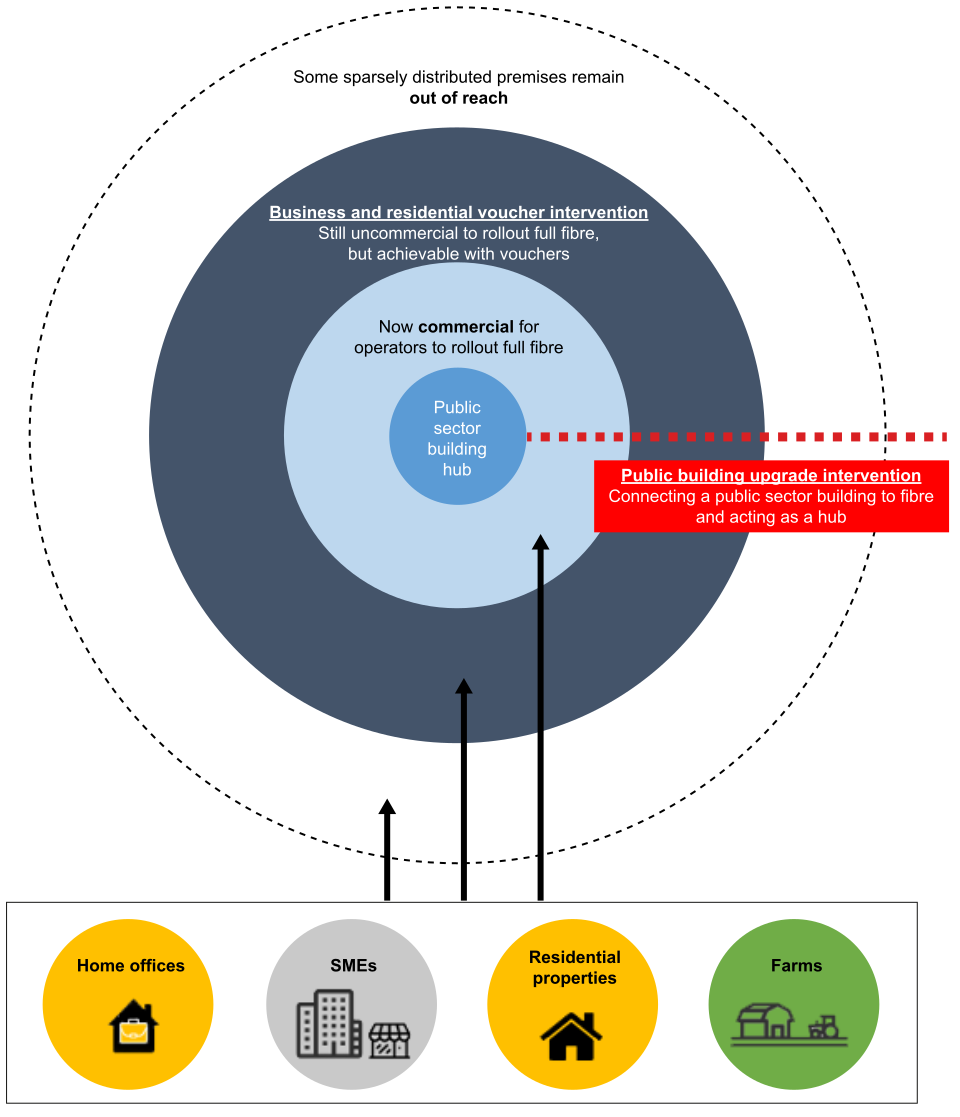
Beyond the first two concentric circles lies businesses and residences where full fibre rollout remained uncommercial. However, with supplier presence established through the Hub, business and residential demand could be stimulated to establish gigabit in the remaining uncommercial areas around the Hub, perhaps using the voucher product. Hence, some overlap was expected between Hubs and vouchers in the same intervention area. There may still have remained some sparsely distributed premises out of reach.
GigaHubs programme
Developing a theory of change
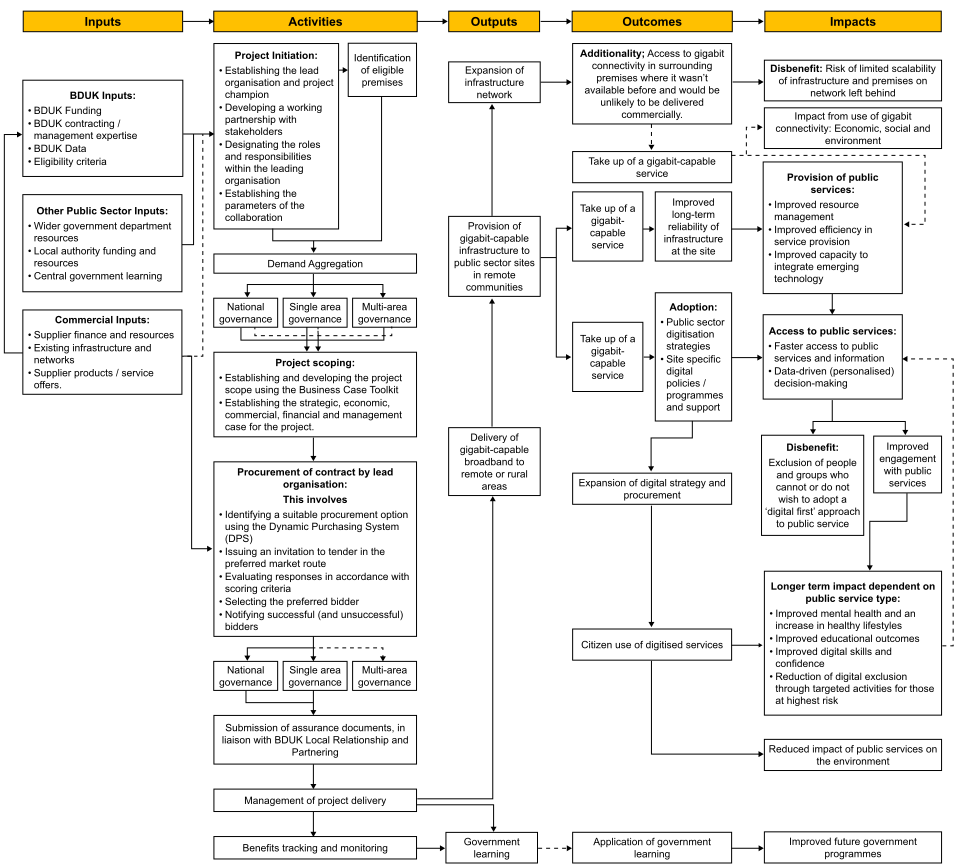
The model was a tool to communicate the spatial effects of the Hub product, especially through the RGC funded Hubs programme. BDUK also developed a Hub theory of change (ToC). It analysed the product’s approach to delivering benefits, identifying demand for gigabit to meet an area’s connectivity needs with this centring on the needs of eligible public sector buildings (such as GP surgeries, libraries and schools). The ToC also presents longer-term expected impacts centred on how digital transformation at the Hub can improve service delivery, develop new services and reduce time and resources spent on processes that would benefit from digitisation. A challenge for the ToC is its overlaps with the wider changes that are expected in public service delivery. Improved connectivity at premises that deliver public services then have effects that are dependent on the public services at the settings, and especially how these adopt digital technology. The ToC has matured through interactions with the other departments and devolved administrations that oversee complementary policies and delivery, each with change aims that characterise individual ToCs. Characterising the overlap and dependencies have been a feature of recent work on the ToC. An earlier version of the ToC was developed and published in the Hubs Evaluation Plan (Belmana, 2025). This has been revised, incorporating the findings of the GigaHubs process review and so including the changes in policy development from the RGC Hubs programme to GigaHubs. The updated ToC is visualised in Figure 2. It starts with the inputs, the resources available to the programme both from BDUK and leveraged in from the Hubs delivery from other bodies. This funds activities that underpin Hub projects. It then links these to outputs, outcomes and impacts.
Inputs
-
BDUK funding. £110m of the £5 billion of total funding allocated to Project Gigabit Programme was made available for Hubs, although some flexibility was built into this so that funds could have been diverted if required. The Hub product was expected to be discontinued, after GigaHub activity reached completion in 2026, with no further funding allocated beyond 2025/26.
-
BDUK contracting / management expertise. BDUK drove local procurement behaviour through a combination of advice, support, documentation, grant agreements and the assurance process. The assurance checkpoint process, managed by BDUK, provided an opportunity to confirm that commercial principles were enacted in procurement documents and resulting contracts. BDUK also supported partners in other government departments and in local authorities through providing funding and assuring delivery against pre-agreed milestones. The BDUK funding was only to cover the capital elements of connectivity upgrades.
-
BDUK data. This input combined knowledge, lists, data and information on the public premises in need of connectivity (from LA/Gov etc). i.e. the need/demand being aggregated. The ToC update adds how Open Market Review (OMR) data provided by suppliers – discussed later – highlighted that entry into the list of Hub sites was time-sensitive, materially shaped by rapid changes in broadband availability. A line from the commercial inputs to BDUK inputs captures the GigaHubs Process Review Report (Belmana, 2026) finding that rapid commercial rollout removed eligible public buildings year-on-year; 4,603 eligible sites fell to 1,207 between 2020 to 2022.
-
Eligibility criteria. BDUK had a specific set of criteria by which public sector buildings were identified as eligible for inclusion in a Hubs project, based on premises level supplier build information and BDUK assessments of whether unsubsidised, commercial provision was possible. The Process Review discusses how eligibility constraints – in that some remote premises were settings for public or community services but not eligible public sector buildings – coupled with alternative routes to connect public buildings further shrunk the pool of viable sites for local authority led projects. For example, only 30-60 Tier 1 Local Authorities had enough eligible sites at the outset, and this fell to 10-20 once primary schools, that could be connected from the national Department for Education (DfE) project to connect schools were removed. the input of viable sites declined over time due to accelerating commercial rollout and the expansion of area-based GIS procurements.
-
Wider government department resources. Time and strategic resources were required from partner departments such as the DfE and the Department of Health and Social Care (DHSC) to deliver the projects in which they took the lead. The DfE GigaHubs project followed from the earlier DfE RGC project connecting almost 800 schools in England. NHS Scotland also delivered 5 Hub sites in the Western Isles, Highlands and in Orkney during GigaHubs building on their RGC work connecting over 170 remote health settings. In leading a project, these authorities, having secured the BDUK funding for the build, resourced the managing of procurements and the contracts with suppliers, as well as overseeing initialising the connections’ use.
-
Local authority funding and resources Three GigaHubs projects were led by local authorities, in Dorset, Oxford and Leicestershire. As with the DfE and NHS Scotland projects, the local authorities were responsible for resourcing the contract management of their projects. This usually involved appointing a project champion within the authority, to take the lead on procurement, management and promotion of the project.
-
Commercial supplier finance and resources Project Gigabit aimed through the provision of subsidy to attract commercial investment and incentivise broadband suppliers to expand into areas that were otherwise unviable, particularly that faced significant geographical and logistical challenges. Whilst the Hub product was not directly expected to result in commercial build, it brought additional build to remote areas through supplier activities connecting public buildings. The updated ToC also accounts for the contributing suppliers’ existing infrastructure assets, networks and product and service offerings which formed an additional core input to delivery, supporting progression and data connectivity insights for the OMR datasets. At a time when the commercial rollout outside of BDUK-funded projects accelerated in rural areas, this input improved targeting of resources, removing many potential sites from eligibility through informing BDUK and projects of new or planned nearby connectivity. Since commercial suppliers did not directly engage in project initiation, this input is now represented with a dotted line.
-
Central government learning The Hub product was tested through the Local Full Fibre Network (LFFN) programme and the RGC programme. The lessons learned from these projects were used to inform how the GigaHubs are managed.
Activities
There were multiple activities which needed to be completed to ensure the delivery of the GigaHubs product. The earlier ToC presented a flow of activities from project initiation to project scoping, but the process review has highlighted how demand aggregation by projects also affected the activities, adding this in as a core activity. The overall activities are highlighted below:
-
Project initiation. GigaHubs projects began with identifying a project lead organisation and building the wider collaboration with partners for those leading on the projects. Project initiation activities included establishing the project champion and developing a working partnership with stakeholders, designating the roles and responsibilities within the leading organisation and establishing the parameters of the collaboration. Pace and feasibility depended on local delivery capability, existing digital teams and prior programme experience. The Process Review found that project initiation was capability dependent, with LAs with RGC or LFFN experience progressing the fastest, more inexperienced LAs moving more slowly and needing support and multi-area projects navigating the mix of experience and capability across different collaborators.
-
Identification of eligible premises. This involved developing the scope of the project through building a site list which identified potential Hubs. This depended on activities in the wider Project Gigabit, such as the OMR that BDUK conducts every four months compiling suppliers’ commercial plans for build. Each site is tested for BDUK eligibility: a site is classed as a public sector building and performing a public function, a rural location defined using an agreed standard of measures depending on the devolved nation, an existing broadband speed of less than 100Mbps, being out of scope of commercial build for a gigabit-capable network and out of scope of other interventions in the area.
-
Demand Aggregation. This updated ToC includes the activity of demand aggregation. This involved the aggregation of potential sites for the Hub product across the projects using the three governance approaches: national governance, multi-area governance and single-area governance. Process review findings indicate how Hub provision could involve sites moving between the different routes/projects both before formal initiation of a project and after, e.g. the differing scales of aggregation, with some LAs having fewer than 100 sites, leading to aggregation with other LAs into the multi-area route.
4. Scoping the project. This involved establishing and developing the project scope using a BDUK Business Case Toolkit, establishing the strategic, economic, commercial, financial and management case for the project. It drew on site identification to develop a procurement strategy. The scoping effectiveness depended on maturity, accuracy and timeliness of OMR data as well as local knowledge. The Process Review found evidence of scoping challenges, the immaturity of OMR data resulted in DfE contacting over 3,000 schools manually and site lists repeatedly changed as commercial plans evolved. The inclusion of both dotted and solid arrows from Demand Aggregation (national governance, multi-area governance and single-area governance) to Project Scoping represents the uncertain, iterative and error-prone use of Inputs in the Initiation stage which improved/matured over time.
5. Procurement of contract. This involved identifying a suitable procurement option often using the Dynamic Purchasing System (DPS), issuing an invitation to tender in the preferred market route, evaluating responses in accordance with scoring criteria, selecting the preferred bidder and notifying successful (and unsuccessful) bidders. Approval of the grant offer award was given upon receipt of assurances and completion of submission. It brought with it a commitment to execution of build. The updated ToC breaks this procurement into national governance, single-area governance and multi-area governance projects. There is a dotted link between procurement of contract to represent the weakened initiation effectiveness associated with multi-area governance through diffused accountability. Procurement effectiveness was moderated by risk allocation clarity, supplier confidence and tender viability, and whether the project is single-area or multi-area. The Process Review found that RM6095 worked well for single Local Authority projects, but the Midlands Project did not proceed due to clawback-related risk exposure and governance issues.
6. Submission. This activity used criteria and navigated assurance process steps (including site level dialogue) to turn this into the final list of sites for procurement/contract. This included preparing the documentation required for assurance and liaising with BDUK Local Delivery Partners or Managers to agree the best solution for the specific contract. Project leadership varied depending on whether the project is national, multi-area or single area.
7. Management of project delivery. This was overseen by the lead body who was responsible for the management of the supplier. Part of this activity was reporting back to BDUK through the fulfilment of project management information templates and compliance with financial deadlines.
8. Benefits tracking and monitoring. BDUK required projects to collect additional management information from the supplier to assist with benefits monitoring, which fed into evaluation. Typically, this reporting should have been submitted every quarter for three years following completion of the project build.
Outputs
The key outputs that the GigaHubs aimed to achieve were:
-
Delivery of gigabit-capable broadband to remote or rural areas. Sites that were identified as being outside of commercial build plans received gigabit-capable broadband.
-
Expansion of infrastructure network. Infrastructure was made available in areas that were previously deemed unviable by commercial suppliers, making the area more commercially attractive for supplier-led build out in the future. Wider coverage effects often occurred with suppliers taking actions or using further incentives, such as the stimulation of community demand or the alignment of voucher products. Whether or not suppliers promoted wider build varied and often only occurred if it had become sufficiently commercially attractive for suppliers to do so.
-
Provision of gigabit-capable infrastructure to public sector sites in remote communities. Public sector sites in remote and rural areas had access to improved connectivity services that delivered considerable benefits in terms of enabling service transformation. Delivery was moderated by the differentiated progression of sites and projects through input and activity stages, reflecting the interaction of design constraints such as the 100-site threshold, the pace of commercial rollout and the parallel delivery of GIS and DfE routes.
4. Government learning. Extensive and proportionate evaluation of the Hubs product provided the opportunity for BDUK to improve future government investment.
Outcomes
The outcomes of the product, as outlined by BDUK’s ToC, were as follows:
1. Improved long-term reliability of infrastructure at the site. The Hub intervention provided a long-term solution to the provision of reliable broadband at the site. This offered access to infrastructure that can support the use of multiple devices by multiple users and ensured that a reliable connection remained available subject to take-up of gigabit connectivity made available at the site for as long as the site is within use. Notably, this is reliant on the site activating and adopting the service.
2. Additionality. The Hub intervention provided premises outside of the scope of suppliers’ commercial build plans with gigabit-capable broadband infrastructure at the identified premise, thereby increasing the availability of faster, more reliable broadband at the premise. Simultaneously, it promoted uptake of business and residential voucher intervention in the surrounding area, but then only indirectly promoted wider uptake. The incremental Hubs combined with vouchers build was steadily replaced by GIS-driven area-wide investments, which rolled together these public incentives, guaranteed far more premise connections in single interventions and area-wide progress to government coverage targets. However, it is worth highlighting that the GIS provision to a public building would not be accompanied by any conditions on the public services taking up gigabit and then adopting technologies to improve public services, which was a feature of the Hubs product. Whereas in the Hub product, the line from outputs to the outcomes at the connected Hub sites are solid, in the top portion of the outcomes – where the route to provision is through wider infrastructure build including GIS – the link to uptake is dotted. This reflects the lack of levers to force taking up the gigabit connection at the outside of the Hub sites.
3. Greater take-up of gigabit contracts. Increased availability of gigabit-capable service through additionality may have led to households and businesses taking up an improved/gigabit-capable service. Through infrastructure improvements, there was opportunities for public sector organisations to take up contracts which included gigabit-capable broadband at the site. There was also a greater opportunity for the creation of new service offerings at public sector sites. This was dependent on contract cycles, organisational readiness and access to and elevation by sector-specific support like DfE’s Connect the Classroom funding.
4. Adoption. The Hub intervention facilitated the adoption of digitisation strategies in public sector buildings, the adoption of accessible, deployable site-specific digital policies, programmes or support and the integration of digital technologies into service delivery subject to the take-up of gigabit connectivity made available at sites. Adoption of digitisation strategies often required complementary funding, IT strategies and workforce capability. The Process Review found that adoption at the site depended upon sector-specific factors; schools had strong adoption pathways due to Connect the Classroom alignment while libraries and health settings experienced slow, contract-cycle dependent take-up.
5. Expansion of digital strategy and procurement. As digitisation expanded, the Hub intervention allowed for the use of emerging technologies and updated devices procured by government departments and local authorities to be used in rural areas with previously low connectivity.
6. Application of government learning. The learning achieved during the outputs stage of the ToC was applied internally in order to improve BDUK products, as well as shared across other government departments through published evaluation research reports.
7. Greater citizen use of digitised services. The digital divide reduced and service users became accustomed to accessing information, transactional services and other digital services online. As digital services continued to become more integrated into service provision, the ‘digital first’ approach suggested by Government Digital Services met the needs of service users while making more efficient use of public sector resources.
Impacts
Longer-term expected impacts of the GigaHubs programme were centred on promoting public sector efficiency as the buildings were giving access to fast, reliable broadband infrastructure. Project Gigabit more broadly aimed to improve public sector efficiency in a quantifiable manner, based on the logic that better internet connectivity led to efficiencies in service delivery within the public sector. These sectors included, but were not limited to, health services, educational institutions, leisure facilities, local authority functions, criminal justice services, and energy and transport sectors. This broad variety of public services made better use of digitised public services and utilised sector-specific enhancements to increase their efficiency. Impacts then varied.
Provision of public services
1. Improved resource management. Resources in this context referred to the objects, devices and platforms used to deliver public services, but it also referred to the people who use them and the time spent doing so. So, whilst this referred to the use of (for example) cloud storage for easier access to important files, it is also associated with the automation of certain tasks that allowed for time and effort to be redirected elsewhere. This was particularly true of tasks that can be automated, such as minute-taking.
2. Improved efficiency in service provision. It was expected that improved management of public sector resources would allow departments to focus time and effort on activities directly related to service delivery. There was also an assumption that the digitisation of tasks implicitly sped them up and made them more efficient. The extent to which this happened across public sector departments depended on many factors, especially given the wide range of services that were being discussed. For example, the provision of driving licenses differed to the delivery of health care. Many of the tasks that received this benefit had already been digitised but it should be noted that it was not necessarily universal. A good example of this is using digital technology to triage patients in secondary care and attending routine appointments with patients with chronic illnesses. The evidence suggested that these were processes that improved the efficiency of healthcare provision but there were still many details missing from the wider evidence as to how this could be implemented more broadly.
3. Improved capacity to integrate emerging technology. Evaluation evidence suggested that public sector organisations would have redirected finances into digital technology once they began to see the benefits of it. As the adoption of digital technology becomes embedded into the public sector, evidence suggested that organisations would have been able to integrate technology faster as it emerged. This meant that the benefits of improvements to automation, cloud computing and machine learning could be more quickly realised as organisations were better prepared to integrate them into their ways of working.
Access to public services
1. Faster access to public services and information. The purpose of the digitisation project was to make public services more accessible to a wider range of people whilst minimising the impact those who deliver the services. The foundations of this was laid by Government Digital Services who enabled information and statistics to be presented digitally in a way that promoted engagement and access across all sectors of society. This progress continued with the development of app-based services, such as apps developed by the healthcare services and the digitisation of DVLA services. Such developments improved efficiency by making information available thus reducing the need for contact with service providers. This progress continued through the development of further services, such as the UK Government App, which aimed to collate services in one place.
2. Data-driven (personalised) decision making. The development of app-based services allowed for a holistic approach to service provision by government, driven by data. This in turn allowed for data-driven decision making that made service provision and intervention more personalised and tailored to individual needs. This was particularly useful in the case of complex needs where public sector services were accessed across a range of government departments.
Longer-term impact dependent on the public service type
Longer-term impacts varied depending on site type and associated sector. The revised ToC reflects how connected sites that were libraries and community spaces acted as trusted environments for digital inclusion, providing group learning, one-to-one support and access to digitally enabled devices and broadband connectivity. These settings reduced digital exclusion through supporting groups most at risk and fostering peer-learning which built confidence and long-term capability. Enhanced digital inclusion within these spaces improved access to wider public services, social participation, and wellbeing. In contrast, the longer-term impact of improved broadband connectivity on health and school sites were more interrelated to improved outcomes for patients and students respectively.
1. Improved mental health and an increase in healthy lifestyles. Increased connectivity created opportunities for increased and more discrete opportunities for mental health support, which in turn improved wellbeing, created greater outcomes for service users and reduces pressure on mental health services. Digitisation also created opportunities for healthier lifestyles through allowing access to online wellbeing resources such as exercise classes, healthy eating information, and social and cultural activities. This also created better health and wellbeing outcomes for users, reducing pressure on health and social care services.
2. Improved educational outcomes. Improved broadband delivered, using investments in educational technology, long-term impacts from improved educational outcomes. These have been enabled by complementary policies, such as the DfE Connect the Classroom. Links between policies in causing the overall impacts rely on understanding the changes to the broadband network due to Hubs and the changes in the schools, with the latter covered in recent DfE evaluation work (DfE, 2026).
3. Improved digital skills and confidence. The ToC was updated based on process review observations to include the longer-term impact of improved digital skills and confidence. Improved connectivity enabled the provision of digital skills services and support in community-oriented public sector sites such as libraries. Supportive peer-learning environments helped participants develop the digital capabilities needed to wholly participate in modern life and opened up access to digital opportunities.
4. Reduction of digital exclusion through targeted activities for those at highest risk. The ToC has been updated based on process review observations to include the longer-term impact of reducing digital exclusion. Increased broadband connectivity enabled the reduction of digital exclusion through supporting targeted activities for those at highest risk. Libraries and other public community sites often tailor sessions for groups like older adults, people with disabilities, people with low incomes, or isolated or rural residents who may be more likely to be digitally excluded due to limited access to digitally enabled devices and broadband connectivity, or in greater need of targeted digital skills support.
Other impacts, disbenefits and risks
The ToC also covers a mix of impacts outside those on public services and broadband networks. There are also potential negative impacts and risks to delivery explored in the ToC.
1. Reduced impact of public services on the environment. Environmental benefits from the integration of digital technologies included increased energy efficiency at public sector sites and increased use of cloud computing rather than using physical servers which were more power intensive.
2. Improved future government programmes. The application of government learning from the Hubs product could be used to improve future programmes.
3. Low public trust and engagement. It should not be assumed that the digitisation was desired or welcomed by those who access services. At present, there is very little evidence to help government services understand the perspectives of service users and it is unclear whether digitised services improved the user experience of those accessing the services. It is unclear whether the digitisation project will result in greater satisfaction with services or promote engagement with essential services.
4. Limited scalability of infrastructure.This disbenefit refers to the significant limitations on public sector bodies’ capacity to respond to emerging technology and to adopt new forms of digitisation once their reliability has been proved. Barriers in this area were chiefly public sector reliance on legacy technology, which is well established within the literature in this area, but it also referred to scalability in terms of skills, capabilities and willingness in public sector employees. The digital skills gap that exists in the UK is felt keenly amongst many public sector departments and it was noted that there is a significant lack in leadership that enabled this to be resolved at present.
5. Further exclusion of poorly served communities.The development of a ‘digital first’ approach brought with it the risk of excluding citizens who struggle to access digital services. The assumption that services would be accessed and used digitally created several layers of exclusion whereby those who lack the connectivity, devices, skills, or confidence to access services online would not be able to gain the help that they need. Research from organisations such as the Good Things Foundation and academia suggested that those at highest risk of digital exclusion are those who already experience exclusion and barriers to participation in society. People who live on low income, live with disabilities, or are isolated are among those who were more likely to be in this group. The digitisation of public services risked exacerbating and entrenching those difficulties.
Figure 2: Visualisation of the Theory of Change
Interpretation of the Theory of Change
Figure 2 illustrates how the GigaHubs intervention was expected to generate change, from the initial inputs and activities through to outputs, outcomes and longer-term impacts. The purpose of the ToC is not to restate delivery processes, but to articulate the causal pathways through which the Hub product intended to deliver benefits and to identify where evidence could be gathered to assess effectiveness. The ToC began with inputs from BDUK, partner government departments, local authorities and commercial suppliers. These inputs enabled a series of activities, including project initiation, identification of eligible premises, project scoping, procurement, assurance and delivery management. Together, these activities led to the delivery of gigabit-capable broadband to public sector buildings in rural and remote areas, alongside associated government learning. The ToC assumes delivery of gigabit connections to targeted public sector building at scale. However, the Process Review identified several moderating factors including the shaping of output volumes by design and the evolving context. The volume of outputs was affected by the interaction of design constraints (100-site threshold), the increased rate of commercial rollout and the progression of other routes using the same market product to deliver identical outputs (GIS and DfE projects). The Process Review also found that onward diffusion was highly variable and depended on supplier incentives, voucher uptake and community engagement. These outputs were expected to generate a range of outcomes.
At the site level, these included improved long-term reliability of broadband infrastructure and increased take-up of gigabit-capable services. Beyond individual sites, the Hub intervention was intended to deliver additionality by extending infrastructure into areas outside of commercial build plans, stimulating further demand and supporting wider adoption of digital technologies. Over time, this was expected to support the adoption of public sector digitisation strategies, expansion of digital procurement and increased citizen use of digitised services. The ToC also identified longer-term impacts associated with improved connectivity. These included improved efficiency and resource management within public services, enhanced access to services through faster and more data-driven delivery models, and broader economic, social and environmental impacts. Alongside these potential benefits, the ToC recognised risks and disbenefits, including the exclusion of individuals who were unable or unwilling to engage with digital-first services and constraints on the scalability of infrastructure and organisational capability. Notably, the scale and timing of long-term impacts differed between schools, health settings, libraries, and community spaces, reflecting variation in organisational readiness, digital capability, contractual cycles, and user needs. Both libraries and community spaces provided unique, socially embedded forms of impact that extended beyond site-level service delivery. The ToC provided a framework for addressing the core evaluation questions for the GigaHubs product. Evidence at the outputs and outcomes stages supported assessment of delivery effectiveness and behavioural or organisational change, while consideration of longer-term impacts informed judgments on overall effectiveness and value for money. Learning generated through this process could have been applied to improve the design and delivery of future government broadband and digital infrastructure programmes.
Future Evaluation Evidence and the Theory of Change
The ToC highlights clear pathways through which public‑sector connectivity could have generated benefits, but the process review evidence also shows that several of these pathways remained contingent on sector‑specific adoption patterns, organisational capability and the maturity of complementary policies and systems. Future evaluation should therefore prioritise understanding the differences in how schools, health services, libraries and other public organisations exploit gigabit connectivity once delivered and explore how these behaviours evolve as GIS becomes BDUK’s dominant broadband connectivity delivery mechanism. As GIS provides more comprehensive, there is a valuable opportunity for onward impact evaluation to further test the ToC’s assumptions about spillover benefits, long‑term service transformation and community outcomes. This would assist in addressing remaining evidence gaps and strengthening understanding of the broader consequences, both intended and emergent, of the UK’s public‑sector connectivity interventions. The ToC for broadband provision at a setting that delivers public services overlaps with the policies and delivery plans of the different services. In some areas, such as education, there are digital adoption policies in place, such as England’s Connect the Classroom and similar interventions in other UK nations. The ToC engagement involved understanding this and – more generally – policy design has been able to integrate the dependencies between the Hub product and the translation into educational outcomes envisaged as schools use educational technology. This has been two-ways often, with BDUK knowledge and understanding drawn into the related DfE work. A similar dialogue for healthcare premises has been established. With other Hub settings, such as connection at libraries or community spaces, the interaction of the Hub product is more complex, with a diversity in pathways for impacts. Future evaluation should explore how these digital enabled community spaces contribute to inclusion, wellbeing, digital capability and service access. Further work is also needed to understand how all these outcomes are achievable when using the GIS approach as the primary widening coverage mechanism, where take up and support to use this connectivity is not built into this delivery mechanism. This revised Theory of Change reflects a more mature and evidence‑informed understanding of how public‑sector connectivity interventions generate benefits, and the conditions under which those benefits are most likely to be realised. Drawing directly on the findings of the GigaHubs Process Review, it clarifies the causal pathways, dependencies and constraints that shaped delivery and outcomes, and makes explicit where assumptions were tested, refined or challenged by recent evaluation evidence. In doing so, the ToC provides a more robust framework for interpreting past performance, assessing value for money and informing future evaluation. As BDUK’s delivery model continues to evolve towards area‑wide approaches through GIS, the revised ToC offers a clear articulation of where programme design, adoption and complementary policies remain critical to securing public value from connectivity investments and establishes a transparent basis for learning to be carried forward into future broadband and digital infrastructure programmes.
References
Belmana (2023) BDUK Rural Gigabit Connectivity Hubs Evaluation. Report to Building Digital UK. https://www.gov.uk/government/publications/bduk-rural-gigabit-connectivity-hubs-evaluation Belmana (2025) BDUK Hubs Evaluation Plan. Report to Building Digital UK. https://www.gov.uk/government/publications/bduk-hub-evaluation-plan/bduk-hubs-evaluation-plan Belmana (2026) BDUK Gigabit Hub Evaluation: Process Review. Report to Building Digital UK DfE (2026) Connect the Classroom Evaluation: Research Report. February. https://assets.publishing.service.gov.uk/media/698c75e82f683cc788c28774/Connect_the_classroom_evaluation.pdf HMT (2025) Magenta Book: Central Government guidance on evaluation, Revised July. https://www.gov.uk/government/publications/the-magenta-book