GigaHubs Process Review
Published 26 June 2026

© Crown copyright 2026
This publication is licensed under the terms of the Open Government Licence v3.0 except where otherwise stated. To view this licence, visit nationalarchives.gov.uk/doc/open-government-licence/version/3 or write to the Information Policy Team, The National Archives, Kew, London TW9 4DU, or email: psi@nationalarchives.gov.uk.
Where we have identified any third party copyright information you will need to obtain permission from the copyright holders concerned.
This publication is available at https://www.gov.uk/government/publications/bduk-gigahubs-evaluation-process-review/gigahubs-process-review
Authored by Belmana, an independent contractor commissioned to run this evaluation on behalf of Building Digital UK (BDUK). Study conducted by Belmana and GC Insight.
Introduction
The Department for Science, Innovation and Technology (DSIT) directorate Building Digital UK (BDUK) commissioned Belmana, working with GC Insights, to conduct a multi-stage evaluation of its Hub product. The Hub product mobilises resources to secure gigabit-capable broadband connections for remote public buildings such as schools, GP surgeries, and libraries in rural areas. The evaluation runs from 2022 to 2027 and includes this process review of the GigaHubs programme, which delivered the Hub product 2021-26.
It addresses a set of questions grouped under two broad themes:
- Did the GigaHubs product achieve the intended scale efficiently, and did design of the product and processes support beneficial impacts?
- How did the different stages in the process contribute to efficient and effective delivery?
The evidence draws on BDUK management data and interviews with BDUK staff, other government department leads, local authorities (LAs), suppliers, and site representatives. It draws from findings in a first published impact evaluation (Belmana et al., 2023).
The Hub Product and GigaHubs Programme
The GigaHubs programme forms part of Project Gigabit, a set of interventions designed to extend gigabit-capable broadband to areas unlikely to be reached through commercial rollout alone.
The Hub product
The Hub product funds connections to the gigabit network for public buildings in remote areas. These buildings then act as anchor sites to stimulate further broadband rollout into surrounding communities, offering threefold benefit:
- improved public services through fast, reliable broadband at the Hub itself
- cheaper, faster rollout of connections to nearby homes and businesses
- long-term market growth, as suppliers expand commercial networks outward from the Hub
The Hub business case centres on the benefits delivered at the public building itself, such as savings in school administration costs through the use of cloud services and improved productivity enabled by better connectivity and associated IT. By connecting multiple buildings, the Hub product also acts as a demand-side intervention: Hub projects aggregate demand for broadband across numerous sites, allowing some costs (such as procurement and site identification) to be shared.
In addition to these direct benefits, there are wider network effects as suppliers establish a presence through Hub connections and then invest further in surrounding areas, supported by complementary products such as Gigabit Vouchers and the Gigabit Infrastructure Subsidy (GIS). The Hub concept evolved through earlier BDUK programmes. It was first piloted as the Public Sector Building Upgrades strand of the Local Full Fibre Network (LFFN) programme (2017–2021), and then formally launched as a BDUK product under the Rural Gigabit Connectivity (RGC) programme (2019–2022). GigaHubs, launched in 2021, built on these earlier initiatives to connect a larger number of rural public-sector premises, with delivery running through to 2025/26.
The GigaHubs programme
For the GigaHub programme, BDUK works with partners who set up GigaHub projects. The Department for Education (DfE), the Scottish Government, Dorset, Leicestershire, Nottinghamshire and Oxfordshire County Councils initiated a GigaHubs project. After the initiation stage, there were three further stages. The project leads identified eligible buildings, typically schools, GP surgeries or rural libraries with download speeds below 100 Mbps and that could not be connected to fast broadband commercially.
BDUK funds the costs of the connections and, in the procurement stage, GigaHub projects then use BDUK’s Dynamic Purchasing System (DPS) or other frameworks to contract suppliers to build the connections. The final stage of delivery saw projects coordinate across public services, suppliers, building managers, and network operators. The impact of improved connectivity depends in part on complementary policies that support the adoption of digital technologies in public services. For example, DfE’s Connect the Classroom (CtC) programme funds technology in connected schools, while the NHS and devolved administrations promote digital health and care services that rely on strong connectivity.
There are also spillover impacts on the wider gigabit network, with BDUK interventions such as voucher schemes supporting installation costs for homes and businesses located near to Hub-funded infrastructure. GigaHubs processes have sought to maximise impacts both at the Hub itself and in surrounding areas. The policy context for the Hub product has evolved over time. Most notably, BDUK’s Gigabit Infrastructure Subsidy (GIS) programme, launched in 2021, adopts a broader area-based approach, procuring both infrastructure and public building connections across 41 intervention areas covering most of the UK. While GIS complements GigaHubs, it increasingly provides an alternative route for connecting public buildings and extending rural broadband coverage.
Process review objectives
This process review seeks to address the two overarching themes through a set of more detailed questions. The question of whether the GigaHubs product achieved its intended scale efficiently is examined through the lens of key design choices, such as the 100-site minimum and the interaction with contemporaneous GIS and DfE delivery routes. The extent to which product and process design supported beneficial impacts is explored across three dimensions:
- Did the programme/product have processes in place to ensure connected sites used the gigabit service once delivered?
- How did the overlap and sequencing of other Government interventions(DfE schools’ rollout, GIS, RGC legacy) influence the relevance, timing, or necessity of GigaHub delivery in different areas?
- Did delivery processes support “beyond‑the‑Hub” benefits and integration with complementary programme/products?
Process review questions are also linked to the four stages of the projects:
- Initiation – To what extent did local delivery capability and governance(single‑local authority area vs multi‑area) influence pace and quality of delivery? How did local organisational capacity, capability and governance(particularly among LAs) shape the speed, quality and feasibility of project initiation, procurement and delivery?
- Scoping – How effective were the site‑selection processes at targeting premises least likely to be served commercially? Were data pipelines sufficiently mature and timely to support confident, low‑friction decisions?
- Supplier procurement – Did procurement routes enable timely, good‑value contracting and under what conditions did they falter? How did the pace and pattern of commercial broadband build during 2021–24 affect the programme’s ability to meet its original aims, and reshape which projects were viable, timely, or necessary?
- Delivery – How did the pace and nature of delivery‑side constraints (wayleaves, highways, landowners, seasonal access, internal IT changeover)influence delivery timelines and the degree to which infrastructure could be exploited quickly?
Evidence and methods
The report draws on both primary and secondary data to assess whether each stage of the programme achieved its objectives and to understand how the overall process operated within a changing policy and market context. Evidence gathering was structured around three methods.
-
First, a review of official documents was undertaken to understand the full delivery process. This included Project Gigabit guidance, BDUK’s theory of change, and relevant policy and strategy documents from government departments, devolved administrations and the four participating LAs.
-
Second, the study analysed BDUK management information data covering 2,554 Hubs supported by mid-2024. The data, shared with Belmana at seven time points between July 2023 and July 2024, includes information on Hub locations, connection status, and delivery bodies. These data were linked to other public datasets, including DfE data on English schools and Ofcom’s Connected Nations database, to support analysis of broadband availability and use. Quantitative analysis also explored the potential scale of future Hub projects by linking lists of public buildings to organisations capable of leading delivery.
-
Third, in-depth qualitative interviews were conducted about the multi-area projects and the LA-led projects in Dorset, Leicestershire, Oxfordshire, and the Midlands region. Qualitative evidence gathering typically began with interviews with BDUK local delivery leads or managers, followed by discussions with delivery teams, suppliers, and connected sites. Interviews were conducted between September 2023 and July 2024, lasted 30–45 minutes, and were primarily held online.
Delivering GigaHubs and Impact Pathways
The GigaHubs programme aimed to deliver gigabit-capable connectivity to public buildings at scale and with efficiency, while enabling benefits both at connected sites and in surrounding broadband infrastructure. Key Hub product design choices (such as the 100-site minimum and parallel delivery routes through GIS and DfE) raise questions about whether the programme was able to achieve its intended scale efficiently and generate wider impacts. This chapter explores delivery performance and impact pathways across three dimensions:
- Did the programme/product have processes in place to ensure connected sites used the gigabit service once delivered?
- How did the overlap and sequencing of other Government interventions(DfE schools’ rollout, GIS, RGC legacy) influence the relevance, timing, or necessity of GigaHub delivery in different areas?
- Did delivery processes support “beyond‑the‑Hub” benefits and integration with complementary programme/products?
The GigaHub projects
Launched in Autumn 2021 under Project Gigabit, GigaHubs has connected around 1,200 rural public sector buildings – such as schools, GP surgeries, and libraries – to gigabit-capable broadband. At the outset of the programme, an upper estimate was to connect up to 7,000. After scoping of the potential pipeline, the requirement was reduced to around 2,500 sites by September 2022, with a BDUK commitment of £70 million or £28,500 per site for these connections. The goal is also to extend fibre networks into remote communities with approximately 30 premises passed consequentially per Hub.
Scale efficiencies in projects
At the time of launch, an upper estimate of 7,000 Hub connections was made. Early scoping involved BDUK engaging with the departments that had property portfolios tilted to rural areas, such as the Ministry of Defence and Department of the Environment, Food and Rural Affairs. Modelling undertaken for this study also indicates that LA’s with sufficient public buildings was likely to decline swiftly due to the pace of the wider rollout. BDUK noted how it became clear that “demand was not there” for several thousand Hubs as “sites [were] under contracts for the next number of years” preventing early use of a Hub connection or the number of potential sites was quite modest as commercial builds were in progress. BDUK reset the target to 2,500 sites and delivery was to be through projects led by local authorities, government departments or devolved administration that led public service delivery. By mid-2023, the six projects had all been initiated (Table 1):
- Local authority-led (LA) projects: Three county-led (Dorset, Oxfordshire, Leicestershire) projects.
- Multi-area projects: Three multi-LA or national (DfE, Midlands GigaHub, NHS Scotland) projects.
Across the six projects, 2,554 potential Hub sites spread across England and Scotland were identified. The majority were schools (2,332 sites), followed by libraries (121) and GP surgeries (66), alongside a small number of other public buildings such as recycling centres, council offices, and museums. The GigaHubs Programme is set to complete delivery in 2026 connecting around 1,200 sites, with the multi-area projects providing 90% of these connections. A clear contrast emerged between project types. LA-led projects were relatively small in scale seeking around 100 connections at initiation, progressed quickly through to procurement, typically connecting between 35 and 45 sites.
In contrast, multi-area projects were larger but slower to mobilise. The DfE project planned connections to nearly 1,900 schools, while the Midlands GigaHub project proposed around 300 sites across ten LAs before being suspended following unsuccessful supplier negotiations. NHS Scotland successfully delivered five connections. Overall, projects spanning multiple areas experienced longer initiation and procurement timelines than single-LA projects.
Table 1: GigaHubs projects Summer 2023
| Project | Status July 2024 | Initiation | Procured | |
|---|---|---|---|---|
| Projects co-ordinating across local authority areas | ||||
| DfE Project | Scoped 1,898 primary schools across England funded by BDUK and DfE | 800 schools benefit by end 2025/6 | Jan 22 – Jul 22 | Sep 22 – Mar 23 |
| Midlands Project | Notts CC with nine LAs, NHS connecting 300 schools, libraries, surgeries | Project suspended | Jun 22 – Mar 23 | No procurement |
| NHS Scotland Project | NHS Scotland connecting 5 GP surgeries | All five connected | Dec 21 – Mar 22 | Procured thru extant contract |
| Projects led by a single local authority | ||||
| Dorset Project | Dorset CC connecting 35 schools, libraries, etc with BDUK & LEP funding | 35 sites connected | Dec 21 – Feb 22 | Mar 22 – May 22 |
| Leicestershire Project | Leicestershire CC connecting 43 schools, libraries, recycling centres, etc | 43 sites connected | Dec 21 – Jun 22 | Aug 22 – Oct 22 |
| Oxfordshire Project | Oxfordshire CC connecting 45 schools, GP, libraries with CC & BDUK funding | 45 sites connected | Prior to programme | Oct 21 – Dec 21 |
| And other public buildings include a combination of fire brigade and ambulance depots, community centres, council offices. |
When GigaHubs was launched, BDUK anticipated multiple projects, each connecting at least 100 sites, to achieve the overall target of 7,000 connections. In practice, many LAs found it difficult to meet this threshold. Eligibility for BDUK funding required sites to need subsidy, be outside commercial delivery plans, deliver public services, and be capable of using gigabit connectivity once connected.
Modelling from the perspective of an LA (see Annex) suggests that only 30–60 Tier 1 LAs initially had sufficient eligible sites, typically rural county councils. Each had an estimated 105–228 potential buildings. Further, when adjusting for overlap with national delivery routes – particularly the DfE Schools Project – the number of viable English lead authorities fell further, to around 10–20. This reduction largely reflects the dominance of schools among eligible sites and the availability of the DfE-led project as a simpler alternative route to connectivity. BDUK noted this:
Most local authorities didn’t see [a project] as a priority. They didn’t see that the number of sites that they had was sufficient to make this something that they wanted to do. This phase coincided with both a better-than-expected pace of commercial rollout of gigabit broadband and the BDUK Gigabit Infrastructure Subsidy (GIS) programme, which provided a parallel, centrally managed route to connect public buildings.
BOX 1: UK Fixed Gigabit-Capable Broadband — Market Context (2019–2025)
Connected Nations Report 2025 (Ofcom, 2025) and its data provide an insight into the rapid expansion of gigabit-capable networks that occurred during the period the GigaHubs programme was being rolled out.
By July 2025, fixed gigabit-capable broadband networks were available to 87% of UK residential premises, up from 83% in 2024, driven by commercial rollout and public-funded interventions. This built on momentum from earlier years: UK gigabit broadband availability was reported first in 2020 (Ofcom, 2021) and was 27%, by 2021 this was 47% and 70% by 2022, indicating strong annual growth. Rural coverage remained behind urban and, in mid-2025, 62% of rural UK homes had access to gigabit-capable broadband, compared with 91% in urban areas.
But the commercial rollout outpaced earlier forecasts, and so these rates were higher than anticipated. The investments were made by major providers, alongside alternative network builds. This reduced the number of premises without high-speed options and eroded the population of low-speed rural sites over the GigaHubs programme period more than expected. Persistent connectivity gaps in hardest-to-reach areas have remained, with Ofcom estimates around 44,000 premises still lacked access to at least ‘decent broadband’ (10 Mbit/s down / 1 Mbit/s up) from fixed or fixed wireless access networks in 2025, underscoring persistent gaps post-commercial rollout.
These unreachable or poorly served premises are disproportionately in rural and remote communities, reflecting the enduring digital divide that policies like GigaHubs are designed to address.
While both GigaHubs and the GIS aimed to improve rural connectivity, GIS’s centrally managed delivery model was widely viewed as more efficient and less burdensome for local bodies. As one BDUK official explained:
Ultimately, GIS and Hubs are doing the same thing but through different routes. Evidence says that we are not doing any more GigaHub projects because they only target specific sites… With now GIS, all rural public sites are under one or the other GIS projects. The need for GigaHubs has disappeared anyway.
Suppliers similarly saw GigaHubs as part of a longer transition in delivery approaches. Many suppliers involved in GigaHubs were also bidding for or delivering GIS contracts, which are procured through a separate dynamic purchasing system. GIS was widely understood as an evolution of the Hub model, shifting the focus from individual connections to area-wide delivery:
Hubs have their time and their place, and they were great but now obviously the focus is on getting more connectivity into properties. That’s what the GIS contracts are for through Project Gigabit.
The two approaches differ fundamentally in scale and design. GigaHubs focused on connecting individual public buildings, without directly incentivising wider community connections. In contrast, GIS contracts cover whole intervention areas – often the size of a small rural county – combining public buildings with broader infrastructure investment. This allows suppliers to design networks strategically, connecting hard-to-reach premises alongside denser clusters as part of a single build.
BOX 2: Government Infrastructure Subsidy (GIS) Programme Procurement
During 2021, BDUK initiated a dynamic purchasing system, separate from RM6095, for the Government Infrastructure Subsidy (GIS) Programme. Through the DPS, the intention was to procure suppliers that would provide broadband infrastructure for defined geographic intervention areas. Contracts are held directly by BDUK rather than by local authorities or other delivery bodies. This approach introduced a staged, consultative process prior to procurement to define the spatial focus of each intervention area and the level of public subsidy required.
To date, 41 intervention areas across England have been identified, supporting a more strategic approach to improving broadband access. OMR → Public Review → Determine intervention areas → Procurement Market intelligence is gathered through the Open Market Review (OMR), drawing on Connected Nations data, voucher data, and supplier engagement to identify existing and planned network provision. This supports a premises-level understanding of connectivity, both at the time of review and over the forward period. A subsequent Public Review (PR) validates eligibility for subsidy and assigns subsidy control classifications.
The PR also informs procurement design, including: - the shape and scale of intervention areas; - the appropriate procurement route (local, regional, or cross-regional); and - the market’s capacity to bid. BDUK then runs procurement through the GIS DPS, with transparency over expected subsidy levels and detailed data on the premises – including public buildings – to be connected. BDUK maintains this premises-level dataset to ensure procurements are driven by consistent national evidence.
Implications for GigaHubs delivery
GigaHub projects were initiated before GIS but operated alongside its rollout. In several areas, GIS procurement followed soon after GigaHub delivery began. By late 2023, GIS contracts had been awarded in Dorset and Oxfordshire, often involving the same suppliers delivering GigaHubs. Suppliers noted that this created coordination challenges. GigaHub connections were procured as discrete builds, sometimes without alignment to GIS infrastructure plans, requiring suppliers to balance multiple datasets and delivery assumptions:
There was a bit of a balancing act of Project Gigabit announcements and data sets and making sure we weren’t doing a lot of work and not getting paid for it essentially.
A further distinction is that GIS-funded infrastructure is open to wholesale access. Under GigaHubs, suppliers operate the individual connection and any onward connections. Under GIS, suppliers build infrastructure that enables multiple retail providers to serve communities, supporting wider competition and take-up. Another key shift is governance. Under GIS, BDUK contracts directly with suppliers, giving it greater control over contract and supplier management. Local delivery bodies described this as a transition from earlier programmes:
Project Gigabit’s GIS contract sits with BDUK rather than the local body… there has been a bit of a transition… to understand where our role fits.
As GIS progressed, some sites originally identified for GigaHubs were transferred into GIS delivery. For example, GIS is expected to connect nearly 60 schools previously included in the Midlands GigaHub list:
We do not have the mechanism to do it. GIS will be the way to do it and I think they will get into early GIS so the school will not be delayed much but it is a bit of a shame.
GIS is reshaping expectations around how public buildings are connected. Rather than leading delivery, local bodies increasingly expect to identify need and signpost sites, with BDUK—acting as the specialist delivery body—procuring and managing connections at scale.
Modelling time to procure and reduced project scope
Delays to project initiation and procurement occurred in a period of rapid improvement in broadband availability. Annex A models how delays combine with increases in broadband speed to reduce the number of eligible sites. Linked lists of primary schools, libraries and GP surgeries in England was combined with data about average broadband download speeds in the areas of the public building. Modelling established how many of these buildings were in an output area with slow broadband in the 2020 base year. A cut-off speed level was set identifying around 5,000 public buildings. However, as Table 2 shows, the number of candidate buildings declined sharply year on year as commercial rollout progressed.
Table 2: Public buildings in areas with slow download speeds
| Changes in potential sites, 2020-22 | 2020 | 2021 | 2022 |
|---|---|---|---|
| All candidate sites | 4,603 | 2,417 | 993 |
| Of which schools | 3,541 | 1,921 | 993 |
| Other site types | 1,062 | 496 | 214 |
| Broadband characteristics, 2021 | In scope | Descoped | |
| Median download speed (Mbps) | 56.2 | 64.8 | |
| Average download speed (Mbps) | 69.9 | 97.5 | |
| Number of connections speed >300Mbps | 3.8 | 8.3 | |
| Source: Analysis described in annex |
BDUK leads observed the consequent attrition:
Securing our money might have been quite difficult in part just because as soon as we get a site list, the market would build more… We want to then … chip away at the site list.
As GigaHubs projects were designed in 2021–22 and experienced delays in site finalisation and procurement, the delay reduced the scale of remaining need. The number of eligible public buildings in low-speed areas fell by around half annually, significantly constraining the scope for intervention by the time projects moved into delivery.
GigaHubs and complementary government interventions
BDUK contrasted the established relationships with the Department for Education (DfE) with interactions with the Department for Health and Social Care (DHSC). GigaHubs continued collaboration with DfE from earlier RGC projects that funded school connections. The schools focus also provided a productive entry point for joint work on connectivity. This alignment meant GigaHub investments supported DfE initiatives such as the Connect the Classroom (CtC) programme. Engagement with health bodies has been more limited. As one BDUK representative explained about:
Digital strategy, at DHSC, is not an end goal, rather an enabler of the end goal… Their goal is to digitise as much of their services as they can and make sure it is useful and cost effective. But their main priorities lie beyond this, so it has been difficult to engage them in the same way as DfE.
BDUK’s engagement with the Ministry for Housing, Communities and Local Government focused primarily on financial oversight rather than operational delivery, as MHCLG co-ordinated interactions with LAs. Relationships with devolved governments were generally positive, supported by shared priorities around rural connectivity, although broadband policy itself is not devolved. At the local level, development of the Hub product’s Theory of Change (ToC) highlighted gaps in understanding digital strategies beyond education and health, despite increasing experimentation with digital tools across public services.
In review of the evidence base on the public sector, I found that there are many areas of public sector connectivity which we don’t know much about… This trickles down to LAs and at the moment we do not know that much about it.
Third-sector organisations and alternative network providers (altnets) often played a key role in bridging these gaps, particularly in rural areas where commercial incentives were weaker. The public sector’s innovation capacity is often supported by third-sector partners: charities and social enterprises providing digital skills and outreach where state or commercial provision is limited. These collaborations play a crucial role in reducing digital exclusion and extending the benefits of connectivity.
Capturing Benefits from Connectivity
The Hub product’s theory of change (ToC) explains the pathways to impact and how investing in gigabit connectivity for public buildings delivers social and economic benefits. It was developed within BDUK during the GigaHubs implementation, exploring where public funding can have the strongest impact by meeting local connectivity needs through sites such as schools, libraries, and GP surgeries and understanding the pathways to desired outcomes.
Public Service Delivery after Connecting Premises
The primary intended outcome is public sector efficiency, increasing adoption of new technologies, improving the quality of services and allowing new services. The Hub product initiated a new direction within BDUK:
I think there is a bit of a renewed interest in public sector connectivity within the organisation.
The development of the ToC built on this interest:
The role of public sector connectivity is not seen to be as exciting as commercial connectivity within the organisation. So, the ToC is [a] way of showing how the work is benefitting the communities.
Early work populated the ToC with insights from evaluations and existing evidence about the services delivered at Hubs. This co-development of integration plans helped to understand how, after a connection, different services would integrate digital technology recognising key enablers and blocks following connection. This differed from other BDUK products directed to the private broadband user, such as vouchers, where benefiting from the connection was outside the product’s scope. This was related to incentives and behaviours differing between the public and private sector,
It was assumed that what happens in the private sector is what happens in the public sector… One of the primary objectives was to flag that for … public sector… behaves differently. Improving public service delivery following connection is central to GigaHubs’ design.
In schools, uptake of connectivity depends on complementary investments in internal networks, devices, and digital capability. Under RGC, the delivery of connections in English schools were closely aligned with DfE’s CtC funding, whereas more recent CtC eligibility criteria mean some schools receive connectivity without follow-on IT funding, and vice versa. DfE has sought to mitigate this through guidance and support, reflecting lessons from earlier programmes:
There is a whole suite of guidance. … It is an important lever. Some schools once connected can find the transition to using fast broadband difficult as the site is locked into an existing broadband contract.
Interviewees hypothesised that “schools were sometimes poorly advised by their consultants about keeping their current lease rather than Hubs”. This pattern was also mentioned by LA projects:
We’re also aware of a couple of schools who are waiting for their existing contract to finish before they take the new service, which is kind of known and understandable.
BDUK has worked with NHS Digital to better capture connectivity benefits in healthcare. Programmes such as Electronic Patient Records and General Practice IT rely on gigabit connections for remote surgeries. NHS Digital is now developing detailed site-level data and coordinating with local health bodies to ensure that digital health investments are supported by strong infrastructure. In libraries, one project noted that IT services provision is part of a wide network of libraries across the LA, and a collective contract is currently being renegotiated. It is unlikely that the libraries will begin their use of enhanced connectivity on provision, and there would be a delay to adoption of services using the gigabit-capable network.
Digital Divide and GigaHubs
A second set of outcomes – reducing the digital divide and providing public value, increasing uptake of gigabit infrastructure in areas that may have taken longer to be connected without the Hub – was found to require coordination between BDUK, lead organisations, suppliers, and other government departments. The ToC emphasises alignment with wider digital strategies of the partners in local authorities focusing on access to broadband in the areas remote from the broadband network. Many viewed the public buildings, once connected to gigabit broadband, as settings in which new services could be delivered or where access to internet could be provided for community members, especially ones unused to digital service.
A common feature of the digital activities in Dorset, Oxfordshire and Leicestershire is the goal to improve digital inclusion. For example, Dorset has launched Digital Champions, which is a group of volunteers, which provide basic training in the use of technology. Similarly, the community centres in Oxfordshire are being used to stream videos and deliver dance and fitness classes by community members. Delivery of Hub investments might be linked with the wider provision of online services in a Hub. This involves mapping to better understand the areas that have poor connectivity, identify gaps, work with the District Councils and look for solutions to fill them.
There’s never been a digital strategy…. So, we are focusing on doing mapping work so we can understand better the areas of Leicestershire that have poor connectivity. And we’ve already got that in place, so we can overlay that with where Project Gigabit will go, so we can then find their gaps.
While taking broadband to people’s home, LA teams realised that the residents are not necessarily taking up the improved service or broadband due to a skills gap. The team was also taking the programme broadband to older people who did not know what they wanted it for or what to do with it. The council then developed the Digital Champions programme to add skills while taking broadband out to people.
It is quite interesting because it is not a statutory duty of the council. We don’t have to provide this service. The programme began with just two members in the team but has expanded to five people who are now in the “Skills and Adoption” team and part of the larger “Digital Place” team at Dorset Council. The larger innovation team is looking at economic growth and how digital jobs can be brought to different areas.
Connecting Premises near to GigaHubs
A third set of objectives – driving growth in the economy – centred on the onwards connectivity in the areas following a Hub connectivity. Unlike other BDUK products – such as business vouchers, where demand follows quickly from commercial incentives – public sector uptake driving further connections depends on different motivations and constraints, including the take up of business and residential voucher in rural areas. From RGC Hubs experience, uptake beyond the Hub was slower than expected:
We thought that if we are giving them money, then they would see that as money in the bank and will start advertising it in the area, but they did not… Even the take-ups we could see in the community happened at the postcode level.
However, it was noted how the Hubs product would achieve this indirectly. The ToC was viewed as capturing this process more realistically, mapping the steps from connection to wider adoption and acknowledging the time needed for suppliers, communities, and institutions to respond. By extending gigabit infrastructure into remote areas, GigaHubs reduced the cost and risk of further commercial build. Suppliers and project leads emphasised the importance of vouchers and community engagement in stimulating take-up beyond the Hub:
Providers will get to the entrance of it and look at it and go “No, too hard, not interested, and move on” if they’re just delivering commercially within an area. So, without interventions like GigaHubs getting fibre into those areas is incredibly difficult. Now we know we have fibre into those areas because there is a public sector building which has an interest in getting connectivity. The build out from there is much easier.
The structuring of individual projects then would prioritise remote areas from the outset, so that Hubs were placed with wider connections in mind:
So it’s an area where there is not a lot of commercial activity. It’s an area that has maybe been descoped because it’s just that much further to get to the road network… So, there were discussions quite early on [with the supplier] about whether there were any innovative ways of getting down there.
Promotion and public education around gigabit broadband were also seen as essential to encourage residential and business uptake and to maximise the long-term impact of Hub investments:
We’re going to be working on education pieces for the general public: What is FTTP? Why would you want it? Because it is more expensive. Why should they make that change? We thought that whilst this Project Gigabit is coming in, it might be a good opportunity.
Conclusion
Hub product design choices shaped delivery behaviour and the range of outcomes achieved through the GigaHub programme. The 100-site minimum threshold was intended to drive scale efficiencies and reduce unit costs, but it limited the number of LAs able to assemble viable pipelines.
As the programme moved from scoping into procurement, a faster‑than‑expected acceleration of commercial gigabit rollout in rural areas, alongside the mobilisation of BDUK’s area‑based GIS approach further narrowed the pool of sites for which GigaHubs was the most appropriate mechanism. Together these factors resulted in fewer locally-led Hub projects than originally anticipated. However, the increased reliance on national and multi-area projects proved to mitigate this, though not through GigaHubs.
The reduction in GigaHubs was offset in part by large national delivery routes, most notably the DfE Schools Project, which used the same market product and procurement processes to secure gigabit connections for schools, but funded these builds through DfE budgets rather than Project Gigabit. This ensured the intended infrastructure effect was still delivered while allowing Project Gigabit funding to be utilised elsewhere. The requirement for connected sites to commit to taking up a minimum level of service, reinforced through clawback provisions where connections remained unused, introduced strong incentives for careful site selection and active engagement with site owners during scoping. This supported value-for-money objectives and protected the public purse. However, it also reduced flexibility, particularly in multi-area projects where lead organisations had limited control over site-level decisions.
In the Midlands project, concerns about financial exposure arising from unused connections proved decisive in preventing agreement on procurement terms and ultimately led to project cancellation. These design features also shaped the profile of sites included. Emphasis on guaranteed take-up favoured schools and council-owned buildings, where adoption could be more confidently secured, while making it harder to include health sites and some community buildings operating under different governance and contracting arrangements. In some cases, sites with strong potential for wider “beyond-the-Hub” benefits were therefore excluded or required supplementary local funding to proceed.
This chapter has considered delivery performance and impact pathways across three dimensions.
-
Did the programme/product have processes in place to ensure connected sites used the gigabit service once delivered? The GigaHubs programme put mechanisms in place to support effective use of gigabit connectivity at connected sites. In education, alignment with the Department for Education and programmes such as Connect the Classroom provided a clear pathway from connection to use, supported by guidance and follow-on investment in internal networks and devices. However, changes to CtC eligibility criteria and existing contractual constraints meant that some schools were unable to capitalise immediately on new connections. In other public services, particularly libraries and health settings, uptake was slower and more dependent on wider organisational IT strategies and contract cycles. Overall, while the programme recognised the importance of digital adoption, ensuring consistent and timely use of connectivity required complementary funding, guidance, and organisational readiness that sat partly outside the Hub product itself.
-
How did the overlap and sequencing of other Government interventions influence the relevance, timing, or necessity of GigaHub delivery? The overlap with other Government interventions had a significant influence on both the scale and trajectory of GigaHubs delivery. The Gigabit Infrastructure Subsidy (GIS) offered alternative, often simpler routes to connect public buildings and the neighbouring areas. As these programmes expanded, they reduced the pool of sites for which locally-led GigaHub projects were the most appropriate delivery mechanism. At the same time, rapid commercial rollout meant that delays to GigaHubs initiation and procurement reduced the number of eligible sites over time. Together, these factors diminished the necessity of GigaHub projects in many areas and constrained delivery relative to original ambitions.
-
Did delivery processes support “beyond-the-Hub” benefits and integration with complementary programmes? Delivery processes supported “beyond-the-Hub” benefits primarily in indirect and longer-term ways. By extending gigabit-capable infrastructure into remote areas, GigaHubs lowered barriers to subsequent commercial build, voucher take-up, and further public and private connections. Local authority-led projects were best placed to integrate Hub delivery with wider digital inclusion strategies, skills programmes, and community-based initiatives. However, uptake beyond the Hub was slower and less automatic than initially expected, relying on active promotion, public understanding of gigabit benefits, and alignment with other schemes. It also has been taken on by the GIS programme, which suppliers were engaging with having completed Hub provision.
GigaHubs Project Stages
In late 2021, BDUK invited suitable organisations to apply for GigaHub funding, marking the start of the GigaHubs delivery process. BDUK issued a toolkit and guidance to support applicants in developing business cases and navigating the stages from initiation through to delivery (BDUK, 2021). Each project required a lead organisation responsible for governance, procurement, and managing the grant funding agreement with BDUK. The overall approach aimed to promote collaboration, effective oversight, and value for money. The figure indicates the stages, what they involved, the expected time for each and how this process evaluation has collected evidence about effectiveness.
Figure: GigaHubs staged process
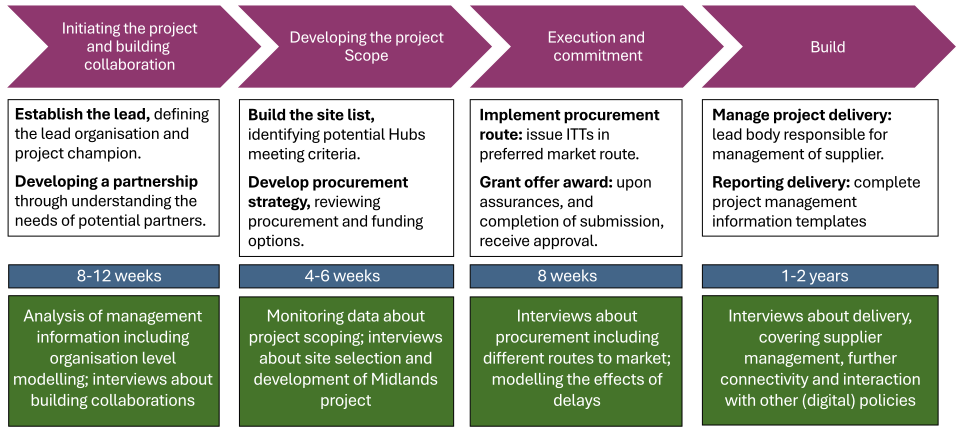
This chapter examines the four delivery stages, aligning with the process review research questions:
- Stage 1: Initiation – To what extent did local delivery capability and governance influence the pace and quality of delivery?
- Stage 2: Scoping – How effective were site-selection processes and supporting data pipelines?
- Stage 3: Supplier procurement – Did procurement routes enable timely, good-value contracting, and where did they encounter difficulties?
- Stage 4: Delivery – How did delivery-side constraints affect timelines and the realisation of benefits?
Stage 1: Initiating GigaHub projects
BDUK approached local authorities (LAs), government departments, devolved administrations, and local enterprise partnerships to lead projects. Lead bodies were also asked to engage local partners and gather expressions of interest from potential participants. This formed the initiation stage of GigaHubs.
Establishing project leads and identifying project stakeholders
The Hub product built on earlier BDUK programmes such as RGC, LFFN, and Superfast initiatives, which improved broadband in public buildings and interviewees have reflected on this as enabling LAs to lead a project:
We then had a colleague of mine ran what we called a Fibre Hubs project, which was funded by the LEP… it kind of was almost GigaHubs Part One. I think there were about 60 sites in that contract. Fibre Hubs really laid the ground for what happened for GigaHubs Lessons from earlier programmes informed the DfE’s approach under GigaHubs, including the high level of co-ordination with the CtC programme funding internal networks and associated IT equipment and software.
However, not all areas had the same level of experience. Some had focused on Superfast Broadband – targeting general premises rather than public buildings – and lacked previous RGC or LFFN funding. One interviewee noted:
[The county] didn’t have RGC or LFFN funding… they were quite under-resourced compared to other LAs and focused on Superfast projects, not Hubs.
BDUK recognised that the challenge was not procurement itself, but the overall delivery burden placed on local bodies:
[The] downside of GigaHubs, I do not think it was the procurement. It was that delivering the requirement was difficult… what we were asking them to do, was difficult.
Some local bodies felt they lacked experience with broadband programmes, expecting to rely on BDUK to develop GigaHub projects:
There are varying levels of capability and capacity in LAs to run these programmes. There was a lot of under-resource, and they leaned on us quite heavily to help them particularly with the commercial finance aspects of managing change and all of that.
Each project linked to a BDUK Local Delivery Lead (LDL) – the main point of contact for BDUK programmes in that area. But for multi-area projects like the DfE Schools Project and the Midlands Project, there was a need for LA projects to engage with the multi-area projects. A direct arrangement generally worked smoothly; for example, Dorset Council coordinated with DfE on school site selection:
We had some conversations with DfE for working out which schools in Dorset weren’t either provided for or in a plan. We only had two or three schools that were DFE funded separately.
Engagement with NHS bodies indicated their leading of a project could prove challenging.
NHS as an organisation has very set ways of doing things…
Discussions with the DHSC involved detailed look at site lists, which were complex both because of the range of sites and the data about each site. Some specific blockages were also identified. There were “subsidy control issues around care homes”:
Even when we had interest from NHS England…. it was really, really hard for them to pull everybody individually together. [There would be a need to] to go out and speak to the GP surgeries and hospitals and … have a contact within all of them to bring that project together and they didn’t have the authority to do it.
NHS governance and centrally managed broadband contracts made it difficult to commit to the usage requirements associated with GigaHub funding for LA-led projects: one LA project could not include NHS sites, and a second reported similar issues but took measures to manage the risks of the Hub connection not being used. The low number of LAs that could individually lead a viable project encouraged joint initiatives. The Midlands Project covered ten local authorities and around 300 sites. Initiated by the Midlands Engine Local Enterprise Partnership, Nottinghamshire County Council acted as the lead authority and funding recipient, supported financially by the LEP over three years.
Objective setting for projects
Initiation involved setting project objectives and, across projects, the core objective was to extend gigabit connectivity to public buildings left out of earlier broadband programmes:
Providing gigabit connectivity is the main goal of the GigaHub project in [the LA]. Gigabit and Superfast projects were connecting individual premises with superfast broadband but left schools and community buildings out of that scope. GigaHubs helped to bring public buildings into that scope.
At the LA level, projects aimed to enhance public services and ensure council-owned sites had the connectivity needed for modern IT systems and education:
Where we are the custodian of a site [we want] to make sure that we’re providing the best possible connectivity so that we’re able to run our own IT systems on it. We also have a lot of schools. There has been a real push to get schools to be upgraded to Gigabit capability.
Strong broadband also aligned with wider local policy goals such as economic growth and tourism, leading councils to connect additional sites like libraries, visitor centres, and waste facilities:
We want to make [area] a great place to live, work and visit. That is the overarching Council plan. To be able to drive forward for those things we know we can’t do that without our gigabit capability. For visibility, we would have to offer a lot more than learning capabilities of schools and libraries. The tourism capabilities will be vastly improved with having gigabit capability down there [a low connectivity area].
Some projects also sought to reduce long-term connectivity costs for LAs, for example by moving away from high cost leased line arrangements. A council was on a managed service contract with a supplier which expired in the near term. The council viewed migration off fixed leased line infrastructure to a lower-cost connectivity as an objective.
They had reached a decision that they wanted to move away from very high cost leased line Connectivity as managed services…[the]wide area network is the network that connects all our Council buildings together. GigaHubs was an opportunity to receive funding for the infrastructure needed in some of the Council’s estate distant from fast broadband, as well as enabling broadband availability for the nearby areas which were outside commercial build.
Identifying additional funding
BDUK expected projects to secure complementary funding for sites outside GigaHub eligibility. This enabled councils to include additional community buildings, such as village halls and community centres, where future public service delivery was anticipated:
The NHS is keen to do more locally… community centres can be part of that solution—but without the fibre, it would never start.
The DfE project aligned with the department’s goal of connecting all schools in England by 2025. This meant that – where a school did not meet eligibility criteria – the Department could meet the costs of a connection:
We knew that colleagues at BDUK had similar concern, so we had a conversation with them. Initially, we thought that there would be more than 3000 such schools. We tackled budgets so that we could go ahead and in partnership with what we applied to BDUK, we went through gateway A, B and C to become a GigaHub.
The Department viewed this process as successful.
This is a great example of two government bodies working together to solve a problem… BDUK will tick off their schools, and we’ll meet our goal.
Together, these co-funding approaches strengthened project reach, enabling more rural and community sites to benefit from gigabit connections.
Stage 2: Developing the project scope
Scoping involved identifying Hub sites. Table 3 indicates how the scoping process started with over 2,500 potential sites across the six projects in July 2023, then a rescoping and descoping exercise, progressed to develop site lists of just over 1,200 sites at the end of the analysis period in early 2025. Much of the descoping occurred early and in the DfE Schools Project’s scoping process. This started with a long list of schools, but then quickly identified that the initial list relied on outdated broadband connectivity data. Out of the 2,069 sites, 60% (1,243 sites) were descoped early. LA-led projects entered this phase with mature site lists. Qualitative evidence suggests these councils began with longer site lists but refined them before formal reporting, meaning descoping was minimal once projects were underway and, by July 2023, authorities such as Dorset and Oxfordshire had finalised their Hub selections. Their local knowledge of digital connectivity – across public buildings like libraries, recycling centres, and council offices – helped ensure early accuracy. Monitoring data shows only two sites removed in Dorset (a library and council office) and seven in Oxfordshire (four schools, two museums, one healthcare centre). For healthcare sites, scoping had to carefully determine whether a site would use the connection within the required timescale. Decision-making about technology investments in healthcare is complex, with provision for individual practices involving integration with wider NHS digital systems. Ensuring that the Hub connectivity was quickly utilised by the site was complicated by the dispersed decision-making.
So, you had this kind of [situation of] no one person to speak to, to open doors. We had to engage and consult with numerous people to get them to understand what it was all about…
Table 3: Hub connections scoping over time
| STATUS | Jul-23 | Sep-23 | Dec-23 | Mar-24 | Jul-24 |
|---|---|---|---|---|---|
| Descoped | -186 | -1,296 | -1,380 | -1,379 | -1,376 |
| In Assurance | 2,199 | 1,129 | 1,047 | 1,048 | 906 |
| In Build | 79 | 70 | 34 | 16 | 0 |
| Built but not Live | 33 | 41 | 75 | 93 | 0 |
| Rescoped (Midlands) | 0 | 0 | 0 | 0 | 145 |
| Live connection | 16 | 17 | 17 | 17 | 126 |
| Total Sites | 2,513 | 2,553 | 2,553 | 2,553 | 2,553 |
| Source: Analysis of BDUK MI data |
The Midlands Project combined several LAs and planned 349 investments, with 68% of investments (236 Hub sites) funded by BDUK (the remaining sites funded by MHCLG). Being a cross-LA project, processes involved long lists from each member of the project. This required both LA-level evidence gathering and then a look across the project participants. This project’s scoping status changes markedly in April 2024, with an unsuccessful procurement leading to the project being cancelled. The monitoring data tracks the sites being removed and there is then a period where some of the descoped sites are brought back into the scope of other projects. Out of 343 Hub investments, 144 are rescoped in other projects, primarily schools taken into the DfE Schools project.
Comparing in-scope and de-scoped sites
A question is whether scoping has selected the sites to align with the aims of Project Gigabit to connect rural places which are unlikely to be connected commercially. Most of the descoped sites are in Greater London or urban locations outside London. Urban areas typically have higher broadband speed and are more likely to be connected commercially than their rural counterparts.
Table 4: Differences in broadband performance
| Broadband Characteristics, 2021 | In Scope | Descoped |
|---|---|---|
| Median Download Speed (Mbps) | 56.23 | 64.8 |
| Average Download Speed (Mbps) | 69.89 | 97.54 |
| Number of Connections with >=300 Mbit/s | 3.78 | 8.26 |
| Source: Analysis of BDUK MI data and CN data at time of stage 2 (2022). |
Table 4 reinforces this pattern. It shows that descoped sites had significantly better broadband performance than those remaining in scope, with median download speeds of 64.8 Mbps compared to 56.2 Mbps, and average speeds nearly 30 Mbps higher (97.5 Mbps versus 69.9 Mbps). A greater proportion of descoped premises also already had access to gigabit-capable connections (≥300 Mbps): 8.3% compared to only 3.8% among in-scope sites. These figures indicate that descoped sites were already better served, confirming that the rescoping process refined the project’s focus toward the areas in most need of intervention. The processes to scope would have driven this in terms of future broadband speeds. Whilst Table 4 indicates descoped sites had better broadband as of 2022, sites were descoped by BDUK on, not only their current connectivity, but also on their likelihood of coverage by the market in their plans (see Box 2 on BDUK OMR data used). From a policy perspective, the decision to remove better-connected Hubs and those in future plans underscores the programme’s emphasis on addressing the digital divide and improving public service access in regions the market is less likely to deploy gigabit capable infrastructure in the near future.
Data to select GigaHubs
The selection of GigaHub sites relied on a combination of national datasets held by BDUK and locally held intelligence within delivery organisations. Projects and BDUK engaged in ongoing dialogue to assess the eligibility of individual sites, with decisions shaped by both data availability and the rapidly changing broadband landscape. A central input to site selection was BDUK’s Open Market Review (OMR), which gathers market intelligence from broadband suppliers on existing coverage and planned network build. The OMR draws on multiple data sources, including Connected Nations data, information from voucher schemes, and supplier submissions, to develop a premises-level picture of broadband availability.
Using this intelligence, BDUK categorises premises as white, grey, or black, reflecting whether gigabit-capable infrastructure is absent, limited, or already well-served. A fourth category, “under review”, captures premises where delivery plans exist but remain uncertain or unverified. In principle, the OMR enabled projects to focus subsidy on white premises, where public intervention would not constitute state aid and where commercial delivery was unlikely within three years. Project leads were able to use OMR outputs provided by BDUK to support eligibility decisions and justify site inclusion.
However, OMR data was still maturing at the time of scoping projects. Interviewees consistently described the early data as difficult to interpret and incomplete, particularly for public buildings. DfE highlighted specific limitations. Some schools identified as white had already procured leased line connections, making GigaHub investment unnecessary. In other cases, data did not indicate whether a school was able or willing to take up a broadband contract following infrastructure delivery. These uncertainties prompted DfE to supplement national datasets with extensive primary data collection, contacting more than 3,000 schools directly to confirm connectivity status and need. This was described as: “grassroots up rather than a top-down approach”. DfE felt the need to improve data was significant:
[There is] an initiative involving four LAs with a broadband officer who had very good local knowledge. So, we did not just cold call the schools, we also tried to take them off the list by scanning and talking to third parties. To cut the long story short, we came up with 833 schools. Schools could be removed due to lease line, because LAs already covered them or suppliers told us that schools are connected. Although BDUK thought that they could not get a connection, we could go to BT or Virgin checker and see that they could. So, there is awful lot of fog.
The OMR data was improving over the period, and the consequent data changes impacted the scoping stage. Sites were added, and sites could be removed.
Sometimes the schools we had scanned were taken off and we were told that they will get connected and equally we were given very short notice when plans for some schools were cancelled. It was a difficult process. We are aware of a hundred or more schools which will not be connected by end of 2025 because they have fallen through the cracks.
Scoping changes also occurred due to the dynamics around providing a connection. After site selection, an LA found that two schools were being provisioned through an alternative programme.
Then we did lose two sites in delivery because… two of the sites that were in the GigaHub contract were provisioned during delivery by another supplier. Once we’ve seen that they had Gigabit capability, we needed to alert BDUK that.
BDUK delivery officers could also descope sites:
…where we saw signs of commercial delivery, we would descope those [sites], because there’s no point in that. That’s the only reason that we’ve descoped …[we’re] protecting the public purse, basically.
For national and multi-area projects, data challenges were amplified by scale. DfE, operating across England, encountered cases where schools were being considered by multiple interventions simultaneously, including non-BDUK funded schemes. While BDUK’s Local Delivery Lead (LDL) network helped identify overlaps, DfE felt that coordination across programmes was often fragmented:
There were also some LEP funded projects, so it was not just BDUK funded work rather lots of agencies were involved in the mix. One of the best contacts we got in the Northwest was a BDUK’s LDL. He was brilliant in saying that “here are the things that you probably do not know about”. So, there are people in the field who have incredibly detailed knowledge and if you can find the right person then that can save you a large amount of time. But it seems very fragmented and there is not a coordinated response.
Local authority-led projects were generally better placed to interpret and validate data due to their familiarity with local infrastructure, assets, and delivery history. Several LAs described beginning with very broad lists of public buildings, spanning schools, healthcare, council offices, libraries, village halls, and waste facilities, which were then refined against GigaHub eligibility criteria. In one case, an initial list of 500 sites was reduced to 43 eligible buildings. Sites were excluded where commercial upgrades were planned, where buildings lacked staff on site, or where organisations could not commit to taking up a fast broadband service.
Despite this refinement, LAs expressed concern that strict eligibility criteria sometimes excluded buildings with strong potential to act as community hubs. Village halls, community centres, and pubs were frequently cited as locations where connectivity could unlock wider social and economic benefits, even if they did not meet formal definitions of public service delivery:
We had a … kind of running joke that FTTP should be ‘fibre to the pub’ because as soon as you go out into these rural areas, actually other than the odd primary school, the public sector buildings become fewer and far between. When you start going into the villages, it might just be a pub. Or a village hall. Where we have been able to bring those properties in, we have, because we know that they do act as a community Hub and any kind build out from there is actually really advantageous Where possible, councils used local funding to include such sites, recognising their role in enabling onward build and community access: “… [the rollout] ended up including a bunch of community centres in the village halls, which BDUK actually didn’t fund, but we decided we wanted [to fund] from our project…So we…ended up with a long list of sites that formed this sort of problem statement [of] what we were trying to get fixed, and then [we] worked with BDUK [to determine] which ones they would be willing to fund.
Sites in remote areas were identified from which further build may then be possible, but where the broadband connectivity was not vital to their function.
Some of the others are recycling centres. Some of them are our sites so having that overarching IT systems on and then other parts of that will be just bringing in areas that we know would be unlikely to be delivered through any commercial kind of intervention. Now we know we have fibre into those areas because there is a public sector building which has an interest in getting connectivity. The build out from there is much easier.
Across projects, a consistent picture emerges of data-driven decision-making constrained by imperfect information. National datasets provided an essential starting point, but local knowledge, direct engagement with sites, and iterative reassessment were critical to refining scope and ensuring that GigaHubs targeted premises least likely to be served commercially. Over time, improvements in data quality supported more confident decisions, but the dynamic nature of broadband rollout meant that site selection remained a moving target throughout much of the programme.
Stage 3: Execution and Commitment - Procuring GigaHubs
Once sites were selected, project leads began procuring the required connections. BDUK did not mandate a specific procurement route but recommended using the Crown Commercial Service’s Dynamic Purchasing System (DPS) for Gigabit-capable Connectivity (RM6095), which became the preferred approach for most projects.
Use of the Gigabit Capable Connectivity DPS in Local Authority areas
The DPS RM6095 has operated since 2019. It provides a route for public bodies to procure gigabit broadband connections competitively, linking them with telecom suppliers. Suppliers apply to join the DPS at any time during its 2019–2025 term. By 2024, BDUK, which manages the framework, had approved around 50 suppliers, including BT and several firms that delivered earlier RGC projects. DPS RM6095 provided access to appropriate suppliers and sufficient flexibility to introduce smaller or niche suppliers into competitions. In interviews, suppliers observed they were signposted towards the DPS system. They went through the registration process and their engagement with the Hubs began from there participating in competitions initiated by the GigaHub projects. All three LA-led GigaHub projects used RM6095 to secure suppliers. Oxfordshire County Council awarded a contract to NEOS Networks in October 2021 to deliver over 200 connections by December 2023 combining those funded as GigaHubs with connections funded by the Council and other sources. NEOS adopted a consortium model, subcontracting to Openreach, Virgin Media Business, and Gigaclear to extend coverage efficiently. As one representative explained:
I think the key factor relating to [the decision to use subcontractors] was value for money for the customer… We’re saying we’re going to do it all and then have to do miles and miles of network provision. If a third-party supplier was nearer to that particular site, we chose to utilise them.
The relationship between NEOS and its partners was described as highly collaborative:
Well, we adopted a collaborative approach, not really taking the view that we are the prime contractor… We worked a bit ‘hand in glove’ really with each of the suppliers. Regular communications on a weekly basis.
Dorset County Council also procured through RM6095, appointing Wessex Internet, a local provider already familiar with the council through earlier RGC Hubs and voucher schemes. Similarly, Leicestershire County Council used the DPS to award a contract to BT in October 2022 to connect 43 public sector sites by March 2024, with Openreach subcontracted to deliver and manage the new infrastructure. The DPS framework offered clear advantages for local authorities. It standardised documents, and terms and conditions. It also enabled project leads who had leveraged additional local funding to have a route to procuring the connections. There were risks in the LA-led projects. One council recognised the challenge of transitioning buildings from old broadband contracts to new connections and established a parallel project to manage this process:
We have … a project which is replacing the endpoint connections as we go to them to say, that’s now available… they run their project to decommission the [old provision] and commission the new infrastructure services… basically, we’ve got two projects working side by side to make that all happen.
Contracting where projects work across local authority areas
Alongside projects operating within single LA areas, three multi-area projects were developed. Both the DfE Schools Project connecting up to 800 primary schools in England and the Midlands Project, led by Nottinghamshire County Council, chose to use RM6095. The NHS Scotland project followed a different route, using an existing framework agreement with Capita, which in turn contracted BT Openreach to complete five connections. The framework covers a broad range of NHS digital services and had previously been used for RGC Hubs procurement. The small number of sites means further analysis of this route has not been undertaken. Pooling site lists across multiple areas has both advantages and drawbacks. Using the RM6095 DPS, large contracts could achieve scale and lower costs. In the Midlands Project, by August 2022, Nottinghamshire County Council with ten collaborating LAs began to procure suppliers, targeting delivery from spring 2024 to March 2026. Procurement initially progressed smoothly, refining to a site list removing premises already covered by commercial builds or other BDUK interventions.
A competitive procurement was run through the RM6095 DPS, identifying a preferred bidder, and BDUK confirmed the project had met value-for-money and subsidy control requirements. However, discussions then stalled over a ‘clawback clause’ in the Grant Funding Agreement (GFA). The clause allowed BDUK to reclaim funds if connected sites did not subscribe to a fast broadband service. BDUK viewed this as an incentive to ensure benefits were realised, but Nottinghamshire County Council raised concerns about financial risk, particularly for sites outside its area of control.
It could mean we pay for the connections, but if they’re not used within three years, the funding would be recovered, leaving us with the cost.
Negotiations were further constrained by the supplier’s tender expiry date, and the BDUK and Nottinghamshire failed to reach agreement. As a result, no supplier was appointed, and the procurement closed without progressing to contract. The Midlands Project then did not re-tender for their connections evidencing “Nottinghamshire County Council not wanting to take on a liability on behalf of all the other local authorities”. Delivery risks are amplified in multi-area projects, where accountability and local control are diffused. A general theme emerged for BDUK that “A multi-authority project not having a clear lead with … clear lines of responsibility between [the lead] and the other partners”. Interviews with both BDUK and the Midlands Project team indicated that the key issue – the risk of unused connections – was well understood. Also, mitigation was in place with the inclusion of many of the sites in other BDUK programmes:
The sites that were in the Midlands [Project] … just went into the pots for our other interventions, which is basically GIS and vouchers.
The experience underscores the need for clearer processes and earlier dialogue on risk-sharing arrangements in future GigaHub projects where the lead LA acts across the portfolio of connections and any relevant risks. Reflecting on the Midlands experience, one interviewee observed:
The project has been cancelled despite everyone’s best efforts. We sent people to help them and BDUK put hours and hours of work [in]. The problem with central funding and a local delivery is that if the local delivery gets cold feet or does not want to follow through, then you have the money but not the mechanism to spend it.
For the DfE project, procurement also faced delays and required two rounds. The first competition, run through RM6095, invited bids for all connections in one region. but the prices were prohibitively high, making the programme unaffordable. DfE discovered that a small number of sites accounted for most of the cost and chose not to appoint a supplier. A second procurement followed, structured differently: suppliers were asked to provide site-by-site costings and compete based on how many sites they could deliver within the available budget. Two suppliers were ultimately appointed to connect around 90% of schools. While contracts were eventually put in place – they have “the right people doing the work” – there was a delay of two months and a feeling that the DPS filtering system to qualify suppliers could be improved, emphasising a need for clear roles for those leading the DPS if problems occur.
We will be reviewing … with the [DPS] commercial services in the due course because we felt like everyone vanished and left us leaving the lawyer’s letter… [When] we went into the DPS, which we were told is the safe way of procurement.
Assistance from BDUK or the Crown Commercial Service could have prevented missteps. As one DfE representative put it:
We felt that either Crown Commercial Services or BDUK could have told us not to do it that way because they afterwards said that ‘of course that would happen’.
However, procurement teams in BDUK viewed the cost information drawn upon through the first procurement as valuable in that “the procurement … told us that the costs were not the cost that we would want to support”. With a contract in place, the DPS enables the sites selected for GigaHubs to be procured, with standardised contractual terms and operating systems. Contracts have also been used for connections deemed necessary but not qualifying or only partially qualifying for BDUK support.
In places where the school is not rural enough for BDUK to fund, [the project lead] is providing the whole cost.
Overall, 60% of the cost is being paid For the remaining 33 high-cost sites, DfE is conducting detailed surveys to assess alternative, lower-cost options such as satellite broadband:
We will get to a hundred percent, and we hope that only three or four sites will need satellite.
Overall, the DfE procurement took about six months, significantly longer than the two months initially planned.
Stage 4: Delivering the GigaHubs
Dorset, Leicestershire, and Oxfordshire have connected 35, 43 and 45 Hubs respectively funded by BDUK, and installed other connections through their own funding. The DfE project completed procurement in January 2024. The first school was connected early May, with connections planned until March 2026. NHS Scotland is the smallest project delivering the Hubs with five planned investments. All the five healthcare Hub sites are funded by BDUK and are live.
Managing Delivery
Delivery for the LA-led projects is nearing completion and has been largely successful. Local authority teams oversaw contracts with suppliers, though some delays arose from staffing changes during supplier appointments. Most LAs already had experienced digital teams running other broadband programmes, which helped integrate the GigaHubs work into existing operations. A BDUK Local Delivery Lead (LDL) highlighted this cross-programme strength, noting that the LA “has the various resources, including a service manager focused on strategy, a digital skills lead, a programme manager for SuperFast, and another programme manager overseeing vouchers, and LFFN initiatives.” The LA’s own view reflected this capability:
We have always tried to take a proactive approach… and we have got the team skills to be able to do it and also a very good handle on the data. Again, very proactive.
Suppliers confirmed this positive assessment. In mid-delivery interviews, they reported that progress was on schedule and praised the council’s responsiveness:
The LA is being very pragmatic and proactive as well, and they were very good at seeing potential issues and asking questions, challenging… to say; is this going to be a problem going forward.
They expected to complete delivery on time and had already expanded the project scope:
So, there were phases and milestones [to the GigaHubs delivery contract], and we’re at milestone eight at the moment…. We [should] have completed the whole of the original scope. And I say the original scope, because we’ve just signed a variation to the contract for a further eighteen sites.
BDUK also described the rollout as “really smooth, with no issues meeting targets or anything like that,” while one council official called it “a considerable success because [the supplier has] not been behind on a single milestone. From our experience, these infrastructure build programmes… almost invariably slip.” Suppliers described the contracts as “fairly standard,” with clear reporting and administrative requirements. There were issues noted by those involved in the projects. Site access was sometimes a challenge - “The team often shows up on the site to carry out the work, but the owner of the site is not aware of the project or refuses for other reasons” – with smaller Hubs without dedicated IT leads particularly vulnerable to delay:
There are just a couple of sites where we need a much stronger management with the site owner or the IT manager… things have maybe changed hands since they were initially put into scope… We need to keep an eye on some of those smaller sites, but again, the smaller sites are the most desperate to get it so it works out there.
Delivering connections in remote areas also required creative engineering solutions. In one case, the cabling route ran beside a steam railway and through mixed-use land, demanding bespoke approaches:
So, there was some real tricky delivery in this final half of the project and to be able to get into an area where [the supplier] haven’t delivered before and there’s been very little commercial activity.
Challenges such as securing wayleaves, road access, and managing weather-related delays were frequent:
Addressing connectivity issues that require road digging is essential. Accessing sites and dealing with wayleave issues pose significant connectivity challenges… Other barriers during the delivery cycle include infrastructure damage from adverse weather conditions, as well as traffic management.
As a result, the project often necessitates significant adjustments in delivery outcomes and timelines. At the time of review, LA-led projects were the most advanced in delivery. The DfE project had only recently begun, with initial testing planned for mid-year. As one project lead noted:
We are on the right path, but it is very early days. The testing days will be in June, July and August when we start seeing schools come online.
Interactions between project lead organisations and suppliers LA-led projects report a strong working relationship with the supplier. At initial commissioning, compared to similar projects for publicly funded clients, a supplier felt the LA project lead did a good job of conveying the aims of the rollout. The council had clearly articulated the overarching vision in the kick-off meeting explaining what they wanted to do within the region and how infrastructure was the platform to promote access and IT in rural areas.
There was a lovely diagram that one of the heads of [the] County Council had produced. I’m not sure [if] they drew it themselves, but it was almost a caricature of [the] location. There were all the functions and the businesses and how they all connected with the infrastructure, and…you know the old adage a picture paints a thousand words. It did just that; it was fantastic, and I think that was key…you know, everybody on the team understood the ‘why’. Why are we doing this? What’s the rationale for us putting this Gigabit-capable network into these areas? That was clear.
The BDUK lead also had first-hand experience of this and believed there was benefit from and a better relationship with their supplier for the contract.
The local body are very knowledgeable in this area and quite competent, and they had a good relationship with the supplier, which I think really helped. There is regular contact, such as organised weekly calls, to share updates and then take actions to speed delivery.
The supplier had separate teams for GigaHub and other parts of Project Gigabit.
We’ve worked with [the supplier] for years of different projects and we do have a really good strong working relationship with them which [is] crucial to these projects because you have these tough conversations on why projects are not being delivered or running late. We’ve been … in real partnership with them to make sure stuff is complete.
Moreover, the council could internally unblock delivery. For example, the LA project lead would contact the LA highway authorities or parish councillors to move the project forward. These interventions also improved the relationship between suppliers and these local government bodies, such as the LA planning department.
Sometimes you just need to give a portfolio member a nudge or parish councillor nudge if they are blocking the way.
A useful element is having the project management within the local authority to access these other areas of the Council, unblock delivery where you can or just make it smoother. Suppliers report building their own relationships with the different parts of local government to unblock delivery. For example, the supplier planning team works directly with teams at the councils to deliver connection to land owned by the councils. Relationship building involves links beyond those needed for individual works. One LA highlights its fibre community partnerships, which involves suppliers, BDUK and the LA to promote the benefits of these to local communities.
Where suppliers need to cross farmland, the support of landowners is important. Sometimes, landowners benefitted with a connection and so were supportive. On one occasion, the landowner resisted a supplier initially. The supplier’s community engagement team was working with the local parish council. This involved events promoting the potential connectivity that the Hub investment might bring and the community awareness of the plans proved a useful lever in making the landowner reconsider access to the land that was needed for the Hub connection. A supplier contract manager observes that the lack of challenges experienced during delivery strengthened their ability to coordinate across their supply chain. Consortium suppliers feel that there are higher project management resources benefitting delivery:
I think the other benefit of using multiple suppliers and doing that from a sort of programme perspective is you get parallel running in terms of delivery…There were, in effect…four programme teams all working for the same aim in terms of trying to deliver sites to the programme in parallel… So you’re getting quicker delivery…
At the time of fieldwork, delivery of the DfE project was at an early stage. Contracts and the teams to oversee delivery were in place. Connections were being made, and the team expected substantial progress during the summer 2025 holidays for the start of school, with completion of all connections in the first half of 2026.
Hub connections in the context of wider rollout
The delivery of GigaHubs is being managed during a period where there are several parallel initiatives to improve access to gigabit broadband including BDUK products. LAs noted that their role involved seeking additional funding from these, explaining that “the next project was always around the corner”. These are viewed positively, such as one authority noting how in their case the collaboration with a neighbouring county was beginning to take shape. A challenge was then maintaining focus on the GigaHubs rollout.
We will need to understand how that looks in terms of our resourcing and our profiling and where we might want to invest in other projects.
There were then implications on staffing, with shifts of resources between projects lessening the time for reflection and learning. Focus on new initiatives and staff change at LAs can lead to a limited awareness in the team about the state of broadband in the county before GigaHubs, necessitating scoping activities, specific aims and goals to deliver the Hubs and why the council had not accessed the Hubs funding previously. The same was also true on the supplier side: due to change of staff, suppliers found it tough to manage relationships.
When the last grant has been submitted and you’ve finished up your project closure activity, the resource will be then moved on very quickly onto another project. So, across lots of intervention projects, I think the lessons learned and the benefits realisation piece is quite often lost or lessened in a way just because of resourcing and moving people on…
In contrast, a second project lead explained that continuity was a feature of their Hubs project. The LA would continue with suppliers citing costs should they switch suppliers in knowledge and experience. However, there were concerns also for the GigaHubs project as its scale is modest compared to other projects.
We felt that GigaHubs was given less attention by the supplier in the run up to the first milestone of the Project Gigabit. There were definitely some challenging weeks; the supplier also felt they wanted to complete GigaHubs, but they were being pulled in various directions.
To some extent, the shape of the GIS programme – with centralised management and procurement by BDUK and a consultative delivery plan development – should mitigate the tensions across alternative initiatives. BDUK’s defining of intervention areas and then procuring in each provides LAs, government departments and agencies with a co-ordinated process for connections, in which connection needs can be met. This was preferred by project leads:
We see ourselves having a much larger involvement long term and capitalising on the GIS work so that our work is less interventionist and more signposting. BDUK are the specialist, so what we are going to do is never going to be the same scale. It is a better use of public money to work with the grain.
Conclusion
This chapter examined the delivery of GigaHubs across four stages: initiation, scoping, supplier procurement, and delivery. Taken together, the evidence highlights how delivery outcomes were shaped by variations in local capability, data maturity, procurement design, and the wider policy context in which GigaHubs operated. Overall, the evidence suggests that GigaHubs delivery was most effective where strong local capability, mature data, and clear accountability aligned. Where these conditions were weaker—particularly in complex, multi-area projects—delivery risks increased. The chapter also highlights how GigaHubs increasingly operated within a crowded delivery landscape, with the emergence of GIS reshaping roles, expectations, and delivery models for public-sector connectivity.
- Stage 1: Initiation – To what extent did local delivery capability and governance influence pace and quality of delivery? Modelling indicates that around 30-60 LAs would have enough sites to lead projects, reducing to around 15 if schools, which could be connected by the DfE Project, were excluded. Then, local delivery capability was a critical determinant of progress at the initiation stage. Local authorities with prior experience of BDUK programmes such as RGC and LFFN, and with established digital teams, were better placed to develop viable projects and move quickly into delivery. In contrast, authorities with limited experience of public-sector broadband programmes took longer to consider initiating a project, reporting capacity constraints and a reliance on BDUK for support. In the context of a wider rollout of gigabit in the areas, the modelling indicates the case for locally-led projects would have been lessened, contributing to fewer LA-led projects than initially anticipated. Multi-area projects emerged in part as a response to these constraints but introduced additional governance complexity, increasing delivery risk. Engagement with national bodies such as DfE was generally effective, while integration with NHS organisations proved more challenging due to centralised decision-making and difficulties committing to usage requirements.
- Stage 2: Scoping – How effective were site-selection processes and supporting data pipelines? Quantitative evidence shows that rescoping successfully removed better-connected sites. Site-selection processes improved over time but were initially constrained by immature data and the dynamic nature of broadband rollout. LA-led projects benefited from local knowledge and entered scoping with more refined site lists, resulting in fewer changes as projects progressed. Strict eligibility criteria excluded some community buildings with potential wider value, but securing additional non-BDUK funding by projects led to the sites’ inclusion. National datasets, particularly the Open Market Review, provided a necessary starting point but were sometimes incomplete or out of date, especially for public buildings. This led to data gathering exercises, most notably in the DfE project.
- Stage 3: Supplier procurement – Did procurement routes enable timely, good-value contracting, and where did they encounter difficulties? The Dynamic Purchasing System (RM6095) provided a flexible and generally effective procurement route for single-LA projects, enabling access to a broad supplier base and supporting good value for money through competition and subcontracting. These projects progressed relatively smoothly once sites were finalised. However, procurement risks increased substantially in multi-area projects. The Midlands Project illustrates how issues around risk allocation – particularly clawback provisions linked to service take-up – combined with diffused accountability to stall procurement and ultimately prevent contract award. The DfE project also experienced procurement delays, requiring a second competition after initial bids proved unaffordable. These experiences underline the importance of early clarity on risk-sharing, stronger support during procurement, and tailored approaches for large or multi-area projects.
- Stage 4: Delivery – How did delivery-side constraints affect timelines and the realisation of benefits? Delivery performance was strongest in LA-led projects with experienced teams and established supplier relationships. These projects largely met milestones, managed delivery-side challenges effectively, and in some cases expanded scope. Common constraints included site access, wayleaves, coordination with site owners, and engineering challenges in remote areas, but these were mitigated through proactive project management and strong local relationships. Smaller sites without dedicated IT leads were more vulnerable to delay. Multi-area and national projects were at earlier stages of delivery at the time of review, with benefits yet to be fully realised. Delivery also took place alongside multiple parallel broadband initiatives, stretching local and supplier capacity and reducing opportunities for learning and benefits realisation.
- Across stages – GigaHub processes in the context of wider Gigabit programme Across the stages of the GigaHubs projects, although the GigaHubs approach did not ultimately scale to the levels first envisaged, and some public buildings originally in scope did not receive gigabit connectivity during the period in which the Hub product was in use, the final outcomes were within the context of the wider Project Gigabit programme and evolution of the market context. GigaHubs provided an early, ready‑to‑deploy route to connect priority public buildings, bridging the period before GIS could be fully designed and procured using detailed OMR and Public Review evidence. GigaHub Project participants envisaged the emphasis of investment naturally shifting toward the GIS area‑based procurements. In this context, the contribution of GigaHubs is reasonable, and viewed as strategically valuable: it accelerated early benefit generating connections and supported local delivery capability. It is helping to prepare the ground for the more comprehensive, and scalable coverage that GIS is positioned to deliver.
References
-
BDUK (2021). GigaHubs: key information: Toolkit for Delivery, Checklists and Subsidy Control Guidance. https://www.gov.uk/government/publications/gigahubs-key-information
-
BDUK (2025). BDUK delivery performance, Quarterly: April 2025 to Sept 2025. https://www.gov.uk/government/statistics/bduk-delivery-performance-quarterly-april-2025-to-sept-2025
-
Belmana, Hatch and Winning Moves (2023).
-
BDUK Rural Gigabit Connectivity Hubs Evaluation. https://www.gov.uk/government/publications/bduk-rural-gigabit-connectivity-hubs-evaluation
-
Ofcom (2021). Connection Nations 2021 Report. Published 16 December. https://www.ofcom.org.uk
-
Ofcom (2025). Connected Nations 2025 Report. Published 19 November, https://www.ofcom.org.uk.