Animal Welfare Committee (AWC): opinion on the responsible sourcing of fur
Published 26 March 2026

© Crown copyright 2026
This publication is licensed under the terms of the Open Government Licence v3.0 except where otherwise stated. To view this licence, visit nationalarchives.gov.uk/doc/open-government-licence/version/3 or write to the Information Policy Team, The National Archives, Kew, London TW9 4DU, or email: psi@nationalarchives.gov.uk.
Where we have identified any third party copyright information you will need to obtain permission from the copyright holders concerned.
This publication is available at https://www.gov.uk/government/publications/animal-welfare-committee-awc-opinion-on-the-responsible-sourcing-of-fur/animal-welfare-committee-awc-opinion-on-the-responsible-sourcing-of-fur
Introduction and scope
Farming animals for their fur has been banned in England and Wales since 2000, and since 2002 in Scotland and Northern Ireland. Fur farming is permitted in the European Union (EU) and animals bred or kept for the production of fur are within scope of EU farm animal welfare legislation including Council Directive 98/58/EC of 20 July 1998 concerning the protection of animals kept for farming purposes.
The United Kingdom (UK) applies restrictions on some skin and fur products which may never be legally imported into the UK. These include fur and products from cats and dogs, and restrictions on seal products including fur and fur products (see ‘legal context’ below).
The UK has established controls on fur from endangered species protected by the Convention on International Trade in Endangered Species (CITES) and does not allow imports of fur from wild animals caught using methods which are non-compliant with international trapping standards (see ‘legal context’ below).
Notwithstanding the restrictions described in (2) and (3), it is still possible to import other fur into the UK from abroad. The Animal Welfare Committee (AWC) has been asked to consider how much fur is imported in relation to which species, where this fur sourced from, and where is it destined.
The AWC has also been asked to identify what welfare standards or safeguards currently apply to that fur, and whether they are sufficient to adequately provide for welfare needs.
The AWC has also been asked to consider whether systems, schemes, processes etc., applied to imported fur and designed to ensure that current standards and safeguards are complied with are effectively applied in practice.
The AWC has also been asked to consider what traceability schemes are in place to ensure that fur which is imported into Great Britain has been subjected to the systems and schemes described in (5) and (6).
The AWC has also been asked to make recommendations for additional safeguards or standards which it considers necessary to sufficiently provide for the welfare needs of animals being used as a source of fur.
The AWC has also been invited to offer any other ideas or views on this topic.
The scope of this Opinion covers all fur imported into GB from all sources, whether the animals are farmed, trapped or otherwise hunted for their fur. In relation to animals who are farmed for their fur, this Opinion covers all aspects of welfare including industry standards relating to breeding, rearing, and slaughter.
Most of the evidence which the AWC was able to assess on welfare of farmed fur relates to the EU, but the AWC is aware that fur is imported into the UK having been farmed in countries outside the EU. Members of the AWC were able to make limited visits to farms and other supply chain stakeholders and processes within the EU and which were covered by assurance schemes (see below). The AWC was limited in its ability to visit many other countries in which fur farming occurs.
The data on importation and species, source and destiny are available from a variety of different sources. Most of the data about importation used by the AWC in this report have been provided with the help of Defra colleagues. The AWC cannot be absolutely confident in its validity.
Leather, suede, vellum, neonatal lamb skins and other such products including Astrakhan from karakul that are by-products of farming animals for food are not included in the scope of this Opinion. This is because these animals are subject to a wide range of other standards and requirements relating to the fact that they are farmed primarily for food – and these other standards and requirements are subject to separate consideration.
Neonatal lamb skins are not within the scope of this Opinion. However, in the opinion of the AWC, welfare issues around that practice ought to be given consideration in a separate piece of work.
Importation policy is not within the scope of this Opinion.
Background
Fur from any fur-bearing mammal where import or sale is not prohibited by one of the UK’s fur-related trade restrictions on the grounds of origin, species, trapping method or type of product may be imported into the UK. Fur imported to the UK may be sold in raw or dressed form or in the form of apparel and clothing. It may also be imported or sold as a named or unnamed component of another product. Fur imported into and sold in the UK may be new, second-hand, vintage or antique. Goods made with or containing fur may be made from one or more animals of the same or different species which may have been farmed for their fur, hunted or trapped.
The trade in fur is global. Fur may be derived both from animals farmed for that purpose and from animals caught in the wild. Trapping of animals for their fur is an activity with cultural and economic significance amongst some indigenous communities, particularly in North America. AWC is also aware that the fur farming industry through all stages including apparel production has cultural and economic significance within certain EU countries.
The fur supply chain may be split into several stages following an animal’s death including tanning and or dressing and or dying of fur; manufacturing; and retail. These stages may be carried out in different countries and as such, goods imported to and sold in Great Britain (GB) may contain fur that has been obtained from animals in different countries. These may or may not originate in the country that the final product imported into the UK was exported from.
Public position
A YouGov online poll commissioned by animal charity Humane Society International and or UK and published in 2020 surveyed 1,682 adults online between 4th to 5th March 2020. The charity funding the survey stated that ‘The figures have been weighted and are representative of all GB adults (aged 18+)’. The YouGov poll reported 72% support for a ban on the import and sale of animal fur in the UK. The results also indicated that only 3% of the sample population were currently wearing real fur at the time of the survey. The AWC does not know how well informed, if at all, those surveyed were about welfare standards pertaining to and experienced by animals of various species farmed or caught for their fur in many different countries. Given the difficulty which the AWC has had in finding reliable information (see below), it seems likely that survey responses represented uninformed sentiment rather than opinion derived from evidence-based knowledge about animal welfare.
The AWC is aware that in the last decade there have been some issues with the use of real fur in fashion items that are marketed and sold as faux fur. This means that consumers are buying a product which they cannot accurately identify and which may not align with their ethics. An example of this is a complaint upheld by the Advertising Standards Committee that one online clothes retailer was selling a pom pom jumper which contained real animal fur but was advertised as faux fur, in 2019. A joint investigation between Humane Society International UK and Sky News in 2017 identified that two companies were mis-selling real fur as faux fur. They returned to the issues in December 2017 and January 2018 and discovered other retail companies and online sellers amongst others were also selling real fur as fake fur.
An EFRACom inquiry into the mis-selling of ‘faux’ fur products in 2018 found that some retailers were mis-selling as ‘faux’ products which actually contained real fur from rabbits, common raccoon dog (sometimes called ‘Finnraccoon’) and mink. EfraCom noted that in most instances retailers were not intentionally selling real fur products.
One Health, One Welfare.
Environmental Impact
Whilst this is not the focus of this Opinion, some regard to the environmental impact of fur farming from a One Health, One Welfare perspective is necessary. Environmental impacts are highlighted by various Non-Governmental Organisations (NGOs) and sustainable approaches have been adopted by some stakeholders within the fashion industry who have developed a rating system to define product sustainability. Assessing the environmental impacts through a mechanism such as a Life Cycle Assessment (a process of evaluating the effects that a product has on the environment over the entire period of its life), can be difficult without a globally recognised standard and appropriate data. Fur farming is a relatively small overall contributor to Greenhouse Gas (GHG) emissions compared to livestock farming in its totality. However, fur animal manure produces disproportionately more nitrous oxide (N2O) emissions which is a more potent GHG than carbon dioxide (CO2) as well as disproportionately more Nitrogen (N) and Phosphorus (P). AWC members have seen operations where the production of feed for mink and the processing of mink fur (dressing and dyeing) has incorporated a high degree of recycling (for example of water) in an effort to reduce by-product waste and the use of more ‘natural’ products in the dressing and dyeing processes. The AWC is also cognisant of the argument that fur is a natural product therefore being more capable of being broken down in the environment with less residues than some man-made fibres.
A 2023 report from Humane Society International, ‘Fur’s Dirty Footprint’ commissioned a third party (https://www.foodsteps.earth/) to analyse Environmental Profit & Loss accounts by Kering and compare the data by per kilogram (kg) produced with other materials including cotton, polyester and acrylic. The results for fur farming regarding GHG emissions, air emissions, water pollution, water consumption were consistently the highest. In the category of ‘waste’, conventional cotton was higher than the average for fur production per kilogram (although mink fur was higher than cotton); for the category ‘land use’, as expected, fur farming is low.
Feed used for carnivorous farmed fur animals includes animal by-products, some cereals and mineral and or vitamin supplements. Feed for farmed chinchilla is an appropriate compounded herbivorous feed. The fur-farming industry uses some animal by-products not intended for human consumption as one source of feed for carnivorous fur-producing species. The fur farming industry may be in competition with other users of these finite animal by-products such as pet food manufacturers and fish farming (when by-products of fish processing are used). The quantity of feed needed to produce a pelt from mink is relatively high. Extrapolating data from CE Delft report of 2011, one pelt of mink requires approximately 49.4 kg of feed, or 563 kg of feed per kg of mink fur. To give some perspective to this figure, Atlantic salmon have an edible meat yield of 56kg per 100kg fed, and pig feed conversion rate is in the region of 3 to 5 kg feed per 1 kg pork.
The wild capture of animals for fur has the potential to reduce a population below the sustainable level if a species is over-hunted, to disrupt ecosystems if capture of predators causes individual animals and groups to move outside their usual domain, and to affect wild populations in other ways.
Some customers view vintage or antique fur as a sustainable clothing option.
Zoonotic risk
Mink are particularly susceptible to Severe Acute Respiratory Syndrome Coronavirus-2 (SARS-CoV-2), which resulted in millions of mink being culled across EU and North America during the recent pandemic. The World Health Organisation and or Food and Agriculture Organisation and or World Organisation for Animal Health tripartite risk assessment concluded that the risk of transmission of SARS-CoV-2 from fur farms to susceptible wildlife populations and to human populations was considered ‘high’ in Europe and ‘moderate’ in Asia and the Americas, and that “spillover from fur farm animals to humans poses a serious public health and socio-economic threat and requires a One Health approach to manage”.
Outbreaks of SARS-CoV-2 have been documented on 447 mink fur farms in 12 different countries in Europe and North America since April 2020. Veterinarians and virologists have highlighted the potential for fur farms to act as reservoirs for the virus and the potential for fur farms to create future zoonotic diseases. The World Organisation for Animal Health’s ad hoc Group on SARS-CoV-2 and Safe Trade in Animals and Animal Products has concluded that that there was not enough evidence to demonstrate that raw mink skins could be considered a safe commodity for international trade.
In 2022 Denmark culled mink due to the SARS-CoV-2 pandemic and a temporary governmental ban on mink farming and breeding for fur was put in place until January 2023.
Influenza A virus can affect mink, raccoon dog and red and silver fox. This has been reported as having the potential for ‘devastating’ cross-species epidemics and pandemics. Further research is needed to understand the risk potential with little data existing at present.
Disruption of ecosystems (paragraph 25) can increase the spread of zoonotic disease.
Cross species disease risk
The available literature shows a wide number of pathogens, bacterial, viral and parasitic, within the fur farmed animal population. Some of these are also zoonotic (see above). The potential to infect non-human animal populations outside of the fur farm is unclear without further research.
Legal context
Fur farming
In the UK, the keeping of animals solely or primarily for slaughter for the value of their fur is prohibited by the Fur Farming (Prohibition) Act 2000 (England and Wales) and the Fur Farming (Prohibition) (Scotland) Act 2002) and the Fur Farming (Prohibition) (Northern Ireland) Order 2002.
The legislation covering hunting and trapping is complex and summarised in Appendix 3, and varies across England, Scotland, Wales and Northern Ireland.
Trade restrictions
There are some specific controls that apply to imports of fur or fur products into GB.
Cat and dog fur
Assimilated Regulation (EC) No 1523/2007 of the European Parliament and of the Council banning the placing on the market and the import to, or export from, the Community of cat and dog fur, and products containing such fur prohibits the import into, and the export from, GB of cat and dog fur (and products from cat and dog fur), as well as the placing on the market of cat and dog fur and fur products in GB.
Seal Products
Assimilated Council Regulation EC No. 1007/2009 on the trade in seal products prohibits the placing of seal products on the market in GB. The prohibition applies to seal products produced in GB and to imported products with two exceptions. The first exception applies to seal products certified by a recognised body as resulting from hunts conducted by Inuit or other indigenous communities that have traditionally carried out seal hunting, are conducting hunting for subsistence reasons and with due regard to animal welfare.
The second exception allows seal products to be imported into GB where it is of an occasional nature and consists exclusively of goods for the personal use of travellers or their families.
Endangered species
There are established controls on fur from endangered species protected by the Convention on International Trade in Endangered Species (CITES). Assimilated Council Regulation (EC) No 338/97 applies CITES requirements in Great Britain. The fur of endangered animals and goods made from species listed in Annex A to that Regulation may not be imported into GB without a valid permit.
Trapping standards
Assimilated Council Regulation (EEC) No 3254/91 sets out the trade restrictions and conditions relating to the import of species in scope of the Agreement on the International Humane Trapping Standards (AIHTS).
The Regulation prohibits the importation of pelts of the animal species listed in Annex I into GB, except where they are imported from approved countries. It also applies to certain goods if they incorporate pelts of those species. The list of approved countries is set out in assimilated Council Decision 97/602/EC. These countries are listed either because they prohibit the use of leg-hold traps or only allow trapping methods that meet internationally agreed humane trapping standards.
Textile labelling
In addition to the above, textile labelling requirements in Great Britain under assimilated Regulation (EU) No 1007/2011 require the identification of fibre content of in-scope goods. This includes a requirement to state on labels that a textile product as defined in the regulations contains “non-textile products of animal origin” where this applies. This requirement applies to new and vintage goods and imports together with any products made using fur from animals killed in the UK including by-product fur and fur obtained through hunting and trapping.
Sourcing, importation and destination of fur, provided by Defra
Chapter 43 of the UK Integrated Online Tariff covers fur skins, artificial fur and related derived clothing products. His Majesty’s Revenue and Customs (HMRC) data covering chapter 43 goods other than artificial fur provide insight into the volume and value of skin-on fur goods entering and exiting the United Kingdom. Some but not all commodity codes cover named animals.
Of those that do, five commodities cover animals whose fur may be obtained as a by-product meaning they would be out of scope of this opinion along with artificial fur.
The remaining core of commodities provide the trackable scope of fur covered by this opinion. These cover goods made from fur, raw fur skins of named species and unnamed pieces and cuttings together with tanned and dressed fur. A list of these commodities is provided in [appendix 6] with further details on value and volume of trade, origin of imports and destination of exports. Data has been considered across the 10-year period 2014 to 23. When comparing trade over this timeframe we have used 3-year averages to avoid year-on-year fluctuations. We have not used 2020 within the 3-year averages due to the potential impacts of SAR-CoV-2n trade. Totals include an estimate of Below Threshold trade for EU to UK imports (until 2020) and EU to NI imports (2021 onwards) for Chapter 43. Below Threshold Trade is an estimate of the trade from businesses that fall below the threshold for Intrastat, the EU trade statistics survey. A note of caution does need to be added. The source of trade data for movements between the EU and GB changed at the end of the Transition Period, from the Intrastat Survey to Customs declarations from January 2021 for exports and January 2022 for imports. This change in data source is known to have had some impact on the published statistics. and some caution should be exercised when comparing trade with the EU before and after these dates.
Limitations of available data
While the scope of this Opinion is GB, HMRC trade data is published at a UK-level only. HMRC trade data shows the countries where each commodity is imported from or exported and or re-exported to. It does not reveal whether the animals lived or were killed in the exporting country. Thus, in considering this data the AWC has been able to see where fur has been imported from, but not which country it originally came from (which could have different animal welfare standards).
Not all fur animals have a species-specific code. Thus, the AWC is unable to determine from HMRC data how much imported fur comes from some species of interest for example, raccoon dog and chinchilla. Except for the species-specific codes, the animal or animals from which fur or fur products originate cannot be known. HMRC data also does not enable the AWC to determine whether animals were farmed or wild caught. HMRC data does not enable the AWC to determine whether any wild caught fur imported into the UK was caught by indigenous trappers (who are sometimes exempt from industry welfare standards).
Fur-specific commodity codes represent a proportion only of the total UK trade in fur. An additional volume will enter or exit under other headings including as an unnamed component of an imported or exported product. While the welfare standards applicable to fur used in such goods are in scope of this report, the value and volumes of these goods cannot be tracked through HMRC data and therefore are not considered further here.
The AWC is aware that there has been particular public interest around the traditional and ceremonial use of bear skins. However, the only species in scope of this Opinion for which species-specific import codes exist are raw fur skins of mink and fox and tanned or dressed fur skins of mink. Therefore, the AWC has not been able to consider bearskins specifically in terms of volume of trade. The welfare of bears has been considered within the wider category of ‘wild caught fur’. The AWC sees no evidence that the welfare of wild-trapped bears is any better or worse than the welfare of any other animals trapped for their fur.
Notwithstanding these limitations around data interpretation, the following observations can nonetheless be made:
Imported fur
Volume and value of fur imports
Import volumes of all fur (excluding artificial fur) under chapter 43 were lower in 2017 to 2019 than in 2014 to 2016, however the volume in 2021 to 2023 (1,010 tonnes) was the highest for the period, largely due to greater imports of tanned or dressed sheep or lamb skins in 2021. The value of fur imports (excluding artificial fur) from 2021 to 2023 (£39 million) is lower than the value in 2017 to 2019 (£67 million) and 2014 to 2016 (£57 million). Volume, rather than value, is likely to be of primary interest.

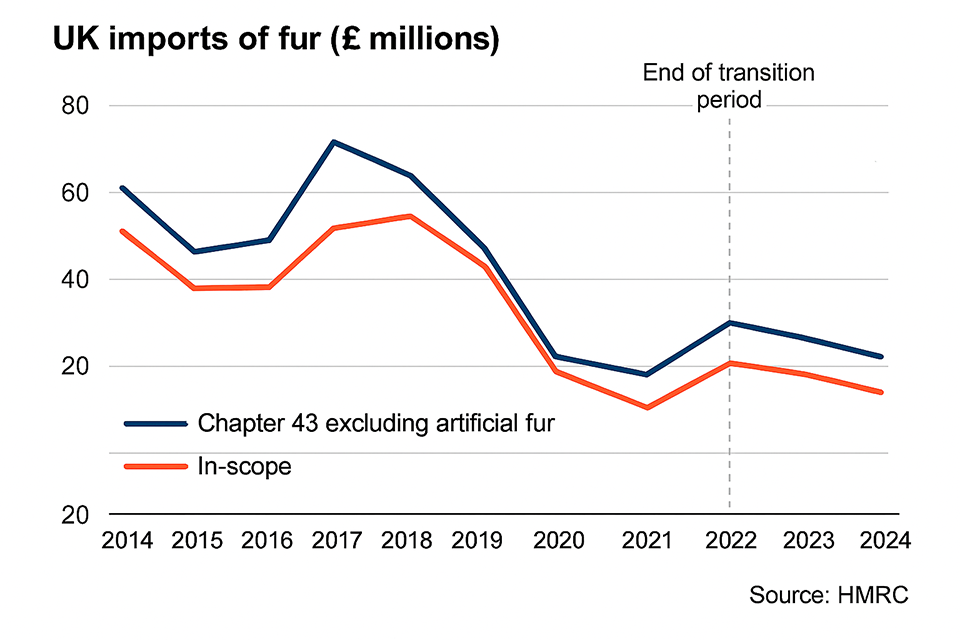
Fig 1. Volume (tonnes) and value (£ millions) of fur imports to the UK
Notes for Fig 1.
- Fur has been defined as all fur in chapter 43, excluding artificial furs.
- The combined effects of covid restrictions and EU exit uncertainty may have contributed to lower trade in 2020.
- The grey line at 2021 indicates the end of the Transition Period.
In 2014 to 2016, the proportion of Chapter 43 imports (excluding artificial fur) accounted for by in-scope fur was 70% in volume terms and this figure had fallen to 49% in 2021 to 2023. By value, the proportion had fallen from 83% in 2014 to 2016 and 2017 to 2019 to 78% in 2021 to 2023.
Sources of imported fur
HMRC data shows that the UK imported in-scope fur from 80 different countries during the 10-year period 2014 to 2023.
A total of 12 countries provided at least 1% of the average total volume of imported in-scope fur in the 10-year period 2014 to 2023. In each year, China was the biggest single source by volume for this fur, accounting for an average of 37% of the total across the 10-year period. China has supplied an increasing proportion of in-scope fur, rising from an average of 21% for 2014 to 2016 to 49% for 2021 to 2023, in volume terms. The AWC was told by the British Fur Trade Association (BFTA) that most fur farmed in China is for the Chinese domestic market and that the vast majority of Chinese exports are finished goods using fur from farmed animals farmed in the EU. The AWC was not able to verify this. HMRC data suggests that heading 4303, covering articles of apparel, clothing accessories, is the major HS4 code through which the UK imports in-scope fur from China. In overall terms, HMRC data suggests the proportion of total fur imports (excluding artificial fur) from China coming in under 4303 has increased over the last few years from around one quarter (27%) of the total volume in 2022 to 40% in 2024, although the proportion remains below 2014 to 2016 and 2017 to 2019 levels.
A total of 15 countries provided 1% or more of the average total value of in-scope fur in the 10-year period 2014 to 2023. While the biggest source of this fur by volume was China, the biggest source by value was Italy.
Types of imported fur
Heading 4303 goods covering articles of apparel and clothing accessories of fur skin account for most of the volume of imported chapter 43 goods in-scope of this report, 70% in the period 2021 to 2023. The remainder of imports are traded under headings 4301 (1%, raw fur skins) and 4302 (30%, raw and tanned fur skins) for the same period.
Articles of apparel, clothing accessories and other articles of fur skin under heading 4303 account for most of the value of all imports of chapter 43 fur in scope of this report. The proportion of total value contributed by these goods has increased over the 10-year period, from 72% in 2014 to 2016 to 90% in 2021 to 2023. At the same time, the proportion of value contributed by imports under headings 4301 (raw fur skins) and 4302 (raw and tanned fur skins) have both decreased.
Exported fur
The AWC was asked to consider the destination of fur products imported into the UK. Some of those fur products (farmed or wild) are imported, treated or used in some way, and then re-exported. Some wild fur is trapped within the UK and subsequently exported, but this is outside the scope of this Opinion and is not therefore considered further here.
Volume and value of fur exports
The UK exports considerably less fur by volume under chapter 43 than it imports. Average export volumes of all chapter 43 fur (excluding artificial fur) were considerably less in the period 2020 to 2022 (see chart below). Although there was some recovery in 2023 and 2024, levels remain below the period 2014 to 2019. Average exports of all chapter 43 fur (excluding artificial fur) fell by value from £36 million from 2017 to 2019 to £16 million in 2021 to 2023. The value of exports has not recovered in 2023 to 2024 to the same extent as volume.
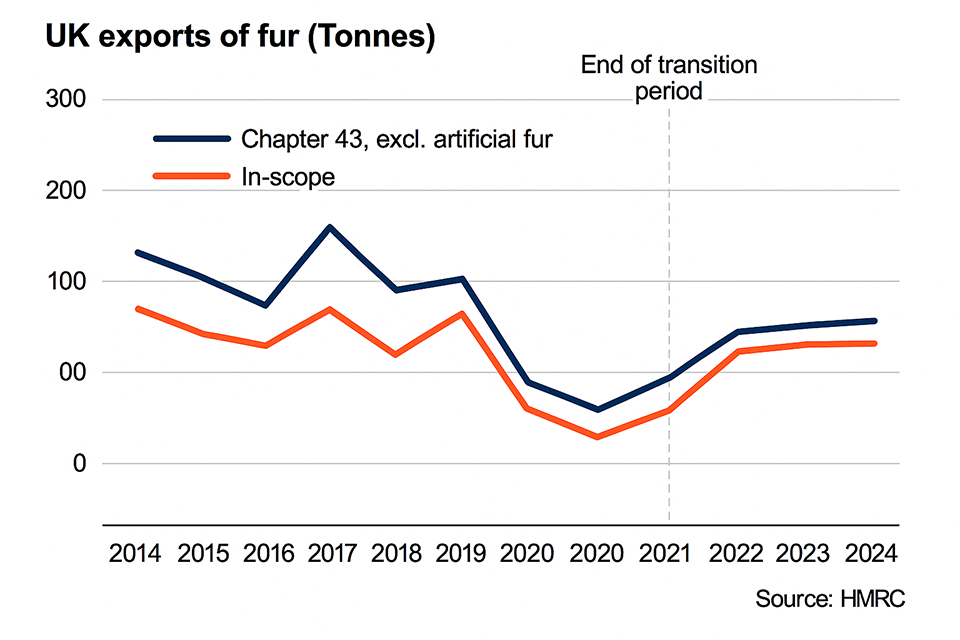
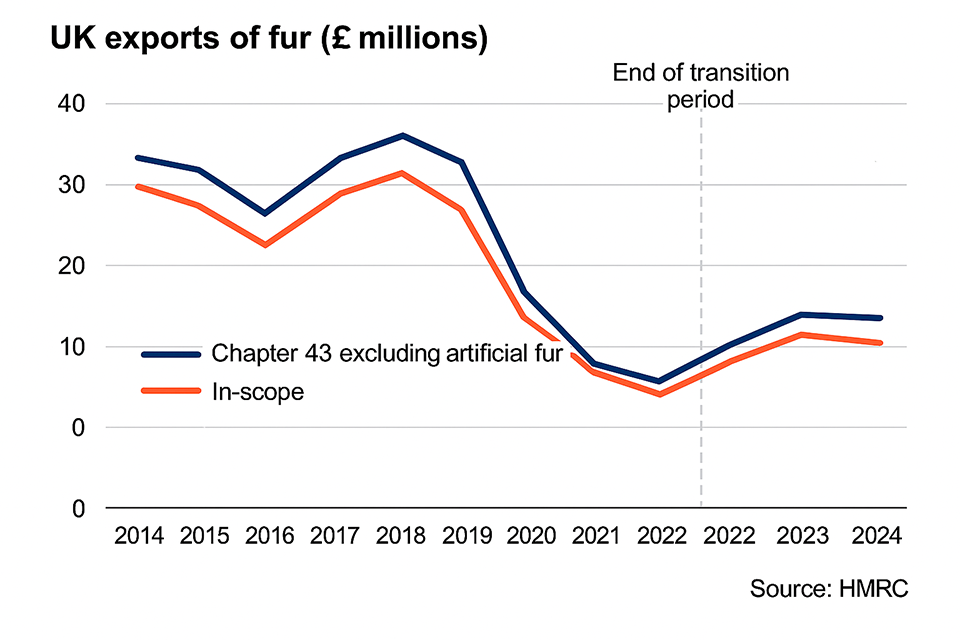
Fig 2. Volume (tonnes) and value (£ millions) of fur exports from the UK.
Notes for Fig 2.
- Fur has been defined as all fur in chapter 43, excluding artificial furs.
- The combined effects covid restrictions and EU exit uncertainty may have contributed to lower trade in 2020.
By volume, the proportion of Chapter 43 exports (excluding artificial fur) accounted for by in-scope fur has increased from 80% in 2014 to 2016 to 93% in 2021 to 2023. However, by value, the proportion of exports made up of in scope fur had risen from 92% in 2014 to 2016 to 98% in 2021 to 2023.
Types of exported fur
Most exports by volume were chapter 43 goods in scope of this report. While these goods formed a declining proportion of imports, these accounted for a high and relatively consistent proportion of exports.
Destinations of exported fur
Between 2014 and 2023, the UK exported fur goods within the scope of this opinion to 112 countries; a greater number than it imported from.
[1] Previous releases for Impact of trade in goods data collection changes on UK trade statistics - Office for National Statistics
Welfare standards and safeguards
The European Commission had asked the European Food Safety Authority (EFSA) for a scientific opinion and technical assistance concerning the welfare of fur animals, which was published in 2025. (https://efsa.onlinelibrary.wiley.com/doi/epdf/10.2903/j.efsa.2025.p230703.) This Opinion refers to findings from that EFSA report (‘The EFSA report’) where relevant.
In producing our Opinion herewith presented, the AWC has reviewed current practices of breeding, rearing, transport and slaughter for fur animals through reference to industry standards and processes, animal welfare regulations, engagement with stakeholders and the peer-reviewed and ‘grey literature’ applicable to (a) farmed and (b) wild-caught fur animals.
In the paragraphs which follow, the AWC focuses on animals who are primarily farmed or caught for their fur. However, issues with import codes make it impossible to distinguish with complete confidence between animals being farmed primarily for their fur and those whose fur is a by-product of food production (which for species within the scope of this Opinion the AWC believes is a minimal amount).
In practice, the animal welfare standards that apply to fur may be informed by several factors. These include the extent of any national or regional legislation or guidance that applies in the country in which the animal from which the fur was obtained lived and was killed, and the extent to which such legislation or guidance is observed and enforced. Where there is no regulation or guidance standards may vary widely. Even where standards exist, groups or individuals may voluntarily adopt higher standards than required. Where standards exist but enforcement is weak then standards may not be adhered to.
In addition to standards at national level, some international industry standards also apply. These are summarised in Appendix 4 for farmed fur and Appendix 5 for wild caught fur, along with an indication of standards or protocols used by individual nations.
The International Fur Federation (IFF) global Furmark® certification scheme includes (i) the WelFur® certification scheme, a set of standards concerning the production and welfare of species farmed for their fur in Europe and (ii) protocols for both farmed (mink) and wild caught fur in North America and (iii) the Russian protocol for sable. There are separate protocols relating to fox, raccoon dog and mink upon which WelFur® is based and also for nutria from Argentina, swakara from Namibia and chinchilla.
A significant proportion of commodities in scope of this Opinion are imported from China. Based on our research and interactions with stakeholders, this is the AWC’s understanding to date of the situation in China: China has a ‘GOOD4FUR certification scheme’ which was introduced by the China Fur Commission of the China Leather Industry Association (CLIA) and IFF in 2017. Furmark® was launched in China in 2021 though Chinese-produced fur is not included in the scheme. The AWC understood from the IFF and BFTA that they will not support Good4fur and its joining Furmark® at present due to lack of independent inspections. However, as the AWC understands it, the IFF is working with the Chinese authorities to develop stronger standards. It is a limitation of this Opinion that the AWC has not been able to access any meaningful evidence about the function of the GOOD4FUR scheme inside China.
Summaries of Industry Standards
International and national welfare standards and protocols for farmed fur are summarised in Appendix 4.
International and national welfare standards and protocols for wild caught fur are summarised in Appendix 5.
Whether current standards and management systems are sufficient to adequately provide for welfare needs (including traceability and compliance)
Species farmed for their fur
Current practices in fur farming
Fur farms are intensive units in order to be economically viable. The 2025 EFSA report states that, based on 2023 data, there were around 1,100 active fur farms in the EU producing mink, foxes and raccoon dogs, with a total animal population of around 7.7 million distributed across these farms. With regard to chinchilla, the EU produces around 220,000 pelts per year, but no accurate data are available on either number of farms or animals produced.
Fur-farmed animals are typically housed in large numbers, within cages which can be set out in several tiers often using natural ventilation to control the environment. The cages are designed to maintain the quality of their fur while meeting basic animal care standards. They also have to be practical and efficient for the farmer to monitor and feed animals, and clean and maintain animal accommodation. The specific housing conditions and any resource and or enrichment vary depending on the species of animal, the country and what regulations, if any, are in place.
Cages are typically arranged in rows inside sheds or outdoors under open-sided shelters.
Cages are typically made of wire mesh to allow for ventilation, easy cleaning, and collection of animal waste underneath.
Cages can also contain nest boxes.
Cage sizes vary by species, regulations and any industry protocols.
Some cages have platforms or partitions to allow animals to move to different levels or sections.
Shelters are sometimes provided to protect animals from harsh weather, such as rain or intense sunlight, while still allowing airflow.
Grouping of animals is species-specific.
Species such as mink, who are territorial and solitary by nature are usually housed individually (or possibly with siblings) in cages to prevent fighting.
In contrast, it is possible to house social species like fox and chinchilla in pairs or small groups.
Provision of water and feed can entail a degree of automation, to facilitate feeding of large numbers of animals.
The levels of enrichment (objects or activities which facilitate natural behaviours) can depend on regulatory or industry protocols.
Some producers provide enrichment in the form of items to chew, climb or hide in as well as nesting material especially for those about to give birth.
Depending on the species and disease threats, fur farmed animals such as mink may be routinely vaccinated.
Assessment of sufficiency of welfare standards
The welfare needs of farmed animals may be categorised as: - The need for a suitable environment - The need for a suitable diet - The need to be able to exhibit normal behaviour patterns - The need to be housed with, or apart from, other animals - The need to be protected from pain, suffering, injury and disease
(Animal Welfare Act, 2006, Animal Health and Welfare (Scotland) Act, 2006).
Current understanding of animal welfare science focuses on assessing animal welfare across ‘Five Domains’ (Mellor et al, 2020) four of which (nutrition, environment, health and behaviour) align with those welfare needs, and the fifth of which - mental state – is a reflection of the impacts across those four domains on the animal’s psychological wellbeing.
Domestication across generations does not guarantee that a species’ welfare needs can or will be met. Whilst selective breeding over many generations has resulted in some adaptations to human-made environments and management systems by species farmed for millennia, even these animals still retain many of the key behavioural and physiological characteristics of their wild ancestors. This is even more the case for species such as mink, fox, chinchilla, which have not historically been domesticated and which have diverse environmental and other welfare needs which continue to align to the evolutionary history of their ancestors.
Even in the absence of detailed evidence around species-specific welfare needs (see below), it is in the opinion of the AWC self-evident that keeping in caged systems with limited space and little if any enrichment animals who are biologically adapted to behaviours such as roaming is highly likely to cause significant welfare harms.
Independent reports dating from more than twenty years ago (for example of the Standing Committee Of The European Convention For The Protection Of Animals Kept For Farming Purposes (t-ap) (1999) https://www.coe.int/en/web/cdcj/1999-rec-fur-animals#P410_37171 and of the Scientific Committee on Animal Health and Animal Welfare Report on The Welfare of Animals Kept for Fur Production (SCAHAW) (adopted 12 to 13 December 2001)) referred to a lack of scientific certainty around the welfare needs of species farmed for their fur (https://food.ec.europa.eu/system/files/2020-12/sci-com_scah_out67_en.pdf).
In its searches of the literature, the AWC found that published evidence pertaining to the welfare needs of species farmed for their fur remains limited, and is more limited for some species than for others (with the most research having been undertaken on mink). The AWC understood from our interactions with stakeholders that this is due to a lack of funding for such research which may itself be consequent upon a lack of consumer-led demand-side pressure for such research be undertaken to improve animal welfare.
Notwithstanding this apparent lack of published evidence about the welfare needs of many species farmed for fur, the AWC is aware of practical industry efforts to improve welfare. For example, through selection for reduced aggressiveness when breeding animals farmed for their fur in captivity.
Nonetheless, many NGOs and other stakeholders with whom the AWC interacted in preparing this Opinion were of the view that welfare needs of species being farmed for their fur either cannot be or are not being met by current management systems.
Stakeholders from within the fur farming industry, in contrast, insist that the voluntary standards which they have developed are based in scientific knowledge about the welfare needs of species farmed for their fur (including, in some protocols, some animal-based measures) and when met provide management systems which do fulfil those needs (see Appendix 3).
For example, the criteria relating to housing, nutrition and thermal comfort included within the WelFur® standards for farmed fox and mink were established through an independent academic review of the literature (Mononen et al, 2012).
The AWC notes that this research is now more than a decade old, and understanding of animals’ welfare needs has progressed significantly during that time.
When considering in the sections below whether the welfare needs of animals farmed for their fur can be met by current practices, the AWC has focused on three areas:
- Physical and psychological effects upon animals, viewed from a ‘Five Domains’ perspective.
- Welfare at the time of killing.
- Compliance, enforcement and traceability.
Note: China is not discussed any further within this section since, the AWC were unable in the course of preparing this Opinion to find any evidence about the application of or the welfare impacts (if any) of relevant schemes in that country.
Physical and psychological effects upon animals, viewed from a ‘Five Domains’ perspective.
Many of the welfare standards which relate to animals being farmed for their fur (Appendix 4) focus on the provision of resources (for example, access to water; cage size etc) and some provision of enrichment. However, there is little evidence that consideration is given to the total lived welfare experience of the individual animals within management systems, to provide the animals with the opportunity for a ‘good life’.
Similarly, in North America many of the standards relating to farming animals for their fur is around provision of resource and preventing distress (for example due to water deprivation).
Within the EU, the WelFur® protocols and Furmark® chinchilla protocol are exceptions to this trend, as they do incorporate a limited number of animal-based measurements of welfare such as ‘Temperament Test’ in various protocols (see Appendix 4). There is, for example, detail on desirable enrichment in the WelFur™ mink protocol. However, most of this is on a recommendatory (that is, ‘should’ rather than ‘must’) basis. AWC members visiting a mink farm saw little evidence of enrichment beyond provision of bedding and a raised platform.
The way in which the welfare protocols are constructed may allow farms to pass protocol assessments notwithstanding welfare harms to individual animals. For example, the WelFur® schemes for species such as mink or fox combine different welfare measures into overall scores, which may obscure adverse individual measurements. Current WelFur® protocols for these species allow for a certain percentage of animals to show such conditions without adversely affecting the overall score and no immediate penalty or need for action appears to be within the protocols. For example, the WelFur® Welfare assessment protocol for foxes, 2015 pp 21-22 Explanation Box 3 states: ‘% of foxes with severely bent feet = 15%’ are needed to meet the ‘Alarm threshold’. This can represent a significant number of animals on a large farm.
The economic imperative for animals to be fast-growing may ensure that they do not suffer hunger, but seems to have resulted in obesity being tolerated and accepted within protocols (‘Although obesity is not a welfare problem in itself ….’ WelFur® Welfare assessment protocol for mink 2015, 3.1.4).
Obesity is known to cause welfare issues relating to metabolic derangement in other domesticated animals, and the 2025 EFSA report highlights these in mink. The AWC accepts that the lifespan of fur animals is relatively short, meaning that potential metabolic disturbances and their consequences may not become overtly apparent. For the same reason (short lifespan) an increased incidence of neoplasia sometimes associated with obesity in other species may not become apparent. However, welfare issues in individuals being raised for fur related to increased body mass such as reduced movement and bent joints and or feet do appear to be relatively common within fur farmed animals (see previous paragraph). Additionally, females are fed a high-energy diet throughout lactation and if they are not culled but returned to a condition for breeding, their diet is restricted. This may result in the animals experiencing boredom (due to lack of feeding opportunity) and or hunger.
The standards for cage size within current welfare protocols are in the opinion of the AWC insufficient to meet physical and psychological welfare needs. For example, to score the best score for the length and width of a cage under the WelFur™ protocol for raccoon dog, the cage need be only sufficient in each dimension to allow that: ‘The animal can walk straight ahead without obstruction a longer distance than its own body length’.
Cage design requirements seem also not always to be adequate to meet the need to be able to express normal behaviours. For example, the WelFur® mink protocol does not enable the normal behaviour of digging. In some EU Member States it is mandatory to provide some form of enrichment resources for farmed mink, for example in Germany, an elevated platform, a non-wire climbing object and access to a 30 cm deep water basin are mandatory items. (EFSA supporting publication 2025:EN-9562. 115 pp. doi:10.2903/sp.efsa.2025.EN-9562 )
There is also no requirement within current industry welfare protocols for mink to be provided with an area in which they can swim. The AWC heard varying views on the importance of swimming to mink. Many stakeholders take the view that swimming is an intrinsic behaviour in mink, whereas stakeholders from the fur industry told the AWC of research they have conducted which showed that mink had no preference for water over other enrichment types. In the opinion of the AWC, whether swimming is an absolute welfare need or not it is a highly motivated natural behaviour in mink and the absence of an opportunity to swim must deprive the mink of an opportunity to exert autonomy and experience a positive welfare impact. The 2025 EFSA Report concluded that a lack of open water may be relevant for four out of their five selected highly relevant ‘welfare considerations’.
There is concern amongst some stakeholders that many of the practices historically intrinsic in fur farming are the basis of many criteria within industry-developed welfare protocols. For example, current fur farming systems and associated welfare protocols are all predicated on an assumption that animals will be kept caged, in close proximity to each other. This is always likely to cause stress in animals such as mink who are naturally solitary animals as adults, even when they cannot see each other.
Welfare at the time of killing
The AWC were unable themselves to view any fur-producing animals being killed.
The main slaughter method used on fur farms is species dependent. The AWC understands that in the EU carbon dioxide (CO2) gas is used for mink, that electrocution is commonly used for foxes and raccoon dog, and that chinchilla is typically killed by cervical dislocation or gassing. Some AWC members during a visit were told that mink also killed using carbon monoxide (CO) gas generated by an internal combustion engine. In interactions with other stakeholders, the AWC understood that pure CO gas from a cannister may also be used (which has a lower human health risk).
CO can be administered by the exhaust gases from a petrol engine which must be filtered and cooled before use. A survey quoted in a 2023 report for Eurogroup found that a high number of farms in Finland did not cool the exhaust gases nor check the temperatures within the killing boxes.
Standard practice at killing by gassing seems to be moving down a house containing fur animals, selecting individual animals, and placing them in a mobile chamber or grouping them and killing the selected groups. This movement within the house is likely to cause stress to the animals kept there as it is not a routine activity.
The whole process of slaughter by CO2 or CO, especially if using a killing box with 30 to 50 mink, involves high levels of stress from handling and placing them in a box with other conspecifics (that is, belonging to the same species), as mink are solitary animals.
CO2 has been shown to be a highly aversive method of killing mink. It fails to kill rapidly, with additional welfare issues arising from animals smothering each other before they are rendered unconscious, or not being exposed to correct levels of gas due to crowding.
Killing of fox and raccoon dog is usually by electrocution. One electrode is inserted in the rectum and the other in the mouth. The AWC is not confident that electrocution is a humane method of killing in these species. In addition, in animals unused to being handled the act of restraint to apply electrodes is likely to be very stressful, especially if animals are restrained using neck tongs because those are often used for other stressful operations such as vaccination and the animal will therefore associate them with stress and pain.
WelFur® protocols give some details on methods of killing and minimum gas concentrations. The mink protocol, for example, states that ‘correctly applied’ killing should be by >4% CO or >80% CO2. WelFur® protocols also refer to EU Council Regulation (EC) No 1099/2009. The Protocols expect farmers to have produced Standard Operating Procedures (SOP) regarding killing which should be inspected at the audit.
As far as the AWC has been able to establish, there appears to be little current published research by the industry to identify effective methods of killing which would minimise welfare harms.
The AWC has found no evidence of audit of killing under existing welfare protocols for farmed fur, even though the numbers killed are relatively high and routine killing takes place in short time period. As the AWC understands it, an independent inspection of a farm is never scheduled for a day on which animals are being killed.
In the EU, equipment used and personnel supervising the killing must have a valid certificate consistent with the requirements of Council Regulation (EC) No 1099/2009, the protection of animals at the time of killing. The AWC found little evidence about training of those who undertake the killing of animals farmed for their fur, either on government websites of countries where fur is farmed or in our interactions with stakeholders.
Compliance, enforcement and traceability.
There is a lack of international consistency. For example, even within the Furmark® scheme EU protocol requirements are different from those in the United States of America (USA) (https://www.Furmark® .com/certification-programs/us-farm-raised-fur).
The WelFur® protocols (mink, fox and raccoon dog) contain complex mathematical calculations to derive scores.
Thus, rather than inspections focusing primarily on individual animal and / or group welfare, the determinants of compliance with WelFur™ protocols seem to be heavily dependent upon the practicality of performing assessments (whether resource based or animal based) within the timescales of an inspection, along with the ability to produce a replicable scoring system.
Poor scores in one criterion may be obscured by the complex calculation which takes many resource- and animal-based measures into one overall score.
The AWC understood from stakeholders that if a major non-compliance or other animal welfare risk is flagged under the WelFur® system, the local fur association is alerted and a local veterinarian is requested to make an immediate audit. Based on the veterinarian’s report an evaluation is made of whether the WelFur® certification needs to be withdrawn. If withdrawn, the farm immediately loses access to Furmark® approved sales channels (auction house that only accept certified furs) with immediate effect.
The protocols supplied to the AWC by the BFTA for chinchilla (the most recent protocol produced) have a simpler checklist than those for other species, and compliance or non-compliance is clearer to see. Certification in the chinchilla protocol is based on a sanction list, and the consequences of ‘notes’, ‘minor non-conformities’ and ‘major non-conformities’ discovered and timescales for rectification are easier to understand through use of a ‘traffic light system’. Corrective actions for major non-conformities must be rectified and sent to the certification for review within 30 days. Four or more recorded major non-conformities results in termination of the certification process and or loss of certification. Breaches of national legislation result in immediate withdrawal of certification.
The AWC heard from industry stakeholders that compliance with the Furmark® system and with the WelFur® protocols within the EU is achieved through two mechanisms. Either:
Farmers decide that they will not be able to meet the requirements of the appropriate protocols or decide not to join the voluntary system, and find they are unable to sell their product to the international fur auction houses linked to Furmark®. This in effect removes the main market for their product. The AWC was told by some industry stakeholders that such farmers subsequently stop fur production. Other stakeholders believed that the fur was sold in other ways.
Or:
Farms that join the WelFur® system initially have 3 inspections with a yearly cycle, each inspection at specific periods within the cycle (Period 1 pelting to mating, Period 2 mating to separation, Period 3 separation to pelting). If they pass the initial period assessment the farm is granted an applicant status and allowed access to the fur auction houses. Once a farm has passed all three assessments, they are granted a certificate. Assessments then occur yearly but each one will be at different stages of the production cycle. All assessments are announced in advance. If a farm fails an inspection, it is given time for remedial action before re-inspection, which can be 14 days after the initial inspection (in which time corrections have to have been made) or could be delayed until the same stage of the production cycle the following year.
Whatever the time period between failing an inspection and re-inspection, the farmer still has access to fur markets and is able to sell as a certified producer during that period. Thus, a farmer could potentially continue selling their product as a certified producer for a significant period of time having failed an inspection and not undertaken remedial actions.
The audit for adherence to Furmark® WelFur® protocols is conducted by independent auditors accredited with International Organization for Standardisation (ISO) standards (https://balticcontrol.com/about-us/accreditations-quality-management).
The system of inspection is that of announced and planned visits. No unannounced inspections occur. This is at variance with welfare inspection schemes for many other farmed species. The AWC understood from our interactions with industry stakeholders that they do not feel that unannounced visits are necessary as longer standing faults within the farm system are hard to disguise even at an announced audit.
The AWC met with those involved in assessment and understood that there is a potential lack of assessors, exacerbated by a need to have local assessors as otherwise language issues as regards terminology may prove difficult to interpret.
The farmer owns the data collected from their farm. It is therefore not possible for the AWC to assess compliance with fur farming welfare schemes as there is little data available from independent or statutory bodies.
The AWC understood from stakeholders that there are a variety of mechanisms within Europe whereby national authorities may inspect fur farms, but the AWC is unable to establish whether these inspections are adequate to protect animal welfare. The 2025 EFSA Report did not alter the AWC’s view on this matter.
Fur Europe, one of the four regions into which the IFF is organised, states that they intend to publish aggregate data of the participant farms, but not that of individual farms. Such data may well be valuable when available.
In our interactions with stakeholders, the AWC understood that in the USA the ‘Fur Commission USA Mink Standard’, was based on the same research as WelFur® protocols, and that annual audits and the certification are implemented by an independent certification body called Validus. The AWC has not validated the verification systems.
Some States have legislation that authorizes a director, inspector, agent, or minister to issue an order that requires animal owners or custodians to take certain actions.
In Canada, third party audit is provided for the CertiFur® scheme (Appendix 3) by NSF International. CertiFur® state that audits occur every 15-18 months in order to maintain certification.
In Canada, a 2018 review of standards for farmed fox identified the need for major changes in pen sizes and design and bedding to protect animal welfare, but the AWC has been unable to find any evidence that such changes are being implemented
Russian sable farms who are part of the Furmark® and or WelFur ®scheme are inspected by Russian authorities. The AWC is unable to comment on this scheme as work on this area by IFF under the Furmark® scheme has been paused due to the Ukraine war.
GOOD4FUR is apparently audited by the Chinese government but the AWC was unable to obtain any data relating to that audit and as far as we are aware there is no independent auditing system.
Manufacturers and retailers using fur produced within the Furmark® scheme can choose to label the final produce being sold with a Furmark® label (or not). Consumers could use the label to follow directions to the Furmark® website, and access information about the scheme’s husbandry standards for particular species under the Furmark® system. Consumers would still need to interpret this information to understand the welfare impact.
Species caught for their fur
Current Practices in North America
Wild trapping of fur is largely associated with Canadian practices. Some trapping is also undertaken in the United States.
Commercial trapping occurs in every state of Canada – Quebec being the leading state followed by Ontario.
The most commonly trapped species in Canada are muskrat (28%), beaver (21%), marten (13%), squirrel (9%) and raccoon (5%).
For the period 2022 to 2023, 264,949 pelts wildlife pelts (with a market value of over $9 million) were taken from the wild, with 32,625 trapping licenses issued in Canada as reported by the Fur Institute of Canada in March 2025.
Current trapping methods used in North America focus on two main principles: 1. Lethal traps - where the trap is designed to crush the head and chest and kill the animal outright. 2. Holding traps - where the trap is designed to grip a single limb either via a snare device or sprung metal jaws, or by neck snares. The aim is that the animal is held at the site of the trap until a trapper returns to kill the animal by another means. The method of killing is not specified in licenses issued in many states. Holding traps are generally used for larger mammals such as wolf, coyote, lynx and bear. It should be noted that leg hold traps have been banned in the UK and EU for many decades. In the UK, the Welsh and Scottish governments have fully banned snaring as a means of capturing wildlife, whereas England and Northern Ireland have banned only ‘self-locking’ snares and still allow ‘running’ type snares.
The regularity of checking these traps once set varies from country to country; for example, in Canada once per day is regarded as the minimum according to the Fur Institute of Canada.
AIHTS (see Appendix 5) assessment of a humane kill in the lethal traps depends upon time taken for the trapped animal to lose corneal and palpebral reflexes which the Fur Institute of Canada advised equates to the following 1. 45 seconds for Mustela erminea 2. 120 seconds for Martes spp. 3. 300 seconds for all other listed species (such as beavers, otters, lynx etc)
Holding traps are more likely to be used in urban and or well populated areas as accidental capture of pets is a risk in those areas, and so are more commonly used in the relatively urban and or densely populated USA than in Canada.
Assessment of sufficiency of welfare standards
The ISO has developed two international, science-based trap standards to test restraining and killing devices. The ISO is comprised of 162 members, each being the sole representative of their country. These standards outline how traps should be tested, regardless of the reason for trapping. These ISO standards are encompassed in some other schemes. The AWC has seen no evidence that these schemes offer further welfare protections.
In the USA two international agreements and associated Best Management Practices (BMPs) serve to implement the ISO standards.
- The Agreement on International Humane Trapping Standards (AIHTS)
- The USA – EU Agreed Minute
For further details see Appendix 5
The AIHTS has been assessed by some stakeholders as providing inadequate protection for animal welfare (Proulx et al., 2020).
In the Opinion of the AWC, the welfare impacts of trapping animals for their fur relate to (a) the type of trap being used (b) the skill of the person setting the trap and additionally, for holding but not lethal traps (c) the frequency with which the trap is checked and (d) the humaneness with which an animal caught within a trap is killed.
Type of trap
Lethal traps rely on the skill of the trapper to ensure they are correctly set in order to produce a rapid kill. Even if correctly set however, it can take up to 300 seconds for larger species to become unresponsive, meaning a prolonged period of suffering before death. If incorrectly set, even longer periods of suffering occur before death.
Holding traps are designed to minimise limb or neck trauma (thus minimising damage to the pelt), but again rely on the skill of the trapper to ensure they are correctly set.
Leg hold traps are banned in the EU and in the UK, and the AWC believes that their use in the UK would constitute an offence under the Humane Trapping Standards Regulations (2019) and also under the Animal Welfare Act, (2006) in England and Wales and the Animal Health and Welfare (Scotland) Act, (2006) in Scotland, as deemed to cause unnecessary suffering.
AIHTS standards (Appendix 5) deal with trap performance, but the standards are not based on a consensus definition of key animal welfare indicators underpinned by scientific evidence.
Similarly, the use of the terms “humane” and “welfare” in the AIHTS are not consistent with any consensus definition of key animal welfare indicators underpinned by scientific evidence. The AIHTS does not cover the method of killing to be carried out if a holding trap (for example snare or leg hold) is used.
The lack of guidance on approved killing and handling methods that should be used for animals found within holding traps can also lead to increased suffering of the animal(s) involved.
Skill of person setting the trap
The training of trappers appears variable within and between nations.
Training is carried out at a provincial and territorial level and is often carried out by other trappers, although the Fur Institute of Canada provides supporting information. The duration of training courses varies from province to province between 1 day and 6 days.
In our interactions with stakeholders, the AWC understood that of trappers in the USA had completed a trapping course and or had heard of the best management practice trapping guidelines.
The regulation of wild trapping is carried out in Canada at a provincial and territorial level. In the USA regulation of the wild trapping is carried out at state and county and also at federal levels.
The AWC has been unable to find evidence of convincing programmes of compliance monitoring or enforcement in relation to the application of AIHTS standards.
There are exemptions from using ISO traps for around 50% of indigenous trappers in Canada, according to the Fur Institute of Canada.
The frequency with which holding traps are checked
The AWC heard from stakeholders that the remote locations in which traps are often set makes frequent checking difficult, particularly during bad weather. Infrequent checking of holding traps once set (in Canada a minimum period of once a day) is likely to result in a significant period of mental stress for the animal before being killed.
The humaneness with which an animal caught within a holding trap is killed.
The AIHTS does not cover the method of killing to be carried out if a holding trap (for example, snare or leg hold) is used.
In the opinion of the AWC, the lack of guidance on approved killing and handling methods that should be used for animals found within holding traps is likely to lead to increased suffering of the animal(s) involved.
Ethical analysis
In line with its previous work and Opinions, the ethical approach which the AWC has adopted in considering this issue is a primarily utilitarian one in which the human use of animals is considered permissible to achieve important benefits providing that animal welfare is safeguarded as far as possible and, as a minimum, in accordance with national and, where relevant, international legislation. The utilitarian approach adopted by the AWC is qualified in that the justification of harms is considered in relation to both the magnitude and importance of the benefits that accrue, within the context and situation under consideration. The AWC recognises that there are some harms which, due to their severity, should not be inflicted upon animals under normal circumstances. Animal welfare should be maximised as far as possible in each and every situation to ensure that animals have ‘lives worth living’ and ideally ‘good lives’.
The assessment of whether a life is ‘good’ or ‘worth living’ from the animal’s point of view when taken across that animal’s lifetime should include analysis of the welfare impacts of the method of killing or cause of death.
The analysis of such questions should not, in the opinion of the AWC, be affected by cultural issues.
For animals who are being caught from the wild for their fur, and unless their environment has been adversely impacted by human activity, their welfare needs are not (potentially) compromised by humans until such time as they are trapped and subsequently killed.
Whether or not animals being trapped for their fur have ‘good lives’ or at least ‘lives worth living’ until that point in time is largely determined by nature, not humans.
Whether or not trapping and (ultimately) killing animals for their fur is ethical in terms of human activity therefore depends heavily upon whether or not welfare harms are mitigated and positive welfare affects promoted to the full extent enabled by current scientific understanding during the period of trapping and killing.
Theoretically, if an animal could either be trapped and reliably immediately killed or trapped and held humanely until humane killing rapidly thereafter, the associated harms might be sufficiently minimised to ensure that an animal living in the wild had a natural life consistent with the idea of a ‘life worth living’ and possibly a good life when assessed across that animal’s lifetime.
However, based on all the evidence heard and reviewed in the course of preparing this Opinion, the AWC believes that current methods of trapping and killing are not ethical because trap design, time intervals between trapping and killing, insufficient specification of killing methods, inadequate training of trappers, and inadequate enforcement all allow unnecessary suffering.
The AWC notes that for wild caught fur, properly executed free shooting without prior trapping could provide a humane method of fur provision. However, the AWC realises that shooting is expensive, is time consuming and only kills one animal at a time. It is therefore unlikely to be a commercially viable alternative to trapping other than for exceptional, small-scale cases.
In relation to animals farmed for their fur, understanding of welfare needs is currently underdeveloped compared to understanding of the welfare needs of species commonly farmed for food production.
Nonetheless, basic welfare needs relating, for example, to space requirements, nutrition and the facilitation of normal species-specific behaviours are established for all farmed fur species.
Conclusions
General conclusion
In the opinion of the AWC, consumer and market forces currently do not and cannot provide sufficient pressure to adequately safeguard animal welfare.
Conclusions about how much fur is imported in relation to which species, where is this fur sourced from, and where is it destined.
The nature of the recorded import data makes it impossible to be confident about the actual origin of fur imported into the UK, resulting in a lack of clarity on the welfare standards that relate to the animals from whom the fur was sourced.
HMRC data does not reveal whether animals were farmed or wild caught, making it impossible for the AWC to assess the volume of importation of wild caught and farmed fur into the UK. The AWC’s interactions with a wide variety of stakeholders make it clear that the vast majority, but not all, of fur being imported into the UK comes from farmed sources.
The way in which data is presented is such that the AWC has been able to see the country from which fur has been imported, but not the country from where the fur skin originated (which could have different animal welfare standards from the importing country).
CITES data does provide some insight into the importation of wild caught fur, but this represents only a subsection of the total volume of wild caught fur imported since CITES only covers listed species and some species caught for their fur are not listed as such.
For fur not imported under CITES, fur may enter the UK in a processed form, meaning that its origin is very difficult to identify.
HMRC data does not enable the AWC to determine whether wild caught fur was caught by indigenous trappers.
Notwithstanding the Furmark® labelling scheme, it is currently not possible for consumers to identify the source and identity of all fur skins and fur products currently available in the UK.
Consumers are not currently able to accurately identify whether products are fur of animal origin (wild caught or farmed) or ‘faux’ fur, or a mixture of the two.
Notwithstanding the fact that manufacturers and retailers using fur produced within the Furmark® scheme can choose to label the item being offered for sale accordingly, there is a general lack of sufficient traceability of fur and fur products on sale in the UK.
Conclusions about welfare standards or safeguards that currently apply to that fur, and whether they are sufficient to adequately provide for welfare needs.
The AWC welcomes the 2025 EFSA Report and the additional evidence which it provides.
Based on the experience of the AWC it is impossible to access reliable data in which one can have confidence and to find information about welfare standards and management practices for all countries from which fur imported into the UK originates, for both farmed and wild-caught fur species. This is particularly true of China, which appears (from HMRC figures) to be a significant source of fur imported into the UK. The AWC is aware of fur industries within other countries for which reliable information about animal welfare standards is not readily available.
Farmed fur
Current welfare standards and safeguards are difficult to understand and do not apply to all animals being farmed for fur.
There is a current scarcity of sufficient scientific knowledge about species farmed for their fur to ensure their needs are met within captivity. In the view of the AWC, that makes it impossible to meaningfully comply (or to provide evidence of compliance) with the requirement of Council Directive 98/58/EC of 20 July 1998. In the opinion of the AWC, this scarcity of knowledge makes it impossible to safeguard the welfare of species farmed for their fur with regard to their species, their degree of development, adaptation and domestication, and to their physiological and ethological needs.
In the opinion of the AWC, whilst more research has been undertaken for some species than for others, a sufficient evidence base on the welfare needs of all species farmed for their fur is currently still lacking.
Nonetheless, all species farmed for their fur have identifiable basic animal welfare needs that need to be fulfilled. Conditions to ensure needs are met would include adequate three-dimensional space, choice, species-specific requirements to be housed separately from or with other animals, and species-specific enrichment which permitted natural behaviours such as digging, swimming and foraging.
Based on the evidence available to AWC and on our interactions with stakeholders, there are no species being farmed for fur whose welfare needs are being adequately met by current standards and safeguards.
Current fur industry standards and protocols generally continue to rely too heavily on the provision of resources, which does not adequately reflect the current scientific understanding of fur animals’ welfare needs. Such reliance reflects a ‘freedom from’ approach to welfare rather than a more modern approach based in an understanding of animals’ welfare needs. The AWC recognises that some more recent protocols have started to incorporate some animal-based welfare measures, although we do not yet feel these are sufficient.
Current standards that exist focus primarily on mitigation of negative welfare effects rather than the need to provide opportunities for positive welfare experiences.
It is the view of the AWC that within a commercial setting it is not possible and is unlikely to ever be possible to farm species such as fox and raccoon dog without having a detrimental effect on their health and welfare, or in a way which meets their welfare needs. It is the opinion of the AWC that this makes it currently impossible, for such species, to meaningfully comply with paragraph 21 of the Annex to Council Directive 98/58/EC.
The AWC is concerned about the welfare at the time of killing of animals being farmed for fur.
Provision of training for and monitoring of those undertaking the killing of animals being farmed for their fur through both national legislation and assurance schemes is not adequate to safeguard animal welfare.
Wild caught fur
Many of the standards being applied to the trapping of fur subsequently imported into the UK are in the opinion of AWC not sufficient to prevent unnecessary suffering, and do not adequately protect animal welfare.
The use of holding traps always has a detrimental effect on animal welfare. Neck hold traps if used properly should not cause pain but nevertheless will cause significant suffering; foot hold traps will cause both pain and significant suffering.
There is a lack of science underlying the time to death which is acceptable when kill traps are being used under ISO protocols, and there is a lack of evidence that those times to death as permitted by AIHTS standards are humane.
There is a lack of evidence that the interval between checking of hold traps permitted by current welfare standards is based in science in regard to what is sufficiently frequent for each species under consideration to prevent unnecessary suffering.
There is a risk to non-target species associated with the placement of traps.
There is insufficient consistent, appropriate mandatory training in the use of traps.
All of the evidence which the AWC has been able to find suggests that enforcement of voluntary guidelines is carried out by the trappers themselves, with no independent oversight.
The AWC did not have the opportunity to interact with indigenous trappers and thus cannot comment upon whether the methods which they use for trapping are higher or lower welfare than those associated with the welfare guidelines which do not apply to them.
Properly executed free shooting without prior trapping could provide a humane method of fur provision. The AWC is, however, not confident that it would be possible to institute an enforcement system which ensured that shooting was carried out without prior trapping.
ISO standards as defined by AIHTS agreement are in the view of the AWC inadequate and do not apply to all species.
Welsh and Scottish governments have fully banned snaring as a humane means of capturing wildlife whereas England and Northern Ireland still allow ‘running snares’. These discrepancies in national legislation relating to snaring permit poor welfare.
Conclusions about whether systems, schemes, processes etc., applied to imported fur and designed to ensure that current standards and safeguards are complied with are effectively applied in practice.
Farmed fur
Other than established controls on trade in fur from endangered species protected by the Convention on International Trade in Endangered Species, and the textile labelling requirements detailed in paragraph 42 above, there are no requirements to label fur and some fur will enter or exit GB as an unnamed component of an imported or exported product. While the welfare standards applicable to fur used in such goods are in scope of this report, the value and volumes of these goods to species level cannot be tracked through HMRC data.
No certification scheme covers all species in all countries.
Such certification schemes as do exist are voluntary and industry-run.
Assurance scheme inspection visits are announced (rather than unannounced).
The AWC has found convincing evidence that the International Fur Federation (IFF) global Furmark® certification scheme operates in Europe, North America and Russia.
Fur from animals farmed other than in Europe, North America and Russia is not currently covered by the Furmark® and or WelFur™ schemes (although the AWC understands that the scheme is being expanded internationally).
Although the Furmark® was reportedly launched in China in 2021, the AWC has not been able to find any evidence about its operation there.
Caught fur
Although a number of guidelines for welfare around trapping of animals for their fur exist, they are predominantly voluntary.
There is no adequate assurance of compliance by individual trappers.
There is no independent enforcement of the welfare guidelines.
There is a lack of independent auditing process. There is a lack of certainty and or audit around where traps are being placed.
There is a lack of consistent, appropriate and mandatory training in the use of traps.
For all of these reasons the AWC cannot be confident that welfare standards and safeguards for wild caught fur are being complied with.
Conclusions about what traceability schemes are in place to ensure that fur which is imported into Great Britain has been subjected to such systems and schemes relating to welfare standards as do currently exist.
The AWC is not confident that current traceability schemes ensure that fur imported into GB has been subjected to such systems and schemes relating to welfare standards as do currently exist, for the reasons explained (i) in paragraphs 46 to 48 on limitations of the data provided to us by Defra, and (ii) in the section on compliance, enforcement and traceability.
Recommendations
Recommendations about how much fur is imported in relation to which species, where is this fur sourced from, and where is it destined.
To better protect animal welfare and inform the UK consumer, the classification of commodities (for example within HMRC reporting) should be revised to identify the species, source (farmed or wild) and country of origin of any fur skins and products containing fur.
At the point of sale, consumers should always be able to easily understand the source and identity of any fur skins and fur products, and to readily obtain information about the welfare standards relating to the animals from which the fur was sourced. In countries where fur is sold, a labelling system which enables this should be a requirement of sale.
Recommendations about welfare standards or safeguards that currently apply to fur, and whether they are sufficient to adequately provide for welfare needs.
Farmed fur
There is an urgent need for industry and other stakeholders to fund a significant, independent and comprehensive programme of research into the species-specific welfare needs of any animals that continue to be farmed for their fur, which encompasses physical and psychological domains.
There is an urgent need for industry and other stakeholders to fund a significant, independent and comprehensive programme of research into species-specific welfare at the time of killing for any animals that continue to be farmed for their fur. There is a particularly urgent need for industry to move away from the use of aversive gases at the time to killing, to develop and apply methods that achieve at least unconsciousness (which persists until death) without any prior suffering.
For any species to be farmed, the provision of space, enrichment and other needs should be met to a level consistent with their species-specific requirements as determined by appropriate research. When it is not commercially and or economically viable to meet the species-specific needs of all animals (including juveniles and male and female breeding animals) to a standard which would provide them with the opportunity of at least ‘lives worth living’ then they should not be farmed.
To drive improvements in animal welfare, retailers in countries where fur is sold should work urgently with producers and those running assurance schemes to fulfil the requirements of paragraphs 228 to 230 above, and should not sell farmed fur and fur products derived from animals who have not been provided with the opportunity for at least ‘lives worth living’ and a humane death.
Global industry should aim to move to a position where any animals that continue to be farmed for their fur are experiencing ‘good lives’ when assessed within a Five Domains framework.
To facilitate the realisation of these recommendations, retailers in countries where fur is sold should not support assurance schemes which do not include (i) evidence-based welfare standards that meet species-specific needs and (ii) animal-based welfare measurements, and within which compliance or non-compliance cannot be easily understood and the consequences of minor and major non-conformities and associated timescales for rectification are not clearly stated.
Wild caught fur
No animals should be caught for fur by any method that does not cause instantaneous death, and such methods must be appropriately used by a competent operator.
Recommendations about whether systems, schemes, processes etc., applied to imported fur and designed to ensure that current standards and safeguards are complied with are effectively applied in practice.
Farmed fur
If any animals are farmed for fur, those running assurance schemes should ensure that inspection visits are carried out on both an announced and an unannounced basis by a truly independent body, and include inspections at the time of killing. This is a necessary pre-requisite for the fulfilment of the recommendations in paragraphs 232 to 235.
Wild caught fur
If lethal traps are used to capture animals for their fur commercially, there should be a system of independent inspection of the traps and of the trappers’ competence in using them, which should include an inspection of animals killed using those traps.
Hunting and trapping legislation (particularly snaring) across the UK should be reviewed with reference both to the work undertaken in Scotland around the Wildlife Management and Muirburn (Scotland) Act 2024 and to the recommendations of this Opinion.
Recommendations for additional safeguards or standards which the AWC considers necessary to sufficiently provide for the welfare needs of animals being used as a source of fur.
Fur should not be sourced from systems within which the species-specific welfare needs of animals are not being met to a level which provides the animals with the opportunity of at least ‘a life worth living’.
Fur (whether wild-caught or farmed) should not be sourced where a humane death has not been ensured.
Fur should not be sourced from systems and processes where animal welfare standards are not verified through announced and unannounced independent inspection, including at the time of death, and which do not have an effective mechanism in place to ensure that non-compliances are rectified.
All stakeholders should aim to support only producers who, and systems which, meet the welfare needs of animals to a level consistent with those animals living ‘good lives’.
Bibliography
Information and resources provided by the stakeholders listed in Appendix 2
Welfare protocols as summarised in Appendices 4 and 5
Abraham, M., et al., (2021) Open Letter to the UK Prime Minister Accessed 12.6. 25)
Anon (2019) Boohoo warned over advertising real fur as fake. https://www.bbc.co.uk/news/newsbeat-46809757
Anon, Chinchilla checklist. Submitted to AWC by the British Fur Trade Association
Anon, Chinchilla sanctions list. Submitted to AWC by the British Fur Trade Association
Anon, Criteria of breeding and Utilization for Mink, Foxes and Raccoon dogs. Submitted to AWC by Humane World for Animals
Anon, EFSA submissions on mink, fox and raccoon dog. Submitted to AWC by the British Fur Trade Association
Anon, EFSA submissions on Mink, fox, raccoon dog and chinchilla. Submitted to AWC by Respect for Animals
Anon (2024), Furmark® GB Proposal . Submitted to AWC by the British Fur Trade Association
Anon (2010), Pälsuppfödarna bryter mot lagen. Article submitted by Humane World for Animals and available at: https://www.svd.se/a/011f94a7-5671-3a49-8e41-50025494de18/palsuppfodarna-bryter-mot-lagen
Anon (2016) Real fur falsely sold as ‘faux fur’ by 17 retailers. https://www.furfreealliance.com/real-fur-falsely-sold-faux-fur-17-retailers/ Accessed 12.6.25
Anon (2018) Fur trade in the UK https://publications.parliament.uk/pa/cm201719/cmselect/cmenvfru/823/82303.htm Accessed 12.6.25
Anon (2020) You Gov / HSI survey results https://docs.cdn.yougov.com/5r7ryfdp97/HSI_FurRegulation_200305_w.pdf Accessed 12.6.25
Baltic Academy, Argentinian Wild Nutria Certification. Submitted to AWC by the British Fur Trade Association and available at: https://www.furmark.com/certification-programs/certified-wild-nutria
Baltic Academy, Chinchilla Production Standard. Submitted to AWC by the British Fur Trade Association and available at: https://www.furmark.com/certification-programs/welfur
Baltic Academy, North American Wild Fur Certification. Submitted to AWC by the British Fur Trade Association
Bass, C (2023) Written Evidence Submitted to AWC by the Humane Society International (EMD0051). Submitted by humane World for Animals and available at: https://committees.parliament.uk/committee/135/science-innovation-and-technology-committee/
Bijleveld, M., Korteland, M. and Sevenster, M. (2011) The environmental impact of mink fur production.
British Fur Trade Association (2024), Animal Welfare Committee UK Fur Sector Inquiry. Presentation submitted to AWC by the British Fur Trade Association
British Fur Trade Association, The Fur Truth. Submitted to AWC by the British Fur Trade Association and available at: https://britishfur.co.uk/
British Fur Trade Association, Proposal for Government – A New Opportunity for Fur Labelling in the UK. Submitted to AWC by the British Fur Trade Association
Campbell, D.L., Dallaire, J.A. and Mason, G.J. (2013). Environmental enrichment reduces perseveration in the American mink, but enhances spontaneous alternation. Behavioural Brain Research 239:177-187. https://doi.org/10.1016/j.bbr.2012.11.004
Defra (2021) The fur market in Great Britain https://consult.defra.gov.uk/animal-welfare-in-trade/fur-market-in-great-britain/#:~:text=Overview,animals%20trapped%20for%20their%20fur Accessed 12.6.25
Eurogroup for Animals (2020) – Joint Open Letter to the European Commission: Eliminating potential COVID-19 reservoir on EU mink farms. https://www.eurogroupforanimals.org/news/joint-open-letter-european-commission-eliminating-potential-covid-19-reservoir-eu-mink-farms Accessed 12.6.25
European Economic and Social Committee (2025) Welfare Standards for fur farmed animals (WelFur) EESC Accessed 12.6.25.
European Fur Breeders’ Association, WelFur Welfare Assessment Protocol for Mink. Submitted to AWC by BFTA
Federation of Veterinarians of Europe (202). Letter submitted to AWC by Humane World for Animals
Fraser, D., Koralesky, K.E. and Urton, G. 2018). Toward a harmonized approach to animal welfare law in Canada. Can Vet J, 59: 293-302. Available at: https://pmc.ncbi.nlm.nih.gov/articles/PMC5819020/pdf/cvj_03_293.pdf Accessed 12.6.25
Fur Europe, Welfur Certification Programme. Briefing submitted to AWC by the British Fur Trade Association
Fur Europe, Welfur. Infographics submitted to AWC by the British Fur Trade Association
Fur Europe (2025), Understanding Zoonotic Disease Risks: Fur Europ’s response to misleading claims about the fur sector
Fur Europe (2020), Welfur. Report submitted to AWC by the British Fur Trade Association
Fur Europe, Welfur Welfare Assessment Protocol for Finnraccoon. Submitted to AWC by the British Fur Trade Association and available at: https://www.furmark.com/certification-programs/welfur
Fur Europe, Welfur Welfare Assessment Protocol for foxes. Submitted to AWC by the British Fur Trade Association and available at: [https://www.furmark.com/certification-programs/welfur]
Fur Institute of Canada (2020), Black Bear Population and Management in Canada. Submitted to AWC by the British Fur Trade Association.
Fur Institute of Canada Website https://fur.ca/ Accessed 12.6. 25
Fur Institute of Canada (2025) Canadian Wild Fur Production 2010 to 2022 Accessed 14.10.25
Furmark®, Sable farms certification in Russia in accordance with the Furmark® project. Submitted to AWC by the British Fur Trade Association.
Government of Canada (2008) An Act to amend the criminal code (cruelty to animals). Available at: https://laws-lois.justice.gc.ca/eng/annualstatutes/2008_12/FullText.html Accessed 12.6.25
Hansen, H. O. (2020), Brexit and trade agreement negotiations: Implications of a potential British ban on import of fur skins, fur garments etc. Paper presented at Brexit Symposium, London, United Kingdom. Submitted to AWC by the British Fur Trade Association.
HMRC fur imports exports data overview Feb24. Data submitted to AWC by Humane World for Animals.
House of Commons Library (2023) Research briefing: debate on the sale and import of fur https://commonslibrary.parliament.uk/research-briefings/cdp-2023-0140/ Accessed 12.6.25
House of Commons Library (2023) Research briefing: debate on the sale and import of fur. Debate pack https://researchbriefings.files.parliament.uk/documents/CDP-2023-0140/CDP-2023-0140.pdf
Humane Society International, Fur for Sale 2023-24. Data submitted to AWC by Humane World for Animals
Humane Society International (2023) Fur’s Dirty Footprint Accessed 25.6.25
Humane Society International, HSIUK fur overview Sept22. Footage submitted by Humane World for Animals
Humane Society International, HSIUK fur certification schemes film. Footage submitted by Humane World for Animals
Humane Society International, HSIUK graph Annual fur production global 2014-2022. Submitted to AWC by Humane World for Animals
Humane Society International, HSIUK graph Trade stats conversion to animals 2015-22. Submitted by Humane World for Animals
Humane Society International, Information for the Animal Welfare Committee: Fur – responsible sourcing. Submitted to AWC by Humane World for Animals
Humane Society International, Kiton mink & chinchilla fur coat labels Oct22. Submitted to AWC by Humane World for Animals
Humane Society International (2024) Media footage and images. Submitted to AWC by Humane World for Animals
Humane Society International, Kiton mink fur coat labels Nov23. Submitted to AWC by Humane World for Animals
Humane Society International, No business in fur: economic decline in the global fur trade. Submitted to AWC by Humane World for Animals
Humane Society International (2019), Presentation to European Parliament DIR98 58 Finland. Submitted by Humane World for Animals
Humane Society International (2024), Shocking Suffering Exposed on Finnish ‘High-Welfare’ Fur Farms as Calls to Support UK Bill to Ban Fur Imports Intensify. Press Release submitted to AWC by Humane World for Animals and available at [https://www.humaneworld.org/en/news/shocking-suffering-exposed-finnish-high-welfare-fur-farms-calls-support-uk-bill-ban-fur]
International Fur Federation (2025) FURMARK® https://www.wearefur.com/responsible-fur/fur-mark/ Accessed 12.6.25
Jensen, P., Buitenhuis, B., Kjaer, J., Zanella, A., Mormede, P. and Pizzari, T. (2008) Genetics and genomics of animal behaviour and welfare - challenges and possibilities. Applied Animal Behaviour Science 113: 383 to 403
Łapiński S, Niedbała P, Markowska K, Rutkowska A, Lis MW. The effects of age, size, and cage complexity on the behaviour of farmed female chinchillas (Chinchilla lanigera). Sci Rep. 2023 Apr 14;13(1):6108. doi: 10.1038/s41598-023-32516-5. PMID: 37059744; PMCID: PMC10104823.
Mellor, D.J., Beausoleil, N.J., Littlewood, K.E., McLean, A.N., McGreevy, P.D., Jones, B. and Wilkins, C. (2020). The 2020 Five Domains Model: Including Human–Animal Interactions in Assessments of Animal Welfare. Animals 10(10), 1870.
Møller, S. H (2023) Comments on the reports: ‘How cage enrichments or alternative housing systems fail to meet the welfare needs of animals farmed for fur (Pickett 2023) and ‘The case against fur factory farming in Europe’ (Pickett and Harris 2023). Available at: https://pure.au.dk/ws/portalfiles/portal/358272930/Comments_on_reports_20231207_shm_lfh.pdf Accessed 12.6. 25
Mononen, J., Møller, S.H., Hansen, S.W., Hovland, A.L., Koistinen, T., Lidfors, L., Malmkvist, J., Vincke, C.M. and Ahola, L. (2012) The development of on-farm welfare assessment protocols for foxes and mink: the WelFur project. Animal Welfare. 2012;21(3):363-371. doi:10.7120/09627286.21.3.363
National Farm Animal Care Council (2018) Farmed fox code 5 year review https://www.nfacc.ca/farmed-fox-5-year-code-review. Accessed 12.6.25
Offor, I.I.H and Walter, J (2017) The Applicability of GATT Article XX(a) to Animal Welfare 1(1), 2516-2225, Pg 10 to 20. Available at: https://www.alaw.org.uk/wp-content/uploads/2023/12/The-Applicability-of-GATT-Article-XXa-to-Animal-Welfare-by-Iyan-Offor-and-Jan-Walter-Colour-1.pdf. Accessed 12.6.25
Peacock, T.P and Barclay, W.S. (2023) : Mink farming poses risks for future viral pandemics https://doi.org/10.1073/pnas.2303408120
Picket H (2021) The Environmental Cost of Fur. Report for Respect for Animals. Submitted to AWC by Respect for Animals and available at: https://respectforanimals.org/fur-industry-greenwashing/
Picket H (2022) Fur Farming and Public Health. Report for Eurogroup for Animals. Submitted to AWC by Respect for Animals and available at: https://www.eurogroupforanimals.org/library/fur-farming-and-public-health
Picket, H (2023) Inadequate and Unworkable. Report for Eurogroup for Animals and Respect for Animals. Submitted to AWC by Respect for Animals and available at: https://www.eurogroupforanimals.org/library/cage-enrichment-fur-farms-inadequate-and-unworkable
Pickett, H and Harris, S (2023) The Case Against Fur Factory Farming in Europe 2nd Edition Report for Eurogroup for Animals and Respect for Animals. Available at: https://respectforanimals.org/wp-content/uploads/2023/03/Scientific-animal-welfare-REPORT-2023FINAL-SINGLES.pdf Accessed 12.6.25
Proulx, G., M. Cattet, T. L. Serfass, and S. E. Baker (2020). Updating the AIHTS trapping standards to improve animal welfare and capture efficiency and selectivity. Animals 10, 1262; DOI:10.3390/ANI10081262
Scottish Animal Welfare Committee (2022) Position paper on trapping of terrestrial wild mammals.
Warwick, Clifford & Pilny, Anthony & Steedman, Catrina & Grant, Rachel. (2023). One health implications of fur farming. Frontiers in Animal Science. 4. 10.3389/fanim.2023.1249901.
World Trade Organisation (2015) European Communities — Measures Prohibiting the Importation and Marketing of Seal Products https://www.wto.org/english/tratop_e/dispu_e/cases_e/ds401_e.htm Accessed 12.6.25
Zhao, J., Wan, W., Yu, K., Lemey, P., Petterson, J.H-O., Bi, Y., Lu, M., Li, X., Chen, Z., Zheng, M., Yan, G., Dai, J-J., Li, Y., Haerheng, A., He, N., Tu, C., Suchard, M.A., Holmes, E.C., He, W-T. and Su, S. (2024) Farmed fur animals harbour viruses with zoonotic spillover potential Oct Nature 634(8032):228-233. Submitted to AWC by Humane World for Animals and available at https://www.nature.com/articles/s41586-024-07901-3 (accessed 21.11.2025)
Appendix 1: AWC membership
- Prof Madeleine Campbell—Chair**
- Dr Gareth Arnott
- Professor Amaya Albalat+
- Dr Emily Craven
- Dr Jane Downes***
- Dr Troy Gibson***
- Prof Simon Girling** / ***
- Dr Julian Kupfer**
- Dr Stephen Lister
- Dr Dorothy McKeegan***
- Dr Jessica Martin+
- Mr Charlie Mason+
- Dr Romain Pizzi**
- Dr Pen Rashbass
- Prof Sarah Wolfensohn**
- Dr Julia Wrathall
- Dr James Yeates**
[**] = members of the working group for this Opinion
[***] = members of the AWC during the preparation of this Opinion, whose term on the AWC ended before publication
[+]= members of the AWC from 1st August 2025 onwards, who were not involved in the preparation of this Opinion.
Note: One member of AWC did not feel able to support all of the Recommendations in this Opinion
Co-opted Working Group members
The AWC is grateful to the AWC Secretariat and APHA and Defra staff who gave assistance.
Appendix 2: Those who gave evidence and assistance
Academics involved in the WelFur® Protocols
Baltic Control
The British Fur Trade Association (BFTA)
Humane World for Animals UK
Mike Moser Consulting
Fendi
Fur brokers and merchants recommended by BFTA
Fur Institute of Canada
Fur producers recommended by BFTA
Independent Academic
International Fur Federation members
LVMH
Respect for Animals
Appendix 3: Legislation covering hunting and trapping of fur-bearing mammals
- Section 11 of the Wildlife and Countryside Act 1981 (the “1981 Act”) prohibits certain methods of killing or taking wild animals in England and Wales.
Snares
Whilst all snares are banned in Wales and Scotland (see Scotland Wildlife Management and Muirburn (Scotland) Act 2024), only self-locking snares are prohibited throughout GB
Snares, other than self-locking snares, are permitted in England and are regularly used to catch foxes, rabbits and hares. They must be checked daily. However, snares are not permitted in England for trapping species included in Schedule 6 or 6ZA of the Wildlife and Countryside Act 1981.
The 1981 Act implements the Agreement on International Humane Trapping Standards (AIHTS) together with the Pests Act (1954) in Great Britain. The AIHTS applies to a list of 19 species commonly caught in the wild for their fur of which only otter, beaver, pine marten, badger and stoat occur in the UK. These five species are listed in Schedule 6ZA to the 1981 Act and may only be trapped in Great Britain under a licence using a certified trap.
The Deer Act 1991 prohibits the use of snares for catching or killing deer in England and Wales.
Spring traps
Section 8 of the Pests Act 1954 prohibits the use of unapproved spring traps in England and Wales; section 50 of the Agriculture (Scotland) Act 1948 prohibits the use of unapproved spring traps in Scotland. These provisions also permit the Secretary of State, the Welsh Ministers or the Scottish Ministers to make orders relating to the inclusion, removal or conditions of use for approved spring traps. Approved spring traps for use in England and the conditions on their use are set out in The Spring Trap Approval (England) Order 2018; equivalent legislation applies in Wales and Scotland.
Leghold traps
The Pests Act 1954 also prohibits the approval of leghold traps in England and Wales. The equivalent provision in Scotland is found in s.50 of the Agriculture (Scotland) Act 1948.
Assimilated Council Regulation (EEC) No 3254/91 prohibits the use of leghold traps in Great Britain and sets out the trade restrictions and conditions relating to the import of species in scope of the AIHTS (see further below).
There is no legislation to prohibit animals other than seals that are not covered by special licences from being trapped for their fur in Great Britain.
The Hunting Act 2004 makes it an offence to hunt a wild mammal with a dog in England and Wales unless the hunting is exempt. The equivalent provision in Scotland is the Hunting with Dogs (Scotland) Act 2023. ]
The Wild Mammals (Protection) Act 1996 offers protection for wild mammals in Great Britain against certain acts of deliberate harm, with certain exemptions for example in the course of lawful trapping or pest control. “Wild mammal” means any mammal which is not a “protected animal” within the meaning of the Animal Welfare Act 2006 (Schedule 3, Section 13 of the 2006 Act), or a protected animal within the meaning of section 17 of the Animal Health and Welfare (Scotland) Act 2006.
Appendix 4: Summaries of international and national welfare standards and protocols: farmed fur
Furmark® : (https://www.Furmark® .com/) is a single global certification framework for fur both farmed and wild, created by the British Fur Trade Association and its members working with the International Fur Federation (IFF) to bringing all fur under one certification umbrella. As of 2024, it has been running for 2 years.
The organisers of Furmark® told the AWC that its strength is that it does not rely on legislation and enforcement in individual countries, and that they believe Furmark® standards are higher than legislative requirements in many countries.
Furmark® is, according to the organisers, based on 3 principles: (i) independent science (ii) independent inspection and (iii) transparency and clear labelling – traceability.
It encompasses a number of existing certification programmes, each of which is species-specific, and based on individually developed science-based protocols/standards, which are to subject to third-party assessment and certified by a recognised certification body.
The Furmark® system includes a traceability component accessible to the final consumer via optional retailer labelling, and a quality mark indicating certification.
WelFur™ is the European assessment and certification programme for farmed fur.
WelFur™ (https://www.eesc.europa.eu/en/policies/policy-areas/enterprise/database-self-and-co-regulation-initiatives/146 ) is a voluntary standard within the European programme for Furmark® (see above).
WelFur™ was initiated by Fur Europe in 2009, and later came under the auspices of the European Economic and Social Committee (EESC) through a private Act (Welfare Standards for Fur Farmed animals 2015) to create a fur farm inspection and certification programme. The first protocols (fox and mink) were published in 2013 and 2014 respectively and the official implementation of WelFur® started in 2017. A chinchilla protocol, developed for the IFF, is active as of 2025. WelFur® farm protocols require an independent assessor and certification body, which is Baltic Control®.https://balticcontrol.com/.
WelFur® states that the scheme was developed by 7 scientists and with third party assessment. The methods for welfare assessment are stated to be similar, but not identical, to those applied to animals farmed for other agricultural products (as described in the EU Welfare Quality® protocols Welfare Standards for fur farmed animals (WelFur) - European Economic and Social Committee (europa.eu) Accessed 11.11.23). This forms the basis for a certification programme to cover all European fur farms and also includes the Chainpoint traceability system. It has 12 criteria based on the EC welfare principles: good housing, feeding, health and appropriate behaviour.
Participation in WelFur™ is voluntary. However, WelFur™ asserts that more than 90 percent of all fur farms in Europe have enrolled in their assessment scheme. The auction houses through which farmers sell fur skins, announced that they would only sell WelFur™-certified skins from 2020 onward
To obtain a WelFur™ certificate, each fur farm must undergo three visits to evaluate the entire production cycle. These are conducted by a third party. The visits cover (i) the winter season with breeding animals only, (ii) whelping and nursing (when dams and kits are assessed) and (iii) the growth season until pelting (when animals are killed). A compulsory inspection once a year is thereafter required to maintain the WelFur certificate™.
Farms are awarded WelFur™ certification if they are graded as ‘best current practice’, ‘good current practice’ or ‘acceptable current practice’.
The AWC’s understanding of the various welfare standards and protocols being used in various countries is as follows:
Finland, The Finnish Fur Breeders’ Association is responsible for the development of the Saga Certification by Finnish Standards quality system (https://www.sagafurs.com/sustainability/certification/ ). This includes a traceability system, and this certification programme also includes the WelFur™ protocols.
China
Welfare standards and protocols for farmed animals seem to exist in China, but the AWC has had trouble ascertaining their details and has not been able to find any evidence of them being enforced.
Fur farmed animals were moved from Wildlife Protect law to animal husbandry law in 2022 according to the ActAsia-Chinese-Fur-Industry-Report-2022-Executive-Summary-1.pdf.
There appear to be temporary Regulations for Domestication, Breeding and Utilisation of Wild Fur Animals, which are not mandatory.
The Chinese government apparently produced criteria for breeding and utilisation for minks, foxes and raccoon dogs (China fur harvesting guidelines 2016 (https://issuu.com/wearefur/docs/criterion_of_breeding_and_utilizati, accessed 24/10/2024). These seem to be a top line set of guidelines with very generic wording of provisions of suitable provisions and supervision of the animals.
‘GOOD4FUR’ certification exists in China, having (as the AWC understands it) been introduced by the China Fur Commission of the China Leather Industry Association (CLIA) and IFF in 2017.
The function (if any) of Furmark® in China is discussed in the Opinion above.
USA
Over 90% of mink comes from farms Certified under the ‘Standard Guidelines for the Operation of Mink Farms in the U.S’, which were launched in 1985/9 by Fur Commission USA (the national trade association of the U.S. mink producers).
The certified farms undergo mandatory veterinary inspections by accredited United States Department of Agriculture (USDA) veterinarians to get a “Humane Care Merit Award”. Standards cover accommodation, food and water, health, environmental quality, transportation, Euthanasia and bio-security (Humane Care Certification - Fur Commission USA)
Mink raised under these guidelines qualify for the Furmark® label.
Canada
Canadian provinces have primary responsibility for protecting the welfare of animals. Provincial and territorial legislation tend to be general in scope, covering a wide range of animal welfare interests. Some provinces and territories have regulations that govern specific aspects of animal welfare, or are related to certain species.
The Canada Mink Breeders Association and National Farm Animal Care Council (NFACC) publishes Codes of Practice for Mink and Fox (Code of Practice For the Care and Handling of Farmed Mink, Canada mink Breeders Association and NFACC, 2021. ISBN 978-1-988793-24-5) and the Canada Fox Breeders Association and NFACC (Code of Practice For the Care and Handling of Farmed Fox. Canada Fox Breeders Association and NFACC 2013. ISBN 978-1-988793-22-1) These Code of Practices cover; feeding; behaviour; housing and health.
Certifur Canada was a mink industry initiative undertaken in conjunction with the NFACC (National Farm Animal Care Council) to develop an on-farm animal care assessment program based on the Code of Practice for the Care and Handling of Farmed Mink. Certifur Canada is part of Furmark®.
Appendix 5: Summaries of international and national welfare standards and protocols: wild caught fur
Agreement on International Humane Trapping Standards (AIHTS)
Wild trapping of fur is largely associated with Canadian practices. Trappers are licensed and receive training in Canada. The Fur Institute of Canada is the official testing agency for traps in Canada. The Canadian government uses the Agreement on International Humane Trapping Standards (AIHTS), which are ratified with the EU and Russia. The AIHTS stated aims are to provide high welfare standards for traps used in those countries, based upon strict performance evaluations. It applies to a total of 19 different wild animal species. Under AIHTS rules, traps must be approved by the appropriate authorities and they must conform to AIHTS standards. More than 600 trap designs have been tested under AIHTS in Canada since it was ratified in 1999. The agreement guarantees trade of specific wild animal species between signatory nations, providing the trap standards outlined in it are adhered to.
Agreed Minute’ (1997) between the United States and European Union.
The United States (US) has a separate, but similar, agreement with the EU, in the form of an ‘Agreed Minute’ (1997), which represents an international treaty commitment between the US and the EU. Welfare standards for this Agreed Minute reflects the commitment of the United States and the European Union to the principles of the AIHTS. To comply with this agreement, the US has developed Best Management Practices (BMPs) to scientifically evaluate traps and trapping systems. These BMPs aim to prioritise animal welfare whilst also considering safety, efficiency, selectivity, and practicality. Results of research arising from the implementation of the Agreed Minute are provided to the general public, trappers, regulatory authorities and to state and federal wildlife agencies.
International Organization for Standardisation (ISO) standards for testing restraining and killing devices.
The International Organization for Standardisation (ISO) has developed two international, science-based trap standards to test restraining and killing devices. The ISO is comprised of 162 members, each being the sole representative of their country. These standards outline how traps should be tested, regardless of the reason for trapping.
Key parts of the standards include:
Providing testing methods for the performance evaluation of traps in the key areas of: 1. Capture efficiency, animal welfare, selectivity and user safety 2. Sampling sizes for devices tested 3. Definitions of words 4. Trauma scales and classification of injuries 5. Length of time to death for devices that kill 6. Mechanical testing of trapping devices 7. Compound and field testing protocols 8. Pathology protocols
Definition of the ISO standards 10990-4 and 10990-5. ISO 10990-4 addresses the methods for testing killing-trap systems used on land or underwater. ISO 10990-5 covers methods for testing restraining traps. These ISO standards are integral to all the work done in North America to meet the commitments under the AIHTS and the Agreed Minute.
Appendix 6: import and export data provided by Defra
2020 has not been included in the 3-year averages in this appendix as trade may have been affected by the Covid pandemic.
Commodities in chapter 43 of the UK Integrated Online Tariff in scope of this opinion are:
| 43011000 | Raw furskins of mink, whole, with or without heads, tails or paws |
|---|---|
| 43016000 | Raw furskins of fox, with or without heads, tails or paws |
| 43018000 | Raw furskins, whole, with or without heads, tails or paws (excl. those of mink, lamb - Astrachan, Caracul, Persian, Broadtail and similar, and Indian, Chinese, Mongolian or Tibetan - and fox) |
| 43019000 | Heads, tails, paws and other pieces or cuttings of furskins suitable for use in furriery |
| 43021100 | Tanned or dressed furskins of mink, whole, with or without heads, tails or paws, not assembled |
| 43021915 | Tanned or dressed furskins of beaver, muskrat or fox, whole, with or without heads, tails or paws, not assembled |
| 43021941 | Tanned or dressed furskins of whitecoat pups of harp seal or blueback pups of hooded seal, whole, with or without heads, tails or paws, not assembled |
| 43021949 | Tanned or dressed furskins of seal, whole, with or without heads, tails or paws, not assembled (excl. whitecoat pups of harp seal or blueback pups of hooded seal) |
| 43021999 | Furskins, tanned or dressed, whole, with or without heads, tails or paws, not assembled (excl. furskins of mink, rabbit, hare, beaver, muskrat, fox, seal, sheep and lambs) |
| 43022000 | Heads, tails, paws and other pieces or cuttings of tanned or dressed furskins, not assembled |
| 43023010 | Tanned and dressed ‘dropped’ furskins |
| 43023051 | Tanned or dressed whole furskins of whitecoat pups of harp seal or of pups of hooded seal (blue backs) |
| 43023055 | Tanned or dressed whole furskins of seal, and pieces or cuttings thereof, assembled, without the addition of other materials (excl. of whitecoat pups of harp seal or blueback pups of hooded seal, and ‘dropped’ furskins, clothing, clothing accessories and other furskin articles) |
| 43023099 | Tanned or dressed furskins, whole or in pieces or cuttings, assembled, without the addition of other materials (excl. furskins of rabbit, hare and seal; ‘dropped’ furskins; articles of apparel and other articles of furskin) |
| 43031010 | Articles of apparel and clothing accessories made of the furskin of whitecoat pups of harp seal or blueback pups of hooded seal (excl. gloves made of leather and furskin, footware and headgear and parts thereof) |
| 43031090 | Articles of apparel and clothing accessories made of furskin (excl. those of whitecoat pups of harp seal or blueback pups of hooded seal, gloves made of leather and furskin, footware and headgear and parts thereof) |
| 43039000 | Articles of furskin (excl. articles of apparel, clothing accessories and goods of chapter 95, for example toys, games and sports equipment) |
Commodities in chapter 43 of the UK Integrated Online Tariff not in scope of this opinion are:
| 43013000 | Raw furskins of the following types of lamb: astrakhan, broadtail, caracul, persian and similar lamb, indian, chinese, mongolian or tibetan lamb, whole, with or without head, tail or paws |
|---|---|
| 43021935 | Tanned or dressed furskins of rabbit or hare, whole, with or without heads, tails or paws, not assembled |
| 43021975 | Tanned or dressed furskins of Astrakhan, Caracul, Persian, Broadtail or similar lamb, and Indian, Chinese, Mongolian or Tibetan lamb, whole, with or without heads, tails or paws, not assembled |
| 43021980 | Tanned or dressed furskins of sheep or lambs, whole, with or without heads, tails or paws, not assembled (excl. of Astrakhan, Caracul, Persian or Broadtail or similar lamb, and Indian, Chinese, Mongolian, or Tibetan lamb |
| 43023025 | Tanned or dressed whole furskins of rabbit or hare, and pieces or cuttings thereof, assembled, without the addition of other materials (excl. ‘dropped’ furskins, clothing, clothing accessories and other furskins articles) |
| 43040000 | Artificial fur and articles thereof |
UK fur imports
Volume of fur imports
Countries supplying at least 1% by volume of in-scope UK fur imports for 2014-23. Ordered by the average for 2014-2023. Totals include an estimate of Below Threshold trade for EU to UK imports (until 2020) and EU to NI imports (2021 onwards) for Chapter 43. Below Threshold Trade is an estimate of the trade from businesses that fall below the threshold for Intrastat, the EU trade statistics survey.
| Country | Average % 2014-23 | Average% 2014-16 | Average% 2017-19 | Average% 2021-23 |
|---|---|---|---|---|
| China | 37 | 21 | 41 | 49 |
| Italy | 15 | 31 | 7 | 8 |
| Germany | 10 | 10 | 9 | 11 |
| Brazil | 6 | 6 | 7 | 5 |
| Poland | 6 | 12 | 5 | 1 |
| Turkey | 6 | 2 | 7 | 8 |
| France | 4 | 2 | 5 | 5 |
| Uruguay | 2 | 2 | 4 | 1 |
| Netherlands | 1 | 2 | 1 | 1 |
| Spain | 1 | 1 | 3 | 1 |
| India | 1 | 1 | 1 | 2 |
| Hong Kong | 1 | 2 | 1 | 0 |
Average volume of UK fur imports 2014-23 (selected 3-year averages)
| 2014-16 average | 2017-19 average | 2021-23 average | |
|---|---|---|---|
| Volume of all fur imports under chapter 43(a) | 799,985 kg | 708,395 kg | 1,009,944 kg |
| Volume of chapter 43 imports in scope of this report | 556,093 kg | 441,654 kg | 490,430 kg |
| Proportion of overall volume | 70% | 62% | 49% |
(a) Excludes artificial fur
Proportion of imports by volume of in-scope fur by heading in chapter 43 (selected 3-year averages)
| 2014-16 average | 2017-19 average | 2021-23 average | |
|---|---|---|---|
| Heading 4301 | 4% | 2% | 1% |
| Heading 4302 | 27% | 30% | 30% |
| Heading 4303 | 68% | 67% | 70% |
Value of fur imports
Countries supplying at least 1% by value of in-scope UK fur imports for 2014-23, ordered by the average proportion over the 10-year period.
| Country | Average % 2014-23 | Average % 2014-16 | Average % 2017-19 | Average % 2021-23 |
|---|---|---|---|---|
| Italy | 38 | 36 | 39 | 41 |
| France | 19 | 16 | 22 | 19 |
| China | 8 | 6 | 8 | 13 |
| Turkey | 6 | 2 | 7 | 8 |
| Germany | 4 | 4 | 4 | 5 |
| Poland | 4 | 6 | 4 | 1 |
| United States | 3 | 4 | 3 | 1 |
| Russia | 3 | 5 | 2 | 0 |
| Netherlands | 3 | 3 | 2 | 1 |
| Hong Kong | 2 | 5 | 1 | 0 |
| Canada | 2 | 3 | 2 | 0 |
| Spain | 1 | 1 | 1 | 1 |
| Brazil | 1 | 1 | 1 | 1 |
| Switzerland | 1 | 1 | 0 | 2 |
| Uruguay | 1 | 1 | 1 | 1 |
Average value of UK fur imports 2014-23 (selected 3-year averages)
| 2014-16 average | 2017-19 average | 2021-23 average | |
|---|---|---|---|
| Value of all fur under chapter 43(a) | £57,118,676 | £67,388,445 | £38,504,133 |
| Value of in-scope products | £47,672,407 | £55,965,883 | £29,901,962 |
| Proportion of overall value | 83% | 83% | 79% |
(a) Excludes artificial fur
Proportion of imports by value of in-scope fur by heading in chapter 43 (selected 3-year averages)
| 2014-16 average | 2017-19 average | 2021-23 average | |
|---|---|---|---|
| Heading 4301 | 9% | 5% | 0% |
| Heading 4302 | 18% | 11% | 9% |
| Heading 4303 | 72% | 85% | 90% |
UK fur exports
Average volume of UK fur exports 2014-23 (selected 3-year averages)
| 2014-16 average | 2017-19 average | 2021-23 average | |
|---|---|---|---|
| Volume of all fur exports under chapter 43(a) | 157,446 kg | 175,153 kg | 93,722 kg |
| Volume of chapter 43 exports in scope of this report | 125,474 kg | 126,112 kg | 87,461 kg |
| Proportion of overall volume | 80% | 72% | 93% |
(a) Excludes artificial fur
Proportion of exports by volume of in-scope fur by heading in chapter 43 (selected 3-year averages)
| 2014-16 average | 2017-19 average | 2021-23 average | |
|---|---|---|---|
| Heading 4301 | 7% | 3% | 9% |
| Heading 4302 | 35% | 41% | 10% |
| Heading 4303 | 58% | 57% | 81% |
Value of fur exports
Average value of UK fur exports 2014-23 (selected 3-year averages)
| 2014-16 average | 2017-19 average | 2021-23 average | |
|---|---|---|---|
| Value of all fur under chapter 43(a) | £ 33,619,553 | £ 36,085,526 | £16,060,708 |
| Value of in-scope products | £31,071,809 | £33,458,017 | £15,739,423 |
| Proportion of overall value | 92% | 93% | 98% |
(a) Excludes artificial fur
Proportion of exports by value of in-scope fur by heading in chapter 43 (selected 3-year averages)
| 2014-16 average | 2017-19 average | 2021-23 average | |
|---|---|---|---|
| Heading 4301 | 3% | 2% | 1% |
| Heading 4302 | 43% | 29% | 10% |
| Heading 4303 | 54% | 69% | 89% |