AI Adoption Plan: Digital and Technologies
Published 8 June 2026

© Crown copyright 2026
This publication is licensed under the terms of the Open Government Licence v3.0 except where otherwise stated. To view this licence, visit nationalarchives.gov.uk/doc/open-government-licence/version/3 or write to the Information Policy Team, The National Archives, Kew, London TW9 4DU, or email: psi@nationalarchives.gov.uk.
Where we have identified any third party copyright information you will need to obtain permission from the copyright holders concerned.
This publication is available at https://www.gov.uk/government/publications/ai-champions-ai-adoption-plans/ai-adoption-plan-digital-and-technologies
A report by Katie Gallagher OBE, AI Champion for the Digital and Technologies sector.
Vision
The UK’s Digital and Technologies sector is one of the jewels in the crown of the British economy. The sector plays a central role in driving growth, innovation and productivity across the UK, and for our growing AI sector the wider adoption of AI presents a major opportunity in its own right.
As more firms across the economy adopt AI, UK AI companies will be well placed to supply the tools, services and expertise that make that possible. Stronger AI adoption is therefore not only a route to higher productivity across the economy, but also a source of demand, growth and global opportunity for the UK’s own digital and technology businesses.
I also want this plan to recognise the role the Digital and Technologies sector has as a leading adopter of the technology it produces. In many cases, firms in this sector are ahead of the curve, and their experience - from high-value use cases to strong data deployment - can shape adoption across the wider economy.
But digital and technology firms are also grappling with the same practical questions as others about skills, the impact of AI on jobs, data, cyber security and how to deploy AI well at scale. My ambition is therefore not only to capture learnings from firms operating at the cutting edge, but to ensure that the Digital and Technologies sector’s adoption of AI raises productivity, supports the creation of good jobs and career opportunities. I am keen to ensure this benefits the sector in all corners of the UK, including where technology adoption has historically been slower, rather than only being concentrated in major urban hubs and the South East.
This plan will focus on integration as well as adoption. The UK already has one of the highest AI adoption rates in Europe, but data suggests that firms are using it less intensively than their US counterparts. The evidence from previous general-purpose technologies is clear; depth of integration, not headline adoption, drives productivity.
Adoption across the sector is hugely varied, with firms at very different stages and clear outliers in both directions. I have tried to focus this plan on the barriers that businesses themselves raised with me most often, so that firms at every stage stand to benefit. I am also conscious that the technology is moving quickly: the specific tools, use cases and recommendations set out here will need to flex as capabilities advance. But the fundamentals - getting data, skills, governance and culture right - will carry the majority of businesses, whatever comes next.
Katie Gallagher OBE, AI Champion for the Digital and Technologies sector
Context
The UK Digital and Technologies sector is a major part of the economy. In 2024, it generated £158 billion in gross value added (GVA), equivalent to around 6% of overall UK GVA, and employed 1.33 million people. Its performance therefore matters both for the sector itself and for the wider economy, given the role digital products, services and infrastructure play across other industries.
What do we mean by the Digital and Technologies sector?
The Digital and Technologies sector develops and applies advanced technologies and digital tools to drive transformative changes in our economy and society. These technologies are foundational, enabling other innovations and transformation across other sectors. Many are emerging, novel, and untested, and will therefore take some time to be fully developed and realise their potential for high economic growth.
The Digital and Technologies sector is structured around 2 components:
1. Frontier technologies – 6 priority technology areas identified in the Digital and Technologies Sector Plan: - Advanced Connectivity Technologies (ACT) - Artificial Intelligence (AI) - Cyber Security - Engineering Biology - Quantum Technologies - Semiconductors
2. Digital – a set of companies comprising the wider digital component of the Digital and Technologies sector.
DSIT has recently developed a new, dynamic company-level definition of the sector, which substantially improves measurements compared to proxy approaches based on Standard Industrial Classification (SIC) codes (see DSIT (2026) Digital and Technologies Sector statistics).
The potential upside of AI adoption for our sector is substantial. The OECD identified IT and Information Services as the single most exposed sector to AI, with approximately 50% of tasks exposed to AI, and almost 80% of tasks exposed in an “expanded capabilities” scenario.[footnote 1] The same paper suggests that this wide range of potential applications means that, over the next decade, high levels of AI adoption could lead to total factor productivity gains exceeding 10% in this sector – almost double the median sector.[footnote 2]
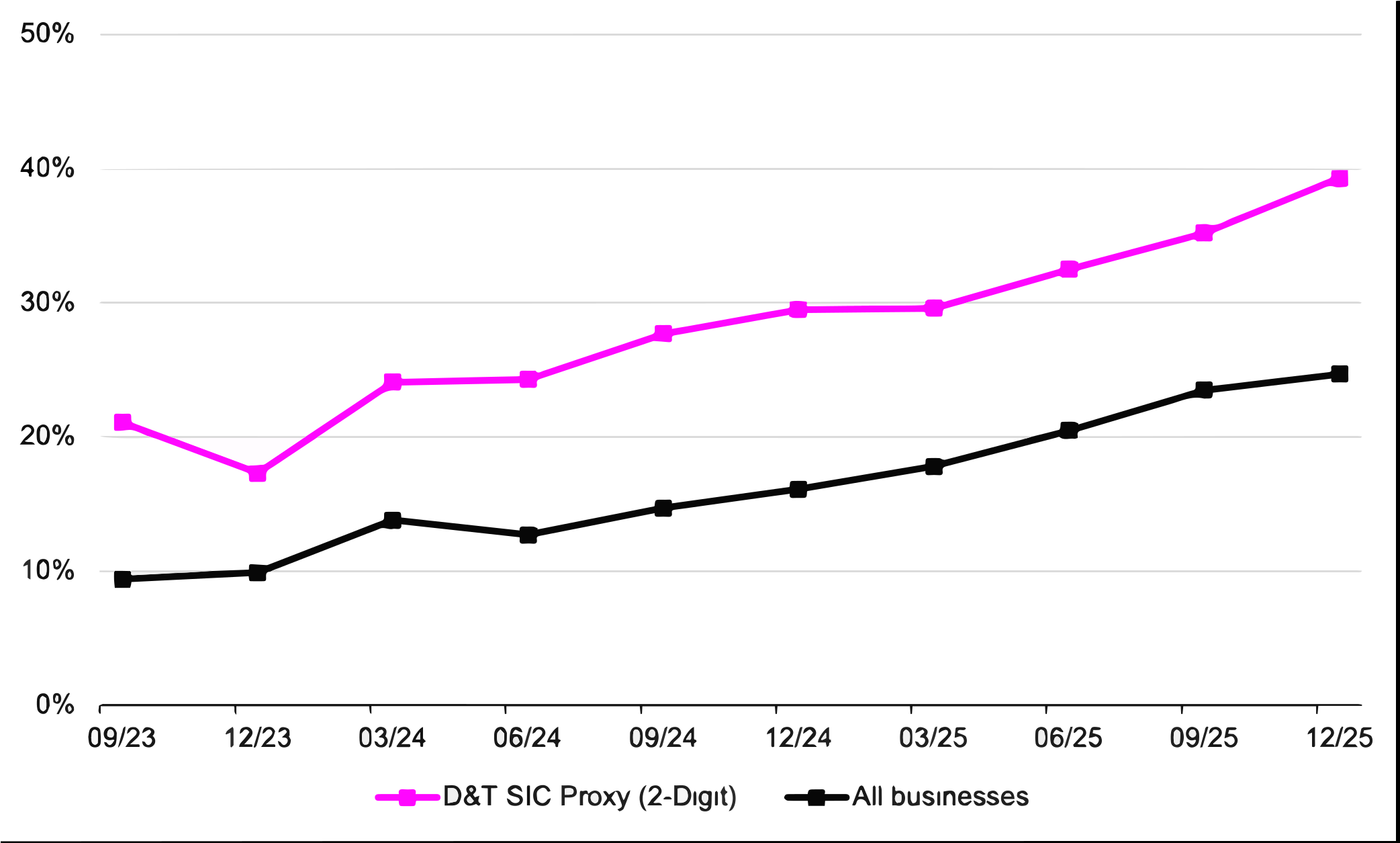
High exposure to AI does not mean jobs will simply be replaced, but it does mean AI will reshape how work is organised and where productivity gains can be realised. Adoption is already ahead of the national average: in December 2025, 39% of firms identified through a proxy for the Digital and Technologies sector reported adopting AI, compared with 25% of firms across the economy (see Figure 1). That combination of high exposure and above-average adoption means the sector is well placed to capture early gains, but it also raises the importance of accelerating effective deployment.
Figure 1: Percent of Business using at least one AI technology - D&T SIC Proxy vs All Sampled Businesses (ONS, 2026)[footnote 3]
How the sector is approaching adoption
My engagement with businesses revealed significant variation in how far adoption has progressed. Some firms are embedding AI deeply across multiple functions, products and services; others are at a much earlier stage, working with individual tools and discrete use cases. For most, the question is no longer whether AI matters but how far and how fast to take it. Understanding where firms sit on that spectrum, and what helps them progress, is what shapes the rest of this plan.
These are some of the most exciting applications that I heard about in my conversations with businesses about how they are using AI today:
-
AI-native engineering - AI coding tools are supporting engineers across the software development lifecycle, from coding and testing to documentation and code review. Used well, they can reduce repetitive engineering tasks, improve product iteration and free teams to focus on architecture, quality, security and user needs. For example, Arm has focused on providing employees with access to high-value use cases across hardware and software engineering, including AI-assisted code review, debugging, workflow optimisation, optimisation regression and vulnerability identification. See the case study below for more detail on how Arm are deeply integrating AI across their organisation.
-
AI-powered cyber security - AI is helping firms move from reactive to more preventative cyber defence by identifying unusual activity, prioritising vulnerabilities and responding to threats faster than traditional rule-based systems. This is particularly important for digital and technology firms whose products, platforms and supply chains depend on trust and resilience. For example, Darktrace uses self-learning AI to understand normal behaviour across an organisation’s digital estate and detect activity that could cause disruption. Its platform can contextualise connections and respond to known and novel threats in real time, including those targeting networks, email, and AI systems and agents
-
AI-enabled telecoms fraud prevention - AI can help telecoms providers detect suspicious calling patterns and protect customers from scam and spam calls at network scale. Virgin Media O2 is using a call defence system to analyse calling patterns in real time and flag suspicious numbers directly on users’ screens. Since launch, the system has identified over one billion suspected scam and spam calls, showing how AI can act as a high-volume, real-time decision layer within telecoms infrastructure and help reduce customer exposure to fraud.
-
AI scientific tools for engineering biology – AI is accelerating biological discovery by helping researchers design, test and scale new biological solutions more quickly, supporting renewed progress in decarbonisation, pandemic preparedness, food security, the eradication of preventable illness, and more. The potential for AI scientific tools to accelerate biological discovery, reduce the number of physical experiments required, and help researchers analyse large datasets across different scientific fields is vast. For example, Epoch Biodesign is tackling plastic waste by engineering enzymes that can break down hard-to-recycle plastics at low temperatures. AI can address scale-up bottlenecks in engineering biology by accelerating bioprocess optimisation. New Wave Biotech is doing just this - supporting biotechnologies to scale more quickly and cheaply with AI-powered process simulation and optimisation, supporting targeted decision making and fewer costly R&D runs.
Case study: How Arm is building an AI-native organisation
Arm is building an AI-native workplace by enabling employees - particularly engineers - to use AI in their day-to-day work so they can drive organisation-wide transformation via AI adoption.
The company has focused on high-value use cases across hardware and software engineering, including AI-assisted code review, debugging, workflow optimisation, optimisation regression and vulnerability identification. It is also using AI to support code optimization for the Arm ecosystem and deploying knowledge assistants to help employees rapidly retrieve information from extensive internal documentation.
Adoption has been supported through broad access to tools, with approximately 70% of Arm’s engineering population using a coding assistant on a regular basis. Arm views this tool not only as a coding aid, but as a broader productivity assistant connected to wider data and knowledge systems. To drive uptake, the company is also running hackathons and bootcamps across its sites.
Arm’s strategy combines innovation with governance. It is exploring new AI-enabled ways of working while introducing guardrails around responsible use, sustainability and quality assurance. Its solution development kit and “develop faster, share faster, scale faster” model are designed to help teams build, reuse and scale AI solutions more effectively.
This approach is delivering clear productivity gains across key workflows. At the heart of these improvements is Arm’s AI-native strategy - empowering everyone at Arm to drive productivity by giving them access to AI-enabled tools, use cases and workflows. Arm’s experience shows how AI can be embedded at scale to augment expertise, improve ways of working and equip a highly skilled workforce for the AI era.
Barriers to AI adoption and integration
Across the Digital and Technologies sector, firms are often able to stand up initial AI use cases relatively quickly - for example internal chatbots, coding assistants, content generation tools and data analysis. The harder challenge is scaling these into production environments and embedding them into day-to-day workflows so that they drive transformation. My engagement with businesses suggests that the following barriers are the most important in preventing firms from moving from experimentation to integration.
-
Skills and management capability: Skills were one of the most commonly cited barriers to adoption. For frontier technologies such as quantum and engineering biology, bilingual AI talent is a scarce but highly valuable resource. However, the issue is broader than technical expertise. Firms need leaders and managers who can identify good use cases, manage change, evaluate outputs and redesign workflows. Management capability can matter as much as technical skill. Wider research suggests that better-managed firms are significantly more likely to adopt AI successfully, which reflects what I heard directly from businesses: where leadership is engaged and ownership is clear, adoption moves faster and delivers more value.
-
Use-cases and integration: For many firms, the issue is not whether AI matters, but where it can create the most value and how it should be integrated into real business processes. Many businesses are experimenting with multiple tools, but relatively few feel they have embedded AI across core workflows. The challenge is often moving from a promising demo to a reliable production use case with clear success metrics, process changes and human oversight. As with previous general-purpose technologies, the biggest productivity gains come not from adoption alone, but from integration and organisational change.
-
Cultural, behavioural and workforce challenges: AI adoption is being shaped as much by people and organisational culture as by the technology itself. Businesses described poor early experiences reducing trust, overhyped expectations leading to disappointment, and uneven confidence across teams. Technical staff are often more comfortable experimenting, while non-technical teams need clearer guidance and support. Firms also stressed the importance of psychological safety: people need to feel able to test tools, challenge outputs and learn from mistakes if adoption is to spread more widely. These challenges are closely linked to workforce impacts. With a substantial proportion of work exposed to AI, firms are beginning to rethink hiring, job design and progression routes. Some are slowing recruitment, while others are redesigning entry-level roles around judgement, critical thinking and adaptability.[footnote 4] But there is real concern that, without deliberate action, AI could reduce entry-level opportunities and weaken the routes through which junior workers build foundational skills.
-
Data readiness: This is cited by some businesses as a barrier, but it is generally less of a constraint in this sector than across the wider economy. Many Digital and Technology firms are further ahead, with stronger data foundations, clearer ownership and more mature governance. Where data is fragmented or hard to access it can still slow the move from pilots to deployment, but for most firms here it is no longer the main thing holding adoption back. That relative strength is an opportunity in its own right, with the sector well placed to set an example on data readiness and to help businesses across the wider economy prepare their data for AI.
-
Governance, trust and security: Uncertainty around governance is a major barrier to scaling AI adoption, particularly in core operations or customer-facing processes. Businesses raised concerns about privacy, cyber security, use of proprietary or sensitive data, and the reliability and accountability of AI outputs. In many cases, firms are less worried about whether AI can perform a task than whether it can do so safely, consistently and in a way that can be audited. This is compounded by uncertainty about how existing rules - including on data protection, consumer rights, intellectual property and sector-specific compliance - should be applied to rapidly evolving AI tools and use cases. Where that clarity is missing, businesses often restrict AI to low risk use cases and delay wider deployment, underscoring the need for clearer, practical guidance and adaptable guardrails.
-
Pace of change and product uncertainty: A final barrier is the sheer pace of change in AI tooling. Model capabilities are advancing rapidly, platforms are evolving quickly, and the range of available technology stacks continues to grow. For businesses, this creates real uncertainty about which tools to back, particularly where adoption requires significant time, cost and organisational change. As a result, some firms are hesitant to make larger-scale investments or embed tools more deeply, for fear of committing too early to an approach that may soon be overtaken. This is helping to sustain a pattern of ongoing experimentation rather than confident, long-term integration. Businesses also highlighted the lack of shared standards and straightforward ways for buyers to identify trusted suppliers, which can further slow procurement, reduce confidence and make it harder for adoption to spread beyond the firms and places already ahead.
Businesses described a range of ways to overcome these barriers, but the clearest theme was the importance of experimentation and rapid learning. Businesses consistently told me that they learn best from peers, and some are engaging in AI guilds and communities of practice - often among developers - to share lessons, identify where AI tools add most value, and clarify where human judgement remains essential. However, there is still no consistent structure for capturing and spreading practical lessons across the sector. As a result, smaller firms and those outside the strongest clusters often have less access to trusted guidance, specialist support and credible case studies.
Figure 2: Percent of Firms Reporting Factors that have Prevented or Delayed AI Adoption - D&T SIC Proxy vs All Sampled Businesses (ONS BICS, DSIT Analysis)
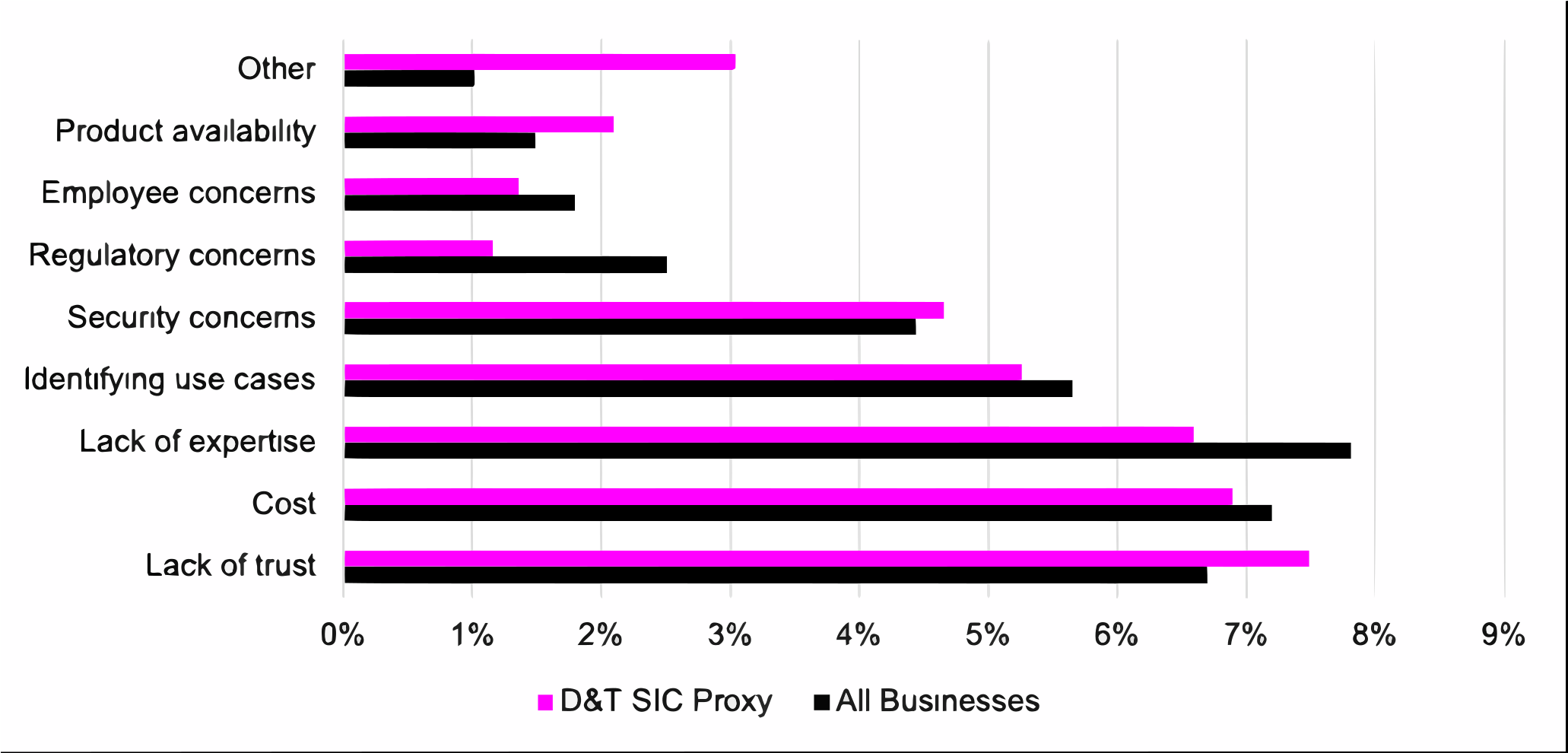
In the March 2026 Business, Insights and Conditions Survey (BICS), the most frequently cited barriers to AI adoption reported by Digital and Technology firms were lack of trust, cost, and lack of expertise (Figure 2). This broadly fits the pattern observed in the rest of the economy, although regulatory concerns and expertise are relatively less prevalent in the Digital and Technologies sector than the rest of the economy, and trust, availability, and firms responding with “other” barriers are more represented in the sector.[footnote 5]
Case study: Fuzzy Labs
Fuzzy Labs is a Manchester-based AI consultancy specialising in machine learning - showing that even AI-native companies benefit from a deliberate, culture-first approach to internal adoption.
Last year, Fuzzy Labs recognised that AI tools were not being used as widely or effectively as they could be. Rather than treating this as a training gap, leadership saw it as a cultural challenge. Capable engineers were cautious about quality, over-reliance and skill erosion - concerns the company acknowledged rather than dismissed.
Its response focused on trust and experimentation. Fuzzy Labs introduced internal hackathons, giving staff protected time to explore AI tools in a low-pressure setting and identify where they could support real engineering workflows. This helped shift norms. AI coding assistants are now a routine part of work but remain subject to human judgement and review. Teams continue to experiment with proprietary and open models, with peer-led knowledge sharing helping spread effective practice.
Recommendations to accelerate adoption
I have structured the recommendations in this plan into three sections. First, I set out the actions I will take forward in my role as AI Champion, working in partnership with businesses across the sector, government and trade unions. Second, I highlight areas where government can build on its existing approach to better address the barriers and opportunities facing Digital and Technology companies. Finally, I set out the role that businesses and workers in the sector can play in helping to make this plan a success.
In my role as AI Champion:
Action 1: Establish an Early Careers Jobs Alliance for the AI era
Problem statement:
AI is beginning to change the nature of entry-level work in the sector. Tasks that have traditionally helped junior workers build foundational skills are increasingly being supported by AI, and firms are responding in different ways - from reassessing hiring to redesigning roles around judgement and problem-solving. While recent falls in employment among 16 to 24 year-olds cannot directly be attributed to AI, they are a warning sign that entry-level routes into the sector may already be under pressure. The challenge for the sector is to redesign, not reduce, early-career opportunities and act as an example to other sectors across the economy that are facing similar challenges. There is an opportunity for us to lead by example in how we create rewarding entry-level pathways for our young people in the AI era.
Proposed action:
That is why I want to establish an industry-led Early Careers Jobs Alliance for the Digital and Technologies sector, bringing together young people, employers, sector bodies and trade unions to set out a positive vision for how entry-level roles and pathways should evolve as AI becomes embedded in the workplace. This would be based on a simple proposition: firms should redesign, not retreat from, early-career opportunities. The Alliance would ask employers to commit to practical action, including reviewing how AI is changing work; protecting structured learning opportunities; defining the skills new entrants now today and in the future; and piloting redesigned entry-level roles, apprenticeships or graduate pathways. It should produce reusable materials for the sector, such as job descriptions which reflect the need for relevant AI skills, entry-level skills frameworks, and case studies from participating firms, and create a feedback loop between industry and government to enable policy changes in skills development to better align with the needs of the sector.
Intended impact:
The Alliance would help ensure that AI adoption supports, rather than undermines, a strong talent pipeline for the Digital and Technologies sector. It would give employers a clearer model for designing junior roles in AI-enabled teams, while helping early-career workers build the foundational technical skills, judgement and AI capability they need to progress. It would also provide a positive, pro-worker vision for AI adoption in the sector. I want to show that productivity gains need not come at the expense of opportunity. Done well, the Alliance would help modernise routes into tech careers, improve alignment between training and employer demand, and support better-designed junior roles across firms of different sizes and sub-sectors.
Case study: Autotrader: protecting entry‑level tech roles in the age of AI
Autotrader demonstrates how firms can adopt AI while retaining a strong drive to create entry-level opportunities and nurture junior talent. As generative AI increasingly automates routine coding and data tasks, Autotrader has focused on developing engineers through graduate programmes, apprenticeships and T-Levels who can use AI as part of their roles, rather than being replaced by it.
It has created a two-year graduate programme in which new hires are trained on the foundational engineering skills needed to use AI tools effectively, alongside non-technical human skills including communication, teamwork and adaptability. Meanwhile, those on apprenticeships now spend longer in a structured, classroom-based environment, working through challenging tasks in controlled settings. This helps them build confidence in using AI tools and bridges the gap between education and the workplace. As a result, when trainees move into live engineering environments, they are better prepared and able to have greater impact. In addition, Autotrader provides work experience schemes for T-Level students to help the next generation of workers to develop both technical and softer skills by placing them in project teams in which they gain real-world experience of a professional work environment.
In 2026, trainees joining Autotrader through graduate programmes, apprenticeships and T-levels accounted for around 10% of its engineering team - its largest cohort to date.
Next steps:
I plan to convene a group of employers, sector bodies and trade unions to shape the Alliance, agree its core commitments, and identify practical areas for early action. Firms that want to help shape the future of entry-level tech roles are encouraged to get in touch and support this important work.
Action 2: establish a sector-led programme that identifies, captures and diffuses the AI use cases with the greatest potential to improve productivity, growth and competitiveness in the Digital and Technologies sector
Problem statement
AI adoption is already widespread in the sector, but this adoption is often fragmented and uneven. Many firms are experimenting with multiple tools across different teams, but only a minority feel they have reached meaningful, embedded use across core workflows. Businesses told me there is a clear gap between what AI tools are capable of and how confidently firms can apply them to real business problems.
The challenge is not simply that firms lack interest in AI. Many are already trying things, but without clear use-case prioritisation, defined success metrics or standardised ways to assess productivity, efficiency and risk. In the absence of formal playbooks, firms are relying heavily on peer-to-peer learning to build capability. The opportunity is therefore to identify the highest-value use cases, capture what works, and diffuse practical learning across the sector so more firms can move from pilots to productive adoption.
Firms would also like more structured opportunities to learn from each other when approaching AI adoption. In a recent paper, the OECD also identified peer to peer learning, including network events, case-sharing platforms and practitioner forums as an effective way of helping businesses within the same sector or network to learn from each other about successful digital adoption pathways. Meanwhile, a recent randomised control trial across 515 start-ups found that firms who received structured case studies on how other firms have adopted AI reported 44% more AI use cases and generated 1.9× higher revenue than the control group
Proposed action
I would like to work in partnership with techUK, the UK Tech Cluster Group and its regional cluster member organisations to establish a sector-led programme that identifies, captures and diffuses the AI use cases with the greatest potential to improve productivity, growth and competitiveness in the Digital and Technologies sector. The programme should build on existing regional AI adoption programmes such as techSPARK in Bristol, Sheffield Digital’s Pathways off the Plateau, Tramshed Tech’s AI-Enable programme in South Wales, and Scotland IS’s AI skilling mission, and use existing cluster networks to reach SMEs. Delivery mechanisms should be informed by evidence on what works, and could include structured case-study libraries, peer-to-peer networks of exemplar firms, SME demonstrator programmes and bundled diagnostic-plus-integration support.
Intended impact
This action would give firms clearer direction on where AI can deliver the greatest business value and reduce uncertainty about where to start. It would help businesses move beyond scattered experimentation by showing which use cases are working in practice, what conditions enable them, and how they can be adapted by firms of different sizes, sub-sectors and levels of maturity.
It would also create a shared knowledge base of how to integrate AI effectively across the UK, supporting wider diffusion of AI adoption beyond the firms and places already ahead. Done well, the network would strengthen peer learning, improve confidence in adoption, increase take-up of proven use cases and help the sector shift from pilots to embedded productivity gains.
Autotrader: protecting entry‑level tech roles in the age of AI
Autotrader demonstrates how firms can adopt AI while retaining a strong drive to create entry-level opportunities and nurture junior talent. As generative AI increasingly automates routine coding and data tasks, Autotrader has focused on developing engineers through graduate programmes, apprenticeships and T-Levels who can use AI as part of their roles, rather than being replaced by it.
It has created a two-year graduate programme in which new hires are trained on the foundational engineering skills needed to use AI tools effectively, alongside non-technical human skills including communication, teamwork and adaptability. Meanwhile, those on apprenticeships now spend longer in a structured, classroom-based environment, working through challenging tasks in controlled settings. This helps them build confidence in using AI tools and bridges the gap between education and the workplace. As a result, when trainees move into live engineering environments, they are better prepared and able to have greater impact. In addition, Autotrader provides work experience schemes for T-Level students to help the next generation of workers to develop both technical and softer skills by placing them in project teams in which they gain real-world experience of a professional work environment.
In 2026, trainees joining Autotrader through graduate programmes, apprenticeships and T-levels accounted for around 10% of its engineering team - its largest cohort to date.
Next steps:
I will work with techUK, the UK Tech Cluster Group, regional clusters and a group of exemplar firms to scope the programme.
Action 3: Develop an AI Adoption Framework for the Digital and Technologies sector
Problem Statement
The adoption challenge isn’t access to the technology - firms are already experimenting with and deploying AI tools - it’s how to actually operationalise at scale and integrate properly across workflows, systems and products.
A consistent message is that governance, risk, integration and moving from experimentation to production are the real sticking points. There is a broad spectrum of data maturity across the sector, and while data readiness still matters, it’s not the thing holding most businesses back day today. The more immediate need is practical support on how to operate AI in real business environments.
Firms are looking for clearer ways to:
- establish internal guardrails for safe and responsible use
- understand data sovereignty, including what data is being shared, when and with whom
- give teams clear guidance on which tools can be used, how they should be used, and what data can and cannot be input
- navigate external risks, particularly around vendor practices, data handling and liability
- integrate AI across workflows, systems and products, rather than leaving it in isolated use cases
- move from experimentation into something that is embedded and scalable
Proposed Action
To address this, I recommend the development of an AI Adoption Framework for the Digital and Technologies sector. This needs to be practical and usable, not another static document. It should be flexible, regularly updated and reflect how quickly this space is moving, as well as the different levels of maturity across businesses.
The framework should:
- set out clear guidance on governance, guardrails and responsible use, both internally and in relation to external partners and vendors
- help businesses make informed decisions about tools and vendors, with much clearer expectations on data sovereignty and what providers are doing with business data
- provide practical guidance that can be used internally to brief and manage teams, reducing the risk of inconsistent or informal use of AI tools
- include real implementation pathways, grounded in business use cases rather than theory
- be modular, so businesses can engage with it at the right level for where they are
- be shaped with industry and updated as practice evolves, not designed once and left
In parallel, I also recognise the opportunity to strengthen data readiness and data exploitation across the wider economy. The sector has a clear role to play here. I therefore also recommend developing a data readiness playbook for wider sector use, helping businesses across the economy to better prepare, manage and unlock the value of their data as a foundation for AI adoption.
Intended Impact
This framework will support firms to adopt by helping them make better use of existing datasets, strengthen governance and security, and reduce uncertainty around responsible deployment. By providing practical, tested approaches rather than abstract principles, it should help firms move more confidently and quickly from experimentation into deployment.
Over time, this should accelerate productivity and innovation gains from AI across sectors, reduce implementation risk, and support more consistent, responsible adoption - particularly among SMEs that lack internal specialist capacity but are keen to adopt AI effectively.
This also needs to be built with an eye on what’s coming next. AI and cyber are already embedded across much of the sector, but emerging technologies such as quantum will introduce new considerations, particularly around data security and how AI systems are developed and deployed. If this framework is going to be useful, it has to be able to adapt as that landscape shifts.
Case study: Quantexa and Vodafone - using better data to support AI adoption
Vodafone Business faced a challenge familiar to many large firms: years of growth, mergers and new systems had left its customer data spread across different platforms. This made it harder for teams to get a clear view of customers, understand their needs, and use data confidently to make decisions.
Vodafone worked with Quantexa to bring this information together and make it easier for teams to use. The first step was creating a single view of each customer, drawing together using Quantexa’s dynamic entity resolution technology to unify data from across products, services and systems. This helped sales, customer care and service teams find the information they needed more quickly, rather than relying on multiple systems or waiting for separate data requests.
The work then expanded into new tools to help Vodafone identify potential customers, improve the quality and governance of its data, and make data easier for non-technical teams to search and use. This meant more people across the business could use trusted information in their day-to-day work, without needing specialist data skills.
The impact was practical and immediate. Sales teams could prepare for customer conversations faster, service teams could resolve issues more quickly, and data teams could spend more time producing useful insights rather than responding to basic information requests. Vodafone also supported adoption by building a network of internal champions, improving the user experience, and providing guidance and training.
This case study shows that successful AI adoption often starts with getting the basics right. By working with Quantexa to clean, connect and make better use of its data, Vodafone created a stronger foundation for AI - helping teams make faster decisions, improve customer service and identify new opportunities for growth.
Next Steps:
I will work with a group of leading Digital and Technology firms to co-design the framework, drawing on their experience of governance, data readiness and deployment in practice.
For government:
In this section, I offer my reflections for government on how it can strengthen its existing policy programme to help the Digital and Technologies sector make the most of the opportunities presented by AI adoption. This is not about starting from scratch, but about moving further and faster on measures already under way. I believe progress in the areas set out below will be particularly important over the next 18 months, as AI capabilities continue to advance rapidly and the need for clear, practical government support becomes more pressing.
-
AI Assurance: My engagement with the sector has made clear that concerns around trust are causing some businesses to hesitate before adopting AI at scale. This is particularly true where AI is being integrated into core business operations or into customer- and client-facing processes, where reliability, transparency and accountability are especially important. The UK already has a world-leading AI assurance sector, and this is a clear strength that government should build on. A stronger assurance market would not only support the growth of an important UK capability in its own right but also help give businesses the confidence to adopt AI more widely and responsibly. In turn, that would support the development and diffusion of trusted AI products and services across the economy. I therefore encourage government to continue strengthening the UK’s AI assurance market, building on the commitments set out in last year’s AI Assurance Roadmap, and to ensure that businesses of all sizes can more easily access the tools, standards and services they need to adopt AI with confidence.
-
Regional adoption and local growth: I welcome the government’s commitment to ensuring that AI adoption is a UK-wide opportunity, rather than one concentrated in a small number of clusters. The announcement of Barnsley as the UK’s first Tech Town is a positive signal of intent and an important step in recognising the role that towns across the UK can play in driving innovation-led growth. However, one Tech Town alone will not be enough if we want the benefits of AI to be felt in all parts of the country. This ambition should be scaled up significantly so that more communities, and the many Digital and Technology sector businesses within them, can benefit from AI-driven growth. And, just as government is convening an AI Adoption Summit for the Industrial Strategy sectors in London this Summer, future summits should be held in the UK’s industrial heartlands. That would send a strong signal that AI-enabled growth is a national priority, with opportunities for every region and nation of the UK.
-
Regulatory clarity: When I speak to the sector – and its customers across the economy – many aspects of regulation work effectively to safeguard the public and encourage responsible AI adoption. There are, however, areas where regulation makes adoption challenging, or where uncertainty in how existing regulation should be interpreted for a new technology slows AI adoption. For example, the application of GDPR and specific elements of sectoral regulation to new AI products or services. I encourage regulators to continue to navigate this uncertainty with companies to support the safe and responsible adoption of AI. The government also recognises that regulation needs to keep pace with technological change and have announced their intention to legislate to establish an AI Growth Lab. This is a good step in the right direction.
-
Data: Business leaders repeatedly raise the need for greater clarity and modernisation of the rules and regulations that govern how data can be accessed, shared, and used. It is clear that this continues to affect firms’ appetite to integrate AI into their workflows and risks impeding adoption at scale. While some positive steps have already been taken, I am calling for a renewed ambition in Government to reduce unnecessary barriers to the responsible use of data for AI adoption, actively incentivising this for economic growth, and building in safeguards that are proportionate to any associated risks. If the UK gets this right, there is an opportunity to build strategic advantage in AI adoption. Smart regulatory policies and interventions that help create the conditions for businesses to do more with data will help unlock the full potential of our Digital and Technologies sector and economy as a whole.
-
The convergence of AI with other frontier technologies: The AI for Science strategy is a significant step towards supporting AI’s convergence with frontier technologies. As this is taken forwards, I would like to underscore the importance of training and upskilling in AI methods to support development of leading research and entrepreneurial talent, curating and making available AI-ready datasets in biology, energy, quantum technologies and beyond and developing pathways for UK businesses to access the compute resource which is now so vital in modern R&D.
Concluding remarks
Alongside the actions set out in this plan, I want to conclude by addressing the businesses and workers from the Digital and Technologies sector.
As suppliers to the wider economy, Digital and Technology companies should ensure that the products and services they develop are as easy to adopt as possible. Businesses consistently tell me that the challenge is not just access to AI, but understanding where it can add value, how to implement it, and what it will cost over time. I therefore encourage technology suppliers - both UK firms and international companies with a strong UK presence - to do more to demonstrate high-value use cases, provide practical adoption support, and improve pricing transparency.
Our sector also has an important role to play in showing the wider economy how to adopt our technology well. I encourage firms that are already integrating AI successfully to share practical lessons on deployment, productivity gains, workforce impacts and governance. The actions in this plan are designed to build on expertise that already exists within the sector, and their success will depend on businesses being willing to contribute case studies, participate in peer-learning networks, and support collective initiatives such as the Early Careers Jobs Alliance and the AI Adoption Framework. If you are a business in the sector and would like to support this work, I would welcome your involvement.
-
Macroeconomic productivity gains from Artificial Intelligence in G7 economies (EN). See Figure 4. Exposure here refers to whether the use of AI can substantially decrease the amount of time to complete the task. ↩
-
Ibid. See Figure 10 ↩
-
Business Insights and Conditions Survey (BICS) Wave 92 to 147, Artificial Intelligence (AI) Adoption Ad Hoc Tables: Department for Science, Innovation and Technology - Office for National Statistics See “Requested SICs” for specific proxy definition for D&T (2-digit SIC code, here).
DSIT is developing an updated SIC-based proxy definition for the D&T sector as part of the Digital and Technologies Sector Statistics release (published in June 2026). Therefore, this analysis should be treated as indicative rather than a definitive representation of the sector. ↩ -
Economic Estimates: Employment in the Digital Sector, January 2024 to December 2024 - GOV.UK In 2024, UK digital sector employment dropped for the first time in a decade, with the number of 16–24-year-olds in computer programming down 44% in a single year. Note, that while suggestive, there is no conclusive evidence that AI is the cause of this decline. ↩
-
Data from ONS BICS Wave 153, analysis for D&T sector by DSIT. Note that ONS does not bear responsibility for this additional analysis or interpretation. Based on a sector SIC proxy definition (Sector Plan, Table 1). Note: DSIT is developing an updated SIC-based proxy definition for the D&T sector as part of the Digital and Technologies Sector Statistics release (published in June 2026). Therefore, this analysis should be treated as indicative rather than a definitive representation of the sector. ↩