Adult education and skills funding allocation technical guidance: 2026 to 2027
Updated 26 May 2026
Applies to England

© Crown copyright 2026
This publication is licensed under the terms of the Open Government Licence v3.0 except where otherwise stated. To view this licence, visit nationalarchives.gov.uk/doc/open-government-licence/version/3 or write to the Information Policy Team, The National Archives, Kew, London TW9 4DU, or email: psi@nationalarchives.gov.uk.
Where we have identified any third party copyright information you will need to obtain permission from the copyright holders concerned.
This publication is available at https://www.gov.uk/government/publications/adult-education-and-skills-funding-allocations-guidance/adult-education-and-skills-funding-allocation-technical-guidance-2026-to-2027
1. Purpose
This guidance sets out the methodologies and technical details for the following allocations for the 2026 to 2027 funding year:
- apprenticeships non-levy (procured)
- adult skills fund
- advanced learner loans
We will publish information and updates to this page as we issue funding allocations for the rest of the 19+ funding streams.
We have divided this guidance into sections, which include general information on allocation statements and the business case process.
The allocation methodologies section explains the funding methodologies specific to the funding agreements and separate allocation lines you hold with the Department for Education (DfE).
We have included a glossary to explain technical terms.
2. Contact us
If you have questions after reading our guidance, or if there is anything else you need help with, you can find more support in our customer help centre.
3. Understanding the terminology
The 2026 to 2027 funding year runs from 1 August 2026 to 31 July 2027.
We will use the generic term ‘you’ or ‘provider’ unless the section only applies to a specific provider type.
We use the term ‘non-procured’ to include providers funded through a:
- financial memorandum
- conditions of funding (grant)
We use the term ‘contract for services’ to include providers funded through a:
- contract for services
- conditions of funding (grant) – employer
When we refer to ‘Adult skills fund (ASF)’, this is funding that you can claim from us for delivery of Department for Works and Pensions (DWP) adult skills fund to learners outside of devolved areas.
4. Allocation statements
You must follow the relevant funding formula and rules guidance when managing your funding.
We will monitor how you use the funding and adjust in line with performance management arrangements, when published.
4.1 Disclaimer
Allocation statements are not legally binding. They do not create any legal obligation against the Secretary of State for Education, acting through DfE.
We reserve the right to remove or reduce your allocation if we find incorrect data or audit errors as part of our funding assurance and monitoring work.
4.2 How to access your allocation statement
Your allocation statement is available to view on manage your education and skills funding.
Manage your education and skills funding is an online service that gives you access to information about contracting and payments. We use this service to share your:
- contract documents
- allocation statements
- remittance reports (payments)
- subcontracting declarations
- reconciliation statements
To use this service, you need to:
- have a DfE Sign-in account
- add the ‘Manage your education and skills funding’ service
- request the ‘View allocation statements’ subservice
Your allocation statement will show how:
- much we have allocated to you for the 2026 to 2027 funding year
- this spans financial years (August 2026 to March 2027 and April 2027 to July 2027)
If we change your allocation, we may update your original allocation statement. You will be able to view all versions of your statements on manage your education and skills funding.
4.3 Why a statement is not issued
You will not see a funding line on your allocation statement if we have calculated zero allocation. We will write to you separately if you currently have a contract for the relevant funding stream and this applies to you. See the business case process section for more information.
You will not receive an allocation statement if:
- your provision is about to change, for example you are about to merge with another organisation or take on learners from a failing provider
- you are subject to an investigation or we are reviewing your allocation due to a complication or known data error
- you have received notice that we are terminating your contract
4.4 How we apply infrastructure changes
If you merged or were part of a disaggregation before we issue allocation statements, and we have received confirmation from your organisation, we reflect this in your allocation. We aggregate your data for each of the providers into the continuing provider.
For disaggregation cases, we split the allocation using the agreed proportions.
If we have not received confirmation of a merger or disaggregation, then you will not receive a merged or disaggregated allocation.
4.5 Quality standards to statements
We use historic delivery and performance data to calculate your allocation to make sure provision is of a high quality. We will use your track record to assess your ability to deliver education and training to the required standard. We may reduce your allocation if one or more of the following is true:
- your Ofsted grade is inadequate or equivalent
- you are in formal intervention for minimum standards or inspection
- you have been issued with a notice for financial control
- you have been issued with a notice to improve, additional conditions of funding or additional contractual obligations in relation to minimum quality standards for 19+ education and training
- you have significantly underdelivered against your contract value in previous years
- you are subject to an investigation for breach of contract or failed audit
5. Business case process
5.1 Why submit a business case
You should only submit a business case if you:
- have made significant data errors that have affected your funding allocation
- had a contract value for funding year 2025 to 2026 but did not use it and therefore you have not received a 2026 to 2027 allocation
- want to request a reduced allocation amount or remove allocation
- want to transfer 19 to 23 year-old adult skills core to free courses for jobs
5.2 Why not to submit a case
We do not accept requests for growth. We review this as part of in-year performance reviews within the relevant funding rules or through final reconciliation.
5.3 When to submit a business case
There are different deadlines to submit a business case dependent on when you received your allocation. Business cases can be submitted from the day following allocations being published to the published deadline.
For allocations issued in February 2026
These refer to apprenticeships non-levy (procured) allocations. The deadline to submit a business case is 28 March 2026.
For allocations issued in April 2026
These refer to:
- advanced learner loans facility
- bursary and adult skills fund allocations
The deadline to submit a business case is 29 May 2026.
5.4 How to submit a business case
Submit your business case using our digital form after reading our form guidance.
5.5 Thresholds for business cases
If we issued you with a zero allocation, the maximum you can request is £25,000 or your current contract value, whichever is lower.
For cases where you have significant data errors that affected your funding allocation, the minimum overall impact must be more than 5% of the allocation value.
We will apply the allocation methodology as set out in this guidance when reviewing business cases using a nationally consistent formulaic calculation.
5.6 Response timelines
We aim to communicate the outcomes by the end of June 2026 through Document exchange.
6. Allocation methodologies
We have split the allocation methodologies in this guidance by the funding agreements and allocation lines you have with DfE.
It is essential that you read the rules that apply to you. You may have more than one agreement and will need to read the parts that relate to that funding agreement, funding stream and allocation line.
We have updated the following sections:
- apprenticeships non-levy (procured)
- advanced learner loan facilities and bursaries
- Adult skills fund (non-procured)
- Adult skills fund contract for services (procured from August 2023)
The allocations that we issue set the value at which we will manage and pay a provider for the funding year. Your allocation is the maximum amount you can earn in the 2026 to 2027 funding year and not necessarily the amount you will be paid.
We allocate funding on a historic (lagged) basis, whereby funding in one year informs the allocation in the next. This means that we base the allocation for an academic year on the last full academic year delivery. For example, 2026 to 2027 allocations are largely based on 2024 to 2025 R14 individualised learner record (ILR) data submissions. Some allocations may differ and more information is provided in each allocation methodology.
When processing allocations, we abide by the following standards:
- calculate allocations on an annual basis using nationally consistent methodologies, taking into account the current policy position and affordability
- reflect lagged full-year delivery and current allocations to ensure that future allocations are in line with what providers can realistically earn
- ensure that we treat all providers fairly and equitably
- protect public funds and meet principles of public law
- enable providers to respond to government priorities
7. Apprenticeships non-levy (procured)
This section sets out how we have calculated apprenticeship non-levy extension allocations for 1 April 2026 to 31 March 2027. This will be of interest to training providers with an apprenticeship non-levy contract for services.
From 1 April 2021, you can no longer use this allocation to fund new starters. All new starters must be funded through the apprenticeship service from this date.
This allocation is for the purpose of carry-in learners only. The funding that we calculate is for apprentices who started on this contract on or before 31 March 2021 and who continue and require funding between 1 April 2026 to 31 March 2027.
Where necessary, we will allocate and extend your contract for services on an annual basis until apprentices who started on this contract between 1 January 2018 and 31 March 2021 complete their programmes and funding is no longer required.
We have used the same calculation for 16 to 18 and 19+ apprenticeships but we have run them separately at age-band level.
We use the R04 (December 2025) data return and our standard carry-in allocations methodology to calculate the funding required in 2026 to 2027.
We work out your allocation by calculating all future costs occurring between 1 April 2026 and 31 March 2027.
We assume that:
- all apprentices remain on programme until their planned end date
- no apprentices drop out
- all apprentices achieve on their planned end date and earn their achievement payment on this date
- learners who passed their planned end date in financial year 2025 to 2026 and are still in learning (for example, late achievements)
We apply a £1,000 minimum allocation. If you have a non-levy apprenticeship contract (split between age bands) for 2025 to 2026 and your allocation was less than this, then we have uplifted your allocation to this value.
This minimum allocation reduces to £1 to allow you to submit data if either:
- you received and did not use a minimum allocation in 2025 to 2026
- you had no recorded delivery in 2025 to 2026
- all your apprentices are recorded as break in learning or learners with late achievements greater than 3 years
Read the apprenticeship performance management rules for how we will review your contract value in-year, including payments and capping.
You must use your allocation within the terms and conditions of your funding agreement. You must operate within the relevant apprenticeship funding rules. If you do not operate within the rules, you will be in breach of your contract.
Your contract is for the financial year, and we will manage it as such.
Your procured non-levy apprenticeships contract remains separate from:
- apprenticeships carry-in allocations for starters before 1 January 2018
- any funding you may be earning through the apprenticeship service
We will inform you of your future apprenticeship non-levy funding for 2027 to 2028 later in this financial year.
8. Adult skills fund (non-procured)
Do not use this section for contract for services. See the Adult skills fund contract for services (procured from August 2023) section in this guidance.
If you have a query about the ASF funding allocated by a Mayoral Strategic Authority (MSA) or Strategic Authority, contact them directly.
This section applies only to your education and skills agreement.
ASF (non‑procured) has 2 ring‑fenced budgets:
-
adult skills (including adult skills core, tailored learning and funding for innovative provision)
-
free courses for jobs (FCFJ)
It is important that you pay attention to the different allocation lines. Each allocation line has its own calculation method and is subject to separate funding and performance management rules.
You can view this in manage your education and skills funding by reviewing the detailed allocation table. See the relevant sections within this guidance for details of each method:
- adult skills core (this includes learning support and learner support)
- tailored learning
- funding for innovative provision - FCFJ
We will fund learners who are residents outside of devolved areas and continue to support continuing learners who are residents in newly devolved areas.
Read the section on continuing learners for more information on these funding arrangements.
8.1 Changes for allocations 2026 to 2027
The key changes affecting your 2026 to 2027 allocation are:
- funding rate changes are already included in delivery data and allocations - we will not add separate rate uplifts
- over delivery – we no longer include over‑delivery above 100% and up to 110% in the baseline
- applied increases to FCFJ to support the expansion of more construction and engineering training - if you received construction funding in 2025 to 2026 and have not delivered construction courses you will receive a reduced FCFJ allocation removing the construction uplift
8.2 Adult skills fund allocations
We calculated your ASF allocations for the 2026 to 2027 funding year for providers that:
- are non-procured (grant funded)
- have a 2025 to 2026 ASF contract value, excluding continuing learners
- delivered ASF between August 2023 and July 2025
We use final delivery data in the calculation. This includes monitoring and audit adjustments and exception cases.
We adjust delivery data for the 2026 to 2027 allocation to reflect devolution from August 2025 in:
- Cornwall
- the East Midlands
- York and North Yorkshire
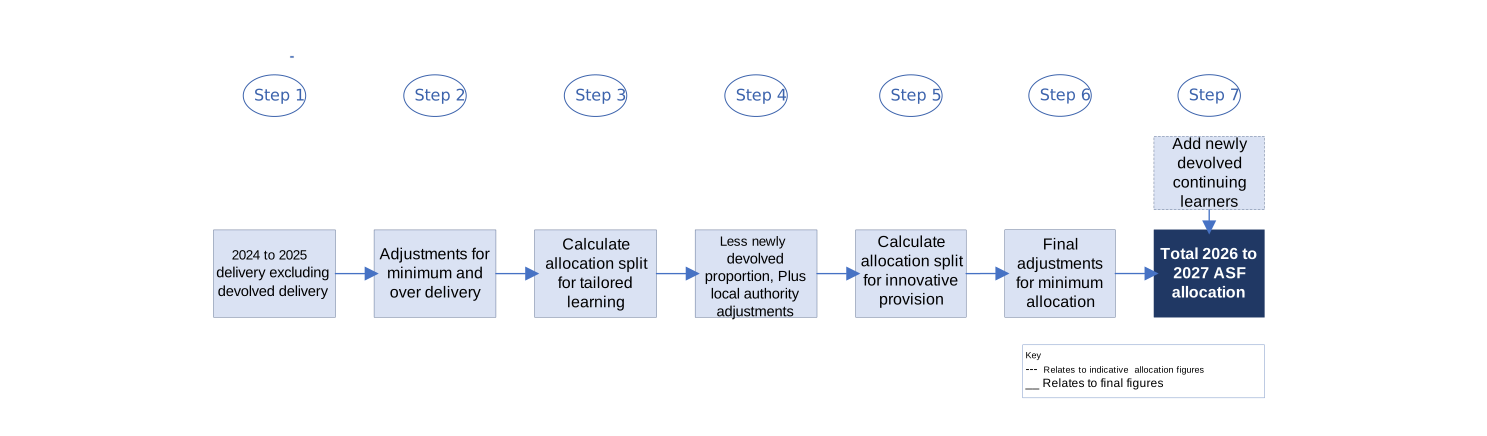
Figure 1 shows the methodology we have used to calculate ASF allocations.
Step 1: identify your baseline
We calculate your initial allocation, known as your baseline, using your final adult skills, tailored learning and innovative provision delivery for the 2024 to 2025 year. If your delivery is higher than your 2025 to 2026 contract value, we set your baseline at your 2025 to 2026 contract value.
We then reduce this figure to reflect areas that became devolved in August 2025. To do this, we remove the value based on the devolved percentage from the previous year. This approach makes sure you are not penalised for changes in devolved delivery.
We are not increasing allocation for over-delivery.
Step 2: apply adjustments
We adjust your funding allocation in the following scenarios if:
- your calculated allocation is more than £0 but less than £10,000, we increase it to £10,000
- you received funding for local authority pilots last year, we add the increase you received from the pilot back into your delivery
Step 3: calculate tailored learning value
For more information, see the adult skills fund: funding rules for 2026 to 2027. We will include a link in the Adult education and skills funding collection once published.
The tailored learning allocation line is the total of your non-qualification delivery. We are not changing this value based on delivery and therefore it will equal your 2025 to 2026 tailored learning contract value.
When the tailored learning value is below 5% of the overall allocation, we apply a minimum tailored learning value of 5% of the overall allocation for all non-procured providers.
We may limit your tailored learning value to the overall allocation if your community learning and formula-funded non-regulated provision is greater. This is the maximum amount of funding you can draw down for this purpose.
Our performance management rules set out that we will not fund tailored learning over-delivery or offset tailored learning over-delivery against adult skills under-delivery.
Providers have the flexibility to spend part, or all, of tailored learning allocation funding on adult skills.
Step 4: changes to delivery for devolved areas
We remove delivery to residents of any local authorities that become devolved within the 2026 to 2027 academic year from ASF allocations. Providers that previously delivered to residents in these areas will therefore receive a reduced allocation based on historic delivery.
The new areas receiving ASF as part of devolution plans:
- Buckinghamshire
- Devon and Torbay
- Greater Lancashire
- Greater Lincolnshire
- Hull and East Yorkshire
- Surrey
- Warwickshire
We use the 2024 to 2025 delivery data for both the adult skills core and the tailored learning allocation lines to identify the percentage of delivery to learners residing in the newly devolved areas. We will then adjust the allocation to remove delivery that will be the responsibility of the devolved area using these proportions.
We base the calculation for resident learners in these areas on each learner’s home postcode prior to enrolment.
Continuing learners in the newly devolved areas will continue to form part of ASF. However, we will list the allocation amount separately (see the ‘Step 7: adding continuing learners in newly devolved areas’ section for more information).
Some local authorities will receive funding transferred from contract for service values. We include this value for these local authorities here. These values are based on 2024 to 2025 devolved proportions.
Step 5: calculating funding for innovative provision
Where applicable, a proportion of your ASF is moved to funding for innovative provision.
Further details can be found in the Adult education and skills funding collection once published.
You can earn up to 3% of your ASF non-procured allocation for the development of new innovative provision.
To be eligible, you must have:
- delivered ASF in 2025 to 2026 (excluding FCFJ)
- a 2026 to 2027 ASF allocation (excluding FCFJ) over £500,000
- a 2026 to 2027 tailored learning value of less than 20% of your total ASF allocation post-devolution
We use post-devolution adjustment values for tailored learning and total ASF allocations.
Step 6: final adjustments
If you have a track record issue, we will adjust your 2026 to 2027 allocation to a maximum of your current allocation value.
If your calculated allocation is greater than £0 but less than £10,000, we will uplift your allocation to the minimum value of £10,000.
Step 7: adding continuing learners in newly devolved areas
We will continue to be responsible for ASF learners who are residents in a devolved area and in learning before the authority’s devolution date but who did not complete their learning by 31 July 2026 (continuing learners).
You must ensure that you meet the cost of continuing learners from within your ASF allocation, as you have always done.
For 2026 to 2027 only, we will add funds to your ASF for learners who were residents in the newly devolved authorities and were in learning in 2025 to 2026, but did not complete their programmes by 31 July 2026.
We include an illustrative value for continuing learners in your allocation statement. This is a provisional value to help you understand the value you may receive later. We will exclude the illustrative value from your initial contract.
We calculated the illustrative continuing learner value by looking at the funding in 2024 to 2025 (based on R14 data) for residents who were in learning in 2024 to 2025 and continued into 2025 to 2026.
We calculate the final value for continuing learners following the completion of the 2025 to 2026 funding year. We will update your contract shortly after to include funding for continuing learners. We calculate the full year cost of learners and assume all learners achieve on their planned end date.
We show continuing learner funding as a separate value on your allocation statement. However, this will form part of your overall ASF allocation, and we will not manage it separately. We will not consolidate this into your ASF allocation beyond 31 July 2026. We show this separately on your statement so you know the value we will remove from your 2026 to 2027 allocation.
We have provided information on which areas will devolve and when in our adult skills fund devolution guidance.
Learners who started after the devolution date are the relevant devolved authority’s responsibility.
8.3 Free courses for jobs (FCFJ)
FCFJ (non-procured) are a component (‘of which’) of ASF allocations. We will manage these on separate allocation lines. We will not allow virement of funds between allocation lines.
We calculated your FCFJ allocations for the 2026 to 2027 funding year for providers that:
- are non-procured (grant funded)
- have a 2025 to 2026 FCFJ value within their contract, excluding continuing learners
- delivered ASF between August 2023 and July 2025
We use final delivery data in the calculation. This includes monitoring and audit adjustments and exception cases.
We adjust delivery data for the 2026 to 2027 allocation to reflect devolution from August 2025 in:
- Cornwall
- the East Midlands
- York and North Yorkshire
Construction uplift has been removed from allocation. A separate value has been calculated for construction and engineering and added into FCFJ.
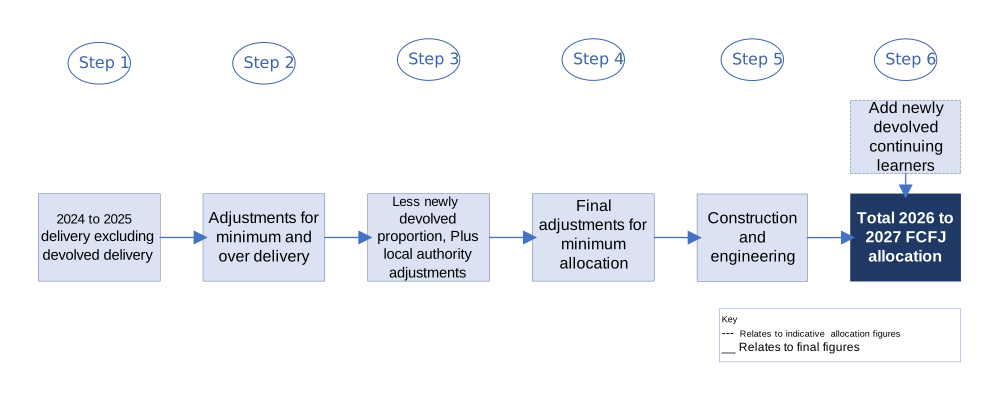
Figure 2 shows the methodology we have used to calculate FCFJ (non-procured) allocations.
Step 1: identify your baseline
We calculate your initial allocation, known as your baseline, using your final free courses for jobs delivery for the 2024 to 2025 year. If your delivery is higher than your 2025 to 2026 contract value, we set your baseline at your 2025 to 2026 contract value.
We then reduce this figure to reflect areas that became devolved in August 2025. To do this, we remove the value based on the devolved percentage from the previous year. This approach makes sure you are not penalised for changes in devolved delivery.
We are not increasing allocation for over-delivery.
Step 2: apply adjustments
We adjust your funding allocation in the following scenarios if:
- your calculated allocation is more than £0 but less than £10,000, we increase it to £10,000
- you received funding for local authority pilots last year, we add the increase you received from the pilot back into your delivery
Step 3: changes to delivery for devolved areas
We remove delivery to residents of any local authorities that become devolved within the 2026 to 2027 academic year from FCFJ allocations. Providers that previously delivered to residents in these areas will therefore receive a reduced allocation based on historic delivery.
The areas and how we apply devolution is consistent across all ASF (non‑procured) allocation lines and is described in Step 4: changes to delivery for devolved areas of section 8.2.
Step 4: final adjustments
If you have a track record issue, we will adjust your 2026 to 2027 allocation to a maximum of your current allocation value.
If your calculated allocation is greater than £0 but less than £10,000, we will uplift your allocation to the minimum value of £10,000.
Step 5: adding continuing learners in newly devolved areas
The approach to continuing learners in newly devolved areas is consistent across all ASF (non‑procured) allocation lines and is described in Step 7: adding continuing learners in newly devolved areas of section 8.2.
Step 6: add construction and engineering
This explains how we calculate construction and engineering allocations that is included in your FCFJ allocation.
Last year we informed you that allocation increases you received in 2025 to 2026 will not be included in your 2026 to 2027 allocation, unless used for construction.
We calculated construction and engineering top-ups separately however the method is the same.
We use 2 types of delivery information for each subject area, number of starts:
- for the whole of the 2024 to 2025 year
- year‑to‑date delivery for 2025 to 2026 (this is the most recent delivery data available for the year as of February 2026)
You meet the threshold to receive construction or engineering if you have at least one learner in either the:
- 2024 to 2025 delivery academic year
- 2025 to 2026 year to date as of February 2026
If you do not meet the threshold for a subject area, you are not included in the calculation for that subject.
If you meet the minimum threshold, we use the higher of the learner volumes.
We calculate the construction allocation by:
- identifying all providers who meet the minimum delivery threshold for construction
- aggregating the eligible learner volumes for those providers and dividing this total by the available budget to calculate a per‑learner rate
- multiplying the per‑learner rate by your eligible learner volume to determine your allocation
Transfer funding for 19 to 23 year old learners to free courses for jobs
In the 2025 to 2026 funding year, we updated free courses for jobs. All eligible learners are now funded through your FCFJ funding lines. This applies regardless of the learner’s age or when they started their learning.
Because of this change, delivery for learners aged 19 to 23 that was previously funded through Adult Skills Core is now funded through FCFJ.
If this change affects you, you can request to transfer funding from adult skills core to FCFJ. This transfer is:
- a one-time offer available until the business case window closes
- only available for 19 to 23 delivery affected by this change
The amount you can request to transfer is fixed. We provide the value in your adult skills fund calculator. You will receive this through Document exchange. The value is not negotiable.
To request the transfer, raise a business case and select adult skills core funding stream and request to transfer 19- to 23-year-olds reason.
9. Adult skills fund contract for services (procured from August 2023)
This section applies to you if you:
- applied for and received an ASF contract for services award as part of the ASF procurement process
- had a contract in 2025 to 2026
There are 2 ring-fenced budgets within ASF (procured from August 2023):
- ASF (including learner and learning support)
- FCFJ
It is important that you pay attention to the different allocation lines. Each allocation line is also subject to separate funding and performance management rules. You can view this in manage your education and skills funding by reviewing the detailed allocation table.
We will fund learners who are residents outside devolved areas and will continue to support continuing learners who are residents in devolved areas. Read the section on continuing learners for more information on these funding arrangements.
9.1 Changes for allocations 2026 to 2027
The key changes affecting your 2026 to 2027 allocation are:
- funding rate changes are already included in delivery data and allocations - we will not add separate rate uplifts
- over delivery – we no longer include over‑delivery above 100% and up to 110% in the baseline
- applied increases to FCFJ to support the expansion of more construction and engineering training - if you received construction funding in 2025 to 2026 and have not delivered construction courses you will receive a reduced FCFJ allocation removing the construction uplift
- as part of the plan to put commissioning decisions in the hands of local areas some contract for service may receive a reduced allocation for 2026 to 2027 - values are being transferred to local authorities in areas
As devolution progresses, it is important Strategic Authorities have the necessary support and opportunity to prepare themselves for full responsibility for ASF (which includes FCFJ) delivery in their area
9.2 Adult skills fund allocations (procured)
We calculated your ASF allocations for the 2026 to 2027 funding year for providers that:
- are procured
- have a 2025 to 2026 ASF contract value, excluding continuing learners
- delivered ASF between August 2023 and July 2025
We use final delivery data in the calculations. This includes monitoring and audit adjustments and exception cases.
We adjust delivery data for the 2026 to 2027 allocation to reflect devolution from August 2025 in:
- Cornwall
- the East Midlands
- York and North Yorkshire
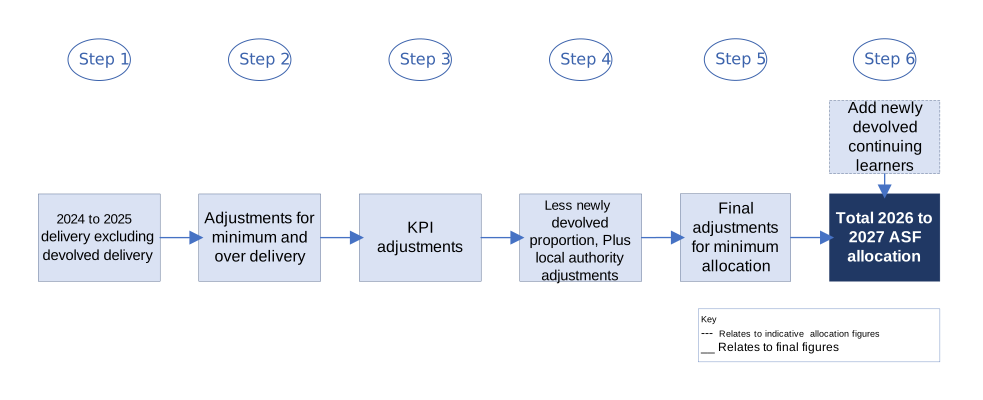
Figure 3 shows the methodology we have used to calculate ASF allocations.
Step 1: identify your baseline
We calculate your initial allocation, known as your baseline, using your final adult skills core delivery for the 2024 to 2025 year. If your delivery is higher than your 2025 to 2026 contract value, we set your baseline at your 2025 to 2026 contract value.
We then reduce this figure to reflect areas that became devolved in August 2025. To do this, we remove the value based on the devolved percentage from the previous year. This approach makes sure you are not penalised for changes in devolved delivery.
We are not increasing allocation for over-delivery.
Step 2: apply adjustments
We will apply adjustments where your calculated allocation is greater than £0 but less than £50,000, we have uplifted your allocation to £50,000.
Step 3: applying KPI adjustments
Your contract for services agreement includes 4 key performance indicators (KPIs). We measured these KPIs and adjust your allocation based on these scores.
We review your current year (2025 to 2026) KPI scores based on returns at R06. If you scored requires improvement or inadequate on any of your KPIs, a 1% reduction is applied to your baseline for each KPI.
Step 4: changes to delivery for devolved areas
We remove delivery to residents of any local authorities that become devolved within the 2026 to 2027 academic year from ASF allocations. Providers that previously delivered to residents in these areas will therefore receive a reduced allocation based on historic delivery.
The new areas receiving ASF as part of devolution plans:
- Buckinghamshire
- Devon and Torbay
- Greater Lancashire
- Greater Lincolnshire
- Hull and East Yorkshire
- Surrey
- Warwickshire
We will use the 2024 to 2025 delivery data for adult skills core to identify the percentage of delivery to learners residing in the newly devolved areas. We will then adjust the allocation to remove delivery that will be the responsibility of the devolved area using these proportions.
We base the calculation for resident learners in these areas on each learner’s home postcode prior to enrolment.
Continuing learners in the newly devolved areas will continue to form part of ASF. However, we will list the allocation amount separately (see Step 6: adding continuing learners in newly devolved areas section for more information).
As devolution expands, the local authorities below will receive funding directly from 2026 to 2027. This means these areas will no longer be funded through your contract. The value we remove from your allocation for these areas is as calculated the same as above for the following areas:
- Brighton and Hove
- Cheshire East
- Cheshire West and Chester
- Cumberland
- Essex County
- Hampshire
- Isle of Wight
- Leicester
- Luton
- Milton Keynes
- North Northamptonshire
- Portsmouth
- Southampton
- Southend-on-Sea
- Stoke-on-Trent
- Thurrock
- Warrington
- Westmorland and Furness
- West Sussex
Step 5: final adjustments
If you have a track record issue, we will adjust your 2026 to 2027 allocation to a maximum of your current allocation value.
If your calculated allocation is greater than £0 but less than £50,000, we will uplift your allocation to the minimum value of £50,000.
Step 6: adding continuing learners in newly devolved areas
We will continue to be responsible for ASF learners who are residents in a devolved area and in learning before the authority’s devolution date but who did not complete their learning by 31 July 2026 (continuing learners).
You must ensure that you meet the cost of continuing learners from within your ASF allocation, as you have always done.
For 2026 to 2027 only, we will add funds to your ASF for learners who were residents in the newly devolved authorities and were in learning in 2025 to 2026, but did not complete their programmes by 31 July 2026.
We include an illustrative value for continuing learners in your allocation statement. This is a provisional value to help you understand the value you may receive later. We will exclude the illustrative value from your initial contract.
We calculated the illustrative continuing learner value by looking at the funding in 2024 to 2025 (based on R14 data) for residents who were in learning in 2024 to 2025 and continued into 2025 to 2026.
We calculate the final value for continuing learners following the completion of the 2025 to 2026 funding year. We will update your contract shortly after to include funding for continuing learners. We calculate the full year cost of learners and assume all learners achieve on their planned end date.
We show continuing learner funding as a separate value on your allocation statement. However, this will form part of your overall ASF allocation, and we will not manage it separately. We will not consolidate this into your ASF allocation beyond 31 July 2026. We show this separately on your statement so you know the value we will remove from your 2026 to 2027 allocation.
We have provided information on which areas will devolve and when in our adult skills fund devolution guidance.
Learners who started after the devolution date are the relevant devolved authority’s responsibility.
9.3 Free courses for jobs (procured)
Free courses for jobs (FCFJ) (non-procured) are a component (‘of which’) of ASF allocations. We will manage these on separate allocation lines. We will not allow virement of funds between allocation lines.
We calculated your FCFJ allocations for the 2026 to 2027 funding year for providers that:
- are procured
- have a 2025 to 2026 FCFJ contract value, excluding continuing learners
- delivered ASF between August 2023 and July 2025
We use final delivery data in the calculations. This includes monitoring and audit adjustments and exception cases.
We adjust delivery data for the 2026 to 2027 allocation to reflect devolution from August 2025 in:
- Cornwall
- the East Midlands
- York and North Yorkshire
Construction uplift has been removed from allocation. A separate value has been calculated for construction and engineering and added into FCFJ.
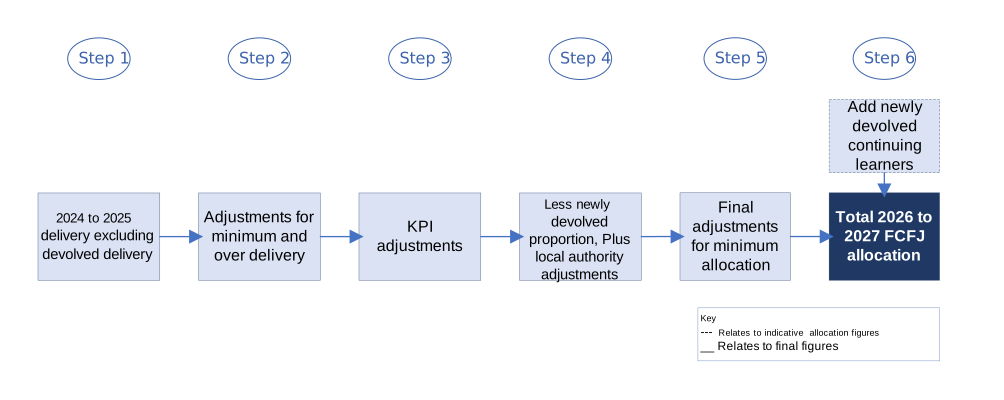
Figure 4 shows the methodology we have used to calculate FCFJ (non-procured) allocations.
Step 1: identify your baseline
We calculate your initial allocation, known as your baseline, using your final free courses for jobs delivery for the 2024 to 2025 year. If your delivery is higher than your 2025 to 2026 contract value, we set your baseline at your 2025 to 2026 contract value.
We then reduce this figure to reflect areas that became devolved in August 2025. To do this, we remove the value based on the devolved percentage from the previous year. This approach makes sure you are not penalised for changes in devolved delivery.
We are not increasing allocation for over-delivery.
Step 2: apply adjustments
We will apply adjustments where your calculated allocation is greater than £0 but less than £50,000, we have uplifted your allocation to £50,000.
Step 3: applying KPI adjustments
Your contract for services agreement includes 3 (KPIs). We measured these KPIs and adjust your allocation based on these scores.
We review your current year (2025 to 2026) KPI scores based on returns at R06. If you scored requires improvement or inadequate on any of your KPIs, a 1% reduction is applied to your baseline for each KPI.
Step 4: changes to delivery for devolved areas
We remove delivery to residents of any local authorities that become devolved within the 2026 to 2027 academic year from FCFJ allocations. Providers that previously delivered to residents in these areas will therefore receive a reduced allocation based on historic delivery.
The areas and how we apply devolution is consistent across all ASF (non‑procured) allocation lines and is described in Step 4: changes to delivery for devolved areas of section 9.2.
Step 4: final adjustments
If you have a track record issue, we will adjust your 2026 to 2027 allocation to a maximum of your current allocation value.
If your calculated allocation is greater than £0 but less than £50,000, we will uplift your allocation to the minimum value of £50,000.
Step 5: adding continuing learners in newly devolved areas
The approach to continuing learners in newly devolved areas is consistent across all ASF (non‑procured) allocation lines and is described in Step 6: adding continuing learners in newly devolved areas of section 9.2.
Step 6: add construction and engineering
This explains how we calculate construction and engineering allocations that is included in your free courses for jobs allocation.
Last year we informed you that allocation increases you received in 2025 to 2026 will not be included in your 2026 to 2027 allocation, unless used for construction.
We calculated construction and engineering top-ups separately however the method is the same.
We use 2 types of delivery information for each subject area, number of starts:
- for the whole of the 2024 to 2025 year
- year‑to‑date delivery for 2025 to 2026 (this is the most recent delivery data available for the year as of February 2026)
You meet the threshold to receive construction or engineering if you have at least one learner in either the:
- 2024 to 2025 delivery academic year
- 2025 to 2026 year to date as of February 2026
If you do not meet the threshold for a subject area, you are not included in the calculation for that subject.
If you meet the minimum threshold, we use the higher of the learner volumes.
We calculate the construction allocation by:
- identifying all providers who meet the minimum delivery threshold for construction
- aggregating the eligible learner volumes for those providers and dividing this total by the available budget to calculate a per‑learner rate
- multiplying the per‑learner rate by your eligible learner volume to determine your allocation
Transfer funding for 19 to 23 year old learners to free courses for jobs
In the 2025 to 2026 funding year, we updated free courses for jobs. All eligible learners are now funded through your FCFJ funding lines. This applies regardless of the learner’s age or when they started their learning.
Because of this change, delivery for learners aged 19 to 23 that was previously funded through Adult Skills Core is now funded through FCFJ.
If this change affects you, you can request to transfer funding from adult skills core to FCFJ. This transfer is:
- a one-time offer available until the business case window closes
- only available for 19 to 23 delivery affected by this change
The amount you can request to transfer is fixed. We provide the value in your adult skills fund calculator. You will receive this through document exchange. The value is not negotiable.
To request the transfer, raise a business case and select adult skills core funding stream and request to transfer 19- to 23-year-olds reason.
10. Advanced learner loan facilities and bursaries
10.1 Loans facility
We have calculated advanced learner loan facility allocations for the 2026 to 2027 funding year for providers that have an advanced learner loan facility for the 2024 to 2025 funding delivered between August 2023 and January 2025.
Figure 5 shows the methodology that we use to calculate allocations.
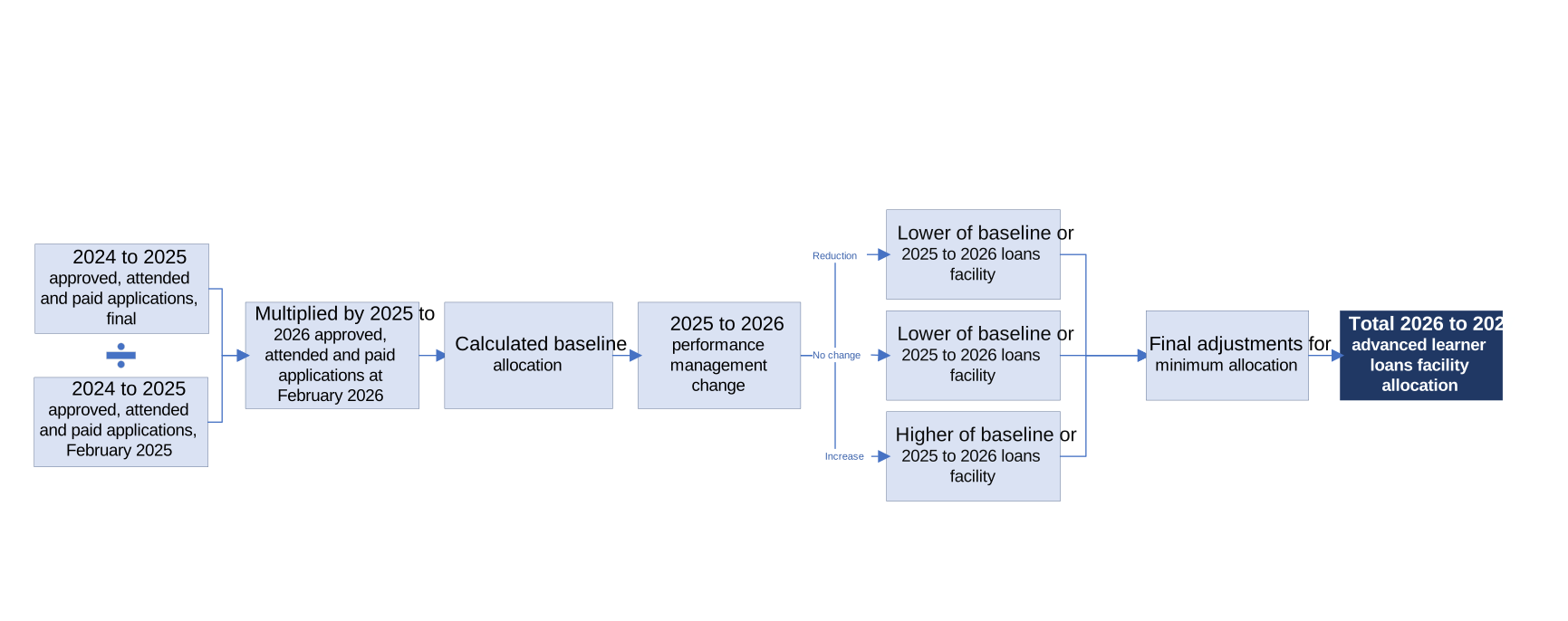
To calculate your advanced learner loans facility allocation (baseline), we use your approved, attended and paid loans applications from 1 February 2026, in the 2025 to 2026 funding year.
This is uplifted to a full-year value using your 2024 to 2025 data as a guide. For the uplift factor, we divide your 2024 to 2025 full-year delivery by 2024 to 2025 delivery reported on 1 February 2024 (as a percentage).
We have aligned allocations with the performance management and growth thresholds for 2025 to 2026 this means:
- if your 2025 to 2026 loans facility reduced or remained the same at the review points (October 2025 or February 2026), your allocation is the lower of the baseline or 2025 to 2026 loans facility (as of February 2026)
- if your 2025 to 2026 loans facility increased at the review points (October 2025 or February 2026), your allocation is the higher of the baseline or 2025 to 2026 loans facility (as of February 2026)
- growth in the calculated 2026 to 2027 allocation is limited to the maximum growth limits within the funding and performance management rules, less growth received in-year
Table 1 shows how the growth limits are applied, depending on the value of the facility as at the beginning of the previous year:
Table 1
| Facility as of 1 August 2025 | Maximum growth |
|---|---|
| Up to £100,000 | £50,000 |
| £100,000 to £3,000,000 | 50% |
| over £3,000,000 | £1,500,000 |
We ensure that your allocation is sufficient to support learners continuing into the next funding year (2026 to 2027).
We use your February 2026 approved, attended and paid loan applications to account for potential liabilities. This allows additional funding for learners continuing into the next funding year. The minimum value of liabilities is 70% of your allocation.
Loan applications that occur after receiving your allocation over and above your historical proportions will create liabilities not consolidated as part of your loan facility.
We will uplift your 2026 to 2027 allocation to £10,000 if the allocation we calculated for you is lower than this (unless you have a track record issue).
We do not issue you with a loans facility if you have not used it between August 2024 and February 2026.
If you had an advanced learner loans facility allocation in the 2025 to 2026 funding year, but we have not issued you with an allocation for 2026 to 2027 because you have not delivered, review the business case process for more information.
If you have a track record issue, then your 2026 to 2027 facility allocation will be no greater than your 2025 to 2026 contract value as of February 2026.
10.2 Loans bursary
We directly link the calculation of your bursary allocations to advanced learner loans facility allocation at a proportionate level.
Figure 6 shows the methodology that we use to calculate advanced learner loans bursary allocations.
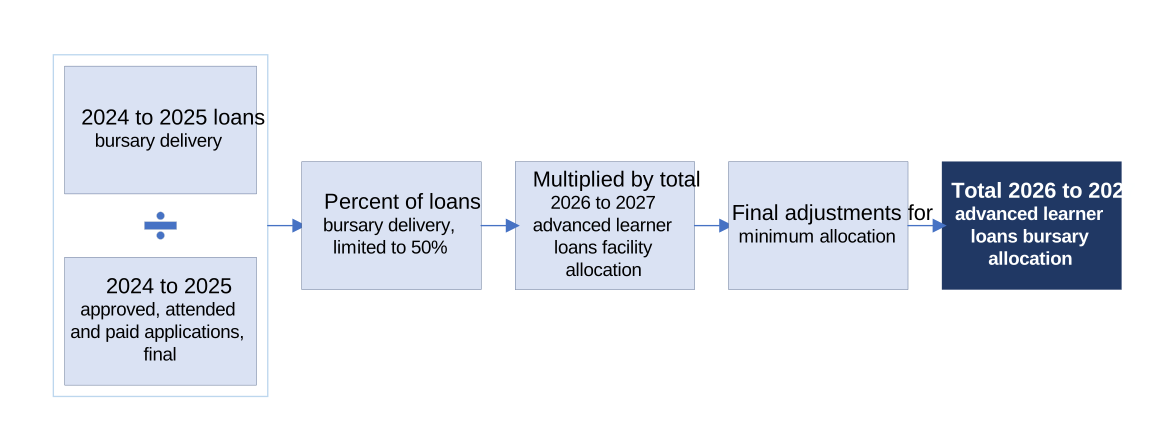
To calculate your allocation, we divide your bursary delivery for 2024 to 2025 funding year (from either the ILR or final funding claim) by the value of your approved, attended and paid loans applications in the 2024 to 2025 funding year.
We then multiply this percentage by the advanced learner loan facility allocation we calculated for you for the 2026 to 2027 funding year.
We apply a 50% limit. If the proportion of your bursary delivery was greater than this, we will reduce your funding to this proportion.
If the allocation we calculate is less than £500, we will uplift it to this value.
If you did not use your loans bursary in 2024 to 2025 or in 2025 to 2026, your loans bursary allocation for the 2026 to 2027 funding year will be £100.
If you have a track record issue, then your 2026 to 2027 bursary allocation will be no greater than your 2025 to 2026 contract value.
11. Glossary
11.1 Allocation line
A separate value within your funding agreement that we use to manage your contract value.
11.2 Approved, attended and paid loan applications
To receive funding from the Student Loans Company (SLC), individuals must qualify and apply for student finance.
Approved applications meet the eligibility criteria and have been accepted.
Attended applications are for learners who have taken part in their course.
Paid applications are those that the SLC has paid in full.
More information is available from the Student Loans Company.
11.3 Continuing learners
Learners who started their programme in a previous funding year and continue into the next funding year.
11.4 Devolution
The transfer of adult education functions from the Secretary of State for Education to specified combined or local authorities, or to the Mayor of London, for delivery in their areas
11.5 Disaggregation
When a provider splits into separate organisations and we adjust the funding allocations to reflect this change.
11.6 Financial year
The period from 1 April to 31 March.
11.7 Funding agreement
The agreement between the Secretary of State for Education, acting through DfE or DWP, and a provider that receives funding for education and skills training.
11.8 Funding claim
Providers paid on a funding profile must submit 3 funding claims each year. They show expected delivery during the year and actual delivery at the end of the year.
11.9 Funding year
The period from 1 August to 31 July.
11.10 Individualised Learner Record (ILR)
The main data collection used for further education and work‑based learning in England. The government uses ILR data to monitor policy implementation and provider performance.
11.11 Learner support
Funding provided to support learners with an identified learning difficulty and/or disability to help them achieve their learning goal.
11.12 Merger
When 2 or more providers join together to form a single organisation.
11.13 Virement
The process of moving funding from one contract period or budget to another.