Life Chances Fund final report: The Life Chances Fund performance
Published 5 March 2026

© Crown copyright 2026
This publication is licensed under the terms of the Open Government Licence v3.0 except where otherwise stated. To view this licence, visit nationalarchives.gov.uk/doc/open-government-licence/version/3 or write to the Information Policy Team, The National Archives, Kew, London TW9 4DU, or email: psi@nationalarchives.gov.uk.
Where we have identified any third party copyright information you will need to obtain permission from the copyright holders concerned.
This publication is available at https://www.gov.uk/government/publications/achieving-outcomes-life-chances-fund-final-report/life-chances-fund-final-report-the-life-chances-fund-performance
This is an extract taken from the final Life Chances Fund report (Chapter 3). Footnote numbers may differ from the PDF report, but they share the same information. View or download the final report.
This chapter summarises key statistics and performance data across all 29 Life Chances Fund projects. It aims to answer the following questions:
- To what extent have these 29 social outcomes partnerships achieved their intended outcomes?
- To what extent have these 29 social outcomes partnerships achieved the intended level of outcome payments?
The chapter is organised as follows:
- Section 3.1 presents an overall introduction to the LCF projects.
- Section 3.2 offers a description of the outcomes funding committed and spent by the Life Chances Fund.
- Section 3.3 describes the spend profile of the LCF.
- Section 3.4 describes the LCF projects’ referrals and engagement rates.
- Section 3.5 describes performance in terms of outcomes achievements.
- Section 3.6 presents projects’ performance in terms of outcomes payments from both the LCF and local commissioners.
3.1 The Life Chances Fund projects
The Life Chances Fund projects delivered different interventions for people with complex needs, which makes them very difficult to compare against each other. Each project had a unique list of outcome metrics which they pursued. Even when projects were labelled with the same policy theme, they were often pursuing substantially different outcome metrics and worked with substantially different cohorts. Table 1 presents a list of the 29 LCF projects with data on their delivery dates, planned investment, planned maximum potential outcome payment, type of intervention and primary outcome to be achieved. Projects are clustered by their policy themes.
Table 1. Basic characteristics of Life Chances Fund projects
| LCF theme | Name of project | Location | Year delivery start and end | Planned size of cohort | Description of intervention | Planned social investment (upfront capital) | Maximum potential outcome payment (LCF and local commissioners) | Complete/ Continuing after September 2024 | |
|---|---|---|---|---|---|---|---|---|---|
| Children’s services | Fostering Better Outcomes | Cheshire West and Chester | 2018-2024 | 30 service users [footnote 1][footnote 2] | Fostering Better Outcomes aimed to reduce the number of children in residential placements by ‘stepping down’ to specialist foster care, thereby offering an intensive, therapeutic and family-based support package. | £300,000 | £1,028,926 | Complete | |
| Children’s services | Stronger Families Suffolk | Suffolk | 2019-2026 | 542 service users | Stronger Families Suffolk is a whole family-based intervention using Functional Family Therapy. It sought to improve communication and supportiveness between parents or guardians and young people, while decreasing hostility. | £1,400,000 | £6,925,607 | Continuing after September 2024 | |
| Children’s services | Stronger Families Norfolk | Norfolk | 2019-2028 | 436 families | The project delivers a service based on Family Functional Therapy. It seeks to improve communication and supportiveness between parents or guardians and young people, while decreasing hostility. | £2,100,000 | £9,576,245 | Continuing after September 2024 | |
| Children’s services | The Pyramid Project | Telford and Wrekin, Warwickshire, Sandwell, Stoke on Trent, Surrey, Worcestershire, Wolverhampton, Staffordshire, and Dudley | 2020-2024 | 92 service users | The aim was to work with independent foster care providers to recruit specific resilient carers for children in residential care with high levels of complex needs. The service included bespoke wrap around support alongside the delivery of therapeutic services to enhance the stability of placements. | £925,562 | £11,341,260 | Complete | |
| Children’s services | DN2 Children’s Services Social Impact Bond | Nottinghamshire and Derbyshire | 2020-2027 | 304 service users | DN2 offers intensive support to children and young people (aged 10-17) at risk of care entry or who recently entered care. The goal is to help them remain with their families when it is safe to do so. | £884,831 | £9,123,323 | Continuing after September 2024 | |
| Drug and alcohol dependency | Integrated Family Service Support | Staffordshire | 2018-2027 | 2,006 service users | IFSS works with families who have children and young people identified as being in need or who are under child protection plans, particularly in cases where parental drug and alcohol use may indicate a potential risk. | £475,000 | £5,331,000 | Continuing after September 2024 | |
| Drug and alcohol dependency | Cornwall Frequent Attenders | Cornwall | 2018-2023 | 705 service users | The project works with residents of Cornwall aged 18 and older who are experiencing issues related to substance misuse and have had eight or more visits to Accident and Emergency or two or more hospital admissions within a year. The intervention included regular key worker outreach, home visits, drop-in sessions, crisis management to address immediate problems, and other therapeutic techniques. | £407,000 | £2,226,336 | Complete | |
| Drug and alcohol dependency | IPS Employment Support For People With Drug And Alcohol Addictions | West London Boroughs | 2019-2022 | 2,074 service users | Individual Placement Support Service helps adults (16-70 years old) with drug and alcohol addictions, who are out of work, to gain and retain competitive employment. | £400,000 | £2,375,150 | Complete | |
| Early years | Reducing The Prevalence Of Mothers Experiencing Recurrent Care Proceedings (Pause) | Plymouth | 2019-2024 | 56 service users | Pause works with women of childbearing age who have experienced (or are at high risk of experiencing) a cycle of recurrent care proceedings leading to removal of their children into local authority care. Pause is an intensive, relationship-based support programme. | £1,100,000 | £1,623,872 | Complete | |
| Early years | ParentChild+ | Royal Borough of Kensington and Chelsea and City of Westminster | 2019-2023 | 198 service users | ParentChild+ aimed to narrow the gap in school readiness between vulnerable children and their peers. The service targeted families with a child aged 2-3 who do not meet age related goals on speech and language, and social-personal skills assessed during the national 2-year-old checks. | £100,000 | £1,107,287 | Continuing after September 2024 | |
| Early years | West London Zone (AllChild), Placed-Based Support For Children And Young People: Scale-Up | London Boroughs (Brent, Westminster, Kensington and Chelsea, and Hammersmith and Fulham) | 2019-2024 | 2,420 service users | All children who participated in this project faced various challenges, including economic disadvantage, emotional wellbeing, proficiency in English and Math, school attendance and interpersonal relationships. The intervention was structured around each child’s Individual Support Plan, which had four key components: informal engagement, formal engagement, developmental support, and specialised support from delivery partners. | £1,400,000 | £16,244,960 | Complete | |
| Young people | FutureImpact | Nottingham | 2018-2023 | 1,180 service users | FutureImpact coaches worked with young people with special educational needs and disabilities to overcome problematic behaviours, build capacity, resilience and confidence, and sustain their progress. | £498,000 | £3,288,900 | Complete | |
| Young people | DFN-MoveForward UK | London, West Midlands and Kent | 2018-2024 | 358 service users | DFN-MoveForward supported young people aged 14-25 with mild to moderate learning disabilities, such as cognitive impairment and communication and interaction difficulties. The programme offered a framework of one-to-one coaching and action planning. | £450,000 | £1,683,620 | Complete | |
| Young people | Big Picture Learning In Doncaster | Doncaster | 2019-2024 | 541 service users | Big Picture Learning works with young people in small advisory groups, as an alternative provision to learning centres and Pupil Referral Units. The target population is children and young people aged 11-16 who are disengaged from education and showing early signs of crisis. | £750,000 | £6,194,792 | Complete | |
| Young people | The Skill Mill | Birmingham, Croydon, Durham, Leeds, Nottingham, Rochdale, Surrey, and West Sussex | 2020-2024 | 252 service users | Skill Mill service centres around the provision of employment. High risk ex-offenders aged 16-18 are offered paid employment four days a week and are encouraged to acquire a Level 2 qualification. | £1,100,000 | £3,241,776 | Complete | |
| Young people | Chances | 22 different locations across England | 2020-2024 | 6,720 service users | The aim of Chances was to use sport and physical activity to provide new opportunities and alternative life pathways for children and young people in disadvantaged areas whilst improving their health and wellbeing. | £1,245,000 | £4,104,000 | Complete | |
| Young people | Gloucestershire Positive Behaviour Support | Gloucestershire | 2020-2029 | 14 service users[footnote 3] | Gloucestershire Positive Behaviour Support’s target cohort is young people with a learning disability and/or autism and displaying challenging behaviour, who are at risk of going into residential care. The service delivers practical solutions to improve the individual’s quality of life, reducing the need for residential placements, with a focus on them remaining at home or other supported homes. | £501,000 | £1,774,925 | Continuing after September 2024 | |
| Older people’s services | Enhanced Dementia Care Service | London Borough of Hounslow | 2021-2024 | 300 service users | Enhanced Dementia Care Service offered coordinated and integrated services using evidence-based care pathways, case management and personalised care planning. The aim of the service was to anticipate and avoid deterioration of conditions and support reduction in hospital admissions for people affected with dementia with a high rate of admissions. | £345,000 | £810,000 | Complete | |
| Healthy lives | MHEP Haringey And Barnet | Haringey and Barnet | 2019- 2023 | 985 service users | Individual Placement Support aimed at getting people with enduring and severe mental health issues back or into paid employment. | £227,000 | £1,421,234 | Complete | |
| Healthy lives | Promoting Independence | Sheffield | 2019- 2026 | 105 service users | Individual support to assist adults with mental health issues to live independently in the community. | £725,000 | £2,744,750 | Continuing after September 2024 | |
| Healthy lives | Midlands Regional Pause Hub | Derbyshire, Northamptonshire, Worcestershire and Plymouth | 2020- 2026 | 166 service users | The service aims to help women who have experienced or are at risk of experiencing at least two episodes of care proceedings leading to the removal of one or more of their children into care. Pause seeks to address the cycle of repeated removals by intervening at a time when women are not caring for children. | £2,150,000 | £5,643,426 | Continuing after September 2024 | |
| Healthy lives | MHEP Enfield | Enfield | 2020- 2024 | 674 service users | Individual Placement Support aimed at getting people with enduring and severe mental health issues into paid employment. | £126,000 | £620,689 | Complete | |
| Healthy lives | MHEP Tower Hamlets – Severe Mental Illness | Tower Hamlets | 2020- 2024 | 3,644 service users | Individual Placement Support aimed at getting people with enduring and severe mental health issues back or into paid employment. | £300,000 | £2,068,270 | Complete | |
| Healthy lives | MHEP Shropshire | Shropshire | 2020- 2024 | 582 service users | Individual Placement Support aimed at getting people with mental health issues back or into competitive employment. | £204,000 | £1,034,487 | Complete | |
| Healthy lives | MHEP Tower Hamlets – Learning Disabilities | Tower Hamlets | 2020- 2023 | 411 service users | Delivering services using Individual Placement and Support (IPS) principles to clients with learning disabilities in Tower Hamlets. | £328,000 | £1,307,059 | Complete | |
| Healthy lives | A Norfolk Carers SIB | Norfolk | 2020- 2026 | 8,419 service users [footnote 4] | The Norfolk Carers Partnership supports adult unpaid carers and transitioning carers (aged 16 to 24) to improve their wellbeing and enable them to sustain their caring role. | £2,500,000 | £11,872,775 | Continuing after September 2024 | |
| Healthy lives | Provision Of A Social Prescribing Framework And Offer At Scale Across Northamptonshire | Northamptonshire | 2021-2027 | 5,832 service users | Social prescribing focuses on prevention of ill health and the promotion of positive health and wellbeing through community-based services. This programme works to create sustained lifestyle changes and improved self-care for people living with long-term health conditions in Northamptonshire. The service specifically targets people with long-term health conditions. | £1,350,000 | £8,455,774 | Continuing after September 2024 | |
| Other cross-cutting themes | Kirklees Better Outcomes Partnership | Kirklees | 2019-2024 | 6,300 service users | The project addressed issues including drug and alcohol dependency, older age, homelessness and disability, and other factors that can contribute towards a person’s ability to successfully live independently. The service targeted people over the age of 16 who have vulnerabilities and support needs that may impact on their ability to live independently and who may, without support, be at increased risk of homelessness due to their disabilities, vulnerabilities, issues or lifestyle. | £4,535,645 | £22,297,917 | Complete | |
| Other cross-cutting themes | Single Homelessness Prevention Service | London Boroughs (Brent, Ealing, Enfield, Hackney, Islington, and Waltham Forest) and Norfolk | 2019-2028 | 18,518 service users | The service targets single people who are homeless or at risk of becoming homeless. A support worker model helps people secure new accommodation or to sustain existing tenancies. | £2,521,000 | £17,113,000 | Continuing after September 2024 |
Map 1: Distribution of projects’ delivery locations in the UK
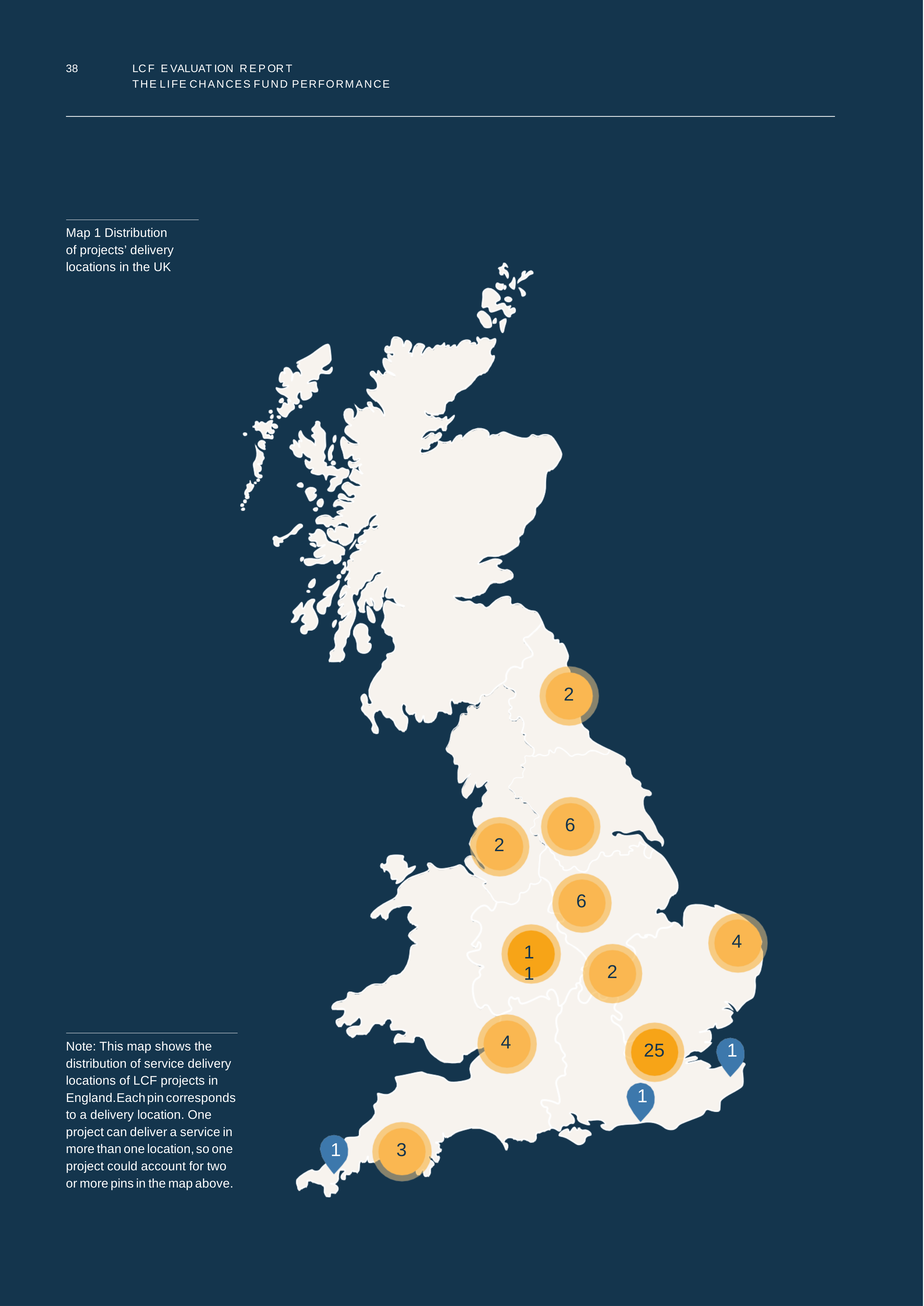
This map was built using data from the INDIGO Impact Bond Dataset as of 2024. Data on LCF projects and locations has been updated since then, and might not fully coincide with the current map on the INDIGO Impact Bond Dataset.
| Project Name | Service Area(s) |
|---|---|
| A Norfolk Carers SIB | Norfolk |
| Big Picture Learning | Doncaster |
| Chances | Sunderland, Birmingham, Coventry, and Devon |
| Cornwall Frequent Attenders | Cornwall |
| DFN-MoveForward | London, West Midlands, and Kent |
| DN2 Children’s Services Social Impact Bond | Nottinghamshire and Derbyshire |
| Enhanced Dementia Care Service | Hounslow |
| Fostering Better Outcomes | Cheshire West and Chester |
| FutureImpact | Nottingham |
| Gloucestershire Positive Behaviour Support | Gloucestershire |
| Integrated Family Service Support | Staffordshire |
| IPS Employment Support For People With Drug And Alcohol Addictions | West London Boroughs |
| Kirklees Better Outcomes Partnership | Kirklees |
| MHEP Enfield | Enfield |
| MHEP Haringey and Barnet | Haringey and Barnet |
| MHEP Shropshire | Shropshire |
| MHEP Tower Hamlets – Learning Disabilities | Tower Hamlets |
| MHEP Tower Hamlets – Severe Mental Illness | Tower Hamlets |
| Midlands Regional Pause Hub | Derbyshire, Northamptonshire, Worcestershire, and Plymouth |
| ParentChild+ | Plymouth |
| Promoting Independence | Sheffield |
| Provision Of A Social Prescribing Framework And Offer At Scale Across Northamptonshire | Northamptonshire |
| Reducing The Prevalence Of Mothers Experiencing Recurrent Care Proceedings (Pause) | Plymouth |
| Single Homelessness Prevention Service | London Boroughs (Brent, Ealing, Enfield, Hackney, Islington, Waltham Forest) and Norfolk |
| Stronger Families Norfolk | Norfolk |
| Stronger Families Suffolk | Suffolk |
| The Pyramid Project | Telford and Wrekin, Warwickshire, Sandwell, Stoke on Trent, Surrey, Worcestershire, Wolverhampton, Staffordshire, and Dudley |
| The Skill Mill | Birmingham, Croydon, Durham, Leeds, Nottingham, Rochdale, Surrey, and West Sussex |
| West London Zone (AllChild), Placed-Based Support For Children And Young People | London Boroughs (Brent, Westminster, Kensington and Chelsea, Hammersmith and Fulham) |
As described in Table 1, the LCF supported 29 projects tackling complex social issues across the following policy themes: healthy lives (9 projects), young people (6 projects), children’s services (5 projects), early years interventions (3 projects), drug and alcohol dependency (3 projects), older people’s services (1 project), and ‘other cross-cutting’ projects (2 projects). These projects worked with different cohorts and pursued different outcome metrics, so it is not possible to establish any direct comparisons between them. In Appendix 2, we present outcome achievements for projects that are working towards overarching outcomes (eg, outcomes around employment, homelessness, or children in care) to facilitate the analysis of the fund, but we have not aggregated them to avoid the conflation of non-identical elements.
The LCF projects can be subdivided in two groups: complete and ongoing projects. Complete projects refer to the projects that have finished service delivery and received their last outcome payment up to the end of September 2024. Ongoing projects refer to those projects which have agreed an extension beyond September 2024 with exclusive funding from local commissioners. In many cases, these extensions had been agreed from the start of the project. Table 1 shows that 18 projects are complete and 11 projects are still ongoing. Describing the performance for ongoing projects presents challenges, as some ongoing projects have reported targets and payment plans for the entire life of their service, as opposed to only the period when they were supported by the LCF. Given these complexities, the following subsections will present findings separately for the groups of complete and ongoing projects. The following subsections describe the special treatment for ongoing projects (eg, comparing them against interim targets, instead of the final targets reported in the DCMS Data Portal when possible).
Our comparison of user engagement, outcomes achievement, and payments against targets, is limited as target setting is highly dependent on stakeholders’ predictive powers and how they approached these targets. For instance, some projects updated their targets more than others, facilitating more realistic targets to be set as project delivery progressed. Whereas other projects may not have prioritised target setting due to time constraints or may have chosen to set particularly high expectations in order to ensure enough resources were available for potential project successes. Resultingly, comparing performance against targets should not be used as relative, objective measures of impact, but instead they give an insight into how each project functioned.
In sum, the subsections on LCF performance will disaggregate the analysis by policy theme (when appropriate) and stage of project (complete/ongoing). Target achievement should be viewed as a subjective measure of performance.
3.2 The Life Chances Fund outcomes funding
Table 2 shows the list of projects that were awarded a contract and the initial LCF award amount [footnote 5]. These amounts changed during the life of these contracts. Some projects received further allocations and increased the size of their cohorts and programmes, while other projects decreased their award and delivered smaller interventions. The project performance chapters provide details on the changes and adaptations to each project.
In order to account for the entire amount of funding commitment by the LCF, Table 2 includes the two projects (Adults With Complex Needs and Opening Doors) that were awarded contracts but withdrew shortly after.
Table 2. Life Chances Fund projects initial awards and final awards grouped by policy themes
| LCF theme | Name of project | LCF original award | Completed LCF contract | Received LCF further allocation? | LCF award after further allocation [footnote 6] | Complete/continuing after September 2024 | |
|---|---|---|---|---|---|---|---|
| Children’s services | Fostering Better Outcomes | £939,000 | Yes | No | Complete | ||
| Children’s services | Stronger Families Suffolk | £422,400 | Yes | Yes | £771,689 [footnote 7] | Continuing after September 2024 | |
| Children’s services | Stronger Families Norfolk | £1,238,512 | Yes | Yes | £1,617,248 | Continuing after September 2024 | |
| Children’s services | Pyramid Project | £2,388,592 | Yes | No | Complete | ||
| Children’s services | DN2 Children’s Services Social Impact Bond | £2,995,411 | Yes | No | Continuing after September 2024 | ||
| Drug and alcohol dependency | Integrated Family Service Support | £1,890,000 | Yes | Yes | £2,132,400 | Continuing after September 2024 | |
| Drug and alcohol dependency | Cornwall Frequent Attenders | £779,216 | Yes | No | Complete | ||
| Drug and alcohol dependency | IPS Employment Support For People With Drug And Alcohol Addictions | £1,075,000 | Yes | No | Complete | ||
| Early years | Reducing The Prevalence Of Mothers Experiencing Recurrent Care Proceedings (Pause) | £536,810 | Yes | Yes | £649,559 | Complete | |
| Early years | ParentChild+ | £252,900 | Yes | Yes | £332,187 | Continuing after September 2024 | |
| Early years | West London Zone (AllChild), Placed-Based Support for Children and Young People: Scale-Up | £4,248,082 | Yes | Yes | £4,612,082 | Complete | |
| Young people | FutureImpact | £891,660 | Yes | Yes | £1,151,115 | Complete | |
| Young people | DFN-MoveForward UK | £683,620 | Yes | Yes | £837,088[footnote 8] | Complete | |
| Young people | Big Picture Learning in Doncaster | £1,795,810 | Yes | No | Complete | ||
| Young people | The Skill Mill | £1,255,311 | Yes | Yes | £1,418,976 | Complete | |
| Young people | Chances | £1,224,000 | Yes | No | Complete | ||
| Young people | Gloucestershire Positive Behaviour Support | £338,000 | Yes | No | Continuing after September 2024 | ||
| Older people’s services | Enhanced Dementia Care Service | £420,000 | Yes | No | Complete | ||
| Healthy lives | MHEP Haringey And Barnet | £596,918 | Yes | No | Complete | ||
| Healthy lives | Promoting Independence | £750,000 | Yes | No | Continuing after September 2024 | ||
| Healthy lives | Midlands Regional Pause Hub | £1,997,446 | Yes | No | Continuing after September 2024 | ||
| Healthy lives | MHEP Enfield | £260,690 | Yes | No | Complete | ||
| Healthy lives | MHEP Tower Hamlets – Severe Mental Illness | £868,966 | Yes | No | Complete | ||
| Healthy lives | MHEP Shropshire | £434,484 | Yes | No | Complete | ||
| Healthy lives | MHEP Tower Hamlets – Learning Disabilities | £589,673 | Yes | No | Complete | ||
| Healthy lives | A Norfolk Carers SIB | £4,082,470 | Yes | No | Continuing after September 2024 | ||
| Healthy lives | Provision Of A Social Prescribing Framework And Offer At Scale Across Northamptonshire | £2,769,521 | Yes | No | Continuing after September 2024 | ||
| Healthy lives | Adults With Complex Needs - Sheffield | £1,461,000 | No (early withdrawal) | No | Complete | ||
| Healthy lives | Opening doors – Bexley Council | £374,000 | No (early withdrawal) | No | Complete | ||
| Other cross-cutting themes | Kirklees Better Outcomes Partnership | £6,600,000 | Yes | No | Complete | ||
| Other cross-cutting themes | Single Homelessness Prevention Service | £3,991,000 | Yes | Yes | £4,201,000 | Continuing after September 2024 |
3.3 Spend profile of the Life Chances Fund
The LCF’s spending profile evolved over the course of the fund, falling from an initial 2016 commitment of £80m (of which £73m committed to outcome payments)[footnote 9], to final outturn spend of £52m (of which £42m was outcome payments, see Chart 1).
Chart 1. Evolution of total Life Chances Fund spend
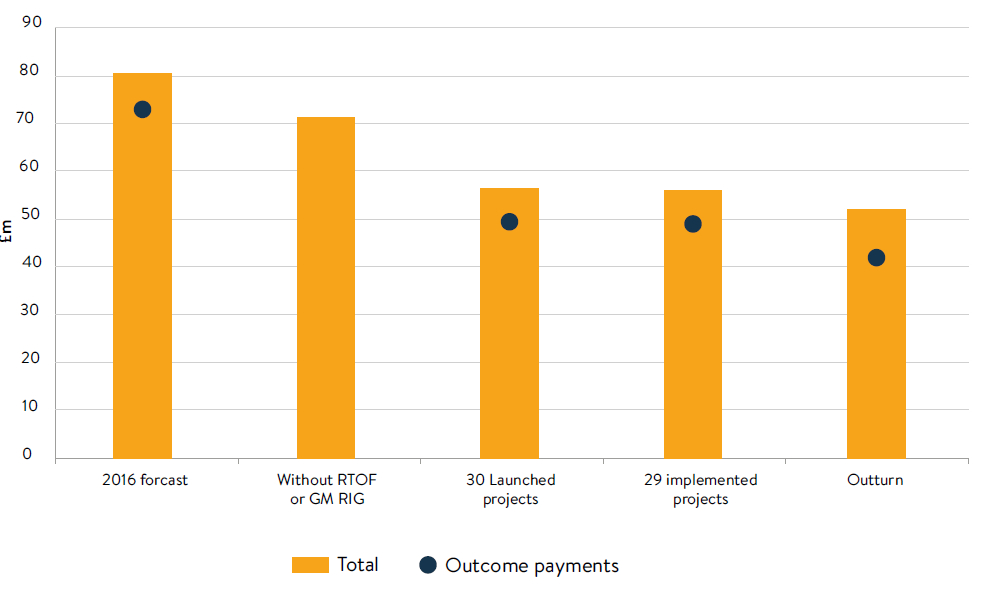
Approximately £9m of LCF funding was reallocated to the Greater Manchester Reform Investment Fund (RIF) and the Refugee Transition Outcomes Fund (RTOF), bringing total potential LCF spend down from £80m to £71m (see Chart 1). The RIF was agreed with Government as part of the fourth devolution agreement for Greater Manchester. The original ambition for the RIF was to create a vehicle through which different Government funding streams could be brought together into a single Greater Manchester pot to be invested alongside other local funding in driving system wide reform. This included a £5m allocation from the LCF. The RTOF was a fund of up to £13.99 million that sought to improve employment, housing, and wider integration outcomes for approximately 1,800 newly recognised refugees. The funding for the RTOF programme came from two sources: up to £10 million from the HM Treasury’s Shared Outcomes Fund, which funded pilot projects to test innovative ways of working across the public sector, and the remaining funding of up to £3.99 million came from the LCF.
The LCF initially committed £48.15m in outcomes funding for 31 projects. This commitment was the result of three rounds of funding allocation between 2016 and 2018. This reduced by £1.8m following the early withdrawals of two projects (see table 2), bringing total commitment prior to any further allocations to £46.32m. In 2020, the LCF offered projects an opportunity to request further allocations and scale their existing interventions. As shown in Table 2, 10 projects received further allocations, amounting to just over £2.31m bringing the total forecast outcomes spend up to £48.63m. The LCF expected these further allocations to work with the same cohort criteria, outcomes and payment structure as the core LCF project [footnote 10]. As of September 2024, the LCF has spent £41.61m in outcomes payments.
Chart 2. Life Chances Fund Outturn (Jan 2025) and forecast spend
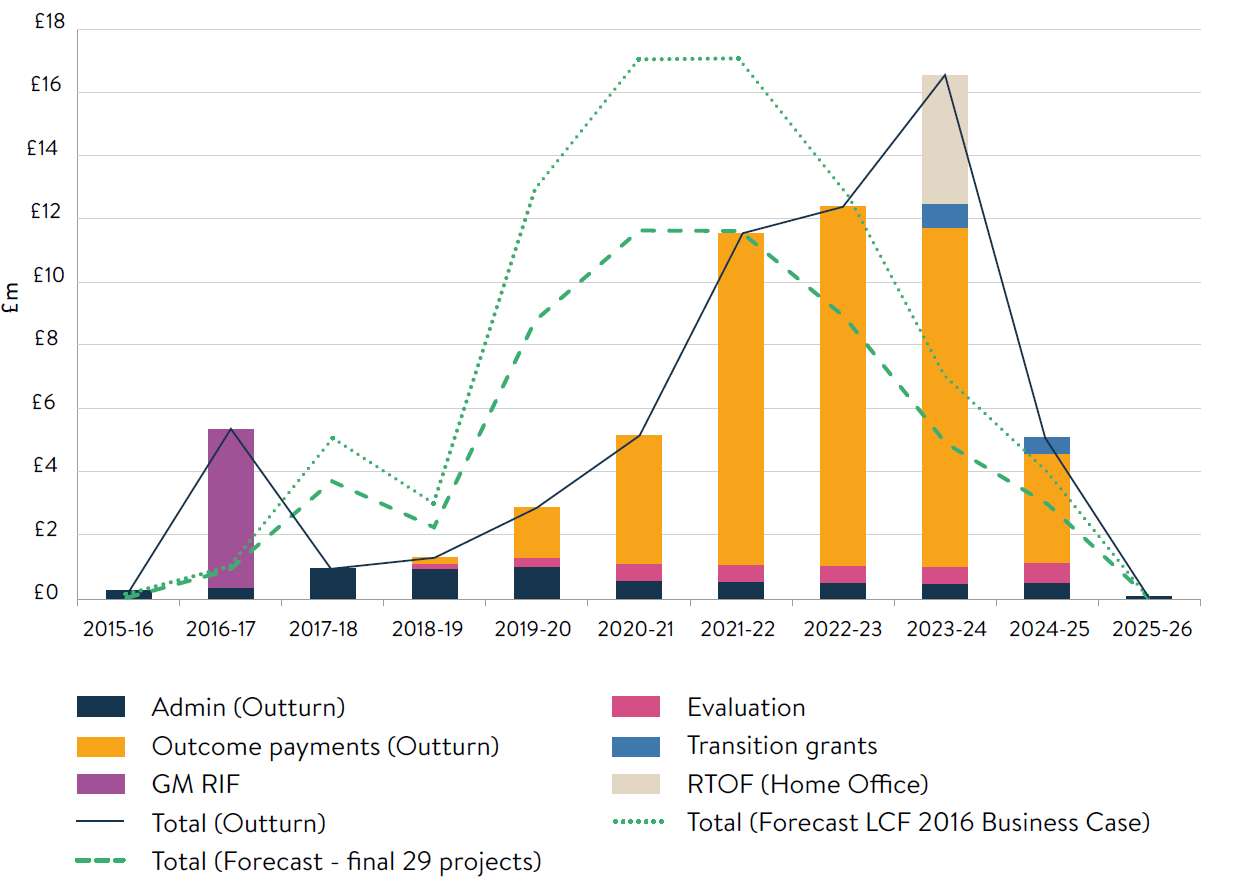
Note: COVID-19 pandemic resulted in lower spend on outcomes than expected in 2020-21 for the LCF.
Chart 2 shows annual LCF spending by financial year, based on actual outturn. The bars indicate the amount spent each year. The chart covers spending from financial year 2015–16 to 2025–26. In the first five years, the largest single item of spending was the £5 million allocated to the Greater Manchester Reform Investment Fund. Most LCF spending occurred in the final six years of the programme. Between 2019–20 and 2025–26, the LCF paid more than £41 million in outcome payments, representing 67% of total outturn. The remaining expenditure includes programme administration, evaluation costs, transition grants to help projects develop sustainability plans, and £4 million allocated to the Refugee Transitions Outcome Fund, which was supported by the Home Office. Total LCF outturn was £61 million.
3.4 The Life Chances Fund referral and engagement conversion rates
In the context of the Life Chances Fund, ‘referrals’ is used to describe potential service users who are referred to a particular service, usually by a local authority. ‘Engagements’ is used to describe service users who have been referred to the service, met the eligibility criteria, and decided to actively participate in the programme. According to self-reported end of grant forms, by September 2024, 130,345 people were referred to the LCF projects, 54,213 people engaged, and 48,904 people achieved at least one project outcome. In other words, 42% of people referred to a project went on to engage in that project, and 90% of engaged service users went on to achieve one or more outcome. We note that the same service user could be referred or engaged multiple times over the life of the project.
In addition to submitting quarterly payment claims, projects were required to self-report the target number of referrals that they expected for a particular quarter, the actual number of referrals that they received, and the final number of service users who engaged with the service in that quarter. Some projects had a conversion rate of more than 100% from actual referrals into engaged service users. This is due to projects engaging with service users from sources other than the ‘official’ referral channels. Official referral channels often include local commissioners and other locally based organisations that committed to refer eligible service users for the project.
Table 3 presents an average rate of conversion between the target referral into actual referrals, and actual referrals into engaged service users for each LCF project. These summary figures were calculated by averaging the self-reported quarterly figures for each project.
Table 3. Average conversion rates for Life Chances Fund projects – target referrals into actual referrals received by projects and referrals into engaged service users
| LCF theme | Name of project | Project referrals (as % of referral target) | Engaged service users (as % of project referrals) | |
| Children’s services | Fostering Better Outcomes | 87% | 53% | |
| Children’s services | Stronger Families Suffolk | 98% | 86% | |
| Children’s services | Stronger Families Norfolk | 104% | 79% | |
| Children’s services | Pyramid Project | 38% | 14% | |
| Children’s services | DN2 Children’s Services Social Impact Bond | 118% | 97% | |
| Drug and alcohol dependency | Integrated Family Service Support (IFSS) | 104% | 100% | |
| Drug and alcohol dependency | Cornwall Frequent Attenders | 87% | 100% | |
| Drug and alcohol dependency | IPS employment support for people with drug and alcohol addictions | 120% | 65% | |
| Early years | Reducing the prevalence of mothers experiencing recurrent care proceedings (Pause) | Data not available | Data not available | |
| Early years | ParentChild+ | 214% | 69% | |
| Early years | West London Zone (AllChild), Placed-Based Support for Children and Young People: Scale-Up | 98% | 60% | |
| Young people | FutureImpact | 145% | 93% | |
| Young people | DFN-MoveForward UK | 56% | 87% | |
| Young people | Big Picture Learning in Doncaster | 96% | 88% | |
| Young people | The Skill Mill | 85% | 100% | |
| Young people | Chances | 99% | 100% | |
| Young people | Gloucestershire Positive Behaviour Support | 92% | 94% | |
| Older people’s services | Enhanced Dementia Care Service | 143% | 86% | |
| Healthy lives | MHEP Haringey And Barnet | 91% | 68% | |
| Healthy lives | Promoting Independence | 88% | 95% | |
| Healthy lives | Midlands Regional Pause Hub | 165% | 104% | |
| Healthy lives | MHEP Enfield | 79% | 71% | |
| Healthy lives | MHEP Tower Hamlets – Severe Mental Illness | 60% | 55% | |
| Healthy lives | MHEP Shropshire | 129% | 66% | |
| Healthy lives | MHEP Tower Hamlets – Learning Disabilities | 23% | 113% | |
| Healthy lives | A Norfolk Carers SIB | 166% | 59% | |
| Healthy lives | Provision Of A Social Prescribing Framework And Offer At Scale Across Northamptonshire | 83% | 82% | |
| Other cross-cutting themes | Kirklees Better Outcomes Partnership | 226% | 56% | |
| Other cross-cutting themes | Single Homelessness Prevention Service | 94% | 88% |
In general terms, LCF projects have been successful in receiving referrals from their local commissioners and engaging with service users. Two projects have struggled with achieving the target number of referrals that they initially planned. The Mental Health and Employment Partnership Tower Hamlets for people with learning disabilities only achieved an average of 23% of target referrals, and the Pyramid Project achieved an average of 38%. Detailed explanations provided by projects around these issues are presented in the projects’ performance chapters but generally they are related to projects assuming that local commissioners or other local partners would provide more referrals than they actually did, and difficulties engaging with service users in-person during the COVID-19 pandemic.
Twelve projects achieved an average of 100% of expected referrals or higher. Projects had initial expectations for referral numbers, but projects could receive more referrals than anticipated, from the expected referral sources and other sources too. These projects have received more referrals than initially planned, which was not necessarily advantageous for those projects. As noted above, the LCF projects tend to have well-defined cohorts and eligibility criteria, which means that not everyone who is referred to the service can use it. Service users need to demonstrate that they comply with the eligibility requirements before engaging with the service. The time and resources spent on triaging service users could be onerous for projects.
Only one project achieved an average of 50% or lower for the conversion rate of referrals into engaged service users. The Pyramid Project had an average conversion rate of 14%. More details on the development of this SOP can be found in the project’s chapter, but the main explanation for the lack of engagement related to difficulties receiving the right referrals, and the lack of appropriate foster placements available to be offered to the cohort.
There are no substantial differences in conversion rates across policy themes.
3.5 The Life Chances Fund projects and outcome achievements
In the baseline form, every project was required to specify the list of outcome metrics and identify which of those metrics would be the “primary outcome”. The selection of the primary outcome was left to the project stakeholders, and they could choose the metric that was most relevant to them. They did not always select the most long-term, or the most difficult to achieve metric. To describe the performance of projects, we calculate the percentage of achievement of the primary outcome against the best-case scenario expectation set in the baseline form. Over the course of the LCF, some projects updated their baseline estimate due to changes in circumstances. These were agreed case-by-case and following a due process. In these cases, we report the revised figures. Table 4 uses data self-reported by projects in their end of grant forms [footnote 11]. It was not possible to use data from the DCMS Data Portal for all projects, as there were gaps and different levels of granularity for projects’ achievements.
Once the primary outcome was identified, we looked at the payment triggers and targets linked to that primary outcome. For projects with one payment trigger per primary outcome, we calculated the percentage of achievement for that single payment trigger. For projects where the primary outcome is linked to several payment triggers, we have calculated an average of the achievements for those payment triggers.
Figure 1. Referral rates as a proportion of initial projections by project, based on projects’ self-reported quarterly data on referrals and engagements
| Policy theme | Project | Complete or ongoing project | Percentage | |
|---|---|---|---|---|
| Children’s services | DN2 Children’s Services | Ongoing project | 118% | |
| Children’s services | Stronger Families Norfolk | Ongoing project | 104% | |
| Children’s services | Stronger Families Suffolk | Ongoing project | 98% | |
| Children’s services | Fostering Better Outcomes | Complete project | 87% | |
| Children’s services | Pyramid Project | Complete project | 38% | |
| Drug and alcohol dependency | IPS (drug & alcohol) | Complete project | 120% | |
| Drug and alcohol dependency | Integrated Family Support Service | Ongoing project | 104% | |
| Drug and alcohol dependency | Cornwall Frequent Attenders Project | Complete project | 87% | |
| Early years | ParentChild+ | Ongoing project | 214% | |
| Early years | West London Zone (AllChild) | Complete project | 98% | |
| Early years | Pause (data not available) | data not available | data not available | |
| Healthy lives | A Norfolk SIB for Carers | Ongoing project | 166% | |
| Healthy lives | Midlands Regional Pause Hub | Ongoing project | 165% | |
| Healthy lives | MHEP Shropshire | Complete project | 129% | |
| Healthy lives | MHEP Haringey & Barnet | Complete project | 91% | |
| Healthy lives | Promoting Independence | Ongoing project | 88% | |
| Healthy lives | Northamptonshire social prescribing | Ongoing project | 83% | |
| Healthy lives | MHEP Enfield | Complete project | 79% | |
| Healthy lives | MHEP Tower Hamlets SMI | Complete project | 60% | |
| Healthy lives | MHEP Tower Hamlets LD | Complete project | 23% | |
| Older people’s services | Enhanced Dementia Care Service | Complete project | 143% | |
| Young people | FutureImpact | Complete project | 145% | |
| Young people | Chances | Complete project | 99% | |
| Young people | Big Picture Learning | Complete project | 96% | |
| Young people | Gloucestershire Positive Behaviour Support | Ongoing project | 92% | |
| Young people | The Skill Mill | Complete project | 85% | |
| Young people | DFN-MoveForward | Complete project | 56% | |
| Other | Kirklees Better Outcomes Partnership | Complete project | 226% | |
| Other | Single Homeless Prevention Service | Ongoing project | 94% |
Table 4. The Life Chances Fund projects and their primary outcome achievements – according to their end of grant forms
| LCF theme | Name of project | Primary outcome | Baseline target (for primary outcome, for entire lifetime of project)[footnote 12] | Achievement up to September 2024 | Percentage of primary outcome achievement (against baseline target) | Complete/continuing after September 2024 |
|---|---|---|---|---|---|---|
| Children’s services | Fostering Better Outcomes | Supporting children and young people in foster care, as an alternative to residential care. | 30 children and young people expected to not be in residential care for 1 month. 24 children and young people expected to not be in residential care for 12 months. 22 children and young people expected to not be in residential care for 24 months. |
9 children and young people not in residential care for 1 month. 5 children and young people not in residential care for 12 months. 3 children and young people not in residential care for 24 months. |
22% | Complete |
| Children’s services | Stronger Families Suffolk | To avoid the need for sustained care through the delivery of an evidenced-based therapeutic intervention. | 282 children to achieve this outcome.[footnote 13] | 276 children achieved this outcome. | 98% | Continuing after September 2024 |
| Children’s services | Stronger Families Norfolk | Prevention of families from breaking down and young people/ children from entering care. | 166,748 days of care saved. | 145,852 days of care saved. | 87% | Continuing after September 2024 |
| Children’s services | Pyramid Project | Young person moves from residential to foster placement. | 79 young people moving from residential to foster placement. | 16 young people moved to foster placement. | 20% | Complete |
| Children’s services | DN2 Children’s Services Social Impact Bond | Child/young person steps down from residential care into a familial type of environment. | 85 service users expected to achieve this outcome. | 70 service use achieved this outcome. | 82% | Continuing after September 2024 |
| Drug and alcohol dependency | Integrated Family Service Support (IFSS) | To reduce the number of children with Child Protection Plans (CPP) escalating to become looked after children (LAC). | 553 families engaging on the CPP. 553 children and young people avoid escalation from CPP to LAC. 455 families completing the CPP programme. |
553 families engaged on the CPP programme. 795 children and young people avoided escalation from CPP to LAC. 466 families completing the CPP programme. |
115% | Continuing after September 2024 |
| Drug and alcohol dependency | Cornwall Frequent Attenders | Reduce the avoidable use of A&E by drug and alcohol ‘frequent attenders’. | 380 service users achieving a 60% reduction in A&E attendance - achieved after 6, 9 and 12 months. 233 service users achieving a sustained reduction of use of A&E services after 18 months. |
362 service users achieved a 60% reduction in A&E attendance - after 6, 9 and 12 months. 271 service users achieved sustained reduction of use of A&E services after 18 months. |
106% | Complete |
| Drug and alcohol dependency | IPS Employment Support For People With Drug And Alcohol Addictions | Job start. | 766 service users starting a new job. | 276 service users started a new job. | 36% | Complete |
| Early years | Reducing The Prevalence Of Mothers Experiencing Recurrent Care Proceedings (Pause) | Women are supported to take a ‘pause’ from pregnancy to enable them to focus on their own needs and take control of their lives. | 40 women to be supported. | 49 women were supported. | 123% | Complete |
| Early years | ParentChild+ | To narrow the school readiness gap by improving early speech and language, and personal-social-emotional skills. | Speech and language skills improvement at ASQ level for 94 children (original cohort). Socio-personal skills improvement at ASQ level for 94 children (original cohort). Speech and language skills improvement at EYFS for 77 children (original cohort). Socio-personal skills improvement at EYFS for 77 children (original cohort). |
87 children (original cohort) achieved speech and language skills improvement at ASQ level. 84 children (original cohort) achieved socio-personal skills at ASQ level. 28 children (original cohort) achieved speech and language skills at EYFS level. 34 children (original cohort) achieved socio-personal skills at EYFS level. |
75% | Continuing after September 2024 |
| Early years | West London Zone (AllChild), Placed-Based Support for Children and Young People: Scale-Up | Child achieves at least one outcome on the AllChild rate card to set a foundation for successful development into adulthood. | 1,487 children to achieve at least one outcome from the AllChild rate card. | 2,024 children achieved at least one outcome from the AllChild rate card. | 136% | Complete |
| Young people | FutureImpact | Young person demonstrates increased resilience, social inclusion and capacity for independent living, ability and knowledge to support career planning and further education/ training (wellbeing assessment completed). | 2,487 wellbeing outcomes (one person could achieve several wellbeing outcomes). | 2,796 wellbeing outcomes achieved[footnote 14]. | 111% | Complete |
| Young people | DFN- MoveForward UK |
Young people with mild to moderate learning disabilities will enter and sustain paid employment. | 78 young people entering and sustaining employment. | 64 young people entered and sustained employment. | 82% | Complete |
| Young people | Big Picture Learning In Doncaster | Personal Learning Plan (PLP) established for students in KS3 and KS4. |
465 PLP for KS3. 65 PLP for KS4. |
372 PLP for KS3. 77 PLP for KS4. |
99% | Complete |
| Young people | The Skill Mill | No reoffending for 12 months. | 230 young ex-offenders do not reoffend for 12 months [footnote 15]. | 203 young ex-offenders did not reoffend for 12 months. | 88% | Complete |
| Young people continued | Chances | Improved engagement and attitude to physical activity and sport. | 11,040 outcomes around improved engagement and attitude to physical activity and sport (one person could achieve several outcomes). | 11,046 outcomes around improved engagement and attitude to physical activity and sport. | 100% | Complete |
| Young people continued | Gloucestershire Positive Behaviour Support | Avoidance of full-time residential care for the young people accessing the Positive Behaviour Support (PBS) Service. | To support 14 children avoiding full-time residential care [footnote 16]. | 14 children supported in avoiding full-time residential care. | 100% | Continuing after September 2024 |
| Older people’s services | Enhanced Dementia Care Service | Reduction in avoidable hospital admissions. | 300 reductions of avoidable hospital admissions. | 620 reductions of avoidable hospital admissions. | 207% | Complete |
| Healthy lives | MHEP Haringey And Barnet | Job start. | 379 job starts. | 218 job starts. | 58% | Complete |
| Healthy lives | Promoting Independence | Adults with mental health issues move from 24/7 provision into their own tenancy and sustain this move. | 74 people moving into their own tenancy. 61 people to sustain tenancy for 6 months. 55 people to sustain tenancy for 12 months. 47 people to sustain tenancy for 18 months. |
73 people moved into their own tenancy. 60 people sustained tenancy for 6 months. 51 people sustained tenancy for 12 months. 34 people sustained tenancy for 18 months. |
90% | Continuing after September 2024 |
| Healthy lives | Midlands Regional Pause Hub | Women are supported to focus on themselves, increase their wellbeing, employability, sense of self and engage with other services whilst taking a ‘pause’ from pregnancy. | 121 women engage with the Pause programme and 108 women successfully complete the Pause programme. | 175 women engage with the Pause programme and 149 women successfully complete the Pause programme. |
141% | Continuing after September 2024 |
| Healthy lives | MHEP Enfield | Job start. | 181 job starts. | 88 job starts. | 49% | Complete |
| Healthy lives | MHEP Tower Hamlets – Severe Mental Illness | Job start. | 718 job starts. | 359 job starts. | 50% | Complete |
| Healthy lives | MHEP Shropshire | Job start. | 197 job starts. | 170 job starts. | 86% | Complete |
| Healthy lives | MHEP Tower Hamlets – Learning Disabilities | Job start. | 182 job starts. | 135 job starts. | 65% | Complete | |||||||||||||||||||
| Healthy lives | A Norfolk Carers SIB | Sustainment of the caring role at 6 and 12 months since care support was agreed. | 1,797 outcomes at 6 months and 1,284 at 12 months. | 1,257 outcomes at 6 months and 779 at 12 months. | 65% | Continuing after September 2024 | |||||||||||||||||||
| Healthy lives | Provision Of A Social Prescribing Framework And Offer At Scale Across Northamptonshire | Wellbeing improvement, measured by changes in the Well-being Star survey and Warwick-Edinburgh Mental Wellbeing Scale measurement tools. | 3,696 service users to show improvements after 6 months and 3,328 service users to show improvements after 12 months. | 1,084 service users showed improvements after 6 months and 546 service users showed improvements after 12 months. | 24% | Continuing after September 2024 | |||||||||||||||||||
| Other cross-cutting themes | Kirklees Better Outcomes Partnership | Entry into, completion and sustainment of employment, education, training and/or volunteering. | 1,386 service users expected to achieve at least one of the outcomes under employment, education, training and/or volunteering. | 1,817 service users expected to achieve at least one of the outcomes under employment, education, training and/or volunteering. | 131% | Complete | |||||||||||||||||||
| Other cross-cutting themes | Single Homeless Prevention Service | Successful completion of a Personal Housing Plan (PHP) for homeless people, or at risk of homelessness. | 11,497 service users to complete a PHP. | 12,117 service users to complete a PHP | 105% | Continuing after September 2024 |
On average, the LCF projects have achieved 88% of their primary outcome, based on the granular end of grant data. The 18 complete projects have an average primary outcome achievement of 87%. This average summarises a diverse range of individual project performances and different types of primary outcome metrics. For instance, the Pyramid Project achieved 20% of their primary outcome, while other projects, such as Chances, FutureImpact or Kirklees Better Outcomes Partnership achieved 100% or more. These averages should be interpreted with caution, as projects set benchmarks for themselves with different levels of difficulty. While some projects selected metrics around engagement of completion of initial plans, other projects selected long-term metrics as primary outcomes. More granular data on the performance of projects for other metrics (not just the primary outcome) can be found in the projects’ performance chapters (chapters 4 to 32).
The 11 ongoing projects present an average primary outcome achievement of 89%. These projects have been compared against their baseline target for the entire service, to give readers an understanding of where projects were in their delivery journey by September 2024 [footnote 17]. The ongoing projects summary figure also summarises the performance of projects at very different stages of implementation. For instance, Social Prescribing in Northamptonshire has achieved a 24% of their primary outcome but they still deliver a service up to 2026. Midlands Regional Pause Hub continues until 2026 and has already overachieved their targets at 141% [footnote 18]. Each project delivers a different intervention with distinct achievement and payment cycles, so all data for ongoing projects should be understood as interim data that may be updated in the coming years.
As noted above, it is not possible to directly compare outcome achievements between projects as they work with very different cohorts and outcome metrics. The following table presents an average of the achievements by policy themes, together with the number of projects falling under each policy theme.
Table 4.1 Primary outcome achievement by policy themes
| Policy theme | Average | Min value for the group | Max value for the group | Number of projects | Average for complete projects |
|---|---|---|---|---|---|
| Children’s services | 62% | 20% | 98% | 5 (2 complete, 3 ongoing) |
21% |
| Drug and alcohol dependency | 86% | 36% | 115% | 3 (2 complete, 1 ongoing) |
71% |
| Early years | 111% | 75% | 136% | 3 (2 complete, 1 ongoing) |
129% |
| Young people | 97% | 82% | 111% | 6 (5 complete, 1 ongoing) |
96% |
| Older people | 207% | 207% | 207% | 1 (1 complete) | 207% |
| Healthy lives | 70% | 24% | 141% | 9 (5 complete, 4 ongoing) |
62% |
| Other cross-cutting themes | 118% | 105% | 131% | 2 (1 complete, 1 ongoing) |
131% |
Figure 2. Primary outcomes achieved as a proportion of best-case scenario by project
| Policy theme | Project | Complete or ongoing project | Percentage |
|---|---|---|---|
| Children’s services | Stronger Families Norfolk | Ongoing project | 98% |
| Children’s services | Stronger Families Suffolk | Ongoing project | 87% |
| Children’s services | DN2 Children’s Services | Ongoing project | 82% |
| Children’s services | Fostering Better Outcomes | Complete project | 22% |
| Children’s services | Pyramid Project | Complete project | 20% |
| Drug and alcohol dependency | Integrated Family Support Service | Ongoing project | 115% |
| Drug and alcohol dependency | Cornwall Frequent Attenders Project | Complete project | 106% |
| Drug and alcohol dependency | IPS (drug & alcohol) | Complete project | 36% |
| Early years | West London Zone (AllChild) | Complete project | 136% |
| Early years | Pause | Complete project | 123% |
| Early years | ParentChild+ | Ongoing project | 75% |
| Healthy lives | Midlands Regional Pause Hub | Ongoing project | 141% |
| Healthy lives | Promoting Independence | Ongoing project | 90% |
| Healthy lives | MHEP Shropshire | Complete project | 86% |
| Healthy lives | A Norfolk SIB for Carers | Ongoing project | 65% |
| Healthy lives | MHEP Tower Hamlets LD | Complete project | 65% |
| Healthy lives | MHEP Haringey & Barnet | Complete project | 58% |
| Healthy lives | MHEP Tower Hamlets SMI | Complete project | 50% |
| Healthy lives | MHEP Enfield | Complete project | 49% |
| Healthy lives | Northamptonshire social prescribing | Ongoing project | 24% |
| Older people’s services | Enhanced Dementia Care Service | Complete project | 207% |
| Young people | FutureImpact | Complete project | 111% |
| Young people | Gloucestershire Positive Behaviour Support | Ongoing project | 100% |
| Young people | Chances | Complete project | 100% |
| Young people | Big Picture Learning | Complete project | 99% |
| Young people | The Skill Mill | Complete project | 88% |
| Young people | DFN-MoveForward | Complete project | 82% |
| Other | Kirklees Better Outcomes Partnership | Complete project | 131% |
| Other | Single Homeless Prevention Service | Ongoing project | 105% |
Children’s services
The children’s services projects are the cluster with the lowest average outcome achievements (62%). This average summarises a diverse group of performances, with the Pyramid Project achieving 20% of their primary outcome and Stronger Families Suffolk achieving 98%. There is one key difference between the two Stronger Families projects (achieving 98% and 87% in Suffolk and Norfolk respectively), and the three other projects. Stronger Families is a model where the intervention aims to prevent family breakdown and avoid children going into the care system. Meanwhile, Fostering Better Outcomes and the Pyramid Project worked with cohorts of children in care or in the edge of care. These proved to be complex cohorts not just because of their vulnerability, but because of the structural problems around the lack of sufficient foster placements in England. DN2 Children’s Services worked with four different cohorts of children, and they have also found that the most difficult to work with was the cohort of children in residential care who were looking for foster placements, as it was very challenging to find appropriate placements for them. The children’s services projects addressing prevention were more successful than the ones working with children already in care. This is not necessarily a reflection of the performance of the partnership or the effectiveness of a certain intervention, but an indication of a structural problem around the lack of sufficient foster placements.
Healthy lives projects
The healthy lives group contains the highest number of projects. This group encompasses 5 complete Mental Health and Employment Partnership (MHEP) projects and 4 ongoing projects. The MHEP projects delivered an intervention based on IPS [footnote 19] (the same methodology as the project IPS Employment Support For People With Drug And Alcohol Addictions) and represent a diverse range of performance. For instance, the MHEP service in Shropshire achieved more than 86% (170 people) of its primary outcome baseline target (of 197 people), while the same service in Enfield achieved 49% (88 people, compared to target of 181). MHEP Tower Hamlets Learning Disabilities was the first time that an IPS service was provided for a cohort with learning disabilities. The project did not achieve its baseline targets, but generated substantial lessons about the feasibility of delivering this intervention for people with learning disabilities. MHEP Tower Hamlets Learning Disabilities, therefore, achieved its broader goal of understanding whether IPS is a viable methodology for this group [footnote 20].
The rest of the healthy lives projects are continuing after 2024. For instance, Midlands Regional Pause Hub, Social Prescribing In Northamptonshire and Promoting Independence will deliver a service until 2026. A Norfolk SIB for Carers was contracted until 2025. All data for these projects should be understood as interim. Apart from Midlands Regional Pause Hub, which has already achieved more than 100% of initial targets, the other three projects have lower achievements against their targets, but this is due to the comparison against baseline targets for the entire life of the project.
As almost half of the healthy lives projects are still ongoing, it is not possible to offer a fair description of their achievements. The group of complete projects, all MHEP SOPs, had mixed performances when focusing on their primary outcome and comparing it against baseline targets. We note that the MHEP SOPs did not update their target from the original baseline set at the launch of the projects. These targets were ambitious and significantly higher than the caps set by commissioners. Projects may not have had sufficient incentives to dedicate their limited time to update targets that did not have financial implications. Even though the actual achievements were much lower than targets, they are considered good performances when compared to other IPS services and the expectation of NHS England for IPS [footnote 21]. An in-depth analysis of the MHEP projects, performance and learnings can be found in the final report for the MHEP partnership.
Drug and alcohol dependency projects
The drug and alcohol dependency projects have an average achievement of 86%. Again, this group encompasses diverse performances. IPS Employment achieved 36% (276 people) of their primary outcome target (of 766 people), while Integrated Family Service Support achieved more than 100%. Integrated Family Service Support was designed to address the issue of children whose parents have issues with alcohol or substance misuse becoming looked after children, with part of its success due to delivering an intervention based on prevention rather than working with children already in care.
Cornwall Frequent Attenders and the IPS Service, meanwhile, had a more direct focus on cohorts with drug and alcohol addictions. Cornwall Frequent Attenders has been very successful in reducing the number of unnecessary visits to A&E services by people with alcohol addiction (106% achievement). IPS employment support for people with drug and alcohol problems has achieved 36% of their primary outcome target, but this figure can be framed as a success too. This is because 32% of the project’s engaged service users went on to start a job, which is in line with what is considered a successful result in IPS literature [footnote 22].In this context, all alcohol and drug dependency projects could be considered as well performing interventions.
Young people’s projects
The young people cluster encompasses 6 projects with an average achievement of 97%. Only one of these projects continues after 2024: Gloucestershire Positive Behaviour Support was contracted until 2029. Gloucestershire Positive Behaviour Support could have also been included under the theme of children’s services projects, as this intervention supports young people displaying challenging behaviours, at risk of going into residential care.
The rest of the projects address different issues that affect young people, such as youth offending, those not in education, employment or training (NEET), learning disabilities and students with special needs. Many of these projects aim to place young people into employment or help them get ready for a job search. FutureImpact has helped 547 young people to go into full-time work, part-time work or volunteering (initial target: 670). DFN-MoveForward has helped 61 young people to go into work (initial target: 103). Although neither of these projects have achieved 100% of their initial targets, they faced challenging labour market conditions due to the COVID-19 pandemic.
One key learning emerging from these projects is the relevance of rewarding young people who get a part-time job. Most programmes tend to incentivise young people to go into full-time jobs due to the perceived advantages (higher salary, more time occupied, etc.). However, most of the LCF projects found that part-time employment works better for cohorts of young people with learning disabilities, special needs or other vulnerabilities. Part-time jobs allow them to adjust to working life and to other changes that might be going on with their lives. Full-time jobs were perceived as overwhelming for more vulnerable cohorts.
Chances and The Skill Mill had specific metrics for young people who have been offenders. In Chances, 573 service users who had offended once did not reoffend again, and 116 service users who had offended three or more times did not reoffend again. In The Skill Mill, 203 service users who had offended before did not reoffend for 12 months after the end of the programme. Skill Mill achieved 82% of their initial no reoffending target. Chances did not achieve their non-reoffending targets, but this was due to a lack of ex-offenders in the referrals sent by local partners.
Early years interventions
The early years interventions present an average achievement of 111% of their primary outcome. Reducing The Prevalence Of Mothers Experiencing Recurrent Care Proceedings was grouped under this theme, but it could have been grouped under the healthy lives theme (together with Midlands Regional Pause Hub, the other project delivering the Pause programme).
West London Zone and ParentChild+ were the two projects with a direct focus on early years interventions. West London Zone has achieved more than 100% of their primary outcome target [footnote 23],while ParentChild+ has achieved 75%. However, ParentChild+ has an outcome tracking window that goes beyond September 2024. This is because they work with children aged 2-3 and learning improvements at Early Years Foundational Stage (EYFS) [footnote 24] level are measured when children turn 5 (among other reasons).
Other projects
Two projects were labelled as ‘other cross-cutting themes’: Single Homelessness Prevention Service and Kirklees Better Outcomes Partnership. They present a combined average of 118% achievement. The point in common for these projects is that they both work with people who are homeless or at risk of homelessness. Kirklees Better Outcomes Partnership works with other vulnerabilities and complex needs too, but their housing outcomes are the only comparable metric with Single Homelessness Prevention Service. 3,458 service users have achieved at least one accommodation outcome under the Kirklees Better Outcomes Partnership (target of 3,421 service users achieving at least one accommodation outcome). Accommodation outcomes include finding new accommodation, or sustaining the accommodation for 3 or 6 months. Through the Single Homelessness Prevention Service, 2,464 service users avoided becoming homeless and 4,313 have relieved their homelessness situation. Single Homelessness Prevention Service have not achieved their targets yet, as they are continuing after the LCF.
3.6 The Life Chances Fund projects and outcome payments
Table 5 shows the latest figures for maximum potential outcome payments, as recorded in the DCMS Data Portal. These figures might differ from the initial figures in Tables 1 and 2 as most of these projects requested variations of their payment profiles across the life of the service. The figures on actual outcome payments as of September 2024 were also sourced from the DCMS Data Portal. These might differ from the figures that projects have reported internally, given that some local commissioners kept paying for outcomes after September 2024. Table 5 marks with an asterisk (*) all cases in which the difference between the value reported in the Portal and those reported internally was larger than 5%. Overall, according to internal project reports, the outcome payments were £128,898,222, ie. about £3m more than those documented on the Portal. More details are provided, for each project, in the project chapters later in the report.
Table 5. Life Chances Fund projects, maximum potential outcome payment and total outcome payments from LCF and local commissioners
| LCF theme | Name of project | Planned maximum potential outcome payments (LCF and commissioners) | Actual outcome payments up to Sep 2024 (according to DCMS Data Portal) | Percentage maximum outcome payment claimed |
|---|---|---|---|---|
| Children’s services | Fostering Better Outcomes | £1,028,926 | £964,058 | 94% |
| Children’s services | Stronger Families Suffolk | £6,925,607 | £4,710,609 | 68% |
| Children’s services | Stronger Families Norfolk | £9,576,245 | £8,626,543 | 90% |
| Children’s services | Pyramid Project | £11,341,260 | £1,066,524* | 9% |
| Children’s services | DN2 Children’s Services Social Impact Bond | £9,123,323 | £4,102,993 | 45% |
| Drug and alcohol dependency | Integrated Family Service Support | £5,331,000 | £4,662,002 | 87% |
| Drug and alcohol dependency | Cornwall Frequent Attenders | £2,226,336 | £2,205,244 | 99% |
| Drug and alcohol dependency | IPS Employment Support For People With Drug And Alcohol Addictions | £2,375,150 | £2,072,296* | 87% |
| Drug and alcohol dependency | Reducing The Prevalence Of Mothers Experiencing Recurrent Care Proceedings (Pause) | £1,623,872 | £1,598,983 | 98% |
| Drug and alcohol dependency | ParentChild+ | £1,107,287 | £1,107,197 | 100% |
| Drug and alcohol dependency | West London Zone (AllChild), Placed-Based Support for Children and Young People: Scale-Up | £16,244,960 | £16,112,650* | 99% |
| Young people | FutureImpact | £3,288,900 | £3,103,050 | 94% |
| Young people | DFN-MoveForward UK | £1,683,620 | £1,644,120 | 96% |
| Young people | Big Picture Learning in Doncaster | £6,194,792 | £5,112,036 | 83% |
| Young people continued | The Skill Mill | £3,241,776 | £3,176,810 | 98% |
| Young people continued | Chances | £4,104,000 | £3,878,283* | 95% |
| Young people continued | Gloucestershire Positive Behaviour Support | £1,774,925 | £840,500 | 47% |
| Older people’s services | Enhanced Dementia Care Service | £810,000 | £810,000 | 100% |
| Healthy lives | MHEP Haringey And Barnet | £1,421,234 | £1,431,647 | 101% [footnote 25] |
| Healthy lives | Promoting Independence | £2,744,750 | £2,376,250* | 87% |
| Healthy lives | Midlands Regional Pause Hub | £5,643,426 | £4,933,934 | 87% |
| Healthy lives | MHEP Enfield | £620,689 | £604,044 | 97% |
| Healthy lives | MHEP Tower Hamlets – Severe Mental Illness | £2,068,270 | £1,724,693 | 83% |
| Healthy lives | MHEP Shropshire | £1,034,487 | £1,034,487 | 100% |
| Healthy lives | MHEP Tower Hamlets – Learning Disabilities | £1,307,059 | £1,243,387 | 98% |
| Healthy lives | A Norfolk Carers SIB | £11,872,775 | £9,238,784 | 78% |
| Healthy lives | Provision Of A Social Prescribing Framework And Offer At Scale Across Northamptonshire | £8,455,774 | £2,991,017 | 35% |
| Other cross-cutting themes | Kirklees Better Outcomes Partnership | £22,297,917 | £22,553,79 | 101% [footnote 26] |
| Other cross-cutting themes | Single Homeless Prevention Service | £17,113,000 | £11,919,546* | 70% |
| Other cross-cutting themes | Total: | £162,581,360 | £125,845,483 | 77% |
*denotes projects in which the value reported in the portal and those reported internally was larger than 5%.
As shown in Table 5, the LCF and local commissioners started with a commitment to use £162,581,360 as outcomes funding to support SOPs. As of September 2024, the LCF and local commissioners have spent £125,845,483 in outcome payments, which amounts to 77% of the total available funding. It is worth noting that there are 11 ongoing projects that are still delivering a service and will be drawing on the local component of this funding to claim for their outcomes. There are two ways of describing total payments for LCF projects. First, when comparing the total payments received by all projects against the maximum potential payments available for all projects, completed projects have claimed 85% of the available funding, while ongoing projects have claimed 70%. Second, when looking at payments claimed by individual projects (as a percentage of the maximum potential outcome payment), completed projects have claimed an average of 91% of available payments, compared with an average of 72% for ongoing projects.
Table 5.1 shows the distribution of committed and actual outcome payments across policy themes. The projects with the highest amount of combined potential outcome payments are the two projects labelled as ‘other cross-cutting themes’: Single Homelessness Prevention Service and Kirklees Better Outcomes Partnership. They are followed by the children’s services projects (5), the healthy lives projects (9), young people’s projects (6), early years projects (3), drug and alcohol dependency (3) and older people’s services (1).
Table 5.1 Committed and actual outcome payments across policy themes as recorded in the DCMS Data Portal
| Total maximum potential outcomes funding from LCF and local commissioners per policy theme | Total outcomes funding from LCF and local commissioners spent per policy theme | Average outcomes payment claimed by policy theme | Number of projects | Average outcomes payments claimed by complete projects | |
|---|---|---|---|---|---|
| Children’s services | £37,995,361 | £19,470,727 | 61% | 5 (2 complete, 3 ongoing) | 52% |
| Drug and alcohol dependency | £9,932,486 | £8,939,542 | 91% | 3 (2 complete,1 ongoing) | 93% |
| Early years | £18,976,119 | £18,818,830 | 99% | 3 (2 complete, 1 ongoing) | 99% |
| Young people | £20,288,013 | £17,754,799 | 86% | 6 (5 complete, 1 ongoing) | 94% |
| Older people’s services | £810,000 | £810,000 | 100% | 1 (1 complete) | 100% |
| Healthy lives | £35,168,464 | £25,578,243 | 85% | 9 (5 complete, 4 ongoing) | 95% |
| Other cross-cutting themes | £39,410,917 | £34,473,342 | 85% | 2 (1 complete, 1 ongoing) | 101% |
| £162,581,360 | £125,845,483 | 77% | 29 (18 complete, 11 ongoing) | 85% |
The early years and older people’s services projects have claimed 99% or more of their potential outcome payment. The drug and alcohol dependency projects have claimed 91%. Young people’s projects have claimed 86%. Healthy lives and “other cross cutting themes” have claimed 85% [footnote 27]. The children’s services projects have been the least successful in claiming their maximum outcome payments, having claimed for 61%. Again, these figures should be interpreted with caution as some projects decided to reprofile or lower their maximum potential outcome payment during delivery and some of the outcome payments were not recorded on the DCMS Portal. These changes make it easier for projects to achieve a higher percentage of outcome payments claimed.
Figure 3. Total outcomes payments (actuals) by project
| LCF theme | Project name | Payment amount | |||||||||||||||||||||||
|---|---|---|---|---|---|---|---|---|---|---|---|---|---|---|---|---|---|---|---|---|---|---|---|---|---|
| Other | KBOP | £22.55m | |||||||||||||||||||||||
| Other | Single Homeless Prevention Service | £11.92m | |||||||||||||||||||||||
| Children’s Services | Stronger Families Norfolk | £8.63m | |||||||||||||||||||||||
| Children’s Services | Stronger Families Suffolk | £4.71m | |||||||||||||||||||||||
| Children’s Services | DN2 Children’s Services | £4.10m | |||||||||||||||||||||||
| Children’s Services | Pyramid Project | £1.07m | |||||||||||||||||||||||
| Children’s Services | Fostering Better Outcomes | £0.96m | |||||||||||||||||||||||
| Early Years | West London Zone | £16.11m | |||||||||||||||||||||||
| Early Years | Reducing the prevalence of … (Pause) | £1.60m | |||||||||||||||||||||||
| Early Years | Parent Child+ | £1.11m | |||||||||||||||||||||||
| Healthy Lives | A Norfolk SIB for Carers | £9.24m | |||||||||||||||||||||||
| Healthy Lives | Midlands Regional Pause Hub | £4.93m | |||||||||||||||||||||||
| Healthy Lives | Social Prescribing in Northamptonshire | £2.99m | |||||||||||||||||||||||
| Healthy Lives | Promoting Independence | £2.38m | |||||||||||||||||||||||
| Healthy Lives | MHEP Tower Hamlets MH | £1.72m | |||||||||||||||||||||||
| Healthy Lives | MHEP Haringey & Barnet | £1.43m | |||||||||||||||||||||||
| Healthy Lives | MHEP Tower Hamlets LD | £1.24m | |||||||||||||||||||||||
| Healthy Lives | MHEP Shropshire | £1.03m | |||||||||||||||||||||||
| Healthy Lives | MHEP Enfield | £0.60m | |||||||||||||||||||||||
| Young People | Big Picture Learning in Doncaster | £5.11m | |||||||||||||||||||||||
| Young People | Chances | £3.88m | |||||||||||||||||||||||
| Young People | The Skill Mill | £3.18m | |||||||||||||||||||||||
| Young People | Future Impact | £3.10m | |||||||||||||||||||||||
| Young People | DFN-MoveForward | £1.64m | |||||||||||||||||||||||
| Young People | Gloucestershire PBS | £0.84m | |||||||||||||||||||||||
| Drug and Alcohol Dependency | Integrated Family Support Service | £4.66m | |||||||||||||||||||||||
| Drug and Alcohol Dependency | Cornwall Frequent Attenders Project | £2.21m | |||||||||||||||||||||||
| Drug and Alcohol Dependency | IPS employment support for people with drug/alcohol addictions | £2.07m | |||||||||||||||||||||||
| Older People’s Services | Older people’s services EDCS | £0.81m |
3.7 The Life Chances Fund projects and social investment
SOPs include the provision of upfront capital by social investors. Table 6 shows the planned total investment and actual investment received for each LCF project.
LCF projects planned to leverage private investment totalling £29,348,038. Given the SOPs’ capacity to adapt, investment commitment figures changed during the life of the fund, with some projects receiving different investment amounts than expected. In total, LCF projects received 93% of committed upfront capital. When complete and ongoing projects are considered separately, complete projects have used 93.1% of their planned investment and ongoing projects have used 93.4%.
Table 6. Life Chances Fund projects, planned and actual investment from social investors
| Project Name | Planned Total Investment | Actual Investment (per EOG Form)[footnote 28] | Percentage Received |
|---|---|---|---|
| Fostering Better Outcomes | £300,000 | £0[footnote 29] | 0% |
| Stronger Families Suffolk | £1,400,000 | £1,400,000 | 100% |
| Stronger Families Norfolk | £2,100,000 | £2,100,000 | 100% |
| Pyramid Project | £925,562 | £600,000 | 65% |
| DN2 Children’s Services Social Impact Bond | £884,831 | £884,831 | 100% |
| Integrated Family Support Service | £475,000 | £445,000 | 94% |
| Cornwall Frequent Attenders Project | £407,000 | £123,000 | 30% |
| IPS Employment Support For People With Drug And Alcohol Addictions | £400,000 | £400,000 | 100% |
| Reducing The Prevalence Of Mothers Experiencing Recurrent Care Proceedings (Pause) | £1,100,000 | £721,000 | 66% |
| ParentChild+ | £100,000 | £100,000 | 100% |
| West London Zone (AllChild), Placed-Based Support for Children and Young People: Scale-Up | £1,400,000 | £1,400,000 | 100% |
| FutureImpact | £498,000 | £498,000 | 100% |
| DFN-MoveForward | £450,000 | £400,000 | 89% |
| Big Picture Learning In Doncaster | £750,000 | £750,000 | 100% |
| The Skill Mill | £1,100,000 | £1,100,000 | 100% |
| Chances | £1,245,000 | £1,250,000 | 100.40% |
| Gloucestershire Positive Behaviour Support | £501,000 | £501,000 | 100% |
| Enhanced Dementia Care Service | £345,000 | £355,950 | 103% |
| Mental Health And Employment Partnership Haringey and Barnet | £227,000 | £227,000 | 100% |
| Promoting Independence | £725,000 | £800,000 | 110% |
| Midlands Regional Pause Hub | £2,150,000 | £1,429,000 | 66% |
| Mental Health And Employment Partnership Enfield | £126,000 | £126,000 | 100% |
| Mental Health And Employment Partnership Tower Hamlets SMI | £300,000 | £300,000 | 100% |
| Mental Health And Employment Partnerships Shropshire | £204,000 | £204,000 | 100% |
| Mental Health And Employment Partnership Tower Hamlets LD | £328,000 | £328,000 | 100% |
| Norfolk Carers SIB | £2,500,000 | £2,500,000 | 100% |
| Provision Of A Social Prescribing Framework And Offer At Scale Across Northamptonshire | £1,350,000 | £1,480,000 | 110% |
| Kirklees Better Outcomes Partnership | £4,535,645 | £4,847,427 | 107% |
| Single Homeless Prevention Service | £2,521,000 | £2,087,921 | 83% |
| Total | £29,348,038 | £27,358,129 | 93% |
Table 6.1 presents the distribution of planned and actual investment amounts by policy themes. Most groups of projects have received all or most of the planned social investment. For instance, the healthy lives projects present an average of 98% of planned investment and the early years’ projects have an average of 99%. The groups of projects that have received less investment than expected were the young people’s projects (90% of planned investment) and children’s services projects (61% of planned investment). There are three ongoing projects in the children’s services group, which might indicate that this figure will increase in the remaining years of delivery.
Table 6.1. Planned and actual social investment amounts by policy themes
| Total planned social investment per policy theme | Actual social investment by policy theme | Average investment received by policy theme | Number of projects in policy theme | Average investment received by complete projects | |
|---|---|---|---|---|---|
| Children’s services | £5,610,393 | £4,984,831 | 61% | 5 (2 complete, 3 ongoing) | 32% |
| Drug and alcohol dependency | £1,282,000 | £968,000 | 95% | 3 (2 complete, 1 ongoing) | 65% |
| Early years | £2,600,000 | £2,221,000 | 99% | 3 (2 complete, 1 ongoing) | 83% |
| Young people | £4,544,000 | £4,499,000 | 90% | 6 (5 mcomplete, 1 ongoing) | 98% |
| Older people’s services | £345,000 | £355,950 | 100% | 1 (1 complete) | 103% |
| Healthy lives | £7,910,000 | £7,394,000 | 98% | 9 (5 complete, 4 ongoing) | 100% |
| Other cross-cutting themes | £7,056,645 | £6,935,348 | 93% | 2 (1 complete, 1 ongoing) | 107% |
| Total | £29,348,038 | £27,358,129 | No data | 29 (18 complete, 11 ongoing) | No data |
3.8. The Life Chances Fund projects and their return on social investment
All Life Chances Fund (LCF) projects included upfront capital from a third party as a requirement of the Fund. In LCF SOPs, this initial investment is provided by social investors and financial returns are made if social outcomes are achieved and evidenced as contractually agreed. In the UK, social investment for SOPs is typically made available by specialist fund managers. By pooling risks across a portfolio, social investors are able to balance potential short-term financial fluctuations in individual projects against cumulative long-term value creation. This aggregated approach allows investors to absorb temporary setbacks in particular projects, provided their overall portfolio achieves its intended social outcomes and maintains financial sustainability. Ultimately, this long-term portfolio perspective facilitates continuous capital deployment into SOP initiatives.
Projected investment returns were reported by projects in the LCF projects’ baseline forms. In baseline forms, investment return was defined as ‘the percentage return [of total investment commitment] that social investors stand to gain in the best-case scenario’. These figures were self-reported by projects, but it has become clear in the production of this report that projects did not use a consistent methodology in estimating projected or final returns. DCMS did not prescribe a method for calculating financial returns at the outset of data collection.
As a result of these data issues, we consulted Better Society Capital to fully explore the potential to report projected and actual investment returns through a consistent methodology for all 29 projects. Better Society Capital recommended using a “Money Multiple” (MM) methodology to understand returns.[footnote 30]
The money multiple measures the total amount of capital returned to the investor relative to the capital provided. It’s calculated by dividing the total cash returned to the investor by the total cash provided. A money multiple of 1.0x means the project just returned the capital back to the investor; a multiple greater than 1.0x means that the project was able to repay more than the initial capital; a multiple smaller than 1.0x means that the investor received back only a percentage of the original capital (eg. 0.8x means that the investor recovered 80% of the capital).
Money multiples are relatively easy to understand and helpful in the context of a socially motivated investor which is not driven by maximising profit. It is important, however, not to interpret the money multiple measures as annual returns. To estimate annual returns, it would be necessary to take into account the exact timeline of when money has been provided and paid back. For instance, consider two hypothetical projects with a money multiple of 1.5x, project A and project B. Project A has an initial investment of £1,000, lasts for one year, returning £1,500 at the end of the year. The money multiple is 1.5x and the approximate annual return 50%. Project B also has an initial investment of £1,000, returning £1,500 at the end of the project, but has a duration of 5 years. In project B the approximate annual return is about 8.5%.
Better Society Capital were able to capture final actual (outturn) money multiples for 20 of the 29 LCF projects, and forecast money multiples for 6 projects. We do not have data on 3 projects. Table 7 is provided by BSC and shows complete projects have a median net money multiple of 1.04, meaning most completed projects were able to repay more than the initial capital back to the investor. For 6 ongoing projects, we estimate a median net money multiple of 0.9-1.18. Different projects have still calculated these on a different basis, so although more consistent than original data, these figures should only be taken as an indication, they can not be used to inform bidding for outcomes contracts or investment into them.
Table 7. Life Chances Fund project money multiples for complete and ongoing projects
Note: Table provided by BSC. *includes 7 LCF projects, however, 2 of these projects are treated as 1 transaction by the investor and considered as a single unit for the purposes of this analysis.
| Completed projects, actuals (Net MM) | Ongoing projects, forecasts (Net MM) | |
|---|---|---|
| Lower quartile | 0.74 | 0.73 to 1.11 |
| Median | 1.04 | 0.9 to 1.18 |
| Upper quartile | 1.16 | 1.08 to 1.21 |
| Projects/transactions | 14 | 6* |
Discussion of LCF investment and return on investment provided by Better Society Capital
Better Society Capital (herein BSC, formerly known as Big Society Capital) is the UK’s leading social impact-led investor. Our mission is to improve the lives of people in the UK, with a focus on disadvantaged or underserved individuals, through growing the amount of money invested in tackling social issues and inequalities. We believe social outcomes contracts could play a key role in delivering this mission – this has led us to become the largest institutional investor into the UK SOPs market over the last 15 years.
Fund managers, and the funds they raise, are the principal conduits through which most social investment is raised and channelled into social outcomes contracts, including those from the LCF. These specialist funds bring together funding and expertise to maximise impact at project level, including through coordination of delivery partners, adaptive management and supporting delivery partners to implement delivery innovations where relevant. The investors into these funds are socially motivated to use their capital to tackle some of the most difficult problems facing people in the UK. They are actively seeking investments where financial performance is achieved in tandem with impact performance and achievement of outcomes.
Most social outcomes contracts in the UK have been invested into through these specialist funds. A consequence of this is that individual or aggregate project-level returns are not reliable indicators of fund-level investor returns – they do not take account of fund-level costs and expenses and where they try to, there has not been a consensus approach for how to attribute these costs to individual projects across the funds that invest in LCF SOCs. Currently, these investment funds are still active and invest into social outcomes contracts that also are not from the LCF. Therefore, current fund level returns are also not indicative of returns made from LCF SOCs. Whilst acknowledging these limitations in the data, to give an indication, BSC expects to generate a low-to-mid single digit return per annum on its capital invested directly into SOCs and through SOC funds to date overall (including both LCF and non-LCF SOCs)[footnote 31].
To better understand investment and financial returns in future outcomes funds, the SOP community may wish to jointly develop a shared set of definitions, methods and reporting expectations. Some fund managers are developing an approach for allocating costs so that there is a more standardised approach to fees, charges and investment structures at a project level. A neutral convening and development space could be used to further prototype SOP investment definitions and reporting norms. In future, this would mean that project-level investment and financial returns information could be published in a comparable and granular format.
-
For research and data analysis purposes we have opted to use the term ‘service user’ to refer specifically to those individuals who formally received a support service, or in other words, were engaged with, through a Life Chances Fund project. We did so to ensure consistency with previous related publications and for clarity as to the ‘unit of analysis’ when discussing results across multiple projects. We recognise that different organisations and communities may prefer alternative terms, each of which carries its own connotations and significance. The choice of terminology can reflect important values and relationships, and the use of ‘service users’ here is not intended to diminish that diversity or overlook the sensitivities some may associate with the term. ↩
-
In the end of grant form, Fostering Better Outcomes reported aiming for a smaller cohort of 12 service users ↩
-
In the end of grant form, Gloucestershire Positive Behaviour Support reported aiming for a smaller cohort of 10 service users ↩
-
In the baseline form, the project reported aiming for a cohort of 16,000 people ↩
-
These amounts do not include outcomes funding from local commissioners. ↩
-
The LCF funding allocation was renegotiated for some projects after the further allocation process. A description of these changes can be found in the project chapters. ↩
-
In April 2023, the award was reduced to £632,793, then in April 2024, the award was increased to £658,112. ↩
-
DNF Move Forward revised its maximum potential outcome payment to £683,620 at a later stage. ↩
-
“£80 million boost for Life Chances Fund to transform lives” Cabinet Office Press Release (July 2016) ↩
-
The LCF shared guidance with projects to apply for further allocations. ↩
-
In some cases, data from the end of grant forms differed from the data on the DCMS Data Portal. For instance, several projects did not report on the Portal the outcomes achievements for which they could not claim a payment as they had reached a cap. The end of grant form included those. ↩
-
All baseline targets in Table 4 refer to targets for the entire life of the service. Readers can see the duration of services in Table 1 of this chapter. ↩
-
This primary outcome encapsulates 2 payment triggers which specify that the user avoids care, one for 1 and a half years and the other for 2 years. ↩
-
In the DCMS Data Portal, the project FutureImpact had an achievement of 2,167 wellbeing outcomes. The achievement of 2,796 wellbeing outcomes was reported in the end of grant form. More information about the projects’ data on the DCMS Data Portal can be found in the project chapter ↩
-
The achievement of 203 young ex offenders not reoffending for 12 months is based on the end of grant form. Further details on the performance of The Skill Mill can be found on the project chapter. ↩
-
This primary outcome includes the payment triggers of: Young person stays out of residential care for 3 months (target and achievement of 14 users), 6 months (target and achievement of 14 users), 12 months (target and achievement of 13 users), 15 months (target and achievement of 12 users), 18 months (target and achievement of 12 users), 21 months (target and achievement of 12 users), 24 months (target and achievement of 12 users), 27 months (target and achievement of 12 users), 30 months (target and achievement of 11 users), 33 months (target and achievement of 11 users), 36 months (target and achievement of 11 users), 39 months (target and achievement of 11 users), and 42 months (target and achievement of 11 users). ↩
-
The project’s performance chapter present interim targets for September 2024 for ongoing project, so readers will compare the performance against baseline targets and interim targets. ↩
-
Some of the ongoing projects started with the commitment of the local commissioner to sustain the service for longer than the LCF period, and some others were recommissioned or extended during the life of their contract with the LCF. The first group reported targets for the entire project that were agreed with the local commissioner from the beginning. The second group had to update their baseline form with new data after the extension. These updates presented different levels of granularity and in some cases, these updates were not recorded at all. ↩
-
Individual Placement and Support (IPS) is an employment support approach that was originally developed for people experiencing mental health and addiction issues. ↩
-
More details on the development of the MHEP social outcomes partnerships can be found in the in-depth MHEP evaluation reports published by the GO Lab. ↩
-
NHS England (2023). Individual placement and support for severe mental illness. ↩
-
Whitworth, A. & Cullen, A. M. (2023). Evaluation of the WDP IPS Into Work service. Scottish Centre for Employment Research, Department for Work, Employment and Organisation, Strathclyde Business School, University of Strathclyde. (p.6). ↩
-
The DCMS Data Portal could not support the level of detail required to capture granular data on West London Zone payment triggers. Thus, this primary outcome achievement is at the outcome metric level. ↩
-
The Early Years Foundation Stage (EYFS) Profile assessment is typically completed in the final term of the academic year in which a child reaches age 5. This assessment is a statutory requirement, meaning it is legally mandated for schools and early years settings to complete. ↩
-
Some projects claimed more outcomes funding than their maximum potential outcome payment. This is because they negotiated an increase in the outcomes funding available from local commissioners after signing their contract with the LCF, and did not update the DCMS Data Portal on this change. ↩
-
Some projects claimed more outcomes funding than their maximum potential outcome payment. This is because they negotiated an increase in the outcomes funding available from local commissioners after signing their contract with the LCF, and did not update the DCMS Data Portal on this change. ↩
-
There are four ongoing projects in the healthy lives group, so this percentage will be higher once they finish service delivery ↩
-
Actual investment figures are only reported in end of grant forms and cannot be double-checked with other sources. ↩
-
The initial investment was channelled through a previous SOP, which made it difficult for the lead applicant to calculate the investment and investment return. The lead applicant preferred to report £0 instead of reporting a figure that they were not confident with. ↩
-
The final synthesis report of the Commissioning Better Outcomes Fund also provides returns information in the form of a money multiple. Adopting the money multiple in LCF reporting therefore supports comparison. ↩
-
Outcomes For All Report, BSC Please note this is based on the Big Society Capital portfolio of completed investments and forward-looking projections of current investments and is not necessarily representative of the likely performance of the wider SOC market. ↩